




Abstract
Today’s leaders and managers are increasingly required to operate in a world that is complex, volatile and rapidly changing. There is an increasing need to develop leaders and managers who are adequately skilled and competent to deal with these complex and turbulent challenges. Historically, many leadership development programmes have focused on the individual leader, emphasising the enhancement of their personal skills and abilities. While this ‘leader’ development is crucial for organisations, it is increasingly acknowledged that addressing the pressing and ‘wicked’ problems society faces today requires different understandings of leadership. This article focuses on understanding the collective and collaborative leadership development processes that occur in an online action learning set. We draw upon data from a large-scale leadership and management development project established in the North of England during the latter stages of the global pandemic. This article makes an important contribution to the literature on collective leadership development by providing rich insights into the specific practices and processes within peer learning/action learning that facilitate the development of collaborative leadership. Our focus is to explore what collective leadership development really looks like in a given setting and to discuss the implications of these findings for leadership learning and development.
Introduction
Today’s leaders and managers are increasingly required to operate in a world that is complex, volatile and rapidly changing (Rath et al., 2021). Such volatility encompasses ongoing changes in personnel and practices, international competition, new technologies, financial corruption and global societal crises such as the Covid-19 pandemic (Thite, 2022). There is an increasing need to develop leaders and managers who are adequately skilled and competent to deal with these complex and turbulent challenges (Avolio and Gardner, 2005). Over the last 20 years, interest in leadership development courses and programmes has rapidly grown (Day, 2000). Consequently, there is an underlying assumption that the development of leaders is a source of competitive advantage and the key to organisational vitality (Johnson, 2008). Investing in leadership and management development is widely considered to be an outlay that is expected to yield a return (McCauley-Smith et al., 2015). However, determining the most effective strategies and approaches for developing leadership capability remains an ongoing predicament for many organisations.
Historically, many leadership development programmes have focused on the individual leader, emphasising the enhancement of their personal skills and abilities (Day et al., 2014). In these studies, the terms ‘leadership development’ and ‘leader development’ are often used interchangeably. However, most studies that discuss leadership development are actually referring to ‘leader’ development, that is, the development of a single leader’s competencies. While this ‘leader’ development is crucial for organisations, it is increasingly acknowledged that addressing the pressing and ‘wicked’ problems society faces today requires different understandings of leadership (Edmonstone et al., 2019).
Contemporary challenges demand more collaborative and concerted actions among individuals who work together towards a common purpose (Edmonstone et al., 2019). Bennis argues that today’s societal and organisational predicaments necessitate the ‘co-ordinated efforts of many people working together’, with leadership and decision-making occurring at all levels of the hierarchy, not just among those in formal leadership roles (p. 73). There is also a growing recognition that leadership can and indeed should be developed in practice and is inherently a collective, relational and collaborative process rather than something enacted by a single individual alone (Bolden and Gosling, 2006; Raelin and Coghlan, 2006). In view of such perspectives, leadership development efforts need to focus more on fostering collective and collaborative capacity and agency and supporting people across the organisational hierarchy to work together to address challenges of mutual interest. With a collective leadership approach, leadership development shifts from concentrating on individual leader’s skills (leader development) to helping people coordinate, learn effective collaboration and engage in leadership ‘with’ others.
This article focuses on understanding the collective and collaborative leadership development processes that occur in an online action learning set. We draw upon data from a large-scale leadership and management development project established in the North of England during the latter stages of the global pandemic. Notably, there has been a growing interest in action learning and indeed peer learning approaches to leadership development in recent times (e.g. see Pedler and Burgoyne, 2008). While there is a growing body of research on the development of the individual leader through methods like peer and action learning (e.g. career management and personal resilience), there remains a significant gap in understanding how to develop collective leadership capabilities in peer settings, such as action learning groups (Edmonstone et al., 2019; Raelin, 2021). Despite the increasing recognition of the importance of collective leadership models, particularly in today’s collaborative work environments, the specific mechanisms that foster collective leadership development in action learning and peer learning remain underexplored. This gap is concerning as peer and action learning environments offer powerful opportunities for collective leadership development. Without a clear understanding of how to cultivate collective leadership within these settings, such initiatives may fall short of their potential. Furthermore, leaders may leave these experiences without the necessary collaborative skills, and organisations may fail to develop the collective leadership required for future success.
Thus, the purpose of this article is to address this gap by offering new insights into the practices and processes that support the development of collective leadership in peer learning and action learning settings. Specifically, this article demonstrates the critical connections between the learning processes leaders engage in during peer learning – such as sense-making and collective discussion and the development of key collective leadership capabilities (e.g. collaborative problem-solving and compassionate leadership). In doing so, this article makes a contribution to the literature on collective leadership development, providing a deeper understanding of how peer learning environments can effectively nurture the collaborative leadership skills that are essential in today’s organisational landscape.
The article begins by briefly reviewing the leadership development literature, outlining the traditional individualistic view of leadership (leader development) and then progressing to elucidate collective and collaborative leadership approaches. Following this, the empirical data will be presented. This section explores key processes and practices through which different elements of collective leadership were developed among the members of the action learning sets. In this analysis we highlight the central role of the facilitator in creating conditions for collective leadership to flourish as well as unpacking some of the power dynamics that are inherent within these processes. Finally, we discuss the implications of these findings for leadership learning and development.
Individualistic models to collective conceptualisations
The topic of leadership and leadership development is both complex and multifaceted, with a substantial body of theory and research spanning several decades. Given the extensive volume of leadership material available, a full exploration of this literature is beyond the scope of this article. However, it is crucial to provide some foundational knowledge about the history of leadership development and the theoretical areas that have evolved over the years. Leadership development is concerned with questions such as how to become an effective leader, how to best facilitate the acquisition of leadership skills and competencies and how to design effective leadership development programmes (McCauley-Smith et al., 2015). We can trace the origins of leadership development back to military organisations during the first and second World Wars with this later expanding into other institutions in the mid-1970s. The earliest leadership development programmes primarily focused on helping individuals develop aspects of the ‘self’, such as self-awareness and self-introspection (Edwards and Turnbull, 2013). As highlighted in the introduction of this article, this more traditional form of leadership development is more aptly termed ‘leader development’ and centres around the enhancement of an individual’s interpersonal competencies, skills and capabilities. These include emotional awareness, self-confidence, self-motivation, the ability to deal with ambiguity and change, as well as risk-taking (Day, 2000).
Such approaches to development are most commonly delivered through traditional lecture-based classroom training (Dotlich and Noel, 1998). These methods aim to foster a set of desired behaviours, skills or traits in leaders that are deemed critical for business success. However, these methods can be costly, and their effectiveness is questionable, as many participants revert to old patterns and behaviours after training (Day, 2000). A further critique is that these approaches often fail to change participants’ underlying mindsets and deeper beliefs, which are essential for lasting behavioural change. Others have similarly argued that approaches of this nature that aim to develop a single leader’s competencies and skills often neglect the broader context, culture, or strategic environment in which leaders operate (Swensen et al., 2016). Because of this lack of contextual sensitivity, leaders often find it challenging to apply or transfer their new learning into their organisations.
While a substantial amount of leadership theory centres around the notion of an individual leader, in the last 15 or so years, there has been a shift towards newer conceptualizations of leadership as a collective and collaborative process (Edwards and Turnbull, 2013). This shift is based on the view that leadership can be distributed among many actors, emerging as a collective phenomenon where people engage in leadership processes that arise in the flow of their work activities (Raelin, 2019). It should be noted, however, that there is no commonly held view of what collective and collaborative leadership entails, leading to various conceptualizations and a lack of conceptual consistency. Some scholars argue that collective leadership is becoming an ambiguous and elusive term due to the multitude of definitions and perspectives (Edwards and Bolden, 2023). Notably, collective leadership is also referred to by various terms such as shared leadership (Avolio, 1996), distributed leadership (Gronn, 2002) and relational leadership (Hosking, 2011). In spite of this diversity, there seems to be some consensus among these perspectives that leadership is not an activity tied to a formally assigned leader. Instead, leadership emerges through the shared practices of multiple organisational members. Indeed, much theorization on collective leadership is underpinned by the notion that leadership emerges in the micro-practices between two or more people who co-create their community and often work towards a mutual purpose (Raelin, 2021). Denis et al. (2012) for example describe such forms of leadership as a ‘collective phenomenon that is distributed or shared among different people, potentially fluid, and constructed in interaction’ (p. 212). Others have asserted that collective leadership has an emergent and unfolding quality as leaders co-create practices together (Crevani et al., 2010; Uhl-Bien, 2006). Collective leadership is also characterised by notions of congruence, democracy and plurality, where leaders share power with others with multiple individuals acting as equally valuable contributors simultaneously working towards a common purpose (Drath and Palus, 1994; Raelin, 2021). With such a perspective, problem-solving and decision-making are often made by the collective rather than resting with one individual alone. Collective and collaborative leadership also require high levels of compassion and appreciation for others’ viewpoints. As Raelin (2021) explains, compassion, humility and inclusion are foundational values that underpin a collective leadership approach.
In view of this growing interest in collective and collaborative leadership, it is not surprising that researchers have begun to think deeply about the best ways to develop collective leadership and what kinds of processes and practices can facilitate this. Within leadership development literature more generally, one notable area of research focuses on how leadership occurs and is learned through collaborative activities, peer interactions and communities of learning (Crevani et al., 2010; Lave and Wenger, 1991; Raelin, 2011; Smith et al., 2019). Such approaches typically acknowledge that leaders can learn through peer networks and peer coaching. Parker et al. (2014) for example focussed on how peer coaching can help leaders with career decisions and enable individuals to address core challenges in their work. Similarly, Ladegard and Gjerde (2014) concluded that peer coaching can help leaders to feel more mastery of their role and experience greater leader role efficacy. Other studies by Hagen et al. (2017) and Smith (2015) and Parker et al. (2014) consider the benefits of peer coaching for increasing an individual leader’s resilience.
However, despite a growing body of literature advocating for the advantages of peer coaching for developing leaders, for the most part, existing research focuses on the development of the individual ‘leader’ through these coaching interventions. There has been very little research on the deployment of peer coaching for leadership when the latter is conceived as a collaborative or collective practice. Where such methods have been studied for their leadership development prospective, the leadership has been of the ‘leader’ development variety. This is also the case for the form of peer coaching that underpins the research in this study, namely action learning.
Action learning (originating with the work of Revans, 1980) is a form of peer-based learning that is increasingly being used as a tool for supporting collective and relational forms of leadership and managerial learning (O’Neil & Marsick, 2007; Pedler and Burgoyne, 2008). Action learning is based on the premise that individuals discuss real-life organisational challenges with others in a group setting and then later try out new ways of practicing. The premise is that the best learning takes place when people work on real time organisational challenges and engage in collaborative problem-solving (Raelin, 2018; Revans, 1980). During action learning leaders are given the opportunity for critical reflection and reflexivity in relation to one’s beliefs, assumptions and practice as well as being encouraged to think about different standpoints and alternative ways of ‘making sense’ of their challenges (Raelin, 2018). There are many expressions of action learning (e.g. critical action learning, auto action learning, remote action learning), and one critique is that it is not easy to know how to define it. In addition, while action learning (and indeed other peer learning modalities) are becoming increasingly recognised as a useful tool for the development of leaders, this theorisation and empirical investigation has again been largely focussed on ‘leader development’, that is the development of a single leader’s competencies and skills. For example, Skipton Leonard and Lang (2010) explore how action learning has quickly emerged as one of the most effective and powerful tools in developing critical leadership skills and improving an individual leader’s behaviour. Similarly, Smith (2001) focuses on the way in which action learning accelerates personal development such as the reflexive habits of individual leaders. Our study takes a somewhat different focus to this literature in that the learning and development potential for collective and collaborative leadership within peer/action learning interventions is considered extending beyond the individual leader’s development.
Methods
This research formed part of a wider Economic and Social Research Council funded project called the Good Employment Learning lab. The learning lab was set up by a University in the North of England to explore the best way to train managers and leaders with line management responsibilities. The focus of the project was to evaluate ‘what works for who’ when delivering this kind of training. As part of the broader project, a series of training initiatives were set up consisting of masterclasses, one-to-one coaching with a skilled HR coach and peer learning sessions (underpinned by action learning principles). The training was initially going to be delivered in person, but due to the global pandemic, the project team was forced to move the training online and deliver via Microsoft teams. The participants could engage in one, all or any mixture of the different training offerings. In this article, we focus on some of the emergent findings from some of the peer learning sessions.
The participants
The participating managers and leaders were recruited from a large number of different organisations both private and public including local councils, health and social care organisations, large and small businesses. The participants held a range of different managerial and leadership roles but a pre-requisite of attending the training was that all of the managers were required to have line management responsibilities. In total, 366 managers and leaders attended the training.
Philosophical and methodological approach
The research drew upon a methodology called engaged scholarship underpinned by the work of Van de Ven (2007). Van de ven (2007) argued that managers are more likely to use research if they are involved in the conversations and decisions in terms of scoping the research problem and focus. Engaged scholarship argues that there needs to be spaces where academics and practitioners can share ideas and have conversations about pertinent issues. This ensures that the research that is then planned is relevant to managerial problems. In our project, we engaged in conversations with a range of stakeholders such as health and social care organisations and charities to discover what they felt the main challenges were in terms of line managers capabilities and what topics were of most importance in terms of training. As a result of these conversations, several topic areas were agreed upon for the training including values -based recruitment, agile working, enhancing creativity in teams, managing conflict and getting the best out of people.
The research was underpinned by an interpretive paradigm; this is, the view that the world is fluid and emergent, being actively constituted by those that inhabit it (Berger and Luckman, 1966). Individuals each interpret experience and create meaning about worldly entities and occurrences through their own social experiences. Interpretivism directs us towards research methods that immerse us in social settings and facilitate access to how people behave, the meanings people develop and how they come to understand and construct their experiences (Pham, 2018).
Data collection
Methodologically, the research employed a qualitative approach to collect data on the participant’s experiences of being part of the training. All participants who signed up to the project were asked to complete a consent form and were guaranteed anonymity if their data was to be used as part of the research project. All participant names were replaced with a pseudonym to project their identity. Data collection commenced in May 2021 and was completed by May 2022. We were interested in particular in what the participants learnt in each intervention, how they had learnt, whether the training had impacted their practice and whether there had been any knock- on effect of this on their wider leadership practice. In order to collect this data, a range of methods were employed including semi-structured interviews, self -report surveys, reflective portfolios and observations of the sessions in order to collect ‘thick descriptions’ (Geertz, 2008) of the learning taking place. It is important to highlight data that much of the data presented is based on participant’s self-reporting on the changes they experienced, this is notably a limitation. Nonetheless, the triangulation of methods we used, including observational notes taken during peer learning sessions by the researcher and session facilitators can somewhat help to minimise the limitations of the self-report element. When collecting data, we were particularly interested in exploring the ways in which participants worked with others during the sessions (collaborative learning), how the participants reflected during the training and what the participants committed to changing or ‘experimenting’ with once back in their organisations. We also asked the participants to provide us with demographic information and contextual information about themselves such as their background, level of experience, number of years in a managerial or leadership role, gender, ethnicity and educational level. We were also interested in their reasons for joining the project and what their most pressing leadership challenges were at the time that they completed the training. We completed 146 interviews in total across the project. The interviews were conducted via Microsoft teams, audio recorded and then transcribed verbatim (Table 1).
Data-collection table.

Data analysis and ethics
A thematic analysis was employed drawing on a set of inductive codes that related to the broader project research. The first stage of the thematic analysis was familiarisation with the entire data set, this involved reading and re-reading all of the data to gain a sense of its content. Following this the researchers began generating some initial codes and labels, these were short and descriptive and related to our research interests in relation to how and what learning was taking place in the sessions. Here some initial codes related to mechanisms that supported learning such as reflection, sense-making, collaboration and so on. Other codes included for example psychological safety, trusting environment, collegiality, compassionate facilitation. We also coded the new knowledge, learning and insights that participants seemed to gain such as new ways of thinking about themselves or their leadership role. Codes were also allocated to the things that participants committed to experimenting with. The coding process was then repeated to ensure that nothing had ben mis-coded or miscategorised. Reflections on the development of thinking, interpretation and theorisation were shared among the project team to ‘sense check’ emerging understandings. From this, these codes were organised into broader themes that represented patterns or trends in the data such as learning processes and practices, learning outcomes and changes to practice. These themes were then checked to ensure that they accurately reflected the data and the richness of the participants experience. Triangulation across the data sources and methods facilitated comparison and integration of multiple sources of evidence. The study was signed off by the university research ethics committee, and informed consent, appropriate data management and data-protection procedures were used throughout. All collected materials, transcripts, surveys and portfolios were fully anonymised to protect participant confidentiality. All participants were allocated a pseudonym and any data relating to that participant was linked to that identifying pseudonym.
Peer learning sessions
The peer learning sessions were grounded in action learning (Revans, 1980). Typically, each peer learning session had between three and six participants, attending three sessions over a 5- to 6-week period. Each session lasted 1.5 hours. The research team initiated a pilot design involving 6 participants from different organisations, meeting online three times over a 5-week period, with each session being 3 hours long. However, feedback from both the respondents in this group and the facilitators indicated that the sessions were excessively lengthy, and maintaining focus, especially in an online setting, was challenging. Consequently, the sessions were shortened to 90-minute sessions and rebranded as ‘flash’ peer learning. In these 90-minute sessions, participants discussed each challenge in 15-minute sets.
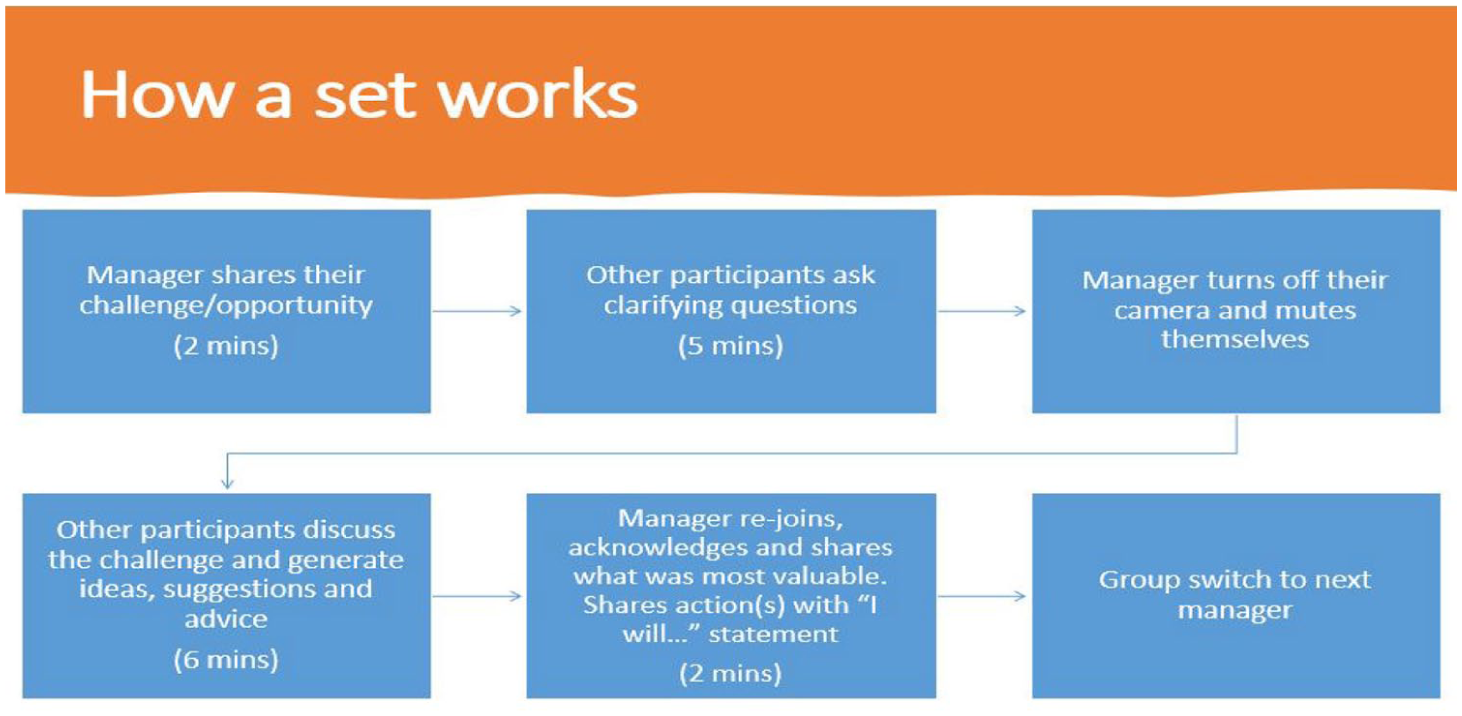
Facilitators played a crucial role in keeping the peer learning sets functioning effectively. The facilitators were skilled Learning and Development professionals who both had a background in Human Resources, working as HR business partners with learning and development roles for large organisations. Both of the facilitators had used coaching and peer learning/ action learning approaches in their previous employment. During the sessions, the facilitators made interventions into group processes to ensure that the process ran correctly, this helped to remove the groups’ anxiety that they were adhering to the rules and requirements of the session (Marsick and O’Neil, 1999). Facilitators in peer learning play a vitally important role in terms of setting the tone, ensuring that processes are adhered to and creating a climate of openness, trust and critical thinking (Waddill et al., 2010). In our study, the facilitator laid out the structure of the session (as per Figure 1) at the start of the peer learning set as well as the rules of conduct. These included listening respectfully and actively, offering constructive feedback and being empathetic and compassionate in one’s approach as well as remaining confidential (‘what’s said in the space remains in the space’).
Structure of the peer learning session.
During each set, the facilitator encouraged the participants to take turns in presenting their leadership challenge. Facilitators would typically tell the leader to give as much detail about their challenge as possible including when the challenge had started and what they had done already to try to tackle the challenge. Subsequently, the facilitator would then ask other leaders in the group to ask curious and inquiring questions to gain a better understanding of the problem. The presenting participant then turned off their MS Teams camera while the others discussed the issue without the presenter’s input. This provided the presenting participant with the opportunity to listen to others’ perspectives and reflect on the discussion without actively participating. Following this, the presenting participant switched their camera back on. The facilitator then encouraged the group to work together to try and address the challenge. Facilitators would typically ask the group to share their experiences and perspectives and work with the presenting leader to collaborate and find new strategies. At the end of the set, the presenting leader articulated an ‘I will’ statement, signifying a commitment to experiment or change some aspect of their practice based on the collective discussion that had taken place. The group then rotated as the next participant shared their challenge.
Findings
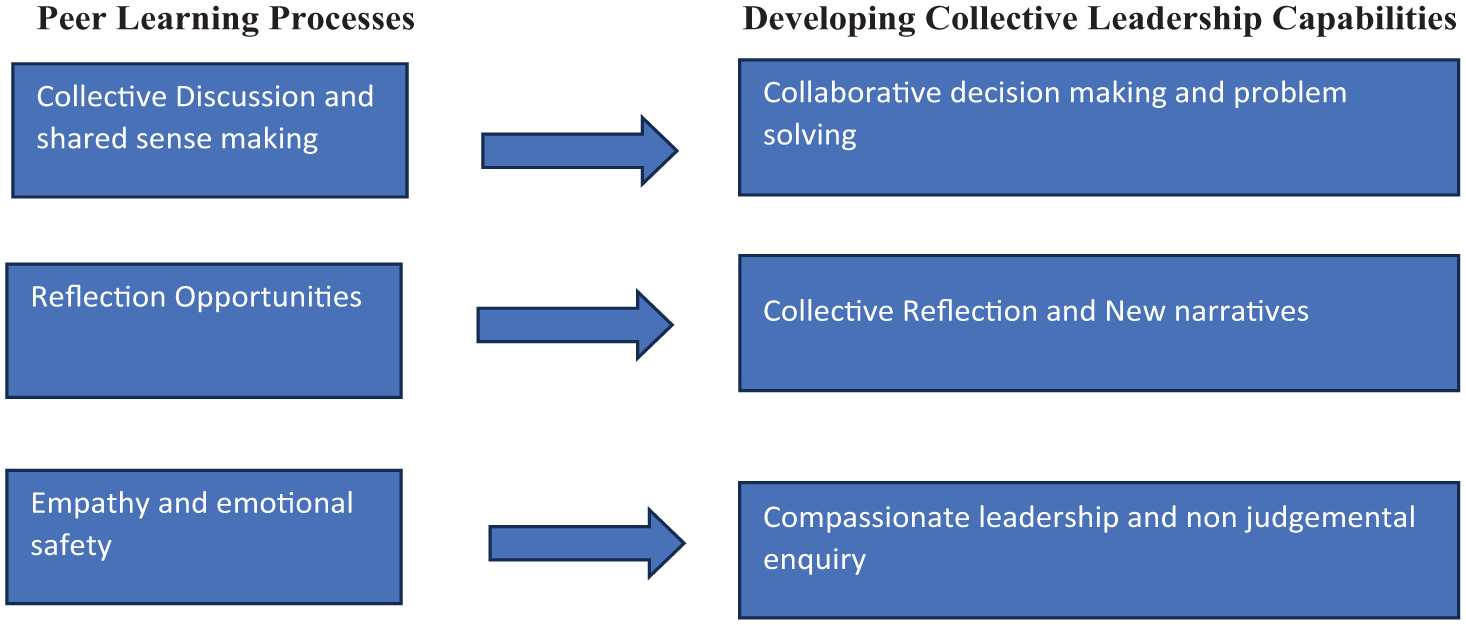
In this section, data will be presented, which will show how the various processes and practices within the peer learning support the development of collective leadership capabilities such as collaborative decision-making, collective reflection and compassionate leadership (Raelin, 2021). Specifically, this section will illustrate some of the critical connections between peer learning processes and collaborative leadership (See also Figure 2 below).
Processes and practices within peer learning that support collective leadership.
Collective discussion and shared sense-making – collaborative decision-making and problem-solving
First, we will demonstrate how the practices within the collective discussion element of peer learning helped the leaders to develop the collective leadership capability of collaborative decision-making. The format of the peer learning was set up so that each leader presented their issue or challenge and then engaged in a rich collective discussion with the other leaders about the presenting leader’s problem. The other leaders were then encouraged to offer pertinent advice and collegial support in relation to how best to address the issue. The following vignette offers insight into a particular collective learning episode. Here, we observe an example of the leaders engaging in the process of collective discussion. In the vignette, Rita was a leader who was struggling to manage her team’s transition to hybrid working following the pandemic and was feeling quite distressed by the dilemma. When asked to present her issue, Rita explained that she had recently tried to organise an in-person team meeting, and her team had not been responsive. Some of her team complained that they didn’t have time to come into the office, others explained that following the pandemic they no longer had a desk or equipment at the office and so wanted to stay at home. Other managers were refusing to travel for emotional and psychological reasons. Rita was feeling quite uncertain about how to proceed with this challenge and confessed to the other leaders that there were lots of logistical issues and she couldn’t conceptualise what the ‘new normal looked like’. In the first part of the peer learning session, the facilitator encouraged the leaders to work together by prompting the leaders to ask Rita a range of clarifying questions to help them to connect with Rita’s issue and fully grasp what Rita was struggling with:
Now its time to ask Rita some questions about her issue so you can get a better sense of what is going on
Did any of the staff say that in terms of logistics they couldn’t make the meeting, was that because more and more meetings are crammed into the day in a virtual way now?
It’s also around when they would do the commute, if someone was working a full day in the office they would leave at 8 and leave at maybe 5, because I put in an afternoon meeting and asked them to come in for that, their point was then they will be on train in the middle of the day
Is there a facilities team in your organisation that is responsible for office space and what have they done so far?
Yeah there is a facilities team, I am working with them quite closely, they have built a desk booking system so people can book a desk for half a day, that is one of the logistical problems. . . if I ask the whole team to come in that’s going to overload the booking system and there may not be 40 desks available on that day.
Are there other teams having this issue, those at your level are they having similar issues with their teams?
Yeah Monday at the senior management meeting we kind of all had these nuanced situations with individuals, one manager was saying I am scared, I’m nervous I don’t want to use public transport, but the same individual colleagues have said I have seen her on social media going to the pub so it’s that difficult dynamic right. . .
What’s the perceived benefit of getting the staff into the office?
It’s not a productivity or business issue.. but its more around the sort of wellbeing and camaraderie, we have had a high level of leavers and one of the things we are thinking is would people feel more part of the team?
In the vignette above, we see the leaders demonstrate a genuine interest in Rita’s issue. The clarifying questions that the facilitator encourages the leaders to ask, help the group to understand what underlies Rita’s challenge. When asked about this in a follow-up interview, the leaders explained that this process helped them to make sense of the dilemma together and get a clearer grasp of why the challenge was concerning Rita. Once this shared understanding was established, the leaders were able to begin problem-solving together:
This is something that businesses are facing up and down the country . . . it’s a really difficult one I think, I think, what we are trying to do eventually is have a clear directorate and rules around when people come in and when people don’t. Maybe having staff know what is expected of them moving forward really clearly . . . so being clear about what the rules and expectations are . . .
Two things for me, we have all become accustomed to working from home, that sort of staged approach, building people back into that mentality of working in an office environment, committing to a review, an open and honest review about what the future should look like?
There’s the hard line of saying you come back and it’s at least two days a week . . . being open and honest about the reason for it.. having that conversation between staff and senior management so that everyone is clear on why it’s been done is important.
There was a time when going to work was quite easy, got on the bus, train and its suddenly become difficult . . . all of those reasons like when do I commute . . . we are all looking for that smooth commute we used to have . . . mentally there has been a huge switch, ‘ you have to be in the office for half 8, noooo that’s when I drop the children off’, we have all slipped a little bit, . . .. we all jumped into lifeboats 16 months ago (at the start of the pandemic) and saved ourselves but now we are stuck at Sea thinking how do we get back to land and it’s not easy. . .
We have created new habits over the last 16 months and breaking those habits and returning to new habits, that’s going to take time. I really empathise with Rita’s situation, you’re trying to do the right thing and get people back in for a team’s session. . .. but the things around it to make that happen don’t seem as prepared or thought through as you are. . .. It’s going to take some time
I love that life-boat analogy, I genuinely think it’s a really good point, we all had to mobilise so quickly to get to this way of working from home . . .if some of the logistics are not there it’s one thing to ask people to do something. . . but yeah there’s the emotional piece as well
. . . it’s the practical bit, the logistical bit, the emotional bit, I don’t want to be that unreasonable member of the leadership team that is saying to people you need to come in, when they are saying I can do my job perfectly well from home, it’s what that balance is. . .
. . . it’s good to know that these logistics every organisation in the country will be navigating
Rita, what will you take away from this, what will you do?
I think; the point of taking people on a bit of a journey with this, acknowledging that some of these issues are facilities issues or IT issues, so if I have another meeting next week it might not go how I want it to. . . giving it time. . . I should be worried if in 6 months’ time I am not pleased with where we are at, but I shouldn’t be surprised if my first team meeting poses a series of challenges, I hope that down the line some of this stuff has worked itself out.
A key feature of the collective discussion above is when the leaders take it in turns to share their own stories and similar experiences as Jack indicates when he talks about everyone ‘jumping into a lifeboat’ at the start of the pandemic. In many cases, the facilitators would encourage this process of sharing by making comments like ‘can anyone relate to this’, ‘is this something that others have experienced’. The facilitators that were interviewed commented that they observed lots of scenarios where participants would openly share their own stories and experiences to demonstrate their empathy towards the presenting leader’s challenge or to demonstrate that they understood and had navigated something similar themselves. For the most part, participants were very willing to talk openly about their past experiences. The leaders explained in follow-up interviews that working in this way gave them ‘a much needed feeling of collegiality’, helping them to feel ‘heard’ and ‘less alone with their challenges’. This social support was something they felt had been absent throughout the pandemic and move to remote working. Leaders also explained in interviews that they ‘made sense of things together’. This shared meaning making and working towards a common purpose can help support collaborative problem-solving a key aspect of collective and collaborative forms of leadership (Ospina and Foldy, 2010; Raelin, 2019).
As well as beginning to problem solve as a collective, the practices within the collective discussion can also be seen to be developing the leader’s ability to make decisions with others. Collaborative decision-making of this nature is an essential capability of a collective leadership approach. Raelin (2021) for example, argues that collective leadership requires people to be able to reach collaborative decisions, with everyone being invited to advocate their views but equally being prepared to listen and deeply consider those of others. Effective dialogue between the leaders is a fundamental component in the co-creation of solutions and decisions (Cope et al., 2011; Crevani et al., 2010; Murrell, 1997). In the peer learning sessions, as the participants engaged in their collective discussion and dialogue, the facilitators encouraged the leaders to share their views by using phrases such as ‘what do we think Rita could do here’ and ‘any other thoughts and suggestions’. This kind of dialogue again helped the leaders to see the problem as a shared responsibility, encouraging them to make decisions about future steps with the support of others. When decisions are made collaboratively, often more constructive solutions can emerge than the individual leader has been able to find themselves. One leader in our study explained for example that this process helped her to become ‘unstuck’ and that while she might be a manager ‘it doesn’t mean I have all the answers, you can learn from each other’. In this way, the peer learning helped participants to become more comfortable relying on peers and not having to make decisions about complex issues alone. Thus, the facilitated collective discussion within the peer learning helped to foster the skills of inter-dependency and collective decision-making which are essential capabilities of a collective leadership approach (Gronn, 2000).
Reflection opportunities: collective reflection and new narratives
In addition to developing the capabilities related to collaborative problem-solving (a key feature of collective leadership) the opportunities to reflect and contemplate their challenges (fundamental to action learning) also developed the leader’s ability to collectively reflect. Collective reflection is a key aspect of collaborative and collective leadership (Raelin, 2021). When referring to her involvement in the peer learning, one leader noted for example that:
Yes, because it is better to work together and use each other as a point for reflection and planning. It also ensures we feel supported in our professional development. (Penny)
Participants commented that they valued the opportunity, not only to reflect on issues in their own minds, but to reflect with others on their challenges and subsequently gain new insights from the rich experiences and perspectives of other leaders. Newer, less experienced managers particularly valued the insights of more experienced managers when they were given the opportunity to reflect alongside them: I got some really good advice from . . . because everybody else I think being a manager for a while at least, and so had had more opportunities to deal with this kind of stuff. So, again, if I look back at my notes, at the first session . . .. it was really useful, to make sure that staff are on track. And it helps with time management, things like that. (John)
By being given the opportunity to contemplate their predicaments with others in the flow of their practice, participants with a ‘deep and peripheral awareness’ that is fundamental to collective leadership (Raelin (2018). This type of collective reflection can open up space for re-thinking how work is accomplished. In our study, when engaging in shared reflective processes (as in Vignette 1), leaders frequently gained a clear direction from their peers on how to tackle work-place dilemmas. One leader noted this process made her ‘think about things in different ways and become more receptive to learning’. From this she gained the courage to ‘tackle things head on’. Through the peer learning’s reflective processes, many of the leaders came to realise that by being ‘challenged in a very safe and supportive way’, some of their current leadership practices were not working and they needed to explore ‘new ways of being’ as a leader. Mezirow (1991) explains that as people explore, affirm or disconfirm their frames of meaning or reference, they revise their assumptions often leading to a change in their practice. Rita in Vignette 1 for example, through having the opportunity to reflect on her issue alongside her peers, came to re-evaluate her current thinking about hybrid working. From such processes, Rita ‘learnt’ that expecting the new hybrid model of working to be immediately successful was probably unrealistic. Rita also learnt that she needed to take a different approach as a leader and give her team more time to adjust to the changes. Rita situation was not uncommon in our findings. Many of the leaders, by reflecting on their issues with the other peers realised that they needed to set their own ideas about how to tackle a problem aside and think about things in an entirely different way: I learnt what others had tried and some of their challenges. My peers made me think about things in a different way too and I thought this made me more reflective and open to learning. (Oscar)
Interestingly, by being given the opportunity to reflect on their own practice with the support of their peers, many leaders learnt that their approach to leading was in fact quite different from how they personally perceived it to be. Having an alternative reality mirrored back to them by the other leaders generated a novel perception. One leader for example, who prior to peer learning considered herself to be a leader who ‘liked to coach others’, learnt that in reality she tended to give her team the answers rather than coaching them to find solutions for themselves. From reflecting on this with the other peers, she realised she needed to adapt her approach in order to become a more ‘coaching manager’.
Effective collective leadership requires that participants are open to disturbing their own pre-conceived view of the world and being open to new ways of approaching things that arise out of a process of mutual enquiry (Raelin, 2021). Through the reflective processes in the peer learning, we observe how the leaders begin to re-define their challenges and collectively find new narratives and alternative practices (Du Toit, 2007).
Notably, while many of the leaders in our study gained new ways of ‘seeing’ their challenges following reflection opportunities, there were occasions where the leaders would have undeniably benefitted from a much deeper collective reflection than time permitted. Facilitators reflected for example that ‘I feel like both participants had bigger issues than we go to the bottom of’ and ‘I feel like there are bigger reasons for the participants issue that we didn’t get the chance to discuss’. Such observations highlight that effective shared reflective processes take time and it can problematic to try compress the messiness and complexity of some leadership dilemmas into a 15-minute time slot.
Data analysis also revealed that while most of the leaders in the study were keen to work in a collaborative way and engage in rich collective conversations and reflections, there were some participants who were much more reserved in their approach and did not seem as actively engaged in the presenting leaders’ challenge. This finding was supported by interviews with the facilitators who explained that in a small number of the sessions, they had to work much harder to encourage questioning and discussion, stepping in at times to give advice as some of the leaders in the group did not volunteer their perspective. When reflecting on these sessions, the researcher and facilitators concluded that these issues stemmed from the fact that some of participants in this group knew each other prior to the session. Interviews with the leaders revealed that they preferred to learn away from their organisation with people that they did not know. Many cherished the privacy to open and disclose vulnerabilities with strangers. In addition, some participants did not feel comfortable sharing their feelings due to fear that information would leak back to their place of work. This highlights important issues around the mix of participants in the groups and the ethics of anonymity in collective leadership development interventions (Coopey and Burgoyne, 2000). Notably, the development of collective leadership capabilities such as collective reflection can be hampered by prior relationships and privacy concerns.
Empathy and emotional safety – compassionate leadership and non-judgemental enquiry
For the most part, many of the leaders found that the supportive peer learning setting provided them with a feeling of safety and much needed opportunity to be vulnerable and open. This vulnerability was something that many felt ‘unsafe’ to express in their organisation. The discussions within the peer learning environment helped participants to dig deeper into potentially emotive topics and get a much more nuanced sense of where negative feelings were originating: I have found real value in learning and sharing from others in these sessions. This felt like a very open and supportive environment. At times, my workplace hasn’t always shared these features. By sharing I have opened myself up to the possibility of learning and recognising where I can improve – the vulnerability that this brings has brought significant rewards in the sessions. (Peter) The participants offered each other lots of support and got the impression that they genuinely cared about each other’s success. (Facilitator)
In supporting each other and being empathetic in their stance, a learning environment that we would term psychologically safe was being created (Edmondson et al., 2024). The research team and facilitators were taken by surprise at just how quickly rapport and indeed psychological safety were established, especially given that the sessions were online. It could have been that working online during the Covid-19 pandemic built familiarity with relationship building online. For the most part, the participants did not know each other, and this relational distance created a safe space and a level of anonymity to reflect on personal weaknesses and challenges within their place of work and share their emotions openly.
Participants also expressed that the peer learning setting became a space where they could openly express their leadership fears and anxieties to others and gain not only practical advice but much needed emotional support. One manager noted for example that it was reassuring to learn that ‘others are experiencing similar issues so we could empathize and share ideas’. Another noted that it was ‘good to get a lot of support and encouragement’. It could be argued that such environments become what have been termed ‘holding environments’ – a set of relational experiences and a reliably available empathetic presence (Yip et al., 2020). A set of norms for relating such as respect, careful active and empathic listening and non-judgemental enquiry help to foster such spaces (Uhl-Bien, 2003). Holding environments are particularly helpful when leaders face anxiety and uncertainty at work and can support them in feeling secure while navigating uncertain territories. Emotionally safe ‘holding environments’ provide a container for leaders to express their fears and feel calmed, appreciated and understood as they address their leadership challenges (Kahn, 2001). In our peer learning, facilitators played a vital role in creating a supportive, empathetic environment that honoured and celebrated the members of the group. This helped to create a climate where participants felt safe to authentically disclose their deeper challenges. The warmth, empathy and non-judgemental approach brought to sessions by facilitators tended to be mirrored in the managers’ high levels of empathy towards one another. Leaders explained that the high levels of empathy in the sessions helped them to feel comfortable enough to delve into their own practices and begin to adopt new ways of ‘being’ as a leader (Boyatzis et al., 2006).
In our peer learning sessions, leaders were encouraged (by the facilitator and other peers) to regularly express and verbalise their emotions (e.g. ‘How did that land with you, how you feel about that now?’). This sharing of emotions with others helped them to navigate negative emotional states that often blocked their ability to see a sensible way forward. The leaders were continually encouraged by the facilitators to emotionally support their peers and offer advice that was compassionate, understanding and kind and respectful.
Interestingly, through these supportive conversations, the managers and leaders explained that they gained new insights into how to approach their own leadership practice in a more compassionate manner. For example, leaders gained new knowledge about how to have difficult conversations with members of their team and how to relate to them in a more supportive and understanding way. Leaders also shared that they gained knowledge on how to be more nurturing and supportive towards themselves. For example, one leader expressed that through the empathetic conversations in peer learning, she realised she was doing ‘too much’ for her staff, leading to significant personal stress. Consequently, she decided to take the pressure off herself and shift the responsibility back to her team. Others discussed how peer learning helped them be less critical of themselves as leaders and acknowledge their achievements. One manager explained how discussing issues with her peers helped her realise she was better at handling things than she thought, taking a more self-compassionate stance: I probably was quite a reflective practitioner and, sometimes, I didn’t give myself credit or maybe I came out of it feeling I was a bit stronger than I thought I was. (Amanda)
By being part of the peer learning and adopting an empathetic supportive stance towards themselves and their peers, the leaders are learning a further key component of collective leadership – compassion. As Raelin (2021) and West and Chowla (2017) emphasise, collective and collaborative leadership requires high levels of compassion. Compassion helps leaders to build trust and when leaders show care for other’s wellbeing it strengthens relationship and encourages more effective collaboration. Compassionate leaders listen actively and validate the feelings and perspectives of others. This open, non-judgmental communication fosters an atmosphere where team members feel safe to express their ideas and concerns which can lead to better problem-solving and decision-making (Kanov et al., 2004).
Discussion
As detailed in the previous section, peer learning processes play a crucial role in developing collective leadership capabilities (see Figure 2 above). The primary capabilities identified include collaborative decision-making and problem-solving, collective reflection and compassionate leadership. At the heart of collective leadership is collaborative decision-making, where team members contribute their insights and expertise to inform choices and action (Conger & Pearce, 2003). In this model, decision-making responsibility is shared across the group, ensuring that no individual bears the full burden of these decisions. This distribution of responsibility fosters a democratic approach, cultivating a sense of ownership and accountability among all members. Throughout the peer learning process, we observed leaders actively engaging in collaborative discussions to explore diverse perspectives, address challenges and develop strategies for moving forward. This process significantly strengthened their decision-making capabilities. The variety of ideas and solutions that emerged from peer discussions led to more comprehensive, thoughtful decisions. By leveraging the collective intelligence of the group, leaders were better equipped to make informed, collaborative decisions – an essential skill in collective leadership (Raelin, 2021).
Another critical capability nurtured through peer learning is collective reflection. In our study, leaders were given ample opportunities to reflect on their challenges in collaboration with others. Collective reflection is vital for aligning a group’s goals, values and actions, while fostering a shared understanding of leadership practices. When leaders engage in collective reflection, they achieve alignment on vision, purpose and strategy. Collective reflection also enables teams to reconcile differing perspectives and adopt a unified approach to complex issues (Zammel and Najar, 2021). Furthermore, this reflective process builds trust within leadership teams, offering a safe space for open dialogue – an essential component of effective collective leadership dynamics (Edmondson and Bransby, 2024).
Finally, the empathy and emotional safety embedded in our peer learning process also promoted the development of compassionate leadership. Compassionate leadership emphasises empathy, understanding and support for others, cultivating an environment of collaboration, stronger relationships and resilience within teams. Recent research by Kouzes and Posner (2023) highlights that compassion is a cornerstone of trust-building among team members. Compassionate leaders foster inclusive, diverse environments where all voices are heard, thereby reinforcing a collective leadership approach.
Given these findings, there is significant potential for management and leadership learning educators to foster collective leadership development within peer and action learning environments. Educators must ensure they create ample opportunities for collective discussion, shared sense-making and reflecting on challenges with the support of peers (Klar et al., 2020). In addition, participants should be encouraged from the outset to view leadership challenges as collective responsibilities – issues that the group will collaboratively address. Facilitators play a critical role in setting the tone and ensuring that the group maintains an empathetic and supportive stance. It is essential that facilitators receive clear guidance and training on how to create a space that is safe, trusting and compassionate. When action learning and peer learning interventions are structured with these principles in mind, they can effectively foster the development of skills and capabilities fundamental for collective and collaborative leadership.
Factors impeding collective leadership development and areas for further research
While peer and action learning approaches have great potential to develop collective leadership capabilities, notably, there are certain dynamics within groups that can impede this process. We observed that while many leaders were open to receiving advice from others, especially those with more experience or seniority – some were reluctant to consider different viewpoints emerging during collective discussions. Instances of defensiveness and resistance to change were noted, where some leaders were unwilling to have their current leadership practices challenged. In addition, some leaders were granted more status and influence within the group, with their opinions often receiving more weight. At times, certain individuals dominated discussions with lengthy personal stories or strong opinions, which were rarely challenged by others.
Collective leadership is inherently reliant on a sense of congruence, with power being shared and distributed within the group (Raelin, 2019). Therefore, understanding the role of power in collective leadership development is essential (Foldy and Ospina, 2023). Further research is needed to explore power dynamics in peer learning settings and how these dynamics may hinder the development of collective leadership. Investigating how power is distributed within group discussions and why some leaders hold more influence than others, would contribute to a more nuanced understanding of collective leadership development as a political process, where participants navigate and advance diverse, sometimes conflicting, values and interests (Collinson, 2018; Tourish, 2014). It would also be valuable to examine how collective leaders manage organisational politics and structures. In our study, while many leaders agreed on new leadership practices in the peer learning setting, they struggled to implement these within their organisations due to opposition from higher management or entrenched organisational cultures resistant to change. Thus, the confidence and skills developed through collective leadership interventions can be undermined when organisational policies or norms work against new leadership practices. This highlights the influence of broader contextual and organisational dynamics on collective leadership development.
Strengths and weaknesses of the study
Our study’s strengths lie in its use of diverse data-collection methods, including semi-structured interviews, self-report surveys, reflective portfolios and observations. This triangulation enhanced the depth of the data, offering a comprehensive understanding of participants’ experiences while helping to mitigate the limitations of relying on any single method. The use of ‘thick descriptions’ provided a rich portrayal of participants’ learning journeys, allowing for a nuanced exploration of the leadership development process. In addition, the study’s responsiveness to participant feedback contributed to its effectiveness. For example, session lengths were adjusted based on feedback from both participants and facilitators, demonstrating the study’s adaptability and commitment to meeting the learners’ needs.
However, a key limitation is the reliance on self-reported data, which can introduce biases, as participants may struggle to accurately recall events or processes. While triangulating the data with observational notes helped mitigate this limitation, it remains a challenge. Another limitation is the study’s focus on the dynamics within peer learning settings without exploring external factors, such as organisational culture or broader pressures, that could impact the effectiveness of the learning. These external factors may significantly influence how participants apply what they have learned in their roles once they return to their organisations. Furthermore, the study would benefit from a longitudinal follow-up study to assess the long-term impact of the training on leadership practices. A follow-up could provide valuable insights into whether the practices leaders committed to experimenting in the peer learning with were successfully embedded in their day-to-day roles and whether the collective leadership skills developed in peer learning settings influenced future collective leadership activities.
Conclusions
It is increasingly being recognised that the field leadership development must not only focus on the skills and competencies of the individual ‘leader’ but also consider the most effective strategies and interventions to develop collective and collaborative leadership capability. Successful organisations of today will be those that focus on developing leaders that can engage with others and demonstrate effective collective leadership. The focus of this article has been to demonstrate that peer learning (founded on action learning principles) offers a potentially useful opportunity to develop some of the skills and capabilities that are essential for collective forms of leadership. In focussing on the collective leadership potential of peer/action learning, rather than the development of a single leader’s skills, this article offers a contribution to collective leadership development debates. As the participants spent time with their peers in the online setting, engaged in rich collective discussions, asked clarifying questions, reflected with their peers and tackled the challenges as a group in an empathetic way, it was visible that many of the skills and competencies required for effective collective leadership were being developed. There is a pressing need to develop collective leadership capability and while there are no guarantees that action learning will automatically foster collective leadership capabilities, our study has highlighted that there is real potential for such interventions to be utilised in this endeavour.
