




Abstract
Recent scholarship has acknowledged the importance of materiality, body senses and sensible knowledge in understanding knowing in practice, although humans and their practices are still privileged. In response, we examine how vital materiality, or the capacity of things, constitutes the practice of knowing, including in relation to and with the body and bodily senses. This focus is relevant for management education and learning, sharpening our view of what practices and knowing matter most. Drawing on a study of 20 studio potters, involving observation, interviews, and participation in a pottery course, we reveal the agentic power of the material in constituting the practice of knowing, in the resistance of the material, the accidental and unpredictable encounters between material, and the loss of self in, and a subversion from, the material. We show what constitutes “embodied learning” for knowing in practice is the generation of a specific materialized sensitivity of—attunement, sensitivity to risk, and subversion—through the vitality of matter. Offering a stimulus to rethinking subjectivity and positionality in our pedagogy, we propose that to truly unsettle the human-centric practices of teaching and learning, we need to develop a specific “materialized sensitivity” in our pedagogic activities and entanglements.
Introduction
Practice-based studies have shown how the epistemic practices of a community of practitioners in their situated everyday skilled actions sustain learning and knowing, collectively and individually (Gherardi, 2009; Gherardi and Rodeschini, 2016; Orlikowski, 2002, 2007); this turn to “knowing in practice” (Orlikowski, 2002: 249) moves our understanding beyond the view of knowledge as a static entity and the simplistic binaries of knowledge and the knower (Corradi et al., 2010; Gherardi, 2001). The human body is similarly understood as integral to and embodied in “knowing in practice” (Dall’Alba et al., 2018; Hindmarsh and Pilnick, 2007; Orlikowski, 2002; Yakhlef, 2010), including bodily sensations (Strati, 2003, 2007); that may form new and creative knowledge (Gherardi and Perrotta, 2014). However, despite this understanding, there has been a relative neglect of the body, and the sensible knowledge generated from multiple body senses (Strati, 2007), or at times, in superficial treatment, where the body has been objectified (Willems, 2018).
At the same time, research that takes seriously the ontology of matter (Barad, 2007; Bennett, 2010) has challenged the traditional understanding of knowledge and knowing as mere human cognition, body, and social relationships and suggests we consider matter and that which is other to humans as agentic actors, in the constitution of knowledge. This challenge is made within “new materialism” which we understand in a broader post humanism of practice that decenters humans as the subject and understands matter as vibrant, alive, and ontologically inseparable from human, organizational, and social life (Gherardi, 2021). We know the importance of materiality and its power to impede or promote learning and “knowing in practice” (Bell and Vachhani, 2020; Gherardi, 2021; Gherardi and Perrotta, 2014; Gherardi and Rodeschini, 2016). However, in terms of its embodied nature, “humans and their practices” are still largely privileged by us, and the material world is often positioned in relation to, but outside practice (Gherardi, 2021). The material remains mostly for the human body to sense, feel, touch, as a contribution to embodied learning (Brown et al., 2016; Gherardi and Perrotta, 2014; Strati, 2007). There has been less attention to the vitality of matter, how matter moves or what it does or how it acts (Barad, 2007), and matter’s own historicity. This focus on human cognition and bodily senses limits our understanding of knowing in practice.
How vital materiality or the capacity of things (Bennett, 2010) constitutes the practice of knowing, including in relation to and with the body and bodily senses, thus requires our attention (Gherardi, 2021; Rekret, 2018). In response, in this article, we ask how the doing and acting of materials enact and constitute the practice of knowing, examining the vitality of matter in a study of knowing and learning in the craft of pottery (Bell and Vachhani, 2020; Beyes and Steyaert, 2021). The practice of knowing in craft involves multiple relationships between humans, tools, raw materials, and the material environment (Ingold, 2001). Thinking with craft allows us to mobilize the body and material, as sites of knowing by focusing on their relations between themselves and with others (Bell and Vachhani, 2020; Brown et al., 2016). This focus is relevant for management education and learning (Steyaert et al., 2016), sharpening our view of what practices and knowing matter most (Gherardi, 2016) by considering the material (Fenwick, 2016) alongside the senses, the body and the spaces we inhabit (Steyaert, 2022).
Drawing on a study that involved observation and interviews with 20 studio potters, and the first author’s participation in a studio pottery course, over a period of 18 months, we show how matter affected the constitution of the practice of knowing and learning. First, in the material’s initial and subsequent resistance to the hand, the human and their body become sensitive, attuning to how different matter moves in the momentary practice. Second, how in accidental moments in experimental practice, in the encounters between materials, practitioners develop sensitivity to the disruption, and the risk of disruption, by the material. Third, over time there is a sensitivity to a loss of self in, and a subversion from, the material. We thus advance theory by showing what constitutes the “embodied learning” for knowing in practice is the generation of a specific materialized sensitivity in and through the vitality of matter. Specifically, it is materialized sensitivity of attunement, materialized sensitivity to risk, and subversive materialized sensitivity that constitutes knowing and learning in practice. Further, how materialized sensitivity changes and shifts in temporal dynamics, and how this challenges expertise and prior knowing is also key. Adding to Barad (2007), we show how a focus on the body and bodily sense is thereby insufficient. It is the subversion by the material, defamiliarizing us from the habituated and stabilized, that moves learning and knowing to a materialized sensitivity in and over time.
Specifically, we add to the shifting focus to the body senses and materials in management education and learning, by exploring intricate entanglements between human and non-human that construct a pedagogic relationship in our management education practices. While body senses have been mobilized in management education and learning, where materials are considered important in the daily management teaching and learning, we advance theory by showing the capability of the material to constitute knowing in everyday practice. In our attention to vital materiality especially that which may be difficult to sense and feel by human mind and body, we sharpen the view of what matters most in our management and learning practices, and stimulate rethinking subjectivity and positionality, in our pedagogy. We propose that to truly unsettle the human-centric practices of teaching and learning, in our daily management teaching and learning activities, we need to develop a specific “materialized sensitivity” in our pedagogic activities and entanglements.
We begin by tracing the development of “knowing in practice,” and the connection to the body and the material. Outlining a new materialism perspective on this development, we set out our research agenda. We then describe our methods, and our focus in the encounters between humans, and nonhumans, and between nonhumans themselves. We next present our findings. In the discussion we examine the implications of our study, and how that enables our (re)conceptualization of the embodied nature of “knowing (and learning) in practice.”
Knowing in practice
Developing understanding of knowing in practice
Earlier research on communities of practice (Lave and Wenger, 1991) suggested knowledge can be understood as a process that emerges through situated social and collective practice (Corradi et al., 2010). In her earlier work, Gherardi (2000) outlines how knowledge as traditionally understood as something universal and decontextualized, which can be organized and recorded in spoken and written language and acquired through rational mental processes residing in one’s mind (Sørensen, 2009), ignores other types and forms of knowledge. This early critique is part of the broader turn to practice (Schatzki et al., 2001) and has shifted the view of knowledge as static with stable properties or dispositions, and thereby existing “prior to and independent from the knowing subject, who creates no knowledge in the act of appropriation” (Gherardi, 2000: 212). Moreover, a focus on how knowledge is being generated, produced, and shared in everyday practice over time and across contexts (Orlikowski, 2002), has moved our thinking to a different epistemology of knowledge and knowing (Bruni et al., 2007; Gherardi, 2000; Nicolini et al., 2003).
Thus, practice-based theories have helped to advance the understanding of knowing and learning in a non-dualistic and non-individual approach (Gherardi, 2009; Nicolini, 2016), as practiced in specific social, cultural, and historical contexts, enacted and constituted through participation in social activities (Lave and Wenger, 1991), and organizing and knowing as an ongoing process which is constituted in everyday relationships (Gherardi and Rodeschini, 2016). Calling attention to situated learning alongside the role the body plays in the constitution of social relationships and everyday organizational life has also meant a focus on the active and lived body in our social and organizational practice, contrasting the objectified, normalized, anatomized, and fixed body being used for our convenience for the analysis of organizing and learning (Hindmarsh and Pilnick, 2007), or “embodied practice” in studies of practice-based organizing and learning.
Body, the material, and knowing in practice
Attention to the body in the practice of knowing, that is, the corporeal aspect of knowledge (Strati, 2007), has further challenged the idea of the cognitive nature of knowledge, stressing the capacities of the human body and the power of body-senses to know and learn in organizational practice. From this perspective, the body is considered as a source of knowledge and a site to know work and organizational practice, and advocates for taking bodies seriously and understanding organizing and managing as embodied practice (Hindmarsh and Pilnick, 2007; Yakhlef, 2010). The body is not simply a tool for knowing, rather social experience and practice settles in the body and the body is central in relationships between humans, and with and within organizations, for example, in social communication and cooperation in teamwork (Hindmarsh and Pilnick, 2007). Multiple senses, such as hearing, looking, touching, smelling, and tasting, are vital to knowing. Workers learning from and communicating with each other, in part through body senses, thereby construct sensible knowledge and form everyday organizational and work practice (Brown et al., 2016; Strati, 2007). This so-called sensible knowledge is collectively and socially constructed, thus the social communications and negotiations involved in organizational practice is embodied in the shared body actions and gestures for members in communities to understand each other’s work (Strati, 2007).
Focusing on embodied learning has also meant that the importance of the relationships between human and non-human elements, for example, tools, materials, and the environment, in organizational learning practice, has been identified and acknowledged (Brown et al., 2016; Gherardi and Perrotta, 2014; Strati, 2007). Strati (2003) discussed the process of how knowledge is constituted through the performance of everyday work and how learners extend their body (senses) toward and with tools, materials, and the environments. Feedback from materials and tools reaches the body, then is gradually integrated into the body, and becomes part of the knower’s corporeality. Gherardi and Perrotta (2014) stressed the role of materiality in the process of forming products and realizing ideas, where materials with specific material characteristics suggest opportunity and constraint for action and movement in practice. Materials and tools provide important clues for the knower’s body to feel, sense, and thus learn through touching, hearing, seeing, tasting, and smelling (Brown et al., 2016).
Studies on embodied practice regard the non-human elements not as simply background, inert, or passive (Strati, 2007; Yakhlef, 2010), instead these elements are alive and actively participate in the practice of knowing and organizing. The human body is never separated from the matter and the environment in which they are involved. However, non-human elements are still largely discussed as that which can be sensed and felt by the human body and subject to “manipulation” or “domination over the material that opposes resistance and enjoys obedience” (Gherardi and Perrotta, 2014: 146). Where practice is constructed by the “interactions” between different spatially separated elements, the material is mostly considered as the mediations of social relationships and the practice of learning (Svabo, 2009). There is thus still a risk of privileging the agency, subjectivity, meaning making, and knowing to humans, considering actions as somehow pre-defined or pre-fixed, and the performative process in practice is ignored and the roles of others (the matter) are limited (Hultin and Mähring, 2017).
An emerging new materialism perspective on knowing in practice
This apparent domination of the body and mind in practice-based studies has been strongly criticized by scholars of new materialism (Gherardi, 2021; Gherardi and Rodeschini, 2016). New materialism challenges humanist and social constructionist perspectives of understanding the world and knowledge (Lemke, 2015; Markula, 2019) and moves beyond intellectual traditions which privilege human agency solely. The boundary between ontology and epistemology is blurred by recognizing the agential forces of things which are ontologically unseparated from humans and discourse (Barad, 2007; Bennett, 2010; Braidotti, 1994). New materialism provokes us to think about how “matter comes to matter” (Barad, 2007), to re-examine the relationship between the animate and inanimate, and rethink the power of “things” ontologically (Bennett, 2004, 2010); material is no longer the dull, inert, fixed, or just-being-used-by-humans, but rather the “substance in its intra-active becoming” (Barad, 2003: 828), it is “an excess, force, vitality, relationality, or difference that renders matter active, self-creative, productive, unpredictable” (Coole and Frost, 2010: 9).
The use of intra-action here by Barad (2007) is to contrast the term of “interaction” which was situated in the paradigm of the traditional dualism, implying that things are independent and separate entities and necessitates their pre-established existence to take part in the actions with each other. Intra-action recognizes instead that distinct and separate agencies are not pre-existing but emerge through entanglements between humans and nonhumans (Barad, 2007). New materialism thus asks us to rethink the agentive power of things where agency does not exist in humans exclusively but is a “dynamism of forces” (Barad, 2007: 141), constituted in the reciprocal engagement between multiple actors, not only limited to relations with humans but also with nonhumans in themselves (Alldred and Fox, 2017). New materialists acknowledge “the vitality, wilfulness, and recalcitrance possessed by non-human entities and forces” (Bennett, 2004: 347). In this way, when the vitality of matter is discussed in new materialism, it means
the capacity of things—edibles, commodities, storms, metals—not only to impede or block the will and designs of humans but also to act as quasi agents or forces with trajectories, propensities, or tendencies of their own. (Bennett, 2010: viii)
Materials, as agentive actors, have the intricacy—complex and with many parts—to engage us humans to explore deeper meaning about humans, the world and so on (Garber, 2019). Matter acts, “together with other things and forces, to exclude, invite and regulate particular forms of participation” (Fenwick and Edwards, 2010: 7).
Through this onto-epistemology (Barad, 2007), practice is reconfigured as “an agencement of elements (humans, nonhumans, more-than-humans, discourses, bodies, rules, knowledges) that achieve agency in their being intra-acting” (Gherardi and Laasch, 2022: 272). This understanding of practice no longer focuses on “who” and “what” are in the scene, but on the “how,” because “who” and “what” have always been constituted by it. The subject is not external to the practice, but always produced and enabled in the encounters (Hultin and Mähring, 2017).
In this sense, knowledge and knowing are not individual properties but entangled with and produced where the agency is circulated, shifted, and moved among the humans, nonhumans, the social, the material which enabled the formation of routines and the dynamics and challenges to the stable and organized in organization and management practice. The shift from a human-centered approach to a post-human practice epistemology of knowing entails the transfer of attention from human language and discourse to “the other,” for example, matter (Bennett, 2010; Gherardi, 2021). This opens the possibility for considering “the vitality” of matter and its power to engage humans in knowing in practice (Gherardi, 2021). While the capacity of matter to affect and “push back” has been recognized in organization and management studies (Gherardi, 2021), as discussed in the previous section, the literature mostly focuses on materials being sensed and felt by the knower’s body. This focus can lead to a lack of awareness of other parts of materiality which cannot be directly sensed by human bodies but contributes much to the practice of knowing and the encounters between nonhumans themselves in the practice. Thus, the vitality of matter and the processual dynamics in encounters of different materialities within the practice of knowing still need attention. We follow this perspective (Gherardi, 2021; Gherardi and Rodeschini, 2016) to consider materiality in the practice of knowing to understand the role of the material as an actor and theorize its constitution in the practice of knowing. We ask how the doing and acting of materials enact and constitute the practice of knowing?
Knowing in craft
In the development of understanding of management learning and knowing as practice, craft work provides an important site for understanding the processual vitality of matter and the capability of the material to constitute knowing in everyday practice.
First, craft learning is recognized as being sustained within certain communities, for example, a guild, religion, or the family, where the master-apprentice form of relationship was organized for the teaching and learning of craft knowledge (Kroezen et al., 2021; Li et al., 2023 Stierand, 2015). New learners enter these communities, learn specific knowledge, techniques, and community codes from the master through participation in daily activities, imitation, and practice (Wolek, 1999), and gradually become involved in the centralized performance. They are awarded a community identity by becoming a member of a particular community of practice (Lave and Wenger, 1991). They then become the experts through different development stages, normally novice-journeyman-master. This system allows new learners to closely observe the demonstration of “masters” doing specific work, and the learning of craft is facilitated by their subsequent guidance and supervision (Bamforth and Finlay, 2008; Portisch, 2010). The daily routines and activities organized in these communities and institutions enable learners to repeatedly practice and improve their craft expertise (Crown, 2007). Applying a practice lens, craft knowledge thus resides in social relations and is continually reproduced and negotiated in such communities across generations (Gherardi, 2001).
Second, craft knowledge is manifested in bodily actions and movements which are difficult to teach and learn through formulated and scientific language, and it can only be visualized and shared through demonstration and observation (Gamble, 2001; Polanyi, 2009). This embodied mode of learning craft through the master showing so-called expert body gestures and bodily movement and learners observing and copying these body moves in everyday craft practice has been theorized and recorded in previous craft literature (e.g. Marchand, 2008; Portisch, 2010; Tsoukas, 2011). Recently, some attention has been paid to the vitality of materials in the practice of craft making, and the encounters between the craftspeople’s bodies and the matter into making craft pieces (Bell and Vachhani, 2020; Ingold, 2011), and more generally the embodiment in craft work and practice (Brown et al., 2016; Gherardi and Perrotta, 2014; Strati, 2007).
Third, though the nature of corporeality and materiality in knowing and learning craft has been recognized by management and organization researchers, the social and bodily sense associated with craft practice, is still engaged much more than its material aspect (Brown et al., 2016; Gherardi and Perrotta, 2014; Strati, 2007). Consequently, learning in craft practice is shown as grounded in sense and sensing in the human body, and still conceptually considered as collective and individual “doing,” through bodily movement, observation, and repetition, and thereby is human centered. This understanding, within the knowledge system of management learning and education, means that the potential of the materialized aspect of learning in craft is still to be realized. It is for this reason that in this article we start by questioning whether the approach that centers embodiment can capture the vital materiality in its moment-by-moment moves in craft practice, and thereby the implications for knowing and learning in practice. We explore post humanism as a theoretical approach to think with the vital materiality within craft and the wider practice of learning (Bell and Vachhani, 2020; Gherardi, 2017).
This article follows this materiality perspective of practice, combines the “doing,” “knowing,” and “becoming” to explore the agentive capacities of matter “in terms of what it does” and what it becomes, rather than “in terms of what it is” (Alldred and Fox, 2017: 24). In our empirical study of everyday craft practice, we explore how materials move and act and how knowing emerges through engaging with these moves in the practice, to contribute to the further theorization and conceptualization of materiality in practice-based theories.
Examining everyday pottery practice
Our methodology is situated in “the relationality of the research assemblage[s]” (Charteris et al., 2019: 921), which includes the researcher, human participants and nonhumans. We avoided privileging “humans and language as a tool of doing research over non-human and matter,” eschewing the artificial separation of the researcher from what they observe and their dominance in the process (Davies, 2018: 115). We focused our attention on what things do and the forces they produce in their encounters, rather than what things are that predefines their involvement and participation. We considered the affects flowing between all human and nonhumans (Andersson Korp and Reinertsen, 2020), which are not limited to the relationships between humans or between humans and nonhumans but also between nonhumans themselves.
To know and understand the everyday practice of knowing and learning, we conducted our research in pottery studios in the United Kingdom. We first selected seven studio potters who had each exhibited their work at an Arts Council funded exhibition. From this initial selection we asked for recommendations for further participants whose pottery they considered to be purely handmade, with high skill. Twenty potters participated in the study. Data were collected intermittently (because of the COVID-19 restrictions) over 18 months. We include here a collage of photographs from a pottery studio not for analytical purposes but rather for illustrative ones to show the typical research setting we encountered (Figure 1).
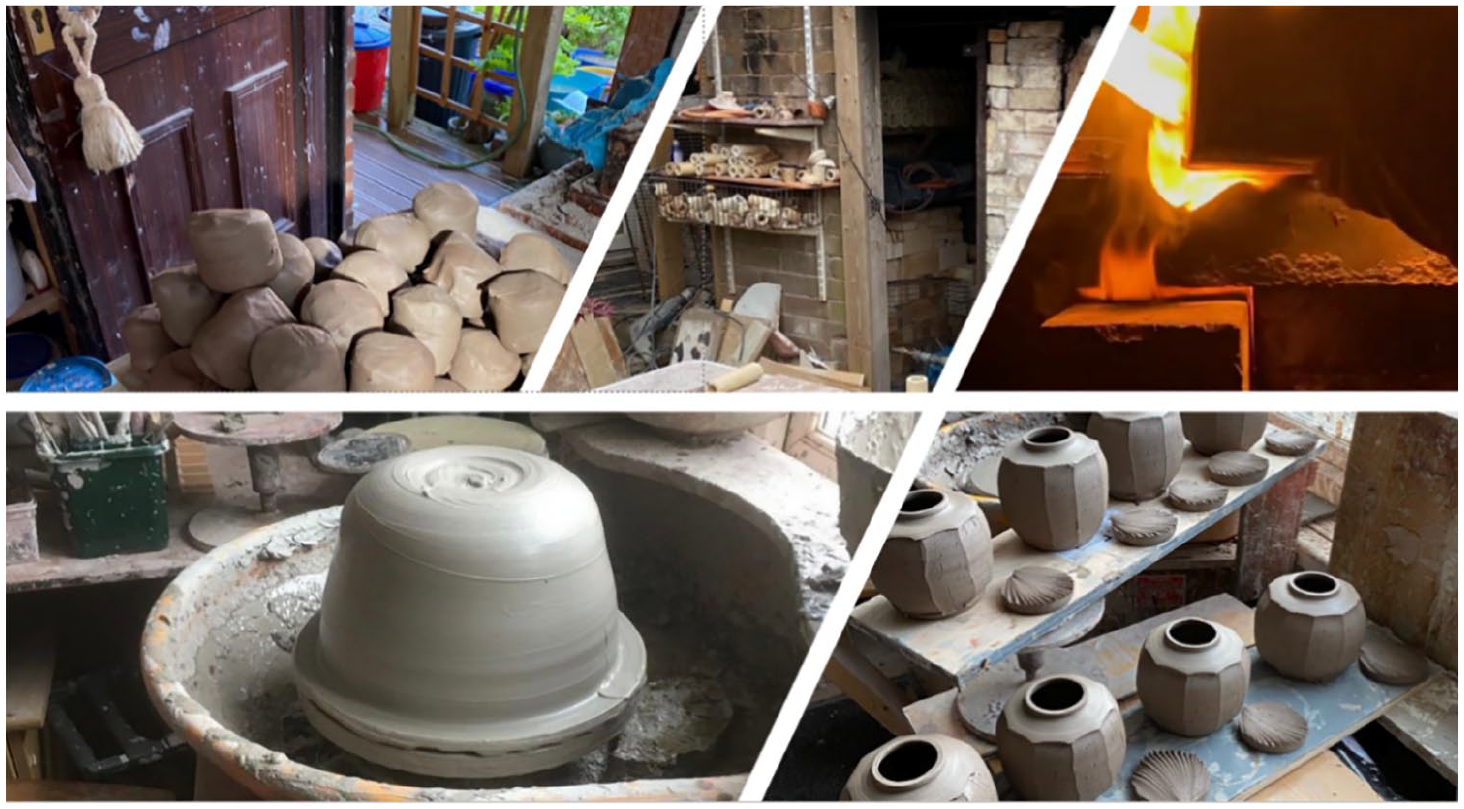
The studio [Pictures taken from one participant].
The first author carried out semi-structured interviews with the 20 studio potters, each interview was linked to an entire day observing working and making practices. The interviews mainly focused on participants’ teaching and learning experiences and their reflections on their daily pottery practice. Each interview lasted approximately 60 minutes and was recorded and transcribed. The participants showed the whole process of making, trimming, and firing pots while explaining what they were doing, which helped us to understand how participants learn from their daily work and practice and how they worked with the clay, tools, equipment and so on. The first author also took photos and videos during the process of interview and observation. These captured the movement of human and non-human actors (Bell, 2012). In this way we sought to understand better the potters’ sensory states and the encounters between them and materials via their bodily gestures and movement (Fox and Alldred, 2015). The transcripts, notes, and photographs were discussed and reviewed by all three authors. The intermittent nature of the research process enabled an iterative process of exploration and analysis (Wuetherick, 2010). The attention to vital materiality in the practice of craft learning did not come before our intra-actions with participants, the pottery studios, the materials, and tools. It emerged with our relations unfolding with and through the craft and research practice. The intimate relationship of us researchers with materials in craft practice allowed us to reflect on and rethink the research process, including the methods we used, the data generated, and the analysis we engaged in.
Throughout the interviews and during observation, the importance of materiality was often mentioned by participants and then subsequently directly observed by the first author in pottery studios. To be able to understand the role that matter plays in pottery practice, the first author spent 26 weeks (3 hours a week) in the pottery studio learning pottery and carried out self-observation of her learning process at the same time. She immersed herself in the process of learning the craft and built up a sensitivity to and close relationship with materials, firsthand. Through this process, her hands, eyes, and whole body became a tool to observe her body’s and materials’ movement that enabled her to feel how materials and her body affected and were affected by each other in the process. She sensed and followed what the material did and where it led her, and how the material communicated the unsayable beyond the representation and “objective” interpretation (Bell, 2012). She made field notes during each visit, where she recorded her bodily feelings, senses, and the communication between herself and material in that moment.
Analysis
The three authors met monthly over the course of the data collection and analysis: a total of 52 hours of discussion and engagement with experiences, data, and concepts. These discussions were also recorded and reviewed. We focused on reading the transcripts and field notes, listened to the recordings again, to draw us back to those encounters that happened in the studio (Chadwick, 2021). We looked at the images and videos many times, to support our analysis of the tactile relationship among human and non-human elements and the movements of materials acting in the entanglements. During the meetings, it was not simply exchanges of information from interviews and observations between three of us, but the first author expressed what she experienced together with the potters, the studio, the clay, the tools, pots, through her body. The other two authors then imagined that relatedness, connection, and the flow in the studio through their body senses. The second author had previously worked with potters and in the ceramics industry so brought a further sensitivity to this flow. Although they were not in the field, they were still able to feel the movements through the first author showing them the pictures and videos taken from the studios and touching different pots made by the first author with their hands. In this way the role of material and body was imagined by all authors.
We acknowledge that analysis is a generative process in the engagement with and negotiation of theory and data (Wuetherick, 2010). Moreover, coding data are an open-ended and ongoing practice of making sense, rather than “a static representation or translation of the world laid out before us” (MacLure, 2013: 171). Researchers, human participants, and non-human actors were all entangled in the encounters of the process of analysis. We did not adopt “a distant, disembodied position,” instead we became “a present, sensing and relating researcher” (Østern et al., 2023: 13). We were thinking and reflecting with our body in, rather than just representing from the mind and isolating us from, the situated moments of research practice, questioning and critiquing the potential domination and privileges of our perception over the vitality of matter (Steyaert, 2022). On one hand, consistent reflective notes and discussions were (re)made not in a linear way, but back and forth among three of us. On the other hand, we valued the moments of our body sensitivity in the practice of knowing and doing research, though always with the sense of struggle and resistance, and opened to the intra-actions between us researchers and the data for allowing the disruptive to come through, not denying it for challenging our pre-perception (Bell and Willmott, 2020).
We first focused on the relationships between humans (e.g. the teacher and the learner; the peers) and we situated our analysis in the social and cultural contexts of learning craft in everyday practice. However, through talking to our participants, learning, and observing the first author’s self-learning experience, the vitality of matter came to the fore and caught our attention. We could not neglect the power of matter in understanding the everyday practice of knowing and learning craft. Then we started to trace the different voices of the researched in front of and behind the scenes, including the human body, the clay, glaze, tools, flame, air, water, equipment, and so on. We followed these movements, dynamics, reciprocity in everyday practice, and how changes emerged in those relationships, which constitutes what and how we can learn in different ways. Then we found that different matter and their encounters initiated the dynamics in the relationships, which contribute to the knowledge production differently. The relationships between the knower’s body and other matter, between matter itself, and how matter responds in different ways after the knower has gained a certain level of expertise, were generated as themes in this article. The concept of “specific materialized sensitivity” emerged through understanding how matter affected the constitution of practice of learning and knowing in various moments. Three conceptual themes were generated in developing the “specific materialized sensitivity”: materialized sensitivity of attunement; materialized sensitivity of risks; and subversive sensitivity to the material.
Findings: Vibrant materiality and the knowing and learning of craft
In our findings, we trace the actions and movements of materials in the everyday practice through which the knowing and learning are constituted. We focus on the reciprocal forces between the material and the knower’s body, and the moments of intra-actions between materials themselves when the potter’s body is “missing” or at least “marginalized” in particular moments. We show how different materials’ movements constitute different ways of learning and knowing craft in different materially situated practices in different stages.
Here, participant N, as an experienced potter, could feel the clay with his hands through another potter’s body by watching YouTube videos:
A strange thing [is] when I watched a YouTube video . . . I can feel here what they can feel there. I know what that clay feels like. It’s strange. I can almost feel it in myself in my hands, the roughness of clay or the smoothness of the clay or when you make it narrower, I can feel it on my hand, that’s really weird . . . So, I am watching a video of someone, because I’ve got the experience and the tactile knowledge. Therefore, I know what that person feels like when they’re doing this with the clay, I can feel. (participant N)
The tactile knowledge developed was not simply the observation of the body movements, but a specific materialized sensitivity which enabled him to imagine the material with another potter’s body and the knowledge got shared between different potters’ bodies. This specific materialized sensitivity becomes the key in the practice of knowing and learning craft.
Resisting force of hands: Materialized sensitivity of attunement
When throwing and trimming, the potter is dealing with dynamic forces from the clay, different tools, the spinning potter’s wheel. In the process of forming this sensitivity, materials affect the process through exerting multiple forces on the bodies of practitioners. One example is visualized in Figure 2, where the forces from the hands, clay, the spinning potter’s wheel are colliding with each other in the practice of throwing a pot. Combined with participant N’s experience, this formed materialized sensitivity for knowing what materials, tools, equipment do and move behind the human body’s actions. This is the key for understanding and communicating with each other, for example, between a teacher and a learner.

The encounters of different forces
When the first author threw a pot for the first time, the teacher shared the body gestures and hand movements in the class which caught the moments of how his body, or hands moved with materials and tools. Then the teacher asked learners to copy and imitate his bodily movements which was approved as effective to throw a pot. However, she could not get the clay centered through simply “copying and pasting” the teacher’s professional bodily gestures: the clay on the potter’s wheel was wobbling around, resisting her force, the tool was not steady and destroying the clay body, the spinning wheel was just spinning against her, not following the pace of her hands. The first few pots thrown by the first author are shown in Figure 3, where the resistant forces (from clay, tools, the wheel) against her hands, were obviously captured and marked through the uneven and inconsistent walls of the clay body and the clay bumps on the bottom.
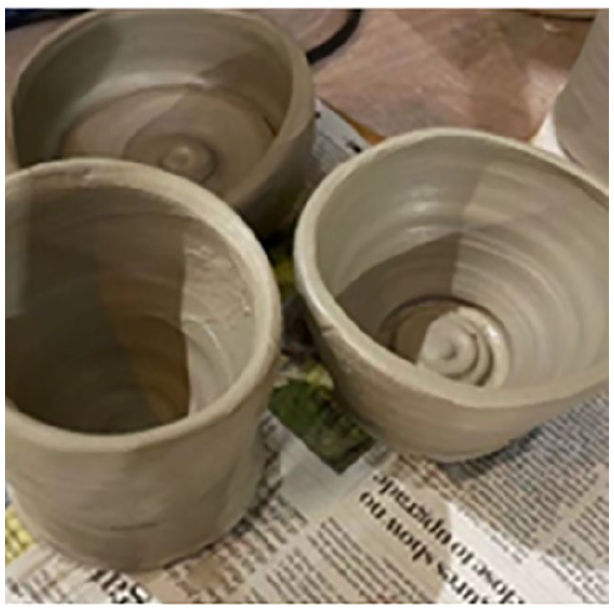
First pots made by the first author.
(I) tried to center, but you don’t know what center means, you don’t understand where you have to go and the guy (the teacher) [was] yelling at me and saying, “You are clay! You have to feel it! You are clay!” (Participant A)
The above refers to how an experienced potter taught an inexperienced potter (participant A) how to center the clay on the potter’s wheel. When learning how to throw a pot, participant A and the first author all experienced the moments when clay, tools, and the potter’s wheel were acting and moving against the hands. Everything was “out of control” and clay’ went “crazy” with the wheel. To understand the teacher’s body movements and gestures, the first author and participant A were both required to form a specific materialized sensitivity with the practice of throwing. The teacher of participant A tried to tell her to learn through merging with the clay, “becoming the clay,” to break the boundaries between herself and clay. When merged with the clay, she could think of herself as clay moving on the potter’s wheel, then she knew where and how to move and behave, and how to center herself. Here, it is a process of understanding and attuning to what clay together with tools and equipment is “thinking and doing” through touching.
Feeling the “uncontrolled” forces from the matter and knowing how to center and make the pot, came about through these dynamic encounters. What participants and the first author learnt was constituted through those forces that the potter holding the tool exerted onto the clay, and the clay’s response needing to be attuned, especially when throwing or trimming a pot on the wheel. If this attunement was broken or could not be maintained during the process, the form of the clay would be distorted immediately, as experienced by the first author. Participants C mentioned the importance of learning how to keep attuned in and to materialized sensitivity through adjusting the feelings with the clay, tools, and equipment:
I concentrate on how the clay feels in my hands, and how my hand pressure needs to adjust to accommodate it and to maintain an even walled vessel. (Participant C)
This attuned materialized sensitivity is not fixed and nor does it grow in a linear way. The attunement can be disturbed by different clays, tools, and equipment, which generated different forces with potter’s hands together in different practices. Different materialities dis-attuned the sensitivity integrated in the bodies of experienced participant potters and required them to reform the already attuned materialized sensitivity from previous practices. For example, while participant M was working with porcelain, she felt different resistant forces from the stoneware:
I started throwing a little bit with porcelain, porcelain is awful all the time. All the time it cracks. So, I prefer stonework clay. It’s just kind to me. Porcelain is very hard to throw. It doesn’t stretch, it shrinks a lot. It can be very thin. But much more difficult to throw, much harder. It is really hard, especially this which is not stable. (Participant M)
Participant N as an experienced potter over 20 years also expressed the same “awfulness” of him working with porcelain: “if you ask me what I hate about porcelain, I will answer you: everything!” The inconsistent waves and stripes shown in Figure 4 captured the dis-attunement and arrhythmic intra-actions of the forces between his hands and the porcelain clay on the wheel. How much participants M and N needed to push back to different clays cannot be either measured or taught by others in both verbal language and body actions. The variety of material forces required them to know and learn the practice of throwing different clays from touching and feeling the forces themselves.
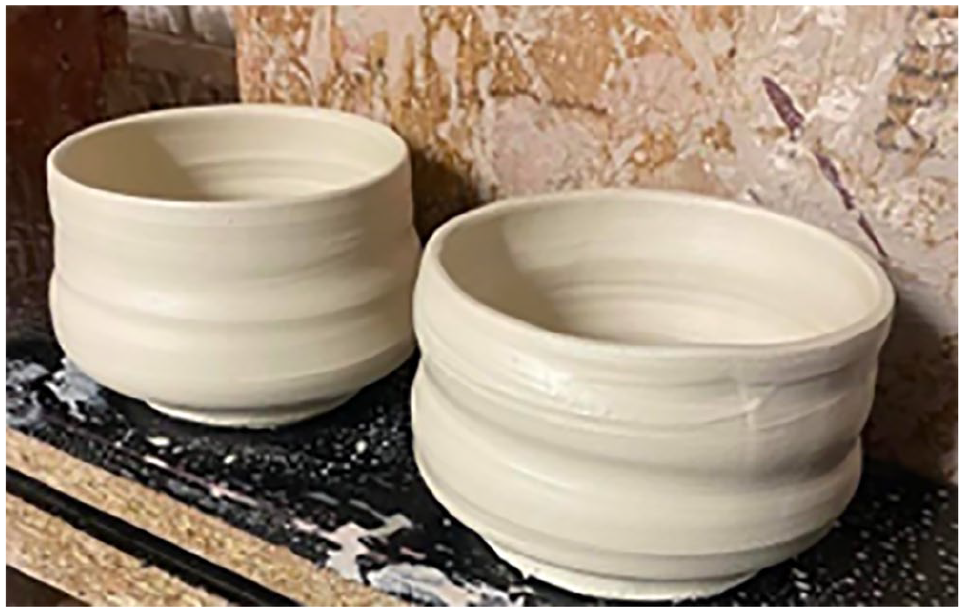
Pots thrown with porcelain clay by participant N.
Disrupting the certain: Materialized sensitivity to risk
Participant R is an experienced potter, especially in glazing. Here she shows that craft practice always lives with uncertainties even for a professional potter, as the normalized knowledge about glazing and firing, previously prescribed and recorded in the recipes was disrupted, and different knowledges were produced because of the uncertainties, dynamics, and varieties:
What I love about clay is that you never are in control. You think you are, sometimes something can happen that you really don’t understand why, like with a glaze, for example, the recipe, sometimes when you’re sure you’ve measured it the same, it comes out completely different. I can’t understand why . . . The actual surface of the glaze changes each time you fire, and all sorts of things happen in the kiln . . . There’s lots of testing and you’re thinking what’s going wrong. You know, there’s so many different things that can happen. You don’t know what you’re going to get. (Participant R)
This generation and constitution of different knowledges and the emergence of risks and uncertainties are largely sourced from the intricate encounters between materials themselves.
In the intricate dance of matter and energy, fired clay continues to engage and transform in and of itself. Even as tactile plasticity diminishes after the firing process, clay remains imbued with a vibrant intra-activity, continually forging relations with other material entities such as glaze, air, flame, and heat. Within this practice, while potters still contribute to the conversations with other matter, their roles are comparatively limited and marginalized when the pots are sent to the kiln to respond to other materials as the hands are not able to touch the materials due to the high temperature. The color and texture are thus largely dependent on what the materials such as different glazes, clay, air, flame, heat have experienced in the kiln and how they responded to each other in the process:
I try to make notes and record [after each firing]. So, I will try and write here: what happened? what’s gone wrong? Keep a record of it. So, I’ve got something to look back to. (Participant M)
Participant M was learning the glazing and firing process by trying to record each experimental practice by making notes to make her own glazing and firing recipes. Those recipes were formed through imagining certain moments of mutual encounters between clays, glazes, fire, air, the kiln, and others, such as ashes at different settings. The intra-active dynamics among clay, glaze, and firing instantiated a plethora of possible outcomes, that showed potters different ways of combining and thereby producing different knowledge.
Within the practice of experimenting with different materials, different body senses were often used to know and learn how the materials were moving and changing. Potters often use different ways, such as see the temperature through the pyrometer, to enable their body to feel the heat released by the kiln, taste the surface of and look at the bending of pyrometric cones, and observe the fired pots through the peek hole in the kiln, then to know what was happening in the kiln and learn the firing practice (see Brown et al., 2016). Those encounters of materialities can be partly captured and tested by practitioners’ body senses; however, humans were just part of this process and were even marginalized at certain moments. There was more knowledge constituted in the material intra-activities in those moments happening inside the kiln than what the body can sense, see, and taste. Thus, how knowledge was produced could not be attributed to humans alone and mobilizing body senses cannot fully bring to the learning of the complexities of, such as glazing and firing, practices.
As illustrated in Figure 5 in participant N’s studio, the cones in the top and bottom layer bent in different angles even in the same firing process, which represented the dynamics in the firing practice where clay, glazes, fire, flame, air reacted to each other differently in the same process. The unexpected color emerged as the glaze moved and intra-acted with the air, flame, or the ash in different ways. For example, pots on the top left and right initially presented the consistent color of white glazes. However, post-firing revelations manifested unforeseen chromatic moves, for example, the black vertical strip in the pot on the top left and the black spots on the pot on top right, rendered the dynamism and unpredictability inherent in material intra-actions in that moment.
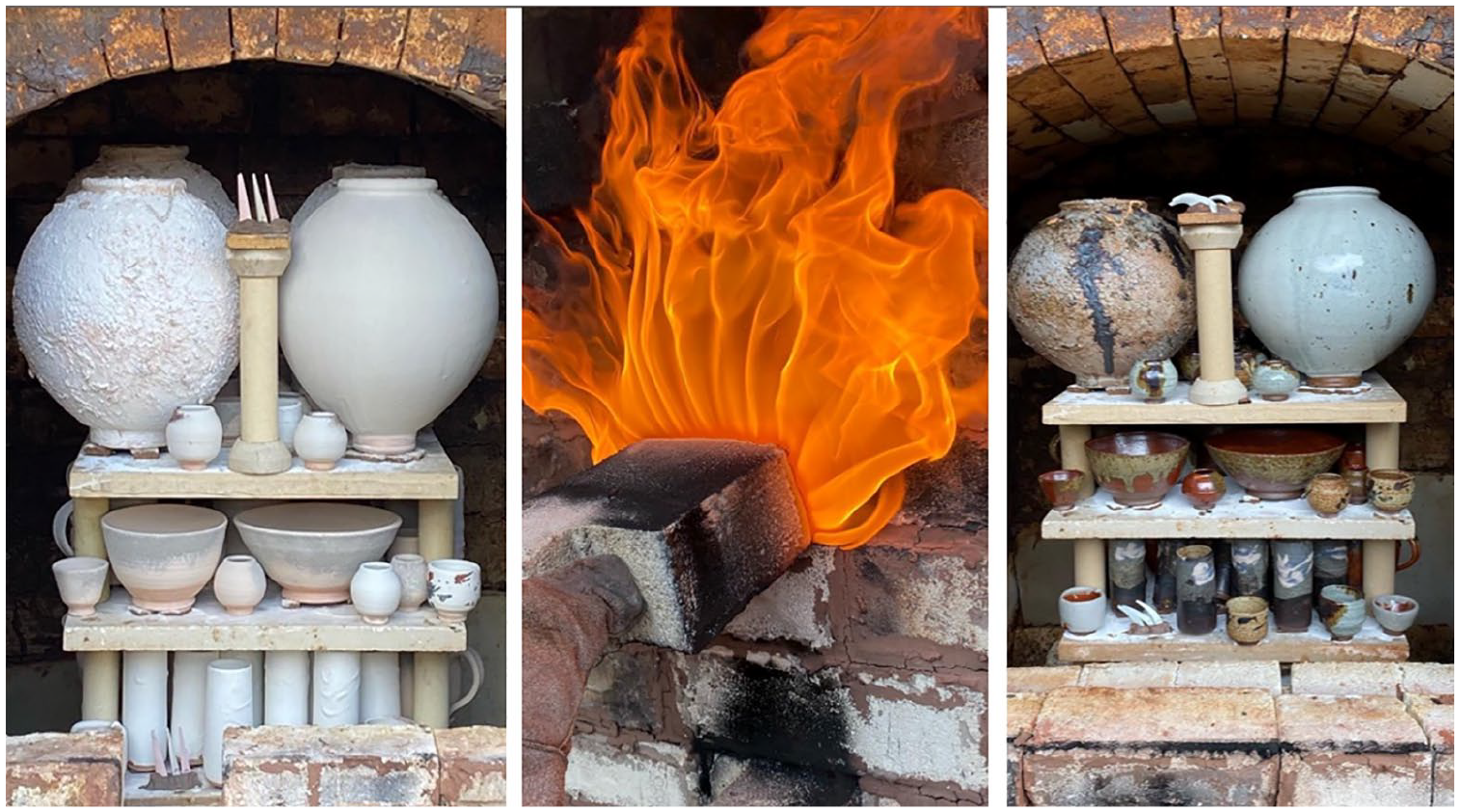
before and after firing.
I can show you. So, this here, now I’ve tried 20 times to recreate, 20 firings. I cannot [make that again] . . . it breaks my heart . . . I find the most difficult thing is to open the kiln. So that moment . . . is the most difficult thing and then to know what’s right and what you did wrong and usually, there is a moment of “brilliant! I’m so pleased! It’s great!” And then I absolutely never ever ever think happy all day, always within an hour maybe two, (she sighed). So that is what’s hard . . . always opening the kiln is the moment of starting a new journey, and that’s great but sometimes (she laughs). (Participant M)
Although it became possible to envisage the dynamic relationship between clay, glazes, fire, oxygen, and others and to predict more accurately what would happen in the kiln as expertise grew, having and knowing these “recipes” did not completely reduce the dynamics in the kiln, nor did it eliminate “unexpected” kiln outcomes, as shown in participant R’s and participant M’s reflection above. The subtle and hidden material intra-actions were reflected in the emerging surprise, joy, adventure, and how knowledge emerges in and beyond the practitioner’s expertise, as illustrated by participant C in her reflection below:
The questions that each problem raises [on glazing and firing] inevitably leads to a lot of testing, and you often learn even more from this than you originally intended. (Participant C)
The dynamic relation between materials, kiln, and potters meant even experienced potters are constantly learning more about pottery and discovering more possibilities in the relationships between different materials and equipment. The risk in the making process could not be fully eliminated, it was making without a certain order or pattern. There are virtually unlimited possibilities embedded in materials, and more knowledge or even new knowledge emerged through these encounters with material or between materials themselves. In this sense, participants, such as participant S below, intended to develop a materialized sensitivity of opening to the risks, attending to the unexpected and uncontrolled through mobilizing the varieties, complexities, and uncertainties above any fixation with the “messy” intra-actions between the clay, glazes, kilns, temperatures, fire, and so on to break up what she has known as the so-called conventional rules:
The way that I approach working with clay, it’s in a very, very experimental way and not in a conventional way though. I fire it to temperatures, it’s not supposed to refire to, I glaze it not supposed to reach and then I glaze again, a lower temperature. So, then I reglaze it. So, some pieces have been glazed like 10 or 15 times each piece. And then you just build up the clay, the actual surface of the glaze changes each time you fire. And all sorts of things happen in the kiln, you just aren’t in control though. So, you know, you don’t know what you’re going to get. (Participant S)
Participant S showed how she learned the craft through leaving the process unknown, which enabled her to know more about the so-called rules and her expectations. The uncertainties enacted with the multiple encounters between different materialities affected how participants approached experimentation. The experimentation here is different from the traditional laboratorial approach which looks for the one truth and “a” knowledge worked as a proof and evidence to mitigate the risks, mistakes, and uncertainties, such as examined in mass production (Pye, 1968), but as a space to permit the provisional moments and different ways of thinking and making. Many experienced potters love the process of being out of control to be able to learn more knowledge and possibilities from material, some of them expected more unexpected surprises through adding extra flux, for example, spraying soda or salt into kilns. Thus, the patterns or colors shown on pots became different.
Defamiliarizing the habituated: Subversive materialized sensitivity
After repeated practice, the relationships between the body and materials were habituated in certain body movements and gestures. Participant C showed that the more she was in tune with the material, that is, the greater her corporeal sensitivity, the more comfortable she felt working with clay. As the clay and her body became one, she felt what clay “thought about” and where clay “wanted to go,” and her hands just moved following the flow of clay’s movement, the clay keeping in tune with her:
As time has gone by, my work has become more refined. I can throw thinner forms and straighter walls etc., to the point that I want to be able to loosen up and loose a bit of control over the clay. I sometimes feel that I am not always allowing the personality and character of the clay to show through, but hopefully this will come during my next 20 years of making!! My second “style” of work is much looser and is something I am not yet entirely happy with. It needs to be further developed, but I strive to create forms that show the nature of the clay, i.e., are “softly” thrown. (Participant C)
By habituated we mean certain patterns of relationships, which made participant C comfortable between herself and different non-human actors, that have been proven as “productive and effective.” The resistant forces from materials, tools, and equipment gradually were “dissolved” in the habituated bodily movements, which have been taken-for-granted in everyday practice. In this case, knowing was fixed in those habituated moves, what participant C described here was that she unconsciously started to take control over the clay, where the power relations between herself and the clay had been unconsciously formed and constructed. This continued to guide her next moves and same ways of making were being reproduced and reinforced in everyday practice, thus the different and new knowledges and ways of knowing might be diminished. What she explained further was to break down the power relationships, “liberate” the clay’s voice, constituting a subversive sensitivity to materials, and deconstruct the already known or learnt patterns of knowing constructed in previous practice.
In this stage, knowing more and learning something new and producing something innovative came from “letting materials take control” (participant C). The role of potters was not controlling the whole process, instead “disappearing,” and matter came to the fore. Participant C was not doing nothing and not pushing at all but diluting the power in practice to others, including materials, tools, or equipment. After having reached a certain expertise and so-called “level,” she tried to let the clay control her in order to explore more possibilities and to push the boundaries to break down the habitual patterns of engagements constituted through previous practice.
When the first author went to the pottery class in the first few times, she could not throw an even walled pot due to the resistant power from the clay with the potter’s wheel with the fast speed and the inconsistent response from her hands while throwing. When she was upset with what she got, the teacher went to her and said, “you know, as an experienced potter, I like it so much when the clay went off the center of the wheel in certain ways! It’s so beautiful and exciting. The clay pushes differently from the usual. I can make something different from what I usually make.” This corresponds to what participant C mentioned above—“letting materials take control”—and constituted the possibilities to defamiliarize his stabilized movements, create something new, produce different knowledges from what have been constructed in normalized practice. This was reflected in participant Q’s interview below when he considered the broken pot (Figure 6) as an opportunity to rupture his repetitive practices and make something new and different rather than reproduce the sameness out of his formed habituated movements in his body. For him, it was not a case of mastering materials and process, but a process of letting materials master him and guide him to find new possibilities and produce new knowledge:
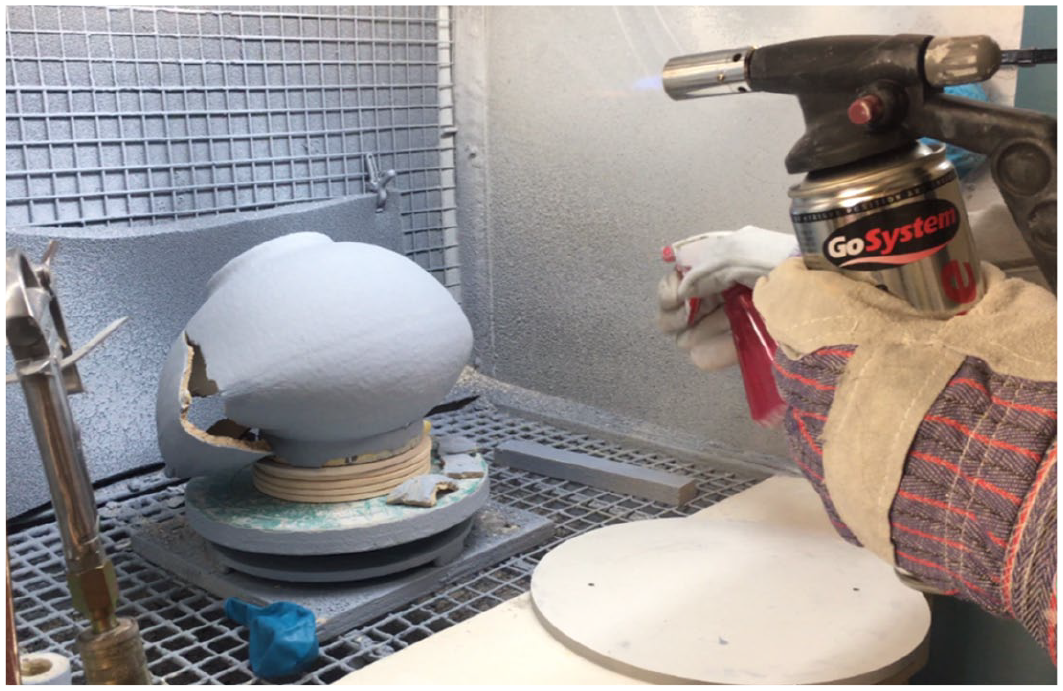
The broken pot with potentiality (not a disaster).
It (the broken pot shown in Figure 6) was made or textured in the same way as the rest of it . . . When you’ve been with the broken pot . . . every time, you break some more, I don’t see it’s going to be disaster, I see it’s being, “ok, that happened, now, what can I do?” If you always make the same thing, you will never make new things, but that pot collapsing is an opportunity to do something new. (Participant Q)
In sum, knowing and the constitution of knowledge, in the becoming of the pots are intrinsically formed by the continuous intra-actions among the potter, materials (e.g. clay and glazes), tools, equipment, fire, pots in the daily practice. The key to the process of learning here is not only the systematically organized environment or the rules and methods legitimated by experienced potters but also in the materialized sensitivity, the encounters between matter (e.g. clay, tools, equipment, kiln, and studio) and potter, both forms of knowledge and knowing need recognition in the pottery learning process. Although the teacher showed the “appropriate” bodily gestures and movements, and the similar bodily movements are routinized through the generations, the possible outcomes from glazes, clays, and fires were all recorded in the sample pottery pieces or the recipes, knowing the essence of “crafting” manifest within the concurrent practice of “doing” amid the present materialities.
Discussion
Following recent calls for understanding how the material (and materiality) constitutes the practice of knowing, including in relation to and with the body and bodily senses (Gherardi, 2021; Gherardi and Rodeschini, 2016), we take a new materialism approach to examine the vitality of matter in everyday craft practice and its constitutions of knowledge and knowing practice (Barad, 2003; Bennett, 2004). Craft provides a suitable setting and perspective to examine the multiple relationships between the body and various materials in the practice of knowing and learning, since the capability of the materials has long been recognized in craft practice (Adamson, 2007; Bell and Vachhani, 2020; Ingold, 2001). We follow scholarship that breaks down conventional dualisms (Gherardi, 2019), by bringing materials on to the same ontological status as humans and locating knowledge and knowing in the relational encounters. While the need to draw material more centrally into the analysis of knowing in practice has been acknowledged, existing studies have partly but not fully delivered in this regard, the practice of knowing instead has been restricted to the human-centric and in embodiment. Further, where previous studies have considered material as that which is not inert, static, passive, and a dead substance (Brown et al., 2016; Gherardi and Perrotta, 2014; Strati, 2007), the focus was largely on what we can see, hear, and sense.
Instead, our work chimes with previous research on how various and dynamic forces generated in the encounters between material and human, become engaged in the whole “materialized” process (Ransom, 2019) through touching and feeling the forces emerging in the momentary practice. We show that matter are active participants in practice, not just contributing in or impeding the generation of but also constituting the tacit and sensible knowledge, through tactile intra-actions. We contribute by showing what constitutes the “embodied learning” for knowing in practice through tactile intra-actions, is the generation of specific materialized sensitivity, and it is this that is also the key to the development and sharing of embodied knowledge. We thus advance practice-based theory by conceptualizing “how” vital materiality, emerging in everyday practice, constitutes what and how we know and learn through resisting force of hands, disrupting the certain, and defamiliarizing the habituated.
First, different materialities affect knowing and learning in resisting forces, requiring the human and their body to become as one with the material, and to be attuned to feeling how different matter moves in the momentary practice. To be capable of working with the materials, this attunement generates a certain materialized sensitivity, which is essential to the learning practice. Nonetheless, dynamics and varieties within the forces from different materials can disturb the attuned materialized sensitivity, even for the expert, in a perpetual disattuning and reattuning.
Second, adding to Barad (2007) we show encounters between different nonhumans affect what we know in the formation of recipes and how we know through body senses, in practice. Dynamic collisions between different materialities from experiments, are the source of the formation of recipes, certain moments of which can be recorded; however, these vital material intra-actions are not diminished, rather the unpredictability and uncertainty always emerge in momentary practices even with the growth of expertise. Learning and knowing from body senses, noted in previous literature (such as, Brown et al., 2016; Strati, 2007), is, therefore, not enough to capture the intricacies and complexities within encounters between different matter. Instead, we learn through accidental moments in experimental practice and leave the process unknown. The growth of expertise here relies much on opening to the unexpected and permitting risk, which requires us to develop materialized sensitivity and orient this sensitivity to material contingencies.
Third, we further advance theory by showing further how this materialization changes and shifts in temporal dynamics. The centrality of the knowledgeable self/subject is not fixed in one actor (humans or other matter) and is not unidirectional but shifts and moves through the constituent reciprocities between different actors in and through the practice. Matter mostly resists in the beginning and knowing arises through the strong conflicts felt by practitioners in these encounters. With the growth of expertise, a harmonious flow emerges in the practice, where the forces of the materials may no longer resistant, but in harmony with the pace of human hands and body. This harmony, in one aspect, fixes the varieties and liveliness of matter into few patterns and modes of practice and knowledge. To bring the dynamics and varieties in the intra-actions with the materials back to the practice and produce something new and different, requires a deliberate retreat of human consciousness, in the constitution of subversive sensitivity (Bell and Willmott, 2020). This subversion forms a sense of being lost to the straying materials, moving learning and knowing from that which is habituated in the body, to a new temporality of practice. This act is not one of relinquishment, but rather a strategic fading, allowing the material’s dynamic characteristics to flourish, and thus defamiliarize us from the habituated and stabilized.
Conclusion and implications
In this article, we addressed the question of how the doing and acting of matter constitute what and how to know and learn in practice. We want to clarify that we are not trying to ascribe all agencies and contributions only to the material, but we advocate the focus on the multiple encounters and relationships which are not only limited to relationships related to human but also the relationships between nonhumans themselves, who also contribute much to the practice of knowing and learning. The practice is seen here as an “agencement of entangled entities” (Gherardi, 2021: 12), which is processually constituted through the multiple relationalities and encounters between human and non-human entities.
Our study joins others in calling for a shift in focus in research, so that humans are not the only subjects in acting, doing, and knowing in practice. Rather, subjectivities are formed and constituted through multiple intra-actions. Indeed, we know that organizational and management learning is no longer just about human-centric skill development, instead it is the entangled becoming and productive creation between forces without pre-existing beginning and fixed end points (Johansson, 2016). Human bodies and materials engage in a reciprocal dance of “making themselves intelligible to each other” to produce knowledge and influence learning processes (Barad, 2007). Our work therefore is also a potential stimulus to rethinking subjectivity and positionality in the practice of knowing and management learning, as the human subject’s position is always co-constituted in relation to the material world. Thus, the roles of humans and nonhumans playing in different practices are shifting and changing in different times. These intricate entanglements construct a pedagogic relationship where both humans and matter engage in learning through multiple intra-activities in the practice of knowing. Consequently, we suggest the practical contribution to the shift to the body senses and materials in management education and learning through proposing an approach of “(re/de) forming” specific materialized sensitivity. With the proposed approach we expect to further help unsettle the human-centric practice of teaching and learning, where to form the specific materialized sensitivity is the key to share, teach, and learn, highlighting an onto-epistemological and pedagogical shift from human-centered agency to a more holistic, materially co-constituted process of creation.
A final consideration concerns the efficiency and value of conducting research which speaks for materiality. In this article, we used an embodied approach of immersing one author in the practice of learning craft, and we valued multiple voices in constituting what the data becomes, which were not only limited to traditional human language and texts. We examined the potential limitations and risks of reducing the material vitality when we, as human researchers, reflected on and discussed materiality. And we suggest future considerations in management learning on the onto-epistemological shift from the traditional human-centric for making methodological choices and the usefulness of future engagement into exploring craft as not just a practical concept, but more theoretical and conceptual in the methodological transformation.
Footnotes
Acknowledgements
This is a fully co-authored article. The first author conducted the research so is listed first. We wish to thank the editorial team and three anoymous reviewers for their constructive and helpful comments in reviewing this article. The clarity, consistency, timeliness and consideration of the review process overall, is noteworthy and a credit to the journal, thank you. We would also like to acknowledge and thank Dr Andrew Greenman and Dr Anniiina Rantakari, for their the insightful comments and generous help in the early stages of this paper.
Funding
The author(s) received no financial support for the research, authorship, and/or publication of this article.

Author Notes
“master”: In this article, we use “master” and “apprentice” to refer to the formal relationships that existed in traditional apprenticeships, where experienced craftspeople teach craft knowledge and provide resources and spaces, and in exchange, the inexperienced craftspeople need to work for them to learn. We use this term because it has been generally used in the craft industry. As time goes by, people used “master” as a neutral term to describe people who have developed proficient knowledge and skills with many years’ experiences in specific areas, rather than only refer to craftsmen.