




Abstract
Existing research has highlighted a global return into fashion of craft work in the new century. Within this context, the term ‘neo-craft’ work has been used to identify innovative craft work practices characterized by an aura of ‘coolness’, which promise a less alienated form of work; yet, the specific contours of this new form of work remain uncertain. In this article we develop a theoretical conceptualization of neo-craft work. We define it as an emergent form of post-industrial craft work whereby work that was previously considered low-status, or performed by the working class, is: (a) ‘resignified’ into status-producing activity through the integration of craft practices and values; and (b) conferred new meaningfulness as the outcome of a specific process of discursive materiality, by which the intra-action of discursive and material practices provides meaning to work activity. Neo-craft work, we contend, finds roots in the cultural milieu of hipster culture, where extenuating cultural negotiations around authenticity and ‘the particular’ constitute the baseline for a quest for social status based on practices of ‘marginal distinction’, and sets itself as an alternative not only to industrial work but, primarily, to the precarious, low-paid or otherwise unsatisfactory ‘bullshit jobs’ of the knowledge and creative economy.
Keywords
Existing research has highlighted a global return into fashion of craft work in the new century, described as a ‘third wave of craft’ (Jakob, 2013, p. 130). This has primarily concerned the creative and cultural industries, where craft work is understood as a semi- or non-market form of creative work and a countercultural practice set to ‘pragmatically resist’ capital accumulation (Banks, 2014; Luckman, 2015). Inspired by the work of Richard Sennett (2008), who conceives of craft as the epitome of ‘good work’, the resurgence of craft work has also been fostered in no small part by digital media. On the one hand, digital platforms such as Etsy.com have allowed craft producers to sell their artefacts online, enabling new ways for supply and demand to meet (Krugh, 2014). On the other hand, social media have facilitated the gathering of global communities of practice around craft, who engage in discussion and exchange advice (Naudin & Patel, 2019).
However, this revival of craft work has extended beyond the creative industries to become a relevant phenomenon in the market economy at large, particularly in the food and hospitality sector. A new term has been coined to describe this trend: ‘neo-craft’ industries (Bell, Mangia, Taylor, & Toraldo, 2018; Land, 2018). Epitomized by craft beer brewing (Fox Miller, 2017, 2019; Land, Sutherland, & Taylor, 2018; Thurnell-Read, 2014; Wallace, 2019), this term identifies those sectors whereby forms of craft work – that is, ‘concerned with the skilful production of high-quality products’ – combine with ‘innovation in both product and process’, pointing towards ‘a post-industrial imaginary’ (Land, 2018, np). Within this context, the specific cultures and practices of work are of particular interest. ‘Neo-craft’ work, as it has been labelled, is characterized by an aura of ‘coolness’ and promises ‘a less alienated form of work’ (Land, 2018, np; Ocejo, 2017). Akin to creative work in the late 1990s and early 2000s, neo-craft work is marked by a notion of passion, which makes it appealing particularly for those who have found themselves excluded from, or have explicitly rejected, traditional pathways to education and work (Ocejo, 2017). Yet, research on neo-craft work remains in its infancy, and its specific contours remain uncertain. What are the distinctive features of neo-craft work? What differentiates neo-craft work from other forms of craft or manual work? Why does neo-craft work represent a ‘less alienated’ and innovative form of work?
Contributing to the emergent body of research on craft in the new century, this article provides a theoretical conceptualization of neo-craft work. Using existing studies, we present neo-craft work as a peculiar ‘new form of work’ of the 21st century. We define neo-craft work as an emergent form of post-industrial craft work whereby work that was previously considered low-status, or performed by the working class, is: (a) ‘resignified’ into status-producing activity, through the integration of craft practices and values into forms of labour-intensive or manual production; and (b) conferred new meaningfulness as the outcome of a specific process of discursive materiality, in which discursive and material practices become inextricably connected, and their intra-action provides meaning to work activity. Neo-craft work, we contend, finds roots in the cultural milieu of hipster culture, whereby extenuating cultural negotiations around authenticity and ‘the particular’ (Smith Maguire, 2018) constitute the baseline of a quest for social status based on practices of ‘marginal distinction’. In neo-craft work, we show, the discourse around authenticity and ‘the particular’ provides meaning to the engagement with material practices, so that this acquires value in itself – and not conditional to its mastery – because it allows the body to set free from the usual organizational constraints (Harding, Gilmore, & Ford, 2022), thus enabling the experience of embodied affectivity (Bell & Vachhani, 2020; Gherardi, Murgia, Bellè, Miele, & Carreri, 2019). This sets neo-craft work as an alternative not only to industrial work but, primarily, vis-a-vis the often precarious, low-paid or otherwise unsatisfactory ‘bullshit jobs’ (Graeber, 2019) of the knowledge and creative economy (Ross, 2009).
In the pages that follow, the article unfolds focusing first on the contextualization of neo-craft work within the larger debate on the ‘future of work’, and then on the articulation of its definition, with specific attention to its relationship with traditional forms of craft work. Subsequently, we provide reason for its grounding in hipster culture and then outline in full the notion of discursive materiality, that we argue represents its distinctive feature. In the conclusion we critically reflect on the broader implications of our proposition, suggesting that neo-craft work does not represent another kind of craft as ‘return to the past’, but rather one based upon innovation that speaks directly about present and future societal trends.
The Bigger Picture: Contextualizing neo-craft work as a ‘new form of work’
A lively discussion on the ‘future of work’ has animated the academic and popular debate over the last decades, especially following the 2007–08 economic downturn. For the most part, this has been prompted by technological advancements in the digital sector: in a society transitioning out of the industrial era and into a highly fragmented scenario, fresh concerns have been voiced in particular against the threat of job automation and the consequences of the suppression of human labour by means of technology (e.g. Neufeind, O’Reilly, & Ranft, 2018; Servoz, 2019; P. Thompson & Briken, 2017). Within this context, a variety of ‘new forms of work’ have been identified and critically discussed, including algorithmic and platform labour (Vallas, 2019), collaborative work (Aroles, Mitev, & de Vaujany, 2019), together with issues concerning quantification and surveillance of work (Moore, 2017), and the introduction of robotics in industrial work (West, 2018), to name a few. Much less attention has instead been posed onto the emergence of new forms of work that are not directly related to technological advancement, and on their perceived meaningfulness vis-a-vis existing or otherwise well-established ones.
The affirmation of neoliberal policies aimed at flexibilizing and globalizing the labour market across Western economies since the 1980s ignited a profound process of transformation of work cultures and practices. Overall, this has been characterized by a diminishment of permanent employment and a comprehensive push towards the ‘entrepreneurialisation’ of the workforce (Harvey, 2005; Kalleberg & Vallas, 2018). This has particularly concerned the so-called knowledge economy, culminating at the turn of the century in the vision of an upcoming ‘creative class’ of workers who would thrive on individual talent and enjoy a ‘cool’ lifestyle (Florida, 2002). Contextually, the rapid diffusion of digital technologies and their integration in work practices and organization facilitated the proliferation of ‘contingent’ and ‘nonstandard’ forms of employment, particularly freelance work, which have affirmed as a ‘new standard’ of work (Cappelli & Keller, 2013; Gandini, 2016). These ‘cool’ creative jobs, however, largely materialized in the form of precarious, low-paid work, characterized by long hours and scarce remuneration (McRobbie, 2016; Ross, 2009).
Somewhat paradoxically, in the middle of these advancements craft work experienced a resurgence. Following the 2007–8 economic downturn, craft has enjoyed a new ‘moment in the sun’ (Luckman & Thomas, 2018, p. 1), described as a ‘third wave of craft’ (Jakob, 2013, p. 130). Craft work affirmed as a potential way out of the recession, enabling a renewed push towards small entrepreneurship while a new set of actors, particularly startup investors, entered the craft scene, anchoring the revival of craft firmly in the camp of the neoliberal economy (Adamson, 2013; Luckman & Thomas, 2018). The popularity of social media and online platforms such as Etsy.com also contributed in no small part to this resurgence, enabling different stakeholders and communities of practice around craft to get in contact irrespective of their geographic location, opening up new markets and spaces of action (Krugh, 2014; Luckman, 2015; Naudin & Patel, 2019).
Interestingly, however, this revival of craft has not solely concerned work that has been traditionally classified as craft. Particularly within some productive sectors of the market economy that do not necessarily belong to the ‘native’ contexts of craft (Gibson, 2016), such as the food and hospitality industries, existing research has noted the emergence and popularization of craft-based forms of production and an increased interest in small-scale, artisanally produced goods (cf. Pedeliento, Andreini, & Dalli, 2020). This has been defined by Currid-Halkett (2017) as a new form of aspirational consumption, characterized by ‘conspicuous production’. It is ‘the production, rather than the consumption’, Currid-Halkett argues, that ‘becomes the key conspicuous signal’ which confers value to the individual consumption practice as a kind of aspirational move based on cultural preference (Currid-Halkett, 2017, p. 117).
The term ‘neo-craft’ industries (Land, 2018) has been coined to grasp the artisanal turn of the market economy. This identifies those sectors whereby the recuperation of pre-industrial, small-scale or otherwise abandoned forms of production, aptly repurposed to the modern economy, has become fashionable, tapping into a consumer niche. Neo-craft industries are quintessentially epitomized by craft beer brewing (Fox Miller, 2017, 2019; Land et al., 2018; Thurnell-Read, 2014; Wallace, 2019), which has grown from a semi-hobbyist activity to a lively entrepreneurial and cultural scene punctuated by global actors, and today represents an important subset of the beer economy worldwide (Kroezen & Heugens, 2019; Land, 2018; Land et al., 2018).
Yet, besides craft beer brewing, the cultures and practices of work within the neo-craft context are of particular interest. Neo-craft work, as it has been labelled, is marked by an aura of ‘coolness’ and promises ‘a less alienated form of work’ (Land, 2018, np) that is deemed to subvert ‘the usual aspirations of social mobility, with middle-class, college educated kids rejecting office work and the professions in favour of butchering, barbering or bartending – all traditionally working-class jobs’ (Land, 2018, np; Ocejo, 2017). Like creative work in the late 1990s and early 2000s, neo-craft work is characterized by a notion of passion, which makes it particularly appealing for those who have found themselves excluded from, or have explicitly rejected, traditional pathways to education and work (Ocejo, 2017). Yet, we still know rather little about its distinctive features, what differentiates it from other forms of craft (and non-craft) practices, and how we can make sense of its rise in the present day and age. This article aims at filling this gap.
Neo-Craft Work: A Primer
A landmark reference in the emergent scholarship on neo-craft work is Ocejo (2017). Through in-depth ethnographic research within four neo-craft industries in the United States – ‘mixologist’ bartending, whole animal butchering, barbering and gin distilling – Ocejo recounts how a variety of educated and culturally savvy young workers have turned to traditionally working-class activity in search of meaningfulness and ‘good’ work, transforming once-undesirable jobs into ‘elite’ occupations and creating new cultural hierarchies within and around them. The food and hospitality sector – particularly craft beer brewing – is considered to be the ‘native’ context of neo-craft work (Land, 2018). Yet, as Ocejo’s work demonstrates, a variety of activities could potentially fit this framework, including other craft occupations – such as ceramicist or small jewellery producer – as well as jobs commonly performed by the working class. It seems necessary, in other words, to develop a more accurate understanding of how these cultural hierarchies have come to be, and how they have contributed to what may be seen as a resignification of work activity that does not necessarily belong to the domain of craft, but where craft practices and values have become commonplace and the source of original forms of social recognition.
We define neo-craft work as an emergent form of post-industrial craft work whereby work that was previously considered low-status, or performed by the working class, is: (a) ‘resignified’ into status-producing activity, through the integration of craft practices and values into forms of labour-intensive or manual production; and (b) conferred new meaningfulness as the outcome of a specific process of discursive materiality, in which discursive and material practices become inextricably connected, and their intra-action provides meaning to work activity. This new breed of craft work can typically be found in the gentrified urban areas of Western global cities. Here, as Gibson (2016, p. 6) points out, new craft and maker scenes are ‘conferred a degree of industrial or working-class authenticity’, that is reflective of ‘a new phase of ‘cultural capitalism’ in which symbolic meaning and sign values infuse commodity production’. Research suggests that three main subjects typically participate in neo-craft work, frequently overlapping with one another in their capacity: (a) the producers, who materially work on the production process; (b) the entrepreneurs or business owners; and (c) the salaried workers, particularly in the hospitality sector, who participate in these scenes not just for the mere necessity to work, but to fulfil their ‘passion’ and as a means for social recognition (Bell et al., 2018; Land, 2018; Ocejo, 2017).
Empirical accounts of neo-craft work remain sparse; existing works, however, portray a contradictory picture. Fox Miller (2019), for instance, describes craft beer workers in Oregon as ‘glorified janitors’ and ‘glamorised’ workers who have assumed celebrity-like status because of their ‘cool’ job, but that continue to experience significantly bad working conditions. Similarly, Wallace (2019) highlights how craft beer brewing in London is increasingly associated with status-achieving features but continues to be marked by acute social inequality, and suffers from extensive precarity. Land et al. (2018) also underline that craft beer brewing in the UK is prone to forms of gender inequality, noting that, within this context, an emphasis on authenticity and retraditionalization is enmeshed within a comprehensively masculine culture of work. Other studies also underline that social media has contributed significantly to the ‘coolness’ of craft and artisanal work (Bell et al., 2018), constituting an important milieu for neo-craft producers to meet their consumer base (Currid-Halkett, 2017; Eckhardt & Bardhi, 2019).
More empirical research is certainly required to dig more in depth into this new kind of craft work and the forms of organization characterizing it. Yet, to further complicate things, the existence of neo-craft work is difficult to account for in official statistics, as it remains somewhat hidden among established craft occupations and new small entrepreneurial activities, and no existing data source is able to account for the exact size of this workforce. Furthermore, and perhaps most importantly, its ‘neo-’ status rests on unclear theoretical boundaries; the distinctive features of this kind of craft work have so far only been sketched out, as they emerge inductively from rich but nonetheless context-specific ethnographic research. Similar to creative work in the late 1990s, the alleged quality of neo-craft jobs as ‘less alienated’ forms of work remains untested, and cloaked in a somewhat mythological status that needs to be questioned. As Kroezen, Ravasi, Sasaki, Żebrowska, and Suddaby (2021) point out, there is a demand for research that addresses how ‘creative’ and ‘pure’ forms of craft relate to more technical and industrialized ones, and the extent to which the association with a ‘craft imaginary’ (Bell, Dacin, & Toraldo, 2021) actually confers more meaningfulness to certain forms of work. Neo-craft work seems to be an ideal case to observe in this endeavour.
Traditional Craft Work vs Neo-Craft Work
As mentioned, the existing scholarship identifies craft beer brewing and, more generally, the food and hospitality sector, as quintessential examples of neo-craft work. However, the production of food and drinks has generally not been considered to be craft work in its traditional meaning, nor have workers involved in their production traditionally been considered craftspeople – with the exception of specific contexts, such as France, where the word artisan historically refers to a wide range of occupations including, among other things, baking. Furthermore, the boundaries of what is conventionally considered ‘craft work’ have been difficult to draw from a strictly academic point of view, as craft research has historically displayed, ‘if one were being generous, a plurality of meanings; less charitably, the word [craft] has been the epitome of confusion’ (Dormer, 1997). However, a clearer picture emerges if we adopt an ‘institutionalist’ perspective, looking at the boundaries set by the professional bodies representing craft producers.
As of today, the UK Crafts Council classifies its more than 800 members in 29 categories, according to the final goods they produce or the production process; these range from bookbinders to 3D makers (UK Craft Council, 2022). The UK Heritage Craft Association goes even further, enlisting as many as 244 categories of craft (Heritage Crafts, 2017). The American Craft Council (2022) does not offer a similarly specific categorization, but the vocabulary used and the people and businesses showcased is akin to the other two here mentioned, as well as the World Crafts Council Europe (2022), which enlists craft associations from all around Europe. The craft work that these bodies chiefly preserve and promote is one that skilfully manipulates raw materials to produce a final durable object with artistic quality. This resonates with the definition provided by Howard Risatti (2009) in A Theory of Crafts, which is prompted by the same recognition of a general ambiguity in the term ‘craft’ in the literature. Recognizing that craft work is commonly associated with a range of materials (ceramics, glass, fibres, metals, wood, etc.) as well as with specific technical and working procedures (weaving, quilting, turning, smithing, etc.), Risatti (2009) adopts a definition of craft work as a working process aimed at producing objects with a practical physical function. Risatti does not mention explicitly that these objects must be durable, but from the premises this is implicit. Clearly, none of the four jobs included in the seminal book by Ocejo (bartenders, barbers, butchers and gin distillers) could be reasonably defined as ‘craft’ according to this definition, nor to the definitions provided by traditionally established craft associations. This ambiguity also extends to craft beer brewing, which has often remained excluded from the circle of proper craft occupations (Brown, 2020), albeit recent research (e.g. Kroezen & Heugens, 2012, 2019; Land et al., 2018) has somewhat ‘naturally’ included this among the new craft and making activities. Overall, an evident research puzzle emerges here, hindering the possibility of pursuing a systematic investigation of neo-craft work, its practices and organizational forms. How can neo-craft work be epitomized by sectors that are extraneous to what is generally understood as craft work?
Building on the ‘configurations’ of craft devised by Kroezen et al. (2021), we see neo-craft work as an emergent form of ‘post-industrial’ craft work that bypasses the dichotomy between traditional and industrial craft and, in so doing, devises an original blend between ‘creative’ craft – where craft is ‘associated with a pursuit of creativity in making and fueled by social movements promoting individual freedom and expression’ (Kroezen et al., 2021, p. 521) – and ‘pure’ craft – where craft represents ‘the radical prioritisation of human skills at the expense of all that is considered mechanical’ (Kroezen et al., 2021, p. 519). Like other forms of craft work, neo-craft work maintains an ontologically alternative stance to industrial production, stressing how manual work – once free from the alienation caused by machines – can be the source of ‘the craft satisfaction that arises from conscious and purposeful mastery of the labour process’ (Braverman, 1974, p. 7). The mastery of skills, an all-rounded understanding of the making process and dedication to one’s work are integral to neo-craft occupations (Ocejo, 2017). Yet, as a post-industrial form of craft work, neo-craft work extends its scope of action to the mastery of specific types of innovation and knowledge, expressed in cultural negotiations around authenticity and ‘the particular’ (more on this later). In so doing, neo-craft work is not necessarily antithetical to technological advancement; on the contrary, it is principled on an opposition to the meaninglessness of other forms of employment and, in particular, sets itself as alternative to the low-paid and precarious forms of knowledge and creative work in the neoliberal economy. The making of something through manual or otherwise labour-intensive but ‘authentic’ practice is preferable, for participants in neo-craft industries, to the engagement in a labour market – that of the knowledge and creative economy – which is comprehensively believed to be unable to valorize one’s skill, characterized by marked precariousness and dissatisfaction (again, more on this later). Conceived as such, neo-craft work allows workers to fruitfully marry cultural exploration with the pursuit of personal interests and a striving for authenticity and self-affirmation, in the context of a comprehensively romantic and nostalgic narration that glorifies the past and uses it as a future-oriented source of inspiration. This finds roots in the context of a very peculiar social phenomenon: hipster culture.
From Hipster Culture to Neo-Craft Work: A question of ‘marginal distinction’
Historically associated with an obsession for trendiness and being in-the-know about fashion and lifestyle (Michael, 2015; Schiermer, 2014), and largely considered a byproduct of the indie subculture (Arsel & Thompson, 2011; Cronin, McCarthy, & Collins, 2014), hipster culture has affirmed in the first decades of the 21st century as a highly heterogeneous social phenomenon, typical (albeit not solely) of the hyper-gentrified, post-industrial neighbourhoods of Western global cities (Arvidsson, 2020; Maly & Varis, 2016). Theorizations of hipster culture in academic research exist mainly in the context of consumer research and cultural studies. These largely agree on the following, ideal-typical description: ‘Hipsters are young, white and middle class, typically between 20 and 35 years old (who) contribute to the “gentrification” of former “popular”, working-class, ethnic or “exotic” neighbourhoods in the big Western cities’ (Schiermer, 2014, p. 170). They ‘generally vote to the left, typically study at the humanities or work in the ‘creative industry’ or in cafes or bars or music or fashion stores’ (Schiermer, 2014, p. 170). Accordingly, hipsters are regarded as being ‘voracious consumers’ who strive to keep up with the latest trends and are ‘deeply involved in the cultural field of the city they live in’ (Michael, 2015, p. 169).
While this account looks credible, at least from a commonsensical standpoint, it must be noted that it relies more on theoretical assumptions than on empirical grounding. In fact, contrary to other social groups, participants in hipster culture tend to keep self-identification at bay. As Maly and Varis (2016, p. 638) note, ‘the rejection of the label “hipster” as a category of self-identification seems to be part and parcel of the hipster identity discourse’. Similarly, Cronin et al. (2014, p. 8) underline that ‘(s)ignificant complications arise (. . .) when studying the hipster subgroup on the grounds that most members of this identity category shun the very label used to define them’. Put differently, the question of who should be considered a hipster remains a kind of epistemological conundrum, as a result of the absence of an explicit claim of ‘hipster subjectivity’. For the purposes of this article we follow Maly and Varis (2016), who describe hipster culture as a highly heterogeneous, translocal, polycentric and layered social phenomenon, participated in by a variety of subjects roughly belonging to the same generational cohort – so-called millennials – and constituted of practices marked by a dimension of normativity, which combine ‘very local’ tastes and attitudes with global consumption practices and cultures (Maly & Varis, 2016, p. 644). Accordingly, elaborating from Gerosa (2021), we define hipster culture as a constellation of diverse (micro-) social practices underpinned by a distinguishing, shared discursive imaginary and aesthetic regime, characterized by (a) the hegemonic normativity of authenticity as a value logic and (b) the (to some degree, consequent) popularization of a logic of taste based on the social recognition of ‘the particular’ and its extenuating cultural negotiation.
Virtually all research agrees on the centrality of authenticity in hipster culture. Something ‘authentic’ carries remarkable social value in hipster circles, as it conveys experiential meaning and constitutes a key determinant in the expression of oneself. It has been noted that authenticity in hipster culture mediates a tension between individuality and imitation (Michael, 2015). Schiermer (2014) for instance, points out that hipsters usually refrain from imitation and reify individuality, while they thrive on being ‘quirky’ and displaying knowledge of ‘unique’ trends. Yet, as Michael (2015) also suggests, hipsters do not reify trendiness as such, but rather the narrative that is attached to it – that is, the discourse around the perceived authenticity of a practice or product. This extends to the practices of sociality and consumption peculiar to these scenes (Gerosa, 2021; Maly & Varis, 2016). The normative, culturally hegemonic role of authenticity in hipster culture is expressed through practices that are exemplary of a logic of taste based on the social recognition of ‘the particular’, and in its extenuating cultural negotiation in given social contexts. This is particularly epitomized by an obsessive attention towards production features in consumer goods, which is reflected – and here we are – in the popularity of craft, artisanal, natural or organic products among this social group (Currid-Halkett, 2017; Ocejo, 2017).
We understand these cultural negotiations as practices of ‘marginal distinction’. These concern the valorization of the display of one’s capacity to grasp the ‘marginal’ differences that characterize certain products and tastes. The adjective ‘marginal’ is here intended in two different and complementary nuances. On the one hand, it concerns the social value of newness, both in absolute terms and in relation to the mainstream. In this sense, it echoes the economics notion of marginal utility, which contends that the utility (i.e. the satisfaction) of consuming a product or service decreases as the number of additional units consumed increases (Kauder, 2015). In existing research and in popular discourse, this is represented through the expression ‘before it was cool’, which highlights how participants in hipster culture value the newness of a fashion trend, a food habit or a technological device (Maly & Varis, 2016). Yet, the more a new taste or trend becomes incrementally popular in the mainstream consumer arena, the less it carries social gain in hipster circles. A new consumption practice, taste or trend is considered socially valuable in hipster culture if it is recognized as new and ‘marginally’ uncommon: its recognition brings social gain. In turn, its value incrementally decreases if a growing number of consumers – the mainstream – takes an interest in this same practice, taste or trend, leading to the consumption practice becoming common and thus igniting the search for a new marginality (Gandini, 2020).
At the same time, ‘marginal’ also refers to the detection of ‘the particular’ (Smith Maguire, 2018) in a given consumption practice, taste or trend. This is intended as the apparently indiscernible, discursive and/or material differences that set similar products apart. In hipster culture, this commonly takes place – and here we are again – on the basis of production features. Labels such as ‘craft’, ‘artisanal’, ‘organic’ or ‘natural’ become value-conferring precisely because they allow expression of such ‘marginal’ and apparently indiscernible differences between categories of products (and inside these categories too) – which recognition, again, is status-producing. For instance, a preference for craft beer as opposed to its mainstream counterpart allows participants in hipster culture to present themselves as refined consumers of a product that is beer, but a tiny bit different (cf. Pozner, DeSoucey, Verhaal, & Sikavica, 2022). Similarly, their appreciation of organic coffee allows them to showcase their knowledge about a product that is coffee, but a tiny bit different (Gandini, 2020). While an attention to production features is not necessarily new as a consumer preference, in hipster culture it becomes a conspicuous trait, as Currid-Halkett (2017) argues, and a device to express cultural competence. At the same time, this kind of cultural competence is used as a means to social status acquisition, which results from the capacity to grasp the actually existing, or otherwise perceived, ‘marginal’ differences between apparently identical consumer goods.
Neo-craft work emerges within this cultural milieu. Here, craft production and products as discussed do not solely represent a market response to a consumer trend, but constitute ‘actually authentic’ forms of production founded upon ‘particular’ techniques or materials, that are ‘reconverted’ to the present-day consumer economy (Scott, 2017). This constitutes the aforementioned ‘resignification’ process, which is characterized by the integration of craft practices and values into forms of labour-intensive, manual production. The engagement in an eminently cultural – and therefore, quintessentially post-industrial – labour extends the craft allure onto the subjects and practices involved in these jobs, providing them with social recognition. A vignette in Ocejo’s (2017) work perfectly describes this process, when he presents a mixologist bartender who explains that requesting a bartender to ‘do what they want’ with one’s cocktail order represents a form of social reward and a nurturing of their creative dispositions. Here, a mixologist behaves like a creative worker, in that the successful understanding of the marginal preferences of the consumer – expressed in the production of a cocktail that matches these preferences – represents a means of creative expression. This same exchange, in turn, has status acquisition potential: mixologist bartenders are bartenders, but a tiny bit different from ordinary ones. As participants in what may primarily be seen as a cultural scene, neo-craft workers thus produce a ‘culturalization’ of their working-class or otherwise manual work by way of this resignification, anchoring it in a ‘craft imaginary’ (Bell et al., 2021) and transforming it into a creative labour of sorts.
This, as said, finds roots in the cultural negotiations that are peculiar to hipster culture. Obviously, we do not argue that all neo-craft workers are hipsters, nor that all hipsters are neo-craft workers or that hipsters solely consume neo-craft products and engage in consumption practices principled upon marginal distinction. As research on hipsters notably underlines, their consumer practices are diversified and heterogeneous; hipsters play with taste hierarchies in ways that do not always comply with a coherent cultural construction, mixing highbrow and lowbrow in clever manners, and using irony as a cultural marker (le Grand, 2020). It is for this reason that hipster culture has been taken somewhat less seriously than it deserves, both in academic research and in the popular debate, often dismissed as a fad or a joke. Yet, for how incoherent, hipster culture has been argued to be exemplary of emerging ‘modes of distinction’ (Friedman, Savage, Hanquinet, & Miles, 2015) that lead to new forms of social status acquisition (Eckhardt & Bardhi, 2019), the affirmation of neo-craft work, we contend, should be seen as a byproduct of this cultural and social phenomenon.
Within this context, craft, quoting Bell et al. (2021), ‘responds to the desire for authenticity through retrospective symbolic and discursive construction’ (p. 7) and, in so doing, promotes ‘a ‘forward-looking consciousness [that] does not ignore past experiences (. . .) but it uses its experience in order to transform it’ – in this case, into meaningful work (p. 13). This is why, as a form of ‘cultural labour with hands’ with entrepreneurial and reputational potential, as noted by Ocejo (2017), neo-craft work becomes appealing for many young workers of a middle-class background, representing not only ‘the only viable alternative to the drudgery of factory labour’ (Arvidsson, 2020, p. 21) but, as said, a credible alternative to the status-inducing, but also precarious, low-paid ‘bullshit jobs’ (Graeber, 2019) of the neoliberal knowledge and creative economy (Ross, 2009). See for instance how this craft beer worker, an interviewee in Fox Miller (2019, p. 84), describes her shift to neo-craft work: I spent my days in a cubicle staring out the window thinking about all the different things I could be doing with my time. . . [With brewing] there’s this sense of autonomy, like I have agency over everything I’m doing. This is my choice. I am creating a life-cycle and I’m creating a living product. . . When you are behind the computer, you are so disconnected from the end product. And there might not even be a product that you are working towards. But [beer] is a discernible product that I can consume and use and share with people.
In sum, here we extend Ocejo’s (2017) argument and contend that neo-craft work represents a new kind of ‘meaningful work’ (Laaser & Karlsson, 2022; Schwartz, 1982) through which workers experience that unity between worker, production process and object that is historically associated with the ideal of unalienated ‘good work’ in craft work (Sennett, 2008). This meaningfulness – interpreted as the combination of autonomy, dignity and reputation (Laaser & Karlsson, 2022) – is determined by a peculiar combination of the discursive and the material, that we argue is the distinctive trait of this new form of work.
The Discursive Materiality of Neo-Craft Work
Discussing craft beer, Brown (2020) identifies the low skill level required to enter the industry as the main culprit which, in his view, disqualifies craft beer from being considered a ‘true craft’. The solution, for him, is to give the craft beer brewer a professional title, emulating the guild system of the Middle Ages. In contrast, Langlands (2017) considers craft beer as a marketing ploy that misuses its authentic allure for commercial purposes, and suggests that in order to recover the true meaning of craft, we must instead resort to ‘cræft’, i.e. skilfulness and wisdom. Despite standing on opposite grounds, both these authors – writing for a generalist audience – ultimately agree that ‘true craft’ equates with skill, and there is a distinction between ‘new crafts’, like beer brewing, and recognized crafts.
In Masters of Craft, Ocejo (2017) undertakes his ethnography precisely with the aim of understanding why young people with high-level education are enthusiastically choosing jobs that are traditionally considered as low skilled. The answer he finds is that, for them, these jobs turn out to be more personally rewarding than any corporate job for which they might have acquired educational or professional skills. Ocejo fully acknowledges these activities with the status of ‘crafts’, but also argues that there is a tension between them and their traditional counterparts: the jobs he discusses are creating a new industry rather than updating or substituting other forms of craft work. Having discussed the relationship between traditional and neo-craft work and conceptualized the cultural milieu wherein the latter emerges, for our argumentation to be fully outlined we now turn to argue that what is distinctive about neo-craft work is a peculiar combination of the discursive and the material that we call ‘discursive materiality’.
The common denominator of craft work as traditionally intended has long been deemed to be the skilful production, using raw materials such as wood and metal (precious or otherwise) of durable objects such as pottery, woven textiles, glass, etc. Success – be it commercial or in terms of personal satisfaction – depends upon the production of high-quality, refined objects. To achieve this goal, the artisan needs to accumulate significant experience and mastery in a specific production technique. This focus on skilfulness, durable objects and quality represents the baseline of the fundamental connection between craft, art and design, that persists (Shiner, 2012) even after the separation between ‘fine arts’ and ‘craft arts’ that Adamson (2013) brought to a widespread degradation of its status. Thus, in the context of craft work as traditionally conceived, the mastery requires engagement with cultural and symbolic discursive practices which primarily relate to the artisan’s proficiency in the engagement with matter, that is, to create products of extraordinary quality.
On the other hand, if we accept the conceptualization of neo-craft work just outlined, it appears that neo-craft work primarily rests upon an engagement with the previously illustrated cultural and symbolic discourses of marginal distinction in the performance of the working act. To put it in simpler, comparative terms: from the perspective of craft work as traditionally intended, to master the ‘craft’ of a high-quality cocktail or beer requires less expertise in manual manipulation than to master the craft of a finely decorated ceramic vase, jewel or blown-glass sculpture. Thus, jobs that iconically represent neo-craft work are usually not considered to be craft work because they require a lower degree of manual engagement, and produce goods for immediate consumption that – apart from exceptional circumstances – do not possess the artistic and design qualities associated with durable craft objects. However, this does not explain why neo-craft work is now so fashionable and tightly associated with the notion, albeit in a new form, of craft. The low entry-level skill requirements may make neo-craft work an escape route for middle-class, highly educated individuals from the ‘bad jobs’ of the knowledge economy. But why does this kind of manual work remain attractive in the first place? Why do some want to become ‘craftspeople’, albeit in a different way? Put differently, if we have accounted for the ‘neo-’ prefix in the neo-craft definition, it still remains to make sense of and justify its ‘craft’ component.
In order to accomplish this task, a good starting point is to critically re-examine the renowned The Craftsman by Richard Sennett (2008). In the opening pages of the book, Sennett (2008) argues that ‘craftsmanship is poorly understood when it is equated only with the manual skill of the carpenter’s sort’ (p. 20), which is a much more groundbreaking statement than what it might appear at first. Instead, he advances a definition of craft work that revolves around three pillars: engagement and dedication to ‘good work’ for its own sake; co-presence of ‘hand and head’; and presence of a skill developed to a high level (Sennett, 2008, p. 20). But which skills? Certainly not only manual ones, given the premise. Indeed, Sennett provides a very illustrative sample of who qualifies as ‘craftspeople’ according to his definition: carpenters, laboratory technicians, conductors, even Linux programmers. This is an extremely broad set of professions in which the manual component of work largely fades away, becoming peripheral if not invisible. To describe his ideal of craftspeople, Sennett (2008) recovers the archaic Greek ideal of the demioergos, who focuses on achieving quality and doing good work for social recognition (pp. 21–27). While resorting to ancient Greece, Sennett actually proposes a very (post-)modern definition of craftsmanship that well captures the meaning of craft in neo-craft work: neo-craft workers aspire to be demioergoi. However, this does not mean that the craft in neo-craft work acquires a purely metaphorical dimension, becoming detached from the necessity of manual work. Manual work still possesses a fundamental value in neo-craft work, only a different one: it acquires value by means of an intra-agential process where the materiality of the making combines with the discursive dimension (cultural negotiations around authenticity and ‘the particular’), which gets tangibly incorporated in the aura of the material object serving as a semiotic vehicle (Harold, 2020). It is through the combination of these dimensions that the neo-craft artisan embodies, effects and perceives the achievement of ‘good work’.
Thus, informed by the performative and the affective turn in organizational studies (Bell & Vachhani, 2020; Gherardi, 2016; Gherardi et al., 2019; Harding et al., 2022) based on agential realism (Barad, 2007), we argue that neo-craft work as a productive process represents the outcome of a specific form of discursive materiality, that is, one in which discursive and material practices become inextricably connected, and their intra-action provides meaning to work activity. By applying a performative approach we interpret the working act as a situated practice (Gherardi, 2016) constituted by the intra-action (Barad, 2007) between the body of the artisan, the raw materials, the tools and the discursive practices altogether. By adding the lenses of the affective turn to this conceptualization we consider affect (in the Spinozian meaning of the ability to bodily affect and be affected) to lie in and emerge from the intra-action of embodied subjects, objects and discourses (Gherardi et al., 2019). In line with this interpretation, the artisan should be considered as the ensemble of agentive matter and embodied discursive practices (Harding et al., 2022). The concept of discursive materiality allows enlightening the entanglement between discursive and material practices in neo-craft work, stressing how ‘materiality is in itself performed and knowing emerges from the interactions between material phenomena, the material arrangements for knowing about these phenomena, and epistemic practices’ (Gherardi et al., 2019, p. 296). To read neo-craft work in this entanglement requires in other words, on the one hand, an analysis of the nature of the discursive practices embodied by the artisan’s body at the moment of the working act, and on the other hand an understanding of the meaning and function of the relationship between the body of the artisan and the matter in the manual working act.
An example of this entanglement between the discursive and the material is offered by Gabriele, a Lithuanian, Copenhagen-based upcycle bag maker in her late 20s. Describing her neo-craft enterprise, called Bagabù, she explains: Bagabù’s journey started back in Italy in 2015. At the time I was living there and I was looking for a job, but without much success. Meanwhile, to keep myself occupied, I started learning how to sew, and decided to try to sew some simple tote bags. One weekend, while strolling through the monthly vintage market in the main city square, I spotted five old, big leather jackets that the seller was almost giving away for free as they were waaay out of fashion and also a little bit damaged. At that point the idea kicked in: why not make leather bags by re-using the jackets? Here the whole journey started of experimenting, learning, finding cool and smart ways of upcycling leftover materials into high quality, handmade, and pretty unique products.
1
Gabriele has a visual communication and sustainability degree. In her work, the intra-active relationship between her embodied discursive practices, the meanings associated with the manual process of production and the cultural process of marginal distinction, the raw materials such as leftovers, the direct affective relationship with the final product and consumers, all contribute to her identity as a neo-craft worker. See for example the passage below, in the same interview: I am trying my best to be very transparent about my work, how I produce my bags, and about myself as an entrepreneur and craftsman. This is to show that my products are the fruit of my passion and hard work, and that they are built with quality and durability in mind. I also want to show my products not as something to show off, like some people like to do with famous brands. I want my products to match the personality of their owners, and be there with them when they enjoy their life and daily adventures like a trustworthy companion. On a more general level, I also do my best to show that upcycling fashion can be pretty, funky, durable, and that it can be a source of inspiration for our everyday life.
2
Seen through the lens of discursive materiality, the focus of neo-craft work thus shifts from the nature and the properties of the final objects to the process of their formation. This means focusing on the playful and hybrid relationship between the corporeality of the artisan, the materiality of the raw materials and of the final goods, and the discursive practices informing that relationship as a whole (Gherardi, 2016). Furthermore, the entanglement between human and non-human elements has the potential to produce embodied affective resonance (Gherardi et al., 2019), but this is not an automatic outcome. Indeed, the material or discursive elements which are internalized in the bodies and the matters involved in the intra-action can favour, or on the contrary constrain, the embodiment of affectivity. Thus, a process of discursive materiality takes place when the working act resulting from the intra-action of these elements enables the achievement of affective resonance. The discursive materiality of neo-craft work is pivotal in connecting it with the ideal of the ‘good work’ as theorized by Sennett or Ocejo. As a means to achieve affective resonance, neo-craft work sets out as a response to the ‘cruel optimism’ (Berlant, 2011) of creative work and a response to the general crisis of work, pursued by means of an adjustment in the way one’s discursive and material, manual and cultural dispositions are put at value.
Arguably, discursive materiality is not an exclusive feature of neo-craft work. Yet, neo-craft work represents a specific engagement in material and discursive practices: the engagement of the worker in a direct relationship with matter and its manipulation and alteration – i.e. the act of crafting – brings with itself a fundamental value. It allows what Bell and Vachhani (2020) define as the sensual, experiential and being-centred quality of craft. Indeed, building on the notion that global capitalism and consumerism depend on preventing humans from having sensory engagements with matter (Bennett, 2010), Bell and Vachhani (2020, p. 695) argue that craft work ‘can be understood as a site where feeling and desire for crafted objects intersects with the bodies of others and is transformed into a source of affect’, producing interactions of desire. This embodied experiential pleasure is essential to the discursive materiality of neo-craft work. On the other hand, discursive practices embodied by the worker and expressed through the material engagement are equally fundamental in the process of discursive materiality of neo-craft work. Through the symbolic practice of marginal distinction, the worker operates a resignification of the craftsperson as a professional and, consequently, of their social status based on the cultural negotiation around the values of authenticity and the particular (Gasparin & Neyland, 2022).
Also, both neo-craft work and work that has been as traditionally classified as craft might represent, potentially, processes of discursive materiality. Yet, what distinguishes them are the specific forms of engagement with the material and discursive practices in the process. In the latter, the discursive component embodied by the worker responds mainly to the ‘pure craft’ logic described by Kroezen et al. (2021), which emphasizes mastery in the knowledge of the history and skills associated with the production techniques. The achievement of embodied affective resonance between the artisan and the matter in the working process derives from a manual manipulation consistent with this discursive mastery, i.e. a skilful working act capable of producing an object of high artistic quality and coherent with tradition. Compared to neo-craft work, the discursive engagement remains more reflexively oriented toward the manual manipulation of the matter. Also creative work might perpetuate the constraint of the workers’ bodies. As material and discursive practices are not independent but are intra-acting components, the lack of engagement with material practices in ‘classic’ creative work also influences the kind of engagement with discursive practices this can enact, undermining its potential to the achievements in terms of status and good work involved in neo-craft work.
Comprehensively taken, work that has been as traditionally classified as craft and neo-craft work as here conceived might be seen as two pure ideal types at the ends of a broad spectrum (see Figure 1) rather than clear-cut categories. Neo-craft work may well engage in discursive practices based upon gaining mastery in the production process of an object with high artistic quality, altering their engagement with matter accordingly. Craft work as traditionally intended may as well engage in discursive practices of marginal distinction, achieving conspicuous production. Yet, in line with the focus of discursive materiality on the process, the critical assumption is that neo-craft work may engage in discursive practices distinctive of craft work as conventionally conceived and in the production of objects of exquisite artistic and design quality, but it must engage in the discursive practice of marginal distinction. The same, reversed, is valid for traditional craft work. Accordingly, jobs such as food truck operator, craft brewer, cocktail mixologist or the hairdressers described by Ocejo (2017) tend to align very closely with the neo-craft work ideal type. Others, such as potter or weaver, tend to align very closely to the traditional craft end of the spectrum. Still, these may also be considered to be neo-craft work: it is not the occupation that determines the closeness to a category, but the configuration of discursive materiality enacted through the work process. Ultimately, where a particular practitioner falls on the spectrum depends on how they practise their craft.
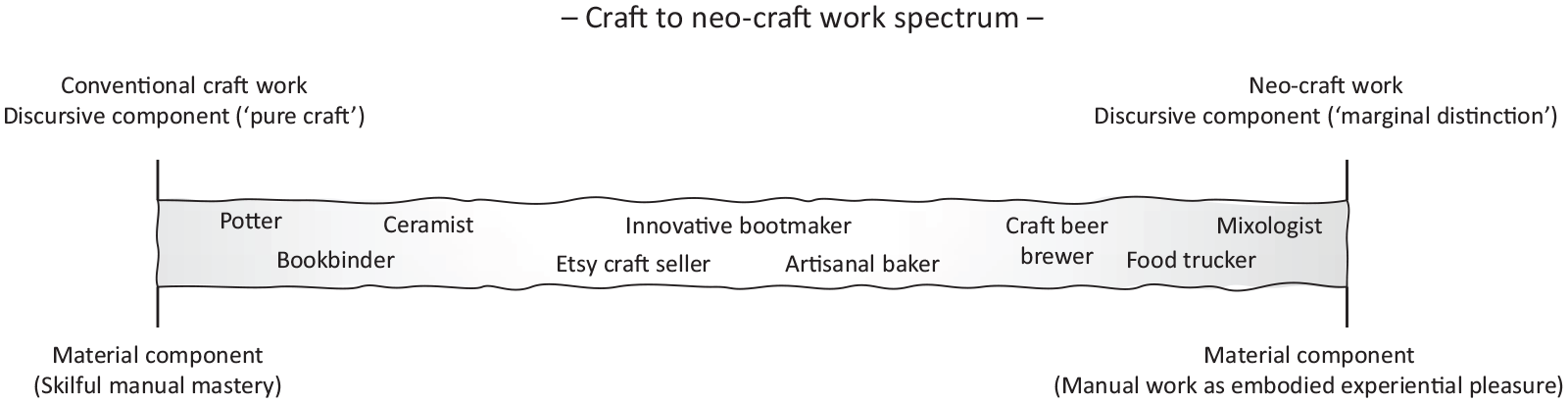
Discursive materiality: spectrum of differentiation (including prototypical examples).
This becomes particularly evident in the example of the new generation of bootmakers in El Paso, Texas, described by Gibson (2016). These have embraced craft production for its relationship with the logics of creative work and authenticity but also have the will to acquire and bequeath the traditional production technique of cowboy boots from the previous generations of bootmakers. As seen earlier with Gabriele’s example, also for Gibson’s (2016, p. 76) bootmakers, in the new craft era workshops are run by people who view themselves as ‘creative’ people with artisanal values, seeking to carve a living from a personal ‘passion’ [. . .] The product’s material shape and dimensions have provided a template for new and ‘retro’ artistic expressions.
On other occasions, instead, there may even be the adoption of technological developments to enable the neo-craft nature of one’s craft work, as in the case of Laura Quinn, a glassblower who integrated prototyping with 3D printing and social media work. In her auto-ethnographic reflections, she points out that her use of digital technology is to ‘expand my audience’s understanding of my identity, of the entire glass making process’. Put differently, for Laura her craft work is not only about mastering glass blowing, ‘and I want them to know that’ (Quinn, 2022).
Conclusion
This article presented a theoretical conceptualization of neo-craft work, with the goal of better understanding its growing significance. We have argued that neo-craft work should be seen among the ‘new forms of work’ of the 21st century, as it represents an emergent form of post-industrial craft work whereby jobs that were previously considered low status, or performed by the working class, are ‘resignified’ into status-producing occupations through the integration of craft practices and values, and conferred new meaningfulness as the outcome of a specific form of discursive materiality, in which discursive and material practices become inextricably connected. We have shown how this finds roots in the cultural negotiations and the practices of of marginal distinction that dominate hipster culture, taken here as the cultural milieu within which neo-craft work emerges, and outlined the notion of ‘discursive materiality’ as an interpretative framework to analyse and define neo-craft work in its intra-acting components. The discursive materiality framework also contributes to the recent but rich practice and affective turns in organizational studies, advancing a model that allows interpretation of the working act, taking into full account human and non-human factors in organizations.
It derives from this interpretation that neo-craft work should not be seen as another kind of craft, as a simple ‘return to the past’ (Bell et al., 2021), but rather one based upon what may be defined as a form of ‘progressive nostalgia’ (Gandini, 2020), which binds together the past and the future in a dialectical relationship, using the past as a future-oriented horizon that is not merely about preservation or conservation, but chiefly about innovation and change. The achievement of ‘good work’ is exemplary of this dynamic: after the demise of Fordism, this has been a long-standing promise of creative work (Hesmondhalgh & Baker, 2010; McRobbie, 2016), based on the fulfilment of autonomy and self-expression in contrast to the impoverishment of working conditions caused by industrialization (Boltanski & Chiapello, 2007). However, the reality of creative industries’ working conditions, made of precariousness, alienation, exploitation and stressfulness (Hesmondhalgh & Baker, 2010; Ross, 2009), have undermined the credibility of this promise. Neo-craft work is taking over from creative work in this endeavour, renewing it on the basis of a resignification of manual work that looks back at the past with a future-oriented mindset. Traditional working-class occupations that involved (allegedly) low-skilled and manual work, as shown elaborating upon Ocejo (2017), are conferred an ‘elite’ status on the basis of cultural negotiations around authenticity and ‘the particular’, in which narration and detection confer value and meaning to these new craft practices. A return to a direct relationship with matter (and nature), the celebration of the embodied pleasure of manual labour and the idealization of the allure of a meaningful work dedicated to ethical rather than purely economic goals (Gerosa, 2021; Ocejo, 2017), are the building blocks of this promise.
Yet, our effort remains an initial step: more work is required both theoretically and empirically to have an in-depth understanding of neo-craft work. Future research will need to provide detailed accounts of work organization, labour processes, job quality and conceptions of status across different neo-craft industries. This would also contribute to further delineating the actual boundary conditions of neo-craft work. Indeed, while neo-craft work challenges traditional notions of craft and ‘menial’ manual labour through their symbolic upscaling, not all forms of manual work seem able to equally sustain discursive materiality based on marginal distinction. Emerging evidence suggests that objects for everyday experiential consumption (food and drinks, but also bikes and clothing, furniture and houseware, etc.) seem to be more prone to hold symbolic value for identity projects or (in)conspicuous consumption display thanks to the taste dealing of neo-craft workers (Gerosa, 2024). Other manual occupations (e.g. house cleaning, plumbing, construction work) might ultimately remain extraneous to such processes. Further research must thus work to refine the understanding of the boundaries of neo-craft work and analyse if and how it contributes to the creation of new hierarchies of symbolic inequality in manual work.
This also highlights the need to conduct research on the potentially critical aspects of neo-craft work, for both workers and society. Indeed, despite neo-craft work taking over the promise of achieving ‘good work’ from creative work, the first empirical explorations suggest that it is not without issues of social and gender inequality, and work precariousness (Delgaty & Wilson, 2023). Additionally, neo-craft businesses are increasingly under the spotlight as drivers of gentrification of urban space (Schiermer, 2014; Wallace, 2019) and of the cultural appropriation of popular consumer cultures (Gerosa, 2024). An in-depth critical exploration of these issues (and beyond) is essential to avoid an academic glorification of neo-craft work, similar to that which has occasionally happened in the past with creative work.
Nonetheless, while acknowledging its inevitable limitations, we contend that this article serves the key purpose of mapping the terrain on which debates over the contemporary status and significance of craft work are taking place, as well as delineating an original framework for understanding the specifics of ‘neo-craft’ work within that terrain. Seen from this perspective, neo-craft work emerges as being more than just a fashionable trend. Paraphrasing Neff, Wissinger and Zukin (2005), it may be argued that neo-craft work represents the new ‘cool job in a hot industry’, whose significance is likely to further increase in the post-Covid-19 pandemic scenario, where questions around the meaningfulness of work have become fully mainstream, epitomized among other things by the emergent ‘great resignation’ debate (D. Thompson, 2021).
Footnotes
Acknowledgements
The authors thank the anonymous reviewers and the Guest Editors, particularly Jochem Kroezen, for their support and extremely insightful comments throughout the review process.
Funding
The author(s) disclosed receipt of the following financial support for the research, authorship, and/or publication of this article: This article is part of the CRAFTWORK project, which has received funding from the European Research Council (ERC) under the European Union’s Horizon 2020 research and innovation programme (Grant agreement No. 948982).
