




Abstract
Drawing on leader–member exchange and conservation of resources theories, we investigate the role of the quality of leader–member exchange in the relationships between supervisors’ and subordinates’ cynicism and dedication. Survey responses were collected from 104 supervisors and 971 subordinates nested within 104 work-units in five organizations in Finland. A multilevel structural equation model and cross-level mediation were utilized to test the hypotheses. The results show that the quality of leader–member exchange mediates the association between supervisor cynicism and subordinate cynicism and dedication. However, supervisor dedication does not appear to have an influence on leader–member exchange or subordinate cynicism and dedication. The findings related to the influence of supervisor cynicism on the cynicism and dedication of subordinates point toward the value of management interventions that directly address supervisor psychological well-being. Practical interventions might include training for supervisors and employees to enhance relationship-building skills, team-building activities, and leadership development. This empirical study is novel in its focus on how a supervisor’s cynicism and dedication may affect their relationships at work and how this, in turn, may have an effect on their subordinates.
Keywords
In many workplaces worldwide, organizational leaders are facing the challenge of finding ways to encourage employees to identify with their work. Integral to this challenge are efforts to prevent negative attitudes such as cynicism and to build positive employee attitudes such as dedication. These are important attitudes for employees’ psychological well-being as well as productivity and organizational performance (Bakker et al., 2011; van Rossenberg et al., 2018; Young et al., 2018). Attitudes such as cynicism and dedication do not arise in a vacuum; they are embedded in and affected by social relationships at work (see, e.g., Lorinkova & Perry, 2017) and the dyadic relationships between leader and follower are an essential part of an organization’s social networks. Previous research has demonstrated the important role of line managers and supervisors in employee attitudes and psychological well-being (Kuvaas & Buch, 2018; Medler-Liraz & Seger-Guttmann, 2018; Schuh et al., 2018), although several scholars have called for research to investigate the process of how supervisor and subordinate attitudes are connected (Harms et al., 2017; Skakon et al., 2010). Our study builds on this understanding and contributes novel knowledge by addressing the research question: Are supervisor and subordinate cynicism and dedication associated via the quality of their dyadic relationship?
Cynicism and dedication represent negative and positive aspects of identification with work and are important elements of psychological well-being at work (Bakker & Leiter, 2010; Mäkikangas et al., 2017; Schaufeli & De Witte, 2017). On the negative side, employees who do not identify with their work are often described as experiencing burnout, and more specifically, cynicism. Burnout cynicism (also referred to as depersonalization) is a core dimension of burnout, which organizational psychologists have studied as a critical indicator of negative psychological well-being (Maslach et al., 2001; Salmela-Aro et al., 2011). The burnout literature defines cynicism as a disinterested or distal attitude toward work in general and the people with whom one works, losing interest in one’s work, and not seeing work as meaningful (Maslach et al., 2001; Salmela-Aro et al., 2011). Burnout cynicism is also linked to decreased investment in social interactions (Nesher Shoshan & Sonnentag, 2019). We focus on burnout cynicism because it is the interpersonal dimension of burnout and therefore most relevant to social relationships at work.
On the positive side, previous studies have contrasted burnout cynicism with dedication, which is defined as a motivational and emotional dimension of work engagement that also has been identified as a positive indicator of psychological well-being (Bakker et al., 2011; Schaufeli & Bakker, 2010). Dedication refers to a strong sense of involvement in one’s work, feelings of enthusiasm and significance, and a sense of pride, challenge, and inspiration found at work (Bakker, 2011; Schaufeli & Bakker, 2010). Our study focuses on dedication, which conceptually resembles, yet is distinct from, the constructs of organizational commitment and job involvement (Christian et al., 2011; Schaufeli & Bakker, 2010). Dedication is about identifying with the work itself, the work role, or work group (Christian et al., 2011). It is likely that dedication in the context of supervisory work is related to positive feelings toward other people in the organization, for example, being proud of the achievements of their work group. Therefore, dedication is highly relevant to one’s social relationships at work.
The dyadic relationships between leader and follower are an essential part of an organization’s social networks and often studied through the lens of leader–member exchange (LMX) theory. LMX is based on the idea that each relationship between a supervisor and his or her subordinates is unique and differs from others in quality. LMX relationships develop through social exchanges between relationship parties (Bauer & Green, 1996; Dienesch & Liden, 1986; Graen & Uhl-Bien, 1995) and are most likely to be initiated by the supervisor (Dulebohn et al., 2012; Gregersen et al., 2016; Liden et al., 1997). Developing and maintaining high-quality LMX relationships requires psychological investments to be made by the supervisor (Nienaber et al., 2015; Schaufeli, 2006). There is also some empirical evidence that impaired well-being of a leader, especially leader stress, is linked to abusive supervision (see the recent meta-analysis by Harms et al., 2017). Therefore, the supervisor’s cynicism and dedication are likely to play an important role in the quality of LMX relationships she or he is able to build and maintain. Unfortunately, previous studies reveal very little about how a supervisor’s cynicism or dedication may affect his or her LMX relationships, so the first contribution of our study is to address this gap in knowledge.
Previous research has established a wide range of positive outcomes for LMX (Dulebohn et al., 2012; Ilies et al., 2007), and several studies have connected the quality of LMX with the well-being of workers (e.g., Christian et al., 2011; Gregersen et al., 2016; Harms et al., 2017; Jiang et al., 2014; Medler-Liraz & Seger-Guttmann, 2018; Sparr & Sonnentag, 2008). However, these studies have focused either on positive well-being indicators such as work engagement (Christian et al., 2011) or negative indicators such as stress and burnout symptoms (Gregersen et al., 2016; Harms et al., 2017; Jiang et al., 2014; Medler-Liraz & Seger-Guttmann, 2018) or job depression (Sparr & Sonnentag, 2008). The second contribution of our study is that we focus on both negative (i.e., cynicism) and positive (i.e., dedication) employee outcomes of LMX.
While it has been shown that LMX relationship quality plays a mediating role in the relationships between several different antecedents and outcomes (see Dulebohn et al., 2012, for a meta-analysis), only a few studies have investigated the mediating role of LMX related to psychological well-being indicators (Gregersen et al., 2016; A. Hassan & Al Jubari, 2010; Sparr & Sonnentag, 2008). There is evidence that, for instance, stress can be transmitted from one person to another either directly via empathy or indirectly via different mediation mechanisms (Westman, 2001; see also Chen et al., 2015). In the context of relationships at work, transmission of supervisor cynicism, or dedication to subordinates may happen directly or indirectly, for example, through the supervisor’s activity in exchanges with his or her subordinates, in particular, LMX. Thus, we propose that LMX relationship quality has the potential to mediate the relationship between a supervisor’s cynicism and dedication and the subordinate’s cynicism and dedication. Therefore, our third contribution is to investigate this mediated relationship.
However, to understand the role of LMX in the relationship between supervisor and subordinate indicators of psychological well-being, we need to look beyond LMX. To explain this connection, we bring together the theoretical perspectives of LMX and conservation of resources (COR).
COR theory (Hobfoll, 1989, 2001, 2002; Hobfoll et al., 2018) is one of the leading theories of psychological well-being (Chen et al., 2015). The fundamental base for this perspective is that people tend to obtain, retain, protect, and foster the things that they value and these different types of valued things are called resources (Hobfoll, 2001, 2002). Resources can be, for instance, time, skills, personality traits, or social support. For instance, working with a supervisor who provides social support can be one type of resource employees have at work (Halbesleben et al., 2014; Hobfoll, 2011). COR theory states that individuals who have resources are likely to acquire even more. However, where there is a lack of resources it is likely that they will diminish further (Halbesleben et al., 2014; Hobfoll, 2001, 2002). Furthermore, lack of resources leads to stress and burnout, which, in turn, leads to negative organizational outcomes, such as poorer job performance (Chen et al., 2015).
Building on COR theory’s (Hobfoll, 1989) explanation of resource protection, gain, and preservation, Bolger et al. (1989) added the notion of resource exchange or crossover. As described by Hobfoll et al. (2018), a crossover refers to the transmission of psychological states, experiences, emotions, or resources between individuals in dyads or workgroups, in social and organizational contexts. This is particularly salient to our study because we suggest that high-quality LMX serves as a resource (Hobfoll et al., 2018) that underlies the connection between supervisor and subordinate. Specifically, we develop and test hypotheses in relation to how supervisor cynicism and dedication start a path leading to subordinate cynicism and dedication, where the quality of LMX relationships serves as a linking mechanism for crossover.
Below, we review the literature and discuss the relationships involved in more detail. After explaining our research survey method, empirical evidence is presented and discussed. The article concludes with a discussion of the implications of the research.
Supervisor’s Cynicism and Dedication and Leader–Member Exchange Relationship Quality
The central argument in LMX theory is that the leader creates a unique exchange relationship with each of his or her followers and the quality of these relationships will vary from high to low (Liden & Maslyn, 1998; for a review, also see Schriesheim et al., 1999). LMX relationships between a supervisor and each of his or her subordinates develop through social exchanges that entail a series of interdependent interactions between parties. Through exchanges, dyad partners generate obligations and expectations for each other. Depending on how well those expectations are met, the quality of the relationship will develop in either a negative or positive manner (Bauer & Green, 1996; Dienesch & Liden, 1986) leading either to low- or high-quality supervisor–subordinate dyads (Liden & Maslyn, 1998).
Due to differences in organizational roles and the power relations between dyad partners, LMX exchanges are typically initiated by the supervisor (Dulebohn et al., 2012; Gregersen et al., 2016; Liden et al., 1997). For instance, delegation of tasks by a supervisor to a subordinate has been positively linked to the quality of LMX relationships (S. Hassan et al., 2015; Schriesheim et al., 1998). Furthermore, it has been suggested that where a subordinate performs well with the delegated tasks, the supervisor will be more satisfied, give better feedback and assign additional interesting work tasks; this process leads to positive development of the LMX relationship (Choy et al., 2016). In general, supervisor-related behavior, such as a supervisor’s recognition and reward of subordinates’ good performance (Wayne et al., 2002) and supervisor characteristics such as extraversion, a personality trait related to sociability and individual consideration (Bono & Judge, 2004) and agreeableness, a trait associated with cooperative and helpful behavior, have been found to be important antecedents for the quality of LMX relationships (Dulebohn et al., 2012).
Intensive social exchanges in working life, especially those in which supervisors are engaged (e.g., providing feedback and recognition for accomplishments) when developing and maintaining high-quality LMX relationships, require psychological investments (Nienaber et al., 2015; Schaufeli, 2006). Drawing on COR theory’s notion of accumulation and diminishment of resources, we can expect that individuals who have resources (e.g., social support) are likely to gain even more, while where there is a lack of resources it is likely that they will diminish further (Halbesleben et al., 2014; Hobfoll, 2002, 2011). Thus, with the help of COR theory, we can expect that where a supervisor suffers from high cynicism she or he is likely to have few resources to invest in interactions with his or her subordinates, as cynicism is related to distancing oneself from social relationships at work and being disinterested in people with whom one works (Maslach et al., 2001). Previous research has found that leaders who are negative and cynical are less likely to be supportive of their subordinates (Rubin et al., 2009). A recent meta-analysis (Harms et al., 2017) found support for the notion that depersonalization (cf. cynicism) is negatively related to a transformational leadership style. The same study also reported that leader stress is positively related to abusive supervision.
Thus, it is likely that a supervisor with a high level of cynicism will find it difficult to be interested in his or her subordinates’ work, give recognition and feedback, and be available when they need help; all of these are crucial elements in LMX relationship building. Even though LMX relationships are dyadic and the quality of each LMX is different from each other, subordinates who have a supervisor high in cynicism are likely to have a different average level of LMX than subordinates whose supervisor is not suffering from cynicism. Thus, supervisor cynicism can impair all LMX relationships in the unit or reduce the number of high-quality LMX relationships. In both cases, the unit’s average LMX level is lower when compared with units with a less cynical leader. Therefore, we hypothesize as follows:
In contrast to the negative role of cynicism, people with a high level of dedication find their work to be meaningful and valuable and they are proud of their job (Bailey et al., 2017; Meng & Wu, 2015). Again, applying COR theory, we may expect that where a supervisor’s dedication is high, she and he will have resources (e.g., a positive mind-set and communication skills) to invest in interactions with subordinates (Halbesleben et al., 2014). Thus, supervisors high in dedication may enact strong involvement with their subordinates and strengthen their relationship-building activities as a part of their supervisory work. In contrast, supervisor low in dedication may not involve in such behavior and activities and thus the average level of LMX relationships between supervisors with high and low dedication are likely to vary. Therefore, we suggest that supervisor dedication could be a critical antecedent for LMX relationship quality and we hypothesize as follows:
LMX Relationship Quality and Subordinates’ Cynicism and Dedication
To explore and explain the link between LMX relationship quality and subordinates’ cynicism and dedication, we again apply COR theory (Hobfoll, 2001; Hobfoll et al., 2018). According to COR theory, several types of resources are salient to employees’ attitudes and psychological well-being, and a high quality of relationship with one’s supervisor is one of the important resources that can be acquired in a workplace (Halbesleben et al., 2014; Hobfoll, 2011). A high-quality LMX relationship offers direct resources to the worker such as emotional and social support, desirable work assignments, and job direction (Dulebohn et al., 2012; Gerstner & Day, 1997). High-quality LMX relationships also serve as an instrumental resource, as they give workers access to additional resources such as autonomy, developmental opportunities, and extra information, because the leader actively creates a resource-rich work environment for followers (e.g., Breevaart et al., 2015). Empirical research supports the view that a high-quality LMX relationship functions as a job resource and can therefore have a positive effect on subordinates’ attitudes and well-being (Furunes et al., 2015; Karanika-Murray et al., 2015; Sparr & Sonnentag, 2008). While there is strong evidence connecting LMX with work engagement in general (Christian et al., 2011; Meng & Wu, 2015), our research offers a novel contribution by focusing on the specific connection between LMX and dedication.
On the other hand, subordinates with poor-quality LMX relationships are likely to have few meetings with their supervisor, and receive very little support and positive feedback about their work from him and her (Dulebohn et al., 2012). Poor-quality LMX may also indicate that dyad partners do not like each other but due to organizational structure they are forced to work together (Dulebohn et al., 2016). These kinds of work situations lead to negative outcomes and poor-quality LMX relationships have been associated specifically with subordinates’ cynicism (Becker et al., 2005; Jiang et al., 2014; Schaufeli & Bakker, 2004) as well as with burnout in general (e.g., Huang et al., 2010; Thomas & Lankau, 2009). Explained through the lens of COR theory, the resource loss associated with a poor-quality relationship with one’s supervisor can have a profound negative impact on employees (Halbesleben et al., 2014).
Based on COR theory and relevant empirical findings, we hypothesize as follows:
A meta-analysis by Dulebohn et al. (2012) has shown that LMX relationship quality plays a powerful mediating role in explaining the relationships between several different antecedents and outcomes. Those studies mainly focused on aspects of justice and fairness. For example, Hassan and Al Jubari (2010) found that LMX mediates the relationship between organizational justice and subordinates’ work engagement. Some evidence was also found to support the view that LMX may mediate the association between a supervisor’s behavior and a subordinate’s psychological well-being. In particular, LMX has found to mediate the association between perceived fairness of supervisor feedback and job-related depression (Sparr & Sonnentag, 2008). In addition, a study by Gregersen et al. (2016) focused on the mediating role of LMX and burnout. These authors found that LMX mediates the positive link between job resources (in particular, role clarity, meaningfulness, and predictability) and reduced emotional exhaustion, which is another core indicator of burnout alongside cynicism.
Only a few studies have investigated the mediating role of LMX related to psychological well-being. However, there is evidence that, for instance, stress can be transmitted from one person to another either directly or indirectly (Westman, 2001). Direct transmission happens through empathy and occurs typically in close relationships, for example, between husband and wife. There is also some evidence that leaders’ emotions are related to employees’ emotions (see, for a review, Skakon et al., 2010). Also, indirect transmission can occur via a mediating mechanism (Chen et al., 2015). In their review paper, Skakon et al. (2010) reported that there is some evidence that may indicate that leader burnout is linked to leader behavior and through that, to employees’ burnout. However, these studies (Price & Weiss, 2000; Vealey et al., 1998) have been conducted in the field of sports psychology and in the context of coach–coachee relationship and therefore the results are not directly comparable to the workplace context.
Drawing on this literature, we suggest that emotional states transfer from supervisor to subordinate through the supervisor’s ability to build or maintain LMX relationships that offer resources to the subordinates. Thus, LMX relationship quality will serve as a crossover mechanism (Hobfoll et al., 2018) and mediate the relationship between the supervisor’s cynicism and dedication and the subordinate’s cynicism and dedication. It is however unlikely that LMX quality would be the only mediating mechanism and there could also be direct crossovers, so we will also model the direct effects between supervisor and subordinate cynicism and dedication. Therefore, we propose the following mediation hypotheses:
Our hypothesized multilevel model is shown in Figure 1 below. Subordinates reported quality of LMX, cynicism and dedication and supervisors of the units provided the information about their cynicism and dedication. Thus, cynicism and dedication of the supervisor were measured at the unit level, while LMX quality, cynicism, and dedication of the subordinates were observed at the individual level.
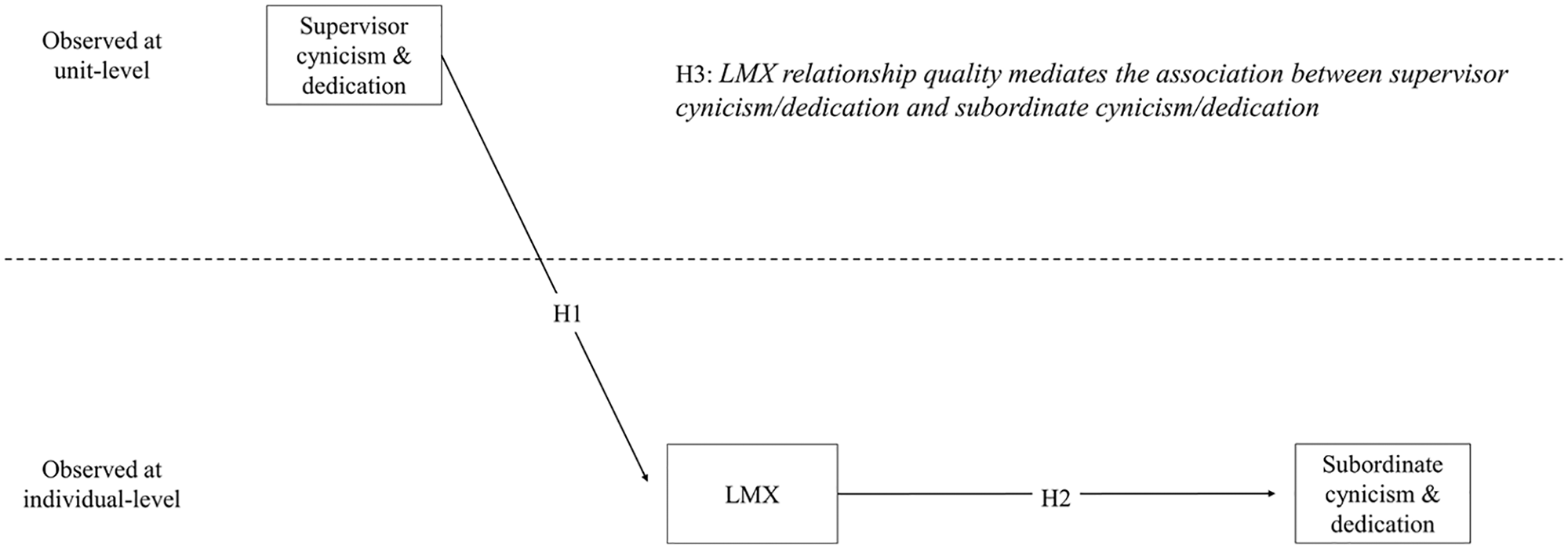
The conceptual model and hypotheses of the study.
Method
Sample and Procedure
The sample for this study was recruited in 2011-2012 from five different Finnish organizations, which give a broad representation of the service sector. The combined sample was utilized in the analysis to have more statistical power in estimation and enough work-units to analyze a multilevel model. We collected data by using both paper and online versions of a questionnaire. The paper version was used where employees did not use computers in their daily tasks. In some organizations, a member of the research team administered the survey in meetings with employees arranged by the participating organization, with time allocated to facilitate survey completion. Where there was no opportunity to arrange a meeting, paper questionnaires were delivered with prepaid envelopes to employees who returned their completed questionnaires directly to the research team. The online version was administered via a link emailed to the supervisors or the organization’s contact person, who distributed an email to employees using an internal organizational email list. It is not possible to calculate response rates because there is no information on how many employees received the invitation to the online questionnaire. All participants were informed that their participation was voluntary and responses to the surveys would remain confidential. The participants were asked to give the name of their supervisor and this information was used to determine the work-unit to which each subordinate belonged. It was possible for the researchers to identify each supervisor, as there was a possibility for each participant to give their name confidentially.
A total of 1,430 responses from employees and 142 from supervisors were obtained from organizations including an insurance company (n = 334), a communal day-care organization (n = 364), a logistics organization (n = 488), a retail company (n = 175) and a finance organization (n = 211). In the final sample there were 971 matched responses from employees nested within 104 work-units, and 104 supervisors. The majority of respondents (73.4%) were female, which is explained by the day-care organization with a majority female workforce being one of the participating organizations. The average (mean) age of respondents was 42.77 years (SD = 12.05) and the average tenure with their current employer was 11.35 years (SD = 11.31). The majority of the respondents have had the same supervisor for between 1 and 7 years (52.4%) or less than 1 year (40.2%). The respondents identified their direct supervisor and all employees sharing the same supervisor were defined as a work-unit. The number of employees in work-units ranged from 1 to 40 (M = 9.34; SD = 7.43). Almost half of the respondents were in work-units with 21 to 40 employees.
Measures
Cynicism
To measure burnout cynicism, we used the validated Finnish version of the five-item subscale of the Bergen Burnout Inventory (Näätänen et al., 2003). A sample item is as follows: “I find it difficult to involve myself in my customers’ or my other employees’ problems.” Supervisors and subordinates were asked to rate their own cynicism using a 6-point Likert-type scale ranging from completely disagree (1) to completely agree (6). The Cronbach’s alpha coefficient for the cynicism measure was good for supervisors (α = .86) and subordinates (α = .86).
Dedication
Dedication was measured with the three-item subscale of the Utrecht Work Engagement Scale using the validated Finnish version (Seppälä et al., 2009). The items were as follows: “I am enthusiastic about my job,” “My job inspires me,” and “I am proud on the work that I do.” Supervisors and subordinates were asked to rate their own dedication using a scale ranging from never (0) to every day (6) and the reliability of the scale was good for both the supervisors (Cronbach’s α = .87) and subordinates (Cronbach’s α = .88).
Leader–Member Exchange
LMX measures the quality of the work relationship occurring in an organization between two vertically-related individuals, supervisor, and subordinate. We utilized a validated Finnish nine-item LMX-UVA scale that is a refinement of previous scales (e.g., LMX-7; Tanskanen et al., 2019). Subordinates were asked to complete the LMX-UVA scale with a 7-point Likert-type scale ranging from (1) strongly disagree to (7) strongly agree. Sample items include the following: “We trust each other” and “We can genuinely listen to each other’s opinions.” The reliability of the scale was excellent (Cronbach’s α = .97).
Control Variables
Several possible confounders were controlled in the analysis as they might influence the connections between supervisor cynicism and dedication, LMX and subordinate cynicism and dedication. As our sample came from five organizations and by controlling the organization (organizations dummy-coded and insurance company as a reference), we can state the relationship between supervisor and subordinate cynicism and dedication via LMX is not simply caused by the differences between organizations.
Furthermore, organizational tenure in years, age, and gender of the participant (coded female = 0, male = 1) were controlled for because earlier studies have reported that these can be related to psychological well-being (Cheng et al., 2013; Purvanova & Muros, 2010). We also controlled for the tenure of the LMX relationship (1 = younger than 1 year, 2 = 1-2 years, 3 = 2-7 years, 4 = older than 7 years) because the temporal aspect has been found to influence outcomes related to LMX quality (Harris et al., 2006). Finally, we controlled for the size of the work-unit using information reported by the supervisors (1 = under 13, 2 = 13-20, 3 = 21-40, 4 = over 40) as it might act also as a confounder. Categorical control variables were dummy-coded for the analysis.
Measurement Model and Missing Data
Unfortunately, it was not possible to run a complete two-level measurement model, because it had more parameters than there were work-units. However, measurement models where LMX was analyzed only at the within level, χ2(215) = 660.83; root mean square error of approximation (RMSEA) = .05; within standardized root mean square residual (SRMR) = .04; between SRMR = .11; Tucker–Lewis index (TLI) = .96; comparative fit index (CFI) = .96, or where supervisor cynicism and dedication were analyzed at the between level, and LMX, subordinate cynicism, and dedication at the within level, χ2(135) = 429.07; RMSEA = .05; within SRMR = .04; between SRMR = .07; TLI = .97; CFI = .97, both produced acceptable model fits. With regard to standard goodness-of-fit cutoff values, RMSEA < .05 and SRMR <.08 are indicators of acceptable fit, and TLI and CFI values over .95 indicate a good fit (e.g., Hu & Bentler, 1999).
The main study variables held very small amounts of missing data (1-15, less than 1.5% of the whole sample). There were more missing values regarding organizational tenure (N = 60), age (N = 179), and gender (N = 68) and therefore full information maximum likelihood estimation was utilized in the analysis to handle the missing data.
Analysis
As the data were collected from supervisors and subordinates nested within work-units, multilevel structural equation modeling (MSEM) was employed to test our hypotheses (Preacher et al., 2010). MSEM was also appropriate because the data were collected at both work-unit level (supervisor cynicism and dedication) and individual level (subordinate LMX, cynicism and dedication; 2-1-1 model). As the data are nested within units there is only work-unit-level variance regarding the supervisors’ cynicism and dedication. Thus, the effect of supervisor cynicism and dedication on LMX can be examined only at the work-unit (between) level. We used Mplus (7.4) software with robust maximum likelihood estimation (Muthén & Muthén, 1998-2015). Compared with the standard multilevel modeling paradigm, the MSEM strictly and without bias separates within- and between-level effects (Preacher et al., 2010).
We utilize a cross-level mediation approach as described by Pituch and Stapleton (2011; 2012; also see Krull & MacKinnon, 2001; Talloen et al., 2016; VanderWeele, 2010), where unlike the cluster-level only mediation approach (see Preacher et al., 2010; Zhang et al., 2009) a mediation process can flow through an individual-level mediator, if it is theoretically plausible that the individual-level outcome could be influenced by an individual-level mediator that reflects absolute scale value, not relative standing in a group. Our study satisfies these conditions as it is safe to assume that an employee’s personal LMX quality impacts employee cynicism and dedication, and further that it is the absolute level of LMX rather than relative position in the work-unit that is important. Because of this, the cross-level mediation is a more suitable approach for this study. Moreover, a big advantage of cross-level mediation approach is that there is more information in estimating an individual cross-level indirect effect than a cluster-level only indirect effect (there are more observations at the individual than unit-level). This means that a cross-level mediation approach has a huge power advantage in finding indirect effects over the cluster-level approach (Pituch & Stapleton, 2012).
The regression paths and cross-level mediation effects were estimated utilizing two separate models (Model 1 and Model 2) following Pituch and Stapleton’s (2011) instructions. Model 1 examines the effect of supervisor cynicism and dedication on LMX at the unit-level, while Model 2 estimates the relationship between LMX and employee cynicism and dedication at the individual level. Grand-mean centering was utilized for predictors and only fixed slopes were estimated. The confidence intervals (CIs) for the cross-level indirect effects were estimated with the Monte Carlo method, with 20,000 simulations, utilizing the interactive online tool developed by Selig and Preacher (2008). Our analytical approach is consistent with similar recent examples of cross-level mediation in management research (e.g., Cooper et al., 2019).
In cross-level mediation the mediation may happen at the individual level and also through cluster-level aggregate of the mediator. Estimating these two indirect effects instead of their combination, as in cluster-level only approach, is interesting as the individual level effects are usually theoretically the most important; in addition, contextual effects are often hypothesized to be present in multilevel designs. Contextual effect is defined as the difference between individual (within) and aggregated (between) effects. An additional analysis was estimated to study the contextual effect of LMX relationship quality on subordinate cynicism and dedication. Contextual effect measures whether the collective LMX relationship quality of a work-unit (group average) contributes any additional effect beyond the effect of individual LMX (Pituch & Stapleton, 2012). In other words, we study whether belonging to a unit with for example a high average LMX level brings any extra increase/decrease to the individual dedication/cynicism. For example, high average LMX level in the unit might lead to an extra increase in employee dedication.
Results
Table 1 presents the means, standard deviations, and intercorrelations among the study variables at work-unit and individual levels. Intraclass correlations indicate how much employees resemble each other in the same work-unit. Of the study variables, LMX had the largest intraclass correlation (.15), while dedication (.11) and cynicism (.08) were at lower levels. The intercorrelations between study variables were moderate at both the work-unit and the individual levels. The associations followed the hypothesized direction. The measure of supervisor cynicism was positively correlated with subordinate cynicism (r = .35, p = .005) and negatively with subordinate dedication (r = −.40, p < .001) and LMX (r = −.32, p = .025). The correlations for supervisor dedication were a bit lower with subordinate cynicism (r = −.29, p = .030), and dedication (r = .37, p = .001), and the correlation with LMX was not significant (r = .20, p = .155). LMX was connected more strongly with subordinate cynicism and dedication at the work-unit level (r = −.45, p =.003 and r = .43, p = .009) than at the individual level (r = −.28, p < .001 and r = .28, p < .001). The correlation between subordinate cynicism and dedication was also larger at the work-unit (r = .88, p < .001) than individual level (r = −.49, p < .001) and the connection was stronger than among supervisors (r =.−65, p < .001).
Means, Standard Deviations, and Correlations Among the Study Variables.
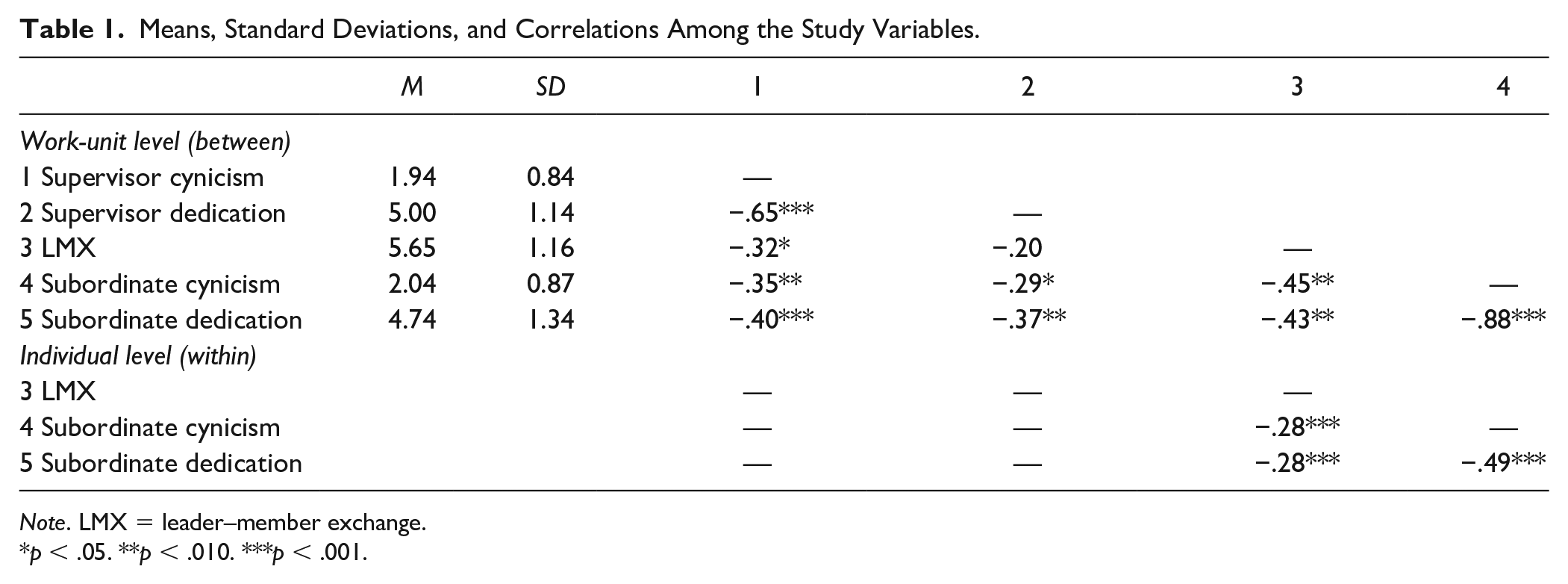
Note. LMX = leader–member exchange.
p < .05. **p < .010. ***p < .001.
The standardized results of the two MSEM models utilized in cross-level mediation (Model 1 and Model 2) are presented in Table 2. All models were saturated and therefore had a perfect fit to the data. The analysis revealed that in work-units where the supervisor was more cynical, subordinates reported on average lower quality of LMX relationships (β = −.34, p = .029), which supported our Hypothesis 1a. However, the association between supervisor dedication and LMX (β = −.08, p = .642) was not statistically significant and thus our Hypothesis 1b was not supported.
Results for the MSEM Models 1 and 2.
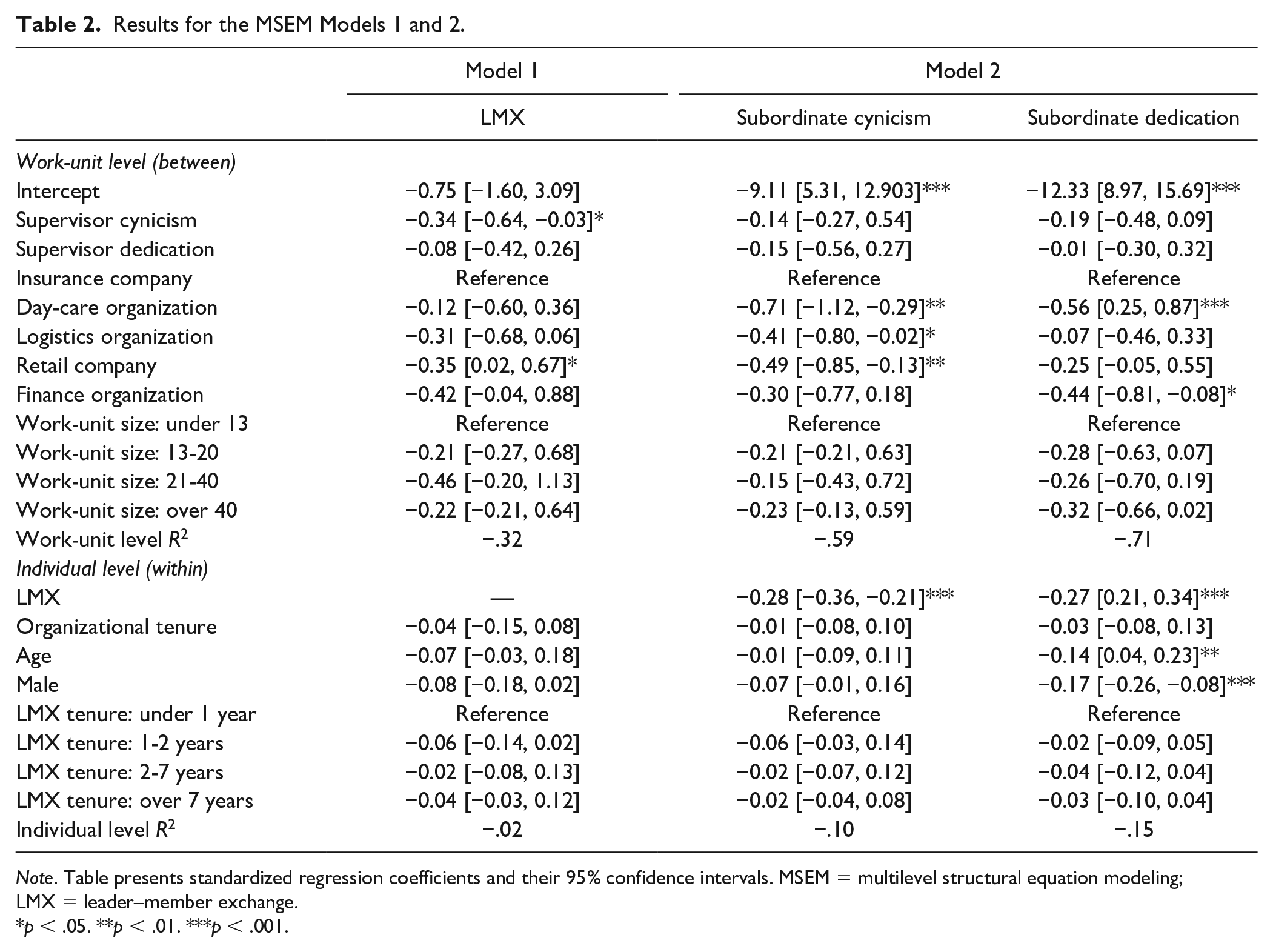
Note. Table presents standardized regression coefficients and their 95% confidence intervals. MSEM = multilevel structural equation modeling; LMX = leader–member exchange.
p < .05. **p < .01. ***p < .001.
The individual level effects of LMX on subordinate cynicism (β = −.28, p < .001) and dedication (β = .27, p < .001) were statistically significant. Hypotheses 2a and 2b were both supported as subordinates reporting higher quality of LMX relationships experienced lower levels of cynicism and higher levels of dedication. In addition, the direct links from supervisor to subordinate cynicism and dedication were tested at the work-unit level and none of the direct effects between supervisor and subordinate cynicism (β = .14, p = .506 and β = −.15, p = .488) and dedication (β = −.19, p = .182 and β = .01, p = .926) were significant.
The contextual effect of LMX relationship quality was estimated in an additional analysis that clearly revealed that LMX did not have a contextual effect on subordinates’ cynicism (β = .04, p = .534) or dedication (β = −.05, p = .572). This means that the average LMX relationship quality of the work-unit members did not have any influence on their cynicism and dedication above and beyond the individual-level association between LMX and subordinate cynicism and dedication.
The significance of cross-level indirect effects was examined with the Monte Carlo method. Two cross-level indirect effects can be viewed as significant because the CIs of the estimates do not include zero. LMX significantly mediated the effect of supervisor cynicism on subordinate cynicism (β = .10, 95% CI [0.01, 0.19]) and subordinate dedication (β = −.09, 95% CI [−0.18, −0.01]) supporting Hypotheses 3a and 3b. More cynical supervisors were associated with lower LMX relationship quality, which in turn led to higher levels of subordinate cynicism and reduced subordinate dedication. In contrast, where a supervisor was more dedicated to work, this was not significantly associated with LMX relationship quality nor through that with cynicism (β = .02, 95% CI [−0.07, 0.12]) and dedication (β = −.02, 95% CI [−0.12, 0.07]), thus Hypotheses 3c and 3d were not supported.
With regard to the control variables, results indicated that (subordinate) women and older workers tended to report higher levels of dedication than did men or young workers. Organizational tenure, current LMX tenure, and size of the work-unit were not connected to any outcome variable, while some differences were found across organizations in terms of LMX relationship quality and subordinate cynicism and dedication.
Discussion
In this research, we applied LMX and COR theories to investigate the role of LMX relationship quality as a mediator between the cynicism and dedication of supervisors and their subordinates. Our work contributes to the management literature and in particular, to the field of LMX. Theorizing a process from leader cynicism and dedication to subordinate cynicism and dedication via LMX and with the help of COR theory opens novel avenues to explain and study different kinds of resources (e.g., psychological resources of leaders) important for the leadership process. Resource loss and gain mechanisms help us better understand the antecedents, underlying mechanisms, and outcomes of LMX. In addition, our study also contributes to the literature on work well-being by highlighting the importance of LMX as a possible underlying mechanism linking supervisor and subordinate cynicism and dedication to each other. Moreover, our study not only contributes to scholarly knowledge, it also has valuable implications for practical application, such as helping to shape intervention strategies to improve employee identification.
We found mixed results for our hypotheses. With regard to our first set of hypotheses, while supervisor cynicism was found to be negatively associated with the quality of LMX relationships in the work-unit, the expected positive influence of supervisor dedication was not found. By focusing on supervisor cynicism and dedication, our study extends research into antecedents of LMX relationship quality (e.g., Dulebohn et al., 2012; Nienaber et al., 2015) and addresses calls for research into associations between the attitudes and well-being of leaders and their employees (Gregersen et al., 2016; Harms et al., 2017; Skakon et al., 2010). However, our findings are only partially consistent with LMX theory. Our findings provide novel evidence about how a leader’s well-being may affect their ability to perform in a leadership role and suggest that a supervisor’s negative attitudes could have a stronger influence on LMX relationship quality than might a supervisor’s positive attitudes. This can be explained through the lens of COR theory, which posits not only that loss of resources is more salient than gain (Hobfoll, 2001; Hobfoll et al., 2018) but also can lead to substantial negative outcomes for subordinates’ attitudes and psychological well-being (Halbesleben et al., 2014; Skakon et al., 2010).
Our second set of hypotheses was fully supported: We found LMX relationship quality to be positively associated with subordinate dedication and negatively associated with subordinate cynicism. This is consistent with COR theory (Hobfoll et al., 2018) and supports the notion of LMX relationship quality as a job resource for subordinates (Gregersen et al., 2016). This finding provides novel knowledge about outcomes of LMX and also about the role of leadership in work and employees’ attitudes.
With regard to our third set of hypotheses, we found support for the mediating role of LMX in the link between supervisor cynicism and subordinate cynicism and dedication, as predicted in Hypotheses 3a and 3b. The results show a negative effect of supervisor cynicism on their work-unit’s LMX relationship quality and through that on subordinates’ cynicism and dedication, indicating that a supervisor’s negative attitudes present a risk not only for the individual but also for the work-unit (Gregersen et al., 2016; Skakon et al., 2010). Based on our findings we may assume that the supervisor’s cynicism decreases their ability to invest in building dyadic relationships with their subordinates, which in turn reduces the subordinates’ involvement at work and psychological well-being (Halbesleben et al., 2014; Hobfoll et al., 2018). Further studies, such as qualitative and longitudinal research designs, are needed to reveal the mechanisms behind this. In contrast, we did not find support for the proposed mediating role of LMX in the link between supervisor dedication and subordinate cynicism and dedication, as predicted in Hypotheses 3c and 3d. As noted earlier with regard to findings for our first hypothesis, a possible interpretation of this is that a supervisor’s cynicism might be more influential for the work-unit than is the supervisor’s dedication. A highly dedicated supervisor does not appear to have an effect on his/her work-unit LMX relationship quality. This finding can be interpreted with the help of literature bringing together crossover and COR theory (Hobfoll et al., 2018), which suggests that transfer of emotional states and resources from one individual to another happens more slowly and is less impactful for positive transmissions than it is for negative transmissions (Chen et al., 2015). Future studies could explore this further: Perhaps the supervisor’s dedication is more influential in areas other than relationships, such as work-unit performance (Gooty & Yammarino, 2016).
Finally, in an additional analysis we did not find evidence of a contextual effect between LMX relationship quality and cynicism and dedication, meaning that the average LMX of the whole work-unit did not have any additional effect on subordinates’ cynicism and dedication beyond the effect of an individual LMX relationship. This supports the proposition of LMX theory that each LMX relationship is unique. An employee’s own LMX relationship is influential for their psychological well-being; however, the average LMX quality, or relationships between colleagues in the same work-unit, does not influence their cynicism and dedication. To strengthen understanding of this, future research could consider the relative importance of situational and workplace context as well as individual factors in the quality of relationships between supervisors and their subordinates (Dulebohn et al., 2012; Gregersen et al., 2016; Skakon et al., 2010).
Our study contributes new empirical evidence focusing on cynicism and dedication. Our finding that LMX relationship quality at the individual level is related to subordinate cynicism and dedication supports LMX theory, as it is aligned with the proposition of LMX theory that each LMX relationship is unique. Our findings are also consistent with the COR theoretical argument that relationships at work, such as the LMX relationship quality, are key resources for workers (Hobfoll et al., 2018).
Limitations and Future Research
Several limitations of this study must be acknowledged. First, while the results overall are consistent with theory, our reliance on cross-sectional data means that we cannot infer causality and the direction of relationships is unclear. LMX relationships develop over time through an interactive process. Thus, subordinate cynicism and dedication may influence leader attitudes or behaviors that could in turn influence the quality of LMX relationships (Byza et al., 2017; Dulebohn et al., 2012). The findings of this study would need to be replicated with a longitudinal design before stronger inferences could be drawn in relation to the associations between supervisor and subordinate cynicism, dedication and LMX. It may take some time for supervisor attitudes to affect LMX and in turn for LMX to influence subordinates’ attitudes and these temporal dynamics are best captured with longitudinal data. Second, while reliance on the use of self-reported perceptual data is a limitation, we did collect data from multiple sources: supervisors and subordinates. Several steps were taken to account for method bias through careful procedural and statistical research design. Two measurement models for all study variables were estimated utilizing the COMPLEX algorithm in Mplus to test common method bias with an unmeasured latent method factor approach. Comparison of the models indicate that common method bias is unlikely to be a problem in this research as the unmeasured latent method factor model did not produce a better model, Δχ2(1) = 0.618, p = .22; ΔRMSEA = .00; ΔSRMR = .00; ΔCFI = .00; ΔTLI = .00, fit when compared with the normal measurement model (Podsakoff et al., 2012). While perceptual data are appropriate to address our research aim, it would be beneficial for future research to combine perceptual and objective data where possible or to explore LMX evaluation from supervisor or coworker viewpoints, for instance, subordinates’ view of their superiors’ cynicism. Third, although the respondents included almost 1,000 employees from five firms drawn from different industries, there is scope for enhancing the generalizability of the findings by examining the association between supervisor and subordinate cynicism and dedication across a wider range of industries. Finally, future studies might explore additional outcomes related to subordinate cynicism and dedication. In recent studies, both burnout (Son et al., 2014) and work engagement (Agarwal et al., 2012; Breevaart et al., 2015; Burch & Guarana, 2014; Li et al., 2012) have been examined as mediators linking LMX relationship quality with a range of outcomes such as performance, organizational citizenship behavior, and turnover. Future studies could contribute by investigating the specific mediating roles of cynicism and dedication.
It is possible that our findings are culturally specific to Finnish workers, so a valuable direction for future research would be to replicate our findings in other national contexts. Future research might also explore the moderating effects of various demographic and organizational characteristics in the supervisor–LMX–subordinate relationship. In addition, future studies could explore the effect of leader attitudes, such as cynicism or dedication on LMX within a unit from another perspective, LMX differentiation among subordinates (see, e.g., Dong et al., 2020; Haynie et al., 2019; Manata, 2020) and its mediating role in a relationship between supervisors’ and subordinates’ attitudes. In addition, Future research could add the team–member exchange dimension and examine the impact of interplay between LMX and team–member exchange quality on subordinate dedication/cynicism.
Practical Implications
Evidence of the role of LMX relationship quality in the association between supervisor and subordinate cynicism and dedication provides organizational leaders with useful information to substantiate efforts within organizations to influence the identification of their employees. Interventions such as leadership development can play an important role by helping line managers and supervisors to understand the critical role of dyadic relationships in the workplace. Given the pace and extent of change in many contemporary organizations, supervisors often experience substantial stress during organizational restructuring and change, which includes the risk of more severe impairment of their work attitudes and well-being. An important practical implication of our finding is that organizational leaders should pay particular attention to supervisors’ cynicism. Interventions might include initiatives for the prevention and early identification of stress and burnout symptoms, as well as provision of support available to both supervisors and subordinates. Also, leadership development for supervisors could be an effective intervention leading to improved worker attitudes and overall psychological well-being (Kelloway & Barling, 2010). Developmental interventions aiming to increase leader resilience and coping skills would be beneficial not only for the leader but also for subordinates’ attitudes and well-being (Bardoel et al., 2014).
Our findings related to the influence of supervisor cynicism on the cynicism and dedication of subordinates point toward the value of directly addressing supervisor attitudes in efforts to influence the general workforce. Practical interventions might include initiatives to enhance relationship-building skills, team-building activities, and leadership development, which could benefit both supervisors and subordinates.
Conclusion
The overall aim of the current research was to address a gap in understanding by examining the association between supervisor and subordinate cynicism and dedication and the mediating role of LMX in this association. We suggest that application of LMX and COR theories in combination has much to offer research investigating work-teams, relationships, attitudes, and psychological well-being at work. This study contributes to leadership research by providing empirical evidence of the importance of LMX relationship quality for the connection between supervisor and subordinate identification with their work. In combination with the confirmation of the mediating role of LMX in the association between supervisor and subordinate cynicism and dedication, this research highlights the important role played by relationships at work and the value of investment at the supervisory and work-unit level.
Footnotes
Acknowledgements
We are very grateful to Associate Professor Brian Cooper, Monash University, Australia, for his advice on this paper.
Declaration of Conflicting Interests
The author(s) declared no potential conflicts of interest with respect to the research, authorship, and/or publication of this article.
Funding
The author(s) received no financial support for the research, authorship, and/or publication of this article.
