



Abstract
This article offers critical reflections on In Search of Excellence. Located within a discussion of ‘the historical turn’ and offered as a ‘counterhistory’, the article argues that the excellence project has had a profound and enduring impact on management education and on the manner in which we understand and elaborate the problems and processes of management. The article suggests however that the excellence project persists as a form of knowledge and prevails as a set of idealized practice because critics and educators have failed to engage meaningfully with the managerial practices of those organizations vaunted as ‘excellent’. Building upon newspaper archives and longer forms of journalism to provide a novel, critical analysis of the practices of those organizations vaunted as ‘exemplars of excellence’, the article offers tools for a critical pedagogy of business excellence.
Introduction
Critical accounts of In Search of Excellence (Peters and Waterman, 1982) and of the larger excellence project, enabled by the success of this text (Collins, 2022), typically focus upon the practices of Peters and Waterman. This article essays an unusual approach. It will focus upon the conduct of those organizations vaunted as exemplars of business excellence. While conceding that In Search of Excellence has had a profound and enduring impact on management education, and upon the ways in which we now understand the problems and processes of managerial work I will argue that the reputation and longevity of the excellence project builds and depends upon a peculiarly truncated reading of organizational processes and politics. Challenging this reading, I will offer a new counter-history, designed to explore the practices of those organizations said to exemplify business excellence. Building upon newspaper archives the article will reveal wholesale misconduct among the exemplars of excellence. This revelation, as we shall see, demonstrates the rotten core of In Search of Excellence and the tainted legacy of the excellence project.
I am of course aware that any attempt to analyse the excellence project, nowadays, represents a potentially fraught undertaking. In Search of Excellence is, after all, often dismissed as a ‘popular management’ text, unworthy of serious or sustained academic scrutiny (see, for example, Jackson and Carter, 1998). Reflecting upon the excellence project, Collins (2007, 2022) highlights the prevalence of this attitude and yet notes its consequences for academic practice. Documenting fundamental errors of fact within academic criticism he suggests that Peters seems to belong to that category of authors who should be mocked but need not be read. Yet there are good reasons to suggest that In Search of Excellence should be read, must be taken seriously and, indeed, remains relevant to the contemporary practice of management and to management education. We should note, for example, that In Search of Excellence has secured a genuinely worldwide audience. The complexities of international contracts and licensing agreements make it difficult to form reliable estimations of sales nonetheless it would not be an exaggeration to suggest that In Search of Excellence has sold more than 10 million copies since its first release in 1982. 1 Beyond the direct influence, which this text has had on its millions of readers, we must also acknowledge that In Search of Excellence spawned and effectively defines the billion-dollar segment of the publishing industry that is known as ‘popular management’. Indeed, In Search of Excellence may be regarded as the prototype that became the very archetype of a literary genre, which now sustains a billion-dollar business (Collins, 2021). Furthermore, the text has inspired and has shaped a global business certification industry (see Boulter et al., 2013; Ghicajanu et al., 2015). This certification process is significant, I suggest, because it simultaneously defines and advances the practices, deemed central to managerial leadership. Indeed, in gauging organizational processes and practices against core benchmarks, the business excellence certification process actively shapes the manner in which practitioners across a whole range of industries and territories are now obliged to think about; talk about; document and indeed practice ‘management’. Finally, we must concede that the excellence project has exercised a profound influence on management education and on academic inquiry. It has, for example, done much to advance and to enable the constitution of organizations as cultures and has, in this context, repositioned ‘management’ as a form of charismatic leadership, skilled in the art storytelling (see Collins, 2007, 2022; Wood and Wood, 2013). This generalized (re)framing of management has allowed In Search of Excellence to spread beyond its original geographical location and has enabled the production of studies, which consider ‘excellence’ in specific organizational settings (see Moli and Heller, 2009; Sharp, 2022) and in different national contexts (see Boulter at al., 2013; Heller, 2002). Reflecting upon these developments, Ployhart and Bartunek (2019) remind us that the work of Peters and Waterman (1982) remains a powerful force within the academy. A generation of scholars, they observe, has been obliged to position its work as a response to the core ideas and orientations projected by the excellence project. Yet despite some 40 years of academic inquiry, our understanding of In Search of Excellence remains limited because scant attention has been paid to the conduct of those organizations whose practices were celebrated within In Search of Excellence. Recognizing this, the (counter) history of business excellence, developed here, will probe what might be termed the netherworld side of social organization (Burrell, 1997), and in so doing will reveal the profane, lived realities of business excellence.
Accordingly, the article is structured as follows: section ‘The turn to history in organization studies’ will offer brief reflections on the turn to history within organization studies (see Clark and Rowlinson, 2004; Kieser, 1994; MacDonald, 1996) and an outline of the intellectual contours of ‘counter-historical’ approaches (see, for example, Cavanagh et al., 2023; Cummings et al., 2017). Recognizing that readers may have formed, only a secondhand and hence, distorted appreciation of In Search of Excellence, section ‘The genesis of the excellence project’ will offer a brief outline of the excellence project and an account of the context of its development. This counter-historical rendering of the genesis of the excellence project will probe the internal politics of McKinsey and Co. to reveal and to recover voices and perspectives written-out of the dominant narrative. Section ‘Responding to In Search of Excellence’ will consider the academic framing of the excellence project but will suggest the need for an alternative approach, rooted in a sanguine consideration of managerial practice. Noting that in its treatment of the excellence project academia has failed to pursue this agenda with vigour, section ‘Excellence in practice’ will build upon an archive of newspaper reports (and on longer-form journalism) to explore the practices of the excellent organizations. Finally, section ‘Concluding comments’ will offer a summary of the article and, in brief concluding comments, will highlight its implications for management education.
The turn to history in organization studies
Over the past three decades, leading scholars have advocated an epistemic shift that has become known as the ‘turn to history’ within the field of organization studies (see, for example, Cavanagh et al., 2023; Clark and Rowlinson, 2004; Cummings et al., 2017; Cummings and Bridgman, 2016; Cummings and Bridgman, 2011; Kieser, 1994; MacDonald, 1996; Űsdiken and Kieser, 2004). Alvaro-Moya and Donzé (2016) remind us however that the, proposed, turn to history is rather more complex and just a little more contested than the phrase alone might seem to suggest. Indeed, Űsdiken and Kieser (2004) observe that the turn to history is more usefully characterized as a turn back to the historical concerns, which framed this arena in its infancy. Moreover Alvaro-Moya and Donzé (2016) suggest that the turn back to history for the field of organization studies occurs as economists have, increasingly, turned their backs on matters historical. Acknowledging this dynamic, Decker et al. (2012, 2015) warn that unless we are careful the turn to history may prove to be rather less productive than we anticipate. They advise therefore that scholars should work to ensure that the narrative sensibilities of the humanities are not subordinated to the overarching problematics that underpin (orthodox) organization studies. Indeed, they warn that in this context, matters of historical concern may be admitted to the analytical frame as a form of set-dressing for more conventional or orthodox forms of organization studies. Echoing this concern, Űsdiken and Kieser (2004) contrast supplementarist, integrationist and reorientationist variants of the turn to history. The supplementarist approach, they advise, obliges ‘history’ to work within organizational projects, which continue to pursue a scientistic agenda. This approach is, they observe, unappealing because it amounts to a rejection of the manner in which historians would choose to come to terms with the world. Zald (1993) suggests that the integrationist approach, in contrast, represents a useful, mutual accommodation of contrasting traditions and sensibilities. Űsdiken and Kieser however challenge the terms of this negotiation. They counter that, within the integrationist approach, historians will still be expected to endorse an approach to the study of social organization that remains positivistic if not openly scientistic in its treatment of the historical record. The reorientationist approach, as the name suggests, represents a more fundamental challenge to the orthodox framing of organization studies inasmuch as the epistemic sensibility of the humanities is here allowed the space necessary to enable the exercise of historiographical reflexivity (see Decker at al., 2012). Recognizing the potential of this form of reflexivity, Cummings, in the company of a variety of co-authors (see, for example, Bridgman et al., 2016, 2019; Cummings et al., 2017; Durepos et al., 2020; McLaren et al., 2021), has developed what amounts to a catalogue of ‘counter histories’ designed to show that our present (understanding) has emerged not through law-like or law-given processes but as a result of the intersection of choice and opportunity within specific contexts (see Kieser, 1994). This rendering of the turn to history is, as Durepos et al. (2020) observe, useful and distinctive because it has been designed deliberately ‘to destabilize hegemonic practices and [to] disturb normative organizational theory’ (p. 4). Commenting upon this agenda, Miskell (2018) suggests that the turn to history has been successful insofar as a number of ‘mainstream management’ journals have chosen to produce ‘historically themed special issues’ (p. 213). Nonetheless he warns that those inclined to a reorientationist approach must now strive to develop studies that can genuinely satisfy, both, the needs of business historians and the orientations of organizational theorists. Echoing this, Cooke and Alcadipani (2015) observe that while the turn to history has genuinely altered our appreciation of ‘management’ as a field of knowledge and practice, few of those active in this arena have drawn directly upon ‘the historian’s empirical method of choice, namely archival analysis’ (p. 483). Bátiz-Lazo (2019) takes this criticism a step further. Indeed, while applauding the thrust and intent of the text developed by Cummings et al. (2017) he suggests that the work undertaken by these authors lacks the dual integrity, which Miskell (2018) argues will be necessary to secure the historical turn. Tennent et al. (2020: 74) meanwhile take a different tack. While applauding the turn to history, the authors invite us to acknowledge an important community that has had, hitherto, only a shadowy and somewhat subordinate position within our discourse. Thus, Tennent et al. argue that the turn to history has clear implications for management learning and education inasmuch as it provides an opportunity to develop an ‘historical consciousness’ among learners. This movement is they tell us, profoundly important. It augments and extends the discussion of management and social organization while situating learners as ‘moral agents’ obliged to confront new and ‘troublesome knowledge’, previously excluded from the analytical frame. Amplifying these educational implications, Tennent et al. observe that counter-histories of management and organization are powerful in this context precisely because they oblige students to acknowledge their role in the perpetuation of dominant and often exclusionary narratives, which are as Brownlow (2015: 157) puts it, generally ‘whiggish’ in their treatment of history. This is an important intervention because it reminds us that, for students schooled in more conventional pedagogies, the epistemic ‘turn to history’ may amount to a rather more fundamental shift in ontology.
The ‘counter history’ of In Search of Excellence developed in the remainder of this article is reorientationist insofar as it has been designed to notice and allow (Shotter, 1993) the profane realities of our organized existence, lost within positivistic and more scientistic approaches. In this respect, my ‘counter-history’ of excellence is plainly part of an epistemic project. Yet it has ontological implications too for in working to reveal routine and serious misconduct among the exemplars of excellence the article has been designed to ensure that readers, in any sense of the term, awake to a new world (of social organization), which requires moral agency. Indeed, while the methodology underpinning the account of the lived experience of business excellence developed here proceeds from the default position for the Business Historian (Cooke and Alcadipani, 2015), it is nonetheless distinctive because it offers historically reflexive insights that challenge the dominant narrative of business excellence. Moreover, the article provides a distinctive (re)conceptualisation of the lived realities of social organization, which has, as we shall learn, clear ramifications for management education and for the manner in which students are obliged to address their own ideas, ideals and practices. Yet to deliver upon this promise we must first pause to offer reflections on the genesis of the excellence project.
The genesis of the excellence project
The dominant narrative deployed to explain the origins of the excellence project and its core concerns typically observes that In Search of Excellence (Peters and Waterman, 1982) builds upon a programme of research that the consulting firm, McKinsey and Co. instituted in the mid-1970s (Collins, 2022; Crainer, 1997; Peters, 2018). Tom Peters, then an employee of McKinsey and Co., was appointed to the ‘organization practice’ – one of three new practices instituted within the firm (see Peters, 2018) – and soon began working with colleagues to explore the organizational arrangements necessary for sustained business success in the US economy. In an attempt to bring some structure to these stirrings, Bob Waterman was appointed to the organization practice. Soon afterwards Waterman chose to enlarge the practice further by recruiting two external consultants with a brief to develop a heuristic for Peters’ emergent manifesto. This heuristic, after some debate, revision and extension (see Collins, 2022; Pascale and Athos, 1986 [1981]; Peters, 2018) 2 became, of course, the 7-S framework (see Figure 1).

The McKinsey 7-S framework.
To provide an empirical basis for their inquiries, Peters and his colleagues (see Peters and Waterman, 1982: 13) were instructed to analyse publicly available data on performance; to review the academic literature published on this topic during the previous 25 years; and to engage in structured interviews with personnel drawn from key organizations. Initially the authors identified a panel of 75 companies whom, it was suggested, had enjoyed consistent business success (see Peters and Waterman, 1982: 13). Thirteen of these companies were, however, subsequently rejected because, we are told, they failed to reflect the pattern of American business (Peters and Waterman, 1982: 19). Yet the authors never elaborate on the characteristics of this pattern and fail to explain, for example, why the French firm, Schlumberger was retained within the sample of organizations now said, properly to reflect US business.
Commenting upon the absence of banks and other financial services institutions from their panel, Peters and Waterman confide that they chose to exclude such organizations from their inquiries. Elaborating upon this decision the authors tell us that this exclusion was based upon an understanding that the distinctive nature of the regulatory regime operating in this setting would make the problems and processes of business excellence in banking somewhat unusual and, hence, a poor template for managerial action beyond this immediate context (Peters and Waterman, 1982: 22). The logic underpinning the exclusion of banks from In Search of Excellence is, at one level, reasonable and perfectly sensible. Yet it fails to explain why other similarly regulated businesses were included in the panel of excellent organizations. The reader is, therefore, left to wonder why banks were excluded from the analytical frame while companies such as Procter and Gamble (regulated by the Food and Drugs Administration) and Delta Airlines (regulated by the Federal Aviation Administration) were (a) retained and (b) presented as offering general and transferable lessons on the business of excellence.
Returning to the general sample compiled by Peters and Waterman, it will be useful to observe that 62 of the organizations from the initial sample of 75 were subsequently analysed in the light of 6 financial performance indicators relating to the years 1961–1980 (Peters and Waterman, 1982: 22–23):
Compound asset growth;
Compound equity growth;
Average ratio of market to book value;
Average return on total capital;
Average return on equity;
Average return on sales.
The authors decided that each company would have to post results in at least four of the six selected measures, which placed it in the top half of its industry in order to qualify as ‘excellent’. Following a review of the performance of their sample of 62 organizations, Peters and Waterman decided that 43 companies could be considered to be ‘excellent’. Figure 2 identifies the 43 ‘excellent’ companies highlighted within In Search of Excellence while Figure 3 lists the 14 organizations, which Peters and Waterman suggested exemplified business excellence. Bechtel, we should note, appears within this exemplary grouping despite its failure to publish financial information. Indeed, The Economist (08/05/1981) offers the following insight on Bechtel’s posture as regards the public reporting of its business affairs: An inquiry about profits to an otherwise charming Bechtel boss produces a sharp reminder to mind your manners. Such things remain the concern of the Bechtel family (who still own the vast majority of the stock) and a handful of top officers. (parentheses in original)
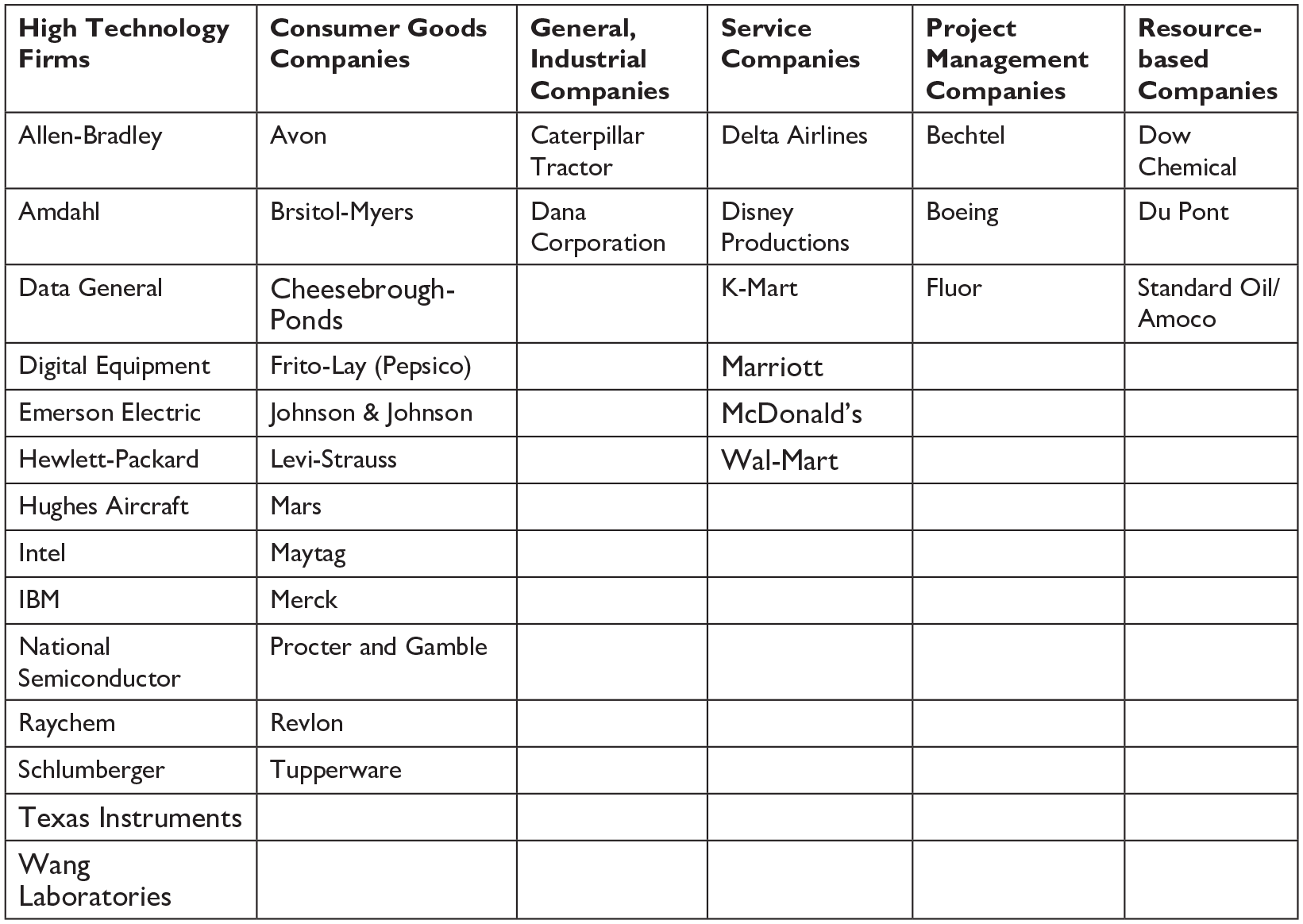
The list of (43) excellent companies organized by sector and listed alphabetically.
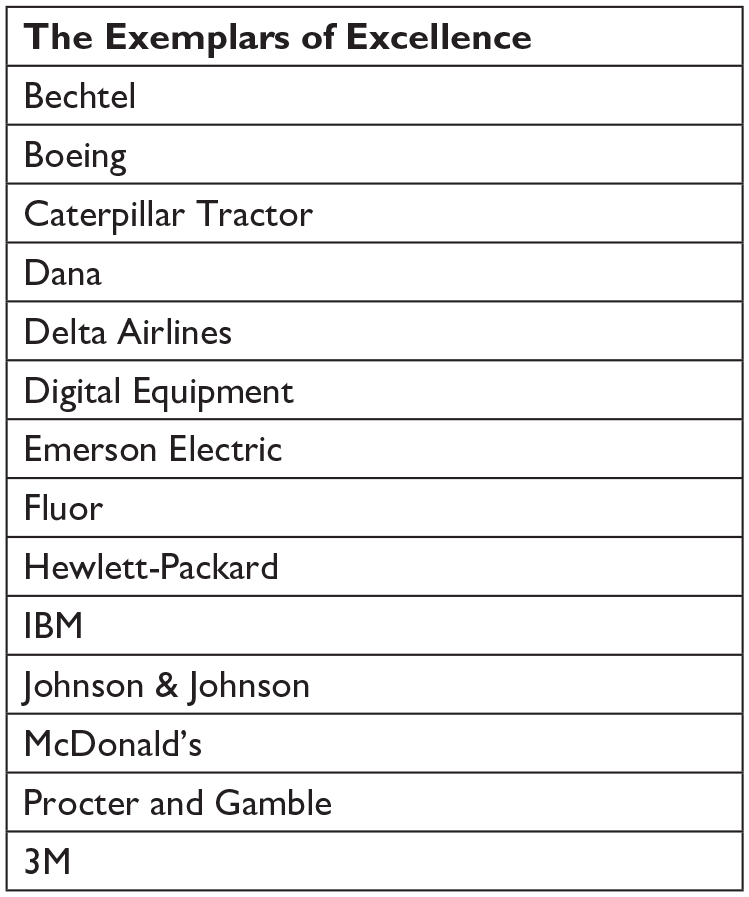
The 14 exemplars of excellence.
The attributes of excellence
Peters and Waterman are taken to be either early converts or pioneering contributors to what Thackray (1993) has termed ‘the corporate culture rage’. Yet the truth is that the authors provide no sustained or critical analysis of the concept of organizational culture. Nonetheless, Peters and Waterman assert that their excellent organizations are remarkably similar in cultural terms. Thus, the 43 organizations listed as ‘excellent’ are, we are told, defined by 8 organizational attributes, which indicate the presence of a common, over-arching culture at the heart of the excellence project. These attributes (Peters and Waterman, 1982: 13–16) may be summarized as follows:
A bias for action;
Close to the customer;
Autonomy and entrepreneurship;
Productivity through people;
Hands-on; value driven;
Stick to the knitting;
Simple form, lean staff;
Loose-tight properties.
Mere mention of In Search of Excellence tends to excite and polarize opinion (see Collins, 2007, 2022). Kiechel (2010), however, takes what might be regarded as an agnostic position. He suggests that the text, whatever its faults, remains worthy of our attention because it provides, in the shape of the ‘7-S’ framework, perhaps the closest thing that the field of management has to an over-arching organizational paradigm. Watson (2001) offers a different albeit similarly qualified endorsement. He suggests that In Search of Excellence, despite its manifest failings, remains a significant text because it demonstrates that the central task of management is to craft a moral economy. Others however are more effusive in their support for In Search of Excellence. Indeed, several, more managerialist, commentators 3 have suggested that the text offered, in 1982, a meaningful and enduring analysis of the core problems of management and continues to offer a useful vision-driven manifesto for purposeful change and development (see, for example, Dahlgaard and Dahlgaard, 2007; Wood and Wood, 2013). There is however a context beyond the limits of managerial energy and vision that must be recognized if we are to understand the initial popularity of In Search of Excellence and indeed the enduring appeal of the excellence project. To secure this understanding, I will offer a brief counter-history of the genesis of the excellence project designed to unsettle the ‘ready-made’ (Latour, 1987) narrative that has framed our appreciation of this endeavour.
Excellence in-the-making
Couched within a particular if peculiarly passive form of grammar it is, of course, reasonable to suggest that the excellence project was ‘developed by McKinsey and Co’. A more faithful appreciation of these processes, however, would acknowledge that the excellence project arose as a response to the perceived competitive slippage of ‘the firm’ (see Bogdanich and Forsythe, 2022; Kiechel, 2010) 4 and was sponsored by the then head of the partnership Ron Daniel despite vocal, internal opposition. Taking up this narrative, Peters (2018) observes that Ron Daniel chose to institute three new organizational practices within ‘the firm’ to regain the ground that it had lost to competitors. Two of these practices, associated with ‘strategy’ and with ‘operations’, were launched with some fanfare while a third practice associated with ‘organization’, to which Peters and Waterman were assigned was launched, essentially, under the radar of the partnership. Accounting for the low-key launch of the ‘organization’ practice, Crainer (1997) observes that the partners were, at that time, not at all convinced that McKinsey and Co. needed to address day-to-day managerial matters. Indeed, he confides that while the partners were comfortable selling strategy to Boards of Directors they were, in truth, actively hostile to the suggestion that McKinsey’s staff might usefully consort with the hoi polloi. Acknowledging this opposition, Peters (2018) argues that the work of the ‘organization’ practice was fostered and sustained only because Ron Daniel understood that McKinsey’s work with its clients, too often, ‘failed the implementation test’ (p. 60).
Fleshing out the standard narrative, Peters (2018) tells us that following his appointment he was given an unlimited travel budget and was allowed to spend 6 months travelling the globe ‘in pursuit of the best and most provocative’ (p. 61) business leaders. During this extended trip, Peters began to form an appreciation of the dynamics of social organization that was, for the partners of McKinsey, a serious heresy. Thus, Peters argued that the organizations which had been successful in the United States during the post-war era had prospered because they (a) juggled more variables than their counterparts, (b) addressed managerial matters in a non-linear fashion and (c) paid special attention to people management matters; the ‘soft stuff’ (p. 61). Indeed, the development of the alliterative ‘7-S’ framework must be located within Ron Daniel’s understanding that the ‘organization’ practice collective would struggle to communicate its purpose in the face of opponents, within and beyond McKinsey and Co. who had been schooled within a more conventional (or ‘hard’) account of the business of management.
Commenting upon the application of the ‘7-S’ framework, Peters (2018) observes that it was used, initially, as a tool within executive development workshops to outline (a) the importance of implementation matters and (b) to highlight the potential of the excellence project. The framework appears to have been well received in this context. Indeed, by 1979, Peters had developed a two-day pitch, illuminated by some 700 slides. Representatives of Dart, Shell and Siemens (among others) endured these pitches, but none could be persuaded to retain the services of the ‘organization’ practice. Recognizing this difficulty, a colleague based in one of McKinsey’s German offices advised Peters that he needed to offer his audience a more tangible appreciation of business excellence. Responding to this advice, Peters conjured post hoc the assertion that the organizations highlighted within his research exhibited common cultures and were, in fact, defined by common organizational attributes. In 1980 Business Horizons show-cased the eight attributes of excellence – culled, we should note from a long-list of 22 (see Peters and Waterman, 1982: 24) – in an article authored by Waterman et al. (1980). In the 18 months which followed the publication of this article, Peters and his colleagues were invited to host 200 presentations and 50 workshops on excellence and began to develop broad support for their emerging manifesto (Peters and Waterman, 1982: 25). Yet even as the world of business was warming to the excellence project, Peters’ opponents within McKinsey were circling. Peters (2018: 61) observes that the head of the New York office sought his summary dismissal when he published an ‘opinion’ piece in The Wall Street Journal, highlighting the limitations of business practice in the United States (see also Bogdanich and Forsythe, 2022: 36–37). It seems Ron Daniel vetoed this demand, but by the start of the new decade, Peters found himself cast as troublesome by his fellow partners and was, despite Daniel’s previous support, released with a furlough payment of $50,000 5 and with a plan to publish his research. On 15 October 1982, Harper and Row published this research under the title: In Search of Excellence. The publishers had anticipated that the text might sell 5000 copies (Peters, 2018) because, while the general public had demonstrated a taste for books documenting corporate and political scandals (see, for example, Goldstein et al., 1976; Sampson, 1973, 1977), it had shown no interest in texts concerned with the day-to-day practicalities of business management (Collins, 2021). To the surprise of all those concerned however, In Search of Excellence sold some three million copies between late 1982 and the middle of the decade (Saunders and Wong, 1985). Indeed, the text topped the New York Times bestsellers list for two years, outselling every other non-fiction work published at that time bar one; a new edition of the bible (Collins, 2000). Recognizing, both, the unlikely commercial success of this book and the enduring appeal of its core message, the publisher Bloomsbury named In Search of Excellence ‘The Greatest Business Book of All Time’ (Collins, 2007). Not all, however, are content to announce the end of history. Indeed, there are many who have attempted to demonstrate that the core claims of In Search of Excellence are in fact undone by a host of conceptual, methodological and empirical failings.
Responding to In Search of Excellence
Perhaps the most voiced criticism of the excellence project appeared in Business Week (1984) as a cover-story entitled ‘Who’s excellent now?’ Reviewing the performance of those companies, which Peters and Waterman had identified as enduring beacons of corporate success, this article observed that, just 2 years after the first publication of In Search of Excellence, one third of the 43 organizations featured had begun to experience significant financial distress. Accounting for this outcome, Business Week argued that Peters and Waterman had produced a bogus prospectus. Three years later, writing for The Financial Analysts Journal, Clayman (1987) offered a similar indictment.
The summary judgement of Business Week is we should note, very often repeated. It is perhaps the sole ‘fact’ about In Search of Excellence that most readers have retained. Yet despite its frequent repetition this critique is far less cogent than is commonly imagined. Three points of clarification are worthwhile: First, we should note that the observations as to financial performance offered by Business Week and by The Financial Analysts Journal are challenged by later work which appears to confirm the economic success of the excellent organizations over the period 1982–2002 (Ackman, 2002). Second, Business Week asserts that the excellent organizations faltered because of internal managerial failures which Peters and Waterman should have understood but failed to consider. Woolfson and Foster (1988: 6–7), however, invite a different reading of the economic performance of the excellent organizations in this period. They remind us that many US organizations suffered significant financial distress in the 1980s. Looking at the case of Caterpillar they suggest, for example, that the very significant decline in sales experienced by this company in 1982–1983 (Los Angeles Times, 13/01/1983) is explained, not by internal failures but by broader contextual factors. Challenging the narrative preferred by Business Week, Woolfson and Foster suggest that in common with many other US organizations Caterpillar lost market share in the early 1980s because a combination of the third-world debt crisis and a change in US economic policy (which occasioned a significant rise in the value of the dollar) simply made its exports prohibitively expensive. Third, we should acknowledge that while the criticism voiced by Business Week appears to attack the very foundations of the excellence project, the truth is that this critique continues, quietly, to endorse the building blocks of the excellence project. Thus, Business Week seems to accept (a) that there could exist a separate and distinctive category of excellent firms who might (b) stand proud of their peers because of (c) their distinctive managerial practices but (d) chooses to mock Peters and Waterman for being, as Stewart (2010 [2009]) quips sarcastically, ‘particularly bad stock pickers’ (p. 246). Other commentators, however, have looked longer and harder at the work of Peters and Waterman and have generated critical reviews of In Search of Excellence, which question its core assumptions and orientations.
The methodological critique
In Search of Excellence builds upon a panel of organizations, offered to the reader as beacons of best practice (see Peters and Waterman, 1982: 19–24). Yet, Carroll (1983) and, in a later contribution, Guest (1992) both observe that, in preparing this sample of firms, Peters and Waterman employed unorthodox and largely unscientific methods. Indeed, both note that the final sample of companies lauded as typifying ‘excellence’ proceeds from an ad hoc grouping, which reflects the orientations and predispositions of colleagues rather than, say, any more meaningful account of business fundamentals. Furthermore, Guest observes that this initial and ad hoc sample becomes progressively corrupted as the authors allow their own biases to adjust the population in a self-serving and thoroughly unscientific manner. In addition to these design problems, Guest and Carroll both observe that the methodology of the excellence project is poorly executed. For example, Carroll reminds us that Peters and Waterman fail to constitute a less-than-excellent population for comparative study. 6 In this respect, the core argument of In Search of Excellence is ‘non-falsifiable’ insofar as the methodology employed by Peters and Waterman is constitutionally incapable of uncovering information, which would refute the idea that excellent firms (a) have eight attributes in common and that it is (b) these attributes, collectively, which deliver business excellence (see also Rosenzweig, 2007).
The conceptual critique
In Search of Excellence suggests that organizational success is, uniquely, a product of internal managerial processes; those magical things which nowadays tend to be rendered as managerial vision and commitment. Countering this heroic assumption, however, Carroll (1983) suggests that the account of excellence developed by Peters and Waterman is flawed because it fails to recognize the ways in which factors such as ‘proprietary technology, market dominance, control of critical raw materials, and national policy’ (p. 79) might have a bearing upon organizational performance.
Collins (2022) notes that Peters and Waterman (1982: 16–17) overcame early indecision and ultimately suggested that business excellence depends on the presence of all eight organizational attributes. Probing this position, however, Guest (1992) complains that Peters and Waterman promote a binary understanding of business excellence when their own initial formulation, in fact, suggests that this might more usefully be framed as a continuum.
The empirical critique
Examining the financial track-record of the excellent organizations, Saunders and Wong (1985) question the validity of the eight attributes said to be necessary for business excellence. Questioning the efficacy of the ‘bias for action’ attribute, for example, they observe that the more successful organizations in their sample were more, not less, planning oriented than their rivals. Moreover, they note that there is, in truth, no evidence to suggest that the success of the excellent organizations derives from ‘sticking to the knitting’. Indeed, Knight (see Knight and Dyer, 2009 [2005]) the former CEO of Emerson actually contradicts the assertion that his company had prospered by ‘sticking to the knitting’. Reflecting on his term of office, Knight confides that his strategic approach represented a continuation of his predecessor’s diversification strategy. Yet where WR Buck had acquired some 36 companies during his term of office (1954–1973) Knight reminds us that he purchased more than 200 companies during his own 19 years at the helm. The analysis of the excellent organizations offered by Saunders and Wong (1985) does therefore provide useful insights on the empirical limitations of In Search of Excellence. Yet we should note that the account developed by Saunders and Wong is incomplete and deals only with a sub-sample of those organizations highlighted by Peters and Waterman because relevant financial information was not always available. Saunders and Wong, however, do not to tease out the implications of these gaps. Indeed, they seem to accept that this is a limitation in their work and so fail to recognize that the absence of reliable data on Bechtel, for example, mocks the suggestion that In Search of Excellence truly builds upon comprehensive empirical research that can sustain critical scrutiny. Moreover, Saunders and Wong (1985) never actually challenge the core conceit of In Search of Excellence, namely that the excellent organizations are led by charismatic leaders and have ‘done well by being good’. Indeed, despite their empiricism, Saunders and Wong show no real interest in the day-to-day practices of the organizations highlighted by Peters and Waterman (1982). Yet, in this, they are not alone. Indeed, there is across the critical literature on business excellence a focus upon the conduct of Peters and Waterman and on the rhetoric of business excellence, but no sustained consideration of the actual policies pursued by the excellent organizations. Wilmott (1993), for example, argues that In Search of Excellence amounts to a fabulous exhortation, which offers no useful foundation for policy; for action; or for change (see also Boltanski and Chiapello, 2007). And yet while Wilmott is right to suggest that In Search of Excellence is, as Pettigrew (1985) would have it ahistorical, acontextual and aprocessual, there can be no doubt that the excellence project is performative; has underpinned managerial action and has shaped policy for a generation. In the next section, I will consider the nature of this policy and action.
Excellence in practice
The excellence project has secured and maintained a place at the very heart of the management curriculum and at the core of managerial practice. This situation persists, I suggest, because in focusing upon the conduct of Peters and Waterman academia has simply failed to challenge the central conceit of In Search of Excellence; that the excellent organizations have done well by being good. Newspaper reports and longer forms of journalism, however, have explored the reality of the practices instituted and maintained by the excellent organizations and, as we shall see, usefully challenge the rhetoric of Peters and Waterman and the historical legacy of the excellence project. Sampson’s (1977) account of Boeing provides a case in point and indeed provided the initial impetus for this article.
Boeing’s business practices
Peters and Waterman offer Boeing as an exemplar of business excellence. Boeing’s approach to management is they assure us, special and distinctive even among the organizations taken to be ‘excellent’. Leaving to one side the fact that Boeing failed to report consistent growth and profitability in the decades prior to the first publication of In Search of Excellence and had, in truth, suffered significant periods of crisis throughout the 1970s (see Pelletier, 2010 [2008]), Sampson’s (1977) analysis is particularly significant for our purposes because it reports Boeing’s bribery of Japanese officials and in so doing challenges, directly, the assertion that this company’s success is a product of the eight attributes of excellence. In short, Sampson’s reportage mocks the suggestion that this company is, in its practices, laudably ‘hands-on; value-driven’.
Taking inspiration from Sampson’s (1977) revelations, I embarked upon preliminary research, designed to investigate the conduct of those organizations vaunted as exemplars of excellence and in the absence of academic inquiry, chose to research within newspaper archives. Three newspapers were selected for what was intended to be an exploratory and preliminary analysis, namely The Los Angeles Times, New York Times and The Economist. The period 1971–1981 was initially selected as the operating time frame; this being the decade immediately prior to the first publication of In Search of Excellence. Searches built around this timeline were configured around the company names of the 14 exemplars of excellence. Taking a lead from Sampson (1977), additional terms chosen to index serious misconduct (such as ‘bribery’, ‘corruption’, ‘court action’, ‘pollution’ ‘skulduggery’ and ‘harm’) were also employed. The initial search period was, however, subsequently extended to track down stories that were on-going within this decade and to pursue themes suggested in longer forms of journalism developed, for example, in Love’s (1986) account of McDonald’s and by McCartney’s (1988) reflections on Bechtel. Given Sampson’s account of Boeing, it had been anticipated that searches of newspaper archives might uncover some level of organizational misconduct within a minority of the exemplars. The discovery of such misconduct had been expected (a) to suggest that Peters and Waterman (and indeed their academic critics) had been wilfully blind to the profane realities of organizational life and (b) to suggest the need for more broadly based research on the conduct of the excellent organizations that might include, for example, an analysis of company documents and archives. Wholesale misconduct across those organizations celebrated as exemplary models of value-driven management had not been anticipated. Yet this is exactly what my preliminary inquiries revealed and what my ‘counter-history’ demonstrates.
A ‘counter-history’ of the excellence project
Peters and Waterman offer the exemplars of business excellence as beacons of/for good practice. These organizations are offered to us as positive examples of a distinctive and laudable ‘hands on; value-driven’ approach to management. Those concerned to understand the appeal and legacy of the excellence project have, it seems, largely accepted this claim at face value. Critical commentaries have therefore tended to highlight the social scientific limitations of the excellence project yet in so doing have failed to offer any serious engagement with the practices of those organizations celebrated by Peters and Waterman (1982). In the sections that follow I will offer this engagement.
Racism and the excellence project
The exemplars of business excellence are, we are assured, guided by a set of cultural absolutes. A simple question therefore arises: Should we expect the business strategies of the exemplars of excellence to embrace policies and/or territories that are openly racist?
The answer is, I hope, obvious because my question is largely rhetorical. Nonetheless, my inquiry does merit some sort of response because at least 3 of the 14 exemplars of excellence – Fluor, Hewlett-Packard and IBM (see New York Times, 13/03/1979; 09/11/1986; 22/03/1989) – maintained production facilities within South Africa’s racist, apartheid regime during the period in which the research on business excellence was developed and first published. If the excellent organizations are ‘hands-on’ and ‘value-driven’ in their management practices and yet prepared to work with an openly racist state, can they reasonably be said to constitute sources for cultural renewal, beacons of good practice? Similar questions arise, I suggest, in the context of broader organizational policies and processes associated with trades unions.
Unions and the excellence project
Peters and Waterman say very little about organized labour within In Search of Excellence. For a text centrally concerned with the regeneration of US business and the consequent need to conjure a response to Japan’s ‘enterprise unionism’, this omission is surprising. Other commentators writing around this time, for example, plainly felt it necessary to highlight, explicitly, the problems associated with adversarial trade unionism and in so doing advocated broader changes in culture and/or policy designed to secure the transformation of labour-management relations (see Wickens, 1987). Indeed, the silence of Peters and Waterman on this contentious issue is particularly surprising because during the period within which the excellence project was conceived and developed, Emerson, 7 Procter & Gamble (New York Times, 14/09/1983), Delta Airlines (New York Times, 11/08/1981; 15/08/1981; 10/08/ 1981), Caterpillar (New York Times, 27/01/1983; 14/04/1983; 20/04/1983) and Bechtel (McCartney, 1988) were all dealing with protracted labour-management disputes. The employee relations strategy prosecuted by Emerson at its Kennett plant is particularly worthy of note in this context because it attracted the attention of the National Labor Relations Board and led to court action. The court found that Emerson had, during a recognition dispute, threatened employees with discharge; with plant closure and with the loss of benefits associated with their years of service. Emerson appealed this decision but in April 1978, the appellant court upheld the ruling. Indeed, the appeal judgement found that Emerson had conducted a campaign of harassment and intimidation against the union and against named, individuals.
Reflecting upon the conduct of Procter and Gamble, Swasy (1993) reminds us that this company had also attracted the attention of the National Labor Relations Board. In 1976, the court found Procter and Gamble to be in breach of numerous statutes designed to offer employees dignity and protection in work. While highlighting the extent to which the company (a) felt able to spy on its own employees and (b) found it necessary to harass activists who had challenged the company’s record on pollution, Swasy reminds us that in 1977 the courts had instructed Procter and Gamble to produce an affirmative action plan to counteract policies and processes which were brazen in their racism. Little wonder perhaps that when the AFL-CIO (the confederation of American unions) published ‘a roll of dishonour’ designed to name and shame those organizations which had failed to act fairly in their dealings with organized labour Procter and Gamble was named as the worst offender (New York Times, 14/09/1983). Yet the charge sheet against the exemplars of excellence extends beyond a consideration of their posture towards race and organized labour. It includes, as we shall learn, anti-trust violations, (more) bribery, corruption, money laundering, sexism and that pernicious species of racism that goes by the name of anti-Semitism.
Wider misconduct within the exemplary organizations
IBM features very prominently within the narrative of In Search of Excellence. Indeed, it is presented to the reader as embodying a corporate culture, hinged upon the delivery of exceptional results for customers (see Collins, 2022). Yet the truth is that IBM has a long history of anti-trust violations and was, in fact, battling ‘dozens of private anti-trust cases’ (DeLamarter, 1988 [1986]: xiv) and a further case brought by the Attorney General throughout the period in which Peters and Waterman were compiling In Search of Excellence. Discussing Bechtel, McCartney (1988: 158) points out that throughout the 1970s this company pushed through the normal boundaries of the anti-trust statutes and participated, actively, in widespread bribery and corruption to secure its business goals. Bechtel, he notes, furnished bribes to the tune of some $3 million to Indonesian officials in order to secure lucrative contracts. Beyond such obvious corruption, however, McCartney (1988: 153) points out that Bechtel, apparently the project manager par excellence (Peters and Waterman, 1982: 192), falsified records to cover up sub-standard work for the Libyan state (in 1969) and took steps to conceal similar problems with work carried out for the Canadian government (in 1974). And if this were not enough, Denton (2016) notes that Bechtel was, in 1975, subject to class actions for racism and for sexism and was, furthermore, accused of denying employment to those of the Jewish faith. Fluor, we should note, was also accused of anti-Semitic practices throughout the 1970s. These charges, like those brought against Bechtel, were widely reported in the press as was the response of the company. Indeed, in a bizarrely tin-eared rejoinder to allegations of anti-Semitism, Fluor suggested that the charge was little more than a confection manufactured by the Jewish press (New York Times, 11/02/1979; 28/08/1979; 11/09/1979). And yet the authors of In Search of Excellence are silent on this scandal. Peters and Waterman (1982: 224–234) do however lavish rather a lot of attention on 3M. Indeed, they suggest that this company is very special; driven to innovate by a cultural obsession with its customers’ needs. The authors, however, make no mention of a money-laundering conspiracy, which came to light in the mid-1970s. Thus, we should note that in 1975 The New York Times (09/03/1975) reported that 3M had developed and maintained, for over a decade, a money-laundering conspiracy designed to allow it to make unlawful payments to local, state and national government officials.
Dana, a key supplier of components to the auto-industry, caused harm to its employees and to its customers because it used asbestos throughout its product range. Long after the first publication of In Search of Excellence when the scale of the harm and, perhaps more importantly, the extent of the company’s liabilities became apparent, it did something, which surely suggests that its core values place the wealth of shareholders above the health of employees and customers. Thus, Dana angered litigants by seeking protection from its growing liabilities through Chapter 11 (Chicago Tribune, 04/03/2006). In a similar fashion, we might note that the production processes employed by Digital were, in the early 1980s, linked to foetal abnormalities and to spontaneous abortion (Pastides et al., 1988). Despite this, the company ignored, for a decade, advice from the Semiconductor Industry Association, which had recommended key changes in the production process and settled claims dating from this period only in 2009. We should concede, however, that Digital did at least behave better than Johnson & Johnson, which despite its much vaunted cultural ‘credo’ consistently chose to deny the presence of asbestos in its talcum powders (New York Times, 15/12/2018; 20/12/2018) and now faces what the Guardian newspaper (18/10/2019) has referred to as an existential crisis. Finally, we might note that reports on the conduct of McDonald’s throughout the 1970s might have been taken as offering a challenge to the values said to guide the company conduct – if Peters and Waterman had cared to notice. Love (1986), for example, observes that in the 1970s McDonald’s had attracted criticism in the press for perceived interference in political affairs and was, in addition, accused of misreporting its finances by its own accountants – Arthur Young – who demanded that the company remove assets listed at $17.4 million from its balance sheet.
Commenting upon McKinsey’s role in ‘turbocharging’ the sale of opioid painkillers, Tom Peters reports that he is ‘shocked’, ‘appalled’ and ‘pissed off’ at a company, with which he was once ‘vaguely proud’ to have an association (Bogdanich and Forsythe, 2022: 27). I have no reason to doubt Tom Peters on this matter. There are, after all, very clear and obvious reasons to lament the conduct of companies such as Purdue Pharma and Johnson & Johnson who have been central players in this crisis (see Meier, 2020). Nevertheless, it is worth noting that despite these, recently voiced, concerns about misbehaviour within key US corporations and within his former employer, none of the (mis)conduct that I have noted, above and which was widely reported in the US press, appears within the covers of In Search of Excellence. Furthermore, little, if any, of this, features within those critical academic commentaries offered as correctives to In Search of Excellence. In our final section, I will offer a summary of the paper and brief reflections on what the (counter-historical) analysis of the lived experience of business excellence, essayed here, might now teach us about the legacy of the excellence project, the politics of academic inquiry and the processes of management education.
Concluding comments
Reflecting upon the development of Management Learning and its contribution to the field of management education, Bell and Bridgman (2019) suggest that editing the journal is a form of curatorship and add that this work is, in so many ways, a labour of love. Teasing out the implications of this frank and very welcome disclosure, the authors tell us that Management Learning has throughout its history, and despite the advent of new market entrants (and competing, normative, narratives), embraced plurality, diversity and fellowship. The journal and its editors have, in short, chosen love. Indeed, Bell and Bridgman are clear that the journal, both, through its own organizational arrangements and through its contents has expressed this clearly and publicly. Thus, the authors remind us that the journal has, for more than five decades, chosen to stand up for others and where necessary has worked to face down those analytical approaches and organizing conventions that threaten to undermine its cherished guiding philosophy. Acknowledging these principles, Anderson et al. (2020) nonetheless warn that the ‘excellence’ metrics, which now constitute academic conduct (in the United Kingdom and elsewhere), make it increasingly difficult to prosecute research that is robust, critical, pluralistic, ‘impactful’ and yet (lovingly) connected to practice (see Burrell et al., 2024, for a cautionary tale). Echoing Bell and Bridgman (2019), Anderson and colleagues advise that those who would contribute to the community that is Management Learning must now renew the intent to work with and for others (without othering) and in so doing must continue to provoke forms of critical thinking that can influence education and practice in genuinely positive ways. Embracing this philosophy, this article has essayed a new and critical engagement with the excellence project, designed to reveal and to redeem those voices silenced by Peters and Waterman (1982) and by (ostensibly) more critical forms of scholarship. To this end I have, while working to outrage the sensibilities of my readers, offered a counter-history of the excellence project that is theoretically robust and yet rooted in and connected to practice. I have acknowledged that scholars have quite correctly highlighted the conceptual, methodological and empirical limitations of In Search of Excellence. Nonetheless, I have insisted that the manifesto outlined by Peters and Waterman prevails because academic inquiry has limited its engagement with the excellent project. Indeed, I have demonstrated that the academy has failed to produce a useful counter-narrative because it has refused to offer a meaningful engagement with the practices of the excellent organizations and with the profane realities of our organized lives. Noting that this limitation has, in effect, perpetuated the central conceit of In Search of Excellence among practitioners (including those who manage our own labour directly), I have built my analysis upon newspaper archives and longer forms of journalism in order to reveal what Peters and Waterman obscured and what academia has ignored, namely the racist, sexist, corrupt and corrupting practices that have underscored the market success of the exemplars of excellence. These revelations are of course significant and valuable on their own terms. Yet this new, history of business excellence offers, I suggest, a more general but nonetheless useful contribution to the labour of love that is, Management Learning, because it provides tools for a grounded but critical pedagogy. In this regard, the distinctive account of In Search of Excellence offered here is notable and potentially very powerful as a pedagogic tool for at least three reasons. First, my article provides management educators with an invitation to work with students in a historically reflexive fashion and with a broader array of sources than is normal in the field of organization studies. Second, my article is useful as a pedagogic tool because it uses these resources to remind readers that In Search of Excellence has had an enduring influence on theory and practice and yet takes this opportunity to shift the terms of the debate so that we can come to a new understanding of the legacy of the excellence project. Third, the article probes the practices of the excellent organizations and in so doing makes concrete, contemporary themes associated with equality, diversity, inclusion and exclusion. Indeed, in standing up for those silenced and/or marginalized within the excellence project (and within mainstream scholarship), the article provides a useful entry-point to broader debates on organized misbehaviour and criminality. This final (entry)point is, I suggest, of special importance because these debates (re)position students as ‘moral agents’ (Tennent et al., 2020: 74) in a world of managerial practice that is, despite the apparent insouciance of the academy and the narrow instrumentality of our leaders, so often and so obviously marked by risk, harm and injury.
