




Abstract
Previous management learning research on phronesis or practical wisdom has focussed on its local, contextual application rather than its connection to wider ethical and political relationships. Drawing on a new materialities perspective that is helpful in theorising the interconnectedness of contextual practical knowledge and the greater good, this article suggests phronesis is learned by understanding relationships between materialities in different spaces over time. The article is based on a qualitative, longitudinal study of Operation Princess, an actual project that took place on mainland Britain’s railway. Through a composite fiction, we show how under nationalised organisation managers learned phronesis by becoming steeped in wider material relationships over time. Privatisation introduced a financialised perspective that was detached from wider material connections and produced unworkable plans. Operation Princess was rescued by managers who had developed a phronetic appreciation of the interrelationships between employees, trains, services and communities. They learned phronesis through an institutional lengthy formative process of becoming entangled in vital materialities, repeatedly experimenting and doing, supported by intermittent classroom learning. This is a very different approach to the commodified style of management development today which abstracts and condenses, undermining the development of practical wisdom.
Introduction
Phronesis, Aristotle’s (2009: Book VI) concept for practical wisdom dating from the 4th century BCE has been suggested as a way to address shortcomings in contemporary management education, namely that it has become centred on commodified, conceptual knowledge remote from embodied organisation praxis (Antonacopoulou, 2010; Kinsella and Pitman, 2012; Küpers and Pauleen, 2015; Statler, 2014). Aristotle thought phronesis to be a kind of knowledge that considers both the local context and wider ethical concerns when taking practical steps in organising and that it takes time and effort to cultivate. He argued that phronesis could not be taught, and we would agree and offer that phronesis needs time and space to learn, as it is a kind of agencement, or connection-in- action (Gherardi, 2021) that unfolds through its formativeness (Gherardi, 2016). It is learned by doing, and the opportunity to experiment is useful. Phronesis needs skilful communication through talk and other more subtle forms of exchange (Ashcraft et al., 2009). Moreover, to appreciate wider ethical concerns it is crucial to acknowledge that learning phronesis happens between different human and non-human materialities, ‘living, throbbing confederations’ of affective bodies (Bennett, 2010: 23) that can intra-act in unexpected ways (Barad, 2007), and form a dense texture of multiscalar agencements or ‘socio-spatial spheres of practice that are constituted in relationship to each other . . . within various hierarchies of networks of power’ (Çağlar and Glick Schiller 2018: 8, 2021).
The article explores how staff learned phronesis on a mainland British public railway service through an integrated management development approach that combined shorter periods of classroom-based learning with a variety of different rich context experiences that linked local decision-making with a public sector ethos. Following the privatisation in the 1990s, a single entity was divided into 99 parts, producing tensions between collective public interest and private profit, and fostering a different, narrower financialised approach to management (Shaw, 2000). Integrated management development became a thing of the past, although people who had learned phronetic wisdom in the public era continued to work for individual organisations. What constituted a railway leader became disconnected from a guiding sense of the common good of the sector and society, becoming instead managed through a set of restricted indicators and algorithms that guided plans to maximise profits for each fragment. The changes led to projects like that of ‘Operation Princess’, an ambitious plan to run new services over long distances that intersected with many others. Because the plans did not fully consider the human and non-human material entanglements, they were unworkable and had to be ‘rescued’ by phronetic managers developed prior to privatisation who knew how to manage material entanglements.
Operation Princess and its antecedents encompasses more than four decades; therefore we have created a fiction composed of a wide range of qualitative research materials such as publicly available documents, interview transcripts, observations and archival material all carefully analysed using grounded theorising (Glaser and Strauss, 1967) and historical methods (Yates, 2014) to create an interpretation of events (Savage et al., 2018). The fiction traces an individual progressing along a common development path for a BR operations trainee, how they were socialised into the agencement of practising phronetic wisdom, through formativeness (Gherardi, 2016) and experimentation, developing more awareness of the materialities and immanence (Holt, 2003) of local contexts. Privatisation introduced characters with different backgrounds and perspective on the railway, whose spreadsheet-based knowledge did not make for workable plans. Finally, the fiction describes how the project was ‘rescued’ by managers who had developed phronesis during the pre-privatisation period.
Whereas previous texts on phronesis in management learning have focussed on the individual within a localised context, this article, drawing on the ideas of materialities theorists such as Bennett (2004) and Gherardi (2016), shows how entangled phronetic wisdom is with wider human and non-human materialities and power relations that are multiscalar in nature (Çağlar and Glick Schiller, 2018). Previous authors such as Antonacopoulou (2010) have focused on the classroom learning of reflexive criticality or noted how professional associations have restricted the possibilities for learning phronesis (Kinsella and Pitman, 2012). Our article contributes by extending work that contends that phronesis is the situated (Hadjimichael and Tsoukas, 2023), embodied Küpers and Pauleen, 2015), timely learning of good habits (Statler, 2014), within a specific habitus (Rooney et al., 2021) by highlighting the role of non-human materialities, experimentation and duration in developing a form of phronesis that integrates different forms of knowledge with an ethical sense of the common good.
The article begins by exploring Aristotle and MacIntyre’s ideas on phronesis in more depth, before reviewing how authors have discussed it in contemporary work, highlighting where Gherardi (2016) and Kuhn’s (2021) ideas of practice link to phronesis. We employ Bennett’s (2010) new materialist approach showing the interconnections between local practices and wider power relations supporting a deeper understanding of how managers learn phronesis. We then describe the methods underpinning our fiction before it is presented. Finally, we discuss the main implications from the fiction, for management learning approaches to phronesis.
Phronesis
Aristotle’s teaching was concerned with ethics as a preparation for politics and education for public administration in the interests of the common good. Virtuous leaders do what is good for their organisations and society by understanding the higher moral purpose of what they do while remaining grounded in everyday practical detail. Wise leadership links practical detail to wider organisational and societal needs (Küpers and Statler, 2008; Nonaka et al., 2014), providing a framework for a flourishing society. Phronesis enables individuals to do the ‘right thing’ without recourse to a rule book (Hartman, 2013), the ‘right thing’ producing an outcome that works for the good of one’s community, not just oneself.
MacIntyre’s (2007) linkage of virtue and phronesis to practice has been of critical importance to the development of the application of Aristotelian virtue theory in modern times. Aristotelian virtues are not innate but must be acquired through repeated habits over time (Dunne, 1997). MacIntyre’s description of virtue as the pursuit of excellence in practices is the starting point for the modern application of virtue theory to management.
‘Virtue is always realised in concrete situations’ (Kavanagh, 2013: 110) and virtuous decisions and actions require a form of practical wisdom (phronesis). Phronesis is heavily dependent on context, and judging what the right outcome might be raises the question of who will benefit. Aristotle stresses that an individual can only flourish by undertaking actions that benefit their wider group or society. Empirical examples of phronesis in action (Flyvbjerg et al., 2012; Küpers and Statler, 2008; Shotter and Tsoukas, 2014) have drawn attention to the context in which it is performed. Virtuous action differs from context to context and is heavily conditioned by social and cultural norms (Hartman, 2013).
Kristjánsson et al. (2021) support the view that phronesis, largely as defined by Aristotle, can still be considered as an intellectual meta-virtue of holistic, integrative, contextual, practical reflection and adjudication about moral issues, and most importantly, lead to moral action. Having a ‘perspicacious description of good decision-making about crucial moral issues’ (Kristjánsson et al., 2021: 248), is vital for contemporary managing. Their neo-Aristotelian model of wise (phronetic) decision-making combines the ideas of moral identity, described as a ‘blueprint of flourishing’, moral emotions and moral reasoning as elements in a process diagram that results in wise decisions and moral action. Phronesis is therefore excellence in such decision-making and acts to integrate and harmonise other virtues, especially when those might conflict, to reach a balanced decision. Other formulations include phronesis as a self-cultivating form of action (Dunne, 1997), orienting one’s will (Shotter and Tsoukas, 2014) and a skill between contemplation and action (Nonaka et al., 2014). Phronesis takes place in everyday practices (Nonaka et al., 2014), through perceptual awareness (Dreyfus and Dreyfus, 2005) from extended engagement with materialities (Nonaka et al., 2014), and in managing banalities and breakdowns in organisational routines (Hahn and Vignon, 2019; Nonaka and Toyama, 2007: 379; Yanow and Tsoukas, 2009), or improvising in extreme circumstances (Hadjimichael and Tsoukas, 2023).
Phronesis challenges traditional post-Aristotelian Western concepts of universal principles and the prioritisation of explicit knowledge and predictive models (Scalzo and Fariñas, 2019).
Phronesis encapsulates the other intellectual virtues, combining both rationalism and values into judging. Contemporary authors have contrasted decision-making based on phronetic wisdom to modern shortcomings of instrumental-calculative rationality, blind maximisation of target quantities, and failure to recognise broader ideas of public good (Nonaka et al., 2014; Sison and Fontrodona, 2012). Phronesis involves experience, judgement and action, and employs different types of knowledge arising from the other intellectual virtues of episteme, scientific knowledge based on analytical rationality; and techne, practical rationality with the important sense for this article of a craft, appreciating materiality within technical arts for an end beyond itself. Higher forms of wisdom (sophia, nous and episteme) were theoretical, eternal and context-free. Not all contemporary business decisions are economic or technical, and executives cannot rely on either techne or episteme alone for strategic thinking (Tsoukas, 2018). When strategy becomes scientific, it loses the intent of management and leadership as being in the service of a good life for all stakeholders. There is however a shortage of research in which virtue ethics and phronesis are applied in strategic projects and our fiction helps fill this gap. ‘Phronesis is not science (episteme) . . . and not an art (techne) . . . we consider this quality belongs to those who understand the management of households or states’ (Aristotle, 2009 NE 1140a24 – 1140b12). For Bachmann et al. (2018: 148), there are eight core features of practical wisdom needed to counter the conspicuous leadership failures of recent times arising from the over-reliance on abstract management or economic theory. These include the realisation of action, the ability to integrate multiple factors, norms related to an understanding of ‘a good life’ and an understanding of how one’s actions are interlinked with wider society. Other features relate to aspiring to the right goals and the importance of self-discipline, the ability to adapt ‘cultural heritage’ to new contexts and an awareness of the limitations of one’s knowledge and capabilities.
Aristotle believed that ‘collective phronesis can help coordinate independent deliberations from different agents’ (Kristjánsson, 2022: 52), and this has been a feature in the management literature through the work of Nonaka describing organisational spaces where people can share experiential knowledge known as ‘Ba’ (Nonaka and Konno, 1998). However becoming more perceptive, communicative and ethically aware is helped by understanding relationships between different materialities, as Kuhn (2021) notes. He supports Bennett’s (2004, 2010) new materialist thinking as a way of becoming ethically aware. For example, Bennett (2010) surfaces how entangled practice is with wider societal power relations and how interdependent human and non-human matter are in global environmental change (Bennett, 2004). Humans exploit natural resources for economic ends, but equally ecological forces can circumscribe human activities in dramatic ways, such as the recent pandemic or adverse weather conditions stopping trains. Such interventions are impossible to control.
Matter can be defined as ‘an excess force, vitality, relationality, or difference that renders matter active, self-creative, productive, unpredictable’ (Coole and Frost, 2010: 9). Bennett (2010) questions the labelling of non-human matter as inanimate and demonstrates how agency is vested in mundane items such as trash and electricity. She contends that human existence would be more ethical and sustainable if the power of ‘things’ was more included in our organising and learning.
‘We are vital materiality and we are surrounded by it, though we do not always see it that way. The ethical task at hand here is to cultivate the ability to discern nonhuman vitality, to become perceptually open to it’ (Bennett, 2010: 14).
Sensitising ourselves to different forms of non-human vitality would reduce our likelihood of failing to understand the common good. As Kuhn (2021) notes previous practice theorists focus upon humans as the primary agent. We take a more balanced view and suggest considering the subtleties of relationships between vital materialities important in reaching ethical practice.
No one materiality is sufficient on its own but joins with others in cooperation or counters a mesh of relations many authors refer to as an assemblage (Bennett, 2010; Kuhn, 2021). Assemblages can be viewed from different ontological perspectives, they are never simple hierarchies, moreover, an assemblage is different from the sum of its parts, and the parts may well extend to other assemblages with communication constitutive between intersections. Kuhn (2021) ‘frames communication as the practice through which a variety of elements enter into relationships, and it is from such relations that realities materialise’ (p. 115). Unlike conventional conceptions of organisation, assemblages are precarious, ongoing accomplishments that can unfold in unexpected ways because they are based on aleatory materialities, and are not controllable (Bennett, 2010). Similarly, ethics are produced in relations within an assemblage, they are not something separate. Taking this approach, phronesis can be seen to unfold as a communicative relation between different materialities situated within a wider assemblage and ethics system. If researchers wish to transform ethics or the assemblage, Kuhn (2021) suggests they pay attention to what is included or excluded in the assemblage, or where boundary demarcation is attempted and whether new relationships are possible. Learning phronesis is thus about building an understanding of communicative constituted relations between assemblages of different materialities.
Gherardi (2016: 686) also identifies lacunae in practice theories but takes a different approach. Although she notes that theorists share common positions on practice as organising human and non-human materialities and that knowing is entangled with doing, two blind spots for practice theorists to address are – ‘How do practices achieve agency’ and ‘How does knowledge take form in knowing’. First, she suggests practices achieve agency through ‘agencement’, a better translation of ‘assemblage’ from Deleuze and Guattari (2002). This translation retains more of an active sense of making connections between heterogeneous materialities in an open process (Gherardi, 2016: 687, Nail, 2017; Phillips, 2006). Using the word assemblage, like organisation, conveys a sense of fixedness rather than agencement’s more dynamic sense of arranging (Phillips, 2006). For example, a railway can appear to be a fixed system of tracks, trains, stations, staff and passengers, but it is a rich, open texture of different materialities like the weather, viruses and corroding metal intra-acting (Barad, 2007) unexpectedly and not necessarily in line with governmental or managerial plans. Second, learning knowledge is a kind of agencement that Gherardi calls formativeness, practices are rendered thing-like through understanding the relations between different kinds of materialities that emerge through creative experimentation and are mutable, they may appear and disappear as thing-like. Gherardi (2016) invokes Pareyson’s (1960) ideas on the aesthetics of producing art to describe the formative process of knowledge-making: ‘There is a sense of the final result, attempting and correcting and re-doing; there is the inspiration and the elaboration of an intuition; there is improvisation and exercise; there is domination over the material that opposes resistance and enjoins obedience and there is technique and the language of style’ (Gherardi, 2016: 691).
Knowledge takes form through this process of agencement. Therefore, knowing how to run the railways would entail an image of what smooth operations might look like, then trial and error and the undoing and redoing of management practices. When a problem is encountered, a manager would try to understand the immanence they encounter, making connections between different human and non-human materialities, performing or adapting techniques they have learned before and experimenting, additionally drawing upon intuition to form a solution that may change. We think Gherardi’s ideas offer insight into how phronesis is practised and learned, moreover, it is important to remember that an integral part is the awareness of the greater good, which guides agencement. Such processes relate closely to our understanding of learning phronesis we have drawn from our studies of the UK railways. How we studied the railway and have represented what we learned is the subject of the next section.
Method
Phronesis emerged as an interest for the authors after decades of research, work and personal encounters with the UK railways. In this article, we have chosen to illustrate our contributions through a fictionalised account of how prior learning of phronesis helped turn around Operation Princess, a real project that unfolded between 1996 and 2003. Tracing phronesis learning trajectories and how the knowledge influenced events needed materials that covered over four decades. The following section details which methods were used to gather different materials, how they were analysed and then how we formed the fiction.
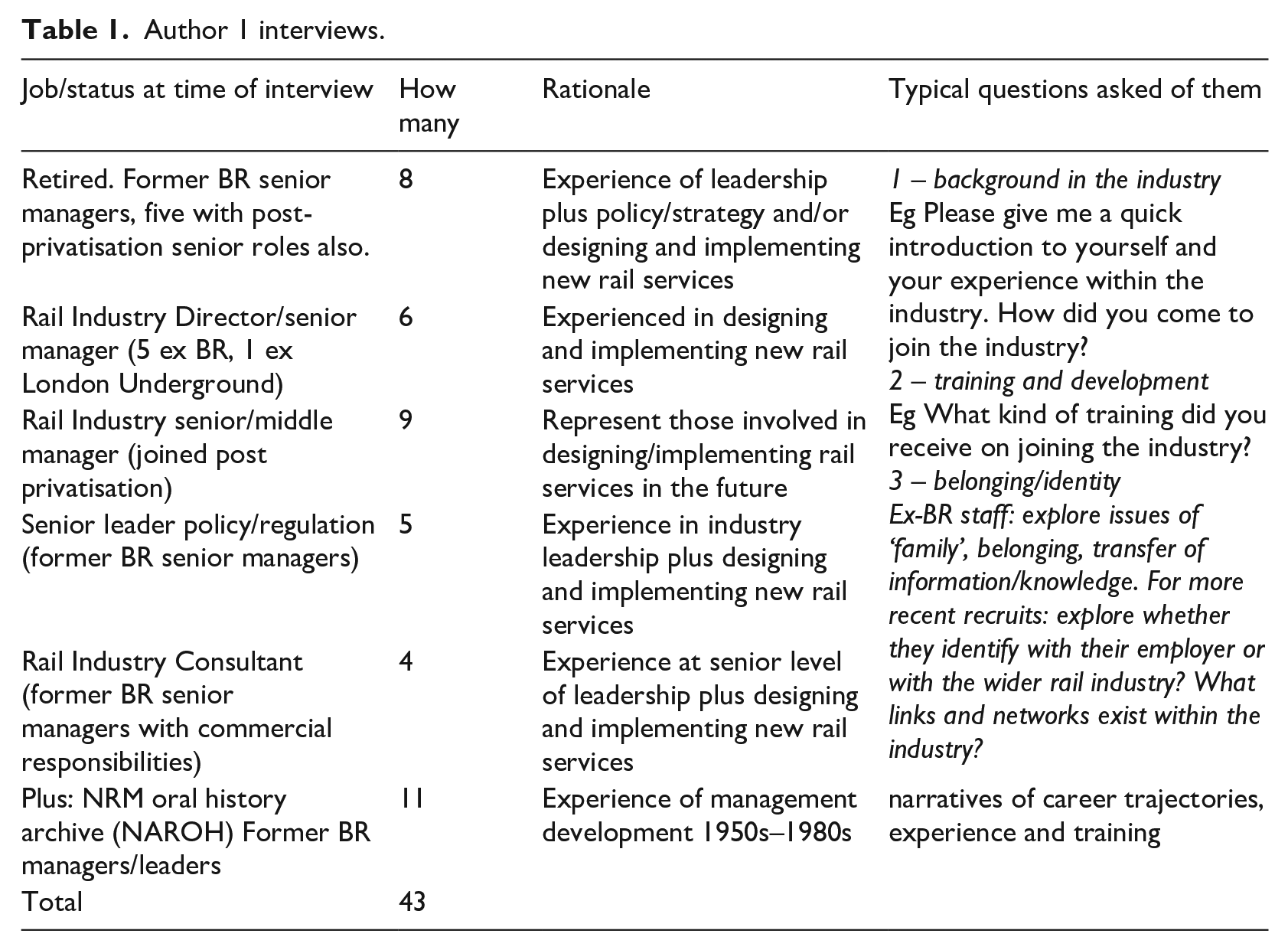
A range of qualitative methods were used to gather materials. Operation Princess was one of three case studies in author one’s PhD on privatisation’s effects on railway knowledge development. The research materials included over 30 interviews with managers, and oral histories in the National Railway Museum’s (NRM) oral archive (see Table 1).
Author 1 interviews.
These were augmented by analysis of publicly available documents at the UK National Archive and National Railway Museum. Search terms covered elements such as ‘training and development’, ‘courses’ and ‘policy relating to training and development’, which identified documents on BR national training programmes 1970–73; policy for senior managers 1967–70; policy and reports on management courses 1965–76; and management development approaches up to 1989. Material was analysed using grounded theorising (Glaser and Strauss, 1967), uncovering concepts such as railway citizenship that informed ideas of phronetic wisdom. Historical methods (Yates, 2014) were used to create a narrative of how management learning unfolded across nationalised and privatised stages in the industry.
Materials on Operation Princess include 5 of the interviews in Table 1, where individuals had been directly involved with the project, rail industry journal articles, government documents and news media. In addition, author one worked in marketing on the railways for three decades, for BR in the decade pre-privatisation before moving to a private consultancy post-privatisation where they worked on a range of franchise bids excluding Operation Princess, observing the process from the inside. Author two studied pre-privatisation BR for their PhD using ethnographic methods to interview over 50 managers and observe 3 office workplaces on BR’s computerising of administrative tasks such as payroll in the 1980s. Materials gathered were analysed using Glaser and Strauss’ (1967) grounded theorising. More recently, author two is researching an oral archive material containing almost 200 interviews on the privatisation process housed at the UK National Railway Museum. Every interview begins with an invitation to describe the interviewee’s career on the railways, and there are rich depictions of experiences of work and learning to be analysed using grounded theorising. Author three has more informal encounters to draw upon. A close relative who attained a senior position in the railways, with whom there were numerous discussions about railway management, development and enactment over decades.
Reflecting on the different materials together, we unpicked the unfolding processes (Corbin and Strauss, 2015) combining historical and qualitative approaches. Wadhwani and Bucheli (2014) identify the key difference between the epistemologies of history and social sciences as being how they address temporality. Although the social sciences view history as longitudinal, enabling events to be placed within it in sequences to establish their significance, histories ‘employ a retrospective point of view to establish the significance of an event or action in light of antecedent and subsequent developments’ (Wadhwani and Bucheli, 2014: 9). One advantage of the historical approach is that it allows consideration of how multiple temporal processes come together to help explain a particular feature, which the article encapsulates through a narrative fiction.
Given the broad set of possible research materials and concerns about maintaining the confidentiality of our interviewees (McCann et al., 2020), we have created a semi-fictionalised version of Operation Princess. Previous authors such as Nair (2021) have noted the problems of articulating theorisations from extensive qualitative information and enabling others to scrutinise sources. Rhodes (2001) and Rhodes and Brown, 2005) discuss the power of fiction written by authors who are not researchers to communicate ideas succinctly and encourage further work while being mindful of ethical responsibilities, while Leavy (2013) suggests that fiction is a powerful way of illuminating the ‘complexity of lived experience’ (p. 37). More recently, Savage et al. (2018) have argued that organisations can be seen through and as fictions. Given the complex way in which phronesis is formed and unfolds through experience (Kristjánsson, 2022) using fiction to illustrate its development would thus seem appropriate.
The events described in the fiction are ‘real’ in that the authors can trace activities and career paths that match those described from interviews, archival recordings, documents, observations and participation. We have amalgamated them into a smaller set of characters, to protect individuals’ anonymity. The training and life experiences of all our respondents were similar, yet no one interviewee’s experience correlates exactly with the characters in our story. Before the fiction begins, the article introduces Britain’s railways.
Context
Britain’s railways were originally established in the 19th century through private enterprise (Casson, 2009). In 1948, they were nationalised by the government enmeshing the sector thereafter in wider political forces that affected funding and perceptions of performance (Parker, 1991). During the 1960s, the railway network was radically altered, with rural lines closed and many stations shut leading to an improvement in its finances. The Transport Act (1968) introduced for the first time the concept of a wider public good role for the railways, setting up a mechanism for local passenger transport executives to pay British Rail for the provision of socially necessary, but not financially viable services. By the 1970s, when our story begins, the day-to-day running of the railways was led by Board Headquarters which oversaw five vertically integrated regions, each responsible for the maintenance of infrastructure (Gourvish, 1990). British Railways Board developed a new business-led sector management structure in the 1980s with sectors instead of geographical regions responsible for setting strategy and financial results (Gourvish, 2008). In 1990 the sectors became profit centres, and these changes drove a 35% improvement in the financial performance of the industry (Shaw, 2000).
Throughout the 1960s, 1970s and 1980s, railways developed their staff through socialisation processes. Managers took active mentoring roles, giving opportunities to early career managers to learn by experimentation. A key part of this process was learning how to manage a public service for the wider good by having formative experiences that interrelated the different human and more-than-human materialities of running the railway (Institution of Railway Operators (IRO), 2013), helpful in developing phronetic wisdom. Such wisdom was valuable as managers had to reconcile a public service ethos within strict financial constraints, the government awarded loans not grants for infrastructure projects, meaning cost constraints were tight, unlike road where central taxation paid for major projects (Shaoul, 2004).
While media and public perceptions of British Rail’s performance was mixed, because of public relations failures such as the filmed testing of the Advanced Passenger Train and ‘British Rail sandwiches’ being a national joke (Wolmar, 2022). This belied reality, where the financial and operations performance of the railways was good in comparison with other European provision (Nash and Preston, 1994). In 1992 (HMSO, 1992), the Conservative government, opposed to public ownership, passed a bill to privatise the organisation to harness ‘the management skills, flair and entrepreneurial spirit of the private sector to provide better services for the public’ something they believed to have been achieved in the raft of other privatised public organisations. Privatisation brought disaggregation to the rail industry. Track infrastructure was separated from trains, and rolling stock and peripheral businesses were sold off. The operation of rail passenger services was franchised through competitive tender. British Rail was split into 99 parts, producing tensions between collective public interest and private profit, fostering a different, narrow, individualistic and financialised approach to management (Shaw, 2000). The kind of management development opportunities afforded in the pre-privatisation era became scarcer or even impossible, although people who had been developed in the public era continued to work for individual organisations. Railway leaders became disconnected from a guiding sense of the common good of the sector and society, managing through a set of restricted indicators and algorithms that guided plans to maximise profits for each fragment. This approach was useful in winning franchise bids from the government containing innovations and service improvements. This method soon proved problematic and by 2002 more than half of the original franchises had been re-negotiated (Smith and Nash, 2006). However, the changes led to plans like that of ‘Operation Princess’, an ambitious project to run new services over long distances that intersected with many others. Because the plans did not fully consider the human and non-human material entanglements, they were essentially unworkable and had to be ‘rescued’ by the people who were developed in the disbanded BR to manage interrelationships between materialities for the greater good. Our fictionalised account of this process begins with how a young entrant to the railway becomes a wise manager through being steeped in the materialities of its operations, enabling him to have an awareness of the greater good.
Fiction: rescuing the Princess
Prologue
Following drastic cuts made in the 1960s, 1970s BR is smaller, busier and more interconnected. It remains under political pressure to improve its finances (Gourvish, 2002). requiring managers who understand how to integrate efficiently the railway complex assemblage of people, track and trains for the travelling public (Casson, 2004).
Jon, a junior clerk, passes through the imposing arches of a large railway station in the West of England with pride. Built in the late nineteenth century it has grand facilities for travellers on the ground floor. Jon opens a nondescript door on the concourse and skips up a dark stairwell. It is a roasting day, and he hopes Alf, the old railwayman on the next desk has washed and changed his shirt. ‘There’s no such thing as body odour son, it was invented after the Second World War to sell soap’ Alf snorted the last time Jon hinted there might be an issue. Jon sniffs nervously as he enters the dark general office, with the Area Manager’s office at the back. The small windows are pock-marked with pigeon excrement, but they do not affect the stifling heat. Jon is soon hunched at his desk next to Alf, pouring over reams of paper. These contain a variety of information, including types of trains, when they are planned to arrive and leave from each station, routes, qualifications for staff for operating which trains, and Union agreements. Jon’s role is to ensure there is a guard and driver rostered to every train from the moment it leaves the depot in the early morning until it returns at the end of its working day, making sure that people can reach their destination. If for some reason that couldn’t happen, the railways had a public duty to get them there, especially late at night. Allocating the crew is not a straightforward exercise. Working a train requires a specialist understanding of the moving parts of the railway – different trains and passenger needs – and the fixed part – features of the route track and locations of signals. Good rostering means coordinating and integrating a range of materialities to provide a service, taking account of the potential for them to behave in unpredictable ways.
Jon is not long out of school. He learned about the job opening from a family friend, was successful at an interview, and is now on a low rung of a complex administrative hierarchy. He will now be moulded into the railway family, a process begun by the ‘old hands’ in the office. Other clerks are long experienced, with specialist knowledge of what makes their patch of railway work. They take a paternal interest in Jon, discussing his work, and nurturing him. They know that some sections of track allow trains to run faster than others, and that speeds are variable, depending on physical features such as bends, level crossings, and stations. Some of this knowledge is captured in the papers and manuals on Jon’s desk, but much is not. ‘The best laid schemes o’ mice and men gang aft agley’ said Alf ‘You need to get out and about son! Dinnae get the bus to the football on Sunday son, get the train and look out the window at the route – you have your free travel so use it’.
One time Jon is returning home after a match he sees Alf and his mates in the carriage and is rather pleased Alf asks him to their next trip to the seaside, and they look at the fixtures and fittings of the route, Alf telling him about changes he has witnessed. Over time Jon visits every corner of ‘his patch’, becoming familiar with all its idiosyncrasies. Because every station is physically quite different, you cannot assume that turning a train around will take the same time in each. There might be a burst of more passengers than usual. Learning is a continual process, immanent within Jon’s day-to-day interactions, environment, and existence. It is an emotional and bodily form of learning, although the culture is not to dwell on or even voice these aspects.
Initiation
In time, Jon catches the eye of Alan Smith, the Area Manager in the office. ‘How are you getting on lad?’ Mr Smith enquired. ‘Oh, it’s great Sir, I think I am getting my head around things’ Jon replied. ‘Alf says you are doing very well, good lad. Would you like to go on a course to learn more about operations? There’s one at Derby that might be good for you’. Jon is thrilled – he has never been that far north before.
A couple of months later an excited Jon makes the journey to a large training centre, another imposing building, and meets people from all over mainland Britain who are there to learn like him. He is one of 20 engineers, accountants, rostering staff, signallers, and personnel people. Over two weeks, they are taught in the classroom and put through practical exercises. One day they are split into groups and taken in minibuses to the middle of nowhere. Navigating miles across rough Derbyshire moorland without equipment and only basic provisions, they learn to work with each other, noticing who needed supporting or working out ways to cross streams or avoid livestock. Back warm and dry at the pub at the centre, they exchange stories of horrible incidents and minor triumphs, poking fun or empathising consolingly. Evenings are taken up with talks from various senior managers, giving them views of their wider railway responsibilities for everyone in mainland Britain. The senior managers stay for dinner and the pub, and if anything, that was even more eye-opening, as Jon learns of upcoming opportunities and areas of shortage. The course has accustomed him to interacting with senior people Alan Smith can only dream about. Several of the group have formed firm friendships and Jon is feeling a part of the railway family,
Returning home, Jon takes a greater interest in the weekly railway job vacancies ‘escape list’. He obtains a job 400 miles away planning the National train timetable, a major step up, but the person who hired him had noted his glowing references and training college experience. It’s a long way from home, but as Alf says, ‘The railway family will make sure you’re all right son, look at me coming here from Glasgow’. After a few months drawing on his existing knowledge, skills, and experience of those around him to perform the job, he again attracts interest from senior managers. They suggest he join BR’s management training scheme, which he does alongside 29 others, some insiders like Jon, and some recent university graduates.
Jon is excited to arrive at an even grander training college, this time with outsiders giving classes alongside BR staff. Jon learns management subjects and more about how BR is operated. Trainees are expected to become familiar with every aspect of the railway apart from specialist engineering and accountancy. For the next 18 months classroom subjects and skills are interspersed with placements on diverse railway operations. One month Jon is sorting mail on the night train to Glasgow, the next selling tickets in Manchester. His favourite activity is working in a rural manual signal box, working alongside experienced old signallers who are not exactly welcoming at first. An early mistake where Jon caused a General Manager to arrive late for work by holding back a delayed express train to allow a slower-running passenger train through, resulted in an earbashing over the phone. Colin, an old signaller, sniggers in the corner. Jon blushes, swearing under his breath. He vows to not let this guy snigger at him again. At the end of the placement, Colin says grudgingly ‘You’re all right lad, I’ll give you that’. Jon knows they will never be friends, but he has won Colin’s respect and learned much from him.
After completing the management training scheme, Jon becomes an area relief operations manager, covering any unexpected managerial operations task due to sickness or leave. The job is demanding and requires wisdom that is often beyond the reach of the rookie. Jon is lucky there are plenty like Alf who are generous with their advice, and he comes to welcome the interventions which generally begin ‘Well now, Archie would often do x in this situation’. There are also people like Colin, who take joy in him making mistakes, but Jon views that as a challenge. Practical wisdom on the railway is achieved through trial and error. He has heard that some on his management course did not thrive in their new roles, and were moved sideways, but Jon and a few others persevered. Jon becomes an assistant manager with day-to-day responsibility for managing train crew and signallers to ensure trains run on time. His experience means he understands the job deeply, rostering and signalling coupled with managing people enabling him to respond in real-time to unexpected happenings such as trespassers, trees on the line, breakdowns or staff illness interrupting services.
Yet again, Jon’s skill set wins the attention of more senior staff, and he is sponsored through a project-based course where a team of 5 from across BR investigate how to improve a major station’s train capacity. Over three months they test options for signalling and track layouts to optimise throughput safely, identifying costs and revenue opportunities. The group meets at the prestigious BR training college periodically while continuing to fulfil their normal jobs in between. Jon extends his network, layering new contacts onto those he already has accumulated, as Alf predicted he is now fully at home in the railway family, comfortable with moving jobs, learning new environments, developing his knowledge on courses and practising phronesis, as he does over subsequent decades, rising high in the industry, meeting people he had studied with when he arrived there. Jon is now fully absorbed into a collective of senior managers who bear the tradition and heritage of the railway as a public good, although this is implicit rather than explicit. The wisdom gained through this process now flows almost naturally into decisions and actions as unexpected situations arise.
An alternative ontology of management arrives
Fast forward to the early 1990s. After privatising all the other UK public utilities, the Conservative government turns its attention to the railways, reversing a previous decision to retain them in public ownership while squeezing costs. Their political mantra is that privatisation will bring more investment and innovation to an industry that is unresponsive to customers and market demand (HMSO, 1992). BR managers fight hard to preserve the integrated organisation in a different form, but the government wanted to marketize the railways into 99 individual companies (Gourvish, 2002). Different organisations would run parts of the infrastructure, rolling stock and routes. BR staff either join the new organisations, consult or leave the sector entirely. There were different ways to manage the newly created supply chain. The government chose franchising to manage the operation of train services, setting up a new organisation comprising industry newcomers and former BR managers to manage this process (Gourvish, 2002).
The former managers used their knowledge to set challenges for the bidders to address, one of them being a push for improvements to cross-country routes. Formerly, these were Cinderella services, necessary but unloved compared to the better-funded ones that visited London. Although the new franchising organisation could offer innovative work, the contract would be awarded to the bid that offered the greatest benefit at the lowest subsidy. The government hoped the bidding process would attract creative minds.
Someone perceived as coming up with creative solutions is Mark, a recent graduate from a prestigious university. He walks from the tube to his work in a modern office block in his smart business suit, then enters the glassy entranceway and takes the lift to reach his office with its shiny new desk, empty except for a powerful computer. Mark won his job at the new rail company, part of a wider transport conglomerate, thanks to demonstrating his intelligence at Maths and Statistics through a complex recruitment process. He models financial variables in different ways to create impressive business plans, today it is a franchise bid. Mark has only ever encountered the railway as a very occasional passenger, but then again none of Mark’s previous projects had required him to know anything about the day-to-day running of the business he was modelling. Mark’s expertise lies in using his knowledge to cost business deals that obtain the best result for his employer. Jon could have told him that plans that may look detailed on paper need many different people and things to join to happen, and unexpected things might stall or block them, however, Jon or people of his ilk are not involved until after the plan is devised.
The plan Mark presents to his bosses is bold and risky. He presents an impressive PowerPoint showing shorter, new trains carrying twice as many passengers on much more frequent services than before, with the taxpayer subsidy projected to reduce to zero over the franchise period then a good profit accruing to the new franchise holder. It is possible that some of the revenue will stem from passengers switching to the shiny new services from other companies, but that is no problem in the new marketized world, Mark’s loyalties are not for the overall rail sector, they are just to his employers. These employers are delighted and so is the government which awards them the franchise. They received bids with more humble plans, but they did not excite in the same way. This is just the kind of innovation privatisation was supposed to deliver, and CrossCountry Trains are born.
After the franchise is awarded and the new train operating company is formed, Mark is tasked to model a timetable based on his plan. The company brings in Jon to help its implementation of the plan. Jon is impressed at the ambition of the plan idea: ‘We’d never have done this in BR days in a million years’ he muses but suspects they will have to get there in stages. There will be pain ahead to get different companies and local authorities on board, but improving this service would be a great thing to do. The immediate problem is that during the time it has taken to first negotiate and contract the new franchise and second, plan the new train services in detail, the space on the tracks for the services has been taken up by other operators’ trains. Jon communicates a vision by dubbing the project ‘Operation Princess’, the transformation of a drab, unloved, under-invested set of services into shiny new privately operated success stories and sets about negotiating successfully with the rest of the industry for the necessary access to the track.
Disaster unfolds
The new services are finally launched to much fanfare, but things do not unfold as predicted. The shiny new trains are delivered late, stalling the plan. When they finally arrive and are introduced to the routes, they are overcrowded at peak times, causing people to be late for work or get home (BBC, 2002). A three-minute delay on one part of the route has the potential to turn into a major disruption 400 miles away, creating problems from Aberdeen to Penzance. Rather than improving passenger journeys, the new timetable makes them much, much worse (Select Committee on Transport, 2003). The government is embarrassed and angry. Across the network, members of the railway family are mortified at the disaster which has befallen them. CrossCountry is pilloried in the media (BBC, 2002) and has no option but to introduce a drastically revised timetable. Longer trains are brought back, and the number of new services is reduced.
Rescue
This time the process goes very differently. The franchising authority recognises that this is a complex strategic problem which will impact on the future (Gourvish, 2008). At the same time, some people in the franchising authority and CrossCountry can see an opportunity to improve rail services for many people. Simply returning to the old timetable is not an option.
The franchising authority selects four former BR operations managers to address the timetabling problems. Drawing on their experience, they set out a national approach to the timetable to optimise the provision of services for both passengers and taxpayers. They have a shared, unspoken vision of a railway that is there to serve the wider public good, not just shareholders, a vision arising from their formative day-to-day interactions as BR managers reinforced through their management training.
Implementing the vision is reliant on the timetabling teams within different train operators. Jon is now Managing Director at CrossCountry. He oversees the re-writing of the timetable, removing stops and extended routes that had been added by Mark to raid income from other operators. Jon’s priority as a member of the railway family is to come up with a timetable that will work in practice, delivering the best possible service for the greatest number of people, at the lowest practical cost. It is up to others to argue about the finances. Jon is supported by the managers in the franchising authority who share his outlook.
The franchising authority negotiates with other train operators to adjust their services around CrossCountry, creating space so that a minor delay in one service will no longer bring gridlock to the national network. This leads to some major changes that must be negotiated with local community representatives. On his way to what promises to be a difficult meeting, Luke from the franchising authority, a former rail colleague of Jon’s and like him, a graduate of BR’s scheme, remembers similar situations he has been in in the past. Initially he accompanied more senior managers and observed meetings. It was fascinating how the dialogue was shaped until those present were able to reconcile conflicting priorities of local governments of differing political hues and what is affordable or negotiable with other train organisations. Afterwards, managers would talk over a beer about how the meetings had gone, and the stories they told took on a life of their own becoming moral fables to pass on, communicating and strengthening the unwritten ethical codes that guided railway activities. Luke is a calm and capable individual, but the audience tonight is difficult, and the discussion is heated. ‘I’m f. . ..g well not going to recommend we accept your proposal’ says one local councillor
‘It means re-routing the trains through the city via a different station, the level crossing is going to be closed more often and I’m going to spend all my time sitting in my car waiting for the train to pass. And now it goes to somewhere quite useful, but the revised timetable will take it to a different city which is no e. . .g use to me’.
Luke reminds the meeting that the viability of the local and national railway is at stake. Choices are never easy, and everyone must live with the consequences. But Luke knows that what is at stake is important. His experience suggests that choices made for the common good will have better consequences overall, even though the outcomes might be worse for some individuals than for others. Like Jon, Luke knows that solving difficult problems such as Operation Princess relies on detailed practical knowledge to identify a solution for the common good, balancing what is achievable in relations between complex materialities, including track, trains and railway staff, with the needs of local communities seeking to travel to work or school, to do their shopping in the nearest town and keep medical appointments. Operation Princess can only be rescued by making and holding to some difficult decisions.
The meetings with local communities are not the only difficult ones. New contracts need to be negotiated and drawn up with other train companies. Away from the timetabling process, a different team is negotiating a new financial agreement with CrossCountry and things are far from smooth. CrossCountry has a new fleet of trains and more staff to pay for to run the improved timetable, but the new timetable has reduced its revenue projections. The franchising authority needs two key outcomes from the negotiations. There is an important political imperative for CrossCountry to remain a viable business, but this must not be at the expense of the taxpayer. Somehow the negotiators need to find the balance. The team is led by Matt, another former BR management trainee and manager, who has a solid understanding of railway operations. He has a good idea of the resources required for the new timetable and the costs associated with that. He also has a blueprint for what a flourishing railway is, born not just of his railway experience but also from years spent working for local authorities, negotiating, and procuring improvements to rail services for the betterment of his community. Supported by a team of top lawyers and financial advisors Matt draws up his negotiating position designed to work for both CrossCountry and the taxpayer. The final negotiation meeting is particularly difficult. The directors of CrossCountry’s holding company are pushing for a better financial settlement. ‘You can’t expect us to run the service for that. We’re not a charity’ says their negotiator. ‘We’ve done the sums, we know that you’re going to need a subsidy, but if you think we’re going to give you the sum you’ve asked for, you’re going to be disappointed’, responds Matt. As the hours turn to days, Matt sticks to his guns, even when partway through the final day their team stalks out of the room, frustrated by their inability to change Matt’s position. After a while, they return. Eventually, realising that they cannot shake Matt’s resolution they give in.
In the end Jon’s team planned and implemented a rail service that is significantly better for a larger number of people. More punctual trains serve formerly poorly covered areas. BR would not have attempted the project, because the government of the day would not have let them raise the finance. However, it needed BR-developed managers to make the investment happen. Unlike Mark, they can comprehend the ramifications of changes on the wider community because of the virtues instilled through their experiences and education which give them the competence to know what to do to implement the plans. Over time, rescuing Operation Princess and its story of overcoming challenges becomes another railway fable.
Discussion
The rescue team for Operation Princess were able to implement a successful compromise plan because they had developed phronetic wisdom over time, enabling them to appreciate the entanglement of different human and non-human materialities that make up the railways and to make decisions that take into consideration the greater good. Previous research on phronesis and management learning has focused on developing virtues in a classroom as preparation for subsequent work (Antonacopoulou, 2010; Statler, 2014), discussing constraints on educators’ abilities to enable opportunities (Kinsella and Pitman, 2012). Our work extends management learning research that questions the timing of learning phronesis (Statler, 2014), and draws attention to its embodied nature (Küpers and Pauleen, 2015), often in unforeseen circumstances requiring a degree of improvisation (Hadjimichael and Tsoukas, 2023). It does so by using a new materialities approach (Bennett, 2010) to highlight the length of time it takes to develop phronesis (Kristjánsson, 2022) through formative experiences (Gherardi, 2016) in multiple material situated contexts, and how interconnected local practices are with wider power relations and consideration of the greater good. While previous work tends to focus on individual learning or experiences (Antonacopoulou, 2010; Hadjimichael and Tsoukas, 2023; Statler, 2014) within a habitus (Rooney et al., 2021), the article shows how a collective approach to learning phronesis was possible in the railway sector, a multiscalar environment (Çağlar and Glick Schiller, 2021) enmeshed in wider power relations (Bennett, 2010).
Kristjánsson (2022) argues for the benefits of helping students develop the critical faculties to ‘be alert to norms’ (p. 303). We suggest this can be facilitated and built on through a different balance between experiential and classroom learning. The use of experiential education, in which students engage with the material world, rather than abstract, commodified concepts alone, providing them with a safe space in which to practise those first tentative steps in phronetic decision-making. More experienced staff routinely quizzed and encouraged more junior staff to reflect upon their work in a mundane way that would not be unfamiliar to Aristotle. This is an example of communication being constitutive (Ashcraft et al., 2009; Kuhn, 2021) of both the formativeness of phronesis’ development and performances of agencement (Gherardi, 2016). Techne and sophia were not ignored, but the balance of learning was more in favour of experimentation and situated learning (Hadjimichael and Tsoukas, 2023), linked to an ethos of public service. BR’s development programme was clear about the multiscalar nature of the railways, and that wider power relations shaped every activity (Çağlar and Glick Schiller, 2018, 2021). BR had a collective, established social path for this process demonstrated by the everyday mentoring that was not a special activity stream, as it appears in other organisations today.
The railway shows that institutions are open agencements (Gherardi, 2016). MacIntyre (2007) makes a clear differentiation between practices and institutions, the former being the bearer of the traditions of each practice. This fits the context of our study, as the traditional management practices with their own internal sense of the good came into conflict with a new, narrower institutional ontology of economic goods. Institutions may often be at variance with practice because practice has an ethical purpose, and the bearing institutions may not. The common life of an institution (such as the railway) should always find within itself an argument over what management for the common good is (MacIntyre, 2007: 222). Our fiction draws out the components of a managerial and leadership practice which had developed in a historic public good tradition. In this story, the overall institution had lost sight of the common good but was operationally restored to excellence through the character of those within a community of practice in which a wider commitment to the good of passengers together with a deep material appreciation of the railway had been forged.
Our fiction also illustrates how a phronetic approach was developed in managers then displaced by a competing, highly restricted ontology of management (Kuhn, 2021), one of neoliberal marketization which adopted a narrower perspective that detached many of the human and more-than-human materialities (Bennett, 2010) from managers’ thinking. Focussing on the Common Good would not have won CrossCountry the franchise. Instead, metis, the ability to play the franchising game, was all important (MacKay et al., 2014). People developed in that ontology have learned to agence the numbers skillfully and devise idealised future states designed to earn the most money for their organisation. Details of how the plans could be enacted or how they relate to other organisations are not of concern; a limited worldview of shareholder value is the directing ethic. This is all very remote from the smell or sound of an overcrowded train carriage, or the cold depressed commuter freezing on a platform waiting for a train that never arrives. Moreover, a human like Mark developed in agencing numbers is rarely faced with the consequences of their plans – it is others who need to pick up the pieces, people like Jon, Matt and Luke, who have developed phronesis via the very material engagements Mark and those who developed him think are irrelevant. The failed initial solution can be seen to be not just lacking in material appreciation but also relying on the deployment of gaming skills within disengaged algorithms to maximise income at the expense of the common good of passengers. MacKay et al’.s (2014) comprehensive exploration of metis and its implications for management learning includes twists, dissimulation and ruses, and is specifically differentiated from phronesis by its, at best, amoral ends. Our story contrasts this approach with the phronetic rescue, balancing various goods towards a common good purpose in a way that was open to inspection, which the first project was not. This is not to suggest that phronetic leaders may not also use metis in certain situations, and this may feature in the political competence and resilience required for leaders to hold out for a moral final solution against those representing narrower interests. The rescue of Operation Princess is consistent with Bachmann et al’.s (2018) eight core features of phronesis.
Moreover, marketization has undermined the development of phronesis on the railway. It is far more difficult to apprehend or act wisely on decisions that involve complex entanglements of materialities and have multiscalar repercussions. Previous studies of privatisation have focussed on financial performance (eg Bartle, 2004; Pollitt and Smith, 2002; Smith et al., 2010). An exception to this is the work of Michael Brook (Casson, 2004) who identified a knowledge gap in the post-privatised railway relating to understanding the railway as a system and proposed an MBA in railway management to fix the issue. We would argue that the development of wise railway leaders requires something more than an MBA. At the beginning of our article, we discussed how Aristotle’s concept for practical wisdom, that is, phronesis, has been suggested to address shortcomings in abstract, commodified contemporary management education. The story of Operation Princess supports the findings of Kristjánsson (2022) that phronesis develops over time and from experience. However, the Princess story also gives us some hope, suggesting that a structured programme of development over a career, combining a mixture of classroom-based teaching of techne, with opportunities to learn agencement through formative material experiences (Gherardi, 2016), within an organisational culture in which more experienced individuals take responsibility for the development of newcomers and are exemplars for phronesis in practice can shape people in such a way that they become ready to take on the full responsibilities of citizenship.
Conclusion
To conclude, we have made the following contributions to discussions on phronesis. Previous research has elaborated on different dimensions to the concept of phronesis, and argued it is useful in addressing the shortcomings of overly conceptual thinking. We build on practice theories approach by taking up Kuhn’s (2021) provocation to adopt a new materialities (Bennett, 2010) approach to phronesis that extends previous work on its situated (Hadjimichael and Tsoukas, 2023), and embodied nature (Küpers and Pauleen, 2015). We argue for more attention to non-human materialities that join with humans in the vibrant, multiscalar inter-relationality of the formativeness and agencement in both performing and learning wise management (Gherardi, 2016). As a result, local, practical knowledge is entangled with consideration of the greater good, as Aristotle (2009) originally intended. It took time and repetition for railway managers to develop powers of awareness, immanence, perception, communication and reflection. Doing so combined both conceptual and practical skills used in experimentation where learners were often finding out what they needed to know as relationships between materialities became apparent – it was a formative experience. Such a process is almost diametrically opposed to how contemporary management development unfolds, with its fragmented, specialised, programmed packages with their learning objectives and outcomes, that reify in a way that the spreadsheets and franchise bids elided the wider materialities of the railways. The development processes need to consider the interrelationships between vital materialities in organising that transcend simple subject or organisational boundaries and are heavily shaped by power relations. We also make some tentative suggestions as to how teachers can help students to prepare for this.
Finally, it is not coincidental that the characters in our fiction are male. For many decades, the railways of Britain were predominantly a male preserve, and the development of phronesis took place within a homosocial, paternalistic environment (Collinson and Hearn, 1994). The environment is only slightly more diverse at the time of writing. Hanna et al. (2020) found homosocial environments make it easier for men to communicate, be supportive and share knowledge, but we think it may also make it more difficult for women and people of colour to be thought of or developed as potential wise leaders and reinforce hegemonic masculinities. It would be interesting to study the relationship between gender, phronesis and management development further, although this is beyond the scope of this article.
