




Abstract
Heuristics are fast-and-frugal rules of thumb, used to simplify complex decisions. This article explores how heuristics may help improve project leadership. First, it identifies two schools of thought in scholarship about heuristics. Second, it explains why heuristics work, based on Occam’s razor. Third, it outlines five steps for teasing out project leaders’ tacit heuristics, with examples of how the steps were employed in leadership training at Oxford University. The five steps emphasize the role of Aristotelian phronesis in developing effective heuristics. Fourth, the article discusses heuristics that drove success at Pixar and how we may learn from these. Finally, areas for further research are identified. Readers, whether practitioners or scholars, are encouraged to develop and improve their own leadership heuristics and guidance is given for how to do this.
Keywords
Introduction: What Are Heuristics?
Heuristics are fast-and-frugal rules of thumb, used to simplify complex decisions. “Follow the brook, and you'll get to the river,” is an example. Both experts and laypeople use heuristics when making decisions under uncertainty. So do animals. Heuristics seem fundamental to cognition and decision-making in evolutionary terms. 1 They are mental shortcuts used to reduce complexity, making decisions manageable. Heuristics are typically tacit and need to be teased out and made explicit before they can be made the object of formal research and be discussed by teams and organizations. Here, we explore how heuristics may help improve project leadership and the research involved in understanding and bettering heuristics.
The term “heuristic” has its origin in the ancient Greek word for “to find,” in the sense of discovering or finding out something. Eureka!—the cry of discovery (the correct spelling is heureka, which is rarely used)—is at the root of the term (Oxford English Dictionary, 2021: full entry). Kahneman (2011, p. 98) defines a heuristic as “a simple procedure that helps find adequate, though often imperfect, answers to a difficult question” (italics added). Gigerenzer et al. (2011, p. xvii) similarly define heuristics as “processes that ignore information and enable fast decisions” (italics in the original). Albert Einstein used the term in 1905 to denote a useful but incomplete shortcut in developing his Nobel Prize–winning work on quantum physics (Einstein, 1905). In the 1950s, Herbert Simon used the term as a central tenet in his work on decision theory, which won him the Nobel Memorial Prize in Economic Sciences (Simon & Newell, 1958). Finally, during the 1970s, Amos Tversky and Daniel Kahneman did their famous work on heuristics and biases (Tversky & Kahneman, 1974), which also won the Nobel Memorial Prize in Economic Sciences emphasizing, once again, the high regard for heuristics scholarship. Today, the study of heuristics is central to a wide range of social and behavioral sciences. Gigerenzer and Brighton (2011, p. 2) view heuristics as so fundamental to human behavior that they have named the human species “Homo heuristicus.”
In management, heuristics have been argued to be about “leadership by simple rules” (Sull & Eisenhardt, 2015). In project management, this translates into “project leadership by simple rules,” which is the focus below, especially for complex projects because heuristics seem particularly useful for navigating complexity. In their comprehensive overview of management heuristics research, Vuori et al. (2024) suggest that scholars should pay particular attention to the emergence of individual-level heuristics with managers and the conversion of those heuristics to the team and organizational levels. We agree and present our contribution to this work below. We argue that with its emphasis on specific domain experience, project leadership is a particularly rewarding field for the study of heuristics, because deep domain experience is the very life blood of good heuristics.
Two Schools of Heuristics
Two main schools exist in thinking about heuristics. 2 The first focuses on what we call “positive heuristics,” defined as heuristics that help people make better decisions such as the recognition heuristic and the take-the-best heuristic, demonstrated by Gigerenzer and Goldstein (1996) and Gigerenzer (2002). Gerd Gigerenzer is the leading proponent of this school. The second school concentrates on what we call “negative heuristics,” defined as heuristics that trip up people, violating basic laws of rationality and logic, for example, the availability heuristic and the anchoring heuristic, documented by Tversky and Kahneman (1973) and Kahneman (1992). Kahneman and Tversky, who are leading exponents of this school, emphasize that heuristics are “often approximately correct” and generally “quite useful,” but also that heuristics can be “quite wrong” (Kahneman, 2011, p. 416; Kahneman & Klein, 2009, p. 522). Despite their nod to the usefulness of heuristics, Kahneman and Tversky chose to focus almost exclusively on heuristics with negative impacts on decisions. They founded the highly successful “heuristics and biases” movement in decision science, based on a string of ingenious experiments designed to show how people, under the influence of cognitive biases, violate laws of logic, probability, and rationality in their everyday decisions (Tversky & Kahneman, 1974).
The existence of the two schools—with such prominent intellectual leaders—has encouraged an unfortunate tendency to see heuristics as either positive or negative, without a middle ground, and to see research as belonging to one camp or the other, not both. We see this as unproductive and take a different approach. In our judgment, both schools have demonstrated their relevance in impressive detail. 3 Important disagreements exist between the two, to be sure (Gigerenzer, 2018; Kahneman & Klein, 2009). But the two schools are best understood as complementary models for understanding different aspects of heuristics, not as competing and mutually exclusive models for explaining heuristics as such. In short, you need to understand both schools to understand the role of heuristics in human adaptive behavior. Specifically, you need to understand positive heuristics in order to be fast and frugal in what you do and to understand negative heuristics in order to debias your decisions, when needed, through what Kahneman et al. (2021, p. 327) call “decision hygiene.”
We covered central aspects of negative heuristics, their impact on leadership, and how they may be mitigated in Flyvbjerg (2013, 2014, 2021) and Flyvbjerg et al. (2009). To balance things, here we focus on positive heuristics and especially how they pertain to experienced leaders responsible for successfully building, running, and changing complex projects, programs, and organizations in government, business, and nongovernmental organizations (NGOs). Following Gehry (2006), we call such leaders “masterbuilders,” loosely named after the architects of the cathedrals of the Middle Ages, but here not limited to architecture or history. 4 Specifically, when we say “masterbuilders” we mean “project masterbuilders.” We define them as individuals (with their teams) who have a track record of being able to deliver their projects as promised; that is, on benefits, on budget, and on schedule, or combinations of these that clearly spell success. Like everyone else, project masterbuilders operate based on knowledge and intuitive judgment, including heuristics.
Why Heuristics Work
Masterbuilder heuristics are typically:
Limited in number: Usually a handful or two, and no more than a few dozen, for each masterbuilder. Personal: Tailored to the person and organization using them. Specific: Based on well-defined and deep domain experience. Intuitive: Unreflected to the masterbuilder, unless deliberately teased out. Clear: Provide explicit guidance, once teased out.
Below, we cover each of the five characteristics.
The cure to complexity is simplicity. That is why the first and foremost heuristic, informing all others, is Keep It Simple. It is also why each decision-maker uses only a few heuristics. If decision-makers used more heuristics, they would be reintroducing the complexity they are trying to get rid of by using heuristics. Occam’s razor, a.k.a. the principle of parsimony, states that the simplest explanation is mostly the best one (Stoica & Söderström, 1982). So does formal work on statistical model selection (Akaike, 1970; Akaike, 1998; Box et al., 2015; Krugman, 2000; Lee, 1973; Smith, 1997; Tukey, 1961) and human decision-making (Czerlinski et al., 1999; Gigerenzer & Gaissmaier, 2011; Marewski et al., 2010). This body of research demonstrates that when two models fit the data the simpler one is generally more accurate. Moreover, simpler models are more testable because they have fewer assumptions; they therefore allow easier and faster improvement, which is key to success in science, policy, and practice. More detail, therefore, does not necessarily translate into more accuracy in explanation and prediction, but quite the opposite. This is key to understanding why heuristics work. They are the ultimate simple model, with detail stripped away until the model is, in effect, a fast-and-frugal rule of thumb, eminently testable and therefore eminently improvable.
These observations may seem counterintuitive. It appears self-evident and true to many that if you do not understand a phenomenon, or if your predictions fail, you need to dig deeper and obtain more detail to understand the phenomenon better. To conclude the opposite as we do here—that more detail leads to less accuracy—goes against much work in science, engineering, policy, and practice that attempts to understand complexity by developing ever more elaborate and parameterized models of it. 5 But this is a dead-end. As elegantly summarized by Box (1976, p. 792, italics added), “Just as the ability to devise simple but evocative models is the signature of the great scientist so overelaboration and overparameterization is often the mark of mediocrity.” This is Occam’s razor in a nutshell.
To illustrate the power of simplicity, consider the following two examples. First, Goldstein and Gigerenzer (1999, p. 43) quizzed students at the University of Chicago and the University of Munich: “Which U.S. city has more inhabitants: San Diego or San Antonio?” Sixty-two percent of University of Chicago students, who are among the best educated in the United States, chose the correct answer, which is San Diego. But 100% of the German students chose correctly. What happened? All the German students had heard of San Diego, but many of them had never heard of San Antonio. They applied the recognition heuristic (“the city I recognize is probably bigger than the one I don’t”) and made the correct inference. The American students, recognizing both cities, were not able to simplify like this and therefore had to use more complex reasoning. The German win in the quiz was due to what is called the “less-is-more effect,” less information lead to better decisions. This was not because the German students had access to privileged information. The American students had the same information, and more. The keywords here are “and more.” The reason the Americans’ more complex reasoning led to inferior results is that it considered details many of which were irrelevant and therefore created noise instead of clarity in their decision-making process. Scheibehenne and Bröder (2007) similarly found that mere player name recognition led to highly accurate forecasts by laypeople of outcomes in the Wimbledon tennis competition.
Second, Wübben and Wangenheim (2011) compared the power of complex statistical models against managers’ fast-and-frugal heuristics in predicting repeat customers in the airline, apparel, and online music industries. Repeat customers are highly profitable. As a business manager, you therefore want to know who they are so you can concentrate your efforts on them. Statistical models were pitted against the following simple heuristic, which distilled the savvy of experienced managers: “A customer who has not purchased for x months will not be a repeat customer” (with x a different number for each of the three industries). The heuristic beat the complex statistical models for the airline and apparel industries and tied for online music. Wübben and Wangenheim (2011, p. 709) call this a “devastating result” for the statistical models used in the three industries to predict repeat customers.
The two examples illustrate the less-is-more effect, which has been documented across scores of experiments (Gigerenzer, 2014, p. 120 ff.). More often than we think, it is better to know less than to know more, if the goal is prediction accuracy. This is especially the case if the little we know is not the result of mere ignorance (as in the first example) but instead of careful curation through years of experience and tests, deciding what works and what doesn't in our specific domain of expertise (as in the second example). The latter is how project masterbuilders manage their affairs—and their heuristics.
Five Steps in Teasing Out Heuristics
Heuristics are typically personal and intuitive, as mentioned. They are stored with individuals as tacit knowledge. In explaining what tacit knowledge is, Polanyi (1966, p. 4) famously wrote: “[W]e can know more than we can tell.” This is because much of what we know is not conscious, and the “more” in “more than we can tell” is what Polanyi defines as tacit knowledge. Most leaders are not conscious of their heuristics and therefore cannot easily explain what they are—not to themselves, even less to others. This is a problem from a leadership point of view, because the impact of a leader’s heuristics can be amplified if they are shared with their team and organization. Luckily, there are ways to tease out tacit heuristics and make them explicit, for instance through interviews and workshops. My team and I have done this for more than 15 years in our research and in the leadership programs we run at Oxford and elsewhere, with around 1,000 graduates to date. Here we briefly summarize and report on the main findings from these interventions and programs.
In workshops for teasing out leaders’ tacit heuristics, we guide participants through the following five-step procedure in progressive order:
We explain what heuristics are. We give examples of other leaders’ heuristics. We ask participants to identify, among these, heuristics that resonate and explain why. We have participants carefully reflect on their work as project leaders, then articulate heuristics that help them succeed, inspired by, but not copied from, the examples given. We ask participants to share their heuristics with the cohort, explain their choices, and give concrete examples of how their heuristics help them succeed as project leaders.
We work with one cohort of leaders at a time, typically 20 to 30 participants, with a total of around 40 cohorts graduated over a decade. Most participants are already deeply experienced in delivering big, complex projects, although a few have commenced their careers more recently. Before we start, we explain to each cohort that we are not their teachers and they are not our students, because that is not an effective model for learning about heuristics. Instead, we are colleagues doing a workshop together with the purpose of teasing out their heuristics for successfully managing big projects. We will be their guides, but they will do most of the work, to ensure their heuristics are personal, grounded in their specific domain experience.
Examples of Masterbuilder Heuristics
Step 1, explaining what heuristics are, consists in what we already covered above. Step 2, examples, are a presentation of heuristics that other leaders found useful in their work. Figure 1 presents a sample of such heuristics, taken from our research at Oxford, where we have interviewed dozens of leaders about their heuristics, from, for example, Pixar’s Ed Catmull and Pete Docter in movie making, Frank Gehry in architecture, and Andrew Wolstenholme and Manuel Melis in engineering and infrastructure. The figure shows 15 concrete heuristics, which is an arbitrary number, chosen to ensure there is enough variation for all participants to find an example they find relevant, balanced by the need to be brief, because every workshop is limited in time.
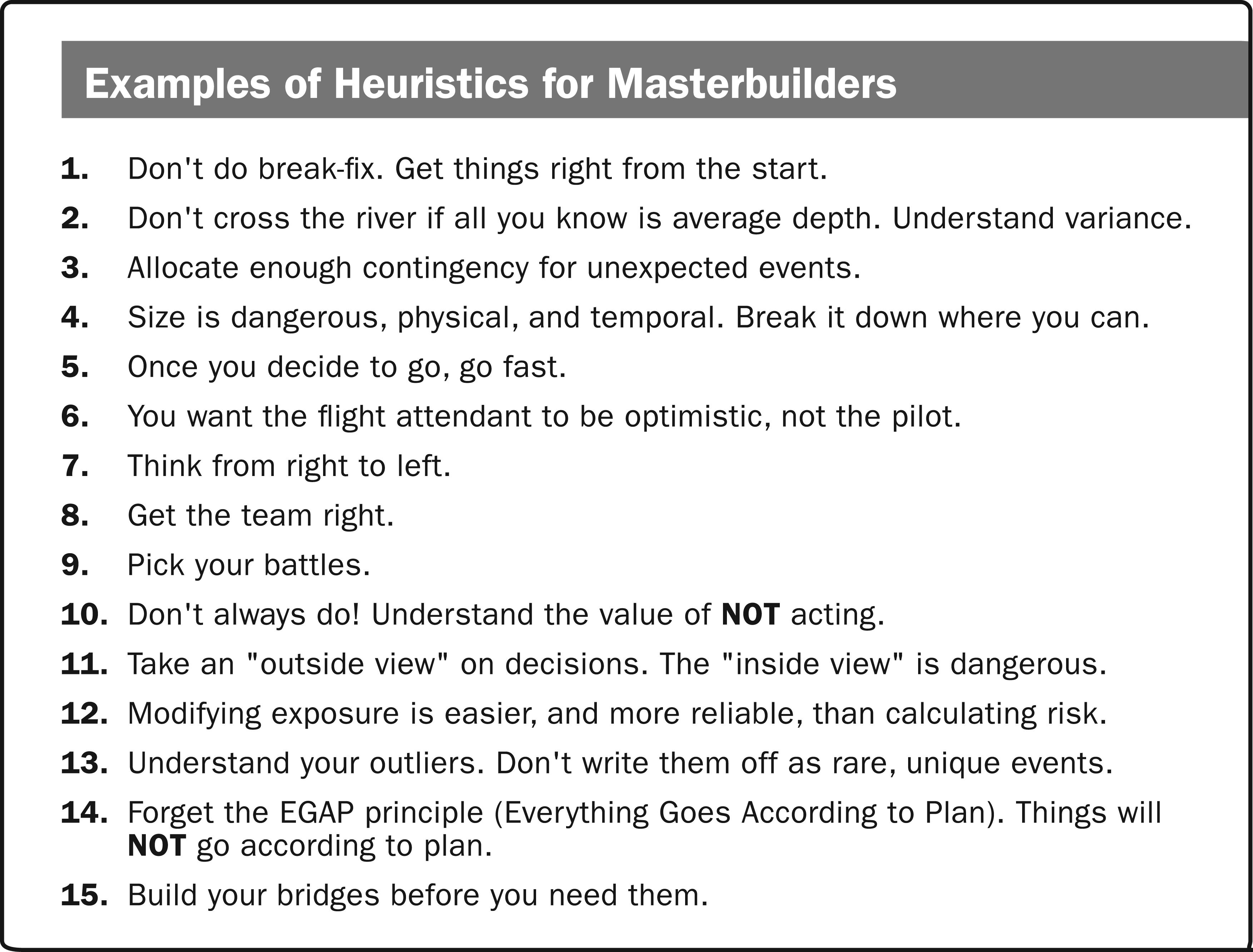
Examples of specific masterbuilder heuristics used in Steps 2 and 3 of the five-step process for teasing out project leaders' tacit heuristics.
We explain each of the 15 heuristics in some detail and give an example of its use. We explain, for instance, that the heuristic Think from Right to Left comes from Andrew Wolstenholme, former project director of Terminal 5 (T5) at London’s Heathrow Airport. Wolstenholme explained to us that the way he keeps his projects on track during delivery, including the US$5–billion T5, is by always keeping a clear image in his mind of what the result must be, placed on the far right of his project plans. “No matter where I am and what I’m doing in the delivery process I check myself constantly by asking whether my present actions effectively contribute to the result on the right,” Wolstenholme said. “If that’s the case, we're good and we can press ahead. If not, we need to stop doing what we're doing and do something else that will get us to the right.”
“The right” is Wolstenholme’s compass, which helps him to not get lost on the enormous projects he directs, no matter how far to the left he is on the plan and what he is doing there. Thinking and working like this was key to the successful delivery of T5 on time and budget. Wolstenholme has guest-lectured in our programs at Oxford many times. He is intense when he explains his approach, including “Think from Right to Left.” You have no doubt that this matters to him and that he is distilling decades of hard-won experience right there, in front of you, for you to learn from. That is the way to communicate heuristics. Not as dry textbook material, but with affect, engagement, and embodiment. 6
The Difference Between a Heuristic and a Slogan
After the 15 heuristics have been explained like this, one by one, we progress to Step 3 and ask each participant to take a few minutes and quietly contemplate all 15 heuristics and then register which ones resonate with them the most. We explain that by “resonate” we mean that a particular heuristic evokes or suggests memories, images, and emotions with the participant from their own personal experience. They must feel the heuristic, like you feel music and literature that matter to you, not just understand it intellectually. It must speak to them. We emphasize emotional over intellectual connection at this stage. This is because merely reading and repeating a heuristic means nothing. That is what the airport bookstore management literature does, with its superficial “leadership principles.” And it is why that literature does not work, no matter how high it is on the New York Times bestseller list. To work, heuristics must be felt and owned and acted on by those using them; they must be embodied through long experience. In short, they must be Aristotelian phronesis. 7 You cannot buy this at the airport bookstore.
Ed Catmull—movie masterbuilder and former president of Pixar and Walt Disney Animation Studios—explains the importance of embodiment and phronesis with a quirky metaphor about one of his favorite heuristics, Story Is King, which has formed every Pixar and Disney movie he was responsible for: “Imagine an old, heavy suitcase whose well-worn handles are hanging by the threads. The handle is … ‘Story Is King’—a pithy statement that seems, on the face of it, to stand for so much more. The suitcase represents all that has gone into the formation of the phrase: the experience, the deep wisdom, the truths that emerge from struggle. Too often, we grab the handle and—without realizing it—walk off without the suitcase. What's more, we don’t even think about what we've left behind. After all, the handle is so much easier to carry around than the suitcase” (Catmull, 2014, pp. 79–80).
Walking off with the handle is equivalent to reducing a complex idea to a slogan on a bumper sticker or a T-shirt, says Catmull. It gives the illusion of understanding. But in the process the idea has been sapped of its power. It has become disembodied and is now something that is easy to say but difficult to do, because it is unconnected to experience and behavior, that is, action (Catmull, 2014, p. 315). Heuristics are experience-based and action-oriented; to be effective, they must reflect the experience and wisdom of the person using them, their phronesis. The suitcase is the phronesis.
Heuristics have baggage, so to speak—positive and negative. That is why we ask participants in our leadership training programs to identify heuristics that resonate with their experience. We attempt to make sure that we tap into their “baggage,” in other words, their lived experience and phronesis, and that they don't walk off with the handle without the suitcase. Walking away with the handle would land them back with negative heuristics, that is, heuristics that would trip them up instead of helping them succeed. The same holds for the reader of this article: if you walk off with any insights from the article, make sure they resonate with you and are yours and not just someone else’s you imitate and use as a slogan. Make sure to take away the whole suitcase and not just its handle.
Heuristics are fast-and-frugal rules we use to simplify complexity, as said. Taleb (2012, pp. 11, 468, and 472) understands heuristics in this manner and recommends their use. He flags an important pitfall, however, when he underscores that “the same condition that makes us simplify pushes us to think the world is less random than it actually is” (Taleb, 2007, p. 69, italics in original). Project leaders cannot afford this mistake, because project management is risk management and thinking like this would underestimate risk and make projects fragile. 8 A central heuristic of project leaders must therefore be: Don't Underestimate Randomness. Walking off with the handle without the suitcase is not simplification—it is oversimplification and as such it is likely to underestimate randomness. Walking off with the whole suitcase avoids oversimplification and reductive thinking about randomness.
Once participants have had time to decide which heuristics resonate with them, we ask who wants to go first and share their top choice with the cohort. This is when involvement takes off because the session now becomes personal. In every cohort there is an eager cloud of raised hands.
A senior civil servant volunteered and told the cohort, voice trembling, that “Things Will NOT Go According to Plan jumped out at me.” He looked decidedly uncomfortable, and everyone immediately paid attention. He explained he was the senior responsible officer for the safety of his country’s soldiers in one of the nations invaded during the so-called “war on terror.” As such he had planned to keep the soldiers safe, including protecting armored personnel carriers from roadside bombs. Except he and his team had underestimated the strength of explosives available to the enemy. Several armored carriers had their bottoms ripped out, killing and maiming people onboard. By unlikely coincidence, one of the passengers in one of the carriers was a young member of the official’s own extended family, who lost both legs. “I feel terribly guilty,” the official explained in a hoarse voice. “Our whole family has changed because of this … but I’m not telling you this to get pity, or even sympathy, only to make sure you don’t make similar mistakes. I’ve sworn it will never happen again for me, I remind myself every day, and I've never worked harder to keep a promise.” I looked around the room to check how everyone was doing. They seemed okay, although no one appeared to be breathing. The sympathy and attention in the room were palpable. Everyone was learning with an intensity and a focus that are rare for classrooms. “I should not have trusted our estimates,” the official continued, “I should have added a large safety margin, which would have translated into thicker steel on the carriers, which would have prevented the tragedy. This is what we do today, and what we should have done then. “Never trust the plan,” he emphasized in closing, “question everything about it.”
That’s resonance. A handle with a suitcase, in Catmull's terms. Hard-won phronesis in mine. Obviously, all sessions are not this intense, but it is not as unusual as it might seem. The participants in the workshops are senior leaders who make important decisions in their day jobs. The stakes are high; therefore, so is the pain when things go wrong. The whole session with the civil servant took three to four minutes. It felt much longer and will serve those who were there a lifetime of good in checking and rechecking our plans before we trust and implement them.
After five to 10 examples like this, the cohort is typically ready to move on. We make sure, however, that we do not proceed until everyone understands the importance of resonance and of the difference between the handle and the suitcase, a slogan and phronesis. This typically happens quickly, because like most experienced leaders the participants understand resonance, intuition, and judgment in decision-making. Most have never had the opportunity, however, to work with the concepts as explicitly and systematically as we do here.
What Are Your Personal Heuristics?
In Step 4 we get to the most important part of the exercise. Here we ask participants to forget about the examples of heuristics given above, which are other people’s heuristics and only used to illustrate what heuristics are and how they work.
Now, we ask participants to instead focus on what their own heuristics are, which they use in their work. It is okay to be inspired by the previous examples, we explain, but it is not okay to copy them. What we are after now are original insights from the participants themselves, building directly on their personal professional experience. We ask them to identify their personal equivalents to Wolstenholme’s “Think from Right to Left” and Catmull's “Story Is King.”
We encourage participants to use pithy language, like Wolstenholme and Catmull. Short, Sweet, and to the Point, is the relevant heuristic for writing up heuristics. This is because short and simple heuristics are easier to remember and communicate than long, complex ones and therefore more effective in practice, for instance if you want to communicate your heuristics across your team and organization, which is a good idea if you want organizational development driven by heuristics, as recommended by Vuori et al. (2024).
Step 4 is typically done in groups of four to five, where each group has time to discuss and give one another feedback on their heuristics. Groups are usually also asked to agree on their top three heuristics, because the discussions necessary to try and reach agreement help sensitize group members to what makes a good heuristic. The lecturers work the floor, listening in on groups and offering their help where it might be useful.
Sharing Heuristics
Finally, in Step 5, groups are asked to share their heuristics with the cohort. This includes summaries of how their Top 3 was decided, including possible disagreements and reasons for these. It also includes examples of how the heuristics have helped participants in specific work situations. My team and I manage the discussions and give feedback on specific heuristics, for instance, whether they live up to “Short, Sweet, and to the Point.” If not—in other words, if a heuristic is long-winded and imprecise at first, which is common—we ask groups on the spot: “If you had to rephrase what you just said in five to eight precise words, what would they be?” This typically results in impressive, immediate improvement.
The following are three illustrative examples out of hundreds of participants’ heuristics generated by the above process in dozens of heuristics workshops over more than a decade:
• Projects Don't Go Wrong, They Start Wrong. This heuristic was proposed by a project leader who observed that decisions at the outset of projects often are rushed and substandard. Typically, there is an early decision by top management on an idea, a budget, and a schedule before either can be verified. This then causes problems with cost and schedule overruns, lack of resources, and reputational damage throughout delivery, simply because budgeting and scheduling had not been done properly from the outset, or so she explained. She had learned to push back on the rush at the start of projects, based on her experience that fast-tracking would boomerang during delivery as delays and cost overruns much larger than whatever might have been thought to be saved initially. “All that happens if you hit the ground running is you fall,” she explained. A good start is a slow start, with time to think things through before delivery, so you don’t fall. Thinking is cheap, whereas action is expensive. The heuristic is cost-effective, which is exactly what you want. The experience of this leader resonated with many in her cohort and with my team. Our research and that of others demonstrate she is right: Most projects start wrong by getting the front-end wrong. This heuristic is therefore spot on and will save you lots of grief and money if you make it yours and live by it. • Value Truth Over Good News. This was proposed by a leader who had observed that in most organizations good news is encouraged over bad. As a result, no one wants to be the messenger of bad news. The problem with this approach, the leader said, is that on big, complex projects it is only a matter of time until something goes wrong and bad news appear. As a leader, you want to hear about this as quickly as possible, so you can do something about it before it grows worse. To be an effective project leader you therefore cannot afford the good-news culture of most organizations. You need to do the opposite: Encourage your team to always immediately tell you the truth about the project, no matter how bad it is. You need to actively invite bad news and create an organization in which they travel fast, with clear escalation mechanisms and directives for who does what when things go wrong, so you don’t have to spend precious time on figuring this out after the fact, argued this leader. Again, there was deep resonance in the room. And, again, these are heuristics that will help you be a better leader if they resonate with your experience, and you can walk the talk. • It’s the Benefits, Stupid! A project leader pointed out that project teams and owners focus too little on the benefits of their projects and too much on cost and schedule. It’s not that cost and schedule are not important, emphasized this leader. But the ultimate reason for doing projects is their benefits. Cost and schedule are means to an end— the end being benefits—not ends in themselves. We must therefore keep our eyes on the benefits or we lose sight of why we do what we do, the leader concluded. Again, the cohort agreed. And, again, our research supports the heuristic. First, we have found that most projects don’t even measure benefits, making their study difficult. Second, project leaders who do measure and manage benefits perform better than leaders who do not. Not only do these leaders perform better in delivering benefits, but also in delivering on budget and on time. It appears that once project leaders know how to get benefits right, they know how to get everything right. They have graduated to the level of project masterbuilder. Therefore, if you don’t already focus on benefits in your projects, now is a good time to start. You will not truly master project leadership until you do.
If these three heuristics resonate with you—in other words, they are suitcases and not just handles—and if you are not already running your projects by similar means, then you would likely be able to improve your project performance significantly by simply beginning to employ these heuristics in your work, in other words by (1) always ensuring you have a viable front-end before you start a project, so you don’t start wrong; (2) encouraging bad news and setting up an early-warning system to detect and act on them quickly; and (3) focusing on benefits to ensure that your project is a means to an end, and not an end in itself.
As homework, we encourage participants to keep working on their heuristics until they have a minimum of five to 10 that they are satisfied with and that capture most of what is crucial to make their projects succeed, based on their experience. 9 We also encourage them to revisit their heuristics at least once a year to improve and update them, as needed. Further, we encourage participants, who are typically leaders of large teams or whole organizations, to share their heuristics. Members of a team are likely to be more effective if they know their leader’s heuristics. This can be a first step in developing heuristics that are owned by the whole team and organization, like the leadership principles many well-functioning organizations have, but more hands-on, because that is the nature of heuristics and what you need in project management, as opposed to general management. 10
In sum, if you want a top-performing team running your project, you want a team that has thought long and hard about their heuristics, with every team member contributing and every member taking ownership of the heuristics. But what would a full set of heuristics look like?
A Full Set of Heuristics
Heuristics are typically tacit knowledge, as said, unreflected by those using them until someone comes along and asks the questions that might tease them out. This has not stopped a few enlightened individuals to explicitly reflect their heuristics. Ed Catmull, whom we met earlier, is such a person. As CEO and president of Pixar, Catmull led one project after another —each resulting in a Pixar feature film, including Toy Story, Ratatouille, and Cars, to mention but a few—to do what no other film studio has done in Hollywood's 100-year history: Produce only blockbusters, a total of over 20, with not a single dud, winning 23 Academy Awards, 10 Golden Globe Awards, and 11 Grammy Awards.
Toward the end of his career at Pixar, Catmull took time to explicate the specific heuristics that made for Pixar’s unique achievement, in his book Creativity, Inc.
11
The book and Catmull’s heuristics are must-reads for any project leader. They are Catmull’s and Pixar’s heuristics, to be sure, and other leaders will have to develop their own. Nevertheless, they will be useful not only to project leaders who work in companies like Pixar, but to project leaders in any organization—whether in business, government, or NGOs—who may use them as a source of inspiration for their own heuristics (see below). Catmull’s heuristics tell you in detail—yet briefly and clearly—how to organize a team and successfully deliver a product, which is what good project leadership is about. Being the ultimate nerd, in the best sense of the word, Catmull did not limit himself to the typical five to 10 heuristics. No—Catmull had to have 33, summarized in a separate appendix to his book, tellingly called “starting points:”
Get the team right. Hire people for their potential to grow. Hire people smarter than you. Solicit ideas from everyone in your organization. Solicit ideas proactively. Identify barriers to candor and address them. Understand disagreements, people disagree for a reason. Root out fear. Don't assume you’re right, cultivate doubt. Create structures and processes that uncover what's real. Truth should be in meetings, not hallways. Forget line-of-command, just communicate. Share problems, don’t tone them down. Measuring success and failure without evaluating process is deceiving. The cost of preventing errors is often far greater than the cost of fixing them. Change and uncertainty are part of life, build capability to recover. It’s not the manager’s job to prevent risks; it’s their job to make it safe to take them. Failure isn’t evil, it’s a necessary consequence of doing something new. Trust doesn’t mean you trust people to not screw up; it means you trust them even when they do. Finding and fixing problems is everybody's job; anyone can stop the production line. Measure people by their ability to solve problems, not by the mistakes they make. Share early and share often; don't wait until things are perfect. Organizational structure is not communication structure; everybody can talk to anybody. Don’t make too many rules; most don’t need them; address those who do directly. Imposing limits often encourages creativity. Exceptionally hard problems force us to think differently; welcome them. Organizations are conservative; it takes substantial energy to move them. If one agenda wins, we all lose. Protect new ideas, even not-so-great ones. Crises are not always lamentable; they test values and bond people. Excellence, quality, and good should be earned words, attributed by others to us. Balance is more important than stability; do not make stability a goal. Making our product great is the goal; don't confuse the process with the goal (Catmull, 2014, pp. 315–319).
Catmull’s list may serve as an exemplar of what a full set of heuristics can look like. The heuristics are a summary of Catmull’s phronesis, his accumulated practical wisdom. He explains how it took him 45 years to arrive at these specific heuristics and how they were central to what he deems “Pixar’s greatest triumph—the integration of art and technology,” with better art as the outcome (Catmull, 2014, p. 323).
Given Catmull’s talk about art and technology, you are excused if you think his heuristics may be fine for making high-tech movies but would be irrelevant in your line of work. We encourage you to think again, however, and do the following exercise, like the leaders we train at Oxford: (1) Review Catmull's 33 heuristics one by one; (2) choose the ones (and only the ones) that resonate with you and that you think might help you improve your projects; (3) develop additional heuristics specific to your personal domain experience as needed, if not already covered by Catmull; and (4) try to keep the total list to a maximum of 10 to 15 heuristics because “less is more” in managing by heuristics. Fewer heuristics force you to focus on what is truly important and are easier to communicate, both of which make for more effective leadership. Most likely, the heuristics you arrive at will help you get even better at what you do, especially if you get your team and wider organization onboard regarding understanding, developing, and managing by heuristics as fast-and-frugal project leadership principles. Getting buy-in from your team and wider organization will involve struggle and compromise, needless to say, so be prepared for this.
Conclusions
We took our point of departure in Vuori et al.’s (2024) suggestion that management scholars should pay particular attention to (1) the emergence of individual-level heuristics with managers and (2) the escalation of those heuristics to the team and organizational levels. Doing this calls for extensive collaboration between practitioners and scholars and, above, we gave examples of such collaboration from leadership training at Oxford. Going forward in furthering this work, specific tasks for practitioners would be to familiarize themselves with the concepts of heuristics and project masterbuilders; begin to develop their own sets of heuristics; develop organizational setups that would allow the sharing and development of heuristics across project teams and organizations; and, finally, place heuristics central to efforts at organizational development. For scholars, specific tasks would be, first, to develop methods and conduct natural experiments for teasing out the tacit knowledge inherent in practitioners’ heuristics, so they can be made the object of explicit study. Second, to conduct studies of how heuristics are best escalated from the individual to the team and from the team to the organization. Third, to conduct comparative studies of different heuristics in order to establish which are most effective in delivering specific project outcomes, for example, in terms of benefits and costs. Finally, to research what defines project masterbuilders, who they are, what they do, how they became what they are, and how they succeed. If we do this, the result is likely to be better project leadership. This article is intended as a first step in that direction.
Footnotes
Acknowledgments
The author wishes to thank the many students and interviewees who contributed to the research reported in this article. Further thanks go to the major program management group at Oxford and especially Dr. Alexander Budzier and Dr. Atif Ansar. Finally, special thanks also to Jonas Söderlund, Giorgio Locatelli, and Jörg Sydow for highly useful comments on earlier versions of this article.
