




Abstract
Compelling global challenges and the COVID-19 pandemic have multiplied calls for embedding complexity theory in management research and education to develop more effective analytical skills and organizational practices. Yet, educational curricula adopting complexity theory are still very sparse. This conceptual article explores the relationship between complex adaptive system (CAS) theory, individual and organizational learning, and sensemaking to inform a novel integrated framework for teaching and learning complex reasoning. We outline several cognitive challenges hindering the adoption of complex thinking in managerial settings, such as the tendency-to-simplify of reductionist thinking, the counterintuitive nature and continuous evolution of complex systems’ behavior, the difficulty of updating cognitive frames, and the tendency toward immediate decision-making. We thus propose the need for dynamic preparedness as a core competence for embedding complex reasoning in management learning and practice. Based on CAS core concepts, namely nonlinearity, feedback loops, system delays, path dependency, multiple interacting agents, and autopoiesis, we argue how dynamic preparedness can be nurtured through an abductive, situated educational approach, which develops intuition to sensemaking and the ability to recognize the boundary conditions of simplified models. The proposed framework provides a timely contribution to complexity-oriented education, crucial to increasing societal resilience toward future systemic crises.
To the trained mind, complexity is a delight, not a burden
Introduction
Over the last decades, many authors in diverse research streams have emphasized the need to educate individuals, teams, companies, and institutions to deal with complex, often unexpected events. Such calls have recently become even more compelling, along with the recognition that rising grand challenges—or complex societal and environmental issues that are often unknown, unclear, and unpredictable in their antecedents and outcomes—need to be integrated into business and management research in pursuit of higher scholarly impact (Angeli et al., 2022; Ferraro et al., 2015; George et al., 2016; Wright and Nyberg, 2017). The high-reliability organizations perspective proposes organizational mindfulness for orienting individual and collective behaviors towards heedful operations (Christianson et al., 2011; Roberts, 1990; Weick and Sutcliffe, 2007). The system engineering domain recommends integrating human cognition in system design and considering human-context interaction as a complex adaptive system (McCarthy, 2013). Cognitive studies, behavioral economists, and statisticians suggest that humans’ natural cognitive structures can prevent people from coping with unexpected events (Kahneman et al., 2021; Klein and Kahneman, 2010; Taleb, 2007). These bodies of work converge in suggesting that institutions should integrate failure prevention and mitigation in organizational design and training programs (McCarthy, 2013), combined with risk and safety management systems (Batalden and Oltedal, 2018; Hollnagel, 2008). Accordingly, regulators, companies, and institutions have promoted prevention processes based on probabilistic risk analysis and embedded them into policies and procedures (Basel Committee on Banking Supervision, 2017; International Civil Aviation Organization ICAO, 2013).
Despite such theoretical and managerial advancements, the COVID-19 pandemic has highlighted how societal, individual, and organizational preparedness toward complex, unexpected crises is still far from adequate. It became apparent that the decision-makers’ capability to recognize an impending danger—when the threat cannot be classified within available cognitive frames—is still low, just as Weick described in his study of the Bhopal disaster in 1984 (Weick, 1988). As soon as the World Health Organization officially declared a pandemic on March 11, 2020, it was clear that the impending threat signals had been ignored or underestimated (Angeli and Montefusco, 2020). The COVID-19 pandemic has powerfully marked the need for business and management schools to re-think theory and practice toward new models and ways of thinking grounded in complexity theory (Bansal et al., 2020; Hill, 2021). Building on these initial thoughts, we argue that the lack of necessary cognitive structures can be ascribed to a salient gap in current management education curricula, which primarily focus on developing problem-solving skills for common challenges while deterring decision-makers’ capabilities to face complex phenomena. Complex phenomena arise from multiple interactions among connected events and agents, creating unexpected internal dynamics and nonlinear relationships between input (any agent’s action within the system) and output (Anderson, 1999; Sterman, 2000). Their progression becomes unpredictable because of the inherent complexity of the relationships connecting the many moving parts within the system. Oftentimes, complex behavior remains hidden for a prolonged time, as a system performs predictably and within its expected limits for years. Then—because of a novel perturbance—system parts may start interacting nonlinearly through multiple causal loops, boosting significant variations that, for a while, influence the monitored outputs very weakly. When the outcomes appear out of control, it is too late to stop the emergent behavior through simplified models, by adopting pre-defined procedures, and by applying expertise, knowledge, and experience that might even be deep and well-established. A crisis then manifests in a nonlinear, complex, and systemic way (Sterman, 1989, 2002);
Based on these considerations, we advance that “complex reasoning” education is fundamental for strengthening organizational and institutional preparedness for unexpected crises. It is important to clarify that “crisis” as used here refers to an extreme event, “a discrete episode or occurrence that may result in an extensive and intolerable magnitude of physical, psychological, or material consequences to organization members” (Hannah et al., 2009). In this sense, we consider crises as extreme contexts triggered by significant disruptions of normal organizational and community life and routines, different from those that naturally organize around emergencies (e.g. firefighter units or ICUs) and from those that are inherently risky (e.g. aviation) (Hällgren et al., 2018). We take the powerful example of the COVID-19 crisis to illustrate how the lack of complex reasoning capabilities led decision-makers and observers worldwide to underestimate or overlook the dangers associated with Sars-CoV-2 and the subsequent COVID-19 disease. While some contributions have highlighted the value of complexity and systems-oriented thinking in managerial studies (Schneider and Somers, 2006; Sterman, 2000), how to introduce complexity in managerial curricula is still understudied in management and learning education literature. This is particularly relevant as organizations and social systems—such as an intensive care unit, the stock exchange, the English National Healthcare System, the Army, an ant colony, or the human brain—can be conceptualized and hence understood as complex adaptive systems (Amaral and Ottino, 2004). In a similar vein, contemporary global challenges—such as social inequality, climate change, equitable maternal care delivery, drug abuse, domestic violence, or the COVID-19 pandemic—are increasingly approached as “wicked problems” (Furnari et al., 2021; George et al., 2016) when neither the problem nor the solution is apparent and when multiple stakeholders views and values clash in defining both the problem and the solution (Alford and Head, 2017; Roberts, 2000). These issues are characterized by a high level of political contestation arising from value-laden, subjective perspectives (Grint, 2010). Hence, the understanding of these challenges, their manifestation and solutions are necessarily socially constructed, context- and time-dependent (Angeli et al., 2021), and require a complex reasoning approach (Angeli and Montefusco, 2020).
In this conceptual article, we propose a novel learning framework for educating decision-makers in complex reasoning, which—we argue—is critical to facing current global wicked problems and increasing organizational and societal resilience. In doing so, we review, analyze, and reflect upon how educating individuals in framing reality through the complex adaptive system approach could contribute to preventing systemic failures. First, we situate the concept of complexity in the business and management studies domain. We then connect complexity with the notion of competencies and highlight the need to develop a new competence, which we label as “dynamic preparedness.” This notion is anchored in what we identify as a “threshold conceptual system” underpinning complexity theory—namely the one connecting the concepts of nonlinearity, feedback loops, system delays, path dependency, multiple interactions, and autopoiesis as key building blocks, which allow for the understanding, learning, and practicing of complex reasoning. We then describe the challenges and modus operandi of teaching and learning complex reasoning and the importance of an abductive learning approach. All these elements are then combined into a novel framework for teaching and learning complex reasoning, conceptualized to inform educators, scholars, and policy- and decision-makers. Figure 1 reports the framework to provide overall guidance through the article.
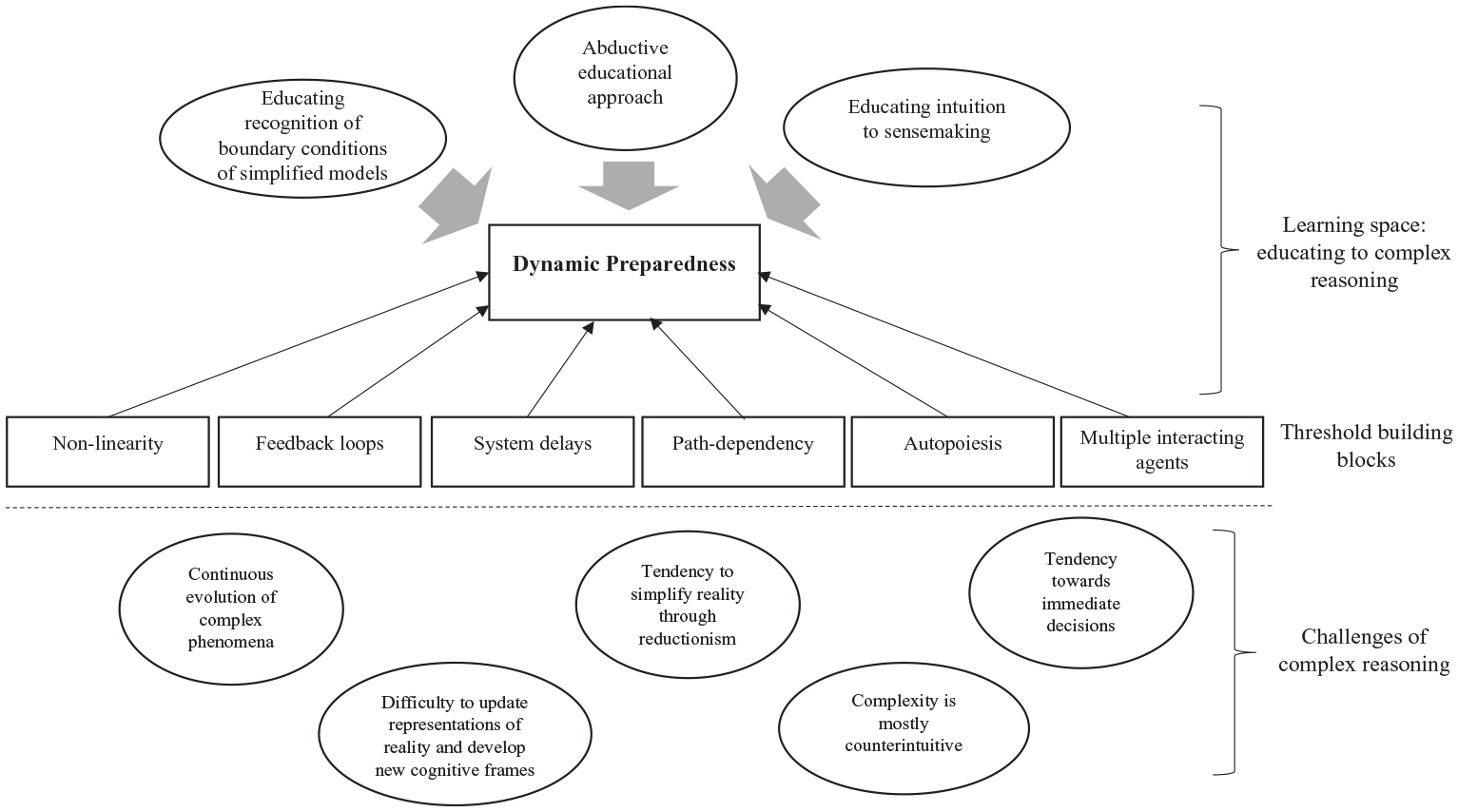
Learning Framework for Dynamic Preparedness.
This article advances the nascent literature on complex reasoning education in several ways. Scholarship in this domain is still very sparse, in stark contrast to the increasing calls to embed complex reasoning and system thinking in curricula worldwide, for example, in health services research (Churruca et al., 2019; Khan et al., 2018), in policy decision-making (Angeli and Montefusco, 2020), in understanding food system resilience (Garnett et al., 2020) and sustainability challenges (e.g. Mahaffy et al., 2019) and, increasingly, in management research (Bansal et al., 2020). The appeal for (re-)introducing and emphasizing behavioral science in education and social science research is paramount (Hallsworth, 2023). Existing analyses and studies have shown different directions, dimensions, and variables that should be considered in an effort to increase preparedness. They range from how to learn collectively about high-reliability organizations’ behaviors (Weick, 1988; Weick et al., 2010) to improving individual decision-making skills (Kahneman et al., 2021; Klein, 2003). Their application is likely to sharpen decision-makers’ ability to deal with complex events, fix errors, and limit failures. However, in-depth reflection on both challenges and potential approaches to teaching and learning complex reasoning is still missing. Our novel framework is conceived to formally establish and propel this line of research and education. It proposes to originally connect the challenges of complex reasoning and its differences from an ordinary and reductionistic mindset to the need for a new type of competence (dynamic preparedness) rooted in the complexity threshold conceptual system. We particularly highlight the cornerstones of educating such competence, namely the importance of abductive practice and intuitive reasoning and the understanding of boundary conditions to the applicability and validity of ordinary mental models.
Complexity and competencies
This article adopts a Complex Adaptive System (CAS) perspective based on the representation of agents interacting in an evolving system (Angeli and Montefusco, 2020; Morel and Ramanujam, 1999). Though different paradigms for representing complex systems are available (Anderson, 1999), many studies use the CAS representation to relate and elaborate complexity concepts in the economics and management field (Csaszar and Ostler, 2020; Sterman, 1989, 2006). Instead, we want to explore the powerful reading keys that CAS elements offer to represent complexity for many diverse purposes and particularly for helping organizational decision-makers understand current and future phenomena and global challenges. The COVID-19 pandemic is undoubtedly a complex phenomenon in which individuals’, organizations’, and society’s behaviors have proved challenging to interpret, influence, integrate, and redirect (Angeli and Montefusco, 2020; Bansal et al., 2020). We argue that in situations like these, nurturing complex thinking could lead to transformative action. COVID-19 has brought to the fore the difficulties of deciding and building effective responses to complex events in a systemic way. Starting from a novel approach, our reflections will explore how complex thinking can be educated, focusing on its most relevant dimensions, to “derail” individuals, organizations, and social systems from their routine tracks when it is necessary to cope with emerging complexity effectively. This is particularly evident when decision-makers face wicked problems, so challenges that “cannot be removed from their environment, solved, and returned without affecting the environment” (Grint, 2010: 169). These problems are highly contested and value-laden and require leadership approaches that are able to combine competitive, collaborative and authoritarian strategies, to elicit multiple solutions and scenarios, agree “good enough” (albeit “clumsy”) solutions and then impose a resolution when and if necessary (Roberts, 2000). The need for balancing exploration and exploitation, following and modifying routines, is well described in various contributions (Feldman, 2000; Nelson and Winter, 1982; Rerup and Feldman, 2011; Zollo and Winter, 2002). Every routines’ system also contains elements and processes that modify routines (Feldman and Pentland, 2003). Therefore, it is salient to reflect on how organizations, policymakers and more in general, social systems, can learn such adaptive competencies, continuously question, revise, and change the current procedures and practices, often moving far away from patterns taken for granted and institutionalized, embracing complexity of social systems. The recent contribution of Lamb et al. (2019) highlighted that many studies had described the limit of (Western) management education approaches in delivering contextualization ability, discussing why simplistic solutions have fallen short. The following sections build upon these research streams to propose a different way to frame the competencies for dynamically managing real complexity, and consequently the way to learn them.
The need to develop dynamic preparedness
The vast majority of the world’s scholarly representations that individuals have developed aim to simplify complex phenomena and control the world according to a linear and first-order logic (Csaszar and Ostler, 2020; Sterman, 1994; Tsoukas, 2017). Widespread examples come from engineering, where design methods aim to limit system performance to allow for a linear input-output response curve. Some economics and management studies suggest that managers and entrepreneurs should try—and they actually do—to both mitigate and reduce uncertainty in order to bound the complexity and limit phenomena to a chartered landscape, where the simplified representations are, however, valid and allow them to take decisions in line with business goals (Packard and Clark, 2020a, 2020b). Complexity has two different meanings. The reality is ontologically complex when its behaviors show characteristics similar to those described above (Morel and Ramanujam, 1999; Sterman, 2000). Climate change is an example of an objectively complex phenomenon, one which we probably even lack adequate analytic skills to comprehend (Garnett, 2018). Reality is also epistemologically complex when some phenomena appear complex due to the observer’s (limited) available information, competencies, and knowledge. Epistemological, subjective complexity can originate from different cognitive, social, and affective phenomena, so many reflections about subjective uncertainty are valid for subjective complexity too (Holmes and Westgren, 2020). For Spender, the field of strategy is “[. . .]finding a knowledge absence to plunge into” as he defines “[. . .] strategizing as the judgment or imaginative response to what is NOT known, to the surprising, unexpected, incomplete, or illogical nature of what arises through our practice” (Spender, 2014: 21). Therefore, it makes sense to talk about complexity in relation to the competencies of the people who have to deal with it. Competence is a circular, recursive concept commonly defined as a set of skills, attitudes, and knowledge (Beardwell and Claydon, 2007; Rowley and Jackson, 2011). Knowledge has application elements, like methods, procedures, and specific rules necessary to carry out tasks and make decisions, applying the skills. However, knowledge—as a complex system of cognitive behaviors and patterns interacting through multiple feedback loops— also contains the ability to learn, modify and evolve the skills themselves, thus generating a loop (Tsoukas, 2004: 231). People contextualize their knowledge during and for practical action. To couple with the emergent complexity, individuals have to integrate the “living forward” with the “understanding backward” (Shotter and Tsoukas, 2014), so they have to complexify their knowledge on the go. Therefore, this article’s central question could also be seen as how to develop the ability “of thinking about complexity” when it emerges, often unexpectedly, while people are busy with their well-known, day-to-day life and practices.
Different study lines have identified competencies salient to managing complex systems (Roberts, 1990; Sterman, 2000). Most scholars emphasize skills to cope with a known critical situation and to prevent it from becoming a crisis: if normal routines fail, the “abnormal” and “emergency” routines need to be ready (Batalden and Oltedal, 2018). In a broader view, Phan and Wood (2020) clarify that the ability to react to complex situations is also a preparedness theme. Reading their work, it is clear that the word preparedness lends itself to multiple interpretations. While for most people, organizations, and institutions, preparedness means trying to predict with certainty all possible situations to prevent an ordeal through pre-defined instruments, Phan and Wood’s vision opens up a new perspective. Doomsday does not always come from real complex situations that never manifested before (unknown unknowns) (Phan and Wood, 2020); instead, they show how the COVID-19 crisis could have been dealt with through preparedness conceived as a dynamic and continuous activity. The authors highlight that preparedness needs to go beyond risk management to address these events. For example, in aviation, risk management means designing and applying procedures for managing normality—called normal procedures; procedures to deal with abnormal but noncritical situations—called abnormal procedures; and procedures to manage very critical situations—called emergency procedures (Loukopoulos et al., 2009). This way of operating is valuable, but unfortunately, it is only the starting point. We argue that what we have experienced with the COVID-19 pandemic does not come from unpredictable events but events that could have been foreseen. Moreover, as emphasized by Phan and Wood in their article, decision-makers were experiencing challenges in devising appropriate policies to manage the crisis, even after more than a year since March 11, 2020, the day when the WHO declared the COVID-19 disease as a pandemic 1 (Phan and Wood, 2020).
Is it possible to identify an appropriate skillset to deal with complexity? Practical illustrations come from high-reliability organizations’ domains (Weick and Sutcliffe, 2001; Weick et al., 2008), for example, aviation. The document that prescribes how to develop and train commercial aviation pilots decisively states that it is not enough to draw up a list of skills or competencies to allow pilots to address all failures and events with the necessary preparation. It reads:
1.3 It is impossible to foresee all plausible accident scenarios, especially in today’s aviation system where its complexity and high reliability mean that the next accident may be something completely unexpected. EBT addresses this by moving from pure scenario-based training to prioritizing the development and assessment of key competencies, leading to a better training outcome. The scenarios recommended in EBT are simply a vehicle, and a means to assess and develop competence. Mastering a finite number of competencies should allow a pilot to manage situations in flight that are unforeseen by the aviation industry and for which the pilot has not been specifically trained. It is impossible to predict all plausible accident scenarios, especially in current aviation systems where its complexity and high reliability mean that the next incident may be totally unexpected. (International Civil Aviation Organization (ICAO), 2013).
It follows that it is essential to generate and foster a culture of openness, proactiveness, and critical thinking, thereby creating an environment where acquired knowledge, protocols, and guidelines can be continuously questioned and adapted to the needs of the current circumstances. Interestingly, this very rationale illuminated a radical change in the decision-making process of the British Army. “Mission Command” was introduced after the Falklands Wars in the 1980s, and marked a radical shift in how officers were empowered, giving them the tools, the opportunity and the contextual understanding to exert proactiveness and make rapid decisions to disrupt the enemy, rather than wait to be told what to do, through narrow, top-down instructions (Maciejewski and Theunissen, 2019).
Being prepared for something entirely unexpected might seem like an oxymoron. Yet, we lay out here the possibility and importance of achieving dynamic preparedness—a fundamental competence to use acquired knowledge critically, understand the boundary conditions of the models being used, and update the same competencies when the application context requires it. There are different possible solutions to achieve dynamic preparedness. A crucial point is recognizing when the system, which seems to transition from normal to unknown and abnormal, “sends” some dissonant signals. A common challenge is understanding whether the system’s evolution can be managed with what is already defined and learned or whether the system’s behavior is changing drastically, moving from linear to nonlinear or even chaotic behavior. Being dynamically prepared requires to re-contextualize knowledge from different experiences and domains. That calls for using knowledge critically while the system is rapidly evolving toward situations of complexity not already known, while usually, it is hard to understand what to look for, search, and prioritize quickly. To be dynamically prepared, we propose educating people to search for specific characteristics of complex adaptive systems to increase the possibility that the situation does not strike as an entirely unexpected event (Angeli and Montefusco, 2020). These characteristics should have three properties. First, they should help decision-makers to learn “what complexity is about,” as individuals have to spot complexity by distinguishing its categories. Second, they should support developing “how to think about complexity” which can fuel the “second logic” of action (Shotter and Tsoukas, 2014) and the double-loop learning (Argyris and Schön, 1995). Third, they should favor the “conjunction” between the two (Tsoukas, 2017). So, dynamic preparedness includes (static) preparedness, as complex knowledge, procedures, and practices result from analyzing imaginable and knowable risks.
As further expanded in the next section, six specific dimensions of complex adaptive systems—taken together—will form an essential threshold conceptual system (Meyer and Land, 2005) for learning complex reasoning. These six building blocks bring learners into a liminal space of complexity where they can integrate their cognitive frames for reading and making sense of the ambiguous cues that any variated situation shows.
A threshold conceptual system to complex reasoning
Threshold concepts are conceptual gateways that lead learners to ways of thinking that were inaccessible before (Meyer and Land, 2005). We argue that threshold concepts are not just notions; they are sets of dynamic conceptions, tightly coupled, interrelated, and varying over time, just as a complex adaptive system themselves. They concern language and symbols (Meyer and Land, 2005). They emerge from the foundation of a subject, a model, or a theory but are not absolute. By their definition, they open gates to new ways of reasoning. We suggest that gates-to-open are relatives to the specific culture, routines, values, knowledge, competencies, and other dimensions, as they fall within the circularity of competencies. Different individuals will have different gates-to-open to understand the same set of subjects, models, and theories, although similarities emerge and are widely shared in similar contexts and cultures. Gates-to-open are thus inherently relative and subjective, so learners should progressively explore their unchartered—or differently chartered—cognitive landscape through a constructive learning process. Recently, some authors proposed that threshold concepts should be viewed as bridges that sustain learning efforts in the liminal space after the open gates, the cognitive limbo where learners roam before they acquire the capacity to bring the entire subject to practical application (Lindsay et al., 2018). The authors proposed threshold concepts as fundamental to sustain learning in ambiguity resulting from teaching subjects precursors of practice, like strategy (Lindsay et al., 2018).
We argue that six threshold building blocks—rather than being threshold concepts themselves—form a “threshold conceptual system” through their interactions, and together they are crucial to stimulate the teaching and learning of complex reasoning: multiple interacting agents, nonlinear behavior, feedback loops, autopoiesis, path dependency, system delays. While none of them single-handedly defines a complex adaptive system, the conjunction and interdependences among these factors univocally characterize CAS. It is important to note here that although differences exist in the field around terminology, and some authors equate complex systems with complex adaptive systems (e.g. Amaral and Ottino, 2004), we instead deem it important to distinguish between complicated, complex and complex adaptive systems. Complicated systems are composed by a high number of parts which, however, behave according to predetermined rules, and the behavior of which can be predicted based on their initial conditions and the system’s properties at a given time. A complex system’s behaviour instead cannot be inferred only by its properties because of the presence of feedback loops and internal states and dynamics. Finally, a CAS represents a complex, open-ended system, adaptable to external conditions and therefore learning through experience and continously evolving.
Given these differences, we integrated these six concepts into a framework because-together-they meet the five distinctive threshold characteristics (Wright and Hibbert, 2015). First, they mark the boundary of the complex adaptive system concept. Second, their understanding can help students make practical sense of emergent complex behaviors. Third, they are integrative and interconnected, as we conceptualize them into a model that frames emergent situations through multifaceted and interactive concepts. Fourth, these concepts can induce durable change in understanding complex behaviors. Internalizing these concepts and their impact has the potential to dramatically change the way students and decision-makers evaluate phenomena, far from naïve simplifications or common sense lenses. Fifth, these concepts, and the related framework, are designed to stimulate a “learn how to learn” tool for complex reasoning, coupled with an appropriate educational approach.
High number of interacting agents
CAS theory poses the emphasis on the interdependencies between the behaviors of multiple agents. The presence of a high number of parts itself does not imply complexity. Amaral and Ottino (2004) explain this point by considering the difference between a Boeing aircraft and a flock of geese, as examples of complicated vs complex adaptive systems. While there are many more interacting parts in a Boeing aircraft, their roles and rules are fixed, while the flock of geese adapt to external conditions and to the behaviors of other agents, according to changing rules and following fluid roles. Without explicit coordination or awareness, these parts cause the system to display orderly phenomena or patterns, which cannot be predicted by looking at the behavior of the single parts. Crucially, agents change and adapt their rules of behavior, which makes the system open-ended, adaptive and learning from experience. This can be observed for all CAS, such as the human brain, the stock market, a colony of ants, a city or the English National Health System (NHS). Interestingly, an aircraft can be considered complicated until malfunctions that are not predicted emerge and hence need to be addressed through improvisation and interpretation by the pilot. Therefore, the system cannot be isolated and becomes a CAS, because of the adaptive behavior inherent in the human-machine interaction. Adaptability of relationships and tightly coupled interdependencies is what defines a complex adaptive system, where even small changes can determine nonobvious consequences with separation in space and delay in time.
Non linear behavior
Nonlinearity is present even in very simple systems, the behavior of which might even be dependent on a single variable (such as a pendulum), yet it can still be surprising. For example, a rock in free fall with mass 1 without air resistance is propelled only by gravity according to the differential equation x(t)’’ = g. But because we think of gravity as a constant, this thought tends to spill over to speed, which instead increases as the falling body progresses through its trajectory. This means that in 2 seconds, the rock will travel many more meters near to the ground than at the start of its journey, according to the formula:
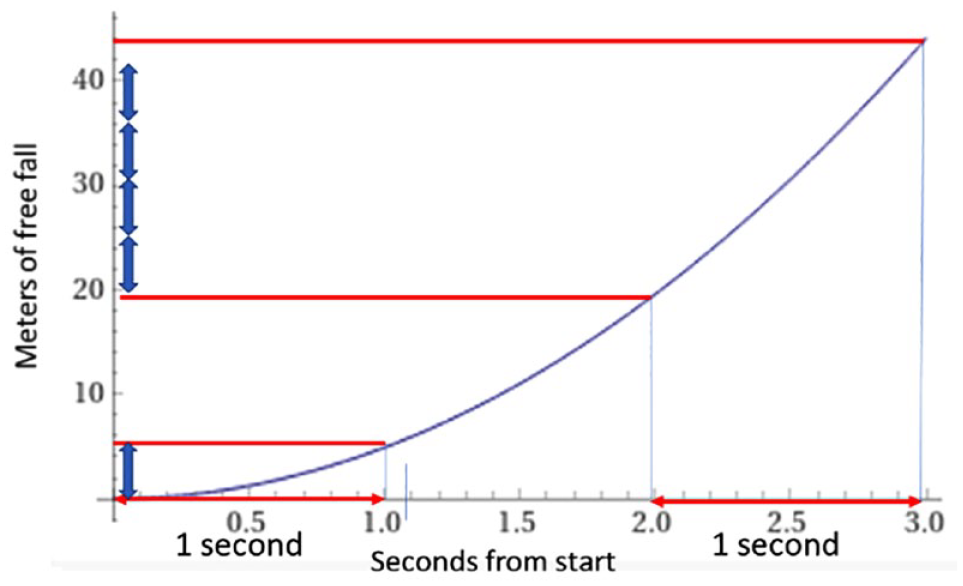
Distance traveled by a rock in free fall for 3 seconds.
While the rock covers 5 meters in the first second, it travels almost 30 meters during the third second. Therefore, a first enabling factor of dynamic preparedness is the knowledge of nonlinearity; however, it is not sufficient. Although many people have such abstract knowledge, the practical answers to COVID-19—a nonlinear phenomenon (Angeli and Montefusco, 2020)—have been in most cases insufficient, inaccurate or delayed. To stimulate preparedness, it is not enough to learn nonlinearity; it is also important to learn how to apply it in observing reality. The pandemic underlines how the lack of familiarity with nonlinear phenomena has become increasingly unsustainable. The world has multidimensional interconnections that enable the transfer of goods and information, allowing for endless interactions and recombinations of each element and making the impact of the pandemic on—for example—supply chains particularly difficult to predict and anticipate (Garnett et al., 2020). The effects of nonlinear recombination are described in the context of the evolution of technology, training, and work (Acemoglu, 1998; Acemoglu and Autor, 2011; Brynjolfsoon and Mcafee, 2016), but the COVID-19 pandemic highlights also nonlinear physical interconnections. Interpreting nonlinear phenomena with a linear mindset can be devastating. Not only does it hinder effective containment policies, but it prevents learning. As both Kahneman and Klein (2009; Klein and Kahneman, 2010) pointed out, the early response is mainly based on recognizing modified patterns, testing the mental model we are applying, testing their application, evaluating the results and, if necessary, repeating the cycle. This cycle is frustrated if we apply a linear mental model.
Feedback loops
This second dimension is present in many elementary systems, such as our house heating system. If the room temperature falls below the desired one, the thermostat turns on the boiler, the radiators warm up. If there is a feedback loop, the system receives an effect of its output as input. Although the system is elementary, this effect can be highly relevant (Sterman, 1989, 2002); and can lead to both stabilizing loops—which keep systems in balance and favour inertia—and to reinforcing loops—which instead constitute the leverage points for rapid system change (for better or worse). Also in this case, alongside abstract knowledge, the training to identify different types of loops in different contexts is salient.
Feedback loops highlight a circular conceptualization of causality (Senge, 1990), which is crucial to understand complex systems and their constant flux and different scales (individual, or node-level, and systemic). A notable example provided by Kim (1992) in his system archetypes review is the one of fisheries, and the tragedy of the commons. Figure 3 reports the causal loop diagram representing the system archetype used by the author. Here the use of a common resource establishes a reinforcing loop at individual level, where the use of the resource fosters more use (R1 and R2). However, the compounding effect of usage increases total activity and (with delay) reduces the individual gain, because of the rising cost of harnessing resources (B1 and B2). At the same time, increased scarcity also increases individual benefit due to higher prices or value attached to the output. Depending on the delay of the effects of B1 and B2, and on the effects of additional harnessing costs vs additional value, the system can stabilize or entirely exhaust the common pool.
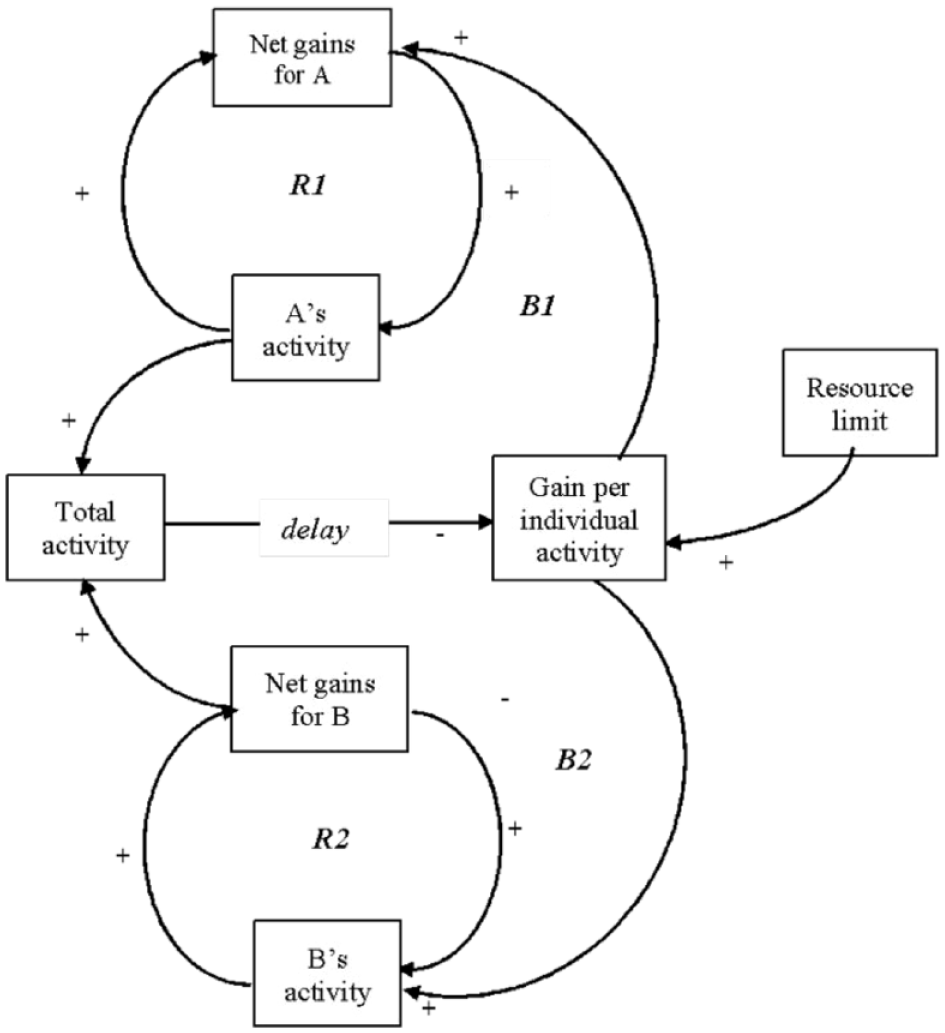
Causal loop diagram representing the “tragedy of the commons” system archetype.
The presence of loops highlights how catastrophic evolutions potentially leading to “the end of the world” can be avoided by leveraging balancing loops. Moreover, although sometimes the phenomenon starts as a slow exogenous factor, it can become a nonlinear catastrophe rapidly because of the influence of the system’s internal loops, which have a multiplier (and nonlinear) effect. In fact, one of the critical outcomes that can be generated by a feedback loop is nonlinearity. In the COVID-19 pandemic, this continued to occur for a long period of time: the virus creeps into limited communities, where it accelerates its spread quickly due to frequent contacts between people. Studies documented that the uncontrolled spread has reached even R0 values as high as 6.49 (Liu et al., 2020).
System delays
Feedback loops emphasize an element present in most systems: the delay, which is due to the nonimmediate transfer of information or goods from one point of the system to another. We see the salient effect of system delays in the tragedy of the commons above, but also in the so-called “drifting goals” archetype presented by Kim (1992) (Figure 4).
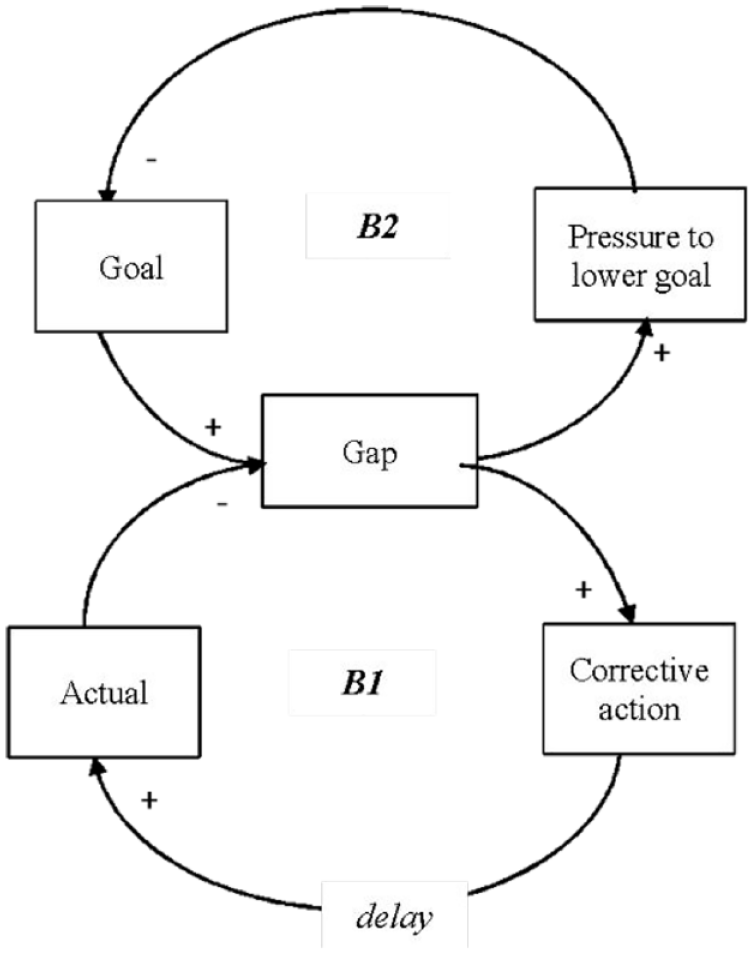
Causal loop diagram representing the “drifting goals” system archetype.
The figure exemplifies a common dilemma in policymaking and decision-making at organizational level, where the gap between aspired outcomes and actual ones (e.g. mortality in the case of COVID-19 or economic growth) can be closed by either lowering the aspirations or implementing interventions or corrective actions (e.g. introducing socialization restrictions or face-masks in the case of the COVID-19 pandemic, or R&D investments at firm level in the case of innovative performance falling below the social or historical benchmark). The crucial difference here again is the system delay: because corrective actions’ benefits take time to materialize and policymakers are under constant and immediate scrutiny by the public and political opposition (just like managers in a company strive to present favorable quarterly performance reporting to shareholders), the pressure to lower goals instead of engaging with longer-term beneficial corrective actions is high.
The COVID-19 pandemic illustrates system-level delays in several ways. The first is the virus’s incubation period, which averages 5–6 days but can reach up to 14 2 . The second is the emergence of nonlinearity and exponential growth, which takes up from a few days to more than a month. As long as the R0 remains contained, the perception is that the phenomenon is limited and under control, but in reality the virus can already be present in many individuals although not yet manifest. The spread presents the nonlinear growth that we have already talked about, but in this case, there is also a delay with which the symptoms of the disease become apparent with respect to when the contagion has taken place. Of course, the combination of the two phenomena complicates decision-makers’ ability to be dynamically prepared.
Looking at more systemic implications, the pandemic also illustrates delays in the way the number of infections translates into growing hospitalizations, increasing ICU pressure, and ultimately death toll with a delay of a few days to 2 weeks (Angeli and Montefusco, 2020). In a more long-term perspective, the COVID-induced public health crisis has also illustrated how prolonged containment policies lead, after a few months, to economic recession, social tensions, growing inequalities, and lockdown fatigue (Patel et al., 2020; Public Health England, 2020). Our basic cognitive system, born to react to immediate threat situations and search for elements necessary for survival, is not used to processing delays (Rolls, 2007).
Autopoiesis
As a foundational and at the same time consequential aspect of all of the above, it is important to note how complex systems’ behaviors emerge from the multiple interactions between their components. Systemic behaviors cannot be studied or predicted by looking at isolated elements and inferred from the simple sum of the components’ behaviors when they operate within the system. Autopoiesis is a term coined by Maturana and Varela (1973) and points to the self-emergence of behaviors and patterns in far-from-equilibrium states. They explain that:
An autopoietic machine is a machine organized (defined as a unity) as a network of processes of production (transformation and destruction) of components which: (i) through their interactions and transformations continuously regenerate and realize the network of processes (relations) that produced them; and (ii) constitute it (the machine) as a concrete unity in space in which they (the components) exist by specifying the topological domain of its realization as such a network. (Maturana and Varela, 1973: 135).
This definition closely connects to the concept of nontrivial machines, reprised by Tsoukas (2017) in his conceptual contribution, highlighting the relevance of conjuctive complex thinking. Nontrivial machines are ones for which the output cannot be predicted from the input, because they do not follow fixed rules of transformation as they have an internal state that keeps changing with experience (through an internal feedback loop). Consequently, every time an NTM operates, it changes its rules of transformation, or in other words, experience changes an NTM into another machine. The same applies to organizations, social systems, the brain, which constantly accumulate memory through experience, which then informs and change their internal behavioral rules. Because of the multitude of individual agents that experience different things at different times and change their behavior accordingly, systemic self-organization and self-emergence are paramount and foundational of CAS.
Thinking about the COVID-19 pandemic and considering as elements the individual communities in which the contagion takes place, self-emergence and autopoiesis imply that the overall spread evolved as a result of the interaction between social members and the constraining effect of policy measures. However, evidence suggests that both the choice of policy interventions and their outcomes varied across countries and social systems, as well as over time, in the account of agency, time, context, values highlighted by Tsoukas (2017), and as a result of the internal learning and adaptation processes that could not be predicted and that jointly changed the system and influenced the evolution of the pandemic (Angeli et al., 2021; Tsoukas, 2004; Tsoukas and Dooley, 2011).
Path dependency
Finally, and with particular connection to their autopoietic nature, CAS are strongly path dependent, meaning that their behavior is historically determined and their reaction to a disturbance is highly dependent of the initial condition of the system. The fact that a system’s behavior depends on its initial status is common to many simple systems, but it creates or increases the system’s complexity when combined with other CAS characteristics. The example of the falling stone is still applicable. To predict its speed after 10 meters, it is important to know its initial speed, which we automatically tend to assume as 0. This effect is even more pronounced in systems characterized by more complex dynamics, such as a dice being thrown or a double pendulum, the movements of which can be seen as chaotic and yet predictable. Loops, delays, and nonlinearity can amplify the impact of initial conditions many times to the point that a system—because it is in constant flux and adaptation—cannot experience the same initial conditions twice. In nontrivial machines, a “response once observed for a given stimulus may not be the same for the same stimulus given later” (Von Foerster, 1984: 10 in Tsoukas, 2017: 140). It follows that path dependency encapsulates the arrow of time, or irreversibility of CAS behavior (Tsoukas, 2017), which becomes even clearer and more intuitive when we think about the constant evolution of organisms or of social systems. Even with COVID-19, the information at one point in time about the number of infected cases does not afford any prediction about the future evolutions of cases, or of contacts that will be at risk. This estimate depends on the type of containment measures that are being applied at a specific time, and on the contact history of the infected people in the previous 14 days. Moreover, the effect of containment policies cannot be assumed to be equivalent across countries, or in the same country or region at different points in time (Angeli and Montefusco, 2020). The population’s degree of acceptance of and compliance with the restrictions is highly dependent on the context-specific norms and values, as well as the lockdown fatigue accumulated over time (Angeli et al., 2021).
Figure 5 highlights how the six CAS threshold building blocks can be appreciated as a complex system themselves, through a causal loop diagram representation, and hence form a “threshold conceptual system” to complex reasoning. High number of interacting agents, along with feedback loops, are generative aspects of CAS; the number of agents interacting generates multiple chains of cascading behaviors, thereby causing delays in systemic input and output, and stimulating autopoiesis. The presence of feedback loops is also related to the multiplicity of agents interacting and closely linked to the presence of nonlinearity in relational patterns, which in turn nurtures autopoietic adjustments, and further stimulates causal loops dynamics. Particularly nonlinearity and autopoietic behaviors are generative of path dependency and irreversibility of systemic evolution. Crucially, CAS are open-ended, so in a mutually adjusting relationship with the external environment. This should be considered as one of many potential illustrations, which however can help better understand CAS and the relations between their characteristics.
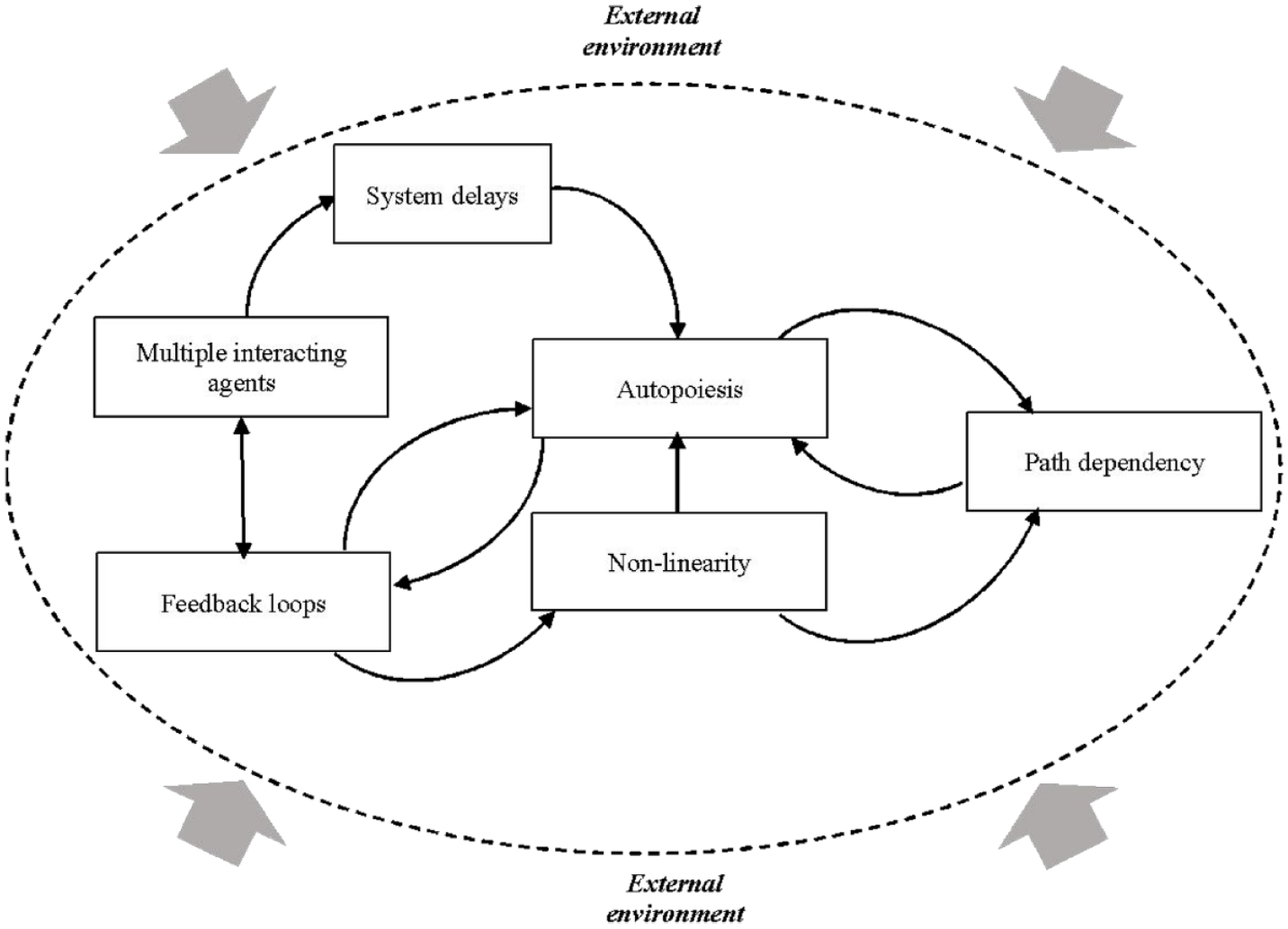
Causal loop diagram representing the six CAS characteristic in dynamic interdependence, hence forming a threshold conceptual system to complex reasoning.
Situating complexity in business and management studies
Despite its frequent abuse and trivialization, the concept of complexity adopted in social sciences and applied to the study of social systems, organizations, and policy dynamics emerges now as more useful than ever. Since Von Bertalanffy and other scholars called for novel ways to explore reality, focusing on properties emerging from the interactions between multiple—sometimes countless—parts (Bode et al., 2006; Boulding, 1956; Von Bertalanffy, 1950), numerous studies have investigated complexity. The CAS paradigm stems from the broader General System Theory, which supported system-oriented rather than reductionist approaches and hence opposed the mechanistic simplification of focusing on singular entities for describing the whole as a mere sum of its part. Von Bertalanffy (1950) recognized how the vast majority of people acknowledge “the concept of wholeness”, yet he also highlighted that “[. . .]these concepts have often been misused, and they are of a vague and somewhat mystical character.” (p.142).
Nowadays, numerous studies robustly connect complexity studies to the economics and management domain (Anderson, 1999; Arthur, 2021; Hill, 2021; Maguire et al., 2006; Zimmerman, 2010). A recent work focused on the new language that scholars and practitioners have developed for talking about complexity (Teixeira de Melo et al., 2020). The analysis shows that complexity studies focus on either “the content of thinking: what you think about” or “the process of thinking: how you think about.” We argue that the current management education still sees these, as separate learning processes and prefers instilling analytical knowledge to focus on what should be done to address specific topics—what you should think about—while learning about ways of thinking is seen as a by-product. Instead, this article proposes a framework for integrating the learning of “what you think about complexity” and “how you think about complexity.” Our threshold conceptual system provides the seeds of “what you (could) think about complexity.” At the same time, it serves as a “thinking tool” for sustaining a dynamic and infinite double-loop learning process about “how you (could) think about (emergent) complexity.” In a similar vein, Tsoukas (2017) argues the need to distinguish without disjoining, and that, if the paradigm of simplification relies on disjunction and reduction, the paradigm of complexity relies on distinction and conjunction. Along this line of reasoning, Spender argues that complexifying thinking is also necessary for strategy (Spender, 2014).
Systems are complex when their behavior cannot be easily inferred by their properties or initial conditions, because of their internal dynamics. Because of their evolutionary and dynamic aspects, organizations are increasingly conceptualized as complex adaptive systems, emphasizing their nonlinear adaptation, change, evolution and emergent properties (Angeli and Montefusco, 2020; Morel and Ramanujam, 1999; Zimmerman, 2010). The feedback loops that govern interactions and behavioral adaptation of interacting components may produce nonlinear dynamics and emerging patterns, through which the organizations autonomously evolve and self-organize via the phenomenon of autopoiesis (Luhmann, 2008; Morgan, 1986). Mintzberg’s concept of realized strategy as the interplay between planned and emergent strategy (Mintzberg and Waters, 1985) closely recalls autopoiesis, in the way a stimulus (the intended strategy) leads to unexpected effects different than the envisioned one, as a result of internal dynamics of self-organization. Feedback loops are foundational concepts of the behavioral theory of the firm (Cyert and March, 1963) which directly informed the field of organizational adaptation and renewal (Levinthal, 1991; Sarta et al., 2021), performance feedback theory (e.g. Greve, 2003) and organizational learning (see Argote et al., 2021 for a recent review).
Organizations and their subsequent evolution trajectories are therefore highly dependent on their initial conditions, which implies that a stimulus applied to the same organization or systems of organization does not always produce the same effects. Organizational systems evolve over time, and, therefore, their initial conditions (configuration of all variables) are always different (Angeli and Montefusco, 2020). This characteristic defines the path dependency and irreversibility of CAS (Tsoukas and Dooley, 2011) and underlines how organizations and organizational systems’ current composition, configurations, and dynamics rely on their history. It is crucial to understand the complex chain of organizational components’ interactions to understand the relationships between the actions carried out on the system (e.g. strategies) in its present configuration (input) and their effects (output). Building on this line, scholars have long argued for a tighter integration between management studies and business history (O’Sullivan and Graham, 2010). By recognizing and emphasizing the inherently temporal nature of social phenomena, the deep co-evolution between agents, their social systems and their larger contexts, the processual and uncertain nature of emerging change brought about by autopoiesis, the CAS perspective enables a shift from the “universal, the general and timeless” of Newtonian’s view to the “particular, the local and the timely” of the ecological view (Tsoukas and Dooley, 2011).
It is essential not to confuse complexity as a phenomenon with complexity as a representation. The latter arises from the concrete need to identify organizational variables to govern the former (Csaszar and Ostler, 2020). Complex behaviors can also emerge from divergent interests and the consequent conflicts of norms and values within organizations and societies (Angeli et al., 2021). Diverse interests also come with diverse expectations and goals, while different groups bring various values and representations (Levinthal and Marengo, 2020; Marengo, 2020). Though reviewing possible sources of complex behaviors is out of our scope in this article, it is imperative to consider that specific sources pose diverse threats and originate different problems, especially when they raise ambiguity and uncertainty. Knight’s (1921) exploration and conceptualization of uncertainty are highly relevant here, and more generally to management and policymaking, especially after the COVID-19 pandemic (Phan and Wood, 2020). Two key concepts are particularly relevant to this argument. First, Knight defined uncertainty as nonquantitative and, then, unmeasurable. Second, and more relevant in discussing complexity sources, he argued that uncertainty is intrinsically connected—mainly—with human action. Managers, for the sake of predicting future outcomes, continuously adapt and change the way they manage and organize. Their actions are mainly based on considering future scenarios more or less probable, based upon judgments and common sense. Although Knight started from considering uncertainty as exogenous, his arguments also brought to the fore that managers, by changing their companies’ equilibrium with imperfect knowledge and through trials, indirectly contribute to generating uncertainty, which affects both their possible future outcomes and the external context. Later, and focusing more on decision-making processes, March highlights that ambiguity and uncertainty challenge decision-makers in subtle ways (March, 1994), while more recently management studies began exploring the Knight’s uncertainty consequences. On this line, Malekovic et al. (2016) emphasized that human decisions in situations of uncertainty, ambiguity, and information asymmetry are likely to lead to complex scenarios, especially when in interaction, while Griffin and Grote (2020) tried to integrate the diverse perspectives and argued that organizations regulate uncertainty. Some contributions argued that a more complex view of what management and its environment are is crucial to reinterpret ambiguity and uncertainty. For example, Tsoukas (2004) proposes that uncertainty can be seen more as the presence of unexpected information than the absence of the necessary one, while Spender (2014) emphasizes that ambiguity and uncertainty are a product of strategy formulation. Both suggest that individuals and decision-makers should embrace complexity rather than try and eliminate ambiguity and uncertainty. That is impossible, due to the incomplete knowledge of the systems, while the attempt is likely to generate distress (Kahneman et al., 2021).
A learning framework to educate complex reasoning
The main challenges of complex reasoning
Learning about complexity is a challenge because complex phenomena are all around us and hence cannot be observed at a distance (Sterman, 2000, 2002); complexity arises from phenomena’s variation, evolution, and transformation. Static objects rarely constitute a challenge because they do not behave independently, though they can influence how we live and behave. A rock is not a challenge per se. A rocky landslide could be a challenge. When controlled and streamlined, a river’s water flow is an opportunity for humankind to produce power. However, when its energy gets out of control, it can produce catastrophic floods. So, dynamism and variations are the first challenges as decision-makers have to make sense of complex phenomena while they continuously evolve. We all live in a dynamic landscape where everything constantly varies inside multiple loops (Sterman, 2000). That often prevents decision-makers and individuals from distinguishing between causes and effects. Objects, actors, and phenomena in the real-world influence each others’ behaviors, and decoupling them is almost impossible. This brings about the second challenge: finding an effective, though simplified, representation of reality.
Humankind has survived and evolved through catastrophes, plagues, and cruel wars, by developing strategies over time to cope with nature’s complexity. Our ancestors were mainly engaged in surviving. Our emotional and cognitive systems have learned to distinguish food from poison, friends from enemies over thousands of years. Humans have had to learn a binary selection between beneficial and fatal (Rolls, 2007, 2014). However, in the current world, most of the fruitful processes defending humanity from perils are seen as part of the problem (Kahneman, 2011; Taleb, 2007). The primary emotional system elicits strong and immediate responses to stimuli, such as real threat cues (Rolls, 2014). While crucial to early survival, this mechanism constitutes a third challenge to complex reasoning: avoiding immediate decisions (Klein, 2003). Rolls highlights how learning to carefully ponder responses to cues and stimuli cannot be taken for granted (Rolls, 2007, 2014). When our brain is engaged in binary decisions that entail clean and simple alternatives, we mostly face a fast process that involves a few neuronal networks, reducing their electrical potential quickly, and saving energy. Because it reduces anxiety, this process produces a highly rewarding emotional state. On the contrary, ambiguous stimuli, like those generated by wicked problems, with confusing cause/effect flows and potential unexpected consequences, activate many different neuronal networks, and the electric potentials remain high for a long time. The emotional state is one of anxiety until it is resolved with a decision (Rolls, 2014). If this does not resolve, it could result into a decision-making paralysis, often triggered by information cues that are overwhelming, incomplete or contradictory, leading to a sense of helplessness and doom that needs to be avoided (Kanter, 2020). Therefore, human beings are naturally pushed forward to act—decide—even when they should instead pause and learn. This effect is useful to escape known perils, however it could hamper our judgment ability, up to the uncontrollable startle effect (Rolls, 2007, 2014), resulting in several sever accidents, taking off guard even very experienced and skilled crews (Moriarty, 2015; Pinet, 2016). We suggest that this is the fourth challenge of learning complexity: we do not naturally learn nuances that conflict with our previous (simplified) frames (Argyris, 1976, 2002; Schein, 2004; Schon, 1983).
Unfortunately, complexity is largely counterintuitive (Sterman, 1989, 2000, 2002). The counterintuitive nature of complex systems could trap learners, eliciting a false sense of confidence in their knowledge and competencies. Human beings’ interventions can skyrocket system reactions, especially those that we want to control, limit, or stop (Angeli and Montefusco, 2020). Here the fifth challenge emerges, as the need for understanding that we need to learn about the subject while updating cognitive frames and logical reasoning at the same time (Argyris, 1976; Argyris and Schön, 1995). The learning capacity comes from diverse human abilities and could be either facilitated or hindered by many internal and external factors. While humans strive to learn something that is remote from their experience, they have to fill a double gap. The learning process involves both understanding the topics we aim to acquire and updating the cognitive tools for learning what we already have acquired in the past (Argyris and Schön, 1995; Senge, 1990). The latter must come first: without a substantial modification of cognitive frames, decision-makers can even entirely overlook complex phenomena (Angeli and Montefusco, 2020; Bansal et al., 2020; Hallsworth, 2023; Phan and Wood, 2020; Senge, 1990).
Learning about complexity as an abductive endeavor
To better situate the five challenges outlined above, it is important to carefully explore and thoroughly understand the contexts in which individuals are most likely to learn about complexity: situations in which people are only potentially aware of the presence of complexity and of course, of its impacts. Scholars’ attention on how to use complexity to manage, orient, develop, and give directions to organizations and institutions started in the sixties with Simon (1969) and has been a constant over the years. People base their actions, plans, and decisions upon their representations of their living context and acquired predetermined ideas linking causes and effects—where “ideas” are used here in a Deweyan sense. We are all passengers of a weird plane (Sterman, 2000). The “plane”—our context—evolves continuously, following its internal rules. Like weird, strange pilots, we influence its evolution. Often, we do not limit our efforts to control the flight path, simply accomplishing tasks, but we also aspire to modify our context and shape reality. That is not just to react to variations but also to proactively modify and improve our environment. Even the routines we have generated are sources of change (Feldman and Pentland, 2003; Rerup and Feldman, 2011). Therefore, individuals invent and design new artifacts while controlling and managing their environment and context (Mintzberg and Westley, 1992; Schein, 2004), like pilots who invent new flight control instruments while flying. As part of the system itself, our interventions combine with the other system dynamics to change the system itself, and the system—according to its autopoietic, learning, and nontrivial nature—transforms because of its experience. Hence, decision-makers increase the number of loops they have to deal with while trying to do the opposite: reducing and simplifying, decoupling relations, and dismantling networks. Human beings create evolution cycles (Mintzberg and Westley, 1992; Van De Ven and Poole, 1995) while trying to understand the system, as if they were trying to modify an equation while solving it. We are a large part of the problem that we want to fix (Sterman, 1989, 2000);
Learning complexity is thus a process that proceeds with living and, at work, accomplishing tasks, setting goals, managing teams, and building strategy. Besides, complexity is not a unique subject to learn, not a “science” in itself (Arthur, 2021). Learning complex reasoning hence directly points to the learning paradox—how to develop new, more complex ideas from less complex learning and hence, how to transform and continuously adapt knowledge. Prawat (1999), building on the work of Dewey (1933) and Pierce (Frankfurt, 1958; Peirce, 1974), argues the superiority of “abduction” over rational deductive, realist inductive, and postmodern socio-constructive approaches to learning. Abduction overcomes the classic contraposition between mind and the world, that takes a dualistic form in both deductive (e.g. Descartes, Kant) and inductive thinking (e.g. Nelson, Bacon, Piaget) and instead becomes monistic in postmodernism (e.g. Gergen, Rorty, or Wittgenstein), with the mind becoming inseparable from the world, and the effort of knowledge encapsulated in the use of language. Abduction as a philosophical stance promotes instead a dialogic interaction between the mind and the world which are universally neither separate or merged but together only in “functional unity” (Dewey, 1933). As Prawat (1999) beautifully puts it (pg. 50–51): “the mind plays a role in helping to develop certain antecedent expectations or anticipations about the world, but the world has its say as well, which leads to a reshaping or remolding of one’s expectations in ways that conform to the reality of what is actually being experienced. Ideas, as a construct, the key to this interaction. . .. once ideas connect with objects and events, they are capable not only of illuminating facts but also of being illuminated by facts, thus meeting the transformational requirement specified by Dewey. In addition to these two highly desirable characteristics, ideas are amenable to social construction. They thus allow for transactions between people and between things and people.”
Therefore, abduction allows for both information and transformation, continuously updating and adapting received knowledge with new theory better suited to explaining surprising evidence. As such, an abductive approach is crucial to developing a teaching framework that combines three processes simultaneously: flying the plane according to predetermined rules and theories, trying to adapt the rules to unexpected environmental or mechanical stimuli, and learning how to fly it. The threshold conceptual framework highlighted above should play a dual role: it should tip both the learning curve and the “learning how to learn” curve (Argyris and Schön, 1995). However, to achieve this double aim, students should absorb the threshold framework through an abductive process, that uses applied learning and inductive clues (Bruner, 1996; Dewey, 1933; Kolb, 2015; Lindsay et al., 2018), mostly acquired by either simulation or assisted experience (Billie and Dorit, 2017; Spector et al., 2001; Sterman, 2001) to extend established theories. In its more modern and practical formulation, abductive reasoning (Haig, 2014; Josephson and Josephson, 1996) is problem-driven—where the phenomenon under study does not meet any accepted theoretical explanation and hence becomes surprising—and is common in the development of new fields or to the application of accepted theories in new contexts, where purely inductive methods would not allow for knowledge accumulation and extension (Angeli et al., 2020; Ward et al., 2016). Abductive learning is, therefore, well suited to complex reasoning, as it allows continuously extending, modifying, and re-using accepted norms and rules as the contingencies change.
Teachers should hence facilitate abductive learning through simulation and debriefing. Many studies emphasize the crucial role of debriefing in inductively learning, mostly where simulation is extensively adopted (Montefusco et al., 2021). We argue that pure inductive education is impossible, as educators possess knowledge that they think will be relevant to the students and start from hypotheses and pre-existing frameworks. This step is deductive, as we consider existing frames, for example, the threshold conceptual framework, and take it as the starting point. Students also use pre-existing knowledge and cognitive schemes, even when they are required to immerse into a scenario following a very short and limited task briefing. The next steps in the simulation process are inductive teaching, as educators a) stimulate students through a complex experience and b) help students to make sense of it through open debriefing. Overall, the students’ learning process is abductive, as they reiterate trials and reflect upon them both in executing simulation and during debriefing. Then, they alternate hypotheses and their testing. Robust debriefing techniques are particularly important for abductive learning, as they allow for a critical comparison of existing theory and available evidence, to adequately highlight gaps and stimulate theory extension. Debriefing techniques cannot be based on common sense as they require that debriefers adopt counterintuitive behaviors, which need to be carefully learned through experience under the guidance of skilled teachers (Carroll et al., 2002; Rudolph et al., 2013). However, we argue that adopting debriefing techniques like good judgment (Rudolph et al., 2007), based upon frames’ exploration (Argyris and Schön, 1995; Schon, 1983), is necessary to teach threshold conceptual framework in a truly abductive way.
Educating the understanding of boundary conditions of simplified models
The abductive approach highlighted above will help overcome the innate challenge of complex reasoning while recognizing the context in which educational processes take place. The point of view we propose should not lead people to attend courses on complexity, schools to include courses and programs on complexity, and corporate “academy” to launch corporate masters on complexity. What we believe would be effective goes instead in the opposite direction. Each subject deals with and contains elements of profound complexity and also the methods necessary to simplify it. While we usually spend the most efforts educating about the first, we reserve less energy to explore the latter. What is needed to educate toward complexity is the ability to monitor whether and when the simplified version of the world remains valid. When one hits the brake pedal, the car slows down. Simplified mental models, established through consolidated theory and validated through consistent practice. However, if the road strangely glitters in winter because of a heavy snowfall or ice due to low temperatures, one has to question the validity of that model and understand that pressing the brake pedal could lead to a spinning vehicle, which epitomizes the abductive process of critically question available theory and adapt it to the current contingencies. Education curricula should hence situate models and highlight the boundary conditions to their validity. On the one hand, programs should improve learners’ knowledge: the more I know about a complex system, the less the risk to be surprised. On the other hand, they need to train students about questioning their frames’ validity, in light of possible unexpected combinations and the emergence of different boundaries. Under pressure, experienced crews failed to deal with boundary conditions; those tragedies have brought aviation authority to include abductive sensemaking and critical thinking into crew training programs, as said above (International Civil Aviation Organization (ICAO), 2013) and parallel to similar transformation changes in the army context (Maciejewski and Theunissen, 2019).
Educating intuition to sensemaking
One final point we want to highlight is the use of intuition. Trying to address complex problems only through analytical, deductive approaches based on perfect rationality is an unthinkable approach because available data and models are incomplete. Dynamic preparedness means continuous decision-making in contexts of high ambiguity: decisions on priorities, decisions on relevant variables, decisions on what risks to take. Various models have been developed to illustrate how decisions are made under these conditions, where the key is the construction of new meaning (sensemaking) to variables, data, phenomena, that seem recognizable as ordinary routines but in fact are about to behave in a radically different way (Dosi et al., 2020; Gigerenzer and Brighton, 2009; Klein, 2003). We believe Klein offers some practical ideas to ground the skills we have introduced. In his book The Power of Intuition (Klein, 2003), the author shows how individuals recognize clues, which lead them to possible patterns, which would suggest actions. In this sense, we consider here intuition as intuitive insight, which then informs action, rather than intuitive judgment (Dörfler and Ackermann, 2012). Importantly, intuition is rapid, spontaneous and alogical, and allows for forming insights that are tacit, holistic and confident (Dörfler and Ackermann, 2012). It comprises both cognitive and affective elements and results in direct knowing without any use of conscious reasoning (Sinclair and Ashkanasy, 2005). Through intuition, action can be rapidly and continuously adjusted while forming and refining the mental model guiding action (Klein, 2003). As Klein also pointed out, exercising well this loop requires training, while it calls also for learning to trust sensing, and learning from sensing too (Bas et al., 2022). Using this loop for dynamic preparedness involves training to practice it on the complexity dimensions that we have explored.
Discussion and conclusion
In this article, we suggest approaching teaching and learning complex reasoning through six key concepts in the complex adaptive system domain. We argue that proposing them as six building blocks of a complexity threshold conceptual framework allows a higher transformative impact on management learning and practice. Starting from exploring the meaning of complexity, we have seen how the ability to react to complex situations can relate to the knowledge of some of its key dimensions and to decision-makers’ capability to use them in different contexts. The rich analysis and recent reflections by Phan and Wood (2020) have allowed us to introduce the concept of dynamic preparedness, which advances the useful but static notion of preparedness activities, such as risk analysis and the definition of procedures. Dynamic preparedness can therefore be defined as the ability to use one’s current knowledge, including that on complexity, even if elementary, to quickly rework one’s ability to act (skills) and learn, according to double-loop learning (Argyris, 2002). We argue that decision-makers should abductively hone the skills and knowledge around complex reasoning and internalize its threshold conceptual framework to overcome innate challenges. They should practice using such skills by looking at real-world phenomena in search of clues that signal the presence of emergent complexity. Nonetheless, individuals need to exercise sensemaking to identify the boundary conditions of simplified models and mindsets.
Our framework advances the discourse addressing complexity applied to business and decision-making by linking it explicitly to the organizational learning literature. We argue that adopting the proposed abductive process to teach the proposed complexity threshold conceptual framework will help learners get value from the liminal spaces (Lindsay et al., 2018), while learning through abductive reflection under the educators’ facilitation. The threshold conceptual framework brings learners into the liminal spaces to deal with practical complexity, feeling, and experiencing uncertainty and ambiguity as necessary and intrinsic components of the natural evolution of humans as individuals and institutions (Spender, 2014; Tsoukas, 2004). We have explored that the human brain tries to quickly escape uncertain conditions unless external stimuli keep the mood high for a sufficient time (Rolls, 2007, 2014); and recent studies showed that this directly hinders mindset and behavior changes (Brusoni et al., 2020). Likewise, in complex reasoning, actors need to find a behavioral strategy that allows them to resist the negative feeling associated with uncertainty and, at the same time, supports their efforts to explore the frames they are adopting to make sense of their context. Lingering in the liminal spaces is necessary. Understanding concepts remote from their culture and experience requires special efforts for learners. The first obstacle is even detecting the novelty as learners try to make sense of it through their existing paradigms (Schein, 2004). Learners’ experience can even prevent them from admitting that something different is happening, as the actors mainly select those cues easily classified amid their knowledge and competencies. Though routines are sources of change, they influence sensemaking processes (Feldman and Pentland, 2003). Understanding novel concepts at the organizational and societal level also requires challenging basic assumptions and integrating the current culture with new meanings (Schein, 2004). As we have highlighted, learning combines two integrated processes: learning about the subjects and topics and learning about learning, as a double-loop process (Argyris and Schön, 1995). Both individuals and social entities are involved in this double process, as individuals are immersed in their social context that influences the way they learn over time. In this sense, sensemaking and learning routines are inextricably part of organizational routines (Feldman, 2004) and every action and decision starts from the current basic assumptions and values. If learners fail to explore their basic assumptions, they will likely reduce the novel concepts to fit their cognitive frames (Schon, 1983) and miss the nuances. In this light, we stress that learning is much less about acquiring knowledge than discovering cognitive frames (Rudolph et al., 2008; Schon, 1983), while progressively constructing new meanings: in this way, knowledge becomes complex itself (Tsoukas, 2004). This framework, through abductive learning, satisfies three needs. Teachers can open the gates to complex reasoning, sustain the learners while struggling with troublesome situations, and engage them in authentic double learning experience, reflecting through an accurate threshold conceptual system. Building on this, future research can explore the importance of emotions and irrationality in enabling or hindering learners in their process to continuously question and update established frames and discover new ones, in the abductive effort of double-loop learning.
This article also contributes to the scholarship and body of literature exploring complex adaptive systems, as we propose a novel interpretation of threshold concepts for teaching complex reasoning through a learning framework based on the CAS approach. CAS education, however, is only a precursor of complex reasoning, while at the same time, we argue that complexity is inextricable from the study of a vast majority of subjects, models, and theories. Here we cannot neglect a central peculiarity that characterizes complex phenomena. Teaching complex reasoning, especially in business, should help decision-makers learn how to deal with subjective—epistemological—complexity as a precursor of ontological complexity’s practical effects. One of the main concerns we have explored is failing to detect complexity, which leads to underestimating its impact. When people use subjective complexity to decide and act, they likely underestimate real complexity because denial is a frequent coping behavior, like in dealing with uncertainty. The lower the (subjective, i.e. < perceived) complexity of the situation, the safer (subjective, i.e. perceived) is the representation of reality because it appears simple to control and close to our actual mindset (Brusoni et al., 2020). That often pushes decision-makers to wrongly extend the current models’ validity to cover new contexts. It is essential to underline that complex reasoning education is completely different from teaching complexity theory. The first aims to develop learners’ ability to detect complexity, make sense of it, and navigate the manifold spaces between complexity theories and practical complexity. In contrast, the latter aims to deliver knowledge about dealing with complexity once this has been identified. Our dynamic threshold conceptual framework can solve the conundrum while integrating all key elements; dynamic preparedness is a threshold competence as it allows people to be transformative in addressing unforeseeable problems. Future research could take this effort further by extending the framework to incorporate networks and collaborative practice, which are intrinsically linked to complex reasoning and are chief examples of CAS in (inter-) organizational arrangements (Amaral and Ottino, 2004). We know from network literature that micro-founded agentic decisions of tie formation depend on actor-level, dyad-level, and endogenous network effects. Such complex dependencies generate broader network dynamics (Corbo et al., 2016; Granovetter, 1973) and organizational structures that are clearly autopoietic, especially those without formal coordination. Connecting complex reasoning and dynamic preparedness with the broader network dynamics and network governance literature can illuminate and extend dynamic preparedness also toward the collaborative, inter-organizational space.
Finally, the proposed model highlights that complexity is intrinsically situated, as context-specific norms and values and individuals’ pre-existing knowledge influence the subjective perception of complexity and the very nature of cognitive thresholds. In this sense, our integrated framework is an overarching attempt to start a conversation around teaching and learning complex reasoning while recognizing its challenges and the learning process’s highly subjective and fluid nature. We also hypothesize that such an approach to learning complex reasoning can be explored in some of the conversations about the way managers define feedback in complexity and ambiguity (Levinthal and Rerup, 2021), discriminate between feedforward and feedback actions, learn amid a plurality of goals and expectations (Gaba and Greve, 2019; Marengo, 2020), frame and interpret the human effects on reality (Wenzel, 2021). However, the call is more than ever compelling to increase decision-makers’ preparedness and systemic resilience toward COVID-like future global crises and systemic shocks.
We cannot close without emphasizing that educating complex reasoning and adopting such a dynamic approach first and foremost challenges educators and educational institutions. When teachers prepare to teach a lesson, they struggle between “understanding backward” and “living forward.” However, educators, too, should undertake the same learning path, by constantly challenging themselves—ourselves: are we aware of the complexity that can emerge from applying these topics in practice? Are we going to help our students understand only “what to think” about complexity, or are we going to educate (= educere) them “how to reason about complexity” too? Educational institutions need to embrace and fully commit to the idea that complex reasoning is nowadays essential for evolving work practices and life (Laszlo, 1971; Prigogine, 2000; Tsoukas, 2017).
