




Abstract
The grand challenges of our times are seriously interlinked: ecological crises cannot be tackled separately from social problems. In the strong sustainability approach, a good life for all must be achieved within ecological boundaries. To respect the planetary boundaries, it is required to provide critiques for the current economic, social and political order and suggest concrete actions that may lead to strong sustainability transformation. Business schools must address these challenges and provide solutions through educational content and innovative teaching methods. In this article, we argue that participatory education is the appropriate tool to teach strong sustainability in business schools. Building on Paulo Freire’s critical pedagogy and Gert Biesta’s participatory education theories, we developed a theoretical framework to understand how these theories can strengthen strong sustainability education. Using the analytical framework, we explore the risks of participatory education in our Degrowth course and bring empirical examples of its impacts on students by analysing the reflection articles of 37 students. According to our findings, this particular type of education creates both positive emotions, like enjoyment and enthusiasm, and negative ones, like anxiety and helplessness.
Introduction
The grand challenges of our times are seriously interlinked: ecological demise in the form of climate crisis, loss of biodiversity, overexploitation of natural resources cannot be tackled separately from social problems like inequality, lack of access to basic life-sustaining resources, or the crisis of representative democracy. In current mainstream economic theories, sustainability issues are tackled through the principles of weak sustainability. This means that the overall stock of man-made, human and natural capital should be conserved for future generations, while allowing for the possibility of substitution between these capitals (Ekins et al., 2003; Neumayer, 1999; Ruggerio, 2021). Strong sustainability on the other hand respects the fact that some ecological capital cannot be substituted and once they are lost, they cannot be replenished (Ekins et al., 2003). In the strong sustainability approach, good life for all must be achieved within ecological boundaries (O’Neill et al., 2018; Rockström et al., 2009). Degrowth is a research field and social movement that – based on strong sustainability principles – advocates a just transition from our growth-dependent economic modus operandi to an economy that limits its material flows to stay within the regenerative capacities of the natural environment (Hickel, 2020; Hickel et al., 2022; Kallis et al., 2018; Ruggerio, 2021). In order to respect these limits, this transition requires a transformation in what we perceive as a good life and a shift away from approaching wellbeing merely based on material wealth. Degrowth actively addresses the problems in a systemic way, providing not just the critiques for the current economic, social and political order but suggesting concrete actions that may lead to strong sustainability transitions (Kallis et al., 2018).
The role of education is undeniably crucial in such transformations, and we argue that elevated attention needs to be paid to business schools in higher education in this regard. Business schools currently do not have an educational portfolio that addresses the climate crisis, despite the fact that it is currently one of humanity’s most pressing problems (Dallyn et al., 2023). The ‘ghost of capitalism’ prevents business schools from responding to grand challenges instead of focusing on economic growth (Kociatkiewicz et al., 2022). This indoctrination of students with one single hegemonical narrative was the main reason for demanding pluralism in education by movements like Rethinking Economics (Fischer et al., 2018). For the development of critical thinking of students in business schools and promoting sustainability transformations, this pluralism is crucial not only in the subject taught (i.e. weak or strong sustainability concepts) but also in the forms of education.
To meet the requirements of strong sustainability education – as stated by UNESCO in 2014 – participatory education can be one of such suitable forms of education. This is not only because the future of education is headed in this direction (United Nations Educational, Scientific and Cultural Organization (UNESCO), 2014), but also because achieving and maintaining strong sustainability in the future requires responsible and empowered actions by ecological citizens. Accordingly, following other sustainability scholars (see, for example: Dallyn et al., 2023; Kurucz et al., 2014), we also propose that teaching strong sustainability in business schools needs a different approach than conventional ones and should have a foundation in critical pedagogy and participatory education. Therefore, when showcasing a concrete example of strong sustainability education, we are relying on the theories of two prominent education thinkers, Paulo Freire and Gert Biesta, to assist in analysing the necessary frameworks for the transformation towards strong sustainability. In this article, we use the umbrella term participatory education when referring to participatory learning and teaching processes.
As several studies emphasise self- and critical reflexivity as an essential aim of critical management education (Barros et al., 2024; Corlett, 2013; Cunliffe, 2009; Jamil et al., 2024; Mavin et al., 2023; Willis, 2019), our article also aims to contribute to this academic discourse by demonstrating how participatory education can be utilised to foster these capacities of the students through questioning the existing socio-economic structures and pointing to their inherent contradictions. To move into this direction, the banking model (Freire, 1970) or as Raelin (2009) puts it spoon-feeding education must be transcended and replaced by approaches and teaching methodologies that induce critical thinking, drive towards action and lead to value changes.
In this article, in addition to the theoretical foundations of participatory education and its role in teaching strong sustainability, we also present empirical evidence on how a specific Degrowth course called ‘Limits to growth’ can impact students’ mindframes. The course is offered within a business school as an alternative to mainstream economic thinking. This specific case of a participatory course is based on the concept of providing political deliberative spaces in the form of a citizens’ jury (Aldred and Jacobs, 2000). Hence, it is not just a space transferring knowledge on a given subject but requiring students to provide their own answers and potential solutions to the most pressing problems of our times, boosting active and ecological citizenship.
Our article consists of two main sections, the theoretical background and the empirical case. The first establishes the reasons for the need for paradigm shifts and the critiques of current business school education from strong sustainability perspectives and builds on Freire’s and Biesta’s work theoretically underpinning their relevance in teaching strong sustainability. The second part of our study provides the empirical analysis of our Degrowth participatory course based on students’ reflection diaries to discuss the successes and failures of such course formats. Finally, we draw attention to the risks of participatory education in light of our own case and discuss why they still might be well worth taking if we are to take strong sustainability seriously.
Theoretical background
This section provides the background for our empirical analysis, first laying out what teaching strong sustainability requires, establishing how participatory education is a potential tool and then bringing in critical pedagogical perspectives based on Freire’s works and participatory education using some of Biesta’s concepts.
Requirements for teaching strong sustainability
In sustainability debates one of the most important distinctions in viewpoints is the question of weak vs strong sustainability (Ekins et al., 2003; Neumayer, 1999; Ruggerio, 2021). Sustainable development treats the environmental, social and economic pillars equally important and seeks sustainability where the essentials of all three areas are satisfied at the same time. It also means that the overall aim is to keep the aggregate of natural, human and man-made capital for future generations to enjoy. This is weak sustainability.
An alternative view that criticises the fundamentals of sustainable development claims that the three areas are not on par with each other, but the economic sphere is embedded in the social sphere that is embedded in our ecological world (Giddings et al., 2002). This embeddedness implies that the economy cannot grow infinitely if there are social and ecological limits to its growth. In this understanding, natural capital beyond the regenerative capacities cannot be substituted by human or man-made capital, and it is an elementary imperative of current generations to keep natural capital intact for future generations (Ekins et al., 2003; Neumayer, 1999; Ruggerio, 2021). This is strong sustainability. Hence, the role of the economy in this scenario is to provide a good life for all within these planetary boundaries (O’Neill et al., 2018).
The concept of sustainable development and weak sustainability has managed to fit in relatively well with mainstream economic thinking as through technological fixes (i.e. man-made capital) it promises business-as-usual scenarios with solutions that aim at upholding the economic and political status quo without being sufficient to tackle ecological and social problems on the current scale (Parrique et al., 2019; Ramcilovic-Suominen and Pülzl, 2018). The authors are personally committed to the more holistic approach and research radical solutions to sustainability transitions, and hence also in this article focus on teaching strong sustainability.
On the basis of strong sustainability principles Degrowth is a research field and social movement that advocates a just transition from our growth-dependent economic modus operandi to an economy that limits its material flows to stay within the regenerative capacities (Hickel, 2020; Hickel et al., 2022; Kallis et al., 2018; Ruggerio, 2021). This transition requires a different understanding of the good life to that of consumer societies. Respecting planetary boundaries also means that providing wellbeing for all demands significantly more justice in our allocative and redistributive systems. As Degrowth is about removing the growth imperatives built into our mainstream economy, a meaningful transformation is required in all spheres including, for example, the financial system, our understanding of work, our production and consumption patterns (Hickel, 2020; Hickel et al., 2022; Kallis et al., 2018; Ruggerio, 2021). As these transformations can only be based on new social consensus, value-changes are preconditions for strong sustainability in general and Degrowth in particular.
While mainstream economic theories being taught at business schools proud themselves in being value-free (e.g. Friedman, 1953), this claim has long been diffused (Spash, 2012). Previous research also shows that value transformations do occur while taking part in mainstream business school education increasing the prioritisation of hedonism and power values, while decreasing self-direction values and slightly universalism (Racko, 2019) or changing attitudes towards greed being more acceptable (Wang and Murnighan, 2011).
As it is already doubtful if value-free education in general exists (Sutrop, 2015), in business schools even the most progressive approaches run into problems (Smith et al., 2023). Smith et al. (2023) argue that even those business schools that adapt the principles for responsible management education have difficulties applying them due to the hidden curriculum of teaching dominantly neoliberalist, capitalistic, profit-first theories that by default counterbalance all attempts to teach responsibility. Kociatkiewicz et al. (2022) call this the ‘ghost of capitalism’ that prevent business schools responding to anything other than the demands of economic growth. If the myth of value free business school education is overridden, the new focus needs to move towards consciously handling – among other – value shifts and inducing critical thinking about currently dominant economic and social power relations. Degrowth advocates also claim that strong sustainability is unattainable without addressing power relations and transcending the core operational forces of the current economic and social systems (Hickel, 2020; Kallis et al., 2018).
By following a hegemonic narrative, business schools eliminate the risks of facing difficult and uncomfortable questions but fail to respond to the urgency of ecological crisis and sustainability transformations (Jamil et al., 2024; Kurucz et al., 2014; Van der Leeuw et al., 2012). However, it is not just the topics but also the teaching methodologies that prevent students from reflecting on values and critical questions. Lectures, and other forms of frontal teaching is often impersonal and sterile, where the quality and effectiveness of education is understood in the amount of material transmitted from one person (professor) to another (student). Even if this may work and may be effective (at least in the sense of cost-effectiveness) in several areas of human knowledge where well-defined questions, tried and tested solutions to pre-specified problems exist, one must realise that many areas of human inquiry are not like that. The issue of sustainability, for example, touches upon so much more than technical issues. It needs us to raise questions about and point to inherent contradictions such as that ‘our dominant approaches to wealth creation degrade the ecological systems and social relationships upon which their very survival depends’ (Kurucz et al., 2014: 438). It also questions our own desires; the desirability, and limits of these desires; as well as how we exist in this world (Biesta, 2013). Finally, it also needs to bring in the unfamiliar issues as far as business education is concerned, such as suffering, as well as compassion towards those who are not habitually part of our circle of care (Kurucz et al., 2014; Worline and Dutton, 2022). In the case of sustainability related problems, often their very definition is fuzzy, and in turn, there are simply no ready-made solutions that can be transferred to students.
Traditional course formats (lecture and end of semester exam) can also induce a shopping frame of mind with a ‘what can you get out of this’ attitude. Many students without the empowerment to think for themselves attempt to hack the system and put as little effort into their studies as possible, only going for grades or even being satisfied with a pass to get all the credits necessary for getting the diploma as soon as possible (Caplan, 2018). Their courses in this regard are not personally relevant to them, they can become mere obstacles in the game of education in reaching the final prize: their diploma. This prevents them from feeling that as empowered individuals, citizens, consumers or employees they may play active roles in maintaining or changing existing structures.
If this type of awareness is based on students’ self- and critical reflexivity, as well as on the capacity to envision alternative positive futures, then it is a crucial pedagogical issue of how we can foster these capacities through education. Fortunately, there are several ways to do so (Barros et al., 2024; Corlett, 2013; Cunliffe, 2009; Jamil et al., 2024; Mavin et al., 2023; Willis, 2019).
In order to contribute to this academic discourse, the alternative pedagogical methodology we are focusing on in this article is participatory education that the UN also suggests as a viable method for sustainability education (UNESCO, 2014). Between 2005 and 2014, the United Nations launched its Decade of Education for Sustainable Development under the auspices of UNESCO. The aim of this process was to integrate sustainable development issues into all sectors of education in order to provide information and induce changes in values and attitudes towards sustainability actions. The final assessment of the decade concluded – among others – that ‘participatory learning processes, critical thinking and problem-based learning are proving particularly conducive to ESD. Although more evidence is needed, research is beginning to suggest that students who learn through these methods, together with the content of sustainable development, develop greater awareness of and responsibility for the world around them’. (UNESCO, 2014: 30).
Participatory education also connects the need to transform students into ecological citizens to the relevance of deliberation in doing that. Ecological citizenship is a term that delineates a person who in order to serve the common good, is aware s/he is supposed to live within ecological boundaries (Dobson, 2006). This label is not so much that of a status, but more that of a practice (Dobson, 2006). The approach is rooted in the presumption that ecological transformations cannot happen, unless individuals whose current consumption is beyond the carrying capacity of the ecosystem start to reduce their consumption (Fischer et al., 2023). Karlsson (2012) argues that this line of argumentation builds itself on individual guilt and is not only politically difficult to implement but shifts responsibility to individual levels and attention away from vital global systemic changes that can only happen as a result of collective action. Moreover, it focuses too much on the consumption aspects of sustainability, leaving the necessary changes in production at best to the changing demand of consumers. While this argumentation may be valid to some extent, from a strong sustainability education point of view it is still difficult to imagine the support of collective actions without increasing the sense of empowerment, responsibility and the nurturing the ecological citizenship within individuals. And for this we need deliberative processes.
Even though the relationship of ecological citizenship to deliberation can also be controversial (Melo-Escrihuela, 2015), its strong connection to deliberative decision-making models is undeniable. On the one hand, deliberative processes are conducive to ecological citizenship due to their educative potential, on the other deep transformations need collective actions that are more likely to be supported by ecological citizens. Degrowth also demands democratic processes that rely on wide-scale participation (Asara et al., 2013; Ott, 2012) and channel different sources of lay knowledge into policy processes (Heikkurinen et al., 2019). While ecological citizenship may be needed to be able to transform political systems into green states (Eckersley, 2020), experiences with deliberative decision-making processes are needed to enhance ecological citizenship. As Melo-Escrihuela (2015) argues, however, the questioning of mainstream economic principles of capitalism may also be crucial both in making deliberative democracy appeal to many and to achieve widespread ecological citizenry. The challenge for the rise of such citizenry is to make people engage in dialogue where they are capable of aligning their interests and opinions not only to those present but also to those that are affected without being present (e.g. citizens in other places, animals, future generations, etc.). Even if there are several other spheres of life where ecological citizenship can be cultivated, circumstances of communicative action remain a stronghold. This is where participatory education can play an intensive role both in theory and as we will see from our empirical case, also in practice. As teaching strong sustainability needs to radically move away from our current ways of providing education in business schools – similarly to other researchers (such as Klapper and Fayolle, 2023) – we now turn to critical pedagogy as a resource on how to do just that.
Freire’s critical pedagogy connection to teaching strong sustainability
The political and ethical awareness Paulo Freire (1970) represented in his approaches to education and the transcendence of the banking model of education are both crucial concepts in responding to strong sustainability demands. Freire (1985) emphasises the collective and mutual learning processes that are not only cognitive but also transformative endeavours aiming to shape social reality. According to our understanding, these ideas bear a strong resemblance to those of participatory education (Missingham, 2013) since Freire (1985) puts a special emphasis on collective practices to studying the social reality both within us and surrounding us.
Students need to understand the highly political and power related as well as the value-laden nature of economics and management. It is a crucial pedagogical mission of critical management education to encourage students’ reflexive capacities (Dehler, 2009) and their critical imagination to delineate alternative realities where human and nonhuman suffering are both alleviated (Tallberg et al., 2022). According to Freire (1970), teachers attempt to transfer knowledge on the world that reproduces the oppressions and screwed power relations of a given world order by providing the ‘truth’ that students are incapable of discovering for themselves. As most of our social and ecological problems stem from the way we organise our economies, business schools have an immense responsibility to change their conducts and rather than emphasise the value-neutrality of markets, embrace the impacts they have on the world (Kociatkiewicz et al., 2022). Emancipation in Freire’s (1970) work is key in redesigning power structures also in education where students can be the reflective and socially responsible subjects and equal knowledge holders to teachers rather than the objects of education receiving knowledge transfer.
As opposed to the ‘banking model of education’ (Freire, 1970), there is also the need to develop forms of educational processes which help students develop critical consciousness about their own lives, and about the socio-economic structures in which they not only participate, but in many cases contribute to upholding them through their everyday practices and decisions (Barros et al., 2024; Cooper and Majumdar, 2024). This perspective is highly important in relation to strong sustainability and Degrowth since the currently accepted and shared everyday reality and its maintenance through processes of social construction is detrimental to the very future of these students.
Freire (1970) suggests avoiding ‘truth telling’ by the teacher-emancipator through a dialogical process. Education needs to become the process of collective discovery as students and teachers are co-subjects and students feel the freedom to dynamically engage with the world around them through their own understanding and action. This shift is called in Freire’s term ‘restoring praxis’ and the role of the teacher in this is to ‘re-instigate dialogical and reflective practices which in turn re-initiate praxis and link people back to the world’ (Biesta, 2012: 30).
But then, how can we organise pedagogical processes and structures that help to develop such a critical consciousness about the current socio-economic constellation, and moreover, transcend previous mainstream studies? If we cannot and would not use an alternative banking model based on strong sustainability and Degrowth tenets, we need to develop a sort of education which is a democratic and dialogical process and serves as a ‘problem-posing education’ (Freire, 1970). In this form of education, a given problem is at hand, and students together with their instructors attempt to find answers together, learning from each other. Maybe in this type of educational model well-formed and framed questions are just as, or even more important than answers, given that social reality is always shifting and changing. This way learners are always in the process of learning about themselves and their relationship to the world. In this manner, it is not possible to achieve definite and permanent answers.
Avoiding this kind of ‘solutionism’ is key and a potential response to that has to do with Freire’s concept of conscientisation (Dallyn et al., 2023) whereby students discover social reality through their own critical thoughts and feelings and through the actions they are willing to undertake (Freire, 1985). In teaching strong sustainability, conscientisation also provides a conceptual framework for students to understand how they can act as ecological citizens described in the previous subsection.
However, even in such processes, instructors are expected to act as guardians of the free, dialogical and democratic space (for example, by keeping one or two participants from dominating the discussion or making sure that nobody is humiliated because of their opinion), even if this is primarily the task of the group itself. This passive action of ‘holding space’ is an important aspect because just as in democratic processes at a larger scale, (participatory) structures and processes are also there to restrain those who have more power/knowledge in the situation to act upon it. Gert Biesta’s work on participatory education can shed further light on how to transform the system to enable that, especially through shifting the aim of education.
Strong sustainability education connection to Biesta’s participatory education concept
Biesta’s (2019) criticism of the educational environment also holds a particularly powerful message in terms of teaching strong sustainability: ‘the educational environment. . . seems to have given up on teaching, but that has a slightly wider significance in that it also speaks in the context of an “age” in which we are constantly being told, for example by the economic system we have created, that we can have what we want to have and be what we want to be; that we should just be pursuing our desires and should not be asking whether those desires are desirable or not’. (pp. 552–553)
The forms of participatory educational processes (including the one showcased in this article) that enable students to learn about themselves and their relationship to the current socio-economic structures are very much in line with these ideas. However, we should also pose questions on what aims we should set for the educational processes in order to support the growth of the students.
According to Biesta (2010, 2020), there are three dimensions of education. The first one, which is often emphasised in relation to issues such as economic growth and competitiveness, is qualification. Qualification means that those who are being educated learn to do something which they were not able to do before. In other words, they become qualified in a particular form of activity or task. This activity or task can be quite specific such as solving a particular type of problem or fulfilling a position at an organisation. It can also be quite general such as acquiring life skills or how to communicate effectively with others. Qualification is an important and necessary part of education in all type of societies. It is one of the reasons state-funded education exists since it is closely connected to the preparation of the workforce in society (Biesta, 2010).
The second dimension of education is socialisation. Through socialisation the so-called ‘newcomers’ are formed and shaped in a way so that they can take part in existing social and cultural orders. This might involve young children receiving an education about how to be part of a particular linguistic and cultural tradition. However, it can also represent socialisation at the level of professional communities such as learning to behave and think like a proper economist. The important issue here is that people are educated so on the one hand they find their place in existing orders and traditions, and, on the other hand, they also contribute to the maintenance and continuation of these orders. While this is certainly a necessary element of every type of education, it can become oppressive if it is taken to the extremes. In some educational systems students are asked (or even forced) to unquestioningly accept the existing orders in which they find themselves. Furthermore, it is worth noting that socialisation does not need to be explicit but can happen almost automatically. If certain values and norms seem to be universally shared and accepted in each tradition or school of thought, people tend to accept these presuppositions without doubt even if this unconditional acceptance was not intended (Biesta, 2010). This phenomenon is particularly relevant in business school education.
The third dimension of education is subjectivation. This is, in a way, the opposite of socialisation since it is a process through which students become subjects. This represents a partial independence from the structures, traditions and orders into which they are socialised. Biesta argues that every educational process needs to contribute to the process of subjectivation, or the process of ‘becoming a person’ if we use a Rogerian term (Rogers, 1961). This allows students to think and act in a more autonomous and responsible manner in their lives. This process is not something which can emerge spontaneously (Biesta, 2020). While every education has presuppositions about the subjectivity of the students, we need specific social and educational arrangements to foster the emergence of autonomous and responsible subjects.
In teaching strong sustainability, different course formats are necessary where students are addressed and called for to exist in a ‘grown-up way’ (Biesta, 2013). Participatory processes need to be utilised in education (especially in higher education), because they involve a different set of values and, in turn, call forth different types of subjectivities. These are more related to the grown-up, responsible, socially aware citizen than the subjectivity of a customer or a shopper often invoked in relation to today’s students in higher education.
Biesta (2019) also tries to reframe students’ freedom. When making sense of the notion of freedom, we often presume that freedom entails a form of independence from the outside world. However, being an integral part of the world around us, embedding us strongly in our social and ecological networks, our thoughts, actions and decisions can be autonomous but not independent. In Biesta’s (2019) terms, our subject-ness is not constructed merely from the inside-out but also from outside-in ‘as a response to what speaks to us, to what addresses us, calls us and, through this, calls us forth, calls us into existence and into the world’ (p. 551). In this sense, participatory education can be seen as calling students to existence in an ongoing state of dialogue with the subject matter and with each other. In this setup, the main role of teachers who wish to contribute to the development of responsible and reflexive subjects is to create and maintain the conditions for this to happen, allowing the appearance of grown-up persons.
Biesta warns that in our policy context, there is a strong tendency to understand learning as just another ‘production process’ with emphasis on pre-defined learning outcomes, which in turn might be individually achieved without the help of an instructor (Biesta, 2019; see also Biesta’s ideas in relation to ‘learnification’ in management learning in Aroles and Küpers, 2022; Grenier et al., 2022). This can marginalise the role of teaching and education in a holistic sense while teachers are the very persons who are in the position to create a space where ‘grown-up’ ways of being can emerge. This is why it is so crucial to have a critical awareness about the different roles’ teachers can play in management education (Blasco et al., 2021). So, the power and knowledge of teachers (including their knowledge and skills on participatory processes themselves) are not obstacles but necessary conditions for calling forth and maintaining the freedom of students in the educational process.
Conceptual framework
Derived from the above, Figure 1 shows our conceptual framing when showcasing the concrete example of a participatory course in teaching strong sustainability in the Degrowth course entitled ‘Limits to growth’:
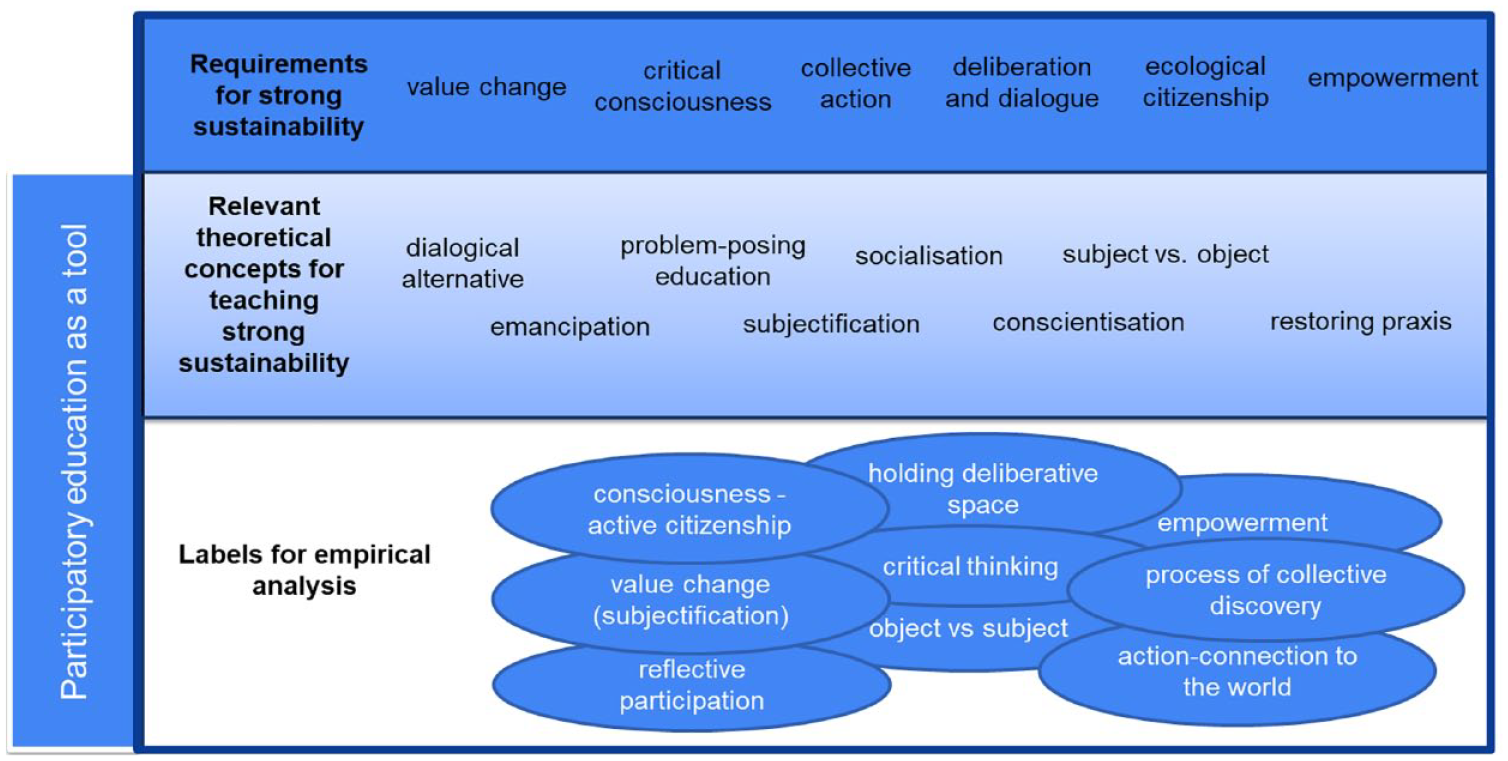
Conceptual framework to establish labels for empirical analysis.
This figure summarises the concepts discussed above in what strong sustainability requires from us, and which Freire and Biesta theories we deem relevant in teaching strong sustainability. However, we use these approaches not in general, but applied to participatory education as an adequate tool to use in strong sustainability education. The labels for empirical analysis are derived from these concepts as a kind of common understanding of a) strong sustainability education; b) critical pedagogy; and c) participatory education. It will be discussed in the next section of our article how these labels have been used in the qualitative analysis of texts gained from reflection articles on the Degrowth course we propose as an example.
The case of the Degrowth participatory course
According to the theoretical considerations outlined above, to promote strong sustainability in education and enhance transformation with individuals and communities in higher education, it is an important goal to promote changes in students’ values and outline a set of values that are different from the values mediated by current economic higher education. Participatory methods leave room for discourse which promote peer-to-peer learning and transformation in the values of the participants. These methods educate students to think critically, work in a problem-oriented ways and become responsible citizens. It was this line of thought that framed our process of developing a university course methodology to achieve ‘subjectivation’ in sustainability education. In this chapter we are analysing our educational practice according to Freire’s and Biesta’s concepts (see Figure. 1). First, we introduce our Degrowth participatory course and showcase our teaching methodology. After that, we analyse our teaching practice and finally discuss our qualitative research and its results that were conducted with the participants (students) using document analysis.
The Degrowth course
Citizens’ jury is a participatory decision-making process, where a limited number of citizens (around 20) are asked to provide recommendations for the decision-makers in a specific policy-oriented question in a 3- to 4-day-long process (Aldred and Jacobs, 2000). The use of this participatory tool in environmental decision-making has a wealth of experience (Aldred and Jacobs, 2000; Crosby, 1995; Petts, 2001). This method provides the framework for our higher education course called the ‘Limits to growth’. The aim of our course is to change students’ thinking related to the growth-oriented operation of the economy. We are trying to challenge the way business students think about an ecologically and socially sustainable society by drawing their attention to alternative approaches, in particular Degrowth.
‘Limits to growth’ is an elective course for master students. In this intensive course lasting three full days, around twenty students act as citizens. The process precisely follows the logic of a citizens’ jury: a teacher acts as a facilitator (from here onward we will refer to her as teacher-facilitator), and experts from the civil, business, academic and government sectors are invited to present different viewpoints. Based on discussions and debates, the citizens’ jury aims to develop a proposal for decision-makers on the issue of Degrowth for the Hungarian economic scene. To make the process even more valid, the course is conducted in cooperation with a real decision-maker on sustainability issues in Hungary, namely the National Council for Sustainable Development in Hungary (NCSDH). At the beginning of the course, the Council Secretary is invited to ask students a real question and at the end, the results of the students’ work are being sent back to him for consideration.
During the course, the entire process is based on discussions and reflections. The main realities of Degrowth and the ecological and social crises are presented by invited experts as well as another teacher who acts as a permanent expert (from here onwards, we will refer to her as teacher-expert). After every presentation (20 minutes), there is a discussion session where students can ask questions from the experts. After the presentation session, there is a long discussion on the given topics just among the students where they can express their feelings and thoughts about them. These discussions are facilitated by the teacher-facilitator. On the third day of the course, students prepare the report for the decision-maker. They decide on which topics are the most important for the suggestions and develop the details of each suggestion in small groups. By the end of the week, a written report is prepared as the outcome of the course. A more detailed discussion of the exact format and organisation of the course is published in an article (Kiss et al., 2021).
The design of the course format reflects several conscious pedagogical goals. In this deliberative process, learning is not about telling the truth, students can question the statements of experts including that of their own teacher-expert and understand them more deeply by discussing them with their peers. This way their subjectivity is built by the discussion, they should formulate opinions, and reflect on ideas and others’ statements. This way there is no transfer of knowledge, the socially aware subject can assess pieces of evidence and opinions in the learning process. Students’ opinions are deemed particularly valuable, and the student’s subject is built by the course. This way we can help the process of collective discovery as well as peer-to-peer learning as core elements. The teacher-facilitator does not show up as an expert, her role is to assist the discussions, and this way the power relation between students and teacher is reframed and empowers students to behave as members of the citizen’s jury. This empowerment is built in the process of creating the report together without input from educators. In this sense, every student has a say in this report and should feel authorised to give advice to decision-makers. The discussions and the topics are connected to real-world ecological and social problems and are raised by the invited experts from different backgrounds. The responsibility of the final decisions and the process is also connected to the real world through the involvement of a real decision-maker. The participatory notion of the course does not include the definition of preliminary frameworks (e.g. timing, selection of experts) and assessment as it is decided by teachers, but the process itself embodies participatory decision-making.
The student perspectives: analysis of the students’ reflections
To understand more deeply the impact of our teaching practices, we conducted qualitative research to see how participatory education can handle grand challenges such as strong sustainability and Degrowth. In our research, we sought answers to the research question whether the reflections of students substantiate our claims that participatory education embedded in critical pedagogical approaches can support the necessary transformations for strong sustainability in students’ frames of mind.
In this analysis, the students’ interpretation of the course was systematically analysed using the conceptual framework. Each participant in the process wrote a reflection article after the course. The articles were 2- to 3-page-long personal reflections about their experiences in the citizens’ jury and revolved around these questions:
What were your expectations and experiences with the Citizens’ Jury?
What was your experience with classwork?
What were the experiences and findings in relation to the method of participation?
What do you take away from these three days on this topic?
Did you have any surprising insights on the topic, and if so, what?
How could you work with so many people? What do you think about the output being the result of such a large group’s work?
We used these reflection articles as primary qualitative data and analysed them with document analysis. For the coding process we used the NVivo software and coded all the relevant reflection articles (altogether 37 articles). The coding was based first on the theoretical framework (Miles et al., 2014). The elements of the theoretical framework were turned into labels for the empirical analysis (see Figure 1) and using them as primary codes for the analysis we explored how these elements were mentioned or reflected upon by the students. Coding was primarily based on the pre-defined codes and was redesigned in the coding process according to the data, new codes were added which arose from the text (Miles et al., 2014). After the open coding, we reviewed the code system we had developed. Based on the consensus of the research group, codes were then merged, removed or renamed. Two new codes were added to the theoretical codes presented in Figure 1: emotions and preconception. The second coding was done based on these 11 codes (Strauss and Corbin, 1998).
The course first was announced in 2019, and since then it has been implemented five times (once each year). In 2019, 2022 and 2024, the courses ran in-person, but in the years 2020 and 2021 due to the Covid pandemic, the courses were held online. The online format was proposed to keep the main aim and characteristics of the course, but it was adapted to the setting of the online cooperation and platforms. To provide methodological coherence, we only involved two years (namely 2019 and 2022) in the qualitative analysis where in-person education happened. This resulted in analysing altogether 37 student articles from two citizens’ juries. The 37 students were all enrolled in different master programmes at the Corvinus University of Budapest in Hungary (30 business-related programmes, 1 business informatics, 1 economics, 3 environmental management and 2 other social sciences). All participants spoke Hungarian, 16 men and 21 women were present in the two groups.
Results
What does this participatory process give participants? In their reflection articles, students often explained how they experienced strong feelings and deep impressions. The label ‘emotions’ was an additional code in the analysis that emerged from the text. The most common experience was the joy of learning, the pleasure of group work, intellectual gratification and sometimes anxiety. We found that students mentioned both good and bad feelings such as excitement, enthusiasm, joy, pride, anxiety and helplessness. The following sentences provide good examples for these emotions: 1) ‘It has been an almost cathartic experience for me over the last three days’.; 2) ‘I went through a bit of roller coaster emotionally’; 3) ‘There were times when I began to feel anxious and helpless’.
Another strong experience of the participants was the form of learning that gave them the opportunity to discuss the topics (holding deliberative space). Most of them noted that the group was ‘very good’, and they experienced constructive debates. It was a surprising experience for most of them that in the deliberative space the discussions could be balanced, and participants could be patient and polite with each other. Many reflections were describing it as a new experience. In this experience, the creation of deliberative space is very important in many opinions as ‘a secure and confidential atmosphere was created’.
The role of the teacher-facilitator and the creation of a democratic atmosphere are of outstanding importance in most reflections (reflective participation). Involvement, activity and mutual attention are new phenomena for almost all students in a university course. It is also clear from the articles that they did not expect this, because they are not used to this kind of good atmosphere in classes. Many people found it surprising that there were no quarrels due to differences of opinion and that most students participated actively and addressed the topics in a constructive manner. In fact, it was a positive experience for many that it was not mandatory to comment, so if someone did not have an opinion on the given topic, they simply did not speak up. The attitude towards the external experts (both positive and negative) indicates the importance to compile well the list of experts. Personal impressions and the depth or quality of the expert’s presentation proved decisive for students.
On the other hand, students stated that taking part in the debate and reflecting on the experts or other students’ statements give the opportunity for reflectivity in the learning process through getting to know the perspective of others and expressing their own opinions (reflective participation). These discussions give them the experience to learn from their peers and start thinking about a particular topic. The experience of reflective participation was explained many times and they concluded that this way of learning gives them a deeper knowledge and understanding of issues: for example, ‘. . .by adding an idea to the conversation, I could come to a much more substantive conclusion based on the reflection of the others, than if I had continued to weave the given idea alone’.
In this learning process students concluded that the discussed questions left a deep impression on them. There were also some topics that gave them opportunities for highly subjective interpretations; hence, they were not only the objects of the education, but they could also channel their own knowledge, feelings and opinions into the conversations (object vs subject). The format of the course provided adequate space for this, and they felt that their opinions and knowledge were valuable. Several students expressed that some topics were closer to them, they liked them more and they were grateful for them. Of course, there were also topics they disliked, but getting to hear more insights helped them form their own opinions: ‘. . .I realized that it (Degrowth) is a much more informal and understandable subject than I had expected. In fact, I had constructive comments on some topics. I became quite self-confident and started to really enjoy the atmosphere’.
The process of collective discovery also proved to be important (code collective discovery). Students concluded that they could learn from their peers, and the different points of views make the topic and knowledge more accessible to them. Sharing the ideas with each other engage them more deeply than listening to one person (teacher), as they have to react to what had been said or express their disagreement which generates more thinking, inspiration, creativity. As a result, they dig deeper into the topic and think through their own position: ‘In my opinion, the “output” is worth much more this way. We discussed it together, evaluated it and came to a common conclusion even if we all came from different places, grew up in different parts of the country and had experienced different things’.
There were students who realised that they really are interested in one particular topic that was raised and felt the need to learn about it even more. However, participation in the debates has, in many cases, made students be aware of their own shortcomings: ‘Many times, however, I felt like I’d suggest something good, but I couldn’t quite articulate and convey it. I still need to improve it, but this course has helped me develop it’. In this sense, this form of learning through discussion is truly the beginning of the learning process.
Another very important learning point in the course was the mobilisation of their existing knowledge. To solve the problem, they had to use what they had learnt in their earlier studies on nature, society and economics and integrate the existing knowledge into one problem-solving process. They also recognised the complexity of issues and the emergency of these problems. This way we can see how critical thinking about socio-economic systems could emerge: ‘. . . at certain points in the conversations I was overwhelmed by a kind of helpless anxiety, as such systemic changes would be necessary, including influencing the financial system or consumption habits, which seem unimaginable in the current situation. Nevertheless, the final impression is definitely positive, since, with the knowledge acquired here, we can work on methods of creating a fairer and more sustainable future’.
The question is whether this type of learning method has made it possible for students to step out of the previous framework and challenge them to think critically (code critical thinking). From the analysis, we conclude that there are students who may have done so and reflected on how they think differently about Degrowth and economic institutions. However, this kind of system-level critical thinking appeared only in the case of a few students, we could code it only five times.
What results can participatory education lead to in terms of strong sustainability? A number of important areas emerge from the students’ writings (coded as action-connection to the world). On the one hand, important changes were experienced in students’ daily lives, and the effects they felt derived from the course. This action-oriented change can show the real-life connection of the participants to the world. They reflect on what they changed in their everyday practice after the course. As an example, one student said: ‘I pay much more attention to the environment than before. I try to use less plastic, tell others, and look for places and shops where I can reuse something. At work, I am often shocked by how much we waste and use pointlessly’.
Another area where strong sustainability appears is the change in mindsets. The most important messages that made participants think about sustainability are the dilemmas that still concern them after the end of the course and continue to think about finding solutions to them: ‘It has moved layers of my thoughts that I do not usually touch upon, even though these topics are important. I need to talk about them, but more importantly, I need to take action’.
We can interpret these thoughts in terms of how the course influenced students’ thinking. How they questioned their own functioning and thinking so far. It should be added that this was not the case for all students. Perhaps the biggest question in terms of changing the way of thinking and promoting strong sustainability is whether the debate had an impact on the values of the students (coded as value change (subjectification)). It is very difficult to draw conclusions in this regard since the change of values is a long-term process. However, in some cases it was possible to make a statement from the students’ writings that points towards this. Here is an example: ‘We study economics and really the importance of profit, returns and efficiency are what has “been built into us”. I do not remember the three pillars of sustainable development, even if I had heard about it in my studies. However, I think this, whether in the case of an economic or other type of university, it is definitely important to keep in mind our own future and I feel that after this course I will try not to forget it again and to deal with it in my life and future work’.
Regarding the participatory method, many students came to the course with doubts in advance (coded as consciousness – active citizenship). They had been sceptical both about the functioning of the Citizens’ Jury and about public participation in general. Applicability in Hungary showed further scepticism. However, the experience of participating in a citizens’ jury made a deep impression on many students. On the one hand, they formulated their demand for the application of participatory democracy in real-life decision-making processes. On the other hand, the experience of participation also induced them to look for more similar opportunities. In fact, some went even further in the conclusions, for example, by saying that s/he will encourage others to actively participate in the future, for example: ‘After participating in the Citizens’ Jury, I felt that people in Hungary are much more passive and voice their opinions less than they should, since listening to and taking diverse opinions into account makes decision-making results more inclusive. In the future, I would like to change this trend and motivate those around me to help any kind of initiative with their insights if they have the opportunity’.
In this sense, the topic of active citizenship, or the intention to become an active citizen, appeared to various degrees among several students, but its effect was significant for only a few of them since seven cases in total touched upon this issue in their feedback. However, even these committed students had not connected conscious citizenship with ecological citizenship. However, the intention to act upon the question of sustainability clearly appeared: ‘After the classes I felt tired of the topic, but I still had positive thoughts and a willingness to continue to do something about it, which I think shows the value and strength of the course’.
In analysing the students’ feedback, it is important to mention the problems they faced during the course, which raise questions for the teachers to solve as well. Even though most students expressed positive feelings and wrote appreciatively and even enthusiastically about the course, there were experiences in the texts that drew attention to the risks of participatory education, especially on the topic of strong sustainability. The feeling of helplessness can also appear in the process. For example, some expressed their concern that despite the interesting discussions, the Jury will not be able to achieve a real impact either: ‘Here I felt that we were talking unnecessarily, apart from the fact that I think a very high-quality intellectual discourse had been conducted, it would have no effect on what we invented’.
The essence of the method is the pursuit of consensus, which is embodied in the formulation of recommendations. Consensus building is a time-consuming process, which is not always enjoyable for all participants. However, there were students who felt that a lot of information, or important opinions and things to say, were lost due to the formation of consensus-building, which was still present as a value in the process: ‘I think maybe it was thanks to my experience that I had deeper suggestions during the three days. But many times, I felt like we were just going round and round about certain issues. I didn’t really see what was going to come out of it’.
We found that participants experienced many benefits in the participatory process. The most important experiences were the joy of learning and the real discussions with the different knowledge holders. In the field of strong sustainability and Degrowth, we can see the change in their thinking that sometimes would turn to actions in their everyday practices or in active citizenship. In addition, we have also identified the different risks involved in these participatory processes. These risks also affect students’ learning outcomes and learning circumstances.
Discussion
With the critique of the banking model of education and formulation of the pedagogical practices in a more emancipatory way (Freire, 1970, 1973) we need to face different risks in the learning process. When we consider students as the objects of education, the learning process can be controlled, and the learning outcomes planned. However, this is not the case in participatory education models. In the book titled ‘The beautiful risk of education’, Biesta (2013) stresses the point that we do not produce our students, and we cannot guarantee learning outcomes or standardise and fix the process of education. Education, if taken seriously, is always a risky business, one can never know whether something will work and what the end results will be like.
This is particularly hard with the ‘contemporary “enthusiasm” for teaching where the whole educational process is also a matter of control, aimed at the effective production of pre-specified learning outcomes’. (Biesta, 2019: 550). We are also working in an environment where we have to prove that we achieve the learning outcomes and that is a risk. Reaching transformation in our attitude towards economics for the sake of saving ourselves and our planet also demands the creation of safe environments. In these deliberative spaces the pedagogy of praxis can be applied, and common meaning-making reached.
The role of teachers is to interrupt the thinking of their students by asking difficult existential questions about desires and how to live, and how to coexist with others (Biesta, 2013; Blasco et al., 2021). Education is always relational in this sense, always involving a dialogue between people where they address, question and respond to each other. Since students are not produced, one can never know and cannot control what kind of subjectivities will emerge as a result of this process. In this sense, education has a special risk for the teachers as students may choose a different path and develop in a different direction compared to what their teacher would have liked or chosen. Nevertheless, if one aims to create conditions in which autonomous and responsible subjects can appear, this is a necessary and unavoidable risk. So, on the one hand, education is risky from the perspective of the students because they are addressed individually and asked to think about their own existence. On the other hand, it is also risky from the position of the teacher who does not know where exactly the educational process leads.
In the case of teaching strong sustainability or alternative paradigms, the learning outcome does not appear just in terms of pre-specified knowledge but also in terms of emotions and values. However, such outcomes are impossible to substantiate in an educational system that is obsessed with concrete, immediate and tangible results even if they are not necessarily long-lasting. Even though there are attempts to quantitatively measure intangible results such as value shifts (see, for example, Sidiropoulos, 2014), it is rather dubious to accept that such transformations are on the one hand immediately available, on the other truly measurable.
Strong sustainability education needs to shift from the knowledge-based transfer of information towards the transformation of values that are pivotal to overcoming the hurdles that lead to an environmentally more sustainable and socially more just modus operandi. This shift also means that the role of sustainability education is not that of providing qualification but socialisation and subjectivation using Biesta’s (2010, 2020) terms. There are cases when the necessary environmental knowledge can be brought in a top-down manner, but it can often arise from the dialogue between the people if given adequate spaces and processes to reflect on their own role in ecological and social concerns (Melo-Escrihuela, 2015).
The most important risk that emerged from our analysis is the risk of students’ negative emotions or psychological pressure in the course when discussing ecological and social problems. As we realised in our teaching practice on strong sustainability and Degrowth, students could feel anxiety and helplessness. In this kind of problem-posing education (in Freire’s term), the problem of the ecological crises (such as other grand challenges) could affect students emotionally negatively. As a teacher, we must handle this risk and be prepared for such feelings. This could be a new challenge for educators trained in business or economics.
One solution that we see and reflected on by our students is to frame the challenges in a positive manner. Strong sustainability education needs to be solution-oriented and should be ended with a positive future framing. Innovative real-life solutions or encouraging examples could represent an important handhold for the participants and give them inspiration for future activism in their own lives.
On the other hand, however, it is worthwhile to remain involved in a more uncomfortable situation, even emotionally, instead of immediately looking for solutions and resolving tensions (Dallyn et al., 2023). Therefore, the goal of teaching Degrowth is not necessarily to reassure the students with a positive solution but to take up a complex problem that they can examine from several angles. The ‘staying with the trouble’ approach (Dallyn et al., 2023) is also interesting from the point of view of subjectivation, that is, students being able to accept the current situation in our world and develop an individual attitude towards it. This can show how they can react and what they can do. It can also add to develop their critical thinking and encourage students’ reflexive capacities which critical management education also aims for (Barros et al., 2024; Corlett, 2013; Cunliffe, 2009; Jamil et al., 2024; Mavin et al., 2023; Willis, 2019).
In addition, we concluded that in managing these risks, it is of utmost importance to create a secure and confidential atmosphere in the process what should usually be the case in participatory education anyway. Moreover, both the problems and their possible solutions need to be explored and elaborated in a collective and social manner and raise the attention to the desirable values shared in our society in the short and long run.
While teaching strong sustainability in a participatory way, Freire’s dialogical alternative that is created in a deliberative space also has risks, especially if the culture of debating is missing from the skill sets of participants. These skills can be developed beforehand in other courses or as Biesta (2017) puts it, could also be developed by the discussions themselves. This cannot be done just waiting for the students to be ready, to be responsible and autonomous enough for a different kind of education. On the contrary, since students will never be ready (for example, one is never ready to become a parent), specific arrangements need to be created where this type of subjectivity can grow, where the ‘event of subjectivity’ can occur. Hence, one of the most important roles of the teacher is to bring forth and maintain the spaces where subjectivity can appear, where people can be addressed, and questioned and where their usual thinking patterns can be interrupted (Biesta, 2017). In our case, students realised their own shortcomings, which could be further developed. Also, special skills are needed from the teacher’s side to be able to facilitate discussion and build a deliberative process adequately. Holding the deliberative space was reflected by our students many times and according to them the circumstances and structure of the learning process have a huge impact on the quality of the learning process. And this is also a risk.
Creating a deliberative space in solving a grand challenge such as the ecological crisis could have its pitfalls as we usually ‘preach to the converted’. When we are discussing an elective, master-level course in a business school, then the participants are far from the average citizens in the country and the underprivileged are not represented. While the proportion of disadvantaged students in higher education in Hungary is a total of 3% (Directorate-General for Education, Youth, Sport and Culture, European Commission (EC), 2023), these students are representing the elites to some extent. When we are talking about the different views and backgrounds of the participants, these are only small differences. They all are well-educated, high- or middle-income citizens in their twenties. Most of them are somehow committed to the topic of sustainability or environmental issues if they had elected this specific course.
A few of the students criticised the Citizens’ Jury concept as it is only a simulation with a small range of committed citizens, and their stakes are almost the same in this issue. In their reflections, the emancipatory notion of education is not emphasised and only a few mentioned the empowerment that they experienced. Interpreting the results of these courses, it is obvious that real differences of opinions were not relevant, and in this case, there might just be the illusion of agreement. In this sense, we must treat the issue of empowerment with reservations in general in the case of critical pedagogical methods used in higher education and business schools, even if we break down the power differences between students and teachers using participatory methods.
If we claimed that in teaching strong sustainability, an appropriate tool can be participatory education, then we should also examine the results of these participatory processes, whether these consensual decisions would really serve the protection of the natural environment, and whether such a discourse-driven decision is able to protect natural values (Arias-Maldonado, 2007). Eckersley (1999) argues that participatory decision-making is unsuited for the protection of natural values because it is based on human considerations and thus cannot guarantee, for example, the protection of species of no apparent use to humans. Brulle (2002) still concludes that discourse cannot assure that our decisions will support the protection of natural values. Accordingly, there is an ecological risk of participatory education as well. The real empowerment in our Degrowth course and in the citizens’ jury method that could lead to strong sustainable solutions could be if the voiceless could become represented in the debate. Our experiences and our research findings show that the consciousness that could emerge or the citizenship that was activated lacked the real responsibility for the future generations or the voiceless. Ecological citizenship as a concept was not mentioned, and social solidarity usually remained among the less developed topics. We could move the focus of the conversations in a less anthropocentric direction if we brought in the representation of future generations and non-human beings. But in that case, it is questioned if we harm the free space for subjectivation or risk the participatory democratic setting of the course.
Conclusion
The purpose of our study was to investigate how participatory methods could support teaching strong sustainability and Degrowth in business schools. Our main findings show that there are beautiful risks of participatory education. As we concluded there are many risks in these kinds of deliberative learning processes, but the empirical research showed that it is worth investing in them in business school education. It is also worth doing this as a teacher when you read the feedback and see the changes you triggered or receive gratitude from students. They most certainly provide encouragement to continue despite all the risks. While students write reflections such as ‘I am very grateful that this course exists and that I was able to participate in it.(. . .) I believe that everyone at the University should gain some insights like these’. and ‘This is a course I would make compulsory for students here and now, seeing how it had an encouraging effect on others (this can be conveyed to the Faculty Council and the Senate)’.
Based on these experiences we see the practical implications of our research namely developing more strong sustainability-related courses in business school education based on the empowerment of students and participatory methods promoting the realisation of sustainability transition in a wider context. While this article is an addition to the evidence UNESCO seeks to underpin the importance of participatory education, the authors wish to take this argument forward and suggest that it is of utmost importance when it comes to teaching strong sustainability and Degrowth and transcending mainstream economic paradigms.
Above all these practical and emotional considerations, in our article, we also attempted to bring Freire’s and Biesta’s theoretical work into strong sustainability education. It is an important theoretical application that Freire’s critical pedagogy was applied to the solution of a concrete grand challenge and was presented empirically. The originality of our work is how we connected critical pedagogy with both strong sustainability education and the topic of participatory education and we showed an empirical case in this framing.
We have contributed to the literature on management learning by demonstrating how we use participatory methods in business education to encourage self-reflection and critical thinking in our students. In addition, we have provided an educational example that diverges from mainstream economic thinking, with the aim of promoting Degrowth education and fostering pluralism in business schools. Following Biesta’s (2017, 2019) lead on the role of the teacher, this example demonstrated that students and instructors cannot be totally equal in a participatory educational environment since instructors are responsible for designing and maintaining the deliberative spaces necessary for developing self- and critical reflexivity about the current socio-economic conditions. Moreover, an additional added value of our article is that it shows that these participatory learning experiences are fraught with risks not only because instructors cannot define concrete learning outcomes beforehand, but also because of the negative emotions and concerns which arise on behalf of the students due to the ‘staying with the trouble’ approach of the course (Dallyn et al., 2023). Based on these arguments, our article can contribute to the preparation of instructors who wish to apply participatory methods in sustainability education.
Our study also contributes methodologically to the management learning literature. We used students’ self-reflective writings (reflection articles) to analyse the effect of the course on students’ thinking. This qualitative method obviously has limitations. (1) The reflection articles that were used for the analysis were written by the students at the end of the course as part of their evaluation. In this sense, their writings likely entail biases, as they were prepared for the teachers in an evaluation process. (2) The course lasted three days and we cannot analyse the long-term impact on students. (3) As it was an elective course, students were engaged in environmental issues, so the impact would be different in other contexts. Despite this, we consider the results worthy of further investigation. It would be worth examining how the same participatory teaching methods can work in the online space. Our practical experience in this regard in the years of the pandemic in 2020 and 2021 suggests that we might get different results. However, this requires further analysis in the future comparing the online and offline deliberative spaces.
