




Abstract
In this article, we emphasize the importance of context for student learning. Based on reflective logs and interview data, we explore how students learn outside of the classroom as they undertake an experiential dissertation project. We identify three different forms of reflexive learning and critique, all triggered by some form of performative failure; scholarly critique, engaged critique and engaged action. Drawing on Butler’s theory of performativity, we illustrate how reflexivity is not purely the action of any individual student, rather it is a practice that is co-created within a certain context. As such, we contest individualistic understandings of reflexivity and encourage a careful consideration of the places students and managers are encouraged to be reflexive.
Keywords
Introduction
Experiential learning and industry placements are becoming increasingly popular in undergraduate and postgraduate degree programmes. As Reynolds (2009) states, experiential learning does offer the possibility of learning that is connected to work and to professional endeavour, and the possibility of ideas being developed through that which can be observed or experienced. And it does assume a less hierarchical interpretation of authority in that learning is derived from dialogue with peers as well as from researchers, teachers and the written word, albeit a process informed by the interrogation, critique and application of ideas in the public domain. (p. 389)
Experience is important because it allows new relationships to form between the student, the objects of study and the context in which the experience emerges. The reflexive learning literature, one of the key ideas for exploring learning through experience, has long discussed the various ways in which individuals learn from reflecting upon their experiences, exploring the ways in which one contributes to maintaining a certain reality and how one might critique some of the taken-for-granted understandings of this construction (Allen et al., 2019; Cunliffe, 2002, 2004). Combining critical pedagogies and social constructionism, Cunliffe (2004) argues that learning is an ‘embodied, responsive process’ (p. 411) that happens by reflecting upon and making sense of our own praxis, tacit knowledge and our role in creating certain socially constructed ‘realities and identities’ (Cunliffe, 2002: 37).
Noticeable in this early work is a strong reliance upon the individual who conducts the reflection and the subsequent critique of their own praxis. Recently, the reflexive learning literature has started to consider the role of others in this creative and critical endeavour (Cunliffe, 2016, see also Gray, 2007 and Keevers and Treleaven, 2011). For instance, Hibbert and Cunliffe (2015) discuss ‘critical-reflexivity’ as a form of reflexivity that encourages the questioning of social practices and organizational policies that allow and constrain certain forms of action. But, again, this positions the reflexive learner as someone who may edit and question certain policies and social practices, which limits a sensitivity to the impact of the established practices and policies that are already at large within organizations.
The purpose of this article is to emphasize the importance of context and the various ‘others’ with whom an individual learner engages. Following Grossberg (2013), we understand context as an active, organised and organising assemblage of relationalities (Hacking, 2004; cited in Grossberg, 2013) that condition and modify the distribution, function and effects – the very being and identity – of the events that are themselves actively implicated in the production of the context itself. (p. 34)
Contexts, in this sense, are spatially bound, whether in the sense of material or lived space, and are based on social relations. We therefore seek to build upon Cunliffe’s (2016) alignment with a broadly social constructionist ontology but emphasize the importance of considering the performative role context and others play within any setting, rather than focusing on the eventual act (and performer) of reflexivity. In particular, we highlight the importance of the receptiveness of the context in which students are struck and the role context plays in the forms of critique and engagement they undertake. We agree that reflexive learning emerges from reflecting on how and why one contributes to maintaining a particular reality (Cunliffe, 2004); however, we suggest that this reflexive learning will quickly become hidden or even lost if the student is in an unreceptive context. Consequently, we address Reynolds’ (2009) critical observation that ‘individually focused disciplines still appear to dominate as explanations of the phenomena which experiential activities generate and ingenuity in creating experiential activities is more advanced than the ideas used to explain what happens in them’ (p. 389). In response to such a challenge, we utilize Butler’s (1990, 1993, 1997, 2005, 2010) work on perlocutionary performatives and performative failure to theorize the importance of particular contexts in enabling forms of learning and critique outside of the classroom. We draw on interviews and reflective logs written by students who had all conducted a ‘corporate responsibility project’ that took them into a variety of different organizations (e.g. social enterprises, charities, foundations and corporate social responsibility (CSR) departments).
Our findings can be separated into three groups of students who all had different experiences with their host organizations. Hosts in the first group were largely unreceptive to students’ critique, which led the students to produce a disengaged and scholarly critique of the organization. The second group of students were in organizations that did not outright reject their attempts at critique and engagement; however, the students felt unable to compromise on the critical academic discourse they had used to formulate their work and so were unable to translate their critique to the host. The final group were in organizations who were largely receptive to critique and the students worked out a position and language with which to address their audience and engage critically within the organizational context.
Stemming from these findings, this article offers two contributions to the management learning literature. Most importantly, we show, via Butler’s work, that reflexivity is not a capacity of students but it is a practice that is shaped by the context in which certain experiences are formed. Second, if we accept that reflexivity and critique depend to a certain degree on context, then it becomes important for us as critical academics to think seriously about the places we send students. We agree that any form of reflexivity and critique is useful, however, we note the propensity for cynicism, (scholarly) escape and disengaged monologues when students are in unreceptive contexts.
The article is structured as follows. First, we start by exploring research on critical dialogical practice and the critically reflexive practitioner (Allen, 2017; Allen et al., 2019; Cunliffe, 2002, 2003, 2004, 2016; Hibbert and Cunliffe, 2015). We then build on the reflexive practitioner literature by drawing on Butler’s ideas on performativity and performative failure to highlight the importance of context in sites of reflexive learning. We describe our methodology and present our empirical material, before concluding with a theorization of three different kinds of student–host relationship.
Reflexivity, learning and performativity
Experience and reflexivity in learning
Cunliffe (2002, 2004) proposes the idea of critical dialogical practice and the figure of the critically reflexive practitioner as a new mode of approaching (management) learning through experiences. Such experiential learning harbours the aim of creating critical managers through exposure to a combination of critical theory and reflective practice as a prefigurative motion towards creating more socially aware practitioners (for a summary and critique, see Fenwick, 2005; Reynolds, 1999). Combining critical pedagogies and social constructionism, and opposing the psychological lens in experiential learning that prioritizes cognitive processes of interpretation and retention (cf. Kolb and Kolb, 2005; Kolb, 1971), Cunliffe argues that we learn when we make sense of our own praxis, that is, when our ‘knowing-from-within’ (Shotter, 1993: 18) or tacit knowledge (Polanyi, 1966) become apparent by our ‘being struck’ (see also Corlett, 2013).
Cunliffe (2004) re-conceptualizes learning as ‘an embodied, responsive process’ (p. 411) that goes beyond applying (critical) theory to order experience (the ‘outside-in’ approach of reflection), and instead, emphasizes that learning emerges from reflecting on how and why one contributes to maintaining a particular reality (the ‘inside-out’ approach of reflexivity). As a way of encouraging reflexivity, the differences between reflective sense-making, reflex actions and enunciations, Cunliffe (2004) proposes the use of staged class exercises that help reveal the constructedness of the world. However, her approach, in some respects, retains Kolb’s psychological focus upon the individual. For instance, her focus on redefining learning ‘from discovering already existing objective entities, to becoming more aware of how we constitute and maintain our “realities” and identities’ (Cunliffe, 2002: 37) still emphasizes the individual as the main driver for learning (see also Cunliffe, 2009). Similarly, scholars such as Maclean et al. (2012) who explore how business leaders practice reflexivity and Segal (2010) who examines the reflexivity of managers during moments of existential breakdown and crisis often portray the individual as the one doing the reflexivity.
More recently, the theories of reflexive learning have moved towards collectiveness and relationality. Tomkins and Ulus (2016) re-imagined Kolb’s model as a lived space of shifting relationships between people (students and tutors) and ideas. Keevers and Treleaven (2011) put forward a relational approach to reflexivity in practice using the metaphor of diffraction. Gray (2007) described a variety of methods that can be used to stimulate reflexivity to achieve collective action. Cunliffe (2016) advocated for ‘an intersubjective ontology’ (p. 742) that introduces a Ricoeurian presumption of one being ‘always in relation with others’, without whom we are unthinkable (p. 743). Reflexivity in this framework becomes a ‘means of interrogating our taken-for-granted experience by questioning our relationship with our social world and the ways in which we account for our experience’ (Hibbert and Cunliffe, 2015: 180). This definition invokes the social context and instantiates a tripartite approach to reflexive interrogation. Self-reflexivity refers to one’s capacity to see what is injurious about their own actions. Critical-reflexivity entails the questioning of social practices and organizational policies that allow and constrain certain forms of action (Hibbert and Cunliffe, 2015). Finally, radical-reflexivity addresses how one’s social, and subsequent epistemological, position influences their reflection (Allen et al., 2019).
It is to this growing consideration of the intersubjective and the context of reflexivity that we contribute. We seek to elaborate upon the idea that individuals come to knowledge and learning through interactions with others. In particular, we seek to build upon Cunliffe’s (2016) explicit alignment with a broadly social constructionist ontology and emphasize the importance of considering that which is already institutionalized (Berger and Luckmann, 1966) within a particular setting, rather than focussing on the eventual act of reflexivity. In other words, we seek to contribute to the reflexivity literature by highlighting the role of the ‘others’ that make up the audience for critique and how reflexivity emerges contextually within this setting. We agree that reflexive learners are ‘thinking in realities’ (Cunliffe, 2016: 410), but contest the prominent role given to reflexive learners in the creation of this reality. We find that a useful way of doing this is to turn to the work of Judith Butler and her consideration of performativity.
Performativity and context
Butler extends Austin’s (1963) theory of the performativity of language. Austin describes how certain utterances not merely describe a referent, which he calls constative utterances, but also perform some sort of an action, which he calls a performative utterance. Reading Austin from a poststructuralist stance, Butler (1990, 1993) extends the theory of performativity to all kinds of acts which create the very thing they claim to simply exhibit (thus, performances of gender reflected in comportment, dressing, conversational style, etc. result in the illusion of sovereignty of the gendered subject). Austin and consequently Butler distinguish between two types of performatives: illocutionary and perlocutionary. The power to perform either type of act stems from a Foucauldian understanding of power as ‘a multiplicity of force relations’ (Foucault, 1979: 92), where certain nodes in certain situations are capable of exercising more (or less) influence over the course of events.
Illocutionary performatives, rather than just describing a referent, actually bring about their existence. As Derrida (1982) shows, the power to make such utterances does not purely stem from the speaking subject’s intention but from their ‘citation’ and reiteration of similar previous performative acts. The illocutionary power of any such performance depends on how closely it echoes previous similar performances – the context, the authority of the actor, the manner of acting, the audience and so on. An illocutionary performance will always be an imperfect citation and thus it might fail if the acting subject ‘does not occupy the position of recognized and, hence, efficacious authority’ (Butler, 2010: 152–153).
Everyday examples of illocutionary performatives include someone making a promise, which beyond being uttered as a string of words actually makes the act of promising happen. Austin gives the example of someone using the power vested in them to christen a ship, which will again only work if it is the right person calling out the new name and certain procedural elements (e.g. smashing a bottle of champagne against the bow) are in place. In business life, a famous example would be when the chair of the US Federal Reserve announces a new monetary policy (Butler, 2010), which is delivered as a speech but given the powers vested in the position and the reiteration of earlier similar announcements, it materially affects the world and generates certain responses in the economy. If the Fed Chair made the same announcement in the supermarket or if it was made by a florist, it would likely fail to create the same effect. Similarly, when at a board meeting, the CEO describes a situation as a crisis, this act is more than just an announcement inasmuch as it concurrently connects and brackets off certain conceptual and material parts of reality as ‘the crisis’.
The perlocutionary force of a performative ‘contingently produces [certain effects] as a consequence of its utterance’ (Loxley, 2007: 129). Perlocutionary performatives do not bring new realities into existence but rather change the already existing reality: in time (and not immediately) if certain intervening conditions are met. The success of a perlocutionary performative depends on good circumstances, even luck, that is, on an external reality that does not immediately or necessarily yield to the efficacy of sovereign authority. (Butler, 2010: 151)
Reality is not readily changeable by any single actor as it depends on having circumstances, which includes various human and non-human actors, who are receptive to the change. For Butler (1993), this means that, for example, the politics of queering gender performances can only be effective if it is perceived as a parody rather than being, often violently, dismissed as a failed performance.
To take an example from organization studies, the various proposals espoused by ‘critical performativity’ which seek to create change within mainstream organizations (e.g. Spicer et al., 2009; Wickert and Schafer, 2015) have been critiqued by Fleming and Banerjee (2016) as being destined to fail due to the lack of a context that may facilitate the changes they seek. Examples of an employee single-handedly negotiating paid maternity leave are few and far between. However, when the circumstances are right and these utterances get picked up, by a sympathetic HR representative or because of a governmental campaign for supporting families, then over time, favourable, though far from determined, changes may ensue. Similarly, dissatisfied depositors cannot force corporate divestment from the carbon industry but their act of showing dissatisfaction may have the perlocutionary force that makes banks change their behaviour, if the circumstances are right. Indeed, the failed illocutionary act of the Chair of the Fed announcing the new policy at a supermarket can also have perlocutionary effects if people nevertheless take it seriously, if it is recorded and posted on social media, or if Warren Buffett happens to buy his groceries in the same store.
We can use performativity to interrogate the reflexive learning literature. In particular, we can challenge the propensity of discussing the ways in which learners might be ‘conscientized’ or turned, via reflexivity or exposure to critical ideas, into critical managers. Importantly for Butler, there is no natural ‘being’, no individual agent, behind the deed, as any utterer or performer draws on past (and future) performances. When we make a reflexive claim, the ‘very terms by which we give [a reflexive] account [of who we are], by which we make ourselves intelligible to ourselves and to others, are not of our making’ (Butler, 2005: 21). Thus, ‘the [reflexive] subject who “cites” the performative is temporarily produced as the belated and fictive origin of the performative itself’ (Butler, 1997: 49). Consequently, it is impossible to give a full account of oneself (Butler, 2005) and retain the individual as the powerful ‘agent’ in the centre of the learning experience (Reynolds, 1997). It also becomes impossible to fully account for the position from which our very positionality is judged as proposed by the concept of ‘radical-reflexivity’ (Allen et al., 2019). As Rhodes (2009) argues, we have to be ‘after’ reflexivity in both senses: trying to be reflexive while also admitting its impossibility, which should actually enhance one’s openness to the ethical demand of continually (re)producing new self-descriptions for new contexts with different audiences. Although one is never ‘the sole originator of’ their speech or act, yet they are ‘to some extent responsible for their utterances [and deeds]’ (Salih, 2002: 102).
Reflexivity, therefore, is not a capacity that one either develops or not, but a contextual practice. In illocutionary performatives, the authority of the act is established by the reiteration of pre-existing discourses, norms, codes and rituals – all part of the context that make the performance possible. Perlocutionary performatives clearly depend on meeting certain contextual conditions, otherwise the performative act will likely ‘misfire’ (Austin, 1963) and not bring about its intended effects – unless powerful actors ‘take up the utterance and endeavour to make [it] happen’ (Butler, 2010: 148). It is such misfires that we explore in our ‘Findings’ section as our students leave the classroom and enter into complex organizational settings. In the following, we introduce our methodology before presenting empirical stories of learning experiences. We have opted to let students’ stories take the front stage in the ‘Findings’ section, which is then followed by a discussion where we deploy the theory of perlocutionary performatives described in this section to analyse our findings.
Methodology
Research context
The ‘corporate responsibility project’ is offered as a dissertation option for undergraduate and postgraduate students on a Business Management programme in the United Kingdom. To set up the programme, the two module leaders, one academic and one practitioner, cultivated relationships with ‘responsible’ organizations located around the business school (e.g. charities, social enterprises, non-governmental organizations (NGOs) and CSR departments in large corporations). Courses offered on the main degree programme could be described as uncritical, with the slight exception of three electives that offer insight into climate change, business and society and CSR. As one student noted, You’ve said an interesting word there, ‘perspective’. The modules I have done here don’t consider perspective . . . It’s just one way. And this is where this dissertation becomes more difficult. [. . .] It’s explore, critique, think. (Kenneth)
1
During the 2013–2016 period, 30 undergraduate and 29 postgraduate students undertook this dissertation option, which was more limited by project and supervisor availability than student interest. All students had to apply to participate with a CV and personal statement and were interviewed in person before they were matched with fitting placement projects. Students worked in a variety of different contexts, projects in major insurance companies, start-ups seeking to revolutionize and reduce the carbon footprint of the cattle feed industry, law firms offering pro-bono work to ethnic minorities, ethical investment, sustainable food, social finance and social housing among others. Guided by an academic supervisor and a host in the organization, such a pedagogic setup encouraged individual learning from experience within ambiguity (Tomkins and Ulus, 2016).
Methods of data collection
Semi-structured interviews
We conducted 13 interviews that were recorded and transcribed verbatim (Appendix 1). Interviewees were contacted via a mass email sent out to all alumni from the course. Some were interested but initially unavailable, 46 students declined to be interviewed; however, 18 students (in total) agreed to us analysing their reflective logs. We finally interviewed 11 undergraduate and 2 postgraduate students (8 males and 5 females). In a few cases, interviews were undertaken 3–4 years after the student had finished their project, which may affect their recall of events. However, given that learning does not occur in one particular point in time, we consider these admittedly ‘delayed’ recollections intrinsic to the extended learning process. The interviews provided a space within which to reflect upon the project (see Appendix 2 for sample questions).
In line with our theoretical framework, we do not think that interviews provide some form of privileged unmediated access to reality (Alvesson, 2003). Rather, it is during the interview process that subjectivities and social worlds are (re)created (Holstein and Gubrium, 2004) and ‘where dialogical processes of meaning making happen and reflexivity may occur’ (Corlett, 2013: 456). It is the constitution of such subjectivities within a learning process that we concentrated on in our analysis. Five of the 13 interviewees were supervised by one of the authors which presented deeper insights based on notes taken during supervision sessions, albeit we are aware that the power dynamics present in such a relationship may affect the interviews we conducted. We acknowledge the potentially amplified issue of observer effect in these settings, however, we tried to limit any leading behaviour. The supervisor’s role was to listen, reflect and supervise – not to encourage or draw out issues during the interviews.
Reflective logs
Reflective logs were introduced as an integral part of the undergraduate dissertation (but could not be introduced at postgraduate level due to institutional constraints) and we were able to analyse more reflective logs than interviews. Reflective logs allowed students to step outside the dissertation, which could be heavy-laden with theory, empirics or a particular focus on the organization, and discuss their feelings and reflect on the learning process. Of the 18 reflective logs, we had 5 from students we interviewed, which allowed us to gain insight into the learning process beyond the 13 interviews conducted (see Appendix 1). Because the reflective logs were not conducted by all students in our sample, we did not use the logs in preparation for the interviews, rather, they were only analysed as a source of contrast and further depth. Where reflective log is not explicitly indicated after a quotation, it comes from an interview. For the whole research project, we sought university ethics approval, which was granted on the basis of students having received their dissertation marks and that we would use pseudonyms to protect their identities and their host organizations.
Analytical approach
Our approach to data analysis utilized a broadly grounded theoretical approach (Corbin and Strauss, 1990) to aggregate data into themes that led to a final abductive process (Peirce, 1965) whereby themes that were first identified in the interview data were then compared and contrasted with existing theoretical concepts and ideas. As such, we did not stick to a ‘pure’ grounded theoretical approach, but have borrowed many of its analytical tools. Our analytical approach can be split into three phases.
Initial coding
After the interviews were conducted by the first author, the first and second authors transcribed as well as re-read the transcripts and reflective journals and re-listened to the recorded interviews. In doing so, we were able to develop various open codes from our data. Coding was conducted using NVivo as this provided a useful way to store, unpack and code data in a shared document. For example, ‘frustration’ and ‘confusion’ appeared in all projects, but were to be expected in any project involving a placement. Less common themes included specific concerns about definitions, relationships with mentors, qualitative methodology, the length of the dissertation and even printing issues.
Linking codes into themes
The second phase of analysis was conducted once we were satisfied that no new codes and themes were apparent in the data. This phase involved the knitting together of open codes into more prominent themes and the collection of indicative quotes, which succinctly illustrated our analytical insights, to be used later in the article. For example, we noticed there were distinct groups of students, all of whom were in the more ‘corporate’ settings, who became aware of the disingenuous way in which their companies were engaging with CSR.
Linking themes to theory
The surprising frustration of students in and with what could be considered ‘pro-social’ organizations became a prominent part of the earlier iterations of the research project. Building on this, the role organizational contexts play in striking students and prompting reflexivity emerged as a focal point for the article and, in the third phase of our analysis, we turned to theory to develop this finding. Having considered the work of various theorists of learning and context, we eventually found that Butler’s work on performativity and performative failure resonated with our findings as it could help us theorize the forms of reflexive learning and critique that are made possible by the different organizational settings our students experienced.
In the next section, we present the main themes through concise representative case studies of students’ experiences that balance the description of their projects with their reflection and our commentary. Then we turn back to theory in the discussion section to theorize these accounts with the help of Butler’s work and highlight their importance for the literature on reflexive learning.
Findings
The starting point: Students’ motivations
To better explore the experiences of the students in this study, it is useful to establish their motivations for choosing the ‘corporate responsibility project’ dissertation option. Many of them considered the responsibility of businesses and charities to society to be important: I’m super attracted to companies that do good things, that do something for the community and [. . .] think about things like climate change and so on [. . .] That are really driven by a purpose. I think that was one of things where my interest grew when I did my CSR project. (Miranda)
Alongside this enthusiasm were other interests in the challenges of working in non-typical business organizations and gaining experiences of a UK workplace: ‘Part of the reason I believe experiential learning is effective is because [it] challenges [. . .] you to explore new areas in order to successfully tackle them [. . .] and as a result gain new knowledge and build new skills’ (Barry, reflective log). Given the self-selective nature of this dissertation option, we had a group of people who were enthusiastic and curious about organizational responsibility, though aware of some of the tensions. What we see in the following sections, however, was that this positivity did not last particularly long.
All students in our sample struggled with both the complexity of their host organization and the difficulty of blending academic knowledge and requirements with their practical experience. The former is easily understandable in any new work context, and especially so with students being thrown into an unstructured workplace setting. The latter, however, highlighted an important backdrop to our study. As Igor reflected, This was perhaps the most significant experience for me during this project. I was caught in a limbo in having to address managerial concerns while ensuring academic feasibility. I was also very surprised at how different those two sides were. (Igor, reflective log)
Moving back and forth between and satisfying the varied requirements of the two contexts made students’ projects particularly difficult: It is crucial to balance the two and create a report that meets the needs of both parties. In such an instance it may even be advisable to produce two reports catering to each party’s needs. (Christian, reflective log)
Negotiating these ambiguous and overwhelming tensions was key to students’ reflexive learning. We found their responses to fall into one of three categories, largely depending on the context they encountered at their host organizations. The first response was for students to separate themselves from the host organization and revert to the familiarity of a scholarly critique. The second response saw students challenging their host and, due to a more receptive context, would use academic literature and the position afforded to them to produce an engaged critique. The final group attempted engaged action by translating and negotiating the competing tensions inherent in their host organization via academic literature. We present our findings related to these three responses in the following sections.
Scholarly critique
Geoff was an undergraduate student whose role was to evaluate the employee engagement benefits of a roof garden. Doing the preliminary research, Geoff found clips from the Guardian and the Times all talking about this remarkable roof garden growing organic food in the middle of a city. The newspaper articles described employee gardening clubs that helped ensure that employees got a full lunch break in a green space. He was both excited and yet expressed confusion as to why a corporation would bother to do such a thing. Following a brief by the CSR department at the host organization, he started talking to employees. What he noticed very quickly was that no one used the roof garden. ‘There was a contradiction – in terms of what they said publicly and then what actually really happened’ (Geoff). In fact, very few employees ‘had time’ to go up to the garden at all and even less were involved in gardening. They even ended up hiring a gardener to maintain the crops.
In a similar story, A.J. was working with a property developer in the city. Having an interest in property, philanthropy and development, A.J. was happy with his project, despite the relatively vague brief he was given. His hosts were seeking to develop a predominantly Bangladeshi part of the city and were hoping to engage partners from nationwide supermarkets, coffee shops, various other stakeholders, and especially the local community. He had some interesting findings: I think I learnt about CSR from lots of different angles. And from a company angle it seems like a tick box exercise. No one is actually passionate about it. No one has said, ‘I want to start a company [. . .] and I’m going to build a property and it’s going to be a socially responsible property’. It’s more, ‘I’m going to add the social responsibility in because it makes the environment better and I think I will get the planning quicker’. (A.J.)
Both students faced some important truths about their hosts which led to serious concerns about what they should do. They had entered into strange environments, worked with organizational members on projects and were invited to engage with the idea of CSR. Both, however, rejected the usefulness of the idea and were instead critical of CSR and mindful of its misuse and the hypocrisy of some corporations. Geoff and A.J. wrote rather damning critiques of their host organizations in their dissertations and reflective logs, yet ended up translating their more ‘critical’ work into an ‘acceptable’ report for their respective hosts:
The main thing was . . . realizing that the work I did for them . . . could be very different to what I did for my dissertation. Once I got that into my head, I was like ok, this is fine, I can be critical against them.
What did you give them in the end?
I gave them what they wanted, which was an assessment of the impact of the garden.
A.J. presented a critical report to his host that traced and focused on the communities that will suffer under the new proposals. However, upon receipt of this report, the developer requested several changes: For the client report, I deleted all the educational stuff [literature] and sent them all of the other stuff [findings]. Actually, they deleted most of it. They said, ‘this is our report, this is what we want in it. Can you see and converge what you’ve written and give us what we need?’ So I did that, and ended up deleting the methodology, lit review. I kept the references in. (A.J.)
Both A.J. and Geoff represented a group of students who felt empowered by their role as a business school student and (eventually) submitted critical reports: . . . and then when you said, ‘you’re welcome to put your own opinion in this, you know’. And as soon as that happened, I said OK, I can analyse this stuff my way. If you are a big CEO of a company or whatever, I can rip this whole thing apart and take a political standpoint on it . . . And I thought that was quite fun. (A.J.)
Similarly, Perez, another student who wrote a critical report of their host organization noted the importance of still having a foot in the business school: I think that’s so special about this kind of projects [. . .] coming in as a member of [the Business School], I think that really does help. [. . .] You know, you hired [the Business School] to work with you, so, like, let me ask these questions, let me get the information I want.
However, some students were uneasy with such a critique and struggled to ‘challenge’ their host: They [the host organization] looked through my dissertation. And certain things were worded differently as a result . . . And as a result, it looked like I wasn’t challenging them enough [according to her supervisor]. It would have been better if I had a free reign. I guess it was my fault. But given free reign, it would have made my dissertation much better. Personally, I felt torn [between the host and the academic supervisor]. (Makosi)
A few students did not even pass their research project on to the host organization: I didn’t give my dissertation back to my host. Because I think our views differentiated [sic] too much, and I thought like, if I were to give it to the client . . . Well, I wouldn’t. (Svetlana, reflective log)
What we see from our students here is what any critical CSR scholar would like to see – students peering past the glossy veneer to critique corporate greenwashing. For many critical CSR modules, this is all they seek to achieve. However, these actions point to a form of scholarly critique, whereby external critique is developed against the organization via a retreat to the protection of an academic discourse or logic. This action was partly fuelled by the unreceptiveness of organizations to critique, as they actively asked for changes or made it very clear they did not want to hear another negative evaluation. In the next section, we explore whether this phenomenon is the same when students enter into organizations that are more receptive to critique.
Engaged critique
Futurechildren, a company that aims to educate and entertain children from the ages of 4–14 hosted two students over 2 years. The organization provides role-playing activities for children, so they may learn about the variety of work opportunities available later in life. Their aim is to link school learning with the world of work and to improve social mobility by providing cheap access to disadvantaged children while charging premium prices to local, more affluent, families. Although not self-identifying as a social enterprise, Futurechildren was very keen to show the societal and educational benefits of their organization. Their activities had attracted a variety of interests from charities, NGOs and governmental ministers. However, that was not enough for one of our students: ‘They’re capitalists! Of course they’re capitalists. They only care about money and shareholders!’ (Rasheeda).
Rasheeda, speaking with one of the authors after their first meeting with Futurechildren, was referring to a comment made by a director about how the company paid dividends to shareholders. This, despite everything else she saw the organization was doing regarding education, social mobility and for schools outside of the city, was enough for her to condemn them. Her expectations about how a socially committed company should act did not match what she saw. She initially seemed reluctant to accept the possibilities of aligning societal/educational outcomes and the pursuit of profit. It was either/or and very little in-between. Due to this perspective, she produced a critical report for the host organization that challenged their governance structure and culture, though it was not the Marxist polemic we originally anticipated based on her earlier reaction. Reflecting on her comment and experience 5 months after the original conversation, she noted during the interview, I . . . I . . . I would not say that. I think ‘capitalist’ would be wrong because that is just making profit. When I actually thought about it, they’re definitely making money. They’re out there to make money and a couple of interviewees as well said that. ‘Yes, we’re out there to make money’. But obviously they do some good, and that is, I mean they help children to learn and that shouldn’t be disregarded, we cannot overlook that. They are not working only for profit. In their own way they’re just doing something social good. They’re just giving back to society in [sic] the means of education.
Another student, Josh, worked with a social finance organization, which presented him with the perfect opportunity to bring his business education to fruition: I’d say one of the reasons I did this project was because I was feeling these tensions already [between societal benefit and profit]. I think what’s been great about this project is that it takes social issues and puts it into a business context, twinning business with social. And that’s exciting. (Josh)
Josh was confronted by a variety of different ways to think about business practices and the purpose of finance. Reflecting on his learning experiences in the business school, he noted, As a Management student at [the Business School], the words ‘social’ and ‘investment’ have rarely been used in the same sentence, let alone used as a term to describe a new and profound way of doing finance! Risk and return is all I knew. (Josh, reflective log)
In terms of the outcome of the project, he was fundamentally disappointed with what social finance was offering as an alternative. He saw his role as being an academic fact checker, of sorts: ‘. . .basically the problem was, there was plenty of that kinda dry bit. What was lacking was [. . .] academic pieces critiquing it’ (Josh).
Unlike Rasheeda at Futurechildren, who preferred a more militant stance against what she saw as a capitalist organization, Josh was happy to accept these tensions. His critique, however, rested on the ethical problems he found in the social finance area. He interrogated the capacity for some charities and social enterprises to serve their constituents: There’s already a lot of debt in the world. Do you really want to mis-sell a load of debt to organizations that are just trying to do some good? So I think that’s where this kind of more serious, more critical tone came from. Social investment sounds really nice . . . It is an investment from the other side but it’s not an investment where you’re going to get ownership. You won’t. It’s borrowing . . . and I said that to the Head of Social Investment . . . Actually, one of the last little meetings I had with [my host] was probably my most satisfying part of the whole thing. Because I was finally able to ask him questions he didn’t have an answer for. [. . .] No, he didn’t take it personally or badly – but that was really satisfying. (Josh)
Both Josh and Rasheeda produced academically informed critiques, which were taken on by the host and discussed further. Despite their shared concerns that the image of the ‘socially responsible organization’ did not match up to their expectations, they remained engaged with the organization but approached the topic from an academic standpoint. This represents an engaged version of the type of critique discussed in the previous section. In both cases, an academic discourse is used to create an oppositional position to the host, but unlike before, and partly due to the receptiveness of the host, Josh and Rasheeda’s critique remained situated and engaged with the context and not outright dismissive. As such, their reports became a challenge to the host organizations and not simply an (unheard) critique.
Engaged action
Autonomy social housing is an organization based in the South of the United Kingdom, managing 13,000 homes, employing around 400 employees. Rich prepared for his time at Autonomy by reading up on social housing (a concept he was not aware of) and noted, in particular, the government funding cuts affecting the sector. He was anticipating a collection of well-meaning individuals aiming to improve the lives of people struggling to find a place to live. When he entered the organization, he quickly realized he was not the only external addition to Autonomy. Giles, a Porsche-driving consultant, was starting his first day as well. Giles’ task was to help ‘streamline’ and transition Autonomy to a more commercial model that could cope with less governmental funding: I think the surprising thing was that the scope they set out for the project was purely commercial. There was no consideration to the social side of it. I wasn’t asked to consider that . . . So I could have quite easily looked at it as purely a commercial business – and not even considered the social side of it. And that would have been the easy option . . . but I wanted to find out more about the social enterprise setting. (Rich)
Rich suddenly became very much at odds with Giles. In Rich’s 15 or so interviews with employees at Autonomy, he spoke to front-line staff who had almost forgotten what the organization was trying to achieve. They described talking to Rich as ‘therapy’: ‘Someone described me as a therapist and as someone that they could give things to that had never been taken up’ (Rich).
While Rich was talking to staff, Giles focused on introducing new processes, formal checks and performance monitoring. In the report, Rich discussed how Giles’ managerialist tactics were not well received but also took it upon himself to explore how the social mission of the organization had drifted and how that affected Autonomy’s employees: The remit was to look at the charging and pricing revenue streams, but I took a step back to look at the bigger picture of not losing your identity as a social enterprise . . . and what that meant to employees. (Rich)
Through his interviews, Rich became a sort of conduit for divergent parts and goals of the organization: The very first interview I did was with Finance and they were just pulling their hair out about the lack of money coming in. Finance saw things differently, they saw a person owing the company money and went nuts, whereas customer services knew that person and knew there was a problem and why that person was in red and it was fair not to charge them. But from Finance’s perspective, everything was wrong. But they were happy that someone was going to take it up [. . .] These were siloed issues . . . And that was the key problem and it was me that was trying to pull it all together. (Rich)
Rich used his report as an opportunity to focus on the loss of identity experienced by many at the organization, the effects and issues caused by Giles but also to raise the divergent issues discussed with him by various parts of the organization. This was received well by the organization, less so by Giles, and Rich was invited back to present his findings to senior management.
Marc faced a similar (albeit reversed) difficulty at a social enterprise where he was told, ‘We are all about [helping] people, not money or business’ (Marc). Keeping to this promise, however, was difficult in practice: Since many of [the Foundation’s] clients were seeing the relationship as a B2B service provider/purchaser relationship, acting strictly as a charity and using ‘non-business language’ has been alienating some of their clients. Yet on the other hand, you also cannot afford to alienate your staff by proposing something very much against their ideals, as they are the people who need to carry it out. (Marc)
The foundation had found itself in a tricky financial spot and had challenged Marc to help keep them afloat. Stuck between a rock and a hard place, Marc’s main challenge was to find a way to convert what he had learnt at business school into ‘non-business language’. Due to his status as a business school student, Marc often found it difficult to even talk to ‘people who were not at all convinced as to why I was there’. Subsequently, he had to adapt his language when talking to people at his host organization: It turned out that profit and efficiency was almost a dirty word [sic] in charity . . . So instead of saying that ‘this is more efficient’ or ‘this will bring you better returns for investment’, you have to mask it. Well, not mask . . . You needed to really focus on the fact that this brings more value to your clients and more stability to your organization. So stability is something that they understood. (Marc)
A focus on clients and improving stability became the way Marc spoke about what he would consider ‘business language’ as he hoped to blend social good with economic survival. Using this knowledge and form of communication, he helped create a marketing plan for the organization and conducted an in-depth overview of the company’s past clients. Again, like Rich, Marc was invited back to the organization to present his findings and ended up working at the charity for a year.
Unlike Rasheeda and Josh, who undertook an engaged but scholarly critique, Rich and Marc, albeit in different ways, sought to navigate between efficiency and the ‘good’ their hosts were hoping to provide, while also trying to actively shape their organizations. Rich tried to re-introduce the social purpose of the organization and provided a conduit to voice the competing tensions apparent in the organization. Marc tried to balance efficiency with the social purpose of his host, trying to ensure its survival but also its status as a social enterprise. Because of this, finding ways to smooth out competing tensions, and even just being aware of that balance, became an important learning outcome for both. Both also used their status as ‘outsiders’ and an academic discourse within the organization, rather than outside the organization as a form of critique. This is a point noted by Christian, a student who also found himself blending economic and social issues: My role on the project made me feel independent from titles and hierarchical norms. I was not paid by [the bank that hosted me] and had no formal obligation to obey or adhere to instructions. I was loyal to the project and did what was asked from me, but if things wouldn’t work out, I could simply walk out the door without any further impact on me (except a dissertation in free fall, but that’s a separate issue). I think this sense of autonomy was the foundation of why I felt so confident in voicing my opinion and later on approaching people in the organization for interviews, and I think this was critical for the success of my study. (Christian, reflective log)
Discussion
In the previous section, we presented three forms of student responses: scholarly critique, engaged critique and engaged action.
Table 1 presents a summary of our findings regarding context, a characterization of the critique they produced, the ‘others’ with whom they produced this critique and the dramatic form of how they communicated their critique. In the following, we unpack these broader findings group by group.
Summary of findings.
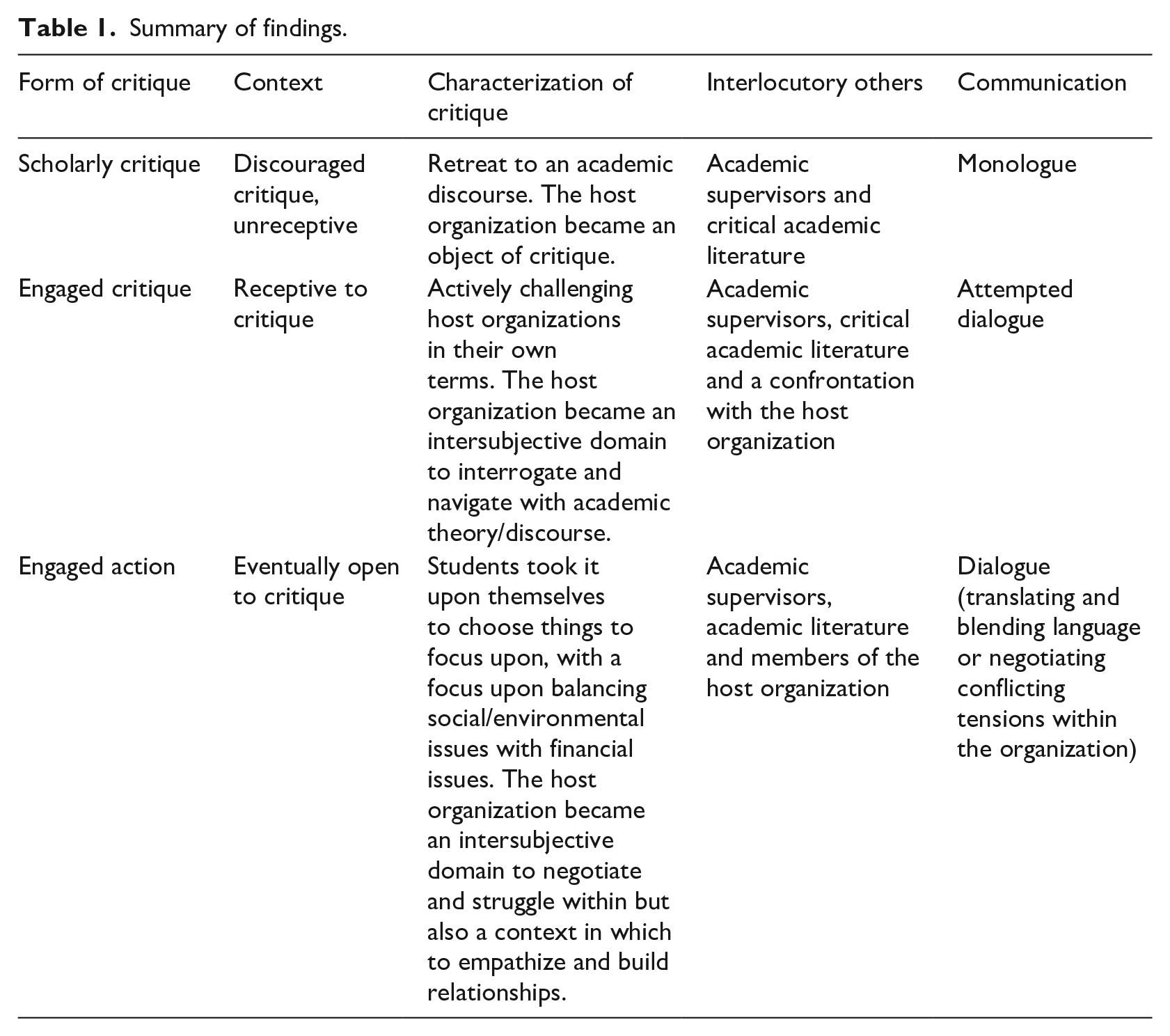
To understand the role of context in reflexive learning let us now return to the two types of performatives discussed by Butler. We should preface that the students’ performative acts mostly failed. While not discounting the possibility completely, it is very unlikely that students sent out to engage in the kinds of projects we described would ever carry enough illocutionary force to create new reality as they were not in the position of an efficacious authority in these organizations. Although students were cast in some sort of an advisory or consultative role with their hosts, these positions did not have the requisite authority with which to cite prior performances to full effect.
The notion of perlocutionary performatives, which might have certain consequences over time if the circumstances are right and certain intervening conditions are met, can help us explore issues of context more clearly. The students in our study experienced a mismatch between their interest in corporate responsibility, as proven by their self-selection for the project, and the complex and messy reality of the organizations they entered. Students’ performative acts did not wield any observable perlocutionary power and, in many cases, were not taken up by their host organizations. Indeed, students were even asked to alter their reports, were shocked by how little people cared about CSR or could hardly find the social aspect of the organization’s activities. It is as if ‘a certain discursive wager on what reality might be fail[ed] to materialize’ (Butler, 2010: 153). Students placed a wager on their hosts, an assumption of what they thought a ‘more’ responsible organization would be like, of what sort of relationships exist therein with each other and the world, but this proved to be wrong. We argue below that these performative failures were the reason for students’ reflexive learning to emerge – but this happened in different ways across the three groups.
Organizations that hosted our students in the first group were not receptive to their ideas or critique. Students were ‘struck’ (Corlett, 2013; Cunliffe, 2004), in the first instance, by the difference between their wager of what the reality of these organizations was like and how they actually found them and, in the second, by the hosts’ responses to their critiques who sometimes ‘deleted most of it’ (A.J.). Although students tried to challenge their hosts, their perlocutions failed as the conditions were not felicitous for ‘develop[ing] more collaborative, responsive, and ethical ways of managing organizations’ (Cunliffe, 2004: 408). The lack of receptive context, made students to practice reflexivity as a form of external, scholarly critique, albeit still derived through experience. Using Butler, we might say that students moved (back) into a context, in which their intelligibility as a subject was not questioned. In the business school, their act of ‘ensuring academic feasibility’ (Igor, reflective log) carried an illocutionary force, given that they had the efficacious authority of being the right sort of person doing the right sort of things. In other words, they were able to (re)establish themselves as the clever student doing excellent critical analysis. The failure of their performative act in one context may have thus even helped their illocutionary performance in the other.
This outcome is similar to much reflexive practitioner/learning work, where a student would be called upon by a critical educator to examine their own subjectivity, complicity and practices in a situation in which they regularly find themselves: their office, their building and so on. Responding to such power dynamics, students often present remorseful accounts of how bad they, someone else or ‘corporations’ truly are. These critiques offer useful forms of reflexive experiential learning to create a common ground for critiquing organizations (Fournier, 2006) but, understandably, very little by way of actual change (Contu, 2008). The reason for this being that the form of communication students are often forced into is that of a monologue. In our case, students’ monologues were actively refused by the host organization, if they were ever handed over by the student. It is possible therefore to consider such reflexive learning that remains trapped in the dissertation, professor’s office or lecture theatre, a form of cynical distancing (Fleming and Spicer, 2003) and reflexive therapy (Reedy and Learmonth, 2009), unlikely to ‘conscientize’ and thus turn learners into critical managers, although they may become more cynical managers.
Students in the second group conducted projects in organizations that did not outright reject their attempts at performing critique, or so they reported. Nonetheless, the students still felt a tension between the organizations’ stated goals and their own ideals – as represented by their ‘being struck’ that, for example, their host organizations wanted to turn a profit as well as pursue societal good. Unlike the first group, students were not asked to change their reports and they were being listened to (e.g. Josh’s host did not take the criticism ‘personally or badly’). However, students’ intentional attempts at illocution (e.g. when Josh confronts the Head of Social Investment in a way ‘that felt satisfying’) not only failed to create a new reality (a new account of what these organizations really do) but even their perlocutions failed when ‘their analytic suggestion backfire[d]’ (Butler, 2010: 153).
Unlike the final group, these students did not adapt their language to fit the organization, were not willing to compromise (or perform what would have felt like a compromise) on the critical academic discourse they tapped into to formulate their critique. The way in which they presented their critique was at odds with how their hosts perceived what was happening, it made visible the mismatch between the hosts’ and students’ lived realities (which is why the host ‘didn’t have an answer’). They attempted a dialogue but their perlocutions also failed because their ‘explanatory scheme prove[d] blind’ to the organizational context, the students’ audience and their needs ‘in some key way’ (Butler, 2010: 153). Consequently, their explanations did not find fertile ground, and hence were not taken up by their hosts, although this might still happen in the future. At the same time, these students’ acts, like those in the first group, could again be understood as carrying an illocutionary force that could establish them as outstanding students doing critical analysis.
For the third group, just like the previous two, the reality of their host organization was still at odds with what they thought their hosts would be like. However, albeit in different ways and under different circumstances, the students were able to find a position and a language with which to address their audience and engage with the organization: ‘you have to mask it’ (Marc). The combination of finding the right language and the receptiveness of these organizations allowed them to perform engaged critique within the organization, rather than the external critique exemplified by the first two groups. Furthermore, unlike the second group, students’ capability ‘of both translation [between their academic insights and the organizational reality] and invention’ led to their having ‘a kind of performative agency’ (Butler, 2010: 155). This agency depended on the students’ ability to adapt to the different-to-envisaged conditions they found, which, far from being purely a question of individual competence, was primarily one of contextually afforded possibilities. This ability meant a reiteration of prior discourses in terms of language used, which performance made the students’ insights and also themselves as subjects intelligible (see Butler, 2005) to the organization (e.g. such a performance provided a reason to those who did not understand why Marc was there at all). Crucially, what they said was not a simple repetition of what had been said before. The freedom provided by the possibility of just ‘walk[ing] out the door’ (Christian) gave them a chance to present a ‘mask[ed]’ (Marc) version of something a little bit different, using their words to say something else (or a form of ‘parody’ as Butler (1990) would say). This allowed students to embed their reflexivity and engage in dialogue with their host, which might have a perlocutionary effect, lead to slow changes over time and did, in fact, allow a prolonged relationship between the students and the organization.
It would miss the point if we tried to set up a scale from more to less useful critique among the three groups. They all appear to be performing something very similar – from being anxious about the task to being angered by social organizations not living up to their expectations. What our data illustrate is that it is rather easy for performatives to fail (Fleming and Banerjee, 2016) and that this failure is largely attributable to the contexts in which students find themselves. A failure of the performative, however, does not equate to a failure of reflexivity or learning. In fact, we find that failed performatives are often the trigger for more reflexivity. What matters, we will go on to argue in more detail, is that this reflexivity goes beyond an individualized discourse.
Reflexivity and learning with others
Reflexive learning is often discussed as being about enabling and creating critical thinking in students, managers and practitioners. In this article, we have tried to enhance and build upon the existing reflexive learning literature that encourages the reflexive learner to become ‘more aware of how we constitute and maintain our “realities” and identities’ (Cunliffe, 2002: 37). Recently, the literature in this area has started to appreciate the important role of intersubjectivity and the relationship between a learner and their ‘relation with others’ (Cunliffe, 2016: 743; Gray, 2007; Keevers and Treleaven, 2011; Tomkins and Ulus, 2016) and not just the eventual act of reflexivity. What we have shown thus far is that the receptiveness of contexts and the ‘others’ who a learner engages with can lead to certain forms of critique (scholarly critique, engaged critique or engaged action), certain forms of communication (monologue and dialogue), levels of engagement and thus certain forms of learning. In other words, we agree that reflexive learning emerges from reflecting on how and why one contributes to maintaining a particular reality (Cunliffe, 2004), however, we suggest that this reflexive learning will quickly become cynical and one-sided if the student is in an unreceptive context (an intersubjective situation where the students’ actions carry neither illocutionary nor perlocutionary force). Alternatively, in receptive contexts, students who are seen as consultants or therapists, realized a sense of radical-reflexivity. That is, they reflected on the tensions involved in being a socially oriented organization. They considered how their presumptions about what their host organization would be like, and their position as student-consultants (for instance, the opportunity to leave at any time) shaped their actions. They came to understand why their performance of being a consultant did not wield its expected power and changed their actions to match the lived reality of the organization in which they found themselves. This resulted in more embedded reflexive learning but also led to a tamer form of engaged critique that might nevertheless carry a certain perlocutionary force as it was not immediately written off by the host organization.
This has implications for understandings of theory in the literature on reflexivity and reflexive learning. While reflexivity is indeed crucial to how we decipher and maintain a particular reality (the ‘inside-out’ approach discussed previously), our study suggests that we should not disregard the concrete importance of the reality in which students find themselves and are simultaneously shaped. In this article, via the work of Judith Butler, we complement what could be considered more idealistic and individualistic (e.g. Allen et al., 2019; Corlett, 2013; Cunliffe, 2002, 2003, 2004; Hibbert and Cunliffe, 2015) or more collective (e.g. Cunliffe, 2016; Gray, 2007; Keevers and Treleaven, 2011; Reynolds, 2009) understandings of reflexivity to one that highlights and examines the role of context in enabling (through performative failures) and constituting (through ‘others’) reflexive practice.
Our second contribution relates to a certain form of critique that emerges in the final group of students we discussed (engaged action) who were more willing to dwell in tension-filled contexts. In so doing, this group displayed a form of perlocutionary power or performative agency, largely due to the receptiveness of the organizational context, which allowed students to learn to empathize and translate between the various tensions encountered. The learning process extended students’ reflexivity and emphasized the possibility of engaged critical action, rather than feelings of cynical scholarly criticism encouraged by non-receptive contexts. If students dislocate themselves from a context in favour of critical theory and limit their discussion to the academic domain, we have concerns as to what this might achieve. Although we maintain our position that all forms of critique are both useful and problematic in different ways, we argue that antagonistic and scholarly forms of critique facilitate discursive closure by shutting down voices via a strong and disengaged monologue, while more agonistic and engaged forms of critique (Parker and Parker, 2017; Reedy and Learmonth, 2009) make students learn that reflexivity can, and sometimes does, lead to changes in the world and dialogue. We believe that critique should be articulated and heard outside of the classroom and a reflexive experience. If not, there will always be a chance that reflexive learning runs the risk of decaffeinating critique (Contu, 2008) while placing too much emphasis on the individual as both cause and effect.
Concluding remarks
In conclusion, we propose that a theory of reflexive learning should embrace the recent shift of focus from the reflexive individual to our ‘relationships with others’ (Cunliffe, 2016), and that this shift should include an evaluation and consideration of the contextual and performative factors that influence whether and how certain forms of reflexivity can emerge. Reflexive learning is concerned with the question of how certain contexts and subjectivities are sustained, and what might make them change. Perlocutionary performatives can easily fail, and their outcomes are uncertain and delayed in time (see Fleming and Banerjee, 2016). Therefore, besides continuing with practising the academic critique we know all so well, we should also consider more extensively how we can expose students to contexts where their performances might find fertile ground. One of our options is to seek out and endorse potentially welcoming organizations for our students to explore and learn (Parker and Parker, 2017). However, we also need to acknowledge that we are not in control of the messy realities students face and cannot foresee how they might encounter such places. As our findings attest, the chances of successful perlocutions are rather uncertain. Besides context and language, discursive factors not studied in this article, like how students’ bodies are read by the host organization, also matter with regard to performative success. More research would be required to identify how students learn in different contexts. Most pertinently, we would be interested in exploring how students learn in radically alternative organizations, for example, workers’ cooperatives, farming communes or activist collectives.
Much like singular instances of gender subversion, the projects we presented here are unlikely to fundamentally shake up capitalist social relations on their own – if that were our goal. Nevertheless, roughly 15 percent of our students on the programme have ended up working in environmentally and socially aware organizations ranging from global philanthropy to sustainable packaging design. Of course, as students selected this project themselves, they may have been predestined to go on to work for ‘good’ organizations. Still, returning to the importance of context, providing students with the opportunity to act within and reflect upon a situation that is outside of the classroom and that hints at alternative forms of value and practice, is something we fully endorse.
Footnotes
Appendix 1
Table of respondents and source of data.
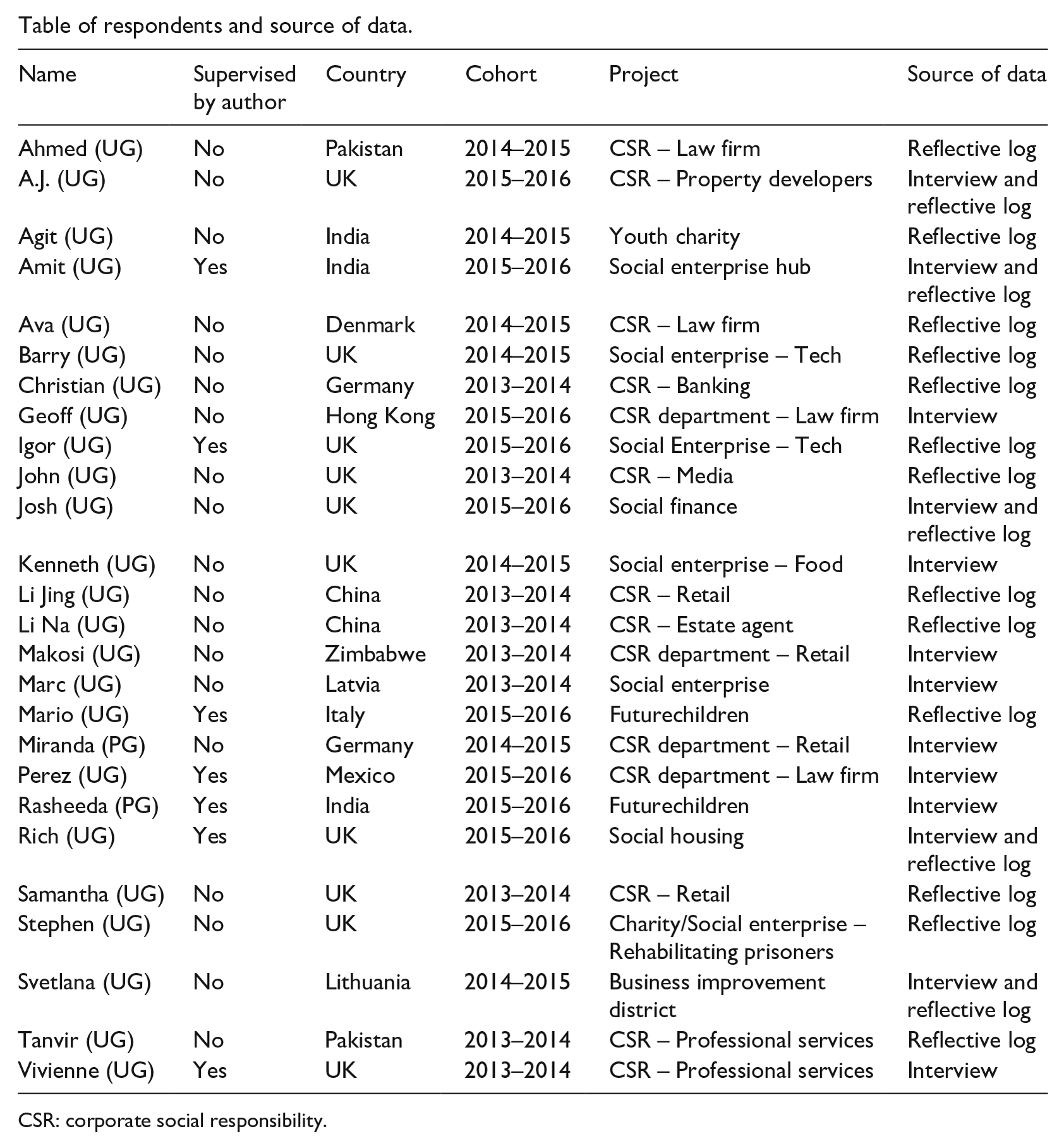
| Name | Supervised by author | Country | Cohort | Project | Source of data |
|---|---|---|---|---|---|
| Ahmed (UG) | No | Pakistan | 2014–2015 | CSR – Law firm | Reflective log |
| A.J. (UG) | No | UK | 2015–2016 | CSR – Property developers | Interview and reflective log |
| Agit (UG) | No | India | 2014–2015 | Youth charity | Reflective log |
| Amit (UG) | Yes | India | 2015–2016 | Social enterprise hub | Interview and reflective log |
| Ava (UG) | No | Denmark | 2014–2015 | CSR – Law firm | Reflective log |
| Barry (UG) | No | UK | 2014–2015 | Social enterprise – Tech | Reflective log |
| Christian (UG) | No | Germany | 2013–2014 | CSR – Banking | Reflective log |
| Geoff (UG) | No | Hong Kong | 2015–2016 | CSR department – Law firm | Interview |
| Igor (UG) | Yes | UK | 2015–2016 | Social Enterprise – Tech | Reflective log |
| John (UG) | No | UK | 2013–2014 | CSR – Media | Reflective log |
| Josh (UG) | No | UK | 2015–2016 | Social finance | Interview and reflective log |
| Kenneth (UG) | No | UK | 2014–2015 | Social enterprise – Food | Interview |
| Li Jing (UG) | No | China | 2013–2014 | CSR – Retail | Reflective log |
| Li Na (UG) | No | China | 2013–2014 | CSR – Estate agent | Reflective log |
| Makosi (UG) | No | Zimbabwe | 2013–2014 | CSR department – Retail | Interview |
| Marc (UG) | No | Latvia | 2013–2014 | Social enterprise | Interview |
| Mario (UG) | Yes | Italy | 2015–2016 | Futurechildren | Reflective log |
| Miranda (PG) | No | Germany | 2014–2015 | CSR department – Retail | Interview |
| Perez (UG) | Yes | Mexico | 2015–2016 | CSR department – Law firm | Interview |
| Rasheeda (PG) | Yes | India | 2015–2016 | Futurechildren | Interview |
| Rich (UG) | Yes | UK | 2015–2016 | Social housing | Interview and reflective log |
| Samantha (UG) | No | UK | 2013–2014 | CSR – Retail | Reflective log |
| Stephen (UG) | No | UK | 2015–2016 | Charity/Social enterprise – Rehabilitating prisoners | Reflective log |
| Svetlana (UG) | No | Lithuania | 2014–2015 | Business improvement district | Interview and reflective log |
| Tanvir (UG) | No | Pakistan | 2013–2014 | CSR – Professional services | Reflective log |
| Vivienne (UG) | Yes | UK | 2013–2014 | CSR – Professional services | Interview |
CSR: corporate social responsibility.
Appendix 2
Acknowledgements
We wish to thank Valerie Fournier, Cliff Oswick and members of the ‘Alternative ways of organizing’ track at the 10th International Critical Management Studies Conference for their valuable comments on earlier drafts of this article.
Funding
The author(s) received no financial support for the research, authorship and/or publication of this article.
