



Abstract
Our article contributes to critical perspectives on entrepreneurial learning by explicating how advice functions as an entrepreneurial product disseminated online. While academics are often critical of online advice, they nevertheless acknowledge that it is thriving. Therefore, we combine critical perspectives on entrepreneurial learning and public pedagogy to examine advice, often presented as rules, tips and reasons, on how to become a successful entrepreneur. We provide insight into how this online advice recursively reinforces who, what and how successful entrepreneurs should be. Subsequently, we demonstrate how online advice acts as public pedagogy reproducing gendered entrepreneurial ideals that shape broader understandings of the entrepreneur.
Introduction
Entrepreneurial learning is of perennial research interest, largely due to the economic, social and pedagogic potential of combining these terms (Cope, 2003; Lattacher and Wdowiak, 2020). Built on cognitive conceptions of entrepreneurial mindset (hereafter, EM), entrepreneurial learning is positioned as enabling individuals to realise their full potential (Kuratko et al., 2021). However, recent critical perspectives suggest that this learning is a process of confirming and legitimating understandings of entrepreneurship that are shaped by neoliberal ideologies (Ahl and Marlow, 2021; Williams et al., 2021). Learning to become an entrepreneur is to become a successful neoliberal subject; where the self is commodified and marketed as economically valuable (Bröckling, 2016).
Research highlights that online spaces contribute to the shaping of individuals as neoliberal subjects (Pritchard et al., 2019). Some scholars have suggested that such spaces can be conceptualised via understandings of public pedagogy, highlighting learning beyond formal institutions (Giroux, 2010, 2021, 2022). Moreover, it is recognised that online media play a significant role in the reproduction of entrepreneurial learning ideologies (Pritchard et al., 2022; Smith, 2021). However, further research is needed to explore online spaces as contemporary entrepreneurial learning contexts. Thus, our article brings together critical perspectives on entrepreneurial learning and public pedagogy in an analysis of online entrepreneurial advice. We explore the role this advice has in forming and reinforcing an idealised entrepreneur, conceptualising this as public pedagogy (Stead and Elliott, 2019). Our research contributes to these debates by unpacking how entrepreneurial learning can itself be viewed as an entrepreneurial product, here packaged as advice and disseminated online.
We further develop critical perspectives highlighting entrepreneurship as a highly gendered construct, which positions women as less entrepreneurial than men (Ahl and Marlow, 2021; Kubberød et al., 2021). This growing body of work considers the gendering of entrepreneurship both as experienced by individual entrepreneurs and shaped by neoliberal exaltations for women to fulfil their enterprising potential (Banet-Weiser, 2018). Since much research has focused on women’s positioning as entrepreneurs, we aim to extend this by considering how online entrepreneurial advice is both implicitly and explicitly gendered (Ekanem, 2015) in ways which naturalise and sediment differences between men and women entrepreneurs. In doing so, we contribute to understandings of entrepreneurship as a gendered project by explicating how entrepreneurial masculinities and femininities (Lewis et al., 2022) are framed and reproduced online (Martinez Dy et al., 2018; Nadin et al., 2020; Smith, 2021).
As indicated above, neoliberal framing is central to these debates whereby entrepreneurial advice aligns with an individual’s search for a deeper, truer, more capable self as a means of securing success (Bröckling, 2016). Through encouraging the search for our immanent selves, online advice emboldens us to affirm and develop characteristics that are seen as valuable and enriching (Winkler et al., 2023). Thus, an EM is central to entrepreneurial learning and plays an integral role in shaping advice and identifying ways of being that are causally associated with entrepreneurial (and wider) success (Lattacher and Wdowiak, 2020). Consequently, online representations of entrepreneurship often rest on the assumption that learning to be an entrepreneur is not simply about what you do; it is about who you are (Pritchard et al., 2019; Kuratko et al., 2021).
Across these online representations of entrepreneurship, advice is pervasive rendering this suitable as being conceptualised as public pedagogy (Giroux, 2010, 2021) The notion of public pedagogy was introduced to the educational research community through the work of Carmen Luke (1996) and other feminist researchers in the mid-1990s, and subsequently popularised through the work of Giroux in the late 1990s. It refers to various forms, processes and sites of education and learning that occur beyond the bounds of formal educational institutions – including popular culture (i.e. films, television, the Internet, magazines), informal educational institutions and public spaces (i.e. museums or monuments), dominant discourses (i.e. public policy, neoliberalism) and social activism (i.e. grassroots organisations) (Sandlin et al., 2011). Giroux describes pedagogy generally as ‘the essential scaffolding of social interaction and the foundation of the public sphere’ (2022: xv). Pedagogy, then, is an approach to teaching people the ways to read the communities and wider societies in which they exist. Within Giroux’s discussion, public pedagogy is not unproblematic as it creates a public that is plagued with socioeconomic and racialised divisions and inequalities. We seek to extend contemporary work examining online spaces as sites of public pedagogy (Schneider and Simonetto, 2017), particularly adding to existing considerations of celebrity success (Stead and Elliott, 2019) by focusing on accounts of everyday entrepreneurship. Through the application of critical public pedagogy (Giroux, 2021), we aim to demonstrate how online entrepreneurial advice works in shaping individuals as gendered neoliberal subjects. The research presented here forms part of a broader project exploring popular, everyday representations of entrepreneurship, within which we explored the use of commercial images of entrepreneurship online (Pritchard et al., 2022). It was in reviewing the online texts within which these images were used that we identified entrepreneurial advice as a particular topic of interest. Here, we present a thematic analysis of 46 online advice texts and respond to our overarching research question: How is entrepreneurial learning gendered through online spaces of public pedagogy?
Our article is structured as follows: we begin by examining the extant literature on entrepreneurial learning with specific attention towards EM, unpacking assumptions about its gendered nature. Next, we discuss public pedagogy and review understandings of learning in a range of spaces including online. After outlining our empirical project, we offer our analysis and conclude by summarising our conceptual and empirical contributions.
Entrepreneurial learning: how to become an entrepreneur
In considering how to become an entrepreneur, research attention has focused on individual characteristics required to build successful enterprises (Lattacher and Wdowiak, 2020). After moving on from personality determinism, learning and development has come under the spotlight in which building EM is seen as causally significant (Wang and Chugh, 2014). The significance of EM rests on the assumption that an individual must be able to ‘tap into’ this mindset: ‘the true source of innovation and entrepreneurship is an ability and perspective that resides within each one of us’ (Kuratko et al., 2021: 1681). EM has been broadly defined as a cognitive perspective but variously encompasses behavioural and emotional aspects. Recognising the ever expanding and loose definition of EM, the recent review by Daspit et al. (2023: 17) proposed an overarching definition: ‘as a cognitive perspective that enables an individual to create value by recognizing and acting on opportunities, making decisions with limited information, and remaining adaptable and resilient in conditions that are often uncertain and complex’. While this offers some clarity as to the behavioural and emotional aspects, EM remains an unspecified, overarching notion but one that has nevertheless gained significant traction across both academic and practitioner audiences. Indeed, pertinent to our study, Daspit et al. (2023: 12) note the ‘thriving’ advice industry generically works on the basis that ‘by investing in themselves entrepreneurs can develop the ‘mindset’ needed for success’, citing Forbes magazine as an example. Another recent review criticises the ‘popular press’ as being awash with ‘mischaracterisations’ of EM (Kuratko et al., 2021: 1689).
Given the expansive conceptualisation of EM (Wang and Chugh, 2014), it is perhaps unsurprising that entrepreneurial learning has emerged as a similarly loosely connected constellation of ideas. Twenty years ago, Cope (2003) highlighted the lack of learning theorisation in entrepreneurship research; a concern that continues to echo across contemporary reviews (Markowska and Wiklund, 2020; Wang and Chugh, 2014). A range of perspectives on entrepreneurial learning have been developed, but lack a cohesive, theoretical focus (Rae and Wang, 2015). Rather, entrepreneurial learning is typically framed directly in relation to EM, as a journey towards translating ideas and problems into opportunities and actions, with the necessary robustness to persevere (Rae, 2017).
In this vein, much previous research has sought to identify causal connections between entrepreneurial learning approaches and enterprise success, focusing on specific aspects of EM. For example, Bendell et al. (2019) explored how learning self-leadership might deliver entrepreneurial success for both men and women. Other research has focused on individual learning needs, and the relationship between learning and stage of the entrepreneurial journey (Rae, 2017). Still further research has examined the relationship between learning and experience; whether an individual’s own experience or learning from others (Wang and Chugh, 2014).
In this way, learning has also been implicitly thought of as a reflective and social experience, based on the sharing of advice embedded within a range of contexts including professional and family networks (Passaro et al., 2017; Rae, 2017). For example, Zozimo et al. (2017: 905) examined role modelling as a socially situated learning activity through which entrepreneurs are able to perform what they describe in rather broad terms as ‘learning tasks’. Relatedly, Jones and Giordano (2021: 273) examine the case of a family firm to unpack the ‘dynamics of learning processes’ and identify different phases and types of learning, highlighting the shared understandings within families, including those supporting but not directly participating in the entrepreneurial venture itself. Meanwhile, considering a contemporary context, Butcher (2018) highlights the co-emergence of entrepreneurial skill within coworking practice. Such work highlights a more serious engagement with understanding the socially situated nature of learning and advice, recognising that a sole focus on the individual entrepreneur limits understanding of learning processes (Rae, 2017).
Perhaps unsurprisingly, research also pays attention towards how to prepare young people for an entrepreneurial career. Such interest is not neutral, and the academy has been particularly interested in its own role, not least since higher education has embraced (idealised even) the notion of the entrepreneurial graduate, set a path for the university as an entrepreneurial venture and has introduced quasi-entrepreneurial measures into key ranking schemes (Clark, 1998). Tracking the impact of university education, research has suggested that factors ranging from students’ international experience (Breznitz and Zhang, 2020) to ‘unintentional exposure’ to entrepreneurial concepts (Stenholm et al., 2021: 505) provide for entrepreneurial learning outcomes. Relatedly, entrepreneurship education scholars propose the distinctive nature of both the entrepreneur and the entrepreneurial venture and emphasise the need to better understand entrepreneurial pedagogies (Hägg and Gabrielsson, 2020). This is largely based on assumptions that EM can be developed within formal educational environments (Kuratko, 2005) with Daspit et al. (2023: 36) noting that the learning approaches most referenced are ‘lectures, learning logs, projects, case studies, brainstorming, prototyping and testing, personal reflections, self-directed assignments, interviews, and ideation exercises’. Intriguingly, these do not seem to suggest that there is anything distinct about entrepreneurial learning pedagogy in formal education, despite beliefs about the need to develop EM or views that enterprise careers are somehow different from the norm (Hägg and Gabrielsson, 2020). Following this overview, in the sub-section below, we explore the connection between gender and entrepreneurial learning, while also offering an overview of relevant gender theory to contextualise our research endeavour.
Gender and entrepreneurial learning
In discussions of entrepreneurial learning, gender and/or sex occasionally feature as a particular concern and are often used as a binary variable or category to investigate impacts on learning; entrepreneurship; and/or, entrepreneurial learning (Ekanem, 2015). Reflecting the first of these, as reported by Garber et al. (2017: 13), ‘significant literature underscores the belief that females and males learn differently’. Here binary differences are reported as biologically innate, categorical variables, and related solely to the point in time at which the learning under investigation is being reviewed. Within much literature on learning, little attention is given to the possibility that gender is itself learned (Casile et al., 2021). For example, when considering learning and EM, Garber et al. (2017) suggest that learning through technologically mediated ‘serious business games’ (2017: 11) is more ‘accepting, feeling, and collaborative’ for women rather than ‘logical, analytical, and competitive’ for men (2017: 22); with the terms women/female and men/male all used interchangeably within this discussion.
That gender impacts entrepreneurship more broadly is the subject of significant research with an arguably more developed, critical discussion of gender than reviewed in relation to EM above. Rather than conflating sex and gender, such research explores processes of gendering in relation to individual experiences and cultural constructions of entrepreneurship, drawing particularly on feminist post-structural perspectives (Banet-Weiser, 2018; Berglund et al., 2018; Nadin et al., 2020). Put simply, this is a concern with the ways in which gender is experienced, shaped and controlled through the maintenance of norms (of appearance, behaviour and so on), which enable the disciplining (and a resulting inequality of outcomes on a whole range of social, political and economic measures) of those who do not fulfil expected feminine or masculine roles, typically associated with women and men, respectively (Lewis et al., 2022). Attention has focused on how women experience this disadvantage, though contemporary discussions further contest understandings and implications of binary perspectives on sex, gender and sexuality for work and workers (Lewis et al., 2022). While a full review is beyond the scope of this article, here we focus on the assumed impact on, and acceptance of, gendered entrepreneurial learning. In short, this highlights concern that the entrepreneur is ‘normalised as male’ (Galloway et al., 2015: 3), positioning of women as in deficit and disadvantaged (Pritchard et al., 2022). Learning has thus been positioned as critical for women to address such deficit and disadvantage (Ahl and Marlow, 2021). This often aligns with a postfeminist view particularly evident in popular media, that the feminist project is completed, and it is now down to individual women to take advantage of opportunities open to all (McRobbie, 2004).
Significant emphasis is given to activities aimed at increasing women’s entrepreneurial confidence (Marks, 2021), a notion that is central to EM. Indeed, Gill and Orgad (2018: 478) situate ‘building’ confidence as key to the wider emphasis on learning resilience that has ‘been especially evident in policy discourse’ and is representative of a neoliberal framing of individual responsibility for entrepreneurial success. Such neoliberal ideologies are further evident in postfeminist appeals for women to take control of their learning, and via this, of their lives: ‘every woman is to forge her own future’ (Berglund et al., 2018: 532). Therefore, while we might be tempted to dismiss EM as a purely academic basis for hypothesised entrepreneurial learning, it underpins institutional investment in entrepreneurial subjectivity. Here, learning becomes a necessary response for women, particularly within a postfeminist media framing of opportunity for all. From this perspective, EM and entrepreneurial learning are regarded as means via which individuals are shaped into ideal gendered subjects (Berglund, 2013).
Thus, critical scholars seek to examine the role of EM specifically and entrepreneurial learning more generally within neoliberal societies (Berglund et al., 2020). Indeed, examinations of formal sites of learning such as schools (Berglund, 2013) and universities (Berglund et al., 2021; Nabi et al., 2017) demonstrate how entrepreneurship education is centred around such a need to be a particular type of individual (Loi et al., 2022). Nevertheless, despite attempts by educational institutions to claim ownership of entrepreneurial learning, there is increasing recognition that such learning extends beyond formal environments and is widely available. Thus, we turn next to examine public pedagogy.
Public pedagogy and the gendered performance of entrepreneurship online
Research investigating public pedagogy is typically oriented towards spaces outside academic institutions and other locations of formal learning. There has been increasing attention towards mass media as pedagogy (Piazza and Abrahamson, 2020) with Stead and Elliott (2019: 172) describing online media as ‘compelling pedagogic resources’. This is significant for our research given the connection to the emergence of digital entrepreneurship (Sussan and Acs, 2017). Indeed, it is suggested that such online spaces can be regarded as a ‘stage for entrepreneurial activity’ (Martinez Dy et al., 2018: 589) where individuals develop, share and consume advice as they ‘become’ entrepreneurs and, in some cases, then sell and market advice as their entrepreneurial product. As Sussan and Acs (2017: 60) note, ‘the online community is a breeding ground for entrepreneurial actions, as users are motivated by the attention they receive from the community to develop new products for fellow users’. This recursive entrepreneurial loop is especially pertinent since the work of producing advice can then itself be understood as entrepreneurial. It is how these recursive loops become forms of gendered learning that is a particular concern of our investigation.
To date, researchers have considered how learning takes place via book clubs (Grenier et al., 2022), blogs (Dennis, 2015), Facebook (Freishtat and Sandlin, 2010), Twitter (Schneider and Simonetto, 2017) and is facilitated via popular management books (Kociatkiewicz and Kostera, 2016). All these authors reflect that these media do more than share advice, rather it is through these various media that the knowing subject is constructed (Ughetto et al., 2019). That these spaces are also gendered is unpacked by Marks (2021) who offers an autoethnographic account of being a female entrepreneurial role model (her term). She deconstructs her public narrative and draws attention to the silences relating to money, business problems and the advantages of personal networks (‘we called in a lot of favours’, 2021: 960). Considering gendering in particular, Marks (2021) examines her own reluctant postfeminist public account and highlights her discomfort as being lauded as a female role model. Here Marks (2021) echoes the analysis by Gill and Orgad (2018) noting how these accounts have been stripped bare of all but the essential postfeminist self-help message while being portrayed as ‘hypervisible’ (Banet-Wieser, 2018: 7). This connects to the way in which exemplar entrepreneurs are held to scrutiny as gender role models, a topic that has been explored in relation to celebrity women entrepreneurs in particular.
Indeed, examining gendered public pedagogy, more broadly Stead and Elliott (2019: 178) highlight that ‘women require distinct and targeted career advice’ and note the influence of aspirational celebrity role models including Sheryl Sandberg, who also endorses a particularly feminine style. Their analysis of power lists highlights that the dominant postfeminist narrative of individual responsibility for overcoming barriers reflects a neoliberal emphasis on self-improvement, echoing understandings of EM. This mutual reinforcement of post-feminism and neoliberalism across the public sphere acts to bolster a belief that working hard on oneself and one’s enterprise will be rewarded; that a place on the power list is possible if enough effort is exhausted. Celebrity status and having it all become achievable results of a meritocratic system in which gender is no object (Littler, 2017), whereby some women come to represent success for all (Pritchard et al., 2019). Studies of representations of women entrepreneurs have similarly noted that online media are implicated not just in relation to celebrity entrepreneurs but are also significant in influencing everyday entrepreneurs (Nadin et al., 2020; Smith, 2021). It is this everydayness that we were particularly interested in pursuing in our research. Consequentially, we attend to online entrepreneurial advice offered both by and to the everyday entrepreneur. We set out our empirical project in further detail in the next section.
Our empirical project
Our research offers a critical analysis of online entrepreneurial advice as gendered public pedagogy. This is part of a broader project exploring online representations of gendered entrepreneurship, which included a visual analysis of commercial entrepreneurial images that we have methodologically and analytically reported separately (Pritchard et al., 2022). In this sub-project, we followed 18 popular commercial images of men and women entrepreneurs, via a Google reverse image search to see where these images had been used online. This is an adaptation of a recognised visual analytic approach often referred to as top slicing (Aiello et al., 2023; Pritchard, 2020; Rogers, 2021). In this approach, popular images are selected from search engines and then the data set is extended via a reverse image search to source further material for analysis (Pritchard et al., 2022; Pelkey, 2020). Our reverse image search involved uploading each of our 18 jpeg files to the Google ‘search by image’ option. This was carried out using a computer that was not assigned to any of the authors at the time and clearing search history from the browser between each search. We recognise that our research is situated within a platform context, and as with our everyday use of the Internet, it is impossible to step outside search protocols or algorithms in use at the time (Pearce et al., 2020; Pritchard, 2020). Our approach was informed by significant discussions of online methods (Aiello and Parry, 2019), highlighting that research negotiation of online spaces should be reflexively reviewed, much as researchers consider their active roles and contextual influences in any ‘offline’ spaces (Banet-Weiser, 2018). Such debates also recognise that there is no possibility of being omnipresent or of collecting everything given the vast expanse that is ‘online’ (Pritchard, 2020).
Given we started with commercial images that were representing entrepreneurs, we were intrigued to find that the imagery appeared in online texts offering dating tips, party planning advice and means of curing headaches and perfecting grooming, alongside much generic business advice. All three authors reviewed these online texts to identify those specifically offering entrepreneurial advice and agreed on 46 that were explicit in their discussion of entrepreneurship and included clear recommendations or advice for readers. These online texts focused on providing advice to and from everyday entrepreneurs; they were not authored by celebrity or high-profile entrepreneurs, although these were sometimes invoked in the advice provided. All 46 were downloaded (a cut and paste exercise) in May 2021 and totalled 39,945 words. All were English language and publicly available, none required an account or personal information for access; institutional ethical approval was secured prior to the commencement of our research. As summarised in Table 1, of these 46, 29 online texts were obtained as a result of following images of women (totalling 25,516 words); of which 22 were explicitly gendered, offering advice to (or about) women. A further 17 texts (totalling 14,429 words) were obtained from following images of men; however, only 2 of these were explicitly gendered, offering advice to (or about) men. As part of our review of these data, we noted three types of online media via which these texts were located: Global news; Business and Entrepreneurship; and Business and Lifestyle (see Table 1). Global news included online texts from sources such as USA Today, Huffington Post and Forbes, while Business and Entrepreneurship included online texts from well-known media with an entrepreneurial focus such as Entrepreneur.com and BusinessCollective.com. Other texts came from online media with a specific focus on either men’s or women’s lifestyle, including career and business advice. We have included further details alongside text extracts in the presentation of our findings which follows.
Data set overview (n) = word count.
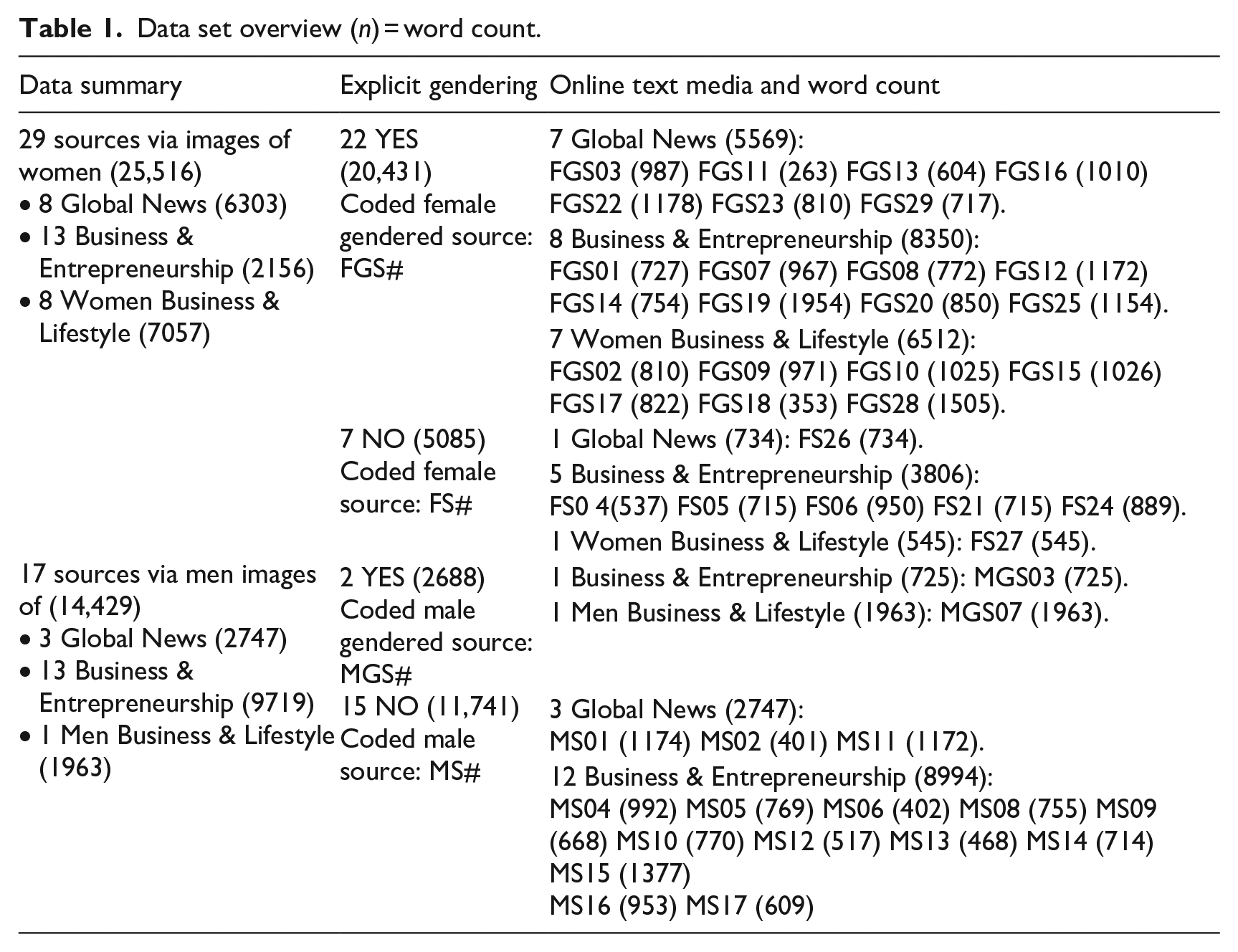
Our analysis of these data adopts an interpretative approach, through which we offer a thematic reading of entrepreneurial advice. This followed the tenets of reflexive thematic analysis (Braun and Clark, 2021) in recognising that themes are the result of active, shared meaning making by the researchers, with a commitment to reflective and thoughtful exploration of how aspects of these online texts converge or diverge in meaningful ways. An initial review of these data was undertaken by the first author who offered a thematic coding for review and a subsequent iterative process ensued in which all three authors worked through these data to develop and challenge the analytic account. As a result of this process, three overarching themes were identified: be the entrepreneur; face the challenge and grow; thrive and share the secrets. These were further developed as each author took the role of challenging themes and conclusions identified by the others. Initial presentation of our research findings at a conference allowed for peer feedback and prompted a further review and refinement of our ideas. As we present our data below, we work through each theme in turn with specific attention in our analysis given to the ways in which advice was gendered and reproduce idealised entrepreneurs. We then return to our research question (How is entrepreneurial learning gendered through online spaces of public pedagogy?) in our discussion.
Findings
In each of the three sections that follow, we unpack entrepreneurial advice, specifically focusing on how it is gendered. In ‘Be the entrepreneur’, we consider the ways in which EM and individual learning is positioned, while in ‘Face the challenge and grow’ we explicate gendered accounts of challenges encountered. Finally, in ‘Thrive and share the secrets’, we unpack advice on how to be successful and the importance of gendered role modelling. Through this analysis, we highlight how entrepreneurial learning is gendered; differences between men and women entrepreneurs are naturalised and sedimented through accessible sites of public pedagogy that function through shaping understandings of who or what a successful entrepreneur should be.
Be the entrepreneur
Here we unpick advice to be the entrepreneur, which was positioned as an individual process of learning, mastering self and self-development; a construction that closely aligns with academic views on EM. This was pervasive across our data and nearly all sources discussed the need to ‘be the entrepreneur’ in these generic terms. Sector, product, or the nature of the enterprise were rarely offered as relevant, rather what is outlined is a shared, common, yet also distinctive ‘entrenpreneurialness’. In this way, online advice is positioned as enabling the necessary self-discovery and self-development, usually based on personal experience (as authored or reported): There’s this common trait among entrepreneurs and athletes; we are risk takers with a vision we want to turn into reality. . .here are 5 tips to move your business forward by mastering your entrepreneurial mindset. (FS26)
Setting the goal as ‘mastering your entrepreneurial mindset’, this advice allies the entrepreneurial and athletic endeavour. This acts to separate the entrepreneur from a typical employee and allows assumptions about natural talent (enhanced by training) to be transferred from the domain of sport. This is grounded on the claim that entrepreneurship involves a risk-taking visionary, and directly links ‘mastering’ EM to progressing the business. EM is positioned as key to moving forward and learning to ‘master’ the self was widely reflected in advice across our data. Writing in an online magazine (labelling itself as the ‘definitive digital magazine for start-ups, small business news and entrepreneurial culture’), the author shares five tips to mastering EM; presented as the very broad advice to: ‘shift from fear to love, make gratitude your attitude, get concrete insight, ask for guidance and think win-win’ (FS26). As we go on to explore across our findings, ‘ask for guidance’ is a tip frequently extended and works to embed advice as an entrepreneurial product. Such advice offers a means to become a member of an aspirational group, reflects the wider genre of lifestyle advice, and is so generic that it is difficult to contradict but also to apply.
Across these texts, assessments of personal characteristics were similarly constructed as opportunities for learning – either via self-knowledge or directed development – here posted on a well-known and well-established site offering advice and mentoring to women: The first thing you need to do is consider your own personal characteristics and determine whether you have, or will be able to learn, the aspects of the mindset of the typical successful entrepreneur. (FGS02)
This advice situates learning as a process of self-discovery or development, as mindset is ‘the first thing’ needed to be an entrepreneur. Once more, there is no reference to any product or opportunity. However, when connected to the ‘typical successful entrepreneur’ mindset becomes both accessible (the aim is to be typical rather than exceptional) but also highlighted as a means to success. This illustrates how such generic statements about mastering EM are situated as both achievable and aspirational. The reader is drawn in by the potential ease of this process; and at the same time drawn to the suggestion that the article’s author is someone to learn from.
The self is central to the construction of an entrepreneur and a target for advice. Across our data, to be the entrepreneur is much more than starting a business; it functions as a call to a fulfilling journey of personal development: Investing in your personal growth can almost automatically translate to your business growth. Your personal mindset has changed, so it can now trickle down to other areas of your life. (MS09)
Featured on a digital news site, this again focuses on ‘mindset’, but here it comes with the potential to positively impact all areas of personal and work activity; offering the neoliberal possibility of having it all if only you ‘invest’ enough. Here the author extends their support to the reader, spelling out the significant benefits of ‘investing in your personal growth’.
Indeed, if such growth ‘almost automatically’ enables a successful life, entrepreneurship is hardly risky at all but is rather a form of freedom: As an entrepreneur, you should consider yourself one of the lucky ones you have set yourselves free from the corporate grind. (FS04)
Freedom from the ‘corporate grind’ is positioned as the positive outcome, entrepreneurship is its own reward, and through following the recommended path to self-development one can ‘set themselves free’.
However, we found that caution is advised – to both men and women – that this freedom is not achievable for all: Not all women, by any means, are cut out to be entrepreneurs . . . (FGS02) Not every man is cut out to become an entrepreneur . . . (MGS07)
Here being ‘cut out’ rests on the personal rather than any aspect of the entrepreneurial context; you might be unlucky and unable to achieve not only entrepreneurial success but wider success across all areas of life. In respect to men, this article continued: for rebels in life, entrepreneurship is the way to go . . .. Any guy learning how to be a real man needs to first learn to be his own master. (MGS07)
Posted on an American coaching website targeted at men entrepreneurs, this taps into the appeal of the masculine entrepreneurial maverick. Entrepreneurial learning here is translated as becoming a ‘real man’ and invokes the dark side of mastery; and the image of ‘the master’. This acts to frame any ‘guy’ not finding this an attractive or achievable proposition as ‘unreal’, or some sort of ‘fake man’. This was the only text we found which focused specifically on the character of men who make the ‘cut’; however, this contrasted with an extensive array of advice targeted at women.
So, while it seemed that men in general – and ‘real men’ in particular – are poised for entrepreneurial success, apparently women need more support to realise and develop their mindset. Here, echoing trends in lifestyle advice more widely, confidence is offered as critical: There are some pretty distinctive characteristics that separate successful women entrepreneurs from the rest of the pack. What is one of the most important? Confidence! (FGS17)
This advice comes from a site stating that it is ‘the top comprehensive website and social media channels for aspirational women who are proud of achievement and serious about success’. While hedged as ‘pretty distinctive’ and ‘one of the most important’ characteristics, confidence (with the almost obligatory exclamation mark) is the focal emphasis for success. Elsewhere, the risk of a lack of confidence is made explicit as a binary between success and failure: Women who struggle with low self-confidence, self-worth and self-esteem can easily project those traits onto their business. (FGS20)
This repositions entrepreneurial risk for women as a personal struggle comprising a triple threat of ‘low self’ hyphenated to confidence, worth and esteem. These detract from the necessary EM, and thus are projected onto the entrepreneurial venture; it too will inevitably struggle.
Across data, confidence is constructed as a gendered difference in relation to releasing and developing EM, including in texts targeted at men: While this may not be true for all men, male entrepreneurs can be more decisive and confident than women. Arrogance may not be an attractive trait, but in the world of business a certain amount of confidence in your abilities (or even over-confidence) can bring positive results. (MGS03)
Here, gender difference is normalised as ‘male entrepreneurs’ are distinguished from ‘all men’ but then compared to generic ‘women’. This offers a hierarchy from traditional masculinity through to femininity, rather than a simple gendered binary. This piece goes on to suggest that even over-confidence or arrogance, both implicitly masculine here, can be the key to success. Therefore, the prospect of success for women is placed even further from reach while normalising an acknowledged unattractive, and here exclusively masculine, characteristic.
While being over-confident is reserved for ‘male entrepreneurs’, our data included much advice for a more feminine and distinctive approach for women: The fact is that women are more relationship-oriented, which is a great thing when it comes to collaboration. (FGS08) Remember the folks that thought women made better homemakers than entrepreneurs? Well, it’s time to prove them right. Build an engaged organisation . . . and nurture the company. (FGS07)
These constructions offer the possibility that women do indeed naturally have what it takes to be the entrepreneur, but this is realised only when an entrepreneur is constructed differently and in a more feminine way. Unlike the earlier text, there is no direct comparison to the masculine, rather this advice draws on stereotypical femininities and feminine narratives emphasising relationships, care and nurture. This highlights a particular type of femininity, one that sets itself as diametrically opposed to the masculine arrogance we unpacked previously. However just as the arrogant, real-man, masculine account might be alienating for both men and women, so too may this hyper-feminine care narrative be problematic. In the first extract above, an assumption about women’s feminine abilities is extended and then aligned with potential entrepreneurial advantage, while the second offers a perhaps ironic challenge to traditional feminine roles, before affiliating this with engagement and nurturing of business growth. Implicit here is an alternative feminine EM that is critical to success for all women; a position which is itself exclusionary to many women and indeed men.
As seen here, much emphasis is placed on the individual learning journey, with noted differences in how this might be gendered. This journey, however, is just the starting point, as we explore in the next section, there will be obstacles along the way.
Face the challenge and grow
Across our data, we found that notions of entrepreneurial challenge are often presented as both inevitable and critical to entrepreneurial development. It seems that without a challenge to overcome, there cannot be a full realisation of being an entrepreneur. Yet challenge is not without risk, and rising to the challenge requires guidance from those who have already overcome, thus setting up a need for further support and advice. Therefore, we shift from advice extended for identifying and developing the characteristics necessary to be the entrepreneur (and related to EM) to unpacking how entrepreneurial challenge is constructed, and the accompanying advice to overcome and grow from it.
In some accounts, overcoming challenge is represented as being able to deal with things going wrong: . . . when we think of an entrepreneur we think of a person fully alive and with bag loads of energy. You need this extra energy to make another attempt when things go wrong or are delayed. (FS24)
Here, by simply being an entrepreneur, the individual is no longer ordinary, rather is uniquely positioned as having extra energy and being ‘fully alive’, exceptional attributes necessary to navigate unexpected challenge.
However, in other texts, this challenge is portrayed as part of the inherent attraction of entrepreneurship, rather than specifically associated with problematic circumstances. For example: While some jobs are exciting and some are challenging too, nothing compares with the limitless adventure and challenges that entrepreneurship poses. (MS15)
Offered on a website linked to an initiative to promote entrepreneurship (and titled: ‘Why you should become an entrepreneur’), entrepreneurship here becomes less like work, and more like an epic adventure. While the site and advice were not explicitly gendered, they can be read as implicitly so, as only images of men entrepreneurs and exemplars (Bill Gates and Steve Jobs) were featured.
Challenge also took the form of a thrilling ride, here denoting the learning journey as a ‘roller coaster’: . . . being an entrepreneur is like being a roller coaster enthusiast. You have to enjoy the thrill of there being ups and downs. (MS08)
This advice was accompanied by warning the man entrepreneur (although not explicitly gendered this piece consistently referred to the entrepreneur as ‘he’) to avoid being a ‘negative Nancy’; and the use of a roller coaster analogy suggests that once you have stepped up to ‘be’ the entrepreneur, you have to be prepared for the ride, whatever may come. Similarly, a piece on a popular global online news site, presented with a man’s image and reporting a man’s account of his own entrepreneurship journey, also compares his entrepreneurial pursuit to a rollercoaster: The emotional rollercoaster was brutal. In entrepreneurship, the highs are high and the lows are low. (MS01)
Challenge (and the entrepreneurial roller coaster) here is positioned as emotional, and through the implicit gendering suggest that the masculine adventurer faces the challenge of dealing with emotions, something that is assumed to be both feminine and potentially un-entrepreneurial. This then has the effect of reinforcing masculinity with entrepreneurship.
As seen above, we noted that entrepreneurial challenge was gendered across much of these data, though at times this positioning was subtly based on the use of pronouns to address the reader and the images used. We found this to also be the case in texts focused on advice to women entrepreneurs. However, significantly we suggest that the very notion of challenge is constructed differently for women: In entrepreneurial land, every start up faces obstacles. When you hit those roadblocks, and you will, you pick yourself up and keep moving forward. Persistence creates the space to breakthrough, even when times are tough, hard or complex. (FGS16)
Within texts aimed at or featuring women, there is no excitement of adventure or thrilling roller coasters; instead, challenge is positioned as hard work to overcome obstacles. Central to this extract (which appears on advice website associated with a management consultancy and from an article explicitly aimed at women entrepreneurs) is its emphasis on persistence. The analogy of roadblocks to be overcome via persistence, portrays addressing challenge as a slow chipping away for women, as opposed to an adrenaline-fuelled adventure for men. This acts to highlight difference between a masculine and feminine entrepreneurial journey.
Another advice piece for ‘female entrepreneurs’, published online in a US magazine well-known for its rich lists, emphasises the need to fight to conquer ‘mountains’: We, as female entrepreneurs, are stronger than we think . . . fight to keep your values, don’t compromise who you are and remain as confident as you can be. You will be amazed at the great mountains you can conquer if you do. (FGS03)
This offers a generic statement that women do have strength, can fight and conquer. However, these are offered as countering some inherent (feminine) doubt: women can be ‘stronger than we think’ and will be amazed at what they can achieve (reflecting previous ideas of needing to find and embrace one’s EM). While superficially we could equate mountain climbing with our previous discussion of a more masculine notion of ‘adventure’, through unpacking this excerpt, we see that it is the hard work and persistence that is highlighted in this piece for ‘female entrepreneurs’. In contrast, more masculine constructions focus on adventure, excitement and exploration.
Across advice texts on challenge, aimed at or featuring women entrepreneurs, there is often a link back to being confident. Confidence is either explicitly named, or as in the example below, implicit in learning to be positive: Ladies, we already face an uphill battle . . . don’t pack more unnecessary personal baggage on your rise to the top . . . tell yourself a positive story about what you have to offer the world. No more excuses. (FGS14)
Presented on a US-based site for business advice, this text invokes a shared understanding of disadvantage (an uphill battle) requiring ‘Ladies’ to learn to be more positive and confident. Anything else is presented as ‘baggage’ that might hold women back and so must be discarded to meet the challenges ahead.
Across these data, we note that the solution always rests within the woman herself learning confidence, power and courage to overcome challenges. Again, challenges are seen as inevitable given the masculine construction of entrepreneurship: Taking charge and being in control can be incredibly scary, especially if you’ve never run your own business before. One of the main qualities that you should have as a female entrepreneur is courage. (FGS15)
This emphasis on the difficulty of challenge featured strongly in texts explicitly targeted at women and, within our data set, we did not see this in articles either targeted at men, found in men’s media or featuring photos of men.
Moreover, we found that even in articles offering advice targeted at women entrepreneurs, an explicit negative comparison to men was often made directly: Women are more afraid of failure than men and they will also take it more personally when something goes wrong, dwell on a mistake instead of moving on . . . Men, because they are less afraid of failure and more excited about the possibility of success, are more likely to take risks and participate, which increases the possibility of success. (FGS12)
Posted on an emerging form of business community site supported by cryptocurrency, this advice included quotes by Sheryl Sandberg, imploring women to lean-in and, intriguingly, ends with a call to reject stereotypes. However, stereotypes seem to be strongly reinforced here: women are presented as afraid, compared to men’s excitement, risk-taking and participation. This three-part list naturalises men’s’ ‘entrepreneurialness’ while calling on women to join in; in short to be more like men.
In unpacking notions of challenge, we highlight how these constructions further reinforce the importance to realise aspects of EM, and thereby success, but suggest both challenges and ways to address these are increasingly gendered.
Thrive and share the secrets
In this section, we unpack specific advice on how to thrive given the potential stress of an entrepreneurial career and the importance of sharing the secrets of success. Such advice drew on personal experience, either of the authors themselves or reported by others, and here we found much citing of the habits of celebrity entrepreneurs. Unsurprisingly, given the neoliberal framing of self-care, there was further advice on physical and mental health: Entrepreneurs struggling with self-doubt could try to exercise more and practice meditation. (FS21)
Many texts cited wellbeing narratives and in line with the generic discussion of entrepreneurial activity, the advice was similarly generic and thereby also difficult to contest. Advice further aligns solutions as personal, if EM is to be realised the self must act. Generic suggestions invoked broad calls to exercise, as in the example above, but also general advice on living well and self-care such as: . . . spending time with an old friend or investing in an education course, a fitness class or in beautifying your home. (FS04)
Here, investing in self-development is extended to fitness and maintaining a home environment. This responsibility beyond self was oft repeated and related to creating an appropriate space to: . . . rest up, recharge and enjoy themselves . . . even small things like keeping your work or living space clean and tidy can give you a boost. (FS05)
While you are allowed to rest, this rest must be productive via virtuous activity such as cleaning. We note that all three of these preceding extracts were accompanied by images of women. In contrast, across these texts, we found that physically being in shape could be implicitly gendered using examples of men performing stereotypically masculine activities (here ‘pumping iron’): Richard Branson is a fitness fanatic, Barack Obama exercises for 45-minutes a day and Mark Zuckerberg slots in three high-intensity sessions a week . . . getting the heart pumping boosts creativity, brain function and can hold off mental deterioration. If these guys can run businesses (and countries) and still pump iron, there’s no excuse. (MS10)
This offers facts about three ‘guys’; highlighting that there is (again) ‘no excuse’ for not working on your physical self. In this way, EM becomes embodied, here it is clearly situated in a strong and masculine body which itself can be read as creative and mentally fit. In contrast, rather than pumping iron a more celestial activity was proposed when femininity was the focus of advice: Schedule goddess evenings . . . it’s likely you need a night off to reconnect to your womanhood . . . take a long hot bath with that lavender vanilla body wash you only use on special occasions. Light some candles, give yourself a coconut oil massage, put on some slow jams, and dance around your living room. (FGS01)
It is difficult to imagine a more feminine alternative to ‘pumping iron’ than this ‘goddess evening’. Both constructions reinforce stereotypical notions of femininity and masculinity and situate appropriate means of relaxation in relation to entrepreneurial activity. Through texts such as this, we see that entrepreneurial advice is not simply a positioning of women versus men, but of a heteronormative masculine man versus a heteronormative feminine woman. In doing so, many alternative forms of both masculinity and femininity become excluded.
Being the best entrepreneurial self does not simply rest on the success of the venture, but also on being a role model and supporting other entrepreneurs (in the same way that many of these authors were doing through providing advice). However, we found this role modelling appeared infrequently in those texts with no explicit gender focus; with the following as one of the few examples: When you’re succeeding at your venture, you’ll have the time and energy to spare, for those who want to follow your footsteps and idolize you. Well this in itself is very gratifying and the satisfaction one can have by helping the newbies set up their venture is unparalleled. (MS15)
This constructs a utopia of entrepreneurial success in which it is possible to have achieved freedom and thus be the subject of adoration. Implicit here is the value of advice as the entrepreneurial product, perhaps because there is nothing left to prove other than the recipe for success itself.
Beyond such generic construction, the importance of role modelling for women entrepreneurs was extensively discussed across our data, as both necessary and as a natural outcome of success: Empower other women and instil confidence in those who need encouragement. (FGS03)
This presents a very specific call to action, with ‘other women’ rendered somewhat passive in their receipt of such empowerment. Less passive constructions offered role modelling as less directive undertaking: You will become a motivation and inspiration to the next generation of female entrepreneurs. (FGS08) Work hard. Do your best. Succeed. And show the next generation of girls that gender shouldn’t come into the equation for business success whatsoever. (FGS23)
These examples draw on a common narrative present in discussions of women’s achievements; that mothers seek to make the paths to success more accessible for their daughters. The reference to girls in the second extract also reflects this notation of intergenerational advancement regarding gender equality. This reinforces the previous discussion of obstacles and barriers, since these will not only have been overcome for the individual ‘female entrepreneur’ but, via this subsequent role modelling, for all those that follow.
Alternatively, there was a construction of a more specific opportunity for successful women to create businesses in which other women could succeed: Entrepreneurship also allows women to play a much larger role in creating an ambient environment for other women to realise their professional dreams. They can build a workplace that allows flexibility, work from home opportunities, women-specific health benefits and medical benefits. (FGS7)
Here role modelling is itself gendered in a particular way, where the creation of women-friendly enterprises is a further requirement for women entrepreneurs. This reinforced the earlier presentation of a specific gendered mindset that enables such outcomes. Thus, we see that while gender ‘shouldn’t come into it’ for future generations, this outcome is hedged since we see a specific construction of gendered workplaces orientated towards feminine success.
Discussion and conclusion
Our research provided a thematic analysis of 46 online texts across global news, business and entrepreneurship, and gendered lifestyle media to examine contemporary constructions of entrepreneurial advice and the gendering of entrepreneurial learning. We unpacked three closely related themes – be the entrepreneur, face the challenge and grow, thrive and share the secrets – and now explicate how this analysis contributes to our understandings of entrepreneurial learning. We address this in three parts; first, we consider the generic nature of advice and the ways in which this is situated in wider circuits of knowledge production; second, in relation to the production of a gendered knowing subject; and finally, by setting out the implications of advice becoming the entrepreneurial product. In each of these parts, we detail our contribution and highlight the implications for the field of entrepreneurial learning from our research.
The generic nature of advice
Our analysis highlights that online advice is generic and non-specific, constructed around broad developmental narratives using a journey metaphor. We noted how this reflects academic conceptions of EM within the field of entrepreneurial learning (Lattacher and Wdowiak, 2020), echoing understandings of this as a cognitive perspective, which calls on the individual to examine and develop themselves (Daspit et al., 2023). Whereas some scholars have criticised the way EM is represented in online texts such as those in our data set (Kuratko, 2005), we find many similarities with the generic representation of EM in scholarly texts. Indeed, we suggest this recursivity is significant and bound within a broader neoliberal commodification of the self (Bröckling, 2016) and therefore should be afforded more critical scrutiny across the field of entrepreneurial learning, reflecting the development of critical scholarship in entrepreneurship more broadly (Berglund et al., 2020).
Across our data, we found virtually no tailoring or specificity of advice to sectors, product or opportunity types. Thus, aspects that might be hypothesised by academics as critical to entrepreneurial success (such as the shape of the market or product offering) and are considered essential in entrepreneurship education, receive very little attention online (Frederiksen and Berglund, 2020). Rather in these data, context specificities fade into the background, while individual characteristics and personal commitment (to development, to overcoming obstacles or being a role model) come to the fore (Berglund, 2013). We have observed that such advice to and by everyday entrepreneurs often mirrors celebrity or influencer success stories, which focus on individual attributes and characteristics as exemplars (Gill and Orgad, 2018; Marks, 2021).
Moreover, in this space of public pedagogy, we note that the style of advice must also meet cultural expectations of online environments: it must be relatable, easily digested and accessible (Pritchard et al., 2022). We, therefore, suggest that our analysis offers insight into the homogenisation of advice within public pedagogy. That is to say – regardless of the focus of the advice – the neoliberal framing works together with cultural expectations of online environments to direct both style and content of advice presentation. As advice proliferates, and the realms of advice offered online increase exponentially, this direction becomes continually reinforced and is difficult to escape. Thus, we contribute to understandings of forms of public pedagogy through our explication of the characteristics and forms of online advice, recognising that this remains an underexplored context (Stead and Elliott, 2019). However, we further contribute by connecting online advice to other spheres of learning, as we explore below.
We explicate how online entrepreneurial advice emphasises accessibility, thus reflecting the proliferation of entrepreneurialism across policy and education, reminding us that anyone can learn how to become a successful entrepreneur if the correct paths are followed (Nadin et al., 2020). Indeed, we found validation of policy and education themes in these media particularly related to the need for targeted entrepreneurial support for women who struggle with confidence (Gill and Orgad, 2018). Accounts of overcoming struggle, evidence of building confidence and online texts, which seem to share the secrets of success therefore act to reinforce and privilege this story (Marks, 2021). Therefore, there is a significant and important recursive loop connecting these spheres of learning. Indeed, we believe that due, in part, to the proliferation of advice of the sort analysed here, policy and education will likely continue to focus on those aspects that are presented online by entrepreneurs as influential for their success. Consequently, the characteristics of online advice are not only important in relation to their intended audience: the nascent entrepreneur, but impact understandings of entrepreneurial success for all, including that considered by academics in the field of entrepreneurial learning. For example, a reputable entrepreneurship journal recently shared an academic article on social media as a series of five ‘gender tips’, (over) simplifying general advice and targeting this directly to men or women. We also see this within our own academic institutions with student-facing activities promoting personal brand development and offering advice on feminine aesthetics (Frederiksen and Berglund, 2020). Thus, we propose that forms of online advice are being replicated in other spheres of, and spaces for, learning including the academy.
As a result, we suggest that there is a risk that academic knowledge generation will further diverge: that which is deemed practical, highlights EM and focuses on personal development will be valued, while more critical endeavours that cannot readily be reproduced as rules, tips or reasons will be side-lined (Ahl and Marlow, 2021; Nabi et al., 2017). Critical studies in entrepreneurship have long faced a challenge of relevance; this looks set to continue when relevance is constructed and mutually reinforcing across these domains of knowledge (Piazza and Abrahamson, 2020). As noted above, we see a significant risk that entrepreneurial learning scholarship will also become further constrained through this process. Consequently, additional research that engages with online advice is needed so that the workings of this proposed recursive loop between public and educational settings can be further evidenced and addressed. This also offers an opportunity to develop understandings of contemporary public pedagogy in emerging digital arenas of learning.
Advice as constructing the gendered knowing subject
Our second contribution aims to extend literatures that highlight how the online texts examined do more than simply share advice, rather they are also the means through which knowing subjects are constructed (Schneider and Simonetto, 2017; Ughetto et al., 2019). In doing so, and in relation to understandings of public pedagogy, we offer empirical detail of the ways in which advice is positioned to become a successful entrepreneur. Despite the generic nature of this advice, there was one compelling foci: gender. Across all three themes, gendering, particularly towards the feminine, offers what at times seems like the only specificity in the broad sea of entrepreneurial advice. This provides authors (often writing as or reported by experienced entrepreneurs) with the means to speak to a wide audience and focus on a subject they cannot easily be challenged on: their own gendered experiences. As Stead and Elliott (2019) highlighted, theorisations of management learning and advice have neglected online media, perhaps dismissing these as inconsequential in relation to more traditional understandings of the ways knowledge is socially constructed. Yet, particularly in relation to gender and women’s subjectivities, the role of online media has been highlighted as critical to contemporary understandings of what is to ‘be’ valued in relation to a particular construct, here entrepreneurship (Martinez Dy et al., 2018; Sussan and Acs, 2017).
We highlight this gendering might sometimes be overlooked given the subtle ways online texts orient to a particular reading, pronoun use and author voice. A further subtlety is found in the framing of advice – as evident within the self, built through challenge and fostered through self and other care. As highlighted above, such style and content are constantly being reinforced across digital media. Here, this shapes a gendered common sense that echoes contemporary postfeminism (Mäkinen, 2022; Orlandi, 2017). Yet we note at other times, to us the gendering seems almost extreme, with talk of goddess evenings and pumping iron, for example. Reflecting Banet-Weiser’s (2018: 7) observations of ‘hypervisibility’, we suggest this is an example of hyper-gendering. This builds on a foundation of persistent, yet sometimes subtle, gendering of entrepreneurial advice that is underpinned by narratives of self-care (Pritchard et al., 2019). While we might regard these analytically as extreme in relation to entrepreneurship, they may seem unremarkable online and act to bolster the gendering effects. This highlights a potential concern that has been raised in relation to online media, in which despite their democratising potential, we see an entrenchment of hyper-gendered stereotypes (Banet-Weiser, 2018).
Analytically, we trace threads of both masculine and feminine difference across our themes, threads which weave together to reveal how understandings of gendered entrepreneurship are reinforced through these sites of public pedagogy. Here, we particularly highlight the importance of attending to gendering and, building on Lewis et al. (2022), note that this has often been assumed to require analytic consideration of women as a single homogeneous group. Extending beyond this, our analysis of advice finds a gendered hierarchy from hyper-masculinity (of real men and arrogance) through to hyper-femininity (of the nurturing goddess), notions that are then unproblematically attached to men and women. This is significant not only because the characterisations of masculine and feminine are used to differentiate men and women entrepreneurs, but because they do so in ways which reinforce heteronormative gender binaries, and obscure other experiences of difference. Thus, we suggest that the gendering of online advice not only acts to sediment understandings of men and women entrepreneurs’ experiences and needs as different, but also to validate these as the only acceptable forms of difference. Along with many scholars (Ahl and Marlow, 2021; Lewis et al., 2022; Pritchard et al., 2022), we recognise a need for further research that reflects contemporary awareness of gender beyond the binary; this is sorely needed across entrepreneurial learning and is a key area for further research in entrepreneurship.
Entrepreneurial advice as the entrepreneurial product
Finally, throughout our analysis, we highlight how advice can become an entrepreneurial product, acting as a signal of entrepreneurial success in complex ways that might be independent of the entrepreneurial venture or potentially be the entrepreneurial product in its entirety. Within this entrepreneurial success is about learning to be a particular type of person and providing advice offers a means for demonstrating this achievement in ways that might be absent from our traditional understandings of everyday entrepreneurial activity (Berglund et al., 2020; Loi et al., 2022). This makes perfect sense when related to digital entrepreneurship and the knowledge economy, as the provision of advice could itself be an entrepreneurial endeavour (Sussan and Acs, 2017). However, we found that success is not evidenced by innovative products, new services or financial results (even though these could also be linked to the commodification of advice itself), but in the personal learning and development journey that is shared. Yet, this does not constrain the impact of this advice or how it recursively reinforces entrepreneurial knowledge across our three themes.
Much has been made of the emphasis on personal responsibility for development and progress in neoliberal times (Bröckling, 2016). We highlighted how the construction of the thriving entrepreneur imparting advice becomes central to what it means to be a successful entrepreneur, a factor that is not yet sufficiently considered in discussions of entrepreneurial learning (Frederiksen and Berglund, 2020). Sometimes this is offered explicitly, particularly in our final theme: thrive and share the secrets. Here we noted that advice might be monetised, for example, marketing coaching activities or benefits of association memberships. However, it is also potentially monetised online in ways that are not obvious (for example, if articles or adverts are paid). For instance, often we found it is implicitly woven as part of a story to be discovered and followed to see that a learning product is part of their entrepreneurial offering (Bröckling, 2016). Further research is needed to unpack these accounts, as helpfully illustrated by Marks’ (2021) autoethnographic offering, so that the experiences of (sometimes hyper-visible) role models can be fully explicated. Integrating this understanding in discussions of entrepreneurial learning would usefully extend discussion of the use, effect and implications of these forms of entrepreneurial advice and role modelling (Zozimo et al., 2017).
Across many discussions, entrepreneurs are valued for their supposed distinctiveness, yet we found this hidden from view in broad appeals to be the entrepreneur, grow through adversity and become thriving role models. The construction of entrepreneurial advice online is an important part of the framing of contemporary entrepreneurship; the third pillar of a knowledge triumvirate that is supported by policy and education (Ahl and Marlow, 2021; Berglund et al., 2020). To date, academic research, including in the field of entrepreneurial learning, considered these independently as a realm of public pedagogy. However, in highlighting their interconnectedness, we suggest more work is needed to investigate the role of public pedagogy in relation to the gendering of the ideal entrepreneurial subject. Moreover, adopting an intersectional perspective to interrogate other dimensions of difference would be a useful extension of this research. Our final tip is then to develop research that does not only lament the failings of online advice but progresses further understanding of this pervasive form of public pedagogy.
