




Abstract
Using the case of the COVID-19 lockdown as a disruptive event, this article aims to show the paradox of improvisation by investigating students’ experiences of transitioning from in-person to digital learning spaces across three select business schools in Pakistan. Using Foucault, we analyse the discursive strategies deployed by students as they oscillate between different subject positions under improvised digital conditions. Our analysis reveals contradictory views about the agency of the improvised subjects which is often considered as enterprising in the sense that individuals are willing agents of change. Findings suggest that improvisation can also be paradoxically experienced as it misaligns with predispositions of agents. We show this through the struggles of students in getting to grips with the digital move, giving rise to uncertainty. This study, therefore, makes three distinct, yet interrelated, contributions to the literature on management learning by identifying: the risks of taming embodied subjectivities, the changing positionality of learners and the paradox of improvisation. Our work has implications for understanding improvisation in business schools during disruptive events, as overlooking the predispositions of students can lead to an enterprising agency of a different kind (e.g. resistance) that forfeits the purpose of improvisation.
Introduction
Improvising and introducing new modes of organizing – such as shifting from in-person to digital spaces, from direct face-to-face learning to technology-mediated platforms and from pre-defined routines to flexible practices – during the COVID-19 pandemic have raised several paradoxes for the future of management education (Brammer and Clark, 2020; Gonsalves, 2020; Simpson et al., 2023). Undoubtedly, global higher education responded to COVID-19 restrictions as universities rapidly embraced digital modes of learning. Quick decisions were taken in the public interest and digitalized learning emerged as a global imperative – an improvisation drawing on digital platforms to continue the provision of education to the masses. It, however, exposed systemic risks, vulnerabilities and contextual challenges in responding to extraordinary events (e.g. Beech and Anseel, 2020; Brammer and Clark, 2020) which seem to provide a temporary sense of empowerment (and control) under the guise of technology (see Budhwar and Cumming, 2020). We, therefore, respond to calls for closely examining the implicit assumption of democratization underpinning digital technology and its paradoxical relationship with the notion of learner empowerment – or ‘new modes of organizing and their implications for the autonomy of the actors [and institutions] involved’ (Branicki et al., 2022; De Vaujany et al., 2021: 676; Hafermalz, 2021). We use the case of COVID-19 in Pakistan as a disruptive event and the move to online learning as an improvisation in line with global trends, calling it the digital improvisation. It is pertinent to point out at the outset that we do not make any claims of generalizability, rather we focus on a case of digital improvisation in three select Pakistani business schools, to explore the challenges experienced by students during the COVID-19 lockdown period.
Drawing on Foucauldian-inspired literature, this article views improvisation as a paradoxical form of change which unfolds within tensions between discourses of power and learner subjectivities (e.g. Kerfoot and Knights, 1993). Existing literature suggests that improvisation is deeply influenced by capitalism, particularly in its appeal for exploiting new markets or reducing operating costs for the enterprise (Bell et al., 2014: 1024); thus, subjecting individuals to assumptions of having the power to change to achieve wider economic interests (Gershon and LaDousa, 2019). These discourses are often ‘powerful’ in producing subjectivities, such that individuals come to ‘embody and enact’ desired ‘modes of thought and behaviour’ which are considered as enterprising (Halford and Leonard, 2006: 657). We argue that discourses pushing improvisation, however, vary based on the context or the environment in which actors are situated, and are likely to create tension if learners’ predisposed methods of learning are challenged.
By discursively analysing the lived experiences of 22 undergraduate students across three select Pakistani business schools, while transitioning from in-person to digital learning spaces, we problematize the notion of improvisation in management learning and education. We contribute to research at the intersection of improvisation and business school education literature by empirically studying the paradoxical effects of negotiating with the implied shift in power relations and the competing discourses in which business school students are located, as well as the new forms of learning they are exposed to. Our study advances theory to raise awareness about improvisation as a political process shaping learner subjectivities, within the settings of the three Pakistani business schools and contexts alike. A key aspect of this contribution is showing how subjects resist improvisation as they experience a false sense of autonomy in the digital space which misaligns with predisposed ways of learning. We argue that improvisation, thus, activates embodied subjectivities, and if the paradox and conflicts within learners are not addressed it hinders the learning process.
To unpack these ideas, we begin by taking a historical and discursive look at Pakistani business schools and their pedagogical legacy along with the digital disruption caused by COVID-19. The next section uses Foucauldian ideas to present our theoretical framework where we problematize improvisation as paradoxical, particularly in creating misalignment with the predispositions of learners. On one hand, it enforces change, with the assumption that individuals will accept new modes of learning, but on the other, it denies that change with the false sense of autonomy. Afterwards, we set out our research strategy which involves an iterative, abductive, approach to make sense of the effects of improvisation on learners. Findings of our study are presented next which address the notion of improvisational agency of learners, showing the discursive strategies deployed in negotiating the shift in power dynamics, followed by a discussion which draws attention towards modes of resistance posed during the digital improvisation.
The digital improvisation and the Pakistani business schools
Contextual situatedness of Pakistani business schools
Following independence in 1947 from British rule, the first business school in Pakistan was established in 1955, in collaboration with US universities. While the role of US universities and philanthropies is critically noted in the works of Cooke and Kumar (2020), for example, USAID, Ford Foundation and Wharton, the American influence is visible in most business schools, particularly in their syllabi which draw on Anglo-American discourses of enterprise and capitalism. The Western influence over Pakistani business schools, and others in the global South, under the guise of international development, can be viewed as a consolidated effort with the aim to develop ‘internationalization both as a pattern of a professionalized business elite and of education institutions, in activating cooperation [. . .] and as a tool to implement interactive strategies’ between the West and the East (Gemelli, 1997). For contextual reasons, it is pertinent to note that among 30 business schools in Pakistan, only 8 business schools are fully accredited, and the rest are provisionally accredited by the National Business Education Accreditation Council (NBEAC, 2021) of Pakistan. The most well-respected (so-called ‘elite’) business schools in Pakistan are run like North American Business Schools (Khilji, 2003), with public sector universities also following similar models of management learning and education. Demographically, private business schools draw most students from Pakistan’s affluent class because of their fee structures (Zulfiqar and Prasad, 2021), whereas the public sector universities’ business schools attract students from diverse social classes and regions (Mughal et al., 2018). Elite-ness of some (private) business schools in Pakistan not only equates with wealth but also points towards the imperialist foundations upon which those institutions have been established. This also does not mean that elite business schools entirely relinquish their historical, social and cultural past in favour of modernity (see Cooke and Kumar, 2020), their situatedness rather shapes how Western pedagogies are discursively applied in the Pakistani context (Mughal, 2021b). For this study, we selected Pakistani business schools that are classed as elite with access to resources (e.g. foreign-qualified faculty and infrastructure, including learning management systems (LMSs)) and located at the intersection of global–local discourses of business and management. Many business schools in Pakistan are influenced by their presence as they try to mimic their practices and symbolize their role in transforming management learning and education in the country (Qureshi et al., 2021; Ul-Haq, 2021).
Despite the presence of these elite business schools and their impact on management education in Pakistan, Mughal (2021a) argues that students remain reluctant to adapt Western notions of the autonomous learner as they prefer teacher-directed methods. While the expectation of an instructive teacher is also linked with a high-power distance culture (cf. Li et al., 2021), the idea of a hierarchical classroom is deeply rooted in students’ minds in countries across the global South (e.g. Andersson and Hatakka, 2010; Kothiyal et al., 2018). We note that traditional punitive forms of teaching are not exclusive to Pakistan and are commonly used in other countries (see Postholm, 2013). Moreover, it is only in recent years that a student-centred approach has been used by some of the leading business schools in the country mainly due to the imposition of globalization of management learning and education (see Mughal, 2021a, 2021b; Pio and Syed, 2020; Zulfiqar and Prasad, 2021). Kashif et al. (2013) found that when self-directed modes (in a traditional classroom) were used in a Pakistani context, students viewed it as frustrating and showed an unconscious need for power hierarchies, quite like students in other Asian countries. The flip side of high-power distance is a tendency towards low assertiveness (Nadeem and Sully De Luque, 2020). This is demonstrated by Mughal et al. (2018) where students exhibited greater acceptance of formal authority during self-managed group learning. Similar to other countries in the Asian region, the Pakistani culture embraces obedience by the young, coupled with an ‘educational system [which] requires surrendering to authority [whereas] personal initiative, originality and independence in decision making are met with disapproval’ (Khilji, 2003: 116). These subservient predispositions could be challenged because of the digital move and its implied democratic ideology, especially as the move from in-person to digital learning would require changes in learners’ predispositions and their subject position.
In addition, pre-COVID-19, higher education in Pakistan was delivered face-to-face in physical classrooms with online education being limited to only the Virtual University (www.vu.edu.pk). The limited research on digital learning emerging from Pakistan suggests a low uptake of e-learning as it is affected by low student motivation, shortage of qualified faculty, lack of technological infrastructure and digital poverty (Farid et al., 2015). Kanwal and Rehman (2017) note that student experience of studying virtually is shaped by factors affecting computer self-efficacy, Internet experience, enjoyment and system characteristics which are significant predictors of perceived ease of use, while Khan and Nawaz (2013) attribute the low uptake of technology-driven learning to learner preference, institutional characteristics, social environment and Information and Communication Technology (ICT) policies of Pakistan. Therefore, the move to online learning, or the digital improvisation, was likely a challenging aspect for Pakistani students because of their unfamiliarity with digitized learning and their preferences for learning.
COVID-19 and digital learning as a disruptive event
Following the declaration of the pandemic, a 14-point policy on COVID-19 was issued by the Higher Education Commission of Pakistan promoting digital modes of learning and education in Higher Education Institutions (HEIs) across the country. The aim was to direct universities to establish LMSs to catalogue teaching materials and use digital platforms for remote learning, such as Skype, MS Teams, WhatsApp and so on. Globally, García-Morales et al. (2021) show that several institutions improvised and embraced digital learning without considering the ramifications of disruptive technologies. We argue that improvisation challenges individuals’ predisposed learning preferences as their worldviews can be violated in attempts to embrace/enact the ‘new normal’. This creates a paradoxical situation for those involved in accepting new modes of learning which misalign with their routine practices (cf. De Vaujany et al., 2021). Although the literature on paradox theory argues that individuals should accept and move through paradoxes (Miron-Spektor et al., 2011), our study focuses on how paradoxical situations are subjectively negotiated – especially those which challenge subejct positions (Putnam et al., 2016). The globally driven and state-mandated move to digital learning in response to COVID-19 combined with the localized preferences of learners was likely to create conditions for a problematic situation to arise. As shown in our findings, this became challenging when learner predispositions (embodied subjectivities prior to COVID-19) interacted with new modes of learning demanded flexibility and adaptation (Hatch, 1997). We, therefore, delve deeper to explore the impact of this digital move in Pakistani business schools to show how learners positioned locally oscillate between different subject positions in relation to the act of improvisation.
Problematizing improvisation: a Foucauldian perspective
Literature views improvisation as an intentional way of organizing, whose purpose is to make sense of complexity in a crisis-like situation (Hatch, 1997; Weick, 1998). It can also be thought of as an antithesis to the idea of stability and routinization of practices as improvisation is born out of disruptive events (Zucker, 1987). Those who experience improvisation are also likely to compare improvised practices with previous cultural, social and institutional logics to understand change (Vera and Crossan, 2005). Some scholars argue that improvisation has the power to displace not only established practices, and the logics underpinning those practices, but also modify structure, relationships and control systems in a given situation (Hatch, 1997; Kingma, 2019). For example, the ability to reconfigure the system by initiating atrophy of established practices in response to field-level changes provides improvisation with the impetus to redress the existing order in place, thereby challenging embodied frames of reference, routinized habits and subjectivities about the self in the new situation (cf. Munir, 2005; see also Tushman and Romanelli, 1983). We contend that improvisation can also be viewed as an institutional ad hoc mechanism to restore power and force alignment of subjectivities with the new order of practice (e.g. Jackson and Carter, 1998: 60). This directs focus on the individual(s) and power dynamics in play, as the success of improvisation depends on the acceptance of the improvisation by them. We posit that improvisation exerts power on individuals to conform with the new order, and in so doing, raises several questions regarding subjectivity, power and dissension.
From a Foucauldian perspective, the subject is predisposed to ‘power which subjugates and makes subject to’ position itself in relation to different modes of ‘subjection’ (Foucault, 1982: 212–213). Situated at the intersection of power–knowledge regimes, the subject forms, and reforms, itself through modes of dependency and conscience – a never-ending cycle of self-construction (Foucault, 1997). The subject, thus, emerges from ‘endless processes of construction of identities that are to a greater or lesser extent, but never completely, constrained by the contingencies of the particular historical moment in which they are inscribed’ (Ball and Olmedo, 2013: 87). While we conceptualize subject positionality as an ongoing process, it is often seen as an outcome of one’s embodied dispositions (or predispositions) as well as structural relations (e.g. class, race, gender), and further shaped by cultural, economic and symbolic forces (Brown, 2015; Mughal, 2021a). We argue that suddenly changing the positionality in a given time and space can incapacitate the individual, leading to conformity or cynicism as a response to new modes of organizing. Our argument is in line with existing literature which suggests that digital improvisations can make conscious the ways in which daily routines are structured through social, institutional and cultural norms which are often taken for granted in everyday life (cf. Fram, 2004: 556; Leonardi and Vaast, 2017).
By positioning digital improvisation as a disruptive event, we advance literature at the intersection of improvisation and management learning and education by moving away from the positive and myopic images of improvised change (e.g. Gulati, 2018). We challenge the assumptions underpinning improvisation (see Cunha and Clegg, 2019; Vendelø, 2009), which assumes that individuals are willing agents: capable of accepting change and thinking outside of their embodied worldviews (e.g. White and Williams, 2012). Applying Foucault’s work helps make sense of the mechanisms producing improvised subjectivities, as we theorize improvisatory spaces as paradoxical, yet stimulating sites to study the acceptance-–resistance struggles marked by the plurality of power (Knights and Collinson, 1987), that is, the tensions between the improvised digital learning and the embodied subjectivities.
Foucault (1980: 52) argues that emerging discourses of practice often re-pack control mechanisms through ‘the exercise of power’ causing ‘new objects of knowledge’ and ‘new bodies of information’ to emerge without losing authority. Through this study, we stress that digital improvisation momentarily reveals the working of the local order of practice (see Fram, 2004) causing discomfort only to sustain power relations through conformity with the improvised order: new forms of knowledge which reinforce power relations (e.g. Binkley, 2007). Apparently, the notion of improvisation stands contrary to the local order because ‘in any given culture and at any given moment, there is always only one episteme that defines the conditions of possibility of all knowledge’ (Foucault, 1994: 168). However, the epistemic knowledge underpinning existing power relations is often upheld through new structures that exert the same pressure. Lemke (2001: 200), drawing on Foucault, notes that imperatives configuring the agency of subjects often operate by focusing less on the individuals but more on ‘the rules of the game, not on the (inner) subjugation of individuals, but on defining and controlling their outer environment’. We therefore focus on the paradoxical effects of power on subjectivity (and learners’ subject position) during improvisation and their negotiation. Arguably, improvisation within digital learning spaces can expose the hidden working of the local order (cf. Fram, 2004: 556; Vera and Crossan, 2005), thus creating a consciousness-raising like effect on the individuals experiencing change. Studying improvisation in Pakistani business schools offers the possibility to understand not only the localized response of the improvised subject (i.e. negotiating changes in one’s subjectivities) but also the politics of improvisation.
Methodology
Research context and data
Prior to the pandemic, only a handful of Pakistani business schools had virtual learning environments (VLEs) or LMSs to support remote teaching. Those with LMSs/VLEs were the first to shift to online platforms during the lockdown. Our 22 participants are drawn from these business schools. We examine these participants’ experiences as they were the first to transition from in-person to digital learning spaces. In so doing, we used reflective interviewing to collect our data set and deployed an abductively designed approach to theorize our findings (Raffnsøe et al., 2016; Villadsen, 2021). Our methodology was inspired by Foucauldian literature in that the processes of reflection trigger evaluation, avowal and modification of the ‘self’ (Foucault, 1980). Thus, reflection provides a Foucauldian method, by means of avowal, to objectify the effects of power to reveal the contestations and confessions felt by the participants (see Bardon et al., 2021).
The three business schools selected for this study have well-established campuses with state-of-art facilities in highly urbanized locations. They offer business education to over 12,000 (select) students across Pakistan, targeting middle and upper social classes who can afford tuition fees that are reflective of the infrastructure with foreign-qualified faculty. While no student had ever studied online, all students were comfortable using technology (e.g. owned and used a laptop and an android device), were active social media users and were able to use their business schools’ LMSs. Therefore, these students could be considered as ‘privileged’ undergraduates as they were studying in select business schools and had proficiency in using technology. They do not represent the larger population in higher education, which is mostly enrolled in public sector universities with limited technological infrastructure and moved to online teaching some months later.
The first author who conducted all the interviews is a Pakistani woman, and a faculty member at a local business school, in her late fifties. While both, she and the students, had similar socio-economic backgrounds and shared similar cultural and religious knowledge, she was conscious of her positionality as an older female academic whose age, academic position and at times gender could bring power inequities into the research project. She was aware that the participants, who were all students, would be conscious of these power imbalances and may not freely express their views. As an instructor during the COVID-19 pandemic, she also experienced the challenges of online teaching but was unaware of the perspective of students and how they negotiated those challenges. She, therefore, came from a position of compassion, spending some time making the participants comfortable at the start of every Zoom interview. This resulted in establishing considerable trust with the informants, resulting in a free expression of feelings with most participants. Some, however, were more thoughtful than others in what they wanted to say before articulating the words aloud.
The first author spent 6 weeks (May to June 2020) collecting data from the participants. The sample consisted of an equal number of male (M) and female (F) participants (11 each) whose ages ranged from 20 to 23 years old. Following consent and assurance of anonymity, interviews were audio-recorded using Zoom, an online digital platform, to ensure participant health and safety during the lockdown. The average length of interviews was about 52 minutes with open-ended questions requiring reflection on their experience of the transition to digital spaces. In total, we had 1000+ minutes of audio recordings yielding over 145,936 words in transcripts along with 33 pages of field notes.
Analysing the data
Our data analysis closely draws on our Foucauldian-inspired literature (Raffnsøe et al., 2016; Villadsen, 2021). The analytical strategy revolves around three points: discursive (talk/textual patterns), non-discursive elements (actions/strategies) and the operationalization of discourse (putting talk-in-action; Hook, 2007; Jäger and Maier, 2009). While our analysis unfolded in three iterative stages, we conducted parallel coding independently – especially for the first six interviews. The authors conducted data analysis separately and then compared notes at each point to ensure ‘peer debrief’ (Flick, 2002; Stead, 2013). Each interview experience and transcript were discussed along with initial codes. The next 13 interviews also followed a similar pattern of data collection and analysis. During our concurrent coding technique, we were able to identify emerging themes at several points to determine similarities and differences across the data set. However, when the final three interviews generated no new codes, the interviews were stopped as we felt we had reached theoretical saturation (Strauss and Corbin, 1998). Our rationale for only conducting 22 interviews was embedded in the philosophy of reaching a point of theoretical saturation. Theoretically speaking, the number of interviews was also deemed appropriate for an exhaustive grounded inquiry (Crouch and McKenzie, 2006) as the study aimed to produce a rich, detailed understanding of the online learning experience, similar to Morgan-Thomas and Dudau (2019) who used 24 student interviews to capture student engagement in e-learning.
Practically speaking, the first stage of analysis consisted of reading interview transcripts with the intent to identify the main narrative (e.g. events, plots or action) and locate their subject position (and strategies of negotiation) in relation to that narrative (see Alvesson and Kärreman, 2011). After reading and marking the main narratives, both the authors separately read through transcripts again and labelled chunks of data (see Table 1) to create initial categories (Miles et al., 2014). Resultant codes were discussed and compared among authors for consistency – a process which consisted of merging repetitive and moving around codes. The second stage was concerned with the subjectivities that students associated with the improvisation: for example, the representational meanings that they gave to themselves and others in relation to experiencing the improvisation. This stage culminated by collapsing initial concepts and spotting recurring patterns to generate five higher- order concepts (see Miles et al., 2014): (in)-visibility, disruption, (dis)-identification, (dis)-empowering, the (un)-willing self. These relate to the discursive strategies deployed by individuals as they oscillated between different subject positions to negotiate the improvisation event. The third stage was focused on grouping higher order concepts into aggregate dimensions. This involved identification of associations, and a continuous dialogue between both researchers, to theorize discursive practices undertaken by participants with which they made sense of their newfound subject positions. It was observed that the changing subject position resulted in the creation of new subjectivities, thus competing with participants’ predispositions (or embodied subjectivities).
Data structure, analysis and findings.
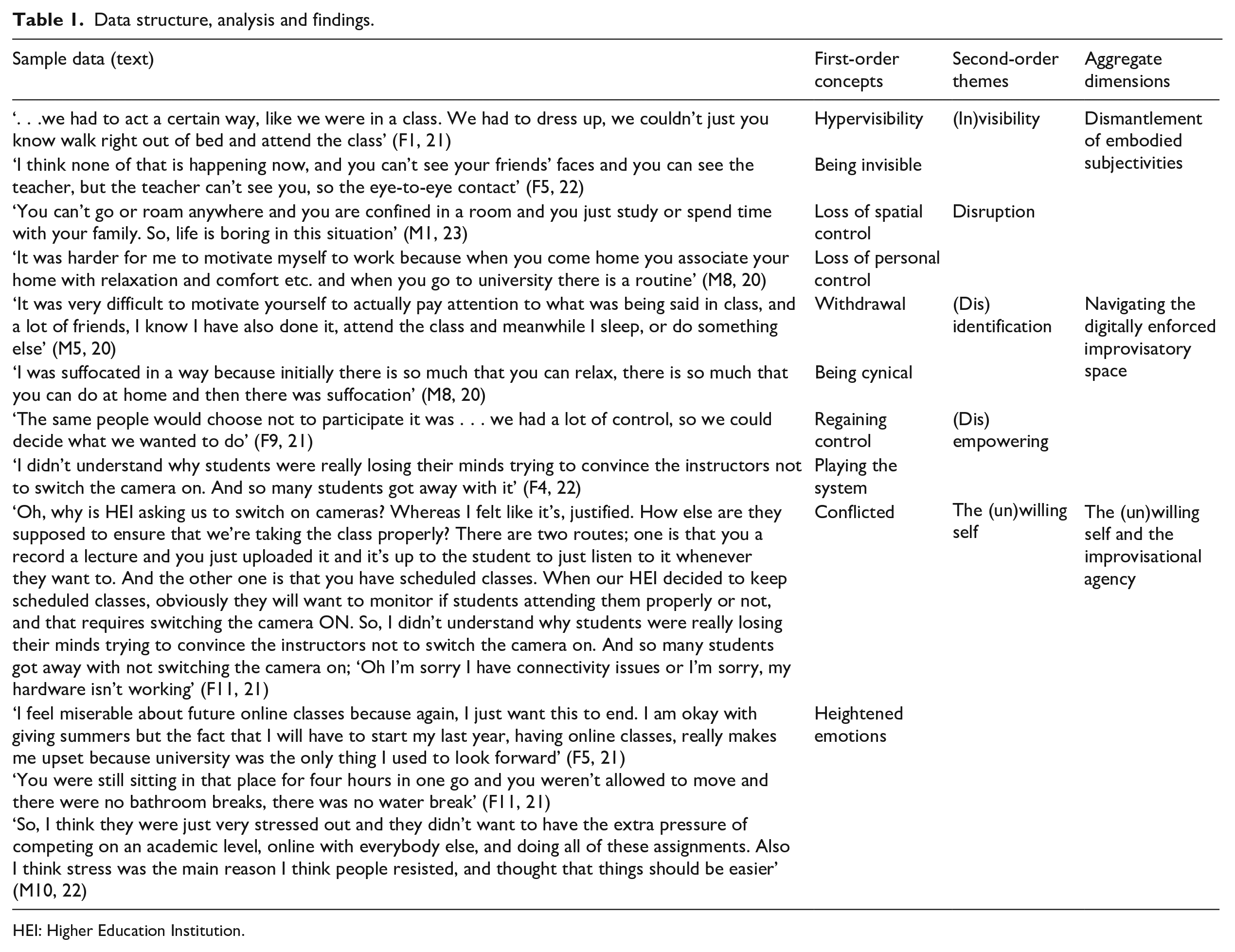
HEI: Higher Education Institution.
Empirical findings
This empirical section directs attention towards aggregate themes which emerged during the final stages of our data analysis and correspond to student experiences, as they transitioned into the digital space. We discuss our three principal empirical sections which direct attention towards the contestations and tensions of embracing new modes of organizing: dismantlement of embodied subjectivities, navigating the improvisatory space and the (un)willing self and the improvisational agency.
‘Turned upside down’: the dismantling of embodied subjectivities
Initially, the students accepted online classes as something that ‘had to happen’ (M5) and felt ‘fortunate to move-on with our education and not just put it on hold till everything settles down’ (F11). This compliance was underpinned by policies of reform leading to the creation of the improvised subject. Compliance can also be linked to the global imperative around digital learning as a way of managing education during the pandemic. However, as online classes progressed, the interaction between improvisation and their embodied subjectivities created feelings of lives being ‘turned upside down’.
First, the lockdown had disturbed their normal routine of being on campus, hanging out with friends and socializing. This was a normal practice and a part of the embodied self of the students from our three select business schools, making them feel in control of their lives. A break in everyday routines, which underpinned the new normal, was a key factor in feeling displaced.
I planned to do internships in these summers so even though I got one online internship but it’s not as good as the actual [. . .]. I feel like mental health wise there is no recreational activity happening. You can’t go or roam anywhere and you are confined in a room and you just study or spend time with your family. (M1, 23)
Losing control and a break in everyday routines seemed to have intensified their feelings. No longer did they have their ‘own space’ of a physical classroom, and their own chair and desk within it. Instead, they were competing for screen space with multiple faces or blank spaces (depending on the camera on/off policy at the business school) on a small screen. This highlights the need to map the ‘lineage of power/knowledge relations at different spatio-temporal nodes’ which constitute the dynamics of interaction for particular sites (e.g. Halford and Leonard, 2006). The digital move had created ‘incursions’ into ‘almost every single aspect of [their] lives’ (e.g. see Shamir, 2008: 3). Students were also sharing the physical home space where they were using a laptop or mobile device with their family members. Pakistani households are often multi-generational with grandparents, married siblings and their children, all living in one home.
Students were not very excited about this. Obviously getting up in the morning, you sit in front of the screen. Lots of distractions; you have your family members, you might have to share your laptop with your siblings, maybe clashing class timings. So [. . .] there was a lower level of interest. The participant numbers were low. (F4, 22)
The above accounts, and the following ones, are an illustration of the effects of the digital move on the subject. Students struggled and the struggle required ‘work on the self’ (Ball, 2016: 1056). Most complained of becoming invisible in online spaces. ‘You can’t see your friends’ faces and you can see the teacher, but the teacher can’t see you, so eye to eye contact!’ (F5, 22). The feeling of invisibility led several students to not attend live classes, or to switch off cameras, keep mics on mute and sleep/eat/watch Netflix. Those who wanted to be visible (to mark class participation and take part in discussions) felt highly self-conscious.
I know everybody could hear everything I was saying, and I had to choose my words carefully and if I screw up or say something wrong it’s going to be recorded and then afterwards people would listen to it and laugh at me. I know it’s a very small thing that plays in your head, so it was a bit difficult. (M8, 20) I would be a bit conscious that ‘Oh my God, my face will be plastered on everyone’s laptop and I’m not looking the best right, I just woke up. But other than that, I feel like it really depended on the student. If you wanted to interact you could have. Like, I mean instructors gave equal opportunity to every single student to participate. I just feel like they just used it as an excuse, most students, I’m not saying all, but most students use this as an excuse for their own slacking behaviour. (F11, 21)
Given the changing order of practice, students had no choice but to embrace change despite the several challenges they faced including that of hypervisibility or invisibility.
Digital learning had disrupted the ‘normal’ ways, creating an alternate mode of being that prompted students to manage themselves (e.g. self-regulation, self-discipline) in the digital space, such as managing their timetables, habits and routines as well as their devices. This reflects what Foucault (1988: 18) notes as subtle ways which ‘permit individuals to effect by their own means [. . . perform] a certain number of operations on their own bodies and souls, thoughts, conduct, and way of being, so as to transform themselves in order to attain a certain state of [. . .] perfection’.
As they experienced improvisation, they gradually became subjects of improvisation: showing a paradoxical inclination. For example, students notionally altered ‘the self’ (i.e. subjectivities) to fit in with the new normal. This fabrication of a new identity or subject position highlights the binding nature of subjectification processes in sustaining regimes of power as exerted by improvisatory measures (see Bardon et al., 2021).
‘Discipline and punish’: navigating the improvisatory space
The persistence of business schools to continue operating under COVID lockdown had a ‘structuring’ yet an ‘unsettling’ effect on students (cf. Vince, 2019: 954). For example, students recalled ambivalent feelings towards the digital move: I feel like everybody sort of quickly understood the gravity of the situation, at one hand we were not satisfied with the way things were conducted online and you know in terms of experience we would rather prefer to go in person. (M1, 23)
Multiple measures were put in place to ensure quality and continuity of education.
We couldn’t be upset towards the institution. Because we knew that they were also trying their best and in this sort of a situation. So, [. . .] we were sort of upset and we were sort of confused, I think confused would be a good word, we were confused at what was going on and there was a lot of conflicting emotions. (F11, 21)
Some business schools required mandatory attendance and remote proctoring by using the camera ‘on’ policy. Remote proctoring, using cameras, is akin to what Foucault (1979: 201) would describe as the ‘automatic functioning of power’ through surveillance – that is, creating a disciplined subject. This was coupled with class participation which was graded along with quizzes, final exams and assignments.
The class I enjoyed but not the grading components because there was a lot of burden from the other courses as well and when you add everything that we had to study for this class then it just became a little too much, but the class itself I enjoyed. (M10, 22)
While some business school educators adjusted courses, pedagogy, module outlines, content and teaching style, others did not. Some continued ‘as usual’, a spill over from the pre-COVID period. As one student explained, his teacher continued with the same face-to-face behaviours in the digital space: She was very strict with the attendance. Early on she wasn’t at all, but then she saw us coming to class after 30 or 40 minutes. So, then she said I won’t mark you if you are late more than 5 minutes. Then people started coming to classes on time and even after lockdown people were attending her classes as they were afraid that she might remove them from the course. So, the attendance was high. (M5, 20)
Learning by fear and using punitive measures to motivate, although not unique to Pakistan, is culturally acceptable as it is reflective of the hierarchical social structures in which the teacher is socially elevated to a father-like status (see Mughal et al., 2018). The Pakistani culture is embedded within the origins of the Asian subcontinent (Khilji, 2003) and reflects Kumar’s (2014) view on the pre- and post-colonial politics of education in India influenced by the British. He neatly ties up how rearing self-disciplining individuals is considered significant in eastern cultures, also noticeable in Britain up until the 1980s (see Parker-Jenkins, 2008) – through a description of ‘school punishment’ as negative reinforcement of cultural practice. The punitive practices of teaching and learning were drawn on, by teachers and their institutions, to navigate the improvisatory space.
The teacher who taught us [course], wanted our cameras ON all the time otherwise she would kick us out of the Zoom meeting. In that way she would ensure that students are not sleeping in the class. Also, she would ensure that we were sitting in a proper place not in our bed or we are not just lying down. (M6, 20)
The need to consider the broader discourses surrounding the digital move is neatly summed up by Cunha et al. (2015) who argue that learning through improvisation is a political process dependent on the prevailing relations of power. As noted in the excerpt above, institutional power was retained, and legitimacy was maintained during improvisation. An imminent threat of being kicked out seemed to constitute the basis of the panopticon, which Burrell (1988: 226) describes as the metaphor for ‘disciplinary’ power (of the institution/educator). At times, this control was exercised by overlooking contextual structural constraints, for example: In exam policy, it was mentioned that your camera and mic should not be turned off, so students panicked because the ones who are studying in rural areas or even the ones living in cities, if they had weak internet connections, if the connection stops working, and the portal doesn’t open, then what would happen [. . .] the issue was people didn’t have their own laptops or didn’t have stable connections. (M2, 20)
This can be seen as an instance where certain socio-historical and cultural practices seem to have prevailed even in the ‘new normal’, with the business schools exerting control but also paradoxically placing the responsibility of success on the student. Nonetheless, business schools were called out for ignoring students from less privileged backgrounds, students who were on financial aid and students who were from rural areas where there were serious connectivity and electricity issues. While some accommodated these issues, others tried to regain control.
What I thought was so sad was that some students that clearly had everything at their disposal; be it laptops, be it internet connection, be it the liberty of having a private room, they would use excuses [. . .], I feel like lots of privileged students were abusing their position and they were taking advantage of ‘the problem underprivileged students’. (F10, 21)
A passive form of resistance was also noted in some cases where students would use connectivity issues as a cover, not to conform to institutional control (see Fleming and Spicer, 2003). It also brought into question the scope of the power exerted by the business schools and the impact of improvisation to retain control which stands against the ethos of technological change and digital empowerment.
‘I feel like I don’t have to be there’: the (un)willing self and improvisational agency
While students seem to inscribe themselves as subjects of institutional control in their interviews, they simultaneously struggled with, and over, the effects of improvisation. Throughout the lockdown period, business schools had maintained control by ensuing improvisatory practices which aligned with global standards. This, however, resulted in some improvised subjects drawing on the entrepreneurial self and exercising creative agency to move away or play the system. The agency of the improvised subject is often misconceived as their willingness to accept change (e.g. Gershon and LaDousa, 2019). For example, one student recalls: [. . .] if we were online and I just switch my camera on and I just tilt it towards the side and the teacher can see half of my face and I’m just, I am dozing off, and I am on mute, and the teacher is trying to unmute me from her end but obviously she can’t . . . unless and until I click the unmute button, she can’t really do anything. I mean or she will call my name once, twice, thrice, then she’ll just move on with the class. She can’t really make me participate this way. (F11, 21)
This form of passive resistance shows what Casey (1995: 175) calls cynical detachment, which protects individuals from committing to dominant regimes and their ‘encroachment into the private realm of individual choice’. Even the ‘action’ or practice of angling the camera in a particular manner could be seen as an effort to regain power in response to digital changes, thus giving rise to cynicism. We term this type of creative manoeuvring as ‘improvisational agency’, which demonstrates enterprising forms of resistance towards new modes of organizing (e.g. De Vaujany et al., 2021; Gonsalves, 2020). This agency is both ‘contingent and relational’, providing a way to relieve stress caused by an unwanted situation (Siddall and Waterman, 2016). The Pakistani business schools in this study assumed the students to be at the disposal of their power because of the prevailing discourse of learner subservience. This was, however, not the case as some students intentionally withdrew their efforts to engage.
Also, improvisation has an overall image of improving things but the quote below demonstrates that improvisation comes at a psychological cost with heightened emotions (see Arifeen, 2023), largely invisible to the one exercising the control mechanism.
I can’t seem to motivate myself enough to wake up on time to just open the laptop and attend those classes, because the motivation level is like zero right now. And then again when the teacher does speak, I sometimes feel like it’s just not worth it anymore, I don’t have to be there. And since attendance is not mandatory anymore, I feel like I don’t have to be there. So, there’s no like motivation level. (F2, 21)
In the quote above, attendance was not mandatory and there was no dominant power at work. This student could have missed the class, yet they struggled within, knowing what ‘should be done’. As Foucault (1977: 203) notes, individuals inscribing themselves as victims eventually become the reason for their own ‘subjection’. The unobtrusive nature of improvisation seems to have operated in a manner that students were compelled to unwittingly achieve institutional objectives by their own volition (cf. Fleming and Spicer, 2002). It also reflects the values underpinning the improvised subject who negotiated the improvisatory space, exercising agency of sorts but not completely breaking free. The students did seem to work on the ‘self’ to accept improvisation but in ‘subtle ways’ to ‘transform themselves to attain a certain state of [. . .] perfection’ (Foucault, 1988: 18). Perfection varies individually and so does action or inaction. For Foucault, the subject can alter their subjectivity by exercising (improvisational) agency. This is also visible in the quotes below, as initially, the students felt disempowered by the improvisation they were not given any time to psychologically adjust to the new norm. Once they got the hang of it, they gradually started exercising agency and used various mechanisms to empower themselves.
So, I mean there were days some people were active, and they would participate, then there were days they wouldn’t. The same people would choose not to participate. It was [. . .] we had a lot of control, so we could decide what we wanted to do and the instructor to a certain level, like instructors, were powerless to a huge extent. They couldn’t really do anything. I mean all they could do was kick students out but didn’t want to do that either. (F9, 21) The teacher is not watching you and you can just hang around and if there is any important assignment then you submit that. (M1, 22)
The above quotes also suggest that improvisation changes the order of practice and intensifies the need to adhere to the improvised order. However, the improvisatory space has room for taking back control. For example, some of the students played the system to resist, modify and/or escape the entrapments of improvisation to break free of control.
I mean you are a black screen. You will just log into the class, and you will not be listening. You will be on your phone, on social media, or make snaps of the class. Obviously when you are sitting in a physical class and the teacher is strict or not even strict, they are in front of you. [. . .] Because our teachers weren’t allowed to do that anymore (mark class participation) they couldn’t grade us on that, and we knew that recorded sessions will be uploaded. So, people either didn’t go to class or they fell asleep, or they were on their phone [. . .], watching a movie alongside. (F4, 22)
Our findings are not indicative of subversion in the literal sense where resistance is seen as a ‘reactive response’ (Raffnsøe et al., 2016: 288) to avoid ‘submission and compliance’ (Jackson and Carter, 1998: 60). On the contrary, they show a form of improvisational agency which paradoxically resists change to their predisposed ways even though they are characterized by power relations of a different kind.
Discussion
Our study shows the power struggles in improvisatory spaces by drawing on debates within the streams of globalization of management education, improvisation and to some extent the paradox theory. Drawing upon Foucauldian-inspired literature as our lens, we show the local and global forces that create a paradoxical interplay of acceptance–resistance in embracing new modes of organizing and learning (e.g. De Vaujany et al., 2021; Gonsalves, 2020). We demonstrate how the subjects of improvisation negotiate subjectivities in relation to improvisatory change. Through subjective processes of accepting, modifying or resisting their newfound position, the improvised subjects performed certain ‘operations’ on themselves to either conform or challenge improvisation (Foucault, 1988). Our study shows not only the subjectification of students to improvisation but also their struggle and creativity in getting to grips with the global imperative of digital learning. Literature also notes that digital improvisation as a global response to the pandemic was deeply associated with Western assumptions of technological empowerment and support infrastructure (Beech and Anseel, 2020; Brammer and Clark, 2020). As noted earlier, the situatedness of Pakistani business schools and students within a non-Western context (i.e. global South) shows a historical legacy which stands contrary to Western practices (Mughal, 2021a). The agency exercised by participants to negotiate with the move to the digital space, contrary to their learning routines, is what we refer to as improvisational agency – i.e. the subjective work undertaken to repair, manage, maintain, contest or revise one’s position in uncertain (or non-routine) situations.
A Foucauldian perspective helps contextualize our findings and develop insights into how improvisational spaces are predisposed towards the production of desired subjectivities by those imposing the new order, and more importantly adding another layer of conformity (Villadsen, 2021). By studying subjectivities in a changing order, we primarily contribute to the literature on improvisation in management learning and education by showing the paradoxical tensions between notions of autonomy and control in the digital space. We also offer insights into competing discourses unfolding inside improvisatory spaces in three select Pakistani business schools during the COVID-19 crisis, which call into question the implicit assumptions around narratives that are insensitive to embedded power dynamics. These insights collectively indicate that management educators must understand that improvisation is inherently political and acts to control subjectivities to restore order. Even though improvisation is control-oriented, our article shows how the subject of improvisation also resists change.
More specifically, our study makes three distinct, yet interrelated, contributions in line with insights emerging from analysis, reflecting issues that higher educational institutions (and organizations) need to consider when looking to improvise.
Risk of taming embodied subjectivities
Acquiring an understanding of predispositions and the ways in which learners are predisposed to routine methods is critical. The focus needs to be on understanding how individuals situate themselves as improvised subjects, for example, by considering discourses that shape their positionality as well as their local constraints (e.g. digital poverty, spatial structures and temporality). As previously theorized, we note that the idea of a hierarchical classroom setting is deeply embedded within the minds of students in the global South who see self-directed modes as frustrating (e.g. Kashif et al., 2013; Kothiyal et al., 2018). Scholars argue that it is perhaps easier to assimilate oneself within classroom hierarchies and become less visible to protect our private selves (cf. Mughal et al., 2018; Stead, 2013). Our findings indicated that improvisation displaces predisposed routines and destabilizes learners’ worldviews, causing anxiety and stress (Feldman and Pentland, 2003). The improvised digital space seems to have activated heightened consciousness towards losing the private domain of the self and becoming public (hypervisibility). Applying digital reforms to improvise learning would, in Foucauldian terms, mean that the individual is subjected to new techniques of sustaining control by infra-political means (Foucault, 1979). As management educators worked with new ‘lockdown literacies’ (Gourlay et al., 2021: 377), improvisation lost its precision (e.g. Cunha and Putnam, 2019). The resulting operational problems arising from implementing the improvisation are often homogenized with localized power and knowledge frameworks to increase success (Cunha et al., 2012). Rather than treating improvisation as a neutral process of change (Kornberger, 2013), we argue that it is political and acts to maintain control over those being improvised.
Improvisational agency and the newfound position
Theorizing the digital space as a site for subjectification helps conceptualize the different forces, inside and outside the individual (e.g. discursive and non-discursive), converging to produce specific subjectivities towards change (Villadsen, 2021; see also Foucault, 2003). The status of the newfound position of the subject as improvised is dynamic, as opposed to willing. It disposes individuals to new patterns of knowledge while simultaneously being pulled back by their embodied subjectivities (Knights and Morgan, 1991; see also Foucault, 1980). In this sense, studying digital movement as a control mechanism offers insight into the norms and normativity emerging from improvisation (De Vaujany et al., 2021). Our findings indicate the creation of negative attitudes, especially towards improvisational tactics as the new order mismatched with embodied subjectivities which resulted in passive and creative forms of resistance. This is reflective of what Fleming and Spicer (2003: 160) term as cynicism, which ‘unobtrusively reproduces relations of power’ because individuals are ‘given (and give themselves) the impression that they are autonomous agents’ and yet expected to participate in rituals. Rather than accepting their subject position, many students resorted to creative methods of resisting like dis-identifying with the improvisation or playing the system. These acts show the counter-conduct of individuals in breaking free (Knights and Morgan, 1991) from the improvisation and dealing with their subjectivity crisis. Even when they dis-identify, they still engage in performative acts which inscribe them as recipients of power leading to the inadvertent success of the dominant ideologies (Knights and McCabe, 2003). This is not to say that Pakistani students are passive recipients of power but points to the ways that dominant discourses frame subjectivities in ways favourable to power relations knowingly or otherwise (see Foucault, 1977).
Improvisation as a paradox and paradoxical improvisation
Acknowledging the misalignment between embodied subjectivities and those promoted by improvisation under the so-called new normal is an important area of concern when experiencing disruptive events as it draws attention to the implicit power of improvisation. The differences between the embodied (or localized) subjectivities pertaining to teaching and learning and the beliefs of improvisation shaped by global forces (e.g. digital platforms) are likely to create dissonance for the improvised subject. While many leading business schools in Pakistan are inclined to adopt international standards (including Western pedagogies, policies and practices), predispositions pertaining to how learners are accustomed to learning are deeply grounded in their social, cultural and historical legacies (Khilji, 2003). Any change in predisposed methods of learning – and especially in cases where technology and digital learning change the dynamics of classroom hierarchies – becomes a challenge to negotiate (e.g. Khan and Nawaz, 2013; Nadeem and Sully De Luque, 2020).
Our findings suggest that improvisation has been experienced as a paradoxical event, ‘generating a crisis-like situation’ which disrupts routines and creates pockets of self-consciousness (Hatch, 1997; Mughal, 2021b: 74). Cunha and Putnam (2019: 101) argue that ‘paradox is just as much about dis-equilibrium as it is about equilibrium’. Other scholars (e.g. Meisiek and Stanway, 2023: 3) also note that ‘breaking with rules, routines and plans’ in light of the unexpected allows tapping into resourceful domains of experience and memory by moving from ‘clock time’ to ‘being present in the moment’ (see also Ciborra, 1999). This type of political consciousness seems to have been misunderstood by these Pakistani business schools which aspired to power through at one level but simultaneously disempowering students at another (e.g. surveillance, timetabling, grading). This also suggests that improvisation has the tendency to disrupt the status quo, and within this disruption of routines it falls victim to the agency it creates, that is, the resistance born of socio-cultural, political and historical practices. While business schools are keen on adopting globalized practices, they are also predisposed towards their local contexts, which creates a Catch-22-like situation. Students remain entangled in their own embodied subjectivities which limits the constitution of their subject position outside of the power relations (e.g. Foucault, 1982). For improvisation to be fruitful, it is essential that business schools specifically (given our context), and organizations generally, address issues of subjective dissonance which could result in failure, frustration and anxiety for those experiencing change.
Conclusions
Our contributions collectively show that improvisation activates embodied subjectivities and if the paradox and conflicts within subjects are not resolved, they impede the learning process from taking its course. These contributions advance literature on new ways of negotiating disruptive events (e.g. COVID-19) in management learning and education by showing the politics of improvisation. When experiencing improvisation, our Pakistani students struggled in getting to grips with the changing order of practice. They showed dissonance and conflicting subjectivities in transitioning towards digital learning, leading to cynicism due to confusion and contradiction. In other words, improvisation challenges individuals’ subjectivities as their worldviews are violated in attempts to embrace/enact new routines, with improvisational strategies needing to be more sensitive towards the situated position of those experiencing improvisation.
While the sample for this study was limited to students from three elite business schools in Pakistan, historical, social and cultural practices seem to have shaped learner preferences which are likely to be more pronounced among peers from non-elite business schools. As a point of departure for future research, findings from this study are likely to provide a foundation to explore more specific cultural issues within improvisatory spaces. For example, there remains a need to delineate gender, race and class-based differences to better understand how the move to online education affects groups of students within the elite and non-elite business schools in Pakistan. Future research could also perhaps include an intersectional lens to study how predisposed subjectivities of learners, arising from culture, gender, race or class-based relations, shape improvisation experiences in the digital space – or impact learners’ positionality. Interestingly, most universities in Pakistan remained online for another year after data for this research were collected. Future research could possibly include understanding the business schools’ perspective (e.g. educators or managers) and how they handled the situation at their end – an area not covered in this research due to the focus on learner positionality and the improvised digital disruption.
Insights from our study, however, proffer implications specifically for educators and business schools in the global South and contexts alike, and generally for improvised learning spaces beyond the three Pakistani business schools. First, organizing consultative groups with students/institutional actors at the beginning and during the improvisation could enable improvements in the process to recognize issues of anxiety, hypervisibility, cynicism and dis-identification of learners. This will allow improvisation to take effect by creating an inclusive learning environment to cater for learner needs and preferences. Second, improvisers should understand that improvisation triggers comparison between historical and newfound subjectivities that shape individual practice. This will lead to better management of the strategy underpinning improvisation and improvisational agency during the disruptive event. Detecting cynical behaviour like silence, disengagement or withdrawal is the key to addressing individual learning needs and proactively managing the improvisatory process (e.g. Casey, 1995; Fleming and Spicer, 2003). Third, the process of adaptation/adoption of new modes of organizing learning can be intensive, intrusive and unsettling, creating conflict and contradictions among actors. Our findings emphasize the need for hands-on engagement with learners by having virtual office hours or one-on-one discussions to help bring all stakeholders on-board during the improvisation.
