




Abstract
The COVID-19 pandemic has amplified and exacerbated organizational paradoxes felt by individuals largely because of the nostalgia individuals feel for the “old” normal while facing the need to let go in order to create a “new” normal. We position improvisation as a synthesis-type approach to working through the paradoxes of the pandemic. Furthermore, we look at individual differences that underpin the ability to improvise, and identify that it is the strength of character and character-based judgment of the individual that enables the enactment of a focal context, the choice to improvise, and the act of effectively improvising to work through paradoxes. Linking character to improvisation, and, vice versa, improvisation to the development of character, reveals the importance of dimensions such as courage, humility, temperance, transcendence, humanity, and collaboration in the practice of improvisation.
The COVID-19 pandemic has been a colossal exogenous shock that has increased the saliency of organizational paradoxes such as those between structure and freedom (e.g. Kamoche and Cunha, 2001), exploration and exploitation (e.g. Lavie et al., 2010), cooperation and competition (e.g. Raza-Ullah et al., 2014), and control and collaboration (e.g. Sundaramurthy and Lewis, 2003). Carmine et al. (2021) recently described five organizational tensions of the pandemic: short term versus long term, social versus economic goals, learning versus performing, common good versus individual privacy, and agency tensions. Sharma et al. (2021) added to the list various societal tensions during the pandemic crisis, such as economic versus public health identities, rigor versus expediency, eastern versus western responses, and public voice versus health. Improvisational processes, defined as the convergence of planning and execution (Moorman and Miner, 1998b), can help to reconcile these paradoxes of our pandemic environment; however, improvisational processes require individuals to also embrace the paradoxes intrinsic in improvising. Improvisation combines freedom and structure, novelty and routine, and chaos and order. From the experience of improvisational jazz musicians and actors, researchers have come to recognize the major investment in practice and study that precedes a good performance (Crossan, 1998; Weick, 1998). Improvisation is a mixture of the pre-composed and the spontaneous (Weick, 1998), where it is possible to “prepare to be spontaneous” (Barrett, 1998: 606) and to “rehearse spontaneity” (Mirvis, 1998: 578).
Since 2020, as researchers and practitioners reach for tools, techniques, and approaches to deal with the global COVID-19 pandemic, there has been a renewed interest in improvisation (e.g. Lloyd-Smith, 2020; O’Brien, 2020), a key process associated with crises (e.g. Bechky and Okhuysen, 2011; Giustiniano et al., 2016; Mendonça, 2007), innovation (e.g. Akgün and Lynn, 2002; Brown and Eisenhardt, 1997; Vera et al., 2016), and organizational learning (e.g. Bergh and Lim, 2008; Miner et al., 2001; Miner and O’Toole, 2020; Vendelø, 2009). For the last 25 years, researchers have studied the conditions under which individuals, teams, and organizations are more likely to deviate from planning to improvisation, and the conditions under which that improvisation is likely to be effective (see Ciuchta et al., 2021 for a recent systematic review). Key variables of interest in understanding the context for improvisation are uncertainty, ambiguity, time pressure, and resource scarcity (e.g. Baker et al., 2003; Crossan et al., 2005; Tabesh and Vera, 2020), conditions clearly associated with the COVID-19 pandemic. However, the pandemic also helps to expose paradoxes associated with improvisation, and amplifies the felt paradox by individuals.
Given the pervasiveness of paradoxes in today’s organizations, the ability of individuals to think through paradoxes—what has been referred to as a “paradox mindset” (Liu et al., 2020; Miron-Spektor et al., 2018)—is critical. A paradox mindset involves “working through paradox by exploring conflicting feelings, practices, and perspectives in search of more encompassing understanding” (Lewis and Dehler, 2000: 710), and focuses on the strategic choices that individuals make when facing a paradox (Smith, 2014). We argue that a key individual characteristic underpinning a paradox mindset is strength of character, while, at the same time, strength of character also requires the balance of apparent contradictory dimensions such as humility and drive, courage and temperance, and accountability and humanity. Character, based in virtue ethics, has many associated definitions (see Hackett and Wang, 2012 for a review). We adopt the definition of virtue and character offered by Bright et al. (2014) as “a deep property of a person that defines the human goodness of the individual. The virtue ethicist sees virtue as rooted in human character—habituated patterns of thought, emotion, motivation or volition, and action” (p. 447). The habituated patterns that define character satisfy a set of criteria identified by Peterson and Seligman (2004) as being virtuous. Building on the seminal work of Peterson and Seligman (2004), who had consolidated much of the prior research on character, Crossan et al. (2017) used an engaged scholarship approach to bridge the deep theory surrounding character in philosophy and psychology with the practice of character in organizations, to develop the leader character framework shown in Figure 1, along with its relationship to improvisation and paradox. The leader character framework guides the operationalization of character in our theorizing. Notably, because their intent was to elevate character alongside competence in higher education (Crossan et al., 2013) and organizations, their research served to broaden the understanding of character as associated with “human goodness” to reinforce other important underpinnings such as Aristotle’s “practical wisdom” or what Crossan et al. (2017) refer to as character-based judgment.
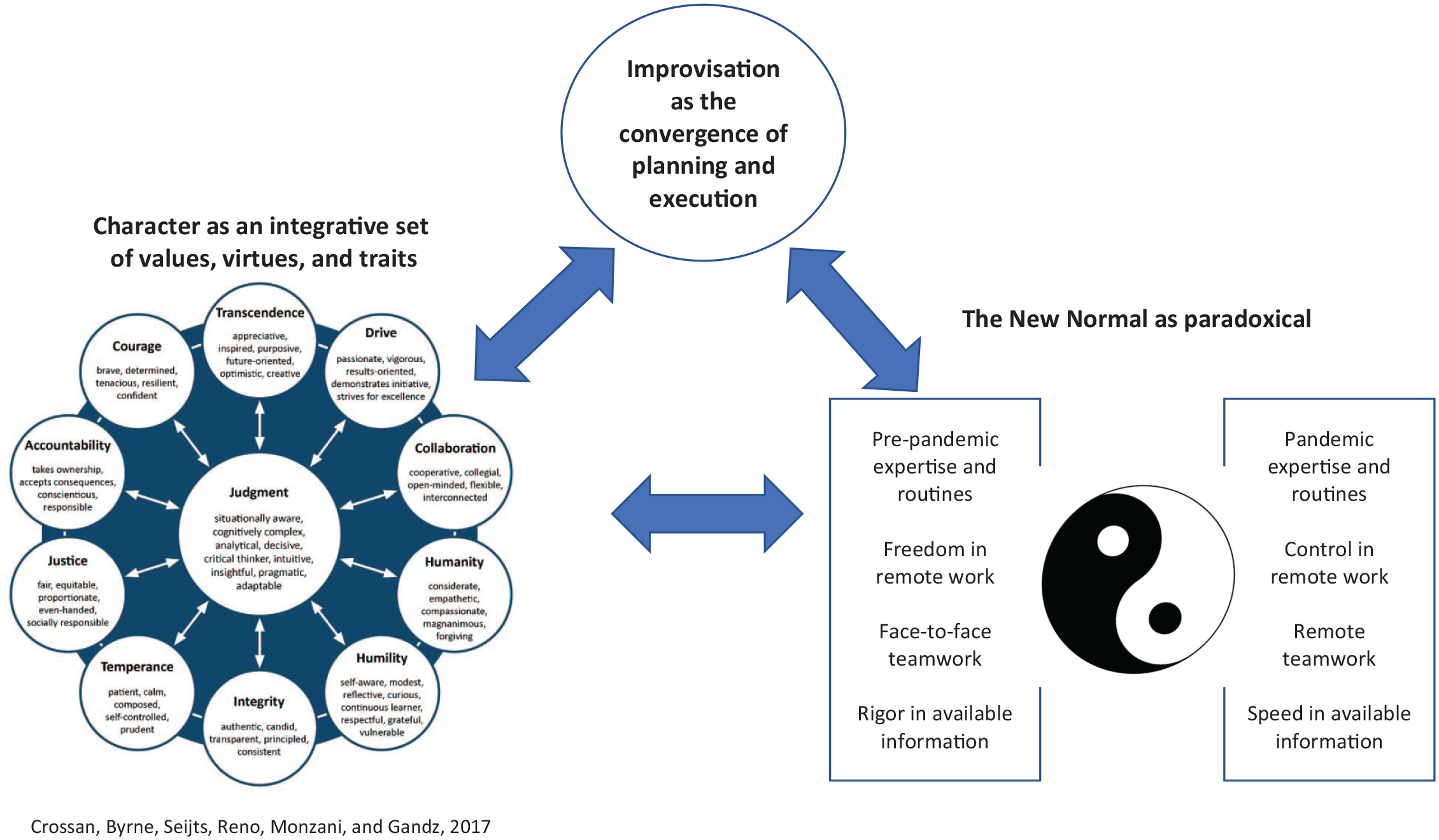
The interplay of character, improvisation, and paradox.
We seek to address the following question: How does strength of character support individuals with the paradoxes inherent in the context of the “old” and the “new” normal, as well as arising from the improvisational processes needed in this context? We contribute to research on paradoxes, improvisation, and character. First, in the area of paradoxes, we position improvisation as a synthesis-type approach to working through paradoxes. Specifically, we examine four examples of paradoxes inherent in the shifting context of the pandemic, and examine how improvisation, enabled by character-based judgment, serves to address these paradoxes. These paradoxes represent the nostalgia individuals have for the “old” normal with the need to let go to create the “new” normal: (1) pre-pandemic and pandemic expertise and routines, (2) face-to-face and remote teamwork, (3) freedom and control in remote work, and (4) rigor and speed of available information. Second, in the area of improvisation, we highlight the character-based judgment that supports the choice to improvise and the act of effectively improvising to work through paradoxes. In addition, drawing on the concept of “focal context” (Suarez and Montes, 2019), which shifts attention from the general context (the global pandemic), to focus on the experience of the context by the actor choosing to improvise, we address how character influences the actor’s experience of the focal context. Third, we introduce the synergistic relationship between character and improvisation—character enables improvisation and its effectiveness, and improvisation requires and can develop character. We identify that it is the strength of character of the individual that enables the enactment of a focal context, the incidence of improvisation in terms of the choice to improvise, and the effectiveness of improvisation in terms of the ability to work through paradoxes. Linking character to improvisation, and, vice versa, improvisation to the development of character, reveals the importance of dimensions such as courage, humility, temperance, transcendence, humanity, and collaboration in the practice of improvisation.
We unpack the relationships depicted in Figure 1 by briefly reviewing paradox theory as it applies to improvisational processes. Then, we differentiate between the general context of the pandemic and the experience of the focal context, which is associated with individual differences and the role of character. Next, we reimagine improvisation theory using a character lens to discuss how character helps individuals to synthesize pandemic paradoxes through improvisation. Finally, we return to the context of the global pandemic to offer implications for research and for practice.
Theoretical background
Paradox theory
Paradox theory (see reviews by Putnam et al., 2016; Schad et al., 2016) has shown that paradoxes, defined as “persistent contradictions between interdependent elements” (Schad et al., 2016: 10), are unavoidable in organizations (Lewis, 2000; Smith and Lewis, 2011). This literature argues that organizations should accept and even embrace the coexistence of contradictions (Ambituuni et al., 2021). Paradoxes can induce stress, denial, discomfort, or rigidity when responding to organizational situations (Putnam et al., 2016), which is why we highlight the nature of the focal context (the way the individual experiences the general context) in the subsequent sections.
A key goal of paradox theory has been to explore how organizations can attend to competing demands simultaneously (Smith and Lewis, 2011). In their review, Schad et al. (2016) summarize how paradoxes are addressed at the collective and individual levels. At the collective level, authors have suggested the following ways to manage paradoxes (Schad et al., 2016): acceptance and “working through” (e.g. Lüscher and Lewis, 2008; Smith et al., 2012), spatial and structural separation (e.g. Lavie et al., 2010; Smith and Tushman, 2005), temporal separation (e.g. Adler et al., 1999; Lavie et al., 2010), synthesis and integration (e.g. Adler et al., 1999; Deephouse, 1999; Schmitt and Raisch, 2013), combination of approaches (e.g. Adler et al., 1999; Gibson and Birkinshaw, 2004), differentiation and integration (e.g. Andriopoulos and Lewis, 2009; Smith and Tushman, 2005), and dynamic decision-making and oscillating (e.g. Smith, 2014). At the individual level, Schad et al. (2016) list the following mechanisms to manage paradoxes: defensiveness and discomfort (e.g. Lewis, 2000; Vince and Broussine, 1996), paradoxical thinking and sensemaking (e.g. Lüscher and Lewis, 2008; Miron-Spektor et al., 2011; Smith and Tushman, 2005), reflexivity and discursive thinking (e.g. Dameron and Torset, 2014; Huxham and Beech, 2003), behavioral complexity (e.g. Denison et al., 1995; Hart and Quinn, 1993), humor (e.g. Hatch, 1997; Hatch and Ehrlich, 1993), rhetorical skills (e.g. Andriopoulos and Lewis, 2009; Fiol, 2002), and responses informed by national culture (e.g. Adler et al., 1999; Chen and Miller, 2011).
An aspect of paradoxes that we know little about is how individual differences impact whether individuals view paradoxes as tradeoffs or as opportunities (Miron-Spektor et al., 2018), which sets the stage for exploring the role of individual character to explore these individual differences. A concept that has emerged as promising is that of paradox mindset, which is defined as “the extent to which one is accepting of and energized by tensions” (Miron-Spektor et al., 2018: 26). A paradox mindset indicates a cognitive ability to engage in paradoxes (Smith and Tushman, 2005), and also captures individual affective reactions to paradoxes (Vince and Broussine, 1996). Individuals with a paradox mindset are more likely to confront rather than avoid contradictions (Miron-Spektor et al., 2018). Instead of “either/or” thinking, they adopt a “both/and” thinking, perceive contradictions between multiple demands, and generate new connections between elements (Smith and Tushman, 2005). This paradox mindset is another preview to the connection to character, and also to improvisational processes where the well-cited practice of “yes-and” is very consistent with “both/and” thinking. As shown in Figure 1, the three elements of our theorizing, improvisation, character, and the nature of the “new” normal, are paradoxical. A paradoxical mindset is intertwined with both character and improvisation to allow individuals to work through the paradoxes of the context.
Importantly, Berti and Simpson (2021) argue that action is not equivalent to agency, and that the capacity to think paradoxically “is not in itself sufficient for enabling organizational members to effectively respond to organizational paradoxes—it must be combined with a degree of agency (p. 255).” Individuals are not always free and able to choose how to deal with a paradox; they may lack legitimate options or be impacted by power differences (Berti and Simpson, 2021). One behavior that helps to manage paradoxes by confronting them through iterating responses (Smith and Lewis, 2011) consists of situated acts of bricolage—making do with whatever you have at hand (Clegg et al., 2002). However, individuals must be able to legitimately engage in this type of flexible behavior; this possibility is impacted by their situated environment. The concept of agency is also an important link we make to character, where Nguyen and Crossan (2021) have forged the theoretical connections between strength of character and individual agency.
Paradoxes of improvisation
Improvisation has been defined as “the deliberate fusion of the design and execution of a novel production” (Cunha et al., 2017: 560; Miner et al., 2001: 314), and “the creative and spontaneous process of trying to achieve an objective in a new way” (Vera and Crossan, 2005: 205). It is a recognized source of learning by doing and learning by responding (Krylova et al., 2016; Miner et al., 2001). Improvisation has been described as a paradoxical process (Clegg et al., 2002) in which organizations need to prepare for improvisation or plan to improvise. This combination of preparation and fast response can be observed in the way that Taiwan’s leaders responded to the COVID-19 pandemic (Wang et al., 2020). Improvisational processes offer a synthesis-type of approach to the resolution of paradoxes, where synthesis involves identifying a novel solution that takes both paradoxical elements into account (Schad et al., 2016).
Several examples are available of how improvisation helps to achieve the synthesis of paradoxes. In the context of scheduling, Crossan et al. (2005) propose that improvisational processes enable individuals to creatively coordinate their actions in order to simultaneously adapt to unexpected events and manage calendar deadlines. Also, in the context of corporate resource allocation, improvisation enables firms to build minimal plans that, instead of prescribing rigid courses of action, provide organizational members with the minimal structure necessary for coordination yet would still promote flexibility in the allocation of resources (Crossan et al., 2005). Within the parameters established by the minimal structures, individuals are free to operate, innovate, and improvise as necessary to achieve the desired goals.
Cunha et al. (2020) link improvisation to strategic agility and discuss how through strategic agility, improvisation enables organizations to deal with the paradoxes of strategic consistency versus the value of rapid change related to unexpected problems, opportunities, and fast-moving trends. Cunha et al. (2020) look at paradoxical human resource management (HRM) practices that support improvisation and strategic agility. This work is consistent with that of Ambituuni et al. (2021), who also link improvisation and strategic agility to paradoxes of HRM such as enabling freedom versus control, work desegregation versus segregation, and peripheral vision versus focal vision.
Tabesh and Vera (2020) discuss improvisational decision-making as benefiting from the paradoxical combination of comprehensiveness and intuition. They argue that executives who synthesize three decision-making processes—improvisation, comprehensiveness, and intuition—are more likely to engage in “quick studies” as fast forms of intentional analysis similar to comprehensive approaches and use their intuition while engaging in improvisational decision-making. In fact, those “quick studies” along with intuitions become additional resources that are recombined in the moment to generate high-quality decisions on the go (Tabesh and Vera, 2020).
A final example is in the context of knowledge transfer and knowledge protection. Krylova et al. (2016) describe the spontaneous nature of knowledge transfer and improvisation as an integral part of day-to-day knowledge work. By improvising, individuals bring knowledge to action and translate it to their context of work, which becomes a barrier to imitation from rivals (Krylova et al., 2016). Present in all of these paradoxes is the central role of individual judgment that we will unpack using the lens of character.
The pandemic as a trigger of improvisation
The global pandemic has been described as a massive exogenous shock (Carmine et al., 2021) that forced all types of organizations to change overnight and that has consequences that will continue in our society for years to come (Sharma et al., 2021). The pandemic is certainly a complex and paradoxical context that can be characterized with the types of variables that trigger improvisational responses. In fact, Ciuchta et al. (2021) categorize the triggers for organizational improvisation based on whether they arise from a problem, an opportunity, or from intrinsic experiential enrichment. Past research has associated these triggers with conditions of uncertainty, ambiguity, time pressure, and limited resources. For example, Crossan et al. (2005) described three types of improvisational processes (ornamented, discovery, and full-scale) based on the degree to which individuals face time pressure or uncertainty. Similarly, authors have linked improvisation to environmental uncertainty or turbulence (e.g. Chelariu et al., 2002; Pavlou and El Sawy, 2010), and entrepreneurs making do with resources at hand (e.g. Baker et al., 2003). In this section, we highlight the shift in thinking from a general context that triggers improvisation to the idea of focal context and extreme context of improvisation.
Focal context of improvisation
Suarez and Montes’ (2019) longitudinal examination of how context influences the enactment of routines, heuristics, and improvisation is a significant step forward in moving beyond the somewhat deterministic view of improvisation as dealing with the general context of uncertainty, ambiguity, time pressure, and limited resources to what they refer to as “focal context.” Suarez and Montes (2019) define focal context as “a constructed temporary reality that encompasses both the objective traits of the environment experienced by the organization at a particular point in time, as well as the subjective perceptions that organizational members had of that reality” (p. 573). The general context they studied was a mountaineering expedition to climb the Kangshung Face of Mount Everest. In attempting to disentangle routines (regular and predictable patterns on behavior), heuristics (cognitive shortcuts), and improvisation in the focal context, they observed that the Kangshung improvisations emerged in response to two triggers brought about by how the climbers perceived the focal context at different stages of the climb: (1) unanticipated problems to be solved and (2) unanticipated opportunities to be pursued
and that “the focal context was as much an objective physical reality as it was a subjective construction in the minds of the climbers” (Suarez and Montes, 2019: 590).
Uncertainty and ambiguity, along with time pressure and resource scarcity, are salient in the Suarez and Montes (2019) study. The uncertainty and ambiguity arise primarily from the weather conditions. The time pressures are linked to the window for ascent. Resource scarcity relates to the timing of the ascent and unexpected problems leading to scarcity of food, water, shelter, and oxygen. However, a novel perspective is introduced, which is their careful unpacking of how the shifting context, both general and focal, triggers shifts in heuristics and routines that underpin improvisation. Our interpretation of their findings is that ambiguity and uncertainty are not the primary catalysts for improvisation; many routines and heuristics continue to operate under these conditions. Rather, routines and heuristics embed within them implicit (sometimes explicit) assumptions about time and available resources and, therefore, the trigger for improvisation is that the underlying assumptions are challenged.
Consistently with this observation, the many documented experiences arising from the pandemic reveal that when underlying assumptions are challenged (e.g. around intensive care unit beds, ventilators, or personal protective equipment), uncertainty and ambiguity may operate counter-intuitively and paradoxically—clarifying priorities. Thus, missing from the discussion of context in the improvisation field is what we refer to as “priority setting,” where shifts in the context dictate priorities. Contrary to current understanding, priority setting may in fact reduce uncertainty and ambiguity because it focuses the attention, yet coupled with lack of time and current resources, organizations have no ready solution to adequately address the shifting focus, as was the case with the onset of the pandemic, which triggers the need for improvisation. Without clarity of priorities, improvisation can foster confusion (Miner et al., 2001). Whereas organizations may struggle to set priorities, we posit that a shifting context can dictate priorities, providing clarity; the key then is the quality of judgment of individuals to assess the changing priorities in the shifting context.
A final point about the triggers of improvisation is that, because improvisation supports innovation, organizations can intentionally engage in improvisation practices without any contextual triggers in order to reap the innovation benefits (Hadida et al., 2015). The importance of this as it relates to context, including the global pandemic, is that this context and the shifting priorities may legitimize the improvisation that had already been taking place within organizations. For example, work-from-home solutions, online teaching, national policy shifts, all occurred by necessity in days, when such shifts could have taken years without the pandemic. The improvisation that occurred could not have happened without innovative underpinnings that were already in play. The clarity of priority (health and safety) served to remove prior obstacles that may have obstructed improvisation, thereby legitimizing these activities in the context of the pandemic. Thus, it is important to understand the timing surrounding improvisation and the priority setting that occurs. That is, the context triggers legitimizing improvisation that has already been taking place through the priority setting process.
To understand whether improvisation research has missed important variables around context, particularly as it relates to the pandemic, we also turn to Hällgren et al.’s (2018) review of extreme contexts research—Risky, Emergency, or Disrupted (RED). When describing RED, Hällgren et al. (2018) parse out the need for a combination of flexibility and stability in risky contexts, which points in the direction of managing a paradox. According to Hällgren et al. (2018: 127), “Among the factors in the early stages of crises that have received extensive coverage, the loss of cognitive efficiency in decision-making and the misinterpretation of small events features large.” Thus, at the very time that great judgment is required, it is compromised.
Moving forward
Miner et al. (2001: 305) have drawn attention to the fact that “Much of the extant research seems to implicitly assume that improvisation is sometimes an inevitable response,” but that “in the focal moment, an organization can take one of several actions: do nothing, enact existing routines, plan a new activity, enact an existing plan, or improvise.” This is consistent with Suarez and Montes’ (2019) call for better understanding of the nexus between the actor and context, and is supported by the study of extreme contexts where the collective sensemaking capability of those experiencing the crisis tends to be the focus of research.
Although the challenges of cognitive complexity are clear in extreme contexts, first, and foremost appears to be the role of affect—“emergency contexts are typically the site of intensely negative emotions, including stress, anxiety, fear, and sadness that can affect the way organizational members under pressure perceive ambiguous cues and interpret them” (Suarez and Montes, 2019: 129). Also noteworthy is that some “life-threatening contexts give rise to positive emotions related to the exercise of courageous and compassionate behaviors toward others that can favour resilience” (Suarez and Montes, 2019: 130). In fact, in one of the few pieces linking improvisation to emotions, Dutton et al. (2006) found that organizations can enact improvised routines in compassion, which are work routines that are spontaneously modified to address human suffering; these improvisations can lead to development of a capability of compassion organizing. While prior improvisation research has largely neglected the important area of affect, the insertion of individual strength of character into the process sheds critical light on courage and humanity, for example. Thus, focal context places attention on the actors in the midst of the context. Furthermore, the need for priority setting to coordinate actors and organizations as they co-create in real-time elevates the role of character and, in particular, character-based judgment.
The synergistic nature of character and improvisation
Research on both paradox and improvisation note the importance of individual differences, however, in their review, Ciuchta et al. (2021) state that “individual-level antecedents of organizational improvisation are notably understudied” (p. 305). Some exceptions are research looking at self-efficacy (Hmieleski and Corbett, 2008), personality (Arshad and Al-Idrus, 2014), level of confidence (Hmieleski et al., 2013), tenure and expertise (Hodgkinson et al., 2016), and risk aversion attitude and proactive attitude (Magni et al., 2018) in relation to improvisation and its value. In this section we unpack character as a theoretical lens that explains individual differences and the elevated capacity for agency associated with judgment, which is both central to the theories of paradox and improvisation. Furthermore, we draw attention to the focal context of the pandemic that amplifies the intensity of experiences and the demands on judgment, with particular attention to affect. Finally, we introduce that character is needed to choose to improvise and to effectively improvise, and also that the reverse is true—improvisation offers a practice that reveals and can build character.
Defining character
We rely on Zaccaro et al.’s (2018) comprehensive and integrative review of leader individual differences to anchor the examination of character. Zaccaro et al. (2018) map out six foundational traits (personality, cognitive abilities, motives and values, gender, race, and physical characteristics, all of which have a genetic predisposition and all of which are expected to influence leadership capacities. We use this set of functional traits to contrast character. Research associated with foundational traits tends to be descriptive in orientation, although often aiming to predict a variety of outcomes including leader effectiveness. There is no normative theory that informs these foundational traits, and given their genetic predisposition they are deemed stable in some cases, and semi-stable in others. In contrast, character with its basis in virtue ethics, has normative underpinnings. The criteria, established by Peterson and Seligman (2004) for a behavior to qualify as being virtuous is as follows: intrinsically valuable, non-rivalrous, not the opposite of a desirable trait, trait-like, or habitual patterns that are relatively stable over time, not a combination of the other character strengths, personified by people made famous through story, song, and so on absent in some individuals, and nurtured by societal norms and institutions. Only a few behaviors associated with character are associated with personality traits (e.g. conscientiousness, associated with the dimension of accountability—see Figure 1), and there are some behaviors that can be considered values (e.g. fair associated with the dimension of justice). However, it is not just any values, but only those which would be deemed as virtuous (Crossan et al., 2017). In addition to the normative orientation of character, character is also differentiated from personality traits in that character can be developed and it is desirable to do so (Sturm et al., 2017).
A unique aspect of character is that it acts in an integrative way. As Aristotle described, any potential virtue operates as a vice in excess or deficiency. He did not mean that there is an “average” level of a virtue, but rather that strength in one character dimension needs to be supported by strength in another. For example, courage without temperance can lead to recklessness, and in its deficiency becomes cowardice. This integrative nature of character serves to distinguish it from other individual difference constructs. For example, Zaccaro et al. (2018) identify mastery motives, learning agility and learning self-efficacy as individual learning capacities and skills. In character research, being self-aware, reflective, curious, a continuous learner, and vulnerable are behaviors associated with humility. However, given the integrated nature of character, humility and the learning benefits it affords need to be supported by other dimensions of character such as drive, courage, and transcendence, to name a few. Without that support, what could operate as a virtue can operate as a vice. For example, being a continuous learner can be dysfunctional if the individual lacks accountability or justice around the focus of learning, or perhaps lacks humanity or temperance with others in the learning process.
Returning to the insights arising from the pandemic context, studies are zeroing in on character-related dimensions such as courage and humanity, however, there is a danger of addressing these behaviors in a piecemeal basis given the virtues and vice dynamic. This may be the reason that research continues to find the pattern of what has been termed “too much of a good thing” (Antonakis et al., 2017), meaning there is a curvilinear relationship in many phenomenon—too little and too much are not as effective as a moderate amount. Character casts a different view on this phenomenon. It is not a moderate amount of something like courage or compassion, but rather a high level that must then be supported by other character elements. In the case of Antonakis et al.’s (2017) study they found a curvilinear relationship between intelligence and perceived leader effectiveness. We recast their findings by suggesting that intelligence may be negatively related to humility, humanity, and collaboration, given that individuals with high intelligence may not have needed to exercise these dimensions of character. Although education reinforces intelligence, it does not typically address the development of character (Crossan et al., 2013). A central feature of character is its association with practical wisdom or judgment. Judgment is the central dimension in Figure 1, as it serves to regulate the reliance on the other dimensions of character.
Character influencing improvisation
There is preliminary evidence of the importance of character as it relates to improvisation both as an antecedent of the choice to improvise and as an enabler of its effectiveness. Abrantes et al. (2020) found that future orientation (a behavior associated with the character dimension of transcendence) positively affects team performance through improvisation in disruptive contexts. We seek to make the case for all dimensions of character working through the dimension of judgment. It is judgment that allows individuals to navigate key choices or tradeoffs such as when and how to improvise (Cunha et al., 2017), how to understand and manage the risk, and importantly how to counter the loss of cognitive efficiency in decision-making that Hällgren et al. (2018) identify. Moving beyond problem- and opportunity-related motivations to improvise (Cunha et al., 2017), we suggest that strength of character yields the judgment that engages improvisation in a meaningful way, not simply because someone wants to improvise or is forced to improvise because of a challenging context.
Suarez and Montes’ (2019) study revealed an intricate relationship between routines, heuristics and improvisation. We contend that it is character-based judgment that enables individuals to navigate the choice and reliance on each. Whereas prior research has focused on the technical competence, expertise, and experience to improvise (e.g. King and Ranft, 2001; Vera and Crossan, 2005; Vera et al., 2016), we suggest that such competence would be insufficient for successful improvisation; the climbers in the Suarez and Montes study demonstrated competence but also needed strength of character. Weaknesses of character would have shown up right from the start where the context, with so much adversity, would have undermined the climbers’ resolve. As well, unbalanced character with some dimensions high and others low would leave them at risk, for example, if some individuals were high on courage and drive, but low on humility, humanity and temperance, leading to compromised judgment about what was possible and a fragmentation of the group effort, as evidenced in many accounts of tragic Everest expeditions (McMullen and Kier, 2016). Thus, the relationship between character and improvisation can be virtuous or vicious in two different ways. First, as mentioned earlier, what could be potential virtues of character can operate as vices, which then compromises judgment, and, second, the actual strength or weakness of character impacts the likelihood of improvisation and also the practice of improvisation.
Although all dimensions of character are implicated with improvisation, we focus on a few examples, to make the connections. A key aspect of effective improvisation, and also a facet of paradox, is being able to see things differently than in the past (Crossan and Sorrenti, 1997). This has largely been captured in the notion of creative process (Vera and Crossan, 2005). However, being creative, a facet of the character dimension of transcendence, is only one behavior associated with character. Examination of behaviors associated with humility—being reflective, curious, continuous learner, vulnerable—reveals that humility is an important underpinning for more flexible thinking. We posit that individuals with strength in humility may not find themselves so captive to their prior views and expertise, a view that is prevalent in prior literature (Maldonado et al., 2021; Vera and Rodriguez-Lopez, 2004). Weick’s (1993) account of the Mann Gulch disaster provided a vivid example of the challenges the firefighters faced to see something new and differently, particularly under duress. As Weick (1993) described, both literally and metaphorically—they could not “drop their tools.” In a group setting, the character dimensions of humanity and collaboration afford opportunity to better engage others in improvisation taking advantage of diversity of views and experience through behaviors such as being open-minded, flexible, interconnected, and empathetic. The character dimension of courage is clearly implicated as the new or novel ideas place the individuals outside of the norm in their views, and thus needing to stand apart from others.
Character, affect, and improvisation
As revealed in our theorizing about context, and largely not taken into account in improvisation research, is the emotional toll on individuals, from improvising in extreme contexts, such as the global pandemic. This does not discount the positive affect of compassion, for example, that can arise in emergency situations, as previously discussed; however, it is imperative to examine the role of character as it relates to negative affect. Crossan et al. (2021b) describe that the development of character relies on four anatomical systems—physiology, affect, behavior, and cognition (PABCs)—meaning that although character is revealed in observable behaviors, those behaviors are connected with the other systems. Emotional regulation during crisis is intimately linked to physiology, for example, and both are important for the exercise of the character dimension of temperance. Also taking into account focal context means that it is perceptions (cognition) of risk, danger, threat, and opportunity that matter and these are not simply cognitive representations but are connected to the other anatomical systems.
Looking into the character dimensions points out to the relationship between character, improvisation and affect. For example, the character dimension of transcendence, with the behaviors of being appreciative, inspired, purposive, optimistic, creative and future-oriented, equip the individual with a sense of possibility, thus helping to mitigate the challenging issues that constantly emerge in a context such as the pandemic. The behaviors associated with the character dimension of courage—being brave, determined, tenacious, resilient, confident—equip the individual with the kind of resolve that enables them to keep going in spite of the difficulties they face. Being passionate, vigorous, results-oriented, having initiative, and striving for excellence—behaviors associated with the dimension of drive—foster a sense of being that finds ways and means to get things done. The dimension of temperance becomes absolutely critical—being patient, calm, composed, self-controlled, and prudent—to ensure that dimensions such as high drive, courage and transcendence do not operate as a vice. Equally, being empathetic, compassionate, considerate, magnanimous, and forgiving—behaviors associated with humanity—support drive and courage in a way that does not fuel the toxic negativity that can arise in emergency situations, but rather helps to place humanity front and center.
Returning to the PABCs underpinning character, the important point about affect is that it cannot be divorced from its connection to the other systems. As Crossan et al. (2021b) describe, weak regulation associated with the physiological system hinders the development of temperance and contributes to the experience of stress and anxiety so prevalent in emergency contexts. This also means that the privileging of cognition in improvisation research (e.g. Mendonça and Al Wallace, 2007; Patriotta and Gruber, 2015) and management theory more generally misses the connections that are prevalent in the PABC systems.
Improvisation influencing character
We build on Crossan et al. (2021b) who describe how character can be exercised through improvisation. A key concept is that of “load,” from exercise science, meaning that more challenging exercises provide the stimulus to strengthen muscles. Similarly, character can be developed through challenging contexts—the very context of the pandemic and the paradoxical nature of improvisation. In addition, intentionality is an important principle of character development. Because improvisation demands judgment, it has the potential to exercise character. Thus, the prior arguments that described how character enables improvisation can be reversed to explore how improvisation requires, and therefore, exercises character.
The caveat is that without intentional development of character, improvisation could simply activate dimensions of character that may be operating as a vice, and compounding the problem of overweighting drive. For example, for someone with a lot of drive, pandemic-related improvisation may activate that drive, but if there is not strength of temperance to support the drive, judgment will be compromised with hasty decisions, and the individual will continue to use the challenging context to further strengthen drive. In contrast, relying on the improvisation context of the pandemic could allow for intentional development of temperance. This becomes particularly important, given the prior discussion of the PABCs, and the pandemic context that can so challenging that it overwhelms individuals.
An example of improvisation developing character is the “yes and” principle of improvisation, which builds the character dimensions of Collaboration, Humanity, Humility and Drive. The spontaneity and uncertainty that is part of “yes-anding” require improvisers to be connected to each other, and to be flexible and have an open mind to respond spontaneously. Building on the offer of another person exercises vulnerability to act in a way that is unplanned, and drive and initiative to try something new.
Character, improvisation, and the pandemic paradoxes
In the following subsections, we revisit several improvisation enablers to expose the paradoxes that are embedded within them using the context of the pandemic to reveal the paradoxes. The overall theme of the paradoxes is the nostalgia individuals feel for the “old” normal with the need to let go in order to create a “new” normal. Prior literature has linked expertise, memory, teamwork quality, experimental culture, minimal structures, and real-time information (e.g. Cunha et al., 1999, 2003; Kyriakopoulos, 2011; Moorman and Miner, 1998a, 1998b; O’Toole et al., 2020; Vera and Crossan, 2004, 2005; Vera et al., 2016) to the incidence and effectiveness of improvisation. By introducing the paradoxes embedded within them—(1) pre-pandemic and pandemic expertise and routines, (2) face-to-face and remote teamwork, (3) freedom and control in remote work, and (4) rigor and speed of available information—we describe how character and improvisation address the paradoxes.
Pre-pandemic and pandemic expertise and routines
Prior improvisation research has offered that expertise enriches improvisation (Vera and Crossan, 2004, 2005). The paradox is that the pandemic creates a tension between pre-pandemic and pandemic expertise. Improvisation allows the recombination of old skills and new skills, and character-based judgment enables individuals to set priorities in the shifting context and to assess what skills to put in the use in real-time. In contrast, weakness of character causes rigidity and being stuck in the past, the present, or the future. The character dimension of humility, for example, is particularly important in allowing self-awareness and the choice about when and how to rely on old or new competences.
The pandemic demanded that individuals and teams develop a new set of skills such as remote communication, intrapreneurship, customer centricity, tech savviness, and adaptability. Some of these new skills were developed under time pressure, and through trial-and-error, learning-by-doing, and improvisational processes. While some may hope that the need for tech savviness, for example, be temporary, these skills remain relevant in the repertoire of today’s organizational members. Judgment is necessary to decide what competences to rely on in the ambiguity and complexity of the pandemic, that is, when to let go of tried-and-true expertise, and when to go out on a limb with newly acquired skills. The key is the character of the individual and how expertise is leveraged when enacting a focal context for improvisation and when setting priorities for action. For example, past research has shown that deep levels of expertise can prevent the incidence of improvisation. From a character lens, however, the explanation may be that expertise is associated with low levels of humility and collaboration, so that it is not that individuals with deep expertise are less likely to choose to improvise, but rather that they may have weaknesses in character in terms of humility and collaboration and, thus, may not value the option of improvisation. In contrast, strength of character enables individuals with deep expertise to remain humble and open to ask for help and advice, to collaborate with others, and to have the courage to “drop the tools” and try something novel, as shown in the Mann Gulch story (Weick, 1993). Thus, we posit that individuals with both competence (expertise) and strength of character—those who have achieved “character-competence entanglement” (Sturm et al., 2017)—are the best positioned to improvise.
The experience of pre-pandemic and pandemic skills applies also to pre-pandemic and pandemic work routines and organizational memory (Moorman and Miner, 1998a, 1998b). Improvising in the presence of high levels of routines requires the character-based judgment to know when to break from routines and established practices, when to stick to them, and when to recombine routines in real-time. In fact, O’Toole et al.’s (2020) study shows that when startups combine the implementation of existing resources and improvisation, they may well experience relatively worse outcomes than concentrating on one or the other. The judgment to work through these difficult tradeoffs builds on the courage to try something new and on the transcendence to appreciate the big picture and where the need to improvise comes from. Effective recombination of routines requires close and highly creative attention (a facet of transcendence) that is limited under conditions of time pressure (O’Toole et al., 2020).
Face-to-face and remote teamwork
Some of the teamwork skills that past research has associated with effective improvisation are trust among group members, a common goal, a shared responsibility, a common vocabulary, the ability to “yes-and,” and the ability both to lead and to follow (Vera and Crossan, 2004, 2005). The paradox is that the pandemic moved organizations from face-to-face to virtual settings, and building social connections, and a sense of belonging and community on a remote team is the hardest part of collaborating with others remotely. In the context of the pandemic, the capabilities to build rapport virtually, practice active listening, and engage an audience remotely can be developed and practiced through improvisation. The rules of improvisation can be successfully transferred from face-to-face settings into virtual or hybrid teams, but they require the character-based judgment to set the priorities that will facilitate virtual team dynamics. The character dimension of humanity, for example, is important in supporting “yes-and” in virtual settings, reading non-verbal cues, and listening to others with an open mind. This is consistent with many organizations prioritizing compassion and flexibility as they moved work and learning to virtual settings overnight.
An example of improvisation in virtual settings comes from Cunha and Cunha (2001), who describe improvisation as endemic to computer-mediated work (DeSanctis and Poole, 1994) and its incidence amplified by virtual work. Cunha and Cunha (2001: 189) studied a virtual cross-cultural team and observed that “the team’s ability to hold the dialectical tensions necessary for performing in uncertain cross-cultural processes depends on performing improvisational actions, rooted in a minimal structure and in a compatible (instead of similar) view of itself and its environment.”
In the pandemic, the quality of remote teamwork rests on a foundation of strength of character, in particular in relation to humility, temperance, humanity, courage, and collaboration. Remote teamwork, supported by improvisation, requires individuals to have the courage and humility to make themselves vulnerable, the temperance to remain patient and present when co-creating with others in real-time, and the virtuous collaboration based on trust, respectful interactions, and interconnection. Trust in a virtual setting may start as swift trust, which is a form of trust occurring in temporary teams, where a group assumes trust initially, and later verifies and adjusts trust beliefs accordingly (Meyerson et al., 1996). Judgment is necessary to make the decision to suspend doubt in virtual team members and to set the priority to trust virtual interactions. Judgment is also important to build on the initial swift trust to deepen social and task communication, and to engage in highly vulnerable practices such as “yes-and,” active listening, and rotational leadership.
Freedom and control in remote work
Past research has studied an experimental culture (Vera and Crossan, 2004, 2005) and minimal structures (Kamoche and Cunha, 2001) as factors enhancing improvisation. The paradox is that, in the past, we discussed these factors mostly in the context of new product development and innovation. The pandemic sent everybody to work and learn remotely from home, creating the potential to try new and different ways of doing things. At the same time, organizations considered ways to maintain control and productivity, and to establish boundaries within which individuals could be autonomous working and learning remotely from home. Improvisation allows experimentation within minimal structures, and character-based judgment enables individuals to set priorities and to assess how to leverage the freedoms given by remote work such as the freedom to choose who we interact with and learn from, the freedom to decide what work we do, and the freedom to decide when and how much we work. In contrast, weakness of character is associated with the inability to set priorities and with the abuse of the freedoms received. The character dimension of integrity, for example, is particularly important in allowing authenticity and transparency about the priority setting and the choices made to organize and deliver remote work.
Embracing the freedoms of working from home during the pandemic requires courage and humility to be confident and comfortable in a context where improvisation is part of learning by doing, and where mistakes and failures are likely to happen. Temperance is also positively correlated with an experimental culture because individuals need to be patient and understand that trying new ways of doing things requires multiple attempts and learning from unsuccessful trials. In addition, to thrive in an experimental culture requires drive and transcendence to persist, and to be creative, inspired, and future-oriented when improvising.
The synthesis of freedom and control in remote work is supported by minimal structures. Minimal structures are a set of controls that enable a synthesis of autonomy and order, and include a few simple rules, irrevocable goals and milestones, a few deadlines, the tracking of key operating variables, and well-defined priorities (Eisenhardt and Sull, 2001; Kamoche and Cunha, 2001). Kamoche and Cunha (2001) and Cunha and Gomes (2003) define minimal structures as a set of consensual guidelines and agreements that include social structures (e.g. specification of priorities and objectives, intense interaction, trust, and revolving leadership), and technical structures (e.g. identification of quality standards, templates, cross-functional skills, and application of unusual methods and technologies). Minimal structures can be successfully implemented when they are supported by strength of character. For example, minimal structures are correlated with accountability and drive, which support empowerment and goal achievement, on one side, and with humility, courage, and flexibility, on the other side, which support comfort with ambiguity.
Rigor and speed of available information
At the core of the COVID-19 pandemic and its lockdowns has been the key decision of how and when to reopen the economy in a way that simultaneously protects organizational members from economic insecurity and from the virus itself. For this and many other decisions, we have relied on whatever information, including whatever science, has been at hand. Past research has highlighted the role of real-time information—information about what is happening “now” (Brown and Eisenhardt, 1997)—in improvisation (Vera and Crossan, 2004, 2005). The paradox created by the pandemic is in judging the rigor and the speed of the real-time information that allows individuals to improvise their way through the pandemic. Sharma et al. (2021) worry that the pandemic highlights the detrimental effects of over-focusing on one pole—expediency of science—over that of rigor, and the consequences this will have in the longer term. Judgment is critical to make decisions about acceptable thresholds for expediency and for rigor in the search of good-enough solutions (Sharma et al., 2021).
In the midst of constantly-changing information during the pandemic, improvisation processes allow individuals to set priorities (even if temporary priorities), try things out, with the possibility to readjust choices and actions. Since group improvisational processes require immediate information about the actions of others and actions occurring in the environment, higher levels of real-time information replace the coordinating role of a plan and permit groups to learn about the consequences of their prior actions as they improvise (Cunha et al., 1999; Moorman and Miner, 1998b).
Nevertheless, real-time information can be overwhelming for some, and this is exacerbated by the need for and constant arrival of new information—medical, scientific, social, and economical—during a pandemic. Character-based judgment with its associated behaviors of being situationally aware, cognitively complex, decisive, and insightful, are important behaviors to set priorities, handle the information flow, and to assess its rigor and speed. Comfort with real-time information flows is correlated with the ability to stay present, to listen, and to collaborate in a way that is flexible, open-minded, and interconnected. Temperance is required to stay calm in order to absorb in-the-moment information coming from multiple stakeholders. Individuals build on humility and courage when improvising based on information that changes dynamically. Transcendence is also important to be open to new possibilities and to appreciate the richness and complexity coming from the real-time information flows.
Discussion
Contributions to theory
By connecting paradoxes, improvisation, and character, our work advances the bodies of knowledge in each of the domains—they are greater than the sum of their parts. First, improvisation is a process that is paradoxical in itself—the convergence of planning and execution—and that provides a synthesis-type of approach to managing paradoxes because it intrinsically embraces a “both/and” way of thinking. We have expanded on the enablers of improvisation to identify four paradoxes of our daily life in a pandemic related to (1) the expertise and routines we had and long for, and those we had to develop on the fly, (2) the ways we worked in teams in the past—face-to-face—versus the need for remote teamwork today, (3) the freedom organizational members may feel working from home contrasted with the need to maintain structure and productivity, and (4) the continuous flow of information that informs our daily decisions that has diverse combinations of rigor and speed. For all of these paradoxes, we have offered the capability to improvise as a way to combine in a creative and spontaneous way the poles of these paradoxes.
Second, the context of the pandemic prompted us to examine some of the basic tenets of improvisation, and this exposed the need to take more clearly into account the focal context, which calls for drilling down on the experience of the actors within the context. Related to the foregoing, and given insights from RED contexts, improvisation needs to provide a clearer account of the psychological impact within which individuals improvise. Furthermore, both the focal and psychological elements prompt the need to examine the role of individuals’ strength of character and its role in improvisation. We have looked at the underpinnings of the choice to improvise and have highlighted the nature of the character-based judgment that supports the choice and the act of effectively improvising.
Third, we also expand our understanding of the influence of character and its bi-directional relationship with improvisation. The pandemic is perhaps one of the greatest VUCA (volatile, uncertain, complex, and ambiguous) contexts the world has faced, fostering the need for improvisational modes of operating. Many organizations discovered the benefits of improvisational capability and also the challenges, and struggled to manage the paradox between the “old” normal and the “new” normal. In the presence of weak or unbalanced character, institutionalized learning is usually favored, since it takes courage, transcendence, and drive, to learn by responding, and to persist in the face of opposition. Weak or unbalanced character can also lead to lack of commitment to decisions, which undermines priority setting. Improvisation is ideally positioned to handle the synthesis of opposite poles, and to employ character-based judgment in the process. As we develop our improvisational capability, we also develop our character at the same time since the lessons of successful or failed improvisations strengthen many character dimensions. Furthermore, while we have focused on improvisation, the power of character-based judgment is that it allows individual to choose between ways of addressing paradox and whether to engage improvisational practices or not.
Implications for practice
Because the pandemic has forced individuals and organizations to improvise, there is greater attentiveness to the need for improvisation. However, as with the early research on improvisation, it will be important for practitioners to understand what enables effective improvisation. First and foremost, we seek to draw attention to the experience of the actor in the focal context of improvisation and thereby invoke the need to understand the role of character in improvisation. It is both insufficient and misguided to ignore the nature of the individual. Research on character reveals that it can be observed, assessed and developed and therefore provides a ready-made approach for practitioners to rely on it. Our analysis reveals there are important psychological implications associated with improvisation, particularly in RED contexts, such as the pandemic. Essentially, individuals are being placed in “harm’s way” and this is not simply a matter of physical danger, but psychological danger. We see developing strength of character as central to this issue.
A key message to practitioners is that the capability to improvise helps individuals to deal with the apparent tradeoffs and dilemmas of the COVID-19 pandemic. Improvisation allows individuals to try things out, to think on their feet, and to adjust incrementally and iteratively to the real-time information at hand. The examples we provided of paradoxes show day-to-day dilemmas that we face in a pandemic, and how character-based judgment helps individuals to choose when and how to improvise to synthesize these paradoxes.
This article also has practical implications in the area of training—both in improvisation and in character development. Prior research building on improvisational theater has established that individual and team improvisation can be developed (see Vera and Crossan, 2005) and also that character can be developed (see Crossan et al., 2013 and Byrne et al., 2017). Training practitioners not only on principles of “yes-anding” and other essential improvisation techniques, but also on how the strength of character is important to make sense of existing paradoxes, effectively improvise, and learn from those improvisational episodes, is important to help practitioners apply the lessons from this work. Because improvisation has been extensively used to foster teamwork in organizations, it is perhaps easiest to apply it to the character dimension of collaboration. However, the correspondence is more profound. In particular, improvisation training provides the experiential learning that reveals to individuals when they undertake it what it actual means to “be” open-minded, flexible, interconnected, cooperative, and collegial—all behaviors associated with the character dimensions of collaboration. Improvisation training exposes weaknesses in character in these behaviors because individuals experience their limits in each of these behaviors and also how these behaviors as well as the broader set of character dimensions are inter-related. For example, the improvisation exercise called “one-word story,” where partners develop a story one word at a time, shifting back and forth swiftly between the partners in creating the narrative, reveals that it is very difficult to be open minded and flexible, when you expect the story to go a particular way, or you don’t fully comprehend the word offered by your partner. This very experience activates other character-related behaviors, most notably increasing self-awareness and vulnerability (behaviors associated with humility) as individuals learn about themselves and undertake exercises that take them out of their comfort zone, relying on the courage to do it. There is a positive learning cycle as the improvisation exercises foster character development and the character development fosters a deeper experience of the improvisation exercises. Improvisation training activates on the PABCs underpinning the development of character, largely because such training is designed to minimize the typical cognitive processing that fosters rigidity and instead provides exercises that not only elevate physiology, affect and behavior (particularly free movement), but call on participants to become more self-aware of these systems.
We have described that improvisation had been occurring in organizations and the pandemic served to legitimize activities that had been already taking place, such as work from home and on-line learning initiatives. These were often viewed as experiments, and the exception rather than the rule. As we have described, the shifts that took place, often over a weekend, could have taken years, without the priority-setting process. The old saying “if there is a will there is a way,” captured the essence of the phenomenon, because the collective will, through the priority-setting process, enabled the improvisation. We see this as more than goal-setting, and more akin to purpose. These experiences reveal the possibility of improvisation and will hopefully provide a learning catalyst for individuals and organizations.
Future directions
An immediate next step to our work is the creation of testable hypotheses connecting character and improvisation, with character being an antecedent of the choice to improvise, and a moderator of the effectiveness of improvisation. At the same time, improvisation is an antecedent to character development. Instruments for both character and improvisation exist. In addition, because of the central role of judgment associated with character, we encourage researchers to engage in rich qualitative work that enables the field to further explore how character-based judgment can serve to address some of the underlying challenges associated with improvisation such as choices about what, when, why and how to improvise. We also see fertile ground to understand that implications of character contagion (for better and worse) because improvisation requires collectives to co-create. We anticipate that future research will provide important insights about the transference of character and also how the routines and practices of organizations not only embed implicit assumptions about resources and time, but implicit assumptions about character and indeed the quality of judgment that individuals possess.
We briefly considered in this work the role of power as it relates to the agency to exercise character-enabled judgment and the agency to improvise. An important direction for future work is to study power conditions in relation to character and improvisation, that is, how both character and improvisation can be influenced by power. Context can build or erode character, and strength of character, at the same time, is a strong positive force when virtuous behavior is risky and opposed by powerful forces. For, example, in the case of the character dimension of accountability, the amount of power, control or authority one has in a situation can impact one’s perceived accountability. Often, individuals feel an increased sense of accountability when they have more power and a diminished sense when they have less power. As such, it is important to consider the interdependence among character dimensions so that individuals call upon other character dimensions (e.g. integrity, transcendence, courage, drive) to help them understand to whom and for what we are accountable, even in a context where they feel they lack power. In the case of improvisation, future research can study the link between power and psychological safety, in order to create a context where individuals are empowered to improvise and take risks within certain boundaries and power structures.
Future research can also focus on the specific mechanisms of character development. The framework shown in Figure 1 acts as a roadmap for both understanding and development of character (Byrne et al., 2017). A self-assessment and 360 Leader Character Insight Assessment (LCIA) is offered through Sigma Assessment Systems (n.d.) and this assessment offers a report that can be used for development. Organizations are already working to embed character in key practices such as selection (Crossan et al., 2021a), which means that both individuals and organizations are paying attention to what character is, how it operates, how to assess it and how to develop it.
Conclusions
The need to develop character is emboldened by both the need for improvisation as a way to manage the paradoxes of today’s organizations, and the fact that improvisation can be practiced in conjunction with character development. We describe strength of character as the key to understand the judgment that individuals require in order to set priorities, improvise and take action, and synthesize the paradoxes that characterize the changing context of the pandemic. While the impact of this pandemic is global, strength of character is what enables individuals to enact a focal context, and make choices about when and how to improvise as they implement shifting priorities. We invite researchers and practitioners to join this conversation about the character-based judgment we need to face the grand societal challenges brought by the global pandemic.
