




Abstract
Demands to re-embed coaching into its larger social context of operation have generated calls to better document the political aspects of this human learning and development process. To address this critical social turn, this empirical article explores the reframing by practitioners of their understanding of coaching practice, using a Freirean lens of oppression and emancipation. The study consists of a 9-month co-operative inquiry with a group of Egyptian practitioners engaged in a praxis comprising initial training and subsequent cycles of action and reflexive workshops about their coaching sessions. Our study found that a Freire inspired praxis led coaches to develop a dialectical understanding of oppression – moving from conflicting dichotomies to a dynamic view, which has implications for their attitude to and role in coaching. We discuss how the resulting politicization allowed the reframing of coaching as a social practice.
Is it growth, when we realize our current society can’t be changed and we move away to find a new one? Is it emancipation when we become free from the painful effects and hopelessness of oppression even when the external conditions do not change? When is acceptance a step in the developmental process? When is it a liberating act? And when is it just giving up?
The questions highlighted in the aforementioned epigraph, which emanate from participants in a critical reflexive workshop for coaching practitioners, put in centre stage the issue of oppression and emancipation in coaching and the power-related struggles practitioners face when supporting clients on their developmental journey. They evidence the political dimensions of the practice long-sidelined as a result of preoccupation with a technical approach to coaching and the sustaining of performance (Gray et al., 2016; Hurlow, 2022). Coaching, a fast-growing approach to human and organizational learning and development (Hurlow, 2022; Joullié et al., 2021), has indeed been the province of functionalism, concerned with techniques, mechanisms, and results. Largely ignoring issues of power (Reissner and Du Toit, 2011; Shoukry and Cox, 2018), methods and practices have been accepted into the mainstream thinking of coaches without critical consideration of their implicit biases. However, the long-assumed neutrality of coaching is now openly questioned (Fatien et al., 2022; Hurlow, 2022), and the practice of coaching is being called upon to be re-embedded into a larger political context of operation. We can even observe a greater social turn in coaching (Gannon, 2021; Shoukry and Cox, 2018), with questions being raised about its contribution to supporting the neoliberal excesses of corporate behaviours (Gannon, 2021), its ability to address ecological muteness and other grand challenges (Boyatzis et al., 2022), and its role in perpetuating structural racism (Roche and Passmore, 2023; Shoukry, 2021). This has stimulated calls for a paradigmatic change in coaching (Bachkirova and Borrington, 2019; Gannon, 2021) beyond psychological (Bachkirova and Borrington, 2019), white (Maltbia and Prior, 2023; Roche, 2022; Roche and Passmore, 2021), functionalist (Bachkirova et al., 2017; Fatien Diochon and Lovelace, 2015)–centred paradigms.
To address this political social turn in coaching, we turn to the work of Freire, whose critique of and hope in education has become a classic reference point for scholars and practitioners interested in oppression and emancipation (Roberts, 2000). For Freire, education is not neutral: It can be used to reinforce structures of domination (Freire, 1999) but also to enable people to become conscious about the way they act and think in the world (Freire and Betto, 1985), thus empowering them on the path to freedom. Rooted in Freire’s ideas of emancipation is a conceptualization of humankind’s central problem: Humanization and dehumanization are possibilities for everyone, but ‘only the first is the people’s vocation’ (Freire, 1970: 43). Humanization and dehumanization are dialectically linked, as the former is constantly negated and thwarted by the latter, yet it is also affirmed by the yearning of people to reclaim and proclaim their humanity (Freire, 1970). Education therefore plays a central role in this transformative process (Freire, 2021).
Today, Freire’s influence can be observed in many fields including sociology, development studies, political theory, social work, theology, philosophy, cultural studies, anthropology, language studies and communications (Mayo, 2004). His thinking has nurtured approaches in critical social psychology and theatre (Boal, 2000), videogames (Frasca, 2001) and photography (Schugurensky, 2011). Meanwhile, Freire’s work has yet to be explored fully for management learning and education (Barros et al., 2021). In this realm, coaching has much to gain from applying a Freirean lens to illuminate the political dimensions of this approach to learning and development.
As theory cannot be separated from practice (Freire, 1993), and co-participation in the thinking process is key (Freire, 2021), we carried out our research in collaboration with a group of practitioners, who were invited to engage in coaching praxis. Paulo Freire (1970) defines praxis as both action and reflection, both theory and practice, dialectically linked, with the aim of transforming the world. Freire (1970) also maintained the importance for any programme to start from a present, concrete awareness of the local context and its thematic universe.
Our study was undertaken in Cairo, Egypt. The history of modern Egypt bears similarities with many countries of the Global South, including Freire’s Brazil (Bhattacharya, 2011). Egypt is a country of 100 million people, emerging from four centuries of colonization (1517–1952) and experiencing cycles of military dictatorships, popular uprisings and attempts at democratization. Political oppression has been coupled with extreme poverty, high rates of illiteracy and powerful religious extremism, leading to discrimination and violence based on gender, religion and ethnicity. The uprising of 2011, hailed in Western media as the Arab Spring, which led to the fall of Egypt’s president after 30 years in power, generated a wave of hope (El-Bendary, 2013; Francois-Cerrah and Sadik, 2013). However, the years since then have seen much of this hope dissipating, with political freedoms and social conditions suffering significantly. Egypt has the largest certified Arabic-speaking coaching community in the Arab world. Typically, coaches use western coaching resources for their professional development, and they use models similar to those in Europe (Passmore et al., 2019). Meanwhile, the challenging social and political context in Egypt has caused some coaching practitioners to doubt the suitability of their existing approaches in supporting their clients through the clash of hope and oppression. This has created a great opportunity to explore how a Freirean lens could support them in reframing their practice.
Over a 9-month period, we facilitated a co-operative inquiry (CI) consisting of a short training phase, followed by three cycles of practice and reflexive workshops to reflect on participants’ experiences and co-design a coaching practice that is more aligned with their observations. Building on this inquiry, we explored how the reframing of oppression led the practitioners to reconsider their practice. Our research question is as follows: How does the reframing of oppression by participants engaged in a Freirean coaching praxis lead them to reconsider their practice?
Our findings show how participants evolved in their understanding of the nature of oppression, responsibility for it and the respective role of coaches and coachees (people being coached). Through a dialectical reframing of oppression, they addressed initial dichotomies and resolved incongruences between their coaching experiences and preconceived beliefs. We discuss how this reframing happened in three moves, with the reconsideration of the relationship between coach and coachee, from oppressor–oppressed to oppressed–oppressed and then to co-agents of emancipation, opening to the conceptualization of coaching as a social practice. We therefore contribute to calls for more socially aware and critically conscious approaches to education (Bachkirova et al., 2017), practice (Shoukry and Cox, 2018) and research (Boyatzis et al., 2022) in coaching.
In the next section, we consider the existing literature in this area. Using a Freirean lens, we explore how coaching, like education, is never entirely neutral and can either challenge or perpetuate oppression and injustice. This is followed by a methodology section, a findings section and a final discussion section.
Beyond neutrality: the political dimension in coaching
Beyond neutrality in coaching
Coaching is a human development process which supports change through structured focused interaction and the use of appropriate tools (Bachkirova et al., 2014). A fundamental question that arises in relation to both coaching and education as processes relates to their alleged neutrality. In the foreword to the 30th anniversary edition of Freire’s Pedagogy of the Oppressed, Richard Shaull (2005: 14) notes the following: There is no such thing as a neutral educational process. Education either functions as an instrument that is used to facilitate the integration of the younger generation into the logic of the present system and bring about conformity to it, or it becomes ‘the practice of freedom’.
Freire (1975), however, goes beyond a neutral/political dichotomy and addresses the question dialectically. He argues that it is not education that shapes society, but it is society that shapes educational systems in a way that re-creates social structures. A ‘pedagogy of freedom’ can break this cycle but requires all parties to understand and accept that what is deemed ‘neutral’ has already internalized the interests of those who control power. Freire (1975: 10) explains the following: Those who defend the neutrality of adult literacy programmes are right in accusing us of political acts when we try to clarify the reality in the context of such a programme. But they also falsify the truth in denying the political aspects of their own efforts to mask reality.
A similar incongruence exists in coaching, with coaches reporting significant tensions when trying to reconcile the neutrality ideal with the reality of their practice (Fatien et al., 2022). In fact, assuming the neutrality of coaching and its apolitical nature makes it part of the power structures of domination. Coaches’ ‘commitment to absolute neutrality’ (Gannon, 2021: 23) leads to them serving a political agenda without their awareness (Fatien et al., 2022; Hurlow, 2022; Shoukry and Cox, 2018). For instance, Hany Shoukry (2017) notes that ‘in every situation where coachees are part of an oppressive social structure, coaching becomes a political process, even when it takes place under the banners of life, career, or developmental coaching’ (p. 184). The lack of critical consideration of their implicit biases under the guise of alleged neutrality will turn coaches into the ‘blind leading the blind’ (Roche, 2022: 30). In particular, we delineate two major biases, namely a functionalist bias towards performance and the individual, and a cultural bias towards the ‘white alpha male’.
Biases in dominant coaching approaches
A functional bias towards performance and the individual
A first important bias is towards the use of coaching in achieving goals, improving performance and changing behaviours, as opposed to facilitating development and sense-making: the role of a coach as technical ‘scientist’ is more widespread than that of ‘collaborative sensemaker’ (Hurlow, 2022: 130). In both coaching education and practice, there is more emphasis on learning new skills and competencies (technical and practical learning) than on reflexive learning leading to a transformation of perspective (emancipatory learning). For Freire, while facilitating technical learning has a clear value, technical educators – even in a field like agriculture – cannot reduce their actions to a non-existent neutrality: As they enter and participate in the systems of relationships of those they teach, their work takes on a broader perspective that goes beyond the domain of technology (Freire, 2021).
This functionalist bias can be attributed to larger ideological shifts towards performativity (Lyotard, 1984) and individualism (Louis and Fatien Diochon, 2018), where the promise of individual happiness favours an individualistic focus over social understanding (Western, 2012). This emphasis on ‘self’, aligned with the capitalist infatuation with the lone entrepreneur, private notions of getting ahead and devotion to ‘making it on your own’, has had an impact on pedagogy (Shor and Freire, 1987) and has been a key theme in the critique of coaching (Gray et al., 2016; Shoukry and Cox, 2018). In both personal and organizational domains, the individualistic bias acts as a deflector for social and organizational tensions, by personalizing conflicts, so that problems are narrated as being individual issues, and other non-individual interpretations are ignored (Fatien Diochon and Lovelace, 2015; Salman, 2021; Schulz, 2010).
A cultural bias reinforcing dominant social hierarchies
One of the critiques of coaching is that it stems from one dominant cultural view. Coaching is predominantly a Western phenomenon, and the dominant culture it arose from is liberal, individualized, democratic capitalism (Gray et al., 2016; Shoukry, 2017; Western, 2017). Much of the early research and literature on coaching reflected a culture that is mainly representative of successful professionals, often white males demonstrating competitive behaviours, in medium and large organizations, in North America, Western Europe and Oceania, where the majority – and highest density – of coaches exists (International Coaching Federation and PricewaterhouseCoopers LLP, 2020). As diversity in organizations started to increase, and coaching expanded to non-Western cultures, several studies emerged providing specific insight into coaching women, ethnic minorities and people from non-Western cultures (Grine, 2014). However, a common critique of these studies has been that they favour adaptation over criticality (Bierema et al., 2023). Coaching is presented as an a-cultural, gender-neutral approach which should be delivered in a way that avoids ‘collision’ with the specificities of its local context, thus denying coaching’s inherent biases and avoiding critical engagement with the culture of the ‘other’. However, ‘assumed neutrality in coaching is explicitly connected to colour-blindness’ (Roche and Passmore, 2021: 12).
Freire (1970) is particularly wary of cultural invasion. He describes it as implying a dominant group imposing their world view, penetrating the cultural context of another group. He argues that cultural invasion serves the preservation of oppression, even when it is delivered as part of an educational or political programme that aims to help people, as it fails to respect their particular view of the world. A revolutionary pedagogy, on the other hand, sets itself the task of decolonizing (Darder, 2017), as would an emancipatory coaching practice (Roche, 2022).
Despite these biases, we believe that coaching has the potential to play an empowering and enabling role in the process of humanization. We next discuss three features in coaching that allow for emancipatory possibilities in its practice, namely its participatory nature, its potential to support critical reflection and action, and its flexibility and adaptability.
The case for coaching’s emancipatory potential
Participatory nature
Freire saw the power of learning as mainly one of ‘intersubjectivity’ that is subject-to-subject dialogue (Freire, 2021). This intersubjectivity is at the heart of coaching. Indeed, one of the main characteristics of coaching, as opposed to other human development interventions such as training or mentoring, is that it is more participatory in nature. While, in all cases, it may be argued that learners should be empowered as equal subjects, coaching has less emphasis on the provider’s knowledge, seniority or power (Garvey, 2011). The coach is expected to offer more questions than advice, and the dialogue is founded on the basic precept that coachees are resourceful, capable of finding their own path with adequate guidance, and not in a mentally vulnerable state. These assumptions originate in the human potential movement with a belief in free will and the actualizing tendency (Salman, 2019). Coaching is portrayed as non-directive, with a core principle being the coachee’s capacity for self-responsibility and ownership of one’s life (Joullié et al., 2021). Hence, coaching can be seen as involving a collaborative and facilitative relationship between a coach and a coachee.
It is important to note, notwithstanding this general principle, that power and directiveness not only exist in coaching but can also be important for its success (Welman and Bachkirova, 2010). In forging a revolutionary practice, coaches, like teachers, have to ‘grapple with the dialectical tensions at work in negotiating power and authority’ and ‘must critically utilize their power in the interest of democratic life’ or ‘on the side of freedom’ (Freire, 2002: 74) to establish dialogical conditions in the coaching relationship.
Critical reflection and action
Freire believed that education is part of a project of freedom because it offers students the conditions for self-reflection, a self-managed life and empowering forms of critical agency (Giroux, 2011). Learning has the capacity to de-mythologize the world (Freire, 1970), as the oppressed develop conscientization, that is, the capacity to read critically the social world and become subjects of history. Critical reflection is a key enabler for emancipatory learning (Merizow, 1991). Elaine Cox (2012) argues that coaching creates the space for reflexive learning and critical reflection, helping to identify the frames of reference and structures of assumptions that underpin and influence perception. An equally important aspect of coaching is the pragmatic and cyclical nature of the coaching relationship. This allows a dialectical relationship between action and critical reflection, where coachees develop new learnings and apply them in the world, only to subject their experience to further reflection in the following session. This action–reflection praxis is at the heart of Freire’s view of the process of emancipation (Freire, 1970). It is important to note, however, that dominant approaches in coaching focus on reflexivity as a more personalized process, in which one reflects on one’s beliefs and actions without critically reflecting on the historical context within which these beliefs and actions are being exercised. As critical reflection goes beyond the exploration of personal experience, to allow the making of ‘informed judgements based upon a recognition of the imbalances of knowledge, power and wealth that exist in society and organizations’ (Gray, 2007: 513), it helps to expose power relations and to appreciate the power of language and the prevailing discourse.
Flexibility and adaptability
Freire (1997) advises the progressive educator to ‘always be moving out on his or her own, continually reinventing me and reinventing what it means to be democratic in his or her own specific cultural and historical context’ (p. 308). Enabling such a continual reinvention, a third key feature of coaching is flexibility, with coaching portrayed as a ‘malleable practice’ (Fatien, 2010: 10). While coaching is often critiqued for being unregulated and non-standardized (Natale and Diamante, 2005), its multifaceted dimensions (Segers et al., 2011) make it open and adaptable to serve different purposes. Coaching has explicit and latent functions (Nizet and Fatien Diochon, 2012), with usage varying across people and contexts and addressing the multiple contracts implied (commercial, psychological, narcissistic) and their various dimensions. In the dynamic and often chaotic context of oppression, where the social or organizational system may not offer adequate protection for either practitioner or client, and where clear delineations between practices such as coaching, counselling and allyship are more difficult to establish, flexibility and adaptability can become key success factors (Western, 2012). The flexibility of coaching allows coaches to keep reinventing their practice.
To summarize, we believe that coaching, like education, can be used in service of existing oppressive social structures but that it also has the potential to become a part of an emancipatory project. To explore this potential, we conducted a study analyzing whether and how engagement with a critical Freirean approach to coaching would help practitioners reframe their understanding of oppression with implications for their practice. The next section in our article details the research methods we chose to answer the research question.
Research method: CI in Egypt
Design and context
Coherent with our research question, our research approach, inspired by Freire’s critical pedagogy, involves active participation of individuals, grounded in praxis, co-creating knowledge and promoting critical consciousness and liberation within the research process (Kincheloe and Mclaren 2011). More specifically, we chose CI (Heron and Reason, 2008) as our methodology as it is a way to do research with people rather than on them. Freire (1970) is adamant that any effort to fight oppression must happen ‘with and by’ the oppressed rather than for them. The co-participation of subjects in the act of thinking is as, if not more, important than the object of thinking (Freire, 2021). Freire also warns against only doing action without reflection (activism) or focusing on theory without action (verbalism).
CI involves two or more people (here coaching participants) researching a topic through their own experience of it, using a series of cycles in which they move between the experience and reflection on it. Everyone is a co-subject in the experience phases and co-researcher in the reflection phases; everyone is as involved as possible in research decisions about both content and method (Heron, 1996). In our study, we practised ‘partial cooperation’ since the participants (co-inquirers) were partially involved in the design of the research, and the researcher was not fully involved in all aspects of the practitioners’ experience. The inquiry, as part of a larger research project, was led by the first researcher, who provided the initial training, facilitated the workshops and offered regular supervision. Our study involved practitioners – but not coachees – as co-inquirers, as the research question was about how they (practitioners) reframe their practice.
Figure 1, based on John Heron’s work (1996), shows the research involved four stages, four forms of knowledge and co-inquirers moving between acting as co-researchers and co-subjects. In stage 1, co-researchers collaborate to define the question and methodology (propositional knowing) – here, it involved initial training invoking the concepts of oppression and emancipation, alignment of the research process and methods and establishment of group dynamics in terms of participatory decision-making and emotional safety. In stage 2, coaches engage in and record their practice (practical knowing) – here, the participants did their coaching and supervision sessions and filled in the reflective and research forms. In stage 3, they become, as co-subjects, completely immersed in their experience, leading to new awareness (experiential knowing) – here, as part of the group workshops, the coaches got together to share their experience and spent time immersing themselves in and reflecting on all the data collected. In stage 4, they reflect on their experience, undertaking analysis and debate and drawing on a wide array of cognitive and intuitive forms of knowing to find ways to express their reflection (presentational knowing), and reach a revised propositional understanding of the inquiry questions (presentational knowing) – participants in our study spent the rest of the group workshops working together as an inquiry group to analyze their journals, debate ideas and evaluate and co-design their practice. Stages 2–4 were undertaken three times, in three cycles of 2 months of practice followed by a 2- to 3-day workshop.
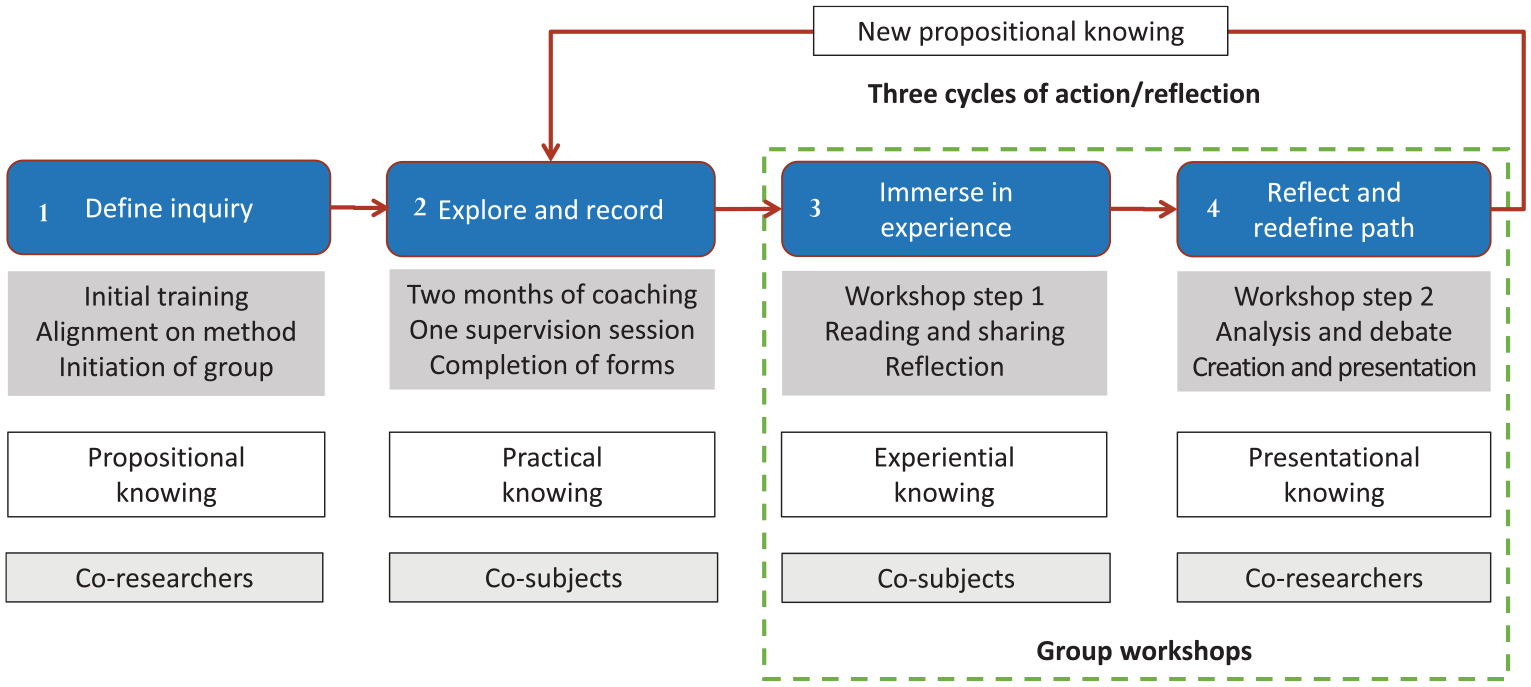
Design of CI in the study.
As discussed in the introduction, the study took place in Cairo, Egypt. The name ‘Cairo’ – as one of the participants noted – is pronounced ‘al-Qāhirah’ in Arabic. It means ‘the conqueror’, but the same Arabic word also means ‘the oppressive’. Cairo is considered to be the largest urban area in the Arab world and Africa, with Greater Cairo being home to over 22 million people. Signs of extreme poverty, gender and religious discrimination and political repression are easily spotted in most of Cairo’s vast area. All the coaches and coachees were locally based in Cairo. The researcher who facilitated the inquiry has lived and worked in Cairo.
Data collection and analysis
Twelve coaches took part in the inquiry. Participants responded to an invitation to join the inquiry group which was posted on several social media and professional networks. They had to meet one of the following conditions: either be currently involved in human development activities and working actively as, or actively seeking to become, a coach or trainer (in Arabic, there is no specific word for ‘coach’; the word for ‘trainer’ is used instead when referring to activities we would class as ‘coaching’) or currently working or have direct access to a community – linked to, for example, NGOs, political parties or awareness-raising initiatives – where they could apply the coaching model on a voluntary basis. While 51 people initially expressed interest, 20 candidates were invited to the first orientation meeting. After presentation of the full inquiry and the commitment required, 12 individuals confirmed their commitment to the full study. They signed research consent forms. Participating coaches chose the names they are represented by in this study.
Over the course of the inquiry, our coaches worked with 22 coachees. Each member of the inquiry sent invitations for coaching in their respective networks. Coaching was offered free of charge, with an estimate of six sessions over 6 months. Coaches explained coaching to prospective coachees as an approach that may help individuals reflect on their personal development and its relationship to their historical and social condition. Coachees had to read a three-page information sheet and sign a consent form to participate in this research. Therefore, both coaches and coachees were fully aware that they were part of a research study on coaching in oppressive contexts. Among the 22 coachees, there were 16 women and 6 men. Most (14 of 22) were Muslims. The youngest coachee was 21 years old, and the oldest coachee was 44 years old.
A total of 87 coaching sessions were conducted during the three cycles of the study. Each cycle included a one-to-one phone supervision session with the researcher. A typical supervision session was 2 hours long and was mainly broken into two parts: a discussion of any issues the coach wanted to reflect on, using a facilitative model adapted from the seven-eyed model of Peter Hawkins and Gil Schwenk (2011), followed by a more structured discussion, where needed, to support the coach in preparing for upcoming sessions. Each reflexive workshop took place over 2 to 3 days. During the workshops, participants shared their feelings, questions and discoveries, collectively analyzed the data and generated new knowledge to take into their practice.
Our project data took the form of reflective journals filled in by the coaches, based on a template adapted from the study by Graham Gibbs (1988) that covered describing sessions from a subjective perspective; recording what happened objectively; analysis of the subjective and objective accounts; critical reflection on the experience and recording the lessons learnt. In addition, coaches were asked to fill in detailed research forms, reflecting on specific aspects of the experience, such as the level of empowerment experienced in the session, or the critical examination of taken-for-granted assumptions. A template was provided that included a matrix with the following questions asked against each of the initial coaching model blocks: How was this aspect present in the session? How do I evaluate it, critically? What do I learn? And how do I understand oppression and development in light of this experience? A total of 57 reflexive journals and 42 research forms were completed. In addition, audio recordings from each workshop were transcribed, and summaries of the transcriptions were brought to the next workshop for discussion. The coaching sessions and the workshops were conducted in Arabic, while the written journals were completed in a mixture of English and Arabic.
As shown in Figure 1, during the workshops, participants were asked to analyze all the journals and forms individually, then discuss themes originating from the content as a group. Between workshops, the audio recordings, transcripts and visual representations were analyzed by the researcher facilitating the workshop, then presented back to the group for validation in the next workshop.
Findings: the reframing of oppression and the implications for coaching practice
We now present our findings on how, over the course of the inquiry, participants reframed their understanding of oppression and the implications this has for their practice of coaching.
At the start of the inquiry, coaches struggled with a number of dichotomies related to the contradictory experiences and assumptions that they were facing. They had questions about the nature of oppression (distant and irrelevant to coaching versus everything and everywhere) and about the responsibility for it (individual versus society). This raised further questions about the respective roles of the coach (neutral facilitator versus invested saviour) and coachee (helpless agent versus blameless victim).
Over the course of the inquiry, it became clearer to participants that their initial views of the world, and their understanding of coaching, were at odds with their experiences in coaching practice; the group thus evolved a view that progressively reconciled the initial dichotomies into a new framework that understood and embraced the contradictions. This was expressed into a dynamic, dialectical understanding of oppression as an intimate multi-layered experience situated in the everyday, where oppression and emancipation happen through reciprocal interactions between individuals and society. This transformed their view of coaching into a practice of criticality and empowerment.
Thus, we present the findings in stages or moves. The first two moves are at opposite ends of the interpretation of practice, creating dichotomist tensions between their different elements (addressed in the first section of the findings). A third move emerges as a way to resolve these tensions, even informing the quest for a further move, built on coaches’ reflection on their overall journey (covered in the second section of the findings).
The experience of dichotomist tensions
First move: oppression as abstract, the fatalism of sadness, blame and self-blame
An initial belief shared by many coaches in our study was that oppression originates in the macro-political level of society in the form of violent aggression that affects people in the most visible ways, similar to their understanding of war or tyranny. Oppression was located in external abstract forces, associated mainly with political dictatorship and religious power. It is notable that the time of the inquiry coincided with political demonstrations in Cairo, involving the use of excessive violence and harassment against protestors, especially women. This situation in the country acted as a common background for describing sources of oppression. For instance, Vana wrote in her reflective journal: ‘What is happening in the country ends up affecting me, and I find myself imprisoned in what is taking place’. Later, she relates how her coachee refers to social violence, as a combination of both Egypt’s patriarchy and religious diktat, as follows: . . . the restrictions the people around her, and the society, are forcing on her. She talked about how she feels restricted as a girl; she can’t laugh, can’t wear what she wants, and can’t be late. For her, it’s illogic, she hates being a girl, Egypt is so patriarchal and she hates it, but she doesn’t know what to do about it.
While the symptoms of oppression, such as the subjugation of women, religious discrimination and so forth, were themes present in the discussions that took place during the inquiry, and coaches were able to relate to them as being relevant to their personal experience, they were not, however, linking these experiences together or seeing these as relevant to their coaching. Rather, these were interpreted as personal struggles, signs of individual incidents and psychological wounds. Consideration of the goals of coachees, and the initial assumptions that coaches had about coaching, did not involve looking at how society affected them: The approach was personal and psychological, rather than social.
Aspects of lives, such as home or work relationships, were presented as completely disconnected within and between coachees’ stories. Neither coaches nor coachees were identifying any links, similarities or trends that could be shared among and across stories. It appeared that the initial perception of coaches was that coachees were experiencing different problems in separate domains. Similarly, coachees interpreted their suffering as being down to their ‘bad luck’, or the unavoidable and deterministic ruling of a greater power. Some coachees tried to find some consolation in their religious beliefs; if God has chosen this life for them, then it must be for a reason, and there was little that could be done about it.
In line with this individual fragmented and distant view, the initial reaction of coaches towards their coachees was, overall, judgmental, with coachees implicitly blamed for who they are. Coaches held the belief that any suffering in people’s lives must be down to the individual’s own shortcomings and bad choices. Coaches assessed their clients as confused, helpless and not in control of their lives, as expressed by Vana: ‘[I see] oppression [in my coachee as] a feeling of weakness and incapability, and it makes the person hate himself, and stops him being happy with his life’. Coaches saw their clients as having begun the coaching journey in a state of surrender to their taken-for-granted social condition. For their part, coachees tended to identify with grief and to magnify pain and sadness. They based their assumptions about the world on the darkest experiences of their lives and used these experiences to ‘prove’ that things could not get better. For Shereen, coachees were deprived ‘the right to dream’. Coachees wanted to change something using coaching, but they did not know what and how to change. They seemed to experience a sense of fatalism, accepting that ‘life is unfair, and my life is no exception’, as one coachee said to Vana. Sarah also explained that, despite his efforts, her client remained in a hopeless state: [The client] is taking a proactive step by coming to these sessions, by running late for Iftar [breaking fast in the Islamic month of Ramadan], all this because he wants to change; yet despite all that, he says to himself what a hopeless case he is, he can’t see hope in anything he’s doing.
Many coachees reverted to blaming themselves for their condition. They expressed a view that any suffering in their lives must be down to their own shortcomings and bad choices. For example, Nadine reflected on how her coachee had interpreted the struggles she faced without reference to gender, bodily or familial dimensions: She didn’t bring up society; her problem was seen as internal, having to do with the specificity of her case. But should I ask about what is behind the situation, her physical problem and her status as single at this age?
In brief, during the early cycles of coaching, and while they reported being shocked at the wide array of ‘oppressive’ stories that their coachees brought to sessions, the coaches were still looking at each case separately and, as neutral judges, trying to find specific reasons in each coachee’s story that would explain the misfortune experienced.
Second move: oppression as ubiquitous, the determinism of despair, saviour and victim
As coaches became more familiar with the concept of oppression as a framework for understanding the world and approaching their coaching practice, they were tempted to move to the other extreme where they saw oppression everywhere and in everything. After the initial exploration of a new vocabulary that was uncommon to their ways of understanding the world, the term ‘oppression’ became ubiquitous, as reflected in the coaches’ journal. For example, Rami noted that ‘I am discovering the existence of oppression in everything’. Nora wrote ‘I now always search for the other side of the story’, suggesting a new approach to her coaching practice. This realization occurred as coaches started to identify patterns and commonalities between their coachees’ stories, as well as their own, with Miral saying: ‘I have no doubts now in social oppression, shared themes are very clear’.
First, coaches noted that, by exploring different dimensions of coachees’ lives, jumping from one story to another, they were able to uncover possible connections between different stories, be it internal assumptions or external oppressive conditions. Through these shared narratives, the group could bring fragmented experiences into a coherent whole. And as the coaches grew in their ability to join the dots, coachees did too. For instance, Vana reported in her journal how one of her clients started to ‘wonder if all her problems are symptoms of the real injury. By asking about many stories, it was very helpful to make her realize the real link between those stories’. In fact, observing this shift – when coachees discovered an underlying factor that explains and links experiences that were previously seen as disconnected – emerged as one of the most inspiring moments in the coaching journey. These moments appeared to be empowering to coachees, as they began to make sense of their fragmented stories, and coaches were touched observing these moments of enlightenment.
Interestingly, the coaches were also discovering how their own stories intersected with one another and with those of their coachees, from the stigmatization of illness, through state censorship and religious discrimination, to sexual harassment and domestic violence. This was illustrated in Nadine’s notes in a reflective form: I felt he had the same problems as me, [. . .] due to his circumstances, I see the typical form of [external] oppression, yet I don’t look at it this way, I see more the internal oppression. I came from different circumstances, and I feel I am trapped in the same place as he is.
Viewing the world through this new lens led to coaches seeing oppression everywhere and questioning their initial reaction of blaming coachees for their apparent helplessness. They started to wonder whether coachees can really be blamed for something external such as oppression. Instead, coachees began to be seen as victims. For instance, Nadine explained how she revisited her initial request to a coachee to ‘write a letter that started with: “I dream, I hope, I love, I choose”’. She ended up pausing and asking herself: ‘But does she really have a choice? Does society give her that choice?’ Thus, she was indicating a level of surrender in the face of the deterministic power of oppression.
This evolution in the approach of coaches is illustrated by one of the most controversial questions that emerged in the inquiry – that is, whether oppression is internal or external. Over the course of the study, coaches engaged in debate about the dynamics of oppression and whether the responsibility for coachees’ conditions falls with the individual, or wider society, and relatedly, whether change can happen individually, or must be at a societal level. During the first workshop, participants debated two opposing positions based on their first encounters with their coachees. On the one side, some subscribed to the ‘internal view’ expressed by Miral that ‘external oppression is not to be acknowledged, as people own their destiny and are responsible for allowing their conditions to affect their lives’ and further endorsed by Samar: There are many stories of success despite adverse conditions, hence, being affected or limited by social conditions reflects personal choice. If people change their beliefs, they will discover that they are completely free to live what they want.
On the other side, others favoured an ‘external’ view. Marianne referred to the ‘deterministic nature of oppression’, while Rami commented more fully: External oppression is present and aggressive. Society exerts significant pressure on the oppressed and they cannot avoid being affected by it. Oppression stops growth and deprives the person of the concept of choice.
For instance, in a group discussion of gender, some blamed females for accepting and surrendering to the unfair conditions they were living in and argued that individuals could choose to get themselves out of these conditions, while others were offended by that position and argued that the all-pervasive nature of social pressures deprives women of the consciousness and the will that are essential for their emancipation.
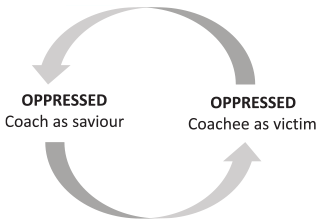
These struggles also led coaches to question the initial understanding of their role as a facilitator and neutral guide. The group discussed the degree to which coaches should step into the relationship as a ‘saviour’ and take an active part in coachees’ stories. Indeed, many coachees sought sympathy from their coaches, as implied by their narratives, in which, as described by Vana, ‘everybody is bad and I’m [the coachee] the only good person on earth’. Thus, increasingly, there were explicit requests for the coach to validate the coachee’s feelings of victimization. Although coachees’ expressions of vulnerability could place a heavy emotional burden on coaches, some nevertheless felt compelled to step in and offer the expected protection to their coachee while also recognizing that this was not a useful position to adopt. In this vein, Nadine commented: ‘I believe that I am not the saviour; however, so far I am acting this way, by assuming that I should help, and by questioning what will become of them if I fail’. More generally, the demands of coachees, and the inclination of coaches to sympathize and to help, raised questions in the group about boundary management in coaching.
Embracing tensions through a dialectical understanding of oppression
Third move: oppression in the fabric of the everyday, agency and structure, empowerment and criticality
Through reflexive discussions on these initial struggles expressed through dichotomist tensions, coaches progressively developed a more dialectical understanding of oppression, which led them to reframe their coaching practice.
Reframing oppression
First, as they moved away from their initial belief that oppression is located in external authority forces and is only experienced as visible physical violence, the group relocated oppression in everyday experiences. For instance, Nadine contrasted the usual perception of oppression as a ‘big word’ to the ordinariness of its experience: ‘It is always viewed as a big word, yet it is present in our daily lives [. . .] Oppression is everywhere, in so many different forms, big or small’. Rather than being seen as a blunt exercise in cruel injustice, the group was beginning to understand oppression as often invisible, hidden in the background and woven into the fabric of everyday life. Sarah depicted it as follows: ‘[o]ppression can hide in so many ways below the radar of awareness. It has so many layers and degrees’. Similarly, Shereen said that ‘[o]ppression doesn’t have to be violent or aggressive; it can take place by just closing the individual’s perception of reality’.
Furthermore, the invisibility of oppression is attributed to the realization that it is performed at home, through one’s close relationships. In Nadine’s words: ‘Oppression can be exerted in small daily doses over a long period of time’. Repeated words included ‘you won’t be able to do it; this might be dangerous.’ For Shereen, oppression was linked to ‘the messages and behaviours of the people around me that are blocking me from being myself and from trying new experiences’.
Group members described how oppressive messages are conveyed through simple social interactions such as advice giving, peer pressure and friendly critique, softly coercing people into a set of pre-defined ‘must and must not do’ behaviours. Sarah saw oppression in the social framing ‘of relationship, of caring, of responsibility’, while Shereen observed that ‘oppression is to willingly let go of what we want to live to fit the social role’.
Oppression is therefore enacted through a connected web of repeated messages, where the self disappears behind social judgement, with such messages often delivered by people in the coachee’s closest circles. The role of the family in this process of socialization was notably highlighted by study participants, as seen in Nadine’s reflection: Society, and ironically the family, plays a major role in oppression. The most dangerous thing is that it leaves traces inside and it becomes self-inflicted, even after the change in the circumstances, so the question is how to liberate the person from herself.
In fact, reflecting on their coachees’ stories, some coaches noted how oppression builds up through daily messages and situations that act to gradually programme the mind. Even when external factors no longer have the same power, some study participants argued that people continue acting in similar ways because it is now part of their identity.
Reframing responsibility
Relatedly, participants’ dichotomist understanding of the ‘responsibility’ for oppression also evolved. After having debated whether oppression was external or internal, the group talked about ‘joint dynamic responsibility’, shared between individuals and society. They created the model in Figure 2 to express their understanding of these dynamics of oppression between the individual and society.
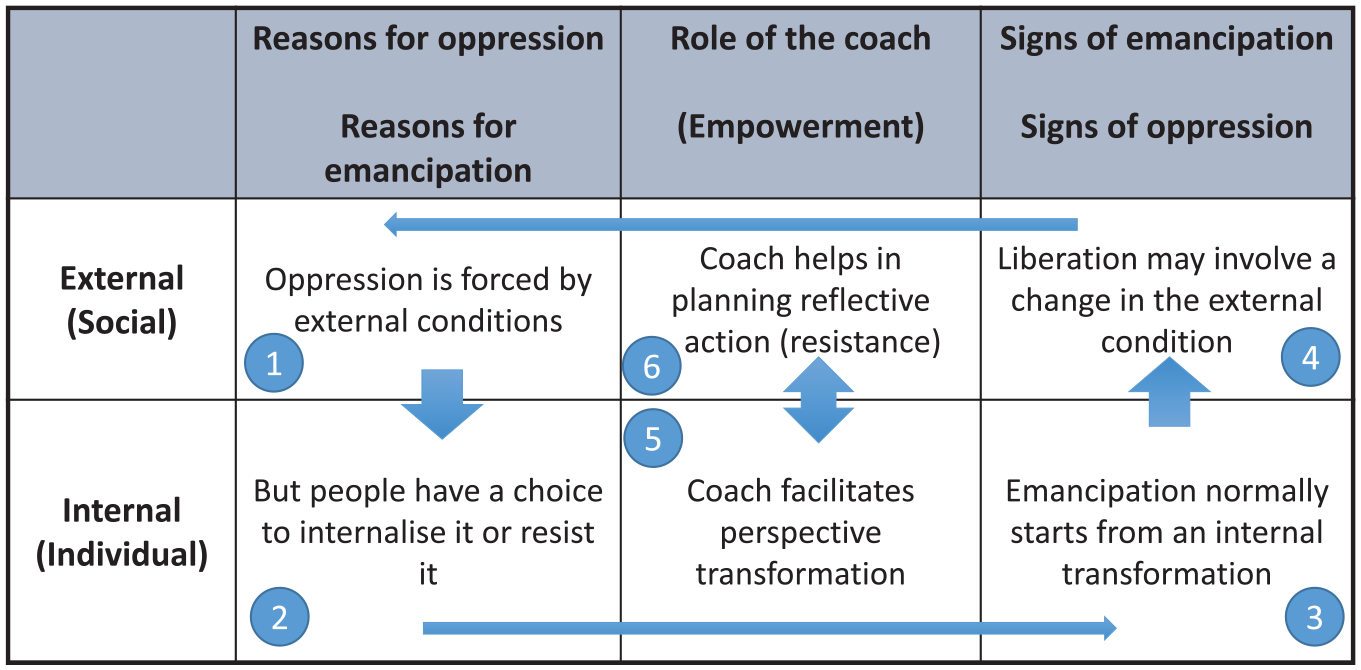
The dynamics between oppression and emancipation as seen by inquiry participants.
The model suggests an interplay between the external and the internal. Participants acknowledged that oppression has social roots: It is not self-inflicted but, rather, is forced by external conditions (1). But a person has a choice whether to internalize oppression or to resist it (2). As oppression is internalized, people lose sight of the concept of choice. So, liberation must normally start from within (3); external improvements in the individual’s social condition may help but are not enough for an emancipatory transformation. Meanwhile, emancipation often demands and drives for a change in the external condition of the coachee (4). The coach has an important role in facilitating both the internal journey of perspective transformation (5) and the external change in the social condition (6). The group emphasized the importance of external action, even if it takes place in latter stages, as Fady reflects: Emancipation is not only about awareness but is also about changing behaviour. I may ‘know’ how to be free and ‘know’ the oppressive chains in my life, but don’t use this knowledge to change my condition.
If external action does not happen, the group argued, the cycle of emancipation can be broken: There is an initial stage of change where all can fall, but once this critical threshold is passed, there is no way back. (group exchange)
Hence, participants argued that, while people are not responsible for their oppression, they need to take responsibility for their emancipation from it and for changing the conditions that oppressed them. For the group, the model resolved the debate about acknowledging the oppressive element of social structures without denying their coachees’ agency.
Reframing coaching practice
This renewed dynamic understanding of oppression led coaches to reconsider their view of coachees. The fact that oppression is externally inflicted then internalized does not remove the responsibility to liberate self and others. Therefore, coaches started to view their role as striking a balance between empowerment and criticality, to challenge the internalized oppression by supporting the oppressed in his or her emancipation. As Nadine comments on a session where she helped her coachee critically challenge many assumptions: In cases of low-self-esteem, and that level of oppression, I think, criticality and empowerment should go hand in hand.
This concerned, for instance, the framing of goals in coaching. In place of their initial view of coachees’ issues and related goals as purely personal, the coaches now noted how their coachees’ sense of agency and empowerment was affected by their social condition, and how, in turn, this affected the types of goals they brought to the coaching arena. Many coachees focused on goals that conformed to society’s expectations (e.g., wanting to get married to avoid the social rejection of spinsterhood), and coaches realized that there was a need to challenge the extent to which coachees’ goals are driven by social pressures.
The issue of goals also triggered another interesting conversation about coaches’ role. As coaches came to realize that oppression often took place through daily interactions, in both personal and professional realms, they started to wonder to what extent they themselves were also a source of prescription and a figure of authority. This led to a more fundamental questioning of the coach–coachee dynamic. While initially coaches tended to view their role as that of a neutral-sounding board, as their understanding of coaching became more politicized, they also started to notice their power and their influence.
With this in mind, the group discussed the degree to which coaches should step into the relationship as an ally rather than as a neutral guide. This manifested itself in exposing vulnerabilities and sharing stories with coachees. Here, the coach’s disclosure of some aspects of their own experience related to the oppressive environment was seen as empowering by the coachee, as coachees felt that someone in similar circumstances could better understand their experience. With increased awareness of the nature and dynamics of oppression, coaches reframed their understanding of sharing their situation from selfish self-disclosure and the rescuing of the self-victimized to a political act of resistance. This was a first political act, testifying to their reframed understanding of oppression and the role of collective action.
They also reconsidered the ‘victim identity’ of coachees and their need for sympathy. Coaches said that it may in fact be beneficial to start the coaching process by offering empathic listening and support, as long as the relationship evolves to examine and challenge self-victimization assumptions. Both coach and coachee need to walk a fine line between acknowledging the right to be affected by injustice and ensuring the coachee takes responsibility for their future and feel more empowered and resourceful over the course of the coaching journey. This was summarized by Vana as follows: Development happens when the person accepts that his nature is not the problem and starts to recognize that he is capable and has strength. One can only move forward when one discovers that he does not have to be a victim to be loved, and that being oppressed does not have to be his identity.
This new understanding opened windows of hope in the closed chamber of social oppression, as Shereen commented: I am amazed at the value and richness of the coachees. Despite oppression, there are still a lot of good answers inside their hearts. I celebrate hope. There is always resistance inside oppression.
In summary, by adopting a critical lens, coaches examined the influence of social oppression on their clients and themselves. They recognized how oppression permeates daily messages and microaggressions within the social system. Coaches navigated the tension between agency and structure, moving beyond simplistic blame or determinism. They identified the impact of social conditions on clients’ behaviours and beliefs, developing strategies to address these effects. Coaches also explored the intersections of their own stories with clients’ stories. Finally, they reflected on how the coaching relationship is influenced by oppression and devised methods to support clients’ empowerment. Overall, coaches expanded their understanding by situating coaching within a broader political and social context, delving into aspects often overlooked in individualized and performance and psychologically based analyses.
Quest for the next move
In the final inquiry workshop, coaches further reflected on how they evolved in their understanding of the political role of coaching. They saw coaching as a mechanism for fighting oppression from the grassroots but noted that it can also be a mechanism for affirming oppression if the coach fails to recognize the dynamics and implications of living in an oppressive environment. Over the course of the inquiry, their theory progressed from analysis to action. They created links between coaching and political change, suggesting that a process of political change starts with liberating the individual, as articulated by Marianne, one of the coaches: ‘A revolution starts with small steps like the ones we’re doing with our coachees’. In fact, coaches realized that, when coaching for emancipation, they need to attend to both the internal and external worlds of the coachee. Internally, this meant facilitating the process of perspective transformation, especially with the importance of hope in supporting the agency of coachees. Externally, this meant supporting the planning of actions aimed at achieving change.
Perhaps more importantly, while the group agreed on the value of having a coaching model, they realized the importance of going beyond tools and processes, towards a reflective, collective, critical and continuously evolving practice. They realized that their experiences took new meanings and perspectives as they were being shared with the group, exposing hidden macro dimensions in the individual coachees’ stories, and providing them with support, calling the room where the reflective sessions were held ‘the room of hope’. For the group, the inquiry process became more than a research project. It became a way of practice for them to get together to immerse themselves to discover how their experience related to the world: The critical reflection we go through is a way of cleaning our inside to reach our inner voice. And once we reach it, we find out how clear and pure, but also naked and vulnerable it is in front of the outside world. (group exchange)
Initially expressing their doubts over the usefulness of theoretical research in the all-pervasive nature of oppression, they noted how empowering and liberating it was to come together in recurrent cycles, reflecting on their individual stories under a critical social lens and taking the learning back into their practice: The fact that a process can generate this is a big discovery. Seeing the outcome building up and relating to it, the concept of hope became real – it was always theoretical, but I saw it, I saw development happening. (group exchange)
Discussion: the politicization of coaching
The reframing of oppression through a Freirean lens led participants to politicize their practice of coaching. As their understanding progressed from an individual model (first move) to a social model (second move) and to a multi-layered model of reciprocal interactions between the individual and society (third move), coaches moved away from a neutral understanding of coaching, which allows only personal and psychological treatment, to a socially and politically aware understanding of power, where context matters for coaching practice. We therefore argue for a conceptualization of coaching as a social practice (next move).
Dialectical relationships of oppression and emancipation in coaching
The understanding of oppression as an everyday experience, seeping into the cracks of social and intimate life, sheds light on one of its less-recognized dimensions, well evidenced by Freire: that oppression is also, or first and foremost, a dynamic and contextualized experience, infiltrating everyday life, in terms of being a connected web of pre-suppositions that often act silently in the background, below the radar of awareness (Habermas, 1987). Oppression permeates the web of interactions that deliver a continuous flow of messages, gradually depriving the individual of the concept of choice, from the goals we set ourselves – in coaching sessions, for example – to the representation of the self. These interactions are, in fact, the results of social ‘prescription’ (Freire, 1970: 47), representing ‘the imposition of one individual’s choice upon another, transforming the consciousness of the person prescribed to into one that conforms with the prescriber’s consciousness. Thus, the behaviour of the oppressed is a prescribed behaviour, following as it does the guidelines of the oppressor’. Oppression is, in this way, pervasive (woven throughout social institutions and embedded within individual consciousness), restrictive (shaping a person’s life chances and sense of possibility), interrelated, internalized and invisible (Bell, 2007).
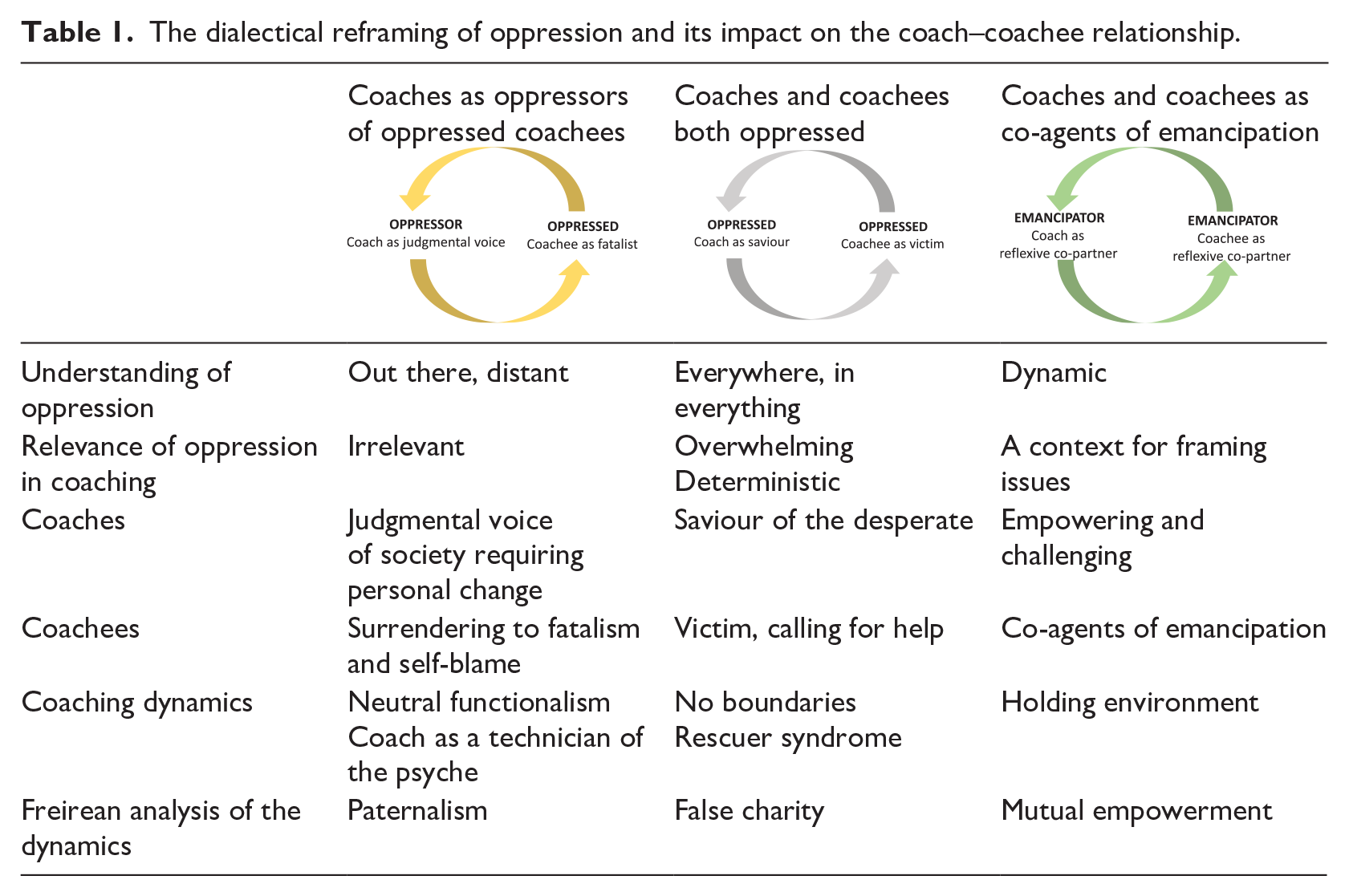
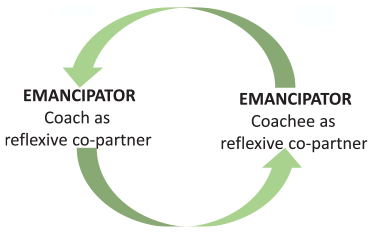
Through praxis, a dialectical understanding of oppression and emancipation in coaching was possible, both refuting and reconciling two contradictory interpretations. The first and second moves presented in our findings reflect the unhealthy dynamics of oppressed–oppressor and oppressed–oppressed relationships between coach and coachee. However, a dialectical understanding allows the coach–coachee relationship to become one of co-agents of emancipation, as represented in Table 1.
The dialectical reframing of oppression and its impact on the coach–coachee relationship.
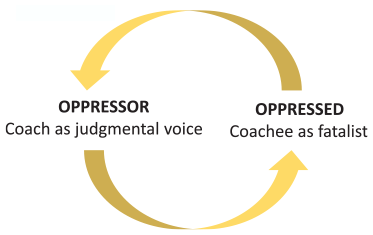
Coaches as oppressors of oppressed coaches
These first dynamics mostly relate to the circumstances of participants at the start of their praxis. Associated with an external authoritative entity, oppression is outside the scope of coaching with a focus on psychological wounds and performance issues. The understanding of topics and goals brought to coaching sessions is filtered through a functionalist psychological lens, where the coach is a technician of the psyche (Western, 2017). Coaches’ core objective is to apply psychological tools and techniques to help coachees achieve personal performance goals. Coaches act as ‘empirical scientist[s]’ (Hurlow, 2022: 123), shaping desired behaviours. The judgmental attitude of the coach towards the coachee – regarding him or her as ‘not good enough’ to adapt and thrive within the system – makes the coach the voice of the oppressor. Coaches are conveying a psychologizing discourse (Fatien Diochon and Lovelace, 2015), implicitly blaming coachees for who they are, while holding out a promise to help them thrive within the system. The paternalistic behaviours of coaches maintain coachees in a state of dependence (Freire, 1970). In fact, both coach and coachee perform roles that sustain each other: The coach offers a judgmental voice, justifying the insufficiencies of the coachee, who in turn is anchored in fatalism and surrenders to their taken-for-granted situation. The fatalist attitude of the coachees echoes Freire’s observations of the dynamics in literacy circles, wherein he also noted that the oppressed were immersed in a culture of silence and were more likely to attribute their situation to fate or to God’s will than to social relations of exploitation (Freire, 1970). Through these interactions, the coach comes to represent the voice and the image of the oppressor which has been internalized by the coachee and prevents them from attaining freedom (Freire, 1970).
Both coachees and coaches as oppressed
Our findings show that coaches were drawn to another extreme as they got acculturated to Freire’s idea of oppression. Through this lens, oppression became a prevailing presence, seen everywhere and in everything. However, this vision was in a way paralyzing, potentially leaving coaches puzzled and ‘lost in translation’: They did not know what to do with this overwhelming presence of oppression in their coaching relationships. They felt that both themselves and their coachees were oppressed, which gave way to a cycle of victim–saviour dynamics. Even if they were uncertain that it was the right attitude, coaches were tempted to rescue their clients, who were themselves asking for validation of their feelings and implicitly expecting to be rescued by their ‘hero’ coaches.
We are faced with a classic syndrome in helping relationships including coaching, that of the rescuer syndrome, termed a ‘disease to please’ by Harriet Braiker (2001), in which the ‘need to help [potentially becomes] an addiction’ (Korotov et al., 2012: 26). While, in coaching, ‘the desire to help people is a very laudable one, and compassion, service and dedication are real virtues’ (Korotov et al., 2012: 25), this altruism can be problematic when it becomes misplaced (Freire, 1970). Freire argues that those aiming to liberate should not fall into the trap of ‘false charity’ (Freire, 1970: 45) that makes so-called oppressed the objects of their ‘humanitarianism’, as this itself ‘maintains and embodies oppression’ and is an ‘instrument of dehumanization’ (Freire, 1970: 54). Freire comments further on the implications of false charity as follows: False charity constrains the fearful and subdued, the ‘rejects of life’, to extend their trembling hands. True generosity lies in striving so that these hands – whether of individuals or entire peoples – need be extended less and less in supplication, so that more and more they become human hands which work and, working, transform the world. (Freire, 1970: 45)
Adopting helpful helping behaviour requires the coach to work on self, something which is identified as a prerequisite for good practice in coaching (Bachkirova, 2021).
Coaches and coachees as co-agents in emancipation
Contrary to the previously outlined dynamic, which is an ‘attempt to “soften” the power of the oppressor in deference to the weakness of the oppressed’ (Freire, 1970: 44) and constitutes, in itself, violence, ‘even sweetened by false generosity’ (Freire, 1970: 55), our third dynamic is closer to supporting humanization and closer to Freire’s idea of ‘true generosity’. It is based on the restoration of ‘the individual’s ontological and historical vocation to be more fully human’ (Freire, 1970: 55). In our study, this implied a dynamic and contextual understanding of oppression, framed as an intimate experience, with joint responsibility for both oppression and liberation. This required coaches to have the ability to link history and personal biography and private problems and public issues (Lankshear and McClaren, 1993).
This third view repudiates both the denial of oppression implicit in the first relationship and the surrender to its determinism, implicit in the second. As Freire sees it, coaches are invited to embrace history as a possibility (Mayo, 2004), with the hope that it can be modified (Schugurensky, 2011). Coaches can therefore pave the way for individuals to discover themselves, the world and new possibilities, through processes of ‘deconstruction and reconstruction’ (Dubouloy, 2004: 492). As we saw in our data, this required a subtle balance between support and challenge from coaches. Support is key to allowing the coachee to feel ‘sufficiently secure in order to advance’ (Dubouloy, 2004: 492) when coaches, as ‘collaborative sense makers’ (Hurlow, 2022: 130), engage their clients in reconsidering their assumptions. They will help in the rewriting of the client’s narrative, and their own. Some authors point to the usefulness of thinking of coaching as a transitional space or, more broadly, as a ‘holding environment’. Holding environments are ‘social contexts that reduce disturbing affect and facilitate sensemaking’ (Petriglieri and Petriglieri, 2010: 44). They provide a safe and reassuring space to explore diverse points of view and help ‘transform conflict and paradox into a dialectical approach of the world’ (Dubouloy, 2004: 477). The coach is a ‘container’ facilitating change, functioning as a receptacle for projections, representations and ideals and preventing this environment from becoming one of normalization and homogenization (Amado and Ambrose, 2018). Both coaches and coachees will in fact offer each other support, which is key to the process of liberation. Indeed, as Bobbie Harro (2000) argues, if we try to liberate ourselves without support, we might fail: ‘We need to practice using our skills and tools with others, and experiment with expressing our new views, and speaking out when we disagree, instead of staying silent’ (p. 466).
The possibility of acting as co-agents of emancipation highlights a number of questions that need careful attention. Indeed, growing up in an oppressive environment may result in a real or perceived vulnerability on the part of the coachee. Power imbalances between coach and coachee need to be carefully addressed in order not to generate harm. For instance, in our study, all supervision calls included questions about signs of coachees being too vulnerable for an equal coaching relationship. Power relations, combined with the emancipatory intention of coaching, led to another question about whether the coach’s agenda might stand in the way of the coachee’s needs.
Also, while coachees may feel they have more confidence and agency because of the enabling coaching environment, this does not automatically make them any more able to face the external world, unless they use their empowerment to engage in a critical analysis of their experience and to plan and act to change their oppressive conditions. Therefore, there might be false signs of emancipation. As Tom Inglis (1997) warns, a focus on empowerment may contribute to making people act successfully within the existing system and structures of power, rather than leading to them critically analyzing, resisting and challenging them.
Finally, in the context of oppressive environments, there are often social repercussions for those who wish to challenge oppressive structures. It is therefore important for coaches to ensure that their coachees consider the implications of their actions and choose what is best for their wellbeing.
These questions suggest the need to go beyond the reframing of oppression and the coach’s role towards a conceptualization of coaching as a social practice, as we next discuss.
Coaching as a social practice
A dominant portrayal of coaching is apolitical (Hurlow, 2022), with a preoccupation of its techniques. This is a strong denial of what Denis Goulet (2021: x) reminds us, that practice cannot be abstracted from its political background, and that practitioners should always think of ideology before methodology. He recalls that ‘Freire insists that methodological failings can always be traced to ideological errors’. Our findings support this warning by showing how coaches’ reframing of oppression and the responsibility for it guided a new attitude and role. In particular, coaches highlighted the need for processes to help coachees with the identification of oppression, the reformulation of personal narratives and the planning of actions to change social conditions.
This calls for positioning coaching as a social practice. Coaching is social (Shoukry and Cox, 2018) as it is both ‘made’ by society and ‘makes’ something for society, a double movement well documented by Scarlett Salman (2019), which is often a condemnation of coaching by critical scholars. Indeed, in her recount of the professionalization of coaching, Salman shows how coaching has been discursively positioned over the years as a ‘solution’ to several socially constructed organizational ‘problems’ to justify its use. This double movement takes a negative connotation, where the contribution of coaching has been analyzed as a superficial band-aid treating only symptoms (Fatien Diochon and Lovelace, 2015), a palliative to help managers cope with dysfunctional systems (Salman, 2021), which is summarized with the potential consideration of coaching as a ‘Pharmakon (. . .) an evil included in the remedy itself’ (Arnaud et al., 2022: 9). However, we contend that coaching has the capacity to fulfil its emancipatory potential if it precisely acknowledges and integrates the social dimension into its core framework.
To do so, coaching cannot be only deducted from a priori models taught in abstraction. Rather, the intertwining of theory, application and reflexivity is essential. These elements are all interconnected and inseparable because a priori theoretical position fails the empirical test when practitioners run into complexities that require adaptation and adjustment (Fatien Diochon and Nizet, 2019; Fatien et al., 2022). This was well evidenced in our study when the coaches engaged with the inquiry not only as a research project but also as a way of living their practice. This therefore calls for approaching coaching as practice with a focus on the doing, the immanent co-construction, coping and negotiation which takes place (Case and Śliwa, 2020). Approaching coaching as practice moves away from mechanistic, abstract and isolationist approaches to rather embrace lived experience in context.
Now, adopting a social practice approach to coaching means bridging the macro focus of the social and the micro perspective of the practice. Coaches use their micro-level experiences to gain a broader understanding of the world, which then should be utilized to empower their coachees in their individual journeys. This was well illustrated in our study where coaches immersed themselves in the intricacies of their interactions, emotions, actions and words, responding with openness and flexibility to address the specific needs of their local context and engaging in a critical yet empowering analysis of their experiences. We argue that while methods and tools are important, a social practice approach to coaching is the key to navigating the complexities of the social landscape while tending to the nuanced needs of the individual.
Approaching coaching as a social practice raises considerations for coaching educators and supervisors. Education programmes would benefit from adopting a critical socially aware lens, using conceptual tools from fields such as critical pedagogy (Freire, 1970). Also, there should be a focus on the development of coaches’ understanding of the world and of their role as coaches within the social context. Educators and supervisors should consider engaging coaches in a praxis that is intentionally critical and participatory, where they come together to reflect on their experiences and are encouraged to challenge their existing worldviews and to co-design a new practice that responds to the real needs of their coachees.
Conclusion
Anchored in a Freirean lens, this article studied coaching as a non-neutral approach to change, building on calls to document and challenge its contribution to its larger context of operation. Our empirical study investigated how the reframing of oppression by participants engaged in a Freirean coaching praxis leads them to reconsider coaching. We answer by saying that they reframed their practice as social. We indeed showed how coaching can be a conduit in an oppressive system, with the coach acting as the ‘voice of the oppressor’, maintaining coachees in a state of fatalism, in which they accept an individualization discourse that says that they need to change and adapt. But we also evidenced that both coachees and coaches can be complicit in oppressed relationships, when they perform victim–saviour roles. Finally, through reframing of oppression as something interwoven into the daily experience, coaches and coachees could take more responsibility in the process of oppression and emancipation, acting as reflexive co-partners in progressing towards greater freedom. On this basis, we argue that coaching should be understood as a social practice, a politically loaded activity performed in situ, in a recursive movement of production within a larger societal context.
