




Abstract
An increasing number of academic scholars have been espousing a decolonial stance, seeking to address the so-called coloniality of power/knowledge. Yet, this path is far from cleared in critical management research and education, where we find a substantial number of studies bringing post-colonial arguments to the debate, but very few engaging with decolonial thinking. In this essay, we highlight the contribution of Paulo Freire to the decolonial debate through the concept of metodologia otra, a notion that questions the hegemony of Western-based methodologies and challenges the modern/colonial matrix by carving out spaces for those who have suffered a long history of oppression and marginalization to communicate from their own frames of reference. We argue that more than being critical, reflexive, or dialogical, a concrete engagement with decoloniality means mobilizing radical principles such as learning to unlearn, escrevivência, interculturality, and corazonar/sentipensar. Although Freire’s contribution to the construction of metodologia otra was original and pivotal, this contribution is poorly known. By salvaging Freire’s contribution in this special issue, we move decolonial concepts and values from the margins to the center of postcolonial debates within critical management studies and critical management education communities.
Keywords
Introduction
The last time I saw and spoke with you in living person Paulo, was at your 70th birthday celebration at New York’s New School for Social Research. Hundreds of us gathered to celebrate you [. . .] as you spoke, you cried [. . .] you cried because crying—as loving—is an emotion and a feeling that is constitutive of being human and of course, of humanizing pedagogies as well; as such, they need not—should not—be hidden. With this action, you reminded us that being a critical educator and thinker means being with and in the world. It means understanding oneself in a constant process of becoming where the “critical” is not a set postulate or an abstract of thought. Rather, it is a stance, posture, and attitude, an actional standpoint in which one’s own being and becoming are constitutive to the acts of thinking, imagining, and intervening in transformation; that is, in the construction, creation, and “walking” of a radically different world.
Postcolonial ideas are increasingly debated in critical management research and education, serving to reveal the power/knowledge imbalances underlying a symbolic and material architecture that tends to present itself as universal (Alcadipani, 2017; Banerjee, 2021). Postcolonial theory uncovers the power relations concealed in an episteme “largely constructed from a central (Western) position that views the rest of the world as periphery” (Fougère and Moulettes, 2012: 6). Thus, postcolonial theorists have addressed numerous issues, such as globalization (Banerjee et al., 2009), workplace diversity (Prasad, 2006), organizational control (Mir et al., 2003), as well as themes like silencing of the “Other” (Calás, 1992), hybridity (Frenkel and Shenhav, 2006), and anthropophagy (Islam, 2012), to cite a few.
A lesser-known stream under the broad postcolonial umbrella is decolonial studies, which originated in Latin America (LA) and was consolidated in the 1990s. Among other critical issues, decolonial scholars have analyzed how the epistemologies created by the Global North have promoted processes of epistemicide around the world (Lander, 2005; Santos, 2009). Decolonial concepts have inspired a growing number of academics and practitioners, from not only LA but also Africa and New Zealand, seeking to break with the Western-based epistemic hegemony and to highlight the existence of alternative voices/knowledge, thereby promoting a lively and impassioned debate (Arias, 2012; Chilisa, 2012; Mignolo, 2008; Ortiz Ocaña and Arias López, 2019; Restrepo and Rojas, 2010; Solano and Speed, 2008). At the heart of the decolonial debate, we find the concept of metodologia otra (“methodology other” in English; we retain the Spanish spelling in this essay to preserve its semantic/political resonance). Metodologia otra means conducting research and education in such a way that those who have suffered a long history of oppression and marginalization have the space to communicate from their own frames of reference (Ortiz Ocaña et al., 2018). It is a way of creating and sharing knowledge that starts from the perspectives and emotions of populations that have been historically silenced by coloniality. The expression was first used in 2018 by Alexander Ortiz Ocaña, Maria Isabel Arias López, and Zaira Pedrozo Conedo—all from Colombia. For them, existing research proposals were insufficient and did not guarantee the development of a genuine decolonizing process. So, they propose the formulation of a metodologia otra, inspired by Walter Mignolo’s idea of “paradigm other.” As discussed below, Mignolo (2003) defines the “paradigm other” as heterogeneity in ways of critically thinking about colonial reality. He refers to a paradigm that takes into account local histories whose epistemic potential has been hidden, denied, or ignored. In this sense, the subverting of grammar through reversing the standard order of the words “other” and “method” in the expression marks a change of viewpoint, a rupture (Mignolo, 2003; Oliveira and Candau, 2010).
In this essay, beyond compiling and organizing the main tenets of metodologia otra, we identify the contribution of one of the most influential Latin American-born educators: Paulo Freire. We argue that while his work is well known for its critical pedagogy (Dal Magro et al., 2020; Perriton and Reynolds, 2018; Trott, 2013), it is notably less known for its crucial contribution in proposing principles and practices aligned with decolonial studies. Freire’s writings have nourished decolonial principles and practices operationalized by scholars seeking to engage with decolonial work. Drawn particularly from LA (Barbosa, 2019; Walsh, 2015a) but also from North America (Reynolds, 1998; Tight, 2000) and Africa (Chilisa, 2012; Ibrahima and Mattaini, 2019), these scholars help challenge the modern/colonial matrix that still characterizes management research and education. The research question motivating our essay is: What is Paulo Freire’s contribution to operationalizing a metodologia otra and to advancing/promoting decoloniality in critical management research and education?
In answering this question, we offer a twofold contribution. The first is to outline the influence of Paulo Freire in terms of the decolonial debate. By examining his work, we conclude that a concrete engagement with decoloniality means not just being critical and reflexive but also practicing a metodologia otra. We show that metodologia otra challenges critical management and education studies by questioning the hegemony of Western-based methodologies—even those of a critical genre—and by demonstrating how decolonial scholars create and transform knowledge that is often relegated to a marginal status or simply ignored. We argue that although Freire offered a crucial and original contribution in the construction of metodologia otra, this contribution is poorly known. By salvaging Freire’s contribution regarding this particular issue, we move decolonial concepts and ideas from the margins to the center of postcolonial debates within critical management studies (CMS) and critical management education (CME) communities.
Our second contribution involves not confining ourselves to conceptual discussion but going deeply into how metodologia otra might be operationalized. This begins by identifying concrete radical principles—learning to unlearn, escrevivência, interculturality, and corazonar/sentipensar—that represent original values which are definitively outside-the-box of the Western episteme. They illustrate why being critical, reflexive, dialogical, and even affective is insufficient to promote decoloniality. We then identify practices that have been experimented with by decolonial scholars to operationalize radical principles, thereby advancing an actionable understanding of researchers’ activities and roles within a metodologia otra perspective. This represents an important step in enhancing consideration of possible methodological paths for a decolonial approach that can be reconfigured and (re)appropriated by researchers in varied locations.
This theoretical article is structured as follows. First, we present the historical path going from postcolonial to decolonial studies. Then, we broaden the exploration of Paulo Freire’s contribution to the development of pertinent research and education strategies. We present a summary of our insights in the form of actionable principles of a metodologia otra, opening new avenues for research and practice. We conclude with some considerations regarding challenges and alternatives for further discussion.
Theoretical background
From postcolonial to decolonial perspectives
The so-called canonical or Anglo-Saxon postcolonial studies were inaugurated in 1978 with the work of the Palestinian intellectual Edward Said (1990 [1978]). Through discursive analysis of European literary texts, Said’s book “Orientalism” demonstrated the invention of the East by the West as a strategic stereotype for the maintenance of European colonial power (Castro-Gómez and Grosfoguel, 2007). In so doing, Said helped enhance our understanding of the “historical process of colonization and the Occident’s constitution of the Orient” (Fougère and Moulettes, 2012: 7). Proliferating worldwide during the 1980s, postcolonial arguments were strongly influenced by cultural and subaltern Indian studies, as well as by post-structural, postmodern, and deconstructivist views. Besides Said, other influential authors are the Jamaican sociologist Stuart Hall, the Indian intellectual Homi Bhabha, and the Indian critic and theorist Gayatri Spivak (Ballestrin, 2013).
In 1993, seeking to insert LA into this debate, a group of intellectuals founded the Latin American Subaltern Studies collective. Although the collective was disbanded due to theoretical divergences in 1998, that year also marked the first meetings among academics who would later form the Modernity/Coloniality (M/C) group (Ballestrin, 2013). The establishment of the M/C group promoted a new strand within postcolonial studies, one known later as decolonial. Thus, decoloniality is a broad field of inquiry embracing political and epistemic resistance to coloniality (Escobar, 2003; Walsh, 2008).
While the earliest writings on postcolonialism had a strong connection with national liberation struggles and independence movements (especially in Africa and Asia), the origins of decoloniality as a political project can be found in the long tradition of resistance by black and indigenous populations since the conquest of the Americas in the 16th century. However, its formulation as an analytic-academic project became widely known among Latin American researchers in the 1990s with the advent of M/C (Bernardino-Costa and Grosfoguel, 2016).
“Coloniality,” a concept introduced by the Peruvian sociologist Anibal Quijano in the early 1990s, refers to a model of ongoing global power—a new world order—which began with the European invasion of AbyaYala and the formation of the Americas and Caribbean, and has as its foundation the idea of “race” (and Eurocentrification) as the base for the social classification and the control of subjectivity, labor, nature, the relations of gender, and the perspective of knowledge. (Walsh, 2015a: 12)
A key concept of decolonial thinking is the coloniality of power. Elaborated by Quijano in 1989, it refers to the “continuity of colonial forms of domination after the end of colonial administrations” (Grosfoguel, 2008: 126). It considers the system of racial/ethnic/sexual hierarchization of the world population, formed during several centuries of European colonial expansion, to be the transversal principle of all global power structures (Castro-Gómez and Grosfoguel, 2007; Quijano, 2009). After Quijano, M/C authors have extended the concept of coloniality to other dimensions, namely, the coloniality of being (Maldonado-Torres, 2009; Walsh, 2008) and coloniality of knowledge (Castro-Gómez, 2005; Lander, 2005). This latter seeks to highlight the epistemic dimension of coloniality: the imposition of modern Western thought as universal, resulting in the subalternization, folklorization, and invisibility of a multiplicity of practices and knowledge (Restrepo and Rojas, 2010).
The imposition of Eurocentric thinking, which shaped modern science, resulted from an epistemological intervention violently imposed on colonized peoples (Santos, 2009). Under the pretext of its “colonizing mission,” European colonialism sought to obliterate cultural differences and diminish the planet’s epistemological, cultural, and political diversity, thereby promoting a process of world homogenization. Then followed globalization, preserving central–periphery positions with their structures and dependencies and maintaining a deeply entrenched mental conditioning enacted almost unconsciously (Joy and Poonamallee, 2013).
For Boaventura de Souza Santos (2009), this process can be characterized as an epistemicide. It represents one of the most effective and enduring instruments of ethnic/racial domination by denying forms of knowledge held by certain groups. Santos argues that modern Western thinking is abyssal, that is, it divides social reality into two distinct universes: “this side of the line,” made up of experiences, knowledge, and social actors considered valuable, intelligible, and visible, and “the other side of the line,” encompassing those considered useless, dangerous, or unintelligible. Axiomatic to abyssal thinking is the impossibility of the co-presence of both sides of the line. Thus, the positioning of Eurocentrism as the sole knowledge perspective precludes the existence of other epistemic rationalities and knowledge (Walsh, 2008).
Given the transformation of the ways of producing and adhering to knowledge, Mignolo (2008) developed the concept of epistemic disobedience. This is a political and epistemological stance that involves taking on the knowledge silenced by modernity (Grosfoguel, 2008; Mignolo, 2003). Epistemic disobedience is the path toward what Mignolo (2003) defines as “paradigm other”: critical forms of analytical thinking and projects arising from experiences marked by coloniality. In this context, the word “other” refers to an alternative perspective and a change of viewpoint (Oliveira and Candau, 2010). The paradigm other does not intend to represent a new truth but, rather, to subvert the idea that paradigms succeed each other, overcoming and replacing the previous ones (Ortiz Ocaña et al., 2018) This is seen as a decolonial ontological shift that leads to the recognition of a multiplicity of valid, non-hierarchical perspectives based on the protagonism of subaltern subjects, their systems of thought, and their linguistics.
We find numerous authors espousing postcolonial perspectives in CMS (Banerjee, 2021; Banerjee and Prasad, 2008; Boussebaa et al., 2014; Cook, 2004; Frenkel and Shenhav, 2006) and CME (Abreu-Pederzini and Suárez-Barraza, 2020; Fougère and Moulettes, 2012; Harney and Linstead, 2009; Joy and Poonamallee, 2013). However, only a very few adopt a decolonial perspective (Alcadipani et al., 2012; Faria and Marcus, 2021; Ibarra-Colado, 2006; Manning, 2018; Misoczky, 2011).
Misoczky (2011) provides a taste of the work of this group, by analyzing the process toward epistemic homogeneity that the alliance between modernity and rationality has brought to LA. She emphasizes all the resistance struggles promoted by indigenous communities and how those decolonial struggles might lead to a renewed order that incorporates multiple and disparate worldviews. In her provocative work, Manning (2018) becomes a decolonial feminist ethnographer to engage in research with marginalized “others,” identifying positionality and representation as key complexities of the process, and offering an alternative approach that recognizes the cultural, social, and historical location of participants. She embraces key concepts of the LA decolonial stream—for example, coloniality of knowledge—to argue that the field of organization and management studies rarely acknowledges non-Western experiences, leading even scholars from the Global South to limited engagement with indigenous knowledge. She argues that broader attention in the field should be given to the importance of constructing a different knowledge from the perspective of otherness. Ibarra-Colado (2006) also underlines the relevance of recognizing otherness, which brings the understanding that even if globalization, an ultimate phase of coloniality, seems to eliminate differences, evidence exists that particularities of local realities remain and multiply. Similar to Misoczky (2011), the author talks about resistance and emancipation and the need to move toward a different modernity.
The original work of the scholars cited above evokes the potential that decolonial thinking represents, which is why we position our essay in this trajectory, highlighting Freire’s scantily known contribution to this political project and showing the timely relevance of metodologia otra.
Uncovering the contribution of Paulo Freire
In the search for ways to overcome the reproduction of power/knowledge structures of domination that characterize decolonial studies, one Latin American educator and philosopher stands out: Paulo Freire—considered one of the most remarkable thinkers in the history of world pedagogy. In his more than 40 years of intellectual production, he denounced various aspects of coloniality, such as violence, dehumanization, and political authoritarianism. Such criticism touches pedagogical, sociological, anthropological, political, ethical, and epistemological issues (Mota Neto and Streck, 2019).
Freire (2001 [1968]) criticized the supposed neutrality of science, arguing that when the researcher does not take a stand against the perpetuation of domination and oppression, he or she contributes to perpetuating social inequality and colonial expropriation. Along with sociologist Fals Borda, he was a precursor of the so-called engaged research, an investigation practice included in the theoretical-methodological framework of action research (Pozzebon, 2018). In this perspective, research goes beyond providing a solution to a specific problem; it must contribute to overcoming the various forms of exploitation and domination. It is taken for granted that the research process cannot be about penetrating another’s experience for purely academic purposes but, rather, demands a political and social commitment to the subjects, groups, and communities as protagonists of that process (Bringel and Maldonado, 2016; Costa and Alves, 2020). Therefore, theory and practice function simultaneously and with the same critical, liberating purpose.
Although in her “Notes to Paulo Freire from AbyaYala,” Catherine Walsh (2015b: 4–5) contends that in some respects, Paulo Freire’s critical pedagogy and popular education could be seen as “Western-modern constructions,” she ends by admitting that “this is not to say that your referents, Paulo, were only of the West, or that Western modernity was necessarily your project.” The author recalls that particularly after his lived experiences in Africa and with communities of color in the United States, Freire began to question his own Western biases that, for many years, had made him “unable to see how the ideas of race and gender, and the practices of racialization and genderization, operate within a colonial matrix of power that is not just class-based.”
We argue in this essay that, more than just moving toward more decolonial frames of reference, Freire made a significant contribution to advancing a decolonial methodology. Paulo Freire’s work contributes to concretely building practices of a metodologia otra, enabling us to rethink knowledge production by giving protagonism to historically silenced voices. The heart of our argument is that to concretely engage with decolonial methodologies like metodologia otra, it is not enough to be critical. We identify the principles and practices of Freire’s pedagogy which go further, and which are crucial to a metodologia otra. It is important to note that the principles we have identified and categorized in this work do not represent original formulations built by us. For instance, the expression “learning to unlearn” is mobilized by several scholars in the Western literature, but in the decolonial reality, it acquires a radical meaning, as expressed by Catherine Walsh (2009) and Mignolo (2008), involving a fundamental break with the existing civilizational and epistemic system. Through our analysis of the documents, we identified the principles, which were categorized and reassembled several times until they took final form. They emerged from a hermeneutical and abductive reading of texts, articles, and books over several months. In parallel to the identification of principles, we combed through the documents looking for concrete practices. Table 1 summarizes the most important insights developed in this essay.
Summary of principles and practices of a metodologia otra.
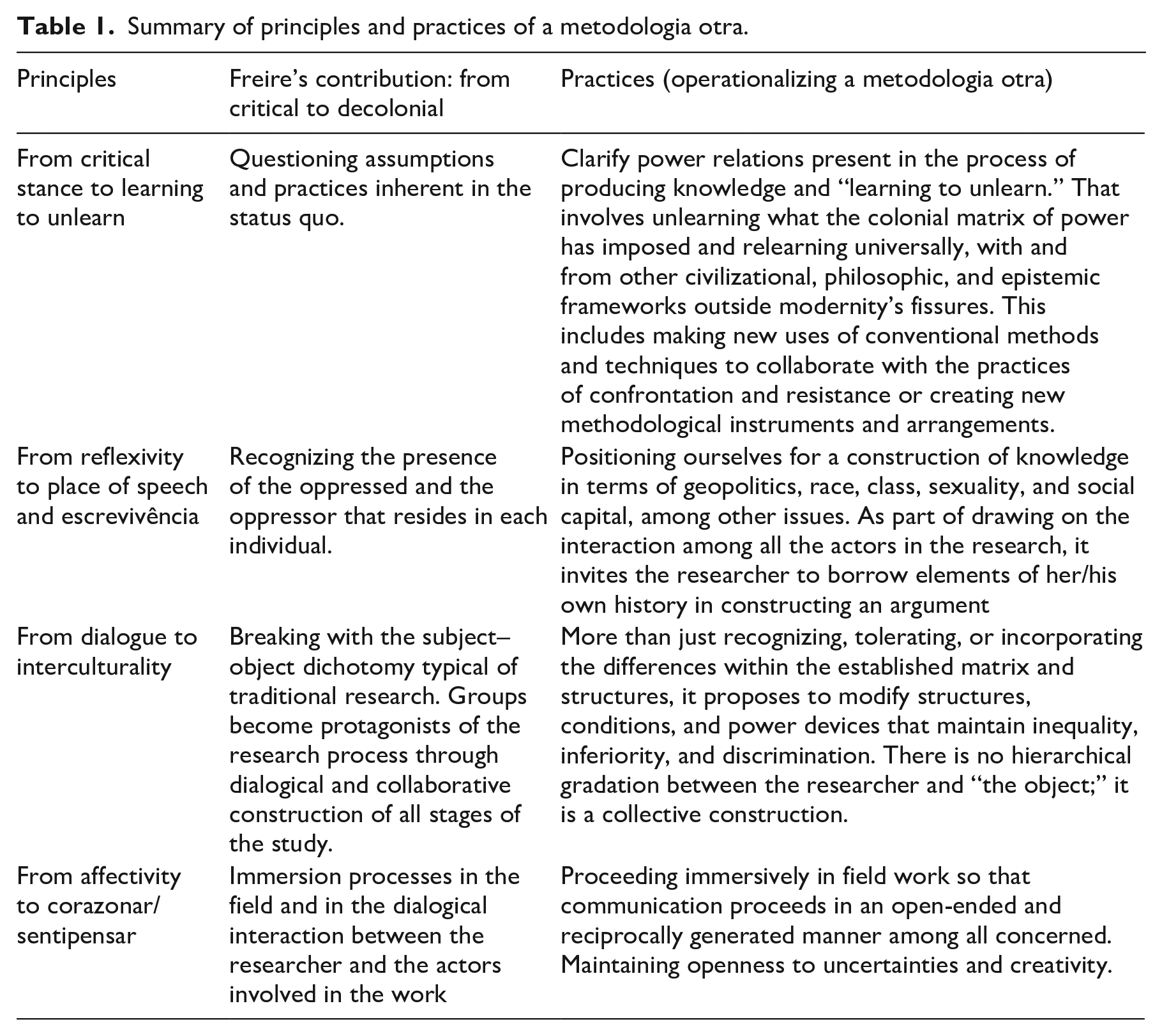
The remaining sections of our article describe these principles and give examples of how the concepts are operationalized in empirical studies. It is important to note that, at several points, those principles and practices overlap.
From a critical stance to learning to unlearn
Freire (2001 [1968]) underlines the importance of the educator/researcher critically reflecting on the reality in which she or he is inserted to enable the observation, knowledge, and intervention necessary to transform it. It is this reading of reality that allows the passage from naive consciousness to critical consciousness, the former being characterized by simplicity of interpretation of problems. Thus, a critical stance should become an ongoing, permanent part of educator/researcher practice, questioning assumptions and practices inherent in the status quo: “The important thing is the exercise of a critical attitude towards the object and not the educator’s discourse around the object” (Freire, 2011: 21, our translation).
A critical stance—or criticality—is a key principle adopted by several researchers, particularly those active in the CMS and CME community. Most critical-interpretive studies activate this principle, seeking to disrupt conventional wisdom and bring in multiple points of view. Still, is that enough for a metodologia otra? Through a decolonial lens, a fundamental element is recognition that research frequently starts from a colonizing perspective (Dulci and Malheiros, 2021). Thus, it is necessary to “recognize with humility that our epistemological, methodological conceptions do not constitute a system of rules, is not a normative configuration, does not represent a universal knowledge, does not constitute an absolute truth” (Ortiz Ocaña et al., 2018: 175, our translation). From this perspective, Chilisa (2012) argues that criticality implies the responsibility to go beyond hegemonic methodologies and imagine other possibilities that accommodate the forms of knowledge of the populations involved. Moving forward in this debate, Walsh (2015a) proposes the idea of unlearning. The author describes her experience participating as a first-grade student in the Escuelita Zapatista (the Zapatista “little school”) in Chiapas, Mexico. Being a first-grader in a context different from that to which she was accustomed was difficult and complex. Nonetheless, she concludes that unlearning is the first step in relearning “alongside, from and with knowledge and ways of being in the world that modernity and Western ideologies have rendered invisible and continue to negate” (Walsh, 2015a: 5).
Therefore, the first principle of a metodologia otra is rendering visible the power relations present in knowledge production and promoting “learning to unlearn,” as proposed by Mignolo (2008), thereby helping to define a “grammar of de-coloniality” (Misoczky, 2011: 348). This involves unlearning what the modern/colonial matrix of power has imposed and relearning in an alternative manner that draws on other civilizational, philosophic, and epistemic frameworks, bridging modernity’s gaps (Walsh, 2009). It includes making new uses of conventional methods and techniques to collaborate with the practices of confrontation and resistance or to create new methodological instruments and arrangements (Borges, 2013).
In this vein, paraphrasing Santos’ (2009) words, Hashizume (2019) proposes an “ecology of methods,” combining ethnography and unconventional techniques, such as journalistic fact-finding and investigation (through the so-called “source” consultations). Many authors use “conventional” qualitative research methods—such as participant observation (Elder and Odoyo, 2018), ethnography (Borges, 2013; Hashizume, 2019), semi-structured interviews (Fonseca, 2016), narrative analysis (Amorim, 2020), and critical discourse analysis (Bragato and Colares, 2017)—but never uncritically and, above all, always being open to unlearn and relearn. A remarkable example is the recent work of Manning (2018), who describes the challenges and paradoxes of becoming a decolonial feminist ethnographer. She suggests an alternative way of seeing and doing research motivated by an ethical commitment to the participants and respect for their knowledge and experiences.
From reflexivity and place of speech to escrevivência
Reflexivity is a common topic in considering research or educational processes (Oliveira and Piccinini, 2009). By adopting a reflexive posture, researchers are called upon to scrutinize themselves, highlighting their place of speech and how it affects the interpretations of the investigations being conducted. In the Freirean perspective, a critical stance guides the reflective process and vice versa, making it essential in training educators/researchers who are aware of their actions in the society and the world (Freire, 1997). Again, notwithstanding reflexivity’s growing importance in academic debate, it is not sufficient to constitute metodologia otra. According to Chilisa (2012), researchers are consciously or unconsciously guided by Western thinking models which drive researchers’ interactions with the researched, shaping the knowledge that can be produced, and how it is produced.
Smith (2000) discusses the importance of the place of speech in investigative practice. The author advocates elucidating the political and ideological positions of the researcher, as well as the intentions of the research. The author proposes certain questions that every researcher should ask themselves about their work: Whose research is this? Who is doing the research? What interests does the research serve? Who will benefit from the research? Who formulated your questions and defined your scope? Who will carry it out? Who will write it up? How will its results be disseminated? Similarly, Linda Alcoff (2016) argues that epistemic decolonization involves recognizing social identities and how particular identities have been silenced while others have been strengthened. The author defines identity as the place in which an individual has links to historical events and communities, and from which he or she engages in the process of sense-making and, thus, from which he or she derives a window on the world. In this way, the project of epistemic decolonization recognizes that experiences in different locations are distinct and, hence, that these locations matter (Alcoff, 2016). In this context, place of speech represents a confrontation with hegemonic knowledge by breaking the silence imposed on subalternate groups (Ribeiro, 2019). Ibarra-Colado (2006), in turn, uses the expression “place of enunciation” to underscore the relevance of “otherness” for understanding organizational realities in LA.
Ribeiro (2019) advances the discussion by distinguishing between place of speech and representativeness. According to the author, “a black transvestite may not feel represented by a cis white man, but this cis white man can theorize about the reality of transgender and transvestite people from the place he occupies” (Ribeiro, 2019: 82, our translation). The fact that few black transvestites are in a place of privilege legitimates their struggle to have a choice (Ribeiro, 2019). The author considers it essential that those who occupy privileged positions also engage in this struggle, but while critically reflecting on the social place they occupy and recognizing their historical legacy in constructing and maintaining the structures of domination. Similarly, for Spivak (2010), postcolonial intellectuals are responsible for fighting subalternity. This action is made effective not by speaking for the subaltern subject, but by creating mechanisms for he or she to articulate himself or herself and to be heard (Nascimento and Martins, 2018; Spivak, 2010). From these authors, we highlight the importance of reflexivity and place of speech to a metodologia otra, wherein the researcher or instructor position themselves for construction of knowledge in terms of geopolitics, race, class, sexuality, and social capital, among other issues.
Methodologically, the field diary serves as an essential tool to materialize the reflexive process. Frequently, reflexivity and place of speech are indicated at the beginning of the article or in the methodological section. This form is prevalent in the case of doctoral theses and dissertations (Amorim, 2020; Borges, 2013; Fonseca, 2016; Gonçalves, 2019), but it can also occur transversally throughout the text (Siqueira et al., 2021; Solano and Speed, 2008). Borges (2013) offers an interesting example. The author adopts autoethnography, starting with an intense reflection on the position of the researchers and their multiple relationships and interactions with the subjects and objects involved in their research. Procedurally, it is developed from participant observation, which materializes in first-person accounts and contains autobiographical elements from the researcher. According to Borges (2013), the autoethnographic interpretation allows for revealing the various roles assumed by the researchers, their proximities to and distances from the field, theme, problem, and the actual subjects participating in the research.
One of the most radical and genuine examples of deepened reflexivity and place of speech as operationalized by decolonial authors is the poetic-literary resource called escrevivência (“writing-living”). The term was coined by Brazilian writer Conceição Evaristo (2011) to suggest the idea of writing intertwined with the subjectivity of the author. It means narrating particular stories—ones that refer to collective experiences—either by shared characteristics through social markers or by the quality of the experience, even if from different participant positions (Cavalcante and Leite, 2021; Soares and Machado, 2017). In practice, it is configured as narrative writing. It invites the researcher to borrow elements of her or his own history in constructing an argument, as part of drawing on the interaction among all the actors in the research. For example, Tremper et al. (2020) prioritize writing about everyday experiences and adopting a more welcoming look at users of alcohol and other drugs. The authors seek to provide an academic conduit for narratives heard and experienced, with a view toward transforming care practices in collective mental health. Borges (2013) mobilizes elements of her biography to understand how young black women participating in the hip-hop and funk culture experience power relations involving sexuality and gender. The author uses reflective tools—including autoethnography, participant observation, field diary, semi-structured interviews, and dense description—to systematize the textual account. Siqueira et al. (2021) use the writing experience to express the voices, reflections, and feelings present in research that was affected by the COVID-19 pandemic, employing escrevivência as a methodological tool because “participating in research continues to be an act of resistance and survival even when we feel the body collapsing” (p. 33). Escrevivência exemplifies putting Freire’s reflective perspective into practice in the research process. Deepening the dialogue between Conceição Evaristo and Paulo Freire is a task for future work.
From dialogicity to interculturality
According to Freire (1997), the human being is a subjectivity that becomes a person only through encountering others in a dialogical relationship. A horizontal dialogue between individuals guarantees that different worldviews have equal opportunity to be heard and debated. Dialogue encourages critical thinking about the human condition, opening the possibility of reimagining life in the society and transforming the world around us (Freire, 2001 [1968]; Hooks, 2010). Through dialogue, we can begin to speak “together with” rather than “for” (Freire, 1997).
The Freirean concept of dialogicity breaks with the subject–object dichotomy typical of traditional research. Instead of a being apart from the observed reality, the researcher becomes a “being in the world” (Bringel and Maldonado, 2016), with research participants accorded the status of producers of knowledge along with the researchers. Thus, historically discriminated groups become protagonists in the research process. Rather than studying themselves merely as products of colonialism, they can think of themselves as endowed with the capacity for self-liberation.
Costa and Alves (2020) also provide clues to the dialogical and collaborative construction of all stages of their study. To produce the empirical material and the analytic corpus, they held meetings—called co-laboring rounds—with community members devoted to discussions about human sexuality. In the co-writing sessions, passages were drawn up and, after being read by the group, became the basis of reflection that culminated in theoretical, epistemological, and/or experiential contributions. The analysis of the empirical material was based on discovering meanings in the narratives produced during the workshops and reading the transcripts of each meeting. It should be emphasized that throughout the process, the authors tried to evaluate whether all the participants/collaborators were comfortable with the discussions and the steps to be followed/produced. Other works use immersion as a practice to establish a dialogical relationship with research participants (Andrade, 2020; Busko, 2019). For Andrade (2020), immersion makes it possible to enter the physical and symbolic spaces that exist in the field. Informal interactions, conversations, and even laughter constituted privileged moments of his research, during which both parties could articulate and share their experiences within the studied context. In addition to immersion, some works use semi-structured interviews (Amorim, 2020; Borges, 2013; Elder and Odoyo, 2018), arguing that this format allows actors to be heard in their identity and wholeness.
However, dialogicity alone is not enough to break with oppressive and power relations (Smith, 2000). According to Walsh (2015a), this perspective can hide or minimize conflicts and contexts of power, domination, and coloniality. Dialogicity cannot occur between those who wish to name the world and those who do not wish this naming—between those who deny other people the right to speak and those whose right to speak has been denied to them. Those denied their primordial right to speak their word must first reclaim this right and prevent the continuation of such dehumanizing aggression (Freire, 2001 [1968]: 76–77). Inspired by the Ecuadorian indigenous movement, Walsh (2009) defines interculturality as a project of social transformation aimed at building symmetrical and dialogical relationships based on mutual recognition and respect for difference. Interculturality does not seek to adopt the other’s perspective but to allow difference to be an agent in opening intercultural perspectives of coexistence (Walsh, 2009). Thus, interculturality is more than just recognizing, tolerating, or incorporating the differences within the established matrix and structures. It proposes to modify structures, conditions, and power devices that maintain inequality, inferiority, and discrimination. Viewed thusly, interculturality must be understood as a design and proposal for society: a political, social, epistemic, and ethical project aimed at structural and socio-historical transformation based on the construction by all of a radically different society.
Numerous studies seek acknowledgment of diverse experiences and perceptions as legitimate knowledge arising through dialogue and interculturality. The cornerstone principle is that effective dialogue can only take place through an effort to recognize hierarchies and break with inequalities. From the methodological point of view, it presupposes a dialogical posture shared by everyone involved in the research and education processes so that all voices are spoken and heard on their terms and without hierarchical mediations. For Dulci and Malheiros (2021), interculturality as a methodological proposal considers those being studied not as passive objects, but as autonomous subjects capable of intervening in the investigation process. There is no hierarchical gradation between the researcher and “the object”; it is a joint construction, with the possibility that the “object” will question the purpose and paths of the researcher. Hashizume (2019) takes the procedural perspective further and proposes reciprocity pacts. The author established agreements with indigenous organizations he researched in the two countries of his fieldwork, Brazil and Bolivia. Such agreements were not limited to the mere “devolution” of the thesis findings. In Brazil, the researcher’s direct intervention through his work as a professional journalist was mobilized to seal and strengthen the dialogue with the indigenous leaders working in the Raposa/Serra do Sol indigenous territory in Roraima. In the case of Bolivia, the researcher’s expertise in the academic field was called upon by the community to prepare a historical panorama of the indigenous struggles in the country, aimed mainly at young people and students in the region.
From affectivity to corazonar/sentipensar
If research is constructed not from the researcher’s detached examination of the other but from their interaction, we can assume it to be permeated with emotion. Thus, affectivity appears as one of the main elements in a metodologia otra through the Freirean lens. By evoking “feeling” as a place of epistemic and ontological enunciation, one recovers a stance present in the path of political resistance of indigenous, peasant, riverine, and quilombolas (Afro-Brazilian residents of settlements first established by escaped enslaved people) peoples in LA (Barbosa, 2019). This stance is also known as “thinking-feeling” or “sentimentality,” a term coined by Fals Borda referring to those who combine reason and feeling to produce knowledge (Fals Borda, 2015).
The Ecuadorian anthropologist Patricio Guerrero Arias advances the idea of affectivity, mobilizing the conceptualization of heart (Corazon). If the hegemony of reason underpins epistemological domination, affectivity must be recovered, and epistemologies of the heart must be asserted as an act of decolonial (re)insurgency (Arias, 2010). For the author, Corazon implies the construction of theoretical and methodological proposals that break with the supposed neutrality of science and recognize “insurgent” wisdom—that is, of peoples who were/are colonized and silenced (Arias, 2012). According to Arias (2012), such knowledge offers references that are not only theoretical and methodological but also primarily ethical, esthetic, and political for the construction of “other” meanings of life. Freire’s contributions opened paths to these new research ideas and practices (Arias, 2012).
In the research process, affectivity can take various forms. Costa and Alves (2020) locate it in daily exchanges of affection. While the discussions involved in their research were sometimes heavy and sad, they were also filled with light and festive moments. Feeling–thinking also emerges in field immersion processes and in the dialogical posture assumed by the researcher/educator vis-à-vis the actors involved in the work.
On the contrary, in Sousa’s (2017) view, even in a dialogical effort, seeing and listening still pursue the logic of knowing something that is to be subsequently translated according to academic canons. In her experience with Kaingang and Mbyá Guarani teachers in Rio Grande do Sul, Sousa reflects on the implications of “being together” and implies certain choices—some conscious and others guided by chance events. Her research methodology was not thought out and built beforehand in omniscient fashion but constructed during her experience in the field. In this way, Sousa (2017) highlights the importance of two elements: intuition and chance. The latter term reflects the unpredictability of research, the occurrence of unforeseen events, and the emergence of new possibilities: “I can say that intuitive sensibility is for this study a reflective proposal that offers intellectual rationality with an organic knowledge, connected to the community and to the experience itself” (Sousa, 2017: 16, our translation).
A clear example of feeling-thinking is found in the work of Siqueira et al. (2021). During the COVID-19 pandemic, the authors were unable to continue their proposed in-person research activity. They opted for an exchange of letters with women whom two of the authors had previously met. These women’s letters were written in the first person, making affectivity the work’s main thread and analytical key. They narrate the life stories of these women, presenting them not as objects or passive subjects of the research but as protagonists of their trajectories through escrevivência.
This openness to uncertainty and creativity within research is transversal and proves fundamental in enabling the researcher to understand reality together with the other. Hashizume (2019) similarly describes the several unforeseen events that occurred during his fieldwork. Not only did he, as a researcher, realize the need to make adjustments in the research, but also the actors involved presented their points of view and their demands throughout the process. In this way, affectivity also implies recognizing fluctuations, decentralizations, and uncertainties as constructive aspects and processes of openness and change. It takes courage to adopt disobedient practices and create emancipatory methodological alternatives.
Discussing metodologia otra
In this theoretical article, we seek to explore how to operationalize what we call metodologia otra and outline Paulo Freire’s contribution therein. We consider it relevant to bring decolonial concepts to critical management and education because the emergence of postcolonial studies among critical management scholars has not heretofore included serious attention to a more than 30-year-old rich Latin American intellectual and political movement around decoloniality.
We seek to participate in the debate over the legacy of Paulo Freire, whose contribution has already been outlined by numerous authors (Reynolds, 1998; Tight, 2000). Our discussion is not confined to the theoretical dimension but primarily targets methodological challenges by mapping a set of principles and practices mobilized by scholars taking a decolonial stance. It is worth noting that using “otra” instead of “other” signals the intent of subverting the meaning historically attached to the term in colonial thinking. Recalling the foundational text of postcolonial thinking—Said’s (1990 [1978]) Orientalism—the Western conception of the East is a representation that “stems from the discursive construction of differences between both, where the East becomes the ‘other.’ [. . .] Such tendencies lead to essentializing ‘self” (the West) and the peripheral ‘other’ (the East) as binary opposites.” Thus, while Western cultures and their values are associated with progress and modernity, the peripheral others are considered underdeveloped—even primitive—and are depicted as suffering from some lack or deficiency (Westwood and Jack, 2007). Our use of otra has an opposite vector: asserting the strength, diversity, and originality of the epistemologies that are absent or have been silenced over recent centuries.
We argue that most tents of Freire’s critical pedagogy underlie the practices mobilized by researchers and educators that claim a decolonial viewpoint. It is interesting to note that although the work of Freire is not formally associated with the M/C group, his work on the pedagogy of the oppressed is considered a core text for understanding issues such as disenfranchisement, social exclusion, and marginalization. Freire “rejects a class-only analysis of power relations in favor of a more robust power-laden language of the ‘oppressed’. The oppressed of Freire’s 20th-century Brazil are similar to those oppressed of today: homeless/landless people, women, poor people, black people, sexual minorities, indigenous people [. . .]” (Collins and Bilge, 2020: 190). Moreover, the connection with decoloniality is also evident when we consider the role of the banking education process, as elaborated by Freire (2001 [1968]). The banking logic allows schools and universities to teach “elite white men that they are set up to deliver cultural capital,” whereas oppressed groups are taught to “uphold the very practices that reproduce their subordination” (Collins and Bilge, 2020: 191). This observation is a staple of decolonial thinking.
On the contrary, although elements of Freire’s theory come close to decolonial thinking, they do not point to finite responses to the complex mechanisms provided by coloniality, especially in academic research. It is necessary to reinterpret and improve it by taking into consideration knowledge and practices otras. Application of our set of principles for a metodologia otra is far from exhausted by this work. We will seek to overcome one limitation in future by finding further illustrations of a decolonial methodology, particularly in the education field. However, our concern lies less with what the instruments/tools are and more with how they are used. We seek to evoke peripheral knowledge paths and to question Eurocentric methodologies’ hegemony and linearities (Dulci and Malheiros, 2021). This quest begins with the recognition of lived experiences that point to possibilities outside the liberal/colonial matrix—that is, worlds that are more just and humane. Beyond producing a study on such categories of thought—“to give a critical touch to the research” (Curiel, 2019: 46)—it engages in a process of reflection arising from them.
Nonetheless, many challenges remain. Solano and Speed (2008: 460), for example, describe the difficulties involved in breaking away from the power relations existing within the working team itself, which is made up of academics and “actor-subjects,” namely, members of indigenous communities and organizations. Criticism emerged at the first working meeting, where the indigenous partners clearly and directly expressed mistrust of any real change in the power relations typically intrinsic to scientific research. The authors also point to institutional limitations and raise the issue of time. There were persistent problems with finding time in the participants’ schedules and a prevalent feeling that this was the biggest impediment to the collaborative process. This represents a concrete manifestation of the different times and logics involved in academic, activist, and organizational functioning (Solano and Speed, 2008).
Hashizume (2019), in turn, reflects on recognizing the “No” answers that arise during the research process, and on the challenges of dealing with the complexity of colonial experiences in the contexts of dehumanization and violence. The author contends that listening and giving serious attention to a “No” allows one to abandon any pretension of a single and superior totality of modern Western scientific reason. Thus, applying the methodology and research is itself a collaborative effort. The researcher is also being “researched” by the movements and indigenous communities of the regions visited and by the individuals and groups involved. The researcher is submitted to evaluation by the participants, who impose conditions and request support to advance the struggle according to their perspectives. Both parties employ means of expanding their articulations and their horizons of knowledge.
Finally, as we have seen, Siqueira et al. (2021) show the challenges of conducting research anchored in experiences, exchanges, and affectivity during the pandemic. Besides the procedural obstacles—for example, the impossibility of face-to-face meetings—the authors note the emotional limitations. The questions that govern their work are: How to frame the continuity of research proposals based on the art of encountering and the experience of narrating, constructed through dialogue and sensitive listening? How to give life to research when the possibility of death inhabits participants’ bodies?
Certain challenges arising from decolonial methodological practices are inherent in academic research. Nonetheless, in breaking with the multiple dimensions of oppression intrinsic to the modern/colonial matrix prevailing in academic research and education, it is clear that the first step consists of recognizing and elucidating these challenges. It is precisely from elucidating contradictions that opportunities for reflection and new paths of resistance are born. The metodologia otra generates movement.
This essay is aligned with seminal articles engaging with decoloniality. Thus, we point to the research agenda put forward by Ibarra-Colado (2006) in his groundbreaking paper on organization studies and epistemic coloniality, which outlines the importance of “otherness,” a radical openness to other rationalities. We also extend the reflection proposed by Manning (2018), who identified positionality and representation as key complexities of engaging in research with marginalized “others,” where the respect for the knowledge and experiences of those others occupies a central posture. Finally, we pursue Misoczky’s (2011) effort to create a grammar of de-colonialidade with practices related to “learning to unlearn.”
Concluding remarks
This article aimed to contribute to the methodological debate in CMS and CME by mapping the main methodological principles and practices applied by researchers engaged in decolonial work. We have endeavored to outline specific paths of knowledge that have hitherto been relegated to marginal status and to question Eurocentric methodologies and their linearities at all times. Our results suggest that, although the way to conduct a methodological rupture of the modern/colonial matrix still needs to be spelled out, it is possible to identify certain paths. Our conclusion is that the focus should be less on the research instruments and more on how they are used.
Finally, we present some challenges faced by researchers in the search for a decolonial methodological practice: the difficulties in disengaging from extant power relations within the work team itself; the different times and logics operative in academic, activist, and organizational functioning; the challenges of dealing with the complexity of colonial experiences in the contexts of dehumanization and violence; and the challenges of conducting research anchored in experiences, exchanges, and affectivity in the context of a pandemic. Finally, in terms of envisioning a methodological approach, we contend that such challenges, far from being distracting “pebbles in the shoe,” actually represent opportunities for reflection from which new paths of resistance may emerge.
What has been discussed here represents only a part of a lengthy process of reflection on decolonial research methodologies. We seek to contribute to a more systematic understanding of the activities and roles of researchers interested in this approach, suggesting possible methodological trajectories that can be reviewed to suit diverse contexts. We hope that our findings will contribute to creating new avenues and research agendas committed to transforming knowledge production into more pluralized and politicized forms. All of this grows out of the type of critical reflection on the world we live in that Paulo Freire dreamed of and struggled for.
