



Abstract
The past decade has seen increased interest in entrepreneurship education outside business schools, driven both by changes in market demand and governmental policies. This has led to an expansion of embedded entrepreneurship education, where entrepreneurship is included as part of existing, non-business courses. Using the context-intervention-outcome-mechanism framework, we systematically review 33 cases of embedded entrepreneurship education programs to understand where, how, and with what outcomes such initiatives were implemented. Our analysis identifies four mechanisms, which explain how embedded entrepreneurship education functions: individual, team-based, organizational, and multi-organizational. Our analysis points to three key recommendations for embedded entrepreneurship education practice and three related avenues for future research: considering program scalability, intended outcomes and misaligned pedagogical models, and contextual diversity.
Keywords
Introduction
Entrepreneurship education (EE) and educational philosophies in general have evolved in the last 50 years from supply (behaviorist or managerialist) approaches which focus on the transmission of venturing knowledge, to demand (cognitivist) and competence (constructivist), and even humanist approaches (Bell, 2021; Dierksmeier, 2020; Nabi et al., 2017), which focus on developing individuals who are able to cope with the new world of globalization (Gibb, 2008), and even consider the holistic intellectual, socioemotional, and physical development of the individual (Bell, 2021; Dierksmeier, 2020). This way, the content of EE is broader, targeting the developing not only of students’ venturing capabilities, but also of personal qualities, attitudes, and skills needed for entrepreneurship and for life as part of a community (Bell, 2021; Fellnhofer, 2019; Gibb, 2008). In this context, the interest in EE from non-business students (Solomon et al., 2002), the broadening of EE to encourage entrepreneurial skills (Bissola et al., 2017; Bureau and Komporozos-Athanasiou, 2017; Daniel, 2016; European Commission, 2002; Kyrö, 2015), and the proliferation of supportive governmental policies, such as the Oslo agenda for EE (European Commission, 2006) and the Kauffman Campus (Katz et al., 2013), have accelerated in the past 20 years.
The approach to the provision of EE to non-business students has followed two paths: either offering entrepreneurship as a distinct course or program part of the non-business curricula, or embedding entrepreneurship within existing non-business courses. We are concerned here with the second path of providing EE as part of courses delivered to students in non-business programs—what we call embedded entrepreneurship education (EEE) and which we define as the inclusion of entrepreneurship education pedagogies or course sequences in existing non-business courses to enhance students’ entrepreneurship competencies (see Gibb, 2008, 1993). EEE is a distinct form of education, targeting students outside the business programs where EE has traditionally been delivered (Bhatia and Levina, 2020; Katz, 2003; Katz et al., 2013), and requiring pedagogies that allow for the intertwining of EE as part of other courses, rather than as a stand-alone course delivered to non-business students (Gibb, 2008; Solomon et al., 2002).
EE is an emerging area of research (Landström et al., 2022) in business and management education. There is a growing body of knowledge mapping the outcomes and pedagogical methodologies associated with EE programs (Nabi et al., 2017; Pittaway and Cope, 2007b; Solomon et al., 2002), the epistemic (Bhatia and Levina, 2020) and ontological (Fayolle and Gailly, 2008; Landström et al., 2022) approaches underlining their delivery, and the contexts of their implementation (e.g. Katz, 2003; Pittaway and Cope, 2007a). Such research highlights the need to understand the varied outcomes of EE programs by considering the nature of pedagogical interventions, and the contexts in which these interventions take place (Fayolle and Gailly, 2008; Nabi et al., 2017). In contrast, most studies on EEE cover narrow aspects related to the adoption of EEE in different fields such as arts or engineering (e.g. Beeching, 2016; Doboli et al., 2010), the use of specific pedagogical models and teaching methodologies (e.g. Bosman et al., 2019; Costello, 2017), or particular countries or education institutions’ approaches to engage with EEE (e.g. Antal et al., 2014; Hoppe, 2016; Leffler and Falk-Lundqvist, 2014). Such a narrow focus means we know much less about the kind of outcomes EEE programs achieve, the contexts in which such programs are likely to flourish, and the kind of pedagogical approaches (interventions) supporting their delivery compared with EE programs in general, and even less about the mechanisms that may explain why particular approaches to design EEE interventions may lead to specific outcomes in certain contexts.
In the context of the evolution of educational philosophies toward constructivist and humanist approaches, our article deals with one specific type of EE which involves embedding entrepreneurship sequences in existing courses outside the business schools, where EE traditionally takes place. Embedding can be a solution for attaining the idealist goal of humanism, as it can support the development of competences other than the professional ones traditionally targeted by higher education programs. As embedding is increasingly examined in relation to a range of non-traditional competencies, such as digital skills (Ala-Mutka et al., 2008), our article also contributes to the field of embedding education in general, in addition to the specific field of EE.
The aim of our review is first to map the range of contexts, interventions, and outcomes of EEE programs, and second to identify the mechanisms that explain the range of outcomes associated with different approaches to the delivery of EEE in different contexts. To do so, we synthetize existing research on EEE using the context-intervention-mechanism-outcome (CIMO) framework. CIMO framework is a design science approach to support the generation of new knowledge from systematic literature reviews (Denyer et al., 2008), one which is recognized as an adequate method to understand the field of management which is highly fragmented, and where it is difficult to extract the applicability of findings (Turnbull James and Denyer, 2009). It focuses on prescriptive knowledge on how design propositions can be applied and developed, and involves the analysis of an existing body of literature to examine how, through a certain mechanism, a specific outcome can be achieved in a particular context by applying a certain intervention. Mapping the EEE contexts, interventions, and outcomes allows us to build a broad overview of where, how, and with what effect EEE programs are implemented. This mapping leads to the identification of four mechanisms ranging from small-scale, individual programs to large-scale programs spanning multiple institutions. We find the scale of the programs to be the critical differentiator between these mechanisms, explaining the nature of the interventions, the associated outcomes, and their deployment within specific contexts. It is thus the scale of the program which explains why EEE programs deliver their outcomes, thus informing the design of more effective EEE programs. These mechanisms represent the key contribution of this article and offer a useful guide to research, by highlighting avenues for future research on EEE programs, and to policy and practice, by clarifying where, how, and why EEE programs achieve their desired outcomes.
Theoretical background
The evolution of EE
The fact that entrepreneurship is taught outside business schools is related to the profound changes concerning what EE is and how it should happen, linked to the evolution of learning theories in management education and in general (Kyrö, 2015; Mueller, 2012). The main theory describing early years of education was behaviorism, associated with the supply-model (Hannon, 2005; Mueller, 2012; Nabi et al., 2017) or the transmission paradigm (Bell, 2021; Fayolle et al., 2016). This theory considers knowledge transfer fundamental (Bell and Bell, 2020) as it can lead to predefined student behavior, obtained through methods used for education in general, and EE in particular, such as classical teaching (demonstration, lecturing, exercises, watching, listening). The content of EE in this case, refers to business venture related activities that one should know when launching or running a small business and developing a business plan (the entrepreneurial process) (Neck and Greene, 2011). In the modern era (i.e. the beginning of the 20th century—1970s) (Kyrö, 2015), the cognitivism theory was used to explain education, associated with the demand model. According to this theory, individuals have different cognitive processes and teaching should therefore adapt to each individuals’ level of cognitive development and processing capability (Bell, 2021; Mueller, 2012; Nabi et al., 2017). Cognitivism implies the use of newer teaching methods (case studies, experiential learning, simulation, interactive searches) (Bell, 2021; Nabi et al., 2017; Neck and Greene, 2011). This theory is also known as the functionalist paradigm, and is oriented towards the conception of pedagogical objectives and associated learning activities (Fayolle et al., 2016). In this context, EE is concerned with how individuals discover business ideas and how they identify and exploit opportunities (the entrepreneurial decision) (Neck and Greene, 2011). During the postmodern transition after the 1970s (Kyrö, 2015), constructivism theory was applied to the education field (Bodner, 1986, in Mueller, 2012). According to constructivism theory, knowledge is constructed by individuals through additions to their previous knowledge and based on their own personality and intelligence (Bell and Bell, 2020; Kyrö, 2015). Constructivism approaches assume that the learner governs their own education. Constructivism teaching methods (launching a business, reflective practice, designed-based learning, problem-based learning)—which are still evolving—are particularly suitable for EE (Bell and Bell, 2020; Higgins et al., 2013) and are chosen by teachers based on multiple criteria in reference to their learners (Daniel, 2016). The motivations and emotions of learners or the affective dimensions of individuals (Kyrö, 2015), the surrounding environment represented by different stakeholders who can affect learners’ involvement in the process, are all considered key parts of the EE model (Fayolle et al., 2016; Higgins et al., 2013). EE content is in this case extended, two definitory elements being included (Fellnhofer, 2019). The first is the development of the personal qualities, attitudes, and skills needed for entrepreneurship, and the second involves specific venturing activities. Within a constructivism approach to EE, the focus shifts from developing pure entrepreneurs to developing an “enterprising person in the wider sense of an individual being equipped to cope with the new world of globalization” (Gibb, 2008). Education here is less about teaching, and more about learning and acquiring competences. This trend is incorporated into the competence model (Bell and Bell, 2020; Nabi et al., 2017). Finally, a more recent theory which influences EE is humanism, which suggests that the role of education is the development of the whole person, including their intellectual, socioemotional, and physical development (Bell, 2021; Dierksmeier, 2020). The axiological component of the humanistic philosophy is compassion. Humanistic education promotes the acquisition of value-oriented skills despite the fact that this is in conflict with the traditional role of universities, that to provide professional education (Bell, 2021; Gibb, 2002). In management education, a call for humanistic approaches was launched by Jensen (Dierksmeier, 2020). Humanistic approaches to management education are challenging the traditional neoliberal paradigm which has dominated EE and are allowing people from other fields to follow a path to entrepreneurship which is not focused solely on profit maximization (Bell, 2021). In this context, EE takes a community perspective (Bell, 2021; Dierksmeier, 2020), assumes that learning happens through social bonds, and places an increased focus on feelings, emotions, and well-being. It also considers value creation for external stakeholders (Bell, 2021; Dierksmeier, 2020), which should be attained by implementing projects closer to communities, building relationships, and identifying opportunities (Bell, 2021).
The development of learning theories is characterized by complementarity and interconnectedness. The development of the humanism learning theory has happened in parallel with the diffusion of the neoliberalism paradigm which considers the individual as “being for himself his own producer, being for himself the source of [his] earnings,” the bearer of human capital (Foucault et al., 2008: 206). In this context, economic schemes are considered to transform the social practice in different areas which are not exclusively economic, meaning that the economic logic pervades areas characterized by varied rationalities (Lemke, 2001: 108), that is, “economising the social” and transforming the culture into an enterprise culture (Kascak et al., 2011). Through a neoliberal lens, entrepreneurialism becomes a style of thinking that invites actors to pursue their interests (Caliskan and Lounsbury, 2022). This way, humanism is not opposed to constructivism, with the current education being described as “a silent partnership between humanism, constructivism and economic neoliberalism” (Kascak et al., 2011).
These changes concerning EE pedagogies are not universal, EE being developed differently in Europe and the United States, with a stronger focus on venture creation in the United States, and on entrepreneurial competences in Europe (Landström et al., 2022). However, the traditional supply pedagogies usually employed in management education (also called rational, managerialist, or mechanistic) (Almeida et al., 2021; Higgins et al., 2013), which tend to ignore the ambiguities and uncertainties which surround the entrepreneurial process and to decontextualize entrepreneurs’ experience, are challenged and complemented by constructivist experienced-based (Almeida et al., 2021; Bell and Bell, 2020; Daniel, 2016) and humanistic pedagogies (Bell, 2021; Dierksmeier, 2020). Entrepreneurship is considered now a processual phenomenon, with EE expected to include not only cognitive but also affective and cognitive capabilities (Bell, 2021; Bissola et al., 2017; Johannisson, 2018). These changes mean that entrepreneurship is now considered an important competence graduates across all disciplinary fields should possess to increase their employability (Bell, 2021).
In education, EE becomes of interest to other fields outside the business school, such as arts and social sciences, and its inclusion within other disciplines has been formalized under varied forms.
Embedding EE
Embedding entrepreneurship was first described by Gibb (1993) in reference to a entrepreneurship teaching model designed at Durham University in the United Kingdom to be “embedded in the educational system rather than introduced as an external add-on” (Gibb, 2008: 5). This model involved the use of design pedagogies to encourage entrepreneurial behavior in subjects such as english, geography, mathematics, history, or science delivered at secondary level as part of the British National curriculum. From the outset, such EEE programs sought to develop individual entrepreneurial skills in the population as a whole, rather than aiming solely to encourage new ventures creation (Gibb, 2008). This wider scope of EEE programs is confirmed in more recent studies of EEE implementation in Sweden across the primary, secondary, and higher level education, which found that outside the constraints of the business schools, the scope of teaching entrepreneurship expanded beyond starting a business to building an entrepreneurship mentality (Hoppe, 2016). This wider scope of EEE is associated with changes in the business school–based pedagogies for teaching entrepreneurship to suit a more diverse range of educators and students (Hoppe, 2016). Thus, EEE seems to be broader in scope and requires novel pedagogical methods compared with those associated with the delivery of EE within business schools—where teaching happens within the dedicated “entrepreneurship” discipline, and is delivered by academics specialized in teaching and researching entrepreneurship to students pursuing an entrepreneurship-related degree.
There is a growing literature examining EEE approaches, including embedding entrepreneurial learning to foster entrepreneurial thinking for technology students (Costello, 2017), teaching embedded enterprise to science and engineering students (Handscombe et al., 2008), developing an embedded approach (Lackéus, 2015), and deploying enterprise pedagogy to nurture students’ learning (Garnett, 2013) in subjects across the entire curriculum delivery across the primary, secondary, and tertiary education levels. The key difference between EEE and other approaches to deliver EE outside the business schools is that EE is delivered as part of existing courses, rather than being seen as a distinct, albeit complementary, discipline or program.
Interest in the provision of EEE has grown recently (Gibb, 2008, 2011) primarily as a result of the implementation of a range of national or international policies that promote the development of entrepreneurial skills and behavior as part of general education. For example, in the United Kingdom, there is a plethora of policies supporting the inclusion of EE across all disciplines (Gibb, 2008, 2011), with more than 95 percent of universities having already incorporated some form of EE for their students (Treanor, 2012). As early as 2006, the European Union (EU) has already documented two distinct initiatives to embed entrepreneurial behavior in primary and higher education (European Commission, 2002, 2006). According to Kyrö (2015), the 2002 European Commission’s report (European Commission, 2002) led 5 years later to the explicitly embeddedness of EE in the national framework curricula of five countries, including Cyprus, Ireland, Poland, Spain, and the United Kingdom, with a further seven countries planning to implement it. By 2019, entrepreneurship has become one of eight key competences to be fostered through lifelong learning across Europe (European Commission, 2019), with recent research finding that the embedding of EE in educational institutions drives change, for the individuals who receive it, for the institutions who deliver it, as well as for the society as a whole (European Commission, 2015). In most of European countries, entrepreneurship has already become an explicit objective in the national framework curricula (Kyrö, 2015), in countries such as Sweden, where EE is widely embedded in pre-university curricula as the EU policy to support EEE has become part of national legislation (Hoppe, 2016). There is also evidence emerging from China of national policy promoting the integration of innovation and EE at all levels of education (Wang and Wu, 2015; Xu, 2017). This policy detailed in the Report of the 18th Communist Party of China national congress has been developed in the context of the innovation-driven development strategy that underpins the overall approach to economic growth transition (Gao et al., 2016).
Despite the strong policy push for EEE, this area is under-researched, with the vast majority of EE research focusing exclusively on programs developed within the business schools (Nabi et al., 2017). With the exception of Gibb (2008), most research considering EEE takes a narrow and descriptive focus, examining individual case studies within a specific academic field such as arts (Brown, 2007; Garnett, 2013; Hietanen and Järvi, 2015), engineering (Arias et al., 2018; Doboli et al., 2010; Paes et al., 2014), or life-science (Baggen et al., 2017; Macosko et al., 2009), without connecting their findings to the experience of running EEE programs for other academic disciplines. Such a narrow focus hampers the ability to understand what is common to EEE in general, and to clarify the best practices to design EEE interventions which transcend specific contexts.
In conclusion, although there is a growing interest in studying EEE, existing research is mostly descriptive and narrowly focused on individual cases, within specific contexts, which precludes a comprehensive understanding of EEE as a distinct form of education, of its underpinning mechanisms that explain how it functions, and of the role that context plays in shaping the approaches to delivering EEE and the outcomes that such approaches may achieve. These research gaps provide the impetus for engaging in the systematic review of empirical evidence of EEE implementation reported in this article to map where (the context), how (the approaches), and with what effect (the outcomes) EEE programs are implemented, and to explain why (the mechanisms) EEE programs deliver their outcomes in specific contexts.
Systematic review methodology
We conduct a systematic literature review of 28 studies describing 33 cases of EEE implementation. Systematic literature reviews are a well-established methodology in EE (e.g. Nabi et al., 2017; Pittaway and Cope, 2007a), as well as an appropriate research design that allows the identification of a wide diversity of cases to inform CIMO analysis (Denyer et al., 2008). As explained in the introduction, we apply CIMO framework to achieve two research aims: (1) to map the outcomes, interventions, and contexts which characterize EEE implementations, and (2) through examining the relationships between them (cf. Denyer et al., 2008), to identify the mechanisms that explain how EEE programs function (Bunge, 2004). Our application of CIMO in the context of EEE aligns with existing approaches in EE research to examine the contexts, inputs and outputs (Pittaway and Cope, 2007a), the pedagogical interventions and program outcomes (Nabi et al., 2017) in EE programs, and the links between what should be taught (objectives), the teaching learning activities (intervention), and impact (outcomes) in entrepreneurship courses (Mwasalwiba, 2010). Considering the aims of our research to better understand how to design EEE programs taking into consideration the context, mode of intervention, and desired outcomes, we envisioned a design science approach, which is seen as a legitimate approach within the field of entrepreneurship to usefully tackle such “how to” problems (Seckler et al., 2021).
Search
Our approach to search aligns with established practices in EE (see also Nabi et al., 2017) and is illustrated in Supplementary Appendix A. In November 2019, we carried out an initial search in the title, keywords, and abstract of studies in the Web of Science for “embedded entrepreneurship education,” “entrepreneurial mindset education,” “innovation and entrepreneurial education,” “enterprising education,” “enterprising pedagogy,” “enterprise pedagogy,” “entrepreneurship pedagogy,” “enterprise education,” and “entrepreneurship education,” which yield 1225 studies.
We included studies that (1) presented EEE cases in courses taught outside the business school, including both empirical and conceptual studies, as long as they included descriptions of EEE cases as illustration and (2) were written in English. Studies were excluded if (1) they did not portray a case of EEE practice, for example, they involved the provision of a dedicated, stand-alone entrepreneurship course to non-business students and (2) focused on EEE within courses delivered within business schools. After screening the abstract of all 1225 studies, and then the full text of the reminder studies, we identified 12 studies that met our criteria. Further seven studies meeting our inclusion and exclusion criteria were identified based on searching the references of these 12 studies. In April 2020, we followed with an expanded search in Web of Science to incorporate further keywords connected with the concept of EEE which emerged based on our reading of these initial 19 studies. The new search terms included “intellectual entrepreneurship,” “authentic alignment of entrepreneurship education,” “entrepreneurial learning,” “cross campus entrepreneurship education,” “cross disciplinary entrepreneurship education,” “interdisciplinary entrepreneurship education,” “innovation education,” “wide entrepreneurship education,” “entrepreneurship and enterprise education,” “nested embeddedness,” and “personalized entrepreneurial learning.” We also updated our original search for “entrepreneurship education” to include new studies published after November 2019. This search identified an additional 600 studies, which, following the application of the inclusion and exclusion criteria, were narrowed down to eight studies. Reference search of the eight studies identified a further study, leading to a final sample of 28 studies (19 from the first search, 9 from the second search) which portray 33 distinct cases of EEE implementation.
Assessment of studies
We used the Critical Appraisal Skills Program (CASP) checklist to assess the validity, reliability, and rigorousness of the studies included in the review, as recommended by existing research (Dybå and Dingsøyr, 2008; Tursunbayeva et al., 2017). CASP includes a list of eight quality criteria which we have adapted to assess the studies in our review (in Supplementary Appendix B). Since the initial screening revealed that most of the studies were qualitative and lacked ethical considerations, questions regarding the appropriateness of the qualitative methodology and ethical issues were dropped. To assess the extent to which a study can be valuable to the review, two authors rated each criterion independently on a dichotomous (“yes” or “no”) scale. In addition to this appraisal, we added a “not clear” option, corresponding to scores of 1.0, 0.5, and 0, respectively. When discrepancies between reviewers arose, the studies were re-read and a common appraisal was agreed. The CASP results for our studies are included in Supplementary Appendix C.
CIMO analysis
CIMO framework informed our approach to coding which was mostly deductive: based on our literature review (see prior section), we identified a list of codes to reflect the contexts, interventions, and outcomes of EEE programs and used these existing constructs to make sense of our data. For context, following Pittaway and Cope (2007a) study of EE in general, and Refai and Klapper (2016) study of EEE, we differentiated between the macro-level setting, including the governmental policies, competition in the higher education, and the changes in market demand; the meso-level setting, including the availability of supportive infrastructure within the education institution; and the micro-level setting, which includes the space in which the educator–student relationship takes place, for example, classroom, the wider education institution, or non-educational organization (e.g. museums, accelerators, other private organizations). For intervention, following Nabi et al. (2017) review of EE, we included the pedagogical model used, differentiating between supply, demand, competence, and hybrid model (cf. Béchard and Grégoire, 2005). Following Bhatia and Levina’s (2020) analysis of rationalities underpinning the delivery of EE programs, we also included the scope of EEE programs, differentiating between interventions that focus on supporting new venture creation and those that focus on nurturing an entrepreneurial mind-set. Being inspired by Nabi et al. (2017), who highlights the multiplicities of stakeholders involved in entrepreneurial programs, and Fayolle and Gailly (2008), who note the varied audiences entrepreneurship courses target, we also included a further category under intervention to capture the range of stakeholders involved in EEE programs. Finally, for outcomes, following existing research on EE impact, we differentiated between types of impact depending on the orientation, that is, short-term versus long-term (cf. Nabi et al., 2017), and level of impact, that is, micro level, associated with the individual participants, and macro level, associated with the organization or the society as a whole (cf. Fayolle and Gailly, 2008). Following Miles and Huberman’s (1994) recommendations for coding qualitative data, our coding approach was flexible, allowing for emergence of new codes from the data as the analysis progressed and new themes emerged as relevant. For instance, we inductively identified one further code referring to negative outcomes which emerged as a third distinct category part of the outcome category. Also, as it has become evident that the initial level-based classification of contexts and outcomes did not entirely fit our data, we have refined the context at education institution level to focus on levels and disciplines, rather than the availability of enterprise infrastructure within the university (cf. Pittaway and Cope, 2007a).
The mechanisms explain why certain interventions produce certain outcomes in certain contexts (Denyer et al., 2008). Generally, if the context, interventions, and outcomes are obvious in most cases, the mechanisms are usually hidden. As Pawson and Tilley (1997) emphasize, the mechanisms resemble the workings of a clock which cannot be seen. To identify the mechanisms that explain the processes that underpin EEE programs, we have looked for patterns of causality (cf. Pawson and Tilley, 1997) in the context, intervention, and outcome codes. This approach was highly iterative, as we sought to explore potential relationships between interventions, outcomes, and contexts. As the analysis progressed, the scale of the program emerged inductively as the underlying factor that differentiates between patterns of interventions and outcomes, allowing us to distinguish four mechanisms that characterize EEE programs.
Findings and discussion
Our analysis shows EEE to be an understudied pedagogical approach. Although the first EEE study was published in 1991, 80 percent of the reviewed studies (n = 22) were published in the last 10 years. The vast majority of studies describe case studies based on qualitative methods (n = 20), some (n = 4) are based on quantitative methods, two employ mixed-methods, and two are conceptual in nature, although they include descriptions of EEE cases to illustrate their argument. We notice a strong European focus in literature, with most cases (n = 18) being located in Europe, mostly in Scandinavian countries (n = 5) and the United Kingdom (n = 10). Then next most common region is the United States (n = 9); several cases span multiple countries including the United States and Europe (n = 4), there is one case only on China, and for one case, the location is not mentioned. All the included papers and their cases are described in Supplementary Appendix D.
Contexts
We identified three main institutional triggers at the macro-level for EEE: market and industry demand (n = 13), supportive government policies (n = 14) sometimes acting in concert to drive the EEE initiative (n = 3), and heighten competitive pressures within the education system (n = 2). There were seven cases which mentioned no institutional trigger. Similarly, with existing EE research (Gibb, 2008, 2011), we find that supportive national and/or international policies are the most popular trigger to encourage EEE, often in the form of national educational strategies and curricular guidelines (Hietanen and Järvi, 2015; Leffler and Falk-Lundqvist, 2014) followed by industry and market demand, in particular, the labor market (Baggen et al., 2017), which requires graduates to be employable and prepared for “real life” (Clark, 1991; Costello, 2017). Heighten competition in the education field emerged as a third important trigger of EEE programs (Carberry et al., 2018). The key role of policies in triggering EEE initiative may also explain the European and US focus of existing EEE studies, which include countries (e.g. United Kingdom) and supra-national institutions (e.g. EU) with strong favorable policies to promote EE.
At the meso level, we examined the characteristics of the educational institutions where EEE were developed. With respect to the academic field, most cases of EEE took place in the arts (n = 9), followed by engineering (n = 7), natural science (n = 6), and social sciences (n = 3) (such as publishing and education). We identified six cases where EEE span multiple academic fields, and three cases that do not mention the field where EEE was implemented. With respect to educational study level, we see a prevalence for the implementation of EEE in single disciplines within universities (n = 25).
At the micro level of analysis, almost half of cases implement EEE in the classroom (n = 16) which is noted as the most common location where entrepreneurial skills and mind-sets are developed, followed by the wider context of educational institutions in general, such as universities and secondary schools (n = 9), and non-educational organizations such as accelerators (n = 7), and hybrid spaces where the context spans educational and non-educational organizations (n = 1).
Interventions
Interventions were analyzed across three dimensions: the scope, the range of stakeholders, and the pedagogy models that characterize EEE programs. In the vast majority of cases, the scope of the EEE intervention was to develop an entrepreneurial mind-set (n = 18), paying specific attention to skills, behaviors, attributes, knowledge, and values that characterize entrepreneurs, and the possibility of applying them in any situation the individual may encounter. New venture creation was the aim in only six cases, while nine cases had a combined scope to both nurture entrepreneurial mind-set and to develop students’ entrepreneurial skills to support the creation of a new venture.
In terms of the range of stakeholders involved in the EEE process, we distinguish between internal (in all cases) and external stakeholders (in 14 cases), depending on their relation to the educational organization. When external stakeholders are involved, this is generally driven by the need to provide students with opportunities to gain practical experience through leveraging links with external collaborators as exposure to external stakeholders is seen to support students’ understanding (Brown, 2007), to enhance their networking skills (Kaandorp et al., 2020), and to support demand-oriented pedagogies emphasizing student participation and engagement with real-world entrepreneurs (Nabi et al., 2017).
With respect to the pedagogy model underpinning EEE, we find no instance of the supply model exclusively. All cases examined students as individuals, either in order to adapt teaching to their specific cognitive style (demand model), or to stimulate their active involvement in the learning process (competence model) (cf. Nabi et al., 2017). We find four cases to fit the hybrid pedagogy supply–demand model, where although the key focus was on knowledge transmission, efforts were also made to create an atmosphere of innovation (Haigen and Xiao, 2016), and to stimulate the entrepreneurial mind-set through discussions (Bosman et al., 2019; Leffler and Falk-Lundqvist, 2014) so as to teach students how to discover business ideas. Such efforts are aligned with the demand model, hence the classification of these cases as supply–demand hybrid models. Six cases fit the demand model where pedagogy was focused on developing new ideas to enhance students’ understanding of entrepreneurship (Carberry et al., 2018; Nybye, 2017), developing entrepreneurship sequences by involving entrepreneurs, field experts, alumni (Antal et al., 2014; Kamberova et al., 2011), mentoring activities (Doboli et al., 2010), or developing an entrepreneurial project (Faherty, 2015; Kamberova et al., 2011). Over half of the cases match the demand–competence hybrid model, and combine high levels of student participation with an element of real practice (cf. Nabi et al., 2017). They include diverse pedagogical methods ranging from project-based learning (Arias et al., 2018; Refai and Klapper, 2016) and complex problem-solving (Baggen et al., 2017; Hietanen and Järvi, 2015) to working side by side with field experts or entrepreneurs (Brown, 2007; Clark, 1991) and realistic entrepreneurial exercises (Gibb, 2008; Handscombe et al., 2008; Macosko et al., 2009). Finally, eight cases match the competence model, use design-based learning method and mention either students working for real clients (Costello, 2017; Garnett, 2013), designing a product that addresses real market needs (Dabbagh and Menasce, 2006; Faherty, 2015; Garnett, 2013; Macosko et al., 2009), or launching a new business (Macosko et al., 2009).
Outcomes
To analyze the outcomes of EEE programs, we considered the temporal and analytical level, differentiating between short- versus long-term outcomes (Nabi et al., 2017), and between outcomes at individual (student) and organizational level. We only considered attained outcomes rather than including the entire range of expected outcomes that were mentioned. Only 18 cases report attained outcomes following EEE interventions, and only in a minority were these measured quantitatively.
Ten cases mentioned solely short-term outcomes at student level, mostly qualitative ones concerning the development of entrepreneurial attitude and intention (Handscombe et al., 2008; Macosko et al., 2009), increased awareness of venture creation (Bosman et al., 2019), or improved satisfaction (Costello, 2017), motivation, and learning (Garnett, 2013). Only one case reported quantitative measures reporting the number of students attending, the number of contact hours, the business plans students entered into competitions, attendance at student entrepreneurship conferences, and engagement with entrepreneurs in their local communities (Katz et al., 2013).
Five cases describe exclusively long-term outcomes either at student or at organizational level including both qualitative and quantitative outcomes. Long-term outcomes are both qualitative, such as increased entrepreneurial interest reported in the student population (Antal et al., 2014), and quantitative, such as the number of students who continued their involvement in business creation after course completion (Nybye, 2017), number of business ventures and patents created at student level (Paes et al., 2014), transnational knowledge transfer (Leffler and Falk-Lundqvist, 2014), regional economic development (Lackéus, 2015), and media attention (Paes et al., 2014).
Four cases report both short- and long-term outcomes, with the latter being both at organizational and student level, while the former is only referring to student level. All four cases report measuring the mixed outcomes quantitatively, with such measures including both short-term outcomes such as improvements in the mean student satisfaction (Arias et al., 2018), the number of comprehensible ideas and the number of concrete ideas generated, and long-term outcomes such as the percentage of students reporting to have the intention of getting involved in an entrepreneurial venture in the future, and the number of students proceeding to postgraduate research (Baggen et al., 2017).
The large prevalence of cases without any mention of realized outcomes (14 out of 33), combined with a prevalence of short-term outcomes and limited efforts to measure them quantitatively, suggests EEE implementation is still in an early stage of development, lacking yet a clear focus to measure consistently the outcomes of such programs.
While the majority of outcomes were positive, we also noticed eight cases mentioning negative outcomes. These were outcomes that either the respondents themselves, or the authors of the cases interpreted as being negative, in the sense of being misaligned with the original objectives of introducing EEE, or perceived as undesirable if unexpected. Most negative outcomes were short-term, student-level outcomes such as a lack of change in the perception of technical skills (Dabbagh and Menasce, 2006), difficulties in workload management (Arias et al., 2018), and in completing tasks either by less able students (Garnett, 2013), by students in teams (Antal et al., 2014), or by students going outside their comfort zone (Nybye, 2017). In one case only, negative outcomes were long-term student-level outcomes and included the reduction in the number of students interested in entrepreneurial activities, and wanting to start a business (Doboli et al., 2010; Kamberova et al., 2011), which was an undesirable outcome as the purpose of the intervention was to raise awareness on entrepreneurship. These long-term negative outcomes followed as a result of EEE increasing students’ awareness of the challenges and complexities of business creation. At the organizational level, we observed short-term negative outcomes in only one case in which teachers complained about increased pressure to deliver results relative to another institution (Leffler and Falk-Lundqvist, 2014). The prevalence of negative outcomes suggests that implementing EEE can create particular challenges for students from non-business disciplines, which may be aligned with entirely different professional identities and logics compared with the business and management students. Thus, while entrepreneurship concepts and pedagogy tools, such as case studies for teaching and business plans for assignments may be aligned with typical business and management education and familiar to business school students, they may be entirely alien to students studying engineering or pharmacy. Crossing different disciplines characterized by different institutional logics, EEE may thus require students to recognize the different logics and find ways of combining them in novel ways for the positive outcomes associated with EEE to be realized.
Mechanisms
Mechanisms form the basis of the CIMO framework, explaining why certain interventions produce certain outcomes in certain contexts (Denyer et al., 2008). To identify the mechanisms underpinning EEE, we explored patterns of causality (Pawson and Tilley, 1997) in the context, interventions, and outcomes on the 33 cases. This analysis allowed us to identify four distinct mechanisms: individual, team-based, organizational, and multi-organizational that explain the relations between interventions and outcomes within specific contexts.
M1: Individual EEE is the most frequently encountered mechanism (n = 15), where the EEE intervention is initiated by a teacher in a single discipline. Individual EEE is often associated with creative education projects, involving interventions which require students to book a concert (Beeching, 2016), find an audience (Beeching, 2016), compose music for a computer game (Garnett, 2013), make a CD (Garnett, 2013), build a better text book (Macosko et al., 2009), harness life’s molecular machines (Macosko et al., 2009), or make complex peer assessment (Faherty, 2015). Individual EEE is triggered either by market needs (n = 5) or favorable legislation (n = 4). In only one case, individual EEE emerges because of a decrease in students’ numbers, while five cases do not mention any contextual trigger. Individual EEE almost always takes place within a single field (n = 13), across both the classroom (n = 9) and non-educational organizations (n = 6), thus proving educators with a large degree of freedom when deciding how to embed EE into their specific subjects. In six out of seven instances, individual EEE happened in non-educational organizations. The interventions are aimed mostly at nurturing an entrepreneurial mind-set either alone (n = 8) or in addition to creating new ventures (n = 4). Only in three cases is the creation of new ventures the unique aim of EEE programs. In most cases, individual EEE interventions involve solely internal stakeholders (n = 11), with only four cases including collaboration between internal and external stakeholders. The pedagogical model almost always involves competence model, either by itself (n = 8) or in combination with the demand competence model (n = 5), and in only two cases it involves exclusively the demand model (n = 2). Although individual EEE is the only type of mechanism to include competence-oriented pedagogical models, it leads only to student-level outcomes, and mostly short term. Six cases do not report any, while one case focuses solely on long-term student-level outcomes. Six out of the 15 cases representing individual EEE also report negative outcomes, predominantly at student level.
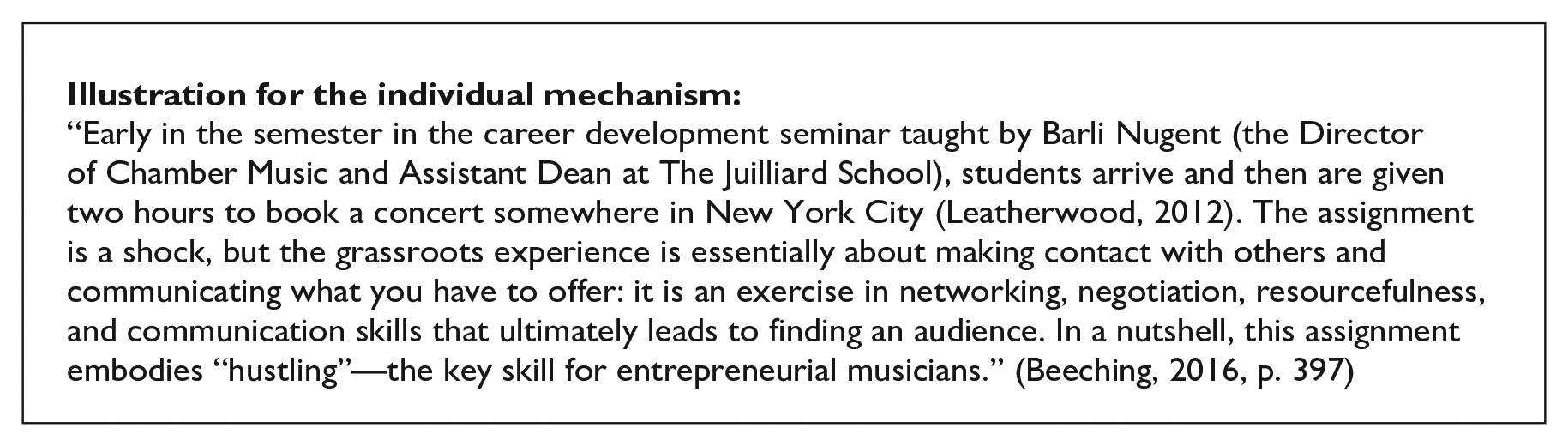
M2: Team-based EEE is the rarest mechanism (n = 4) in our dataset, involving small groups of teachers collaborating and synchronizing their efforts to embark on EEE through undertaking a common project (Arias et al., 2018); creating online synchronized courses, seminars, and discussions (Bosman et al., 2019); or facilitating the development of interdisciplinary student teams (Lackéus, 2015). Similar to the individual mechanism, these team-based efforts are triggered both by favorable legislation (n = 2) and market need (n = 1), with one case where no contextual trigger was mentioned. Team-based EEE takes place mostly in educational institutions (n = 2) and the classroom (n = 1), with only one hybrid setting crossing both an educational institution and a private organization. Three out of the four team-based EEE are in a single discipline, and one is a multidisciplinary field. This focus on implementing EEE within the educational institution (three out of four) highlights less freedom teachers have in team-based mechanisms as compared to the individual one. Team-based intervention involved either internal stakeholders (n = 3) or both internal and external (n = 1). All instances of this mechanism involve hybrid demand pedagogical models: two demand–competence and two supply–demand models. Pedagogical models that require the combination of active student engagement to co-construct their own knowledge with a focus either on real practice and reflection, or on knowledge transmission, may reflect the need to combine different preferred models across the team involved in these mechanisms. We also notice a widening of the realized outcomes in team-based EEE cases compared with the individual mechanism which include both short-term, student-level and long-term, organizational-level outcomes.
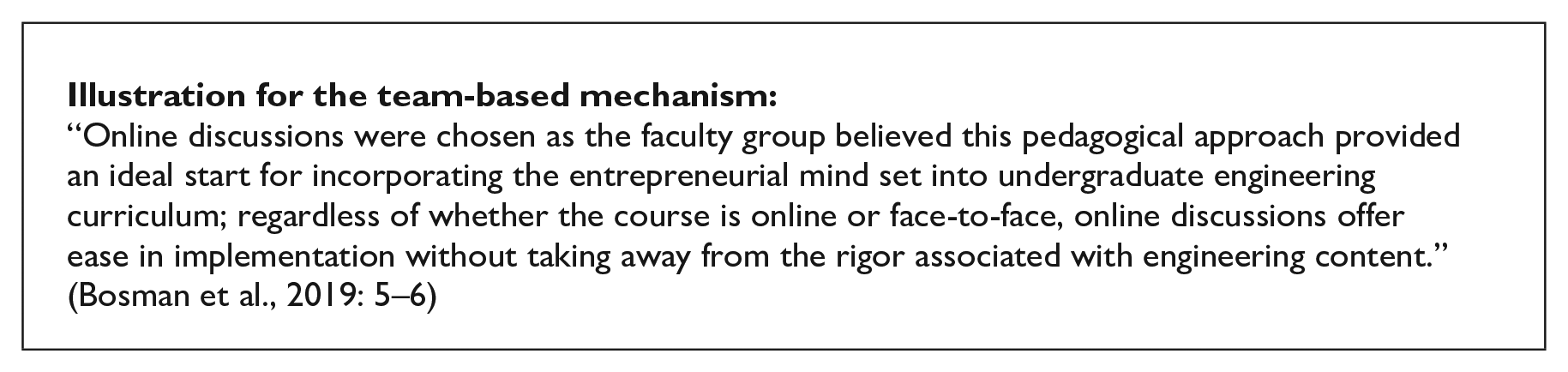
M3: Organizational mechanism is the second most widely used mechanism (n = 7) (together with multi-organizational mechanisms), and refers to a holistic approach characterized by an organization-wide commitment to embed entrepreneurship within non-business disciplines, and to work with a wide range of external stakeholders to support EEE programs. Organizational EEE are triggered by favorable policies (n = 2), market needs (n = 2), both (n = 1), or increased competition in the education sector (n = 1). Organizational EEE programs take place mostly within educational institutions (n = 3) and classrooms (n = 3), as well as non-educational institutions (n = 1). In terms of the academic field, only in two cases EEE targets multidisciplinary fields, with the rest being single discipline (n = 5). Organizational interventions involve mostly combination of internal and external stakeholders (n = 5), with only two cases involving solely internal stakeholders. In comparison with the individual mechanism, organizational EEE interventions include a much wider range of outside organization such as companies, investors, and accelerators, but narrower pedagogical models, including demand competence model (n = 5) and demand model (n = 2). Most organizational type EEE programs do not report any outcomes (n = 4). From the cases where such outcomes are reported, most focus on long-term outcomes at organizational level.

M4: Multi-organizational mechanisms are almost as common as organizational mechanisms (n = 7) and involve implementing EEE across multiple locations. Multi-organizational mechanisms take two forms: national (n = 3), where the locations are all within the same country and international (n = 4), where the organizations involved in deploying EEE span multiple countries. Multi-organizational EEE is triggered either by favorable legislation (n = 3), market demand (n = 2), or both (n = 2). Learning takes place within the educational institutions (n = 4) and classrooms (n = 3) restricting teaching to educational institution space only.
Most of the multi-organizational interventions are conducted under the guidance of an umbrella organization, such as The Coleman Foundation (Katz et al., 2013), Comenius Regio project (Leffler and Falk-Lundqvist, 2014), Science Enterprise Challenge competition (Handscombe et al., 2008), or a specific industrial national policy (Refai and Klapper, 2016). As a result, such mechanisms often include external stakeholders (n = 4 compared with internal only n = 3). The pedagogical models underlying the interventions include demand competence (3), demand (2), and supply–demand (n = 2). Realized outcomes are reported only in four cases, including mostly short-term student-level and long-term organizational outcomes.
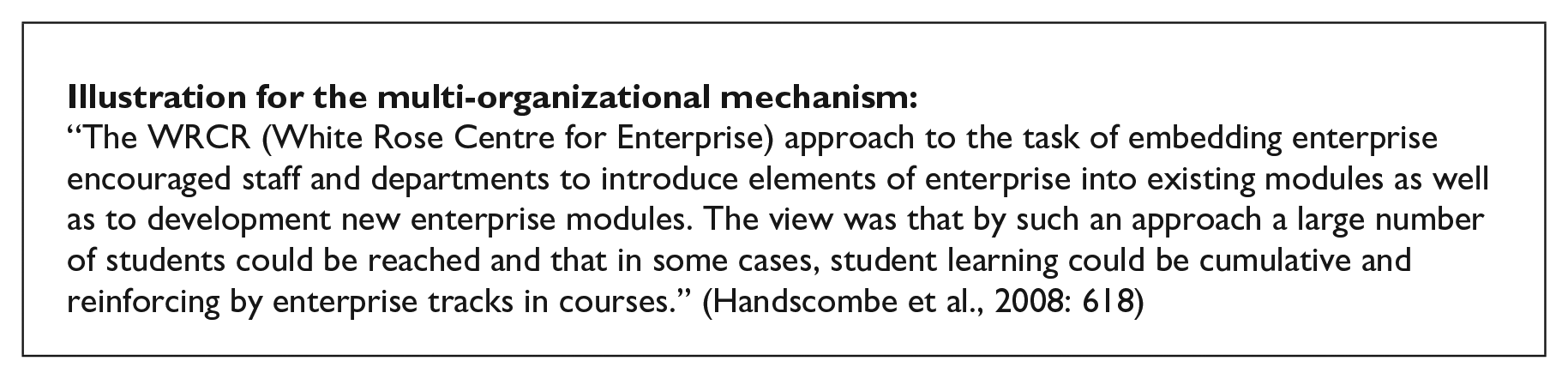
There were also several CIMO attributes where we found no significant difference between the four mechanisms. In particular, all cases are fostered by a combination of market and favorable government policies, span tertiary and secondary educational institutions, and we did not observe any difference in terms of their scope—whether to foster entrepreneurial mind-set, venture creation, and both (intervention). A wider range of discipline fields were involved in most mechanisms, and we did not observe any specific association between programs that are implemented across multiple disciplines compared with the ones that are implemented within a single one.
Further analysis of these mechanisms indicated that they reflect different scales of EEE program implementations—from small-scale programs, involving one teacher seeking to introduce EEE in one course, to large-scale programs, involving multiple organizations collaborating to implement EEE across their institutions. These differences in scale explain the differences we noted in the pattern of contexts, type of interventions, and level of outcomes associated with the EEE programs.
First, in terms of context, individual mechanisms are the most likely to not mention any extrinsic, contextual trigger, suggesting that larger scale EEE programs (organization and multi-organizational mechanisms) are likely to be more sensitive to perceived changes in the market or policy landscape.
Second, with respect to interventions, we find scale is related both to the involvement of external stakeholders and to the pedagogy model. We find that smaller scale EEE (individual and team-based mechanisms) rely almost exclusively on internal stakeholders (i.e. teachers and students), while larger scale EEE (organizational and multi-organizational) tend to involve a wider range of external actors, such as field experts, funders, or private organizations. This may relate to the resources that different scales afford to programs to expend on involving external stakeholders. We also find that smaller scale EEE (individual) tend to involve competence-based (constructivist) pedagogical models that emphasize reflective learning to develop students’ entrepreneurial attitudes and skills, while larger scale EEE programs (multi organizational) rely only on demand and hybrid demand models (cognitivist), associated with experiential learning which focuses on helping students to understand how to take entrepreneurial decisions (Nabi et al., 2017). An explanation of this pattern may be the novelty of EEE programs—as shown by the fact that most EEE publications we identified have been published in the last 10 years. As a result, knowledge and experience on running EEE is still scarce, suggesting that it is smaller scale EEE programs, involving one or a small group of individuals, which are more likely to experiment with newer, competence type of pedagogy models. Larger scale programs seem to be more traditional in their approach and rely on demand or demand–supply models. This seems counterintuitively, as it is these large-scale, multi-organizational EEE programs that happen under the auspices of umbrella organizations tasked with promoting EE, which, as a field, has increasingly adopted a competence model of delivery (Nabi et al., 2017).
Finally, in terms of outcomes, we find a similar difference between small-scale EEE programs which emphasize lower-level outcomes (cf. Nabi et al., 2017)—including student level and short term—with larger scale programs seeking higher level outcomes (i.e. organizational level and long term). Thus counterintuitively, EEE programs associated with competence pedagogy models seem to be associated with student-level, short-term outcomes, while EEE programs involving demand and supply—demand pedagogy models seem to be associated with higher level outcomes. These findings contradict Nabi et al. (2017) results that linked supply, demand, and hybrid of competence in EE programs with lower-level outcomes, and competence model with higher level outcomes. Thus, the association we find is likely to be between the level of outcomes and the kind of mechanisms underpinning the EEE program, rather than between the level of outcomes and the type of pedagogy model. Smaller scale EEE programs—such as those based on individual and team-based mechanisms—are less ambitious in their desired outcomes, focusing on student-level and short-term outcomes such as improved entrepreneurial intention and increased motivation and learning. In contrast, larger scale EEE programs are more ambitious in their desired outcomes, targeting organizational and longer-term outcomes such as contribution to regional economic development, and involvement in business creation following graduation. Also, we find that most EEE programs have a high incidence of unreported outcomes regardless of their scale. For smaller scale programs, this may be related to the limited resources available to track and measure desired outcomes. For the larger scale programs, this may be explained by their reliance on demand type model pedagogy. Demand type pedagogies are associated with lower-level outcomes (Nabi et al., 2017), meaning larger scale programs may experience high difficulties in realizing their desired high-level outcomes (Nabi et al., 2017), thus explaining the high incidence of unreported outcomes we find for organizational and multi-organizational EEE mechanisms.
Recommendations and avenues for future research
There are three major implications of these findings for existing EEE research and practice which concern the scalability of EEE programs, the links between pedagogy models and outcomes, and their contextual diversity. These implications highlight key recommendations for individuals and organizations keen to embark on EEE programs, as well as policy makers willing to stimulate the update of such programs. They also represent areas of significant gaps in existing research on EEE which draw attention to promising avenues for future research within this area.
Scalability
First, our findings point to the critical role that small-scale, individual EEE plays in supporting the growth of EEE programs, representing almost half of the cases we identified. A key constraint in expanding EEE is the availability of teachers who are willing and capable of engaging with an entirely different field, with research noting that teachers in other disciplines have a distant attitude regarding entrepreneurship and its methods (Farny et al., 2016; Gibb, 2011). In contrast, we find that our cases of individual EEE tend to involve creative and enthusiastic teachers, interested and willing to engage with entrepreneurship concepts and teaching, who seek to respond to perceived market demands and policy pressures by implementing EEE within their own course. We have noticed that in most of our cases, these individuals seem to follow the humanist interpretation, by emphasizing that to teach entrepreneurship is not simply to teach students how to develop a venture to make profit, but rather to develop students as enterprising persons (Bell, 2021; Dierksmeier, 2020). Aligned with this approach, such teachers tend to see EEE programs as a way to nurture students’ intellectual, socioemotional, and physical development. But this may not always be the case. As we noted earlier, such approaches may be underpinned by a neoliberal understanding of entrepreneurialism where the focus is on developing students as prepared individuals, able to pursue their own self-interest (Caliskan and Lounsbury, 2022). Regardless of which perspective drives their approach, such individual teachers work mostly with other internal stakeholders to develop a small-scale program—a single individual, within a single course / discipline looking to create impact at the student level. The small scale and high degree of freedom means they can experiment by placing teaching in settings outside the educational institution such as a concert hall (Beeching, 2016), entrepreneurial ventures (Costello, 2017), or a recording studio (Garnett, 2013) and by choosing in most cases competence-oriented interventions. This approach to locate the intervention within local spaces reflects the community perspective that characterizes humanistic approaches to education (Bell, 2021; Dierksmeier, 2020). The appetite for experimentation we find in individual mechanisms also means that such EEE programs are more likely to engage with novel methods, try new things to understand what works and what does not, while their small scale means that the costs and risks associated with failure are limited to one single course. This focus on individual mechanisms to encourage experimentation aligns with the contextual approach to develop organizational ambidexterity, which requires individuals to use their own judgment in dividing their time between aligning with current practices to emphasize efficiency versus searching for new ways of doing things to adapt to a changing environment (O’Reilly and Tushman, 2013). Thus, contextual approaches, rather than structural approaches to combine efficiency in current teaching practice with innovation through adopting new practices outside the core discipline seem to be more appropriate to facilitate the adoption of EEE programs. Although the small scale of individual EEE mechanisms limits their ability to achieve higher level outcomes, they are important to achieve short-term, student-focused outcomes—thus supporting the development of entrepreneurial skills within their target student cohort. Individual mechanisms offer a low-cost, low-risk but high-reward approach for institutions to initiate their engagement with EEE. As larger scale mechanisms have difficulties to realize their expected outcomes, we recommend a gradual approach to EEE implementation, which should start by encouraging the uptake of individual EEE, and then build on this experience to scale the programs. This gradual approach aligns with recommendations made elsewhere in the education field concerning the adoption of new pedagogies, such as Whitaker et al. (2016) suggestions concerning the adoption of online education by business schools, which should start with schools making small-scale pedagogical changes. These initial small steps give schools opportunities for reflection, experimentation, and refinement which increase the chances of a successful adoption.
While individual mechanisms are the manifestation of creativity and passion of a few, dedicated teachers using less conventional approaches to teaching, they also lack a long-term strategy, collaboration, and organizational framework to allow them to scale up their interventions and achieve a wider range of outcomes. With the exception of Katz et al. (2013) and Gibb (2008) who provide rather descriptive presentations of EEE cases evolution in time, we found no research that takes a temporal perspective to examine the implementation of EEE over time, investigating the process which successful EEE programs can follow to deliver their expected results. This is an important avenue for research because as we notice, many cases of EEE implementation either do not report any realized outcomes or lead to negative outcomes.
Intended outcomes and misaligned pedagogical models
Second, our findings point to a discrepancy between the pedagogical models deployed and the outcomes realized, and to a high prevalence of not reported and negative outcomes across the board, which we link to the novelty of EEE programs. Existing research on EE highlights that different pedagogical models are associated with different kinds of outcomes (Nabi et al., 2017; Pittaway and Cope, 2007a). Our findings suggest that in the case of EEE programs, it is the scale of the mechanisms that drives the desired outcomes, rather than the pedagogical models employed, with larger scale mechanisms being more ambitious and seeking longer term and/or organizational outcomes, even though they seem to rely on pedagogical models that are generally associated with lower level—that is short-term and student-level—outcomes (cf. Nabi et al., 2017). Our findings suggest the need for the actors behind EEE initiatives to purposefully design EEE interventions with intended outcomes in mind, and in doing so, to consider both whether the pedagogical models they plan to deploy allow for these indented outcomes, and the possibility of negative outcomes. Seeing the peculiar nature of EEE programs, the choice of pedagogical models must consider both the desired outcomes and their compatibility with the core course. This means the design of EEE interventions is more complex compared with EE. Our recommendation is to design such interventions iteratively, to allow designers time to evaluate the compatibility between approaches to teach entrepreneurship and those typical in the core discipline, and to understand the kind of outcomes that can be realistically achieved. As Fayolle (2013) suggests for EE, a more rigorous approach to designing EEE interventions that collects data before and after the program would lead to more robust EEE interventions which are more likely to achieve their outcomes.
While our findings do point to an increased number of EEE interventions without any reported outcomes or with negative outcomes, we are surprised at the lack of effort to explore this phenomenon. In our view, a key possible explanation for this lack of realized outcomes—despite the wealth of research and practical experience with EE in general—is related to the particular challenges that EEE faces in bringing together two distinct disciplines, reflecting different practices, associated with different preferred pedagogical models and linked to teachers’ different professional identity (Avidov-Ungar and Forkosh-Baruch, 2018). Infusing entrepreneurship into arts or engineering requires finding ways to bridge two different institutional logics, which is a fraught and challenging process (Gibb, 2011). However, we find no efforts to explore these particular challenges the individuals and organizations seeking to implement EEE face, despite the fact that many of the negative outcomes identified relate specifically to students’ negative perceptions who see the entrepreneurship component as misaligned with their core course, for example, increased workload (Arias et al., 2018) and inability to complete the entrepreneurial tasks (Antal et al., 2014; Garnett, 2013). Given how little we know about the challenges to effectively bridge different disciplines in general, and the fact that this is at the core of EEE programs, this is an important area for further research.
Contextual diversity
Our findings point to the importance contextual diversity has in shaping EEE implementations. We find that EEE is implemented across a wide range of different courses. We also find that non-educational organizations play an important role in supporting EEE for individual mechanisms (Beeching, 2016; Costello, 2017; Garnett, 2013), and that the involvement of a diverse range of stakeholders characterizes most large-scale programs, which rely on multiple organizations, for example, universities, umbrella organizations, and industry collaborating to implement EEE across their institutions (Doboli et al., 2010; Katz et al., 2013; Leffler and Falk-Lundqvist, 2014). Our third recommendation for policy makers and educational managers is to pay more attention to the context, beyond responding to contextual drivers—such as supportive policies—to consider the wide range of contextual options they can choose from when designing EEE programs, and in particular to consider the needs and values of the local community. Recent research calls for a humanistic approach to management education (Dierksmeier, 2020), where learning should leverage social bonds and relationships with external stakeholders within the community and emphasize value creation for the community (Bell, 2021; Dierksmeier, 2020). While there are efforts to consider the need to include a range of stakeholders to involve in EEE initiatives, the limited reliance on non-educational institutions, as well as the single discipline focus is surprising for organizational and multi-organizational mechanisms. For such mechanisms, experimenting with designing EEE initiatives that leverage local communities to deliver teaching and support learning may bring higher rewards and more alignment with humanistic approaches to education, as is seen in several of the cases of individual mechanisms. Our review also highlights the paucity of studies on EEE that consider contextual diversity—whether at macro-level, such as different national institutions and cultures, or at micro-level, such as individual characteristics of the students, for example, gender or ethnic background. Even at meso level, in terms of the academic disciplines, we found very few studies that examined EEE implementation across multiple fields. This is an important avenue for future research because we know that in the context of generic EE, both interventions—such as pedagogical methods (Pittaway and Cope, 2007a)—and their outcomes—such as student or organizational impact (Nabi et al., 2017)—vary depending on contextual factors. We suggest three specific avenues for scholars to pursue. First, by considering the little interest in researching EEE programs outside the United States and Europe (e.g. Katz et al., 2013), our suggestion is to examine the implementation of EEE programs in other countries which would allow for rich cross-country comparison in terms of interventions and outcomes. For example, China has initiated different policies concerning EEE adoption (Wang and Wu, 2015; Xu, 2017), but deeper analysis concerning these initiatives is missing. Second, very few studies analyze the implementation of EEE programs across multiple disciplines. Implementation across multiple disciplines augments the challenges we noted earlier of having to align different institutional logics associated with different fields of study (Avidov-Ungar and Forkosh-Baruch, 2018), to consider multiple alignments between diverse pedagogies, professional identities, and expected outcomes. Finally, in an age where issues of diversity are critical, we found no studies to take actors’ background into account to evaluate how different interventions may be more successful depending on, for example, the cultural background or the previous experience of the students involved, nor to consider the heterogeneity in students’ cohort. While this is recognized as a key gap in EE in general (Nabi et al., 2017), EEE is a more complex field given its adoption in different disciplines, where diversity may affect not only the students, but also the teachers, with respect to, for instance, teachers’ background, personal traits, and preferred pedagogical approaches, which are usually different between academic fields (Neumann et al., 2002).
Reflections on the drawbacks of EEE
EEE can be seen as a splinter of traditional EE (Landström et al., 2022), which has emerged as the need for entrepreneurship competences in non-business courses has increased. Our analysis finds that EEE is deeply rooted in EE educational philosophies and has both positive and negative results.
While considering the idealistic goal of humanism which suggests that the role of education is the development of the whole person, including their intellectual, socioemotional, and physical development (Bell, 2021; Dierksmeier, 2020), and the transformation toward an enterprise culture (Kascak et al., 2011) by considering the spreading of the neoliberalism paradigm, it is obvious that the simple introduction of some sequences regarding what is entrepreneurship and entrepreneurs does not create too much value, even if multiple stakeholders are involved, as in the case of multi-organizational mechanism. There are limitations concerning the pedagogies already employed for particular courses even before embedding entrepreneurship, as there are limitations regarding the resources available for attaining the proposed goal, including teacher competences (Farny et al., 2016; Gibb, 2011) and the educational context.
EEE seems more successful when it is employed by teachers alone, dedicated to this initiative and willing to create entrepreneurship competences, in comparison to wider university programs which tend to rely more on demand pedagogies. However, the resistance from students to the introduction of EEE is higher in the former, since the pedagogies used by individual teachers may be different from those employed in their core disciplines, and may increase their workload by requiring students to develop skills and competencies outside their professional education.
Our findings show that currently, it is difficult to embed EE at a large scale in non-business courses. The policies exist, but we need to invest in trained teachers to perform the EEE process and willing students to accept this change at a wider scale.
Conclusions and limitations
While part of EE in general, EEE programs are a distinct form of education requiring the infusion of entrepreneurship as part of existing courses. Our systematic literature review is the first attempt to map the range of contexts, interventions, and outcomes, and to clarify the range of mechanisms underpinning this emerging approach to deliver EE in different contexts. No study is without limitations, and our study is no exception. First, while relying on a systematic literature review design meant we were able to access a wide range of diverse case studies to conduct CIMO analysis, it also required we rely on data reported in these articles to identify the contexts, interventions, and outcomes. There was a minority of articles that did not report on context, particularly the macro-level triggers, which may also explain why we did not find a strong association between triggers and mechanisms. Second, the review focused on EEE where the education was targeted at non-business school students. The definition of what is included in a business school however can vary quite significantly across education systems, and even within—for example, subjects such as tourism or public governance are sometimes taught within business schools, and other times they lay outside. As not all cases discussed the “school” owning the core discipline, to ensure consistency, we have only included those articles where there was no ambiguity about whether the discipline is clearly non-business, for example, engineering or physical sciences. It is likely that these distinctions are relative to the context in which EEE is implemented, and this relativity should be accounted for in future studies.
Notwithstanding its limitations, our review provides value in three ways. First, we identify the contexts in which such programs are likely to flourish, the kind of pedagogical approaches that support their delivery, and the outcomes that they are likely to deliver. Second, we distinguish four types of mechanisms that underpin the delivery of such EEE programs and explain why specific outcomes are achieved (or not) through specific interventions. Finally, our analysis points to three key recommendations both for educators seeking to embed EE or more widely, any kind of skills (e.g. digital) within courses outside their core discipline, and to policy makers seeking to encourage such initiatives. These recommendations also suggest promising avenues for future research as EE increasingly moves outside its traditional domain of business education.
Supplemental Material
sj-docx-1-mlq-10.1177_13505076231169594 – Supplemental material for Embedding entrepreneurship education in non-business courses: A systematic review and guidelines for practice
Supplemental material, sj-docx-1-mlq-10.1177_13505076231169594 for Embedding entrepreneurship education in non-business courses: A systematic review and guidelines for practice by Emil Lucian Crișan, Ioana Natalia Beleiu, Irina-Iulia Salanţă, Ovidiu Niculae Bordean and Raluca Bunduchi in Management Learning
Supplemental Material
sj-docx-2-mlq-10.1177_13505076231169594 – Supplemental material for Embedding entrepreneurship education in non-business courses: A systematic review and guidelines for practice
Supplemental material, sj-docx-2-mlq-10.1177_13505076231169594 for Embedding entrepreneurship education in non-business courses: A systematic review and guidelines for practice by Emil Lucian Crișan, Ioana Natalia Beleiu, Irina-Iulia Salanţă, Ovidiu Niculae Bordean and Raluca Bunduchi in Management Learning
Supplemental Material
sj-docx-3-mlq-10.1177_13505076231169594 – Supplemental material for Embedding entrepreneurship education in non-business courses: A systematic review and guidelines for practice
Supplemental material, sj-docx-3-mlq-10.1177_13505076231169594 for Embedding entrepreneurship education in non-business courses: A systematic review and guidelines for practice by Emil Lucian Crișan, Ioana Natalia Beleiu, Irina-Iulia Salanţă, Ovidiu Niculae Bordean and Raluca Bunduchi in Management Learning
Supplemental Material
sj-docx-4-mlq-10.1177_13505076231169594 – Supplemental material for Embedding entrepreneurship education in non-business courses: A systematic review and guidelines for practice
Supplemental material, sj-docx-4-mlq-10.1177_13505076231169594 for Embedding entrepreneurship education in non-business courses: A systematic review and guidelines for practice by Emil Lucian Crișan, Ioana Natalia Beleiu, Irina-Iulia Salanţă, Ovidiu Niculae Bordean and Raluca Bunduchi in Management Learning
Footnotes

References
Supplementary Material
Please find the following supplemental material available below.
For Open Access articles published under a Creative Commons License, all supplemental material carries the same license as the article it is associated with.
For non-Open Access articles published, all supplemental material carries a non-exclusive license, and permission requests for re-use of supplemental material or any part of supplemental material shall be sent directly to the copyright owner as specified in the copyright notice associated with the article.
