




Abstract
In this paper, we describe a mechanism for subverting the institutional-level neo-liberal hidden curricula of responsibility learning in universities by using a positive hidden curriculum based on extra-curricular activities partnering staff and students. In our study, we leverage projects from an institution-sponsored Justice, Equality, Diversity and Inclusion (JEDI) initiative as notional ‘Trojan horses’ to instil within university students a more reflexive awareness of responsibility that they can take with them when they graduate. In delivering this positive hidden (extra)curriculum, staff are seemingly performing the formal agenda of the institution’s responsibility agenda while undermining its managerialist hidden curriculum by working in tandem with students. Our key findings – student reflection and voice – are evidence of the positive hidden curriculum implementation. Our contributions are twofold. First, we demonstrate that positive hidden curricula can serve as a tool of micro-activism to subvert managerialist hidden curricula. Second, we offer another dimension to Semper and Blasco’s interpersonal strategies for challenging the hidden curriculum by showing that collaborative projects between students and staff can be sites of a positive hidden (extra)curriculum. Collaborative initiatives such as the ones we describe in this article provide a tangible foundation for reconsidering creative and intrinsic approaches to responsible learning environments.
Keywords
The current context of higher education promotes rankings-based power games (Anderson et al., 2021) and targets and terror (Jones et al., 2020) among staff, while students are increasingly measured by satisfaction and productivity in the pursuit of favourable degree classifications and grade point averages (Semper and Blasco, 2018). These types of arrangements in higher education institutions (HEIs) have led to a restricted and individualistic view of education for students as a means to certification, especially for those who are studying business (Muddiman, 2020; Racz and Parker, 2020). A consequence of such an arrangement is known as a ‘hidden curriculum’ (Blasco, 2020) in which there is an implicit body of learning that occurs parallel to and separate from the formal curriculum. At the institutional level, such hidden curricula frequently serve to reproduce and reinforce dominant hegemonic interests at the expense of marginalised groups and often in contradiction to espoused objectives. We contend that institutional hidden curricula have failed students in preparing them adequately for the moral challenges that they will face in their future working lives (Ehrensal, 2002; Laasch and Gherardi, 2019).
Yet, we believe there is a possibility of a more humane future for academia (Korica, 2022) in the form of a positive hidden curriculum that emphasises the collective process over individualised performance (Blasco and Tackney, 2013). With a positive hidden curriculum, this more humane future could be community based with mutual care and explicit value attached to working with students; however, such possibilities will remain utopian visions (Fournier, 2002) unless any action is taken. In the present study, we explore the outcomes of a positive hidden curriculum embedded in two extracurricular projects that engaged students as partners in a mainstreaming initiative that promoted Justice, 1 Equality, Diversity, and Inclusion (JEDI) principles. We employed these institution-sponsored projects as ‘Trojan horses’ to create a positive hidden curriculum that offered innovative and intrinsic ways to rethink responsible learning environments, but accepted the pragmatic reality of the current context of ‘checking boxes’ (Bennett & Brady, 2012, as cited in Semper and Blasco, 2018). We explored how such a partner relationship between staff and students facilitated a positive hidden curriculum that nurtured students to resist the neo-liberal ideologies embedded in the hidden curriculum of responsibility learning. We contend that this positive hidden curriculum enables students to embrace opportunities for deeper, richer learning outside of the confines of the measurable spaces of a corporatised University.
As Deschner et al. (2020) argued, resisting the neoliberal university requires finding theoretical tools that encourage taking action rather than falling into despair. In this study, we evade the ‘insidious power structures’ (The Kintsugi Collective et al., 2021) of the managerialist university by creatively using the resources (time and money) associated with the popularised global EDI agenda within HEIs (Ahmed, 2006). We share insights from working with students as partners (Bovill et al., 2016; Dickerson et al., 2016) in co-created JEDI projects. We illustrate the power of such a collaborative faculty–student resistance relationship by presenting two interrelated projects that reveal two core structuring mechanisms of a positive hidden curriculum – reflection and voice.
Our paper contributes to theory by articulating how a positive hidden curriculum can be embedded within formally approved, extracurricular JEDI projects to subvert the extant, individualist managerialism within higher education. Central to our contribution is the collaboration between staff and students as partners in shared citizenship work to creatively engage with JEDI in parallel with necessary evaluative initiatives. This collaboration functions as both a formally mandated project enabled by institutional resources and an informally nurtured process of individual and collective reflection. The type of positive hidden curriculum we describe acts as a vehicle through which a reflexive, community-oriented discourse can emerge between staff and students.
Our work sheds new conceptual insight on how a positive hidden curriculum might be constructively enacted within everyday practice through reflection and voice within a collaborative initiative that values students as partners and co-creators of their educational experiences. Such collaborative initiatives have been presented between students and staff from a variety of approaches including appreciating student engagement, joint work with institutions to better meet the needs of the student population at large (Dollinger et al., 2018), and recognising a role for students as constituents of the university rather than external objects (Naylor et al., 2021). Our collaborative initiative furthers this tenet of research by valuing students as partners and co-creators of their educational experiences.
This paper proceeds with a review of expanding managerialism within higher education to justify the ‘Trojan horse’ micro-activism we enacted. We explain how creative pedagogy through staff/student partnerships can disrupt this managerialism within HEIs. We outline our methodological approach to enacting the theoretical principles of democratic citizenship via our two JEDI initiatives. We present our empirical findings from qualitative data generated with student partners and discuss the key themes of ‘voice’ and ‘reflection’ that emerged from analysis. Finally, we conclude the paper by discussing our contribution to knowledge of how staff and students can generate a positive hidden curriculum by engaging as partners in extracurricular JEDI projects, which has the potential to enhance interpersonal pedagogy and resist managerialism.
The higher education context
The hidden curriculum of neo-liberal marketised ideology has trapped universities in endless ratings and measurements that prioritise short-term performance over long-term sustainability for staff and students (Lynch, 2015). Positive conceptualisations of education (Labaree, 1997), such as democratic citizenship, have been marginalised via a ‘Trojan horse’ infiltration of marketised efficiency (Miraftab, 2004). This corporatised climate simultaneously grasps power from faculty and students while benefitting a small group of management stakeholders, such as executives who receive bonuses based on favourable university level outputs.
The steady marketisation in the higher education sector endangers the founding purposes of modern education to develop critical minded and responsible citizens (Dewey, 1916; Labaree, 1997). The pressures of marketised education create tensions between academics’ own commitment, judgement and authenticity about ‘good practice’ and students’ commodified ‘needs’ (e.g. employability via a minimum degree classification) and the rigours of performance. Associated research-based pressures to compete for high-ranked journal outputs can be detrimental to teaching quality (Skourdoumbis, 2019). Some academics may be influenced to measure and reward academic performance by tailoring student projects to align with quantifiable, active and observable corporate outputs, not nuanced (potentially personal and unobservable) pedagogical outputs with oft-times intangible rewards (Gourlay, 2015). They might also adjust their teaching practices in an attempt to maximise student evaluations by making students ‘happy’ in the short term (Thiel, 2019). This pedagogy of entertainment, or passification, conspires against stretching students outside their comfort zone to achieve deeper learning that requires sustained and dedicated effort (Horton et al., 1990). Or they may disengage from the learning journey ‘as if it were no longer even necessary to pretend that students mattered in any way other than the prices they pay for the “products” which provide them with . . . a “return on their investment”’ (Parker, 2014: 290).
Within marketisation of contemporary higher education, students have been re-constructed from being ‘learners’ to ‘customers’. As a result, students may resist participation in any extracurricular activity which does not directly contribute to their degree outcome (Seale et al., 2015). They may resort to disembodied online complaints and grievances against faculty members to resolve issues (Hart and Rush, 2007). Or, they may simply avoid fully engaging in the learning experience if they fear retribution from an academic with ‘power over’ their grades (Canning, 2017). Ultimately, the purpose of education has shifted from being a public good for all citizens to a private good for individuals who seek credentialing to improve their individual status.
Challenging this shift, Justice, Equality, Diversity and Inclusion (JEDI) agendas can, potentially, perform a unifying role in engendering solidarity between staff and students with mutual responsible citizenship values (Baker et al., 2006). JEDI agendas connect to social justice through their debt to feminist organising and the importance of ‘consciousness raising’ (Hooks, 2000) as a vital first step in building a coalition of likeminded partners. In a HEI context, the importance of the JEDI lens is particularly acute when considering the widening participation agenda (Burke, 2013) and the disadvantages many students bring with them before they even begin on day 1 of their studies (Bhopal, 2018). This is acutely the case for intersectionally disadvantaged students, whose experiences are not easily contained within conventional top-down diversity management groupings (Dennissen et al., 2020). Increasing awareness of these injustices through evaluative processes such as Athena SWAN emphasise the need for interpersonal approaches between staff and students (Semper and Blasco, 2018) that invest time and resources into community and citizenship.
Although top-down approaches, such as Athena SWAN (a UK-based gender equality review and action charter) and the UN Principles for Responsible Management Education (PRME) attempt to tackle shortcomings of marketisation in HEIs, a recent empirical study of institutional EDI champions found that these approaches reproduce dominant managerialist interests (Yarrow and Johnston, 2022). Tzanakou and Pearce (2019) argued that, although schemes such as Athena SWAN raise awareness of gender inequality and facilitate transformative interventions because they are not ‘resisted’ by the university, they are typically part of a corporate strategy and, at worst, a tokenistic badge for ‘institutional peacocking’ (Yarrow and Johnston, 2022). As a result, institutional approaches to these ‘top-down’ charters can also limit the potential for sustainable change.
Such change should be long-term and embedded consistently in institutional practices and cultural discourse through daily work, not periodic, labour-intensive reports. Similarly, Blasco (2012) argued that altering formal curricular goals and content alone in line with PRME is not enough to improve students’ sense of social responsibility because it does not take into account the hidden curriculum embedded in the management education that embraces neoliberalism and conceals neoliberal market logics (Blasco, 2012; Mandiola Cotroneo, 2013). The problem with top-down approaches is that they often require overly concentrated project work to gather evidence and write action plans to a deadline to cover a 4- or 5- year cycle. Such approaches risk the spectre of ‘diversity fatigue’ (Ahmed, 2006) as people become overexposed to a plethora of similar activities and the impact may be diluted.
Yet, just as the Trojan horse of managerialism has lured higher education into this trap, so can another Trojan horse – harnessing the resources associated with JEDI work – contribute to a counternarrative of democratic citizenship. We contend that mainstream responsible learning remedies such as Athena Swan, which are associated with institutional sponsorship and resources, can be leveraged as ‘counter-narratives’ (Czarniawska, 2016; Frandsen et al., 2016) to re-engage staff and students based on localised, grass roots action. By enacting a positive hidden curriculum, it is possible to ‘co-create’ and ‘foster different configurations of narrative patterns’ within everyday practice (Deschner et al., 2020; Gabriel, 2016; Gabriel and Connell, 2010) for what it means to be a student and academic in a business school and wider community. In doing so, the stage is set for reimagining pedagogy in HEIs. Thus, the next section will consider routes to intervening in, and resisting, the creeping managerialist hidden curriculum within HEIs.
Reimagining pedagogy
Building on notions of democratic citizenship in education (Dewey, 2012), we contend that students and staff become partners in extra-curricular JEDI work to resist the dominant interests that are controlled within the measurable, formal curriculum. We are committed to the idea that, in order to replace certain social structures, the approaches created to fight for replacements must represent some aspect(s) of the desired future structures (Raekstad, 2020). The emphasis on the everyday practice is in line with Freire (2005) who argued that the procedures and experiences of struggles for knowledge and freedom themselves are transforming. Students must proactively pursue such knowledge and recognise the need to fight for it; hence, the mechanism of extra-curricular work, which requires discretionary effort. Therefore, our pedagogical approach is to reimagine the routes to democratic citizenship through collaboration between staff and students.
We argue that a collaboration between staff and students that operates outside of the transactional culture of contemporary higher education (Gonzales, 2015) can normalise inclusiveness and mutual empowerment in current everyday practice. Using every day, easily identifiable processes (see gender mainstreaming project by Kelly et al., 2017) can enable pedagogical innovation and offer the justification for staff and students to take action in the here and now. This goes further than strategic or utopianist ‘imagining’, or failing to imagine, a better future (Millar and Price, 2018). Co-creating opportunities for tangible action concerning JEDI can make students aware of their wider responsibility towards others in society (Padan and Nguyen, 2020) and lead to intangible (Gourlay, 2015) and interpersonal rewards (Blasco, 2020).
Steffen’s (2017) work on engaging students to critique the university alluded to pedagogical approaches which ‘provoke students’ civic imagination’ (p. 23) and invited speculative discourse akin to Freirean ‘praxis’ of ‘simultaneous action and reflection’ (Freire, 2005: 101). The effect of such praxis in the managerialist university context necessitates the ‘critical intervention of the people in [the] reality’ (Freire, 2005: 53) of the university. Working with and through student activists, academics offer ‘shared bases of practical and strategic knowledge’ (p. 24) that contribute to everyday incremental acts to create progressive and iterative momentum towards change (Kelly et al., 2017). To stretch the boundaries of such approaches, academics must take responsibility for their own micro-activism by constructing new learning processes outside of the formal curriculum as positive hidden curriculum (Blasco and Tackney, 2013; Trevino and McCabe, 1994). Thus, we promote the use of extra-curricular action as a rich site for such praxis.
Academics also hold responsibility for mitigating the risks of deductively coding and harvesting research rich ‘data’ when receiving new insights from students. Instead, there must be an emphasis on dialectical thought (Freire, 2005) and a more equal exchange of ideas to learn through praxis about different perceptions of what constitutes JEDI through student lenses. This disrupts academic comfort zones and challenges common-sense assumptions of critically reflective pedagogy (Brookfield, 2017), such as academic experience equating wisdom or in-class discussion always being the best approach. It also pushes the boundaries of ‘safe’ teaching and research practice to re-imagine what such partnerships could be. In such an approach, there is a precarious responsibility due to the positional power held by academics relative to students. It is incumbent upon academic partners to be responsible for mitigating the fear inherent in the expert-novice dynamic (Ford and Harding, 2008) that dominates the transactional norms of the formal, hidden curriculum, and can potentially limit student’s proclivity to be candid.
Below we elaborate our collaborative initiative that includes non-timetabled, light-touch extra-curricular student activity with an integrative impact that informs student self-awareness and, we hope, reinfuses such learning within formal learning contexts, too. In effect, our approach is unbounded by physical or system barriers, a paradigm well suited to the frontiers of designing higher education. As students engage in this micro-activism, they co-create, reflect on, and share what they are discovering with the potential for this learning to transfer beyond the bounds of higher education to family, friends and the workplace.
Methodology
Background
As researchers and educators who were relatively secure members of our organisation, our journey to create a partnership with students began in November 2017 as part of a wider project focused on improving the JEDI culture in a Business and Law Faculty at a large university in the United Kingdom. Modelled after a UN Gender Mainstreaming approach (Kelly et al., 2017) to ensure interests of all genders are accounted for in policy and practice, we developed a mainstreaming project that was broadened beyond gender to explore multiple areas of marginalisation and included a review element and application for recognitions associated with race, gender (e.g. Athena SWAN), disability, and sexual orientation. There is much contention about the validity and value of such recognition schemes (Caffrey et al., 2016; Tzanakou and Pearce, 2019; Yarrow and Johnston, 2022), and we agree that such schemes can have an unintended consequence of seeking a ‘shiny badge’ at the expense of making actual, substantive culture change.
However, as Tzanakou and Pearce (2019) argued, these schemes can be used as a site of resistance and a way to work against neoliberalism. We contend that such schemes can be leveraged as ‘happy consequences’ that can mask Trojan horse initiatives that aspire to embed JEDI as pillars of the positive hidden curricula. By questioning ‘the game itself, making visible its outlines, rules and referees – and the historical contingency and arbitrariness of its arrangements – we might be able to create the conditions of possibility for an alternative approach and produce a different way of practicing politics within the university’ (Shore and Davidson, 2014: 25). This would be possible by using creative resistance with the intention to not oppose, nor speculate, but to offer an actual alternative that can be enacted in everyday practice (Cornell, 2011).
Accepting the risks of our own arbitrary influence in this action-oriented approach, we prioritised student input from the earliest opportunity. As a faculty-led initiative, we, as the academic partners, were aware of the power differentials present in running such a project. We were able to proceed with an overarching JEDI project due to a formal mandate from management, tied in with an Athena Swan award application. Our roles were formally recognised as Project Chair, Project Manager and Sub-Team Leader, which gave us formal credibility among our peers and, crucially, when seeking student volunteer partners. In using our positional power, we were mindful of the potential pitfalls of using student data for instrumental ends. Thus, we made a conscious effort to partner with students as an act of resistance against a ‘common enemy’ (Fournier, 2002: 191), the encroaching normalisation of the neo-liberal university. To facilitate this partnership, we worked with the University Student’s Union (USU) because of their role as champions of student interests (Chapman et al., 2013: 271).
Staff and students as partners: project design principles
We progressed from the overarching aims of our Faculty-level JEDI mainstreaming project to consider the important stakeholders: Staff and Students. By the start of the 2018/2019 academic year, we had undertaken an initial reflective process involving discussion and shared reading of important texts (e.g. Blasco, 2012) with staff and doctoral student project members, recruited via an initial open call for volunteers, to establish a common approach to achieving greater JEDI.
As authors, we were major actors within the founding organising committee, including the project chair and project manager. We worked with fellow staff and students to shape the parameters of the project. It is important to note that, though we worked with post-graduate research (PGR) students at the foundational stage, none of those students participated in the projects presented in this paper. As academics, our involvement in the project was primarily to mainstream JEDI as a cultural and structural aim; the development of these collaborative initiatives became opportunities to progress the broader mainstreaming effort. From the early-stage conceptualisation, we began to work in six different sub-teams, three of which inform the present study of positive hidden curriculum projects: one focused on students, one on media and another on curriculum.
Our research design was developed with an emphasis on real world impact (i.e. measurable outputs that included a feedback loop to Faculty staff, students and management). These real-world impacts addressed the expected data outputs of our overarching JEDI project (i.e. usable data for the Athena Swan application), and enabled the ‘Trojan horses’ of our positive hidden (extra)curriculum (i.e. the JEDI agenda as praxis) and its associated critical consciousness raising. Our hope was that our positive hidden curriculum would generate a dialogue among staff and students as partners within our faculty concerning what JEDI is or should be.
To operationalise this overarching design goal, we adopted three shared principles. Our first principle was to work with volunteer students through an egalitarian and mutually beneficial partnership (Bovill, 2019) and socialise them (Semper and Blasco, 2018) into our collaborative projects. This egalitarian intent was pragmatically implemented; as academics we did not expect to achieve fully equal power dynamics within a managerialist educational context at the first attempt. The primary mechanism of subversion was to make the projects open, voluntary and outside of the existing curriculum (i.e. extracurricular). This was a crucial principle to enable any project we designed to contribute to our overall subversive intent to problematise the increasingly transactional dynamic between faculty staff and students.
Our second design principle drew on the intersectional feminist method of ‘consciousness raising’ (Hooks, 2000) in the context of observable gaps in representation, or to test existing assumptions, concerning management curricula. We approached this principle based on two baseline assessments: a local level review of problematic or underrepresented visuals (posters, artworks, signage etc.) in the building and published research highlighting gaps in the gender diversity of the UK management curriculum (Perriton and Elliot, 2018; Perriton et al., 2022). These baselines provided justification for staff–student partnerships to improve our physical environment and to raise awareness of, and affect change to, our curriculum. Our consciousness-raising was intended to educate and inform all our stakeholders (staff, students and management) about contemporary JEDI issues in context.
Our third principle was to co-construct our projects with students from inception. To achieve this, we consulted with key stakeholders (i.e. those with an elected remit connected to JEDI) in the Students Union (Chapman et al., 2013). This was not a piecemeal consultation, we shared draft review frameworks and templates, took feedback, and met with representatives to refine both projects. We valued this interpersonal relationship and fostered buy-in from these democratically elected students so we could connect with and engage the student body as partners.
These three principles were crucial to undertaking a consistent approach to working with students as partners. From this foundation, we felt confident we were designing projects that were differentiated from the formal curriculum, addressing empirical problems and re-engaging with democratic citizenship. Below, we describe the two projects in more detail.
Project 1 – student-led curriculum review
This project ran from October 2018 to May 2019 and combined the shared interests of students and the curriculum sub-team to evaluate weekly course materials and in-class activities through a JEDI lens. We recognised that the best way to meet ultimate student interests was if faculty interests were also met. Thus, out of a collaborative effort with the USU, one of the primary roles created for students was to work as reviewers by virtue of their in-class and on-course learning experiences. Student partners also acted as analysers and collaborators in sharing their findings and evaluating their experiences with us as staff partners at various stages throughout the project.
To facilitate our work with volunteer students, we incorporated new approaches for participatory research and gender-focused reviews inspired by the work of Kelly et al. (2017) that could give us sustainable, practical and strategic answers to our overarching goal of improving our faculty’s culture beyond simply ‘ticking boxes’. The student reviewer role involved a weekly review template, co-designed with the USU and aligned with existing parameters of daily ‘diversity work’ (Ahmed, 2006), to evaluate learning experiences and materials. We included Likert-type scale responses to frame areas of interest such as ‘reading list authors were gender/disability/race/LGBTQ* inclusive’ alongside summative qualitative prompts to generate students’ overall impressions of the positives and areas for development each week. Students were also asked to complete an overall evaluation at the end of the term to consider the course as a whole, which was later discussed in an interview with staff collaborators. The resulting student participation included multi-term, student-led curriculum reviews and additional options for independent student projects (e.g. critical discourse analysis for the Business School’s twitter account).
The student-led curriculum review was a strategic approach to evaluate the delivery of curriculum (Bovill et al., 2011: 137) triangulated with a parallel academic-led review that looked at the curriculum as developed by academics. This review ran over the course of one academic year and encompassed students from business and law disciplines as members of the wider faculty.
Over two semesters, two cohorts of students followed a review template for their in-class and asynchronous learning on a module of their choosing. From the outset, we encouraged our student partners to choose their modules based on the principles of reviewing representative examples of the curriculum, not limited to modules dedicated to EDI theory and concepts (e.g. Diversity Management). It was important in this process that the students assessed the relative merit of including a module from their course to encourage co-creation in our collaboration. Though we initially met with the students on a semi-formal basis to provide guidance for their role and get feedback from them (and for a mid-point catch up in the second round), we did not supervise their activity. We preferred that the students learn from their experiences of doing the review, which we would then reflect upon through open dialogue with students and further reflective discussions as staff in our regular project management meetings.
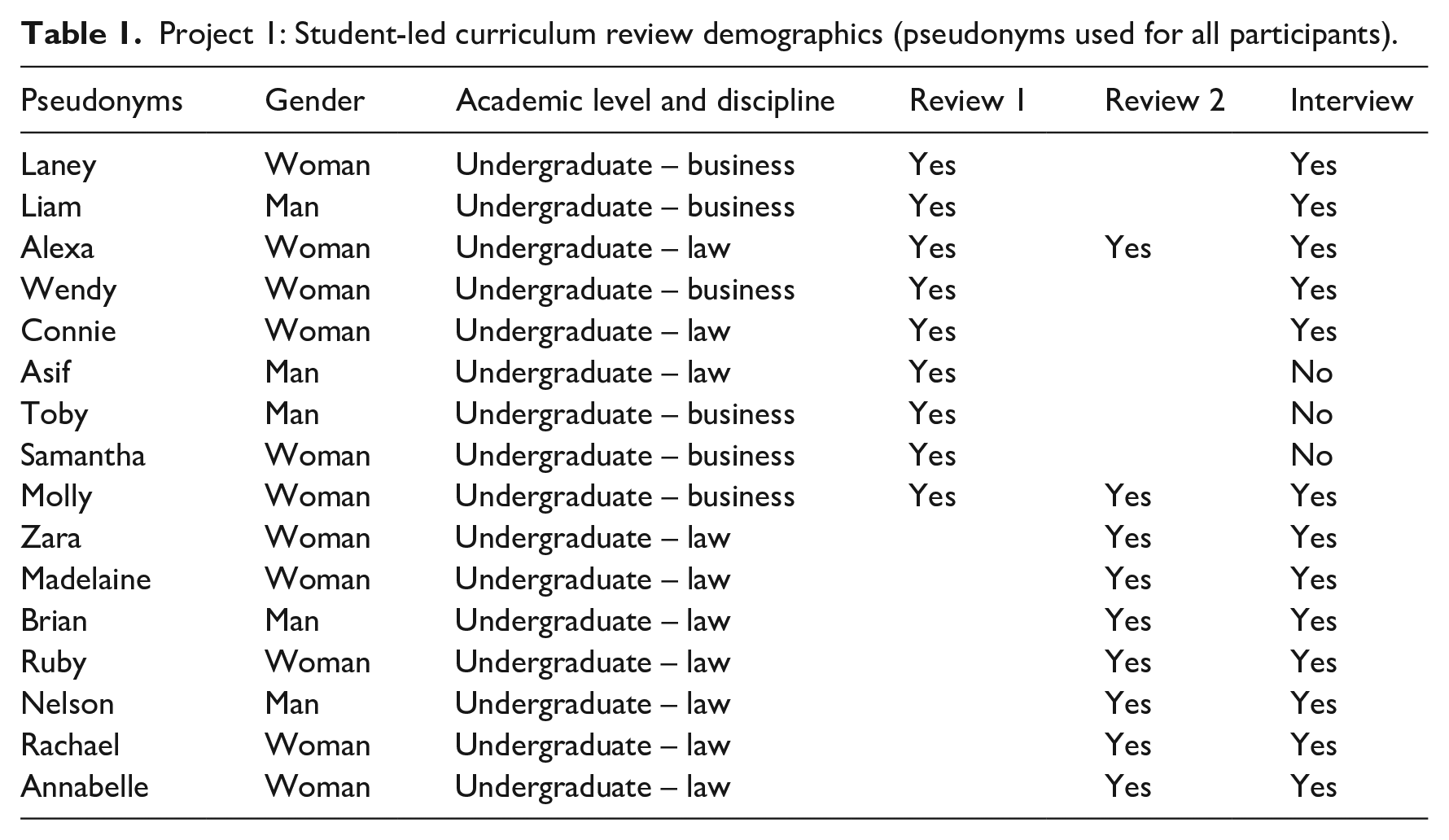
We conducted two rounds of post-review interviews (immediately after each round) with the student volunteers (19 students undertook the review across both semesters, 15 participated in interviews), 6 interviews were conducted in semester 1 (4 women, 2 men) and 9 were conducted in semester 2 (7 women, 2 men). These gender demographics were not representative of Faculty gender representation of students in 2019 (51% women), nor the wider University (56% women), and show that our JEDI project attracted greater participation from women students and may have been invertedly unattractive to students who were men. Though informed consent was given for all participants, interviews were not recorded. Instead, the authors took detailed notes with verbatim quotes. We chose not to record as we did not want the conversation to adopt the tropes of a classic interview with the associated power differential between academic and participant.
The semi-structured interview protocol asked students to respond to thematic questions related to their reflections of participating in the project. In addition to the interviews, 13 out of 15 student interviewees returned their weekly curriculum review templates, including an overall impressions summary sheet, which partially informed the interview discussion. During the interviews, students answered a summative question of, ‘To what extent does this experience make you feel like you can make a difference in the culture of the Faculty?’ This question was posed to learn from their perceptions of partnership and co-creation of the curriculum with staff.
The participants (see Table 1), predominantly white women between the ages of 18 and 21, ranged from highly motivated and engaged individuals to those with more individualist motivations (e.g. it looks good on their CV). Of the men who participated, similar motivations were observed. Such motivations are not surprising because we did incorporate enticements (e.g. transcript credit and a Student’s Union hoodie) to encourage participation, ironically reflecting our complicity with the transactional paradigm in academia. Despite our aspirations, we prioritised greater volume of student participation, rather than seeking purely intrinsically motivated students. This is a tension we will return to later when discussing the student poster competition and associated prizes (vouchers including a £150 top prize).
Project 1: Student-led curriculum review demographics (pseudonyms used for all participants).
The findings from the curriculum review were directly fed back to faculty and students via ‘teachable moments’ workshops, which raised consciousness (Hooks, 2000) of existing gaps in knowledge and student engagement with diversity topics such as hidden/invisible disabilities and unintentional tokenism. These workshops were open to all faculty and attended by staff and students, many of whom were not connected with the project. In addition, the project findings formed a part of monthly and annual reporting from the Project Chair, who was also the EDI Lead within the Faculty, to the Executive Committee and Institutional EDI committees and served as a potential template for other faculty projects to follow. Resultant changes in curriculum were less tangible, though this was intentional (Gourlay, 2015) and is not within the scope of this paper. Democratic citizenship was prioritised via the immediate impact of sharing our findings through the workshops as an extension of our JEDI project.
Project 2 – JEDI poster competition
Our second project, ‘Diversity and Inclusion Poster Competition’, was also a result of the overarching faculty-wide JEDI project. We reviewed visual displays throughout the faculty building with an analytical JEDI lens, identifying good examples and areas for improvement. With clear opportunities for more positive and educational representation, the outcome of the review was to recommend a pathway to address the shortcomings of the existing visuals in the building by working with students as creators. We created a student poster competition and invited students as partners in this project. The competition was designed as an informal, extracurricular space for students to produce innovative posters on the theme of JEDI for display on the walls of the Faculty building. Our goal was to nurture student social learning related to citizenship and community by raising consciousness and encouraging constructive conversations surrounding JEDI alongside the poster competition.
We created the ‘EDI’ poster competition as a Trojan horse, which was funded by the University management with financial enticements for student participants. Though we recognise that this financial reward could be seen as ‘part of the problem’, we contend that this approach symbolised the importance we placed on the creative participation of our students as partners doing important work for the enhancement of our shared environment. Asking for such work to be done voluntarily, with no reward, was felt to be exploitative given our paid roles as academics. Importantly, our Trojan horse ‘competition’ was designed to foster students’ ‘critical analysis of a problematic reality’ (Freire, 2005: 141), and raise their consciousness of the JEDI concepts.
By design, our positive hidden curricula went beyond mainstream business school foci (e.g. professional standards, behaviours and principles), encouraging interdisciplinarity and ‘interpersonal awareness’ (Semper and Blasco, 2018), through creative, emotionally aware, storytelling posters, inspired by JEDI. The competition was therefore an opportunity for students to disconnect from the grade-centred curriculum and engage in a community-oriented project that fostered critical citizenship. This, in turn, created a partnership to achieve our shared goal of critical awareness and consciousness raising within our learning environment.
The competition was introduced to students in October 2019 during induction week and across the University website and intranet. We also promoted the competition via social media (e.g. Twitter and Instagram). To evaluate with a range of inclusive lenses, our judging panel consisted of two student’s union representative (with EDI responsibilities), the Staff Trade Union Equality Officer and faculty staff with JEDI research interests and positionalities (e.g. representation of men and women, disability, ethnicity and sexual orientation).
We had 14 entries that were then shortlisted to 10 by our judging panel for professional printing and permanent display in our faculty building. We interviewed poster creators after they had completed their posters. Seven out of 10 agreed to be interviewed (1 man who participated in a team with a woman, and 6 women) and gave informed consent (see Table 2). As per the curriculum review, gender was a clear factor in encouraging/discouraging student participation. Though this was not further investigated, we inferred from dialogue with students that personal motivations (e.g. feeling part of an oppressed group) played a role in this. Interviews focused on perceptions of JEDI in the culture of the faculty and their individual motivations for participating (aside from financial reward). Across both projects, we also asked for feedback on what we could do differently for future iterations of these project, and this feedback informed ongoing projects beginning in 2021.
Project 2: poster competition demographics (pseudonyms used for all participants).
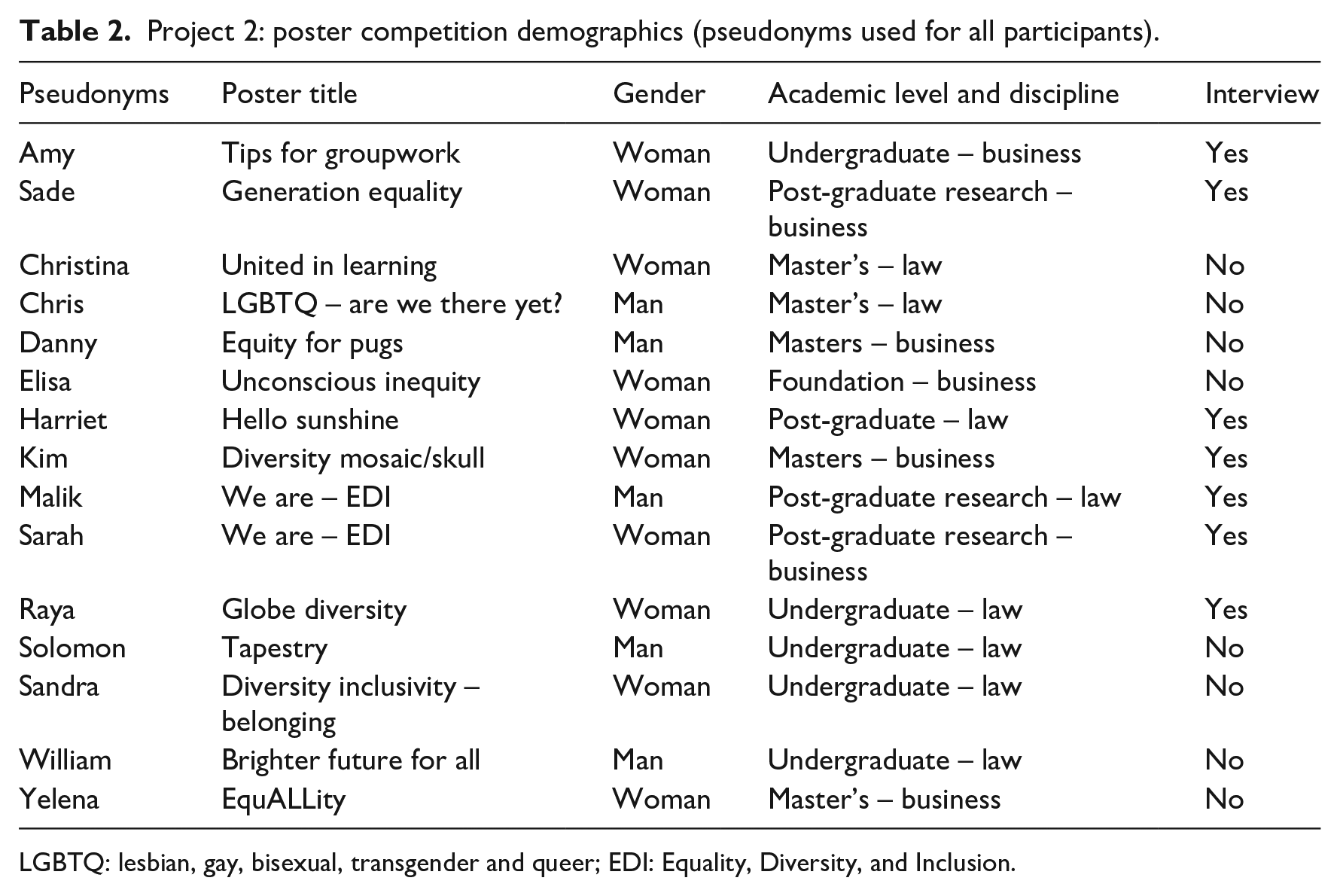
LGBTQ: lesbian, gay, bisexual, transgender and queer; EDI: Equality, Diversity, and Inclusion.
Though we did not explicitly collect other demographic data, we did observe a higher level of engagement from students who could be categorised as being from Black, Asian or Minoritized Ethnicities. In fact, only two participants across both projects could be described as White men. This illustrates a problem in the engagement with that demographic and may connect to a larger problem of White, male privilege (Bhopal, 2018). This is an area we will continue to explore in future project work with students as partners.
Data analysis
Particularly because we were engaging in JEDI research, we avoided what Tuck and Yang (2014) refer to as the ‘settler colonialism’ (p. 811) of coding. Instead, we adopted a post-coding (Augustine, 2014) strategy that emphasised taking a more organic approach of ‘reading-the-data-while-thinking-the-theory’ (Mazzei, 2014). As such, our analysis, or data management as Childers (2014) refers to this approach, was a process of ‘becoming’ from the start of our research project.
All three authors were involved in delivery aspects of both projects and held regular meetings for the duration of each project (every 1 to 2 weeks) to discuss the project. In these meetings, we drew theory through our data as we collected it by asking ourselves, ‘What are we learning from this data?’ from the materials, interviews and observations in the process of the project with respect to hidden curricula. We proceeded to read, re-read, re-view and re-sort the collection before us (Childers, 2014) and discussed our ideas, as a form of ‘praxis’, about what ‘glow[ed]’ (MacLure, 2013, as cited in Ringrose & Renold, 2014: 773) for us in the students’ contributions. For traditional analytic purposes, these meetings served as verbal memos in which we developed insights from observations, informal interactions and submitted review sheets. In our notes from these meetings, we thus captured the fragments of data from the collection that ‘intensif[ied] our gaze and [made] us pause to burrow inside it’ (MacLure, 2010: 282)—such as observing the way student review sheets and casual comments became more nuanced.
Upon completion of the interviews, two of the three authors reviewed the interviews for each project, one of whom participated in analysing the interviews for both projects to provide consistency. At this stage of the analytic process, we looked for ‘hot spots’ (MacLure, 2013) in the interviews that reinforced the ‘glows’ of affective intensities that emerged in our verbal memo meetings. After these initial impressions were developed for each project, one author conducted a meta-review of the initial findings to identify cross-cutting themes that emerged from both projects. We then met as a team to make sense of the assemblage that emerged before continuing the process by writing up our understandings of the projects as we presently see them. We used interview excerpts as the most concise means to share our interpretations of the data.
Findings
Our study sought to explore the potential impact of a positive hidden curriculum to nurture students as resisters of reductive managerialist learning. Thus, we looked across our two projects that aimed to contribute to our wider aim of improving our faculty culture to identify common themes of engagement by the student partners. Our findings presented here capture the two core themes that students identified from their involvement in these projects – reflection and voice.
Reflection and the seeds of reflexivity
From the outset of most of our interviews with the students, it became clear that the projects had encouraged them to engage in both reflection and, for some, reflexivity. We interpret reflection as a process in which an individual examines or considers their personal experiences, while we see reflexivity as an expansion of that examination to consider interaction with the broader social system (Cunliffe, 2009). Personal reflections linked the individuals’ project experiences and personal narratives into their practise of JEDI. Some participants engaged in reflexivity when they acknowledged the inherent complexity of social justice causes and considered their potential roles as micro-activists within the university.
At the very least, students reflected upon how rewarding it was to do something different apart from university assignments and research. Analise commented upon how crafting a poster enabled her to think about how her personal experience of dyslexia could be applied to improve learning for others. She was one of several who reflexively raised the lack of awareness of ‘invisible’ disabilities among staff and students as a key focal point of our praxis.
Extending the reflexivity demonstrated by some student participants, Kim (Poster 2 ) alluded to her own experiences of being labelled as racist when she met fellow international students and had said to one of them that ‘you look similar to your friends’; she recounted how she defended herself and sense-checked with a friend regarding what constitutes racism. To her, racism was ‘a different definition’, she shared her own definition with us, saying ‘I didn’t say I didn’t like you because you are from some country’, before reinforcing her poster purpose to enable ‘people to see we are actually all the same inside’. This recollection illustrated the complexity of JEDI work and the importance of consciousness raising with open dialogue across cultural experiences. It also offered an unexpected opportunity for us to reflect, as staff, upon the ongoing challenges of positionality when operating as champions of JEDI work.
Alluding to a sense of reflexive awareness of her own poster, Raya contended that the poster production went beyond the normal university activities, which are more to do with individual career and personal development, to create an emotional connection for her. The opportunity to create brought the interpersonal into our practice of extracurricular teaching and learning.
As evidence of student reflection, many students shared how their involvement had raised their awareness of equality, diversity and inclusivity in the university context. Molly, who participated in the curriculum review project across both semesters, shared her cumulative sense of awareness over the course of the year, speaking of their new lens within the classroom and stating, ‘I am looking at it from a different way’. Annabelle (Curriculum) reflected on her personal self-awareness saying that the process had been ‘an eye-opener’ in her perceptions of university equality and diversity. Connie (Curriculum) commented that she had ‘gained a different perspective on diversity in the University’ and that she was ‘shocked at how much diversity
Kim discussed the reflexive space and time that the poster competition provided for her ‘to think about what exactly that equality and equity is and what the human is like and what is actually my belief’. Sade also talked about the rewarding aspect of doing the poster competition, which made her think more reflexively about her actions, whether she was unconsciously tokenising through her poster design, or to what extent she was aware of the many differences out there, ‘how can we include without excluding?’
Such awareness led them to be more critical participants, and enlisted them as allies, in our mainstreaming process. In turn, this prepared students for collective awareness raising beyond the classroom experience. Laney (Curriculum) commented, ‘I don’t think I would have picked up on these things before, but now I can identify readings and examples and share that [with others]’. Speaking more proactively about her co-created poster with Malik, Sarah reflected on her motivation for their poster being collectively oriented:
I think it is kind of a future thing . . . more of an encouragement, I think, well, I don’t know what Malik’s thinking was about it, but for me . . . it was an encouragement to people, to say we are welcoming of everybody, and this is what we should be. I do think that those values are at, we have those values at [University]. The extent to what they are kind of shared across the whole university with students, I don’t know.
Sarah’s closing reflection here demonstrates an awareness of the gap between marketing (branding) rhetoric and lived reality for students, and the need for responses beyond the formal curriculum to affect wider awareness of JEDI. This self-awareness in our student partners gave us great cause of confidence in our positive hidden curriculum collaborative initiative.
Voice
Students found voice not only to speak truth to power, but also to speak across socially constructed barriers that served to silence their collective voices. In effect, the process enabled some students to actively reconstruct their own learning experiences with peer-to-peer benefits that can continue beyond the projects to influence open classroom discourse and workplace engagement.
Wendy (Curriculum) found a sense of empowerment when identifying issues of representation in the classroom:
we can bring [these issues] to tutors and not think they had bad intentions by not including some aspects – that they are just reflecting the norm. Different is OK.
Similarly, Molly (Curriculum) said, ‘when I make my point to the class, I have this [the review] in mind’. Participation also facilitated students’ sense of voice as Liam (Curriculum) suggested students ‘can make important points and feedback to the university’, which illustrates how our positive hidden (extra)curriculum created the space for students to see themselves as change agents. Raya (Poster) felt strongly that her participation was not based on hopefully winning a prize, but to get a message across. She also pointed out the importance of the posters as visuals in the faculty as they are the first thing that most people look at.
When questioned about her reason for entering the poster competition, Sade stated, ‘I really wanted to represent something that can grab the attention [so] anyone can see’. She clarified that her participation was not about money at all, and that any money she received would be donated to a charity. Sade went on to discuss the gender critical lens in her poster and why she chose to add a man holding a baby, not a woman. Alluding to her individual agency, she talked about the fact that by participating she was:
part of the force for change or a change agent that do not appreciate the status quo. As my poster, or others’ posters may make the powerful people to think again and change their minds and what they can do to include people.
The projects offered a space for students to embrace others from different cultures, backgrounds and identities, and build relationships. Kim (Poster) talked about the importance of inclusion, when she came to the United Kingdom and met ‘more variety of international friends, but also the different language and accent because sometimes it creates the language barrier’. Other interviewees had similar motivations for entering the competition, which was creating a space for international students to feel welcomed and experience a creative outlet for them to voice their personal experiences with discrimination.
Malik (Poster) shared his life history of racism connected to his heritage and how the projects allowed him to explore and express places for repair. An undergraduate student, Raya (Poster), also made similar remarks about her motivation on entering the competition: ‘to represent the diversity of the students in the University’. She talked about her life experience and how she had been bullied all her life because of the colour of her skin and wanted to create this space for everyone to feel welcomed.
The winner of the poster competition, Kim, talked about her desire to educate others regarding equality and equity: Her winning poster can be seen at Figure 1. She talked about how the poster competition allowed her to express herself and her beliefs:
So I am Buddhist, and my belief is the [teaching] that is called ‘no self’. So, in the end we are going to die and we are not belonging to anything [. . .] So that’s the ideas of mixing these together because we are even though we are from a different countries, but in the end we are the same . . .

Winning student poster.
Kim also stated that this creative experience enabled her to share her beliefs with people without worrying about the management/business theories (disconnecting from the formal curriculum).
Discussion
Our collaborative process requires that students are given a degree of autonomy, in a utopian sense (Knights and Willmott, 2002), whereby the guided, formal, lower-risk classroom approach is set aside in favour of higher risk, but potentially transformative extracurricular process of students leading the shared learning activity with staff. By working alongside these students, we observed many becoming empowered, critical thinkers, free to challenge the ‘rules of the game’ (Bristow et al., 2017; Shore and Davidson, 2014), which may serve them well both in their university and their future organisations. Importantly, the critical reflexivity (Cunliffe, 2009), interpersonal relationships (Semper and Blasco, 2018) and praxis (Freire, 2005) that this partnership provoked in us, as educators and researchers, gave us unanticipated cause to celebrate and share the fruits of our partnerships, through workshops and displaying the printed posters. Our affective solidarity (Vachhani and Pullen, 2019) in JEDI work with our student partners offers a different pedagogical foundation to challenge the drift towards managerialism and transactional individualism within universities. The two projects also instilled in students the importance of acting as responsible citizens (Dewey, 1916; Labaree, 1997) embodying the principles of democratic equality by sharing what they have individually learned.
Our positive hidden curriculum offers an extracurricular framework for partnership with students to be change agents by demonstrating that they can influence events and their own living situations through participation (Luescher-Mamashela, 2013) – in a positive hidden (extra)curriculum. Students referred to their first encounters with a variety of diversity issues as a direct consequence of their review lens. This was education for education’s sake (the positive hidden curriculum in action), in the spirit of citizenship and democratic equality, not a transactional, measurable output. Their comments highlighted an internalised desire to learn more, not simply report on the existence of this concept in their module. Such realisations pointed to ‘intangible rewards’ (Gourlay, 2015) inherent in our partnership, which has the potential to connect students and faculty from across disciplines as they engaged in the micro-activism.
Indeed, learning from such connections made a tangible impact on the faculty culture. For example, we, as faculty partners in formal JEDI roles, identified ‘invisible disabilities’ (Goodley, 2014) as a topic that ‘glowed’ among our student partners and represented a site of ‘affective solidarity’(Vachhani and Pullen, 2019). We used this analytical finding to create a cultural impact within the Faculty by organising a series of ‘teachable moments’ workshops drawing on existing research and personal stories in the faculty on the themes of neurodiversity (e.g. dyslexia, autism and visual impairments) and chronic illness (e.g. arthritis). These workshops were open to all staff and students and offered an opportunity for reciprocity in our staff/student partnership. This reciprocal learning provided immediate evidence of the critical awareness impact of our collaborative positive hidden curriculum. This increased awareness of and enthusiasm for JEDI concepts illustrates the success of our efforts at staff/student partnership, thus counteracting the consumer identity emerging among student bodies in the neo-liberal academic context.
Students not only benefitted from the consciousness raising aspect of this process, they also found their voice in the space we co-created for the curriculum review (Bourke and MacDonald, 2018). Some discussed the empowering relationship between their increased awareness and their confidence to raise constructive questions in the classroom and to management. Such a finding illustrates the potential of this initiative to ‘problematise power dynamics’ that exist in a post-structural sense as paradigms of power and truth (Nelson, 2017) between faculty, management and students. Our findings offer a glimpse of the critical citizenship tools that students can gain from partnership with academic staff (Canning, 2017). Conversely, the role of the researcher/partner is integral as a legitimising gatekeeper to initialise this Trojan horse for criticality, a role which poses a paradox in the existing neoliberal regime where students are conceived as consumers to be served education products by academics, rather than as partners in learning. Our power to initiate and facilitate this project positioned us as arbiters of the student voice, a position with inherent risk for future projects should the arbiters have alternative agendas. Our arbiter role in the emancipation of student voice was especially apparent in the poster competition.
The poster competition participants were demographically skewed towards international students. One unanticipated dimension of the voice finding was these international students expressing their intrinsic motivation for contributing (our Faculty had 34% ‘overseas’ students – a fee paying category – at the time of these projects). We interpret this as the visual medium offering a conduit for their voice that could transcend the ‘cultural asymmetry’ of conventional pedagogy that is typically didactic in lectures and often assumes cultural knowledge in seminar discussions in the UK HEI learning environment (Currie, 2007). In expressing their voice through visuals, students also reflected deeply on their own stories and, for some, their unconscious biases.
The poster competition offered students the reflective opportunity for critical engagement with JEDI through imagery. As noted earlier, interviews with Kim and Sade revealed a connection to ‘deep elements of [their] human consciousness’ (Harper, 2002: 13) when reflecting on their process and motivations associated with their posters. We were surprised by the extent to which these students had reflexively interrogated the visual media they were producing, showing understanding of the power they wielded as potential winners whose posters would be on display.
The power dynamic also emerged as important in the findings from the curriculum review and poster competition. Brookfield (2017) suggests that the ‘power to award grades’ will inhibit honest interactions between students and faculty. Though we were conscious of some power inherent in the building of students’ CVs (curriculum), or winning prizes (poster), these outcomes were ‘nice to haves’ in our extracurricular projects, rather than essential requirements for student degree outcomes. Therefore, we argue these ‘instrumental’ motivations positively complemented, rather than inhibited, our relationship with the students. With respect to the curriculum review, we contend that this process, which assured participants of anonymised student feedback (Brookfield, 2017), sits outside of a transactional dynamic and enables more reflective, self-aware responses.
Overall, we found that engaging students in the work of co-creating a more equitable culture, centred on JEDI consciousness raising, has the power to facilitate a rewarding and collegiate relationship. By creating projects designed to subvert the managerialist hidden curriculum, we began the process of actualising an equitable culture in everyday practice and partnered with students to the extent that our positive hidden curriculum embodied our desired ‘ends’ (Van De Sande, 2013). By triangulating our innovative approach with the students’ and staff unions, we circumvented managerial bureaucracy to facilitate and leverage our collective voice beyond its local range. Our positive hidden (extra)curricular initiatives offer a template for staff to position students as partners through creative and interpersonal approaches to responsible management learning (Blasco, 2020; Semper and Blasco, 2018).
Limitations
There were limitations to the partnership initiatives we implemented, and they aligned to the ever-present influence of individualism. Considering the consumerist student identity described earlier (Seale, 2009), it is not surprising that a number of students referred to participation for its individual benefits. Students spoke of the benefit to their CV and being able to use the voluntary work as an example in interviews, a narrative we were also complicit with when advertising the audit. Nevertheless, a majority of interview participants on the poster competition spoke of their intrinsic motivations for entering, describing prizes as a secondary benefit. However, the alignment between our mission (Kezar and Kinzie, 2006), ethical principles (Martin et al., 2018) and actions reinforced the importance of project integrity in fostering positive relationships with students as partners and prospective change agents.
We recognise our own culpability in harnessing the individualism inherent in the neoliberal system as a means to incentivise participation. We are also conscious of the risks associated with our own instrumentalism for this JEDI work that may have led to us steering our students towards our own research goals, not their authentic voice. Such an outcome would undermine our collaborative process, so we made concerted efforts to hold each other accountable to honouring the student voice.
Nevertheless, the enthusiasm of the students to remain engaged in these projects, and to spread the word to others, encourages us that partnering with students is an effective way to challenge the neoliberal philosophy that dominates higher education. Such collaborative processes are created for students to reflexively learn and independently raise their own consciousness as major stakeholders, and potential JEDI micro-activists, within the University and beyond, while fostering spaces of community interaction with faculty. The ultimate aim is to collaboratively nurture the students consciousness of JEDI to carry with them the ideals of responsible management learning to their future places of work.
Conclusion
Our approach to the positive hidden curriculum leverages existing formal JEDI processes, such as Athena Swan, and adopts a ‘Trojan horse’ initiative to satisfy management rhetoric and affect reflective and reflexive learning between staff and students as citizens of higher education. With this paper, we discussed how a hidden (neo-liberal/consumerist) curriculum can be subverted within an organisation by harnessing existing resources to occupy extracurricular opportunities. We created alternative JEDI themed initiatives as core citizenship principles to mainstream throughout the Faculty culture, and better situate our students as partners and citizens in learning. By treating academics and students as partners, and by trusting in a collaborative process, we pursued the opportunity for deeper, richer learning outside of the confines of the measurable spaces of the corporatized University.
The focus and emphasis of our approach is on the equal partnership of students (incorporating the Students Union) and staff. We contend this serves as an instrument of resistance to the endemic threat of neoliberal universities and academic limbo in a corporatized cycle. This approach enables students and, we submit, staff as partners, to find their own voices and come out of the dominant role that the corporate university wants them to play as ‘regime sweethearts’, ‘silent collaborators’ and ‘pragmatist survivors’ (Alvesson and Spicer, 2016; Butler and Spoelstra, 2012; Teelken, 2012). Our research demonstrated that reflection and reflexivity enabled the students to embrace the idea of exercising their own voice, creativity and identity, which they found appealing. As with other curricula, hidden and formal, our positive hidden (extra)curriculum is likely to influence students beyond their university experience. As such, this research project holds the seeds that can enable these students to one day subvert the neo-liberal agenda in their future organisations.
As higher education organisations increasingly become dominated by managerialist practises of individualised targets and ranking, there is an urgent need for unifying causes, such as JEDI, that can re-invigorate democratic citizenship (Dewey, 2012). Engaging the notion of students and faculty in partnership with one another is not something that could happen overnight, just as the neo-liberal and academic capitalism approach took decades to infuse higher education.
Our major contribution in this paper is to extend Semper and Blasco’s (2018) interpersonal strategies for uncovering the hidden curriculum by showing how collaborative extracurricular projects between staff and students can serve as sites of positive hidden curricula. These collaborative projects are mechanisms to subvert managerialism within the HEI context, galvanising micro-activism between staff and student partners towards JEDI causes. We demonstrated that a positive hidden curriculum is possible in HEIs when formal resources are harnessed and repurposed to meet both tangible (i.e. the legitimisation of accreditation) and intangible outcomes (i.e. reflexivity and voice). Our research offers a tangible exemplar template for others to enact similar hidden positive (extra)curricular projects that fellow academics can use to subvert managerialism outside the constraining boundaries of the formally managed curriculum.
