




Abstract
The world’s dire experience with a new coronavirus has shown that the (re)organization embedded in managing a virus and knowledge on organization(s) and management are out of joint. This article entwines life story into reflections on the pandemic to illustrate how knowledge relations are afflicted by othering that constrains learning and facilitates the conditions of possibility for precarious pandemics. In doing so, the account scrutinizes both knowledge activities and domains of scholarship as it navigates tensions between the works of Latour and Foucault. The article is structured into four parts. Theoria focuses on the textual body and the politics of ‘willful blindness’ that segregate the ‘theoretical other’; Praxis addresses the human body, operational knowledge and the ‘everyday geopolitics of fear’ that heroicize the ‘essential other’; Regimen examines the social body, regulatory knowledge and the ‘political economy of truth’ that contests the ‘prescribing other’ and Poiesis addresses the global body, productive knowledge and the international geopolitics that distance the cultural and national other. Each activity poses relational tensions that confront organization which compel us to extend organizational scholarship in ways that facilitate its articulation with scholarship on the virus and invite us to approach knowledge on pandemic (re)organization as a joint cause.
Wars. So many wars. Wars outside and wars inside. . . Should we be at war, too, we, the scholars, the intellectuals? . . . It does not seem to me that we have been quick, in academia, to prepare ourselves for new threats, new dangers, new tasks, new targets. . . Would it be so surprising, after all, if intellectuals were one war late? (Latour, 2004: 225)
Foreword: west of the border
I shudder as I step out for the bit of exercise allowed in these pandemic days. My mind wanders as I walk. If I had a mask for each time a politician said ‘unprecedented’, the neighbourhood would be well stocked for winter. People are confined to their dwellings (if they have one). Employees are working from home (if they have a job). Children are gazing through windows at deserted playgrounds. In a twist of irony, students are yearning for school, the academic year nipped in the bud. Young adults are staring at phones and dire career prospects, while elderly people are distanced from their loved ones – if not in hospital, wrestling for their lives.
At least it’s not a nuclear winter, I hear myself thinking. As a child, my imagination of a dystopian future took the form and image of a nuclear disaster. My father had once painted the picture in my mind, describing it in graphic detail. That was in the early 1970s. I said goodbye to him after mum’s funeral many weeks ago in Wellington, New Zealand.
‘I’ll be back in a fortnight’, I promised. Then the lockdown came while I was in Melbourne. Like millions of others, I became implicated in the largest global reorganization in modern history. It’s been a long while since I have seen him. My last mental image was captured through the glass window of the rest home as he slumped in his wheelchair. My eyes welled with tears as we drove off. His new winter clothes were still at home, and it was getting cold. The prospect of being with him again was increasingly dimming with the autumn light. May 2020
One war late
The contagion is an infection in our relations. (Giordano, 2020: 6)
I started writing this piece to confront the bewilderment that many organization scholars felt when we first experienced the staggering scale and pace of the reorganizing power embedded in managing a pandemic: what just happened? (Figure 1) In the process, I came to the conviction that the response should not only consider the responsibility of political or corporate leaders. If we are to claim intellectual leadership on organization, then as scholars and academics, we need to ask the hard questions of ourselves as well.
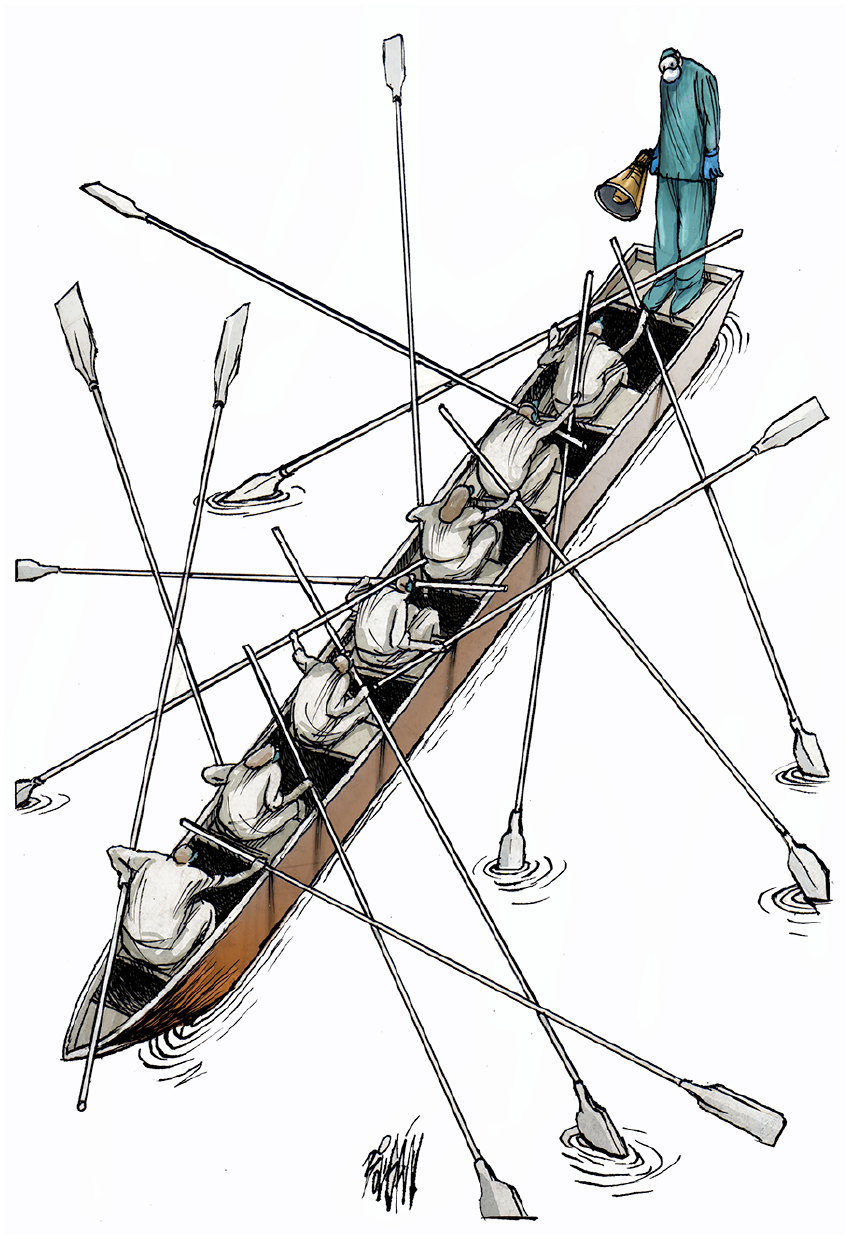
Visual satire on ‘pandemic chaos’ by Angel Boligan, New Mexico.
Pandemics alert us to the limits of our knowledge. Despite decades of progress, ‘viral and bacterial disasters continue to take us by surprise’ (Honigsbaum, 2019) – an assertion which suggests that we do not learn. Indeed, the world’s engagement with a new coronavirus (SARS-CoV-2) and its respective illness (COVID-19) has revealed a disjuncture between the necessary reorganization embedded in managing a new virus, on the one hand, and the management of organization(s) on the other. In the early months, the term ‘crisis’ was bandied around as usual; however, if we must designate a ‘crisis’, then it is one of knowledge, specifically as it pertains to the organizational dynamics of othering and (not) learning. We might have been ‘one war late’ (Latour, 2004: 225), but it is not too late to strengthen organizational knowledge relations.
This pandemic should serve ‘as teacher’ (Thomas, 2020); yet, to benefit from its lessons, we must first address the challenges that constrain our learning. This article uses Giordano’s (2020) metaphor of an ‘infection in our relations’ to argue that the problems with learning are manifestations of othering in knowledge relations. It uses elements from life story (Mann, 1992) to reflect on the past, juxtaposed against organizational encounters with the ‘new coronavirus’. The notion of ‘organization’ in this work is not delimited to productive entities (e.g. firms), but cuts across society and the world to include the pervasive reorganization necessitated for viral pandemics. The aim is to address how the requisite knowledge relations are afflicted by othering and to forward the importance of strong knowledge relations to effective future learning.
As a noun, the ‘Other’ is different to the Self. Such dissimilarity differentiates other persons or groups (‘us’ from ‘them’), or other states of being from one’s own (Cunliffe, 2018; Hall, 1997). The article uses ‘othering’ as a verb in the continuous tense to signal its ongoing character as a form of structuring difference. Otherness (also known as alterity) is integral to defining daily life (Hall, 1997). So, it is not an aberration; it is often theorized as part and parcel of generating meaning (e.g. Derrida, 1981; Levi-Strauss, 1970). However, othering poses serious challenges when it accentuates difference and generates apartness, when it is implicated in politics, power relations and their effects on identification and alienation (Derrida, 1981, 1992; Reedy, 2008; Said, 1978). Through dynamics of inclusion and exclusion, we designate and treat the Other as problematic, dangerous, or in some way beyond our concern or care (Hall, 1997; Wald, 2008).
In this article, othering is pertinent not only to relations between people and groups, but also to fundamental levels of knowledge. I argue that by affecting knowledge relations, othering constrains learning and facilitates the conditions of possibility for the arrival of new viruses and precarious pandemics. This facilitation need not involve intent nor act as a direct cause; rather, it helps set the scene for certain phenomena. The argument unfolds through two theses.
First thesis: that learning is constrained by othering between and within knowledge activities
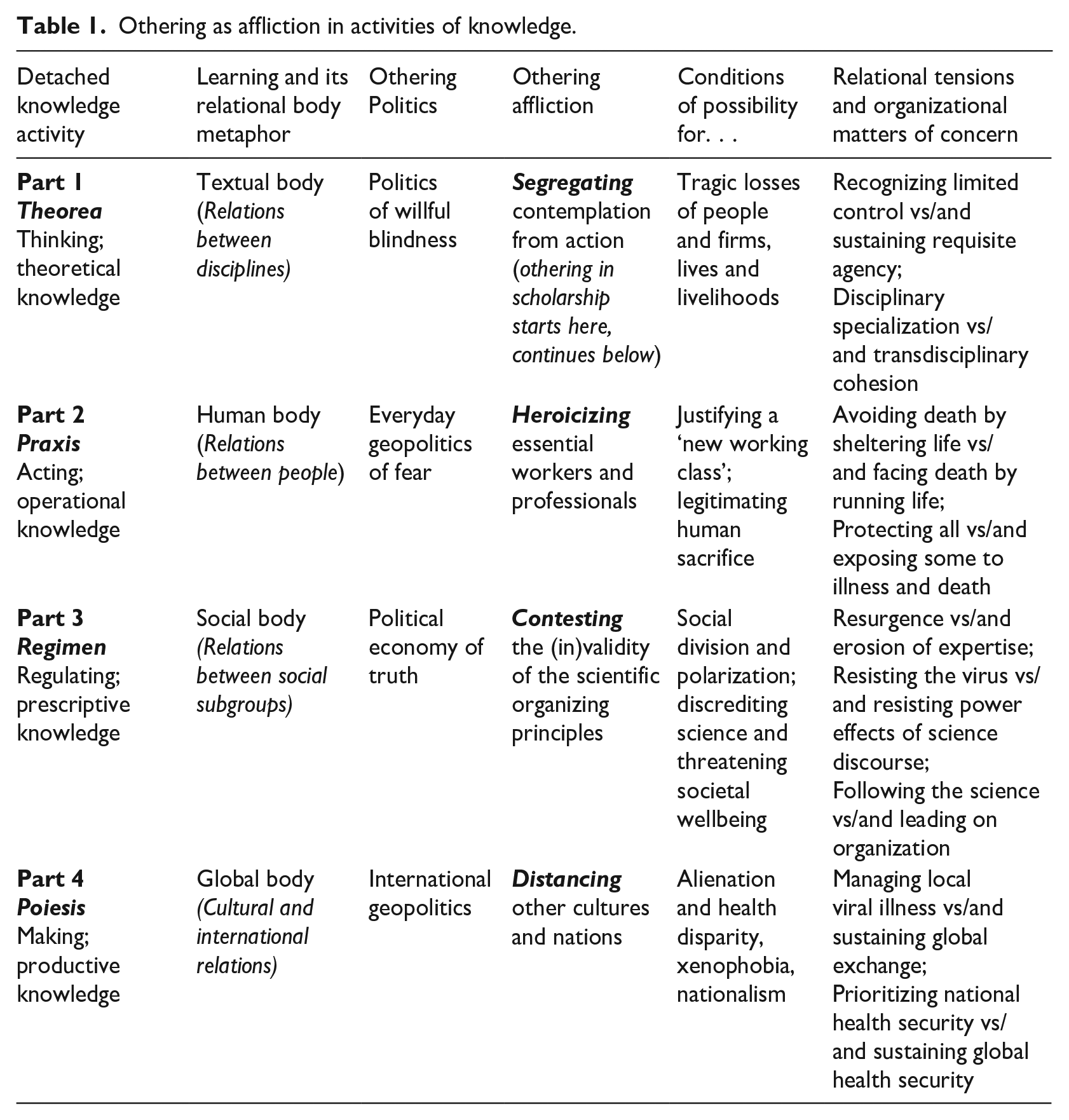
The article examines organization and management in everyday activity to explore relational shortcomings that prefaced the pandemic and its inadequate response. It introduces a framework to examine othering across four knowledge activities (Table 1). It draws on three Greek concepts. Theoria (theory, thinking) is associated with theoretical and epistemic knowledge. Practical knowledge, in turn, was addressed by Aristotle (1999) through the capacity to act, praxis (operation, acting) and to make, poiesis (production, making). The article adds a fourth knowledge activity, regimen (prescription, ruling). Whereas a doctor engages in praxis through professional norms, they can also prescribe a regimen, a course of treatment defined by systems of knowledge. The framework offers a mode of considering different facets of knowledge in everyday life and examining the relationship between its activities (Hammar, 2018). The article illustrates what happens when each of the knowledge activities is detached from the rest and the respective challenges of organizing and managing a pandemic.
Othering as affliction in activities of knowledge.
Second thesis: that learning is constrained by othering across domains of scholarship on organization and on the virus
Not only should the four knowledge activities be tightly integrated, but the domains scholarship they support should also intersect and interact effectively. Yet, in 2020, at the moment when all societies – including industries and firms – had to be reorganized so as to deal with a new virus, what did our scholarship on organization and management have to offer? Given that we were simply dumbfounded (Figure 1), our indignation should mandate an understanding of how othering has afflicted relations between scholarship on the organization and on the virus. In particular, the article focuses on the (re)organization embedded into the canons of science and health and its relevance to knowledge on managing and organizing.
Between Foucault and Latour: positioning theory and metaphor
We behaved like mad scientists who let the virus of critique out of the confines of their laboratories. . . it mutates now, gnawing everything up, even the vessels in which it is contained. (Latour, 2004: 231)
The article’s relational approach to knowledge and organization (e.g. Foucault, 1980; Latour, 2004) is not delimited by work organizations, but cuts across life at large. It draws on Foucault’s (1978, 1979) works, which have been pertinent to research on organization and management for decades (e.g. Burrell, 1988; Knights and Morgan, 1991). In this article, they also matter to othering as pertains to persons or groups, and in terms of the ‘knowing other’ and ‘knowledge of the other’ in the service of sociopolitical power (Foucault, 1978; Said, 1978).
Writing on scholarly critique, Latour (2004: 231) used the ‘virus’ analogy for the affliction of intellectual activity. He noted similarities between conspiracy theories and modes of critical inquiry into science. So he argued that attempts to expose facts as ‘social construction’ play into the hands of anti-science proponents by casting doubt on scientific evidence. He forwards a form of critical realism whereby rather than de-construct scientific ‘matters of fact’, we would engage with facts as ‘highly complex, historically situated, richly diverse matters of concern’.
The article’s theoretical ground is articulated through a triad of metaphors: teacher, body and war. It started with the ‘pandemic as teacher’ (Thomas, 2020); however, this acknowledgement is futile if there is no learning and if the necessary supplement to teaching is lacking. So, the second metaphor is the ‘body’. When we refer to ‘organizational learning’, the expression relies on a body – an entity, a corpus – a system that learns and embodies functional and effective internal and external knowledge relations (Morgan, 1983). Foucault (1973, 1978) was concerned with notions of the body and their intersection with various disciplines, for example, the human body in health and medicine through the ‘medical gaze’, and the ‘social body’ in his writing on biopower.
This article combines the importance of the body with knowledge relations (Foucault, 1978, 1979; Latour, 2004) and explores them on four levels of systemic recursion, each of which focuses on a connotation of the ‘body’: textual, human, social and global (Table 1). The premise is that each of these bodies suffers affliction in its internal and external relations that both curtail learning and facilitate the conditions of possibility for further affliction. Foucault was particularly interested in the ‘conditions of possibility’ for certain forms of knowledge and the need to ‘bring to light’ the knowledge configurations which ‘have given rise to diverse forms of empirical science’ (Foucault, 1970: xxiii–xxiv). Here, the phrase is used in its broader connotation and directed at the conditions of possibility for pandemics and the respective dynamics that facilitate the damaging effects of an infectious virus.
The third metaphor is ‘war’. Used by Latour (2004) for the challenges facing academia, it also became a prominent trope with the arrival of the new coronavirus. It marks tensions between learning and othering and signals their polarized politics (for an overview of pandemic tensions, paradox and power, see Simpson et al., 2022). Drawing on Foucault (1980), the premise here is that all knowledge is political. So, the article illustrates the challenges faced when each of the four ‘bodies’ is afflicted by a specific set of politics (Table 1).
What just happened? Mapping a cautionary tale of othering and (not) learning
My earliest recollection of microorganisms was from my grandfather’s study, a former dining room across from his kitchen. A doctor specialized in bacteriology, my grandfather spent time in the 1930s working in El Tor, a small town in the south coast of the Sinai Desert. It had an infectious bacterium named after it: Cholera El Tor, a strain in the seventh cholera pandemic. His study was off-limits, a mystery, its walls lined with books and shrouded in test tubes, flasks and microscopes (Figure 2). The latter once offered childish marvel at existence that was invisible to one’s eyes and the power of technology to reveal it if one went looking.
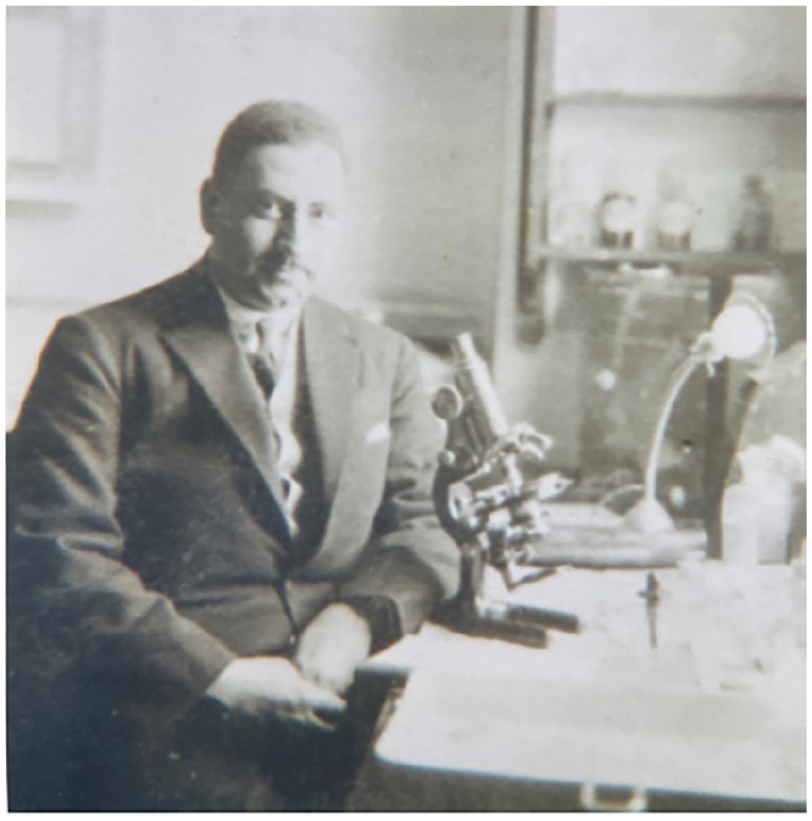
My grandfather and one of his microscopes in his study.
As we were walking to the bus stop, my father pricked the balloon of wonder I’d been tugging along from my first encounter with the microscope. It doesn’t show everything, he said. It was old, surpassed and superseded. But what more could we possibly see?
‘The virus’, he replied.
In 1931, the year my father was born, the electron microscope offered the first images of a virus. (My dad was fascinated by optics, through photography and then ophthalmology.) When I prodded him about the ‘virus creature’, he said that it wasn’t a creature in the usual way; that it’s not quite living. So why does it matter then? For many reasons, he replied, ‘And also because it sometimes exists through us’.
Our human existence harbours a viral existence. And our scholarly existence now contends with the implications. Our concerns share a similar focal point, a coronavirus. When it landed on our human consciousness, a wide variety of experiences rippled around and out of it.
In Melbourne, I closely followed New Zealand’s quick lockdown from a distance. In my enforced solitude, I am compelled to rethink my life, my work and my approach to knowledge. That I had gone into medicine seemed like a familial progression that has included four generations of women and men. That my passions lay elsewhere meant that I eventually left. Now that prior life was resurrected and the experience feels peculiar: as if each of my eyes rested on a different field of vision, both spliced into cross-temporal double exposures.
In the months that followed, our family grappled with six deaths across four continents, so I write from a vulnerable space. The narrative arc juxtaposes events from the first few months of the pandemic with motifs from life story (Mann, 1992) that are used to develop resonance and interpenetration between the personal and the global. Specifically, life story serves as a mechanism for engaging with two dimensions pertinent to othering and (not) learning.
First, despite significant technological progress, a century after my grandfather began his career, it seemed that humanity had not learned fundamental lessons on pathogens, human contagion and the necessary reorganization. So, life story offers juxtapositions through which to interrogate the ‘political economy of non-knowledge’ (Bovensiepen and Pelkmans, 2020).
Second, the story offers insight into the nuanced negotiation of identity and otherness (e.g. Cunliffe, 2018; Reedy, 2008). My geographic position outside a given ‘border’ compelled me to consider other borders. To organization, I often seemed to be writing from the margins, an ‘inside outsider’, an internal other. To health, I now felt like an ‘outside insider’. Storying facilitated reflexivity (e.g. Cunliffe, 2003; Gilmore and Kenny, 2015) towards my ‘othering’ of science and health. I should have known better, yet I am implicated in everything this article outlines.
Based on the knowledge activities (Hammar, 2018), the article unfolds in four parts. Each works with a different connotation of the ‘body’, its politics and the respective othering (Table 1):
Part 1 – Theoria focuses on the textual body and the politics of ‘willful blindness’ (Bovensiepen and Pelkmans, 2020) that segregate the ‘theoretical other’ from spheres of organizational action.
Part 2 – Praxis addresses the human body, operational knowledge, and the ‘everyday geopolitics of fear’ (Pain and Smith, 2012) that heroicize the ‘essential other’.
Part 3 – Regimen examines the social body, regulatory knowledge, and the ‘political economy of truth’ (Foucault, 1980) that contests the ‘prescribing other’.
Part 4 – Poiesis focuses on the global body, productive knowledge, and the international geopolitics that distance the cultural and national other.
Each of the four parts addresses the two theses and maps two sets of knowledge dynamics on:
Everyday organization and management: showing how each of the knowledge activities suffers from othering both in relation to ‘other’ knowledge activities and within it.
Domains of scholarship: articulating the challenges at the nexus of scholarship on organization and on the virus and their salience to the future of management learning.
Part 1 – Theoria: othering and theoretical knowledge
. . .viruses rearrange social relations most notably when they cause harm. (Lowe, 2017: 94)
My eyes flick open. I’m very awake. The border’s closed. I sit up in bed, still in shock, and rummage through the sheets to find my iPad. Yes, the New Zealand border closed last night. Never imagined this could happen. Fights are getting cancelled, travel routes are a mess, the apps are stalling. In Australia, I became mindful of the sea that separated me from my father. I had never given it any thought. My stream of consciousness flows through the many threats that water brings about through climate change, as it erodes and reinforces borders. The torrent takes me to my grandfather and cholera, which taught us the criticality of clean water for all.
I find myself reflecting on the othering of theoretical knowledge, of affliction in the ‘textual body’ by its confinement. It is well known that mounting distress on planet earth would send devastating pandemics our way, but that theory had not been translated into action. Rather, theoria had been confined to quarters, segregated from the other knowledge activities. And the fruit of contemplation is necessary but insufficient in the face of a new virus and its pandemic.

‘To look is an act of choice’, Berger (1972) had noted. ‘As a result of this act, what we see is brought within our reach’. Looking involves a political decision; so in that vein, there is also the politics of overlooking, whereby inaction is a political gesture. Through ‘willful blindness’, pertinent theoretical knowledge on pandemics was othered, retained and restrained in books, lectures and labs. That theoretical other was segregated through a blend of ‘strategic non-perception and normalized disposition’ (Bovensiepen and Pelkmans, 2020: 388) and its prospective relations to other knowledge activities were ignored or severed.
My implication in this omission comes into sharp relief. In class, I often work with students to analyse potential challenges and opportunities posed to organizations by their environment. It now strikes me that there is no ‘Health’ in PESTEL, a classical textbook framework we sometimes use (and critique). It would be ironic if I had offered them a ‘lens’ with this particular blind spot, a tool of ‘strategic non-perception’ (Bovensiepen and Pelkmans, 2020). The virus and its effects now cut across the entire acronym: political, economic, social, ecological and legal. Moreover, the problem (and my implication) is not simply in perception. One of my slides features an old slogan by the New Zealand Earthquake Commission: ‘Don’t think “if”, think “when”: Be prepared’. Many in New Zealand decide to prepare for an earthquake, an ever-pending threat, but deciding is not the same as doing. When I ask the class who has their earthquake emergency kit ready at home, usually it is no more than a third of them, a testament to the fault lines between theoria and the everyday action of the other knowledge activities.
Many dire warnings on the potential threat from (corona)viruses were issued through research papers, reports, videos and books – but they were mostly set aside (Walsh, 2020). The theoretical knowledge that was generated was confined, delimited to the work of contemplation rather than related to its supplementary spheres of knowledge activity. At various times, countries had put together pandemic plans, but willful blindness meant that they were mostly retained in filing cabinets rather than examined and deliberated in ministerial cabinets.
Now declarations of ‘war’ against the virus were becoming deafening. Given the preceding oblivion, it felt bizarre. In place of pandemic readiness, numerous decisions had been made to reprioritize funding, for example, away from the protective equipment that would ‘defend’ frontline workers, away from the ‘weapons’ to ‘fight the virus’ (e.g. Onishi and Mehuet, 2020). Without taking the threat seriously, and with budgets reallocated to other interests, many countries were left with little capability for managing a pandemic. Not only was the potential response to new viruses incapacitated, but also the capacity for research eroded. With funders ‘looking the other way’, few researchers were left looking for coronavirus treatments despite the prospective outbreak being ‘a clear and present danger’ (e.g. Schmidt and Undark, 2020).
When confronted with its gravity, some read the pandemic through the ‘black swan’, a metaphor for a rare and hard-to-predict event that has extreme effects (Taleb, 2010). The deployment was contested until Taleb weighed in on the debate, rejecting the use of ‘black swan’ and stating that the pandemic was wholly predictable, ‘a white swan if ever there was one’ (Avishai, 2020). Whereas a considerable extent of the theoretical scientific knowledge was there, the capability for organized response was not fit for purpose. We had it coming. We heard stories, read articles and munched on popcorn while watching films about it. It is the ostrich we need to consider, not the swan. The proverbial ‘head’ is placed ‘in the sand’.
In Melbourne, I was heading into winter with autumnal clothes, so I went shopping for a vest and warm socks. The stores were eerily deserted, the staff very keen to help. Later that day, as I sat in my new socks watching television, my mouth gaped as the same chains and numerous others were shuttered. As I read the news, many of the international ‘best practice’ teaching cases seemed to be imploding: AirBNB – well, the sharing economy couldn’t share – Disney, a Magic Kingdom was not from a world of disease, etcetera. My mind broods over organizations large and small that seemed to be dropping like flies while I search for firms that could still be used in class discussion. Was I clinging on to a grand illusion of control?
‘Unprecedented’? I think. Possibly in ways of dealing with it rather than its devastating effects. Throughout history, pandemics have had a dire human, social and economic toll (Snowden, 2019; Taylor, 2019). Though valid, this observation facilitates a tone of inevitability for the organizational mess that followed, as if it had to accompany each pandemic like its shadow.
Two issues are at play. First, our world had overlooked root causes of new viral outbreaks through its anthropocentric relationship to the universe. The respective narcissism blinded us to its effects, including climate change and its consequences (for which there is considerable literature). Second, and importantly, the world also overlooked what is necessary for managing a pandemic’s aftermath. Knowing ‘that’ a pandemic is coming and ‘why’ is not the same as knowing ‘how’ things would pan out and ‘what’ we could do about them. We are not without agency. Even if it had to happen, it didn’t have to happen this way.
The vulnerability of most organizations, industries, and sectors in those early days showed a fundamental lack of readiness for the (re)organization mandated by public health for managing a new virus and its respective outbreak. The derailment of everyday organization caused by the arrival of a pandemic had exposed an unattended level junction at the merging point on the railway tracks. When the theoretical knowledge on managing a virus took off and went into action, extant knowledge on organization and management was knocked out. The fallout was catastrophic for organizations and societies. We were left stunned (Figure 1).
To address organizational matters of concern that are salient to the future, we must recognize that othering does not only pertain to relations between knowledge activities. The aftermath also revealed another disjointed relationship: scholarship on organization and management did not dovetail effectively with the social (re)organization inscribed into scholarship on managing a pandemic. Many management and organizational scholars – including me – had directed their attention and resources elsewhere. To echo Latour (2004), we were not quick ‘to prepare ourselves for new threats, new dangers, new tasks, new targets. . .’ This omission signals two organizational tensions that are salient to learning and our future.
First is the tension between the teleological illusion of control and the requisite agency whereby we can actively take steps towards a sustainable world. More specifically, did a grand delusion of ‘being in control’ of organization(s) lead us to relinquish whatever (actual) situated agency we had in (re)shaping our futures? In securing our sense of purpose – which we must – were we too concerned with utilitarian forms of individual organizational success at the expense of meaningful action based on shared aspirational goals?
The second tension is perennial but with added urgency: the need for both disciplinary specialization (along with its respective expertise) and trans-disciplinary cohesion for the breadth of oversight necessary for coordinated action. There was barely any articulation between the scientific scholarship on the required (re)organization of society and scholarship on managing organization(s) – a meaningful dialogue and co-creation of ways that could stop the loss of lives while enabling the retention of livelihoods.
Moreover, it is sobering to think that considerable knowledge on what was needed to manage and organize for a viral outbreak was already there. We could have fleshed out the implications for organization from ways of managing susceptibility, infection and recovery (SIR); ways of managing the speed of viral spread (using Ro or ‘r-naught’) and ways of managing non-linear growth in infections – including the raft of measures we are now familiar with, notably good hygiene, social distancing, isolation and quarantine (Giordano, 2020; Taylor, 2019). All of the above (and more) come down to organizing and managing relations between people and their collective entities, our ‘core business’. So, there is no reason why scholarship on organization and management would not have engaged with scholarship on managing a new virus a long time ago; there is no reason why there wouldn’t be level junctions to their respective theoretical activities. As organizational scholars, we need collective introspection into whether we have participated in a ‘political economy of non-knowledge’ (Bovensiepen and Pelkmans, 2020).
By overlooking the (re)organization mandated in the science of managing outbreaks, organization studies also overlooked the potential for all the imaginative thinking and resources that could have been invested into charting creative ways of managing and dealing with a pandemic. Like the rest of the world, we were left scrambling to reorganize life and its work post hoc and somewhat ad hoc. We, too, were making it up as we went, ‘Building the airplane as we fly it’, some noted – an ironic metaphor given the countless planes grounded in bone-yards and the challenges I confront in getting a flight home.
Dad has dementia but he knows what a pandemic means as I (re)explain my absence over the phone. As I was saying goodbye in Wellington, he didn’t want to let go of my hand. He still had a strong grip even though he looked far more emaciated than the father I wrestle with in my dreams. Meanwhile, as a mother, I start to worry about my son. Medical students will be coming into their practical knowledge through stressful circumstances that pose stark choices. Several op-eds expressed the challenging scale of responsibility for life–death decisions when scarce resources might require junior doctors to ‘play God’. I ring him in Dunedin where he attends medical school. We talk about hard-to-find groceries, the paper, pathogens, the ‘epic mess’ enveloping the world, and the likelihood that we won’t see each other for a very long while.
Part 2 – Praxis: othering and operational knowledge
Viruses have effects and elicit affect. (Lowe, 2017: 95)
The pinging sound of the text message woke me up: ‘This is a mess. Put on your mask’. The linked article from a friend in Wellington felt uncanny. Written by a Sydney-based GP early in the pandemic, long before masks mattered to all, it depicted the acutely stressful disarray and professional turmoil of work in general practice as healthcare workers confronted a new virus within systemic vacuum (Anonymous GP, 2020). I had witnessed identical scenes in the back rooms of a medical practice in Melbourne the day before. This frenetic activity quickly rippled out of health settings and into the various facets of life, and its effects were not new.
Snowden (2019: 235) describes how cholera, my grandfather’s concern, ‘gave rise to a series of societal responses. . . that magnified the disruption left in its wake – mass flight, riot, social hysteria, scapegoating, and economic disruption’. It is well known that pandemics instigate fear and panic (Honigsbaum, 2019; Ingram, 2012; Taylor, 2019), but this knowledge had not been translated into established actionable practice. Rather, praxis and its operational knowledge were disconnected from other knowledge activities. So, in the absence of a ‘blueprint’ (‘no playbook’, ‘no template’, we kept hearing), the new virus landed in an organizational void. As pandemic management and its organization were precariously operationalized on the hoof, we came to witness severely strained health services, emergency departments and healthcare staff. The absence of embodied knowledge showed us the implications of ‘learning on the job’. Lacking in lived experience and organizational know-how, people confront their fears through the uncertainty and anxiety that come to shape life and compound its othering afflictions.
‘The geopolitics of fear is everyday life’, wrote Pain and Smith (2012: 3). The authors discuss how we live in an age in which ‘fear is on the up’ and ‘written on the world’. As a ‘motif for the human condition’, fear also brings about actions that shape our lives. It is against this canvass that a new contagious coronavirus is announced and its respective panic unfolds. As a manifestation of the absence of knowledge, fear affects relations between people in myriad ways. As I keenly watched challenges to praxis in healthcare, some semblance of organization gradually transpired through ‘paroxysms of preparation’ (Murray, 2020). In Australia, it felt as though we had glimpsed the calamity that other parts of the world careened through like an ambulance trolley into an emergency department.
Tracing the language of ‘war’ through the ‘everyday geopolitics of fear’, we come to the calls to ‘fight’ and their respective othering. I never considered my grandfather as ‘fighting’ cholera or my father as ‘battling’ trachoma. When I was in practice, we ‘managed’ pathogens and their effects. It’s been called the ‘management’ of disease and illnesses, but that may be too mundane, or decried for being too ‘clinical’. War, on the other hand, is something else: it fulfils psychological and relational needs. Importantly, it also makes the work of life more ‘noble’ (Le Shan, 2002). So, it is no surprise that a pervasive word was ‘hero’ and its variations (heroism, heroic) as they pertain to people performing essential work. Even Banksy chipped in with a rendition of the nurse as superhero (Figure 3). Heroic behaviour is often characterized by nobility. It demands courage in the face of fear, care for others regardless of risk, and commitment up to self-sacrifice. So, the everyday geopolitics of fear took everyday heroes.
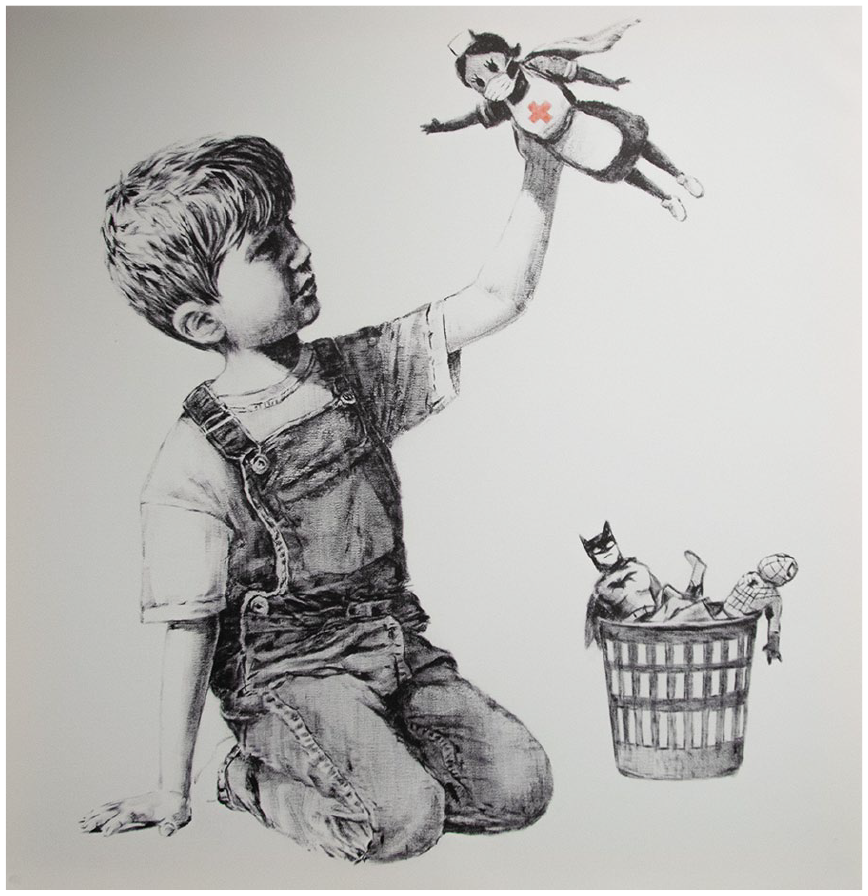
The pandemic nurse as superhero by Banksy.
Heroism is embedded in an epic narrative on organization and has enabling and constraining effects relevant to management (Cunliffe and Coupland, 2011; Gabriel, 2000; Panayiotou, 2010). One of its significant challenges is that it makes an event appear exceptional (Le Shan, 2002). So, it can legitimate the dominant account that a pandemic is ‘unprecedented’, rather than one in a series. But more is at play. As a form of self-othering that is both an ‘us’ and a ‘them’, heroes are undecidable; however, this ambiguity was firmly decided during the pandemic through another margin of otherness: those who get to shelter and those who don’t.
Society designates heroes for many reasons, several rooted in relational support. Stories of heroic defiance offer people means of coping with pain and suffering (Gabriel, 2000). Or, overwhelmed by death and mortality, we identify heroes to help us cope with the fear of dying (McCabe et al., 2016). They bolster our defences against existential worries (Le Shan, 2002). I think of the boy in Banksy’s image. The ‘heroes’ of this pandemic are not our plaything, but we may be invoking them for the imaginative play that enables us to process its horrors.
When heroism is entwined with war, it also offers resolve through a joint cause that draws on our relational strings. So a nation can rally its citizens, who are deployed to back the courageous ‘troops’. Some dynamics paralleled wartime efforts whereby people ‘at home’ are compelled to become industrious, a reminder of the gendered roots of war discourse. Where women once knitted socks for soldiers, they were now sewing scrubs for the NHS. We witnessed a geopolitical reorganization of the everyday. In pervading the ‘new domestic’ by expanding its role in productive organization and deploying it in support of its ‘heroes’, disembodied notions of ‘war’ were pushing the boundaries of what could be done in the name of a coronavirus.
Societies have long set some of their members apart for adulation and human sacrifice. Part of the Self that is also an-Other, our heroes help and unite us, but they are not really ‘us’; they remain ‘them’. This othering is core to their essentialization. Two issues are at stake.
First, essentialization generates and justifies a ‘new working class’. Othering through heroicization is hazardous for people in ‘essential work’, most of whom ‘did not sign up to be heroes’ (Brown and Flowers, 2020). Layered over traditional class distinctions, it transforms previously mundane jobs into work that involves physical and psychological risk. While organizations may reap its value, the enforced heroism raises expectations, often without raising wages or enhancing the work conditions for a raft of low-paid workers: rest-homes carers, cleaners, couriers and so on. Instead, a noble cause gets a noble, symbolic response. We show gratitude to frontline workers in more poignant ways (for us) than mundane rewards (for them): through applause, art, baking and other feel-good measures. So not only do we require heroes to manage our fear; we also use them to make our lives more fulfilling. But what is the point of applauding nurses as heroes when many were overworked and overwhelmed by stress? New Zealand’s lockdown carried a message of ‘kindness’; yet, the latter was least experienced by frontline staff who tended to receive abuse instead (Mau, 2020).
Society often selects its heroes based on ‘special’ innate – or essential – traits, an assumption of embodied ‘wiring’ that disembodies the human and their feelings. Yet, pandemic heroism is neither innate nor immune to viruses and the respective fear. Rather, the metaphor is that fear ‘behaves like a virus’ in its insidious spread (Murray, 2020). This ‘viral fear’ also ‘engulfed hospital hallways’ (Beach, 2020). So there is a strong distinction between the mythical and sensory effects of ‘war’ (Le Shan, 2002) – between the lauded heroism and the embodied fear. Work on the ‘front line’ is gruelling and grinding, nothing like the captivating drama of ‘saving lives’. Yet, its discourse is grounded in a masculinity that marginalizes the body and its respective feelings (Knights, 2021). We were exposed to grating dissonance between the disembodied epic narratives of heroism and ongoing tragedies related by health workers – between the glorification and the accounts of dire need for equipment and resources.
There is a second serious challenge from essentialization. As we designate some to do the ‘fighting’. we also designate ‘them’ for sacrifice. If managing fear takes heroes, then unmitigated risk takes their lives. For example, Italy’s hospital staff shared how they were initially seduced by the heroization, but then traumatized by the experience (Bettiza, 2020). As the anonymous GP (2020) had put it, ‘I am happy to be on the frontline in the government’s war with coronavirus, but I am being sent out there with no armour, no weapons and no leadership’. Even in ‘developed’ countries, many continued to lack adequate protective equipment while constituting a sizable proportion of the ‘curve’ of COVID illness. Their everyday geopolitics was compounded by the haunting fears of being ‘the vector’ that takes illness home to loved ones (Murray, 2020) and anxieties if not ‘brave’ enough to join the ‘frontlines’ and meet society’s expectations (Beach, 2020). This predicament was expressed by Rosenbaum (2020) succinctly and evocatively: . . . many of us tell an ‘I want to help people’ tale when seeking entry into the profession. . . Clinicians on the sidelines must confront not only shame and guilt, but also the loss of their primordial story. Who are you, if you can’t be the hero you imagined yourself to be?
Forced to confront a foundational myth, doctors have had to wrestle with its epic narrative of ‘saving lives’, its deafening adulations of heroism and their respective fear of failure. Glorifying the high stakes of their work detracts from how we might manage the risks. Sacrifice becomes a normative expectation: in this noble battle, you are expected to lay your life down for others (Figure 4). At its worst, heroism legitimates endangerment: the ‘fight against the virus’ is an ordeal worthy of certain ‘heroes’ and their potential martyrdom.
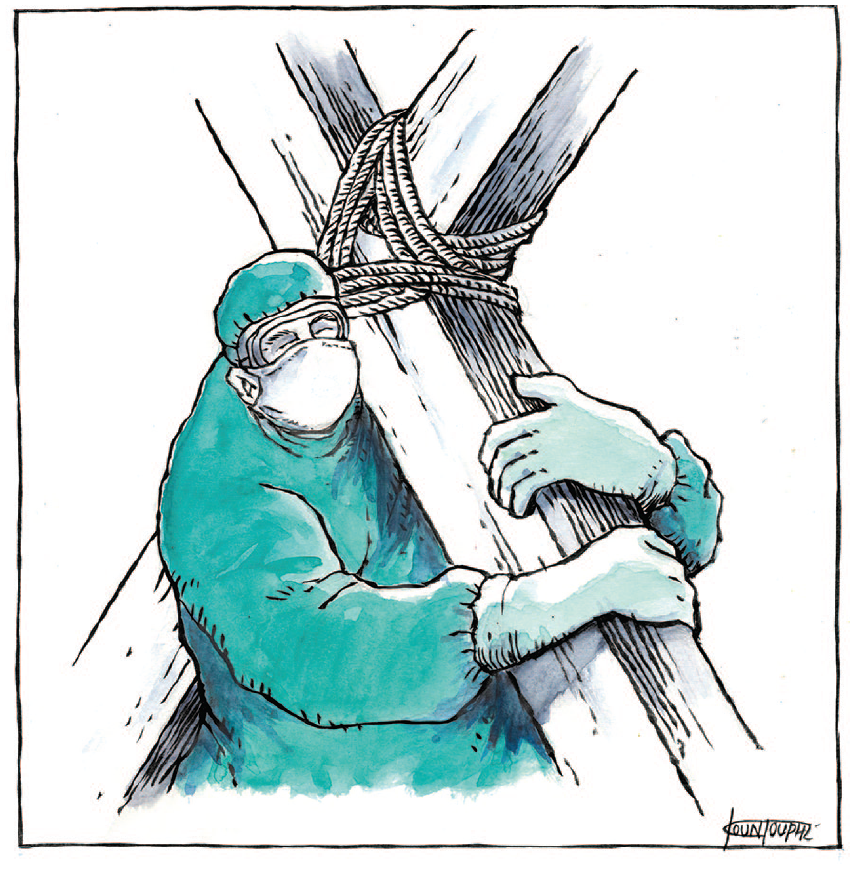
Michael Kountouris, Greece, on Good Friday and sacrifice by healthcare workers.
Turning to organizational matters of concern that are salient to the future, we find a fundamental tension whereby death is inextricable from the work of life: we avoid death by sheltering life and face death by running the work of life. The ‘we’ is selective: some are essentialized and become ‘the other’ who misses out on shelter. So organizational scholarship must counter the effects of the disembodied discourse of heroism and confront the cost of the ‘essential’ in both its meanings: as indispensable and as wired innate ‘essence’. The latter has serious effects.
First, othering through innate heroism justifies ‘new working class’ disparities in safety and security. A substantial brunt of the pandemic burden was born by people in traditional ‘working class’ jobs as their gap widened. And sometimes the risk is not so ‘essential’: the masked serve the maskless who enjoy restaurant cuisine; the under-privileged deliver goods to the privileged who shelter at home and so on. Yet, while sharing elements of traditional job disparities, the ‘new’ working class is defined by the risk of illness and death. So not only is heroicization a cheap price to pay, but its essentialization also normalizes their predicament.
Second, the world has been filling the operational knowledge gaps with human sacrifice. Globally, countless healthcare workers have died, and we all bear witness. As organizational scholars, we need to respond by facing the price they have been paying for the gaps in operational knowledge on managing a new virus and respective lack of embodied and well-organized praxis, the effective action informed by the other knowledge activities. Attention to praxis should also make us wary of blanket critique of the ‘medical other’.
I recall wrangling with my son over what was ‘wrong’ with the ‘medical gaze’, my impassioned critique and his more measured pragmatic replies. Foucault’s (1973) ‘medical gaze’ addresses how medical practitioners fit a patient’s story into a biomedical paradigm, selecting aspects of their concerns and reducing a person’s whole into medical parts. Ultimately, this gaze is about learning and organization. Foucault explicates how, as medical students, doctors learn to ‘see’ patients in certain ways. He describes ‘the discourse of disease’ as ‘re-organization in depth’. I mull over the irony. Now that their work has been reorganized in depth, healthcare staff are in our gaze, one that is also reductive and therefore very precarious. The ‘medical gaze’ seems reversed, turned back on the medical other who is essentialized, heroicized and sacrificed.
I ring my son again, this time to wish him a happy birthday. I tell him that my grandfather was also a medical student and his exact same age during the flu pandemic in 1919, a century ago. He is more interested in telling me about the game he’s designing to keep his morale afloat during lockdown. ‘No, it doesn’t involve heroes’, he says in reply to my question.
Part 3 – Regimen: othering and regulatory knowledge
. . .maths isn’t the science of numbers – not really – it’s the science of relations: it describes the bonds and the exchanges between different entities. (Giordano, 2020: 6)
‘This is going to hurt’, the nurse had told my son. He was at a clinic for a meningitis vaccine before travelling south to his university. He kept a brave face.
‘This is going to hurt’ is also how media summarized Prime Minister Jacinda Ardern’s message to New Zealand months later when she announced the first lockdown in 2020. With neither vaccine nor treatment for this new virus, people had to enact the means of dealing with it. This enactment unfolded through organization that involves managing relations that coordinate and control society as one system.
‘It exists through us’, my father had said of the virus, not only through one’s human body, but also through us as a collective host of an infectious disease. My grandfather was born at the end of the 19th century when, in Britain, Cholera had become ‘a metaphor’ that drew ‘all of society’s problems into a single conceptual cluster’, so it was rhetorically deployed to tie the fates of the poor to the wealthy as ‘one social body’ (Poovey, 1995: 58). I reflect on the othering of science, its prescriptive knowledge and affliction in the social body (Foucault, 1978) from contestation, division and polarization over the (in)validity of its organizing principles. It is well known that pandemics are managed through scientific rules that coordinate the social body towards collective wellbeing. But as a ‘regime of truth’ with organizing power (Foucault, 1980), knowledge on the virus unfolds in a political economy and its struggles. The erosion of relations between knowledge activities meant that the scientific knowledge that prescribes the regimen would both rule and cringe as it is used and abused, followed and unfollowed.
‘When officials and politicians talk about “monitoring” and “managing” the virus, they’re effectively talking about monitoring and managing people’, I explained to my son over the phone. As I heard my words, I flinched. Only a month before, I would have been passionately critical of such a statement.
‘What’s happening is an example of biopower’, I say. ‘That’s when. . .’ He cut me short.
‘I know what that is. We covered it in Population Health last year’.
Foucault (1978: 140) was concerned with the ‘social body’ and used the term ‘biopower’, having power over bodies, to discuss practices of public health and its regulatory mechanisms. He argued that modern nations achieve regulation of their subjects through ‘an explosion of numerous and diverse techniques for achieving the subjugation of bodies and the control of populations’. By ‘taking charge of life’ (Foucault, 1978), biopower involves techniques which function to ‘incite, reinforce, control, monitor, optimize and organize the forces under it’, all of which have been salient to managing our viral pandemic. Writers have offered nuanced views on the notion’s relevance (e.g. Larsen, 2020). The swift (re)organization of the relations between our bodies across space – and its respective (re)organization of societies, industries and firms – could tempt one to generate another superlative: the largest exercise in biopower.
Foucault (1978) had suggested that governments might not have the rigorous knowledge claims that science does, so they use different techniques to regulate and control the “social body”. In this pandemic, however, biopower and scientific knowledge often – not always – went hand in hand. Foucault (1979, 1980) had discussed how scientific knowledge is used to shape the conduct of people through discourse, which involves the practices and language that define a topic at a particular moment in time. Focus here is on the (re)organizing power of science on the virus and how it is embedded in a relational “regime of truth” (Foucault, 1980: 133). The latter constitutes the regimen prescribed by the rules of its discursive formation. Foucault (1980: 131–132) develops the analogy of a “‘political economy’ of truth”, which emphasizes the relations in which “truth” is (re)produced and heatedly contested. It is characterized by five “traits” that are used here to process how scientific organizing principles that rally the social body are rife with othering and its respective struggles. “Truth is. . .
. . .centred on the form of scientific discourse and the institutions which produce it. . .
Check. In the early days, we watched as ‘experts’ were given centre stage. Prime ministers and politicians paraded people who embodied scientific knowledge and its institutions, and deferred to them in questions on the pandemic. Governments engaged a raft of science organizations, international bodies and local health authorities in concentrated knowledge production. The scientific discourse also shaped the popularity of some leaders who appeared to ‘listen to the experts’. Yet, in other parts of the world, science and health experts came and went. Having regained their voice, they were also othered and marginalized, implicated in a tension between the resurgence and erosion of expertise, which signals other dynamics at play. Truth is. . .
. . .subject to constant economic and political incitement. . .
Check. We have been exposed to extensive debates on the economic and political implications of COVID-19 and its management. Many opinions circulating through the media positioned managing the virus within ‘tensions’ and ‘trade-offs’ on managing the economy. In many places, both economics and politics have centred on managing the coronavirus and the range of ‘levels’ or ‘stages’ designed to track its suppression or elimination. Around the world, the effects of the ongoing ‘political incitement’ ranged from outright censoring of scientific knowledge and information to faithful adoption of its advice. It has been constantly tied to the ‘political pressure to open up’ the city/state/country. However, truth is also. . .
. . .the object, under diverse forms, of immense diffusion and consumption (circulating through apparatuses of education and information whose extent is relatively broad in the social body. . .)
Check. We witnessed governments quickly open cheque books to fund scientific knowledge on the virus (e.g. across public health, epidemiology, microbiology), which also became the subject of government financed, generative and creative health promotion and social marketing campaigns on a record scale. Prime ministers and other leaders have held up visual aids and flipcharts, outlined data in graphic forms, and gestured the scale and pace of viral spread. Across the world, we were engaged in mass education so we can contribute to ‘flattening the curve’. Media catered to an explosion of interest and frenzied consumption of information on the coronavirus: how long it lasts on surfaces, whether it has been mutating, and so on. This truth is. . .
. . .produced and transmitted under the control, dominant if not exclusive, of a few great political and economic apparatuses (university, writing, media). . .
Check. A solid proportion of the media has been dedicated to summarizing and conveying ‘what the science says’. The latter is largely based on expert, researched and peer-reviewed knowledge. Their theoria now core to the pandemic zeitgeist, scientists and their institutions participated in public engagement and translated their work into opinion pieces and other popular genres that are lapped up by thirsty media outlets. Foucault (1980: 133) had noted that truth is linked to ‘systems of power that produce and sustain it’. In some countries, such systems eagerly supported and formally promoted pockets of scientific knowledge, while in others they engaged in its corrosion, disempowering scientists and sidelining their local and global institutions. Furthermore, when it comes to ‘true knowledge’ in a ‘post-truth’ world, things get dicey. Since ‘control’ is what is at stake, the ‘voice of validity’ becomes. . .
. . .the issue of a whole political debate and social confrontation (‘ideological’ struggles)
Check; the biggest tick. Space limits full analysis of the scope and scale of this ‘confrontation’, of the ‘war’ between those for/against the ‘regime’, of the polarization of the ‘disciplined’ and the ‘resistant’. Books will be written on the ‘ideological struggles’ pertaining to knowledge on managing this coronavirus. They have ranged from the usual gamut of political debate to other extremes (e.g. ‘sovereign citizens’). Since ‘truth is linked . . . to effects of power which it induces and which extend it’ (Foucault, 1980: 133), it is bitterly fought over and contested.
The relational ‘traits’ outlined above alert us to organizational matters of concern that are salient to the future. The (re)organizing power of science on the virus propels political struggles in a global pandemic. As organizational scholars, we have been witnessing some of the most vocal resistance to scientific organizing principles alongside some of the most pervasive power effects of scientific knowledge experienced in recent times. As we confront an overarching tension between the resurgence and erosion of expertise, we are left with three future concerns.
First, whereas scientific truth unfolds in a set of relations, it also prescribes how pandemics are managed by managing relations (Giordano, 2020) – not only relations between people’s biological and social bodies, but also between domains of scholarship. Science has a mandate that comes with prescriptive power. So the regimen is about how the organizing power embedded in science came to subordinate other domains of scholarship, including organization. That everyday knowledge on organization had been temporarily ‘knocked out’ by scientific knowledge is a testament to the power of the latter, but it also alerts us to our oversight. Where was the organizational knowledge on how things fall into place for that social body, its work and its polities thereafter? We should be able to ‘follow the science’ and lead on organization.
Second, we are reminded that the study of entities and their relations is a study of organization, especially if said entities are human individuals/groups. So, science and mathematical principles are also organizational principles that outline which, how, and when relations are managed. In other words, there is organization embedded in science; we just hadn’t necessarily recognized it as such. Scientific knowledge is not ‘Other’; it is part of the self that is also an-Other.
Third, we should reflect on whether knowledge on the virus is skewing our understanding of resistance. ‘Resistance’ now comes in two modes: against the constraining effects of discursive power (e.g. Burrell, 1988; Foucault, 1979; Knights and Morgan, 1991) and against the harmful bodily effects of a pathogenic coronavirus. Both are related; however, they also pose a tension. In the latter, developing ‘resistance’ means submission: knowledge on the virus tells us that sustaining the health of biological bodies benefits from conforming to the organizational rules set by science. But responsibility for the social body leaves us with a double bind.
On the one hand, we have to maintain the scholarly commitment to scrutinizing the power and truth effects embedded in forms of knowledge, including science. But on the other hand, we must be wary of participating in othering science and thereby inadvertently discrediting its valuable outputs. The relations defining the current ‘political economy of truth’ are already strained. Daily news is rife with endless illustration of mistrust and suspicion of experts and their respective implication in the production and circulation of mis/disinformation (Giordano, 2020). Early in the piece, the Washington Post had cautioned, ‘The pandemic is killing the truth, too’, reminding readers of the saying that ‘truth is the first casualty in war’ (Diehl, 2020).
On the other hand, we are experiencing a form of reckoning, the roots of which were aptly expressed by Latour: ‘we were so happy to develop all this critique because we were sure of the authority of science’ (in Kofman, 2018). Written in the past tense, it signals that things may have changed for science whereby its relevance now requires edification. Internal disagreement and debate has always been central to science and mostly served to strengthen its discursive formation (Foucault, 1980). Now, difference in opinion and contestation within science are deployed to undermine it by various actors in a given political economy.
On the phone with my son, we chat about the exploding lexicon of the ‘coronaverse’ and its ‘coronopticon’, The Economist’s nod to Foucault (1979). The ‘panopticon’ symbolized technologies of surveillance in his work on discipline and power. We contemplate the irony that despite our commitment to critical thinking, we willingly participate in pervasive tracking and tracing technology that monitors each of us for our collective protection. We joke about ‘baring arms’ for the vaccine as soon as it is ready so I can hold him in my arms once again.
Part 4 – Poiesis: othering and productive knowledge
If there are many of us, each of our choices has global consequences. . .: during a contagion, the lack of solidarity is first of all a lack of imagination. (Giordano, 2020: 27)
It was hot and dry, an expanse of glaring sand and arid nothingness. When I finally got to see El Tor, it seemed like a barren outpost in a vast desert, its emptiness starkly different to other Sinai towns, the havens of tourism where I was heading. Yet, El Tor used to be significant. When my grandfather worked there during the cholera outbreak of the 1930s, it was one of several medical stations on the land route from Mecca to North Africa. It catered to pilgrims, a place where ill travellers could be examined and treated. It marked an understanding of global connection – that the wellbeing of people from far-flung places mattered to our collective wellbeing. Over the decades, the safety of Hajj and its routes have been reorganized and significantly enhanced through newer technologies of travel. Yet, its scaled back events in 2020–2021 and the deserted nearby tourist towns in Sinai demonstrated the continuing reorganizing power of disease.
I find myself reflecting on othering in its global sense, of affliction in the ‘global body’ by ways of ‘making alien’, such as xenophobia and nationalism, and the constraints they pose to our learning. It is well known that effective pandemic management for all can only unfold by effectively managing global relations and sharing the creative knowledge that sustains them. And yet, in response to viral assault, we turn inward: we engage in poiesis, productive knowledge and its respective commodities, to protect our own from disease. War always comes down to resources and capabilities, its oldest drivers and key to its outcome. In our new pandemic ‘glocal’, poiesis has been detached from other knowledge activities, which leads to alienation that prioritizes self-interest, generates disparity and prolongs pandemic pains for all.
On the surface, we appeared to experience facets of a shared humanity enabled by an explosion of productive knowledge. Around the globe, many were singing from the same song sheets (literally and metaphorically), exercising to the same online coaches, watching the same videos on ‘how to’ survive lockdown or work from home. The productive activities and their respective knowledge relations were facilitated by – in this case – ‘unprecedented’ communication technologies. Our family had also been using these tools while living across different countries. Yet as with travel, communication technology is necessary but insufficient in overcoming otherness and its constraints. As I think of our New Zealand home across the Tasman Sea, the elusive ethos of ‘transnationalism’ is harder to envisage (e.g. Ailon-Sudday and Kunda, 2003). Shuttered countries laid waste to ideas of a ‘borderless world’ as citizens were recalled from overseas. We even watched cruise ships drift from port to port seeking haven. Their rejection earned mention by the Bishop of Sydney of a ‘whole new class of “boat people” denied landing for fear they’re viral’, in a dig at Australia’s management of seaborne refugees.
People have always experienced the transnational reorganizing power embedded in managing pathogens. Indeed, the organizational tension between managing local viral illness and sustaining global exchange is ancient: smallpox offers a salient historical example of how a virus travelled with the development of trade routes. But the othering that drives our selective amnesia – and its lack of learning – meant that we had to rediscover that knowledge firsthand. In the 21st century, the global supply chain network was the canary in the coalmine; its challenges appeared early and pervasively. Having been optimized and honed for seamless organizational production over decades, its swift failures were widely reported. The problems with relations across the worldwide grid that delivers our goods and services are symbolic of the erosion in the networks of globalization. Importantly, they are also an analogy of the limiting otherness that we face in sharing productive knowledge across webs of global connectedness.
As borders are raised, technology connects us, but it does not overcome their meaning. Feeling ‘under attack’, we circle the waggons and face inward. In this organizational formation, we claim to turn our backs on the virus, but we are turning them on our global supplements: other cultures and nations. The alienation and its polarization normalize ‘us’, distance ‘them’, and prioritize the former over the later. It is as if the ‘six-feet apart’ does not apply physically to other persons, but also as an analogy of cultural and national distance from other peoples.
Though the constraining effects of othering during a pandemic are well documented, we had to experience it all again. Writers had cautioned against the tendency to locate the threat of infectious diseases ‘elsewhere’ and with ‘others’ (Ingram, 2012) and against ‘outbreak narratives’ premised in accounts of alien infiltration (Wald, 2008). Two dynamics matter: the ways in which illness is used to stoke hatred of other cultures (Taylor, 2019) and the ways in which national self-interest generates and excludes subalterns in international systems of knowledge and power (Ingram, 2012) and thereby generates disparities in global health.
First, there is the challenge from ‘outbreak narratives’ that are deployed to stigmatize specific cultural groups during a pandemic (Wald, 2008). Given the widely reported virus-related racism, the ‘phobia’ in xenophobia also alerts us to the relationship between fear and marginality (Pain and Smith, 2012). The same technology that connects disconnects by fostering hatred and facilitating exclusion. The ‘social distancing’ embedded in physical distance is arguably less tenuous than that embedded in the fear and respective malice that generate cultural distance. Physical distancing could be easier to mend and overcome.
Second is the challenge confronted as ‘national interest’ translates into ‘self-interest’. We have witnessed productive effects of patriotic solidarity in setting a common cause and facilitating internal coordination with respective health benefits. Yet, many have voiced concern over the surge in a related notion, nationalism, along with a salient boost to the entrenched discourses of the ‘national interest’. The latter has been aligned with a global shift in what constitutes national strategic resources. Change in value changes the specificities of self-interest. We have seen national struggles for health supplies, commodities that sustain the human in the face of a pathogenic virus, and the physical capacity for their production (e.g. Goodman et al., 2020). At one point, the symbols of strategic resources flipped from the likes of oil to personal protective equipment and ventilators. But the more important issues are at a deeper level.
The world is now highly conscious of the strategic value of productive knowledge on the virus and its management – its national significance as a capability on which other strategic resources are mounted. So, concern with ‘production’ is not only in terms of specific commodities, but also with proprietary knowledge and the scientific research capability that grounds it. Yet, this knowledge is also precarious when afflicted by othering. As Ingram (2012, p. 81) notes, ‘global health security is hardly immune from power relations’.
To address salient matters of concern, we must admit that organizational scholarship had little to offer on how we might collectively organize our way out of a global pandemic by jointly using productive knowledge. This vacuum has posed many organizational challenges. Here we look at two tensions pertinent to the future: between competition and cooperation in pandemic poiesis and its outputs, and between the simultaneous demands for national and global health security.
First, the organization and management of vaccine and medicine supply chains have been signalling the limits of ‘global shared knowledge’ and exposing the othering that leads to knowledge dependence and health disparity, to the haves and have nots. There has been ongoing concern with global inequities when it comes to organizing access to vital drugs and vaccines across the world. Despite international scientists’ best intent and drive for knowledge sharing, the search for treatments and/or vaccines became a ‘global competition’ with some ‘frontrunners’ (Figure 5). If there is a search for winners, then who might become the losers? The respective ‘vaccine nationalism’ was extensively discussed across media accounts (e.g. Milne and Crow, 2020) and repeatedly by the World Health Organization. Such nationalism seeks to guarantee vaccines to a country’s citizens without necessarily taking into account the needs of less privileged nations and its centrality to the wellbeing of a global body (Serhan, 2020). Although competition can fuel human ingenuity, there is extensive literature across many disciplines on the tensions between competition and cooperation. While some competition might be ‘healthy’, ‘good for’ spurring on scientific research, the paradigm for scientific knowledge is premised on cooperation. We were explicitly warned, again, about the crucial importance of cooperation in mitigating the health disparities that would disaffect us all, and yet we still witnessed the othering generated by detaching poiesis from the knowledge activities that would inform and temper its rivalry. ‘Strategic ignorance’ (Bovensiepen and Pelkmans, 2020) is still at play.
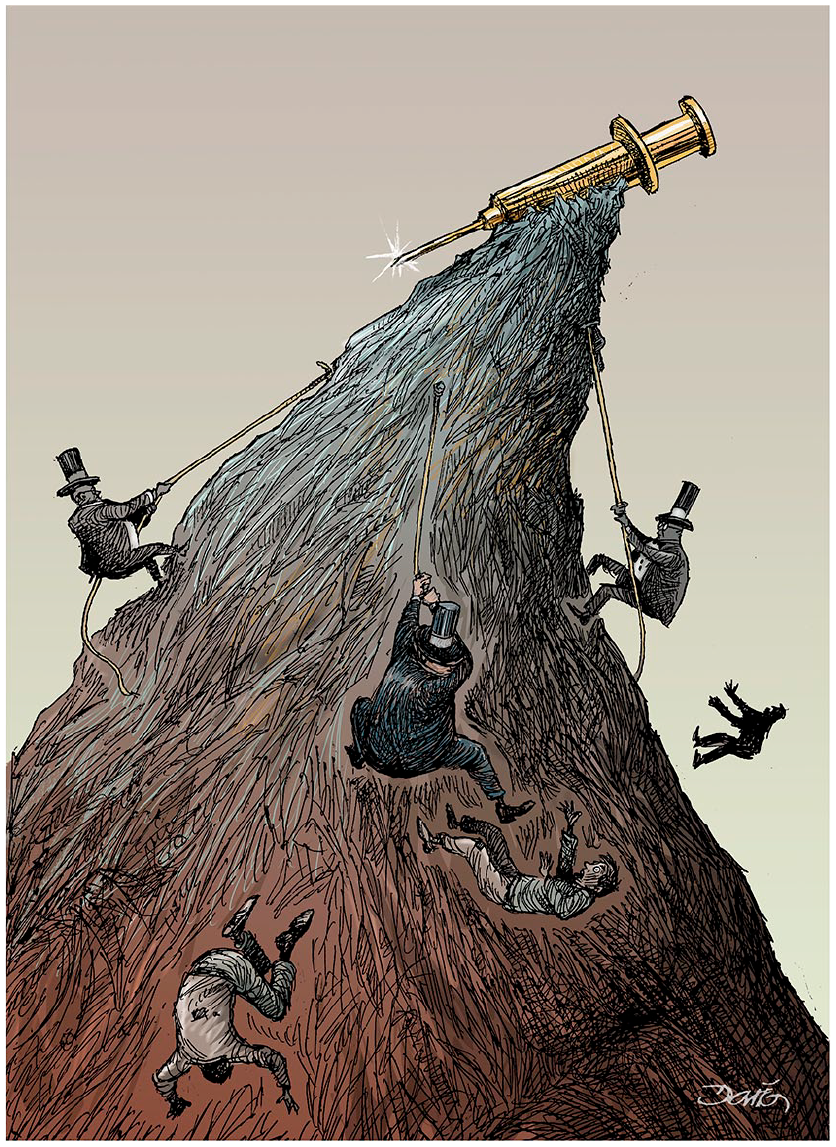
Depiction of the international ‘race’ for a vaccine by Dario Castellejos, Oaxaca, Mexico.
Second, as we consider the relations that integrate our organizational scholarship into one global body, we confront irony: diseases that cause suffering and mortality and require compassionate cooperation tend to fuel conflict and a politics of control (Ingram, 2012). Global health security is connected to other security interests (Ingram, 2012). For example, Fromer (2020) elevates Foucault’s (1978) discussion of biopower from its focus on internal population to the sphere of international relations, whereby nations need healthy populations to retain their economic and political security. Since health grounds strength and wealth, its strategic knowledge factors into international geopolitics. This reorganization is inseparable from organizations and their respective knowledge. It is also set against a backdrop of a ‘new cold war’ along with variegated national responses, its effects on businesses long underway (Riad et al., 2012).
As I reflect on my grandfather’s experience with Cholera El Tor, I realize that there is some learning pertinent to othering: pathogens are now rarely named after places in a step towards countering our tendency to locate the threat with ‘others’ through alienating narratives of infiltration (Ingram, 2012; Wald, 2008). But this is one organizational challenge. . .
I recall when I first heard about antiviral medication from my father in the 1980s. He was talking about the eye drops, Acyclovir, as part of a new beginning, the start of another dimension in humanity’s arsenal against pathogenic viruses. That wonder fizzles when I read the accounts on regional and global ‘rivalry’. Poor in ‘solidarity’ is a sign of being poor in ‘imagination’ (Giordano, 2020) as othering continues to constrain our learning.
I am back using technology to connect to my son. I check if he has the resources he needs. Masks? Hand sanitizer? He sounds nonchalant and reassures me that everything is alright. I sense that things are very different in Dunedin from Melbourne where people were to experience some of the longest lockdowns in the world. Will his safety last, I wonder.
Afterword – organization and the virus: from a politics of strategic ignorance towards a politics of care
We have been warned. As I conclude this piece, the world has passed further grim milestones of illness, death and poverty. The challenges we continue to witness are grounded in organization, so they are our ethical responsibility. The spine-chilling concern is that the pathogenic threat from viruses is ongoing and can be more deadly. There are many more ‘threats’ to come which call for learning and well-organized readiness. This Afterword canvasses what needs to happen if we are to learn from this experience and maps directions for future inquiry.
What organization(s) should do differently: knowledge activities and relational tensions
The article offers a framework (Table 1) that recognizes the variety in knowledge activities (Hammar, 2018) and examines ‘what happens’ when othering detaches and pervades them. It thereby forwards the understanding that these activities must dovetail and supplement each other. As they stand, each activity poses relational tensions that confront organization:
Examining theoria reminds us that when theory on the virus is segregated from organizational action, the respective gap has tragic implications for lives and livelihoods. We have witnessed the sustained pain across societies and their work. So organization(s) must address the relational tension between illusions of control and the requisite situated agency to take action, and thereby reconcile the power/lessness of managing.
Scrutinizing praxis alerts us to the challenges in operational knowledge when it is isolated from other knowledge activities. As people are propelled by fear, they invoke heroes and laud a ‘new working class’ defined by the risk assigned to it. Organization(s) must work to confront the tension between avoiding death by sheltering life and confronting death by running the work of life, between protecting all and exposing some to illness and death.
Examining regimen shows us that when prescriptive knowledge has not been embedded into everyday activity, we experience the (in)validation of science and its organizing principles, along with the respective threats to society’s health and wellbeing. Here, the tension is between the resurgence and the erosion of scientific expertise that resonates with resisting a virus and/or resisting the power effects of prescriptive knowledge on the virus.
Scrutinizing poiesis warns us that when productive knowledge is detached from other knowledge activities, we confront alienation and respective health disparities. When the fruit of scientific research is highly valued, but prioritized for the self ahead of the other, the erosion in international solidarity can be detrimental to humanity. So, organization(s) face relational tensions: between managing local viral illness and sustaining global exchange, and between the competition and cooperation that polarize national and global health security.
Organizational scholarship, politics and conditions of possibility for precarious pandemics
Reflexivity is not the sole responsibility of an individual researcher, but a collective endeavour (Gilmore and Kenny, 2015). Since the pandemic started, we could see things coming and yet let them come. If we are to hold ‘others’ to account for the existential threats posed by pandemics, then we should consider the ways in which we might be complicit. We should foster a reflexive stance that recognizes research as an ongoing accomplishment (Cunliffe, 2003). Future inquiry should integrate knowledge activities into a holistic approach by battling causes of their fragmentation. In doing so, we should build on knowledge that identifies conditions of possibility for precarious pandemics, fight their root causes and tackle politics and their effects.
We should be vigilant with the politics of willful blindness (Bovensiepen and Pelkmans, 2020) that continues to unfold around us and generate the conditions of possibility for tragic losses of people and firms. Knowing that pandemics are coming, we need to be capable of translating insightful theoria into constructive organizational action.
We also need to confront the precarious everyday geopolitics of fear (Pain and Smith, 2012) without appealing to heroism. We must hold ourselves and others accountable for creating the conditions of possibility for essentialization and human sacrifice. We should hone organizing praxis in ways that sustain the lives of essential workers and the quality of their livelihoods.
We must front up to the ‘“political economy” of truth’ (Foucault, 1980) in which scientific knowledge on a virus is embroiled and which facilitates the conditions of possibility for social division and polarization. Science defines rules and prescribes courses of action for societies to manage contagion; however, this prescription necessitates a response from us: leading edge knowledge on ways of (re)organizing the ‘social body’ and its work.
Last but not least, we need to counter the ways in which productive knowledge on the virus is constrained by cultural differences and deployed in international geopolitics, thereby generating the conditions of possibility for xenophobia and nationalism. We must craft ways of producing and sharing the capabilities and outputs of a global knowledge on managing any new virus.
Crosscutting concerns for learning and organization
The scrutiny of the four knowledge activities poses crosscutting concerns for management and organization, structured here through the triad of metaphors: body, teacher and war.
The body, metaphorical and physical
The multi-level body metaphor that frames this work offers a fundamental implication: when a body fights against itself, it fails. It signals the importance of identifying which systemic level, which body (Table 1), matters at a given moment. It also underlines the challenges of division. Part of the problem is the systemic boundary we set for the meaning of ‘organization’: we must rethink the borders of what we define as organizational and what we consider its Other. Moreover, the body metaphor compels us to identify and manage the root causes of afflictions rather than just focus on their symptoms.
Attention to the body alerts us to the dynamics of masculinity that marginalize it (Knights, 2021) and which are pertinent across praxis and poiesis. A critical stance on heroes and organization (Cunliffe and Coupland, 2011; Panayiotou, 2010) requires us to unmask forms of masculinity that respond to the lack of embodied knowledge on managing a new virus with disembodied invocations of heroism. This legacy also surfaces in the hyper-competition that overshadows the benefits of cooperation in pandemic knowledge production by generating ‘winners’ and ‘losers’. Rather than dwell on ‘races’ and comparative league tables on cases, vaccinations, and recovery, we need to dispel the embodied atrocities on pandemic frontlines around the world.
The teacher, ignorance and fear
If the pandemic is to serve as ‘teacher’, then we must strive against the twin themes of othering: ignorance and fear, which matter to all four knowledge activities. We must brace the topic of ignorance, the Other of learning, explicitly and shamelessly. Ignorance tends to be a silenced topic despite calls for its inclusion in research on learning (e.g. Roberts, 2012). The challenge is that ignorance need not be devolved from knowledge; for example, the commodification of expertise provides scope for creating and deploying ignorance in a variety of forms (Stein, 2020). So ignorance threatens learning across a wide range: from ‘strategic ignorance’ (Bovensiepen and Pelkmans, 2020) that blinds us to valuable theory through to ignorance that promotes misinformation and xenophobia.
The last term alerts us to the confluence of ignorance with fear. A nascent theme in learning (e.g. Fulop and Rifkin, 1997), fear deserves specific attention and future inquiry. We need to approach ‘viral fear’, in its various meanings, as an organizational concern with pertinent implications for knowledge. As cautioned in healthcare, if we are not prepared to fight fear and ignorance as actively as we fight a virus, they can do extensive harm (Murray, 2020).
The ‘war’ and critical scholarship
The above concerns have traversed implications from war discourse. Here it is used to (re)consider what it means to be a critical scholar in organization, a perennial theme with newfound urgency. At the heart of our challenges is the tension between resisting a ‘political economy of truth’ and participating in a ‘political economy of non-knowledge’. As Latour (2004) would remind us, by enacting the former, we could end up facilitating the latter. This pandemic has highlighted the power dynamics of the truth generated through science discourse and its enforcement. So scholarly responsibility should sustain the concern with analysing ‘the conditions of possibility’ that underlie scientific knowledge (Foucault, 1973, 1979), but Latour’s (2004) question sums up our predicament: While we spent years trying to detect the real prejudices hidden behind the appearance of objective statements [of science], do we now have to reveal the real objective and incontrovertible facts hidden behind the illusion of prejudices?
In a world where mis/disinformation deploys illusions of scientific prejudice, we must carefully consider how a critical stance on science is enacted. In a ‘post-truth’ world, scholarship should also address the conditions of ‘impossibility’ and the respective disempowerment of science: its institutions, its corpus and people who embody its knowledge. Now that a biological pathogenic virus is circulating, let’s (re)consider ‘the virus of critique’ as we position ourselves in relation to ‘matters of fact’ and take a stand ‘on matters of concern’ (Latour, 2004). We need to enact a shift from the politics of overlooking through a politics of oversight and towards a politics of care (e.g. Gabriel, 2009). Our social responsibility demands it.
We should be wary, however, of empty uses of ‘care’ in political rhetoric and seek to deploy it in meaningful ways: through a politics of care that acknowledges our mutual interdependence and vulnerability and nurtures the conditions of possibility for the wellbeing of human and non-human life (Chatzidakis et al., 2020). Like reflexivity, care is an ongoing accomplishment, whereby caring is a ‘collective knowledgeable doing’ (Gherardi and Rodeschini, 2016). It is not innate; as a form of situated knowing, it is learned. By cultivating concern across borders and margins of difference, it serves as the Other of othering.
Scholarship on organization meets scholarship on the virus: the questions that follow
Learning from the ‘pandemic as teacher’ (Thomas, 2020) is a humbling experience for many professions. My grandfather’s field of research, bacteriology evolved into microbiology as it surpassed the world of the microscope and included further biological entities and infectious agents like the virus. Efforts against COVID-19 have been reshaping many areas of inquiry. ‘Pandemic’ means across all people, so researchers on organization need to become an active constituent in knowledge on managing new viruses and their (re)organizing effects. To do so, we must develop productive avenues and dialogue with other fields of scholarship.
Whereas organizational research has featured engagement with science and health as pertains to the management of work, professions and their contexts, this article forwards a different angle that focuses on the social (re)organization that is embedded into the canon of scientific fields – for example, public health, epidemiology, medicine – and its relevance to all forms of organizing in a pandemic. We had not viewed these fields as ‘organizational’, but they showed us otherwise.
So, at a time when calls for inter/cross/trans-disciplinary research threaten to invoke a cliché, it is more vital than ever. Not only should we reconcile the needs for scholarly specialization and transdisciplinary articulation in our work, we should also view facets of scientific scholarship as part of ‘us’, as organizational knowledge. And if certain mathematical and scientific principles for managing pandemics are organizational principles, what else does science hold that constitutes normative organizational knowledge? Moreover, the observation that various disciplines hold organizational principles probably extends beyond public health, epidemiology and microbiology to other domains. So, which other fields of scholarship hold normative knowledge that could play a future central role in the effective (re)organization of life and the management of work? Finally, the article poses the big questions: what ‘will happen’ to organization when it confronts another new pathogenic virus? How will societal (re)organization articulate with work organization in ways that sustain life and livelihoods? What does the prospective politics of care hold for management learning?
The world’s losses from war do not come close to losses from disease (Snowden, 2019; Walsh, 2020), yet memorials have marked valour over vulnerability. This pandemic offers many a memento mori to the travesty, not just of an infectious virus, but also what its (mis)management tells us about how othering constrains knowledge relations. So it should instigate readiness to learn whereby knowledge on organization(s) is entwined into knowledge on managing a new virus – in the theoretical, practical, regulatory and productive sense. Lives depend on it.
Footnotes
Authors’ Note
In memoriam: The work is in remembrance of my father who taught me a lot about our world. We reunited by Christmas 2020 and met regularly till he died in early 2022. The paperwork noted ‘pneumonia’, what he’d always called ‘the old man’s friend’. The writing is also in memory of my two cousins, Teddy and Ragi, childhood friends my age who died from COVID-19 during 2020 and 2021 in Rome and Cairo. The argument and its theorization were shaped by Latour’s works. His lighthearted writing style was infectious and I repeatedly wondered what he would think if he read this account. Sadly, this is no longer a matter of concern.
Funding
The author(s) received no financial support for the research, authorship and/or publication of this article.
