



Abstract
Through a process of action research with a non-religious organization, this article provides a foundation for the characteristics of a secular discernment process. Importantly, we argue that discernment can be conceptualized as a process of entwined individual unlearning and collective relearning. Our action research study contributes to both the discernment and the unlearning literatures by unpacking how discernment encourages a process of individual unlearning – which our study suggests entails a process of ‘setting aside’ and reflexive-distancing from a priori individual knowledge – to be more open and receptive to new ways of emergent collective re-learning. The process of unlearning – and the behavioural norms and routines that are central to discernment – underscores the collective relearning process. The article concludes with future pathways for research.
Introduction
The phenomenon of discernment continues to gain traction in management and organization studies (Allen, 2017; Benefiel, 2008; Delbecq et al., 2004; Falque and Duriau, 2004; Miller, 2020; Vu and Burton, 2020). Discernment has primarily been explored as an approach to decision-making that integrates emotions, feelings and perceptions, with practical wisdom drawn from spiritual and religious traditions (Miller, 2020). In a recent literature review, Miller (2020) charted the chronological development of the field and noted that there is no unified or single concept of discernment and that different processes of discernment occur across different traditions. Two religious traditions characterize much of this body of work – the Ignatian tradition of individual discernment (Cavanagh and Hazen, 2008; Falque and Duriau, 2004) and the Quaker tradition of collective discernment (Allen, 2017; Burton and Bainbridge, 2019; Burton and Sinnicks, 2021; Reis Louis, 1994). However, while there are differences between their individual and collective foci, each shares a distinctive integration of concerns for the social world and an inwardness that draws from the normative and ethical commitments of the particular discerning community.
While the existing literature has primarily investigated discernment in religious contexts, discernment has also featured in secular philosophies. For example, Benefiel (2008) was perhaps the first to connect practices of discernment to spiritual leadership arguing that spiritual leadership should include management practices that foster virtues and values associated with love and humility. Later, both Michaelis (2010) and Muers and Burton (2019) cited examples of Quaker discernment (or aspects of it) being taken up and utilized by non-religious organizations, such as the Scott Bader Commonwealth, Scottish Legal Aid Board and the UK Green Party, although the extent to which discernment can be practised by secular organizations is contested and still in its infancy (Miller, 2020).
Despite these contributions, the connection between discernment and wider management practice has gone largely unnoticed. Miller (2020), for instance, noticed how the practice of discernment can build consensus and may help balance a focus upon organizational performance criteria with a corresponding concern for ethical processes. Burton and Sinnicks (2021) remarked how discernment tacitly critiques adversarial and manipulative forms of management. In addition, discernment has notably begun to be connected to fields of management learning, such as transformation learning (Vu and Burton, 2020) and as a facilitator of ‘perpetual unknowing’ that recognizes the limits of cognitive potential and the value of participating in collective, equitable and emancipatory ways of knowing (Allen, 2017: 129). Thus, given the possibilities of discernment as a learning process, we were intrigued by the following research question: how could processes of discernment be drawn upon to develop management learning in a non-religious organizational context? Our intrigue was fuelled by the transformative and emancipatory potential of discernment highlighted by Allen (2017) and Vu and Burton (2020) and a corresponding interest in the (non)transferability of religious practices to contemporary management.
To unpack the connections between discernment and management learning, we were drawn to the process of Quaker discernment as a collective process influenced by Quaker commitments to peace, truth, integrity, simplicity and equality (Burton and Sinnicks, 2021). Quakers are advised to ‘Take time to learn about other people’s experiences of the Light. Appreciate that doubt and questioning can also lead to spiritual growth and to a greater awareness of the Light that is in us all’ (Quakers in Britain, 1995). We were particularly drawn to Quaker discernment for two reasons: (1) Quaker theology is highly plural (Dandelion, 2004), including Christian, Muslim, Buddhist and atheist belief systems (Dandelion, 2004), and (2) Quakers reject the idea of adherence to a shared set of religious beliefs (Muers and Burton, 2019). Thus, the plurality of Quaker belief may make discernment relevant in contemporary management contexts.
Our approach was interpretivist and inductive, and we conducted an action research study with an international management consulting firm involved in corporate social responsibility (CSR). Our study enables us to lay a foundation to theorize the characteristics of secular discernment and to illuminate the extent to which discernment may support more equitable processes of management learning. To signpost our contributions, we conceptualize discernment as a process of individual unlearning and collective relearning. Individual unlearning is conceived as a process of setting aside knowledge, old routines and behaviours to be more open and receptive to new ways of collective relearning that are reflexive and emergent. Collective relearning is deeply shaped by behavioural norms and routines of silence and maintaining an uncertain disposition. In this way, we connect processes of secular discernment to processes of unlearning and relearning.
Our article is structured as follows: (1) we provide a brief overview of the discernment and unlearning literatures; (2) we outline our action research design; (3) we then provide an elaboration of our findings and provide an extended interpretation and discussion; and (4) we state our contributions and conclude with practical implications and directions for future research.
Literature
Discernment
The practice and process of discernment is primarily investigated as an approach to decision-making (Benefiel, 2005b; Delbecq et al., 2004; Traüffer et al., 2010a, 2010b). In many ways, expressions of discernment as a decision-making process are not too dissimilar to objective-rational-analytical forms of managerial decision-making – including ‘framing the question, gathering and analyzing relevant data, and identifying courses of action and assessing their implications’ (Miller, 2020: 393). Miller suggests that it is the act of bringing practical wisdom from spiritual and religious traditions into decision-making that distinguishes discernment from other decision-making methods.
Discernment is not a unified concept, and its processes differ across different traditions. Two religious traditions account for much of this body of work – the Ignatian tradition of individual discernment and the Quaker tradition of collective discernment. Ignatian discernment is often concerned with leader development and its interest often lies in the individual as the foci (see Miller, 2020; Rothausen, 2017). The Ignatian perspective focuses, therefore, on the individual discerner, who may be accompanied and guided by an experienced person such as an elder or spiritual director. The emphasis is on personal spiritual formation and life direction. In the Quaker tradition, the process is communal and is interested in collective unity directed towards social action (Muers, 2015)
In the Quaker tradition – our focus – Burton and Sinnicks (2021) have claimed that discernment is its defining feature. Quaker discernment is grounded in the idea of ‘experimental’ knowing whereby claims to knowledge and knowing are based on a continuing cycle of discernment and lived experience (Muers, 2015). For Quakers, discernment is a theologically framed process for decision-making on both ‘worldly’ and ‘religious’ issues (Muers and Burton, 2019). During discernment, discerners often sit in a circle, silence frames the process, and spoken contributions are presented as ‘ministry’, rather than as advocacy. Contributions also tend to follow a few other simple norms: listen deeply, limit repetition, limit oratory, rhetoric or politically charged contributions, be prepared to take time over decisions and limit the number of personal contributions to avoid dominating the process (Cheng, 2019).
Quakers understand that anyone involved in the discernment process may feel led to contribute and contributions are often shaped and informed by Quaker-held normative commitments (Burton et al., 2018). Each contribution is tested, revised and woven together to produce a result that is not recognizably the work of any of the individuals involved. The discernment process requires individuals to open up their knowledge and opinions to others in the group and be prepared for it to be tested through the ministry of others until unity is reached – Quakers call this finding the ‘sense of the meeting’ (Anderson, 2006; Burton, 2017; Burton et al., 2020). These views of discernment, however, bring into focus the question posed by Miller (2020: 382) – ‘what criteria for knowing apply?’ Muers and Burton (2019) suggested that discernment rejects a correspondence theory of T/truth whereby discerners perceive discernment outcomes corresponding to a pre-determined right decision (p. 368). Rather, God’s will or ‘right action’ ‘in any given situation is reflective of the character of God, as revealed and experienced within particular communities’ (p. 368, emphasis added).
A further important characteristic of Quaker discernment is the role of the clerk. The clerk is not there to ‘lead’ or be a facilitator, but to serve the discernment process by sensing the emergent unity and proposing contemporaneous minutes. Quaker minutes rarely reflect the details of the contributions made by individuals in the group and instead reflect the unity of the outcome (Mace, 2012). Contemporaneous agreement of minutes benefits the process in terms of participant understanding and collective ownership of the decision. Anderson (2006) noted that ‘Decisions that are both understood and collectively owned have a far greater chance of being carried out with missional success than do quickly made decisions that are mandated by a dominant individual or group’ (pp. 42–43). In other words, decisions reached with unity and recorded contemporaneously are often more likely to be implemented effectively with less likelihood of revisiting and reworking the decision in subsequent periods.
Connecting discernment to management learning
The suggestion that a process of discernment can facilitate learning in social communities interested us, and discernment has notably begun to be connected to fields of management learning. Vu and Burton (2020) remarked that Quaker discernment gives primacy to ‘collectivized knowledge and learning’ (p. 208) and represents a continuous negotiation between individual knowledge and the collective ‘sense of the meeting’ in a way that can be transformative (p. 219). Furthermore, in a study of UK Quakers, Allen (2017) also emphasized that discernment requires a form of perpetual unknowing and enables users to challenge taken-for-granted assumptions shaping sense-making.
In the management learning literature, recent scholarship has argued that learning and unlearning are situated at two polar ends of a continuum (Tsang and Zahra, 2008), and unlearning is considered as a precondition for new learning (Akgün et al., 2007; Nystrom and Starbuck, 1984). Descriptions of unlearning are often rooted in Hedberg’s (1981) conceptualization of unlearning as a part of a cycle where knowledge grows, becomes obsolete and is eventually discarded (see also Tsang and Zahra, 2008). In current critical debates, however, scholars have advanced Klein’s (1989) criticism that it is not necessary to unlearn existing knowledge before the acquisition of new knowledge, and moreover that existing knowledge often provides a necessary and important context for new learning. Antonacopoulou (2009), for instance, suggested that unlearning requires utilizing what is already known to generate new questions that entail venturing into the unknown.
Given these conversations, the puzzle relating to how individuals unlearn and relearn as a process continues to be under-elaborated ((Grisold, Klammer and Kragulj, 2020) Hislop et al., 2014; Tsang and Zahra, 2008). There are limited studies exploring unlearning and relearning as a process, with a few notable exceptions at the organizational (e.g. Rampersad, 2004; Tsang and Zahra, 2008) and individual level (e.g. Hislop et al., 2014; MacDonald, 2002; Matsuo, 2019; Rushmer and Davies, 2004). However, processes of unlearning and relearning often entail a shift from the individual to the organization and involve cognitive, behavioural and social aspects (Cegarra-Navarro and Moya, 2005; Easterby-Smith and Lyles, 2011; Hislop et al., 2014). There is also a relational foundation to unlearning and relearning as groups can have a significant impact upon the complexities of learning processes (Antonacopoulou, 2009; Becker, 2018) and group dynamics can impact organizational learning and change (Lucas and Kline, 2008).
Given that extant research on discernment has been largely confined to the religious space – despite its potential to interest management in non-religious contexts – we wondered whether discernment may also illuminate processes of unlearning and relearning, and in particular the extent to which moral normative commitments and behavioural norms impact these processes. We approached our research question: how could processes of discernment be drawn upon to develop management learning in a non-religious organizational context? through an action research study using a single-organization case study.
Method
We investigated the possible connection between discernment and management learning through an action research study with a single organization involved in consulting on corporate responsibility.
Case study context
We were motivated to work with an organization that we believed embodied moral and ethical commitments that had some (at least minimal) overlap with Quaker ethics. The organization was recruited after the management team responded to an invitation distributed via LinkedIn to attend a public lecture on Quaker discernment and convened by the lead author. As a result of attending the lecture, the management team approached the lead author and expressed their interest in participating in an action research study utilizing Quaker discernment as a method to explore the challenges of consulting on human rights. The organization explained to us that learning from each other about practices of consulting would provide a much richer picture of how they deliver greater impact. As researchers, we were interested in working with an organization with normative commitments broadly similar to the commitments held by Quakers. We judged the consultancy’s B-corporation status and public commitments to contributing to the United Nations (UN) sustainable development goals (on its website) as evidence of this similarity.
Action research
We utilized an action research method. Action research is generally taken to mean a ‘spiral of cycles of action and research with four major phases: planning, acting, observing and reflecting’ (Zuber-Skerritt and Wood, 2019: 4). However, action research is a dispersed field with ambiguity surrounding definition, processes, and purpose (Coghlan, 2019; Coghlan and Lindhult, 2019; Dickens and Watkins, 1999; Rowell et al., 2015). Therefore, we utilized the principles of a cyclical-spiral approach to action research, drawing on Lewin’s seminal work in organizational development (Burnes and Bargal, 2017; Coughlan and Coghlan, 2002; Lewin, 1946). Lewin developed action research to investigate change through an iterative process of ‘fact-finding, evaluation and action’ (Lewin, 1946: 38). Although Lewin’s action research was developed over 70 years ago, the principles and processes are still considered relevant and continue to permeate current thinking (Bradbury, 2015; Burnes and Bargal, 2017), particularly in the area of action science, management learning and organizational development (Adelman, 1993; Argryis et al., 1985; Dick, 2019; Dickens and Watkins, 1999; Raelin and Coghlan, 2006).
We judged action research was suited to the study for several reasons, primarily as our research was rooted in learning, practical action and improving management practice (Burnes, 2020; Lewin, 1946; Zuber-Skerritt and Wood, 2019). Our approach to action research is situated broadly within an interpretive research philosophy (Bradbury, 2015; Coughlan and Coghlan, 2002; Zuber-Skerritt, 2001; Zuber-Skerritt and Fletcher, 2007) that assumes a ‘communal view of knowledge’ where knowledge is co-created together in context (Gergen and Gergen, 2008). We drew on Lewin’s original tripartite process and the work of Zuber-Skerritt and Wood (2019) and Rowell et al. (2015) to develop a series of action research cycles (List, 2006) that embedded cycles of planning through co-production and emphasized the importance of both researcher and participant reflection (Rowell et al. 2015; Zuber-Skerritt and Wood, 2019)
The cycle of action research:
Fact-finding (Lewin, 1946) / Data collecting: through observations, interviews, discussion, and reading (Rowell et al., 2015; Zuber-Skerritt and Wood, 2019)
Planning: through co-production (Rowell et al., 2015; Zuber-Skerritt and Wood, 2019)
Action (Lewin, 1946) / Acting: through group events and interventions (Rowell et al., 2015; Zuber-Skerritt and Wood, 2019)
Evaluation (Lewin, 1946) / Reflecting: analysis of data, researcher reflections and reflective discussions between participants and researchers (Rowell et al., 2015; Zuber-Skerritt and Wood, 2019).
We ran the action research process over four cycles involving participants in a process of co-production (Lewin, 1946; Zuber-Skerritt and Wood, 2019). The full details of the cycles are explained in Appendix 1. Cycle 1 involved co-constructing the research process with the management team to enable them to explore a management problem they had identified in relation to their consulting practice. After attending a public lecture (led by the lead author) about discernment, the management team expressed a desire to learn more about discernment to use as part of their consulting practice with clients, and so time was spent with them exploring discernment in more depth. The initial cycle also enabled the research team to learn about the organization’s principles, processes and culture, and which helped tailor and adapt the project according to context. Cycle 2 enabled further development of relationships and opportunities for knowledge-sharing between the research and management teams, through attending meetings and several one-to-one and group discussions. Ideas on how to introduce discernment to the wider employee and client base were tested through an initial learning session with the management team, which was followed by group reflection on which areas of discernment required adjusting or omitting to become relevant to the organizational context.
Cycle 3 included an in-depth exploration of discernment during a substantive strategic learning session, with opportunities for group reflection on how discernment might usefully be used in the future. This was achieved during a 3-day strategic planning forum with senior members of the organization from Europe and Asia, in 2018. The 15 participants comprised all the directors, non-executive directors and senior consultants from each office, in addition to a number of invited clients. During the forum, there was an introduction to discernment followed by the opportunity for participants to test the process themselves and adapt according to their context. Cycle 4 occurred a few months later and incorporated reflections on the entire project. All participants were interviewed, which lasted between 45 and 75 minutes. The interviews were focused on finding out more about participants’ experiences of the discernment process, their feelings, emotions, and the challenges they faced. The interviews (framed as open-ended discussions) gave both the research team and participants an opportunity to reflect on the project, how the process impacted learning and perceptions of the group’s learning (if at all) and the extent to which any aspects of discernment had been utilized in their ongoing consultancy work.
Following the interviews, we used template analysis to analyse the transcribed interview data, and we used our field notes as secondary data to help us shape the coding process. Our coding followed the approach developed by King (1998), which has gained traction in multiple disciplines including management and organization studies (e.g. Burton and Galvin, 2018). Template analysis is a flexible type of thematic analysis that emphasizes hierarchal coding but balances structure with flexibility to adapt it to the needs of a particular study. Given the inductive nature of our approach, the flexibility of template analysis was judged to be beneficial to allow us to search for ‘integrative’ themes that permeated the data but at the same time not lose sight of interesting and unusual detail that can sometimes be lost in overly reductive thematic approaches.
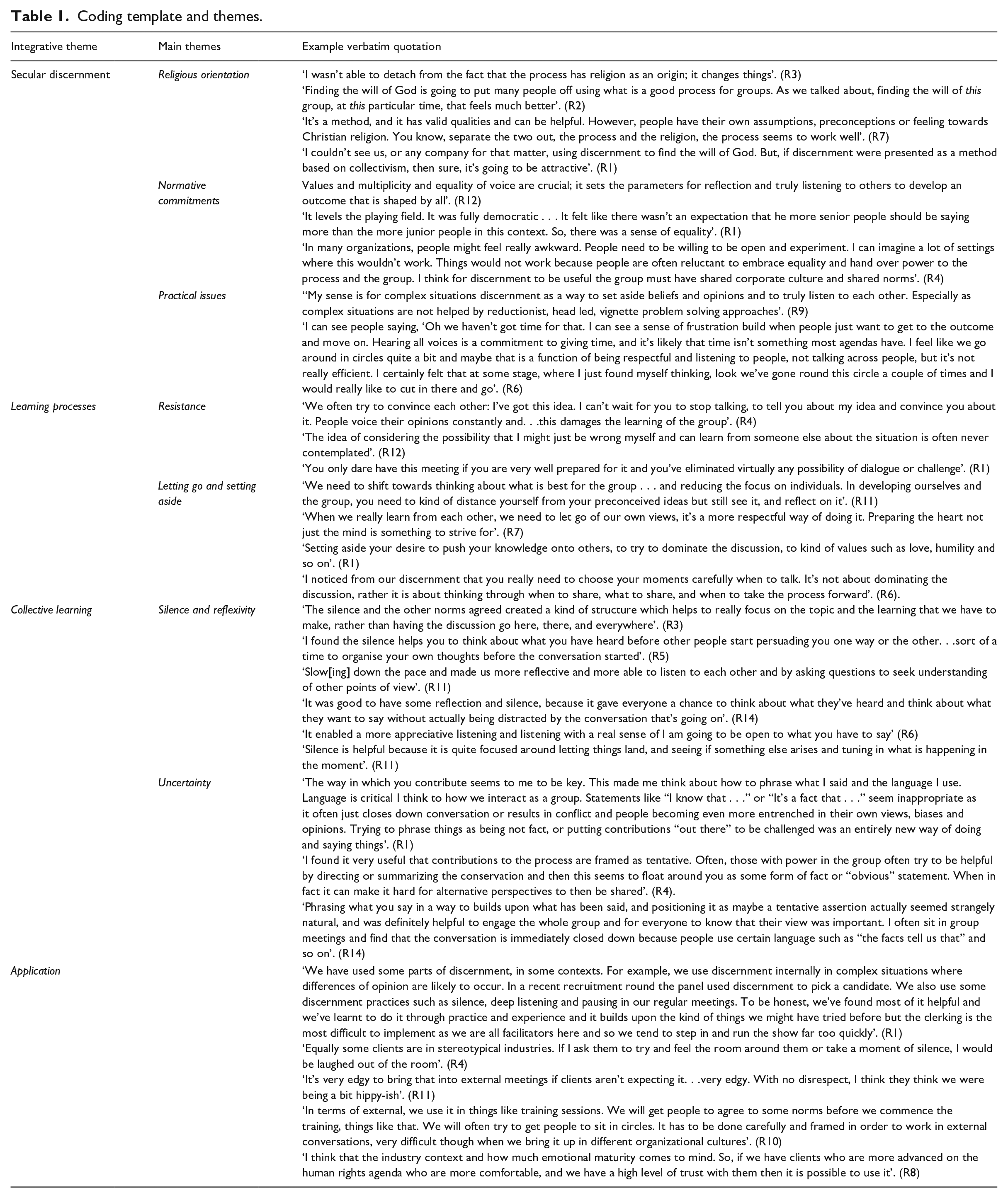
In our coding, we proceeded as follows: first, each author read through three randomly selected transcripts several times to familiarize ourselves with a sub-set of the data. We then developed an initial coding template. Although we were interested in ‘management learning’ we avoided using a priori codes derived from the literature to minimize the imposition of themes onto the data (King, 1998). We then investigated the remainder of our interview data. To attain transparency and reliability of the coding process, each interview transcript was coded separately one at a time by all three authors, and differences in coding were resolved through inter-coder dialogue and discussion (Miles et al., 2013). Where new themes emerged or other changes to the templates were made, previously analysed interview transcripts were re-examined, and this iterative process continued ad infinitum. Finally, we reviewed our final template structure for integrative themes that related to our research question (King, 2004) and emailed a copy of the interview transcript to each participant to check for accuracy. Our final template is shown in Table 1.
Coding template and themes.
Findings
In this section, our organization is by integrative themes and sub-theme(s) that emerged inductively from our coding of the interviews conducted in AR Cycle 4. Our coding begins with the characteristics of secular discernment and interprets the role of normative commitments as well as the challenges and tensions of its use in a management context. Next, we turn to Learning Processes and emphasize the process of individual unlearning and collective relearning and the importance of behavioural norms. We complete our Findings with the theme Application of Secular Discernment and highlight its utility and boundaries.
Characteristics of secular discernment
Within this main theme, participant responses were coded to three sub-themes: ‘religious orientation’ and ‘moral normative commitments’ that together illuminate how a religious process of discernment was adapted to a contemporary management context, and the sub-theme ‘practical issues’ highlights the challenges and tensions involved in this process.
Religious orientation
The religious origin of Quaker discernment caused some tensions in the case organization. For example, many participants found the religious origin unsettling: I wasn’t able to detach from the fact that the process has religion as an origin; it changes things. (R3) Finding the will of God is going to put many people off using what is a good process for groups. As we talked about, finding the will of this group, at this particular time, that feels much better. (R2)
Despite reservations about its religious origin, participants tried to separate out the process of discernment from the religious origin. For instance, It’s a method, and it has valid qualities and can be helpful. However, people have their own assumptions, preconceptions or feeling towards Christian religion. You know, separate the two out, the process and the religion, the process seems to work well. (R7) I couldn’t see us, or any company for that matter, using discernment to find the will of God. But, if discernment were presented as a method based on collectivism, then sure, it’s going to be attractive. (R1)
Moral normative commitments
Despite discomfort with the religious origin of the process, the commitment to the equality of all voices was central to the way participants approached the discernment process. It was summed up by one participant as follows: Values and multiplicity and equality of voice are crucial; it sets the parameters for reflection and truly listening to others to develop an outcome that is shaped by all. (R12)
Participants remarked how discernment created a more democratic process that helped minimize power asymmetries. This was a recurrent theme, exemplified as follows: It levels the playing field. It was fully democratic. . .It felt like there wasn’t an expectation that the more senior people should be saying more than the more junior people in this context. So, there was a sense of equality. (R1)
Participants, however, recognized that while the group did not share religious commitments, the shared moral normative commitments of the organization were crucial to any discernment process. For instance, In many organizations, people might feel really awkward. People need to be willing to be open and experiment. I can imagine a lot of settings where this wouldn’t work. Things would not work because people are often reluctant to embrace equality and hand over power to the process and the group. I think for discernment to be useful the group must have shared corporate culture and shared norms. (R4)
Practical issues
Participants remarked about several practical issues of using discernment. Several participants suggested that discernment particularly supported learning about complex issues, but that it would be frustrating for routine learning. For example, one participant highlighted that My sense is for complex situations discernment as a way to set aside beliefs and opinions and to truly listen to each other. Especially as complex situations are not helped by reductionist, head led, vignette problem solving approaches. (R9)
A further practical issue related to management engagement and a willingness to create the space and time was highlighted by participants as an issue: I can see people saying, ‘Oh we haven’t got time for that. I can see a sense of frustration build when people just want to get to the outcome and move on. Hearing all voices is a commitment to giving time, and it’s likely that time isn’t something most agendas have. I feel like we go around in circles quite a bit and maybe that is a function of being respectful and listening to people, not talking across people, but it’s not really efficient. I certainly felt that at some stage, where I just found myself thinking, look we’ve gone round this circle a couple of times and I would really like to cut in there and go. (R6)
Learning processes
In the next section, participant responses were coded to reflect how discernment involved a process of individual unlearning and collective relearning, and how new routines required overcoming resistance to established routines and ways of behaving.
Resistance
Participants recognized that learning is often limited in group contexts when individuals try to persuade the group of the rightness of their views and opinions. For example, We often try to convince each other: I’ve got this idea. I can’t wait for you to stop talking, to tell you about my idea and convince you about it. People voice their opinions constantly and. . .this damages the learning of the group. (R4)
Opinion-forcing behaviours are often an integral part of organizational culture, but participants recognized that this often limits the possibility of an open dialogue: The idea of considering the possibility that I might just be wrong myself and can learn from someone else about the situation is often never contemplated. (R12) You only dare have this meeting if you are very well prepared for it and you’ve eliminated virtually any possibility of dialogue or challenge. (R1)
Letting go and setting aside
Participants recognized the need to let go of their own views and maintain a deliberate and reflexive distance to better serve the learning efforts of the group. For example, We need to shift towards thinking about what is best for the group . . . and reducing the focus on individuals. In developing ourselves and the group, you need to kind of distance yourself from your preconceived ideas but still see it, and reflect on it. (R11) When we really learn from each other, we need to let go of our own views, it’s a more respectful way of doing it. Preparing the heart not just the mind is something to strive for. (R7)
Furthermore, participants connected the ideas of letting go and reflexive-distancing to virtues and values, which were perceived as central to a discernment process. For instance, Setting aside your desire to push your knowledge onto others, to try to dominate the discussion, to kind of values such as love, humility and so on. (R1)
Participants also highlighted the need to be hesitant and reflexive and serve the group interest: I noticed from our discernment that you really need to choose your moments carefully when to talk. It’s not about dominating the discussion, rather it is about thinking through when to share, what to share, and when to take the process forward. (R6)
Collective learning: behavioural norms and routines
Silence and reflexivity
The silence that frames discernment produced a calm setting which encouraged group learning. For example, The silence and the other norms agreed created a kind of structure which helps to really focus on the topic and the learning that we have to make, rather than having the discussion go here, there, and everywhere. (R3) I found the silence helps you to think about what you have heard before other people start persuading you one way or the other. . .sort of a time to organise your own thoughts before the conversation started. (R5)
The silence helped participants settle into an atmosphere of reflection that was experienced as follows: slow[ing] down the pace and made us more reflective and more able to listen to each other and by asking questions to seek understanding of other points of view. (R11) It was good to have some reflection and silence, because it gave everyone a chance to think about what they’ve heard and think about what they want to say without actually being distracted by the conversation that’s going on. (R14)
The silence and its reflexive atmosphere encouraged a deeper listening and helped constrained egos, serving the learning of the group: It enabled a more appreciative listening and listening with a real sense of I am going to be open to what you have to say. (R6) Silence is helpful because it is quite focused around letting things land, and seeing if something else arises and tuning in what is happening in the moment. (R11)
Uncertainty
The way in which contributions to the learning process were framed was recognized by participants as vital to trigger collective learning. Contributing in a way that framed any statements as ‘true’ were recognized as unhelpful to the group learning process. For example, The way in which you contribute seems to me to be key. This made me think about how to phrase what I said and the language I use. Language is critical I think to how we interact as a group. Statements like ‘I know that . . .’ or ‘It’s a fact that . . .’ seem inappropriate as it often just closes down conversations or results in conflict and people becoming even more entrenched in their own views, biases and opinions. Trying to phrase things as being not fact, or putting contributions ‘out there’ to be challenged was an entirely new way of doing and saying things. (R1) I found it very useful that contributions to the process are framed as tentative. Often, those with power in the group often try to be helpful by directing or summarizing the conservation and then this seems to float around you as some form of fact or ‘obvious’ statement. When in fact it can make it hard for alternative perspectives to then be shared. (R4)
Asserting individual knowledge to the group as tentative was perceived by participants as a positive experience that enabled all voices in the group to be heard and to mitigate power asymmetries: Phrasing what you say in a way to build upon what has been said, and positioning it as maybe a tentative assertion actually seemed strangely natural, and was definitely helpful to engage the whole group and for everyone to know that their view was important. I often sit in group meetings and find that the conversation is immediately closed down because people use certain language such as ‘the facts tell us that’ and so on.
Application of secular discernment
Finally, in this section, participants remarked upon the utility of discernment in their work practice.
In our interviews, we explored the extent to which the participants had utilized discernment (or any constituent parts) in the organization or as part of their consulting practice. A director remarked that We have used some parts of discernment, in some contexts. For example, we use discernment internally in complex situations where differences of opinion are likely to occur. In a recent recruitment round the panel used discernment to pick a candidate. We also use some discernment practices such as silence, deep listening and pausing in our regular meetings. To be honest, we’ve found most of it helpful and we’ve learnt to do it through practice and experience and it builds upon the kind of things we might have tried before but the clerking is the most difficult to implement as we are all facilitators here and so we tend to step in and run the show far too quickly. (R1)
In external consulting settings, bringing discernment as a process to support consulting practice was acknowledged as unlikely to be universal: Equally some clients are in stereotypical industries. If I ask them to try and feel the room around them or take a moment of silence, I would be laughed out of the room. (R4) It’s very edgy to bring that into external meetings if clients aren’t expecting it . . .very edgy. With no disrespect, I think they think we were being a bit hippy-ish. (R11)
The context of the client was key to being confident in using discernment to explore and document client requirements. For instance, in terms of external, we use it in things like training sessions. We will get people to agree to some norms before we commence the training, things like that. We will often try to get people to sit in circles. It has to be done carefully and framed in order to work in external conversations, very difficult though when we bring it up in different organizational cultures. (R10) I think that the industry context and how much emotional maturity comes to mind. So, if we have clients who are more advanced on the human rights agenda who are more comfortable, and we have a high level of trust with them then it is possible to use it. (R8)
As we elaborate further in the next section, our findings underscore how the case organization adapted Quaker discernment to its context and embedded aspects of it in their consulting work with clients. Importantly, our findings show how secular discernment entailed a process of individual unlearning whereby users set aside existing knowledge to be more open and receptive to collective ways of knowing. Shared normative commitments and new routines and behaviours were central to facilitate this process.
Discussion
Our study enables us to conceptualize features of a secular discernment practice, drawn from the Quaker context, as a process of individual unlearning and collective relearning: a puzzle that has been severely under-elaborated (Grisold, Klammer and Kragulj, 2020; Hislop et al., 2014; Howells and Scholderer, 2016; Tsang and Zahra, 2008), and by so doing we further disentangle the ‘black box’ of unlearning (Becker, 2010). We offer three contributions.
Secular discernment
First, our findings enable us to offer a contribution to the discernment literature relating to the theorization of the attributes of a secular discernment process. While in Quaker discernment, ‘truth’ is understood as the group’s best efforts at reflecting the will of God, in our study, participants did not share theological commitments, and seeking the will of God was moreover perceived by the group as uncomfortable and inappropriate, as highlighted: ‘Finding the will of God is going to put many people off using what is a good process for groups. Finding the will of this group, at this particular time, that feels much better’.
Nonetheless, the group was still able to utilize a process of secular discernment by adjusting the commitment to seek the ‘will of God’ to seeking the ‘will of this group at this time’ and were able to ‘separate the two out, the process and the religion’ advancing assertions by Burton (2017) and Muers and Burton (2019) that discernment, and finding unity and a sense of the meeting, is a theological commitment and a process, but that the process of discernment may be practised independent of theological commitments. What are we to make of these kinds of secular accounts of discernment and its potential transferability to secular settings? Muers and Burton (2019) began to try to untangle some of these complexities and noted that if participants in a discernment process give content to the character of God – for example, as desiring justice – it becomes clear that the will of God and ‘right action’ are unlikely to be fundamentally opposed. Furthermore, the outcomes of discernment can be tested, not against their correspondence to the will of God but against their fit with the beliefs and needs of the group, which as a coherent whole reflects the content of God. This softened approach seems to offer some light to the potential transferability of discernment into secular contexts if discernment is practised according to particular normative and ethical commitments. For Quakers this view is potentially problematic. When Quakers use discernment, they are not only trying to seek unity but also to discern the will of God related to a specific issue. However, a secular approach to discernment restates this in non-religious terms. For example, for learning processes to have efficacy, those involved have to be committed, not only to finding agreement and new ways of knowing within the group, embracing an idea that the search for wisdom is a collective endeavour, but also to some wider management context or criteria by which truth or success can be normatively judged and to which all are accountable. Secular discernment then relies upon a collective search for wisdom and – as we shall go on to describe – shared normative and ethical commitments and behavioural norms and routines.
Individual unlearning
Our second contribution unpacks individual unlearning (for a review Hislop et al., 2014). Our findings suggest that discernment encourages individual unlearning as a process of ‘letting go’; a deliberate, reflexive-distancing or setting aside of existing knowledge and ways of knowing in order to be open and receptive to new ways of subsequent collective relearning that are both reflexive and emergent (Cunliffe, 2002; Cunliffe and Ivaldi, 2020), as exemplified by one participant: ‘In developing ourselves and the group, you need to kind of distance yourself from your preconceived ideas but still see it, and reflect on it’.
Our conception of individual unlearning as a process of letting go contrasts with much of the existing literature on individual unlearning as a process of discarding, abandoning or forgetting old knowledge (Becker, 2005; Cegarra-Navarro and Dewhurst, 2006; Hislop et al., 2014; Klammer and Gueldenberg, 2019; Matsuo, 2019). In contrast, secular discernment requires the subordination of individual knowledge – not abandoning or forgetting – and a disposition that is willing to recognize that only collective processes can foster wisdom and right action (Muers and Burton, 2019). Allen (2017: 137) suggested that being ‘subordinated to a more intelligent collective, respectful, and equitable knowing’ requires acknowledging the limits of our own cognitive potential and thus entails a deep reflexive practice. Through the reflexive practice of distancing oneself from one’s own existing knowledge, individuals practising discernment need to reflexively judge how best to import a priori knowledge to the group in a way that serves the needs of the group (Blackman and Sadler-Smith, 2009), takes the learning of the group forward, and so creates an enabling space for others. We assert that our conception of individual unlearning, therefore, has similarities to Becker’s (2010) idea of unlearning through which individuals reflexively acknowledge and release prior assumptions and mental frameworks to accommodate new information and behaviours (Becker, 2005, 2010). In other words, knowledge ‘is not destroyed, but remains’ (p. 661) and may help later relearning.
Our conception of individual unlearning through secular discernment goes beyond Becker’s (2010) assertions, and foregrounds the importance of normative and ethical commitments. For example, a commitment to the equality of all voices and a willingness to relinquish power to the collective were seen as a central commitment that ‘values multiplicity and equality of voice, and sets the parameters for reflection and truly listening to others to develop an outcome that is shaped by all’. This suggests that secular discernment requires some normative and ethical commitments, but that these do not need to be theological. It also foregrounds a behavioural perspective to unlearning by showing how the behavioural norms and routines of discernment modify perceptions to help unlearn ‘old’ behaviours and routines (Akgün et al., 2007; Fiol and O’Connor, 2017a, 2017b). By unlearning old behaviours and routines such as ‘try[ing] to convince each other. . . [and] . . .voic[ing] their opinions constantly’ to ‘eliminate[d] virtually any possibility of dialogue or challenge’, facilitated the development of new routines and habits that supported the collective (re)learning process.
Throughout the discernment process, learning new behavioural norms had central importance. Yet, how individuals and/or organizations unlearn routines has been under-elaborated in the unlearning literature (Rushmer and Davies, 2004). In our case, unlearning old routines was an uneven process and practising secular discernment represented a new way of being and understanding that reflected a break with existing practice that had been shaped over time. As such, the process was uneven and sometimes challenging because ‘I can see a sense of frustration build when people just want to get to the outcome and move on . . . I just found myself thinking, look we’ve gone round this circle a couple of times and I would really like to cut in there and go’. and difficult and unsettling when old routines conflicted with new ways of working, such as ‘To be honest, we’ve found most of it helpful and we’ve learnt to do it through practice and experience and it builds upon the kind of things we might have tried before but the clerking is the most difficult to implement as we are all facilitators here and so we tend to step in and run the show far too quickly’.
In Quaker discernment, the clerk serves the discernment process by sensing the emergent unity and proposing contemporaneous minutes that reflect the unity of the outcome (Mace, 2012). In our case analysis, the process of ‘minuting’ represented a statement and outcome of the collective learning process that those present had discerned. While participants found this process valuable as a reflective exercise, the process of clerking and sensing the unity was found to be reactive and uncomfortable. Expertise in facilitation is a key dimension of a consulting professional identity, and unlearning the routine of facilitation in favour of a more sensing clerking role was challenging. Our interpretation of our findings is that some routines are much more difficult to unlearn than others, particularly when old routines are conceived as central to professional identity (Brès and Gond, 2014). It is probable that facilitation (rather than clerking) is embedded in consultant/practitioner-led conceptions of professionalism and are aligned with the organizational realities which practitioners routinely face in their everyday work (Reed, 2018). Unlearning these kinds of routines may, therefore, be especially challenging.
Collective relearning
Through discernment, collective (re)learning is a construction of altered meanings that embraces collectivism (Rowe, 2008) to generate new transformational learning (Antonacopoulou, 2009). Rowe suggested that collective learning methodologies, such as the ‘dialogue’ approach, have been prominent in the management learning literature, despite the difficulties of achieving real and effective dialogue in practice due to power asymmetries and imbalances in contemporary organizations. Fenwick (2008) remarked that part of the problem is that learning is directed by particular individuals with power and rank in the organization hierarchy and which serves to crowd out dialogue. Our third contribution relates to the critical importance of shared behavioural norms and routines in discernment that begin to address these problems.
Our third contribution shows how the behavioural norms of silence and uncertainty create a learning atmosphere that supports relational processes and the search for group wisdom. In various management literatures, silence is construed as a negative construct, for instance, as a form of ‘cover-up’ (Morrison and Milliken, 2000), as an act of resistance (Grint, 2010) or as an act of hiding and non-disclosure (Priola et al., 2014). However, in discernment silence performs a constitutive and performative role (Brigham and Kavanagh, 2015; Molina-Markham, 2014), and can be discerned as active, nourishing, and liberating. Silence is also a ‘doing’, and ‘serves as a creative and powerful communicative means’ (Covarrubias, 2007: 268). For example, participants reflected that silence helped ‘slow down the pace and made us more reflective and more able to listen to each other’ and ‘It enabled a more appreciative listening and listening with a real sense of I am going to be open to what you have to say’. In contrast to dialogical approaches, silence plays a crucial role in collective relearning as it enables all contributions to be heard and creates an opportunity to reflect upon the contributions of all. The active role of silence in discernment may help redefine the active conditions for how unlearning and relearning occur in the context of co-creation (Butcher, 2018) and through which new understandings are emergent.
Our findings also show how discernment entails being uncertain towards knowing (see also Allen, 2017). While uncertainty in the Quaker context relates to an acknowledgement that the will of God can never be truly known, a posture of uncertainty in a secular context finds expression in an increased openness to learning and a willingness to consider multiple viewpoints (Farnham et al., 1991). In our case, an uncertain disposition towards knowing supported the collective relearning process, as exemplified by one participant: ‘Statements like “I know that . . .” or “It’s a fact that . . .” seem inappropriate as it often just closes down conversation’. The shift to an uncertain disposition entailed a commitment to an attitude of doubt (Yanow, 2009) that moves an individual away from the conviction that one is right, and instead assumes that one might be wrong (Yanow, 1997). Acknowledging the possibility of being wrong, of only having partial access to ‘truth’, avoids a rush to closure (Yanow, 2009) and offers a stark counterpoint to the privileging of expertise and having all the answers. The willingness to be non-expert requires an individual to relinquish power and rank, and this helped encourage a trusting and enabling space (Costas and Grey, 2014).
Generally, our case highlights that a theological process of discernment is unlikely to be transferable to secular management contexts without revision and contextualization; however, this kind of secularization of religious processes comes with a note of caution. MacIntyre (1988), for example, argued that to understand the beliefs of a community requires translation, and yet this translation causes tensions when the beliefs of one tradition are incompatible with the other. Concepts which do not exist outside of certain contexts undergo a change in meaning when applied in a different context (MacIntyre, 1964), and which causes a distortion (MacIntyre, 1988). The secularization of other religious and spiritual practices such as mindfulness have arguably resulted in these kinds of distortion to the extent that they hardly resemble the original practice. Vu et al. (2018), among others, have commented upon the ‘McMinfdulness’ phenomenon, for example, and there is the potential for secular discernment to follow a similar path if picked up and distorted by organizations unwilling to adhere to its moral and ethical tradition.
Nonetheless, we found that our case organization utilized secular discernment (or components of it) in their subsequent consulting work where the compatibility of normative commitments between the consulting firm and the client organization set a boundary condition for its successful applicability. As our participants noted, an absence of the ‘right’ inter-firm relationships would lead to being ‘laughed out the room’. Despite the possibilities for discernment, in practical terms, however, we found that discernment requires significant managerial engagement and time. As our findings explain, using discernment as a management process is unlikely to work well without the buy-in of the group and it requires all members of the group to recognize the commitments demanded by the process. Time, for example, is a scarce resource and this may regulate interpersonal interactions (Perlow, 1997). Avoiding a rush to closure (Yanow, 2009) is a key feature of discernment that is difficult to unlearn. Creating space and time was certainly a practical issue in our study and several participants reflected the view that ‘I feel like we go around in circles quite a bit and. . . it’s not really efficient. . … I would really like to cut in there and go’ affirming that process efficiency, the constraints of time and power imbalances continue to influence the process, thereby limiting its emancipatory potential that Allen (2017) identified. Time and patience appear to be uneasy bedfellows with forced deadlines and time pressures. In the cut and thrust of commercial settings, ‘waiting’ for unity to be achieved may not be viable or desirable. Our findings thus suggest that as discernment requires slow thinking and space to hear the contributions of all, its use as a learning process may be limited to strategic learning and complex decision-making contexts, where differences of opinion are likely to occur and the way forward is unknown.
Conclusion
We have theorized a secular interpretation of discernment and conceptualized it as a process of individual unlearning and collective relearning. The extent to which a secular discernment process is possible or desirable remains ripe for further elaboration. Further research using a wider sample of organizations or contexts is needed to build upon our findings. For example, we do not know whether discernment would support management learning in organizations featuring moral and ethical contexts less aligned to the normative-framing of religious discernment. Our study suggests that similar normative commitments are central to the transferability of discernment to secular contexts, but that these do not need to be theological.
It is intriguing to us that silence and uncertainty appear central to hearing all voices in collective processes, yet these norms continue to be unusual and require shared understandings and expectations of what these norms and behaviours can accomplish. Further research that explores both silence and uncertainty as active and liberating construct in management learning contexts would be particularly valuable. In a similar vein, further research that examines the issues and barriers of implementing discernment in secular management contexts are needed. For instance, Allen (2017) provided a suspicion that over time relational patterns connected to organizational hierarchy, power and rank may become linked to familiarity with the discernment process also continuing to marginalize other voices. Human imperfections can take an almost infinite number of forms and which may derail a discernment process. Dandelion (2002), for instance, highlighted possible alienation fuelled by a decision taken without them or by a clear majority. There are also strong social pressures to discern unity. For example, where a person cannot unite with a decision, social pressures may increase exponentially across time as decisions are delayed. The clerk is also in a unique position to influence the decision-making process. Consciously or unconsciously, the clerk may organize the agenda, mould the proceedings or draft a minute that reflects his or her personal view of the decision at hand. Thus, discernment is by no means immune from abuses of power or human manipulation. These dynamics deserve further attention.
Our study was undertaken in a context of management consulting which, by its very nature, is defined by challenging established knowledge and routines and so the participants in our study may be judged to be more open to experimenting with unusual and unfamiliar processes than in other settings. This adds further weight to our call for further research in different contexts. Furthermore, our approach to action-research sought to embed the principles of a cyclical-spiral approach and was rooted in co-production and practical action. We found our approach to action research to be an effective process; however, we also identified areas for reflection and improvement. Our study could be judged to suffer from two important limitations which further research may seek to disentangle. First, our client organization invited us to focus on utilizing discernment as a process to explore a management learning issue. This meant that our starting point for the study was narrowed to using a particular approach when it might have been more beneficial for an action research process to explore a range of alternative learning methods. We acknowledge that our prior interest in discernment may have influenced the client organization reflections on its utility. Second, when adopting an action research approach, it is important to build-in longer reflection cycles to develop relationships and trust within the group and to more-clearly understand the subsequent effect of changes in practice in particular contexts (Piggot-Irvine and Bartlett, 2008; Zuber-Skerritt and Wood, 2019). Strong relationships built on trust can alter group dynamics and power relations, which influence how groups collaborate, and make decisions (Dick, 2019; Park, 1999; Piggot-Irvine and Bartlett, 2008). We reflected that the short cycle lengths may not have given participants time to make sense of group dynamics and reactions to the discernment process (Rowell et al., 2015; Zuber-Skerritt and Fletcher, 2007) and which, for example, could explain the reluctance of some members of the group to embrace the role of clerking.
Nonetheless, our findings point towards discernment being utilized by the client organization across a number of consulting contexts. This suggests that secular discernment may be transferable to management contexts under certain contextual conditions; however, we do not know whether the case organization continued to utilize discernment in its consulting practice over an extended period of time, nor whether the external client organizations perceived the intervention as having utility. This opens up the possibility for further action research over longer durations that can provide a deeper exploration of how discernment practices get sustained (or not) across time in particular management learning contexts.
Footnotes
Appendix
Action research methods.
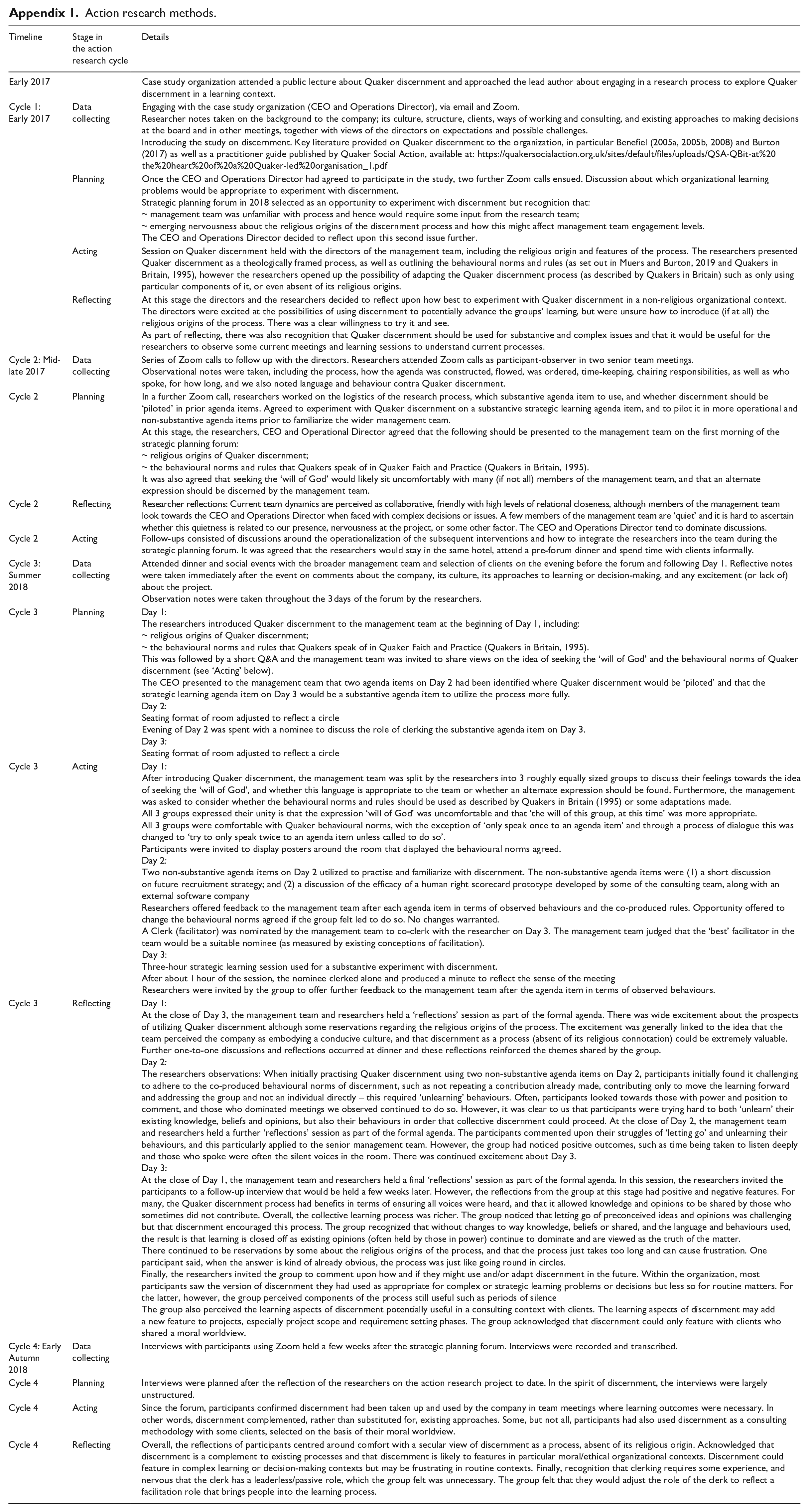
| Timeline | Stage in the action research cycle | Details |
|---|---|---|
| Early 2017 | Case study organization attended a public lecture about Quaker discernment and approached the lead author about engaging in a research process to explore Quaker discernment in a learning context. | |
| Cycle 1: Early 2017 | Data collecting | Engaging with the case study organization (CEO and Operations Director), via email and Zoom. |
| Planning | Once the CEO and Operations Director had agreed to participate in the study, two further Zoom calls ensued. Discussion about which organizational learning problems would be appropriate to experiment with discernment. |
|
| Acting | Session on Quaker discernment held with the directors of the management team, including the religious origin and features of the process. The researchers presented Quaker discernment as a theologically framed process, as well as outlining the behavioural norms and rules (as set out in Muers and Burton, 2019 and Quakers in Britain, 1995), however the researchers opened up the possibility of adapting the Quaker discernment process (as described by Quakers in Britain) such as only using particular components of it, or even absent of its religious origins. | |
| Reflecting | At this stage the directors and the researchers decided to reflect upon how best to experiment with Quaker discernment in a non-religious organizational context. |
|
| Cycle 2: Mid-late 2017 | Data collecting | Series of Zoom calls to follow up with the directors. Researchers attended Zoom calls as participant-observer in two senior team meetings. |
| Cycle 2 | Planning | In a further Zoom call, researchers worked on the logistics of the research process, which substantive agenda item to use, and whether discernment should be ‘piloted’ in prior agenda items. Agreed to experiment with Quaker discernment on a substantive strategic learning agenda item, and to pilot it in more operational and non-substantive agenda items prior to familiarize the wider management team. |
| Cycle 2 | Reflecting | Researcher reflections: Current team dynamics are perceived as collaborative, friendly with high levels of relational closeness, although members of the management team look towards the CEO and Operations Director when faced with complex decisions or issues. A few members of the management team are ‘quiet’ and it is hard to ascertain whether this quietness is related to our presence, nervousness at the project, or some other factor. The CEO and Operations Director tend to dominate discussions. |
| Cycle 2 | Acting | Follow-ups consisted of discussions around the operationalization of the subsequent interventions and how to integrate the researchers into the team during the strategic planning forum. It was agreed that the researchers would stay in the same hotel, attend a pre-forum dinner and spend time with clients informally. |
| Cycle 3: Summer 2018 | Data collecting | Attended dinner and social events with the broader management team and selection of clients on the evening before the forum and following Day 1. Reflective notes were taken immediately after the event on comments about the company, its culture, its approaches to learning or decision-making, and any excitement (or lack of) about the project. |
| Cycle 3 | Planning | Day 1: |
| Cycle 3 | Acting | Day 1: |
| Cycle 3 | Reflecting | Day 1: |
| Cycle 4: Early Autumn 2018 | Data collecting | Interviews with participants using Zoom held a few weeks after the strategic planning forum. Interviews were recorded and transcribed. |
| Cycle 4 | Planning | Interviews were planned after the reflection of the researchers on the action research project to date. In the spirit of discernment, the interviews were largely unstructured. |
| Cycle 4 | Acting | Since the forum, participants confirmed discernment had been taken up and used by the company in team meetings where learning outcomes were necessary. In other words, discernment complemented, rather than substituted for, existing approaches. Some, but not all, participants had also used discernment as a consulting methodology with some clients, selected on the basis of their moral worldview. |
| Cycle 4 | Reflecting | Overall, the reflections of participants centred around comfort with a secular view of discernment as a process, absent of its religious origin. Acknowledged that discernment is a complement to existing processes and that discernment is likely to features in particular moral/ethical organizational contexts. Discernment could feature in complex learning or decision-making contexts but may be frustrating in routine contexts. Finally, recognition that clerking requires some experience, and nervous that the clerk has a leaderless/passive role, which the group felt was unnecessary. The group felt that they would adjust the role of the clerk to reflect a facilitation role that brings people into the learning process. |
Funding
The author(s) received no financial support for the research, authorship and/or publication of this article.
