




Abstract
There is limited research linking entrepreneurial learning and business models in start-up businesses. Business models are important cognitive devices that link entrepreneurial thinking and engagement with customers and suppliers during business start-up. This research examines business model evolution during the first 6 years of a family-based start-up, which was formed in 2008 by 2 young brothers. The business grew quickly and achieved a turnover of £4.5 million with 15 staff members by 2014. The case study contributes a better understanding of ways in which team-based learning in a family business links experiential and cognitive learning during business model evolution.
Introduction: new (family) firms and business models
Although many new firms are founded by family entrepreneurial teams (FETs), Brannon et al. (2013: 107) suggest that ‘entrepreneurship scholars have generally overlooked the potential implications of family relationships in new venture teams’ (Chang et al., 2008; Jaskiewicz and Dyer, 2017; Morris et al., 2010; Reuf, 2010). Biological ties mean that family team members share values and norms, which positively influence behaviours and decision-making (Discua Cruz et al., 2013; Salvato and Melin, 2008; Uhlaner, 2006). Social learning, aimed at promoting good habits, provides continuity across generations and is more important than specific entrepreneurial knowledge (Aldrich and Yang, 2012). Stanley (2010: 1086) confirms that early emotional experiences have an imprinting effect on family firms setting a course for their future development (Berent-Braun and Uhlaner, 2012; Brundin and Härtel, 2014; Shepherd, 2016). Family involvement also means that business problems are overlaid with complex emotional relationships (McKee et al., 2014; Schjoedt et al., 2013). Emotions can have negative consequences as family firms are ‘fertile fields’ for a range of psychodynamics including ‘sibling rivalry, marital discord and identity conflict among family members’ (Morris et al., 2010: 1059). Extending an earlier version (Discua Cruz et al., 2013), FETs are defined as follows (Discua Cruz et al., 2017): two or more family members, related by kinship or marriage, who engage in the pursuit of business opportunities to establish, purchase, or expand a firm, have an actual or planned equity stake in the firm and a direct or legitimate influence on the strategic choice of the firm. (p. 192)
Despite an extensive family business literature (see Melin et al., 2014), 1 there is limited work examining the nature of learning in family firms (Konopaski et al., 2015). Family businesses are typified by specific behaviours, skills, norms and values shared by regular social interaction (Aldrich and Cliff, 2003; Michael-Tsabari et al., 2014; Schjoedt et al., 2013). Hence, the social context associated with a family business influences the nature of learning outcomes as family members operate within ‘communities of practice’ (Lave and Wenger, 1991). Based on an in-depth study of 18 Canadian family businesses, Konopaski et al. (2015) conclude that learning is ‘a complex social process that takes place in everyday situated practices and through patterns of co-participation between family members’ (p. 362).
Business models (BMs) have been linked to entrepreneurial firms since the dot.com boom at the beginning of the 21st century (Morris et al., 2005; Osterwalder and Pigneur, 2005). In their early review, Amit and Zott (2001) suggest BMs enable entrepreneurs to evaluate the nature of opportunities. They are also useful for analysing the value creation potential of new businesses and their longer term sustainability (Chesbrough, 2010; George and Block, 2011; Zott and Amit, 2007, 2010). Early-stage BMs emerge as a result of entrepreneurial choices about organisational activities including procurement practices, location and assets (Casadesus-Masanell and Ricart, 2010; Demil et al., 2015). Adopting an appropriate BM is essential if entrepreneurs are to create customer value that supports survival and growth (Doganova and Eyquem-Renault, 2009). As start-ups begin to deliver products/services the firm’s BM becomes embedded in its nascent routines (Cavalcante et al., 2011).
Even new organisations develop path dependencies and, consequently, an evolutionary approach based on ‘trial and error learning’ is more effective than adopting a radical new BM (Andries et al., 2013). The learning curve effect, and closely related, experience curve effect, describe the process by which individuals and organisations improve efficiency by repeating a range of tasks and activities (Andries and Debackere, 2013). Increased experience leads to higher levels of productivity and more effective managerial decision-making related to internal cost-controls, pricing and marketing (Shepherd et al., 2000). A number of scholars have examined the links between learning and BM change during the process of business start-up (Andries et al., 2013; Cosenz and Noto, 2018; Gupta and Bose, 2019; König et al., 2019; Sosna et al., 2010). However, most existing studies focus on high-technology firms and none examine family-based start-ups. Our objective is to answer the following research question: how does learning in FETs contribute to the evolution and augmentation of a firm’s BM?
This article analyses a dynamic start-up family firm, ECessori, 2 which was formally established by two young brothers. In secondary school Simon, the younger brother, began trading mobile phones on eBay to supplement his pocket-money. Gradually, he identified a market among school friends for cheap mobile phone accessories and this formed the basis of ECessori’s original BM. In September 2008, Bill, 2 years senior, began working full-time 3 in the business during a ‘gap’ year before university. This narrative account draws on longitudinal, qualitative data gathered from regular informal discussions between the lead author and the boys’ mother from the early 2000s and a series of formal interviews with all four family members between 2008 and 2016. These data provide a basis for exploring the dynamic interactions between entrepreneurial learning, capabilities and BM evolution (Wirtz et al., 2016) in a family-based firm (Kellermanns et al., 2008).
Entrepreneurial business models
Demil et al. (2015) argue that the approach articulated in the BM literature differs from the ‘traditional strategic toolkit of concepts and techniques’ (p. 4). Rather than being exogenous to the business, entrepreneurs ‘select’ the environment in which their firms (and associated BMs) evolve (Lecocq et al., 2010). This is achieved through entrepreneurial choices related to key stakeholders including suppliers, customers and competitors. In addition, customers are actively involved in the generation of products and services rather than acting as passive consumers (Demil et al., 2015). The nature of competition, the technological infrastructure and regulatory environment shape the ‘ecosystem’ in which new firms and their BMs operate (Demil et al., 2018). To better understand the dynamic of change, Demil and Lecocq (2010: 231) suggest that BMs can be conceptualised as having the following three core components: first, start-up firms begin with bundles of resources and competences 4 (Penrose, 1959); second, organisational structure captures the firm’s internal activities and external relationships; and, third, the firm’s value proposition is designed to attract and retain customers. As Demil and Lecocq (2010) go on to explain; ‘sustainable performance in the case of BM evolution lies in the ability of managers to identify the consequences of change in one component on the other components and on overall BM performance’ (p. 243).
There is general agreement in the literature that BMs are based on a small number of core elements (value creation, value delivery and value capture), however, there is less consensus about whether they are a cognitive phenomenon (Baden-Fuller and Morgan, 2010; Massa et al., 2017) or patterns of organisational activities (Winter and Szulanski, 2001; Zott and Amit, 2010). Those adopting a cognitive perspective regard BMs as ‘mental representations’ constructed in the minds of entrepreneurs (Funari, 2015: 211). Similarly, Aversa et al. (2015: 152) state that BMs are ‘cognitive devices that mediate between managerial thinking and engagement in economic activity’ (Macpherson et al., 2010). Schneckenberg et al. (2019) propose that BM design is based on the following cognitive processes: ‘problem sensing, considering adaptations, intuitional insights, and integrating customer perceptions – that complement the two further cognitive processes of analogical transfer and learned heuristics’. George and Block (2011) adopt a very different perspective; ‘a BM is the design of organizational structures that enact a commercial opportunity’ (p. 99). Based on their survey of 182 ‘senior managers’ in a range of Indian firms, the authors identify 3 BM dimensions (George and Block, 2011: 100–101):
In their study of new, science-based businesses, Lubik and Garnsey (2016) argue that BMs are important because they show how ‘a firm’s activities fit together to create and capture value’ (p. 396). As start-ups begin to deliver products/services then the BM is embedded in the firm’s nascent routines (Cavalcante et al., 2011; Hernes and Irgens, 2012). Doganova and Eyquem-Renault (2009) suggest that what they describe as BM ‘narratives’ and ‘calculations’ are complementary. Narratives (plot, storyline and characters) help entrepreneurs articulate a BM vision to various stakeholders and are complemented by calculative elements based on the firm’s costs, revenue and potential profit. Creating BMs in entrepreneurial firms is very different than modifying them in established organisations (Andries and Debackere, 2007). A number of authors point out that new ventures have several distinguishing features: they operate under conditions of uncertainty; limited financial, technological and human resources; rudimentary management structures; and little power or influence over other organisations (Ambos and Birkenshaw, 2010; Reymen et al., 2015).
According to Morris et al. (2005), six components underpin BM design for entrepreneurial firms: value creation (the offering), customers (the market), internal capabilities, competitive strategy, economic factors (how to make money) and personal factors (motivation and ambition for growth). Andries et al. (2013: 308) code the activities of six new ventures based on these components and conclude that an evolutionary approach based on ‘trial and error learning’ was more effective than adopting radical new BMs. Aversa et al. (2015) identify three core activities they claim are relevant to all ‘interconnected’ businesses: value creation (products and services), value delivery (customers and market segments) and value capture (revenue streams). These core elements are particularly appropriate for start-up businesses lacking the internal complexity of large organisations. In stressing the importance of understanding the ways in which entrepreneurs manipulate the architecture of their BMs, Aversa et al. (2015) adopt the concept of modularisation. Baldwin and Clark (2000) posit that there are six ‘modular operators’ associated with the modification of complex adaptive systems (Simon, 1962). Any of these operators (splitting, substituting, augmenting, inverting, excluding and porting) could be relevant in the context of entrepreneurial start-ups. However, we contend that start-ups are most likely to add new components to the basic BM as their operations become more complex.
Entrepreneurs augment their BMs ‘whenever they introduce a new element to exploit synergies with different value creation, delivery or capture mechanisms’ (Aversa et al., 2015: 172). We accept the proposition that BMs begin as cognitive representations in the minds of entrepreneurs or managers (Baden-Fuller and Morgan, 2010). The basic BM shifts from cognition through texts and discourses (Perkmann and Spicer, 2010) gradually becoming embedded in ‘organizational routines’ that create and capture value (Cavalcante et al., 2011; Zott and Amit, 2010). In other words, the activity-based perspective is complementary to the cognitive perspective rather than being a competing theoretical approach (Aversa et al., 2015; Funari, 2015). Scholars should clarify their assumptions about whether BMs are cognitive schemas or attributes of real firms (Massa et al., 2017: 97).
Learning in family entrepreneurial teams
Ben-Hafaïedh (2017: 11) critically examines the following three main phases of entrepreneurial teams (ETs): forming, functioning and evolving. Much research dealing with the forming stage examines the importance of homophily in teams comprising friends or family members. For example, Discua Cruz et al. (2013) identified the role of trust and shared values among FETs based on seven Honduran cases. During the functioning phase, much of the literature examines the relative importance of heterogeneity and homogeneity (Horwitz and Horwitz, 2007) in enhancing team performance. However, researchers are yet to establish the exact nature of the relationship between team diversity and performance (Klotz et al., 2014; Zhou and Rosini, 2015). Although Jin et al. (2017) did find that ET diversity was less beneficial in low-technology sectors than for hi-tech firms. A number of scholars confirm links between shared authentic leadership and ET performance (Hmieleski et al., 2012; Zhou and Vredenburgh, 2017). There is also a substantial body of literature examining the external links between ETs and venture capitalists (Ben-Hafaïedh, 2017: 23). With regard to the evolving phase, much of the literature scrutinises managerial transitions when the entrepreneur, or the ET, is replaced by a new top management team. Bryant (2014), for example, argues that the ‘imprinting founding characteristics’ directly influence the adaptive capacity of entrepreneurial ventures.
There is a related body of literature focusing on the operation of FETs (Aldrich and Cliff, 2003; Brannon et al., 2013; Discua Cruz et al., 2017; Schjoedt et al., 2013). According to Michael-Tsabari et al. (2014: 164), ‘the highest level of entrepreneurial orientation is achieved when two generations of the family are involved in the firm’ (see Kellermanns et al., 2008; Sciascia et al., 2013). The authors go on to say that researchers have tended to concentrate on the firm (Davidsson and Wiklund, 2001; Martinez et al., 2011) rather than the ‘dynamics of the family itself’ (Michael-Tsabari et al., 2014). The term entrepreneurial family was initiated by Rosenblatt et al. (1985) and more recently Uhlaner et al. (2012) propose that the concept of an entrepreneuring family refers ‘to that subset of business-owning families focused on entrepreneurial objectives or motives’ (p. 2). A number of scholars agree there is a need for researchers to give greater attention to the family’s influence on entrepreneurship (Aldrich and Cliff, 2003; Chang et al., 2009; Foss et al., 2008). Michael-Tsabari et al. (2014) claim that focusing on the family-level of analysis ‘opens the possibility to track the antecedents of entrepreneurial decisions in a wider perspective’ (p. 166).
According to Hernández-Linares et al. (2018) ‘the unique configuration of resources and capabilities’ (p. 193) is a key to ways in which family firms acquire and utilise knowledge. The authors examine the relationships between learning orientation (LO), 5 marketing orientation and entrepreneurial orientation in family and non-family firms. Hernández-Linares et al. (2018) conclude that ‘family businesses can take advantage of their greater efficiency in transforming knowledge into entrepreneurial behaviour when LO is high’ (p. 198). This confirms findings from a study of team performance by Johnson et al. (2015) who found that good working relationships were crucial in encouraging the sharing of knowledge and information. Discua Cruz et al. (2017) make a number of important points about the unique nature of family teams for learning entrepreneurial skills. FET members are more likely to develop trust and psychological safety through early socialisation in the home. Furthermore, younger team members can obtain a better understanding of business practices from older, more experienced family members (Alsos and Kolvereid, 1998). As the authors go on to state ‘family members working together in entrepreneurship are seen to learn collectively and become more proficient in developing new opportunities over time’ (Discua Cruz et al., 2017: 202).
A start-up firm’s capabilities are developed by coordinated activities associated with the mobilisation of resources as entrepreneurs attempt to build a sustainable BM (Cosenz and Noto, 2018; Monroy et al., 2015; Mueller et al., 2012). Resources include finance, equipment, products, knowledge and IPR as well as intangible assets (Chang et al., 2009). One advantage of family start-ups is that members have access to a wider range of resources, including skills and knowledge, compared with individual entrepreneurs (Rau, 2014). Family firms are typified by shared values and norms which aid cooperation and the dissemination of tacit knowledge. Hence, family firms have unique resource configurations captured in the term ‘familiness’ (Habbershon and Williams, 1999; Tokarczyk et al., 2007). Based on a study of 194 Mexican firms, Monroy et al. (2015) argue that familiness is a capability rather than a resource in family-based enterprises. De Massis et al. (2018) provide the following definition of entrepreneurial capabilities: ‘the capacities (i.e. processes and routines) of an entrepreneurial actor (entrepreneurs, ETs, and enterprises) to prospect, develop, and exploit opportunities by reconfiguring human, social, and financial resources’ (p. 8). While Pearson et al. (2008) confirm the Resource Based View (RBV) as the main theoretical perspective underpinning familiness they also go on to say that ‘the cognitive dimension is unique in family firms, because it is often deeply embedded in the family’s history’ (p. 957).
Whether BMs are a cognitive phenomenon (Baden-Fuller and Morgan, 2010; Massa et al., 2017; Schneckenberg et al., 2019) or patterns of organisational activities (Winter and Szulanski, 2001; Zott and Amit, 2010) has similarities to debates about the nature of entrepreneurial learning (Gavetti and Levinthal, 2000; Mitchell et al., 2007). Armstrong and Fukami (2010: 338) argue that cognitive learning can be categorised into the following three domains: declarative knowledge (amount and accuracy of knowledge), knowledge organisation (interrelationships between knowledge structures) and cognitive strategies (forming concepts and procedures). Dew et al. (2015) point out the importance of ‘distributed cognition’ (p. 154) because learning often involves teams rather than entrepreneurs working alone.
While Konopaski et al. (2015) claim that it is a difficult concept to explain, they provide their own definition: ‘learning represents an ongoing process through which knowledge is acquired and generated’ (p. 349), which leads to observable changes in behaviour. Within the specific domain of entrepreneurial learning, Kolb’s (1984) influential ideas about experiential learning have been widely adopted (Chang and Rieple, 2018; Cope, 2005; Gabrielsson and Politis, 2015; Politis, 2005; Tomkins and Ulus, 2016). In developing experiential learning theory (ELT), Kolb (1984) acknowledges the influence of Piaget’s (1951) understanding of cognitive development, Lewin’s (1951) action research approach to group dynamics, the work of American philosopher and educational theorist, John Dewey (1938), as well as Vygotsky’s (1978) social constructivist learning theory (see Jones et al., 2014; Kayes, 2002). Hence, our understanding of entrepreneurial learning is firmly based on ELT in which new knowledge is created by two distinct dialectical processes: making sense of experience (prehension) and applying that experience (transformation). The prehension dimension varies from abstract conceptualisation to concrete experience; the transformative dimension varies from active experimentation to reflective observation (Kolb, 1984).
In their review of the literature, Wang and Chugh (2014) argue that the field of entrepreneurial learning can be divided into studies focusing on either the individual or the organisational levels. In fact, the authors state that integrating individual and collective learning is one of the key challenges for scholars of entrepreneurship (Wang and Chugh, 2014: 33). Pittaway and Cope (2007: 213) point out that entrepreneurial learning is a relational process of co-participation (Taylor and Thorpe, 2004) based on argument, debate and collaboration with others (Holman et al., 1997). While El-Awad et al. (2017) draw on Crossan et al.’s 4i framework to link individual cognitive learning to team-based learning and, ultimately, organisational learning (Jones and Macpherson, 2006; Lans et al., 2008). A study of 76 entrepreneurs in a venture accelerator programme emphasises the links between experiential learning and collective learning (Politis et al., 2019). ELT was also extended by Kolb et al. who proposed that conversations help groups of learners construct new meaning and transform their collective experiences into knowledge and knowing (Baker et al., 2005: 412). As discussed earlier, close family relationships based on shared values and norms promote collective entrepreneurial learning (Discua Cruz et al., 2017). At the same time, dysfunctional conflict between family members will certainly be a barrier to effective entrepreneurial learning (Lim et al., 2013; McKee et al., 2014; Schjoedt et al., 2013).).
The BM literature certainly acknowledges the importance of cognitive learning (Martins et al., 2015). Berends et al. (2016) posit that such learning is based on ‘forward-looking processes’ in which entrepreneurs choose actions based on cognitive representations (see Mackay and Burt, 2015). In contrast, experiential learning is ‘backward-looking’ as previous experiences are encoded in organisational activities and routines (Berends et al., 2016; Hernes and Irgens, 2012). Based on their longitudinal study of four cases, Berends et al. (2016: 189) identify two mechanisms associated with cognitive search (conceptualising and creating) and two mechanisms associated with experiential learning (adapting and experimentation). Understanding precedes action in cognitive learning whereas action precedes cognition in experiential learning. As Berends et al. (2016) posit, ‘thus, both cognitive search and experiential learning involve action and cognition, but in opposite sequences’ (p. 184). The relationships between family entrepreneurial capabilities, learning and BM components are summarised in Figure 1.
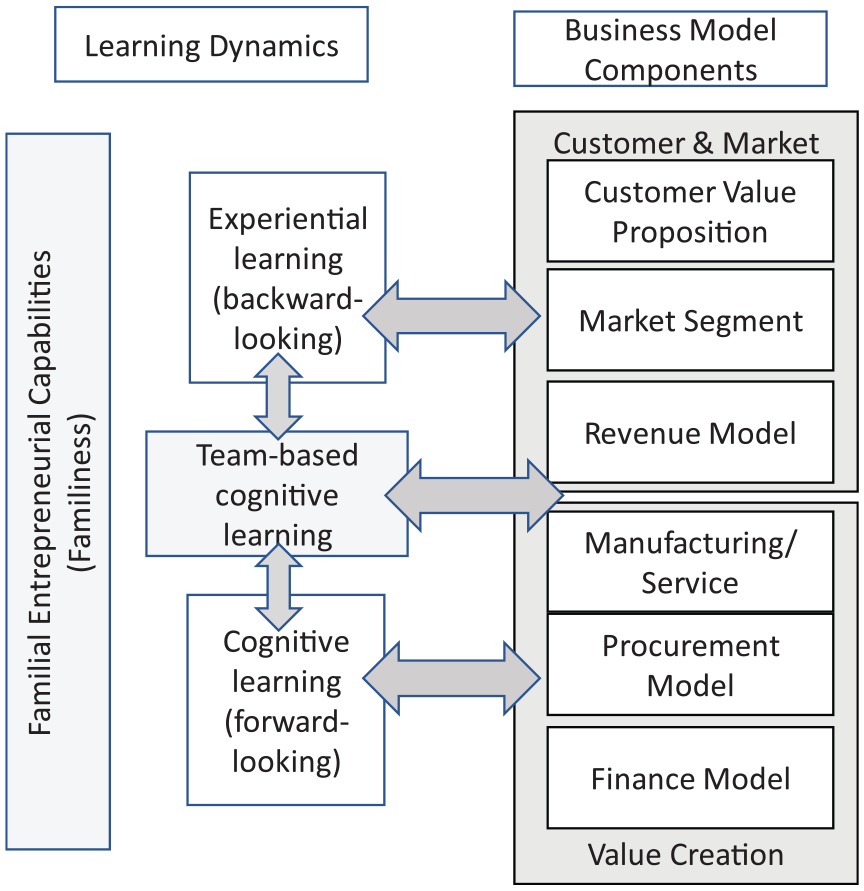
Conceptual framework: Learning dynamics and business model components.
Research methods
The analysis of the ECessori case is based on a longitudinal study of the firm dating back to before its formal inception in 2008 by Simon and Bill. This method was chosen for several reasons. First, it allowed us to explore the dynamics of entrepreneurial learning, over a number of years, which took place between the brothers themselves and also with their parents. Such intergenerational learning is viewed as an even more critical component in FETs compared to other such teams (Discua Cruz et al., 2017). Second, longitudinal cases are crucial for understanding the resourcing constraints faced by entrepreneurs in FETs (Baert et al., 2016; Sieger et al., 2011). Hence, we were able to chart the firm’s growth from its inception in the brothers’ bedroom through several key transition points. This resonates with the approach employed by Michael-Tsabari et al. (2014) in their study exploring the evolution of a family business. Third, we applied an abductive method, or systematic combining, which offers an interpretist approach to the analysis of single case studies (Dubois and Gadde, 2002, 2014). Systematic combining requires researchers to iterate between their empirical data and theory. Abductive methods span the divide between ‘theory testing’ approaches (Eisenhardt, 1989; Yin, 2009) and ‘looser’ approaches associated with grounded theory (Glaser and Strauss, 1967). As the research progressed, we gathered ‘unanticipated’ empirical findings which led to new theoretical insight and allowed us to refine our conceptual framework summarised in Figure 1 (Dubois and Gadde, 2014).
Access to the company was obtained informally as the mother of Simon and Bill worked with the first author in the early 2000s. Anna was proud of Simon’s entrepreneurial activities in junior school (selling pens and sweets to fellow pupils) and in secondary school (selling mobile phones bought on eBay to his friends). When ECessori was established in 2008 Anna asked her sons if they would be willing to participate in an academic study of their business activities. Because of the long-standing friendship with the first author, all four family members agreed to a long-term study of ECessori. These close contacts meant that there were no barriers during the interviews and information about the company and the family relationships were freely shared (Alvesson, 2003; Maclean et al., 2012).
Early in 2010, in-depth interviews took place with Bill and Simon and their parents; in 2012, interviews were carried out with all four family members. The FETs were asked to describe their motivations for establishing the company and explain their contribution to the growth process. Further rounds of in-depth interviews were carried out with the four family members in February/March 2015 and July 2016. Latterly, greater emphasis was placed on exploring the extent to which the BM had evolved during the early stages of growth. In total, 16 intensive, in-depth interviews were carried out with the family during this 6-year period. Interviews of between 90 minutes and 120 minutes were transcribed and coded using NVivo. Observations were also made during the interviews and meetings, which enhanced our understanding of changes in the family relationships. For example, as the brothers matured they became more professional in their business dealings and grew in confidence about their entrepreneurial capabilities. We regularly checked the firm’s online footprint (websites, social media) to establish the increasing levels of sophistication in their interactions with customers.
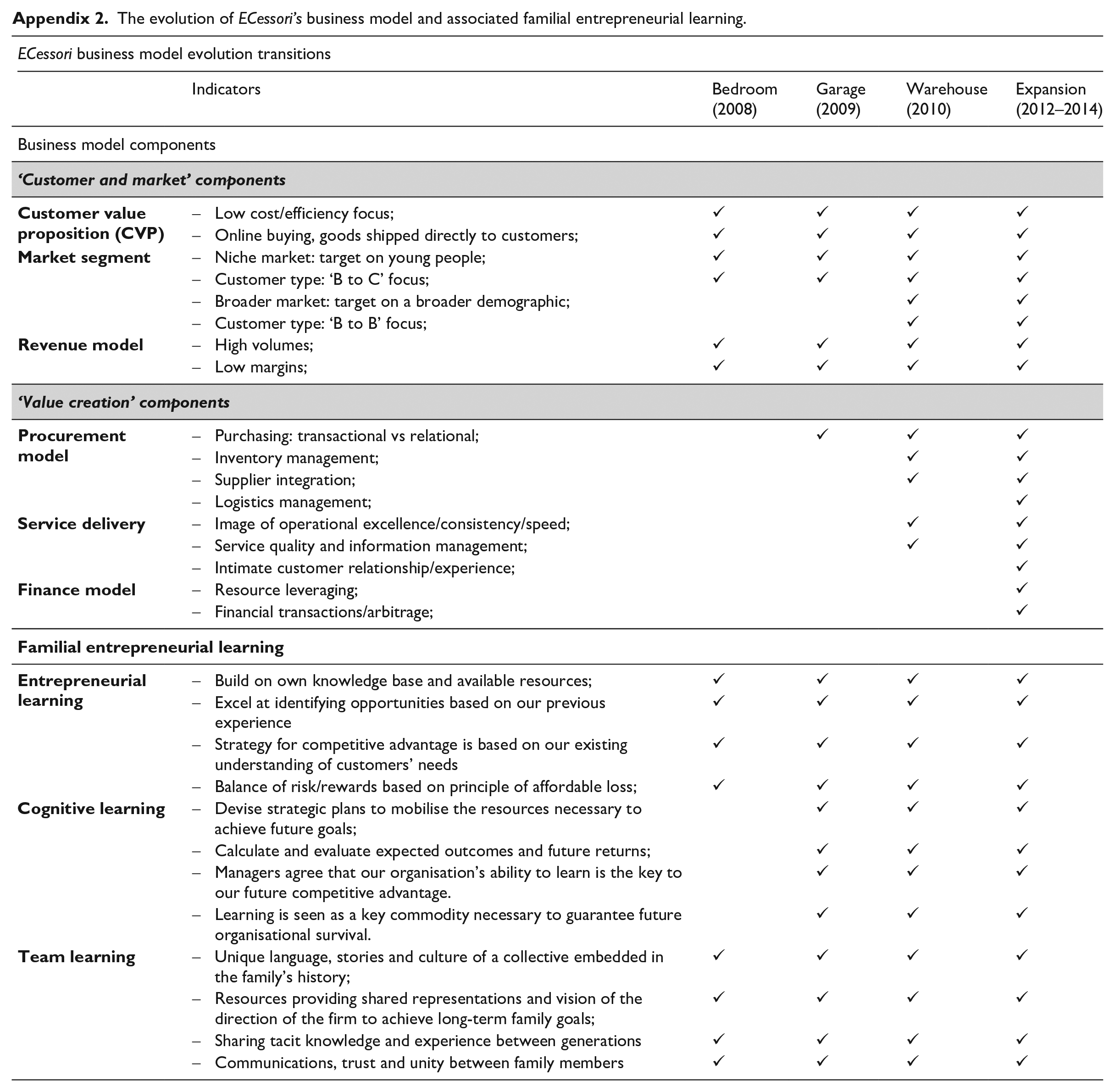
According to Andries et al. (2013: 291), case studies are enhanced by the use of ‘central constructs’ to provide a systematic documentation of the phenomena under investigation (see Eisenhardt, 1989). In this regard, to analyse the empirical data, we used our conceptual framework linking BMs (Andries et al., 2013; Morris et al., 2005; Reymen et al., 2015) and entrepreneurial learning (see Hernández-Linares et al., 2018) as the starting point (Figure 1). Then, we operationalised the key concepts by identifying appropriate sub-components, informed by the literature, to code the interview data. Appendix 1 summarises the indicators and academic sources used in the coding process to analyse the empirical data. This rigorous, theoretically informed approach allowed us to ‘map’ the key transitions in ECessori’s growth which was built on the dynamic interplay between the firm’s BM and associated familial entrepreneurial learning over a 6-year period. Appendix 2 combines the conceptual framework with the respective indicators used for coding the data to illustrate how the different BM components evolved, over time, through the firm’s main growth transitions. In line with earlier studies then (see Andries et al., 2013; Reymen et al., 2015), we confirm that ECessori’s BM became more complex as the brothers, supported by both parents, developed their entrepreneurial capabilities. The next section discusses in detail the interactions between family members (Michael-Tsabari et al., 2014) during the firm’s growth.
The evolution of ECessori’s business model
Simon’s early business activities began at primary school when he sold sweets and pens to his school friends. His entrepreneurial ‘learning’ continued to develop in secondary school when he bought and sold mobile phone accessories on eBay. Bill, his older brother, began working in the business after finishing his A-Levels during a ‘gap’ year before university. Rather than using intermediaries, Bill began to source products directly from China and this dramatically increased turnover and profit. At the time of the formal creation of ECessori in 2008, Simon was 16 and studying for his A-levels, Bill was 2 years older and both were living at home with their parents. Table 1 provides a timeline of ECessori’s growth.
A timeline of the evolution of ECessori.
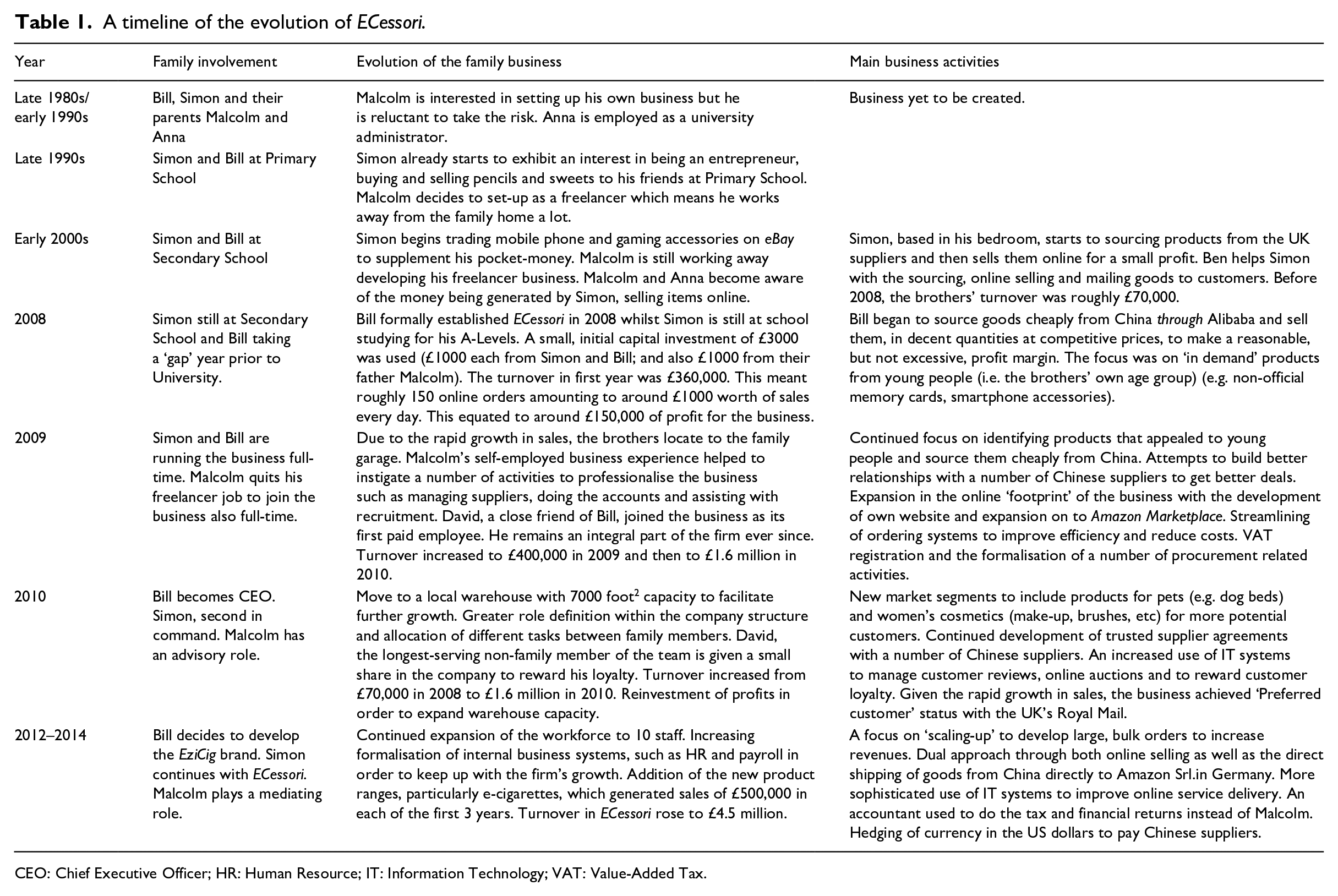
CEO: Chief Executive Officer; HR: Human Resource; IT: Information Technology; VAT: Value-Added Tax.
The key point to emerge from discussions with both brothers was their ability to ‘sense’ and ‘seize’ opportunities and source products attractive to their contemporaries. For example, they borrowed £80 from their father to buy ‘grey’ memory cards for a popular games console and demand was so high the brothers made a substantial return on their investment. The brothers’ initial idea for their BM was remarkably simple – opportunistically obtain cheap products (e.g. smartphone accessories) which they knew they could sell to their friends, online to young people of their own age. From the outset, the brothers articulated a very clear customer value proposition (CVP; Andries et al., 2013) in their BM, which was based on keeping overheads low, generating small margins but selling relatively high volumes. This is in line with the point made by Aversa et al. (2015) and Baden-Fuller and Morgan (2010) that BMs emerge as cognitive representations in the minds of entrepreneurs. Importantly, the brothers’ initial cognitive representation of their BM endured and they were able to develop it through concrete activities to create and capture value (Cavalcante et al., 2011; Zott and Amit, 2010).
From the outset, fraternal bonds between Bill and Simon were crucial in allowing them jointly to set-up ECessori. Moreover, their parents encouraged them to develop the business: We started importing from China via Alibaba and used to store loads of boxes in our bedrooms. We were supported by our mum and dad every step of the way, we wouldn’t be where we are today without them. We were both young we had nothing to lose, only what we had originally invested. It helped that my dad was self-employed and the support was there from day one. My eBay account which was actually in my mother’s name! (Simon)
When it became apparent that running the business from their bedrooms was not feasible their parents suggested using the family’s large garage as a warehouse. This is a prime example of how parental support (Discua Cruz et al., 2017) was fundamental in encouraging the growth of ECessori. Malcolm’s long experience of self-employment was also a crucial learning resource for the two raw entrepreneurs. One motivation for starting the business was to generate enough revenue to enable their father to work at home, as Simon explained, Moving out of my bedroom to the garage was because my Mum and Dad saw that the business was growing. We had to empty the garage and it was a nightmare but it was a great idea as there was no rent to pay. Obviously, we were a business in its start-up stages . . . and we were doing this to help my Dad who worked for himself. We only saw him at weekends as he always had to work away, we wanted him home and so we thought he could work for the company.
That the brothers were able to generate enough revenue to enable their father to join the business was a significant achievement and gave them considerable satisfaction. In addition, the brothers engaged in vicarious learning about entrepreneurship through Malcolm’s long experience of self-employment, which exposed both brothers to the ‘highs and lows’ of running a business. For example, seeing their father take risks to seize business opportunities as well as the reality of their father having to work away from the family home. Furthermore, the brothers benefitted directly from their father’s business acumen. Malcolm had a range of valuable experiences to share with his sons; not least his knowledge of the legal issues associated with running his own business. Again, this illustrates the importance of the familial dimension (Discua Cruz et al., 2017) to support the brothers’ entrepreneurial learning. With the business growing, Malcolm was instrumental in instigating a number of activities to professionalise the company’s nascent BM (Cavalcante et al., 2011; Zott and Amit, 2010) including how to manage suppliers, compile financial accounts and assist with recruitment of staff to support the growing business. For example, David, a close friend of Bill, joined the business and remains an integral part of the firm.
Malcolm provided a ‘steady hand’ and an experienced voice to help Bill and Simon deal with a number of difficult issues that arose as sales increased. For instance, a Japanese games console company filed a law-suit against ECessori because the brothers were selling unauthorised memory cards that allowed games to be downloaded from the Internet. Malcolm negotiated with the Japanese company’s representatives to ensure that legal proceedings were halted. Another example is his insistence that the brothers formalise their business: I just said to the boys, you have a cracking business idea here, lets formalise it, get you VAT registered, get it all set up and do everything by the book. We need to start doing accounts, you can’t keep on earning as much as you are, it’s impossible.
Following the move to the family garage, the brothers’ cognitive representation (Baden-Fuller and Morgan, 2010) of the firm’s BM remained largely the same with the focus on ‘customer and market’ elements by selling online cheap smartphone accessories to young people to generate rapid turnover (see Appendix 2). In terms of ‘value creation’, the brothers realised that it was necessary to develop longer term relationships with Chinese suppliers to get better prices and improve the reliability and lead-times for orders. This was partly in response to ‘trial and error’ experiential learning (Andries and Debackere, 2013; Andries et al., 2013) through problems encountered when dealing with China, as Simon explained, We were on a steep learning curve when dealing with Chinese suppliers. Documentation can be fake and a lot of people are greedy over there and they aren’t often bothered about developing long-term customers. Some suppliers try to rip you off. I know it sounds bad but you do have to be careful. We decided to find the firms that do care about developing longer term relationships as they can see that we are going to sell a lot of their product.
Concurrently, the brothers recognised the need to expand their online ‘footprint’ by reinvesting profits into their own website as well as selling on other sites including Amazon, Play.com and GroupOn. In addition, they improved service delivery particularly through the application of sophisticated IT to manage online auctions, customer reviews and streamline ordering systems. The product range broadened to include new market segments by selling dog beds and women’s cosmetics. The brothers researched what other online companies were selling and exploited their ability to source new products from a range of Chinese suppliers. The aim of these enhancements to the BM was to generate a strong brand to encourage customer loyalty and stay ahead of their online competitors. Adapting their IT system to automate responses was crucial to drive increased online traffic and consistently provide a better customer service. This illustrates the ways in which both Simon and Bill, working together, developed the firm’s BM as a result of their combined and enhanced experiential learning gained through gathering more practical hands-on business experience (Cavalcante et al., 2011; Discua Cruz et al., 2017) exploring what competitors were selling as well as what products they could source cheaply from China.
The combination of these developments led to considerable growth, which saw ECessori’s turnover increase from £70,000 in 2008 to £1.6 million in 2010. At this point, Bill, Simon and Malcolm decided that they needed additional storage space in order to facilitate further growth and rented a warehouse with a 7000-foot 2 capacity in a converted mill. The move to the warehouse heralded the further addition of several other ‘layers’ to the BM. First, logistics and procurement became more formalised as the business achieved ‘preferred customer’ status with Royal Mail (shipping over £300k per annum). The brothers also established ‘trusted supplier’ agreements with several Chinese companies as well as giving more attention to inventory and logistics management (see Appendix 2).
Increasing turnover meant that ECessori took on four full-time and three part-time warehouse staff to meet customer demand, give greater attention to buyer requests, manage customer-feedback and improve service quality. Internally, however, increasing staff numbers created a new set of challenges as both brothers lacked any previous professional experience in managing teams. This meant that the brothers had to learn ‘on-the-job’ as Simon explained, Managing staff is definitely the hardest thing to deal with, much more difficult than what I do on the computer. I’ve only had one job and that was as a pot washer in a local bar! When you take someone on you don’t know what they are going to be like. When things go wrong and you must accept it and not take anything to heart. Luckily, my Dad is around and we have David. He has been a good friend and has worked very hard for us for a number of years, which is why we made him a shareholder.
Thus, as this quote illustrates, the development of a strong ‘inner circle’ of familial ties, with the inclusion of Simon’s trusted boyhood friend, was a crucial support mechanism that helped the brothers to mitigate the challenge of hiring (and firing) staff to meet the demands of business growth. From 2012–2014, the continued expansion of ECessori was based on the brothers’ ability to effectively ‘scale-up’ the number of customers and the quantities of product lines. For example, Simon claimed they were selling more dog beds in the United Kingdom than Tesco and Pets at Home combined. The warehouse had a team of 10 staff (some seasonal) and they began to plan the extension of storage capacity even further to deal with customer demand. Early in 2012, however, a decisive event occurred when Bill serendipitously spotted an opportunity to source e-cigarettes from China. This proved a lucrative decision because sales increased rapidly in the first few months (Bill): I bought e-cigarettes as a gimmick for a friend and he said that they weren’t too bad so I bought 250 packs of an unbranded version from a new Chinese supplier. It was interesting as I bought the first consignment and we stuck them on Amazon to test things. In a matter of weeks, it had grown to be 75% of our business. We were churning £100,000 a month just on e-cigarettes and we made a lot of money in a short period of time through Amazon.
Gradually, there was an increased emphasis on selling e-cigarettes, which by the end of 2012 were generating two-third of ECessori’s turnover. The brothers focused more attention on the ‘finance model’ of the business, investing a substantial proportion of their retained profits (approximately £30,000) in developing their own e-cigarette brand, EziCig. They employed a professional accounting company to manage their finances rather than relying on their parents, Malcolm and Anna. The importance of managing risk associated with currency fluctuations encouraged them to hedge payments to their Chinese suppliers in US dollars. The firm’s BM became more sophisticated as both brothers continued to consolidate and enhance their entrepreneurial learning and capabilities (Baden-Fuller and Morgan, 2010). This led to the addition of value creation components to the original customer and market components of the BM, by the undertaking of a wide-range of further activities within the business (Appendix 2).
Bill concentrated on the implementation of new organisational systems to prepare EziCig for a trade-sale. Although Simon recognised the importance of adopting more professional management practices, he continued to rely on his entrepreneurial ability to identify products to generate short-term profit. The development of the EziCig brand revealed contrasting ‘visions’, and some degree of discord between the brothers, about how best to continue business growth, which influenced their combined entrepreneurial learning (Lim et al., 2013). In particular, the decision by Amazon to cease the sales of nicotine related products caused a potentially serious setback for the business as Bill outlined, In January I went on holiday thinking let’s get away because business is great and we hadn’t had a holiday since starting the business. I started my holiday and that is when Amazon said we are not allowing the sale of any more nicotine. Basically, that meant bang – a £100,000 a month gone overnight! At that point we had to refocus, I let Simon handle current ECessori affairs and I said we have to build a brand and I launched EziCig.
Tensions between Simon and Bill began to emerge as a result of this external setback. The issue of sibling rivalry, while always present, clearly intensified with the creation of the EziCig brand and discussions about the future of ECessori that both had nurtured. As Anna and Malcolm, the boys’ parents confirmed, Well, Simon was a bit sceptical about EziCig when it started. There have been tensions and I think that some of these anger issues Simon has are because he feels Bill has pulled some dirty tricks on him, I think he has got it a bit out of perspective but . . . There is the ‘20 something’ banter and rivalry between them. They get on really well socially but they are also very different characters. Bill was the MD of ECessori when we decided to create the EziCig brand. I said we need to hand over control of ECessori to Simon and you look after EziCig. There were constant battles going on and I was the referee.
Thus, while both brothers were successful entrepreneurs, their respective cognitive learning trajectories were developing in contrasting ways. On the one hand, Bill’s ambition was to develop the EziCig brand in a highly regulated market by maximising returns in the shorter term with the aim of selling the business to another company. On the other hand, Simon remained focused on continuing with the ‘original’ BM – identifying opportunities to make money by importing products from China. The next section explores in detail the main issues arising from the interplay of entrepreneurial learning and the gradual evolution of ECessori’s BM.
Discussion: familial entrepreneurial learning and business models
In this article, we answer the following research question: how does learning in FETs contribute to the evolution and augmentation of a firm’s BM? As established earlier, there is limited research on learning in family firms (Konopaski et al., 2015) particularly related to BM evolution (Cosenz and Noto, 2018; Gupta and Bose, 2019; König et al., 2019). The subject of this case, ECessori, is very different to most studies of BM change, which focus on technology-based businesses (Bojovic et al., 2018; Lubik and Garnsey, 2016) or larger organisations (George and Block, 2011; Sosna et al., 2010). Simon and Bill started their company when still at school and neither had any formal business training or experience. However, they did have parents who encouraged their creativity, independence and enterprise. As indicated earlier, Anna proudly shared stories of Simon’s entrepreneurial exploits during primary and secondary school with the first author. From an early age, they were also exposed to the risks and rewards of entrepreneurship by way of Malcolm’s long experience of self-employment.
Second, unlike most fast-growing start-ups, which rely on proprietary knowledge, ECessori’s competitive advantage stemmed from the brothers’ experiential learning and their ability to engage in forward-looking cognitive learning (Berends et al., 2016; Mackay and Burt, 2015). Third, once it became operational, the business was supported in practical ways by both parents who gave up their garage as well as providing business experience and emotional care (Uhlaner, 2006). Fourth, ECessori is distinctive because it grew quickly in comparison to the majority of UK start-ups (Anyadike-Danes et al., 2015).
In ‘selecting’ the environment in which they operated (Demil et al., 2015), in line with their cognitive representation of their initial BM, the brothers concentrated on the customer and market elements (CVP, market segment and revenue) to generate value. During the early stages of ECessori, experiential learning (Andries and Debackere, 2013; Andries et al., 2013; Cope, 2003; Lans et al., 2008) was key to their survival as they gained experience of dealing with customers and suppliers as well as the day-to-day problems of managing an increasingly complex business (see Figure 2). This reflected a ‘market driven’ approach based on their assessment of market need and a strong customer orientation (Ambos and Birkenshaw, 2010). Hence, during the early stages (bedroom and garage) of the business, the boys were developing their entrepreneurial capabilities related to managing the firm’s internal processes and routines (Appendix 2). As business activity increased, Simon and Bill developed their wider entrepreneurial capabilities by prospecting, developing and exploiting new money-making opportunities (De Massis et al., 2018). For example, by monitoring competitors, Simon realised they could increase revenue by selling dog beds and women’s cosmetics, while Bill recognised the potential of e-cigarettes to transform the original BM.
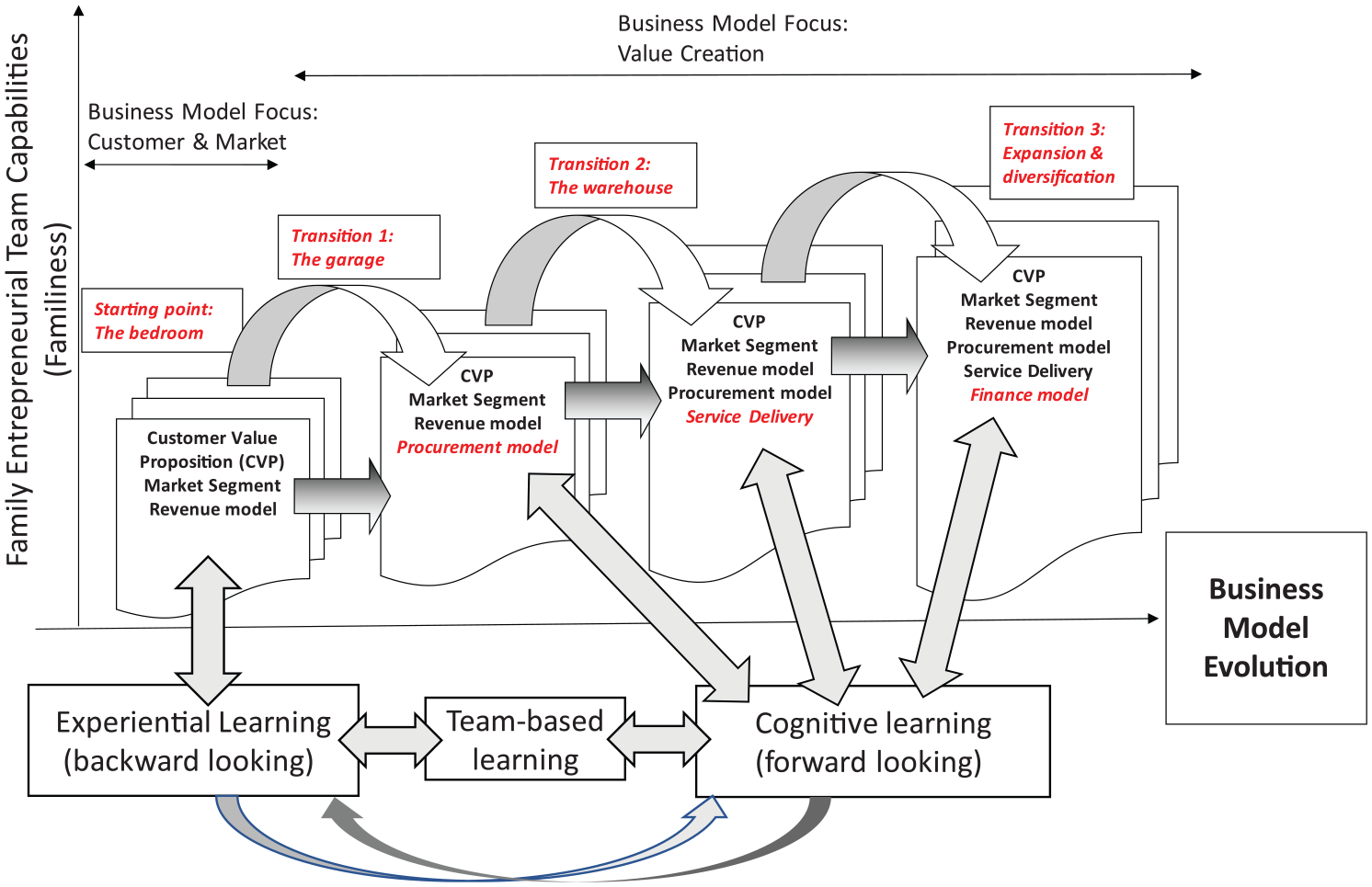
Capabilities, learning and business model evolution.
Malcolm joining on a full-time basis expanded ECessori’s resources and the brothers began to pay greater attention to professionalising the business by becoming VAT registered, clarifying roles and responsibilities and formalising employee recruitment. This provides an excellent example of the mentoring role adopted by both parents (Discua Cruz et al., 2017) in encouraging the boys to systematise their internal processes and create routines to ensure existing operations were managed efficiently. As the business became established, they began to pay attention to the ‘value creation’ (service delivery, procurement and finance) components of the firm’s BM (Andries et al., 2013; Mackay and Burt, 2015). This was augmented with the formalisation of procurement activities as Bill gained confidence in negotiating with their Chinese suppliers (Aversa et al., 2015). Greater attention to the service delivery component followed as the brothers recognised the importance of building longer term relationships with customers. Both procurement and service delivery activities were enhanced by investment in IT systems (consumer relationship management (CRM) for example) to automate routine interactions with customers and suppliers. Finally, the brothers considered the strategic importance of their financial model as they reinvested profit (revenue) into developing the EziCig brand. They also adopted sophisticated financial techniques such as foreign exchange hedging to mitigate risks associated with currency fluctuations (see Appendix 2).
This study demonstrates how various forms of learning contributed to the refinement and augmentation (Aversa et al., 2015) of the ECessori BM over a 6-year period (Figure 2). In the early stages (bedroom and garage), experiential learning helped the brothers refine the customer and market components of their BM. As ECessori evolved through the warehouse and expansion & diversification stages, they then focused on value creation by gradually augmenting their basic model with the procurement, service delivery and finance components. Team-based and cognitive learning became more important as the family (Michael-Tsabari et al., 2014) recognised the importance of longer-term value creation (Figure 2). In particular, Bill identified the strategic importance of moving beyond their original cognitive narrative of their BM based on selling large quantities of goods at small margins to generate income. In part, this reflected his desire to ‘build a brand’ but also included his continued commitment to professionalising ECessori’s activities. In other words, the cognitive narrative shifted to focus on the more calculative BM elements of costs, revenue and longer term profitability (Doganova and Eyquem-Renault, 2009).
While the parents were not actively involved in the very early stages of the business, the resources they provided through use of their home, advice, experience and emotional support were central to the development of ECessori’s BM. This confirms that the brothers’ entrepreneurial capabilities (De Massis et al., 2018; Morris et al., 2005; Mueller et al., 2012) were shaped from an early age by the influence of their parents (Aldrich and Yang, 2012). The case also demonstrates the importance of young entrepreneurs learning-in-practice by accommodating the cognitive and social elements of team learning (Dew et al., 2015). In their recent study, Berends et al. (2016) claim that BM innovation occurs as a result of experiential learning (adaption and experimentation) and cognitive search (conceptualisation and creation). While we identified both learning processes in ECessori, importantly, these two modes were linked by team-based learning (see Figure 2). Based on an extensive literature review, de Mol et al. (2015) confirm that ET cognition is located in team processes associated with decision-making, coordinating information and planning. Learning shaped development of the BM and changes to it simulated further learning. For example, enhancing the procurement model led to Bill considering how to improve relationships with customers and, in the longer term, to offset currency fluctuations (Figure 2; Appendix 2). Therefore, our key contribution is to demonstrate that the various forms of learning are mutually reinforcing; illustrated by the two-way arrows linking the three forms of learning. Experiential learning will also ‘feed-forward’ into cognitive learning and the latter will ‘feed-backward’ into experiential learning (Figure 2). In other words, what we propose is that experiential learning, team-based learning and cognitive learning are part of a learning cycle in which each element enhances and enriches the other forms of learning.
Regular, formal and informal discussions between all four family members encouraged reflection on what was working (or not) in the business (Kolb, 1984). As pointed out by Aldrich and Yang (2012), endowing children with self-discipline, conscientiousness as well as good habits including critical self-reflection and an awareness of cognitive shortcuts is central to the creation of effective entrepreneurs. FETs generally have shared values and norms (Discua Cruz et al., 2013; Uhlaner, 2006) which encourage the dissemination of tacit knowledge (de Mol et al., 2015; Dew et al., 2015). This case confirms that early emotional experiences help imprint good habits on the next generation and guide the development of family firms (Berent-Braun and Uhlaner, 2012; Brundin and Härtel, 2014; Shepherd, 2016; Stanley, 2010).
Conclusion
The ECessori case provides a detailed example of how learning in FETs contributes to the evolution and augmentation of a firm’s BM during early stage growth. Several points of significance emerge from the research. First, the case resonates strongly with Stanley’s (2010) point about emotional experiences shaping the development of family firms. The brothers had a strong desire to generate enough income to ensure that their father did not have to work away from home. This was a key motivating factor in the early stages of the business and influenced their commitment to working together (Aldrich and Cliff, 2003; Foss et al., 2008). In addition, rather than being negative, sibling rivalry (Morris et al., 2010) was a key element in fostering healthy competition between the brothers, which stimulated their entrepreneurial learning.
The close-knit ‘family unit’ meant that there was a clear understanding of each other’s ‘strengths, weaknesses and idiosyncratic habits’ (Foss et al., 2008: 84). The team also had complementary skills: Simon’s focus on opportunity identification; Bill’s increasing confidence as a manager and planner (Goel and Jones, 2016); Malcolm’s willingness to offer ‘wise counsel’ without inhibiting the boys’ desire to grow a successful company; Anna’s consistent emotional support especially during periods of conflict about the future strategic direction of ECessori. As identified by Monroy et al. (2015), a concentration on the cognitive and relational elements bound the four family members together. While there were certainly tensions resulting from competition between the boys, these occurred within the context of a trusting and supportive family environment. In short, the team combined heterogeneous mind-sets with positive team dynamics (Kor, 2003; Penrose, 1959). The behavioural and social resources underpinning the creation and growth of ECessori included experiential (on-the-job) learning; vicarious learning from Malcolm’s business experience and Anna’s emotional intelligence; ability to take risks in a supportive environment; and their adaptation to changing circumstances.
Second, the case illustrates the importance of adopting a flexible BM (Baden-Fuller and Morgan, 2010) to underpin growth in family-based start-ups. The process of ‘trial and error learning’ (Andries and Debackere, 2013; Andries et al., 2013) enabled the brothers to augment their nascent BM by gradually adding the three value creating components rather than developing a completely new BM. The brothers began by implementing more formal approaches to purchasing, followed by a focus on service delivery, and, eventually, they implemented increasingly sophisticated financial planning techniques. The case, therefore, illustrates the value of an evolutionary approach based on the gradual extension of the original BM by the addition of more strategic components (Demil and Lecocq, 2010). This ‘learning curve effect’ describes the process by which the family members improved their efficiency by regularly repeating a range of tasks and activities (Andries and Debackere, 2013).
Third, the ECessori case confirms that the cognitive and activity-based perspectives on BMs are not competing theories (Aversa et al., 2015; Funari, 2015; Massa et al., 2017). Initially, the ECessori BM was simply a cognitive representation in the heads of Bill and Simon. Gradually, their BM was augmented by adding value creation activities to the three customer and market components (Aversa et al., 2015; Baldwin and Clark, 2000). The original BM evolved through a process of modularisation as the core components were augmented to capture value and facilitate growth (Aversa et al., 2015). Moreover, the BM ‘flowed smoothly’ in a process of continuous transition and evolution (Lubik and Garnsey, 2016) rather than the distinct ‘stages’ associated with life-cycle models (Levie and Lichtenstein, 2010) or the ‘incremental steps’ identified by Andries et al. (2013). In contrast to the three science-based firms discussed by Lehoux et al. (2014: 1035), which all experienced ‘mismatches’ between CVP and value capture requiring ‘drastic reconfigurations’ of their BM, this was not the case for ECessori. The brothers did not have to satisfy external investors/shareholders and initially their BM was implicit rather than explicit. The emphasis on ‘trial and error’ learning (Andries et al., 2013) enabled the brothers to augment the original cognitive representation of their BM gradually rather than developing a completely new model.
Finally, the ECessori case extends the work of Berends et al. (2016) by identifying the key contribution of learning through team cognition (de Mol et al., 2015; Dew et al., 2015), which spans experiential and cognitive learning (Figure 2). Our work also extends the recent contribution of Bojovic et al. (2018) by clarifying the links between learning and changes to the nature of the BM. The three learning modes contributed to the expansion of the familial entrepreneurial capabilities as the four family members gained experience of managing the start-up, which ultimately contributed to the firm’s impressive growth trajectory (Foss et al., 2008; Penrose, 1959).
Limitations and future areas for research
We acknowledge that there are unique elements to this case study which may mean it has limited relevance to understanding the significance of learning and BM evolution in all start-up companies. In particular, it is clear that Simon demonstrated a very strong knack for making money from an early age, while learning from his experiences of selling to school friends and trading on eBay. Bill proved to be an astute entrepreneur able to ‘sense’ and ‘seize’ money-making opportunities as well as engaging in forward-planning to enhance ECessori’s long-term future. Malcolm and Anna were supportive of their sons from the outset of their entrepreneurial ‘journey’. Some may regard ECessori’s growth as the entrepreneurial equivalent of a ‘talking pig’ (Siggelkow, 2007); an interesting phenomenon but with little to offer in terms of broader insight into encouraging more growth-oriented start-up companies (Anyadike-Danes et al., 2015). We believe the case does illustrate the importance of inexperienced entrepreneurs focusing on the core customer and market BM components and gradually implementing the strategic value creation components as the business stabilises and begins to grow. In this regard, an important area of future research is to apply the conceptual framework developed here – exploring the interplay between entrepreneurial learning and BM evolution – to a greater number and types of start-up firms, from a range of sectors and over a period of time. Family-owned firms account for 75 percent of global businesses and, therefore, it is important to explore these ideas in different cultural contexts with varying values and norms governing family relationships (Discua Cruz et al., 2017). For example, based on their recent literature review, Dinh and Calabrò (2019) state that focusing on the role ‘cultural values and social norms’ (p. 66) will provide a better understanding of the interplay between firm-level and country-level governance mechanisms. This would generate more data on the entrepreneurial learning dynamics in the early stages of development and the ways in which BMs evolve (or not) to promote growth. In so doing, such research would provide a more systematic contribution to both theory and practice in what is an important yet under-researched area.
Footnotes
Appendix
The evolution of ECessori’s business model and associated familial entrepreneurial learning.
| ECessori business model evolution transitions | |||||
| Indicators | Bedroom (2008) | Garage (2009) | Warehouse (2010) | Expansion (2012–2014) | |
| Business model components | |||||
|
|
|||||
|
|
Low cost/efficiency focus; | ✓ | ✓ | ✓ | ✓ |
| Online buying, goods shipped directly to customers; | ✓ | ✓ | ✓ | ✓ | |
|
|
Niche market: target on young people; | ✓ | ✓ | ✓ | ✓ |
| Customer type: ‘B to C’ focus; | ✓ | ✓ | ✓ | ✓ | |
| Broader market: target on a broader demographic; | ✓ | ✓ | |||
| Customer type: ‘B to B’ focus; | ✓ | ✓ | |||
|
|
High volumes; | ✓ | ✓ | ✓ | ✓ |
| Low margins; | ✓ | ✓ | ✓ | ✓ | |
|
|
|||||
|
|
Purchasing: transactional vs relational; | ✓ | ✓ | ✓ | |
| Inventory management; | ✓ | ✓ | |||
| Supplier integration; | ✓ | ✓ | |||
| Logistics management; | ✓ | ||||
|
|
Image of operational excellence/consistency/speed; | ✓ | ✓ | ||
| Service quality and information management; | ✓ | ✓ | |||
| Intimate customer relationship/experience; | ✓ | ||||
|
|
Resource leveraging; | ✓ | |||
| Financial transactions/arbitrage; | ✓ | ||||
|
|
|||||
|
|
Build on own knowledge base and available resources; | ✓ | ✓ | ✓ | ✓ |
| Excel at identifying opportunities based on our previous experience | ✓ | ✓ | ✓ | ✓ | |
| Strategy for competitive advantage is based on our existing understanding of customers’ needs | ✓ | ✓ | ✓ | ✓ | |
| Balance of risk/rewards based on principle of affordable loss; | ✓ | ✓ | ✓ | ✓ | |
|
|
Devise strategic plans to mobilise the resources necessary to achieve future goals; | ✓ | ✓ | ✓ | |
| Calculate and evaluate expected outcomes and future returns; | ✓ | ✓ | ✓ | ||
| Managers agree that our organisation’s ability to learn is the key to our future competitive advantage. | ✓ | ✓ | ✓ | ||
| Learning is seen as a key commodity necessary to guarantee future organisational survival. | ✓ | ✓ | ✓ | ||
|
|
Unique language, stories and culture of a collective embedded in the family’s history; | ✓ | ✓ | ✓ | ✓ |
| Resources providing shared representations and vision of the direction of the firm to achieve long-term family goals; | ✓ | ✓ | ✓ | ✓ | |
| Sharing tacit knowledge and experience between generations | ✓ | ✓ | ✓ | ✓ | |
| Communications, trust and unity between family members | ✓ | ✓ | ✓ | ✓ | |
Acknowledgements
The authors would like to acknowledge the support of three reviewers and the associate editor, Sarah Robinson, in developing and improving this article.
Funding
The author(s) received no financial support for the research, authorship, and/or publication of this article.
