




Abstract
This study explores the role of relational power and discursive positioning in the knowledge integration process of an interdisciplinary project developing a steam turbine. As boundaries are an important focus of study for knowledge integration studies, more engagement is needed to not only map boundary work in the knowledge integration process, but also to acknowledge the role of power in this context. With help of governmentality and positioning theory, we show how power struggles are manifested as boundary work that both reinforces and undermines temporal and domain-specific boundaries. The study concludes that these reinforcements and underminings are central for our understanding of how knowledge integration develops. In addition, the study shed lights on the significance of the co-existence of domination and freedom in the project work. By acknowledging power relations and studying them as they are played out in discursive talk, the study contributes to an increased understanding of the nuances and intricacies of knowledge integration processes.
Introduction
Power is increasingly understood as a central feature in, for example, research on knowledge management (Heizmann, 2011; Heizmann and Olsson, 2015; Oborn and Dawson, 2010; Swan and Scarbrough, 2005), organizational learning (Collien, 2018; Hawkins et al., 2016) and communities of practice (Contu, 2014; Heizmann, 2011; Hong and Fiona, 2009; Mørk et al., 2010). However, in the knowledge integration literature, studies of the role of power are scarce, something which has been explained by the field’s dominant focus on outcomes, organizational-level constructs and neglect of micro-processes (c.f. Becker-Ritterspach, 2006). The field is also dominated by realist assumptions, one of the most salient being the focus on knowledge boundaries as given rather than as created and to overcome the problem of such given boundaries is of central interest (Tell, 2017). Also, when scholars acknowledge that knowledge is ‘at stake’ the focus is on mutual understandings, for example the importance of ‘dialogue’ (Mengis et al., 2018), rather than delving into power relations. Thus, we want to advance the field of knowledge integration by exploring the role of power in this context. We employ a post-structural Foucauldian approach to power. Such an approach means that power is produced and reproduced in social relationships, that is embedded in the way people act, talk and interact with others (Marshall and Rollinson, 2004), hence in their discursive practices. Power is a strategy in which ‘one should decipher [. . .] a network of relations, constantly in tension, in activity rather than a privilege that one might possess’ (Foucault, 1977: 26).
Knowledge is constructed in ‘truth games’ involving technologies of the self with the help of others (Foucault, 1988). The self is ‘made up’ to be capable of navigating between discipline and freedom (Kosmala, 2003). To analyse how people use such technologies in the project context, we employ the concept of discursive positioning from positioning theory (Davies and Harré, 1990). This concept builds on Foucault’s idea of subjective positioning; the self is always in the making through its interaction with others and agentive rather than solely determined by social structure. Discursive positioning helps us to address project members’ particular experiences but without missing out on the discourses within which subjectivity is constructed (Winslade, 2005). With this approach it follows that boundary work is a main concern (c.f. Bucher et al., 2016).
Thus, the aim of this article is to explore the role of relational power and discursive positionings for boundary work in knowledge integration processes. We particularly focus on how project members carry out discursive positionings, what kind of boundary work these positionings create and the implications of this boundary work for the knowledge integration process.
We engage in a re-analysis of a study of successful knowledge integration involving a case in which project members from different disciplines worked together in developing a new steam turbine. As interdisciplinary ways of working are of growing importance in a number of diverse sectors; from engineering (Enberg et al., 2010) to health care (Oborn and Dawson, 2010), and human services (c.f. Jang, 2012), this study can serve as an inspiration for scholars to pay attention to the role of power relations in knowledge integration processes. By using positioning theory in order to operationalize Foucault’s ideas on power we contribute to an understanding of knowledge integration as dynamic rather than a static pooling together of knowledge pieces as given by the boundaries of specialization. Also, we believe that this combinatory analytical approach can serve as a useful tool for researching project work and learning on a more general basis.
This article is outlined as follows: First, we discuss the role of boundaries and power for the knowledge integration literature. Second, we present our theoretical approach, in which we weave together power, discursive positioning and boundary work from a Foucauldian perspective. Third, we present the Turbine project and account for our findings. Finally, we discuss the implications of our findings for knowledge integration studies.
Boundaries and power in studies of knowledge integration
Boundaries are inherent features of the knowledge integration literature, for example, many studies of knowledge integration start with identifying boundaries related to domain-specific knowledge (Tell, 2017).
Carlile (2002) identified three boundaries related to domain-specific knowledge: the syntactic, the semantic and the pragmatic. He argues that different boundary objects can be used to overcome the various knowledge-related boundaries. If the problem is syntactic, the suggested boundary objects consist of repositories to transfer knowledge, for example IT-based knowledge management systems. If the problem is semantic and a question of interpretation, the boundary objects are standardized forms and methods to translate knowledge. Developing shared practice and mutual understanding has also been suggested as key to overcome semantic problems in knowledge integration (Grant, 1996; Huang et al., 2001; Kleinsmann et al., 2010), a perspective it shares with situated learning theory (Contu and Willmott, 2003; Grandori, 2001). The semantic approach opens up for acknowledging the different opinions and potential conflicts involved in the integration process. Different systems of meaning results in different goals, competing interests, conflicting values and judgements as well as conflicting evaluations of alternatives (c.f. Von Meier, 1999). If the knowledge-related boundary is pragmatic and political, knowledge is ‘at stake’ since actors have invested time and effort in knowledge which is localized and embedded in different practices (Carlile, 2004: 559). Hence, with such boundaries, knowledge becomes an issue of negotiation among organizational members and power is then understood as either enabling or restraining participation in learning contexts (Contu and Willmott, 2003). Investing in time and relationship building as well as compromises of different interests are imperative (c.f. Kellogg et al., 2006). In their description of boundary work in knowledge teams, Faraj and Yan (2009) emphasize the need for obtaining resources through bargaining, negotiation, alliance and coalition building as well as controlling resources. Others have emphasized that boundary objects can enable knowledge integration without demanding agreement or consensus (c.f. Lainer-Vos, 2013). Relating to the boundary object literature and knowledge integration, Kravcenko and Swan (2017) argue for the importance of studying how power occurs through boundary objects themselves.
In general, we need more detailed studies of the role of power in knowledge integration processes rather than solely establishing that power is prevalent and important to acknowledge. In particular, we need to focus on power as productive rather than constraining (Heizmann and Olsson, 2015), and as enacted in webs of relations rather than searched for and used as individual resources (Marshall, 2006). The Foucauldian perspective on power and the emphasis on relationality and self-technology open up for an innovative way of interpreting processes of knowledge integration. To understand the process of knowledge integration from this perspective, we need to focus on the micro-level, on how people position themselves in relation to each other and how that positioning affects the knowledge integration process and the learning involved in it.
Power, discursive positionings and boundary work: a Foucauldian approach
Power and governmentality
To Foucault, knowledge is closely connected to power and fundamental to the operation of power. Power forms or creates knowledge in relations. This approach to power signifies that we approach power as relational, that is it ‘becomes apparent when it is exercised’ (Townley, 1993: 520), and decentered, that is it operates through networks between organizational members (c.f. Torfing, 2013).
For Foucault (1978), ‘power is everywhere; not because it embraces everything, but because it comes from everywhere’ (p. 93), an assumption that has clear methodological implications; it means that we need to trace power in several different relations. An important caveat is that power can only be exercised over free subjects, that is, if actors are stripped of options and thus incapable of acting there is a situation of domination rather than power. What power does is mobilize energy and knowledge of free actors within a certain discursive framework, so that the different subjectivities always have the possibility to resist (Torfing, 2013: 113). Foucault saw discourses as an institutional infrastructure of distributions of power/knowledge, providing opportunities and constraints for individuals (Deppermann, 2015: 370).
The ‘earlier’ Foucault mainly engaged with technologies of domination and the objectification of the self through dividing practices. The ‘later’ Foucault was more interested in the creation of human subjectivities, that is, technologies of the self: Perhaps I’ve insisted too much on the technology of domination and power. I am more and more interested in the interaction between oneself and others and in the technologies of individual domination, the history of how an individual acts upon himself. (Foucault, 1988, in Martin, 1988: 19)
Foucault discussed technologies of the self as permitting individuals to conduct a number of operations on themselves with the help of others, the goal being a state of, for example happiness, wisdom, perfection. These operations may involve self-care, involving reflection and self-examination (Foucault, 1988; Webb, 2003) and self-tutoring and self-learning (Kosmala, 2003). The relation between the technologies of the self and technologies of domination of others, Foucault (1988) called ‘governmentality’ (p. 19). In a project setting, governmentality serves to accomplish results through self-governing and reflexive self-control rather than through external sources of control (Clegg et al., 2002). However, internal technologies of domination of others can still exist as a form of control.
We focus on how technologies of the self and technologies of domination of others are manifested in discursive positionings and boundary work (c.f. Bucher et al., 2016), performed within an institutional infrastructure of discourses. The resistance involved in this process is imperative and connected to the privileging of certain types of knowledge: ‘What is questioned [by people] is the way in which knowledge circulates and functions, its relations to power’ (Foucault, 1982: 781). The acknowledgement of subjectivity and resistance has implications for learning: learners are discursively positioning themselves in multiple ways (Harman, 2011) and have the potential to choose between professional discipline and freedom (Kosmala, 2003; c.f. Foucault, 1988).
Positioning theory and boundary work: operationalizing Foucault
Positioning theory helps us operationalize Foucault’s theory of power and forms a bridge between the local production of knowledge and the discursive infrastructure (c.f. Winslade, 2005). Positioning theory uses the concept of discursive positioning that builds on Foucault’s concept of subjective positioning but focuses more in detail on people’s talk and utterances and the production of relationships (Winslade, 2003). Foucault’s original concept of subjective positioning was more focused on the systematic regulations of people’s lives in society (Foucault, 1978, 1980). Discursive positioning includes both self- and other-positioning (Van Langenhove and Harré, 1999) and they are linked to each other; people are positioned by others and position themselves. Self- and other-positioning are thus highly suitable analytical concepts for detecting technologies of domination of others as well as technologies of the self, as the latter implies help from others (Foucault, 1988). Thus, positionings can serve both inclusionary and exclusionary, in terms of how the positioned person’s knowledge is acknowledged.
In addition, positioning theory allows us to understand contradiction and discontinuity in knowledge integration processes. Rather than stressing the need for consensus and agreement, as the knowledge integration literature tends to do, the possibility of contradiction of discursive positioning is necessary for the possibility of change. People in knowledge integration processes both refuse and accept positions they are offered, and thus exercise agency (c.f. Winslade, 2005). Positioning of people involves boundary work as organizational members may ‘establish, expand, reinforce or undermine boundaries’ (Zietsma and Lawrence, 2010: 194). Thus, project members’ boundary work can lead to reinforcement and/or undermining of the infrastructure of discourses and this results in certain effects (c.f. Foucault, 1977).
The case study
The Turbine project was undertaken at PowerCo 1 and aimed at the development of a new steam turbine. Some of the competences required for the undertaking were aerodynamics and mechanical integrity. For those working with aerodynamics, turbine efficiency was pivotal, while the mechanical integrity engineers focused on risk related to material stresses and fatigue. There were several trade-offs between efficiency and mechanical integrity in the project, which sometimes made knowledge integration difficult. For example, rotor blades at the turbine’s inlet area are equipped with shrouds to reduce losses, while rotor blades at the exhaust area are several times longer, less compact and subjected to more frequencies. To put a shroud on these blades would be beneficial from an aerodynamic (efficiency) point of view but constitutes a real challenge from a mechanical integrity point of view.
For the specific project set-up, the national R&D unit determined which individuals were available, resulting in a team of two project managers, with different responsibilities, specialized in aero and turbine design respectively, and eight project members – six of whom were specialized in mechanical integrity and two in aerodynamics. The project members’ work experiences in the company varied considerably. The project lasted 5 years and 3 months (Enberg, 2007).
Data collection and analysis
This article constitutes a re-reading and re-analysis of interview data constructed by Enberg (2007). Her ethnographic study of the Turbine project consisted of transcripts from 30 meetings, held in English, 15 interviews and documents. The interviews were conducted when the project was in the concept stage. This stage is aimed at generating a pool of different ideas and possible designs which are evaluated according to criteria of technical feasibility, costs and risks. The result of this stage, which is described as a ‘creative phase of project work’ (Enberg, 2007), is a draft product specification which is further developed during the next phase of the project – detailed development.
When doing a re-analysis, it is important that researchers have direct contact with the data, such as detailed transcripts (Wästerfors et al., 2014). Thus, we selected 10 interview transcripts for our re-analysis (see Table 1). Those 10 interviews were conducted with project members who worked in the project on a daily basis. This was not the case for the five remaining project members interviewed, who only occasionally contributed to the project by performing very specific tasks. The analytical approach is inspired by Morgan (2005) who defines re-reading as returning to texts and discovering new themes or connections as researchers’ interests change over time. It constitutes a form of re-analysis which means going back to previously generated data to explore aspects left behind (Wästerfors et al., 2014).
Project members involved on a daily basis.
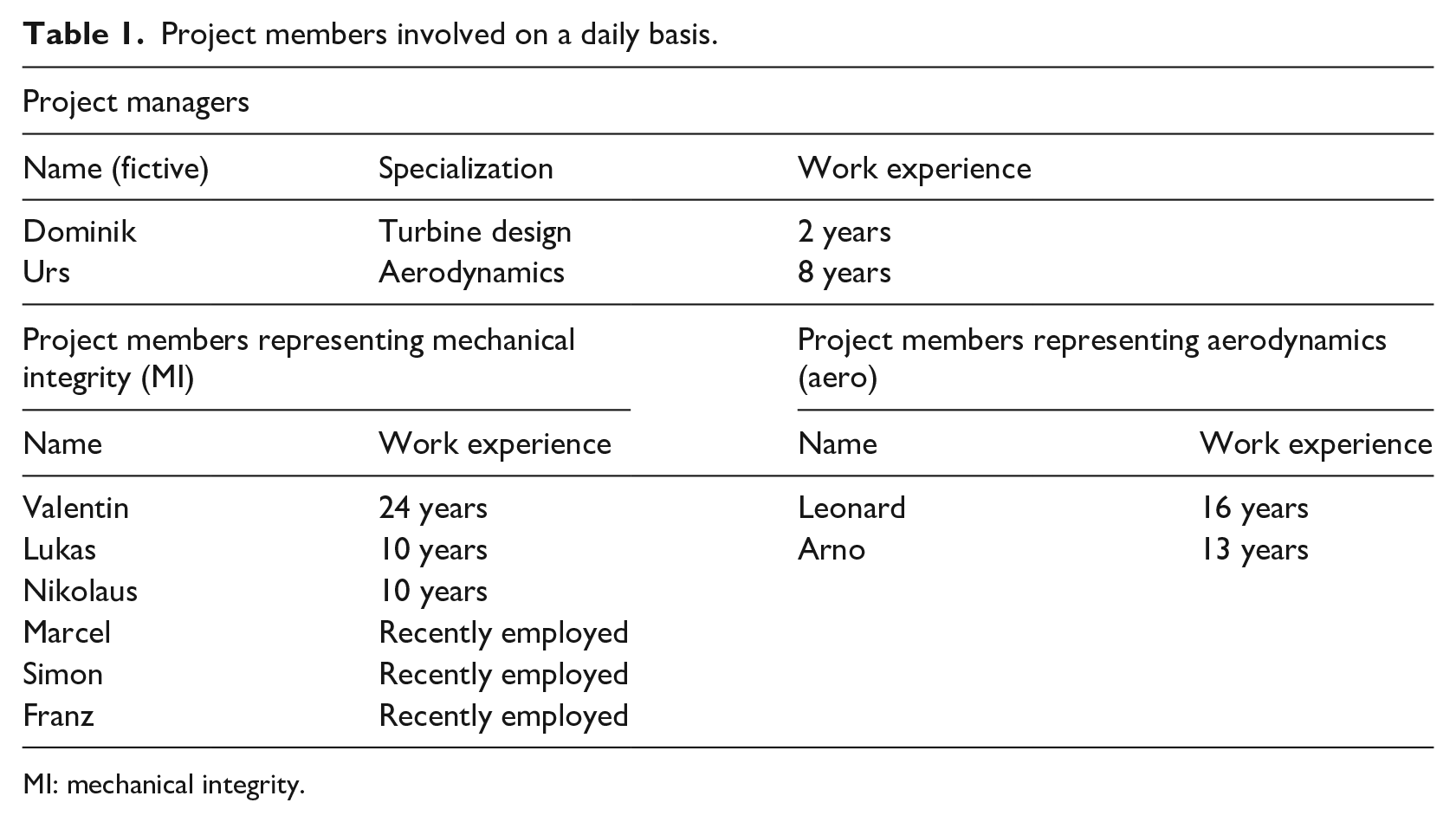
MI: mechanical integrity.
The analysis builds on a data collection for other purposes than the aim of this article, namely, to investigate what mechanisms of knowledge integration are suitable in different project settings. Our choice of the Turbine project is illustrative as the project members needed to integrate their specialized knowledge in order to accomplish the project work (Enberg, 2007), and also because power and positionings were important and constantly present aspects of work in this particular project, although not explored further previously. Hence, we argue that the choice of re-reading and re-analysis of an already existing material constitutes a strength in this case as they can lead to ‘surprising findings and fascinating sidetracks’ (Wästerfors et al., 2014: 473).
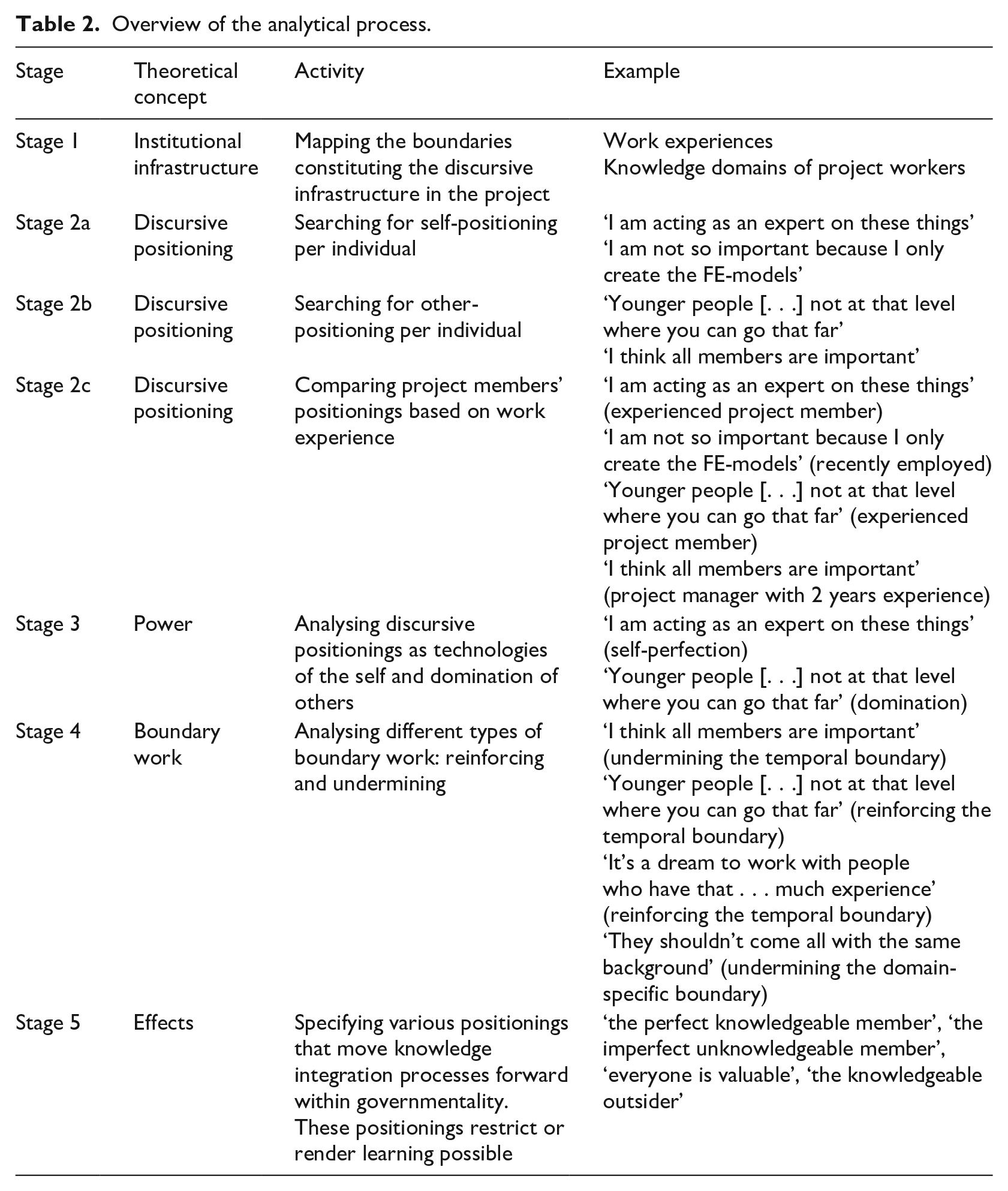
In the first stage of the analysis we identified the discourses, or the institutional infrastructure (Deppermann, 2015), within which the project members’ discursive positionings occurred. In the second stage, which consisted of three different parts, we focused on positionings among the interviewees and looked for utterances where the interviewee positions himself or others. We coded the utterances (Phillips and Hardy, 2002) and found that they differed dependent on work experiences (recently employed/years of employment). As power is decentered and operating through networks, we moved on to analyse consistencies and inconsistencies within the groups of different work experience. The analysis was thus highly iterative (c.f. Phillips and Hardy, 2002). In stage 3, we analysed the utterances in terms of technologies of the self and domination of others. In stage 4, we coupled the analysis to boundary work and in the last stage we analysed the effects (c.f. Foucault, 1977). Thus, the analysis is grounded in the theoretical concepts that inform the study. Table 2 shows the different stages and exemplifies the analysis.
Overview of the analytical process.
Findings: boundary work in power relations
When we enter the project, several boundaries are in place forming the institutional infrastructure (Deppermann, 2015). The first boundary is temporal; the project members have different work experiences at the company, ranging from 24 years to none. Tenure is one example of temporal structures, created and used by people to form ‘everyday work practices’ (Orlikowski and Yates, 2002: 685). Second, there is a domain-specific boundary between the knowledge domains of aerodynamics and mechanical integrity. As we will see, through technologies of the self and domination of others the temporal boundary of work experiences is both reinforced and undermined, while the domain-specific boundary is only undermined.
Reinforcement and undermining of boundaries by experienced members: shaping the perfect project member
The experienced members position the new members based on what they do not know, and this positioning is done in relation to a favourable, agentic self-positioning (‘we make them’), illustrating how technologies of the self involve relations to others: they permit the individuals to position themselves with the help of others into a state of ‘perfection’ and ‘wisdom’ (Foucault, 1988: 18). Let us first illustrate this with Arno’s positioning of the new members: If you have new team members that you have to train, they are not unimportant, and we make them more and more important but at the moment they can’t contribute so much to the project as we. (Arno, 13 years of work experience)
When the interviewer asks about the importance of a common knowledge base, Arno focuses on the temporal boundary, suggesting it is wrong to define the new team members as members, and emphasizing their lack of knowledge: [. . .] the new team members, team members is [sic] wrong, let’s say people who joined us, are really new in this business [. . .] still to get all the knowledge. (Arno, 13 years of work experience)
Also Lukas positions the new members as non-knowledgeable: I have in my group also younger people, [Simon] that you know and [Emiliano] . . . they are not at that level where you can . . . where you can go that far. (Lukas, 10 years of work experience)
He also questions their silence. Their silence illustrates a pedagogical relationship where the master speaks and the disciple is silent, a practice that privileges a culture of silence and the art of listening (Foucault, 1988:32): [. . .] The level of information or so is purely the same, but the knowledge is not the same for everybody. For example, [Alain or Beat], you see also in the project meetings, they don’t say anything . . . Why? It’s a bit pity. (Lukas, 10 years of work experience)
When we compare these other-positionings with the experienced self-positionings we notice the variations. Lukas positions himself as important – more important than the project managers – and a supporter: [Valentin] and others, they rely far more on me than on the project leaders. In fact, in this project, I have a kind of supporting function, not a project leading function [. . .] My target personally is to support, as good as I can, this project and the people that are working in it. (Lukas, 10 years of work experience)
He also takes up the position of mediator: I’m somebody who is . . . to my character . . . I like to solve . . . solve the kind of conflict problems . . . I mean, it’s not like I want to put myself in every conflict, no . . . but if it happens I really prefer to solve them simply when they [are bubbling up] So, if there is a problem with somebody else . . . I’m quite open to try to . . . (Lukas, 10 years of work experience)
Also Leonard positions himself into ‘perfection’; he is the ‘expert’, carrying out ‘advanced’ work, ‘plays an important role’, but at the same time he is also ‘modest’: I am acting as expert on these things, on steam turbine development. So that is my position, being an expert and giving directions for the design philosophy and also doing mainly the blades. [. . .] I do lots of optimisations, this advanced channel that you know we have had, this proposal, it all comes from me. And then at the same time proposing more classical channels so . . . the idea is coming from me [. . .] I am modest, I am not trying to say that I am a very important person . . . but actually, I have defined the design philosophy of the project, I hope to play a very important role in the project [. . .] I’m really pleased to extend my knowledge and apply my knowledge and [. . .] in developing a new product, my knowledge has been . . . you know, I have played an important role. (Leonard, 16 years of work experience)
The temporal boundary between experienced/non-experienced results in different task allocations as some members are suggested to be more suitable for certain tasks than others. Such an activity can be understood by drawing on Foucault’s concept of partitioning (Rees and Garnsey, 2003); a place is created for the newcomers that means specific work assignments at the same time as their competence is ranked and hierarchized.
Leonard also positions the new members as lacking experience. However, he also considers this lack of experience to be a prerequisite for doing hard work. Here we see how tasks are constructed differently for the members with less experience. They do the hard work but are simultaneously considered insignificant for the team’s success: We can’t expect to have any success with those who have less experience. At the same time there need to be some with less experience so that they are prepared to do the hard jobs, doing lots of computations. (Leonard, 16 years of work experience)
This illustrates the ‘broader authority relations’ in action (c.f. Heizmann and Olsson, 2015: 759), meaning that the project members with longer work experience are engaged in the reinforcement of the temporal boundary. It is no coincidence that work experience appears as a temporary boundary here as seniority systems is a typical mechanism through which ranking is materialized in organizations (Townley, 1993: 528).
However, the domain-specific boundary is not reinforced and, as we will see in the next section, the temporal boundary is also challenged which illustrates that power struggles are ongoing and not finite (c.f. Harman, 2011).
Undermining of boundaries by experienced members: care for others
The experienced members Nikolaus, Valentin and Dominik do not engage in the temporal boundary work that involves partitioning and ranking of the new members and they do not position themselves as particularly important. We interpret this undermining of the boundary as a ‘care for others’ (Levy, 2004). For example, they position everybody as important and vital for the project: I would say almost everybody has his role which is fairly important [. . .] everybody knows that you cannot work without the other and everybody knows that you are not only working for yourself but that it’s needed communication and means. (Nikolaus, 10 years of work experience) I think all members are important. These members with a lot of experience are important to give the background and perhaps tell about mistakes we did in the past and so on and then you have young guys who are very keen on computers and fast and they are also important, and I think a team is a mix of all these people. (Valentin, 24 years of work experience) Every team member is needed to achieve the goal. (Dominik, 2 years of work experience)
There is also an undermining of the domain-specific boundary. For example, Arno (from Aero) positions the project members from MI as knowledgeable: At the moment, we have experienced guys from the MI side and if you work with them they really know . . . what they can deliver [not only] ‘this blade is not strong enough’ or ‘frequencies are bad’, but they come along with clear defined suggestions: ‘try to redistribute the mass of the blade like this’ or ‘ we need’ or ‘the variations on the snubber or whatever’ . . . They know what they should do and they are also working on their own and come back with the results and then you go a step forward. (Arno, 13 years of work experience)
The project managers choose a position that is focused on overcoming differences at the same time as they acknowledge them. One quote from one of the project managers, Dominik, illustrates how this boundary undermining is practised: We try to assure that the processes . . . that we have somewhere an overlap of experience from team members, that we try to combine for example very experienced guys with a new team member to have this flow and to maybe establish it within these new people [. . .] you have very experienced people who are very important and . . . but they use to have some approaches and they follow only these approaches [. . .] I think that is part of the responsibility of the project manager and the line manager to find the best combination for this particular problem. (Dominik, 2 years of work experience)
The other project manager, Urs, both reinforces and undermines the domain-specific and the temporary boundary, stating that it is both ‘natural’ and ‘innovative’ with different specializations. He also redefines the inexperienced to ‘very experienced but with different background’: And due to the fact that these aero/MI guys are always, let’s say 99% contrary to each other, mechanics want to have a brick instead of a blade and we want to have . . . a knife instead of a brick, it’s natural that this is always contrary [. . .] I like the mixture . . . which causes a lot of problems . . . people . . . inexperienced, or to be more precise, very experienced but with different background, because that creates new ideas. That’s very innovative. They shouldn’t come all with the same background and they shouldn’t have worked since ten years together. (Urs, 8 years of work experience)
At first glance, this care for others seems at odds with Foucault’s concept of self-technology in general and self-care in particular. However, Foucault emphasizes that ‘care for self renders one competent to occupy a place . . . in interindividual relationships which are proper’ (Fornet-Betancourt et al., 1988: 7), thus indicating that caring for others is the condition for caring for the self (Levy, 2004). Self-technologies thus consist of both discrediting and acknowledging others’ knowledge. In the next section, we explore this further through an analysis of various positionings among new project members.
Reinforcing and undermining of temporal boundaries by newcomers: resisters and docile bodies
The newcomers’ positionings of themselves are characterized by both reinforcing the temporal boundary of work experience as well as undermining it. Some project members detach themselves from project activities and particular tasks. For example, Simon positions himself as passive and ignorant of the project activities, and this position is connected to what he can and cannot do: No, I don’t understand what is the next step or how it is going to end, how it is related to other projects, of the blading team. I don’t see the target, I think the target is . . . to design something but I simply don’t know where and when it’s going to be designed [. . .] . . . I think most people understand what is the target, but they are experienced and I am not experienced so
We interpret this as a situation of domination, rather than a technology of the self, as the latter presupposes the ability to participate actively and purposefully in power relations, not from escaping them (Crane et al., 2008). What comes to mind is Foucault’s (1977) concept of ‘docile bodies’ which he uses to draw attention to the abandonment of people’s freedom (Crane et al., 2008). This situation of domination forms a ‘negative knowledge’ that is, ‘what we are not interested in and do not really want to know’ (Knorr Cetina, 1999: 63). A similar positioning is Franz’s ‘not so important’, which opens up for not attending meetings: I look at myself, I am not so important because I only create the FE-models . . . People which are not that important in the project have to do either research work or line work so everyone is important but . . . on different levels. Because it depends on [the] degree that someone is involved in the project. So, on this point we have weekly aero/MI meetings and sometimes I am at these and sometimes not and . . . mostly I have not been there because, why should I be there? It does not touch me because . . . I am not the person to say that it is wrong or right what they have decided. (Franz, recently employed)
However, although Franz positions himself as ‘not so important’, he simultaneously positions himself as knowledgeable. When it comes to knowing about how to reach the project target, however, it does not really seem to matter what he knows: The target . . . very funny targets because . . . it’s not cheaper but with higher efficiency and no cost increase and the time of the project is being shorter and, so it’s close to impossible so . . . But I know from participating that the efficiency should be increased in this [turbine] [. . .] . . . This is the main goal from my point of view . . . To myself it does not matter. I am here and doing my work and at the end, if the target is impossible, then it is impossible. (Franz, recently employed)
Compared to Simon, we see Franz as exercising freedom by not attending meetings. The latter is an example of power in action, of how free subjects can act differently, by refusing (Torfing, 2013). Another example of this is when Marcel, one of the other new members, acts differently than positionings of newcomers prescribe; he actively takes part in discussions in project meetings and contributes to the discussion and analyses. He also positions himself as part of a group that do not like to be governed in a traditional sense: [The project leader] came with a schedule, that is something that people in development don’t like because we prefer to work freely . . . people were not happy with this proposal and they felt pressure coming from this schedule, ‘no it’s impossible’ and maybe they get a bit, not angry but almost. (Marcel, recently employed)
We see Marcel as an example of the effect of the undermining of the temporal boundary of experienced/non-experienced. Both the reinforcement and the undermining of this boundary include resistance, either through withdrawal or participation and illustrate the questioning of how knowledge circulates and functions (Foucault, 1982). We argue that the care for others by some of the experienced workers facilitated for the participation to take place. As Harman (2011) puts it, learners position themselves differently which illustrates the ongoing character of learning. The example also illustrates how self-learning is a possibility for individuals to choose their own boundaries between discipline and freedom in constructing the self (Kosmala, 2003). The positions available to take up are dependent upon if we have a situation of domination (Simon) rather than power (Franz, Marcel) (c.f. Torfing, 2013: 113).
Based on this observation, and the Foucauldian notion that power is everywhere, we move on to analyse positionings within the group of experienced project members.
Reinforcing the temporal boundary among experienced members: friendships as self-care
Among the project members with longer work experience there were some members who seemed to be closer than others. Thus, there is a boundary between members with and without shared work experiences. Lukas, whom we have seen previously as positioning himself as the true leader, talks about specific experienced project members as ‘very valuable’: When we have people who are very valuable like [Valentin] for example or [Arno], they are guys who are very effective on their job and they don’t like to make bullshit [. . .] With [Nikolaus] and [Valentin], it’s a dream to work with people who have that much background, that much experience and . . . work which is more than efficient. (Lukas, 10 years of work experience)
In effect, a particular place is created for some of the experienced project members, which does not only involve work but also a relationship outside work, in terms of friendship: We build up friendship and relationships . . . How many times have we done something with [Valentin’s] wife and with [Nikolaus’s] wife? Lots of times, that is why we know each other this way . . . we met together over lunch. I remember in the 56 project, [. . .] I organized an excursion down to [name of place] for the weekend for about 15 people and that was great, we had a great time. (Lukas, 10 years of work experience)
Through this positioning, a temporal boundary involves previous work relations, which complicates the notion of ‘new’ and how that position is related to competence. To be new is not only about being new to the company but also new to the project members themselves: I think our project leaders don’t have a very good feeling for the team and the background of these two is too general. They are too new in the project in my opinion. (Valentin, 24 years of work experience)
Neither the project leaders nor Leonard, with 16 years of experience, are placed in the same place as the other experienced project members, but instead partitioned to a place of their own. While this could be interpreted as a struggle between aero and mechanical integrity, we interpret it as more complicated as Leonard is defined as new at the same time as his knowledge is acknowledged: With Leonard it’s a bit different because he is new in this project. I know that he has a very wide aerodynamic knowledge . . . still we haven’t worked that much together. (Lukas, 10 years of work experience)
This is a typical example of Foucault’s idea of power as functioning through a multiplicity of social relations (Cronin, 1996: 57), in particular relations in the past. This partitioning also involves ascribing a different characteristic of behaviour to Leonard than ‘effective’. He is positioned as ‘sensitive’: [Leonard] is quite sensitive to certain things, now I know. Ok, I will take care of this, with [Valentin] . . . We will try to act in a manner so that we don’t come more into these domains. (Lukas, 10 years of work experience)
So, how does Leonard position other experienced project members then? Given how he is marginalized by Lukas, it may come as no surprise that he does not bring up Lukas as a person he works with. The person he brings up is Alain (with 2 years experience), who he refers to several times as ‘doing computations’ for him. Also, another significant person is one of the project managers, Urs, who he positions as a friend: I work in close collaboration with [Urs] who is my boss, but I would say that he is more my friend than my boss. It is an extremely good relationship. [. . .] I have a perfect agreement with [Urs]. (Leonard, 16 years of work experience)
To conclude, a temporal boundary is created among experienced workers resulting in the partitioning of a particular project member. Previous work relations and relations outside work are used to strengthen a boundary at work. A Foucauldian interpretation is that this is a form of self-care; friendship is a prerequisite in taking care of the self and in the transformative practice of the self (Webb, 2003).
The experienced worker that engaged in establishing a boundary between experienced and less experienced becomes an outsider himself. This partitioning leads him to work closely with not only a less experienced member but also to ensure a close relationship with one of the project leaders. This corroborates Heizmann’s (2011) conclusion that a social construct such as ‘old-timer’ is not always linked to greater knowledge resources.
Discussion
The aim of this article was to explore the role of relational power and discursive positionings for boundary work in knowledge integration processes, involving a study of an interdisciplinary project developing a steam turbine. The original study of the project described the knowledge integration process as rather consensus-based, in line with many studies within both knowledge integration and situated learning (c.f. Contu and Willmott, 2003; Mengis et al., 2018; Tell et al., 2017). Experienced members and recently employed members were involved in a master-apprentice relationship, where the recently employed got clearly defined work packages and feedback (Enberg, 2007).
A Foucauldian contribution to knowledge integration
Our Foucauldian re-analysis suggests that the process of knowledge integration should be considered as a continuous power struggle among project members rather than as a search for consensus and agreement. With governmentality as the governing principle, the project members were left to manage themselves through technologies of the self and domination of others. Positioning theory helped us operationalize Foucault’s approach to power and the concept of governmentality on a micro level, thus making visible self-technologies and domination of others in a way that display the relational qualities of project life. The project members’ narratives contribute to make knowledge integration research more vivid than is usually the case in this field.
As project members continuously positioned each other and themselves, they defined their own and others’ knowledge, importance, worth and significance. They were simultaneously the ‘object of improvement’ and the subjects which did the improvement (c.f. Kosmala, 2003). First, those who were positioned as ‘perfect and knowledgeable’ were considered valuable project members and their knowledge was more likely to be integrated in project work. Those who were positioned as ‘imperfect and unknowledgeable’ were less likely to be seriously involved in project work and hence, their knowledge less likely to be integrated. This positioning reinforced the temporal boundary between the experienced and less experienced. However, the experienced members that positioned themselves as ‘perfect and knowledgeable’, also engaged in transforming ‘the imperfect and unknowledgeable’ into ‘perfect and knowledgeable’. The effects for knowledge integration depended on how these less experienced project members responded to these transformational attempts; either by resisting them or by being docile. We interpret the various responses to positioning as an exercise of freedom or as domination (Torfing, 2013) which illustrates the productive character of power (c.f. Heizmann and Olsson, 2015).
Second, there was also an undermining of both temporal and domain-specific boundaries, reflecting a care for others (Levy, 2004), when some of the experienced members created the position of ‘everyone is valuable’, and acknowledged that all members were contributing and that there was a necessity of working across both the temporary and the domain boundary. This facilitated for a less experienced member to eventually be accepted as a knowledgeable member. Thus, the underminings opened up for the availability of different subject positions, which seems to be the key in the knowledge integration process.
Third, some of the experienced members reinforced a temporal boundary among themselves based on previous work relations and friendship outside the workplace. Thus, a position of ‘knowledgeable experienced outsider’ was created. The exclusion of an experienced project member from friendship with other experienced members resulted in him establishing working relations with a less experienced worker. This suggests that a specific form of relationships such as friendship, both in and outside the workplace, might be important for our understanding of the knowledge integration process and should be explored further.
Our analysis enables us to understand knowledge integration not as a process that is externally governed or governed by project managers, but as governmentality that is governing among project members. This, in turn, has considerable impact on whose knowledge and which knowledge becomes integrated as part of project work. Furthermore, to see learning as self-technology, shaped by self-and other-positionings, stresses the role of temporality and the ongoing character of learning and also the limitations to it. Roles such as ‘master’ and ‘apprentice’ are not given but contested, experience is multi-faceted and imbued with personal relations both at, and outside, the workplace. There is a multiplicity of temporalities related to knowledge integration processes in projects.
Conclusions: practical implications for knowledge integration
A Foucauldian perspective has helped us to further develop previous cursory treatments of knowledge ‘at stake’ (Carlile, 2002), knowledge as an ‘open question’ (c.f. Mengis et al., 2018) and ‘political dynamics’ (Kravcenko and Swan, 2017) in the knowledge integration literature. Through our re-analysis of the Turbine project, we contribute to an understanding of knowledge integration as a dynamic and emergent process in which power and learning are ongoing accomplishments (c.f. Harman, 2011) and where boundaries are continuously reinforced and undermined. This allows us to question the assumption in the knowledge integration literature of disciplinary knowledge differentiation as the basic ground for conflicts and a main barrier of knowledge integration.
To learn how to overcome boundaries, the knowledge integration literature should focus more on both how boundaries are created and how they are undermined. As power is decentered, there are different subject positions to take up and project members both reinforce and undermine boundaries. The latter position can be understood as a specific type of boundary spanner; 2 project members who participate in boundary undermining to care for others. This raises some important questions from a practitioner perspective. The first one concerns project members: which positions are available to take up and what consequences do such take-ups have for other members, for project work, learning and knowledge integration? The second concerns project managers: how can they facilitate the availability of different positions and ensure that there are possibilities for care for others so that they can learn and contribute to knowledge integration? Given the Foucauldian focus on the decentered and relational character of power; and that managers do not have power invested in them, a way to facilitate knowledge integration would be to position individuals so there are possibilities for both self-determination and care for others. Thus, working towards creating a satisfying life that goes beyond docility and domination should be an objective for both project members and project managers (c.f. Crane et al., 2008). This is in line with Heizmann and Olsson’s (2015:765) argument that it is important to understand what conditions allow for developing a knowledge culture that includes learning with an ‘interplay of multiple discursive voices’ rather than monologue.
That power is not a resource held by project managers but rather distributed in a network of power relations also have implications for how we understand knowledge integration processes. On the one hand, the control of knowledge integration might be a chimera as what people ‘really’ know is always decided in relation with others, thus making knowledge difficult to fix. On the other hand, governmentality opens up possibilities to position oneself and others in order to fit in and to learn. This might maximize capacities in the workplace (c.f. Usher and Solomon, 1999) and thus facilitate knowledge integration.
We suggest more research that explicitly explores power in the knowledge integration process is needed. For example, the role of power relations in contexts where knowledge integration fails. What might characterize the power relations in such a specific case? Could the absence of freedom, and a situation of domination only, be what characterizes failed knowledge integration?
Footnotes
Acknowledgements
The authors want to thank the two anonymous reviewers for careful reading and constructive feedback which have largely contributed to develop their line of argument and analysis. Furthermore, they want to thank Editor Professor Emma Bell for clear and supportive communication throughout the review process.
Funding
The author(s) disclosed receipt of the following financial support for the research, authorship, and/or publication of this article: The authors received funding from Jan Wallander and Tom Hedelius Foundation and Tore Browaldh foundation.
