




Abstract
The original formulation of communities of practice primarily focused on describing how learning, meaning, and identity within a community can translate into a sustained practice. Wenger-Trayner et al. elaborated the concept of landscapes of practice to describe how different communities of practice may interact, and belong to broader landscapes of practice, rather than rely exclusively on their own local situated practices. In this conceptual article, we apply the perspective of landscapes of practice to organizations. The first part of our argument is descriptive, and is aimed at developing a model of landscapes of practice in organizations. With regard to this model, we propose that practices can be seen as multilevel, including local situated practices, generic practices, and cultural fields. This, in turn, helps to clarify and organize a number of central concepts within the practice literature. The second part of our argument is prescriptive, as we suggest that landscapes of practice call for triple-legitimization of situated learning, meaning that legitimization is not only needed at the level of community and organization, but also by attending to the dynamically changing epistemic texture of the landscapes.
Introduction
It has been more than 25 years since the publication of the first major scholarly article on communities of practice (CoPs) (Brown and Duguid, 1991). In that widely cited paper, a new perspective on organizational learning was introduced, where CoPs play a central role in developing an organization’s ability to work, learn, and innovate. CoPs were understood as groups of people who regularly learn together and from each other, because they care about the same real-life problems (Wenger, 1998). Since the early work on CoPs (e.g. Lave and Wenger, 1991; Orr, 1996), the concept of a CoP has contributed to a field of study in which learning is portrayed as happening in practice and involving an investment of identity in the social context (Carlsen, 2006; Gherardi et al., 1998; Nicolini and Meznar, 1995; Swan et al., 2002).
In Wenger’s (1998) book, in which the CoP concept was formulated, the main emphasis was placed on describing learning interactions in local situated practices. However, while Wenger built the initial ground for describing interactions between different communities, that explanation was limited at that time. On the one hand, Wenger talked about boundary encounters and boundary brokering, and these ideas have been covered extensively by the organization studies literature since then (Barrett et al., 2012; Carlile, 2004). On the other hand, he introduced the concept of Landscapes of Practice (LoPs) to explain how different CoPs may interact, depend on, and be accountable to one another’s practice-based knowing, rather than relying exclusively on their own, local situated practices. LoPs were later elaborated further in an edited book by Wenger-Trayner et al. (2014), which added the role of learning conveners across LoPs, and thereby a link was made to the literature on higher education and work-based learning.
In this conceptual article, we explore the implications of LoPs for organizations, and examine how LoPs differ from other social learning formations such as CoPs or networks of practice (NoPs). By exploring these differences, we develop the existing conceptualization of LoPs in organizational settings, and derive recommendations for managerial practice. Our findings are organized around two interrelated themes which build one upon another. In the first part of our contribution, we take a descriptive view of LoPs and propose a conceptual model of LoPs across organizations. This model shows that organizations are inevitably connected through self-governed learning partnerships of practitioners who typically cannot afford not to learn regularly from various relevant communities across the LoP in order to carry on with their everyday jobs. The LoP perspective thus helps to see various communities within the same landscape as being accountable to one another in terms of their respective practice-based knowing, which is important for them to deal with real-life problems at work and for their professional development. This perspective contributes to the existing practice literature by (1) demonstrating that practices are essentially multilevel, and (2) describing situated CoPs within landscapes as having a core, a local group of most active members, in contrast with more generic practices (such as “teaching,” ‘presenting, or “singing”) which do not have a clear local core group. Furthermore, by synthesizing the situated learning literature with the work of Bourdieu, we (3) develop the argument that CoPs and situated learning bring agency to habitus and to the cultural field, which in turn builds the ground for revisiting situated learning in organizational research.
In the second part of our contribution, taking a prescriptive view, we draw on the model of LoPs in order to gain insights about what managers can do to prepare a suitable organizational environment for situated learning (cf. Saint-Onge and Wallace, 2003), while we acknowledge that CoPs cannot be simply “set up” (Pyrko et al., 2017; Waring and Currie, 2009). Following an approach taken by Furnari (2014), the conceptual argument is illustrated by a vignette set in the National Health Service Scotland. The use of the vignette helps to relate our argument to the reality of organizational life. To wit, we argue that the support of communities within LoPs requires legitimization at three distinct levels: not only at the levels of community and organization, but also by paying attention to the changing epistemic characteristics of the landscapes.
Conceptual foundations
In order to build the conceptual foundations for our argument, we first discuss the notion of membership in CoPs, and we note that learning in CoPs translates into the emergence of epistemic boundaries which may not be easy to cross for non-members. In the spirit of Wenger (1998), epistemic boundaries manifest through knowing, but are grounded in identity investment and a regime of competence negotiated by the local community which give a CoP its idiosyncratic character. In relation to these epistemic boundaries, we then describe LoPs as comprising different communities which are mutually accountable to one another’s expertise. We also provide greater clarity to the conceptualization of LoPs by differentiating them from CoPs, NoPs, and Bourdieu’s notion of field. Finally, we conclude that LoPs inevitably affect organizations, and thus it is important to understand better their possible implications for the wellbeing of an organization.
Communities of Practice and epistemic boundaries
CoPs are typically understood as groups of people who interact regularly because they care about the same real-life problems or hot topics and on this basis negotiate a shared practice (Wenger et al., 2002). Practice, in this sense, refers to: […] both our production of the world and the result of this process. It is always the product of specific historical conditions resulting from previous practice and transformed into present practice […] Practice is a system of activities where knowing is not separate from doing. Further, learning is a social and precipitative activity rather than merely a cognitive activity. (Gherardi, 2000: 251)
Thus in CoPs, practice is a history of learning in a social context, while learning is the driver of practice, and a sense of community forms organically around it (Wenger, 1998). As a part of learning in CoPs, practitioners regularly think together about real-life problems or hot topics. By doing so, they mutually draw on one another’s performances in practice as cues for action (Pyrko et al., 2017). In this way deep, tacit knowledge is shared indirectly and redeveloped, rather than transferred directly, in its original form, from one person to another (Polanyi, 1962). Tacit knowledge is important, as practitioners draw on it to respond to unexpected events (Hadjimichael and Tsoukas, 2019; Orr, 1996), make decisions (Tsoukas and Vladimirou, 2001), or create new knowledge (Dörfler and Ackermann, 2012). Moreover, through thinking together practitioners negotiate three structural elements of CoPs: mutual engagement (activities that they do together in order to “get things done”); joint enterprise (unique sets of problems or hot topics that they care about); and shared repertoire (concepts and artifacts which they adopt or co-produce). These three elements become unique for each CoP (Iverson and McPhee, 2008; Wenger, 1998).
By engaging with other members, individuals gradually enact their membership of the community. The level of membership depends on the degree to which a person interacts meaningfully with other members, and invests their identity (Iverson, 2011; Thompson, 2005). CoP membership is thus multilayered, due to inevitable differences in people’s need, ability, and willingness to invest their time in the negotiation of practice with other members. Core memberships of a CoP are more likely to comprise old-timers, more regular members, while at the CoP’s periphery there are various types of members who either aspire to full membership, or for whom less involved participation is sufficient (see also Beane, 2019). When CoP membership is sustained over time, it manifests in the form of epistemic boundaries (Probst and Borzillo, 2008; Wenger et al., 2002). For example, when an outsider sits through a lunch meeting with a group of computer geeks, it may be very difficult for that person to follow the group’s conversation. Regular engagement in a community’s practice creates histories of learning, and individuals without prior access to those histories are unable to participate fully in the community activities. As a result, epistemic boundaries do not necessarily have negative or constraining connotations, for they are a sign that “serious learning is taking place” (Wenger, 1998: 253–254). Therefore, the role of boundaries is not only to keep the outsiders away, but also to keep the insider in (Wenger, 1998: 113).
Since epistemic boundaries are based on learning, meaning, and identity, they are fuzzier and more malleable than organizational boundaries in which there is a more explicit distinction between the inside and the outside—who belongs to a team and who does not (Wenger, 1998). Epistemic boundaries are constantly negotiated as the CoP membership fluctuates, the rhythm of community’s activities changes, and the set of real-life problems that are of interest to the members change in an emergent manner (Roberts, 2006). The fuzzy and malleable character of epistemic boundaries signifies that CoPs can coincide with functional teams, but they can also transcend the team or even organizational boundaries as people find a way to interact regularly in order to get things done and develop necessary knowledge for carrying on with their roles “[…] in the context of—and sometimes in spite of—bureaucratic rigidities” (Wenger, 1998: 119).
The presence of epistemic boundaries points to the challenges and opportunities involved in working across such boundaries. As discussed by Bechky (2003: 321, 327–328), due to the local and heterogeneous nature of epistemic boundaries, sharing meaning between different communities may be more challenging than learning within the boundaries of one local community. Learning between different communities requires practitioners to be prepared to go through acts of transformation as they seek to understand how knowledge from another community may fit within the context of their own work, enriching and altering what they know. Such transformations can involve power tensions and hence can be highly political (Hong and Fiona, 2009; Mørk et al., 2010). Yet, since the interactions across epistemic boundaries are inevitable and potentially enriching, research and practice have gone beyond focusing on single CoPs (Amin and Roberts, 2008; Thompson, 2011) and much attention has been paid to how different social formations interact across epistemic boundaries (Barrett et al., 2012; Carlile, 2004; Levina and Vaast, 2005).
Communities of Practice, Networks of Practice, and Landscapes of Practice
In our discussion, we focus on LoPs because this concept brings a helpful perspective on mutual dependencies between different local communities across epistemic boundaries. In order to conceptualize LoPs, we first examine them in relation to the related concepts of CoPs and Networks of Practice (NoPs). We also compare LoPs with Bourdieu’s (1993) well-known notion of cultural field. In this way we aim to establish what an LoP is, and what an LoP is not.
As discussed above, CoPs are close-knit communities of mutually engaged practitioners who share interest in the same practice. This concept has paved a way for a rich and pluralistic literature concerned with the practice-based view of organizations (Corradi et al., 2010; Nicolini, 2013). Another popular concept which emerged from this literature is NoPs (Wasko et al., 2004; Wasko and Faraj, 2005). Compared with CoPs, NoPs are looser social formations, but their members are nonetheless oriented toward the same practice (Brown and Duguid, 2001). Members of an NoP are connected through a network of, for example, work-based connections, but they may not necessarily know each other in a direct way; they do however share interest in related problems or hot topics (Vaast and Walsham, 2009).
An LoP, similar to an NoP, is a broader and looser concept than a CoP (Table 1). As in NoPs, not all people who belong to the same LoP are likely to know each other. Nonetheless, in contrast to NoPs, LoPs do not entail a network, rather they are a totality of practitioners, including all CoPs, encompassing a “living and emerging body of knowledge.” Instead of focusing on the plurality of social formations which can sustain a practice, in LoPs the emphasis is “… on the multiplicity of practices involved, the importance of boundaries among them, and with problematizing identification and knowledgeability across these boundaries” (Wenger-Trayner et al., 2014: 27). Wenger (1998) describes LoPs as follows: […] communities of practice differentiate themselves and also interlock with each other, they constitute a complex social landscape of shared practices, boundaries, peripheries, overlaps, connections, and encounters. I want to conclude with two points […]. First, the texture of continuities and discontinuities of this landscape is defined by practice, not by institutional affiliation; second, the landscape so defined is a weaving of both boundaries and peripheries. (p. 118)
Multiple levels of practice.
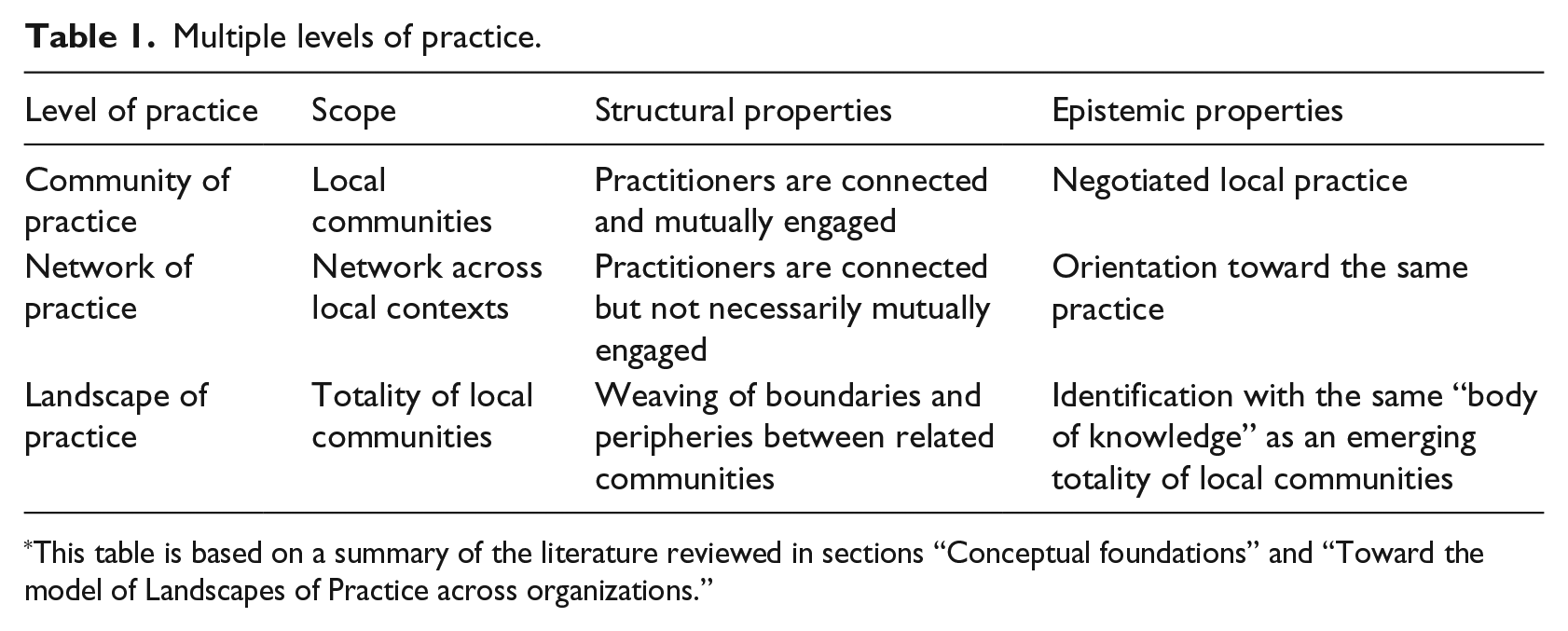
This table is based on a summary of the literature reviewed in sections “Conceptual foundations” and “Toward the model of Landscapes of Practice across organizations.”
Therefore, the LoP concept entails that people develop competence in their own CoPs in order to solve their everyday problems at work and grow as practitioners. Competence is defined by the socially negotiated situated curriculum of what knowing is required to perform work and act as a recognized member in a particular CoP (Gherardi et al., 1998). However, in addition to being competent in a given CoP, practitioners also need to develop, and keep up-to-date, their knowledgeability of the broader LoP that is relevant to them (Wenger-Trayner et al., 2014). For example, a CoP of data scientists who work in the same office may be specialists in working with particular computer languages, but they also may need to have at least a basic understanding of other emerging programming languages and tools within their LoP, as well as trends in business analytics without which they may not be able to carry on with their jobs. Thus, while Gherardi et al. (1998) characterized the negotiated regime of competence as situated curriculum, this applies to CoPs; in the context of LoPs, there can also be considered a wider landscape of situated curricula—that is, the regime of knowledgeability of other local practices which fall within the same landscape.
In addition to this, as discussed in detail by Wenger-Trayner (2013), LoPs can be approximated with Bourdieu’s notion of field. Wenger-Trayner suggests that the two concepts may complement one another. While he acknowledges that a field can be seen as a landscape of different local practices which constitute it, he also points to the differences between the two concepts. Wenger’s understanding of practice is that of competence which is acquired through collective histories of learning. In Bourdieu’s (1992, 1993) work, practice refers to moments in which habitus is engaged with a cultural field (see also Mutch, 2003). Habitus is a set of embodied dispositions, it is a state which remains largely beyond an individual’s consciousness, and it represents the imprint of historical social structures that reside in people. Habitus predisposes individuals to act, think, and behave according to the acquired social norms, and so they reproduce the social structures which originally influenced their habitus. Thus, practices have their own logic, a set of cultural and social rules, and habitus is the acquired “feel for the game” with respect to those logics. In contrast, in landscapes, practitioners actively find their way through a complex geography of local practices, and by doing so they gradually discover which practices matter to them the most as social spaces for developing their competence (Wenger-Trayner et al., 2014). In relation to such wayfinding through landscapes, Wenger-Trayner (2013) concludes that LoP is an alternative way of looking at a cultural field which places a stronger emphasis on agency of learners.
To summarize the points made above, a general implication of LoPs for organizations is that the geography of landscapes spans across organizational boundaries. In the attempts to develop competence and knowledgeability within a landscape, practitioners may be naturally inclined to make connections with other local practices within their landscape. In other words, LoPs may inevitably link organizations through the connections made in practice, whether managers like it or not. This means that it is important for managers and researchers to understand better the significance of LoPs for organizations, and what organizations can do to make good use of the potential which landscapes may offer to them. These questions build the foundations for our following discussion.
Toward the model of Landscapes of Practice across organizations
In this section, we build a conceptual model of LoPs across organizations. By doing so, we address a number of theoretical puzzles which arise when taking an LoP view of organizations. These questions include the multilevel nature of practices, the notion of agency, and the core groups organized around practices. As a result, we develop the understanding of CoPs and LoPs within the practice literature, and we prepare the ground for the second part of our contribution, which is oriented toward managerial implications.
The current practice literature, whether related to organization studies (Carlsen, 2016; Feldman and Orlikowski, 2011) or strategy-as-practice (Jarzabkowski et al., 2007, 2015), emphasizes that practice is assumed as the central unit of analysis in research. Indeed, Nicolini (2013) argues that practice researchers should not steer away from examining practices by placing too much attention on individuals. While he covers situated learning and CoPs, they are sidelined and presented as obsolete. This raises the question of what value situated learning and CoPs offer to the contemporary practice studies. We argue that extending CoPs to the LoP level may lead to insights that contribute to other practice perspectives, which we now examine.
Agencement and formativeness in Landscapes of Practice
One of the immediate outcomes of considering LoPs is the emphasis being placed on individuals’ mutual relationships and the nature of their agency in practice. As discussed by Gherardi (2016), agency in the context of practice can be elaborated with two interrelated concepts: agencement and formativeness. Agencement refers to the extent to which practices establish connections between different actors and elements of practice (e.g. tools, artifacts, and stories) as a system of activities. Formativeness explains that as individuals engage in knowing in practice, they develop and invent new ways of knowing, and so affect the texture of that practice. As noted by Gherardi, agencement and formativeness need to be considered together and one does not have primacy over the other. However, when narrated from the LoP perspective, they both gain a specific meaning, which is worth exploring.
LoPs simultaneously draw on, and extend, the concepts of situated learning and CoPs, because an LoP is a totality of local CoPs (Roberts, 2006). CoP members organize around the local, situated practices, and so practices become properties of communities, not necessarily entailing harmony but also being places of tensions and conflict, such as conflicting values and preferences (Contu and Willmott, 2003; Wenger, 1998). Because meaning and identity are central to both CoPs and LoPs, individuals and communities matter as points of reference, and hence they need to be kept as a part of theorizing. It is individuals who find their way through LoPs, and develop relationships in practice within distinct communities across the landscape. Thus, it is through everyday actions and social relationships of individuals and communities that the LoP gains its ontological properties, serving as a space of epistemic continuities and discontinuities between local practices (Wenger, 1998; Wenger-Trayner et al., 2014). In other words, formativeness in CoPs and LoPs is pronounced conceptually and it is grounded in the investment of identity in the social context.
In addition, as observed previously by different authors, an individual’s experience of CoPs and LoP can be related to the ideas of habitus (Mutch, 2003) and personal knowledge (Pyrko et al., 2017). Both habitus and personal knowledge are acquired through previous socialization in practice (which can be approximated with agencement), but they help to explain different aspects of that socialization. Habitus refers to an individual’s physical embodiment of social capital: it is a culturally and unconsciously acquired “feel for the game.” Habitus is an essential ingredient of practice because practice is enacted when habitus engages with a field, and when practitioners recreate the field. Personal knowledge, in turn, is the potential for tacit knowing, that is, using what one knows in practice. Personal knowledge is developed actively through indwelling, which refers to using one’s mind and body to attend meaningfully to the world around them. However, as elaborated by Tsoukas (2005), the cues for indwelling are found in the interconnected elements of practice (agencement). As people draw on their personal knowledge to think together (Pyrko et al., 2017), they discover some elements of the tacit dimension of one another’s understandings, which can lead to the development of CoPs and LoPs (and which corresponds to formativeness). Thus individuals and the interlinked communities of which they are members, are concurrently actors-in-practice and practice-builders; they are both predisposed and constrained by the structuring features of practices (see also Nicolini, 2013).
The attention to individual and community experiences in CoPs and LoPs means that the texture of practice becomes somewhat different than in practices which are narrated through the work of, for example, Schatzki (1996), Orlikowski (2000), or Giddens (1984). For example, in the strategy-as-practice literature, organizational practices such as agenda setting (Luedicke et al., 2017), or delivering power point presentations (Knight et al., 2018) are examined. While those practices are adopted, developed, and reinterpreted in local settings, they begin to “live the lives of their own” and so they acquire ontologically different characteristics than the local social groups in which they originated (Table 2). For instance, languages spread across space and time, while being localized into various idiosyncratic accents and dialects. Thus, practice grows, but it also remains local.
Practices as growing and localizing from the situated learning perspective.
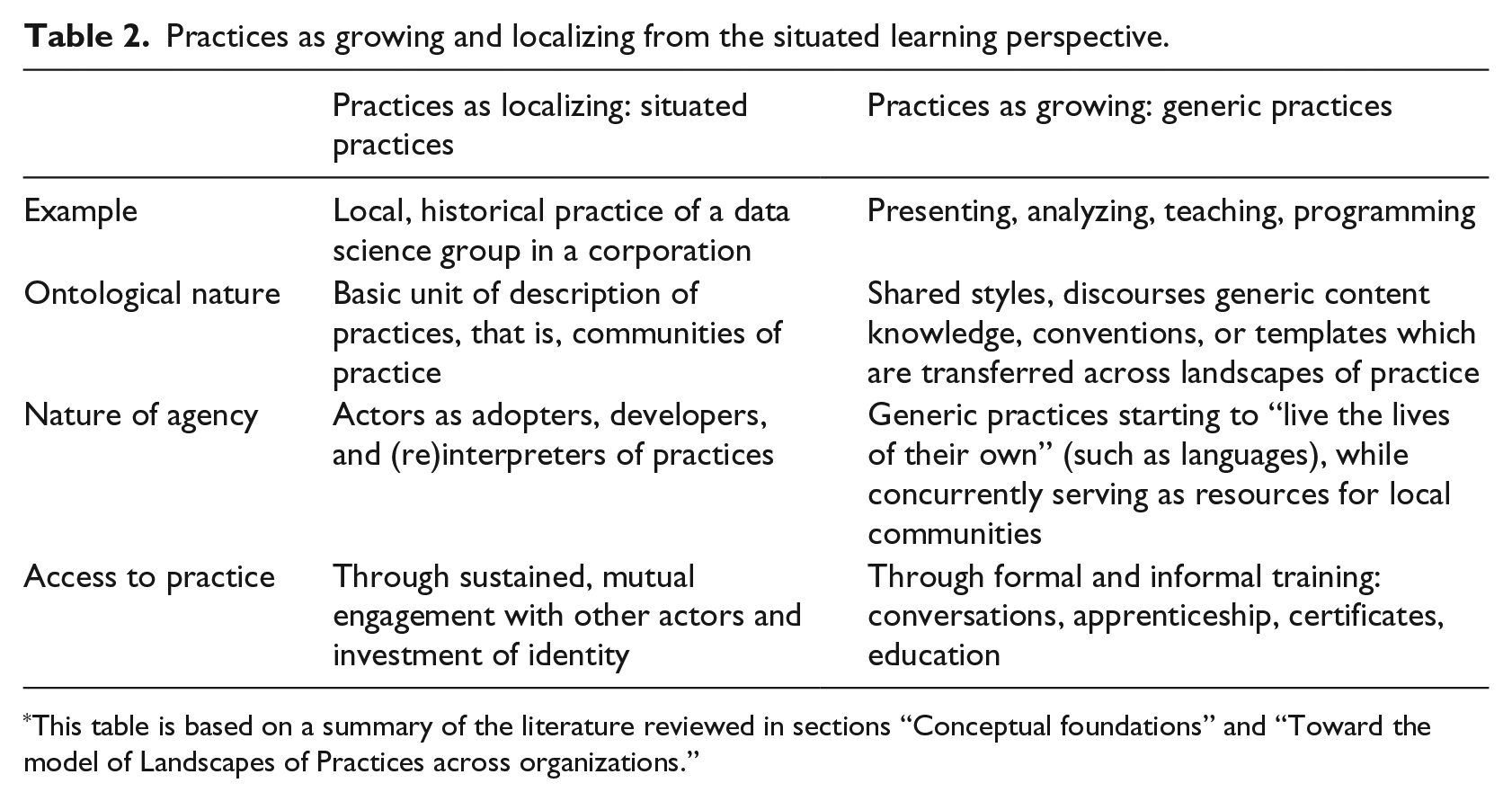
This table is based on a summary of the literature reviewed in sections “Conceptual foundations” and “Toward the model of Landscapes of Practices across organizations.”
In contrast, in CoPs and LoPs local practices hardly ever represent an easily distinguishable, generic set of activities such as “hiring staff” or “designing products.” Local practices embody a situated curriculum, which is a messy collection of tools, frameworks, and activities that are adopted by people to carry on with everyday lives (Gherardi et al., 1998). The meanings of the situated curriculum are accessible by those who renegotiate it and who invest their identities in it. Thus, practices in CoPs have their meanings only in relation to the communities which engage with them, and cannot be defined as single sets of activities—so there is a negotiated practice of a strategy team, and not just “presenting,” ‘analyzing,’ or “prioritizing.” The latter examples, from the situated learning perspective, are rather generic practices which are transferrable across cultural fields and which can all feed into the local practices. These generic practices serve as styles, discourses, generic content knowledge, conventions, and templates, which are carried by individuals and communities across LoPs (Wenger, 1998).
Furthermore, it can be said that CoPs have a dynamically changing core group, whereas generic practices do not have a clear core group. More specifically, a CoP’s core group is characterized by its most active participants. Every local CoP draws on generic practices, and it simultaneously influences those generic practices as they localize them. For example, a theatrical group may begin to use Virtual Reality technology in their performances, borrowing from the existing generic practices in acting, performing, playwriting, and applying Virtual Reality technology in creative arts. Thereby, with time, the theatrical group develops a local practice of its own, which may affect the nature and content of the relevant generic practices which inspired the group in the first place. Therefore, from the LoP perspective, individual agency is important in developing relationships with others and so mutually negotiating practice. Individual agency extends into local practices which constitute the emergent properties of communities and landscapes. In other words, the LoP view helps to appreciate that practices are multileveled, and alternative lenses on practice may be suitable for exploring different aspects of practice as a complex, multidimensional phenomenon.
The model of Landscapes of Practice across organizations
Our conceptual discussion of the nature of LoPs within organizational contexts is now synthesized in a model presented in Figure 1. The purpose of this model is to clarify the role of LoPs for organizations. In this model we portray LoPs as representing the multilevel nature of practices. The focal point of the model are practitioners who belong to different local CoPs. In line with the work of Polanyi (1962, 1969), individuals have their own and inseparable, personal knowledge. The nature of this personal knowledge is that it is rooted deeply in the tacit dimension, which are things that they cannot easily say, and therefore cannot be learned by someone else simply through articulation (Polanyi, 1966). Thus, tacit knowledge cannot be transferred directly but it can be redeveloped by participating in practice with others through a process that Pyrko et al. (2017) label as thinking together. Through thinking together, practitioners guide one another through their understanding of a problem in question and so create opportunities to dwell in those problems meaningfully. However, thinking together can be demanding in time, investment of identity, and commitment, and therefore it is characteristic, while non-exclusive, to the core of local CoPs. In addition, CoP members can also engage with more casual and less intensive knowledge exchanges, which do not necessarily entail thinking together, and which Kuhn and Jackson (2008) refer to as knowledge deployment. Knowledge deployment can take the form of exchanging facts or stories at the various layers of CoP periphery, thus marking the epistemic boundaries of a community.
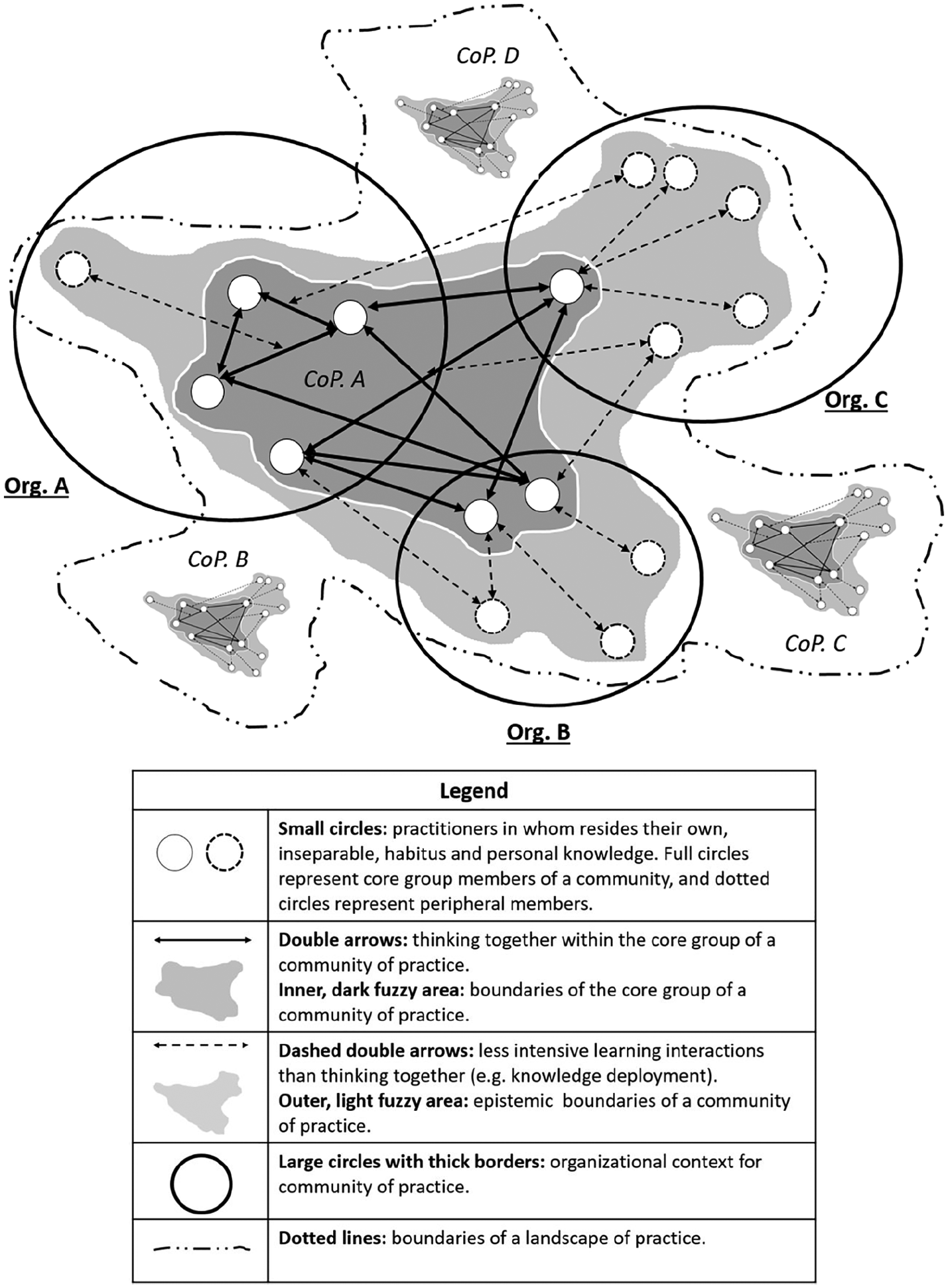
Model of landscapes of practice across organizations.
Moreover, an important aspect of thinking together and knowledge deployment is that it is the way in which individuals engage with the landscape. This view sympathizes with Bourdieu’s (1977) portrayal of habitus and its engagement with the field, albeit in LoPs individual agency it is more pronounced than in Bourdieu’s work. If thinking together leads to CoP development (Pyrko et al., 2017), it also leads to the gradual enactment of local practices. Since the idea of thinking together is grounded in Polanyi’s conceptualization of personal knowledge, individual agency in the social context becomes of essence in CoP formation. However, these local communities do not exist in isolation, but they affect one another across the broader landscape. Local communities learn from generic practices, which they mutually enact within the landscape. And so viewed from the LoP perspective, learning in practice is a two-way street between individual agency of practitioners which extends to the community formation on the one hand, and the structuring influences of the landscape on the other hand.
Another implication of LoPs is that they inevitably span across multiple organizations. Different communities belong to the same landscape because their local practices are related, overlapping, and/or complementary. Unlike NoPs, however, there may be no network structures linking those local communities. Instead, what binds local communities to the same landscape is a shared sense of accountability to what matters to their everyday work, as well as the adoption of similar styles and discourses (Wenger, 1998; Wenger-Trayner et al., 2014). Such learning between organizations is organic in nature and it does not rely on formal alliances, projects, or initiatives aimed at bringing organizations together. Hence, within the context of LoPs, organizations become interconnected through situated learning whether managers like it or not. While the mere awareness of the existence of LoPs can offer insights for reflecting about the nature of organizational learning, managers should also consider how they can respond practically to the idea of landscapes in order to build on them or to mitigate their challenges. In this sense, LoPs can offer the foundations for developing organizational learning, which is illustrated in the vignette discussed below.
Illustration: vignette in the National Health Service Scotland
In this section, we briefly introduce a vignette which is based on a study set in the National Health Service Scotland. Following an approach taken by Furnari (2014), we use the vignette as a way of illustrating the conceptual argument developed in our discussion above. The vignette is based on an exploratory qualitative study which was aimed at understanding how practitioners in the Scottish healthcare make use of the CoP concept in their work. We gained research access with the help of the managers at the National Education for Scotland whom we contacted directly. The study comprised 29 interviews, observations, and the analysis of documents. Participants included nurses, professional education facilitators, and physiotherapists, who recognized themselves as CoP members or who expressed interest in learning in the social context. The data were analyzed using a qualitative causal mapping technique (Bryson et al., 2004), which is well suited for exploring and making sense of rich and messy qualitative material. The interview transcripts were mapped by attending to action-oriented statements which were connected by causal links signifying beliefs of the interviewee about how their social world of practices works (see: Eden, 1988, 1992, 2004). The key themes from that investigation were analyzed further in NVivo and they informed the construction of the following vignette.
The vignette: learning across teams and hospitals about sepsis
Sarah is an early-career Infection Control Nurse with professional interest in treating sepsis. Within the past year, she has been given an opportunity by her line manager to organize monthly sepsis meetings in her hospital, which members of distinct teams are invited to as they all are keen on learning more about helping and diagnosing patients with sepsis. In the meetings patient cases are discussed, and everyone has an opportunity to learn from one another’s work. In addition, the local community organized by Sarah is a part of a larger network called the Scottish Patient Safety Program (SPSP) which is a high-profile Scotland-wide initiative aimed at improving safety and reliability of healthcare. As part of the network, Sarah and her colleagues are invited to share their local learning and engage nationally with practitioners from other hospitals. They also learn more about other communities’ practices, and in this way they can implement new ideas in their own hospital.
Sarah is enthusiastic about participating in the SPSP. The core of this sepsis network comprises representatives from different hospitals and specialist units who regularly learn from each other about their sepsis-related practices, and who were thus called “the collaboratives.” The life of the network includes monthly WebEx videoconferences with around 150 participants, contributions to the network’s Website and document repository, and two large annual conferences dedicated to sepsis and patient safety.
In addition to Sarah’s local sepsis community, there are also other local communities which belonged to the SPSP. One such local sepsis community was organized around the Outreach Team. The Outreach Team comprises five senior nurses, whose purpose is to improve the treatment and diagnosis of sepsis through education of staff in-practice. When the leader of the Outreach Team and a Clinical Nurse Specialist first had an idea to build this team, he sought advice from colleagues in another hospital. Based on those initial conversations he realized that the improvement of learning about sepsis required active collaboration across the professional field of different types of practitioners with interest in treating sepsis. With time, the Outreach Team developed a “sepsis community” which involved different types of professionals within the hospital and beyond. As part of this practice they were producing objects such as small cards with key definitions, descriptions of symptoms, and required actions, which were distributed among practitioners and supported interdisciplinary communication. The Outreach Team also mentored practitioners in the wards with regard to good ways of diagnosing and treating sepsis. Thus, the tacit knowledge of treating sepsis spread from the intensive care unit, where septic patients were traditionally treated, to the wards, which allowed for earlier discovery and better response to the occurrences of sepsis in the hospital.
Discussion
The examples of sepsis practitioners help to illustrate the multilevel nature of practice, and the significance of LoPs for organizations. The local sepsis community facilitated by Sarah can be seen as a CoP, the purpose of which is learning about good ways of diagnosing and treating sepsis. The members of this CoP come from different departments and professions, and so as individual agents possess distinct personal knowledge as well as habitus using which they guide one another in practice. They also belong to a looser NoP, at the national level, which shares the same interest in sepsis, and which provides a platform for developing knowledgeability of the broader landscape of sepsis. The NoP cannot realistically include the whole landscape, which encompasses all the practitioners as well as the totality of CoPs of relevance to sepsis, but it gives opportunities for building bridges across the landscape and so connecting “hills of competence.” In addition, by engaging with the LoP, for example, using the regular national Webex meetings, members of the SPSP can gain new insights for their practice borrowed from other local communities, and this can give them a chance to renegotiate the meaning of what it means to be competent, within their own CoP, in diagnosing and treating sepsis. Thus, it can be argued that members of the SPSP developed local communities, shared styles, and discourses (elements of generic practices) between different communities, and in this way engaged regularly across the landscape. While the practitioners from the vignette did not employ intentionally the concepts of CoPs, NoPs, and LoPs, these concepts tighten the language when discussing the multiplicity of practices and the relationships between them, and help to clarify the roles of the various formations.
Reflecting on the vignette
The implication of our conceptualization for organizations is that it is helpful to view local CoPs as belonging to broader LoPs. Because LoPs span across different organizations, they connect organizations informally. It may therefore be helpful for organizations to think intentionally about LoPs and the ways of strengthening the ties of local communities with their relevant landscapes. In the Outreach Team’s example, there was a clear source of legitimization at the community level as the leader of the CoP helped to form a core group of practitioners who facilitated the learning in the community. As the leader of the Outreach Team and the core group engaged other practitioners in the hospital in their sepsis practice, they helped their community to grow.
While the legitimization at the community level is necessary for any CoPs as acknowledged in the literature (Saint-Onge and Wallace, 2003; Wenger et al., 2002), some CoPs may also need to be legitimized at the level of the organization. The Outreach Team received support from the Medical Director who recognized treating and diagnosing sepsis as a matter of priority. Due to the Medical Director’s support, the Outreach Team’s sphere of influence in the hospital increased and so it was easier for them to implement their practice in the hospital.
The Outreach Team was also, from its very beginning, strongly oriented at the sepsis landscape, with the aim of involving practitioners from other professions who could contribute to the local practice of treating and diagnosing sepsis. As a result of these actions, it was possible to cultivate a lively sepsis community in the hospital. The Outreach Team and their sepsis community benefited from the support at the level of the LoP through active involvement with the SPSP. The network provided an additional source of legitimization to the Team, as well as access to knowledge from other healthcare organizations. As the Outreach Team’s leader noted, the SPSP helped to acknowledge in the hospital that developing the Outreach Team was a matter of priority. Thus, it can be concluded that it is the legitimization at three levels that contributed to the success of the Outreach Team in the context of “getting on board with sepsis.”
Implications of Landscapes of Practice
In the previous sections we concentrated on the descriptive part of our discussion, which was followed by the illustrative vignette. In this section, we examine the managerial implications of LoPs. We acknowledge that various authors have expressed their concerns about operationalizing situated learning and CoPs (Gherardi et al., 1998; Thompson, 2005), which are the building blocks of LoPs. These criticisms emphasize that instrumental CoP perspectives often lead to losing sight of its original emphasis on identity and the social context (Lave, 2008; Waring and Currie, 2009), as well as allow for a philosophical drift of the CoP concept toward realist ontology (Thompson, 2011). We agree with these concerns, as we regard knowledge, and people’s relationships around learning, essentially as a process rather than an entity. Nonetheless, while we accept that situated learning and CoPs cannot be “set up” instrumentally, we explore how managers can account for LoPs in their efforts to develop organizational learning by facilitating suitable work environments. In particular, we discuss whether LoPs can be treated as a possible resource for empowering the agency of CoP members through legitimization.
Addressing power within and beyond Communities of Practice
The topic of operationalizing CoPs has been covered extensively in the literature. For example, it has been suggested that in order to enhance the role of CoPs in developing organizational learning, it is essential to continuously renegotiate the adaptation of local work practices with the managerial expectations and the allocation of resources, and vice versa, so that they can be aligned together with respect to organizational objectives (Valentine, 2017). However, authors have highlighted that in busy organizational settings there may be no time or space for nurturing CoPs (Roberts, 2006), that managers use the CoP concept merely as a rhetoric device (Swan et al., 2002), and that scattered “islands of practice” are more frequent than sustained communities (Macpherson and Clark, 2009). Finally, it has been emphasized that practitioners tend to invest their identity around different local practices rather than spend a significant amount of time with a single community (Handley et al., 2006). Thus, despite the initial promise of the practical applications of CoPs (Borzillo et al., 2012; Liedtka, 1999), organizations struggle to make use of this concept (Harvey et al., 2013), and the so-called “CoP initiatives” have too often ended as abandoned online discussion boards (McDermott, 1999; Pyrko et al., 2017). Therefore, some researchers (Amin and Roberts, 2008; Handley et al., 2006; Swan et al., 2016) suggest to go beyond CoPs in order to draw on social learning to develop organizational learning.
Another problem with putting CoPs to work is to do with power. Some authors observed that communities can resist managerial interventions (Waring and Currie, 2009) or that such interventions can damage the sense of community (Thompson, 2005). Other authors note that while the notion of power is regarded as being central to organizational learning (Antonacopoulou and Chiva, 2007), power has been largely ignored in the original conceptualization of CoPs (Lave and Wenger, 1991; Wenger, 1998). Further research has pointed to the conflicting identities and social tensions which can arise between different professional groups (Hong and Fiona, 2009) which result in different communities possibly distrusting each other’s competences (Heizmann, 2011). Similar tensions will characterize the power dynamics within LoPs, and they depend on the economies of meaning, that is, how powerful and valued a particular community is in relation to other communities (Contu, 2014). In addition, researchers have noted that too high a power of core members, or “old-timers,” within a CoP can prevent community members from learning effectively (Levina and Orlikowski, 2009), albeit the power structure within a community can change along with the evolving texture of the broader landscape (Mørk et al., 2010). Consequently, it becomes evident that the notion of power cannot be ignored in relation to situated learning, to CoPs (Contu and Willmott, 2000), and therefore also to LoPs. In the following subsection we explore how the problems of power can be addressed, in order for CoP to gain legitimacy and strive.
The triple-legitimization of Communities of Practice
Since CoPs, unlike teams, do not play a formal role in organizations, and they are also not free of power struggles, it appears important to warrant CoPs within an organization if they are to function well (Wenger et al., 2002). We therefore argue that CoPs need to be legitimized. The idea of legitimacy in management studies is widely drawn upon in the institutional theory (Suddaby and Greenwood, 2005; Woodward et al., 1996), but it is less frequently referred to groups and individuals in the context of organizational learning, with rare exceptions (Coopey and Burgoyne, 2000). However, in relation to the multilevel model of LoPs across organizations described above, legitimizing CoPs at multiple levels is important. Henceforth, building on the extant literature, we introduce the idea of triple-legitimization at the level of community, organization, and landscape. Such legitimization does not refer only to groups which specifically identify themselves as CoPs, but it can as much apply to functional teams with some CoP characteristics (Wenger, 1998) and the epistemic boundaries between their members.
At the community level, practitioners require autonomy so that they can develop their learning partnerships. In Sarah’s case, the local community was legitimized by her line manager, who believed that the initiative was a good idea. Also, facilitators may help practitioners to connect with each other so that they can develop new, meaningful conversations (Wenger et al., 2002). At the organizational level CoPs need time, exposure to the rest of the organization, and acknowledgment of their role (McDermott and Archibald, 2010; Probst and Borzillo, 2008). In the Outreach Team example, this role was performed by the Medical Director who acknowledges the importance of learning about sepsis within the hospital. Thus, the role of managers is increasingly regarded as not being about control, but about cultivating working environments where people are engaged, and where they trust and care for each other (Drucker and Maciariello, 2008; Mintzberg, 2009; Senge, 2006). CoPs are promoted as being of value to the organization so that employees’ discretionary space increases (cf. Handy, 1995) and so that they can take the responsibility for their learning and for their practice in their own hands.
In addition, CoPs need to be legitimized at the level of an LoP. On the basis of Figure 1, the legitimization of CoPs should extend beyond the frontiers of a single organization. Therefore, CoPs require exposure to the landscape so that their members develop their competence and knowledgeability in relation to other relevant communities. Also, engagement across the landscape allows for opportunities to access experts’ knowledge (Brown and Duguid, 2002), and to grow the local community’s structural elements (Wenger et al., 2002). This can entail raising employees’ and managers’ awareness of the composition of their landscapes, trying to align the everyday work of different communities (Pattinson et al., 2016), and being proactive by joining interorganizational initiatives such as professional groups, open innovation projects, trainings, conferences, or national programs. A good example of legitimization at the landscape level was the SPSP from our vignette, which helped to appreciate the treatment of sepsis as a priority across different local contexts within the Scottish healthcare. Thus, while organizations are inevitably affected by LoPs, it can be valuable to consider LoPs as a source of insight that can inform managerial practice, and as a resource that helps with legitimization.
Conclusion
Examining the implications of LoPs for organizations provides important insights for both the academic and the practitioner audience. What is relevant for both audiences is the clarification of the multiple levels of practices as seen from the perspective of situated learning. This, in turn, recalls the important role of CoPs within the pluralistic practice literature, as it places emphasis on agency, negotiated competences, and changing relationships in local settings. As a result, the CoP concept should not be regarded as being outdated in the context of today’s literature, to the contrary, it still needs to be developed further and built upon.
In addition, our argument helps to appreciate that recognizing LoPs is not merely a reiteration of interdisciplinary learning or learning networks—although we acknowledge that these are overlapping and relevant topics. Although LoPs might be associated with trade associations, conferences, and government initiatives, they are not the same. Trade associations, conferences, and various initiatives have official structures, with formal roles, labels, or committees. LoPs consist of geographies of competences and are underpinned by the relations and dependencies between local practices which are essentially driven by informal learning processes (“practice is a history of learning”). Consequently, LoPs change dynamically, depending on new problems and hot topics arising, and therefore the processes and structures are emergent. Thus, official initiatives can be good vehicles for developing structures which account for the changes in the landscapes, and so improve organizational learning.
Although the concept of LoPs was introduced 20 years ago (Wenger, 1998), with few exceptions (Büscher et al., 2001) it has not been picked up in management and organization scholarship. With this article, we hope to open a new avenue for conducting meaningful research on CoPs making use of the LoP concept. For instance, future research might draw on the organizational implications of LoPs to revisit the levels at which organizational learning takes place (see, for example, Crossan et al., 1999). Also, researchers may continue to combine situated learning with the works of Bourdieu and Polanyi, and, in the spirit of Nicolini (2013: 9), appreciate that “much is gained if we learn to use these [different] approaches [to practice] in combination.” In addition, LoPs could be researched in relation to the notion of open strategizing which is currently a popular direction in the strategy-as-practice literature (Hautz et al., 2017; Whittington, 2019), as well as with respect to virtual learning networks which offer new opportunities, as well as challenges, for engagement across the landscapes. After all, LoPs are always changing, and so in order to cope with the realities of complex, messy, and increasingly interlinked entities, people need to be prepared to engage across their LoPs with practitioners belonging to other organizations. It would perhaps not be an overstatement to say that successful organizational learning cannot work well unless it is underpinned by effective connections across LoPs. Nonetheless, we do have confidence in asserting that those organizations which excel at making the most of their employees’ knowledge will be those bold enough to encourage their staff to engage with the external world, challenge it, strive to understand it better, take risks, accept the teachings of others, and effectively grow as competent professionals across landscapes of likeminded professionals.
