



Abstract
Rooted in systemic gender inequalities, sexual violence in Switzerland persists amid inadequate institutional responses and a pervasive culture of rape myth acceptance. Until 2022, Swiss law defined rape narrowly as coercion-based and recognised only women as victims, thereby excluding many experiences and reinforcing outdated assumptions. Against the backdrop of public debate and legal reform (2019–2024), this article analyses the collaborative, survivor-led artivism project We’ve Had Enough! Survivors of Sexual Violence Dispel Myths, Break Taboos and Reject Stigma, commissioned by Amnesty International and co-created with a group of ten women – seven rape survivors and three creative collaborators (a photographer, a graphic artist, and a journalist/author). Launched on International Women’s Day 2022, the exhibition challenged dominant narratives by foregrounding testimonies highlighting scenarios often dismissed in legal and social discourse, including assaults by known perpetrators, absent visible resistance, alcohol-related contexts and fragmented memories. Drawing on the framework of reparative aesthetics, the analysis examines how visual and narrative strategies enabled participants to reclaim their stories, foster public empathy and transform shame into collective responsibility. The exhibition’s collaborative process blurred the boundaries between art-based research, activism and survivor advocacy, situating sexual violence within a shared socio-political context rather than as isolated incidents. This approach invited audiences not only to witness but also to engage critically, connecting personal trauma to structural inequalities and institutional complicity. While the revised legislation stopped short of adopting a full consent-based standard, it now recognises ‘a state of shock’ as a form of non-consent – a partial shift towards survivor-centred justice. Without claiming to resolve legal shortcomings, We’ve Had Enough! demonstrates how collaborative, art-based initiatives can challenge stigma, influence public debate and complement broader efforts to promote institutional responsiveness. This case study thus contributes to scholarship on sexual violence, rape myths, reparative aesthetics, collaborative practice, artivism and art-based research, highlighting the potential of creative practice to foster recognition, healing and social change.
Keywords
Introduction
In May 2019, as the Swiss Parliament was considering amendments to two articles of the country’s Criminal Code – Article 189,
1
which defines sexual abuse and indecent assault, and Article 190,
2
which defines rape – Amnesty International launched a petition to make legislators better aware of how a restrictive definition of rape can impact victims. Previously, Article 190 had defined rape as follows: Any person who forces a person of the female sex by threats or violence, psychological pressure or by being made incapable of resistance to submit to sexual intercourse shall be liable to a custodial sentence of between one and ten years.
Beyond the fact that only women could be recognised as victims of rape, this definition emphasised the use of coercive force by the perpetrator and resistance on the part the victim. In other words, victims were required to prove they had explicitly and forcefully expressed their refusal to engage in sexual intercourse. The proposed amendments therefore sought not only a change to how rape was defined, but also the adoption of an ‘only yes means yes’ approach based on the principle of free and affirmative consent. 3
The former definition was based on a stereotypical view of sexual offences – in other words, on rape myths (Schweninger and Schwenlinger, 1974) – that has long influenced how evidence is interpreted and victims are viewed (Haskell and Randall, 2019; Parcher, 2017; Pattavina et al., 2021; Ussery, 2022). Researchers who have studied French and Swiss court decisions in sexual assault cases have noted the discrepancy between such myths and reality. For instance, victims often know their aggressors and have a relationship of trust with them. Furthermore, the crime does not necessarily involve the use of physical force or result in visible injury. This can make such cases very challenging for the criminal justice system (Le Magueresse, 2012; Lieber et al., 2019). Other scholars have noted the criminal justice system’s inability to effectively deal with cases of sexual violence where alcohol consumption is a factor (Hohl and Stanko, 2015).
As part of a larger campaign to encourage the Swiss Parliament to adopt the proposed amendments, Amnesty International commissioned an exhibition titled ‘We’ve Had Enough! Survivors of Sexual Violence Dispel Myths, Break Taboos and Reject Stigma’. The launch of the project on 8 March 2022 coincided with International Women’s Day and was marked with a public event designed to draw attention to these issues. The exhibition itself, which consisted of 15 photo panels and 7 accounts of rape, was the result of a collective effort involving artists (a photographer, a graphic artist and a journalist/author) and 7 activists who had been victims of sexual violence. By highlighting the diverse range of circumstances under which rape occurs, the exhibition sought to challenge assumptions and myths surrounding sexual violence in Switzerland. But it also set out to address the multiple, lasting and traumatising effects of such violence on its victims.
Reparative aesthetics (Best, 2016) refers to artistic strategies that confront difficult and shame-laden histories, integrating complex affects to acknowledge, reframe and potentially transform the emotions they provoke. I adapt this concept – originally applied to subjects such as racism and traumatic colonial memories – to the exhibition ‘We’ve Had Enough’, which addresses the persistent, socially produced shame felt by victims of sexual violence in Switzerland. This shame, collectively confronted by survivors and activists, stems not from the self but from a legal and cultural framework that inadequately protects victims, questions their credibility and limits the definition of sexual violence – barriers the exhibition seeks to challenge. My analysis further expands Best’s framework by focusing on the collaborative design and production of the exhibition, rather than on an individual artist’s creation, and by framing sexual violence not as an isolated incident – as it is often treated in medical and legal systems – but as systemic harm targeting women and reflecting the dysfunction of toxic heterosexual relationships.
Reparative approach does not simply generate alternative narratives of violence; it enables collective engagement with harm and its transformation through artistic creation and art activism (Di Lellio et al., 2019; Kahn, 2019). I analyse the collaborative project ‘We’ve Had Enough!’ as a form of research-creation, examining both the impact of survivors’ testimonies on visitors and the ways in which participants – victims and audiences alike – responded to the exhibition. More broadly, I situate this work within debates on the reparative potential of art and aesthetics in addressing injustice (Davis, 2017; Huard and Mooser, 2022), arguing that the process and conditions of its creation offer valuable lessons for future research-creation initiatives involving survivors of sexual assault.
Addressing sexual violence in Switzerland: Discursive frameworks and public perceptions
According to data from the Swiss Federal Statistical Office (FSO), 4 sexual violence is mainly perpetrated by men on women. Furthermore, the assailant is most often the victim’s former or current intimate partner (FSO, 2024), or at least someone close to the victim (a friend, a colleague, etc.) (Ricard-Gauthier et al. 2021). A study based on a cohort of women who had reported a sexual assault at a crisis centre between 2018 and 2021 found that 58% of victims said they knew their attacker, 28% said they did not know their attacker and 14% were unsure due to memory loss or the effects of alcohol (Cottler-Casanova et al., 2024). Cases involving victims who know their assailants often do not involve the use of physical force: emotional or economic dependence as well as psychological manipulation often come into play.
To support its campaign for amending the Swiss Criminal Code, Amnesty International Switzerland commissioned a prevalence study on sexual violence in the country. In April 2019, a Bern-based research firm conducted a representative survey of 4495 women aged 16 and older living in Switzerland (Jans et al., 2019). The results showed that 22% of the women surveyed had experienced at least one non-consensual sexual act during their lifetime, and that 12% had been forced into sexual intercourse. Nearly half (49%) of those who had experienced sexual violence refrained from speaking to anyone about the incident and only 8% filed a criminal complaint. When asked why they chose not to go to the police, the women concerned gave the following reasons: shame (64%), a sense that they had no hope of obtaining justice (62%) and the fear of not being believed (58%). 5
According to the literature, women’s reluctance to report incidents of sexual violence and their fear of not being believed are rooted in widespread and stereotypical views of rape (McQueen et al., 2021). In other words, a prevailing ‘rape culture’ (Baron and Straus, 1989; Bedera and Nordmeyer, 2015; Brownmiller, 1975; Deer, 2015; Herman, 2015; Lonsway and Fitzgerald, 1994; Romito, 2006; Sanday, 1990) tends to trivialise or even excuse sexual violence while shifting responsibility onto its victims. In the context of a rape culture, wearing particular clothes, drinking too much alcohol, walking home alone late at night and similar behaviours are regularly pointed to as reasons why women are assaulted (Aronowitz et al., 2012; Gavey, 2005). Beyond such victim-blaming references to behaviour, clothing and personal history (Boyle, 2005; Madriz, 1997), media reports also tend to frame incidents euphemistically as a ‘family tragedy’ or the outcome of a ‘passionate relationship’ (Gallagher, 2001; Kelly, 1988), thereby rendering invisible the systemic nature of sexual violence and underlying power relations (Jordan, 2022). Furthermore, pervasive perceptions of crime in general frame society’s reactions to situations of sexual violence. Nils Christie (1986) shows that popular understandings of crime construct the ‘ideal offender’ as a poor, mentally unstable man from an ethnic minority – often assumed to be an immigrant – and the ‘ideal victim’ as a white, middle-class woman engaged in respectable pursuits, such as university studies. Cases involving other profiles of aggressors and victims are more likely to be met with suspicion. Drawing on focus groups conducted in New York City (US) with 140 participants from diverse genders, social classes and ethnic backgrounds, Madriz (1997) demonstrates that these stereotypes continue to shape whether people identify more with offenders or victims.
A UK study by Carline et al. (2017) explored the reactions of 41 male university students (aged 18–24) to a prevention campaign on sex, alcohol, consent and rape. The authors found that by portraying rapists as wholly other – monstrous predators (Ducat et al., 2009; Quadara, 2014) – men could dissociate themselves from sexual crimes. This stereotype is reinforced by media coverage (O’Hara, 2012) and sex offender registries (Ducat et al., 2009; Lieber, 2024), despite statistics that show that sexual violence most often occurs in domestic settings and is perpetrated by someone known to the victim (Cottler-Casanova et al., 2024; FSO, 2025; Hamel et al., 2016; Ricard-Gauthier et al., 2021; Scully, 1994; Stanko, 1993). Reeves Sanday (1990) offers another important finding, showing how fraternity culture not only normalises and facilitates sexual violence but also shields perpetrators from accountability. In her work, Sanday (1990) conceptualises ‘fraternity’ less as a mere student association than as a system of male bonding, ritualised practices and shared privileges that constructs solidarity among men while normalising misogyny and legitimising sexual coercion. This study highlights the need to dismantle the social bonds and institutional complicity that sustain such systems. The findings of Carline et al. (2017) also confirm Pease’s (2014) argument that preventing sexual violence requires that dominant constructions of masculinity be challenged and contexts in which harmful behaviours are fostered be addressed. Building on these insights, Carline et al. (2017) recommend that prevention efforts integrate peer-to-peer dialogue as a core component of such interventions.
Research identifies primary prevention campaigns as an effective means of reducing sexual violence (DeGue et al., 2014; Fletcher, 2014; Quadara, 2014), a strategy increasingly adopted in Switzerland and across Europe. However, such campaigns have often been criticised for placing the burden of safety on women (Pease, 2014). These contradictions underscore the need to dispel myths surrounding ‘real rape’ (Estrich, 1987) and to develop representations that reflect the complex realities of sexual violence. Recent scholarship calls for prevention programmes grounded in the principle of sexual consent (Rollero et al., 2023) and informed by gender-specific attitudes towards it (Sczesny et al., 2024). Evidence from McQueen et al. (2021) shows that when sexual assault survivors are not believed by police, health outcomes worsen, highlighting the importance of supportive disclosure responses from law enforcement, health and social service providers to foster recovery. In line with these recommendations, a campaign launched in French-speaking Switzerland in May 2025 6 employs original visuals to convey that rape can occur in intimate settings and be perpetrated by someone known to the victim, encouraging reporting even when the victim’s memory of the event is incomplete.
Sources
The exhibition ‘We’ve Had Enough’ comprised photographs and texts presented to the public and used as educational materials. My analysis examines its three stages – design, implementation and dissemination – focusing on (1) the conditions of production, (2) how the materials addressed sexual violence and (3) the reactions of audiences and participants. Sources include images created by a photographer in collaboration with the participants (seven rape survivors), interview-based texts by a journalist and project documentation (meeting reports, correspondence, proposals, evaluations). The group of ten women (a photographer, a graphic artist, a journalist/author and seven rape survivors), coordinated by Amnesty International Switzerland in Bern, met regularly, with photographs taken at locations chosen by the survivors. Six rape survivors were German-speaking and one French-speaking; German was the working language, and texts were later translated into French. Additional data came from project team comments produced during the final debriefing session after the project’s completion and exhibition launch, which informed both thematic analysis (identifying recurrent themes) and narrative analysis (examining how traumatic experiences were recounted). My corpus of analysis also includes a 15-question open-ended questionnaire in German which I distributed to all participants (N = 10), receiving six written responses. I also conducted an interview with the Amnesty International coordinator of the project.
The exhibition toured several venues in both German- and French-speaking Switzerland, including my own institution, the University of Applied Sciences of Social Work in Fribourg, where I hosted it from 21 to 30 November 2022 in collaboration with the project team. During this period, I facilitated the display, accompanying visitors and observing how they engaged with the material. At the university, the choice of location became a matter of debate. As part of the organising team, I was asked to identify and propose an appropriate space. Some colleagues voiced concern about the need to ‘avoid offending sensibilities’, particularly given the exhibition’s focus on sexual violence. In the end, the materials were presented in a smaller, more secluded area on the top floor, so that visitors would have to make a deliberate decision to attend and would not encounter the content by chance. While this arrangement aimed to reduce the risk of distress caused by confronting narratives and images, it also reflected the persistent sensitivity of the topic and the tendency to push it to the margins. We considered adding a more explicit content warning for visitors who might find certain testimonies difficult, but ultimately chose instead to provide flyers with information about available support services, without designating a specific contact person on-site.
The programme included an official opening with public figures and local officials on 22 November 2022, as well as a conference on 25 November to mark the International Day for the Elimination of Violence against Women, where I presented the project together with a representative from Amnesty International and a survivor participant. In addition, I organised a training session on sexual and gender-based violence for 15 health and social care professionals, drawing on the exhibition materials as pedagogical resources. Altogether, around 200 people took part in the project – by visiting the exhibition, attending the training course or participating in the conference – including students, academics, professionals and policymakers. Rather than measuring the educational impact in a narrow sense, my analysis focuses on how audiences interacted with the narratives and images, as well as on the reflections shared by the project team during and after the process.
Results
A collective approach to crafting new narratives on sexual violence
From the outset, We’ve Had Enough! was defined by a participatory approach. In December 2021, seven women – activists with lived experience of sexual violence – joined a journalist, photographer, graphic designer and Amnesty International’s coordinator for an initial meeting at Amnesty’s offices. Together, they set the exhibition’s objectives, agreed on a tight timeline and decided how visual and written content would be developed. Early discussions centred on dismantling pervasive rape myths – such as the idea that sexual violence is committed by unknown men in public spaces – recognising how such stereotypes distort perceptions, deter reporting and silence victims whose stories fall outside dominant narratives. Drawing on their own experiences, the participants saw the project as both political action and a space for collective creation, reworking traumatic experiences through storytelling, artistic collaboration and solidarity. Their aim was to encourage victims to speak out, counter isolation and guilt, and transform silence into a shared, creative response to sexual violence. This collaborative process not only shaped the exhibition’s political orientation but also ensured that the stories represented reflected a wide range of lived experiences, making visible forms of violence that are often minimised or overlooked. Tackling rape myths through a mix of visual and textual content required confronting the often-overlooked, sometimes insidious forms of violence that occur in so-called grey areas – domestic abuse, non-consensual acts within relationships and alcohol-related assaults.
For the women involved, it was essential to highlight not only the events themselves but also their lasting aftermath. Personal upheaval was a recurrent theme in their accounts: in several cases, sexual violence took place within a relationship of trust, shattering the victim’s sense of safety and leaving her feeling broken and defiled. Everyday spaces and objects that should have brought comfort – a bed, a cup of coffee (see Figures 1 and 2) – instead became constant reminders of marital or family violence. Against this backdrop, the following testimonies shed light on the lived realities behind the exhibition’s images and texts. Sonia, an actress and married woman, endured 10 years of physical, sexual and psychological abuse from her husband, which she initially rationalised as love and emotional dependence. Only when she feared for her life and that of her son did she find the strength to leave (Figure 3), ultimately reframing her experience as a message of autonomy and resilience: For a long time, I didn’t realise that my ex-husband was abusing me. I came up with all sorts of excuses for his behaviour: ‘He’s depressed, he’ll stop when he’s doing better. I need to help him feel better.’ I thought I loved him, that I couldn’t live without him. When I think back now, I see that it wasn’t love. It was dependence. I put up with his abuse because I thought I deserved it. (Sonia)
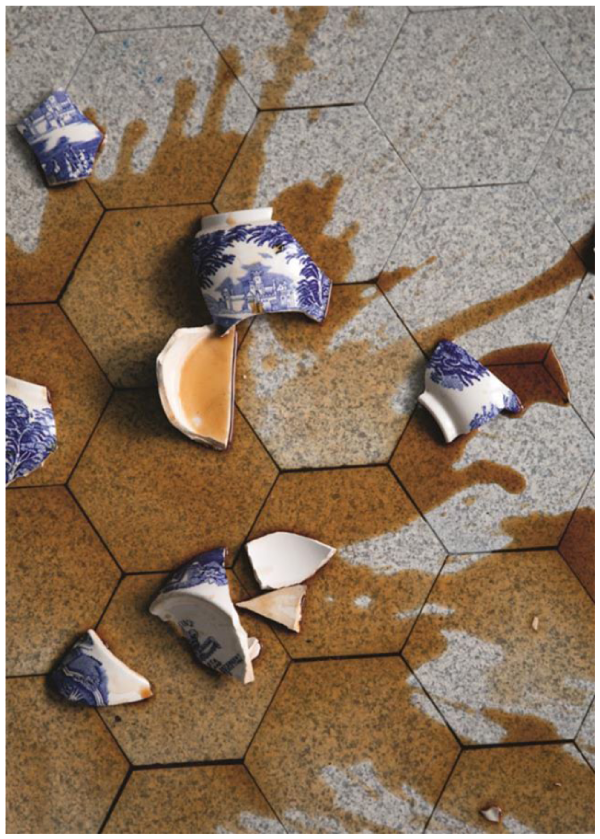
Photograph accompanying Sonia’s story: coffee cup broken on the floor.

Photograph accompanying Sonia’s story: bedroom interior.
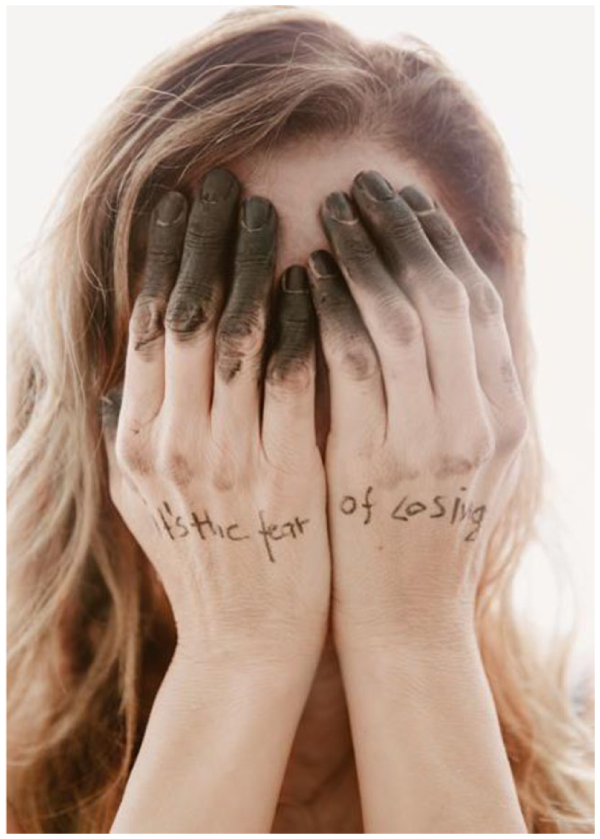
Photograph accompanying Sonia’s story: hands covering her face—embodying shame and the fear of losing home, children, status, respect.
Cathe, a law student, was 14 when she was raped. Despite her martial arts training, fear immobilised her, and in a state of dissociation she erased all evidence by showering (Figure 4). She did not report the assault, deterred by fragmented memories, anticipated legal obstacles and the minimising responses of those around her. In her case, the trauma manifests in a non-chronological and intrusive reorganisation of memories of the rape, often in the form of flashbacks. Like other participants, she did not narrate her story chronologically but returned to specific moments or recounted events through flashbacks. She spoke of ‘memory lapses’, explaining: ‘I remember the start, certain points in time – fragments, nothing more. It’s a defence mechanism. The brain shuts out certain things, or forgets them. But these holes in the story make it less credible’. This is why she never filed a complaint; she was young and afraid of what might follow. Yet the incident continued to haunt her: It was as though I was paralysed. I felt as if I’d left my body. I was 14 years old at the time. I was afraid to go public with my story. Especially since I’d destroyed all the evidence. Disposing of evidence doesn’t always mean hiding a weapon. In my case, it simply meant taking a shower. (Cathe)

Photograph accompanying Cathe’s story: shower scene—erasing traces, blurring memory.
Although memories of rape can be fragmented, as the participating women emphasised, its effects often persist and surface in unexpected ways. Raped at 20, Cindy recalled that certain smells and perfumes could trigger sudden flashbacks, leaving her immobilised for up to an hour, even with a trusted partner. As she explained, The rape changed how I felt about sex. At first, just thinking about a penis disgusted me. I was wary of ever becoming intimate with someone again. All it took was a smell or a touch for my body to suddenly remember the attack, and to freeze. It would happen out of the blue, no way to control it.
The exhibition framed memory as a central element of the ‘aftermath’. The women’s testimonies offered subjective accounts of sexual violence, rich in contextual details – a shower, returning to a place, the scent of a perfume – that reveal how post-traumatic stress disorder (PTSD) can manifest. Dissociative amnesia distorts the sequence of events, leaving memories fragmented or confused. As Cathe and Cindy describe, these memories often resurface as nightmares, flashbacks or intrusive physical sensations that disrupt daily life. The exhibition aimed to convey this reality: that narrating violence from a woman’s perspective stands in sharp contrast to the judicial expectation of a clear, factual, coherent and chronological account – something survivors can rarely provide.
As the shared stories highlight, sexual assault can take many forms, some defined less by overt physical force than by a profound betrayal of trust. The participating women referred to these as ‘unrecognised’ or ‘overlooked’ forms of violence. When the perpetrator was someone they knew, it often led them to question their own perception of the event – particularly in cases involving acts such as oral sex, which at the time did not fit the statutory definition of sexual violence. Jorinde, who was 19 when she experienced such an assault, recounted how shame, self-doubt and the nature of the act itself delayed her recognition of it as rape: My first sexual experience was a violent one. I was 19 when I was orally raped in the woods, while working at a camp. I had gone with the assailant because I trusted him. He seemed nice. I was so surprised, I didn’t even try to defend myself. Saying ‘no’ wasn’t an option for me. It took me years to define what happened as rape. There’s this idea that rape means a penis in a vagina, a brutal and violent act committed by a stranger. But that’s just one aspect of sexual violence; anything done without your consent is an act of violence. Once I recognised that, everything I’d managed to repress up to then came to the surface. I suddenly started having flashbacks and feeling physical effects from the trauma.
Other accounts focused on the harrowing experience of interacting with police officers who requested to meet at the ‘scene of the crime’ or asked detailed questions about the incident (Did you scream? Did you seek out help? Were there any witnesses?). In this way, the exhibition texts highlight shortcomings in the investigative process.
Another participant’s account focused on the reactions of those around her. Morena described how, a few years after pressing charges, she felt happy again – especially after becoming pregnant following years of infertility – only to be confronted on social media with comments reflecting entrenched social attitudes towards sexual assault, as she explains: When I was four months pregnant, I posted a picture on social media showing my tummy and looking happy. In the comments, a member of my attacker’s family wrote: ‘Something bad happened to you. Somebody who went through what you went through shouldn’t look so happy.’ Others made similar comments. A lot of people think that a rape victim shouldn’t go out dancing ever again, that she can’t possibly find love again.
Morena’s story revealed how survivors are often blamed for the violence they endured and expected to embody the role of perpetual victim. She rejected the stereotype that a ‘real victim’ must remain consumed by sadness and anger, instead viewing her pregnancy as a symbol of healing and a source of strength as she prepared to face her attacker in court.
Transforming personal accounts into collective narratives: Exposing sexual violence to public scrutiny
Sharing individual memories within a collective process is, in itself, a political act. Visitors to the exhibition were not invited to engage in voyeurism or seek entertainment (Figure 5), but rather to engage with empathy, foster closeness and reflect on their own positions. By disclosing deeply personal aspects of their past and present – touching on their sexuality, intimate relationships and family life – survivors 7 also, indirectly, expose those around them: partners, children, relatives, neighbours, colleagues. In doing so, the violence becomes collective, and the responsibility shared. What role did these people play in the events? What actions did they take – or fail to take? How might they have suffered indirectly as loved ones or witnesses? Can they continue to pretend that it never happened? And how will they respond to this information once it becomes public – when something long silenced in private, whether through denial, fear or embarrassment, is suddenly exposed to broader scrutiny?
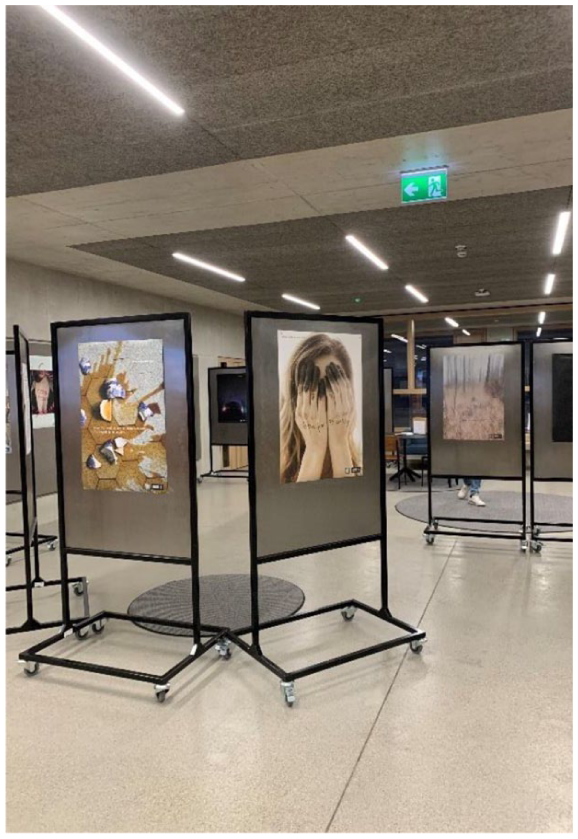
Photograph of the public launch of the exhibition (22 November 2022), School of Social Work, Fribourg, Switzerland — 4th floor display of panels and posters open to the public.
For Jorinde (Figure 6), this process evoked mixed emotions: strength alongside pressure, relief alongside anxiety. More broadly, for her and other survivors, healing oscillated between moments of liberation – breaking the silence, shedding the weight of secrecy – and moments of distress, brought on by feeling exposed or reliving painful memories. Speaking about violence can itself reactivate the trauma, and several participants described the ongoing difficulty of living with both the violence and its public disclosure, as she shared: I thought the more I spoke about it publicly, the easier it would get. That’s not necessarily true, because public exposure means more pressure. But it was my way of working on recovery. (Jorinde)
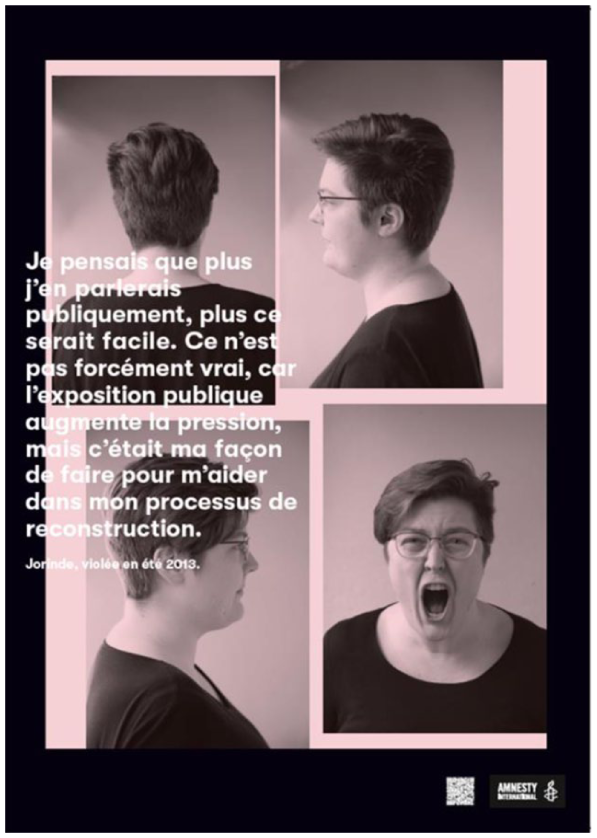
Close-up of a poster with Jorinde’s photograph and testimony excerpt, exhibited on 22 November 2022 at the School of Social Work, Fribourg (Switzerland).
In this sense, the exhibition was designed to engage visitors on multiple levels. They were free to interact with the content as they wished – by simply viewing the images and reading the stories, or by delving deeper into information on sexual violence in Switzerland, including prevalence rates, the legal definition of rape under the Swiss Penal Code and resources for victim support.
During the exhibition at my university (21–30 November 2022), a complementary event was held alongside the official opening: a lunchtime lecture attended by around 40 people, mostly students. The session included an open discussion centred on the testimony of Sonia, a participant who was present. While no audience members shared personal experiences of violence, questions focused on the processes of reconstruction and healing. The exhibition also aimed to encourage reflection. A box, pens and paper were placed on a table, inviting the public to leave anonymous comments over the 2-week display period. Many messages expressed solidarity with survivors, outrage at sexual violence and calls for stronger government action. Several thanked the exhibition for raising awareness and for challenging the culture of shame. None included personal accounts of violence.
Feedback was also received from professionals who participated in the continuing education programme, many of whom underscored the power and significance of the exhibition’s textual and visual narratives (Figure 7). They stressed the importance of making visible the everyday, insidious forms of violence that often remain hidden – traces or symptoms they frequently encounter in their work with survivors. For some, the exhibition also reflected the emotional burden inherent in their roles, particularly when listening to accounts of sexual violence. Professionals from the judicial system and public policy fields highlighted the difficulty of achieving justice within narrow institutional frameworks that often lack empathy for survivors and can even be hostile. Several described the ethical tension of supporting victims while simultaneously confronting the immense weight of the justice system. The exhibition, they noted, created a rare opportunity to voice feelings of loneliness and isolation in their work, and pointed to the urgent need for public debate and for institutions to establish debriefing spaces where such experiences can be openly discussed.
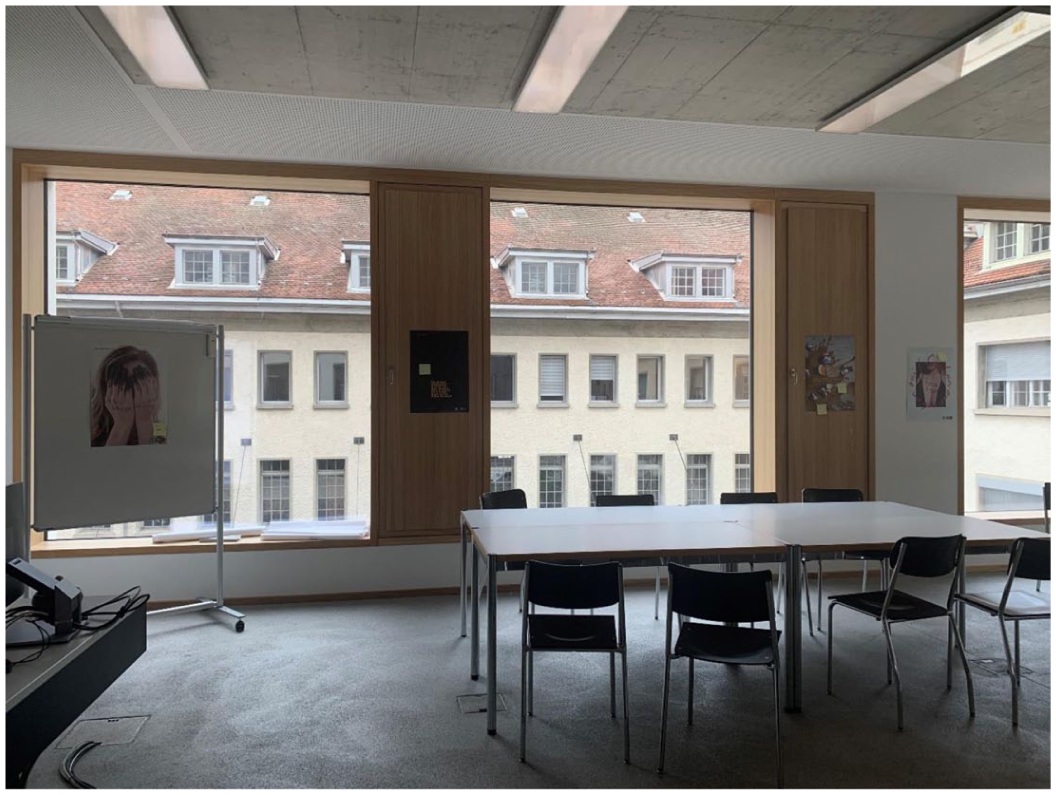
Classroom used for a continuing education course titled ‘Detecting gender-based violence: Viewpoints and institutional responses’, held on 20 and 27 June 2022.
Collaborative projects: Lessons from the field
The success of collaborative projects depends largely on the ability of all participants to engage actively throughout its different phases (Mont Reason and Bradbury, 2008). This section draws on post-exhibition reflections gathered during a debriefing session and through a satisfaction questionnaire. Overall, the survivors expressed satisfaction with the process and a strong sense of identification with the project. One participant noted, ‘The content of the exhibition reflects my point of view’, another described it as ‘fascinating and useful’, and a third took pride in the achievement, saying, ‘We achieved a lot with relatively few resources’. However, participants also reported frustration with the tight deadlines, which limited opportunities for group validation at each stage. Several stressed the value of having more time together – not only to make collective decisions but also to debrief and celebrate milestones. This shared time was seen as both therapeutic and essential yet was sacrificed due to time constraints.
Consent emerged as a major discussion point. While all participants gave their consent freely – initially verbally, then in writing – they wished for a more iterative process in which consent would be revisited and renewed at each stage. They recognised the time implications of such an approach and accepted the more agile, less procedural method used. In practice, the women’s stories were first collected in individual interviews with the journalist, then written up, proofread and validated by each participant. Photographic validation proved more problematic: the photographer’s ‘staged’ approach sometimes imposed her own vision, with aesthetic considerations such as lighting and location influencing the outcome. Several women wished they had more input in these artistic choices.
The group also discussed how rape should be addressed in the exhibition. There was broad agreement on focusing on the factors leading to violence, the societal tendency to minimise sexual assault, and the burden placed on survivors afterward. For some, specifying ‘the date of the rape’ was questionable; others stressed the importance of training artists who work on these themes. The potentially re-traumatising nature of the creative process was also raised as a factor to be anticipated and managed in advance.
Discussion and conclusion
Postcolonial and post-conflict research has long drawn on the concept of reparation to examine how artistic projects can drive social change and foster collective healing (Best, 2016; Di Lellio et al., 2019; Khan, 2019). In this article, I used Susan Best’s (2016) concept of reparative aesthetics to analyse We’ve Had Enough!, focusing on how the exhibition’s narratives and photographic works function as a collective reflection on sexual violence in Switzerland. Best examines the representation of shame-laden subjects in art and argues that shame ‘can transform the affective tone of the subject [. . .] and facilitate attention to the reprehensible actions and disturbing events represented [. . .]. For this to happen, however, the audience must be involved rather than humiliated’ (Best, 2016: 9).
My approach offers a new reading of reparative aesthetics. I apply it to a domestic and contemporary phenomenon – sexual violence in Switzerland – whereas Best mobilises it to analyse troubling historical issues whose repression continues to haunt national consciousness. In Best’s reading, integrating the negative parts of history facilitates recognition, producing a restorative national image capable of tolerating ambivalence. Her emphasis on hope is key: the hope for a progressive society that can confront its past without denial, live with shame and transform it into a reparative memory.
It is on this point that my analysis aligns with Best’s and expands it. I extend her framework to a contemporary, locally situated form of gendered violence, reading this collaborative work on sexual violence as both an indictment of a collective harm targeting women and of a state complicit in that harm by protecting perpetrators more than victims. Crucially, ‘We’ve Had Enough!’ reverses the dynamic of shame: historically borne by victims, it is here shifted onto the public, inviting collective ownership of this discomfort and a shared reworking of responsibility. Although the methodological and epistemological approach of ‘We’ve Had Enough!’ was not primarily grounded in art, its photographic component was shaped by aesthetic choices. At the same time, the project was firmly anchored in activism and political engagement, with an explicit intention to mobilise and provoke action. Hence, Best’s theoretical framework offers a valuable lens for reflecting on such initiatives, particularly when situated in relation to other forms of art activism, as discussed below, in order to better understand the role and potential of reparative aesthetics.
In this article, reparation is not understood as a singular or isolated event but rather as an ongoing process of self-reconstruction and healing. It encompasses both tangible and symbolic actions, embedded within a broader pursuit of justice and the repair of social fractures. This raises the fundamental question: what exactly has been damaged, and thus requires repair? In the case of sexual violence, as evidenced in women’s narratives, it involves restoring self-image and social identity, rebuilding self-confidence and regaining the ability to trust in (current or future) male partners. Reparation thus emerges as a procedural form of restorative justice, beginning with recognition of the harm endured and proceeding towards its redress. In ‘We’ve Had Enough!’, this process did not involve collective apologies or direct confrontation with perpetrators, who remained absent from both the initiative and its activities.
Building on Best’s ideas, Huard and Moser (2022) highlight the role of visual culture in achieving justice and reparation outside of traditional legal or financial frameworks. Art, media and cultural objects can facilitate active processes of reparation, healing and reconciliation. Visual culture promotes sensory and emotional engagement, breaking with established political norms and opening spaces where change becomes possible. It anchors multidimensional memory in both past injustices and future aspirations – an approach consistent with Best’s framework. In this light, the exhibition offered participants not only the chance to revisit traumatic memories, but to actively reframe them as calls for reform in the Swiss legal system. Reparative aesthetics, in this sense, can be understood as an aesthetics of hope and action, capable of transforming personal, political and professional attitudes.
A study of art therapy exhibitions by Davis (2017) reached similar conclusions, emphasising the role of healing. While ‘We’ve Had Enough!’ was not primarily framed as therapeutic, it nevertheless enabled survivors to articulate their memories and emotions – sometimes for the first time – through words and images. This process raised ethical concerns, as participants acknowledged that revisiting their experiences could be re-traumatising (van der Kolk, 2015). Yet the artistic approach also allowed them to shape narratives marked by traumatic memory, challenge stereotypical depictions of rape and testify in the first person. By presenting themselves as a collective rather than isolated victims, the women sought public recognition and, by extension, symbolic reparation. The resulting texts and images formed a shared narrative that extended well beyond individual stories. Audience members – including health and social workers who support victims professionally – reported being deeply affected by these accounts, underscoring the broader emotional and professional impact of such work (Choi, 2017).
Di Lellio et al. (2019) have shown the social and political impact of Thinking of You, an art installation in Kosovo addressing wartime sexual violence. In a symbolic gesture, 5000 dresses were hung in Pristina City Stadium to break the silence on the issue. Although smaller in scale, We’ve Had Enough! shared the aim of making shame visible while fostering empathy and solidarity. Unlike wartime sexual violence – intense but bounded by the duration of conflict – sexual violence in Switzerland persists as a normalised, everyday phenomenon, often occurring within intimate relationships and private life. Nonetheless, both projects sought to counter isolation and exclusion through acknowledgement. In both, art activism pried open an ‘open secret’ and created a shared emotional space from which to press for legal and social change.
Similarly, the Colombian exhibition My Body is a War Zone (Kahn, 2019) mobilised survivors to transform their trauma into cultural expression, inspiring others to follow suit. In contrast, We’ve Had Enough! in Switzerland addressed the more insidious, everyday nature of sexual violence within intimate relationships. Conceived as a lobbying tool to support the adoption of an ‘only yes means yes’ standard in parliamentary debates, it contributed instead to partial legal reforms in 2024, which broadened the definition of rape to include contextual factors such as a victim’s ‘state of shock’. Over time, the exhibition also took on an educational and awareness-raising role, engaging the public with a subject that remains largely taboo. Together, these cases illustrate how the contexts in which sexual violence occurs shape not only its political and social reception but also the artistic strategies through which it is reworked and made visible.
Such examples demonstrate how artistic creation and art activism can break silence, reduce stigma and drive social change. Photography, in particular, creates an emotional bond with viewers, enhancing the impact and accessibility of survivors’ stories. Visual storytelling opens dialogue and fosters public awareness of trauma. As with the other initiatives discussed, We’ve Had Enough! constituted an act of resistance, enabling survivors to reclaim ownership of their narratives through trauma accounts distinct from those shaped by police or court proceedings. Participants explicitly differentiated between the incident that caused their trauma and the trauma itself. In this way, the project’s reparative function lay in enabling survivors to reclaim and reconstruct the memory of violence as part of a collective effort.
The collective dimension of the initiative offers valuable lessons for future research-creation projects. The group operated less like a traditional research team and more like a creative collective, with all the conceptual, methodological and interpersonal challenges this entails. While united by a common objective, participants brought diverse skills and perspectives, making it essential to recognise each contribution as equally legitimate in building a ‘shared world’ (Audoux and Gillet, 2011). Through collaborations with a photographer, a journalist-author and graphic designers, the survivors helped produce an innovative form of textual and visual storytelling. This deeply collective and relational process allowed them to reclaim narrative authority as part of a reparative process. By regaining control over how their experiences were represented, participants engaged in a form of reparation that was both expressive and transformative.
Footnotes
Acknowledgements
With thanks to Amnesty International Switzerland for their commitment, and to Brigitte Lampert, Anne Gabriel-Jürgens, and Alea Rentmeister for their artistic contributions to We’ve Had Enough! I am deeply grateful to all the women for their trust, collaboration, and determination to break the silence around sexual violence.

Funding
The author received no financial support for the research, authorship and/or publication of this article.
Declaration of Conflicting Interests
The author declared no potential conflicts of interest with respect to the research, authorship and/or publication of this article.