



Abstract
This essay examines Fatimah Ashgar’s short lyrical film Retrieval as an important example of art production in a post-#MeToo age. In Retrieval, Ashgar takes viewers on a spiritual journey as the protagonist goes back in time to perform a soul retrieval to revive and heal part of the past-self’s soul that was lost or fragmented due to rape and the trauma that followed. Based on their own personal experience with sexual assault, Ashgar creates a film that relies on both magical realism and the trauma psychology to visually demonstrate to viewers what the aftermath of rape and sexual assault can do to survivors and to offer them a healing way through this trauma. This essay also examines the ways in which many artists are exploring gender violence and sexual assault in performance art, film, and paintings, including historical renderings of Susanna and the Elders. Blending art historical analysis with creative nonfiction, the author draws on psychology, trauma-informed studies, and personal narrative to demonstrate the powerful ways art can be used to heal—both personally and collectively.
Keywords
Introduction
In under 16 minutes, Fatimah Ashgar’s lyrical short film Retrieval (VAM Studio, 2023) takes viewers on a powerful and suspenseful journey of both trauma and healing. 1 As writer and director of Retrieval, Ashgar also stars in their film, performing a soul retrieval—the spiritual process of going back in time to retrieve part of one’s soul that was lost or fragmented, due to past trauma.
In Retrieval, Ashgar portrays the protagonist as both the current- and past-self, as the former saves the latter from a suppressed, traumatic memory of being raped. There is a doubling in this retrieval. Throughout, we see two selves reflected in mirrors, foreshadowing the reveal at the end when the protagonist’s current-self uncovers her past-self’s face under a bed sheet during her assault. There is also a doubling in the origin story of the film. A vision of the film’s opening came to Ashgar (Image 1), as they were beginning to process a buried memory of their own sexual assault. With time and recovery, the story and vision of Retrieval unfolded to Ashgar in 2020.
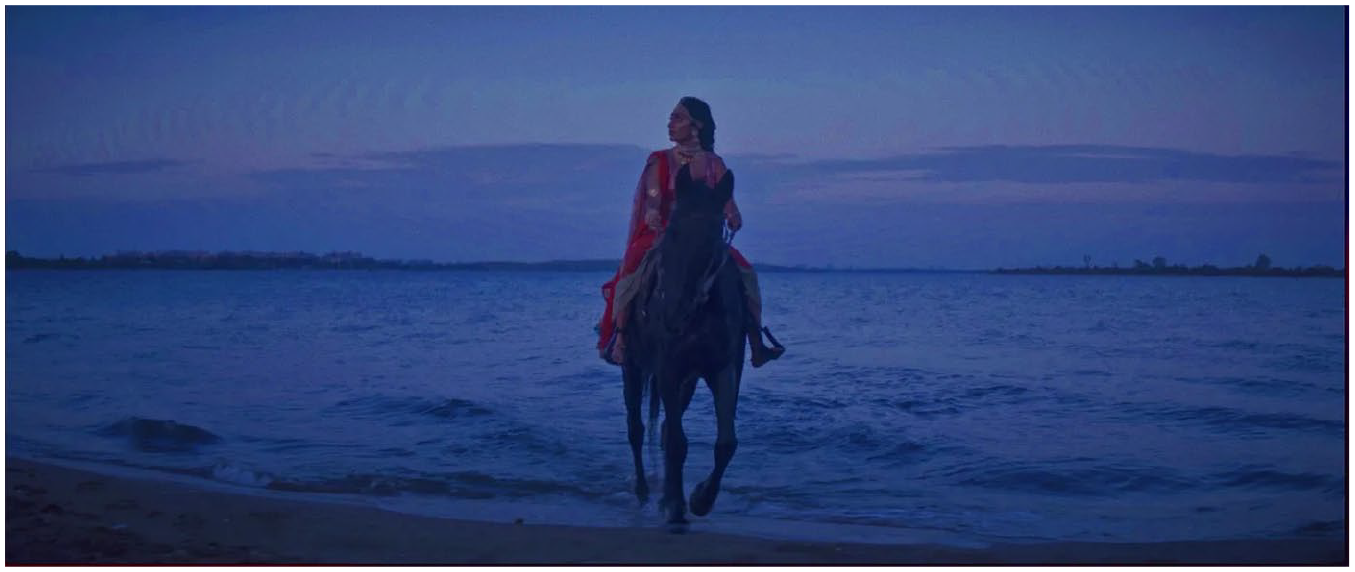
Fatimah Ashgar, director; Jess X. Snow, cinematographer; and Jordan Phelps, editor. Retrieval film still, 2023. Courtesy of Fatimah Ashgar.
Retrieval was filmed in 2022 and released in 2023, following the global #MeToo movement of 2017. 2 As such, Retrieval is an important example of art production in a post-#MeToo age, when reckoning with the trauma of living with gender violence in a misogynistic, homophobic, racist, and patriarchal society is revealed as a complex and layered process.
Many artists have revisited past assaults and rape in their art. Some of the more recent, powerful works that come to mind include Luzene Hill’s Retracing the Trace (2011–2015) (Image 2), Emma Sulkowicz’s Mattress Performance (Carry That Weight) (2014–2015), and Michaela Coel’s I May Destroy You (2020), to name a few. Like Ashgar, these artists physically insert themselves into their art, acting out healing with and through their bodies as their mediums, in a process that is both highly personal and inherently public, designed for an audience. Through their work, they offer curative healing and recovery to themselves and viewers.
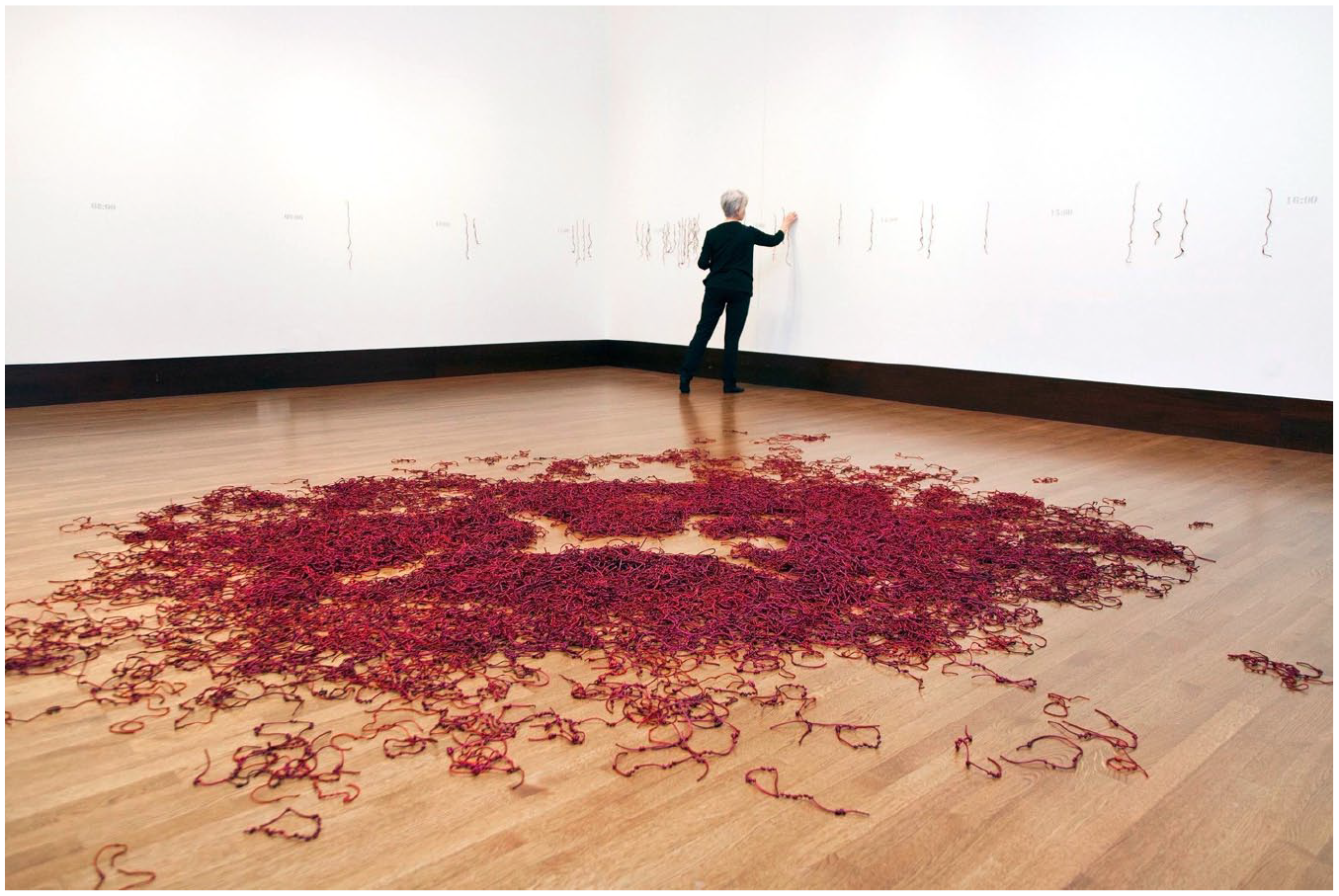
Luzene Hill, Retracing the Trace, performance still, 2011–2015. Photo: Eiteljorg Museum of American Indians and Western Art, Indianapolis, Indiana. Courtesy of the artist.
In this essay, I situate Fatimah Ashgar’s film Retrieval as an important aesthetic intervention, analyzing it through an intersectional art historical lens, informed by trauma studies. As I wrote this article, I also considered how historical paintings can impact us subconsciously, and I gradually dropped the “fourth wall” to join in the collective public chorus of “me too” and to consider the ways that I, and a community of artists, are using our work to heal personally and collectively.
Retrieval as “rememory” and trauma visualization
In Retrieval, Ashgar visually documents the flashbacks they suffered from personally. Their vision for the film coincided with a “resurfacing” of Ashgar’s own traumatic memory of assault (Ashgar, 2022c). By recreating such flashbacks, Ashgar makes concrete the ways in which many survivors process and relive trauma. Ashgar (2022c) quotes Toni Morrison’s character Sethe from Beloved in describing their process: “Some things go on. Pass on. Some things just stay. I used to think it was just my rememory. You know. Some things you forget. Other things you never do” (Morrison, 1987: 36).
Building on Morrison’s conception of “rememory,” Ashgar explains that it is “the idea of remembering a memory, one that has been tucked away for so long, safe-guarded from our mind by our mind, and as we do so we’re not only recalling the exact version of what happened but also of our memory of the version. We call it back, and in the calling, make it new, make it alive. We un-repress what was repressed, it bubbles from the deep. It demands our attention” (Ashgar, 2022c).
Ashgar depicts various stages of post-traumatic stress disorder (PTSD). They scatter these fragmented “rememories” throughout Retrieval, allowing viewers to experience the disorienting and ominous feeling of retracing events leading to a trauma. As Ashgar’s protagonist moves through the city, everyone she encounters is frozen, signifying stagnant, unchangeable memories. After seeing the take-out fries at the rapist’s apartment, for instance, we can deduce that our protagonist began her search at the diner, trying to find her past-self to intervene before the assault occurred. But she cannot. All of her memories are choppy, frozen, and static like the television’s screen in the apartment. With these scenes, Ashgar visualizes what the cloudiness of memory can look, feel, and even taste like, while also illustrating the desire to change the past, and the frustrating tragedy of being unable to.
In one of the most terrifying moments, the protagonist is jarred by a man’s distant laughter. It is immediately threatening. Viewers feel her fear and a haunting foreboding. It also recalls a cultural flashpoint around gender violence that occurred in 2018. Hearing that laughter, I immediately thought of Dr. Christine Blasey Ford and her Senate hearing testimony. Ford described that she had been sexually assaulted by two boys at a high school party in her youth, asserting that Brett Kavanaugh was one of the attackers, and significantly, was the one who pinned her down, covered her mouth, and tried to undress her. One of the most quoted and devastating moments of her testimony came during questioning when Senator Patrick Leahy asked about Ford’s strongest memory from that night. She responded: “Indelible in the hippocampus is the laughter, the uproarious laughter between the two [men], and their having fun at my expense” (Washington Post, 2018). Ashgar nods to this laughter and to the resonance of Ford’s testimony in a powerful way—one that many assault survivors can relate to and which amplifies the horror of assault. That laughter is made more terrifying when we finally enter the bedroom.
But first, we momentarily wonder if we are going to have to see the assault. As the protagonist enters the bedroom and closes the door (Image 3), we are met with a black screen and I sighed in relief briefly, thinking I might not have to see what came next, hoping to be spared the inevitable violence, and considering the many splintered directions this story could go. I wondered whether our protagonist would use the knife she picked up in epic revenge or whether she might meet the more likely and tragic demise of Emerald Fennell’s Carrie in Promising Young Woman (2020). 3
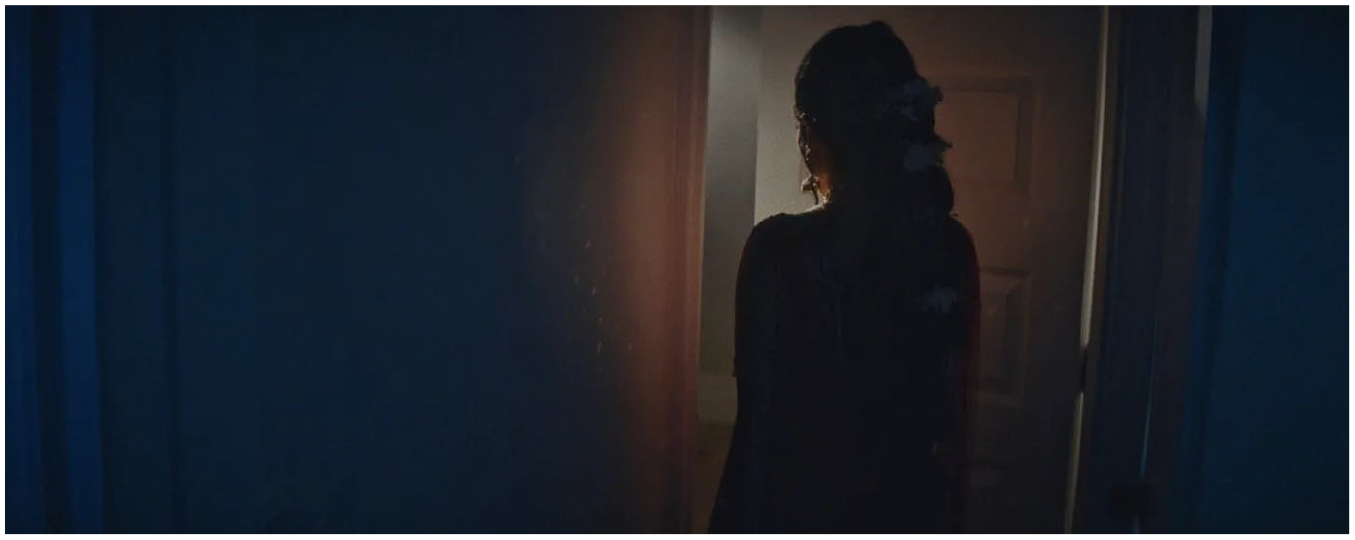
Fatimah Ashgar, director; Jess X. Snow, cinematographer; and Jordan Phelps, editor. Retrieval film still, 2023. Courtesy of Fatimah Ashgar.
But that was not Ashgar’s path. After the screen briefly fades to black, we are in the bedroom and we see the rape almost immediately, as it is frozen dramatically in the bed in the center of the room. This moment of violence is still, and there is a strange power in this suspension of time—it is both active and inactive; it is present and past; it is perpetual and frozen. In this rendering, Ashgar portrays the terrifying way in which assault can live on in one’s memory pervasively, passively, and indefinitely.
When the protagonist approaches the rapist, we also see the way in which struggling is rendered futile. She tries to grab his neck to strangle him, but she has no chance from where she stands. Next, she tries to move his hand that covers her past-self’s face, but to no avail. Survivors’ most common reaction to assault is to physically freeze, feeling temporarily paralyzed and unable to yell or scream (referred as “tonic immobility” in Möller et al., 2017). And while freezing is a healthy and natural survival instinct (De Heer and Jones, 2017), it is also hard for others and for survivors themselves to understand that inactivity when recalled later. In this scene, Ashgar effectively recreates that sense of inexplicable inactivity. No one can speak or move freely until the retrieval has occurred, the healing has begun, and both selves are united safely on the beach.
A femme filming aesthetic and ethic
In filming Retrieval, Ashgar approached the set with great care, knowing that it would feel emotionally charged and vulnerable. They described embodying a “femme directorial ethic” (Ashgar, 2022b) reminiscent of television writer Joey Soloway’s conception of “the female gaze.” In 2016, Soloway explained that implementing the female gaze on set is an embodied way of filming, asking everyone to be emotionally present, prioritizing feelings over actions, and demonstrating to viewers how it feels like to be the object of the gaze (TIFF Talks, 2016).
Similarly, Ashgar ensured their set and filming process was safe and healing. They explained: “the way that I prefer to collaborate is through gentleness, through listening, and through respecting the divine creativity that flows in everything and everyone” (Ashgar, 2022b). They also described cultivating “an ethic of collaboration, an ethic of care, of understanding, and a working with instead of a working against” (Ashgar, 2022b). Ashgar detailed their hopes of creating a safe, ritualistic environment, even enabling a metaphorical soul retrieval in the process: “My dream was to have the set feel like a ceremony space, a ritual space of actually conducting the soul retrieval that the film is about” (Ashgar, 2022a).
In Retrieval, the protagonist wears a gold maang tikka, framing her face, and a red lehenga choli, a traditional Indian gown with intricate embellishments, often worn for celebrations and weddings in India, Pakistan, and Bangladesh. Ashgar deliberately dresses formally, marking the sacred journey and transformation about to unfold in their soul retrieval. Culturally, it is also significant. Ashgar is a queer, Muslim, Pakistani-Kashmiri-American poet, writer, photographer, and performer. They felt strongly about representing the aftermath of assault and healing for communities of color and people from marginalized backgrounds, because Ashgar (2022c) did not feel like they had a good example of this when dealing with their own trauma. Intentionally selecting their production team for Retrieval, Ashgar (2022a) also specifically chose to work with “queer, femme, people of color and/or survivors” (Image 4).
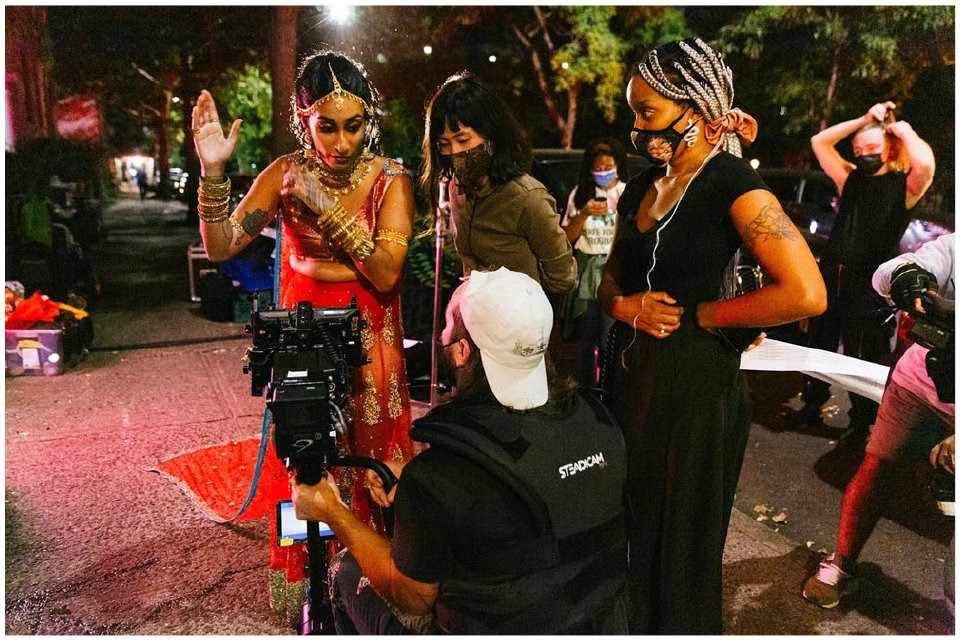
Photograph on the set of Retrieval showing Fatimah Ashgar, director; Jamila Woods, producer and assistant director; and Jess X. Snow, cinematographer, 2022. Courtesy of Fatimah Ashgar.
Art’s personal and collective healing
Such personally-informed artworks as Retrieval offer both the creators and viewers a sense of healing and release—an energetic exorcism of sorts. Ashgar (2022c) explained, “It wasn’t just about processing something, it was about energetically trying to release it from my body”.
Ashgar (2022c) noted that “there’s no linearity in healing”, and observed that people often talk about healing as something finite and completable. But Ashgar asserts that in reality “. . . healing never ends. We can transmute these things, we can use them for our awakenings, we can work until we cease to be so triggered by them. But they still happened. They still stay with us. We spend our lives healing. Or, we ignore it, and our pain consumes us” (Ashgar, 2022c). And this is validated by research. Rape trauma syndrome (RTS) is a common human reaction to an uncommon and unnaturally traumatic event (RAINN: Rape Abuse & Incest National Network, 2008). RTS identifies three stages of psychological trauma that victims and survivors 4 commonly experience: the acute stage, the outer adjustment stage, and the resolution stage (Park et al., 2018). Researchers note that as survivors work through their trauma and PTSD, they may move through these stages in nonlinear ways, sometimes moving backwards, forwards, and between stages while processing, reprocessing, and healing. With Retrieval, Ashgar illuminates the cyclical nature of healing, highlighting the need to revisit and re-heal over and over.
This is something I understand personally. I have been sexually assaulted twice in my life. And although I recently co-edited and contributed to a book about gender violence and art (Caldwell et al., 2024a), I have barely shared my own personal stories publicly because I hold them so close to my heart. In the final year of working on that book, I was speaking to a friend who had just started a form of therapy called eye movement desensitization and reprocessing (EMDR) to work through sexual violence in her own past. EMDR can be very effective in helping people to repair mental and emotional “injuries” resulting from traumatic memories by reprocessing those events in a different way. Through guided talk therapy sessions combined with light, movement, and/or tapping, therapists can help clients to reprogram the painful events so that remembering the trauma does not feel like reliving it over and over—and in doing so, feelings around the event become more manageable (Cleveland Clinic, 2024).
My friend and I were discussing how powerful EMDR can be—a kind of mediated soul retrieval of its own, and I told her that I have done it multiple times in my life, realizing at various points that I needed to circle back for re-healing and reprocessing. I was telling her this to let her know that it is normal to need to return to EMDR, that healing is non-linear and cyclical, but it was like I was hearing it for the first time. The moment the words came out of my mouth, I knew they were for me too: I needed to re-heal and reprocess again. And I needed to write this essay.
Like Christine Blasey Ford, I “wasn’t actually raped.” (This is an exact quote from my first therapist—an older man who made sure to remind my 19 year-old self who was seeking out counseling for the first time after a high school assault, that my trauma could be understood in relative terms of just how bad it was not.) Even though I have addressed the assaults in therapy for many years now with multiple therapists, it was only when Ford testified to Senate that I realized how much I had internalized my first therapist’s minimization and relativistic trauma-scale. In Ford’s strength and testimony, I saw that it was okay for me to acknowledge the trauma and weight of assault, no matter the end result. I was so used to laughing it off and lessening my own experiences through comparisons to worser fates that I had buried a large part of my younger selves.
Conclusion: sitting under Susanna
As I write this now, I am at the Essere Writer and Artist Residency in Tuscany, Italy. I sit in a spacious room with a handful of large paintings lining the walls, reminiscent of 16th century art, if not actually. Across from me, a painting depicts Susanna and the Elders, an Old Testament Bible story retold in paintings for centuries (Image 5). Susanna is one of the earliest identifiable women from the Bible depicted in Christian art (Spier, 2007), largely because a naked 5 woman is at the heart of this tale. Under the guise of simply telling a moralistic Bible story, painters were allowed to portray a naked woman for the patron’s male gaze, sexual pleasure, and “legitimized voyeurism” (Garrard, 1982: 149).
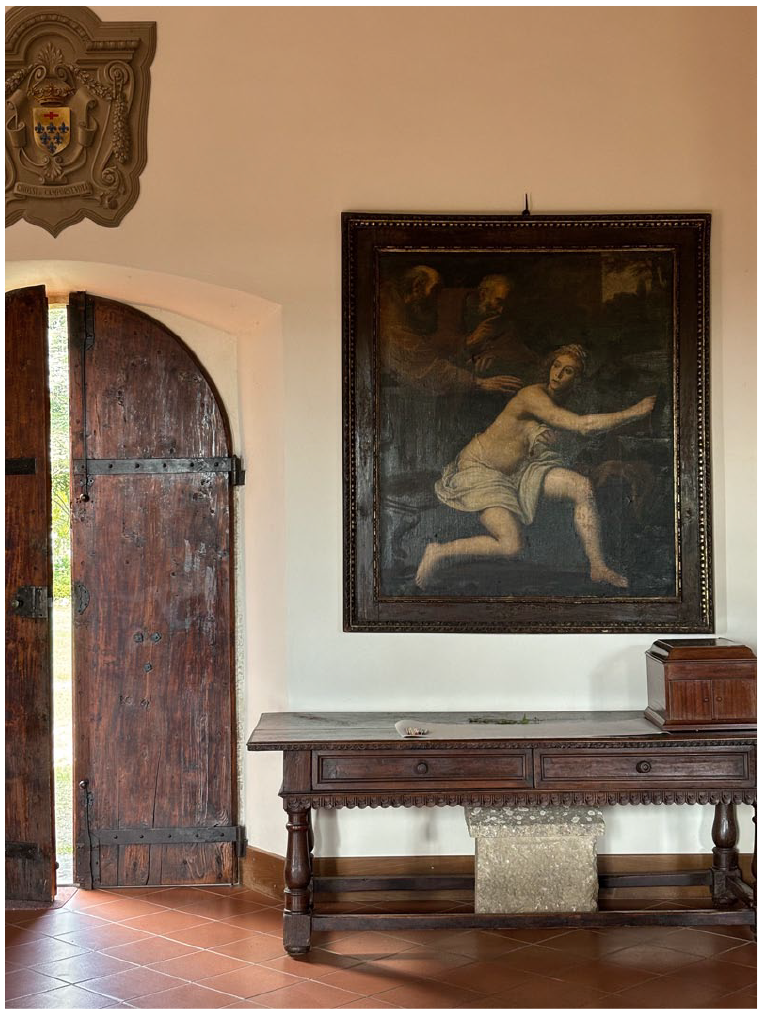
Susanna and the Elders, artist and date unknown, Camporsevoli (Cetona, Italy). Photo by author, with permission from the Estate of Camporsevoli.
Artists often depict Susanna as if she is trying to cover up and escape the men, but they also usually emphasize and sexualize her naked body. In this particular painting, and in most of its kind, the elders creep out menacingly from a dark background, reaching toward Susanna to touch or silence her. Her body is painted to suggest movement, but it would be nearly impossible to stand from her position. In fact, she is portrayed in a semi-seated contrapposto stance to showcase more of her body: her spread legs are sexually suggestive, rather than suggesting movement and fear. It is all a ruse.
Susanna looks aside vacantly, centering us as the viewers and Susanna as the object of our gaze. She shows such slight concern, that it seems to only be there to ensure viewers recognize its Biblical origins. She holds a cloth to her body, a gesture toward modesty, while actually accentuating her exposed body. She is a nearly naked sexual object. We look at her. We look at her body. We don’t make eye contact, because she is simply an object to be looked at, desired, and showcased. Even now.
While it has been in vogue for feminist art historians to analyze and critique this genre of Susanna and the Elders paintings for some time (particularly when compared to Artemisia Gentileschi’s entirely different perspective on the same subject matter in 1610 Garrard, 1982]), the story itself doesn’t get much attention.
From the Book of Daniel, it begins with Susanna bathing in a river alone, while two elders hide in the bushes watching her. These perverse voyeurs notice one another and join forces, concocting a scheme to blackmail her with the threat of a made-up accusation of adultery (punishable by death) if she does not agree to have sex with them. And so, this is also the story of blackmail, threatened gang rape, and lecherous monstrous “elders” embedded in our communities.
Susanna as an age-old painted subject is, in fact, triply violated. First, the elders in the painting watched, threatened, and violated her; second, the patrons of each painting also lasciviously lusted after her in the privacy of their own homes; and third, we the viewers now continue to center an eroticized Susanna as the object of our gaze, whether we want to or not. As Mary Garrard (1982) has famously argued, the story is told from the perspective of the rapist elders and we become unknowing pawns as forced co-voyeurs. We bear witness while Susanna is sexualized, objectified, scared, and threatened—a prisoner to the canvas in perpetuity.
At the residency where I write this, we gather, sitting under Susanna, talking about our art and sharing our stories. Perhaps because of my recent book topic, because of our gender and the related statistics that nearly one in three women will experience at least one form of gender violence in their lifetimes (Godoy, 2021), and because we are artists who process our experiences and traumas through our art and bodies, the topic of gender violence has come up often, more times than I can count. I credit #MeToo—and also all of the artists who are coming out to share, heal, and point out what has always been here, hiding in plain sight.
I am struck by how many of us have shared our stories of gender violence—and importantly, it feels like something has shifted in the sharing. It is not confessional, said in whispered, quiet, or tearful asides, shrouded in shame and secrecy. Instead, it is factual, shared openly. A dancer begins her memoir at age eight when she lost her father and was raped. A suspense writer leaves an abusive relationship and envisions a different future for her protagonist. A painter gives her partner a leather belt, for the first time feeling safe hearing the swish through beltloops, a sound previously reminiscent of childhood beatings. A novelist details the life of a director at a domestic violence shelter, centering her own lived story. A photographer feels safe walking home alone at night for the first time in this remote town. A healer and writer interviews women who have suffered from violent hands and develops a new form of massage that makes touch safe, supportive, and healing. An art historian and sexual assault survivor writes this article about gender violence.
This collective sharing is healing, and perhaps it is not just the only way through, but also the only way to reach a more public reckoning and what Tarana Burke (2021b) calls “empowerment through empathy” (p. 8). Perhaps we are living the next steps of our shared journey in a post-#MeToo world, one where #MeToo might have been the start, but the art is the next phase that has to follow. It is art that will help force society to process and acknowledge these dark truths of an ever-present violence that have been relegated and ignored as “women’s issues” for far too long. Perhaps this is the pathway to truly see the real and present dangers of gender violence, to feel the persistent threats who are quite literally living and breathing among us, and to acknowledge the ongoing danger—and hopefully, eventually, to change these histories and forge new futures. 6 Sometimes I get goosebumps envisioning a future without gender violence—something bell hooks (2004, 2014) called on us to do and actualize. It feels impossible, and yet, it feels more urgent now than ever, and I have more hope than I did ten years ago. 7
Novelist Carol Goodman (2021) has said that “we can’t build a safe—or just or free—world by burying the secrets of the past or hiding injustices, or by telling only part of the story. We can only find true refuge by knowing the truth”. Thankfully, there are many artists, like Fatimah Ashgar, who are sharing their truths in their art, while also providing cyclical, generative, and exponential collective healing. Susanna is in the room with us and always has been. And so too, we have all been in this room. We just need to look.
Footnotes
Acknowledgements
I am deeply grateful to Júlia Garraio and Hülya Adak, the editors of this special issue of European Journal of Women’s Studies. Thank you for centering these artistic interventions so that we may forge new futures. Thank you to Jennie Lee for building a safe, supportive, and inspiring space at the Essere Residency and to Valentina Grossi Orzalesi at Camporsevoli—where I spent days writing, researching, reflecting, and processing—and where I also spent nights eating delicious food, laughing with new friends, and holding space for one another. Thank you also to Jennie, Carol Goodman, Suzanne Dubus, Lauren Gallow, Chisara Asomugha, Christine Kandic Torres, Lauren Sinclair, and Bianca Murillo for reading and for the productive comments. Thank you to my Essere family who allowed me to share our conversations here. And, finally, thank you to Fatimah Ashgar and all of the survivors who are making art to help all of us heal.
Author’s note

Ethical considerations
Not applicable
Any other identifying information related to the authors and/or their institutions,funders,approval committees,etc.,that might compromise anonymity.
Not applicable
Funding
The author received no financial support for the research, authorship, and/or publication of this article.
Declaration of conflicting interests
The author declared no potential conflicts of interest with respect to the research, authorship, and/or publication of this article.
Data availability statement
Not applicable