



Abstract
Gynaecological self-help, a well-known and historical feminist practice from the Second Wave movements which aims at embodying a radical alternative to traditional reproductive politics, is resurging today in France, Switzerland and Belgium. Drawing on empirical observations and interviews, this article questions the links between feminist memory of self-help, the shaping of nostalgia and the production of a political feminist ‘we’. Born at the end of the 1960s in the United States, feminist self-help travelled internationally and was appropriated differently depending on national contexts. This ‘glorious’ history of self-help and, more importantly, its narrated memory, is central to contemporary European self-help activism, as observed in the three national contexts. Drawing on this insight, this article reveals the active memory-oriented emotional work of self-help activists. It examines the ways in which nostalgia for an imagined and lost past is actively and practically produced and encouraged in social movement practices, and highlights the specificity of the kind of collective feminist identity that it shapes and promotes in contemporary self-help politics.
Introduction
The last decade has been marked by a revival of feminist activism in Europe (Dean and Aune, 2015; Evans, 2015). Although this revival is plural, heterogeneous and crossed by lines of conflict, literature has nevertheless highlighted the shared centrality of the body as a site of protest in contemporary feminist activism (Dean and Aune, 2015). From SlutWalks (Reger, 2015) to Femen, to the multiplication of representations of the diversity of women’s genitalia in public spaces (Gardey, 2019), the body has had great importance in feminist repertoires. The resurgence of feminist self-help practices in Belgium, France and Switzerland is in line with these two developments. Through the crafting of a critical feminist analysis of health, self-helpers have tried to challenge the permanence of doctors’ and gynaecologists’ power over their bodies. By a well-known feminist technique that consists in the collective sharing of experiences, they have emphasized how medical power and androcentric science continue to shape oppressive experiences for women. In particular, they have been active in condemning obstetric and gynaecological violence, emphasizing the cross-cutting nature of gender violence. For from being satisfied with discursive criticism, and in line with the 1970s self-help activism (Murphy, 2004, 2012), they also have developed practices to shape a vision of what a feminist reproductive healthcare would look like (Quéré, 2019). Self-help practices are an attempt to take back their body, sexuality and health from medical and patriarchal control. It refers to a set of practices that range from collective sharing and crafting of information and knowledge on specific bodily issues to experimenting with alternative therapies and alternative modes of organization of care work. In particular, it includes the highly symbolic practice of vulvar, vaginal and/or cervix self-examination, which has been emblematic of the Second Wave self-help within the Women’s Health Movement (Davis, 2007; Dudley Shotwell, 2016; Morgen, 2002; Murphy, 2004). Born at the end of the 1960s in the United States (Kline, 2010; Morgen, 2002; Murphy, 2012), feminist self-help has travelled internationally (Davis, 2007) and has been appropriated differently in Europe depending on national and local contexts (D’Hooghe, 2013; Ruault, 2016).
In February 2020, a new French-language adaptation of Our Bodies Ourselves was published in France and quickly circulated in Belgium and Switzerland. This reissue of the ‘bible’ of feminist self-help, first published in 1971 in English, highlights the centrality given to the history of self-help and the repetition of its narrated memory. It is an invitation to question how feminists of the recent generational renewal relate to the past. But what are the contours of the proclaimed ‘bodies’ and ‘selves’? At a time when feminists are divided over the homogeneity of the category women, would the body, placed at the principle of the delimitation of a political ‘we’, open the potentiality of unifying all women in a common struggle? This article examines the activist work oriented towards the production of a unified political subject for feminism. It argues that this work is both a memory work and an emotional work undertaken to produce feminist nostalgia. In other words, this article raises the question of contemporary feminists’ relationship to the past by proposing to focus on the emotional dimensions of collective memory. Drawing on Clare Hemmings’ account of the production of a narrative of loss in feminist theory to report the developments of feminist thought (Hemmings, 2005, 2011), this article questions how this same narrative is reproduced within the feminist social movement through the case of feminist self-help practices as observed in three national contexts – France, Belgium and Switzerland. It examines the ways in which nostalgia for an imagined and lost past is actively and practically produced and encouraged in social movement practices, and interrogates what it reveals of the kind of collective feminist subject that is shaped and promoted.
Theoretical framework
The links between social movements and collective memory have been the object of a growing literature in the past decades (Kubal and Becerra, 2014). Collective memories, as ‘shared ideas about the past which provide a framework for interpreting the present’ (Kubal and Becerra, 2014: 867), have been analysed as enabling (Fine, 2001; Jansen, 2007; Schwartz and Schuman, 2005) and constraining (Olick and Levy, 1997) activism; a stake of competing definitions and institutionalizations (Epstein, 2009; Jansen, 2007; Schwartz, 2009), as well as the result of framing sustained work by memory entrepreneurs (Jansen, 2007; Pollak, 1993), especially through the production of commemorative forms (Armstrong and Crage, 2006); a powerful factor of movement unity (Gongaware, 2003) and collective identity (Polletta, 2004). In particular, the literature on collective memory and social movements has helped conceptualize memory as an interactive process rather than as an object (Zerubavel, 1996). Indeed, social movements are a particularly valuable site for understanding how the process of memory building interactively works (Zamponi, 2013) and for conceptualizing memory ‘as a process of interpretation and reinterpretation through interaction’ (Gongaware, 2010: 216) by group members.
Such a turn towards understanding collective memory in social movements, made possible through an attention to the meso level and through intensive observations of interpersonal interactions, has enabled the development of astute analyses of the links between collective memory and collective identity. For instance, studies on peace movements (Benford, 1996) and Native American education movements (Gongaware, 2003, 2010) have shown how the participation of movements in mnemonic commemorations mobilizes activism, helps the enrolment of new recruits and creates continuity between past and present movements (Kubal, 2008). In particular, the attention to interactive processes of memory building and framing in social movements has enabled to unveil how ‘activists interact and compete with one another to define the proper way to interpret the past’ (Kubal and Becerra, 2014: 870), a negotiation which results in the shaping of a common identity.
However, few of these studies have investigated the links between memory and emotions in the creation and maintenance of a collective identity. In contrast, emotions have become central in the study of collective identity processes in social movements, in particular, thanks to the work of feminist scholars and the studies on feminist movements. It has been showed how emotions participate in the construction of a collective identity (Rupp and Taylor, 2003; Stein and Plummer, 1994), how they shape and fuel collective action (Jasper, 1998; Polletta and Jasper, 2001; Reger, 2004) and how they are worked on and transformed in and by social movements (Flam, 2005; Taylor, 1996; Whittier, 2009). But the links between emotions and memory have been under investigation. In this perspective, the study by Larry J. Griffin and Kenneth A. Bollen on the civil rights movement is an exception. It links memory, emotions and collective identity to reveal how remembering the civil rights movement can trigger specific emotions such as guilt that can generate collective action to redress racial inequalities. However, the link between emotional work (Hochschild, 1979) and memory work (Jansen, 2007) has not been studied relationally in the social movement literature. Collective memory as a result of an interactive process attempts to fill this gap by bringing together the literature on emotions and on collective memory in social movements. Through the case study of the contemporary resurgence of feminist self-help, it analyses the interactive articulation between memory work and emotional work. Specifically, it shows how the work of production of a collective memory generates distinct emotions, and in particular, nostalgia, which in turn shape a specific kind of collective identity, oriented towards the hope for a more unified feminist subject.
Method and data
Data for this study come from 4 years of ethnography of contemporary feminist self-help practices in Belgium, France and Switzerland (2015–2019). Contrary to a restrictive definition of social movements as challenging the state and state actors (see for instance McAdam et al., 2001), a flexible and broad definition of social movements is adopted that acknowledges the ways self-help activists use a variety of means to challenge dominant symbolic codes on the female body and the medicalization of their health, bodies and lives.
Ethnography has been identified by social movement anthropology as the most accurate methodology to grasp the diversity of lived experiences and the ways in which participants make sense of their practices (Edelman, 2001; Whittier, 1995). In particular, ethnographic methods have been used to highlight the interactive processes through which collective memory is constructed in social movements and how activists develop in situ a shared definition of the past (Kubal and Becerra, 2014) that helps create collective identity and mobilize activism (Benford, 1996; Gongaware, 2003, 2010) To serve this purpose, the data were collected through multi-sited ethnography, a method that pays attention to the circulation of discourses and the configuration of practices in diverse places, and to their relationships (Marcus, 1995). Contemporary configurations of self-help practices were considered spaces of circulation of activists, discourses, knowledges, objects, practices and interpretative frameworks. The choice of France, Switzerland and Belgium as sites was facilitated by the sharing of a common language. While these three countries were characterized by different local and national appropriations of self-help in the 1970s, the shared creation of a collective memory of self-help is what helped to create unity between self-help activists.
Data were collected through observation and participation in 12 sessions of self-help practices in the three countries, such as self-examination workshops and 2-day gatherings on self-help, women and health. Those events were usually open on registration, and most of them were presented as inclusive of gender minorities. They gathered between 4 and 25 participants. I always introduced myself as a researcher to all participants, positioning myself as both an observer and a participant. The research was conducted in line with the ethical norms of accountability and confidentiality. I kept written field notes of the activities and interactions observed and gathered self-help cultural productions, such as zines (‘independent, not-for-profit publications that are circulated via subcultural networks’ (Kempson, 2015: 459), podcasts, media interviews and books. Finally, I conducted 84 in-depth interviews to seize the subjective appropriations of the memory-oriented emotional work. Interviewees were recruited through the activities I attended and through referrals from other interviewees. The interviews were conducted with self-helpers who were active during the 1970s and 1980s; contemporary organizers of self-help workshops; occasional participants to self-help practices; members of long-term self-help groups; and health professionals who integrate a self-help approach to their activity. All interviewees identified as women when I met them. They are predominantly upper-middle class, educated and White. I use pseudonyms when I refer to them to guarantee anonymity. The interviews ranged in length from 1.5 to 3 hours and were fully transcribed. The cultural productions and interview transcripts were entered into the Atlas.ti qualitative data analysis programme and coded through the identification of major themes in subjective experiences of self-help and activism, following a grounded theory approach (see Glaser, 1992; Strauss and Corbin, 1990).
Producing and shaping memory
Two types of narratives, both revolving around the idea of loss, shape the politics of memory in the space of European self-help. First, self-help activists constantly refer to the long story of how women were dispossessed of their knowledge, and frame the practices of transmission of a lost tradition. They mobilized a particular set of references, such as Witches, Midwives and Nurses, by Barbara Ehrenreich and Deirdre English (2015), which was translated into French and has known considerable success in the realm of self-help, and Caliban and the Witch, by Silvia Federici (2014), also translated and published in French. The figure of the witch, which functions as a medium for collective identification, refers to women’s empirical knowledge about reproduction. This knowledge was, according to self-helpers, appropriated by physicians during the process of the professionalization of medicine. As such, knowledge about plants is often framed as an example of extinct knowledge whose loss led to the obliteration of women’s role in the history of reproductive knowledge. The framing of women’s history as a forgotten history is based on the construction of a magnified past, characterized by the existence of a community of women based on the exchange of knowledge. This narrative and its repetition work to develop a sense of loss of that imagined past among contemporary self-help activists.
Second, and in a similar way, the history of feminist self-help is built as characterized by the absence of transmission between generations. This is part of a larger framing that has designated amnesia as a central characteristic of feminisms (Charpenel, 2017; DuPlessis and Snitow, 2007). The affirmation of feminists’ forgetfulness of their own history, which is constantly repeated by self-help activists, is an opportunity to demonstrate gratitude for the legacy of previous generations. Thus, the assertion constitutes a useful paradox between the repetition of the little-known character of the origins and history of self-help and the omnipresence of mnemonic narratives in contemporary self-help. In particular, it serves the production of continuity between phases of mobilization. Repetition of the relevance of the self-help approach then and now also ensures continuity. Cha, a 30-year-old artist who regularly organizes self-help workshops, recounts the ‘shock’ she felt when discovering the ‘fact that [she] did the same thing as forty years ago’, and asserts, ‘it kind of freaked me out that it’s so similar and that nothing’s really moved since then’. The framing of the absence of transmission thus serves, somehow paradoxically, the construction of a shared genealogy between feminist generations. The assertion of female and feminist amnesia constitutes a strategy for building an imagined common past around the self-help approach, which, considered as ‘the mother of us all’, has the function of creating a sense of filiation and belonging to the group.
These two narratives designate a double amnesia: the loss of women’s knowledge transmission and the loss of the memory of self-help. Self-help activists frame women’s and feminist history around the pervasiveness of forgetfulness. In so doing, they actively contribute to the production of a feeling of nostalgia for a past supposedly characterized by active solidarity between women. This work of production of nostalgia results in a clear division of labour between two feminist generations that entered self-help activism at different periods of mobilization. The former generation, constituted of activists who first engaged in self-help activism in the 1970s and are still active, creates the memory of the past and the narratives of self-help. These activists are self-help memory entrepreneurs (Pollak, 1993) since they create the common references and ensure that they are respected. Characterized by the longevity of their commitment, they have gained symbolic recognition. The new generation, who engaged in the 2010s, disseminates the narratives crafted by the elders and pays tribute to them.
Against discontinuity, self-help memory entrepreneurs insist on the need to ‘reinvent a new culture of transmission in women’s healthcare’
1
. To defy oblivion, they reproduce foundational stories and a rhetoric based on the centrality of the preoccupation with self-help’s origins (Davis, 2007). These origin narratives and their reiterations are part of the process of movement-building (Morgen, 2002) and structuration, and they help the construction of group continuity through the recognition of the feminist legacy. The process of ‘collective memory creation’ (Gongaware, 2003) can for instance be identified through the publication of stories of the past by former activists of the 1970s. The book Une sorcière des temps modernes: le self-help et le mouvement femmes et santé (A modern-day witch: self-help and the women’s health movement) by Rina Nissim (2014), a central figure of the Second Wave feminist self-help in Geneva, is a telling example of these mnemonic initiatives. It testifies to the desire of previous generations to leave its traces on the movement. Self-identifying through the figure of the ‘witch’, she inscribes herself in the history of feminism, while, at the same time, detaching it from its contextual dimension of the Second Wave. In her book, she looks back at her career in connection with self-help in Geneva and provides a specific narrative of the origins of the ‘women’s health movement’ in Europe. She starts with the visit of Carol Downer and Debra Law in Geneva in October 1973, and the ‘demonstration of self-examination’ that they conducted ‘in front of a crowded room’. The construction of this act as foundational takes up the same narrative patterns as in the ‘origins story’ told and repeated within American feminist self-help (Dudley Shotwell, 2016; Morgen, 2002): in April 1971, Carol Downer, an activist for the liberation of abortion, jumped on a table during a feminist gathering in a bookshop in Los Angeles, pulled up her skirt and showed the participants how to view their own cervix using a flashlight, a mirror and a speculum. As a matter of fact, self-examination is the act highlighted on the cover of Une sorcière des temps modernes, by a photograph of a mirror reflecting the cervix of a person who is also the photographer. Between her legs, two women are also looking at the cervix revealed by the speculum. The narrative serves the construction and transmission of a common past around contemporary self-help practices and connects these practices with feminist history. As a memory entrepreneur, Rina Nissim works to shape how self-helpers remember. She both creates the common references and ensures that they are respected. Her book is often cited as a trigger for self-help activism. For instance, Justine talks about the role played by Rina Nissim’s book in setting up vulvar self-observation workshops: It inspired me, yes, because it was also while reading her book, her biography, Une sorcière des temps modernes, that I thought: ‘it’s so great what she does’. (Justine, 28-year-old, project manager, France, 2017)
As literature has already shown (Benford, 1996; Gongaware, 2003), mnemonic commemorations help mobilize contemporary self-help activism. However, the work of memory entrepreneurs of framing memory is not limited to the creation of memory. In addition to producing the common references that are necessary to inscribe contemporary practices in a feminist connection, they ensure that memory is interpreted and appropriated in the ‘right’ way by new generations, revealing how memory can be a site of power and struggles in a movement (Olick and Robbins, 1998). For instance, Noellie, a member of the new generation who wrote a book on self-examination as a ‘tribute’ to self-help practices of the ‘glorious seventies’, recounts the interview she made with a memory entrepreneur she calls ‘the great preacher’ of self-help by testifying to the lack of understanding of her own initiative: So, it’s funny because during our conversation she was . . . she’s really 100% convinced of the interest of the collective aspect of self-exploration, and so for her somehow the fact of doing it alone doesn’t really make sense. So, our discussion at times was a bit sterile, well not sterile, but we sometimes had a bit of trouble understanding each other while we were talking about the same thing, but there was a difference in experience. What really shaped her thinking was this collective and group movement, and so everything she told me, which is really interesting about the fact of being part of a group and how it could nurture women individually, so my approach itself, which is a book that will be read by one person, and which has nothing to do with a group practice, somehow she didn’t really understand my approach, you know what I mean? (Noellie, 30-year-old, journalist, France, 2019)
The memory entrepreneur defines the good modalities of feminist self-help practices. In her view, self-help, and more specifically self-examination, is in its essence a collective practice. In this way, she produces an opposition between legitimate and illegitimate ways of practicing feminist self-help. To ensure that her own definition is seized, she controls the way new generations practice self-help and appropriate its memory. At stake are both the control of the narrative she crafted and the control that new generations who take up self-help do so in ways that are in continuity with the 1970s, framed as the decade which revealed the very nature of self-help.
The narratives of loss are central to the memory work in contemporary feminist self-help. They participate in building a connection between contemporary self-help practices and 1970s’ ones, the latter being framed as the true ones. The creation of feminist continuity through the process of memory building and dissemination actively produces a sense of nostalgia. However, to ensure transmission, it has to be appropriated by new generations of feminists. How is the feeling of nostalgia fostered in practice in contemporary self-help spaces?
Appropriating memory and reproducing nostalgia
The work of memory entrepreneurs is not sufficient to ensure generational transmission. Transmission and the construction of continuity also presuppose an agreement between generations on the importance of such transmission. How do contemporary self-help activists grasp the imagined past? How do they negotiate memory? How do they contribute to produce nostalgia in situ? Self-observation practices are central to the memory practices of contemporary feminist self-help. These practices participate in the process of producing collective memory by movement participants that ‘make sure recollections from the distant past are carried forward to the present’ (Gongaware, 2003: 504). The memory of self-help, built around the ‘discovery of self-examination’ (Nissim, 2014: 13) as a founding event, is thus the object of a ritualized repetition. It reproduces the modalities of the emblematic practice of self-help in the 1970s while working to disseminate a set of narratives on its history. These practices of self-examination actively contribute to produce feminist nostalgia for the decade of the 1970s. I argue that the importance given to self-examination practices in contemporary self-help participates in what Eric Hobsbawm has called the invention of a tradition (Hobsbawm, 1992). While these invented traditions necessarily borrow from past rituals, the rituals are simultaneously reinvented.
I now turn to the case of a self-examination workshop that I observed in 2016 to expose how memory work around self-observation is actualized in practice, how the historical narratives of self-help are assembled in situ and how nostalgia is actively appropriated and reproduced by self-help activists.
Distributed via the website of a feminist women’s health association, the presentation of this ‘gynaecological self-examination workshop’ began with a reference to the history of the practice of self-examination, which was directly linked to the history of self-help and feminist movements: Born from the ‘self-help’ dynamics around feminist movements, the practice of gynaecological self-examination is a formidable tool for awareness and re-appropriation of one’s health. (Website of a group in Belgium that organized the workshop)
The workshop, led by Carolina, a woman in her 30s, was open to registration. It lasted 3.5 hours and took place on a weekend afternoon in the attic of a wealthy house in a residential area of Brussels. As I arrived early, I helped Carolina set up the room. We arranged a space with cushions in a circle, in the centre of which Carolina placed a tray filled with teacups and some cookies. We moved a double bed into a corner of the room. On a table leaning against one of the walls, Carolina asked me to place the resources she had brought while she went downstairs to greet the participants as they arrived. I displayed emblematic books from the 1970s self-help, such as A New View of a Woman’s Body, the 1977 French version of Our Bodies, Ourselves and a book by Carol Downer, considered the founder of self-help (A Woman’s Book of Choices). There were also other francophone references on the history of the women’s health movement and the Second Wave struggles for reproductive freedom. These references, which place great emphasis on the history of self-help, could be freely leafed through by the five workshop participants. Once all participants had arrived, Carolina invited us to sit in a circle on the cushions provided and to introduce ourselves. She then introduced us to the history of self-help. The narrative she offered focused on the roots of self-help in line with the feminist movements of the 1970s. She particularly highlighted the experiences of American feminist women’s health centres, underlining the absence of such organizations in Belgium. In so doing, she circulated some books among the participants, including the following: Our Bodies, Ourselves, A new View of a Woman’s Body and Une sorcière des temps modernes. She also gave out papers with anatomical plates from these counter-textbooks which have broken ‘with most of the existing narrative and visual codes in terms of the representation of the female genitalia’ (Gardey, 2019: 63) to each participant. These included a view of a cervix from a mirror once a speculum has been inserted, showing ‘women as active knowers rather than passive objects of the knowledge practices of others’ (Davis, 2007: 125).
The construction of self-observation as a mnemonic practice could also be seen in the repetition of certain acts constituted as founding the self-help approach. The construction of self-observation as a mnemonic practice could also be seen in the repetition of certain acts constituted as foundational for the self-help approach. This was particularly evident when, after a long discussion about the distributed anatomical charts, Carolina proposed to undress and get on the bed to show us how to use a speculum. She thus reiterated the approach adopted by Carol Downer at the first feminist meeting during which she performed a self-observation demonstration involving her naked body, an act she repeated during her American and European tours to spread self-help at the beginning of the 1970s. Once her speculum had been inserted and she had looked at her own cervix in a mirror, Carolina handed a flashlight to the participants and invited them to come and look for themselves. Sitting in a semi-circle at the foot of the bed, they approached her in turn and made exclamations of delight when they could see Carolina’s cervix. The scene, which lasted about 10 minutes, suggested a set of images that are representative of the 1970s feminist self-help.
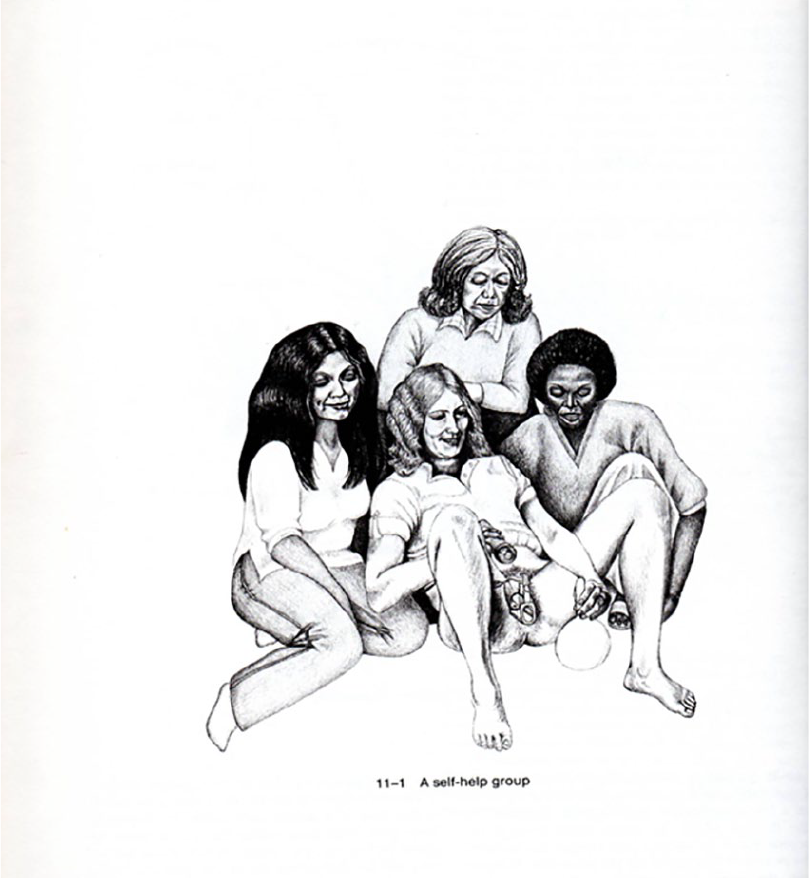
‘A self-help group’, Federation of Feminist Women’s Health Center (1981) A New View of a Woman’s Body, New York: Simon & Schuster.
The ritualized use of a mirror, a plastic speculum and a flashlight recalled the representative function of gynaecological self-observation and anchored nostalgia in objects. Functioning as emblems of the self-help of the 1970s, these objects took part in the repetition of the memory created.
Carolina has a relationship to memory that recognizes the importance given to the recognition of the legacy of previous generations of feminists. Coming from a White middle-class family with high cultural capital, she was introduced to self-help when she discovered feminist zines dating from the 1970s while she was a student in arts. She created a feminist self-help group with friends she met through her anarchist activist sociabilities. It lasted for 5 years. She frames her personal experience in this group as a way of taking part in a feminist genealogy: I think it’s really the historical continuity that’s been important to me. Because I read English and I read a lot of English stuff, stuff from the United States, that nourished my imagination and made me want to stick to this thing or at least to continue in what had been developed there, as practices, as thought, as collective practices. So as a group, we were linked with that. (Carolina, 33-year-old, unemployed, Belgium, 2016).
Memory seems to be a trigger and a catalyst for Carolina’s activism, reminding us how it can be a resource for collective action (Harris, 2006; Payne, 1995). When I asked her about her motivations for proposing and leading gynaecological self-examination workshops, she evoked the original dimension of the practice in historical self-help and insisted on her desire to be part of a feminist ‘filiation’: It has been a founding practice of the historical self-help movement, so it’s a bit like taking part in the filiation, or I don’t know how to say it, in the continuity of this movement. (. . .) I have the impression that this was almost the most obvious, the simplest and the most symbolic tool. I think there’s a very symbolic dimension to it that we don’t discuss so much, but I think it’s there too, it’s like a rite, a ritual, a rite of passage, of integration.
Carolina takes part in the memory work initiated by former self-help activists, revealing a tacit agreement between generations about the importance as well as the content of the transmission. The workshops she organizes, based on the centrality given to history and memory, actively produce a sense of what has been lost. The participants actively reproduce nostalgia in movement practices. Indeed, the ritualized repetition of self-examination expresses the hope to find again what has been lost, that is, a sense of community and solidarity between women, and promotes a sense of belonging to a larger group, as well as to a continuous self-help history. In so doing, it anchors nostalgia in contemporary feminist self-help politics. The intergenerational consensus around the content of memory is particularly striking in contemporary self-help activism compared to other fringes of feminist mobilizations. I argue that this can be explained by the ambition of self-helpers to unify feminists over time and over conflicts.
Collective memory, collective identity and nostalgia
What are the political effects of the promotion of nostalgia and how does it ensure the development of a feeling of belonging? What kind of feminist collective identity is produced and what does it reveal about the political project of contemporary feminist self-help? The production of a nostalgic feeling for the 1970s reveals the hope of regaining what has been framed as the unified feminist subject of that decade. As Clare Hemmings has shown, one way of telling a feminist history marked by nostalgia rests upon a narrative of loss that reframes the 1970s as a ‘past marked by a politicized unity’ (Hemmings, 2005: 126). In the contemporary feminist self-help, this nostalgic account of the 1970s is practically built upon the return to the body and the materiality of women’s lives and experiences. The centrality given to the body specifically reveals the hope for unity through its construction as what ‘all women’ have in common. It participates in the construction of ‘women’ as a unified political category despite the inequalities and differences between them, enabling to assert the existence of a collective identity, a ‘we’, that is not marked by inequalities and conflicts. This hope to find a lost unity can be explained by the social characteristics of contemporary self-help activists: they are widely White middle-class women who try to reaffirm their hegemony on the definition of feminism at a time when feminist Whiteness and cisheteronormativity are questioned.
The pervasiveness of the expression ‘every woman’ in contemporary self-help cultural productions reveals the premise that self-help could be shared by women despite social differences and inequalities. For instance, in a zine presenting ‘feedback on the experience of a circle of women integrating the practice of Self-Help’
2
, the authors affirm they want to show that self-help is ‘within every women’s reach’. Another example can be found in the words of one of the members of the collective Notre Corps, Nous-Mêmes, the group that participated in producing a new French adaptation of Our Bodies, Ourselves, which is a major commemorative initiative of contemporary self-help. She claims about the use of testimonies: The aim is also to make a textbook that is broad and open enough for all women to find their way around. So, it shouldn’t be very prescriptive, but on the contrary, it should bring out testimonies and so on. (Nathalie, 45-year-old, legal expert, 2018)
In this project, the body is built as central to acknowledge the differences between women while stressing their common features: The perspective adopted by Our Bodies Ourselves, and the fact of starting from the body, seemed still relevant to us. It allows us to start from what all women have in common, without being blind to social differences and the experience of other forms of oppression (Membres du collectif Notre corps nous-mêmes and Delage, 2019: 60)
‘The body’ is thus constructed as an ontological given that would unify ‘all women’ despite different social experiences. This idea highlights the commonalities of ‘women’s experiences’ and helps to produce the category ‘women’ as constituted of subjects unified in their difference. The focus on ‘the body’ thus functions in the same way as within the 1970s French Mouvement de Libération des Femmes (MLF; Women’s Liberation Movement): it enables feminists ‘to stress what women have in common’ (Lépinard, 2007: 383). Indeed, as Clare Hemmings has shown in her analysis of the dominant stories that academics tell about the development of Western second-wave feminist theory, ‘when the story is one marked by grief, the contemporary call is for a return to the material contexts of women’s lives’ (Hemmings, 2005: 116). Bodily experiences are framed as what women share, and not as what differentiate them from one another, namely through unequal positions in power relations of race, class or sexuality. Self-help activists insist that women’s relationship to their bodies crosses social differences and is not dependent on the experience of relations of domination. In other words, they define ‘women as a homogeneous category and gender difference as prevailing over other social differences’ (Lépinard, 2007: 383).
The production of ‘all women’ as the political subject of self-help also makes it possible to present self-help spaces, and in particular, the practice-sharing workshops, as inevitably egalitarian spaces, regardless of differences in social position between participants. For instance, for Sophie, a former midwife who organized a self-help workshop based on the practice of self-examination, this practice neutralizes inequalities between women, in particular, those produced by the processes of professionalization in health and the differences in status they shape: The collective workshop and the fact of being each one in self-observation, suddenly we are all from person to person. I mean, whether you’re a midwife or a doctor or whatever it is you are, it doesn’t matter, you’re just a person looking at their own sex, or observing the sex of someone who wants you to look at it. (Sophie, 36-year-old, employee, France, 2017)
Sophie’s remarks show the assumption that through the practice of self-examination, it would be possible to abolish or at least suspend power relations that shape women’s experiences and the way they relate to each other. Self-observation is framed as a means of neutralizing the unequal relationships between participants in self-help sessions, which could, among other things, be a source of tension and conflict within self-help groups. For instance, also for Marine, self-examination plays the role of neutralizing ideological differences between feminists and the conflicts that result from them: I’ve always found it difficult to be part of a group. I think it is really important, but then I have always felt a bit left out. But (. . .) it was really important, it was really great to do it [self-examination] together. To say to each other (. . .) that we had theoretical differences, and at one point we discussed two or three things, and in fact I didn’t agree with some things that were said, and at the same time it wasn’t the right time, we were focused on something, and we were together in that. And that was nice. That was actually important. (Marine, 32-year-old, youth worker, Belgium, 2017)
In the same vein, Isaure also argues that self-examination is a unifying and pacifying practice within feminist movements. She uses an essentialist construction of ‘women’ resting upon a ‘common’ biological body to make her point: For me, what is really interesting in self-examination is that we all have a vagina, and because of that we are in specific social positions and we cannot win, so if we could avoid hitting each other . . . (Isaure, 30-year-old, junior doctor, France, 2018)
The practice of self-examination, as a bodily practice that could address all women, is framed as unifying feminists beyond the plurality of women’s and feminist mobilizations and the heterogeneity of feminist ideological stances.
Conclusion
In this article, I have analysed how memory work is articulated to emotion work, how a narrative of the past is imbued with nostalgia, with the effect of producing a contemporary feminist collective identity attached to self-help practices. In particular, the production of the memory of self-help through the narratives shaped by memory entrepreneurs, who are former activists from the 1970s, and the repetition of origin stories fuel continuity between feminist ‘waves’ and serve the construction of a collective identity characterized by the acknowledgement of the importance of the legacy from previous generations. The memory work in contemporary feminist self-help is also intrinsically linked to an emotion work that shapes a feeling of nostalgia. This specific intertwining between memory work and emotion work also materializes in movement practices. The appropriation by contemporary self-help activists of the memory shaped by memory entrepreneurs, and the ritualized repetition of emblematic activities of the 1970s self-help, such as the sharing of experiences and collective vaginal self-observation, anchors nostalgia in social movement practices and in feminist self-help politics.
The nostalgia produced is both for an imagined past supposedly defined by solidarity and sorority between women and for a fantasized period of unity between feminists. In particular, the nostalgic feeling that is shaped and promoted in contemporary self-help is for the imagined past of the ‘glorious’ 1970s. These years are reframed as marked by women’s unity in their struggle for liberation. The longing for the lost unity of a supposedly uniform 1970s decade rests upon the ‘return’ to the body and to the materiality of women’s lives. Self-examination practices and the sharing of experiences are framed and used to reveal commonalities between women. They are invested as practices that can unite feminists in times of conflict over power hierarchies. This strategy has specific political effects, namely the construction of an idealized image of self-help as a space where a pacified and unified ‘we’ develops and in which equality prevails despite differences. Memory work, in contemporary self-help, through the particular production of nostalgia, thus, contributes to obscuring how inequalities can be reproduced within both self-help and feminist spaces and to reproducing ignorance over power relations.
Footnotes
Declaration of Conflicting Interests
The author(s) declared no potential conflicts of interest with respect to the research, authorship and/or publication of this article.
Funding
The author(s) received no financial support for the research, authorship and/or publication of this article.
