




Abstract
I examine portrayals of digital media and technology in Barbie, analysing Information and Communication Technology (ICT) symbolism in conjunction with the film's thematic commentaries on gender and contemporary affects. I draw my theoretical framework from Tracey Mollet's conceptualisation of twenty-first-century American nostalgia and Donna Haraway's iconic discussion of the cyborg, tracing all appearances of digital screens and devices, media franchises, computer software and virtual platforms in the film. I demonstrate that Barbie consistently associates ICT with toxic masculinity and corruptive futures, while disassociating desirable feminine spaces and interactions from technological artifacts and their use. This gendered representation of technology is contextualised within two competing nostalgias portrayed in the film: a hyperfeminine, commercialised girlhood and a masculine, nationalist and patriotic past. Analysing the strategic placement of digital ICT across the film's settings – Barbie Land, the Real World and Kendom – I illuminate the paradoxical relationship between the film's selectively feminist message and its dichotomous portrayal of technology. This case highlights the challenges of portraying feminism without stakes in popular culture, evoking Sarah Banet-Weiser's observations of neoliberal girl-power narratives in the guise of feminism. Ultimately, I argue that the portrayal of technology in Barbie reinforces biological essentialism, revitalising archaic logics which fixate on the physical gendered body as the motivator for feminist solidarity; moreover, it overlooks the importance of digital spaces in feminist praxis and theory, complicating its status as a pop feminist film.
Several months before the release of Barbie (2023), popular social media platforms such as Instagram, TikTok and X (formerly Twitter) suddenly became inundated with a distinct, recurring photo filter. Usually against a sky-blue background with a spiky, colourful frame, and finished with the signature swirly ‘Barbie’ font, the Barbie Selfie Generator allowed users to place their visages within a poster template of the highly anticipated film. Users not only placed their own photographs within this frame; fictional characters and prominent cultural figures were also placed into the filter's glittery aesthetic and catchy text format, usually as a form of hypertextual or social critique: referencing Azula, a teen villain from the animated series, Avatar: The Last Airbender (2005–2008) – ‘This Barbie's a war criminal!’; referencing pop star Taylor Swift – ‘This Barbie is the reason I have bad blood with Ticketmaster!’; referencing former US President Donald Trump – ‘This Barbie is facing criminal charges!’. The generator was a hit, and its simultaneous functionality as a hip aesthetic framework as well as a memetic form of social critique contributed to a feverish appetite for the upcoming film and its affiliated commodities.
By July, two radio stations had asked me to speak on a recent article I had written about Barbie as a virtual influencer – CGI- or AI-generated characters with social media accounts in their own name, with follower counts so large that they rivalled human celebrities or social media influencers in advertising revenue. At these interviews, however, I realised that there was little interest in evaluating Mattel's efforts to transform Barbie's doll likeness into a cottagecore TikToker, Instagrammer and teen YouTube vlogger for a cumulative count of 14.4 million followers around the world. Rather, the hosts were interested in the intense social media campaign being run, quite successfully, by the upcoming Barbie film. As exemplified by the Barbie Selfie Generator – alongside an outpouring of outfit ‘inspo’ (inspiration) posts by social media creators recreating the pink-coloured, hyperfeminine and summery aesthetic of the costumes shown in the film's press releases 1 – the film's creators leveraged the popular language and dissemination patterns of contemporary photo-sharing platforms and their users. Effectively, the content creation labour of these platforms’ most prominent user base – millennial or gen-Z women – greatly popularised the film before its release, establishing space in the popular digital landscape to an extent that was impossible to ignore. Notably, at the core of these radio hosts’ questions was the notion of nostalgia; specifically, the commercial strategy of reviving nostalgic cultural products for the grown-up, tech-savy millennial consumer. For even before its release, the new Barbie film was upheld as nostalgic marketing's latest success case, with ‘giddy social media commentary’ from female viewers (La Porte and Cavusoglu, 2023: 1) being evidence of that fact.
It is ironic, then, that Barbie places a stark gender binary over technology use within the film's storyline, using new media tools and commodities as visual props in illustrating its masculine version of the doll world, as opposed to a nearly proto-technological feminine alternative. In this article, I first address portrayals of technology and its varying visibilities across the film's three major spatio-temporal backdrops: Barbie Land, the Real World and Kendom. I trace the appearance of all digital Information and Communication Technology (ICT) in the film, particularly the depiction of mobile phones, televisions and computer screens, noting a distinct difference between the near-absence of such technology in Barbie Land; American and contemporary-coded usage of smartphones and desktop computers in the Real World; and the conspicuous emergence of digital television screens, modern computers and televised media in post-patriarchy Barbie Land, otherwise deemed Kendom. In doing so, I question the aesthetic and symbolic role of digital ICT in configuring the film's depiction of gendered time and space, linking this to a brief analysis of the film's interpretation of female empowerment. I draw from the conceptualisation of nostalgia by Tracey Mollet (2020), who refers to a unique progressive-nostalgic tension in post-2009 Disney Princess films which link the American Dream, feminine duality and the search for happiness within the aesthetic glamour of contemporary fairy tales. The recent evolution of both Disney Princess films and the Barbie franchise provides comparative frames of reference for understanding the turn of hyperfeminine legacy products in a post-feminist North American marketplace.
While tasked with the mission of appealing to an increasingly progressive millennial audience, one that demands reference to the changing nature of American identity and social mores, the success of these products depends on their ability to balance these societal commentaries while also evoking the mainstream consumer's idealised notion of the past. Mollet's deconstruction of the oxymoronic progressive-nostalgic fairy tale plot provides a precedent for Barbie, which revives the highly recognisable doll franchise into a witty critique of neoliberal, post-Trump America. Barbie, like contemporary Disney Princess films, succeeds in doubling as hyperfeminine indulgence – illustrating fantastical worlds with beautiful and desirable clothes, spaces, selves and situations – while providing its protagonist with a self-actualising journey which evokes the societal challenges and cultural conflicts of an oppressive and hostile world. Technology plays a crucial role in Gerwig's strategic calibrations of nostalgia in the film. I argue that Barbie's aestheticisation of two versions of twenty-first-century nostalgia, one in the form of hyper-commercialised girlhood and the other in the form of US nationalist, masculine angst for a non-existent past, develops in conjunction with a highly gender-segregated presentation of contemporary technology use and its associated affects, with new media symbolising corruptive masculinity and a hostile future. Ironically, while patriarchal desires and affects are ultimately vilified in Barbie, the film constructs its nostalgic spaces in a way that reifies binary gender norms in digital technology use and access, which entrench patriarchal notions of technological ownership and governance within the message of the film. I critique this pattern of nearly exclusive aesthetic-symbolic correlation between new technology and the latter version of American masculine-coded nostalgia.
Second, I draw from Haraway's ‘A Cyborg Manifesto’ (see: Haraway, [1984] 1991), noting the similarities between the film's illustration of an idyllic, matriarchal doll world and the anti-technological feminine utopia upheld by the goddess movement, which Haraway sought to critique through the symbol of the cyborg. The Barbies in the film share many similarities with Haraway's notion of the cyborg. The dolls’ relationships and communal gatherings have nothing to do with the nuclear family; their sealed plastic bodies will not decay into dust; and in Haraway's words, neither the doll nor the cyborg ‘recognize the Garden of Eden’ ([1984] 1991: 151; see also: Connolly, 2024). Despite the film's playfulness in demonstrating the Barbies’ flexible, self-contained, non-biological bodies in the first part of the storyline, its portrayal of digital technologies and the Barbies’ (lack of) interactions with them uphold the dichotomies which Haraway deems ‘the informatics of domination’: the organic, biological, natural and deistic against the artificial, engineered, scientific and robotic. By invoking Haraway's call to liberate the farcical categories which segregate the liberal human subject, the animal and the machine, in relation to the use of digital ICT in illustrating the film's two gendered nostalgias – one vilified as nationalist and toxic, and one lauded as desirable and life-giving – I demonstrate the continued applicability of ‘A Cyborg Manifesto’ in evaluating contemporary popular media.
I argue that Barbie offers us a compelling case study of how contemporary feminine-coded cultural products, when reaching highly successful levels of mainstream recognition and lucrative commercial gains, are often lauded as feminist triumphs. Yet these strategies of achieving gendered resonance, while couched in narratives of empowerment and recognition, often rely on essentialising narratives which affirm the sexist stereotypes that these products claim to challenge. I illuminate the irony of a film that owes much of its success to the digital marketing and community-making of female content creators, yet portrays technology as a primarily masculine communication method. I close with a commentary of contemporary hyperfeminine memes and intertextual narratives on popular social media platforms today, placing Barbie's popularity and its approach to digital ICT in the larger context of these aesthetic and affective discourses. I assert the need for feminist theory to engage critically with representations of technology in popular media, particularly given the real-world importance of digital spaces for feminist activism and expression.
Conceptualising nostalgia and gendered space
The grounding plot of Barbie is animated by the nostalgia of a Barbie owner in the Real World. Gloria (America Ferrara), a middle-aged Mattel employee, mourns the passage of time through flashbacks of her daughter Sasha's (Ariana Greenblatt) transition from girlhood. In these nostalgic memories, the younger Gloria and a child version of Sasha enjoy playing with Barbies, experiencing moments of mother–daughter connection through dollplay. As Sasha matures into a petulant teen, the Barbies become neglected and boxed away. Barbie dolls simultaneously emerge as a symbol of Sasha's childhood and Gloria's connection to her role of mothering. Barbie Land, the glamorous pink wonderland which provides a home to the Barbies in the film's ‘doll world’, is a manifestation of a Real World woman's nostalgic desires. Yet this version of highly commercialised, female-dominated and pink-coded nostalgia is not the only version that is illustrated in the film. When Barbie Land is flipped into Kendom, reassembled into a blue-toned, horse-patterned and Ken-dominated society after Beach Ken's (Ryan Gosling) encounter with Real World men, it bears the aesthetic signifiers of nostalgia present in American political discourse, film and corporate culture. Arguably, both Barbie Land and Kendom function as gendered space in that both demonstrate inequitable role distribution across their female and male dolls, both citizens of both worlds; aesthetically, they are portrayed with distinctly different colour schemes and material signifiers (Figure 1) which correspond with the pink/blue binary of gendered children's clothes. 2 Mollet's conceptualisation of a specifically North American, post-2010s notion of nostalgia is helpful when we consider the film's feminine aesthetics, millennial audience, American symbols and approach to technology. For Mollet, this romantic past is specifically rooted in US history, prior to 11 September 2001; nostalgia in Disney Princess films – and I argue as well for Barbie – harkens back to a space and time in which digital technologies and social media platforms were nascent or not yet extant.
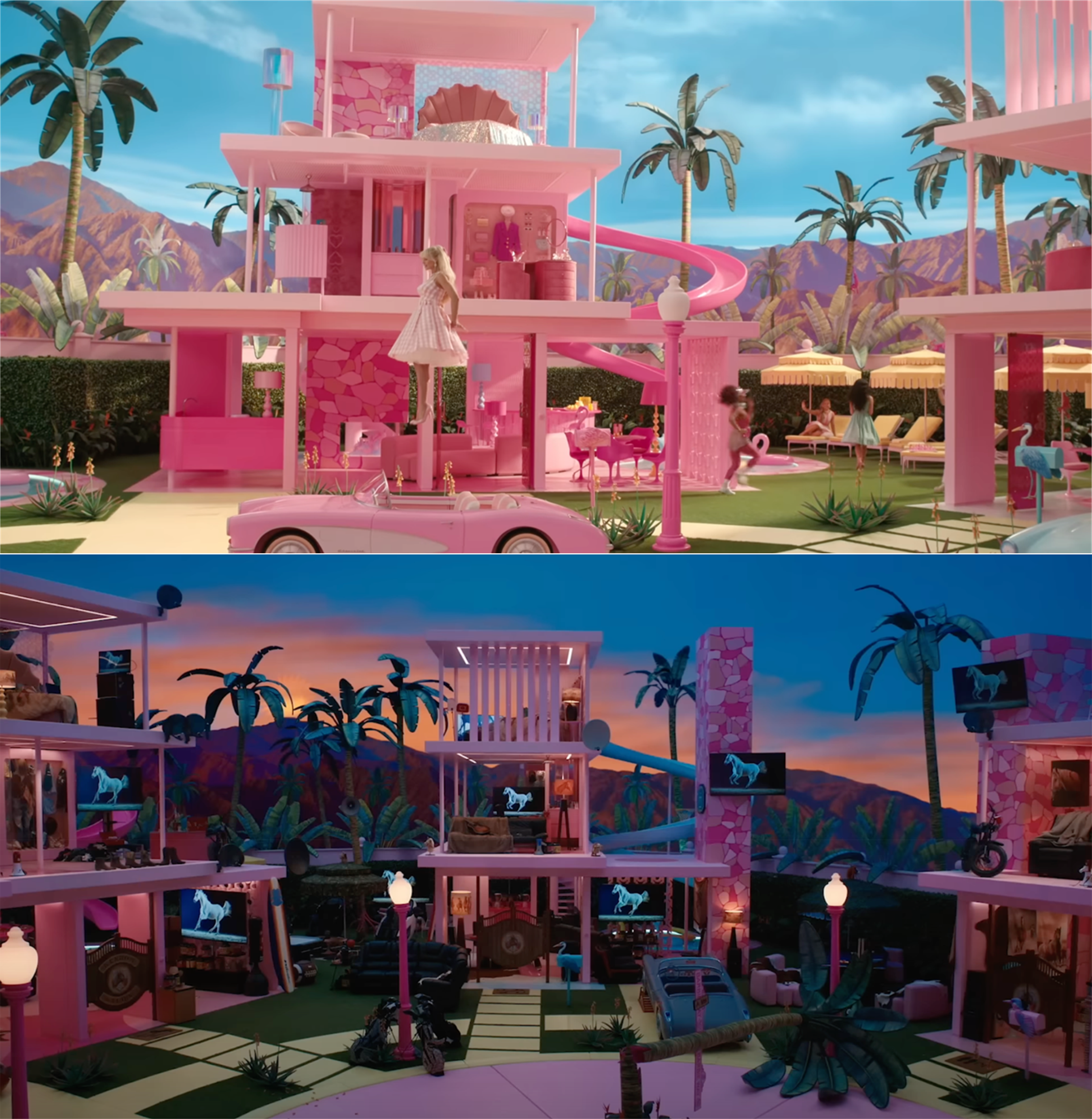
A visual comparison of Barbie Land and Kendom. Alongside cowboy symbolism, beer and horse motifs, large LED monitors have a heavy presence in distinguishing the Kens’ spatial takeover of the former Barbie houses. Source: Warner Bros. Pictures, 2023.
Such a view of the past emphasises the technological nature of present woes, or what came after 9/11: the introduction of data analytics and digital marketing to political campaigns; increased military spending and cyberwarfare; visions of the ‘good life’ mediated through algorithms; the prominence of new aspirational professions within the precarious jackpot economy, a neoliberal ethos in which Andrew Ross determines that ‘intellectual property is the glittering prize for the lucky few’ (2009: 10). Through the example of Disney Princess films, Mollet marks the events of 11 September 2001 as a definitive moment in which American popular culture turned towards nostalgia as an ameliorating affective device to the negative sentiments surrounding personal safety, nationhood and late capitalist survival. 3 Technology forms an indirect, yet significant connection to this political and ethnic timestamp; with most popular social media platforms of the present day having emerged in the early 2000s, millennial nostalgia bears similarities to previous variations of this affect as the desire for a less technologically advanced, ‘simpler time’ (Mollet, 2020: 139), with the added layer of competing political nostalgias between the neoconservative desire for a previously ‘Great’ America and the progressive optimism of a pre-Trump, Obama-era America. Between Twitter-era Trump and data-savvy Obama, digital ICT is interlinked with complex real-world affects for millennial viewers, generating a desire for what Mollet calls the escapist quality of nostalgia media.
Popularly referred to as ‘the last generation that remembers the times of childhood unspoiled with computers and smartphones’ (Lubinski, 2020: 84), millennials are positioned as the primary audiences of reboots of classic toy and media franchises in recent years, such as She-Ra and the Princesses of Power (2020), The Mandalorian (2019) and the Disney Princess live action remakes. 4 These works have each emerged in anticipation of a grown-up audience relying on past cultural commodities to offer critiques of the present, as nostalgic adaptions offer opportunities for viewers to ‘critically juxtapose the past with the present’ (Kennedy-Karpat, 2020: 283). Central to such nostalgic worldbuilding has been the construction of alternative technological storylines which critically differ from our own. For example, while prominent Disney Princess films lean into fantasy visions of a European past to build pre-technological worlds, action franchises such as She-Ra and The Mandalorian illustrate alien systems of technology which are motivated by and function on the logics of a magical world. Mollet asserts that contemporary nostalgia demonstrates ‘an intrinsic relationship to Americans’ conception of the American Dream’ (2020: 135). Accordingly, Disney Princess films of the ‘Renewal Era’ (2009–13) and ‘Reboot Era’ (2014–17), and recent live action films, exemplify adjustments to a nostalgic worldbuilding which not only romanticises the past but satirises a nationalist present through deprecatory self-awareness. Such self-awareness often manifests in the form of empowering, ‘girl-power’ narratives in which conventionally attractive, femme women assert dreams of self-realisation separate from the traditional romance narratives of previous generations. In the post-Trump milieu, these storylines also tend to cast figures who represent toxic masculinity as their most prominent villains.
In Barbie, digital technology functions as a signifier of the ‘contemporary’ and the ‘real’, the appearance of new media technology strategically distributed across its settings. For example, laptop use is shown in both the Real World and Kendom, suggesting a temporal grounding for these worlds, while the lack of comparative digital ICT use renders Barbie Land temporally ambiguous in the presentation of its numerous professions. These dynamics begin from the film's opening, an overtly anachronistic scene. Like in a nature documentary, the camera pans over parched land and trees, the sun emerging across the expanse of the horizon. ‘Since the beginning of time’, the Narrator (Helen Mirren) intones, as a gaggle of young girls in vintage pinafores – and one in modern glasses – play half-heartedly with baby dolls. Then emerges Stereotypical Barbie (Margot Robbie) in the original style of the doll at its debut – in high heels and a black and white swimsuit – who winks down at the girls. This aesthetic collision of a seemingly prehistoric setting, with girls wearing European – or colonial American – nineteenth-century garb, encountering an outsized Barbie in the style of a 1950s fashion doll, sets the stage for the alternative temporality of the Barbies. Other Barbies appear in a montage set against a white background stripped of spatial or temporal markers. The Barbies are multi-ethnic and depict a multiverse of careers and lifestyles through their clothes and accessories. ‘Barbie’, the Narrator explains, ‘can be anything’.
I draw attention to the anachronisms of the film's opening scenes for the reason that this non-normative approach to time continues to be interlinked with the film's two major points of conflict; one of gender, which pits the female-dominated society of Barbie Land against the patriarchal vision of Kendom, and the other of Barbie's selfhood, which culminates in her ultimate decision to become a real woman in the Real World. I particularly focus on techno-anachronisms – specifically the presence or absence of ICT as it emerges in the film – as the strategic placement of digital television screens, phones, computers and media franchises connotes spatio-temporal difference across the three distinct backdrops of the film. Why does the luminous pink environment of Barbie Land yield almost no depiction of ICTs and their use, despite parallel portrayals of modern plumbing, electricity, sewage systems and space technology? Conversely, why is the material and cultural landscape of Barbie Land after Beach Ken's patriarchy-inspired coup (‘Kendom’) dominated by digital screens, media engagement and ICT use?
The gendering of digital ICT
Prior to Stereotypical Barbie and Beach Ken's entry to the Real World, the normative state of Barbie Land largely functions without the role of ICT. Relationships and affinities are demonstrated through face-to-face communication, and despite the depiction of Journalist Barbie (Ritu Arya), who uses a mic and camera system, and the desk of President Barbie (Issa Rae), which holds a laptop and phone, there is no reference to how telecommunications and new media play a systemic role in structuring the daily lives and experiences of Barbie Land's citizens. As such, the first time that a digital screen is depicted in the film is from Beach Ken's perspective in the Real World. The beginning to a dramatic montage illustrating Beach Ken's encounter with Real World masculinity, a collection of billboard-sized screens in an urban office building illustrates Bill Clinton, horses and Ronald Reagan. The heavily nationalist symbolism in this selection, via the two former US presidents, and the cowboy culture associated with the image of a thrashing horse, ties the visual presentation of masculine nostalgia with a distinctly American flair.
This scene is soon followed with an illustration of two office environments which symbolise American hegemony – state power in the form of a CIA office cubicle, and neoliberal capitalism in the form of a Mattel office cubicle, both similarly portrayed with dark grey desktop phones and computers. Meanwhile, Barbie sits at a bus stop as she observes the natural foliage and people of her environment, experiencing her first bodily manifestation of negative affect (‘That felt achy, but good’) and an encounter with an elderly woman whom Stereotypical Barbie deems ‘beautiful.’ Throughout their brief exchange, the camera lingers on the elderly woman's visible markers of age; like the previous reference to cellulite, the biological female body, unlike the Barbies’ toy femininity, points to a mortal ending. The contrast between Beach Ken's and Stereotypical Barbie's encounters with the Real World, and their respective proximities to technology and biological mortality, serves as the starting point to the two characters’ gender-segregated journeys throughout the film. Beach Ken's introduction to nationalist patriarchy is digitally mediated through screens portraying the temporally frozen, televised visages of ‘larger-than-life’ figures, such as US presidents and the fictional character Rocky. Meanwhile, Stereotypical Barbie's introduction to Real World affect and the human experience continues to occur through face-to-face interactions with ordinary women bearing signs of biological decay, or through affective visions and flashbacks which emphasise biological relationships such as that of a mother and child. Accordingly, when Beach Ken returns alone to Barbie Land and proceeds with its transformation into a Ken-dominated space, the fantasy world of Barbie Land / Kendom suddenly takes on far more explicit parallels with Real World technology.
When Stereotypical Barbie brings Gloria and her daughter Sasha to the changed Barbie Land, the cul-de-sac encompassing Barbie's former Dreamhouse – now Ken's Mojo Dojo Casa House – is so inundated with wide-screen TVs that almost every cut in the scene shows a corner of an LED screen. Like Ken's first introduction to Real World patriarchy, the audience's introduction to Kendom patriarchy is in the form of televised remediation, depictions of a changed social order explicitly summarised in the form of a modern news cast. The prevalence of new media tools and the cultural impact of Real World cinema also play a large role in the Barbies’ plan to return Barbie Land to its former self. Backed into a corner – in this case, the hilltop home of Weird Barbie and her gang of discontinued dolls – Barbie and her human guests come up with the idea to separate the Barbies and Kens who have internalised Real World misogyny, distracting the Kens with sexist scenarios in which they can swoop in to ‘rescue’ the Barbie agents. The gang sets out to de-programme the Barbies one by one while the Kens are turned away. The first sabotage mission involves one of the Barbies (portrayed by Alexandra Shipp) sitting coyly with a laptop, lamenting her difficulty in using the editing software Photoshop; a passing Ken (Simu Liu) saunters over to mansplain computers while the brainwashed President Barbie at his arm (Issa Rae) is swept away to be healed of sexism. The second mission involves President Barbie overtaking another Ken (Kingsley Ben-Adir) watching The Godfather, a widely acclaimed gangster film from the 1970s, distracting him via an invitation to mansplain the film's significance. Finally, the latest un-brainwashed Lawyer Barbie (Sharon Rooney) approaches yet another Ken (Scott Evans) with questions about a digital banking system, leading him to mansplain the platform while Physicist Barbie's (Emma Mackey) rescue ensues. Notably, these schemes are supposedly based on the Kens’ condescending expectation that the Barbies are less versed in the use of ICT tools and software, digital platforms and media franchises. Yet the film itself rarely shows the Barbies engaging in these technologies or commodities before or after these brief encounters.
It is notable that the first time that Barbies are depicted using contemporary technology equivalent to the temporal setting of the film's Real World 5 is in the commercial for Depression Barbie. This scene takes place immediately following Stereotypical Barbie's breakdown in Barbie Land / Kendom following an altercation with Beach Ken and his appropriation of her home. In the hyperbolic commercial, Barbie dolls with unkempt hair and dramatic mascara-toned tear streaks across their cheeks peer into smartphones and laptops in bed. A cheerful voiceover tells us that Barbie has been using Instagram to creep on her former friend and binge watch the BBC's 1995 version of Pride and Prejudice for hours (see Gillis, 2024, for more on this). In addition to the descriptor of Depression Barbie, the commercial's disclaimer associates feminine digital behaviours with ‘anxiety, panic attacks and OCD [obsessive compulsive disorder]’. Ultimately, while the parodic exaggeration of common digital practices, such as voyeurism, repetitive consumption of ‘shallow’ media and bad posture is humorous and relevant for the audience, the Barbie dolls and humans portrayed in this commercial are entirely female, contributing to the notion that women are naturally antagonistic to or unfit for technology use.
This persona of the emotionally unstable, femme and demotivated young woman is part of a larger narrative which Ayesha Siddiqi (2022) deems ‘the glamorisation of failure’ in contemporary popular media. Siddiqi critiques the recurring trope of an unhappy white woman as the stand-in to represent the malaise of millennial adulthood, with such stories of self-discovery and authentic living romanticising ill behaviour and the urge to reject responsibility of all kinds. Siddiqi's discussion of this peculiar kind of privileged feminine affect illuminates a recent spate of fatalistic social media narratives which glorify stereotypically feminine aesthetics and behaviours. One example is ‘girl math’, a TikTok term which satirises the quotidian financial decisions that young women make within the absurdities of an affordability crisis: ‘Anything under $5 is free’; ‘Spending $20 more to achieve free shipping is a good investment’; ‘If you buy a $90 dress for $80, it means you earned $10 through shopping’; and so forth. While this discourse affords visibility of the psychological experience of personal finance, particularly for those who have lived their entire lives with constant and pervasive advertising, the notion of ‘girl math’ echoes beliefs which cast female consumers as hysterical, unpredictable, vain and dominated by emotional whims. The connection between such tropes and paternalistic concern around digitally savy young girls on social media today has been saliently noted by Brooke Erin Duffy (2017). Whether in the context of a fin-de-siècle mall or the algorithmic marketplace, Duffy notes, young women have long been perceived as depressed spendthrifts driven by envy and materialism for pretty things. Such is the image of young womanhood portrayed by the Depression Barbie commercial: users rather than engineers of technologies, and prone to being swayed and influenced by the digital advertising infrastructures around them.
Amnesiac relief for real-world burdens
Gerwig's strategic placement of new media depictions and characters’ encounters with ICT returns us to two alternative conceptions of this contemporary nostalgia. Through the appearance of Ronald Reagan on the Real World screen that Beach Ken sees, viewers of Barbie may conceivably remember his popular 1980s slogan ‘Make America Great Again’. The subsequent cultural impact of this slogan in 2023 following its reboot for Donald Trump's successful 2016 campaign offers a strain of nostalgia which is positioned as a corrupting element in the film. I mean corrupting in the sense that Beach Ken's behaviour and values change drastically following his encounter with this American neoconservative imagery, such as violent, loud outbursts in conversations with Stereotypical Barbie, and appropriation of her home. Meanwhile, the consistent lack of digital ICT use in Barbie Land, as well as the irrelevance of ICT-mediated connection in the interaction of its female characters within and outside of the Real World, leans into the nostalgic urge for a ‘simpler time’ without either political complications or the saturation of digital technology in daily life.
This film's wariness of technology is worthy of critique; by linking feminine empowerment with proto-technological nostalgia, Barbie foregoes liberatory cyborg realities which resist the notion that technology is inherently in the hands of hegemonic power. As declared by the xenofeminist collective Laboria Cuboniks (2015), digital realities demand imagination, cunning, nuance and persistence. Technology is neither inherently progressive nor toxic; within the vast expanse of the web, digital ICT mediates discourses of the marginalised, such as by providing ‘diasporas within diasporas’ for queer members of migrant ethnic enclaves. 6 Data-savy fans, often denigrated as teen fangirls, mobilise to produce meaningful archives and enable democratic access to creativity and cultural production on the web. 7 Within augmented or immersive virtual worlds, those of all bodies are invited to ‘toy with power dynamics […] empowered via creating new selves, slipping in and out of digital skins […donning] different corpo-realities’ (Legacy Russell, 2020: 13) to transcend binary codes of identity and the biological body. I argue that the film's nostalgic approach, turning away from these ongoing discourses of digital play and the unique affordances of gender abolition offered by digital space, evokes a twenty-first-century revival of what Haraway ([1984] 1991) critiques as ‘goddess’ feminism. Haraway's manifesto, in which she famously quipped that she would ‘rather be a cyborg than a goddess’ ([1984] 1991: 181), was originally written in reaction to a movement which urged women to find empowerment in nature, fertility and archaic feminine deities. In the cyborg, a figure removed from religious, nationalistic and colonial origin stories, Haraway found hope for a sorely needed framework and praxis of integrating different, yet interlinked lived experiences of oppression and marginalisation. Her concern against the goddess movement, which both essentialised and exceptionalised feminist political identity by tying it to the biological female body, is meaningful to revisit in light of Gerwig's approach to female empowerment via calibrations of technology in the film.
While the Barbies eventually reclaim Barbie Land from the Kens, successfully returning the land to a pristine, pink and proto-technological version of its former self, and returning a Black president to her seat (at once a nostalgic and futuristic vision at this moment in US politics), the audience is left with the sense that the iniquities of this gendered space – in which the Kens are subservient and the Barbies rule – will return along with a retirement of the Real World-inspired screens. To the end, technology in the film is disassociated from hopeful futurity, female joy and community, portrayed as a corrupting influence to be overcome for the ‘good old days’ to come back and set things back to the way they were. This interpretation of gender and digital ICT is disappointing as well as harmful; while digital platforms continue to provide opportunity for toxic masculine spaces to flourish, new media has also ‘afforded spaces and places for popular feminists to create media, voice their opinions, and launch businesses […] women largely populate many of the most visible genres of social media production, and digital media in general is crucial to the heightened visibility of popular feminism’ (Banet-Weiser, 2018: 18–19). By crafting two visually striking doll worlds, each with its own variation of gendered Real World nostalgia, Gerwig flattens the complex relationship between gendered identity, technological affinity and digital ICT use.
The duality of choice
In the film's final scenes, the apparition of Mattel's former CEO, Ruth Handler (Rhea Perlman), sagely warns Stereotypical Barbie about the negative aspects of human society and the mortal experience. Barbie states her reason for seeking humanity on the basis of ‘creation’: rather than being a created being, she declares a desire to join the creators of the world. Remarkably, the visions which subsequently emerge from Barbie's perspective are scenes of family and motherhood, rather than those of other creative activities. In an emotional montage of what appears to be grainy home videos of ordinary women, infants, young girls, teens and old women celebrating life milestones and a spectrum of diverse affects, procreation is posed as the most prominent form of creativity which distinguishes the doll–human binary. This implication obfuscates a humorous moment from a previous scene, in which Stereotypical Barbie's declaration of having no vagina – as well as a fully sealed body – is framed as an empowering rebuke to a gaggle of leering construction workers in the Real World. Inevitably, the viewer is left wondering after this montage why other forms of creativity in the human world are not expressed; the film, after all, owed many of its audiences to the digital creativity of numerous women. Instead, the film's ending scenes align with Barbie's encounters with the Real World throughout the film; beginning with Gloria's thoughts of mortal decay and changes to the biological body, Barbie's journey ends in a gynaecologist's office, confirming to the audience that she now has a vagina. Ultimately, the juxtaposition of masculine-nostalgic space and feminine-nostalgic space, which are respectively coded as being technologically aligned and technology-agnostic, frames the climactic decision of the protagonist to join the Real World and her consequent induction into a biological female body. Gerwig's decision to position ICT use and other forms of digital creativity away from Barbie's interpretation of creation and human agency, instead to highlight a technology-agnostic approach to gendered adulthood with the looming potentiality of motherhood, results in a questionable disassociation between gender and technology throughout the film.
Following the overturning of Roe vs. Wade, it is also a curious direction on illustrating biological female agency. As mentioned at the outset of this article, the gendering of ICT in the film is particularly intriguing given the role of female creators on popular social media platforms such as Instagram, TikTok and Pinterest, who arguably played a critical role in viral bursts of public interest in the film prior to release. Moreover, the exclusion of ICT in Barbie Land and Barbie's cinematic journey diverges from the character's variations as numerous digitally mediated commodities, such as Mattel's efforts to commercialise Barbie's ‘voice’ in the form of an app on Amazon's Alexa system, a virtual YouTuber and the headline avatar of a hugely popular virtual world. 8 Perhaps Barbie's decision is best symbolised by the pink Birkenstocks she sports in the final scene, a compromise between a hyperfeminine girlhood and the stark pragmatisms of the world ahead. However, the duality of feminine mortality and modern science present in the gynaecologist's office critically limits alternative visions of gendered creative potential and the role of ICT in augmenting these potentialities. The decision to portray digital ICT as exclusively in the realm of masculine worlds, and prone to causing emotional trouble in mediating personal lives and interpersonal relationships, comes with real harms in a world with limited diversity and representation in technological design and governance. For example, equitable pay, representative hiring and leadership in the major tech companies which dominate the world's digital realities continue to persist, 9 particularly as the stakes grow ever higher with the emergence of publicly accessible generative AI tools. More than ever, it is important to validate and acknowledge existing bodies of work which present alternative cyber-realities and follow the boundary-defying work of feminists engaged in science and technology. Accordingly, an analysis of Barbie's ICT symbolism, which draws catharsis from a blanket rejection of the politics surrounding technology and futurity, arguably complicates its cult status as a modern pop feminist film.
Through my analysis of the representation of digital ICT across Barbie's different settings, I have noted the paradoxical relationship between the film's selectively feminist message and its dichotomous portrayal of technology. I stress through this example that popular feminist narratives can inadvertently reinforce biological essentialism and overlook the importance of digital spaces for modern feminist practice. This problematic state of affairs is complicated by the reality that female content creators and audiences are often complicit in propagating these essentialist narratives for the sake of nostalgic pleasure and visibility. Within this context, Gerwig's Barbie illustrates the challenges and limitations of portraying a feminism without stakes in popular culture. Accordingly, the film's ending confirms a belief which Banet-Weiser describes as being intrinsic to popular misogyny; that ‘men are suffering because of women in general, and feminism in particular’ (2018: 5). Despite asking for a modicum of representation in the place where they all live, the Kens are denied a place on the Supreme Court and there is a reversion to life without homes, clearly defined or recognised professions and identities of their own which are independent of the Barbies. It is an ending that rejects the liberatory possibilities of institutional change, opting instead for momentary catharsis. While this is an attempt on the part of Gerwig to critique gender oppression in reverse, the film ultimately recreates a hierarchy of valued (doll) bodies in opposition to those who lack citizen rights, agency, selfhood. Despite its flamboyant subversions, it is dispiriting that for Barbie Land, just as in our real world, models of equitable society elude us.
Footnotes
Declaration of Conflicting Interests
The author(s) declared no potential conflicts of interest with respect to the research, authorship, and/or publication of this article.
Funding
The author(s) disclosed receipt of the following financial support for the research, authorship, and/or publication of this article: This work was supported in part by doctoral funding from the Social Sciences and Humanities Research Council and Department of Canadian Heritage during the research, authorship, and publication of this article.
