




Abstract
This article employs the concept of respectability and the discursive representation of gender equality policies to discuss how surrogacy is represented in Nordic parliamentary debates and policy documents. The article’s objective is to study how respectability, problems and equality are represented and discursively and rhetorically produced through a comparative study of Finnish and Norwegian political discourses on domestic unpaid surrogacy and cross-border commercial surrogacy. The article uses rhetorical and discursive analysis to analyse the Finnish and Norwegian Parliaments’ bills, members’ initiatives and proceedings from 2002 to 2018. Finland’s policy on surrogacy has evolved from an unregulated and permissive approach towards a more restrictive one, with discourses focusing on medicalisation, equality, altruism and safety concerning domestic surrogacy and problems and risks concerning cross-border surrogacy. Norway’s policy on surrogacy has been restrictive consistently, with discourses focusing on surrogacy as a transnational social problem involving exploitation of women and children, and biocentrism. Analysing surrogacy regulation in Nordic welfare states, the author concludes that policies and parliamentary debates in both countries have expressed expectations for inclusive health policies and social security for families. Cross-border surrogacy is characterised as an unwanted consequence of globalisation and marketisation of reproduction. Surrogate mothers’ respectability is constructed through rhetoric on differences in terms of nationality, class and binary representations of female caring and instrumentalism.
Keywords
Cultural politics of surrogacy
Very few countries globally have legalised commercial surrogacy (Schurr, 2018). In a resolution from 5 April 2011, the European Parliament ‘asks Member States to acknowledge the serious problem of surrogacy which constitutes an exploitation of the female body and her reproductive organs’ (European Parliament Resolution, 2010/2209[INI]). The resolution portrays surrogacy as a social problem, even though surrogacy already is legal in some EU member states, with several others considering legalisation of domestic unpaid, or altruistic, surrogacy as an alternative to cross-border commercial surrogacy. The global surrogacy market is characterised by rapid changes and the development of new surrogacy destinations and new markets (Schurr, 2018; Whittaker, 2018). By the term ‘reproflows’, Inhorn (2010) refers to the increasing transnational travelling of gametes, embryos and reproductive labour and reproductive travellers. In cross-border surrogacy, tensions occur between global and local applications, emphasising differences in class, race and cultural understandings of reproduction, kinship and reproductive labour (Pande, 2011; Waldby and Cooper, 2008; Whittaker, 2018). The marketisation of reproduction and cross-border reproductive travel also challenges Nordic welfare states’ biopolitical governance of reproduction (Kroløkke and Pant, 2012).
The application of assisted reproductive technology (ART) varies globally, often with regional patterns (Melhuus, 2012: 110). Nordic nations’ ART policies differ greatly regarding treatment accessibility and donor anonymity (Nordic Council of Ministers, 2006: 73–78). Compared to other Nordic countries, the Finnish ART policy is permissive, combining a state-funded care sector with a wide range of private care provision, including egg and embryo donation (Eriksson, 2016; Homanen, 2018). The policies do share an emphasis on equal opportunities and gender equality, contributing to rather permissive ART policies in Nordic countries, except Norway, which has one of the most restrictive policies in Europe (Nordic Council of Ministers, 2006: 78; Spilker, 2016: 100–103).
Surrogacy remains an unresolved issue among Nordic nations’ reproductive policies, having become a debate topic in media and party politics in the past few decades. Individual surrogacy cases that have led to conflicts or legal disputes often elicit media attention. Headlines such as ‘Surrogate mother for a Norwegian couple died after birth’ created a controversy in Norwegian media in 2013 after an Indian surrogate mother pregnant with twins died of jaundice (Tjernshaugen and Dommerud, 2013; author’s translation). Media representations on TV, in movies and in news media often create stereotypes based on certain dramatic surrogacy cases, which form the basis for how individuals perceive surrogacy as a social problem (Markens, 2007: 102–103). Stories about the Indian surrogacy industry was for long common in global media framings of surrogacy as a social problem and a public health policy issue. Situating surrogacy representations in the context of stratified reproduction, this study illustrates intersections of race, class and gender in public surrogacy discourses (Markens, 2012).
This article employs the concept of respectability (Skeggs, 1997) and the discursive representation of gender equality policies (Bacchi, 1999; Lombardo et al., 2009) to analyse framings of surrogacy in Nordic parliamentary debates and policy documents. The article’s objective is to study how respectability, problems and equality are represented and discursively and rhetorically produced through a comparative study of Finnish and Norwegian political discourses on domestic and cross-border surrogacy. A secondary objective is to summarise two decades of policy development regarding surrogacy in both countries. The study uses rhetorical and discursive analysis to analyse the Finnish (Eduskunta) and Norwegian (Stortinget) Parliaments’ bills, member initiatives and proceedings from 2002 to 2018. The study is comparative, illustrating how Finland and Norway have taken different legislative approaches to surrogacy and different discursive framings of the issue. Finland so far is the only Nordic country that has practised non-commercial in vitro fertilisation (IVF) surrogacy at domestic clinics, but surrogacy since 2007 has not been permitted under the Act on Assisted Reproduction (1237/2006). A Norwegian single woman was stuck in India with stateless twins born to a surrogate in 2010. The Volden case brought transnational surrogacy to the Norwegian political agenda through broad media coverage, framing it as a troublesome case contesting perceptions of motherhood and citizenship (Stuvøy, 2018). Drawing on analysis of parliamentary debates and policy documents, this study analyses how Finland’s domestic surrogacy policy has evolved from a permissive approach towards a more restrictive one, while Norway consistently has maintained a restrictive policy in dealing with the consequences of cross-border commercial surrogacy.
Respectability and discursive representation of gender equality policies
The concept of respectability is relevant in relation to debates about surrogacy because they are often rooted in value conflicts regarding gender roles, family norms, reproductive autonomy and reproductive rights. According to Skeggs (1997), researchers should study class and gender intersections to represent power relations accurately. Skeggs describes respectability as a signifier of class, race, gender and sexuality, that is, a tool for how they are disciplined and categorised. Respectability is one of the key mechanisms through which some people are categorised as the ‘other’ (Skeggs, 1997: 1).
Through ethnographic research conducted among women enrolled in a British college course on caring, Skeggs found that tasks related to caring or mothering were considered respectable female positions. Working-class women constructed themselves as caring women by developing self-identities through practices associated with caring. This involved skills such as cleaning and cooking, but also a social disposition of caring as a personality type, including qualities such as being considerate, sympathetic, gentle, reliable and never selfish (Skeggs, 1997: 67–72). These women’s desire to be viewed as respectable motivated them to volunteer for unpaid care work. However, respectability ‘is always under evaluation and never guaranteed’ (Skeggs, 1997: 72). Thus, respectability is not a guaranteed result of caring practices.
I argue that while surrogacy can be described as a task related to caring and mothering, or ‘mother-work’ (Pande, 2010) or ‘clinical labour’ (Waldby and Cooper, 2008), the respectability of surrogacy is sometimes represented as being lower than many other mothering tasks, particularly in connection to understandings of otherness in terms of class, race or nationality. Furthermore, gendered public representations of surrogacy often vary depending on whether it is paid or unpaid and thus characterised as commercial or altruistic. However, distinctions between altruistic and commercial surrogacy are conceptual abstractions, rather than exclusive models. Kroløkke and Petersen (2017) use the concept of bio-intimacy to study the role of intimacy and the gift/commodity dichotomy in uterine transplantation and surrogacy. Kroløkke and Petersen (2017: 207) demonstrate how these technologies are embedded within hegemonic structures of feminised intimacy when they are positioned within an altruistic framework, characterised by female attributes of self-sacrifice, gift giving and family devotion, thereby ethically legitimising this biotechnology.
Ethnographic feminist research among surrogates in India and the United States has shown that altruistic motives often are part of commercial surrogacy arrangements (Berend, 2016; Pande, 2009, 2011; Rudrappa and Collins, 2015; Smietana, 2017). Pande (2011) argues that Indian surrogates often downplay surrogacy arrangements’ economic and contractual aspects, instead emphasising surrogacy as a ‘gift’ or a ‘mission’ and viewing their transnational relationships with the intended mothers as part of a global sisterhood. According to Pande (2009), Indian surrogates negotiate their challenges by constructing new bases for kinship, for example, through their experience of sisterhood or an understanding that their blood nourishes the foetus. Rudrappa and Collins (2015) argue that market actors have justified the Indian commercial surrogacy market through moral frames of compassion and altruism. The authors identified narratives of surrogacy as empowering and liberating surrogate mothers and furthering reproductive rights. Due to the cost associated with US surrogacy arrangements, the neoliberal commercial US surrogacy market attracts a clientele of wealthy intended parents (Jacobson, 2020; Thompson, 2016). However, in a study of meaning-making practices at a surrogacy support website, Berend (2016) argues that economic, contractual and personal relationships are interconnected in surrogacy in the United States. Through fieldwork on commercial surrogacy in the United States among surrogates and gay fathers, Smietana (2017) concluded that affective narratives were used to de-commodify the relationships between surrogates, intended parents and children. These affective narratives co-existed with economic narratives, as well as altruistic and commercial ones.
Several feminist authors have analysed how the meaning of gender equality is constructed discursively or contested in policy debates (e.g. Bacchi, 1999; Forest and Lombardo, 2012; Lombardo et al., 2009). The concept of gender equality sometimes is defined as non-discrimination in a legal sense and is understood in relation to a particular policy or a specific interpretation of an issue. Another common definition of gender equality is equal opportunities for women and men in the labour market. However, both definitions diminish the meaning of gender equality (Lombardo et al., 2009: 4).
Previous studies of policy debates on ART have addressed hidden meaning structures relating to gender equality, for example, how kinship is understood as substance, that is, how human biogenetic substances are given meaning through policies, discourses and representations. Some studies have found narratives describing oocytes, sperm or embryos as future children, or as gendered representations of parenthood (Almeling, 2011; Eriksson, 2016). Almeling (2011) found gendered understandings of gamete donation in clinics’ representations of sperm donation as ‘a job’ and egg donation as ‘a gift’. Spilker and Lie (2007: 329–330) noticed that eggs and sperm often metonymically represent women and men in Norwegian parliamentary debates on egg donation, respectively. The importance of parenthood and equality was emphasised even at the cellular level.
Methods and material
The study’s method, rhetorical and discursive analysis, entails a combination of critical discourse analysis (CDA) (Fairclough, 1992), Bacchi’s and Eveline’s (2010) What’s the Problem approach and metaphor analysis. CDA analyses not only the text itself but also its social context and how it is received and interpreted. According to the CDA approach, text analysis can detect social structures beyond explicit, specific statements in the text. Bacchi and Eveline (2010) suggest that researchers should study meanings that a problem is given, the underlying presuppositions or assumptions of the representation of the problem and how the problem is discursively constituted in the policy or policy proposal. Furthermore, policy studies should analyse the effects produced by the representation of the problem. (Bacchi and Eveline, 2010: 114, 117) Through their effects, policies can reinforce social categories based on, for example, sexual orientation, class or gender (Bacchi and Eveline, 2010: 112).
I identify discourses by searching for similar meaning constructions and by analysing how words are given fixed or indefinite meaning. I searched for key words in documents, for example, ‘surrogacy’ and ‘equality’, and thereby got an overview of prominent terms and articulations. After this initial coding, I deepened the analysis of key sections and studied connections between articulations, and whether terms were used in different ways.
I also analyse competing discourses, paying particular attention to problem representations in distinctions between altruistic and commercial surrogacy, distinctions between domestic and cross-border surrogacy and aspects concerning respectability and equality. By the term problem representation, I build on Bacchi’s (1999) understanding of the discursive construction of social problems in policy documents, including discursive constructions of subject positions, for example, surrogates as discriminated or competent women. Metaphors and metonymy (i.e. concepts are referred to by closely related words) are analysed as rhetorical representations providing discussions a certain direction by concealing some aspects and reinforcing others. In discourse analytical metaphor analysis, ‘metaphors are viewed as being ‘conceptual in nature’ and essential for the creation of social realities (Musloff, 2012: 302).
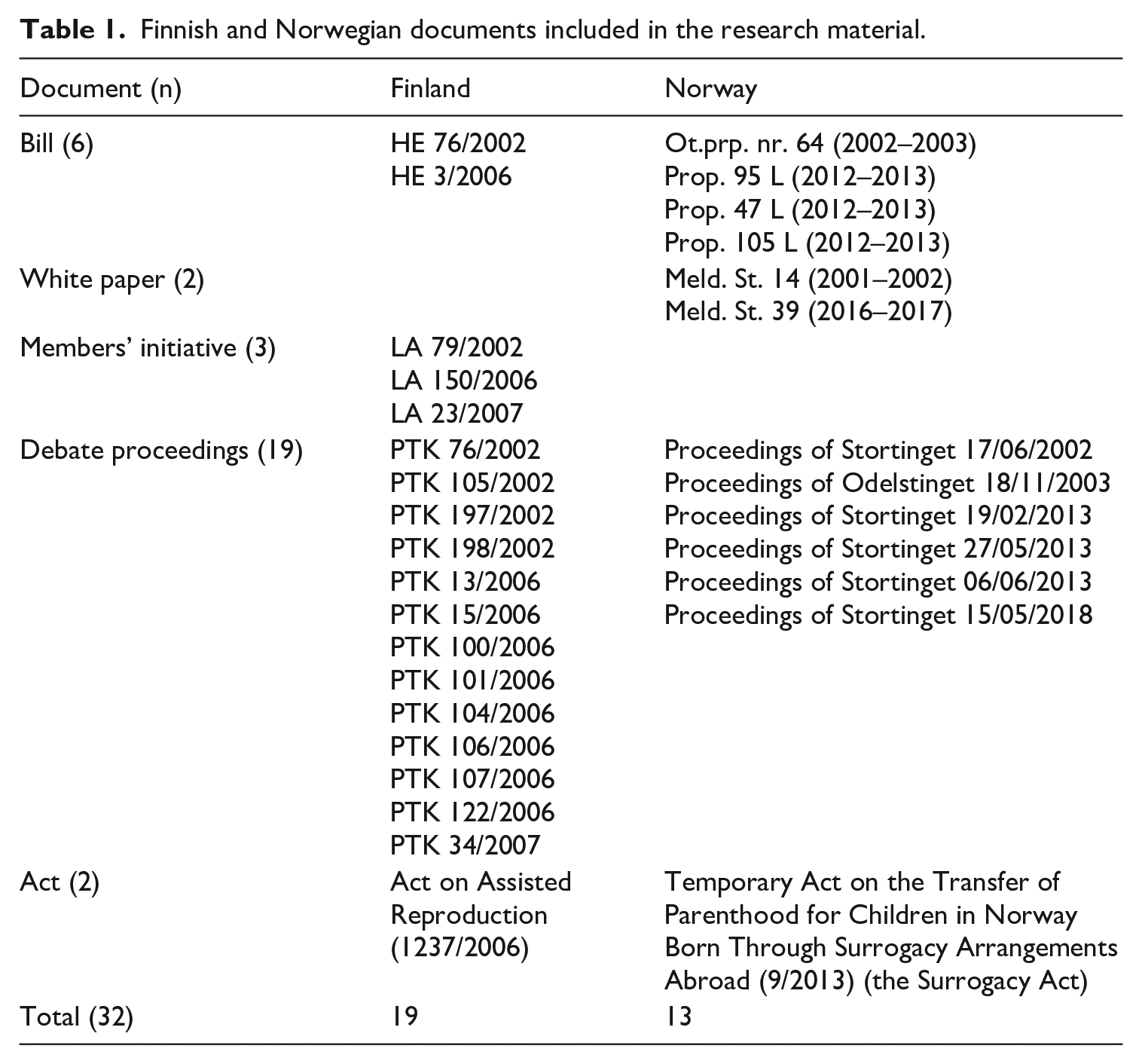
The research material comprises laws, bills, members’ initiatives and parliamentary proceedings of plenary debates from 2002 to 2018 (see Table 1). This period includes the most relevant Finnish and Norwegian policy proposals and parliamentary debates that relate to surrogacy. Some of the legal sources and debates specifically concern surrogacy, while others concern surrogacy as part of the broader legislative issues of ART and biotechnology. Due to the material’s extent, I have chosen not to include parliamentary debates that primarily concern adoption, marriage, motherhood or fatherhood. My analysis focuses on debate proceedings, as they express competing discourses and are linguistically versatile data. All documents are publicly available at the parliaments’ websites.
Finnish and Norwegian documents included in the research material.
Surrogacy regulation in Finland and Norway
Despite healthcare budget cuts due to economic crises and neoliberal economic policies, the Nordic welfare states have remained relatively strong, sharing the ideals of gender equality and inclusive health policies. However, issues concerning gender equality are a potential minefield in Nordic policy debates on surrogacy because of multiple interpretations of reproductive autonomy and rights. This includes competing framings of surrogacy as exploitation/inequality and opportunity/choice (Markens, 2012; Rudrappa and Collins, 2015), for example, in relation to altruistic surrogacy as motivated by pressure or a wish to help. There are no statistics on cross-border surrogacy among Finnish and Norwegian citizens. The United States is a popular surrogacy destination for Norwegians (Stuvøy, 2018: 21), while Finns go, for example, to Ukraine, Russia and the United States, according to my fieldwork and interviews with intended parents.
From 1991 to 2007, surrogacy was practised on a limited scale at four Finnish clinics, which offered surrogacy arrangements only on medical grounds to heterosexual couples. Less than 20 babies were born as a result of these treatments (Kanckos, 2012: 201; Söderström-Anttila et al., 2002). Some of the intended mothers had no uterus, either since birth (e.g. the Mayer-Rokitansky-Küster-Hauser (MRKH) syndrome) or from a gynaecologic disease or severe childbirth complications, while others had uterine abnormalities or other medical conditions that carried high risks for pregnancy complications. A prerequisite of the surrogacy arrangements was that the intended parents had to find a surrogate themselves. These Finnish surrogate mothers were unpaid on an altruistic basis and usually were a close relative or friend of the couple. Two surrogates suffered from postpartum depression (Söderström-Anttila et al., 2002).
According to Act on Assisted Reproduction, ART may not be conducted if ‘there is reason to believe that the child will be given away for adoption’ (Act on Assisted Reproduction 1237/2006, 8 § 6). Bill HE 3/2006 explained that the purpose of 8 § was to prevent surrogacy arrangements. The act does not forbid Finnish citizens from using ART with a surrogate abroad, even if the child is born in Finland, but the embryo transfer needs to occur outside of Finland. Furthermore, according to Finland’s Adoption Act (22/2012), an adoption process cannot be carried out if it involves economic compensation. This may exclude or complicate some cases of commercial surrogacy. However, adoption may not be necessary in surrogacy arrangements if the genetic father can be established as the legal father through a paternity test. The parental rights of the genetic father’s partner can be established through stepchild adoption.
Attitudes towards surrogacy have varied greatly in Finland. In 2011, Finland’s National Advisory Board on Social Welfare and Health Care Ethics (ETENE) argued that surrogacy might be ethically acceptable in some individual cases. The Ministry of Justice circulated a memorandum (OMSO 52/2012) for comments. The majority of statements taking a position called for limited permission for non-commercial surrogacy (Ministry of Justice, 2013). However, a bill on surrogacy was not prepared during the 2011–2015 government period. The Government Programme 2019 set an objective to examine the possibility for non-commercial surrogacy within Finnish healthcare. However, the drafting of legislation has to date not proceeded.
Norway’s Biotechnology Act (5.12.2003/100) is one of the most restrictive in Europe because it is based on a precautionary principle (Melhuus, 2012, 2016). Legalisation of surrogacy within Norwegian healthcare is not on the nation’s political agenda (Ásgeirsson and Nordal, 2015: 14). The bill Ot.prp. nr. 64 (2002–2003) mentions that the ban on egg donation also means that surrogacy is not allowed. Through the Biotechnology Act revision in 2013, restrictions concerning both surrogacy and egg donation were upheld, but it was stated that Norwegian citizens who go abroad for these treatments would not be prosecuted (Prop. 95 L (2012–2013); Stuvøy, 2019). The Biotechnology Act revision in 2021 allowed egg donation, but not domestic surrogacy.
Several cases of cross-border surrogacy, in which the legal status of children has become uncertain, have encouraged Norwegian policy makers to reconsider surrogacy regulation. On 8 March 2013, Norway’s Parliament enacted a temporary Surrogacy Act (9/2013), which was repealed 31 December 2015. The act’s purpose was to clarify the rules in difficult legal cases, for example, if the intended parents divorce or if the legal father dies. According to the bill, intended parents in Norway can, in most cases, receive parental rights under current regulations even without this act in effect (Prop. 47 L, page 3).
Finland: Discourses on medicalisation, altruism, equality, safety and risks
In Finnish parliamentary debates on surrogacy, the Minister of Justice and other government representatives were key players advocating a ban on domestic surrogacy within the framework of the Act on Assisted Reproduction. Members of Parliament (MPs) from different parties advocated permission of small-scale surrogacy at Finnish clinics. A hegemonic discourse was the framing of cross-border surrogacy as exploitative and risky. Government representatives emphasised risks in domestic surrogacy, while proponents of domestic surrogacy framed it as a safe and respectable caring task, which is desirable for equality reasons.
Surrogacy in Finland, through medicalisation (Conrad, 2007), has been transferred to the medical sphere and has become a fertility problem discussed in relation to diagnoses and other medical categories. A central discourse in Finnish legal sources and parliamentary debates on surrogacy is that a clear medical indication for infertility is needed. A missing or malfunctioning uterus in some women is defined as a legitimate medical reason for legalising surrogacy. The keen advocate of surrogacy MP Asko-Seljavaara proposed legalisation of surrogacy in 2006: Therefore, there would be grounds for allowing IVF for women without a uterus, but whose ovaries function. This is a small group of women, but the issue is all the more important for them. We currently have two such women waiting for treatment, and now they cannot receive treatment when the new law comes into effect. (Asko-Seljavaara, National Coalition Party, PTK 122/2006)
Many MPs who speak in favour of surrogacy legalisation use neutral medical concepts such as ‘IVF’ or ‘fertility treatment’, metonymically referring to surrogacy. The metonymical use of medical concepts is part of medicalisation discourse. Another central discourse concerns equality, particularly in relation to women without a uterus. These preconditions correspond to how surrogacy was practised at Finnish clinics before the Act on Assisted Reproduction. The fact that many women who lack a womb still have functioning ovaries, or who have eggs frozen before undergoing cancer treatment, was mentioned as an argument for why these women deserve surrogacy: ‘Why can’t they [women lacking a womb] use this same method in fertile age if they have functioning ovaries?’ (Akaan-Penttilä, National Coalition Party, PTK 13/2006).
Through the discursive construction of wombless women as a minority, medically infertile heterosexual couples are defined as the ideal intended parents in the Finnish policy model. The Wombless (Kohtuuttomat), an association founded in 2012, offers peer support for involuntarily childless women lacking a uterus and actively supports legalisation of domestic surrogacy. Kohtuuttomat is an ambiguous name, also meaning ‘unreasonable’ or ‘unfair’. However, other potential intended parents – for example, same-sex couples, single men or those who are infertile due to old age or unclear reasons – rarely are acknowledged in Finnish political discourse. Thus, this problem representation of the missing womb and medicalised surrogacy is based on a narrow understanding of equality. Minister of Justice Koskinen, who was responsible for the drafting of legislation in 2002, argued that legalisation of domestic surrogacy was an option: These alternative legal texts are, of course, at the disposal of the Parliament if we would want to end up in such a situation that, under very narrow conditions, the use of a surrogate could be permitted. (Koskinen, Minister of Justice, PTK 76/2002)
Today almost 20 years later, a bill proposing surrogacy for only heterosexual couples for medical reasons might be regarded discriminatory. Another discourse portrays Finnish clinics as safe, and domestic surrogacy arrangements as controlled and well-functioning in contrast to risks in other countries: This speaks to the high level of ethics in our medical profession, the high level of morality, as there has been no legislation and it has still been able to function well. (Ylä-Mononen, Centre Party, PTK 105/2002)
MP Ylä-Mononen represents Finnish fertility clinics as representing high morality and respectability. This rhetorical strategy of framing domestic surrogacy services as safe and high quality and surrogacy in other countries as risky is also used by the US fertility industry (Jacobson, 2020).
But if we do not allow it, then these couples will go to Russia or Estonia and from there acquire this womb, or this person, and it is a much more dangerous route than if we allow it for ourselves because it is very controlled among us. (Asko-Seljavaara, National Coalition Party, PTK 34/2007)
MP Asko-Seljavaara argues that legalisation of domestic surrogacy is wiser than outsourcing it to other countries. She uses them-and-us rhetoric and talks about Russian or Estonian surrogate mothers metonymically as acquired wombs. When using this metonymy, she describes the foreign women’s bodies as purely instrumental, and surrogates as separated from their uterus (Kroløkke and Pant, 2012). But then she corrects herself, saying ‘or this person’. Thus, Finnish surrogates are ascribed high respectability, while foreign surrogates are ascribed low respectability through the rhetoric of the ‘other’, by representing distinctions between dangerous cross-border surrogacy versus controlled domestic surrogacy.
[. . .] this arrangement should not be allowed because of the very high legal and social risks involved. [. . .] In relation to this, very serious legal cases are currently pending in Sweden and the US. For this reason, we did not want to proceed in this matter. (Luhtanen, Minister of Justice, PTK 13/2006)
Minister of Justice Luhtanen justifies the ban on domestic surrogacy by referring to surrogacy cases abroad as problematic and risky. However, this problem representation conceals that a surrogacy arrangement at a Finnish clinic became a rather complicated court case in Sweden (NJA 2006 s 505). It involved a married Swedish heterosexual couple and a surrogate who was the intended father’s sister. Both intended parents were genetic parents of the child. The paternity of the intended father was established, and he was granted sole custody. The intended mother applied for adoption, but when the couple divorced, the father and the surrogate withdrew their consent to the adoption. The intended mother appealed to the Supreme Court, who rejected her appeal (Stoll, 2013: 27, 138–139).
The discourse concerning safety primarily concerns legal and medical aspects, but family relationships also are mentioned as an indication of safety and security: I understand very well the concerns of financial abuse, that in the worst case, someone scared of childbirth buys childbirth services from developing countries. But this model is intended to apply to cases where there is a warm and close, affectionate relationship between the surrogate and the mother that enables the surrogate to, in some way, be part of the child’s life, and the uniqueness of the pregnancy will thereby be confirmed. (Krohn, the Greens, PTK 105/2002)
MP Krohn describes binary positions, including different degrees of respectability by distinguishing between exploitation or instrumentalism and female caring. The rhetoric of financial abuse of women in low-income settings frames surrogates in developing countries as the ‘other’ in terms of nationality and class. Commercialisation and marketisation of reproduction in developing countries is contrasted against the Finnish altruistic model, involving affectionate close relationships, referring to the Finnish surrogate’s participation in the family’s life. While describing altruistic surrogacy as a respectable caring practice, distance in commercial surrogacy is referred to not only in a geographical sense but also concerning the quality of the relationships. However, affectionate relationships can develop even if money is involved in surrogacy arrangements (Pande, 2011).
Norway: Discourses on transnational social problems, exploitation and biocentrism
The Norwegian Biotechnology Act prohibits domestic gestational surrogacy. However, previous research has described the Norwegian policy model as facilitating cross-border surrogacy (Stuvøy, 2019). The temporary Surrogacy Act concerns whoever travels abroad for surrogacy arrangements, including heterosexual couples, same-sex couples and single people. The act focuses on children born through surrogacy arrangements abroad and on their best interests, that is, the intended parents’ civil status or gender is of less concern. The bill refers to the child’s social parents using the term ‘caring parents’ (omsorgsforeldre) (Prop. 47 L).
Contrary to the Finnish policy model, which often refers to women lacking a uterus while rarely addressing male same-sex couples as potential parents, the Norwegian Surrogacy Act emphasises biological fathers in surrogacy arrangements as being the ones with primary parental rights. Thus, cross-border surrogacy is made a more viable means of reproduction for Norwegian men (Stuvøy, 2018: 263). Norway is among countries that have specified the traditional legal principle mater semper certa est, that is, ‘the mother is always certain’ (Melhuus, 2016: 113). The principle states that the woman who gave birth is the child’s mother. However, since the introduction of ART, this rule is somewhat outdated and problematic because the birth mother is not, by default, the genetic or biological mother. Thus, motherhood has, in some sense, become uncertain. This problem of defining motherhood rarely is addressed in Norwegian policies or parliamentary debates. According to 2 § of the Norwegian Act on Children and Parents, the woman giving birth counts as the child’s mother. Before the Maternity Act was adopted in 2018, Finnish legislation did not define motherhood, but the unwritten rule of the mother as the woman who gives birth was legal practice (Ásgeirsson and Nordal, 2015: 13). According to the Norwegian Surrogacy Act, the biological father’s current or former partner, who, alongside the legal father, signed the agreement with the surrogate, may apply for transfer of parenthood. The bill refers to the partner ‘regardless of gender’ (Prop. 47 L, p. 1).
A central discourse in Norwegian policy documents and parliamentary debates represents surrogacy as a transnational social problem. Many speakers express their concern for the child’s best interests. The Surrogacy Act’s temporary nature was considered a risk to the children involved: What happens to the kids who come to the country using surrogacy on the day that this temporary law ceases? We know that as long as we do not do anything about surrogacy, parents will be using surrogacy in the future, and children will come to Norway. (Horne, Progress Party, Proceedings of Stortinget 19/02/2013)
Exploitation of women and children is another central discourse in Norwegian policy documents and debates. This is articulated through arguments about victimisation, the child’s best interests, child trafficking and surrogate mothers’ vulnerability. The following example from the Surrogacy Act portrays surrogates as vulnerable and exploited: If the surrogate mother under Norwegian law has custody of the child, then the surrogate mother’s consent is required for the transfer of parenthood. Consent of the guardian is required if she has disappeared, is mentally ill or is intellectually disabled. (The Surrogacy Act [9/2013] 2 § 2)
The articulation of surrogates as potentially missing, mentally ill or intellectually disabled concerns their vulnerability. The acknowledgement in the law that these cases are possible in surrogacy abroad underlines that the Norwegian policy model defines surrogacy primarily as a transnational social problem. Discourse on vulnerability of surrogates is common in narratives of stigmatisation and victimisation, emphasising global power inequalities between intended parents and surrogates recruited from poor conditions and racialised groups (Arvidsson et al., 2015): The committee believes that Norway should work actively in international contexts to combat the exploitation of women in the international surrogacy industry, where poor women are being exploited to allow others to have children. (Bollestad, Christian Democrats, Proceedings of Stortinget 15/05/2018)
MP Bollestad’s representation of surrogates abroad as exploited poor women is another example of how respectability of surrogacy is represented differently depending on women’s class and nationality. A biocentrism discourse in Norwegian policies and debates on surrogacy has been expressed through a metaphor of the surrogate as the original mother. The priority of biogenetic kinship, emphasising the importance of biological or genetic origin, is a general tendency in Norwegian ART policies (Melhuus, 2016).
According to a bill proposing changes in the Childhood Act, transfer of motherhood in surrogacy is possible only after the child is born because an agreement to give birth to someone else’s child is not binding. Before the amendment, it was possible to register the surrogate-born child with only a legal father in the Norwegian population register; motherhood was not registered. The bill proposes that public authorities should have a duty to clarify the identity of ‘the mother’ or ‘the original mother’, a metaphor referring to the surrogate (Prop. 105 L (2012–2013): 34, 38): The commission points out that a public duty to clarify and register motherhood may prevent children from being taken to Norway without the consent of the original mother, and thus help to prevent child trafficking. (Prop. 105 L (2012–2013): 34–35)
Cross-border surrogacy is presented as a problem in relation to legal motherhood, with child trafficking as a possible consequence. The registration of motherhood is motivated by arguments concerning identity and the child’s best interests. The bill suggests that the child’s legal father should be obliged to provide information about the surrogate’s identity because more attention is being paid to the right to know one’s biological origin (Prop. 105 L (2012–2013): 34, 37).
In 2017, the white paper proposing a revision of the Biotechnology Act proposed that the Norwegian prohibition on surrogacy should be upheld. Punishing Norwegian citizens who go abroad for surrogacy arrangements is discussed as an option, but the white paper concludes that a penalty is not apropos because it mostly would affect children (Meld. St. 39 (2016–2017) 22). This also was emphasised in a parliamentary debate in 2013: ‘It is not desirable that Norwegians travel abroad and go through with it, but we cannot allow children to be punished’ (Høie, Conservative Party, Proceedings of Stortinget 27/05/2013).
During parliamentary debate in 2018, only the Liberal Party advocated for legalisation of altruistic surrogacy in Norway: If a woman wants to help someone childless, be it a sister or a sister-in-law, it will be a long way to forbid it. The Liberal Party, therefore, decided, through thorough debate, that altruistic surrogacy in Norway will, nevertheless, be less problematic than commercial surrogacy in poor countries. (Grimstad, Liberal Party, Proceedings of Stortinget 15/05/2018)
This is a rare statement in the Norwegian parliamentary debates as it frames surrogacy both as opportunity/choice and exploitation/inequality, the latter being a hegemonic discourse in Norwegian parliamentary debates (cf. Markens, 2012; Rudrappa and Collins, 2015). Sisters or sisters-in-law serving as surrogates correspond to the altruistic surrogacy model previously practised in Finland (Söderström-Anttila et al., 2002).
Conclusion
Policy documents and parliamentary debates in Finland and Norway have expressed expectations for inclusive health policies and social security for families. However, inclusiveness and equality are understood differently (cf. Lombardo et al., 2009). While Finnish policies and debates often have emphasised authorisation of surrogacy on grounds of medical reasons and gender, primarily for women without a uterus, Norway’s surrogacy policy prioritises parental rights of intended fathers.
In both countries, cross-border surrogacy is represented as an unwanted consequence of globalisation and marketisation of reproduction, involving risks and problems. Differences between Nordic and ‘poor’ or developing countries are represented in terms of respectability. Surrogate mothers’ respectability is constructed through the rhetoric of the ‘other’ in terms of nationality, class and binary representations of female caring and instrumentalism. Finnish surrogates are described as altruistic, affectionate women, while surrogates in other countries are viewed less warmly, for example, with rented-womb metaphors (cf. Kroløkke and Pant, 2012). However, this contrast does not occur to the same extent in Norwegian parliamentary debates, as domestic surrogacy legalisation has been off the agenda. Dominant framings of exploitation of women in ‘poor countries’ may suggest that participants in Norwegian parliamentary debates are not familiar with the United States currently being a growing cross-border surrogacy destination (Jacobson, 2020). I interpret the differences between the countries’ political problem representations in the light of how surrogacy was brought to the political agenda: in Norway through media coverage of troublesome cross-border surrogacy cases (Stuvøy, 2018) and in Finland through the small-scale practice of unpaid surrogacy at domestic clinics (Söderström-Anttila et al., 2002).
Distinctions between surrogacy in the home country and abroad are based on understandings of nationality, which can devolve into us-and-them rhetoric. Evidence indicates that the Finnish approach has been to avoid outsourcing surrogacy to developing countries and instead possibly legalise domestic surrogacy on medical grounds. In Finnish parliamentary debates and legal sources, discourse on risks and problems focuses primarily on cross-border commercial surrogacy in ‘poor countries’ and contrasts it with domestic surrogacy, which is framed discursively as safe and controlled. Through altruism discourse, surrogacy is in Finland represented in terms of affectionate relationships and valued as a respectable caring practice. Through medicalisation and equality discourses, surrogacy is in Finland legitimised primarily as a fertility treatment for women without a uterus. Other categories of intended parents rarely are acknowledged.
A central discourse in Norwegian policy documents and debates represents surrogacy as a transnational social problem. Discourse on exploitation is articulated through arguments about children’s best interests, child trafficking and surrogate mothers’ vulnerability. Through biocentrism discourse, the surrogate is represented as the original mother. Despite being more restrictive, the Norwegian policy model is more inclusive, in that it focuses on how surrogacy affects children, with intended parents’ civil status or gender of less concern. Despite prohibiting domestic surrogacy, Norwegian law facilitates cross-border surrogacy by improving the opportunities to establish parenthood, particularly for intended fathers (Melhuus, 2016; Stuvøy, 2019).
Footnotes
Acknowledgements
I am grateful for valuable comments by the anonymous reviewers.
Declaration of Conflicting Interests
The author(s) declared no potential conflicts of interest with respect to the research, authorship and/or publication of this article.
Funding
The author(s) disclosed receipt of the following financial support for the research, authorship and/or publication of this article: This research was funded by the Academy of Finland project: ‘Nordic Surrogates: The Political and Media Construction of Surrogacy in the Nordic Countries’ (NORSUR, 276025), the Ella and Georg Ehrnrooth Foundation and the Swedish Research Council (2018-03365).
