




Abstract
This article examines the webpages of Russian reproductive clinics and surrogacy agencies that offer surrogacy to foreign clients. Theoretically and analytically, the article is anchored in the works of Donna Haraway and Jean Baudrillard. While the websites are conceptualised as worldings, context-dependent ensembles of practices and possibilities articulated via images and text, the main focus of the analysis is the material-semiotic production of the surrogate in these worldings. The analysis reveals material-semiotic eugenics that render the surrogate a simulacrum, thus challenging her status as human.
Keywords
Introduction
Currently the World Wide Web is the main source of information for those who wish to pursue transnational surrogacy. These ‘spaces’ are context-dependent worldings, locally created and maintained universes of possibilities. In this article, I will focus on the websites of Russian surrogacy agencies and reproductive clinics who serve foreign clients to show the worldings of Russian surrogacy. Theoretically the article engages with the concept of ‘simulation’ (Baudrillard, 2001) and Haraway’s thinking of the body as a ‘material-semiotic generative node’ (2004b). I invite the reader to adopt an optical device, borrowed from Haraway, in order to conceptualise the websites as worldings that come about as a result of national legislation on assisted reproductive technologies (ARTs), local biotechnological practices, and the rhetoric of agencies and clinics. Analytical untangling of these worldings involves an analysis of articulations of the above-mentioned laws and practices. In this article I am particularly interested in whether and to what extent the surrogate’s status as human is challenged in these universes of possibilities. In this way, I will concentrate on the material-semiotic production of the surrogate in the worldings offered by agencies and clinics.
In this article, I examine articulations of surrogacy on Russian surrogacy websites, asking the following questions: How is the material-semiotic body of the surrogate articulated on these websites? How is the surrogate produced and (re)configured both materially and semiotically in these worldings? What effects does this production have on the stability of the category ‘human’?
The article contributes to the existing body of literature both empirically by covering Russia as a destination for surrogacy tourism and theoretically by employing a new materialist framework to the analysis of material-semiotic production of the surrogate on the websites.
Positioning
Within the field of assisted reproductive technologies
Following the crackdown on surrogacy in India and Thailand, Russia has become a more relevant destination for transnational fertility projects over the past decades. While Russia takes a permissive stance towards ARTs, it remains less visible in the academic literature. Weis’s (2017) ethnographic study on the cultural framing and social organisation of surrogacy in Russia and Siegl’s (2018) study of the emotional labour of surrogates in Russia and their affective aligning with dominant narratives are the most recent qualitative academic contributions. Apart from these studies, Dushina and colleagues (2016) have critically analysed the rhetorical manoeuvres that surrogacy managers use to legitimise their practices; Isupova (2014) has parsed the discursive strategies of infertile women negotiating kinship on Russian web forums relating to ARTs; Nartova (2009) has performed a discursive analysis of surrogacy and sperm donorship in the Russian print media; and a number of studies have examined the legal specificities of practising surrogacy in Russia (Arslanov and Nizamieva, 2015; Borisova, 2014; Khazova, 2013; Svitnev, 2010, 2016).
Analysis of the websites of ART clinics and agencies is not as widespread as the websites themselves, even though the Internet is implicitly recognised as an important aspect of a surrogacy arrangement (Bhadra, 2017; Morgan, 2003; Twine, 2011; Zippi, 2009). Several studies of ART-related topics have drawn on Internet-generated data. With the exception of Berend’s (2016) ethnographic study of US surrogacy forums and Madsen’s (2011) analysis of Internet surrogacy blogs in India, most of these studies have focused on clinics’ online representations and marketing strategies. An example of such scholarship can be found in the thorough analysis of American ART clinic websites by Hawkins (2013). Further, Riggs and Due (2017) have studied the ways in which clinic websites appeal to and shape the desire of gay men to become (genetic) parents. Similarly, Kroløkke (2009), surfing the Cryos sperm bank website, and drawing on feminist consumer theory, has explored the symbolic production of (Viking) masculinity. Kroløkke (2015) has also analysed how the websites of ART clinics in Barbados utilise the island’s touristic affordances in their marketing. Additionally, Kroløkke et al. (2010) analysed four surrogacy-related websites with respect to discursive constructions of choice and constraint. All of these studies answer important questions about the online portrayal of clinics. In the present study, I contribute to these discussions by focusing on the Russian reproductive market.
Among the studies inspired by new materialism – the theoretical framework I adopt in this article – the relevant literature also includes Waldby’s (2000) profound analysis of the digitised body through her investigation of the ‘Visible Human Project’. While not directly related to ARTs, Waldby’s study explicates the disturbance of the category ‘human’ when the body is transferred into a digital format, providing insight into the mingling of technology and medical systems of meaning. To this end, Waldby introduced the term ‘biovalue’ to describe ‘a yield of biomedical knowledge and technique regarding management and intensification of the productive and reproductive capacities of matter’ (Waldby, 2000: 33). Another relevant study was conducted by Schmidt and Moore (1998), in which the researchers analysed the websites and marketing materials of semen banks, drawing on Haraway’s cyborg figuration and pointing to the ‘dematerialisation’ of the body – a trend also suggested by Hayles (1993). The study offered the novel term ‘technosemen’ to describe the biotechnologically enhanced sperm that is branded by sperm banks. While this study engaged with donated semen rather than surrogates, it does resonate with the present analysis.
Theoretical positioning
This article is inspired by a theoretical union between Baudrillard and Haraway based on their mutual appeal to the analytical power of science fiction and the concepts to which it gives rise. Baudrillard’s ‘simulacra’, a concept with retro-futuristic reverberations, is predicated on his critique of representation: ‘a gigantic simulacrum – not unreal, but a simulacrum, that is to say never exchanged for the real, but exchanged for itself, in an uninterrupted circuit without reference or circumference. Such is simulation, insofar as it is opposed to representation’ (Baudrillard, 2001: 170). The notion of simulation indicates the corruption of a sign–referent relation; it points to representation gone awry. In her Manifesto (2004a), Haraway mentions simulation as a successor to representation. Much like Baudrillard, she challenges dialectical ways of thinking and favours implosion, attending to the new conditions brought about by technological development. Haraway’s conception of the body as a material-semiotic generative node (2004b) that does not pre-exist its linguistic or technological making is an attempt to come to terms with the Cartesian dualism (Gane, 2006) by means of implosion. Whenever ‘the body of the surrogate’ is invoked, it has already been produced through multiple technologies and meaning-making systems, which are grounded in material practices of all sorts. Thus the ‘material-semiotic body’ in this article will always keep in check the habit of forgetting the constant traffic between the category and the corporeal experiences, as well as the processual character of ‘becoming-surrogate’. In this article, I also use Haraway’s ‘cyborg’ (2004a) – a creature of informational descent, an ironic myth ‘about transgressed boundaries, potent fusions, and dangerous possibilities’ (2004a: 12) – to analyse the assemblage of national law, biomedical practices and rhetoric of the clinics and agencies in their web worldings of surrogacy.
Data
My research concerns websites of Russian surrogacy agencies and ART clinics offering services to foreign clients. The websites under analysis here were selected based on their ability to linguistically cater to a clientele outside Russia, proposing services in English or other languages (see Appendix available online). Geographically, the head offices of the agencies and clinics were distributed between Moscow and Saint Petersburg. In the end, I believe that the final selection was not an exhaustive list of all agencies and clinics that met the study’s criteria, which is due to the websites being very dynamic entities: they mutated, updated and upgraded throughout the study period. 1 Some even disappeared altogether – as did the respective agencies – while others came into being. According to the 2015 Report of the Russian Association of Human Reproduction, there were 89 clinics that reported surrogacy application that year, and 1539 surrogacy programmes initiated with 712 births (RAHR, 2017). However, this statistic does not include surrogacy agencies that performed an intermediary function between intended parents (IPs), surrogate mothers and clinics. Such agencies are numerous, unregulated, and generally conceived of as recruiting agencies.
More specifically, the data generated for this article involve both images and text (treated as articulations) from the aforementioned websites. These are the two essentials upon which I have decided to focus. The images were chosen randomly; the only criteria was that they portray surrogates. The choice of images is not meant to steer the argument but is rather meant to serve as illustrative examples. My purpose is not to analyse the images in terms of representation, but rather articulation (see below). When it comes to the textual passages, I chose excerpts that refer to the surrogates the agencies ‘have’ – either specifying the surrogates’ ‘qualities’ or listing the criteria that were used to select them. Some of the agencies and clinics were more demonstrative in marketing their surrogates with both images and text, while others just listed legal/biomedical criteria. Even though there is a certain degree of uniformity in the worldings offered by the agencies and clinics (which, I believe, is due to the invariables of national legislation and biomedical practices), the choices I make enable a certain view of the agencies to emerge. As Haraway puts it: ‘Optical instruments are subject-shifters’ (2004b: 64). My reading of this particular field is therefore inevitably performative of the worlding it purports to uncover.
As this article comprises one part of a larger project, it draws on other types of data, as well. I visited most of the agencies/clinics examined here, apart from those that did not advertise their physical address. 2 I conducted several interviews with surrogacy managers, a chief doctor, clinic CEOs and a lawyer specialising in surrogacy cases; I also attended a conference devoted to ARTs. 3 In this article, I also refer to the legal documents regulating the application of ARTs in Russia as they appear on the examined websites. 4
Analytical strategy
Drawing on Haraway’s worlding – the practice of world-making and world-patterning (Haraway, 2013) – I treat websites as worldings, that could have been otherwise, but are not. I will see the websites as a specific configuration of relationships and possibilities, which are expressed (read articulated) in images and text. Seen with this optical device, the website provides a rationale for what is important, possible, and normal within the settings of these local universes. The worldings presume dependency on the local legal and biotechnological contexts; in this way, they are specific to Russia. To analyse these worldings, I will address the images and text on the websites in terms of articulation. In my view, articulation is not about the relation between the sign and the referent, but about the linguistic and non-linguistic investments of multiple actors/processes in shaping a specific worlding. To put it simply, I conduct my analysis with respect to the two modalities: (1) by tracing the origins of the images from the websites, I discuss the implications the systems of photo distribution have on the worldings of surrogacy with respect to the image of the surrogate; (2) by analysing claims agencies/clinics make about ‘their’ surrogates, I untangle the knot of national legislation, biomedical standards and rhetoric of the agencies, and discuss their effects on the material-semiotic production of the surrogate.
My analysis of articulation attends to the performativity of the websites, the multiplicity of the data sources and the tempo-spatial dimensions of the articulation process.
With respect to the ‘flat’ visible content of the web, one may make an obvious observation: websites are multimodal (textual, pictorial and architectural). 5 The expressive affordances of websites – in terms of affecting, engaging and interacting with an audience – exceed those of mere text. These expressive modalities are disassembled and analysed by the so-called ‘multimodal’ strain of web analysis, based on a combination of social semiotics and discourse analysis, which originally surfaced in the works of Van Leeuwen (2005), Kress (2010) and Lemke (2002). In these works, modality is understood as a distinct semiotic system for expressing meanings (text, pictures, etc.), and websites are understood to be composed of multimodal media. Without undermining the promise of this approach, this article attempts to break free from the flat screen, seeking to uncover the processes behind the material-semiotic configuration of a body that is being marked by the category ‘surrogate’ in the worldings offered by the clinics’ and agencies’ websites.
Both images and text are conceptualised as articulations of various processes/actors: 6 while images on the websites point to the digital systems of photo distribution, the textual content refers to legal and biomedical standards, as well as to the promises of clinics and agencies. The analytical part of this article is therefore devoted to these two modalities (as well as to databases representing a specifically organised textual form). I start by analysing the pictures, then I proceed with the text and finish with the databases. This structure provides an overarching narrative to the analysis, with an affective dimension, proceeding from happy images to paranoid text and dystopian databases. To study images within the frames of articulations analysis, I will use picture-enabled search engines to locate the ‘origin’ of the images. 7 When analysing the textual articulations, I focus on the concoction of law, agency rhetoric and biotechnological practices. Finally, I look at the databasing of the surrogate’s body.
Images: The happy mirror
Images of bodies, equipment, germ cells, and other ART tropes 8 are present on all of the surrogacy agency and clinic websites. While the sites often personalise the medical/administrative staff (displayed with a name and photo), endowing them with the glory of their qualifications and presenting them as part of the clinic’s capital and on par with the medical equipment, they seem to take a more random approach to the referencing of other bodies, including surrogates.
Consider the screenshots of websites (Figure 1 and Figure 2).
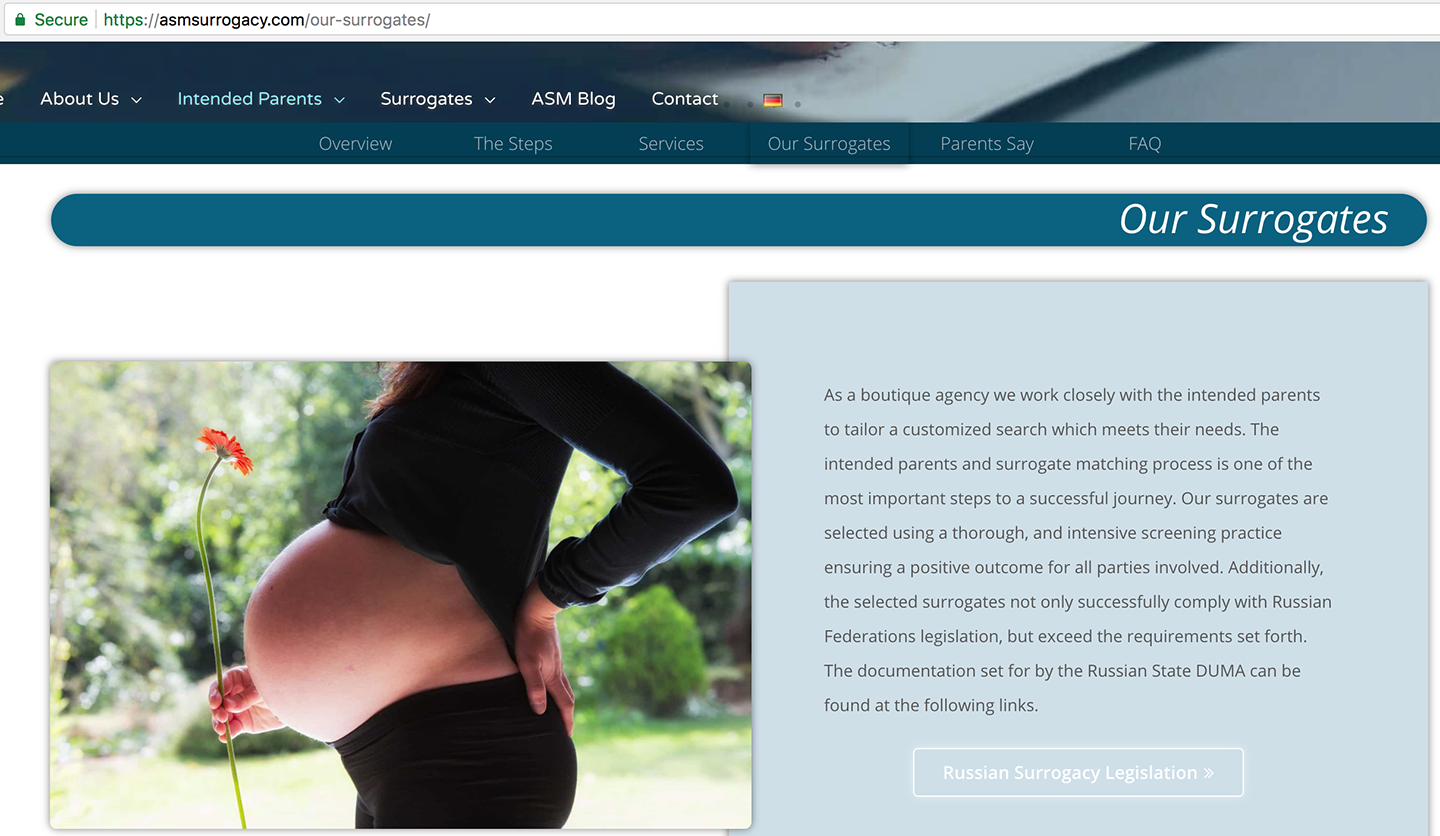
Image of pregnant woman on surrogacy agency website.The picture, taken from the ‘Our Surrogates’ section on a surrogacy agency website, 9 can be traced to multiple other online locations. The same stock photograph is available from a photo repository, 10 where it is tagged with ‘pregnant woman’, ‘baby’, ‘flowers’, ‘parents’, ‘birth’ and ‘femininity’. While the photograph was originally indexed in relation to pregnancy, it is appropriated on the surrogacy website as a stand-in for the body/subjectivity of a surrogate mother. Another example is a picture of three young women accompanying a webpage section titled ‘Leihmama & Spenderin – Auswahl’ (‘Selection of surrogate and donor’) (Figure 2). 11
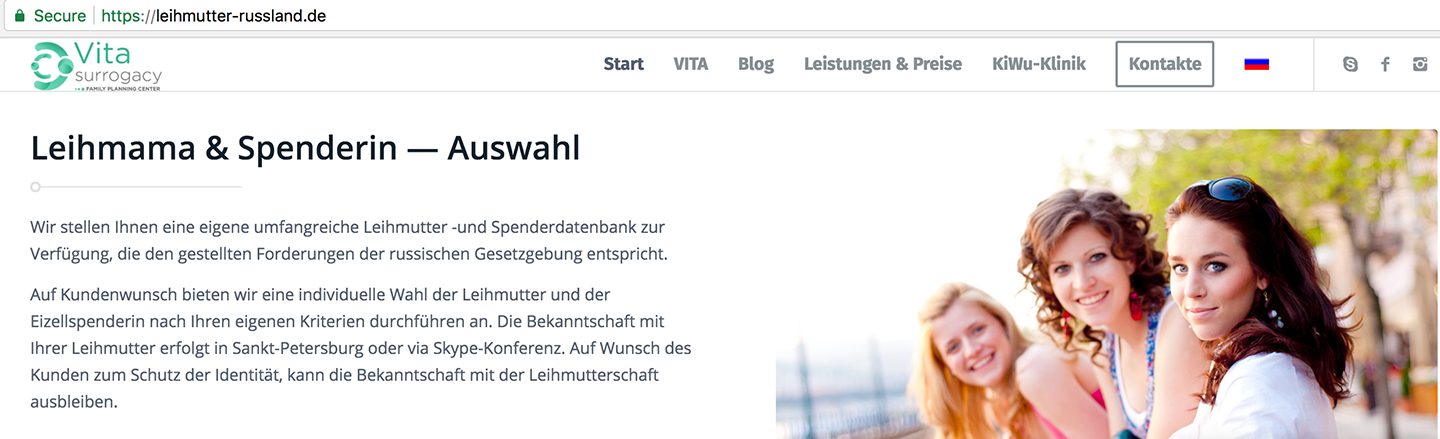
Another example is a picture of three young women accompanying a webpage section titled ‘Leihmama & Spenderin - Auswahl’ (‘Selection of surrogate and donor’). 11 Again, the picture can be found elsewhere on the Internet (anywhere from a dental clinic website to various online stores ) on sites in different languages. When uploaded to a photo repository 12 it was originally titled ‘Girlfriends’ and tagged with ‘female’, ‘Caucasian’, ‘twenties’, ‘happy’, ‘together’, ‘laughing’ etc (Figure 3). On the website of the surrogacy agency, the picture is meant to portray surrogates.

The stock photograph representing ‘surrogate women’ on the original photo library website.
What do these images tell us about the women enrolled as surrogates? Not much. Similarly to Kroløkke (2009), it is tempting to refer to Baudrillard’s (1994) simulacra as a sign with no referent – a sign that not only masks the absence of the real it claims to ‘represent’, but one that is also a simulation of itself. The pictures on the surrogacy agency websites are simulacra, likely retrieved from online photo databases by inserting tag words. These images are relationally malleable, as they endlessly/virally remediate, adjusting to the context. On the websites, the pictures are used to enrich the aesthetics of the site and to make an emotional impact: ‘[It] looks at you, you look at yourself in it, mixed with the others, it is the mirror without silvering (tain) in the activity of consumption, a game of splitting in two and doubling that closes this world on itself’ (Baudrillard, 1994: 76).
In the analysis of articulations, the images point to the invisible presence of multiple actors, including a web designer, an image owner and photo distribution systems. These systems function via generalised signifying categories/tags that circulate. The web designers may have searched for images using the tag words: ‘female’, ‘pregnant’, ‘Caucasian’ and, of course, ‘happy’. Even though, the process of image selection gestures towards a sort of technological, affective/aesthetic economy rather than semiotic pragmatism, indexing pictures on the photo stocks by problematic categories codes whiteness, class, age, able-bodiedness, into an image of, for example, ‘female’ or ‘happiness’, which gets broadcasted over the Internet. Appropriated on the clinic/agency website, it nullifies the validity of women’s embodied experiences in favour of a make-believe racialised generic image of a young (pregnant) female body. The concept of simulacra captures the erasure of the ‘real’ bodies as there is no need for the referent in these worldings, only the emanation of ‘feel good’ vibes. The ‘feel good’ is thus specifically marked by race, class, able-bodiedness, etc. and serves as a ‘happy mirror’ to stimulate reproductive consumption of racialised/classed female bodies through transnational surrogacy arrangements.
Text: Wrestling against default motherhood
One surrogacy agency website states: The greatest difficulties arise in the search for a surrogate mother, as well as in the legal provision of a surrogate motherhood program. The most obvious danger is simple fraud and deception.…There is a great chance of losing money or getting as irredeemably [sic], at best an irresponsible, underdeveloped and if not knowingly infected with venereal diseases or a completely barren woman. Which means the transferring embryos into the uterine cavity of such a woman will not lead to pregnancy. The Internet is full of announcements about various intermediaries and surrogacy ‘agencies’, which offer very attractive prices. But buying a Rolex on the Metro underground can almost certainly mean that it’s a fake. (European Surrogacy Centre)
The danger seems to stem from surrogate mothers who betray their agreement to terminate parental rights. What gives them this power? Strangely, the ‘mother is always known’ principle of Russian law and its consequences for the surrogacy programme are not explicitly stated on the websites. According to existing legislation, surrogates have the right to keep the baby they bear, based on ‘the mother is always known’ legal maxim. This means that, no matter what contracts and agreements are signed, the surrogate may decide to keep the baby she bears, as she has the default status of the mother.
This legal specificity was commented on during a presentation at the XXVII International Conference of RAHR: ‘A surrogate mother shouldn’t have the right to decide over the destiny of somebody else’s child and should be obliged by the law to pass the child on to the commissioning parents.…The surrogate has this right today. As a rule this is used as a threat to tease out money from the intended parents’ (Svitnev, 2017). The issue also received special attention at the Supreme Court Plenum in 2017. For the sake of unifying court practices, the Plenum declared that if a surrogate mother were to reject giving up her legal parental status in favour of the IPs, the court should then evaluate the surrogacy contract and other circumstances and take a decision in favour of the child’s best interests. 13 This development suggests that the surrogate mother may be gradually deprived of her unconditional motherhood rights with respect to the child she bears.
The ‘mother is always known’ principle poses difficulties for the commercial application of surrogacy in Russia. According to a manager of a surrogacy agency, the success of a surrogacy arrangement is measured not only by the birth of a healthy child, but also by the settlement of all paperwork that establishes legal ties between the child and the IP(s). The perils of default motherhood have to be accounted for. In practice, this legal specificity results in a more comprehensive selection of surrogates to ensure their financial motives (as also shown by Weis, 2017). A surrogacy agency manager explained that the initial interview with a potential surrogate aims at clarifying the adequacy of the candidate’s expectations of remuneration. This attitude towards surrogacy perpetuates its framing as work (Siegl, 2018; Weis, 2017), which reinforces existing class hierarchies and potentially contributes to the marketisation of some female bodies on the global scale, conceptually stripping them off humanness.
The interview is also accompanied by ‘psychological testing’: Based on our experience, roughly seventy percent of women, who contact our company for the purpose of becoming a surrogate mother, are eliminated at the first screening round – during the interview and testing with a psychologist. (SurrogacyMed)
The standard set of medical tests undertaken by any woman resorting to ARTs (which concerns potential surrogates, as well) includes: blood type and Rhesus factor identification; blood tests for syphilis, HIV and Hepatitis B and C; tests for infections (chlamydiosis, genital herpes, ureaplasmosis, mycoplasmosis, cytomegaly and rubella); a general urine sample test; a clinical blood sample test estimating coagulation time; a biochemical blood test; a fluorogram; microflora tests of the urethra and cervical channel; a test of vaginal cleanliness; a cytological test of the uterine cervix; an examination by a general practitioner to report on the general state of health and to confirm the lack of contraindications for pregnancy; a psychiatric examination; and a general and special gynaecological examination. This rigorous testing is meant to guarantee that the woman’s body is uncontaminated, safe for the foetus, fertile and sufficiently robust to carry the pregnancy to term.
This legal standard is often claimed to be enhanced by surrogacy agencies: [W]e believe that it is better to ‘re-examine’ rather than to ‘under-examine’ and vouch for their [surrogates’] ‘professional suitability’ and fitness for bearing. They are highly motivated and refer to participation in the surprogram as a job, psychologically ready to fulfil all the doctor’s appointments, know their rights and most importantly, their duties. (European Surrogacy Centre) Our surrogates are selected using a thorough, and intensive screening practice ensuring a positive outcome for all parties involved. Additionally, the selected surrogates not only successfully comply with Russian Federations legislation, but exceed the requirements set forth. (ASM) The websites list additional criteria – or, rather, they claim that the women in their database are more qualified for surrogacy, over and above the law. For instance, the websites may claim that their surrogates: have passed a background check and have no criminal history; have no history of mental illness; are non-smokers and have agreed to maintain a responsible lifestyle; have a body mass index of 20–25; have a positive Rh factor; have had uncomplicated pregnancies and deliveries; express benevolence and an orientation towards cooperation; have provided agreement in writing to undergo the programme in compliance with all conditions.
The claims of quality and docility of reproductive bodies that the agencies and clinics perpetuate through the (extra)legal, technobiomedical and ‘psychological’ filters make candidates appear to be exceptional. Surrogates’ bodies are marketed to have outstanding fertility and health, inaugurated by biomedical technologies in a process of cyborg ‘natural selection’, wherein the assertion of ‘the fittest’ is grounded in a concoction of law, biotechnology and the promises listed on agency/clinic websites. The process of the material-semiotic production of fertility turns the surrogate into a simulacra – a model that precedes the truth. It produces and demonstrates the excess reproductive capacity of the body, semiotically detaches the produced fertility from the lived experiences of the woman, and overexposes her bodily materiality.
The biovalue of the surrogate is framed as her capacity to provide space (and time) for the developing embryo. Such value is not as easily extractable as is the case of sperm or egg donors. The websites present a specific configuration of health as the surrogate’s main virtue. The particular state of a female (biological/material) body – 20–35 years old, having already borne a healthy child, having undergone no abortions or suffered any ‘defects’ – gains its symbolic dimension via the rhetoric of selection and the ‘professional suitability’ for surrogacy. This configuration of the material body translates into the expertise of the agency, which is then monetised.
Following the argument of Schmidt and Moore (1998), whose analysis focused on the marketing materials of sperm banks, one may claim that in contrast to the technosperm, in the case of the surrogate, it is the whole body of a woman that is being biotechnologised, and this biotechnologisation is not only intensive, but also extensive in terms of its duration.
These worldings advertise particularly materialised female bodies who are biotechnologically objectified through the workings of the law and local biotechnological protocols, as well as promises of the agencies and clinics with respect to the ‘quality’ of their surrogates. The surrogate then is not a human, but rather a material-semiotic standard, caught in a grid of instrumental rationalisation wherein bio-value (fertility and ‘health’) could be artificially enhanced, detached and replicated. This process of simulation sustains the devaluation and eradication of women’s lived experiences, which invites their care-less consumption. As a result, these worldings suggest the possibility of enrolling a standardised and depersonalised human female (body) through an intermediary who ‘has’ many of them to choose from. In fact, the very humanness of these women’s bodies becomes an attribute qualifying them for the ‘job’. Following Waldby’s observation of the Visible Human Project (2000), one may say that the human as a humanist subject takes the human as a (reproductive) species as its object.
Databases: Parameterising
One of the most important resources that the ART clinic and surrogacy agency websites draw upon is a database of price-differentiated women who are immediately (bio) available (Cohen, 2005) to serve as surrogate mothers and who can be matched with a particular set of IPs’ criteria. How has the standardised material-semiotic body been further transformed by the time it ends up in the database?
The legal, biomedical and psychological filters select ‘successful candidates’ whose biological parameters are then listed in databases after the surrogate signs an agreement with the agency or clinic. In this fashion, surrogates’ bodies are reinscribed according to the following parameters:
availability and current status; date and place of birth; ethnicity; blood type and Rh; height and weight; hair colour; eye colour; city and country of residence; marital status and total number of marriages; total number of own children; education level; occupation; previous experience as a surrogate mother and/or egg donor.
In line with previous research on semen databases (Schmidt and Moore, 1998), one might claim that the concrete embodiment of a woman is parameterised and dematerialised via the attachment of discursive templates and reinscribed in the online database. Following Schmidt and Moore’s reading of Hayles (1993), it seems possible to argue that this process decreases the friction of the bodily materiality, rendering it malleable and recombinant to better meet clients’ hypothetical demands, encoded in the set of parameters. While in the case of reproductive fluids, technobiologically reworked and reinscribed samples are discursively positioned as genetic information that translates into a specifically configured material potentiality of a child (Kroløkke, 2009; Riggs and Due, 2017), in the case of surrogate mothers, the link between the parameters and the potential body (and ‘personality’, if you wish) of the child is missing, as the websites highlight that ‘The resulting child is genetically unrelated to the surrogate’ (AltraVita).
In this context, the parameterising seems to merely extend the eugenic logic for the sake of granting psychological comfort to the IPs in their imaginary control over the material outcome of the surrogacy programme: Our recruiting system allows us to select some even for special requirements (for example, certain appearance, nationality, religion, level of education). Although this does not affect the outcome of the program, we always go to meet the wishes of customers. (European Medical Centre) The compensation of the Surrogate Mother depends on her age, residence and surrogacy experience. The highest-paid age group is between 20 and 30 years. Moreover, if the Surrogate Mother had a successful surrogacy experience, she is likely to demand a greater compensation. (Surrogate Baby Consulting)
These avatar-like personalities, which seem to have no reality outside of the web, can be booked online. The online display of the surrogate database is accompanied by the following availability tags:
The agency flaunts its ownership over the depersonalised candidates, talking about these women in the passive voice, suggesting their full bioavailability – even in the case of being ‘booked’ or ‘pregnant’, one simply has to wait. This attitude of ownership is based on the financially binding agreement drawn up between an agency and potential surrogates. The agreement stipulates, among other things, that the surrogate must report for duty once she is selected by the IPs from the database. Such form of nominal ownership is the core of an agency’s services, leading one to believe that – in the worldings presented – being a gestational carrier is the main purpose of these women. They are devoid of life outside of surrogacy. Their ‘human’ status has been emptied out.
The parameterisation and databasing of surrogates’ bodies decreases the friction of materiality (Hayles, 1993) to such an extent that it downplays the productivity of this friction: ultimately, gestation is all about the body. In contrast to databases of reproductive fluids, surrogate databases relate to the entire body, standardised bioavailable bodies of women whose subjectivities have been erased and reinscribed for the sake of better (customisable) marketing profiles.
This argument loops back to the notion of the simulacra – the doubling of the real through the workings of code. The parameterisation of the surrogates’ bodies effectively deletes the women’s lived experiences and ‘irrelevant’ differences, turning diversity into discrete variations within the category in a system necessitating choice. These worldings not only make one chose, but also believe in the very legitimacy of value differentiation. Indeed, they invite one to assess the parameters of the candidates against one another thanks to the discursive templates and static measurements organised in columns and lines. At this point the fleshy body, the ‘real person’ with her qualia has long vanished from view, covering up the conditions that constitute her way of living and ‘choosing’ to be a surrogate. The simulation (and therefore dehumanisation) invites care-less consumption by removing the humanist safeguard against buying and selling human bodies through transnational surrogacy arrangements, both contributing to and sustaining global structural inequalities.
Conclusion
As articulations, the images point to the digital technological affective/aesthetic economy with simulation as its mode of operation. The happy imagery of the worldings offered on the web erases the real bodies of the surrogates, glossing over the conditions that brought them to a surrogacy agency. Originating in broader systems of photo distribution, they broadcast problematic notions of ‘happiness’ and ‘female’ coding it as white, young and middle class.
The convivial vibe of the websites contrasts with the agencies’ anxieties over the surrogates’ legal power. In the worlding offered on the web, this power is actively suppressed. In the Russian context, agencies attempt to compensate for ‘the mother is always known’ principle by marketing their comprehensive techniques for selecting and vetting female candidates. On their websites, they boast of having a collection of surrogates with high biovalue as a specific configuration of health and fertility. This biovalue is extracted through a process of cyborg natural selection in which local biotechnological practices, national law and agency promises collectively produce and standardise the ‘surrogate mother’. In a dystopian move, the agencies strive to induce and hyperbolise reproductive capacities, detach biovalue from the lived materialities of the surrogates and expose the women’s naked biomateriality. The female body is then parameterised and databased.
This article has disavowed the seemingly frictionless becoming – from a ‘real’ woman to compendia of data – as an ideological move, feeding on structural inequalities and fostering problematic racial and class hierarchies. This move materially effects the lives of the surrogates (through biotechnologisation, bioavailability and value differentiation) and invites care-less consumption of reproductive bodies. The material-semiotic eugenics in the web worldings is anchored in the informatics of domination (Haraway, 2004a) or the domination of code (Baudrillard, 2001): a pervasive information paradigm coupled with rationalisation and instrumentalisation principles.
The three analyses herewithin, corresponding to the images, text and databases, point to the process of simulation of the women’s bodies through which they are purified and smoothed out, both semiotically and biotechnologically. In their resulting format, they are bereft of the humanist Cartesian coordinates of res cogito and res extensa. In other words, the human status of these women is consequently deleted through different types of simulation (as image, as material-semiotic standard, as data). The hypocritical ‘feel good’ make-up of the web provides a soft and welcoming entrance to the worlding, which in a paranoid manner persuades one to embrace the dystopian reality of selling and buying reproductive bodies.
Supplemental material
Supplemental Material, Appendix - Ideology of simulation: The material-semiotic production of the surrogate in the web worldings of Russian surrogacy
Supplemental Material, Appendix for Ideology of simulation: The material-semiotic production of the surrogate in the web worldings of Russian surrogacy by Maria Kirpichenko in European Journal of Women"s Studies
Footnotes
Acknowledgements
I would like to thank my supervisors Merete Lie and Siri Øyslebø Sørensen, as well as the peer reviewers and the editors of the journal.
Declaration of conflicting interests
The author(s) declared no potential conflicts of interest with respect to the research, authorship, and/or publication of this article.
Funding
The author(s) received no financial support for the research, authorship, and/or publication of this article.

Supplemental material
Supplemental material for this article is available online.
Notes
References
Supplementary Material
Please find the following supplemental material available below.
For Open Access articles published under a Creative Commons License, all supplemental material carries the same license as the article it is associated with.
For non-Open Access articles published, all supplemental material carries a non-exclusive license, and permission requests for re-use of supplemental material or any part of supplemental material shall be sent directly to the copyright owner as specified in the copyright notice associated with the article.
