




Abstract
This qualitative study analysed the agency of eight non-abusing mothers in the Turkish Cypriot Community after disclosure that their child had been sexually abused by someone outside the family. The aim was to discover how, after disclosure, such mothers act to protect their children in the contexts of their family and community. The data were gathered via semi-structured in-depth interviews and analysed using Interpretative Phenomenological Analysis (IPA). In the nuclear family context, maternal agency emerged in the form of motherhood skills, including emotionally supporting the abused child, double-checking the child’s safety or limiting the child’s mobility, and controlling the actions of adult sons. In the community context, maternal agency was manifested in efforts to prevent men in the extended family or the abuser’s family from concealing the abuse and to obtain informal support from others such as birth or extended family members. The women were usually successful in hiding their reactions or making decisions in their children’s best interest despite frequently having to cope with the reality of living in a restrictive and patriarchal culture. The results emphasise the need for working with the general public and professionals to change the culture of silence and to improve the social support network for sexually abused children and non-abusing family members, especially mothers.
Keywords
Introduction
Non-abusing mothers are the most likely recipients of child sexual abuse (CSA) disclosure when compared to other people within or outside the family (Allnock and Miller, 2013). They are often not only the main source of support for their abused child but must also deal with their own post-disclosure reactions and emotions. Previously reported reactions include clinically elevated levels of psychological distress, intrusive thoughts, somatisation and posttraumatic stress disorder (Dyb et al., 2003).
These mothers commonly face secondary victimisation, self-blame and blame by others, social stigmatisation, shame, suicidal ideation, anger, ambivalence, anxiety, shock, disappointment in their search for perfect motherhood, despair and powerlessness (Cyr et al., 2013; Kilroy et al., 2014; Levenson et al., 2012; Masilo and Davhana-Maselesele, 2016; McLaren, 2013; Toledo and Seymour, 2016). This study analysed how mothers act to protect their children after CSA disclosure in the contexts of family and community. The data were gathered in interviews with eight non-abusing mothers in Northern Cyprus.
CSA is an outcome of a male dominated society characterised by the overt and covert subjugation of women (Fitzgerald and Grossman, 2017; Seymour, 1998). The lifetime prevalence of CSA worldwide is 18% for girls and 7.6% for boys (Abbasi et al., 2015; Stoltenborgh et al., 2015) and the overwhelming majority of CSA perpetrators are men (Fitzgerald and Grossman, 2017).
Unlike most previous research, which has addressed parental experiences of either intra-familial CSA (e.g. Levenson et al., 2012; Mayekiso and Mbokazi, 2007) or both intra- and extra-familial CSA (e.g. Bolen et al., 2015; Carvalho et al., 2009), this study focused on non-abusing mothers’ experiences in cases where the child has been sexually abused by someone outside the family.
Extra-familial CSA has been under-researched compared to intra-familial CSA. Furthermore, children and their family members in extra-familial cases do not usually receive the same attention from CSA services as their counterparts in intra-familial abuse cases. This leads to the social perception that this type of abuse is not as serious as intra-familial abuse. Thus, most extra-familial CSA cases are left unreported (Bolen, 2000). For these reasons, it is important to focus on the consequences of extra-familial CSA for non-abusing mothers and their children.
It is known that intra-familial CSA shatters the family dynamics (Hovarth et al., 2014). However, the focus on intra-familial CSA diverts attention away from the discussion of societal factors that are likely to enhance the risk of CSA outside of the family environment. These factors include rigid gender norms that endorse men’s social dominance and entitlement, unequal relationships between children and adults in communities and institutions, and gendered socio-economic disadvantages. Overall, to protect sexually abused children, it is necessary to recognise all the risk factors (Bolen, 2002; Quadara et al., 2015).
Non-abusing mothers are also in a socially disadvantaged position, as they are likely to live in social isolation and frequently face gendered inequalities (Quadara et al., 2015). As the child’s main caregiver, they may be discouraged from reporting CSA or acting freely out of fear of secondary victimisation, blame and male oppression, especially in patriarchal cultures such as traditional Turkish society. However, feminist researchers have demonstrated that women can be agents even when oppressed (Abrams, 1995; Richie, 1996).
Non-abusing mothers of sexually abused children in Turkey are constrained by the dominant ideologies of family integrity and honour. Women in Turkey are also at a disadvantage to men with respect to literacy rates, labour force participation and encountering violence (Kardam and Bademci, 2013). Although this study was conducted in Northern Cyprus, the mothers’ socio-cultural background parallels that of their counterparts in Turkey, as many Turkish immigrants were admitted to Northern Cyprus, especially after 1974.
Non-abusing mothers’ agency
Agency is one of the key concepts associated with gender equality in third-wave feminism and is used to raise women’s awareness of power based on their lived experiences (Snyder-Hall, 2010). Many feminist scholars have challenged and redefined its meaning in the mainstream social sciences. Agency should not be dichotomised as something one either possesses or lacks. The new meanings attached to agency no longer set boundaries between victim and survivor identities but instead view them as coexisting (Charrad, 2010; Samelius et al., 2014; Sherwin, 1998).
Agency, in this article, is considered a relational rather than an individual phenomenon. This use of the concept derives from both the literature and interview data and means that women are perceived as interdependent and socially situated selves (Burkitt, 2016; Meyers, 2002; Moore, 2017).
Women’s agency is intertwined with culture, including societal expectations, obligations, norms and control. Under the effect of such factors, they may often feel constrained and not agents in the full sense (Showden, 2011; Sorial and Poltera, 2015). More specifically, their actions are deeply influenced by their social interactions, which in turn are mediated by unbalanced formal and informal power relationships. Formal relationships include those with possessors of political and social resources, such as professional authorities, while informal relationships include members of the nuclear and extended family, friends and other people (Charrad, 2010; Jordal et al., 2013).
The last two decades have seen an increase in research on women’s agency in a diversity of socio-cultural contexts (e.g. Chapman, 2016; Moore, 2017; Samelius et al., 2014; Seeman et al., 2013). However, research on women’s agency in relation to child sexual abuse is scarce. To improve the quality of the social support network, as recently called for in the CSA literature (see McGillivray et al., 2018; Serin, 2018) mothers’ agency needs to be studied in relation to mothers’ interaction with family members, friends and professionals.
This article investigates maternal agency only within the nuclear family and community context. It aims to contribute to the CSA literature by providing rich descriptions of mothers’ agency in their informal relationships. Women’s decisions and actions in the formal context of professional authorities after CSA disclosure are not reported in this article owing to limitations of space. Although CSA is one of the most painful and traumatic experiences non-abusing mothers may confront, the interview data demonstrated that they are not wholly without agency.
Methodological framework
Conducting interviews with mothers
This article reports on eight interviews with mothers in the Turkish Cypriot Community. Prior to data collection, governmental social workers checked their records and telephoned all the potential participants. Only two inclusion criteria were applied: being fluent in Turkish and having a child with a CSA history.
Written information was then distributed to the eligible mothers, who were also informed about the aims and on the content of the study in person by their social workers. Semi-structured in-depth interviews were then scheduled with the mothers who agreed to participate. They were again reminded that participation was voluntary and that they could withdraw at any point.
The interview guide contained three sections comprising questions on socio-demographic background, maternal and familial reactions to disclosure (addressing CSA history and its effects on daily life and relationships) and interventions and services (legal, health and social services) and a debriefing section on participants’ experiences of the interview process. All the interviewed mothers gave their informed consent to participate.
In all, 23 interviews were conducted for the author’s doctoral dissertation with biological mothers and other primary caregivers on various forms of CSA. Fifteen interviews with non-abusing mothers in intra-familial CSA cases and with couples or fathers who were primary caregivers were excluded from the analysis. The remaining eight interviews, reported in this article, were with mothers whose children had been sexually abused outside the family environment. The data were collected between November 2015 and March 2016. The Ethical Committee of the University of the University of Jyväskylä approved the study prior to the data collection.
All the interviews were conducted in Turkish, audiotaped, transcribed verbatim and anonymised. Interviews varied in duration from 60 to 150 minutes. Field notes related to each participant and interview atmosphere, including observations on non-verbal communication, were also utilised. Seven interviews were conducted on the premises of public social services and one in the participant’s home. Social workers were available on request and ready to help on all occasions even if not present at the interviews. Moreover, the present author is also a social worker and social work academic and, as a trained interviewer, has the professional capability needed to handle possible stressful situations.
Mothers, children and perpetrators
The mothers were aged between 32 and 46 at the time of the interviews. Five were married and three were divorced. Most had been born in Turkey but had since moved to Northern Cyprus either in their childhood or teenage years owing to work-related opportunities for their birth families or as young adults after marriage.
Owing to neighbourhood impoverishment and structural inadequacies in Northern Cyprus, access to formal support by non-abusing mothers is limited to institutional services such as child day care, school counselling and health and social services. Moreover, the interview data revealed that the women’s relatives from their family of birth were mainly living abroad. Therefore, their stories were commonly informed by social isolation and the absence of informal support. It is important to recognise that while such women are mostly from a low socio-economic background, CSA occurs in all social classes in all societies irrespective of socio-economic status.
The present feminist research orientation, despite the differences between the researcher and the participants in power, social class, quality of life, education and health status, is based on the women-interviewing-women situation. The overriding aim of this study is to help these women to be heard and raise awareness of both their needs and CSA. I consider that women’s experiences can be better understood when a woman – such as myself – interviews women even if, owing to potential socio-economic differences between us, differentials in power might be embedded in our relationship (Fisher and Embree, 2000; Ramazanoglu and Holland, 2002).
All the abused children were female and all abusers male except in one case where both child and abuser were male. The abused children were aged between 5 and 17 years. Six perpetrators were aged between 19 and 24 and two were over 60. All the perpetrators were known to the children except in one case where the perpetrator was an elderly foreigner. The abuse was reported as a single incident in five cases and ranged from three months to two years in three cases. However, this is retrospective information given by the mothers and may not be accurate.
Six cases involved penetrative acts such as anal or vaginal penetration or attempt at rape and the other two cases non-penetrative behaviours such as fondling. Four abused girls were adolescents and made to believe that the abuser was their ‘boyfriend’. However, their mothers considered that their daughters were not capable of understanding that they had been sexually abused.
Data analysis
This study applied Interpretative Phenomenological Analysis (IPA), as developed by Smith et al. (2009). IPA facilitates research on people in a perplexing, embarrassing or difficult human predicament, such as people experiencing chronic health problems or other adverse life events. It is recommended that the sample is as homogeneous as possible and does not exceed 10 participants (Smith et al., 2009). Thus, the method is relevant in a study conducted with non-abusing mothers bearing their child’s trauma.
In the data analysis, IPA utilises three levels of comments. The first is descriptive comments, the initial brainstorming phase in which the researcher notes down comments on anything the participant said that seizes her attention. On the second level, linguistic comments, the researcher attempts to be more interpretative and pays attention to how the participant uses language. As the comments become more elaborate, they evolve into the third level, conceptual comments, the deepest level of interpretation. In the final step, the researcher embarks on personal reflection based on her individual and professional knowledge. However, it is worth remembering that this knowledge must serve the participant’s account. The interpretative aspect of the method allows for critical evaluation rather than a basic description of the mother’s experiences (Smith et al., 2009).
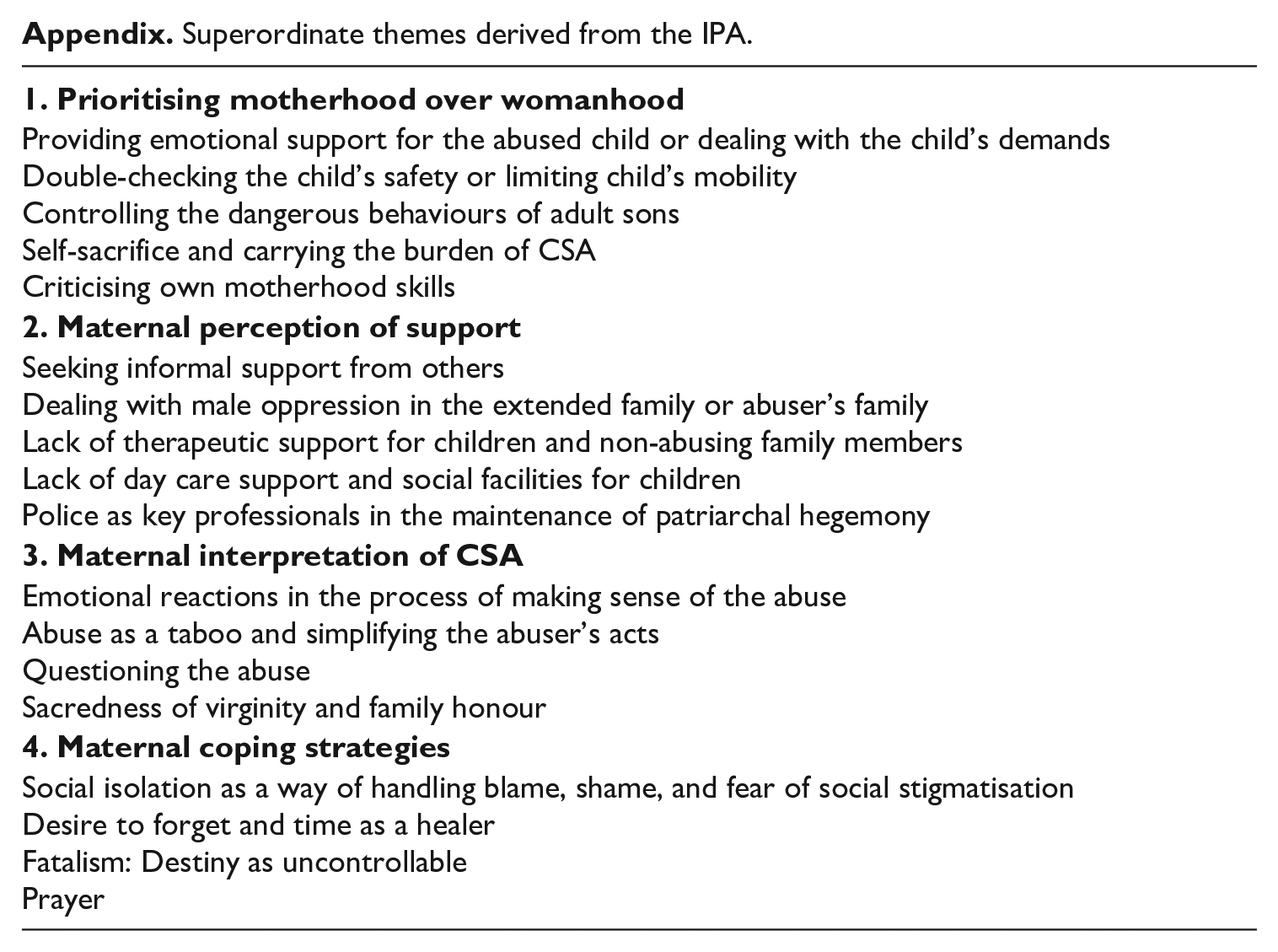
The words, idioms and sentences used by the mothers and my interpretation of these, especially on the linguistic and conceptual levels, helped me identify the contexts in which the mothers reported having agency. The analysis yielded four superordinate themes: Prioritising motherhood over womanhood; Maternal perception of support; Maternal interpretation of CSA; and Maternal coping strategies. Special attention was paid to how mothers described their agency in the family and community contexts. As data on maternal agency in these contexts were mainly provided under the first two themes, the findings are limited to maternal experiences in the context of informal relationships in the family and community. The superordinate themes are presented in the Appendix.
Findings
This section addresses maternal agency at micro and meso levels. The first part addresses the mothers’ agency in the nuclear family and the second their agency in the community.
Non-abusing mothers’ agency in the nuclear family
The women’s agency in the nuclear family was mostly related to their motherhood skills. This emerged in the form of providing emotional support for the abused child or dealing with the child’s demands, double-checking the child’s safety or limiting child’s mobility, and controlling the dangerous actions of adult sons. In doing their best to ensure that their child was safe and well, the mothers also served as a source of empowerment for their child. For example, Zerda, aged 33, recalls how she helped her 8-year-old daughter, Emel, to feel empowered by assuring her that her abuser, who was an elderly foreigner, would be gaoled: I told her, I’m always by your side . . . I’ll always protect you . . . But you’ll tell me immediately whatever it happens . . . You’re not to be blamed in such situations . . . She asked me, will he be punished? I said, of course he will because I won’t leave this matter as it stands . . . She said I believe in you mum, I know you won’t let it go . . . Her trust in me increased a lot . . .
This excerpt reveals the significance of maternal support for sexually abused children. Previous research has shown that believing and supporting an abused child enhances the child’s wellbeing after CSA disclosure (Alaggia, 2002; Cyr et al., 2013). However, in some situations the mother’s perception of her child’s needs conflicted with the child’s own demands. Inci, aged 46 and mother of 16-year-old Zehra, told her story as follows: Your child binds you hand and foot . . .This is what she did to me . . . I never wanted the boy! I was obliged to let her get engaged! Because I really believed that she’d kill herself as she said she would, so many times! She would . . . She attempted suicide and a couple of times ran away! . . . I tried hard to make her give him up but didn’t manage it . . . If I opposed her and she harmed herself, then people’d blame me for what she did . . .
Zehra had lost her virginity around three years ago. In her view, her experience was not abuse and she was in love with the abuser. She insisted, therefore, on getting engaged to him despite her mother’s profound opposition. Clearly, mothers may face occasions in which they feel obliged to prioritise their child’s demands over their own for fear of social stigmatisation and causing their children harm. Kocturk and Bilginer (2019) addressed the needs and problems of 73 sexually abused children and young adults. They found that 84.4% of their participants reported receiving negative reactions from family members, friends and the abuser’s family. Negative reactions involved blaming, social stigmatisation, social exclusion, disbelief and psychological pressure. However, it is not only children who are affected negatively by others’ reactions, but also their mothers, as they identify with their children’s problems.
Not leaving the child unaccompanied or limiting a child’s mobility to ensure his/her safety as a way of handling the CSA trauma was also an important manifestation of mothers’ agency. Esin, a 46-year-old mother, defined herself as shouldering the burden of domestic duties alone. Her 14-year-old daughter, Nermin, was kidnapped and experienced an attempted rape by her ex-fiancé. She told how, after disclosure, she kept an eye on Nermin: When I want to send her somewhere, I always send her with a feeling of fear . . . I keep watching the road and when she returns to our neighbourhood, I’m relieved . . . I lived . . . I lived that fear to be honest . . .
Another account was given by Meral, aged 41. Her 9-year-old son, Umut, was exposed to anal penetrative abuse by a young male neighbour. She describes how she handled her fear that Umut would be further harmed by the abuser or someone from his family: I was always by his side . . . I never left him alone . . . We went everywhere together, when going to school, even when going to bed . . . We changed our route and I didn’t let him go in certain directions to make sure he doesn’t see them . . . I did my best not to remind him of anything related to the abuse . . .
Watching out when their child is absent or accompanying the child everywhere have also previously been cited as ‘overprotection’ and it is known as one of the most common ways in which mothers handle CSA trauma (Kilroy et al., 2014; Masilo and Davhana-Maselesele, 2016). Cyr et al. (2013) also underlined the necessity of protection and emotional support for the wellbeing of sexually abused children, even if both these aspects of maternal profiles were not simultaneously present.
As shown above, such maternal strategies reinforce the traditional perception in patriarchal cultures of motherhood as a sacrifice, a mother’s primary duty being to protect her children. Hence, they are the first to be blamed when their child is abused. This continues even when their living circumstances are unsafe and there is a risk of inadvertent contact with the abuser or his family (Carvalho et al., 2009; McLaren, 2013).
Owing to the lack or inadequacy of long-term therapeutic support for sexually abused children and their non-abusing family members in Northern Cyprus, the present women served as a lay psychologist for their family members, including children and husbands. They effectively used their maternal power of control even where they might not have a direct effect on legal actions against abusers. Two excerpts below exemplify this situation.
Meral narrates how she didn’t give up supporting her son, Umut, despite fearing that her oldest son, Erhan, would harm the abuser if she openly expressed her own reactions to the abuser: I couldn’t do anything at all! I was tied hand and foot . . . Erhan was 22 and he was spitting fire . . . If I looked at Erhan, I’d be all fired up and kill the abuser myself, if I said something stupid to him, he’d go and kill him! I couldn’t open my mouth at all! If I did, all hell would break loose! I had no choice apart from standing by Umut’s side! I bought plane tickets and took him abroad for two weeks . . .
Another mother, Esin, also describes below how she sought to inhibit negative reactions and violent behaviour by her oldest son, Ahmet: Ahmet had a lot of trouble with the abuser . . . I could hardly control him and his aggression towards the abuser . . . I was the only one who struggled with my children and tried to control their anger . . . I supported them . . . I stopped them from harming the abuser . . . I tried my best to stop my children from harming someone else . . .
Three mothers were divorced sole breadwinners. Some of the married mothers were also sole breadwinners, and mostly defined their husbands as irresponsible and dysfunctional fathers as far as meeting family needs was concerned. In such cases, as in those cited above, older sons expressed anger and a desire to physically punish abusers. Their readiness to act may be attributable to their father’s lack of economic power in the family. Moreover, violence towards abusers was perceived as the duty of a ‘strong man’, especially in a patriarchal culture where CSA is seen as an act that shames the family.
These two excerpts exemplify the heavy burden of being a mother in traditional Turkish society. Previous research has highlighted that women’s self-perceptions and their socially assigned roles such as motherhood and caring for others are deeply connected and remain so even in challenging circumstances (Freeman, 2011; Guignon, 2007; Mackenzie and Stoljar, 2000; Sherwin, 1998). The excerpts also support Kagitcibasi (2005), who found that in the patriarchal Turkish culture, family is not only important but also characterised by psychological dependency between the family members. In other words, family relations are based on close-knit ties and women’s relatedness is prioritised over separateness in collectivist cultures.
Non-abusing mothers’ agency in the community
The interview data show clearly that mothers’ agency is not limited only to the nuclear family context. The analysis showed that they are agents to a varying extent even when facing stressful situations in the context of broader social relationships. Maternal agency in the community emerged in the form of opposing the tactics of men from the abuser’s family, seeking informal support from others, and dealing with conflicts arising from the oppressive behaviours of senior males in the extended family.
The ability to say ‘no’ was one of the most significant forms of agency in the community context. For example, this happened when, to conceal the abuse, marriage was proposed between the abuser and the child or the family were offered a large sum of money to withdraw the case. The excerpts below exemplify reflection on this problem.
Seda, 35, recounted how, soon after disclosure of the attempted rape of Nur, her 16-year-old daughter, she rejected an engagement offer by the abuser’s father: I told him, it is the worst thing that ever happened to Nur, your son meeting her . . . He then said, I’m here to propose their engagement . . . I told him that’s what you think . . . I don’t want anything to do with you at all . . . He said, I respect that and he left . . .
Zerda recalls how the abuser’s son offered her money but she adamantly refused: After we complained to the police, he called us and offered us money to drop the charges . . . He kept offering money to us five or six times . . . They don’t look at the shit he did and they actually think they can buy us off? What’s money? I got really really angry . . .
These excerpts show that the mothers had the capacity and strength to act and make decisions on behalf of their child while simultaneously challenging male dominance. According to previous research, such offers testify to the continuance of male hegemony that can be deployed to keep CSA a secret (Guvenc, 2014; Kocturk and Bilginer, 2019; McLaren, 2013).
A form of agency less commonly used by the mothers was seeking informal support from relatives, members of her birth family, or friends. The following two excerpts exemplify women’s desires to enhance their influence as mothers and make decisions that best support their child’s wellbeing, especially at the most critical time when they first heard of the abuse. Esin reflected as follows: What I can say and to who? Who could I talk to? How could I spread this around? Forget about outsiders, I didn’t have the courage to talk about it even with my family . . . In the end, I pulled myself together and said I have to talk about it to my family because I need them by my side . . . I called my uncle’s son first . . . We went to the police station in his car . . .
Seda reported how she insisted that her birth family members living abroad visit her: Since I was on my own, I felt very lonely . . . I wanted help from my family, I phoned them and I begged . . . I’m on my own here . . . I mean my two children and myself . . . Only god and I . . . No one else . . . from my family . . . I begged and said I’d pay for your tickets, come for two days . . . two days . . . Hmm, they didn’t . . .
Receiving support from others was not always possible even when sought. As seen above, Esin’s relatives met her need of support whereas Seda’s seemed not to understand her situation despite knowing that she was divorced and the sole breadwinner. Various studies have emphasised mothers’ crucial need of support after CSA disclosure (Kocturk and Bilginer, 2019; McGillivray et al., 2018; Serin, 2018). Plummer (2006) found that mothers receiving more support were able to take significantly more protective actions towards their children than those receiving less support. Moreover, support from others could be interpreted as a mode of maternal empowerment preceding their empowerment of their sexually abused child (Gulbrandsen and Walsh, 2012; Hebert et al., 2014).
The last point to consider here is male oppression from extended family members. Mothers may not only feel desperately lonely after disclosure, but also have conflicts with senior males in their broader social relationships. Two mothers described this. First, Esin: She was six months pregnant and the police summoned us to the station . . . We went there . . . Nermin’s father in-law started saying things like we’re a well-respected family and we don’t want to get a bad reputation over this . . . We had that fear, I mean me and my daughter . . . When she got pregnant, our fear increased even more . . . Do I want to find her at my door again? Her husband said, damn it! Withdraw the complaint! So we did . . .
Nermin had married someone else as a way of ensuring her personal safety after the attempted rape. Esin felt obliged to drop the charges when Nermin became pregnant by her husband. Finally, Asil, aged 45 and mother of 15-year-old Erin, told her story: They said if we make a complaint to the police, he’d only be in prison a couple of days and then be released! After all, your daughter had a bad reputation . . . What’s gonna happen’s gonna happen to her . . . Drop it! I regret it a lot! They really stopped me! They didn’t let me see him jailed! So what do we do? The families got together after all . . . They say let them wear a ring . . . If you don’t want to, you break up 3–5 months later . . . Just to ensure that no one hears that she was defiled . . . They got engaged but he didn’t stop doing it! He made her pregnant!
Asil was forced to accept Erin’s engagement to her abuser, and the situation further deteriorated with her pregnancy just three months after their engagement. These two excerpts reveal how CSA is associated with loss of morality and family honour in patriarchal cultures. Research findings confirm that, when revealed, the abuse is perceived as the child’s or family’s ‘shame’. In such traditional cultures, social stigmatisation is prevented by internalising, legitimising, and hiding the abuse (Kocturk and Bilginer, 2019; Ozturk, 2009; Yildiz, 2012). These excerpts also show how family members tried to resolve this issue within the extended family rather than seeking professional support.
Conclusion and discussion
Drawing from eight semi-structured in-depth interviews with non-abusing mothers in Northern Cyprus, this study explored how mothers act to protect their children in the family and community context after CSA disclosure. Although agency in the context of womanhood and motherhood has been much debated, little research has addressed the agency of non-abusing mothers of sexually abused children. This study contributes to the research gap on CSA and maternal agency.
The results showed that the mothers were usually alert and knew very well how to handle stressful situations after disclosure even if, in the best interests of their child, they sometimes had to conceal their reactions. They stood against male oppression whenever they could, and their agency extended from the nuclear family to broader informal relationships. Although their actions or decisions were sometimes contradictory, their agency could not be dichotomised as exclusively absent or present. Instead, they can be seen as relational agents to the extent permitted by their prevailing socio-cultural circumstances. They continued searching for better alternatives to protect their children even when they felt constrained by traditional patriarchal norms.
In the nuclear family, two significant forms of maternal agency emerged from the interview data: providing emotional support for the abused child and double-checking child’s safety. These findings reveal how mothers are perceived as the main caregivers and protectors of their children. Moreover, sharing the burden of CSA trauma with the child and helping him/her recover from it, is also regarded as their responsibility. However, there were also instances in which the abused child’s expectations conflicted with those of the mother. It is interesting that in cases where the sexually abused children were adolescent girls, they were often persuaded by their abusers to believe that their experience was not abuse. Thus, mothers had to cope not only with male oppression in the community, but also with their children’s demands.
In the community, mothers’ agency in relation to male oppression was contradictory. Although the interviews showed that mothers rejected offers of compensation from an abuser’s family to keep the abuse secret, in other instances, they had to accede to the demands of senior males in the extended family. The reasons for this included fear of social stigmatisation or of the abuser causing their child further harm, receiving negative reactions from powerful others, and being shamed and blamed. Women’s desires often conflict with patriarchal power relations and hierarchical kin structures. In such conflicts, they often feel that the decisions and choices available to them are restricted (Carvalho et al., 2009; Jordal et al., 2013; Kocturk and Bilginer, 2019).
This qualitative study has its limitations. The size of the sample was small and confined to a specific group of women sharing similar socio-demographic and socio-cultural characteristics, and thus the findings cannot be generalised to all non-abusing mothers. However, this is not to say that women in more ‘advanced’ societies do not face any problems of agency. Moreover, maternal agency in the context of formal relationships, including police and other human service professionals, was not addressed in this article and thus remains for future research.
After disclosure of their child’s sexual abuse, mothers’ agency, manifested in their actions and decisions, was profoundly affected by their social relationships. In other words, relational agency is not something that is amassed solely by women on their own, but also by society (Klugman et al., 2014; Meyers, 2002; Sherwin, 1998). Thus, it is important to recognise the impact of socio-cultural factors such as male oppression and fear of social stigmatisation. Even more importantly, one needs to be aware that empowering women could bring comprehensive gains both in their personal growth and that of their families and societies.
It is often overlooked that mothers are also in a vulnerable situation themselves and often have to deal with CSA completely unaided. This finding underlines the paramount need to improve the social support network for abused children and their non-abusing family members. Also, the implementation of prevention and intervention programmes, such as sex education, counselling, parenting education, and early and effective therapeutic support for children, is needed (Quadara et al., 2015). The present results underscore the need to develop awareness raising and training programmes for educators and other professionals working with this target group, along with community education, including media campaigns, information materials and community groups.
In conclusion, it will only be possible to change the culture of silence if the urgency of the need to work with public and professionals is understood.
Footnotes
Appendix
Superordinate themes derived from the IPA.
|
|
| Providing emotional support for the abused child or dealing with the child’s demands Double-checking the child’s safety or limiting child’s mobility Controlling the dangerous behaviours of adult sons Self-sacrifice and carrying the burden of CSA Criticising own motherhood skills |
|
|
| Seeking informal support from others Dealing with male oppression in the extended family or abuser’s family Lack of therapeutic support for children and non-abusing family members Lack of day care support and social facilities for children Police as key professionals in the maintenance of patriarchal hegemony |
|
|
| Emotional reactions in the process of making sense of the abuse Abuse as a taboo and simplifying the abuser’s acts Questioning the abuse Sacredness of virginity and family honour |
|
|
| Social isolation as a way of handling blame, shame, and fear of social stigmatisation Desire to forget and time as a healer Fatalism: Destiny as uncontrollable Prayer |
Declaration of conflicting interests
The author declared no potential conflicts of interest with respect to the research, authorship, and/or publication of this article.
Funding
The author received no financial support for the research, authorship, and/or publication of this article.
