



Abstract
Web series are short – meaning shorter than television – narrative, episodic series distributed via online and social media platforms. Despite originally being a medium heralded for its independence from legacy media and public institutions, web series have increasingly become a more institutionalised form supported within publicly funded film and television production ecosystems in various countries worldwide, including Australia. This raises questions about the policy rationales justifying government support for scripted web series. Using Australia as a case study, what objectives does the federal screen agency, Screen Australia, aim to achieve by funding web series? What do these policies reveal about current support for online content and digital formats in Australia more broadly? And how do these objectives compare with the rationales driving film and television policy? The study offers an improved understanding of why and how governments support scripted online series and the evolution of online policy alongside broader film and television policies. I analyse institutional policies, funding programs and rationales for web series funding evident in national policy documents, funding announcements and media statements between 2012 and 2024. Insights are also drawn from an interview with Screen Australia's Head of Online Content between 2021 and 2025. The article argues that, in contrast to economic and cultural policy objectives behind public support for film and television production, Screen Australia's online content policy is deliberately developmental and principally focused on generating social value and contributing to industry sustainability through long-term talent development rather than immediate economic returns or employment gains.
Introduction
Web series are short – meaning shorter than television – narrative, episodic series distributed via online and social media platforms. Despite originally being a medium heralded for its grassroots independence from legacy media and public institutions as a form of ‘open television’ (Christian, 2018), web series have increasingly become a more institutionalised form supported within publicly funded film and television production ecosystems in various countries worldwide, including Australia. Indeed, scripted online series have been lauded by Graeme Mason (2022), the then-CEO of Screen Australia – Australia's federal film, television and online content funding agency – as one of the most ‘successful’ mediums supported by the agency in recent years: ‘if success was judged purely on the number of people reached by particular content, online stories would be the clear leader’ (p. 9). Importantly, several of Screen Australia's signature online content support programs, from Multiplatform Production, TikTok Every Voice and Fresh Blood to Digital Originals and Skip Ahead, among others, have played significant roles in facilitating the transition of online creators into professional film and television careers.
The institutionalisation of this format raises questions about the policy rationales justifying government support for scripted web series. What objectives do Screen Australia aim to achieve by funding web series? What do these policies reveal about current cultural support for online content and digital formats in Australia more broadly? And how do these objectives compare with the broader rationales driving film and television policy? This article analyses the policy rationales behind public funding for web series and online content in Australia between 2012 and 2024. The Australian government has historically intervened in the film and television industries to grow domestic production, support industry sustainability, and protect and foster national cultural identity. Although television and film have long benefited from substantial public investment, web series have only emerged recently as a medium receiving institutional support. Consequently, the justifications and logic for such funding remain underexplored in scholarly research.
The article examines the evolution of film and television policy in Australia and how government support for web series and newer digital formats has evolved to delineate Screen Australia's current emphasis on online policy for web series. Ultimately, the research offers an improved understanding of why and how governments support web series and scripted online content more generally and what this reveals about the evolution of online policy alongside broader film and television policy frameworks. I analyse institutional policies, funding programs, and the explicit/implicit rationales for web series funding evident in government policy documents, funding announcements and media statements. Key insights are also drawn from an interview with Lee Naimo, Screen Australia's Head of Online Content (and Games from 2023), between 2021 and 2025. The insights from this interview are accurate as of the end of 2024, and there have been significant changes within Narrative Content (including Online Funding and Games) in Screen Australia during 2025.
The article argues that the overarching objective underpinning Screen Australia's support for online content – and web series as a flagship format – is fostering talent development by funding audience-first projects reflecting unique or diverse voices or perspectives that have the potential to reach wide audiences on online platforms. Screen Australia views web series as a format for experimentation and talent incubation for the film and television industries. In contrast to economic and cultural policy objectives that drive public support for film and television production, Screen Australia's online content policy is deliberately developmental and principally focused on generating social value and contributing to industry sustainability through long-term talent development rather than immediate economic returns or employment gains.
Web series and broader film and television policy debates
There is a small but growing body of scholarship on web series. Research has explored the medium's history (Ellingsen and Monaghan, 2026, forthcoming) and how it has facilitated new production/development techniques and release strategies (Christian, 2014, 2018; Healy, 2022; Leder et al., 2019), created new career pathways (Ryan et al., 2024) and encouraged diverse representation for communities underserved by mainstream media (Leder, 2021; Leder et al., 2019; Monaghan, 2017). Scripted web series are a distinct format of online content emerging at the intersection of technological change, internet culture and evolving television viewing practices (Ellingsen and Monaghan, 2026, forthcoming). In Australia, rationales underpinning public support for online and digital-first content formats have tended to evolve out of broader film and television policy. Thus, they can be understood in relation to the logic governing support for film and television production.
Film and television policy within the broader field of cultural policy are two related but mostly independent strands of scholarly inquiry. Over the last three decades, there have been significant changes in the film and television industries due to the globalisation of production, technological change and digital disruption, and the emergence of video-on-demand streaming platforms that are reshaping audience demand and viewing patterns (Hill, 2004; Hill and Kawashima, 2016; Lobato et al., 2023; McElroy and Noonan, 2022). These changes have created new challenges for policymakers that, in relation to film, although it also applies to television, have led to the transformation of policy rationales and how policy objectives are ‘conceived, defined and implemented’ (Hill and Kawashima, 2016: 667). Due to the globalisation of production, film policy, in particular, has placed less emphasis on supporting and defending local industries on national terms and has instead placed greater emphasis on repositioning local film industries within a global marketplace and engaging with ‘“transnational” opportunities for funding and creative collaboration’ (Hill and Kawashima, 2016: 669; McElroy and Noonan, 2022). However, recent research also demonstrates that definitions of nationality and considerations such as cultural specificity and local content remain important components in film and television policy formulation (Hill and Kawashima, 2016; Lotz and Potter, 2022).
The somewhat uncertain status of film as entertainment, industry and art has meant that film policy has been shaped by various industrial, social and cultural imperatives (Hill, 2004). However, scholars observe that cultural and economic value – especially the tensions between the two and how this shapes policy – has preoccupied film policy debates as governments have attempted to develop an economically viable production sector that also produces local content generating cultural value (McElroy and Noonan, 2022). However, for McElroy and Noonan (2022), scholarly debates tend to overemphasise the binary of economic and cultural value while overlooking the importance of social value. Social value may be fused with broader cultural and economic priorities, but ‘the social’ is also ‘a distinct formation of value associated with ambitions for sustainability, inclusion, diversity, and equality of opportunity’ (McElroy and Noonan, 2022: 389). In this context, social value accounts for ‘promoting equality of opportunity through a more diverse skills and employment market; supporting growth in all geographic locales; sustaining responsible film businesses and activities; contributing to more resilient and vibrant communities including around language’ (McElroy and Noonan, 2022: 389). In framing social value, the authors emphasise diversity and inclusion; however, their interviews with policymakers also make clear that ‘sustainability’ and ‘a more diverse skills and employment market’ encompass both general talent and skills development and creating opportunities for emerging practitioners who national screen agencies do not typically support. These authors identify two important drivers behind a renewed focus on social value in research into screen policy. First, that screen policy has been exclusionary regarding the talent and stories funded, and inequalities in film labour and funding. Second, social value is ‘accruing a greater role in addressing social problems such as health, well-being and community cohesion’ (McElroy and Noonan, 2022: 389).
Television policy has long been part of larger debates around broadcasting policy, diversity, public media and public interest (Bengesser and Sørensen, 2024; Franklin, 2005; Raats et al., 2024; Sunstein, 2009); consequently, debates around social value have been more central to core policy discourse (van Dijck and Poell, 2014). However, television policy debates focused on financial incentives to support production in a global market have also been animated by similar concerns around the binary of cultural and economic objectives (Chalaby, 2010; Lotz and Potter, 2022). Research is also increasingly examining how governments are attempting to regulate the operation of subscription-video-on-demand services in national markets, generating discussion around cultural diversity, censorship, local content quotas and protectionism (Antoniazzi, 2025; García Leiva and Albornoz, 2020; Hagedoorn and Becker, 2025; Lobato et al., 2023). Streaming platforms are online or digital content platforms. Yet, in Australia, until the end of 2024, Screen Australia distinguished between support for professional, long-form film, television and documentary content for streaming platforms and short online series that have a development purpose for online/social media platforms such as YouTube and Facebook (Screen Australia, 2024a).
As a relatively new area of screen policy, there is currently limited research into government policies and public support for web series as an extension of broader film and television policy frameworks. This study addresses this gap by examining how web and online series policy rationales in Australia privilege economic, cultural or social value in contrast to broader film and television policy.
National film and television policy framework
The Australian film and television industries are medium-sized production systems underwritten by government regulation, public subsidy, tax breaks and other forms of state and federal support to:
sustain and grow a local production sector and employment in the industry ensure an Australian voice in the domestic film and television market produce screen content that represents the nation's culture and society on screen.
Foundations for contemporary public support for the film and television ecology emerged during a period of cultural nationalism in the late 1960s to early 1970s in response to the domination of Australian screens by imported drama content from the United States and the United Kingdom and the near collapse of a domestic film and television production sector, making narrative content in the 1960s (Ryan, 2024).
The commercial, linear broadcast free-to-air television system in Australia is highly concentrated, and like other television systems around the world, the sector has been completely upended by digital disruption and the emergence of streaming platforms. Prior to the launch of Netflix in Australia in 2015 and the subsequent rise of streaming platforms, the commercial free-to-air television system was an oligopoly unwritten by a federal broadcasting policy of quid pro quo (see Potter, 2023). The free-to-air television networks Channel Nine, Channel Ten and Channel Seven were required to meet local content quotas and produce priority content such as drama and children's content programming. In exchange, government regulations protected the broadcasters from competition and new networks entering the market. Consequently, the Seven, Nine and Ten Networks competed against each other for audiences and the highest possible television ratings nightly to earn revenue from advertisers. In terms of commissioning programming, it was far cheaper and more cost-effective for the Australian networks to license and import proven drama series from overseas than to invest in producing expensive and unproven dramas made domestically. Further, because networks fiercely competed against each other for audiences during prime-time slots – in Australia, between 6 am and 12 pm – they were extremely risk-averse and conservative when commissioning new drama content. The free-to-air television networks ultimately aimed to make inoffensive content appealing to mainstream audiences and demographics. These priorities limited and constrained the types of content commissioned by this system.
Rather than in-house production, the majority of local original content screened on free-to-air television or commissioned by streaming platforms is produced by small to medium-sized production houses and, where possible, domestic producers look towards international co-productions to increase the scale of production and access to finance.
The federal policy framework supporting film and television production is the responsibility of Screen Australia, a federal government super agency – replacing the Australian Film Commission, the Film Finance Corporation Australia, and Film Australia – established in 2008, that fosters the development, financing, production and distribution of narrative and documentary content. A significant cultural intermediary, Screen Australia implements and operationalises the policies and initiatives of the federal government and administers the Australian Screen Production Incentive – which comprises three tax offsets: the Producer Offset, the Location Offset and the Post, Digital and Visual Effects (PDV) Offset – that currently underpin public support for the production industry. The Producer Offset incentive, legislated under the Income Tax Assessment Act 1997, offers domestic filmmakers a 40% refundable tax rebate on qualifying Australian production expenditure (QAPE). The minimum production expenditure to qualify for the Producer Offset is A$500,000. From 1 July 2023, foreign films undertaking principal photography in Australia are eligible for a 30% Location Offset. Both domestic and foreign films are also eligible for the 30% PDV Offset on all QAPE spent on PDV undertaken in Australia, regardless of where the project was filmed.
The Australian screen industry receives a substantial amount of public investment each year, including:
tax rebates offered for Australian content (via the Producer Offset) with certified rebates worth A$412.79 million in 2023–2024 (Screen Australia, 2024b) Screen Australia's budget, which received A$85.46 million from the government in 2023–2024 to support quality Australian content with cultural value (Screen Australia, 2024b) funding for the national public broadcasters, the Australian Broadcasting Corporation (ABC, 2024) and the Special Broadcasting Service (SBS, 2024), receiving approximately A$1.1 billion and A$334.9 million, respectively, in 2024–2025.
Policy priorities underpinning support for Australia's film and television production industry have long been shaped by dual cultural and economic policy objectives (Curthoys, 1991; Dermody and Jacka, 1987). In terms of cultural policy objectives, since the early 1970s, federal screen policies have sought to support the development of a national cinema and a healthy television production sector making ‘local content’ to generate cultural value and ensure there is a minimum level of Australian content available for national and, secondarily, international audiences (Goldsmith et al., 2012; O’Regan, 1996). In terms of economic objectives, film and television policy has also attempted to prioritise industry development and sustainability, improve box office returns and ratings, increase employment and the profitability of private companies to grow the production sector, and increase the levels of local content made by the local production system (Deloitte Access Economics, 2016; Screen Australia, 2016a).
In the context of film, more so than television in Australia, there have been major tensions between cultural and economic policy since the late 1960s. Policy discourses, major policy programs and prevailing industry sentiments in Australia have tended to oscillate between advocating for more public support for culturally focused Australian stories that generate cultural value and increased support for a more commercial and sustainable industry that produces internationalised content for global markets (Ryan, 2024). Although both cultural and economic policies have underpinned federal policy rationales and programs, the ways policy has been practised since the revival has tended to privilege one over the other. At the time of writing, a growing number of critics argue that the Producer Offset and Location Offset are resulting in the funding of increasingly internationalised content with limited cultural resonance for domestic audiences (George, 2022; Lotz and Potter, 2022). For these authors, Screen Australia's policies have emphasised industry development and, by implication, economic policy, subordinating cultural value to this broader agenda.
Screen Australia's early online content funds and policy phases
The Cross-platform Digital Media Development Fund in 2008–2009 and the Innovation Program in 2009 (although online content funds were also existing) were launched under the leadership of then-CEO of Screen Australia, Ruth Harley. These funds were largely designed to support the creation of experimental, multi-platform and transmedia content rather than exclusively episodic narrative content. Consequently, although early web series such as Jacobson (2009) were funded by the Cross-platform Digital Media Development Fund and the Innovation Program, very few web series were supported by these funds.
Screen Australia's funding and support for short, scripted episodic series distributed online and on social media platforms became a more central priority under the leadership of CEO Graeme Mason (2013 to 2023), and his advocacy for online creators and online audiences was lauded as among his most significant achievements (Screen Australia, 2023a). Federal funding for short episodic content for online platforms increased following the launch of the Multiplatform Drama Program in 2012. This fund emerged from two primary drivers: first, research by the then Labor Government (2007–2013), including the Convergence Review, into the impact of digital technology on user-generated content and the media industry (see Keltie, 2017); and second, Graeme Mason's recognition that audiences globally were shifting online and the talent who could best exploit the new socio-technologies and platforms for Australian storytelling needed to be supported (Screen Australia, 2014).
Overarching policy objectives and funding initiatives backing online content and web series – typically reflected through eligibility and assessment criteria – have evolved subtly but significantly between 2012 and 2024. Since the early 2010s, there have been two early phases of online content policy:
Support for existing industry professionals to reskill or transition into multi-platform content production with an emphasis on supporting commercial projects. Bringing emerging online creators together with established film and television professionals to mentor the former's skills in making short, narrative, episodic content.
The first phase of Screen Australia's online content policy prioritised support for creatives with experience and industry credits in traditional film and television production. In 2011 and 2012, in response to the Convergence Review, Screen Australia launched various new funding models to support multi-platform production. The 2011–2012 Multiplatform Productions Fund offered two different programs: Digital Ignition and Multiplatform Production. Eligible applicants required ‘an experienced producer attached, and the key team members were required to have a proven track record relevant to their role in the project, with two eligible credits’ (Keltie, 2017: 105). An eligible credit for film and television professionals equated to a broadcast by a recognised broadcaster, a commercial theatrical release; for web series creators, a qualifying credit referred to ‘a commercially produced and released online project’ (Keltie, 2017: 105). As this suggests, both initiatives squarely targeted established practitioners with recognised professional screen credits. Consequently, this program focused on reskilling and encouraging established professionals to create multi-platform content rather than support creators working outside the established media industry. This emphasis was justified in 2011 as the ABC, through its online initiatives ABC Open and ABC Pool, was viewed as driving growth in user-generated content ‘as a direct government response to digital media possibilities’ (Department of Broadband, Communications and the Digital Economy, 2011; Keltie, 2017: 94).
The Multiplatform Production guidelines were further revised in 2013 and 2015 in response to government research into media convergence and the emergence of new platforms and forms of online storytelling, including web series (Keltie, 2017). Following these revisions, eligible projects were required to have ‘a producer and director (or equivalent roles relevant to the type of project) with at least one credit in the same role on a comparable project which has been publicly released’ (Screen Australia, 2015: 2). Opening eligibility to ‘equivalent roles’ on a ‘comparable project’ meant that an emerging creator – for example, a director directing an online series – could apply for web series funding (Keltie, 2017: 106). The new guidelines also marked an important shift away from emphasising economic policy with ‘the removal of the requirement that a creator producing for the Web must have participated in a “commercially” produced and released work’ (Keltie, 2017: 106). These eligibility changes lowered barriers to entry, democratising who could apply, and effectively opened the door for online creators to apply for the multi-platform funds.
The launch of Fresh Blood and Skip Ahead in 2013 marked a second phase of online policy. This was a distinct and deliberate policy attempt to bring emerging online creators together with established professionals (those with recognised industry experience) to foster career development for online creators and generate reciprocal benefits for established producers. Fresh Blood, an initiative between Screen Australia and the ABC resulting in the first digital commission for ABC iview, aimed to ‘unearth the next generation of comedy performers and producers’ (Screen Australia, 2014: 40–41). For this round of funding ‘executives from ABC and Screen Australia selected 25 comedy teams’ and ‘each project received a budget of $10,000 to produce three x 2–5 minute short-form comedy sketches premiering on ABC's iview platform’ (Screen Australia, 2014: 40). Screen Australia and the ABC later elected and funded five teams to produce pilot comedy episodes for iview, and through this developmental process, the ABC and Screen Australia aimed to both showcase and foster the production and development skills of a new crop of creative talent.
Skip Ahead, in its ninth round in 2024, is a joint initiative between Screen Australia (2024a) and YouTube Australia supporting ‘YouTube content creators to develop their skills and … work towards sustainable careers’. Since the program's inaugural round in 2013, the program has sought to ‘support a new generation of online storytellers and IP creators to expand their vision and ambition’ and ‘cultivate original Australian narrative content made specifically for local and global online audiences’ (Screen Australia, 2024a). The program's eligibility has been designed to support active and successful YouTubers making original content: With at least 25,000 subscribers, two current YouTube channels with a combined subscriber base of 40,000, or a YouTube video which has achieved a minimum of 1 million views on a channel which has a subscriber base of at least 10,000. (Screen Australia, 2024a)
By the 2020s, although the aim of facilitating mutual benefits for emerging creators and established professionals through collaboration remained a key priority, the third and current phase of online policy prioritises identifying and developing a diverse range of talent for new platforms. The first phase of policy prioritised economic and cultural value by aiming to reskill existing creatives to make commercial projects and Australian content for new platforms. The second phase became more focused on prioritising social and cultural value: commercial mandates were dropped, and policies aimed to support the development of non-professional online creators and content for new platforms. The third phase of policy became more centrally focused on generating social value.
Screen Australia's online content support
As a comparatively new area of focus for Screen Australia, in contrast to film and television, Screen Australia's support for online content has evolved from small satellite funds to a fully-fledged department that sits alongside film and television. In 2024, online and games became a sub-department of narrative content in the Content and Operations Division, slotting in beside other sub-departments such as feature film, television and documentary. This department invests directly – as opposed to indirect investment facilitated by tax offsets – in online content through its various funds and special initiatives. However, in terms of the total amount of funding allocated to production, online content remains a small area of focus compared with traditional media. A total of A$921.3 million was reportedly invested in television drama production alone through the Producer Offset between 2007–2008 and 2022–2023 (Lotz et al., 2024). Yet, although investment in online content is increasing, a modest total of A$65 million was invested in online content between 2011–2012 and 2022–2023 (see Appendix).
Before 2023, Screen Australia did not have a specialised online content development fund. Consequently, online creators seeking federal development funding applied through the agency's general Story Development Fund and two specific initiatives: Generate, supporting lower-budget content with minimal eligibility criteria, and Premium, supporting higher-budget content led by more established and accomplished professionals. The realignment of online development and production funds under a single department has brought more coherence to online content policy within the organisation.
Despite not being the exclusive focus of online content policy, web series are a flagship format for Screen Australia's online development and production funds. Online initiatives are open to various formats, including web series, children's content, documentaries and virtual reality projects. However, eligibility criteria for most online programs require projects to be scripted and episodic. As online funding targets low-budget projects distributed via online and social media platforms, web series are a major format satisfying all these criteria. The Former Head of Online Content and Games, Lee Naimo (2024), stated that ‘one of our [Screen Australia's] stipulations is we need to fund content that's episodic. That could be two episodes. But unless it''s an XR[extended reality] project … we won’t fund a standalone project, we won’t fund a standalone project. Naimo (2024) also alludes to the important function web series play as a calling card, noting that ‘particularly across the scripted narrative series or documentary, that ability to tell a story in episodic format is going to serve you well if you want to graduate to television’.
Since the Online Development Fund and Production Fund were combined, there is a clear distinction between the types of content financed by the Online Development Fund and Generate in the general story development strand. Prior to 2023, online creators applying for development funding through Generate could pitch projects designed for either online or streaming platforms. However, from 2023, when online development was moved out of the general story development fund, eligibility for Generate is ‘lower budget long form [emphasis added] episodic television and feature film projects with an emphasis on emerging screen content makers’. This criterion thus distinguishes between ‘long form’ content and implicitly short-form, ‘lower-budget productions which may present talent development or project development opportunities’ distributed on ‘social media’ platforms, supported by the online department (Screen Australia, 2024a).
At the time of writing, Screen Australia's overarching objective underpinning their funding initiatives supporting online content – and web series as a flagship format – can be understood as fostering talent development by funding audience-first projects reflecting unique or diverse Australian voices or perspectives with the potential to reach large audiences on online platforms. Talent development is multifaceted, and the Online and Games Department attempts to identify talent and foster skills development, career progression and acceleration, and career sustainability. Importantly, in stark contrast to development and production funding for film and television, which remain largely exclusionary and difficult to access for emerging creators (Keltie, 2017; Metro Screen, 2015), online content funds have minimal eligibility criteria, making them more inclusive and accessible to a broader range of emerging creators.
Naimo (2024) stated that the central priorities of the online production and development initiatives are supporting two broadly conceived types of online creators: (a) those attempting to break into the professional television and film industry by making an audience-tested calling card and (b) those seeking to develop an online business or sustainable online ecosystem. The first category, which Naimo (2024) viewed as ‘talent escalation’, is multifaceted and wide-ranging. The program provides funding to support online creators in developing their skills in scripted content by making low-budget episodic stories for online audiences and platforms without interference from gatekeepers. Speaking to the secondary objectives noted below, the Online Department attempts to support talent in telling stories that are not being told on traditional media or streaming platforms. At its core, Screen Australia's support for talent acceleration is targeted at both creators hoping to make ‘stepping stone’ projects to advance their skills in scripted content that help them break into the professional media industry, and professionals already working in the established film or television industry who are attempting to ‘skip ahead’ in their career; for example, from a production manager or production assistant to a producer. Age does not restrict who can apply: a significant portion of applicants are emerging creators without professional film and television credits, although established practitioners are also eligible.
Most applicants applying for Online Department support are attempting to make projects with a funded budget and build an audience ‘to use online as a stepping stone to their feature film, their first television series, something with a bigger budget’ (Naimo, 2024). Screen Australia's online funding attempts to develop the skills of a more diverse range of emerging creators than the development funds for film and television. However, rather than invest in as many different creators as possible, the Online Department identifies talent and re-invests in these creators to support their transition into traditional film and television or their career sustainability. Ryan et al. (2024) found that Screen Australia had funded some web series creators on as many as seven different occasions. A prime example is Danny and Michael Philippou, who began their online careers by making violent, action-based, physical and special-effects-driven video content for their RackaRacka channel on YouTube. After making a viral video, they received production support through the Multiplatform Fund to make their first scripted series, Versus, which pitched superheroes and popular culture characters against each other in ‘Halo versus COD’, ‘Marvel versus DC’ and ‘The Walking Dead versus Last of Us’. The funding allowed them to raise the production values of their videos significantly and grow their audiences to qualify for Skip Ahead. They then used this program to develop their skills in scripted content, and later received enterprise funding for a placement with a film production company before receiving online development funding to produce The Racka (6 × 22 min series). By this point, the brothers had arguably ‘graduated’ from the online department into the general film and television production pool, and they later secured production funding to write and direct the global breakout horror movie Talk to Me (2023), earning almost A$100 million at the global box office. To date, the Philippou brothers have received over A$2.7 million in development and production support from Screen Australia (see Table 1). Rather than returning to online content, they currently make feature films. Online funding support helped the duo in building their subscriber base, which arguably played a part in Talk to Me's success, and developing skills in scripted content through mentorship and placements with established film producers. Ryan et al. (2024) detail other key examples.
Screen Australia support for Danny and Michael Philippou.
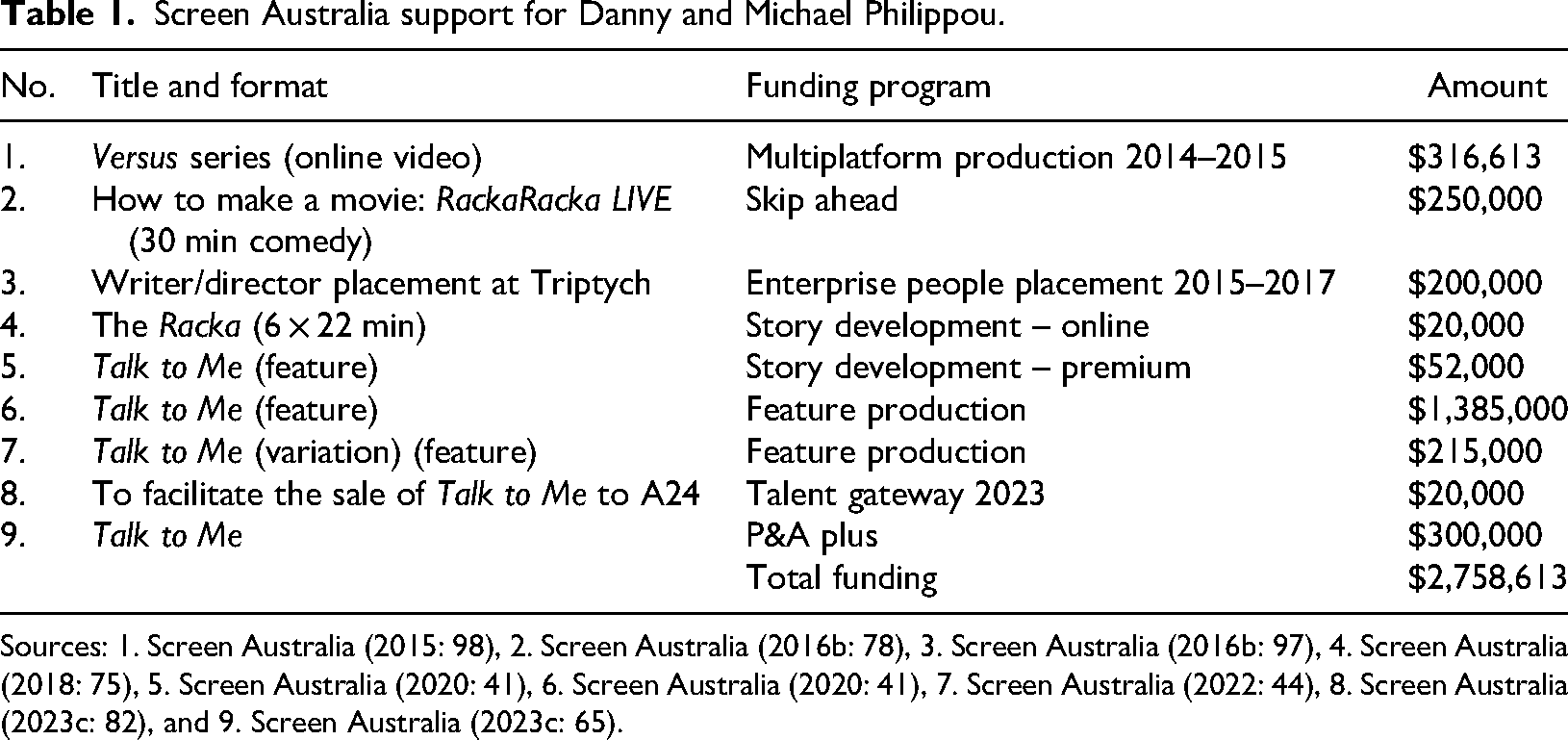
Sources: 1. Screen Australia (2015: 98), 2. Screen Australia (2016b: 78), 3. Screen Australia (2016b: 97), 4. Screen Australia (2018: 75), 5. Screen Australia (2020: 41), 6. Screen Australia (2020: 41), 7. Screen Australia (2022: 44), 8. Screen Australia (2023c: 82), and 9. Screen Australia (2023c: 65).
The second type of creators Screen Australia supports are practitioners building an online business or audience community whose primary goal is to grow a business in online content creation. This category encapsulates born-digital ‘social media entertainment’ creators making video content harnessing the affordances of internet-distributed platforms to monetise their audiences (Cunningham and Craig, 2019). However, it also supports producers and production companies – including Ludo, the company behind the popular animated children's program Bluey – supplementing projects for broadcasters and streamers with content for online markets. As Naimo (2024) observes, delineating a business model anticipated by scholars Ryan and Hearn (2010): We’re seeing more and more production companies want to embrace a model of ‘making a series for ABC, and the next thing we make might be a lower budget project that releases on YouTube’, and they’re trying to build that ecosystem.
As of 2024, online projects are generally not required to have market attachments, nor must they be commercially successful to meet eligibility requirements. Rather than attempt to define success for the diverse range of content they fund, Screen Australia puts the definition of success back on the creators by asking them, ‘Tell us what success looks like for you and how would funding for this individual project help you on that path?’ (Naimo, 2024).
As illustrated in Figure 1, the online development and production funds periodically launch one-off and ongoing special initiatives targeting ‘gaps in the market’ (Naimo, 2024), the purpose of which varies. The Snapchat and TikTok Every Voice initiatives were partnerships launched in part because of Snapchat and TikTok's desire to invest in narrative content with higher production values. For Screen Australia, both initiatives were an opportunity to develop emerging talent and ensure Australian creators are making narrative content for these platforms. Despite generally lower eligibility requirements than film and television funding streams, eligibility for special initiatives varies. For example, Skip Ahead supports already successful YouTube creators. Conversely, TikTok Every Voice is aimed at fostering ‘a new generation of online storytellers’, remarkably including full-time university students, although university students have not typically been eligible for Screen Australia (2021) funding.
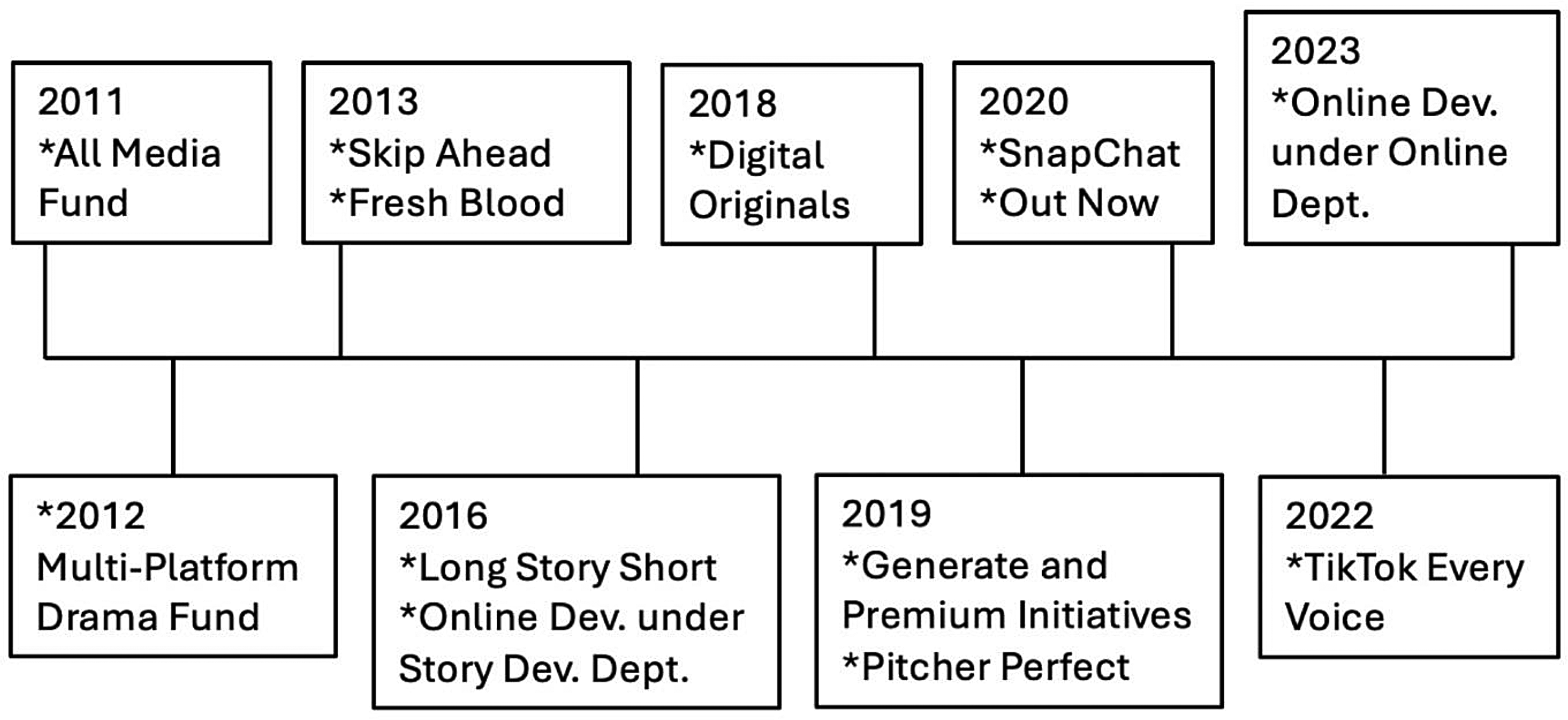
Screen Australia's key online content funds and special initiatives since 2011.
Under the overarching priority of talent identification, development and acceleration, the agency has several key secondary priorities, typically addressed by one-off or ongoing special initiatives. These include:
Supporting diverse emerging creators to tell original and innovative stories for online platforms that are not being told on broadcast media or streaming platforms. Facilitating creators to build audiences and develop new revenue streams in online markets. Partnering with platforms and broadcasters to seed content for these platforms and create developmental opportunities for these creators. Supporting talent that crosses over into professional film and television.
First, ‘diversity’ is not the preserve of Screen Australia's online content programs, and the agency has committed to improving gender equity in the screen industry and ensuring the content it funds better reflects the diversity of Australian society (see Screen Australia, 2023b). However, programs such as TikTok Every Voice are far more focused on diversity than, say, Skip Ahead, seeking applications from ‘creators from under-represented backgrounds – including First Nations, Māori, Pacific Peoples, Pan-Asian, LGBTQIA+, Culturally and Linguistically Diverse (CALD), female or trans/gender diverse, those living with a disability and creators based in regional and remote areas’ (Screen Australia, 2021). Every Voice aims to support ‘diverse and distinct voices in the creation of innovative episodic scripted or factual content for TikTok’ (Screen Australia, 2021). Furthermore, it aims to ‘cultivate original Australian content made specifically for global online audiences’ and ‘ensure the storytellers and stories being told reflect the diversity of people and experiences from around Australia’ (Screen Australia, 2021). SBS Digital Originals, discussed below, is also targeted at supporting the creation of diverse content.
Second, because Screen Australia allows creators to self-determine what ‘success’ means for them, some creators and production companies secure funding to make scripted online series as part of a strategy to build new revenue streams and online audiences. For creators who want to build sustainable careers in online platforms or film and television producers who want to establish new markets, monetisation and building audiences and communities are essential. Skip Ahead specifically encourages and supports these imperatives, whereas other programs have a greater emphasis on skills acquisition or diversity.
The third and fourth sub-priorities are closely related. SBS Digital Originals and ABC Fresh Blood are key examples of programs designed to support emerging talent in making content for broadcaster video-on-demand platforms (rather than their anchor linear channels). These programs allow Screen Australia to share the production costs with a broadcaster while also addressing a specific lack of commissioning opportunities for emerging talent. For broadcasters, the programs produce content for video-on-demand services with younger viewers and develop a new crop of talent working on commissioned works. Yet, both initiatives support a different scale of production. In 2023, applicants for ABC Fresh Blood received up to $50,000 to create three proof-of-concept episodes (of 3–5 min) (ABC, 2023, april) before selected individuals/teams received a budget of roughly A$400,000 (in 2024) to develop a pilot episode (Screen Australia, 2024c). In 2025, projects selected for SBS Digital Originals have budgets of A$1.2 million to fund 6 × 10-min series (Yeast, 2025). Although Snapchat and Every Voice are also platform-specific initiatives, Digital Originals and Fresh Blood create pathways for unproven talent to shift into professional television rather than cultivating diverse voices for social media platforms. Many of these programs – in line with talent escalation characteristic of the first category of online creator discussed above – attempt to foster talent to facilitate their transition into professional film and television production. All the programs discussed here attempt to develop talent in some way; however, some programs, more than others, act as talent incubators specifically for public broadcasters and streaming platforms (see Ryan et al., 2024).
Discussion
As this article has demonstrated, Screen Australia's online content policy objectives in the early 2010s originally prioritised economic and cultural value, mirroring broader logics in film and television policy. However, as the agency's online policy program has evolved, the policies’ emphasis has gradually shifted to focus principally on talent development and supporting diversity and inclusion within the auspices of social value. Here, talent development is not only about creating a more diverse and inclusive workforce. Ultimately, Screen Australia supports online series to identify and foster the upskilling and career development of emerging online creators on the one hand, and to support the career development of creators already working in film and television who aspire to create online series on the other.
At the end of 2024, Screen Australia's online policy objectives privilege social value over the economic and cultural values that have long dominated film and television policy in Australia. While broader debates in film and television policy in Australia are focused on the tensions between cultural and economic policy, the rationales of online content and newer digital formats are propelled by issues pertaining to skills acquisition, talent, careers and diversity. First and foremost, Screen Australia has adopted an explicitly developmental approach, viewing online and web series content as a mode for capacity-building rather than generating commercial products or even expressly cultural content, although many are. At its core, Screen Australia's support for online content is underpinned by the logic of incremental skill acquisition, career sustainability and ecosystem resilience, while also funding scripted content made by Australian creators for new media platforms. Initiatives such as Skip Ahead and Digital Originals do not aim to support established professionals but rather to scaffold the development of emerging creators already working on online platforms through strategic mentorship, flexible eligibility requirements and iterative funding access. In terms of creators attempting to break into traditional film or television production, rather than treat web series as discrete commodities, Screen Australia views web series and low-budget episodic content more generally as developmental artefacts within a broader framework of talent development and industry renewal.
Special initiatives such as Skip Ahead prioritise support for audience-first projects and value the total number of views for funded projects. However, a project's popularity and potential to reach large audiences are secondary to talent development and skills acquisition. Prioritising audience-first content is also an attempt to mandate a more audience-minded approach for screen practitioners seeking public support, which is arguably consistent with Screen Australia's broader push to develop a more sustainable film and television industry since the late 2000s (Lotz and Potter, 2022). For creators wanting to develop careers making content primarily for online and social media platforms, web series are part of a broader strategy to develop audiences and commercial sustainability. This highlights that although talent development and social value are central to Screen Australia's rationales for supporting online content, the agency's policy objectives remain connected to broader economic policy objectives. Importantly, Screen Australia's online policy also aims to bolster industry sustainability, a key tenet of economic policy. But rather than doing so by supporting private companies to make commercial products that generate economic returns and employment, online content policy contributes to industry sustainability by vetting and upskilling talent, and supporting their career development, many of whom transition into film and television production.
Cultural rationales – support for content that generates cultural specificity – are evident but not central priorities. For example, Skip Ahead aims ‘to cultivate original Australian narrative content made specifically for local and global online audiences’ (Screen Australia, 2024c). However, stories are not explicitly required to be culturally specific, have cultural resonance or generate cultural value. Importantly, Screen Australia rightly values online series for their ability to reach global rather than specifically national audiences. In 2016, Screen Australia reported that Racka Racka's Versus series had, at the time, received 70 million views; The Wizards of Aus had generated 3 million views on YouTube; and Aunty Donna's series 1999 had 3.2 million views on YouTube (Mason, 2016: 7). In film and television, international audiences are often only celebrated if a project has also been popular in the national market.
Screen Australia's Online and Games department operates with minimal eligibility barriers, reflexive assessment practices and iterative funding models that intentionally lower the threshold for participation among structurally excluded groups. Programs like TikTok, Every Voice and Digital Originals prioritise creators from historically marginalised communities and systematically and intentionally invest in long-term career progression through mentorship, production labs and repeat funding rounds (Screen Australia, 2024a). In short, Screen Australia is experimenting with a transformative model wherein digital-first content serves not only as a representational outlet but as a way to rethink how cultural production systems function, who they serve and what they value.
However, this is not to suggest that policies supporting online content and web series in Australia are not without limitations. Australia's funding for online content remains a small proportion of Screen Australia's overall budget, and the broader structural precarity of the film and television sectors may constrain the scalability of its web series strategy. Importantly, although the online department's policy program and special initiatives have low eligibility requirements that aim to support emerging practitioners, the department only supports up to 40 projects per year. Because Screen Australia emphasises supporting the development of creators’ careers, the department tends to privilege a small group of talent who are funded on multiple occasions. Consequently, despite limited eligibility criteria opening these programs up to a broad range of applicants, a small funding pool means that these funds are not spread widely, and it is still incredibly difficult for an emerging practitioner to secure public funding for web series in Australia. Thus, we return to McElroy and Noonan's (2022) conceptualisation of social value in screen policy as prioritising ‘sustainability, inclusion, diversity, and equality of opportunity’, including ‘promoting equality of opportunity through a more diverse skills and employment market’ (p. 389). Inclusion, diversity and equality of opportunity are not evenly applied across all of Screen Australia's online programs. Because the core focus of Screen Australia's online content policies is talent development and the creators determine the criteria for success, talent development extends beyond developing a diverse workforce, and economic value can be the primary outcome for some creators who are supported under the auspices of talent development. Screen Australia has successfully supported the development of numerous online creators, many of whom have gone on to become professional film and television professionals, but the extent to which the agency's diversity agenda has resulted in demonstrable outcomes at the national level requires further research.
Conclusion
Using Australia as a case study, this article provides a deeper understanding of why and how government policy supports short online series and other digital formats. Screen Australia's intentional, rather than accidental, online content policy recognises web series as both a format and a strategy that can facilitate access, cultivate new creative labour and create a pathway to long-form content production. As such, Screen Australia's approach offers a forward-looking model for digital content policy in an era characterised by shifting platform dynamics, proliferating creator pathways, and renewed calls for equity and innovation in cultural production systems. Screen Australia's policy has moved towards recognising web series as a unique format, short-form in nature and separate from content made for streamers. Even if the popularity of web series as a medium were to diminish, the Australian strategy remains clear ‒ to use online short-form series to nurture emerging talent and help support their transition into longer-form content. Importantly, Screen Australia launched a new Narrative Content Development Funding Program on 1 July 2025, and online/direct-to-audience, television and theatrical feature film funding streams were combined into a single funding program. Consequently, projects across these categories will vie for funding and will be assessed through ‘an audience-first and platform-agnostic assessment lens’ (Screen Australia, 2025). As this article demonstrates, web series and online content are on a solid footing to compete in this new funding landscape, as ‘an audience-first and platform-agnostic’ philosophy has underpinned Screen Australia's funding for online content in recent years. Yet, whether short episodic series will in practice be valued as highly as legacy long-form film and television projects, and whether talent development and social value will continue to be privileged over economic and cultural objectives, remains to be seen but is unlikely.
This research builds on scholarly knowledge in film, television and digital content policy. Future research could explore whether Screen Australia's policies yield measurable differences in content diversity and systemic talent renewal, how inclusionary their online policies are in attempting to foster inclusion, and how these policies compare with those in other countries that also provide public support for web series and digital formats.
Footnotes
Acknowledgements
I wish to acknowledge that some of my ideas have been influenced by conversations about web series policy in Australia and Canada with my colleague Dr Emilia King from Ontario Tech University as part of our ARC Linkage project.

Ethical approval
This study was approved by the University of Wollongong Research Ethics Committee (approval no. 2019/491) on January 28 2020. The Queensland University of Technology Research Ethics Committee performed an administrative review on this project (ID. no 3021) on 4 March 2020.
Informed consent
The interview participant gave informed written consent to participate in this study.
Funding
The author disclosed receipt of the following financial support for the research, authorship, and/or publication of this article: This work was supported by the Australian Research Council under its Linkage Grant program [LP180100626] for the project Valuing Web Series: Economic, Industrial, Cultural and Social Value.
Declaration of conflicting interest
The author declared no potential conflicts of interest with respect to the research, authorship, and/or publication of this article.
Appendix: Screen Australia Funding for online content and web series
The figures below are extracted from Screen Australia’s annual reports. Notably, the following online-focused programs are not reflected in this table because they did not support narrative, scripted series: Digital Ignition, Talent Escalation, and Digital Extensions.