




Abstract
Climate change is a concern for many nations, industries and citizens. However, for some it will also be a moment of opportunity. As witnessed in relation to the pandemic, dynamics of power have a particular purchase at moments of crisis. This article proposes a greater concern with questions of policy and power in relation to green strategies within the screen sector and highlights the role that media scholars might play in developing this critical lens. There has been a recent rise in efforts to mitigate particular environmental harms and the article outlines some of the initiatives that are emerging from both commercial and public bodies. Here are no shared systems for auditing and reporting, and few formal policies are widely recognised or adopted. As different ideas and approaches garner greater traction, travelling from one national and industrial setting to others, the article scrutinises the industrial, structural and policy obstacles which hinder a meaningful shift for film and television production to be environmentally sustainable. The article reflects on the agendas and forces at play in this space and attempts to stimulate debate about how those researching media production might productively engage in critiquing these policies and dynamics of power.
Keywords
In November 2021, more than 120 world leaders, 35,000 delegates and activists assembled in Scotland at COP26, the largest UN climate change conference to date. With the stark warnings of the global impact of climate change there and in the Intergovernmental Panel on Climate Change’s recent Sixth Assessment Report (2021), there is significant pressure on countries and their governments to extend and agree formal commitments to tackle the climate and ecological emergency. In a year which saw unprecedented flooding in Asia and Western Europe, heat waves fuelling wildfires across Australia, Algeria, Greece and Siberia, and record-breaking temperatures in North America and Europe, few places on earth are yet untouched by climate change and the environmental crisis.
In response to growing urgency within public discussions about the climate crisis, this article locates climate change as a practical challenge for the film and television sector as well as a pressing area of policy concern. It identifies industrial, structural and policy obstacles which hinder a meaningful shift to a green screen industry. These obstacles include: a lack of reliable and comparable data and certification, disjointed industry initiatives and policies, as well as industry practices and funding structures that in themselves complicate and contradict principles of environmental sustainability. Drawing on analysis of policy documents, industry initiatives and certification schemes, as well as interviews and workshops with industry stakeholders, the article reflects on existing environmental interventions and seeks to stimulate debate about the complex intersection of ideas, agendas, resources and stakeholders at play in this domain and the power relations therein.
In the last decade, a valuable seam of theoretical thinking has developed around ecomedia and environmental media studies (to mention but a few Cubitt, 2017; Maxwell and Miller, 2012a, 2017; Miller, 2018; Rust et al., 2013, 2015; Starosielski and Walker, 2016), alongside scholarship on the creative industries and sustainability (see e.g. Banks, 2018; Boetzkes, 2019; Caraway, 2018; Morton, 2018). An internationally diverse academic body is amassing around sustainability and the media including Routledge’s Earthscan series, the Journal of Environmental Media, a special issue of the Nordic Journal of Media Studies (Kunelius and Roosvall, 2021) and the Global Green Media Production Network (funded by the British Arts and Humanities Research Council). Gaining prominence is a growing body of research focussing specifically on sustainability in the screen industry, notably the work of Gustafsson, Kääpä and Vaughan (Gustafsson and Kääpä, 2013; Kääpä, 2018, forthcoming; Vaughan, 2019). We argue that media and cultural scholars can offer further substantial contributions to this area by employing a political economy lens to analyse how the dynamics of power play out amongst industry players and nations in the film and television industry.
The screen industry and climate change
The film and television sectors are often erroneously thought of as having little environmental impact and a limited CO2 footprint (Banks, 2018; Maxwell and Miller, 2017). High-profile content like A Perfect Planet (BBC, 2021), Seaspiracy (Tabrizi, 2021), Our Planet (Netflix, 2019) and Okkupert (Occupied) (TV2, 2015–2020) address issues of climate change, though critics argue that some of these representations can reinforce environmentally problematic ideas and behaviours (Geal, 2021; Jones et al., 2019; Vaughan, 2019). However, the screen sector’s own contribution to climate change remains largely at the margins of public discussion. Leaving aside for another time the critical question of the representation of climate change, our focus is on the industry’s own, often overlooked, contribution to the environmental crisis.
The screen industry 1 is, in fact, underpinned by highly polluting and wasteful practices and is a significant contributor to climate change. To illustrate, the British Film Institute (BFI) and the British Academy of Film and Television (BAFTA) calculate that the average ‘tentpole’ film (over $70 million) generates 2840 tonnes of CO2 during production alone, equivalent to 11 one-way trips from the Earth to the moon, or the annual absorption of 3709 acres of forest (Arup and BFI, 2020: 12). Emissions from television productions average 9.2 tonnes of CO2 (Albert, 2020: 41), varying across genres with drama and international factual programmes the biggest polluters, as the Albert’s breakdown of emissions per genre shows:
Source: Albert (2021: 45).
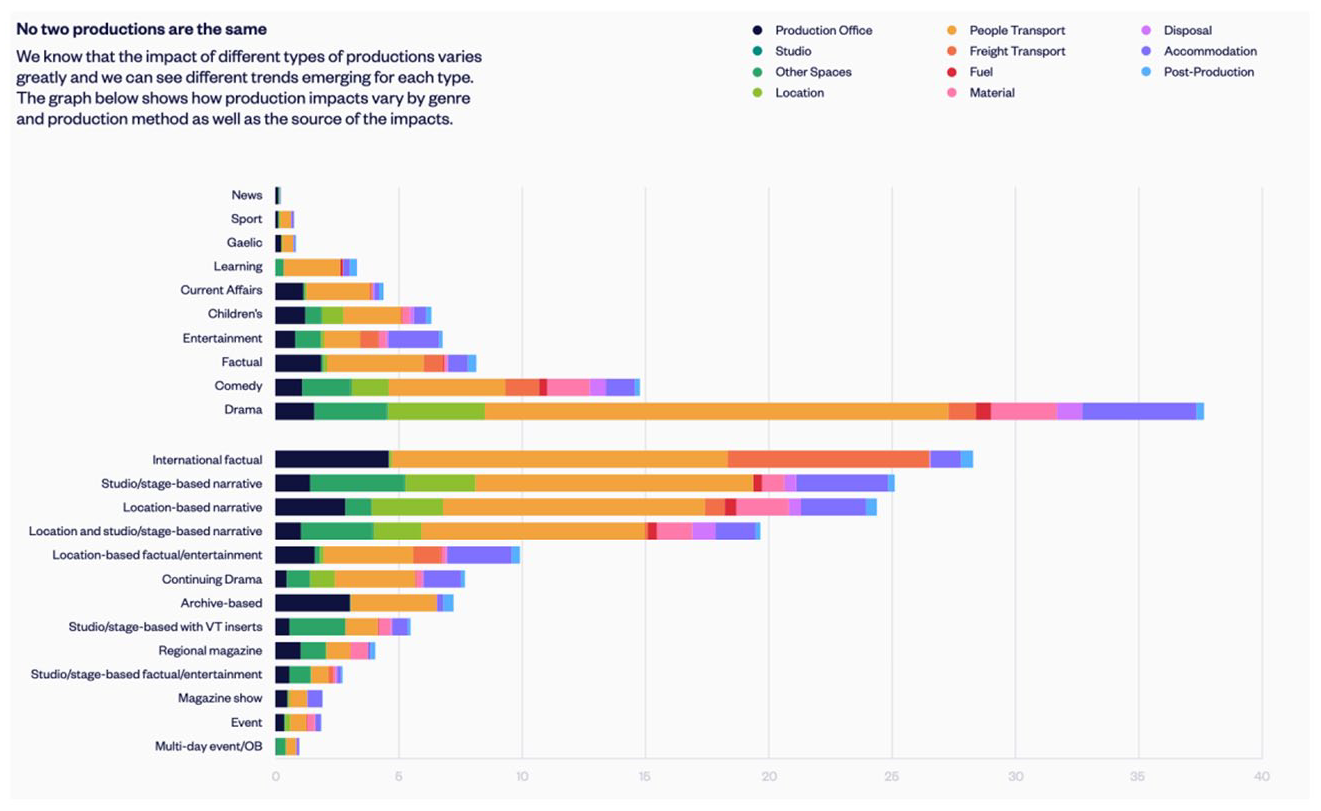
Across the production chain for film and television many of the practices as well as the funding and distribution models that underpin the global screen economy precipitate the climate emergency. We unpack two critical obstacles in the transition to a green sector – industrial structures and infrastructures as well as the absence of policy frameworks – and analyse these as spaces for the circulation of powerful interests which will determine the sector’s ongoing response to the climate crisis.
Industrial obstacles: greening screen practices
The production and distribution of screen content are dependent on the services of some of the most wasteful and polluting industries in the world. These include fashion, energy, transport and technology (Arup and BFI, 2020; BFI, 2020; Creative Carbon Scotland, 2020; Gassmann and Gouttefarde, 2021; Kääpä, 2018; Maxwell and Miller, 2012a; Miller, 2018). On-set and during production, art departments have traditionally used single-use props, costumes and sets. Technical departments rely on consumables and fossil fuels and location shoots often operate using diesel generators. A production will depend on several supporting industries and third-party providers of services. Activities like transport, catering and equipment hire are therefore often beyond the direct control of a specific production manager and sit outside existing environmental measures for productions (Creative Carbon Scotland, 2020).
Moving along the value chain, post-production sees the use of consumables, technology and facilities which are dependent on cycles of continual development and disposal. Access to screen content hinges on resource-intensive technological infrastructures as well as a distribution system based on energy consuming server space and bandwidth (Arup and BFI, 2020; Gassmann and Gouttefarde, 2021: 48). Finally, the human and ecological toll of generating and disposing of media devices are in themselves a challenge to sustainability (Cubitt, 2017; Maxwell and Miller, 2012b; Vaughan, 2019). It is the culmination of these activities which precipitates the climate emergency.
The screen sector is slowly facilitating greener production and distribution practices and is taking tentative steps towards CO2-neutrality and sustainability. Action plans and policy recommendations are being developed within some nations (see Arup and BFI, 2020) and by transnational actors, for example the European Commission in their report Greening the European Audio-visual Industry (Gassmann and Gouttefarde, 2021). Other public bodies like Screen Ireland, Screen Scotland and Ffilm Cymru Wales are allocating resources to help and advise producers, as are regional funders such as the Swedish Film i Väst and the Flemish VAF (Vlaams Audiovisueel Fonds) (Noonan and Sørensen, forthcoming). In recent months there have been a plethora of disparate workshops, events and reports designed to highlight the relationship between industry practices and climate change – though the effectiveness of these in terms of instigating change is generally not reported.
Initiatives aimed at assessing carbon emissions have been at the forefront of the industry’s response. A range of national carbon calculators, certification schemes as well as resources and toolkits have emerged across Europe and North America. One of the most prominent is BAFTA’s Albert awards, established in 2011 and now an international standard (Kääpä, forthcoming), it offers systematic monitoring of emissions and awards certification for sustainability to individual productions. In response to fact that there is no international uniformity or accepted standard, in January 2021 Albert (in collaboration with the media company Freemantle) launched a global calculator for the screen industries in which projects would need to offset carbon in order to receive certification (2021). The European Commission’s Interreg Green Screen Project also has a Carbon Footprint Calculator for Audio-visual Production. Elsewhere across Europe there is a series of competing national and regional initiatives – France has the Carbon Clap calculator, the Belgian VAF has developed E-Mission, in Germany there is the Greenshooting Calculator for film and TV, and Nordisk Film is currently developing a toolkit and calculator for Scandinavian producers (Gassmann and Gouttefarde, 2021: 6; Jetter, 2020). The provision of user-friendly environmental information in the form of carbon footprints is the first step in many nation’s responses to greening their industries.
Certainly, these tools raise some awareness of the issue within the industry, and certification schemes are now more commonly adopted within the funding system and in production decision-making. However, anecdotal evidence shared with the authors by producers and those working within screen agencies suggest these certification schemes are often seen as a box ticking exercises, rather than measures that bring about profound changes in practices on- and off set. Further, these measures fall short, or are problematic, for several structural reasons. Firstly, all these calculators measure carbon differently without common methodology and do not offer comparable accounts (Jetter, 2020), an issue with carbon calculators more widely (Birnik, 2013). Secondly, many of these initiatives aim to retrospectively calculate, or on occasion reduce, the polluting effects of individual productions. They individualise responsibility for change focussing on the process of production rather than instigating a culture of climate responsibility and accountability in the companies involved. Thirdly, many of these are soft targets. They are a gentle nudge towards change rather than a reform of the core workings of the sector (Arup and BFI, 2020; BFI, 2020; Creative Carbon Scotland, 2020; Kääpä and Vaughan, forthcoming; Gassmann and Gouttefarde, 2021). In other words, there are no repercussions or sanctions when targets are not met. Finally, many of these initiatives are focussed exclusively on production practices and see these in isolation from other parts of the value chain (e.g. distribution and exhibition) or from wider concerns. As Maxwell and Miller (2012b) warn, this ‘patchwork’ of certification programmes could be counter-productive, ‘amount[ing] to little more than “greenwashing” the screen industries by providing green credentials and spin, and in this process “starve off regulation”’ (p. 178), a concern echoed elsewhere (BFI, 2020; Gassmann and Gouttefarde, 2021). Visible in the interventions which certification schemes, workshops and reports represent, is an attempt to mitigate specific environmental harms which both misrepresents the complex nature of the environmental crisis and frames responsibility and liability for these, not as the outcome of historical and habitual drivers of industry practices, but as detached elements to be managed and controlled.
Structural obstacles: disrupting embedded policy and funding frameworks
Whilst the interventions detailed above suggest some actions taking place, environmental concerns are still only marginal concerns in most screen policy. This is echoed in wider cultural policy where Maxwell and Miller (2017) highlight the absence of sustainable green policies, advocating that, ‘[c]ultural policy could act as a watchdog to assess the claims of the sector against the actual environmental record of its operations’ (p. 178). A reason for the near absence of environmental adaptation within screen policy is that it transcends a single policy domain (e.g. traversing infrastructure, education, economic competitiveness and social justice), whilst simultaneously running counter to other dominant policy concerns within the screen industries (Creative Carbon Scotland, 2020; Kääpä, forthcoming; Noonan and Sørensen, forthcoming).
Green policies which are developed in isolation from other screen policies (such as around training, employment and co-production incentives) are unlikely to gain traction or secure meaningful change. Therefore, one of the main challenges for the screen sector will be how it balances the demands of environmental responsibility with market-based logics, the cultural rationales for national cinema and sustaining professional livelihoods in the sector. Yet, although often framed as contradictory, we note that green policies are not always at odds with other screen policies or priorities. Indeed, there are ways in which they can be usefully aligned with the development of a sustainable indigenous sector. For example, employing local cast and crew and selecting local services are strategies that both satisfy economic and environmental concerns, and the film 1917 (Mendes, 2019) was granted Albert certification, partly by reducing travel in this manner. Similarly, production companies and postproduction facilities can apply for Albert certification through the Corp B sustainable company certification by prioritising local workforce and suppliers. The pandemic has prompted some reflection on the routines of the sector, and perhaps signalled some of the prospects for change. It has led to new opportunities for collaboration by establishing online workflows, rationalising processes in postproduction (Burns, 2021) and prompted innovation in terms of the presence of workers onset (BBC, 2020; Sweney, 2020). This so effectively, that Screen Ireland, predicts that 2021 will be its most productive year ever, surpassing pre-pandemic activity (Goodbody, 2021). These cases evidence that productions, as well as production companies and postproduction facilities, can build local labour markets, support indigenous talent and access supply chains whilst at the same time delivering positive environmental outcomes.
Whilst there are moments of positive policy alignment, in general, the financial models which underpin screen production seem to be at odds with an ecologically sustainable way of operating. The fiscal incentives which encourage international co-productions, or which leverage the economic value of internationally mobile productions, challenge the meaningfulness of environmental policy. Most major productions require multiple sources of funding, and so the very financing structures of film and high-end television production promote and reward cross-border co-production arrangements. Often, they depend on initial sources of public funding from national funding agencies which are then used to lever additional finance through complex co-production agreements and advances from distributors and sales agents (Doyle, 2013; McElroy and Noonan, 2019; Mitric, 2018; Murschetz et al., 2018; Pokorny and Sedgwisk, 2012; Sørensen and Redvall, 2021). Tax incentives and inwards investment schemes play a crucial role in this, and these are predicated on production and post-production taking place across co-producing countries in order to leverage national and regional funds. Productions funded in this manner are aided by a ‘hyper-mobile’ workforce travelling across multiple international locations (Johnson-Yale, 2017). These international automatic incentives continue to proliferate, growing to almost 200 tax and inwards investment incentives across the world in 2019 (Olsberg, 2019). However, environmental concerns are rarely included in their assessment measures, though there is a growing lobby from industry to ‘green’ the tax system (see Confederation of British Industry [CBI], 2021 for instance) – itself problematic given the limitations around measurement outlined earlier.
Recent research has questioned the assumed economic benefits of these ‘runaway’ productions and indicated that, rather than developing local production talent and facilities, these co-productions arrangements often undermine local and regional sectors, and almost exclusively benefit transnational studios long-term (Johnson-Yale, 2017; Leiser, 2017; Ramsey et al., 2019; Sørensen and Redvall, 2021; Vaughan, 2019). Looking at the current international funding system though this lens, this raises questions about who benefits from the co-production funding system as well as the role and responsibilities of those that most avail of this funding system – mainly Hollywood studios, transnationals like Sky, Disney and ITV Studios and SVODs like Amazon and Netflix – in precipitating the climate crisis.
In cultural policy funding is a well-established tool through which to direct change (Bell and Oakley, 2015; Doyle, 2013; Schlesinger, 2017; Towse, 2010, 2011) and could be levered to facilitate a move towards a green screen industry. There are lessons to be learnt from the sector’s responses to other areas like Equality and Harassment in the European screen industries. For example, Sweden dramatically improved equality among above-the-line crew after linking gender quotas to funding (Jansson, 2016; Redvall and Sørensen, 2018). The threat by the Swedish studio Film i Väst to pull its funding forced the Danish production company Zentropa to tackle accusations of sexual harassment having failed to counter these for more than a decade (Lundtofte, 2013; Sørensen, 2018b). In the UK, BAFTA’s guidelines dismiss productions with ongoing accusations of harassment from their roster of award nominees. This has led to improved frameworks for reporting and addressing abuse on set (Sørensen, 2021). These cases illustrate that a funding system that links sustainable production initiatives to material resources such as the ability to access finance or win awards, could focus greater attention of the screen industry on its environmental impact.
The various automatic and selective funding schemes which underpin the sector may prove the most useful in instigating change. Here, national screen agencies, as first funders, would need to assume greater responsibility by adding more robust sustainability criteria to their funding schemes. At the seminar Going Green at Cannes Film Festival in June 2020, Film i Väst’s Ronny Fritsche lamented, ‘No one is yet producing films within our planet’s boundaries, and financiers and funders carry a huge responsibility’. As already noted, there is a tendency to individualise responsibility for sustainability, yet the wider sector as well as national and international agencies and trades bodies have important roles to play. The challenge for screen policy, then, is to connect macro level policy formations with micro-level acts during the production process, and vice versa.
However, currently such a change of focus is unlikely. At the time of writing, there are few financial incentives or robust policy obligations which motivate or ensure the widespread rejection of polluting practices or encourage the implementation of sustainability goals. Further, emerging policies and initiatives are being shaped by a multiplicity of public and corporate stakeholders implemented without international oversight – and often, as we will return to, by actors with vested and economic interests in maintaining the status quo.
Collective action and the screen industries
Our account of the obstacles facing a transition to a green sector leads us to two conclusions. Firstly, as the very funding models, existing modus operandi and production chain of the screen industry precipitate and augment the climate crisis, a radical rethink of its structures and systems will be needed if it is to be environmentally sustainable. Secondly, as various collective practices and initiatives emerge, greater attention to environmental parity and accountability is needed. As production practices are largely similar and the industry global and interconnected, there are growing calls for internationally comparable standards and frameworks for environmental change. Currently, the initiatives designed to respond to climate change are largely discreet and disconnected, and as Screen Scotland’s Executive Director Isabel Davis (26 February 2020, personal communication) appraised, ‘everyone wants to be a centre of excellence, but this has to be a joint effort’. To deliver such an outcome for instance, EU nations would need to act as a single actor. Indeed, the EU has announced the introduction of the Carbon Border Adjustment Mechanism (CBAM, 2021), a carbon tax for heavily polluting imports from 2023 (2021). The CBAM will cover sectors producing energy, steel, cement and fertiliser only, but a similar Pigouvian tax on creative products could be a potential gamechanger for the screen industry. Firstly, it would create a baseline for measuring productions which would obviously be essential for levying such a tax. Secondly, this would factor in and make visible the emissions and activities of transnational SVODs and media corporations, whose business models are predicated on production and distribution across platforms, borders and continents. A third reason offered in support of CBAM is that an international standard of calculating and certifying productions would prevent countries and territories undercutting others in terms of sustainable production requirements. Without an international standard, there is a risk of ‘carbon leakage’ when transnational co-productions move heavily polluting activities elsewhere and ‘shop around’ for the most lucrative financial and least environmentally restrictive co-financing territories, and in this way circumvent global green production efforts (Gassmann and Gouttefarde, 2021). Here, it is worth noting that the CBAM has yet to be implemented and is also controversial. Critics have raised concerns that this tax favours wealthier nations, could lead to trade wars and has not sufficiently taken into account the issues facing developing countries and the Global South (Mugassy, 2021).
Therefore, whilst it is tempting to advocate for collective action, we must also pause to consider the dynamics of power in such negotiations. In order to seek consensus, to arrive at a single standard and to maximise its legitimacy, radical change is likely to be diluted with the least common denominator prevailing among national screen industries. Furthermore, we note an ideological disjuncture between the prevailing frame of ‘social good’ which is often associated with individual rights, autonomy and empowerment, and the ‘paternalistic’ and often legally contested forms of control and potential regulation which such collective action would entail. Whilst we don’t want to diminish the need for transnational collective action, we see it also as a space in which questions of power will be present.
Recentring questions of power
We conclude by returning to questions of power within the screen sector. Media Studies has a long tradition of critiquing the systems and structures which underpin our social world, whilst also attending to the dynamics of power. In contrast to STEM research which can capture, measure and offer technical remedies for the scientific understanding of climate change, we would argue that media studies can offer a more nuanced and situated understanding of sustainability and its relationship to power. This is important at this moment given the context that we have outlined above.
As various measures and initiatives emerge, certain ones will be adopted more widely and gain greater traction and legitimacy within the sector. These will not be linear nor apolitical. The outcomes of the transition to a green industry risk reinforcing existing inequalities in the sector, whether that be between better-resourced nations, more popular genres (like high-end drama) or augment the dominance of certain players. Powerful global corporations will seek out the best contractual arrangements and so can easily avoid or out-source difficult environmental requirements. Here we draw on the history of financial incentives in the production sector as a prescient warning which have often precipitated a race to the bottom in terms of watering down workers’ rights and redirecting public money into private hands (Johnson-Yale, 2017; Leiser, 2017; Newsinger and Presence, 2018; Vaughan, 2019). Similarly, those who will bear the most responsibilities (i.e. super-sized content makers and global platform providers) will use lobbying, as well as cultural and economic capital to influence polices, in order to protect their interests and influence future certification and policy formations (Conway and Oreskes, 2010; Moore, 2016). In the last year, several climate pledges have been made by high-profile studios, broadcasters and SVODs, keen to profile themselves as ‘green’. For example, Netflix has employed a sustainability officer and announced a strategy towards net zero emission by 2022 (British Cinematographer, 2021), similarly Sky and IMG by 2030 (Burns, 2021). Commendable as they are, it is not clear if these pledges pertain to them as SVODs, broadcasters and distributors of content only (i.e. as buildings and server space only). Or, if this also includes emissions produced by the content, film and TV that they produce, co-produce and co-finance as well as what they buy and licence. How these strategies are implemented and what types of emissions and activities are included will be key to their credibility and success.
To illustrate, a recent white paper for the Carbon Trust, Carbon Emissions from Video Streaming, sets electricity consumption and carbon emissions of 1 hour of video streaming at 55gCO2e per hour – with the caveat that this calculation depends on device used, the source of electricity and the efficiency of grids, content delivery networks and datacentres. The paper, which was produced with funding from Netflix, acknowledges the ‘inherent variability and uncertainty in the estimation of the carbon impact of video’ because of these factors (DIMPACT for the Carbon Trust, 2021: 85), yet also stresses the comparatively modest imprint of streaming, equivalating the hourly rate to 3.5 times that of microwaving a bag of popcorn (p. 66). Crucially, the figure pertains to energy only and does not include the footprint of the production of the content that is being streamed.
There is a need for greater structural and systemic analyses of the implications of policy interventions and funding models. This would include a nuanced and evidence-based understanding of the roles played in facilitating or impeding greener practices in the screen industries by various stakeholders including screen agencies, trades bodies, funders, production companies, broadcasters, SVODs and distributors. As policy is formed in the screen industries, how emissions are calculated and defined – and by who – will determine how effectively the screen industry will achieve carbon neutrality. The critical measure of success will be achieving a shared vision and system for environmental responsibility across the sector, but which recognises that responsibility, resources and power are unequally distributed.
In this respect it is crucial to move beyond simply providing data and develop ways to act on this data. There is no existing framework of holding corporations accountable for what they emit, or as we have seen, a unified framework for calculating this. Academics have a role to play in facilitating cross-sectoral, -disciplinary and -industry fora where exchanges of expertise, analysis and policy formation can take place through industry and academic collaborations. As it stands, there is urgent need for research which intervenes in these issues. In the words of Scott Donaldson (12 July 2021, private communication), Head of Film Education at Screen Scotland, uncertainty is inherent in this challenge, ‘The truth is we don’t know what to do. No one knows’.
Footnotes
Funding
The author(s) disclosed receipt of the following financial support for the research, authorship, and/or publication of this article: This work was supported by the Arts and Humanities Research Council (AHRC) as part of the project ‘Screen Agencies as Cultural Intermediaries: Negotiating and Shaping Cultural Policy for the Film and TV Industries within Selected Small Nations’ [Grant number AH/R005591/1].
