



Abstract
Community radio in Australia is built on the volunteering of community members, including by people from marginalised communities. An accessible website is a necessary condition for recruitment in volunteer organisations; however, digital accessibility presents challenges to increasing inclusion of people with disability. Inaccessible websites impact the rights of people with disability to information and participation under the United Nations Convention on the Rights of Persons with Disability (2006). People who have vision-impairments, are colourblind, or have other disabilities can have difficulty if websites do not conform to Web Content Accessibility Guidelines 2.0, an international measure of accessibility. Enhancing inclusion via accessible websites is a step towards greater participation and volunteering of people with disability in this important community sector. Using a critical disability lens, this research asks, “How accessible are community radio websites in Australia?” using a convenience sample of websites of members of the Community Broadcasting Association of Australia.
Introduction
The Community Broadcasting sector is a cornerstone of communicative rights in Australia since its inception in 1972. This overview of the literature looks briefly at that history, as well as the importance of websites for volunteer recruitment, the volunteering of people with disability and the impairments that accessibility mitigates for. Finally, a short examination of how web accessibility is measured is included for those seeking to understand better what is required to meeting the international standards.
About community radio in Australia
Community radio in Australia is a community-led and volunteer resourced medium providing independent and local news and music to communities. The presence of over 450 community radio stations provides an alternative to commercial media by providing opportunities for other voices and views to be heard in the public sphere and providing vital emergency information during crises. Around five million Australians listen to community broadcasting every week, primarily for local and independent voices (McNair Yellow Squares, 2024). The sector includes a large First Nations contingent, ethic broadcasters representing the diverse languages and cultures of Australians, many faith-based communities, the arts sector, youth, older people and LGBTQIA + communities – all with a strong commitment to ethical and honest local news and participation goals outlined in the Codes of Practice (CBAA, 2025). The sector strives to better reach all Australian communities, according to the vision of the Roadmap 2033 (Community Broadcasting Association of Australia [CBAA] & Community Broadcasting Foundation [CBF, 2023]), including to increase the participation of and voices of people with disability.
In Australia people with disability are a substantial proportion of the population (21.4% of the population and 24% for First Nations Australians) (Australian Institute of Health & Welfare [AIHW, 2024a]). It might be expected therefore that people with disability should be visible and active participants in community radio. Early research (Stewart, 2019) (n = 19) has identified accessibility to be a significant barrier to inclusion in community radio. The literature review that follows examines the role of an accessible website and aspects of disability and access that may impact participation by people with disability in community media. It includes explanations of human differences that affect access and basic web accessibility issues, so it is helpful to those who plan to act on this information.
Volunteering, donations and the importance of an accessible website
There are many reasons a community organisation might want to ensure their website is accessible to all visitors. Websites are the first places donors and volunteers go to find out about organisations or to contact them (Boulianne and Steen-Johnsen, 2023), so they needs to be a useful resource. Providing web access to public organisations is in line with the human rights of all people to have access to information and participate in society and required under the Australian national Disability Discrimination Act (1992) (DDA). The DDA outlines what qualifies as discrimination under the law, including direct and indirect barriers to equal access to services (Australian Human Rights Commission [AHRC, 2025]). Although ‘unreasonable hardship’ is a loophole for organisations who have not provided accessible digital services, the right to complain to the AHRC is an option for people with disability. Improving website accessibility can avoid discrimination complaints, but importantly it provides usability for a wide range of site visitors from the community (Vollenwyder et al., 2023) including older potential volunteers and donors who are the core group of community radio volunteers in Australia (Order and O’Mahony, 2017). Founded on principles of universal design, the benefits of universally accessible websites extend to all the potential visitors to community radio stations websites.
New volunteers seeking information about a volunteer organisation are likely to make the organisation's website their first point of contact. Research in four countries (United States, United Kingdom, France, and Canada) involving over twelve thousand people found the website plays a pivotal role in motivating people to volunteer, more so than social media. Boulianne and Steen-Johnsen (2023: 7) found that people who visit a charity website are five times more likely to volunteer for charity than the rest of the population. A 2024 study by Mason et al. (2025) of 81 US charity websites found less than 5% offered an accessibility policy prior to the Trump administration's discouragement of diversity, equity and inclusion initiatives there. Jumbert's (2021) analysis of enabling tactics for advocacy organisations in their seeking of volunteers found a website that is easily navigable was important for volunteer mobilisation. The website plays an important role in whether people decide to engage with the organisation, including volunteering, making donations or subscribing to a service – all important sources of support for community radio stations.
Volunteers with disability
Volunteers are the backbone of community broadcasting in Australia, with 17,800 people offering their free labour and skills (CBAA and CBF, 2023). Boulianne and Steen-Johnsen (2023) identified younger people and retired people as the core groups that volunteer in all contexts, and this is the case for community radio. The latter are likely to experience mobility or other disabilities as they age, while the younger group may include people who are unable to find work but have left the education system, such as young people with disability (AIHW, 2024b). However, despite vocal support for diversity by institutions, sometimes volunteers can experience discrimination and marginalisation when measures have not been taken to facilitate the work needed to embody equity and diversity policies on the ground in organisations (Sénac and Bencherki, 2024). In their study of community organisations in Quebec, Canada, Sénac and Bencherki (2024) found reliance on volunteers to challenge injustice within institutions, combined with the assumption that social benefit organisations would be “free of oppressive dynamics” could lead to reticence to report or address inequities (2024: 699). Integrating volunteers with disability is better accepted and facilitated by institutional support and action to increase inclusion and access at all levels and bring all staff and volunteers on the inclusion journey together (Idle et al., 2022; Yanay-Ventura, 2019). In addition, people with disability bring diverse life experiences and commitment to volunteering (Yanay-Ventura, 2019).
Benefits to people with disability can flow from better inclusion in volunteering. Yanay-Ventura (2019) notes volunteering can be an alternative pathway to employment that improves people's quality of life: self-image, networking and belonging are enhanced by volunteering, “reducing feelings of alienation and loneliness” (2019: 147). In a study of volunteer coordinators, Balandin et al. (2006) found people with disability were enthusiastic volunteers who understood the value of learning new skills and undertaking socially valued activities. Volunteering in community radio can provide an avenue for positive social identities that reinforces commitment to the organisation and sense of belonging in a community (Backhaus, 2022; Meadows et al., 2008; Order and O’Mahony, 2017). Accommodating volunteers with disability through accessible web sites allows organisations to expand their volunteer-base, and to create social change that can benefit communities, organisations, site visitors and people with disability.
Impairments that impact website access
People with disability are diverse within themselves. Many factors impacting access are not immediately obvious to people without knowledge of diverse bodily differences.
Vision differences
About 13 million Australians have chronic, long term eye conditions that affect vision, with eye problems more likely for First Nations people, overall increasing with age (AIHW, 2021). Myopia, long-sightedness and astigmatism are the most common, followed by trouble focusing, colour blindness, cataracts, macular degeneration and blindness (AIHW, 2021). As there is a lot of variety in the visual capacities of people, there are different ways they need to access information online. Screen readability, size and type of font, and colour contrast are features that allow people with vision differences to easily access online text.
For people who are blind or have low vision, websites are frequently confusing, difficult or impossible to view (Barbosa et al., 2022). Screen readers used by this group of people operate by reading the non-visible code of a website in order from top to bottom. The user can navigate the site using keyboard shortcuts. Correct use of headings and ‘alt text’ (alternative text description) for images a basics that make a website more navigable for screen reader users (W3C, 2023d). Some people have sufficient vision to be able to read web content using a screen magnifier or enlarging the font on a website. Colour contrast is important on websites for easier reading by people with vision impairments while still allow them to read with magnifiers. However, many non-disabled users can also benefit (WebAIM, 2024). Colour blindness is common in the community, affecting about eight per cent of the population (Kernell, 2016). For these people, trying to access information that hampers readability may reduce commitment to continue to seek information.
Physical differences
Screen readers are also used by people for other reasons. People with hand and limb differences or other physical disability, or who prefer keyboard shortcuts for speed also need websites that are navigable using a keyboard (WebAIM, 2024). Arthritis and hand mobility issues are the most prevalent disabling motor related conditions (AIHW, 2024a) that may limit a person's use of a mouse, particularly as people age. Visual or navigational options that require very precise or narrow click options when using a mouse can be unusable for people with visual or mobility impairments.
Cognitive and sensory differences
Issues in access differ between types of users. Pettersson et al. (2023) noted people with communication, language and cognitive impairments had the most difficulty accessing information in their study of 1631 eHealth users in Sweden. People with cognitive or sensory differences may have difficulty reading websites with low contrast, language complexity or density, design complexity or font type or size, increasing their cognitive burden (Raymaker et al., 2019). People with dyslexia comprise about 10% of the Australian population (Dyslexia Australia, 2014). The condition impacts their speed of reading and comprehension where text is visually or linguistically complex. People with intellectual or learning disability comprise about 3% of the Australian population, including people with autism (AIHW, 2024b). People with autism can be impacted by the use of complex or ambiguous language or visual ‘clutter’ or need for excessive scrolling (Raymaker et al.). All these human differences can be accommodated with text and font choices designed for readability, with space around text, using good contrasting colours, or the ability to change website features like font type or size (Kous and Polančič, 2019). Raymaker and colleagues also found cultural considerations, like the use of non-discriminatory language and concepts, was important to autistic web users who prefer disability-first language, compared to others who might prefer person-first language.
Web accessibility
Web accessibility is vital for people with disability to access information and a human right as public services are increasingly online. In Australia, people with disability comprise about 25% of the 9.4% of Australians who are highly digitally excluded (Thomas et al., 2023). A survey (WebAIM, 2024) of 1539 internet users who use a screen reader found about 90% have disability. For those users, CAPTCHA (a tool that uses images to give access); menus and items that use images (buttons, descriptive images) that do not have alt text links and buttons that “do not make sense”; unexpected page changes such as auto-refresh; and lack of keyboard accessibility (achieved with headings) were the top five problems encountered. WebAIM says this ranking of problems has not changed in the 15 years they have been conducting the survey. The WebAIM findings suggest considering web accessibility is a crucial step for improving inclusion.
Web accessibility improves the experience and usability of websites for all users. Bocheński (2023), in an analysis of social media sites with the Web Accessibility Evaluation Tool (WAVE) and end users with disability found a high correlation between errors according to the international Web Content Accessibility Guidelines 2.0 (WCAG) and consequentially reduction in useability. The experience of non-disabled users is also impacted by accessibility issues. Vollenwyder et al. (2023) found users without disabilities had fewer negative web experiences when websites were accessible. Their study of 131 web users (half of whom were visually impaired) found accessibility measures could also have unexpected benefits for non-disabled users such as high contrast helping people who are viewing the web in a bright environment, for example on their mobile phones in sunlight, or whom had eye strain from tiredness (2023: 3). Website design that achieves WCAG 2.0 compliance affects the usefulness of websites for all potential visitors.
Most surveys of the accessibility of web pages find errors and problems, despite rising awareness of accessibility. Many surveys using automated tools examine compliance. For instance, a study by Conway et al. (2012) of Australian national and state library websites found some compliance, but none met WCAG. A survey of 40 Australian private and government websites (Grantham et al., 2012) found none of them conformed to national Australian standards of accessibility under the DDA and WCAG 2.0 (Australian Government, 2024). Many countries in the world have mandated web accessibility standards for public services and government websites, yet compliance remains inconsistent (Moreno and Martinez, 2019). Domínguez Vila et al. examined the tourism websites of 210 countries with the TAW web accessibility measurement tool, and found low levels of access saying, “the existence of laws is no assurance of accessibility” (2018: 2902). Attitudinal and organisational change need to accompany legislative change to see improvements in web accessibility globally.
Accessibility of websites requires regular review. Botelho (2021) highlights the ongoing needs for accessibility as one that requires re-assessment every time an organisation decides to change what it does. This can provide opportunities to make mindful choices that improve overall usability. For instance, Moreno and Martinez (2019) note creating an accessible website is becoming easier, as integration of accessibility compliance is built into organisational policies and many off-the-shelf web authoring tools such as Wordpress (2025) and Wix (2025) offer accessible themes that make the process easier for smaller organisations to apply, raising awareness about WCAG 2.0. Botelho notes it is now a service provided by many online and digital platforms caption videos, create automatic transcripts of recordings or provide accessibility tools to help people incorporate good practice. For example, accessibility of digital documents in Microsoft tools (Word, PowerPoint) is easily achieved with their inbuilt accessibility information that reminds the user to consider accessibility when they save a file. However, as some researchers observe (Botelho, 2021; Sánchez-Gordón and Moreno, 2014), ad hoc application of accessibility can often cause recurring issues which can be quickly undermined when unaware users recreate errors despite the best efforts of accessibility consultants to repair problems. A whole of organisation approach that includes awareness, training, and internal organisational processes is the most effective (Bothelo; Idle et al., 2022). Nonetheless, measuring web accessibility can provide insights and awareness raising around potential issues that if adopted by the organisation as policy can make lasting change.
Methodology
This research is based on an analysis of media inclusion for people with disability using a critical disability theoretical framework. While disability is often couched in terms of deficit, the social model of disability contends it is society that produces disability through not acknowledging the diversity of human bodies and ways of being (Oliver, 2013). The mainstream media, as a source of knowledge about disability, often misrepresent people with disability as welfare dependent, less competent, tragic even, to the extent that the stigmatising attitudes develop in the public (Burns and Haller, 2015; Goggin and Newell, 2005; Mik-Meyer, 2016), leading to further exclusion, discrimination, hate speech and abuse (Burch, 2021). This often negatively impacts the identity and wellbeing of people with disability (Richardson et al., 2016; Zhang and Haller, 2013). Goodley et al. (2019) note a key concern for critical disability studies is the formation of alliances with other social justice movements, understanding the intersectionality of all oppressions. The diverse voices of people with disability have a place in the public sphere through media and communication as recognition of their full citizenship and humanity. Many structural and attitudinal barriers still exist to participation in the media for people with disability.
The exclusion of people with disability from media participation is both a human rights issue and a barrier to full democratic citizenship for a large section of the Australian population. The Universal Declaration of Human Rights (1948. Article 19), The Convention on the Rights of Persons with Disability (United Nations, 2006. Article 9, 21), and other international agreements consider communication fundamental to full human rights, freedom and accessibility the means to independent life (McLeod, 2018). When communicative rights are denied, voices of people with diverse experiences are silenced, affecting the inclusion of political and social realisation of their needs by governments and other citizens (Carpentier, 2011; Ellis and Goggin, 2015). Increased familiarity with the diversity of people with disability can improve attitudes towards people with disability (Wang et al., 2021). Community media can provide a place for increased contact with the views and lives of people with disability, helping reduce social stigma and providing communicative avenues for disability rights, particularly relevant in the context of moves in the United States to restrict diversity, equity and inclusion (Finn and Kamerlin, 2023).
Researcher transparency
The researchers have a long association as community broadcasters in Australia. The first author (R1) has been a radio trainer for a decade, a participant in community radio and media activist for 25 years, advocate for people with disability at a major metropolitan station and has a chronic pain condition that is sometimes disabling. The second author (R2) has been a community radio producer for more than 20 years, held board positions in disability advocacy organisations, has a bachelor's degree in information technology and has been blind since birth.
Method
This research is a descriptive quantitative survey with a critical analysis. Descriptive research is necessary when there is little known about a phenomenon. The measured phenomenon is not changed or manipulated, as knowledge of the state of the phenomenon as it exists is required (Siedlecki, 2020). There is no existing research into the accessibility of Australian community radio websites. This research is expected to provide a baseline from which to measure changes.
Measuring web accessibility
Principles of accessibility require a website to be perceivable (it is visible with the eye or a device), operable (users can operate all parts of the site), understandable (not using jargon or difficult language) and robust (a wide range of people with different needs can use it) (W3C, 2023d). How this is achieved is laid out in the WCAG 2.0 guidelines. These criteria are the basis of all measures of web accessibility and tools made for this purpose. In the literature, measuring web accessibility often means the use of a semi-automated tool that can test a website for WCAG 2.0 compliance with little need for human oversight. Such tools are not entirely effective, with as little as 40% effectiveness in measuring errors in web sites (Mateus et al., 2021). Kumar et al. (2021) in a comparison of 10 web accessibility tools noted there is no one tool is ideal. Assessing website accessibility is not simple, with research indicating a significant difference in the perception of accessibility by the public, compared to people with experience of accessibility issues and problems (Brajnik et al., 2011; Pettersson et al., 2023). Nonetheless, Mateus et al. suggest an effective evaluation should include use of tools, experts and end users, in some combination of one or more of these features. This suggests users and testers with knowledge and experience, including people with disability, should be included in assessing web content for accessibility.
Understanding accessibility can be complex, but there are basic elements of good accessibility that can be measured. Researchers consistently identify the most important features of web accessibility missed by developers include a web page that: (1) is navigable with a keyboard (using the TAB key) and screen reader that uses headings and other hidden elements to understand the logic of a page; (2) has site colours with sufficient contrast to allow people with colour blindness or low vision to distinguish between elements such as whether a link or button has been visited; and (3) has alt text for all images that allows screen reader users to know what each image is about (Barbosa et al., 2022; Mateus et al., 2021; W3C, 2023a). There are other elements that can create confusion, but these three are the most important ones for access and relatively easy to fix for web developers.
The WAVE accessibility checker and Google Lighthouse (2024) are two free online tools any user can easily access by simply inserting the URL of a webpage into the search bar of the tool. Alsaeedi (2020) in a comparison of WAVE and other tools notes that many of them are difficult to interpret for novices. Ara et al. (2024) note most automated testers do not pick up all errors and are not specific about which disability they are testing for, but they are a place to start when understanding web accessibility needs of users. WAVE is a good example as it provides background into the importance of each error found so users are educated about accessibility while using the tool. Ultimately the accessibility of a website is tested by the end user, meaning it is not possible to predict the diverse range of access needs of every user. However, WCAG standards provide a good starting point.
Inclusion and exclusion
The criteria for inclusion in this survey were that the website was a community radio station that is a member of the CBAA (n = 288). The list of member stations was taken from the CBAA website, accessed 25 September 2024.
Sampling procedures
Data was collected in two phases: (1) using the WebAIM WAVE accessibility measurement tool and Google Lighthouse (GL) website assessment tool and (2) user testing. WAVE describes the number and types of errors, while GL gives a score out of 100 on accessibility. Both tools assess websites against WCAG guidelines. Google Lighthouse is Creative Commons Attribution 4.0 Licensed and has not been modified for use here. Permission to use selected results from a WebAIM survey was granted by the Utah State University who manage the tool. User testing was conducted by the R2 who identifies as blind, using assistive software (Job Access With Speech [JAWS]) a commonly used screen reader. The sample size was dictated by the available list of community radio stations with websites that are members of the CBAA, the peak body for over half of all Australian community radio stations.
The purpose of this research is to provide a useful baseline of information for community radio stations to improve their website accessibility. Accordingly, the research is limited to four success criteria essential for accessible websites. There are many other errors that can make a website difficult to use that are not included here for simplicity.
Selected success criteria essential for accessible websites
Use of headings
Use of headings in html code provides good navigation around a website for people using a keyboard for navigation (W3C, 2023b). This can include users who are blind or vision-impaired who use a keyboard, or other users who may have physical disability, cannot use a mouse to navigate, or by choice use a keyboard for speed of navigation. Headings are hierarchical (e.g., h1, h2, h3 etc.) with higher numbers indicating subheadings to users in the same way font size, boldness or italics indicate different levels of headings in a document for visual access. Providing headings in hierarchical order and using the headings html code on all headings solves this problem.
Alt text on images
Alt or ‘alternative’ text on images provide a description of that image for people who are using a screen reader. This is important where images are used to indicate a button or link, or where images enhance information provided in text (such as a photograph of a person or place) or where images contain words that cannot be accessed elsewhere (W3C, 2023c). Alt text errors can include providing the same name for every image (e.g., “Image” or “picture” are common), an incorrect description of the image for users, or simply leaving the image name blank so it supplies no information to the screen reader user. Including a descriptive alt text on every image, button or link that contains an image solves this problem for users.
Contrast errors
Contrast errors are where colour is used either as text or background or both, so there is not sufficient difference between the colour to make them easily read for sighted users. Contrast errors can occur when text is placed over an image, or where colours that are too similar in hue are used. If images or words used have no information content (they are purely for decoration) or are logos, contrast is not a concern according to WCAG 2.0 (2023d). Using the WCAG 2.0 guidelines for colour contrast solves this problem. Github (undated) provides a colour palette for website builders to choose an accessible colour contrast mix.
Meta refresh code
The meta tag “refresh” is often used to force a user's browser to refresh a page with new content or redirect it to another site (W3C, 2023e), causing an unexpected change in the page for users (that may not affect non-disabled users). Screen readers read a web page from top to bottom, a process that can take time if the page has a lot of content. According to W3C (2023e) a refresh instruction on a page can affect usability negatively: If the time interval is too short, and there is no way to turn auto-refresh off, people who are blind will not have enough time to make their screen readers read the page before the page refreshes unexpectedly and causes the screen reader to begin reading at the top. Sighted users may also be disoriented by the unexpected refresh.
Results
Of 288 websites surveyed between October 12 and October 24, 2024, 18 were unreachable or under construction. A further 12 were Facebook sites which were not tested as their accessibility is not under the control of the community radio station. Of the 288 members of the CBAA, 257 were available for testing.
WAVE testing
A final 257 websites were tested using the WAVE accessibility tool. The results are displayed in Figure 1.
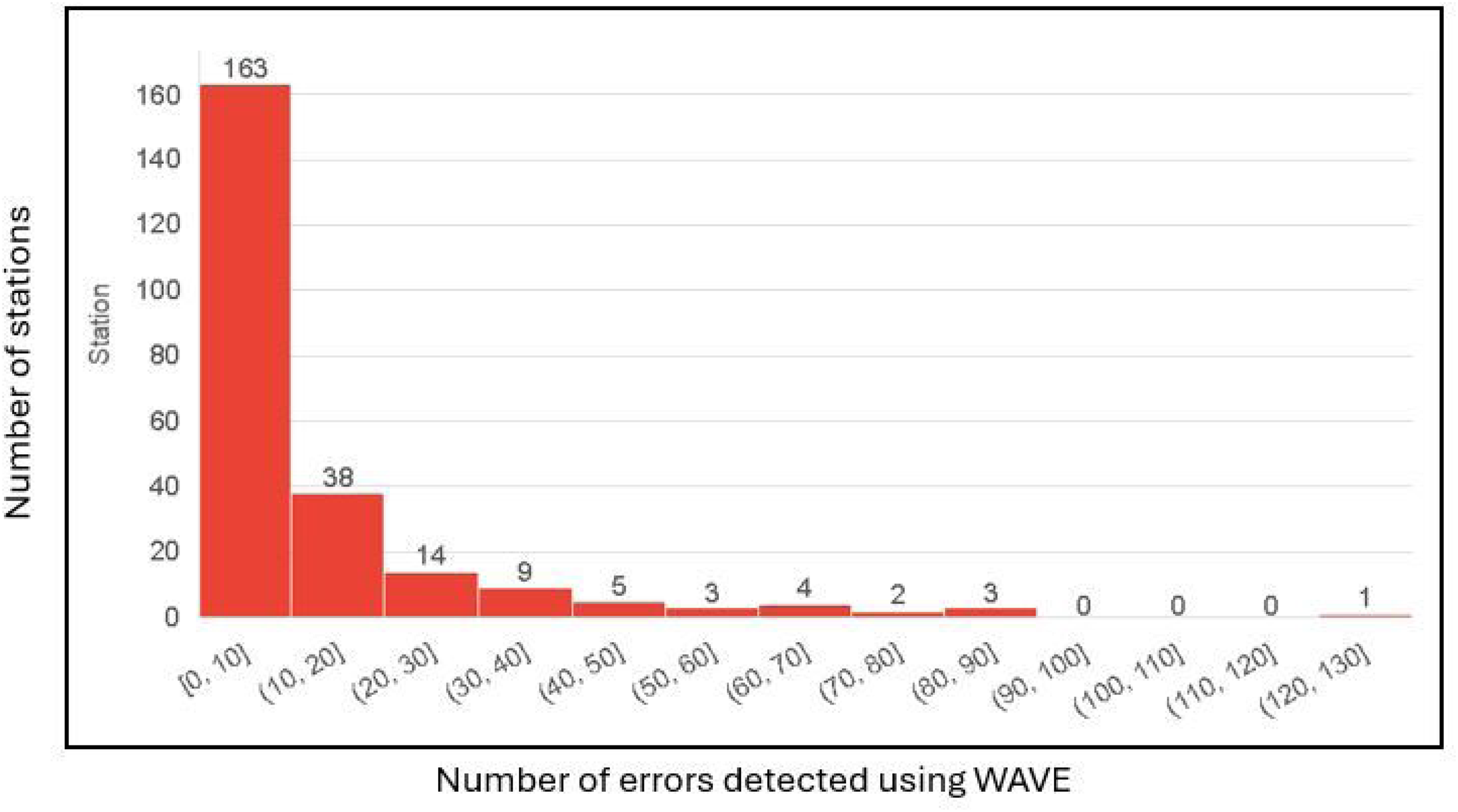
Community radio website error detection using WAVE accessibility tool.
Figure 1 shows that, of the community radio websites surveyed, the majority (163) had less than 10 errors. One notable outlier had 125 errors, the majority of which were empty links and the use of the ‘href’ tag erroneously. The href tag is the prefix used by web browsers to identify clickable links. In this survey, many of the higher scoring error results included the href tag error in addition to other errors. Most errors fell into the categories selected for usability impacts: use of headings, alt text on images and colour contrast issues.
However, 50 of the sites had only one error, the meta refresh error (described in the section above), rendering the website unreadable for many users. The refresh error also affected the ability to WAVE to assess any other aspects of the website. However, a GL result could still be calculated.
The WAVE tool also provides positive feedback for users. For those websites that scored low or no errors, this was for the correct use of headings, alt text on images, good colour contrast and correct use of Accessible Rich Internet Applications suite of web standards (ARIA) (W3C, 2023f). ARIA has not been discussed at length in this study to simplify the information for general readers.
Google lighthouse
Figure 2 shows the distribution of accessibility scores out of 100 from GL. The GL analysis found 135 sites scored over 82 for accessibility, with 28 scoring between 92–100 and six scoring 100. Over half were in the 82–87 range. This indicates a high level of accessibility, as measured by the GL tool, for over half of the sample.
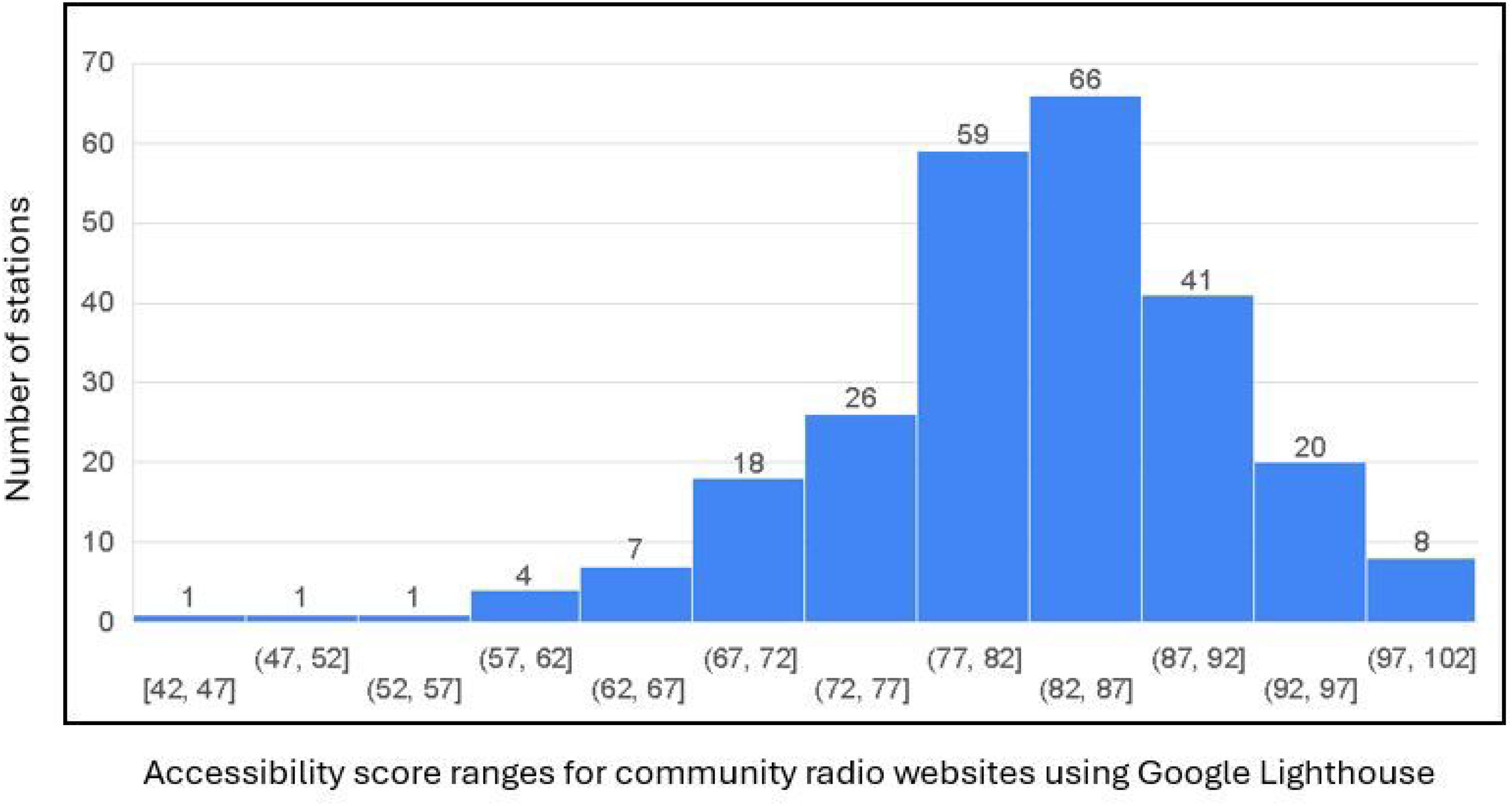
Community radio website accessibility scores using google lighthouse.
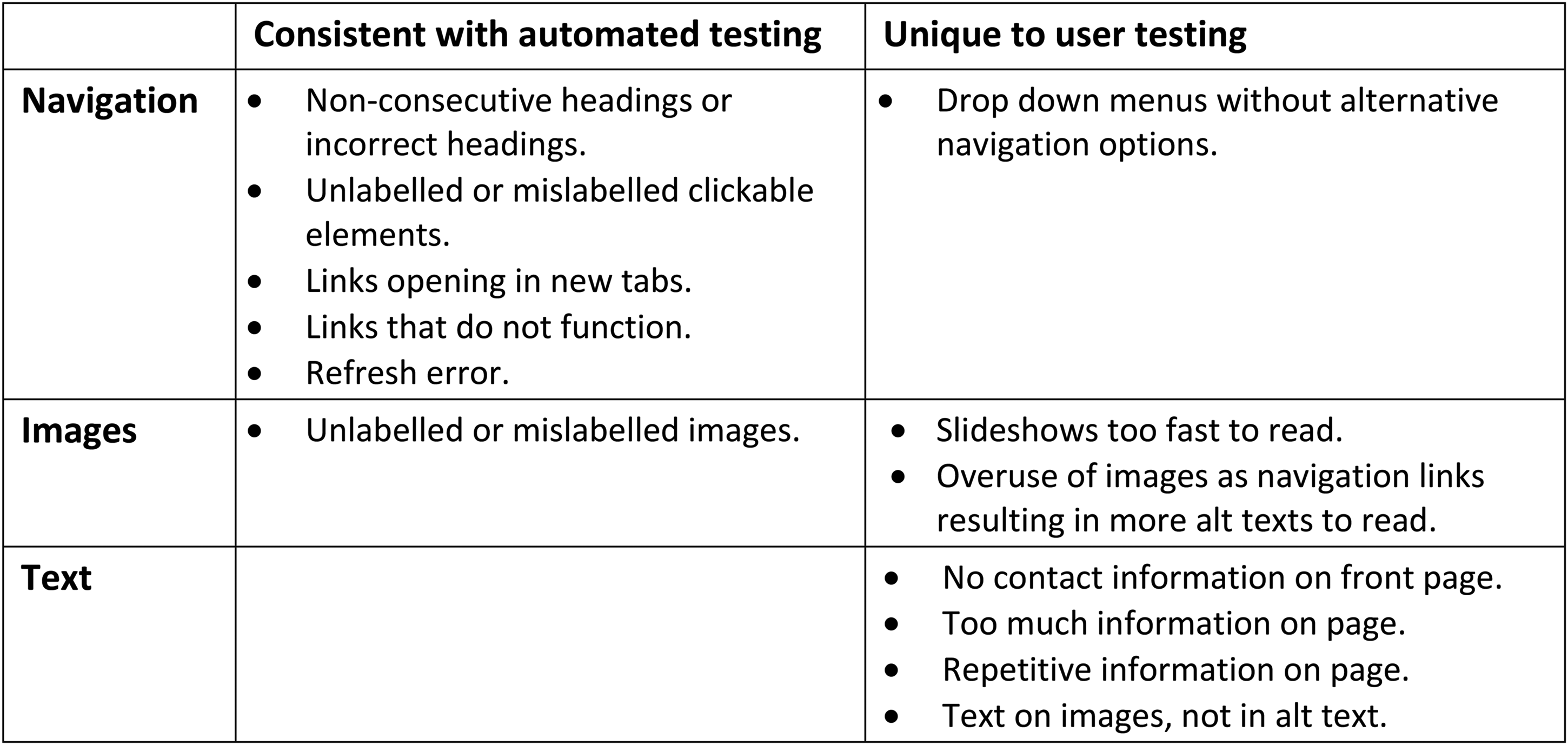
User testing with screen reader summary.
Community radio websites that scored low for accessibility in GL were few. Three websites scored less than 57, with the lowest score being 42. A score between 79 and 91 was achieved by the 50 websites that had the fatal refresh error in the WAVE analysis, indicating that despite a fatal flaw for screen reader users, the sites may still have high accessibility for people with other kinds of disability.
One recurring problem noticed in the testing by R1 (a sighted person) was the use of images with words in them, such as advertisements. Often those images were not described in alt text, meaning that information is not available at all to the vision-impaired or blind users. This could be problematic if the information is vital such as emergency phone numbers or how to contact the station if a user wants to volunteer.
User testing
The final survey of the websites was conducted by R2 using JAWS screen reader. JAWS and other screen readers read aloud the page from top to bottom. Users may skip sections using the keyboard shortcuts (tab key) to move to the next heading. Web sites that were easy to navigate correlated with those who received higher scores in the GL testing. See Figure 3 for a comparison of user and automated testing.
R2 was able to assess only 100 sites from the sample due to the extra labour and time taken to find basic information on the first 100 sites. Typically, it will take a screen reader user longer than a sighted user to access one page of a website, compounded by accessibility issues extending this time further. For this research R2 reported that it took between 10 to 20 min to access basic information on the 100 surveyed sites. Many of the findings unique to user testing were related to the time it took to access information.
Possibly the most important error found by user testing with a screen reader was difficulty accessing or non-existent phone numbers or contacts for stations. Often a phone number provides a simpler way to access information when a website is hard to access. R2 identified 53 of 100 sites that did not have a phone number on the front page of their website. Inability to access basic information like phone numbers, addresses or membership forms is a clear barrier to inclusion for people with disability.
Discussion
This survey of community radio station websites reflects a global trend of accessibility problems for websites that are not mandated government sites. Some community radio websites may be impacting access for prospective participants with disability, infringing their human rights and full participation. Right to information is fundamental to inclusive societies as described in Article 19 of the Universal Declaration of Human Rights (1948). The lack of enforcement on web accessibility indicates a gap in the powers of human rights laws, as they often only come into play when there is a complaint. Universal access is the only remedy to this ongoing human rights challenge.
It is unsurprising that some community radio websites have access issues. Volunteer run community organisations are often under economic and personnel constraints. Accessibility issues on websites are common in all sectors, very few are completely compliant with WCAG guidelines (Barbosa et al., 2022; Conway et al., 2012; Dominguez Vila et al., 2018; Grantham et al., 2012). Setting up and maintaining a website can be expensive and time consuming, and for community radio stations, their core business and communications tools are airwaves and audio rather than visual media, which they may prioritise for communication. This website survey delivered a baseline overview of the state of accessibility of community radio station websites for Australia, with results reflecting common errors seen in the literature. This indicates an ongoing problem of access problems to many site visitors with disability.
Human rights and participation issues
Sites with low accessibility scores, or crucial errors are in danger of preventing site visitors from becoming participants in this community sector. This puts stations at risk of human rights complaints under the DDA, where penalties including fines are a risk. According to the AHRC (2024) disability discrimination complaints comprise 43% of 2708 complaints to the AHRC in 2023–24, 45% of them against providers of goods and services. The AHRC Conciliation Register lists penalties including often substantial financial restitution particularly in employment contexts. Organisational staff that has a substantiated complaint may also be asked to undergo anti-discrimination training, public apologies, and/or requests to change their policy in addition to making donations to charity or the complainant. While restitution goes some way towards remedy to complainants, Murphy's (2021) study of three Australian states found that they may not lead to policy or practice change in the organisations.
The risk of preventing access for people with disability does not only fall on those websites with low accessibility scores. The user survey by R2 found that some otherwise accessible websites failed to provide obvious means to contact the organisation by email or phone. This could lead to a complaint against the Community Broadcasting Code of Practice (2025) that states a commitment to “pursue the principles of democracy, access and equity, especially for people and issues not adequately represented in other media” (2025: 9) and Broadcasting Services Act (1992, Schedule 2, part 5), in addition to the DDA, where it could be found to be a barrier to community radio stations obligation to allow members of the community to volunteer. Complaints about access to participation are lodged to the Australian Communication and Media Authority (2025) who make decisions on community broadcasting licenses that do not provide community access under the Codes of Practice (Code 3). The complaints processes provide some security for people with disability who find it difficult to access community radio websites. However, access is a founding principle of the sector, and proactive accessibility is a preferable reconciliatory process to retroactive punitive measures from government that might invite negative attitudes towards complainants with disability. Better adherence to WCAG standards and training for on accessibility for station volunteers could help mitigate this blind spot in web accessibility.
Limitations
Some of the literature noted the inconsistency of automatic web evaluation tools in delivering accurate results, suggesting an underestimate of errors. This indicates that high scores achieved by some websites in this analysis should be viewed with caution (Alsaeedi, 2020; Kumar et al., 2021; Mateus et al., 2021). This was borne out in this research, where some important website information was not detectable by R2 or the automated tools, only by a sighted user with an understanding of accessibility (R1). This is consistent with issues noted by Ara et al. (2024) where website issues may go unnoticed when web managers are not aware of accessibility and users may use convenient online image-making tools that turn text into images without consideration of the accessibility issues that result. The literature suggests that user testing that includes people with disability is best practice for checking web accessibility, but even then, it is not foolproof without access to a range of testers with a variety of disabilities.
Strategies for change
While people with disability are able to lodge complaints, the amelioration of the problem of website access will have more lasting and wide-ranging success through behaviour change. Volunteer run community media organisations are often low on resources, thus more likely to use free services and volunteer labour to create websites explaining those in this study that use Facebook as their only web presence. This is a good strategy for accessibility, as many large providers of free website services have accessibility statements, staff and resources to remain accessible and respond to complaints. The use of free tools such as WordPress and Wix can result in greater accessibility. For those that use paid services, inquiring about their commitment to accessibility is advisable. In addition, professional development about digital accessibility for staff and volunteers can enhance not only the website but knowledge and attitudes towards potential new volunteers with disability. A whole of organisation approach that includes awareness, training, and organisational processes is the most effective.
Conclusion
Digital inclusion is a human rights issue that has the potential to enhance participation in community radio in Australia, affirming the voice and communicative rights of people with disability. As websites are the first point of contact for all prospective volunteers and donors, it is important they are useful for all visitors, providing them with easily accessible and understandable information about getting involved in community radio. The achievement of an accessible website is something even smaller organisations with low or no budget can achieve with free website services that exist. Improving a website can be an opportunity for stations to affirm their commitment to sections of their community that they may not have yet considered, and to make links with people with disability and the organisations that support them, potentially opening new avenues for attracting volunteers. With ongoing challenges in digital accessibility in every sector, this research indicates there is much to be done to make the world's most important source of information, the internet, available to every person who wants to participate in their community. It serves as a call to action for all community and third sector organisations to do more to enable inclusion, acceptance and the communicative rights of the community that supports them.
Google Lighthouse is a Creative Commons 4.0 online resource used in this research. WAVE online resource was used with permission from the creator.
Footnotes
Acknowledgments
We recognise the sovereignty of the First Nations peoples of the land from which we work, the Yagera and Urgarapul people of Tulmur (Ipswich).

Ethical approval
There are no human participants in this article and informed consent is not required.
Funding
The authors received no financial support for the research, authorship, and/or publication of this article.
Declaration of conflicting interests
The authors declared no potential conflicts of interest with respect to the research, authorship, and/or publication of this article.
Data availability statement
The data from the WCAG desktop research is considered low risk and stored on a publicly available One Drive folder belonging to the University of Southern Queensland.
The data contains no information about individuals. It contains information about organisations that is publicly available on the internet. It is accessible on application to the author kim.stewart@unisq.edu.au
Declarations
This article is intended to describe an aspect of the field and identify ways to progress equity, diversity and inclusion in community broadcasting. The researchers have a long association as community broadcasters in Australia. The Kim Stewart has been a radio trainer for a decade, a volunteer in community radio and media activist for 25 years, volunteer advocate for people with disability at a major metropolitan station and has a chronic pain condition that is sometimes disabling. Paul Price has been a volunteer community radio producer for more than 20 years, held board positions in disability advocacy organisations, has a bachelor's degree in information technology and has been blind since birth.