



Abstract
This paper explores representations of Antarctica and Antarctic science in news media, using Australian news as a case study. Antarctic scholarship in the humanities and social sciences is increasingly interested in public engagement with a continent in geopolitical and geophysical flux. Studies have focused on literature, advertising, music and the arts, while news has been largely overlooked. Focusing on Australia, which claims 42 percent of Antarctic territory, this paper draws on results from a larger study exploring the interplay between news, science and politics on the icy continent. Following a content analysis of online news articles, we find news coverage heavily featured stories of Australians living and working in Antarctica, with less coverage focused on Antarctic science, including climate science. We suggest this news coverage may contribute to promoting awareness of Australia's territorial claim, while potentially limiting broader public engagement with the continent's global significance. Future research incorporating audience surveys could help determine the extent to which media coverage influences public perceptions and reinforces territorial claims.
Introduction
Due to its geographical isolation, the Antarctic region is largely mediated through various forms of communication. Antarctic scholarship in the humanities and social sciences is increasingly interested in public engagement with a continent experiencing geopolitical and geophysical flux. Studies to date have focused on literature, advertising, music and the arts, but news has been largely overlooked in understanding Antarctica and Australia's relationship to it. Given that news media are instrumental in framing social and environmental issues (Couldry and Hepp, 2018) and serve as a primary source of scientific information for both citizens and policymakers (Anderson, 2022), this is an oversight in research concerning a region of growing global significance. The potential for resource extraction, proximity to the fish-rich Southern Ocean, and an increase in tourism means major powers are asserting their interests in a continent of strategic value (Bond and Mortensen, 2023; Press and Bergin, 2022), challenging ideas that the continent is free from conflict (Dodds, 2024). The impact of climate change on a continent that profoundly impacts Earth's climate and ocean systems has also reinvigorated public and media interest in Antarctica and Antarctic science (Tranter and Leane, 2023). It is in this context that the need for examination of news media coverage of the continent is timely and necessary. This paper draws on results from a larger project, which is the first study that we are aware of to produce a systematic, empirical analysis of the interplay between news, science and politics on the ice continent. Using data collected from a content analysis of online news stories, this paper identifies the features of coverage of Antarctica in Australian news media. It concludes with a discussion on the potential implications of these journalistic representations of the continent and suggestions for further study.
Australia's interests in Antarctica
Australia is an ideal case study for examining news coverage of Antarctica due to its long-standing connection and proximity to the region. Australia is one of seven sovereign states that claim Antarctic territory along with Argentina, Chile, France, New Zealand, Norway and the United Kingdom, but these claims are frozen under the Antarctic Treaty (Powell and Dodds, 2014), which Australia played a key role in negotiating (Haward et al., 2006). The treaty does not extinguish these claims, but they cannot be enforced, and countries such as Russia and the United States reserve the right to make future claims (Flamm, 2022). The treaty system established Antarctica as a continent of peace and science, and conducting science is a key Antarctic activity and central to engagement with the continent – it has been described as the currency of Antarctica (Haward and Griffiths, 2011; Press, 2016) and, critically, ‘Australia has played an important role in maintaining its value’ (Haward and Griffiths, 2011: 148). A massive 42 per cent of Antarctica is claimed as Australian territory – a claim closely associated with the nation's long connection to the region, spanning what is called the ‘Heroic Era’ of Antarctic exploration 1 to the present day (Haward et al., 2006; Kawaja and Griffiths, 2011; Kriwoken et al., 2007; McGee and Smith, 2017). Australia maintains three Antarctic research bases in the Australian Antarctic Territory in East Antarctica – Casey, Davis and Mawson – and another on the Sub-Antarctic Macquarie Island. Heard and MacDonald Islands in the Southern Ocean are also part of the Australian Antarctic Program (AAP). Hobart, the capital of Tasmania, is one of five Gateways to Antarctica 2 and is a centre for Antarctic research. The Antarctic Treaty System (ATS) covers a series of international agreements regulating the continent, allowing countries to conduct science in Antarctica and the Southern Ocean, while encouraging international cooperation. As a signatory, Australia must balance domestic sensitivity with broader international diplomacy and navigate a path between what is best for maintaining Australia's territorial claim while reconciling the internationalism required in such an agreement (Haward and Cooper, 2014; McGee and Smith, 2017). A bipartisan approach has characterised and embodied the nation's Antarctic strategy (Hodgson-Johnston, 2015). Australia's sovereign claim in Antarctica is the justification for the existence of the Australian Antarctic Division (AAD), and for the scientific program on the continent (Rothwell and Scott, 2007). This context is critical in order to understand the geopolitical background to Australia's relationship with Antarctica.
Antarctica in the humanities and social sciences
Antarctica is physically inaccessible to the vast majority of the world's population; therefore, most people have a wholly mediated experience of the continent (Alexander et al., 2022). Research into how the continent is represented in popular culture and media has shown that Antarctica is portrayed as a place of extremes and heroic deeds (Nielsen, 2023), as a symbol of purity (Leane et al., 2023) and as an historically masculine place (Nash and Nielsen, 2020). Although more women are working on the continent, culturally it is dominated by men and masculinity (Nash et al., 2019). The emphasis on science as the currency of Antarctica, outlined above, and its role as a ‘sentinel’ for global environmental change (Convey, 2023), contribute to a perception that Antarctica is a place for scientists and science. Further, because Antarctic affairs are conducted through consensus and cooperation, the continent can be viewed as ‘immune to the political, social and economic forces that affect the rest of the globe’ (Leane and McGee, 2019: 7). This exceptionalist approach suggests that the continent is a ‘blank space’ (Glasberg, 2012: 96).
Analysis published elsewhere has shown there is limited existing scholarship into news media coverage of Antarctica (Hunt et al., 2025), but themes of nationalism were noted in studies of news coverage in Norway (Alnæs, 2020), New Zealand (Bell, 2003) and American polar-rim states (Wehrmann, 2018). This feature has also been found in studies of Arctic news coverage, where national interests are emphasised (Stoddart and Smith, 2016). While other studies have engaged with print media (Alexander et al., 2022) and advertising (Nielsen, 2023), contributing to an understanding of how Antarctica is represented and mediated, they do not directly engage with news media or journalistic practices.
Neglecting the study of news media in this critical global location is a significant gap in research given that news media is the main source of information about science and environmental issues for citizens and decision-makers (Goodman et al., 2022; Mach et al., 2021; Newman et al., 2024), while surveys have shown news is a key source of information for Australians about the continent (Tranter and Leane, 2023). The salience of issues in news coverage is shaped by professional practices, organisational structures and wider political, economic, social, and cultural contexts (Schudson, 2019), as has been noted in studies into climate change-related news (Schäfer and Painter, 2021). News is also happening within a media landscape undergoing seismic change. Legacy media have adapted to digitalisation by developing an online presence to capture audiences (Harmer and Southern, 2020; Mellado et al., 2024), while resource-poor newsrooms increasingly rely on information subsidies (O’Neill and O’Connor, 2013; Wheatley, 2020). At the same time, there has been a reduction in specialist reporters, with generalists increasingly covering complex science and environment issues (Anderson, 2022; Boykoff et al., 2015). Investigating news content can reveal what information reaches news audiences (Deacon et al., 2021; Weerakkody, 2008) and is the first step in understanding how Australia's relationship to Antarctica is mediated in the news and which issues are made salient.
This paper explores how Antarctica and Antarctic science is represented in Australian news media. To answer this, the research questions are formulated as follows: RQ1: What are the dominant themes in news coverage? RQ2: How does coverage differ between news organisations? RQ3: Who are the main actors in news coverage? RQ4: If science is described as the currency of Antarctica, is this reflected in news coverage?
Methods
The research presented here is drawn from a larger project investigating the interplay between news, science and politics in Antarctica, using Australia as a case study. The data for the project included analysis of news texts and interviews with journalists, scientists and other Antarctic stakeholders. This paper draws on findings from a content analysis of 374 news texts sourced from Australian online news platforms between 1 July 2018 and 30 June 2020.
Finding the news articles
To ensure a mix of news organisations and audiences, the news articles were sourced from the top 10 Australian online news platforms according to ratings conducted by Nielsen, a global company measuring media audiences. This approach also considers the increasing use of search engines for accessing news by Australian consumers (Park et al., 2023). This is a form of purposive sampling, which is a popular type of sampling strategy used to study news coverage (Riffe and Freitag, 1997), in which the researcher finds texts relevant to the topic of interest, and based on certain criteria (Sibona et al., 2020). Initially, news articles were identified through Google News alerts using the keyword search terms ‘Antarctic’ and ‘Antarctica’. This approach mirrors that taken by Dempster et al. (2022) in their analysis of scientific research in news media. This method was also adopted by Haneef et al. (2015) and Young Lin and Rosenkrantz (2017) for its broad coverage of diverse news sources and real-time reporting capabilities. For this analysis, only articles that were relevant to Australia's relationship with Antarctica were included in the final dataset 3 . Similarly, only news stories, editorials and opinion pieces were included: letters to the editor, and advertorials (including travel advertorials) were omitted, as the aim of the study is to examine news practices. However, keyword searches can have ‘inherent flaws’ as noted by Lacy et al. (2015: np) not least of which is concern about ‘comprehensiveness’ of the data collection. This was evident in this study after the initial year of articles was collected (2019–2020), and the size of the corpus was not sufficient for a study of this size. The decision was made to collect articles for the preceding year in addition to the year already collected. This was achieved through the Google search engine, and by using the search engine on each news organisation's online platform. All articles were entered into NVIVO, a computer assisted data analysis program.
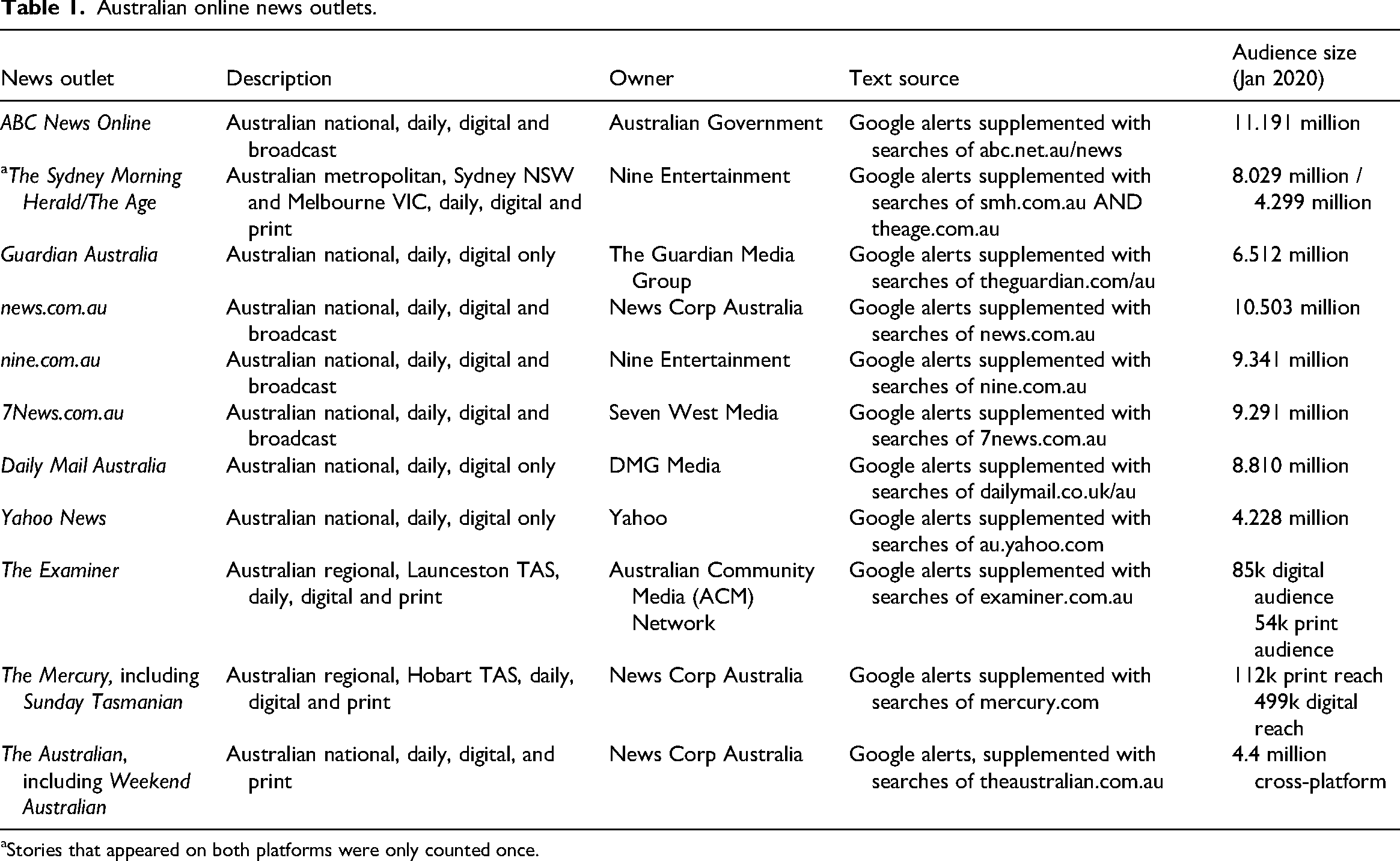
In the period during which articles were gathered, ABC News Online and Daily Mail Australia consistently vied for top position. In the June 2020 ratings, the news platforms next in popularity were nine.com.au, 7News, The Guardian and news.com.au. It is interesting to note these are all stand-alone websites and are not digitised versions of a print newspaper (although ABC News Online, nine.com.au and 7News have broadcast arms). The next three platforms were the online portals for the Sydney Morning Herald, The Age and Australian Community Media (ACM), which all have print and online platforms. Yahoo rounded out the top 10.
ACM is made up of more than 170 rural and regional and community-based websites 4 including Launceston's The Examiner. Given The Examiner's Tasmanian-based status, articles were sourced from the newspapers’ digital portal to cover off the contribution from ACM to Antarctic coverage in news media. Also added to the top ten sites were The Australian online and The Mercury online. The Mercury was chosen as the metropolitan daily newspaper and associated online site is based in Hobart, which is an Antarctic Gateway city. The Australian was added because the publication does on occasion make the top ten according to the Nielsen ratings, but the overriding factor was the presence of a reporter in Hobart who is known for coverage of science, environment and Antarctic content. See Table 1 for a detailed list of the selected online news sites.
Australian online news outlets.
Stories that appeared on both platforms were only counted once.
A large number of articles were written by journalists from Australian Associated Press (AAP), an independent Australian newswire, and syndicated. When an AAP article appeared on more than one platform, they were counted each time to more accurately indicate the prevalence of themes across all digital news. There were also a small number of articles sourced from Agence-France Presse, a global news agency, with a bureau in Sydney, Australia.
Coding the dataset
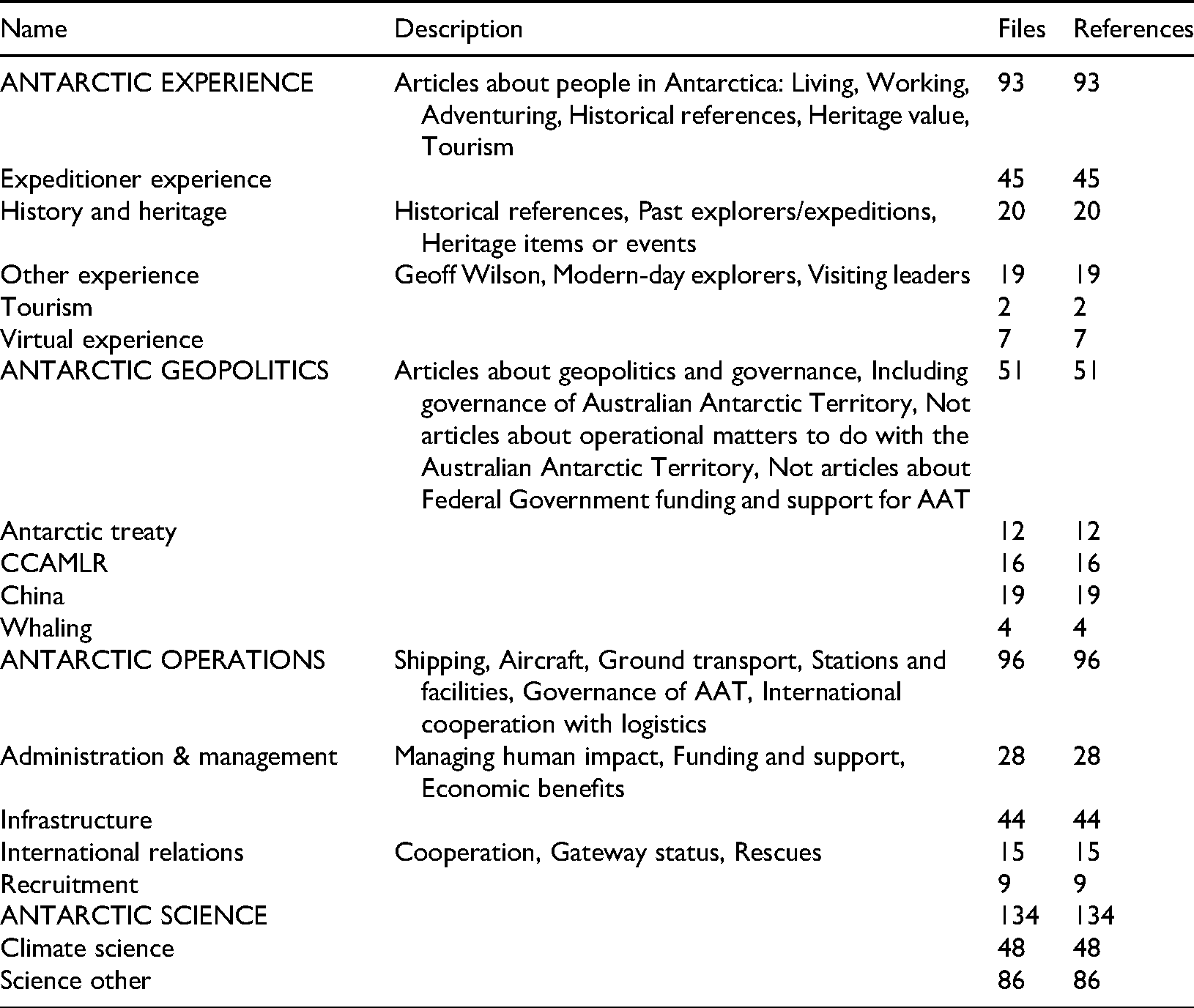
A quantitative content analysis of the dataset was conducted to identify the dominant themes and actors in the news corpus, using an inductive approach (Weerakkody, 2008). All coding was conducted within NVivo. Rather than relying on specific words as a coding element, the researcher systematically identifies ‘specific subjects, themes or issues’ (Hansen and Machin, 2013). This differs to a framing analysis, as the intent was to determine what was being discussed in news discourse about Antarctica, rather than how it was discussed. This approach resulted in multiple iterations of coding, before a final analysis was settled upon – the results of which are discussed in the following section. Coding was conducted by one author only, which can present challenges in terms of ensuring reliable coding (Campbell et al., 2013) that meet research ideals of stability, accuracy and reproduction (Krippendorff, 2018). To address the lack of inter-rater reliability, the data was analysed and coded over different time periods, as suggested by Mackey and Gass (2005). This iterative immersion in the dataset resulted in a high level of understanding and knowledge of the content and allowed for themes to emerge, but also for a precision in coding that was important for understanding the nuances of each news story. A copy of the codebook is shown in Appendix A.
Findings
Dominant themes in news coverage
Content analysis revealed four distinct themes (see Figure 1) and articles were coded depending on the dominant theme. When an article contained elements of more than one theme, the dominant was chosen, which was usually reflected in the headline and opening paragraphs.
5
The dominant themes identified in news coverage were as follows:
Antarctic Science Antarctic Operations Antarctic Geopolitics Antarctic Experience
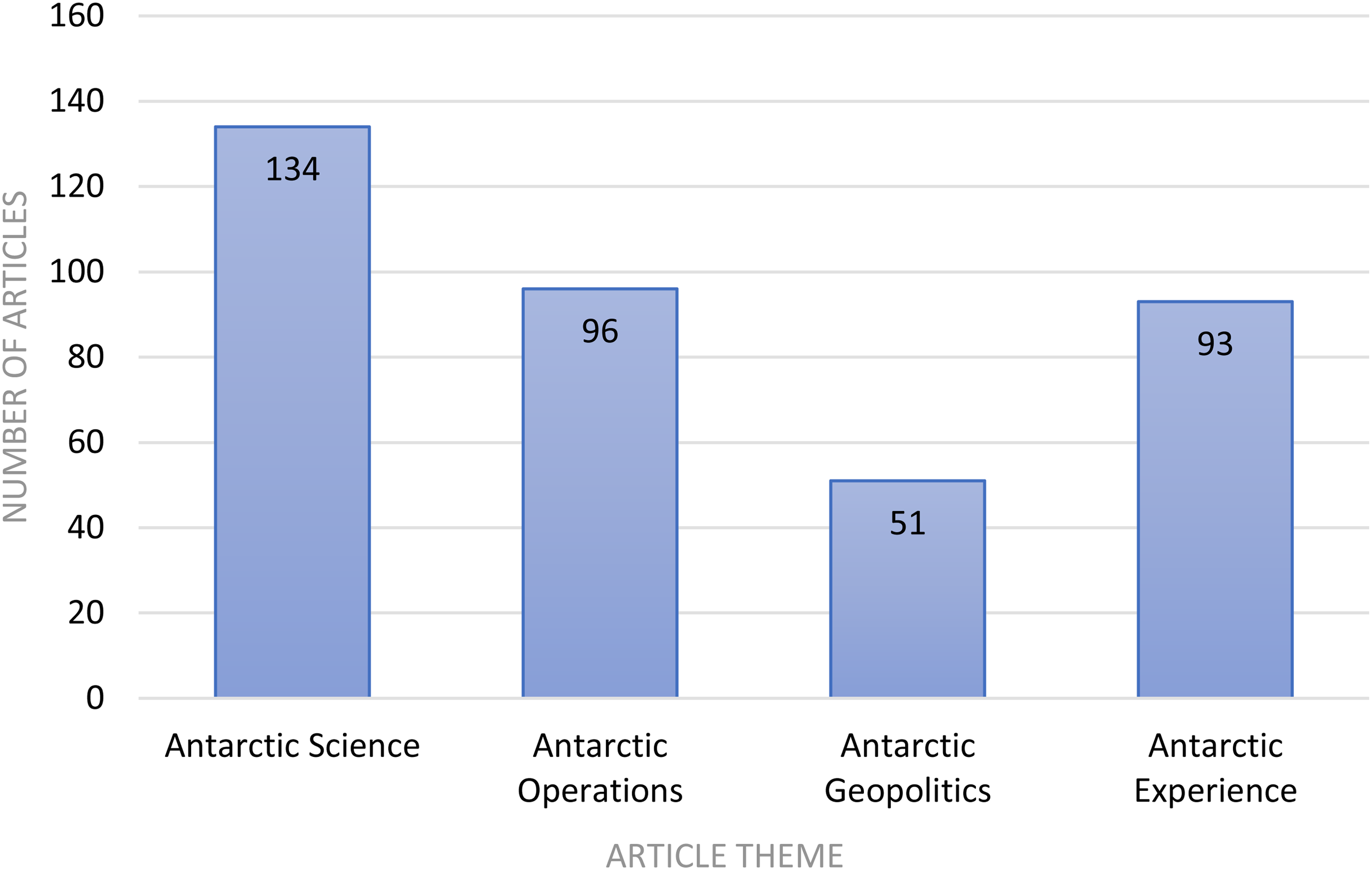
Dominant themes in Australian online news coverage July 2018–June 2020.
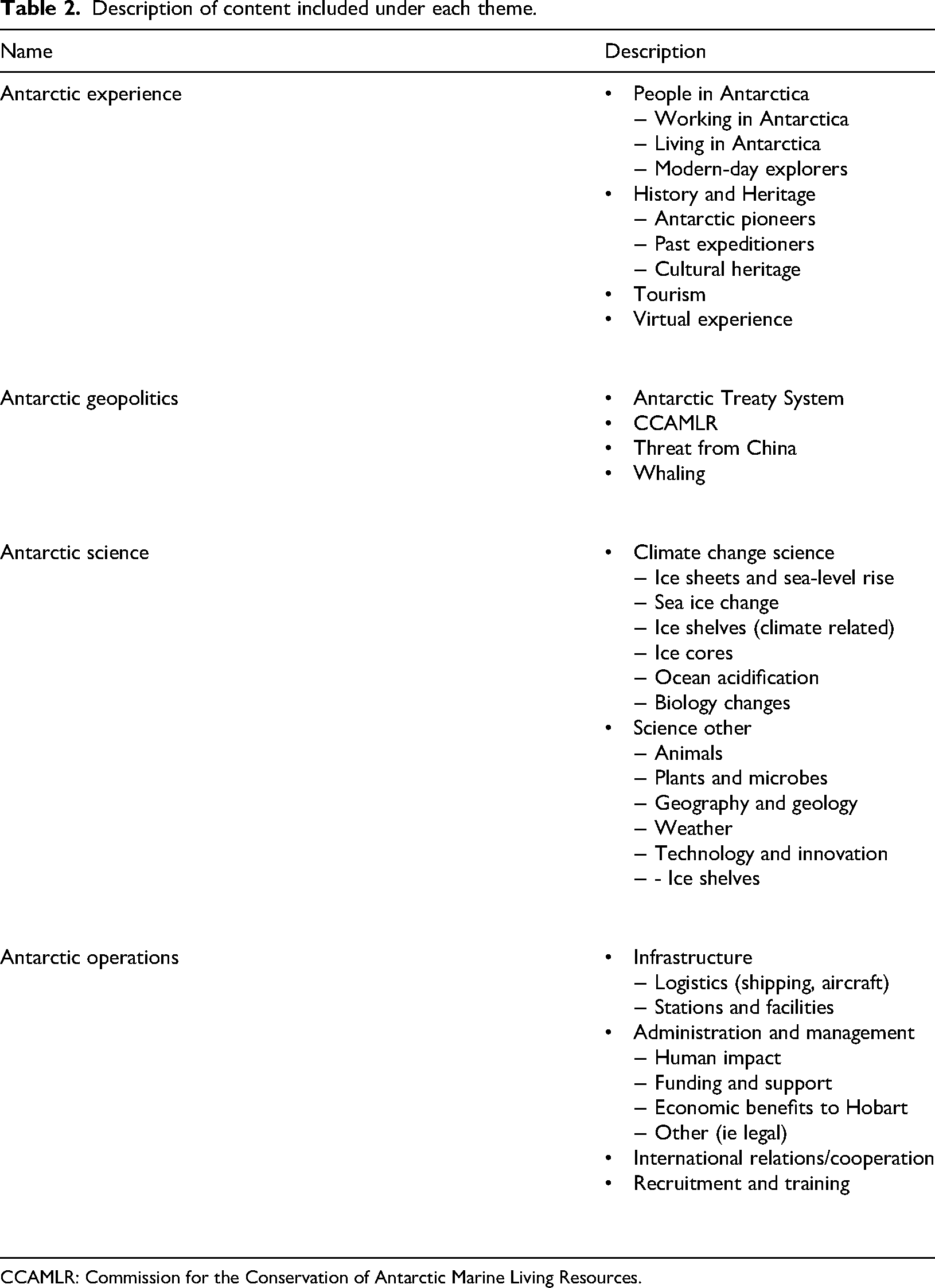
Articles coded under the Antarctic Science theme were focused on Australian scientific endeavours related to the continent. News stories covered a range of scientific and research endeavours by AAD employees, as well as scientists from other Australian research institutions such as the Institute for Marine and Antarctic Science in Hobart, and several Australian universities. These stories explored news about a range of science, which could be further categorised as either climate science or ‘general science’. Climate science news covered topics including sea-level rise, sea ice changes, ice cores, ocean acidification and melting ice shelves. Other science news featured stories about animals, plants and microbes, geology, weather, technology and calving ice shelves not related to climate change. Of the 134 articles about science in the news corpus, 48 focused on climate science.
The Antarctic Operations theme contained articles focused on the massive infrastructure and management required to maintain Australia's presence on the continent. These stories dealt predominantly with logistics, including news about the new icebreaker Nuyina, Australian Antarctic bases and other Antarctic-related facilities. There was an emphasis on funding and support for Australian operations along with the economic benefits to Hobart, Australia's Antarctic Gateway city. The news also featured stories about AAD recruitment drives 6 , and collaboration with the Antarctic programs of other countries, such as France and China.
In the Antarctic Experience theme, the news was focused on the experiences of people who were living and working on the continent, including expeditioners employed by the AAD and modern-day explorers. Also included under this theme were articles exploring the history and heritage of Antarctic pioneers such as Sir Douglas Mawson, and the feats of earlier expeditions. There were several stories presenting opportunities for people in Australia to experience the continent virtually, in lieu of having a physical experience. Of the 93 articles coded in this category, only two were directly concerned with Antarctic tourism. The stories in this category tended to concentrate on the experiences of the article subject, rather than the context of their presence in Antarctica.
Articles coded under the Antarctic Geopolitics theme focussed on geopolitical manoeuvring. Included in this category, were stories about the ATS, international meetings that determine the use of Antarctic and Southern Ocean resources, in particular the Commission for the Conservation of Antarctic Marine Living Resources 7 , and stories about China's presence in Antarctica. Of the 51 articles in this category, 19 were concerned with what was perceived as China's increasing incursion into the continent. A simple text search of the word ‘China’ revealed that 31 of the 51 stories in this category referenced China.
A detailed list of the content identified within each theme is illustrated in the Table 2.
Description of content included under each theme.
CCAMLR: Commission for the Conservation of Antarctic Marine Living Resources.
News themes by media organisation
News coverage is subject to professional practices and organisational structures within different media organisations and occurs in broader political, economic, social and cultural institutional contexts (Schudson, 2019); therefore, an analysis of the content produced on each news platform is valuable for understanding this element. Figure 2 illustrates the breakdown of content within each media organisation analysed during the 2-year period.
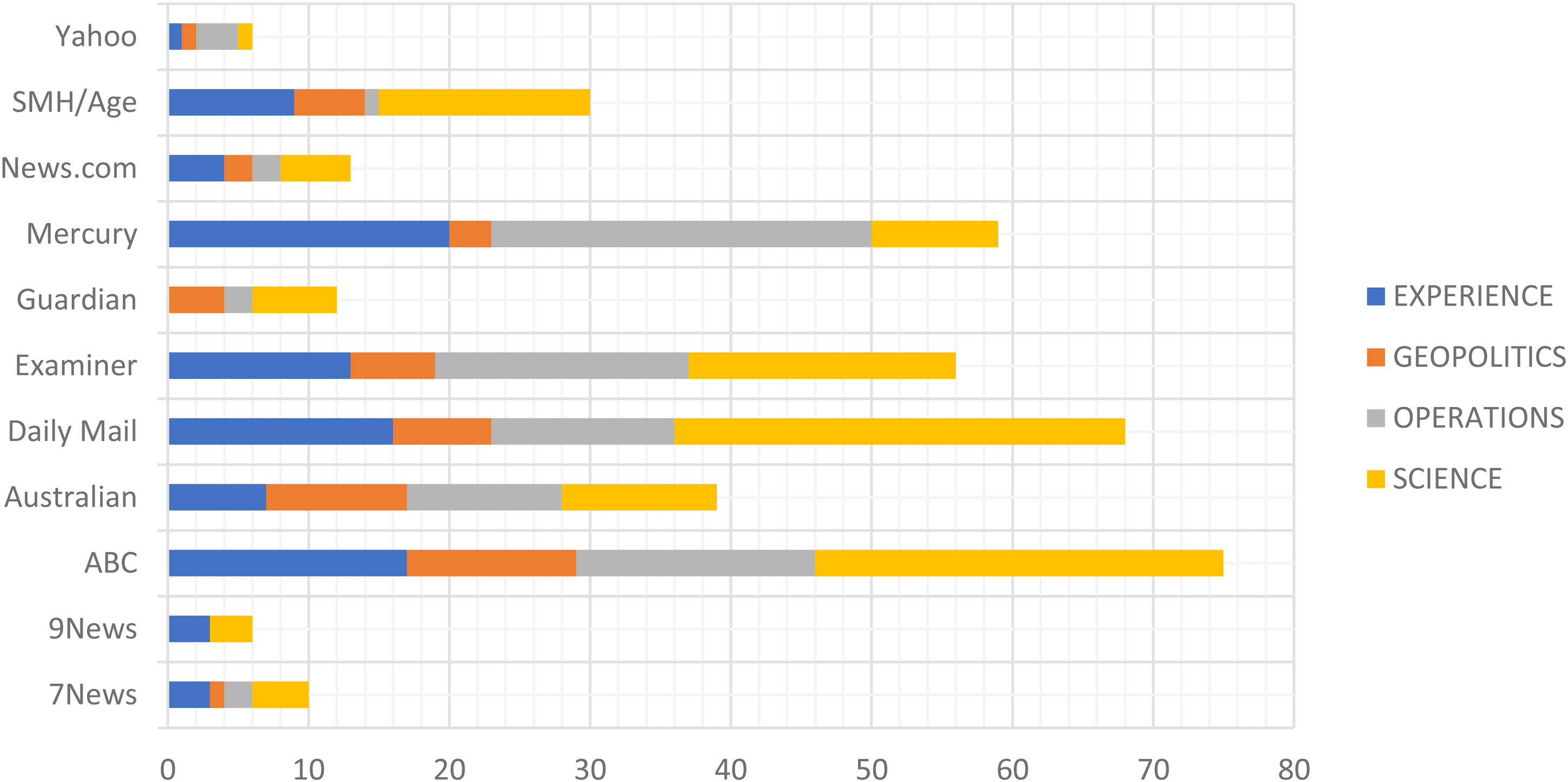
News article themes by media organisation.
The Australian national broadcaster, ABC News Online, published the most online articles about Australia and Antarctica during the time frame analysed (75 articles). The majority of the articles were science-focused (29 articles). There were equal numbers of articles focused on experience and operations (17 articles). A further breakdown revealed that of the 29 articles with a science theme, only 10 were focused on climate science.
The Daily Mail Australia is known for its people-led news content, rather than issues-based news coverage; however, the online-only platform published the second highest number of news articles (68 articles) overall, and the most articles under the science theme (32 articles) almost double the number of stories about experience (16 articles). It should be noted that the majority of Antarctic-related articles that appeared on the Daily Mail site were syndicated from the AAP, which has a reporter based in Hobart.
Hobart-based newspaper The Mercury published 59 articles during the time frame analysed. The newspaper's online platform also topped the number of stories about operations (27 articles). In these stories, there was an emphasis on the economic benefits for Hobart as a Gateway City. Additionally, there were stories regarding funding of science organisations based in Hobart, the push to preserve the icebreaker Aurora Australis, which was about to be retired, and the progress of the new icebreaker, Nuyina.
The Examiner is another Tasmanian newspaper, based in the north of the state with a smaller newsroom in the capital, Hobart. Like the Daily Mail Australia, the majority of Antarctic news stories published on The Examiner's online platform (56 articles) were syndicated from the AAP reporter based in Hobart. The news space given to science stories (19 articles) was considerably greater than the other Tasmanian-based newspaper, The Mercury (9 articles). Operations stories (18 articles) were also prominent.
The Australian is a national newspaper with an online platform and a reporter based in Hobart, Matthew Denholm, who has travelled to Antarctica several times as part of the AAD's media program and as a guest of tourism operators. However, the number of stories about Antarctica on the platform was, in comparison, relatively low (39 articles), with fewer than half written by the Hobart-based reporter. There was relatively equal focus on the four theme categories of science, operations, experience and geopolitics.
The online sites of two Nine Entertainment-owned newspapers, smh.com.au (SMH) and The Age Online, share content. The Age is published in Victoria, while its stablemate, the Sydney Morning Herald, is published in New South Wales. A relatively small number of news stories about Antarctica (30 articles) were published on both websites with science stories accounting for half.
The Guardian Australia has a reputation for coverage of environment and science issues, and although the online platform regularly reports on Antarctica issues, these stories predominantly come from the UK-based arm of the organisation, nor do they engage with Australia's relationship, and therefore did not meet the requirements of the corpus. As such, there was only a small number of Australian-specific Antarctic content (12 articles).
The remaining four online platforms – 7News, nine.com.au, news.com.au, Yahoo – do not have an accompanying print platform, and all contained negligible coverage of Australian Antarctic matters. Three of these news platforms, nine.com.au, news.com.au and 7News, have consistently been in the top five most visited online news platforms over recent years 8 . However, these sites gave minimal news space to Antarctic stories that met the requirements of this study during the 2-year period examined.
Who speaks about Antarctica?
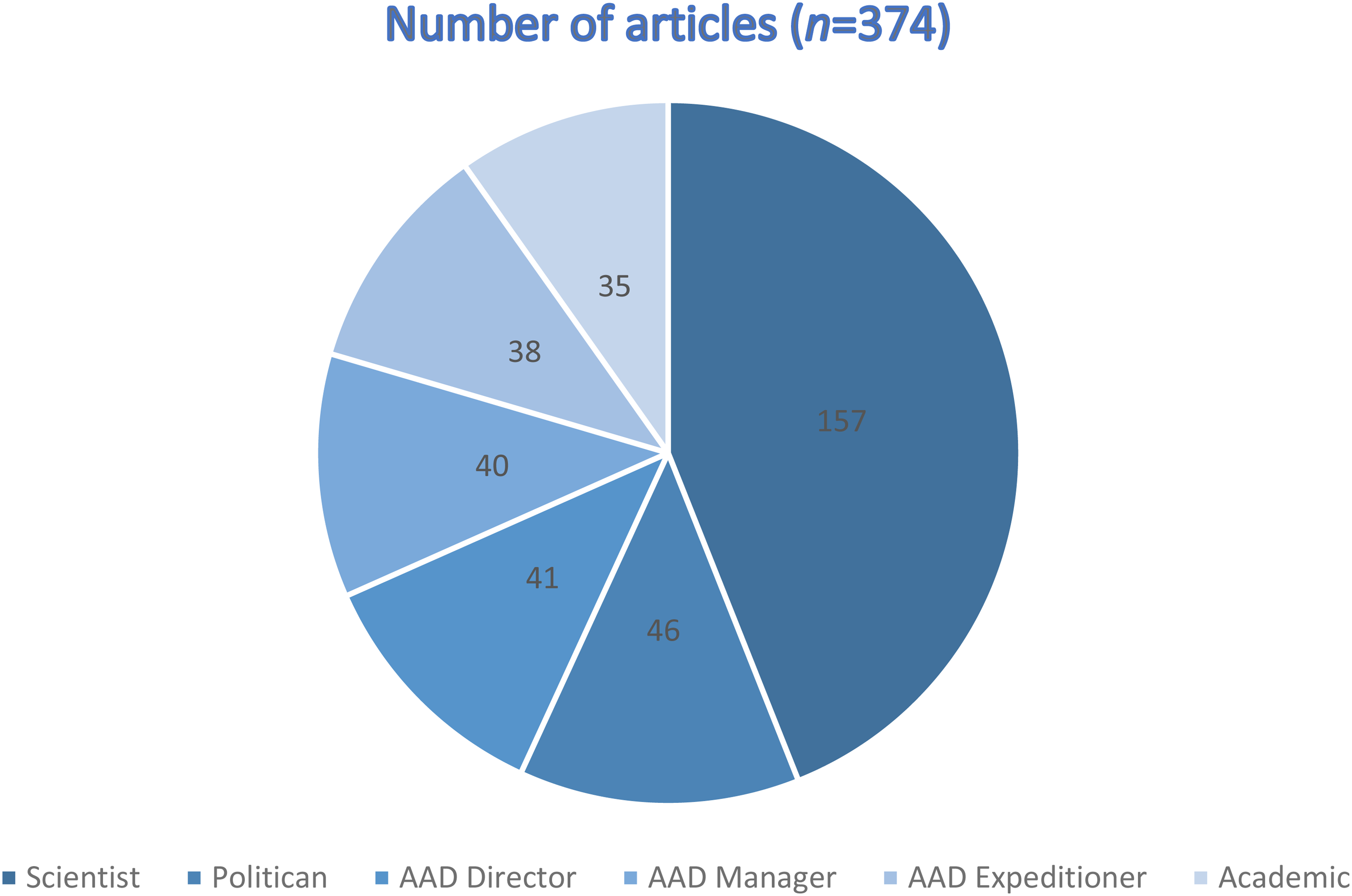
Overwhelmingly, in this corpus, scientists were given the job of talking about Antarctica. Figure 3 presents a breakdown of the number of articles dominant actors appeared in. All actors that appeared in each article were coded once, therefore some articles recorded multiple actors from the same category (i.e. scientists). The results show that a clear majority of articles featured Antarctic scientists, who were quoted either directly or indirectly in 157 of the 374 news articles across all themes.
Dominant actors featured in online news articles.
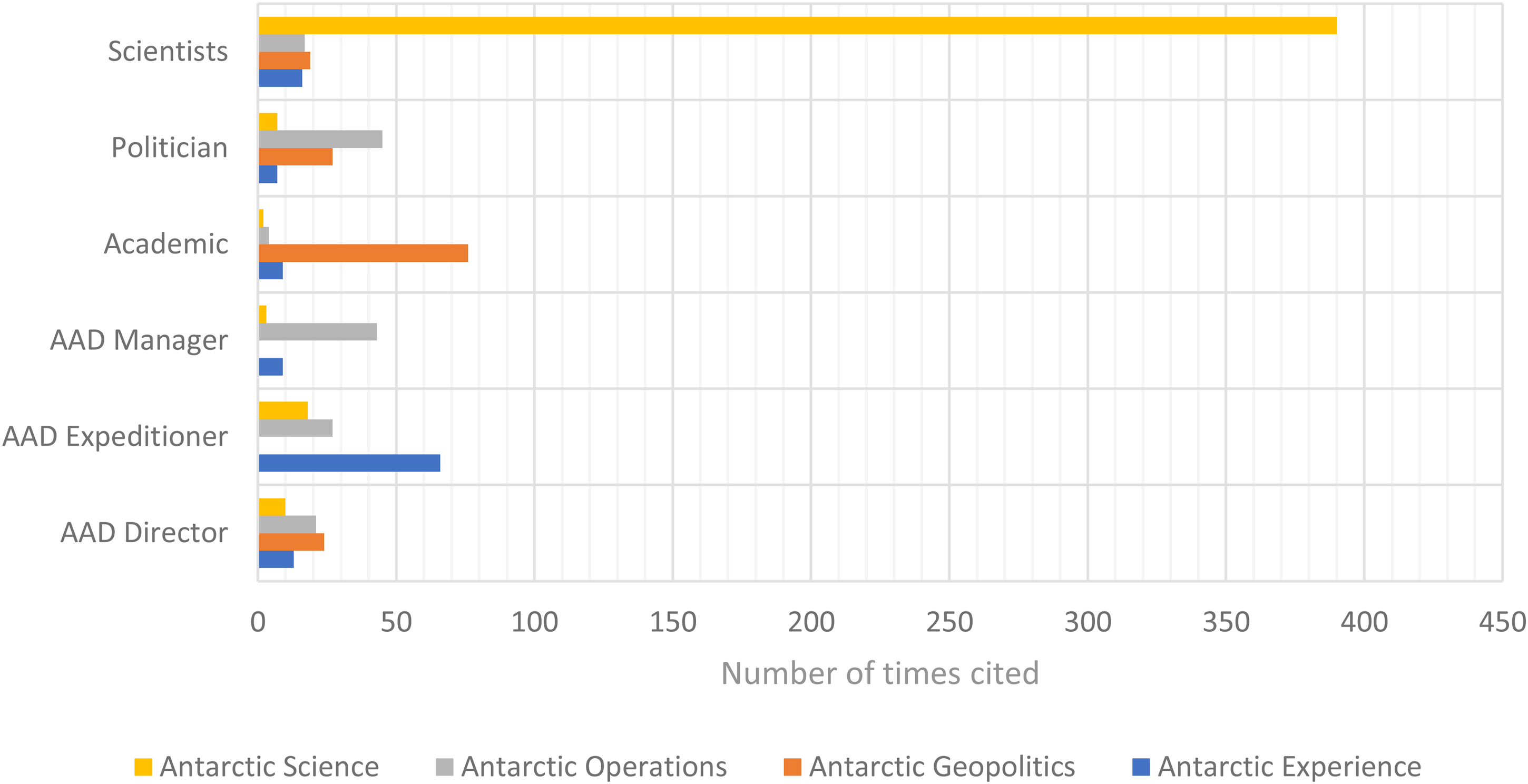
Politicians were the next most featured source of information, quoted in 46 news articles. This was closely followed by the AAD Director 9 (41 articles) and AAD managers in charge of various operational projects (40 articles). AAD expeditioners, both past and present, were used as sources in 38 news articles, while the top six most frequently cited actors were rounded out by academics who appearances in 35 articles. A breakdown of themes within which the top six sources were quoted can be viewed in Figure 4.
Actors by theme.
This illustrates the prominence of scientists’ voices in news stories about science and research. Several articles featured additional comments from AAD Managers, Station Leaders or the AAD Director, Kim Ellis, but this was always in the context of the institutional support that was being provided for the scientific research. Overseas officials were occasionally quoted when science involved collaboration with other countries. Only two politicians were quoted (on three occasions) in science-themed stories – the then Environment Minister Sussan Ley and Science Minister Karen Andrews. In both articles, the pair reiterated the Federal Government's commitment to Antarctic science, with their comments mostly apolitical.
The dominant actors in articles in the experience theme were AAD expeditioners who were used to paint a picture of what it is like to live and work on the icy continent. They described the challenging and extreme conditions they would work in, but also extolled the virtues of the unique experience of working and living in Antarctica, as demonstrated in the below quote: “I loved (the time in Antarctica), I loved everything about them”, he said. “I loved the idea of the unknown”. (Buckingham-Jones, The Australian, 25/10/2018)
The only other actors to be featured prominently in these news articles were other AAD staff including station leaders and the occasional scientist describing life on an Australian base, modern-day Antarctic adventurer Geoff Wilson (see AAP, 7News, 24/12/2019) and several filmmakers who had travelled and worked on the continent.
There was similar representation of AAD staff in stories covering operations; however, the AAD Director, Kim Ellis, featured prominently in these articles. Kim Ellis was, in fact, the most represented individual in all news stories, speaking across all issues. His comments were also drawn upon to make sense of Australian activity on the continent and to act as a promoter, almost as an emissary, between Australia and Antarctica, as was demonstrated when he was interviewed about Anzac Day celebrations in Antarctica: Mr Ellis said the nation's Antarctic program had strong links to the military, with many servicemen and women volunteering on supply and construction missions after WWII. “Our expeditions put people in remote and extreme environment and it gives us a very strong and enduring connection with the Anzac spirit”, he added. (James, 7News, 10/9/2020)
Mr Ellis also featured in several articles which focused on geopolitics, and on numerous occasions was asked to respond to questions about China's intentions in Antarctica – the source of which was generally an academic, leaked emails or reports (see Riordan, The Australian, 9/4/2019). Therefore, it is unsurprising that academics were the dominant actors in this news theme, in which stories often lacked comment from official/government sources.
Discussion
This paper reports on the findings of a content analysis of news coverage of Antarctica in an Australian context. As discussed, news media are instrumental in framing social and environmental issues and informing citizens and policymakers, and this analysis contributes to understanding of the role of news in contributing to public awareness of Antarctica.
In answer to RQ1, the analysis identified four dominant themes in news coverage of the continent – science, experience, operations and geopolitics. About one third of the articles analysed were concerned with Antarctic science, which was the largest category overall. However, two other categories – Antarctic operations and Antarctic experience – both focussed on Australians living and working in Antarctica, accounting for more than half of the stories overall. Previous scholarship has found that Antarctic discourse has been dominated by tales of adventure, endurance and exploration, featuring hero scientists and dominated by the voice of men (Leane, 2012; Nash et al., 2019), and the analysis presented here demonstrates that these narratives continue in contemporary media engagement with the continent through an emphasis on the deeds of Australian's living and working in Antarctica.
In answer to RQ2, examination of coverage of Antarctica on the most viewed Australian online news sites demonstrated that proximity to the Antarctic Gateway city of Hobart appears to influence the amount of content published about the continent. The two Tasmanian-based news organisations (The Mercury and The Examiner) published almost double the number of articles than interstate-based news organisations. However, The Daily Mail Australia is somewhat of an outlier as a national platform recording the second highest number of articles overall. It should be noted, however, that most Antarctic-related articles appearing on the Daily Mail site were syndicated from the AAP, which has a reporter based in Hobart. This reliance on AAP-syndicated copy shown here reflects trend found elsewhere (Boumans et al., 2018). While it is unsurprising that the national broadcaster featured the largest number of science stories, in comparison The Guardian Australia featured few Antarctic science stories. The Guardian is known for its strong coverage of environment and climate issues (Taylor, 2020) and the relative lack of coverage of Antarctica may be an illustration of the difficulty of Antarctic issues cutting through as relevant to an Australian audience, despite the continent's profound impact on global climate and ocean systems. The limited coverage noted on four of the most widely accessed digital news sources suggests a significant gap in public information and awareness regarding Australia's involvement or interests in Antarctica.
In answer to RQ3, scientists were the most prominent voices in news about Antarctica and featured heavily in science-themed news, often given sole authority to speak on scientific issues. It is interesting to note the dominance of one individual – Kim Ellis – across all news themes. He was Director of the AAD during the data collection period, and the prominence of his voice and the lack of official comment on geopolitical issues, points to the need to examine how news coverage is influenced by the strategic communication efforts of Antarctic organisations.
Finally, in answer to RQ4, although science has been described as the currency of Antarctica (Haward and Griffiths, 2011; Press, 2016; Roberts, 2023), this is not reflected in the focus of news coverage of Antarctic issues by Australian news media. The journalistic representations discussed here portray Antarctica as an occupied territory, rather than as a ‘blank space’ (Glasberg, 2012), with few inhabitants (Leane and McGee, 2019). Although research elsewhere (see Hase et al., 2021) has found a low percentage of climate news focuses on the science, the low coverage of Antarctic science news noted in this study is an interesting finding. Antarctic science includes a range of research activities in addition to climate science and given that Antarctica is universally described as a continent of science, greater coverage of scientific research, in comparison with other studies, could arguably have been expected. Instead, the larger number of news stories that focused on logistics, operations and experiences, featuring Australian scientists and expeditioners, highlight Australia's presence on the continent. This raises further questions as to how this emphasis in coverage may contribute to affirming Australia's sovereignty over 42 percent of the continent, even if that claim is not universally recognised. This patriotic focus has previously been noted in Antarctic political and cultural studies (Dodds, 2024; Hemmings, 2019). This nationalistic lens can also be noted in news stories focused on geopolitical issues and the high number of news articles that mentioned China. These are examples in news coverage of what Dodds (2017) describes as ‘awkward’ nationalism, as domestic audiences are re-assured that territorial claims and sovereignty are secure. At the same time, geopolitical stories are dominated by (some) academics voicing concern about the push by non-claimant states to establish bases within ‘claimed’ Antarctic territory, contributing to a public perception that this poses a threat to Australia's Antarctic claim. Anti-Chinese sentiment found in reporting challenges the assumption that Antarctica is an exemplar of international collaboration and is a region which has avoided an international trend towards conflict and confrontation (Dodds, 2024). These findings also align with analysis of news representations of Antarctica in other nation states, which found news coverage is commonly discussed through a nationalistic lens (Alnæs, 2017; Bell, 2003; Wehrmann, 2018). Comparison can also be drawn with news coverage of Arctic issues, an area with similar geopolitical concerns centring on the potential for resource extraction (Stoddart and Smith, 2016). These findings suggest the need for further research into the structural and culture factors that influence news reporting of a geographically isolated, yet globally important, continent.
Limitations
The news corpus examined in the content analysis is not extensive and was limited to a particular timeframe and country. It therefore captures a moment in time – albeit a 2-year period – a snapshot of Antarctic representation in Australian news, so there is information not captured in this selection. As coding was conducted by one author only, this presented challenges in terms of ensuring reliable coding, despite the coders high level of knowledge of the content analysed.
Conclusion
This paper has presented results from a larger project investigating the interplay between news, science and politics in Antarctica, using Australia as a case study. This is the first time a systematic and empirical analysis has been conducted of Australian news coverage of Antarctica. The analysis discussed here is a first step in understanding the role of news in informing public understanding of a globally significant continent, and sheds new light on how Antarctica is mediatised. More analysis of news content is needed – both temporal and spatial. This could include analysis of news content across different time periods and could also focus on specific issues in news discourse. Also, of importance for further analysis is an examination of how the isolated nature of the continent impacts journalistic practice, and how the strategic communication practices of the AAD and other Antarctic organisations influences what is made visible in news coverage. Finally, future research incorporating surveys could help determine the extent to which media coverage influences public perceptions and reinforces territorial claims. Questions could help identify gaps between public interest and actual knowledge, as well as the sources of information. Understanding these dynamics would provide valuable insights into how news coverage shapes public engagement with Antarctic affairs.
The findings presented in this paper make an important contribution to existing scholarship on public engagement with and understanding of Antarctica, with its focus on the role of news in Antarctic discourse. As a continent that is strategically important to Australia, the findings of this interdisciplinary study contribute to both Antarctic studies and media studies. Although the research draws on data about a specific geographical location from the perspective of one nation state, the analysis has relevance and importance in the wider debate centring on science communication and the influence of news media on global concerns.
Footnotes

Ethical approval and informed consent statements
Data collected for this paper was approved by the Human Research Ethics Review Committee at the University of Tasmania (project number H0018094) on 30 May 2019.
Funding
The author(s) received no financial support for the research, authorship, and/or publication of this article.
Declaration of conflicting interests
The author(s) declared no potential conflicts of interest with respect to the research, authorship, and/or publication of this article.
Notes
Appendix A: Codebook themes
| Name | Description | Files | References |
|---|---|---|---|
| ANTARCTIC EXPERIENCE | Articles about people in Antarctica: Living, Working, Adventuring, Historical references, Heritage value, Tourism | 93 | 93 |
| Expeditioner experience | 45 | 45 | |
| History and heritage | Historical references, Past explorers/expeditions, Heritage items or events | 20 | 20 |
| Other experience | Geoff Wilson, Modern-day explorers, Visiting leaders | 19 | 19 |
| Tourism | 2 | 2 | |
| Virtual experience | 7 | 7 | |
| ANTARCTIC GEOPOLITICS | Articles about geopolitics and governance, Including governance of Australian Antarctic Territory, Not articles about operational matters to do with the Australian Antarctic Territory, Not articles about Federal Government funding and support for AAT | 51 | 51 |
| Antarctic treaty | 12 | 12 | |
| CCAMLR | 16 | 16 | |
| China | 19 | 19 | |
| Whaling | 4 | 4 | |
| ANTARCTIC OPERATIONS | Shipping, Aircraft, Ground transport, Stations and facilities, Governance of AAT, International cooperation with logistics | 96 | 96 |
| Administration & management | Managing human impact, Funding and support, Economic benefits | 28 | 28 |
| Infrastructure | 44 | 44 | |
| International relations | Cooperation, Gateway status, Rescues | 15 | 15 |
| Recruitment | 9 | 9 | |
| ANTARCTIC SCIENCE | 134 | 134 | |
| Climate science | 48 | 48 | |
| Science other | 86 | 86 |