




Abstract
Existing conceptualisations of professional cultural competence primarily focus on health-related caregiving, leaving a gap in research on how these concepts can be adapted to enhance health news reporting. Building on existing literature involving cultural competence and journalistic competence, the study employs the method of concept analysis to define ‘journalistic cultural competence’ through analysing a total of 85 articles. The aim is to reconceptualise professional cultural competence in the context of health journalism and then utilise this construct to inform future empirical research related to cultural competence of health journalists. The outcomes of this study include identifying ‘journalistic cultural competence’ as an essential component of overall journalistic competence, rather than a standalone quality. Practical implication includes consistent application of this concept to advance journalism education, practice and research.
Introduction
Various cultural factors, including belief systems, religious values, life experiences and group identity, shape how health information is perceived and understood (Thomas et al., 2004). This is increasingly important in countries with growing cultural diversity, where people hold varying beliefs about health and illness and adopt different approaches to health-seeking and healing (Nguyen et al., 2024). To communicate health effectively within a multicultural context, the concept of cultural competence has emerged. It emphasises the need for health professionals, such as healthcare providers and educators, to develop the skills and qualities necessary for communicating health information in a culturally sensitive manner (Alizadeh and Chavan, 2016). However, focusing solely on the cultural competence of health professionals is not enough to effectively communicating health-related information, given that many other key stakeholders are involved in this process, including news media (Miranda et al., 2009). As Hallin et al. (2021) note, health communication has merged with the field of political communication, a shift driven by a broader social transformation known as biomedicalisation, in which the biomedical sector has more influence on people's lives than ever before. As part of this process, the news media plays a significant role in shaping public perceptions and attitudes, reinforcing the credibility and authority of the biomedical sector (Hallin et al., 2021).
In describing the role of news media in this process, Briggs and Hallin (2007) use the word biocommunicability to define how health information is produced, circulated and received, and how health information is considered newsworthy by journalists and trusted by audiences. These scholars point out that owning to biomedicine and media becoming increasingly interconnected, representations of health can be seen as a co-production between news media, the biomedical sector and other social sectors, rather than being first produced in biomedical sectors and then transmitted later by news media to others (Briggs and Hallin, 2007). In particular, health journalists must be included in this ongoing conversation, as they play a crucial role in presenting diverse cultural perspectives on health issues and enhancing understanding among culturally diverse audiences (Garyantes, 2012). Because health journalists are responsible not only for neutral reporting but also for engaging and educating their audiences (Hinnant et al., 2016), cultural competence is equally important for them as the healthcare professionals.
Health journalists face challenges when reporting on health issues in culturally diverse populations, requiring them to navigate the complex interplay between medical knowledge and cultural perceptions of health (Hinnant et al., 2019). To understand the cultural competence required for these challenges, it is important to contextualise how journalists perceive and perform their journalistic roles. The word ‘performance’ is normally applied to the act of presenting a play at the theatre, where ‘appearing good’ is often more important than actually ‘being good’ (Mellado, 2021, p. 23). By examining role performance in the context of journalists’ cultural competence, researchers can explore how newsroom decisions shape the news, along with the processes involved in news production – such as source selection, information gathering, and interviews with various groups (Mellado, 2021). Individual journalists often balance or blend multiple roles within a single news report. As Mellado (2015) suggests, these roles include interventionist, watchdog, loyal-facilitator, service, civic, and infotainment, reflecting journalistic voice, power relations, and audience approaches. For example, the roles of journalists were performed differently depending on the media outlet in Australia during the COVID-19 pandemic (Nolan et al., 2024). This approach to the mediatisation of public health facilitates the co-production of health news between medical authorities and journalists, as well as between the audience and journalists. Hence, incorporating journalistic roles into the conceptualisation of cultural competence helps to understand journalistic cultural competence, as the journalistic role model provides specific indicators within news production that reflect the key functions journalists perform in their daily work (Mellado, 2021).
As the concept of cultural competence in health journalism remains underexplored (Garyantes and Murphy, 2019), this study aims to contribute to the ongoing debates over cultural competence required for health journalists, which we term as ‘journalistic cultural competence’. We use this concept to describe the specific skills, knowledge and qualities required for qualified health journalists to effectively report on health issues, while considering relevant cultural factors involved in health news reporting. The need for this refinement arises from the lack of consistency and clarity in how cultural competence is defined and applied in existing academic literature, as highlighted by several systematic reviews (e.g. Freire et al., 2023; Jarrar et al., 2024; Vella et al., 2022). Therefore, a concept analysis (Walker and Avant, 1995), grounded in a thorough systematic literature review, is adopted to clarify the term ‘journalistic cultural competence’ from the perspective of health journalism. Concept analysis, a literature review method that provides a systematic way to clarify concepts through a set of defined steps, has been effectively adopted in many studies (e.g. Cai, 2016; Ho, 2019; Ho and Sommers, 2013; Langford et al., 1997).
In the following sections, we will begin by outlining the process of conducting the concept analysis. The findings section will address what journalistic cultural competence entails to enhance health journalism. The final section related to the discussion and conclusion will explore the potential implications of this concept for journalism practice and education. We posit that ‘journalistic cultural competence’ is a crucial aspect that permeates each step of the journalistic process, rather than being a separate quality distinct from news production.
Methodology
Data collection
This data collection was carried out in accordance with PRISMA (Preferred Reporting Items for Systematic Reviews and Meta-Analyses) guidelines (Moher et al. 2015). As shown in Figure 1, we complied with all steps of our selection process with these guidelines and included a completed flowchart as recommended by PRISMA. Given the limited research on cultural competence in the context of journalism, our data collection strategy involves gathering relevant academic literature on both cultural competence without disciplinary limitation and journalistic competence within the field of journalism. We focused on collecting and analysing works that are representative of how scholars use and understand these concepts.
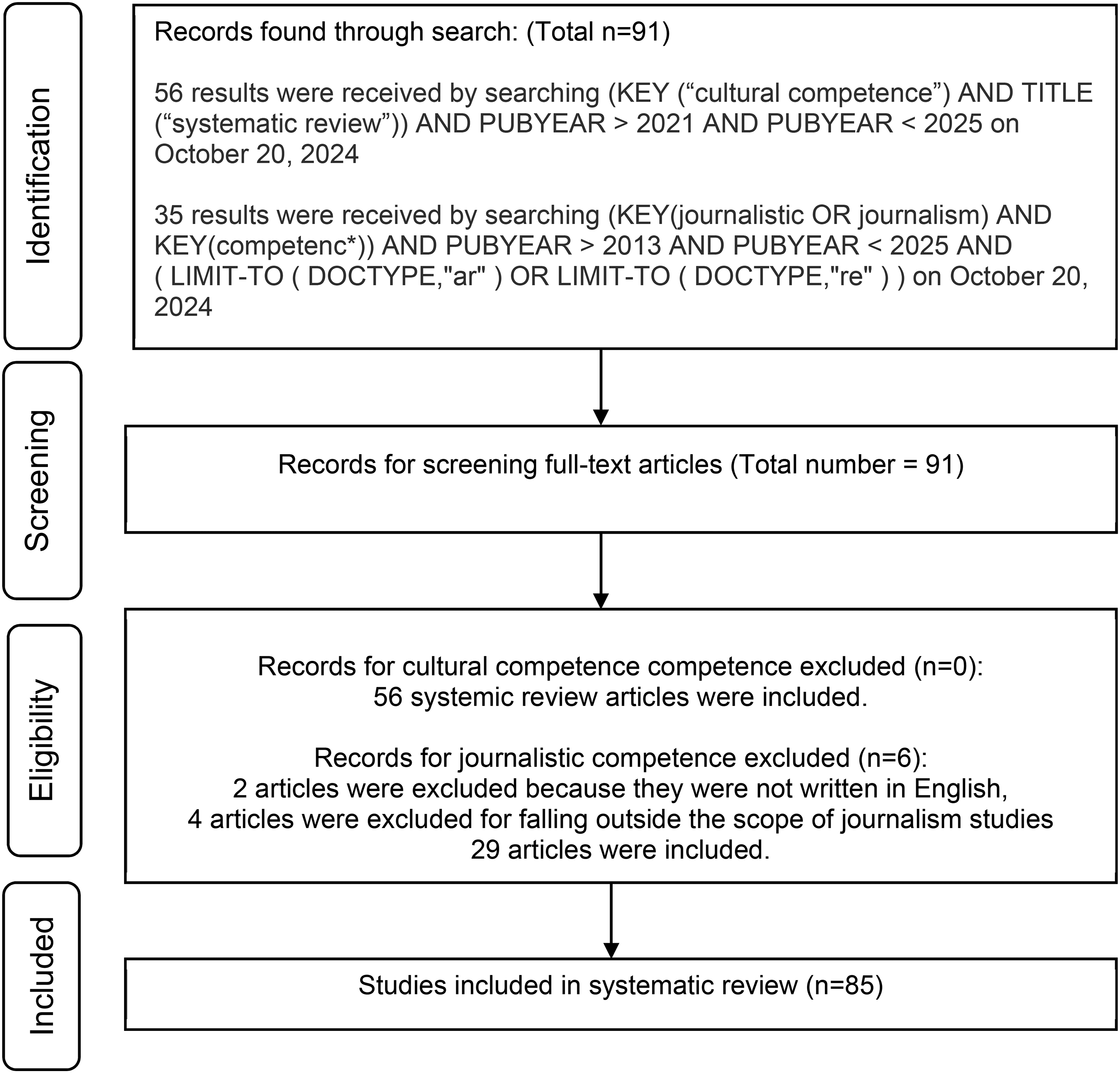
PRISMA flowchart for systematic review.
Given that numerous studies on cultural competence have been published since its introduction by the Georgetown University Child Development Centre in the United States in 1989 (Mao and Ahmed, 2017), this study aims to keep the number of included articles manageable. To do so, we conducted a overviews of reviews by selecting only systematic review articles on cultural competence from the past three years between 2022 and October 2024 (the census date of this study), to analyse the current use of the concept. We chose systematic review articles to review because they provide a comprehensive overview and rigorous assessment of relevant studies in cultural competence (Sriganesh et al., 2016). Furthermore, due to the limited literature on journalistic competence, this study expanded the search timeframe from the past 3 years to the past decade, covering articles on journalistic competence published between 2014 and October 2024.
Scopus was chosen for its extensive coverage of social sciences compared to other databases (Norris and Oppenheim, 2007). Additionally, Scopus provides greater coverage of health journalism research literature, as suggested by a bibliometric analysis (Feng, 2024). Ultimately, a total of 56 systematic reviews on cultural competence, published between 2022 and October 2024 (the census date of this study), were identified through Scopus, using Boolean operators ‘cultural competence’ as the keyword and ‘systematic review’ in the article title.
For the systematic review on journalistic competence, a total of 35 journal articles published between 2014 and October 2024 were identified in Scopus using the Boolean operators ‘journalistic’ or ‘journalism’ and ‘competenc’ in the keywords. After screening the full texts, two articles were excluded because they were not written in English, and four were excluded for falling outside the scope of journalism studies. Only one article (Garyantes and Murphy, 2019) specialised in the domain of health journalism, while most articles have focused on journalistic competence in the wider general context of journalism practice. As a result, this produced a dataset encompassing a total of 85 articles for the concept analysis. These peer-reviewed journal articles, published in English, present a comprehensive overview and rigorous assessment of relevant studies related to cultural competence and journalistic competence. Supplemental Appendices 1 and 2 outline the details.
Concept analysis
Concept analysis is helpful in promoting the consistent use of a concept, ensuring that everyone in this conversation is clear about the definition, without using different terms with the same or relative meaning (Jabareen, 2008; Walker and Avant, 1995). We adopted the analytical framework proposed by Walker and Avant (1995) and Jabareen (2008) by followng the steps below.
Define journalistic cultural competence by analysing the use of ‘competence’, ‘culture’ and ‘journalism’ in the selected literature. Analyse concepts related to or contrasting with cultural competence and journalistic competence in the selected literature. Analyse the attributes that contribute to the construct of journalistic cultural competence based on the selected literature. Discuss the antecedents and consequences, as well as the model cases and empirical referents of journalistic cultural competence.
We then highlighted and extracted key phrases related to the concepts, looking at them closely, and grouping them into themes. We also noted similar terms and related ideas. One reviewer handled the data collection and analysis, and two others checked the process and results to minimise bias. Based on the findings, we came up with a definition that articulates key features, what comes before and what results from the concept.
Findings
Defining ‘journalistic cultural competence’
To provide a coherent definition of journalistic cultural competence for health journalism, we examined how ‘competence’, ‘culture’, or ‘cultural’, and ‘journalism’, or ‘journalistic’ are conceptualised in the selected literature on cultural competence and journalistic competence. Our analysis shows that the literature lacks a clearly defined concept of cultural competence for journalists, including health journalists, and that cultural competence itself remains inconsistently defined in the studies on journalism education and practice. For instance, ‘diversity competence’ was incorporated as an independent item into the Accrediting Council on Education in Journalism and Mass Communications (ACEJMC) assessment of the United States in 2009 (Christ and Henderson, 2014; Henderson and Christ, 2014). It is defined as the requirement for a qualified journalism graduate to ‘demonstrate an understanding of the diversity of peoples and cultures and of the significance and impact of mass communications in a global society’ (Christ and Henderson, 2014, p. 305). Christ and Henderson (2014, p. 305) argue that the ambiguous wording of terms like ‘diversity of peoples/cultures’, ‘significance/impact’ and ‘global society’ necessitates clearer definitions.
Moreover, the definition and application of cultural competence should align with the specific demands of professional roles in journalism, rather than relying on established frameworks borrowed from other professions. For instance, Garyantes and Murphy (2019) examined the cultural competence of health coverage in US newspapers, directly applying the concept of cultural competence from clinical settings to health journalism. They attempted to integrate cultural competence into news production, but their approach has not been consistently developed in subsequent studies.
Based on our review, we draw from the established concepts of cultural and journalistic competence to propose a definition of journalistic cultural competence, marking an initial attempt to initiate this conversation in journalism studies. Starting with an analysis of how ‘competence’ is conceptualised in the selected articles, we found that the term is used to describe a set of specific competencies required for a profession, which Estella (2021a) refers to as a ‘domain of competencies’ (p. 195) or ‘meta-competencies’ (p. 196). Accordingly, in the journalism context, competence refers to the quality or ability to support the acquisition and application of specific competencies, such as self-awareness of personal strengths and weaknesses relevant to the role of a news reporter, as well as the ability to write a news article. Similarly, Guo and Volz (2021) suggest that the concept of competence is understood as a professional competence model comprising a set of fundamental components that underpin professional values and practices in journalism.
In addition, understanding ‘competence’ within cultural competence requires its contextualisation to meet the specific demands of various professional practices. Our review of selected literature on cultural competence shows that cultural competence manifests in distinct ways across different professions, such as therapists (Kayrouz et al., 2024), social workers (Williams and Lee, 2024), pharmacists (Sawalha et al., 2023), nurses (Correa-Betancour et al., 2024), dentists (Álvarez-Cruces et al., 2024) and genetic counsellors (Shete et al., 2024).
However, we found that no work has been done to analyse the cultural competence required to become a qualified journalist. To address this gap, we can begin by examining the requirements of the journalism profession, moving towards an analysis of what ‘journalism’ or ‘journalistic’ means through the lens of journalistic competence. Our review shows that journalism is seen as a profession with clear professional boundaries. In this sense, journalistic competence is used to determine whether an individual is qualified to work as a journalist or whether a student meets the requirements to graduate and obtain a journalism degree (e.g. Bobkowski and Rosenthal, 2022; Christ and Henderson, 2014; Estella, 2021a, 2021b; Guo and Volz, 2021). Certain types of journalistic practices require more specialised knowledge or experience in a particular subject area than that of a general news reporter, such as entrepreneurial journalism (Caplan et al., 2020) and health journalism (Garyantes and Murphy, 2019). Applied to this understanding of journalism as a profession, we can suggest that journalistic cultural competence should be further integrated into the established framework for evaluating journalistic competence.
Finally, with culture at the centre of the concept of journalistic cultural competence, it is essential to examine how it has been defined in the literature on the cultural competence of other professionals to address the gap in journalism studies. Our review reveals that ‘culture’ in cultural competence encompasses a broad range of factors, including race, ethnicity, socioeconomic status, religion, age, gender, sexuality, ability status, immigration status, health beliefs, etc. (Medina et al., 2022). Specifically, the literature identifies several approaches to clarifying the concept of culture. For instance, culture is often understood as cultural identity (Chu et al., 2022) or as the cultural background of individuals, referring to an individual's sense of affiliation and belonging to a sociocultural group.
Furthermore, another approach reframes cultural competence to reflect social constructivist perspectives, moving away from an essentialist paradigm of culture that emphasises stereotypical cultural norms and overlooks intracultural diversity (Höhne et al., 2022). For instance, culture is described as a system in which individuals are both acted upon and act as agents within power structures (e.g. Freire et al., 2023; Walshe et al., 2022). This system involves an interconnected relationship between peoples (such as population dynamics, social groups and social relations), places (such as institutional influences and ecological dynamics), and practices (such as community engagement). Freire et al. (2023) argues that this conceptualisation allows researchers to analyse how different cultural groups experience various forms of oppression within a given society.
Additionally, a cognitive conceptualisation of culture focuses on knowledge about cultural differences at the individual, familial and community levels (Jarrar et al., 2024). For instance, Walkowska et al. (2023) view culture as a set of elements, including beliefs, values, behaviours, and norms, that define these identities and groups, shaped by dynamic, intergenerational, social, historical and political factors. Lie Ken Jie et al. (2022) further emphasise that these cultural elements can be shared, learned and passed on among individuals or specific groups as symbolic artefacts.
In summary, the concept of cultural competence for journalists, including health journalists, is not clearly defined in the current academic literature and remains inconsistently addressed within journalism education and practice. This is supported by our analysis of how the terms ‘competence’, ‘journalism’ and ‘culture’ are defined in the selected literature. We, thereby, propose that journalistic cultural competence for health journalists refers to a professional competence model that encompasses specific competencies – such as news gathering and reporting – required for qualified health journalists to effectively report on health issues, while taking into account the evolving and diverse range of relevant cultural factors. This initial attempt to define journalistic cultural competence, though not yet well-established, serves as a foundation for further empirical studies on journalistic cultural competence within specific cultural contexts.
Related and contrary concepts
Identifying both related and contrary concepts in our analysis can enhance the consistency and accuracy in applying the primary concept (Walker and Avant, 1995). Here, relevant concepts are those that closely resemble the one being studied, but reveal subtle differences upon closer examination, while contrary concepts are terms that directly contrast with the primary concept (Walker and Avant, 1995). Our review of recent cultural competence literature indicates that, even in fields with a long history of cultural competence research, many related concepts have been used interchangeably to address the evolving ideas of culture and diversity within the health-related domain. As noted by several scholars (e.g. Chowdhury et al., 2022; Hardy et al., 2023; Higgins et al., 2023; Jarrar et al., 2024, both culture and competence are multidimensional concepts. This has led to the interchangeable use of terms, such as cultural competence, cultural safety, cultural humility and intercultural competence, among others, due to the absence of consistent and clear definitions. Some of these concepts, such as cultural safety and cultural humility, were developed as critiques of cultural competence and aim to advance the concept from different perspectives (Höhne et al., 2022).
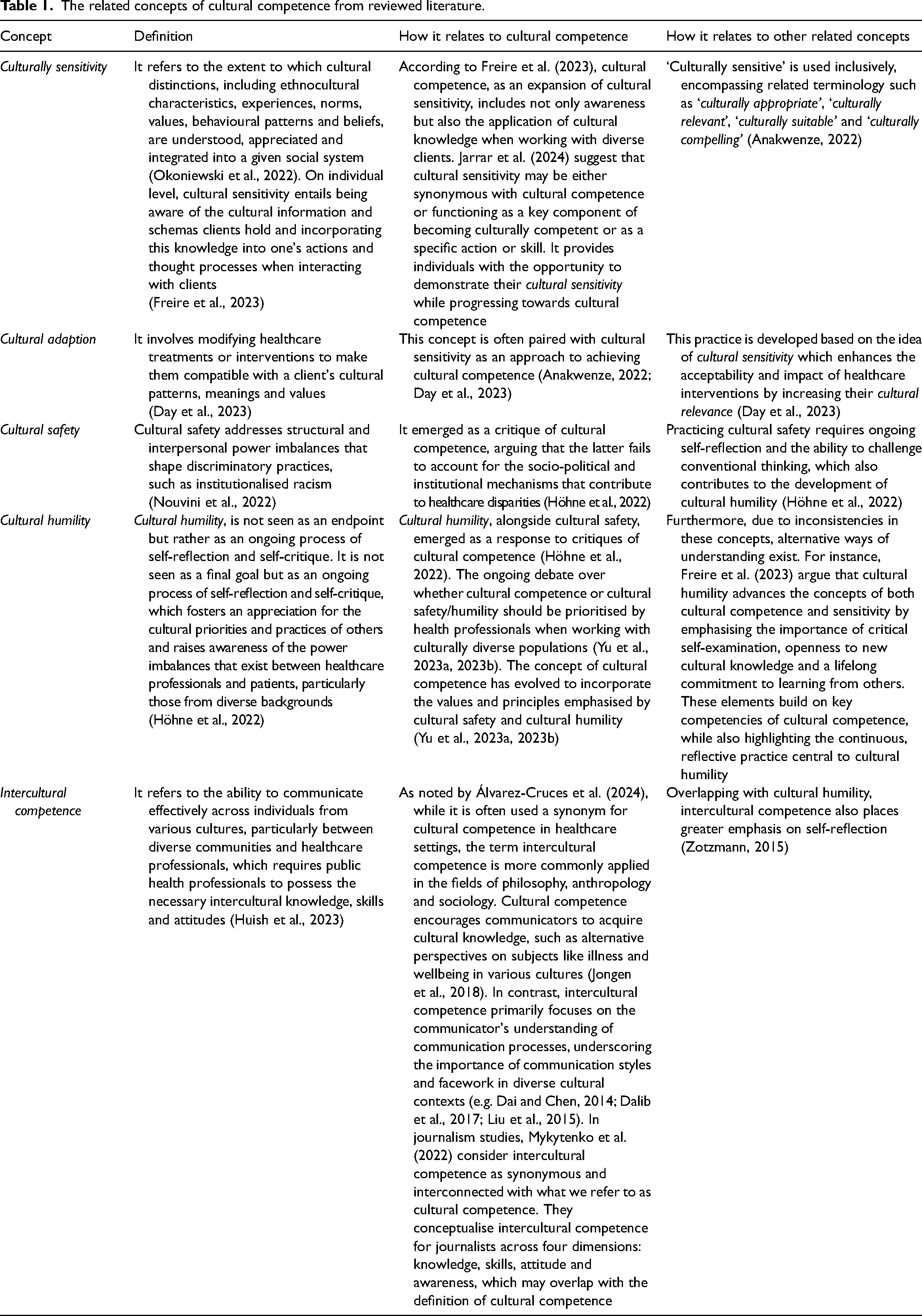
To enhance the consistency and accuracy in applying the concept of cultural competence within the field of health journalism, we identified related concepts from recent cultural competence literature. These include cultural safety, cultural humility (e.g. Höhne et al., 2022; Lambor et al., 2024) cultural sensitivity (e.g. Anakwenze, 2022) cultural adaptation (e.g. Anakwenze, 2022; Day et al., 2023) and intercultural competence (e.g. Huish et al., 2023). Within the literature on journalistic competence, some relevant concepts also emerge, including intercultural competence (e.g. Mykytenko et al., 2022), and sociolinguistic competence, which Bagheri Nevisi and Mousakazemi (2020) define as the knowledge of culturally appropriate forms of communication. The related concepts are discussed below in Table 1.
The related concepts of cultural competence from reviewed literature.
Furthermore, contrary concepts to cultural competence include othering, labelling and cultural blindness. Othering refers to a top-down approach that involves transferring predetermined cultural information one-way, focusing on stereotypes and portraying specific communities as distinct or ‘other’. This approach reinforces feelings of separation and inequality towards those considered different (Lie Ken Jie et al., 2022). Labelling refers to the practice of stereotyping certain cultural groups as ‘deviant’, which hinders effective healthcare promotion and management. This practice perpetuates the notion that minority groups are problematic because they do not conform to dominant white, middle-class norms (Lie Ken Jie et al., 2022). Cultural blindness involves the assumption that all individuals are alike and that what works for one cultural group should work equally well for another (Higgins et al., 2023). Though these concepts were highlighted in the cultural competence literature we selected, which comes from the healthcare discipline, they are relevant to health journalism and can help researchers and reporters conceptualise health-related issues. For instance, mainstream news outlets in the United States have been acknowledged for creating obesity stereotypes within the Black community as a form of othering (Garyantes and Murphy, 2019).
In addition, our review of recent literature on journalistic competence suggests that while journalistic excellence may closely align with the concept of journalistic competence, it carries distinct meanings (e.g. Estella, 2021a). As a recognition of quality journalism, Estella (2021a) argues that journalistic excellence requires journalistic competence to achieve, while both are open to criticism or judgement from external parties, rather than solely within professional circles. For instance, Estella (2021a, p. 179) uses the term ‘journalistic excellence narratives’ to describe the standard of news quality set by online right-wing populists, who, espousing traditional or conservative values believed to be under threat by minority groups, redefine journalistic excellence and the required competence in their own ways to delegitimise professional journalism practices.
In summary, the analysis of concepts related to and contrasting with cultural competence in journalism reveals an inconsistent and ambiguous use of the term in existing literature. Based on this finding, we suggest that the development of journalistic cultural competence should consider the evolving understanding of cultural competence from other fields. While terms such as cultural safety, cultural humility, cultural sensitivity, cultural adaptation and intercultural competence are often used interchangeably with cultural competence, each offers unique perspectives and approaches that highlight the multidimensional nature of culture and competence. For researchers and reporters in the field of health journalism, our findings suggest that a coherent use of the term ‘cultural competence’ is needed. From this article, we suggest that the term ‘journalistic cultural competence’ would help stakeholders involved in the field of health journalism communicate more clearly when discussing health issues that may otherwise be labelled differently.
Component attributes
To analyse the factors or indicators used to examine cultural competence, it is important to explore its component attributes. For instance, Garyantes and Murphy (2019) identified cultural knowledge, cultural awareness and cultural skills as the component attributes in their study on cultural competence in health journalism. Based on our review on cultural competence literature, we identified most studies have used the Campinha-Bacote (2003, 2008) model for cultural competence, which includes cultural knowledge, cultural awareness, cultural desire, cultural encounter and cultural skills (e.g. Bishop et al., 2022; Jarrar et al., 2024; Pokharel et al., 2023). Our findings align with previous systematic reviews (Alizadeh and Chavan, 2016; Henderson et al., 2018; Tao et al., 2022). The components from Campinha-Bacote (2003; 2008) model are listed below:
Cultural knowledge refers to seeking and obtaining knowledge of cultural and ethnic groups (Lie Ken Jie et al., 2022). Cultural desire refers to the motivation to engage with people from diverse cultures, serving as the starting point for developing cultural awareness (Campinha-Bacote, 2003, 2008). It emphasises humility and respect driven by shared values in humanity such as compassion, love, sacrifice and social justice (Campinha-Bacote, 2003, 2008). Cultural encounter refers to interactions between individuals and people from different cultures, whether in person or through other means of connection. These ongoing encounters provide opportunities for individuals to engage with diverse cultural groups, thereby fostering the development of cultural awareness (Cai, 2016). Cultural awareness refers to the ability to recognise and understand one's own cultural background and experiences, as well as the awareness that others may have different assumptions and perspectives. It is a crucial prerequisite for developing sensitivity to diversity (Foronda, 2008). Cultural skills refer to the capability to use communication skills to collect cultural information linked to a patient's health concerns via adequate communication and to integrate related information into caregiving (Cai, 2016; Sharifi et al., 2019).
In summary, the Campinha-Bacote (2003, 2008) model has been widely used in cultural competence studies but has not been fully explored in journalism, including health journalism, leaving this as an area for further research. While the application of the Campinha-Bacote model to journalism may require more investigation, it provides a framework for a more systematic examination of cultural competence.
Discussion and conclusion
This study examined how cultural competence and journalistic competence have been conceptualised by previous scholars to define what journalistic cultural competence means for health journalism reporters and researchers. In this discussion, we explore the potential implications of journalistic cultural competence in health news reporting and research.
To begin, we must clarify the definition of health journalism in order to argue why health journalists need cultural competence for effective reporting. From the articles we selected and reviewed, we did not find a clear definition of health journalism. Therefore, we draw on the previous bibliometric analysis of health journalism research by Feng (2024) to discuss the complex nature of health news and the various existing approaches to defining health journalism. The bibliometric analysis revealed that ‘health news’ covered a broad spectrum of topics, from health policy and medical research to personal lifestyle. These topics include disease prevention, diagnosis, treatment, rehabilitation, risk prevention, health protection, education and promotion (Mohammadi et al., 2021). Health journalism goes beyond just scientific and medical news, frequently intersecting with political and cultural issues, given its impact on broader ideologies and social structures (Briggs and Hallin, 2010). On the one hand, contemporary health journalism can be seen as more than a linear process in which medical information flows from biomedical experts through news media to the public, representing a more complex co-production or hybridisation between health and media professionals (Stroobant et al., 2019). This complex nature of health news reporting underscores the importance of journalists’ competencies in understanding public health knowledge, health promotion strategies, and critical public health challenges (Mohammadi et al., 2021). To sum up, the broader health-related topics that health journalists often cover go beyond the purely scientific perspective of health, where cultural competence is essential for addressing the complexity of health-related issues. For instance, from the articles we reviewed, Garyantes and Murphy (2019) suggest that news reporting on obesity in the United States requires cultural competence to address various concerns and themes related to diverse populations. This includes using inclusive and accessible language that the audience can understand.
Furthermore, as part of the concept analysis process, we must examine the antecedents and consequences of cultural competence in health journalism to better understand its potential application. According to Walker and Avant (1995), antecedents are events that must occur before a concept can manifest, while consequences are events resulting from its existence. Our review suggests that the antecedents of cultural competence for health journalism include health disparities within a multicultural society, and eliminating health disparities can be the consequence.
From the cultural competence literature reviewed in this study, health disparities are preventable differences experienced by socially disadvantaged populations, creating barriers in achieving optimal health outcomes (Medina et al., 2022). These disparities are often rooted in structural inequities such as racism, xenophobia and socioeconomic disadvantage, which contribute to systemic barriers in healthcare access and treatment (Okoniewski et al., 2022). Furthermore, global migration contributes to more culturally and linguistically diverse societies (e.g. Morin and Talbot, 2023; Pokharel et al., 2023; Vella et al., 2022). In English-speaking Western countries, health disparities refer to unequal access to healthcare, variations in the quality of care, and differences in health outcomes experienced by people of colour, including Indigenous, Black, Latino, Asian and Pacific Islander communities, as well as individuals living in poverty and those whose primary language is not English (Okoniewski et al., 2022). Lie Ken Jie et al. (2022) highlight that healthcare education acknowledges discriminatory practices rooted in colonisation across countries like Australia, Canada, New Zealand and the United States. Huish et al. (2023) also note increasing health disparities in the United Kingdom. Cultural competence was introduced as a strategy to address and eliminate health disparities (Medina et al., 2022; Okoniewski et al., 2022; Yu et al., 2023a, 2023b), positioning health disparities as an antecedent to cultural competence. The integration of culturally competent approaches into healthcare services is widely recognised as an effective strategy for improving health outcomes among racially and ethnically diverse populations (Hardy et al., 2023; Williams and Lee, 2024), highlighting these improved outcomes as the consequences of implementing cultural competence.
As our review of articles on journalistic competence shows, health disparities can also be considered an antecedent, highlighting the need for cultural competence and its purpose. This underscores the importance of health journalists addressing and acknowledging issues of health disparities in their reporting. As Garyantes and Murphy (2019) note, Western journalists often portray individuals from diverse cultural backgrounds in ways that magnify differences, distort viewpoints, or are outright inaccurate. They observe that criticism of this behaviour suggests that cultural competence could be applied to health journalists, who can act as bridge-builders between mainstream society and diverse communities to address the aforementioned health disparities. However, beyond our selected articles on cultural competence, Wallington et al.'s (2010) study on news reporting of health disparities indicates that health news cannot directly address these disparities, which often require community- or policy-level solutions. However, as they suggest, it can help set the agenda by raising awareness and prompting action from the public and policymakers, thereby potentially contributing to addressing the issue.
Moreover, as the final phase of concept analysis, it is essential to examine the model case and empirical referents to explore the potential application of cultural competence in real-world settings. According to Walker and Avant (1995), a model case represents a real-world example that clearly demonstrates all the essential characteristics of a concept, while empirical referents are the observable phenomena that indicate the concept's existence.
From reviewed articles in this study, the CómoSciWri workshop is found as a model case for developing cultural competence in health journalism. The workshop provides practical guidance on inclusive, culturally sensitive science reporting based on Latinx and Hispanic experiences in the United States (Landis et al., 2020).
It emphasises the importance of cultural awareness for science writers, encouraging them to:
Examine the cultural context of science and recognise how a scientist's cultural background can influence their approach to research. Consider who conducts the science and how cultural values shape the framing of discoveries, writers can make topics more engaging and appealing to diverse audiences. Recognise the culture and language inherent in science itself – the norms of academia, its jargon, and its foundations in Anglo-American perspectives. Challenge assumptions and avoid biases that could alienate potential readers. Embrace these ongoing shifts in diversity and do the work to understand the contexts and nuances that make each culture and subculture unique.
This workshop guides US journalists in improving science communication by incorporating hybridity, transculturalism and community engagement, while also recognising and addressing the cultural, historical, and social nuances across different ethnic and cultural identities (Landis et al., 2020). By adopting these approaches, journalists can craft more engaging stories, elevate marginalised voices and offer a more inclusive view of the research process, ultimately fulfilling their responsibility as communicators of science to the broader public (Landis et al., 2020).
By reviewing selected literature, we identifies empirical referents, including the studies by Garyantes and Murphy (2019), which examine the cultural competence of news coverage on obesity across four US news outlets: two so-called mainstream newspapers and two ethnic newspapers serving African-American and Hispanic communities. Through thematic analysis, the study found evidence of cultural competence in the coverage, particularly in the selection of themes, choice of news sources, references to at-risk groups and the use of medical jargon in the reporting.
These two cases help us envision the potential use of journalistic cultural competence in journalism education and research. Beginning with our attempt to define the concept of journalistic cultural competence and analysing its related and contrasting concepts and component attributes, this study represents the first step toward conceptualising cultural competence in health journalism. Given the limited research on this topic, we drew insights from a broader literature on cultural competence and journalistic competence. As an interdisciplinary approach based on a systemic literature review, the limitation lies in how to test this conceptualisation in real-world settings. In addition, to manage the scope of this systematic literature review, we limited our search to peer-reviewed journal articles indexed in Scopus, given its extensive coverage of the social sciences (Norris and Oppenheim, 2007) and, in particular, its stronger representation of health journalism literature compared to other databases (Feng, 2024). We should also acknowledge the limitation that we used only one database, Scopus, which may not fully cover all publications across disciplines. Researchers studying health news may also publish in medical or education journals, depending on their disciplinary background, as health news is examined across multiple fields – such as sociology, political economy, cultural studies, health sciences and environmental sciences (Feng, 2024). This interdisciplinary specificity suggests the need for future research to investigate how journalistic cultural competence is conceptualised and approached across different disciplinary contexts. Further empirical research on cultural competence in specific cultural contexts also may be needed to assess its relevance and universality, using data from news articles, policy documents from news organisations, and interviews with people involved in news production.
In conclusion, cultural competence is essential in health journalism and other forms of culturally sensitive reporting, as it plays a vital role in addressing the challenges posed by health disparities in multicultural societies. Although its significance in public health is widely acknowledged, the concept of cultural competence in health journalism remains underexplored and often ambiguously defined in the literature. This study asserts that cultural competence should not be seen as an additional or separate training requirement for journalists, but rather as an integral part of a broader framework of journalistic competence.
Supplemental Material
sj-docx-1-mia-10.1177_1329878X251361564 - Supplemental material for Journalistic cultural competence for health journalists: a systematic review and overview of reviews using concept analysis
Supplemental material, sj-docx-1-mia-10.1177_1329878X251361564 for Journalistic cultural competence for health journalists: a systematic review and overview of reviews using concept analysis by Shi Feng, Xiufang (Leah) Li and Alexandra Nicole Wake in Media International Australia
Footnotes
Data availability statement
The data supporting the findings of this study are available from the corresponding author, Shi Feng, upon reasonable request directed to
Declaration of conflicting interest
The authors declare that the research was conducted in the absence of any commercial or financial relationships that could be construed as a potential conflict of interest.
Ethical approval and informed consent statements
This study does not involve any humans (participants, tissues, data) or other living beings, so ethical clearance is not required.
Funding
The authors declare that no financial support was received for the research, authorship, and/or publication of this article.

Supplemental material
Supplemental material for this article is available online.
References
Supplementary Material
Please find the following supplemental material available below.
For Open Access articles published under a Creative Commons License, all supplemental material carries the same license as the article it is associated with.
For non-Open Access articles published, all supplemental material carries a non-exclusive license, and permission requests for re-use of supplemental material or any part of supplemental material shall be sent directly to the copyright owner as specified in the copyright notice associated with the article.
