



Abstract
The World Health Organisation (WHO) calls the proliferation of conflicting information during the COVID-19 pandemic an ‘infodemic’. To counter the infodemic experienced by diaspora communities, ethnic and multilingual media producers filled vital health communication gaps. This article focuses on the experiences of Indonesian–Australian media producers during this infodemic in Australia. Following semi-structured interviews with 10 Indonesian–Australian media producers, who recounted their experiences and practices supporting the information needs of Indonesian diaspora communities, we found that their translation of public health information extended beyond providing linguistically accessible and accurate information to the diasporic community. We propose the concept of ‘translation as care’. We suggest that translation practice can become an act of communal care during crises enabled by shared diaspora community identification and affective labour by Indonesian–Australian media producers. Translation as care addressed the gaps that Australian authorities could not adequately fill, fostering community trust and social resilience.
Keywords
Introduction
This article provides a timely examination on Indonesian–Australian media practices during the COVID-19 pandemic. On a global scale, the pandemic exposed systematic communication deficits that disadvantaged people experience who are socially and economically disenfranchised. Specifically, during the height of the pandemic, inadequate communication from Australian public authorities, mainstream media outlets, and digital networks exacerbated the exposure of diaspora communities to confusing and misleading information, and in some instances, to targeted disinformation (Singh and Banga, 2022). During this turbulent time diasporic communities experienced a unique form of the COVID-19 ‘infodemic’ (WHO, 2020), marked by an overwhelming influx of information in both English and their community languages, as well as conflicting messages from sources that lacked official confirmation or fact-checking. Thus, there was a shortfall in providing accessible and culturally appropriate COVID-19-related health information, largely stemming from inconsistent coordination between the Australian government and diaspora communities (ECCV, 2020).
Consequently, diasporic communities’ trust in Australian media information significantly waned during COVID-19 (Karidakis et al., 2022). While government authorities attempted to provide multilingual messages, Australian public services’ lack of multilingual capacity and cultural understanding often meant that diasporic communities found the translated materials outdated, nonsensical, or grammatically inaccurate (Dalzell, 2020). Inadequate coordinated communication also affected service providers who usually offer tailored support to diaspora communities, hindering their ability to respond to changing needs, and posing substantial health and well-being risks. Given the significant amount of information confusion, diasporic media producers, migrant community leaders, and multilingual individuals collectively supported their communities by filling notable information gaps (Rajkhowa, 2020), engaging in fact-checking as well as disseminating more accurate information on public health measures and restrictions (Karidakis et al., 2022).
This article focuses on Indonesian diasporic media producers in Australia and their practices and strategies for supporting Indonesian diasporic communities during the COVID-19 pandemic. In this article, we use the term ‘diasporic media producers’, to refer to Indonesian journalists/broadcasters residing in Australia and working in the Australian media landscape producing stories in Indonesian language for this diasporic community in Australia. There are three types of Australian media outlets where the diasporic media producers work: (a) self-funded ‘ethnic media’ organisations (radio or magazine) catering to the Indonesian migrant community whereby the Indonesian journalists are paid a salary per story; (b) ‘community media’ funded by the Australia government whereby Indonesian media producers volunteer in non-commercial community radio stations providing media service to their migrant community in their community language; (c) taxpayer-funded Australian national media with Indonesian-language channels whereby Indonesian journalists are employed by the Australian Special Broadcasting Services (SBS) radio in Indonesian language or the Australian Broadcasting Corporation (ABC) news in Indonesian language (online newspaper). Despite the different media outlet categories these diasporic media producers are similar in that they produce media stories in the Indonesian language for the Indonesian diasporic community in Australia.
While terms like ‘diasporic media’, ‘ethnic media’ and ‘community media’ are often conflated, we found in our research that they represent essentially different places of work for our research participants. Moreover, we align with our research participants, who specifically described themselves as Indonesian diasporic media producers in our interviews. They played a critical role in cultural program and language translation that were not provided by other Australian journalists/broadcasters. Additionally, we focus on the often-overlooked emotional or affective labour these diasporic media producers contribute through their practices of cultural content language translation, which remains largely unrecognised by mainstream public or commercial media. The paper does not aim to directly compare mainstream media to diasporic media but highlights the dominant values public and commercial English-language media uphold.
The article is structured below. It starts from reviewing the literature on health communication within diaspora communities and particularly the role of non-English-language ethnic media in Australia. We subsequently describe the methods and interpretive framework underpinning this research. Our analysis reveals how translation as a form of care was facilitated not only by the shared cultural background of Indonesian diasporic media producers in Australia and their communities but by the careful affective labour of these media producers themselves. While affective labour, otherwise known as emotional labour, is frequently associated with ‘women's culture’ (Hardt, 1999), it is also prevalent within migrant-led media organisations. Often performed invisibly and voluntarily without being formally recognised, this form of labour is essential for effectively engaging with community members, particularly in instances where culturally-appropriate communication is lacking from public services. We conclude by underscoring the critical role of diasporic media producers in bridging communication through ‘translation as care’, supporting information gaps for diaspora communities, especially during a time of crisis.
The article's main contribution is to bridge translation studies, cultural studies, and feminist studies by introducing ‘translation as care’ – a concept that moves beyond translation as mere language exchange (Conway, 2017). While media communication is inherently translational through encoding and decoding of meaning (Conway, 2017), we argue that Indonesian diasporic media practices involve an additional layer: translation as an act of care. In the context of the research, translation as care reflects the communal solidarity, affective labour of Indonesian–Australian media producers during health crises, enabled by shared cultural identification.
Literature review
This section starts by contextualising the Indonesian diaspora in Australia and the community media they rely on. The review then expands to examine public health communication among diasporic communities globally during the COVID-19 pandemic.
According to the 2021 census, 87,075 people in Australia were born in Indonesia (ABS, 2021). 11,516 Indonesian tertiary-level students were estimated to be studying in Australia in early 2024 (Statista, 2024). Indonesians are the 18th largest migrant community in Australia; New South Wales has the highest number followed by Victoria (ABS, 2021). Notably, a significant number of Indonesians are married to Australians and they may choose to become an Australian citizen or remain Indonesian with Australian Permanent Residency (Missbach and Purdey, 2023). Irrespective of their citizenship status, members of the Indonesian diaspora community include those who grew up in Indonesia and still use Bahasa Indonesia to connect with family and friends (Penny and Gunawan, 2001). Prominent Indonesian language media includes radio: Radio Kita (Our Radio) Melbourne, Duta Nusantara (Archipelago Ambassador) Sydney, SBS a national multilingual radio which includes Bahasa Indonesia, the ABC news in Bahasa Indonesia and Indonesian language ‘ethnic media’ community magazines such as Ozip, Buset and IndoMedia. Some of these media outlets are on social media.
Australia's Indonesian population is highly diverse (Missbach and Purdey, 2023), although the majority is Muslim. There are members and speakers of the 700-plus distinct ethnic groups from across the archipelago including Javanese, Sundanese, Chinese-Indonesians, Batak, Buginese, and Minangkabau (Penny and Gunawan, 2001). However, Bahasa Indonesia – the national language of Indonesia is the language of education, government, health and the mainstream media, including television, radio, film, newspapers and digital media (Heryanto, 2014). We estimate there would be very few Indonesians living in Australia today who are not fluent in Bahasa Indonesia, given the 2021 literacy rate in Indonesia reached 99.76% (Global Data, 2022). The qualitative data obtained from Indonesian language media producers in Australia describes their engagement with the Indonesian diasporic community they belong to, who have access to the Bahasa Indonesia media they produce.
The Indonesian diaspora in Australia is socially diverse, resulting in varied information and communication needs across community segments. Since Indonesia's independence in 1945, immigration to Australia has been driven by labour, conflict and other domestic crises, as well as neoliberal economic and educational pursuits (Missbach and Purdey, 2023). Since the 2000s, improved trade and strategic relations between Australia and Indonesia have further facilitated mobility between the two neighbouring countries (Missbach and Purdey, 2023). Australia's 2021 census shows a 22.5% increase compared to 2011 (Department of Home Affairs, 2023). Indonesian communities in Australia are unified by both their national identity and the dominant language Bahasa Indonesia that is used in their everyday communication; despite linguistic, cultural, religious and locality differences (Penny and Gunawan, 2001).
The Indonesian community in Australia maintains strong links with Indonesia. In terms of communicative practices, they occupy the uneasy tension between transnational networks and local connections, even when it comes to urgent messages in times of crisis. In Australia, the struggles experienced by diaspora communities during the pandemic were compounded by exclusionary COVID-19 coverage in English language mainstream media, and biased English language social media discourse, which was discriminatory towards ethnic communities, many of whom were unfairly singled out as (criminal) sources of viral transmission (Sun, 2021). Such framing enhanced a sense of non-belonging for these communities (Ang et al., 2023). In short, practices of racialised hostility toward diaspora communities, coupled with their exclusion from culturally appropriate and accessible crisis communication during the pandemic, exacerbated existing social, economic, and health disparities (Ortega et al., 2020), placing community members at risk.
Multilingual media in Australia
In Australia, non-English media exist as an alternative to public or commercial content that primarily serves English language audiences. The classification of non-English media as news organisations or journalism is a contested field. The Australian Communications and Media Authority defines ‘English language’ as the main characteristic of newspapers in Australia, thereby excluding those published in non-English languages. Journalism is a work of boundary-making, with Australian mainstream English media often defining what does not constitute journalism rather than what is journalism (Yang, 2023). As a result, non-English media outlets are frequently excluded from the category of journalism or considered secondary to mainstream counterparts (Yang, 2023).
Despite being alternative or marginal for English-speakers, non-English media offer accessible avenues of communication to diaspora communities across the country (Bellardi et al., 2018). They encompass ‘ethnic media’, ‘multicultural media’, ‘diaspora media’ and ‘community media’. Ethnic media are media produced for a specific community (Matsaganis et al., 2011). They are products of migrant groups’ attempts to organise, communicate and facilitate transition into the new society (Veronis and Ahmed, 2015). However, ‘multicultural media’ is often used as a terminology that is more encompassing than ethnic media because it refers to media (print, broadcast, digital) largely produced by, and for, particular ethnocultural communities, including immigrants, visible minorities, and refugees; with a broad geographic scope of consumption practices comprising local, provincial, national, and international receivers (Veronis and Ahmed, 2015). SBS Radio, for example, has defined itself as Australia's multicultural media. Meanwhile, ‘community media’ is a term used to refer to any form of media created, controlled and influenced by a community (Dutta and Ray, 2017). To meet the need for non-English ‘community’ language media in Australia, there are six full-time ethnic community radio stations and 91 additional community radio stations that include ethnic programming (NEMBC, 2019).
The selection of a particular term is informed by the politics of multiculturalism and the terminological convention preferred by the incumbent government. For example, in Australia, official documents have historically referred at first to ‘migrant communities’, then subsequently to ‘ethnic communities’, or ‘multicultural communities’. It is worth noting that the ethnicity of community media producers themselves facilitates messaging trust in their audiences. This is crucial in a pandemic situation since public health information changes drastically during global crisis events. Here, the primary aim is to save lives by rapidly changing collective behaviour on a wide scale (Pym and Hu, 2022), which hinges on establishing and maintaining public trust. Trusted social network and community ties are important for migrant communities to access and interpret reliable information in their own language, regardless of health crises. Though informal, these networks play a critical role in both disseminating otherwise inaccessible information and filtering out irrelevant or misleading content (Budarick, 2022; Hanson-Easey et al., 2018). In Australia, however, mistrust or distrust is compounded by the sheer volume of COVID-19 related information, including confusing or unclear content and misinformation (Park et al., 2020), as well as a critical gap in timely translated materials for diaspora communities (Jakubowicz, 2020).
Community trust is often maintained via news and information translation. Beyond translating messages as a means of transcending linguistic and cultural gaps, during COVID-19, translation also improved diaspora communities’ access to culturally specific social and emotional support through providing useful information and building community resilience (Hasnain et al., 2022; Promodh, 2021).
Non-Anglo-Saxon nations are either underrepresented or misrepresented in Australia resulting in migrants being poorly informed about issues of direct importance to their familial and social networks (Tapsell, 2021). Australian English language-media give disproportionate coverage of COVID-19 to Anglo-Saxon nations (Tapsell, 2021). Scant attention was paid to neighbouring countries in Australasia, particularly Southeast Asia, or migrant communities, despite extraordinarily high case numbers, extensive lockdowns, hospitalisations and deaths in this region (Tapsell, 2021). This disproportionate media coverage reflects a re-current trend of stories being considered the most newsworthy when they centre on nations that share ‘Australia's “colonialties” and the plight of many White, English-speaking Australians in them’ (Tapsell, 2021, p. 204). Similarly, in the United States, increasingly diverse populations are not reflected in the domestic media landscape, which remains predominantly white (Gerson, 2025).
The continuous growth in Australia's Asian population in recent decades has not resulted in more media focus on Asian countries, including Indonesia. For this reason, it is pivotal to document the experiences of Indonesian–Australian media producers; many of whom – this article will show – engaged translation as a form of communal care, helping bridge key informational and support gaps for Indonesian diaspora communities during the pandemic.
Health communication within migrant communities
As noted, the COVID-19 crisis emphasised the pressing need for reliable language-specific public health information that successfully engages diaspora community members (Pym and Hu, 2022). In the absence of such information, already marginalised people more readily engage with unreliable messages, created and circulated by members of their own communities in their own languages (see Promodh, 2021). Diaspora media are well-positioned to provide reliable language-specific information that more inclusively engages their communities.
For example, Indonesian migrant domestic workers in Hong Kong established non-official community storytelling networks via interpersonal relationships, community organisations, and media outlets to produce and distribute significant health information (Oktavianus and Lin, 2023). In Australia, Greek communities utilised community radio broadcasting programmes and mailouts to keep elderly members rapidly informed of any health and policy changes (Karidakis et al., 2022). The use of digital and non-digital media channels ensures communication across segments of diaspora communities with varying levels of digital literacy.
Within migrant communities, non-official information channels risk spreading misinformation due to lack of fact-checking resources (Oktavianus and Lin, 2023). For Indonesian communities in Australia, some alternative information sources operating via social media may have disseminated inaccurate health advice or misleading content that conflicted with Australian federal and state public health messaging. We know that ineffective public health messaging can have dangerous consequences (Dalzell, 2020; Pym and Hu, 2022), and poor crisis communication practices contribute to institutional distrust that fuels (and even legitimises) not only misinformation but conspiracy movements that compromise people's health and well-being. Diaspora communities may be especially vulnerable to that risk (Mercado, 2020), particularly as improperly translated information risks significant misunderstandings (Renaldi and Fang, 2020). Because of this, in the case of COVID-19, community members may unwittingly spread the virus due to the misunderstandings and miscommunication about protective measures (Bogle, 2020).
In Australia, public health messages are typically first written in English and then translated. Ideally, translation should encompass the process of carefully reworking text from one language into another to preserve the original meaning of the message. However, in multicultural Australia during the pandemic, hasty poorly translated government health messaging was noted as a major contributor to vaccine hesitancy in Australian diaspora communities (Wild et al., 2021). While Australian state and federal governments made efforts to provide helpful multilingual public health messages during the pandemic, diaspora populations (including Indonesian communities) often found government-translated material and social media content confusing and/or nonsensical (Dalzell, 2020). In these conditions, trusted diaspora media producers offered a valuable resource. For example, well-translated information was distributed across digital platforms by these media producers and in the form of physical mailouts to accommodate a broader range of diaspora community members (Karidakis et al., 2022). During the pandemic, diaspora media producers operated in principle as meso-or-micro-level social actors who bridged the gap between formal institutions and diaspora communities by mobilising their cultural and linguistic capacities. They thus helped counter the evident lack of reliable public health information at the macro-level by providing properly translated messages in addition to social support and improved access to interpersonal networks to accommodate communities’ specific cultural and emotional needs (Oktavianus and Lin, 2023).
Establishing on the existing literature, our study addresses the question: How do Indonesian–Australian media producers and journalists view their roles and responsibilities in speaking to, engaging with, and advancing the needs of their communities during the COVID-19 pandemic? The following section outlines the methodology and interpretive framework of the study.
Methodology
Sampling and data collection
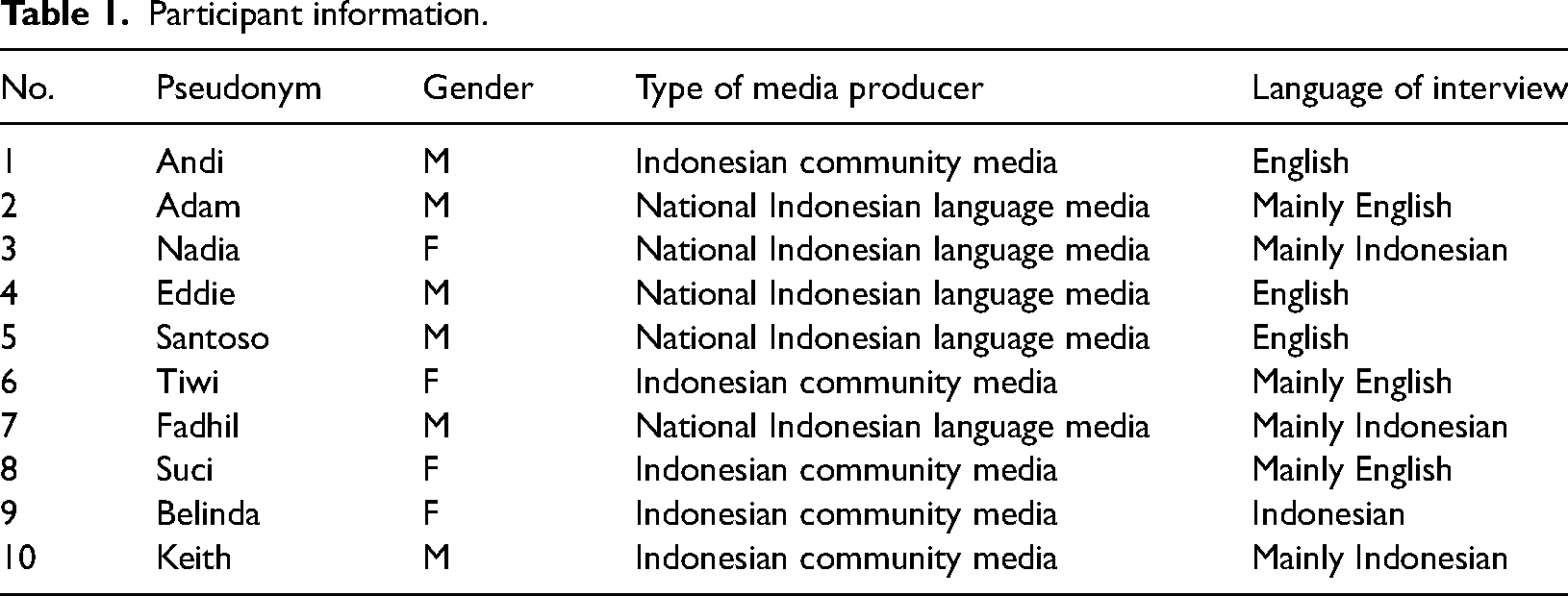
We deployed a qualitative research design, encompassing 10 semi-structured interviews between August 2021 and February 2022, with Indonesian–Australian media producers who actively supported diaspora communities during the pandemic. We used purposive sampling, whereby prospective participants are invited because they meet specific inclusion criteria pertaining to the research question (Willig, 2008). Anecdotally, there are only approximately 20 Indonesian–Australian language media producers Australia-wide; we recruited 10 participants who fit our sampling criteria. Prospective participants were invited via email; either through the organisations in which they worked, or through contacts facilitated by snowballing (Noy, 2008). Table 1 summarises the general characteristics of the sample, who ranged from professional journalists to freelance and voluntary community media practitioners. To ensure anonymity, all identifying information about our sample has been omitted.
Participant information.
Semi-structured interviews facilitate flexible, open-ended, conversational discussions where interviewees are supported to delve meaningfully into aspects of the topics that are important to them (Creswell, 2014). We conducted interviews by phone, Zoom and WhatsApp due to COVID-19 restrictions at the time. Informants could use either English, Bahasa Indonesia, or both. The two interviewers were proficient in Bahasa Indonesia and English. Transcribed interview material in Bahasa Indonesia was translated into English by multilingual members of the research team. The project received University Human Research Ethics approval and all informants provided informed consent to the use of their de-identified data before their interviews. We use pseudonyms in our analysis to account for the preference by the majority of the research participants that they remain anonymous.
Interpretive framework
In the interviews, we asked participants to reflect on how their Indonesian language media organisations reported the global pandemic. We also sought their recommendations on how Australian government directives on public health measures could be better disseminated and received to improve future crisis responses. To analyse our interview data, we deployed the reflexive approach of interpretive thematic analysis (Braun and Clarke, 2019) which incorporates the active role of researchers in knowledge production while acknowledging that emerging themes represent researcher interpretations (Braun and Clarke, 2019). All team members independently reviewed the interview transcripts to note overarching themes across the dataset. Each transcript was then individually coded by at least two team members. In line with a reflexive approach (Braun and Clarke, 2019), the research team met regularly to discuss the respective thematic categories and their implications.
Two interrelated themes were identified: trust and social resilience. This led to the development of a proposition: that trust in media messages is a key element in sustaining social resilience for diaspora communities. In the literature surrounding resilience in a communications context, trust in media sources and messages is deemed vital for social resilience, which is defined as ‘the ability of social entities and social mechanisms to effectively anticipate, mitigate and cope with disasters and implement recovery activities’ (Saja et al., 2019, p. 3). Keck and Sakdapolrak (2013, p. 6) list the specific dimensions of social resilience as follows: ‘coping capacities’ (aided by strong social cohesion and access to social resources); ‘adaptive capacities’ (the ability to anticipate future risks); and ‘transformative capacities’ (access to resources to achieve positive outcomes in the face of adversity). We considered that all three dimensions of social resilience are enhanced by clear, trustworthy, and inclusive public health communication, though access to trust-enabling social networks is not equally distributed across populations . Concomitantly, diaspora communities are more likely to maintain resilience during major crises when supported by trusted information sources and responsive institutions.
Examining the data in terms of the relationship between trust and resilience, we noticed that participants’ accounts of translation indicated that they were considerably enhancing the health message material translated into Bahasa Indonesia by including other forms of communication, such as health expert opinions, anecdotes, stories, photos and inclusion of the everyday Indonesian vernacular where appropriate. To articulate and conceptualise this phenomenon, we coined the term ‘translation as care’; understood as a strategy to bridge communication gaps to build trust and resilience among diaspora communities. The translation practices of bilingual Indonesian–Australian media producers that are done with care and understanding stood in contrast to the more mechanistic (and often inaccurate) translation of public health messages into Bahasa Indonesia by government authorities during the pandemic.
Results
Our analysis indicates that Indonesian–Australian media producers played a crucial role in fostering trust and social resilience in their community; while also providing trustworthy and culturally relevant health information in the spirit of translation as care. First, trust and social resilience were facilitated by the shared cultural background of media professionals, health experts, and community members. Second, the accounts of the Indonesian–Australian media producers illustrate consistent provision of emotional labour, especially the dedicated and detailed practice of health information translation.
Fostering trust through translation
Our interviews suggested that Indonesian–Australian media producers built trust during COVID-19 by first ensuring translations were both factually accurate and culturally appropriate. Participant, Suci, pointed out that ‘accuracy is number one’ for effective health messaging to protect people in a crisis. Fadhil further explained that: If you are an Indonesian, I think you can easily find the difference between a formal translation that is kering [dry] and a good translation which is rich, kaya.
In other words, translation should not be too literal and wooden, but lively and engaging, suggesting familiarity and trustworthiness.
Several participants discussed the daily translation pressure to generate reliable health messaging in ways that were meaningful to their communities. For some, at the height of the pandemic, up to three COVID-19 related news stories per day needed to be carefully translated into Bahasa Indonesia. This was explained as follows: They need more COVID-19 information. We could provide everything, like comprehensive information from government or health official (…). The management, the editors, they would send us like – almost every day [an] article that we have to translate (…) during the peak of [the] pandemic (Adam).
Once an information piece was published for the wider public, it was then disseminated further via Indonesian community Facebook and WhatsApp groups, and in some cases, media producers’ own personal social media platforms. This multimodal approach was intended to reach all community members.
Participants explained their approaches to translating COVID-19 messages in culturally sensitive ways that built trust into the messages themselves. According to Santoso, one way was to align key COVID-19 health terms in Australia, by comparing and checking with those used in mainstream Indonesian media: We compared our translation to what media in Indonesia use (…) because we just didn’t want to use the kinds of words that people in Indonesia don’t use here. We put our trust in news media like Kompas, Detik, Republika and Tempo (mainstream media in Indonesia).
This entailed translating some neologisms. Blended words are very common in Bahasa Indonesia. New terms that appeared during the pandemic included kuncitara, an abbreviation of kunci (lock/locked) and sementara (temporary). This was a challenge for translation: I translated lockdown as kuncitara. Sometimes … [an] unusual term … get[s] people's interest (…) People know this is lockdown in Indonesia, so it gets more people's interest if you use [the] Indonesian word (…) People know what lockdown means, but kuncitara, that is something new and it got more clicks (Adam).
Similarly, Tiwi mentioned the popular Indonesian term isoman (self-isolation), synthesised from isolisasi (isolate) and mandiri (autonomous). Culturally sensitive translations built trust in the COVID-19 health messages because they paralleled common health words and phrases used in mainstream Indonesian media, and also included new terms like kuncitara and isoman. This careful approach in translating as a communication strategy illustrates the central role that ethnic community media can play in supporting diaspora communities in times of uncertainty by drawing on language elements that are familiar to them; helping build their sense of mutual trust.
Interviewees mentioned other strategies for building trust in communal health messaging through community targeting. Nadia said: We thought about how to make our audience interested in reading our translation. So, we added an Indonesian case study.
Nadia cited examples: Indonesian workers who lost their jobs during Covid; Indonesians who could not return to Australia following the closure of national borders; Indonesians living in Australia who were struggling with diverse COVID-19 experiences. Nadia added: The use of photos is also important (…) of the person that we interview, I think most Indonesian people would most likely click it because they see an Indonesian face in an Australian story.
Another respondent, Tiwi, spoke of Indonesians commenting to each other, ‘these are our people giving that message’. She implied that this inferred closeness created a strong sense of community belonging during the crisis, so members were more likely to accept public health messages. Echoing Tiwi, Fadhil declared, ‘the sense of proximity has to be there’. These claims suggest that building community trust in public health information happens through fostering a sense of easy familiarity, not only through community language, but through the expert cultural elaboration of media content.
A further tactic for building trust in health messaging was to involve community figures who were already well-known to Indonesians in Australia, reflecting on trust: If you get someone that the community respects, and someone that the community is familiar with (…) then people are more likely to listen (Andi).
Andi persuaded the much-respected Indonesian Consulate General to make a public health service announcement on COVID-19 to the Indonesian community. This was widely shared and liked on Indonesian-language social media networks. Moreover, 4 out of 10 Indonesian language media producers we interviewed mentioned the important role played by a specific Indonesian–Australian medical practitioner, a leading figure in the Indonesian community: I felt like I would be able to get the message across better because people already trust the doctor. They might not trust the government, but they very much trust her (Andi).
Adam gave a similar pragmatic account of how the inclusion of this known Indonesian health professional effectively built trust in public health measures: Tackling the fake news about vaccination, we had to use a respectable source like a health expert. (…) Sometimes we used a medical doctor from an Indonesian background (…). We interviewed her (…) that was more successful in getting people to think about vaccination or go to a vaccination clinic.
For Adam, the expert medical information given by this doctor in Bahasa Indonesia served as an antidote to rampant social media misinformation spreading through the Indonesian community in Australia. Eddie chatted in Bahasa Indonesia with not only this medical practitioner, but also with an Indonesian epidemiologist in Australia. He described his trust-building communication strategy in detail: [We would take] five questions that we identify among the Indonesian community here or [from] Indonesia. Then we would compile and answer them. And the answer might be best explained by an epidemiologist or a GP (Eddie).
Suci's interviews with the same doctor and epidemiologist, and another Indonesian medical professional in Australia were highly effective in enhancing the credibility of the translated public health messages, which in turn promoted vaccination and encouraged the adoption of protective measures against infection.
Indonesian–Australian media producers mobilised their own established networks to invite leaders to give advice. For instance, Belinda had strong links with Indonesian government representatives in Australia, and with the Indonesian women's civil service association at the local consulate. She was well-positioned to invite respected figures (in Australia and in Indonesia) to communicate vital COVID-19 health messages – live-to-air – directly to Indonesian communities. Belinda's connections helped bolster trust in the information she disseminated about safeguarding health during the pandemic. Similarly, for Santoso, being well-connected was crucial for him as a community media producer. He said that he had ‘quite a good network from my personal networking’, which helped him relate to his audience and in turn, produce highly engaging media stories. He said, If I needed to write stories, I’d find ‘talent’. I would usually seek out some people that I knew directly and then ask them to help me (Santoso).
Santoso drew readily on Indonesian sources for his reporting, embedding his news stories within Indonesian–Australian communities. This approach enhanced audience trust by providing up-to-date, culturally sensitive information concerning the pandemic in both Australia and Indonesia – a vitally important achievement during a time of health crisis and a key source for maintaining cultural resilience.
In summary, the media producers we interviewed played an important role in fostering trust in health messaging during the pandemic by providing accurate and culturally sensitive translations and featuring health advice from Indonesian public figures and health professionals. Cultural proximity – manifested in the form of shared community identification among Indonesian–Australian media producers, health experts, public figures, and community members – further reinforced this trust. Building on this finding, we suggest that these Indonesian–Australian media producers directly contributed to building social resilience through their enhanced health information translation. Practicing ‘translation as care’ was done to ensure that community members in Australia felt supported and well-informed during the pandemic, despite being far away from family members and loved ones in Indonesia.
Social resilience
During times of adversity, social resilience is built on communal trust when people have sufficient confidence in public information (Obrist et al., 2010). Socially resilient communities are better equipped to make informed recovery decisions (Saja et al., 2019) and achieve positive outcomes amid adversity (Keck and Sakdapolrak, 2013). Thereby, building social resilience has significant positive implications for societal health, social, and economic outcomes during and beyond crisis events such as COVID-19. The trust-building health messages disseminated by Indonesian–Australian media producers helped Indonesian communities in Australia adjust to the so-called ‘new normal’ of the pandemic, including state-wide lockdowns, social distancing measures, testing and vaccination. Yet not all media communication at the time was directly concerned with the health challenges of COVID-19. When migrants were being targeted as both potential sources of infection risk, and for non-compliance with protection measures, the media producers in our sample addressed these issues directly.
For further context, the first year of the pandemic saw Australia grappling not only with the challenges posed by the pandemic but also the resulting economic downturn. Then-Prime Minister Scott Morrison suggested in April 2020 that international visitors and international students should return to their home countries, despite the closure of national borders and restricted international flights (Gibson and Moran, 2020). These fast-changing developments manifested in frequent changes to visa streams and requirements, as well as migrant and temporary visa holders’ access to benefits and forms of support.
When diaspora communities were framed as unwelcome subjects and COVID-19 news fuelled discrimination against people of Asian descent and appearance, Indonesian–Australian media producers in Australia strove to build resilience in their communities by acting as ‘information intermediaries’ (Seale et al., 2022). They rapidly communicated practical and useful advice on matters such as fulfilling visa requirements, obtaining work permits and securing employment (including alternative forms of employment); all issues that became more complex to navigate during the pandemic. For example: [During] stage four lockdown [in Victoria], workers needed a permit from the employer to go to work. We hadn’t [yet] got official information from the government, but I had to develop something quickly, so I just elaborated on information from a press conference about the permit for the workers. (…) I got some feedback that people thought we provided really useful stuff about the working permit (Adam).
Like other migrant communities at the time, there was also acute uncertainty among the Indonesian community regarding work, study requirements and visa status. In many instances, the closure of borders and the inability to return to Australia if they did leave presented additional challenges. Misinformation and pessimism were key risks that Indonesian–Australian media producers could counter directly by disseminating accurate information in culturally attuned communication. Social resilience to withstand rapid changes was therefore enhanced by the circulation of trusted practical information. For example, there were numerous government assistance schemes during the pandemic, yet members of diaspora communities were often confused about eligibility. Indonesian–Australian media producers therefore needed to translate, explicate and contextualise in detail: There were several government assistance [schemes], such as job seeker, job keeper. In English it was already quite a headache [to understand] (…) [We had to] translate step by step the ways people could get government assistance. [Like] who is eligible, and how (Eddie).
It seems evident that pragmatic advice in Bahasa Indonesia (and from a familiar and trusted source) was pivotal to enhancing Indonesian community resilience by helping members cope, adapt and transform in the face of adversity.
Indonesian–Australian media producers further helped build resilience by disseminating stories about how some Indonesian community members had transformed COVID-19 challenges into economic opportunities. The aim was to serve as a source of inspiration and hope, as explained by Adam: Two Indonesian students, they started up a business, delivering fruits and veggies at the beginning of the pandemic. (…) by three or four months’ time they had opened a fruit and veggie store (…). People needed something to inspire them (…). People loved that kind of story.
Finally, our interviewees highlighted how resilience in a crisis can be fostered by giving people access to factual knowledge, firmly anchoring knowledge claims to expertise. Suci spoke about doing this when she described an interview with the epidemiologist: I talked to him about the new virus sub-variant, and if we monitor the cases. I mean we were still getting a high number of new cases (…). That kind of thing.
Suci identified that convincing medical and statistical facts were used as an effective counterstrategy against fake news and misinformation about COVID-19 variants circulating on some Indonesian language social media. She anticipated the factual content she generated would be widely shared. Similarly, Belinda felt that the factual information she passed on improved Indonesian people's awareness of the pandemic: When Covid was at its peak, people really liked to know which were the centres or places where Covid was detected (…) Getting news like that made them more cautious.
Beyond his usual tasks, Eddie decided to do a series of media articles to address each of the misinformation and fake news topics he saw circulating online about the pandemic in Indonesian communities’ social media and WhatsApp groups.
Arguably, actions by Suci, Belinda and Eddie to counter the misinformation and fake news enabled Indonesian diaspora communities to cope and adapt during the pandemic while also transforming their thinking, thereby enhancing their social resilience during the pandemic. It is evident from our interviews that during COVID-19, the building and maintenance of trust among diaspora communities was enabled through ‘translation as care’, achieved through improved access to clear and culturally-appropriate information, including health messages, in their own language.
Discussion: translation as care
Our analysis initially identified two significant and interconnected themes: trust and social resilience, both of which may be facilitated by the journalistic practice of translation. For Indonesian–Australian media professionals or diaspora media producers in the pandemic, news translation extended beyond delivering accurate and culturally appropriate information to the Indonesian diaspora; it represented an ongoing act of communal care. This communal care manifested through media professionals’ performances of careful curation of opinion leaders as reliable sources of information that cater to community interests; fact-checking and debunking disinformation; managing the daily pressure of news translation in addition to their regular roles; crafting translations of public health information; and providing hopeful and positive messages to their community during times of crises. The practice of translation is frequently excluded from journalistic practices (Yang, 2023). Aligning with what Judith Butler (1990) argued to be ‘emotional labour’ as part of ‘women's culture’, translating public health information to care for diasporic communities requires voluntary, non-compensated efforts. Indonesian–Australian diaspora media producers often juggle full-time roles as journalists and media producers at Australian media outlets while simultaneously undertaking voluntary work in their community associations, though not necessarily at other community media outlets. Nevertheless, this voluntary work in community associations cements their position as belonging to, and having insiders’ knowledge of, their diasporic community. However, it is not accounted for in their institutional performance assessments, and Australian English-speaking (mainstream) society and public institutions may even be unaware of such invisible yet essential efforts among migrant communities in addition to their work as Indonesian diasporic media producers. Moreover, instead of acknowledging the importance of translation work in providing care to migrant communities – care that Australian public institutions often fail to deliver – news translation is often perceived as non-professional or non-journalistic work (Yang, 2023). We therefore highlight four key aspects of the significance of news translation of community media and argue that ‘translation as care’ was internalised within the everyday practices of Indonesian–Australian media producers during the crisis.
Firstly, the detailed translation efforts undertaken by the media producers in our study surpassed conventional or universal journalistic practices that are normally focused on ensuring news integrity and media ethics. Instead, translation emerged as a manifestation of caring; our interviewees described instances where they expended great effort to create highly engaging communications because they were concerned about the safety and protection of Indonesian diaspora communities. In this context, translation went beyond the mere cultural or linguistic transmission of information in a time of crisis. Rather, Indonesian–Australian media producers went further, translating other essential information, such as access to social resources and updates on visa regulations. This may have encouraged some Indonesian migrants to remain in Australia.
Secondly, building trust in media messages themselves was not solely dependent on the inclusive translation and explanation practices of Indonesian media producers themselves, but also on their selected additional material, especially advice from health experts and community leaders. This strategic selection served as a confidence-building measure. Leveraging their transnational capabilities, Indonesian–Australian media producers adeptly used their social and cultural capital, drawing upon insider knowledge in their communicative efforts. Their established reputation and longstanding engagement with their communities played a pivotal role in fostering the trust they garnered within these communities.
Thirdly, shared diasporic community identity, cultural values and language (Bahasa Indonesia) played a significant role in forging compelling translations designed to foster trust in health messages during the pandemic. Solidarity was particularly important given the rise of anti-Asian racism in Australia during this time. Furthermore, despite multiculturalism in Australia, the English language holds institutionalised status, granting privileged access and authority to English native or fluent speakers, while other languages are marginalised. Non-English-speaking migrants may find the dominant use of the English language in health communication intimidating since it symbolises institutional power and exclusivity. Standard official translations can sometimes lack nuance or fail to capture cultural context, rendering them less effective in conveying information. In contrast, translations provided by Indonesian–Australian media producers incorporated expressive elements, emotional nuances, and cultural contextualisation, making health communication much more accessible. These media producers, in turn, cultivated trust through the affective labour of creating translation as care, with the aim of conveying practical messages that encouraged hope and optimism (see Koskinen, 2020).
Finally, the accuracy and cultural compatibility of translated information provided by Indonesian–Australian media producers were vitally important because it was common for diaspora communities living in Australia in 2020–2021 to access unreliable COVID-19 information, disseminated in their language of origin by sources in Indonesia; further amplifying fear and confusion about the crisis. At the same time, inconsistent and confusing health information was being communicated by the Australian government (Karidakis et al., 2022). This may have further exacerbated existing distrust of Australian government messaging among diaspora communities; largely due to valid, longstanding institutional suspicion among these communities, and/or because they have historically experienced exclusion in Australia (Pym et al., 2023).
Our sample of Indonesian–Australian media producers reported that their efforts in developing and sharing trusted Indonesian language pieces, which re-packaged public health messaging into linguistically and culturally tailored content, helped promote the social resilience of Indonesian communities living in Australia. According to our sample, social cohesion was strengthened by access to trusted, well-translated information ready to be shared and put into practice.
Conclusion
This article contributes to a broader understanding of Indonesian–Australian media producers’ foreign language translation practice by elucidating the inherent care embedded in their health communication efforts during the COVID-19 pandemic. Our sample directly addressed the health information service gap left by Australian government institutions during the pandemic by engaging in genuine and diverse informational and emotional support with Indonesian diaspora communities. They not only translated essential information efficiently and accurately but rendered translation into a sensitive practice of communal care. In doing so, they prioritised fostering trust and social resilience within their communities.
Operating in an in-language media ecology, Indonesian–Australian media producers harnessed their unique transcultural belonging to counter misinformation, bridge cultural boundaries, and enhance trust and care. These media creators straddle two different communicative life worlds – one in Indonesia and one in Australia; a positioning that enabled them to play a key role in bringing critical, time-sensitive health information to Indonesian diaspora communities during the pandemic. Arguably, they helped counter the ‘infodemic’ by operationalising their keen awareness of the diverse challenges faced by their own communities to devise relevant and accurate information that helped alleviate stressors and maintain resilience.
This article contributes to understanding the experiences and needs of diverse societies such as Australia in terms of adaptable strategies for effective health communication messaging in times of crisis. It also enriches the theory of social resilience through the identification of trust-building as a communicative priority to build social cohesion and aid effective choice-making in times of adversity. Most cogently, our research enables us to view these communicative practices beyond translation defined only as mechanistic or straightforward lexico-semantic swapping of words and terms. Rather, our findings demonstrate how Indonesian–Australian media producers engaged in a form of care by offering a means for diaspora communities to engage with culturally sensitive translations of reliable information during a global health crisis. To ascertain, however, if these practices were successful in building a sense of trust and resilience among Indonesian diaspora communities, further research, centering on the experiences and perspectives of these communities, is recommended.
While it was beyond the scope of our study to investigate the outcomes of the communicative strategies deployed by the media producers we interviewed, our findings nonetheless point to a critical need for governments to strengthen collaboration with diaspora communities and multilingual media to enhance the accuracy and trustworthiness of public health communication strategies. A closer partnership model with community media, and with diaspora communities themselves, is therefore recommended. We conclude by recognising that COVID-19 represents just one contemporary example of a longstanding problem of inaccessible and culturally inappropriate health messaging during times of crisis. As such, our findings and their implications can benefit media policy and practice in future crisis communication situations.
Footnotes
Declaration of conflicting interests
The authors declared no potential conflicts of interest with respect to the research, authorship and/or publication of this article.
Funding
The authors disclosed receipt of the following financial support for the research, authorship and/or publication of this article: ‘Mobility, Diversity and Multiculturalism' Research Stream Funding from the Alfred Deakin Institute of Citizenship and Globalisation, Deakin University. ‘Mobility, Diversity and Multiculturalism' Research Stream Funding from the Alfred Deakin Institute of Citizenship and Globalisation, Deakin University.
