



Abstract
What kinds of comics were sold and procured from Australia's zine fairs, comics fairs and market days in 2022? The research team for Folio, a comics oral history project, visited Australian zine fairs, comics fairs and market days between February and October 2022 at a time when many such marketplaces had resumed trade for the first time after 2 years of COVID lockdowns. The research team identified 144 comics that were clearly identifiable as being published in 2022, and then investigated this cross-section of Australia's comics life in 2022, finding a frequent focus on COVID; mental health, disability and chronic illness; online life; place; and climate disaster. Beyond the documentation of these comics and themes from an important but easily-missed quadrant of Australian comics publishing, the research team considers this comics environment – with its links to other publishing cultures, its incorporation of anomalies – for its research potential.
Introduction and background
We are the team behind Folio, a research project aiming to reveal the creative ecology of Australia's graphic storytelling community. We have sought to accomplish this through mixed methods that include acquiring comics for one of our research partners, the National Library of Australia. As well as the work of First Nations artists, work by people in rural and regional areas, work by culturally and linguistically diverse people, and work by women and non-binary people, the National Library of Australia’s (NLA) collecting priorities include work that responds to current events, in particular the COVID-19 pandemic (meeting, February 2022), as the library's mission is to ‘collect today what will be important tomorrow’ (National Library of Australia, 2020).
There is a close and ongoing relationship between zines and comics in Australia. Zine fairs are recognised as opportunities for skills development and income generation both by creators (Grant et al., 2021: 21) and by institutions; for example, the State Library of Victoria uses ‘Zines, comics & graphic novels’ as a hold-all title at an access point for exploring its collections (2023).
In Australia, zine fairs are by no means the primary mode of distributing comics, which are mostly sold through direct trade and bookstores, while zines are distributed through complex and informal means such as exchange through the postal system (Poletti, 2008: 14). In the 2020s, conditions for Australian comics-makers remain similar to Amy Louise Maynard's 2017 finding that entrepreneurialism and ‘social network markets’ are essential to comics production (Maynard, 2017: 14). Zine fairs are important, lively, and vital outlets for distributing comics in Australia, as are events billed as comics fairs or comics market days that are often attached to conferences and more ‘polished’ festivals, and share a great deal of crossover with zine fairs in terms of mechanics, atmospheres and audiences. The research team recognised that zine fairs and these similar events, as well as being obvious places to collect rare, self-produced comics for the NLA, presented a unique opportunity to take the pulse, or a pulse, of Australian comics production through and after COVID.
Part of the fun of zines as well as the challenge in writing about them is that they exist outside of norms including those of cataloguing or longevity; they often escape citational convention; and the temporality of comics and zines is part of what makes them interesting cultural documents. Some of the comics we collected at these fairs have some or all of the traditional markers of trade published magazines, books or comics, like Sarimest Book One by Kay Kudelka, a transdimensional high school adventure that is full-colour, perfect bound with a spine, and has a copyright page, barcode and registered ISBN, but lists no publisher, and ends with a very appealing, personal note about the joy of getting the hang of comics and creating one's first book (Figure 1).
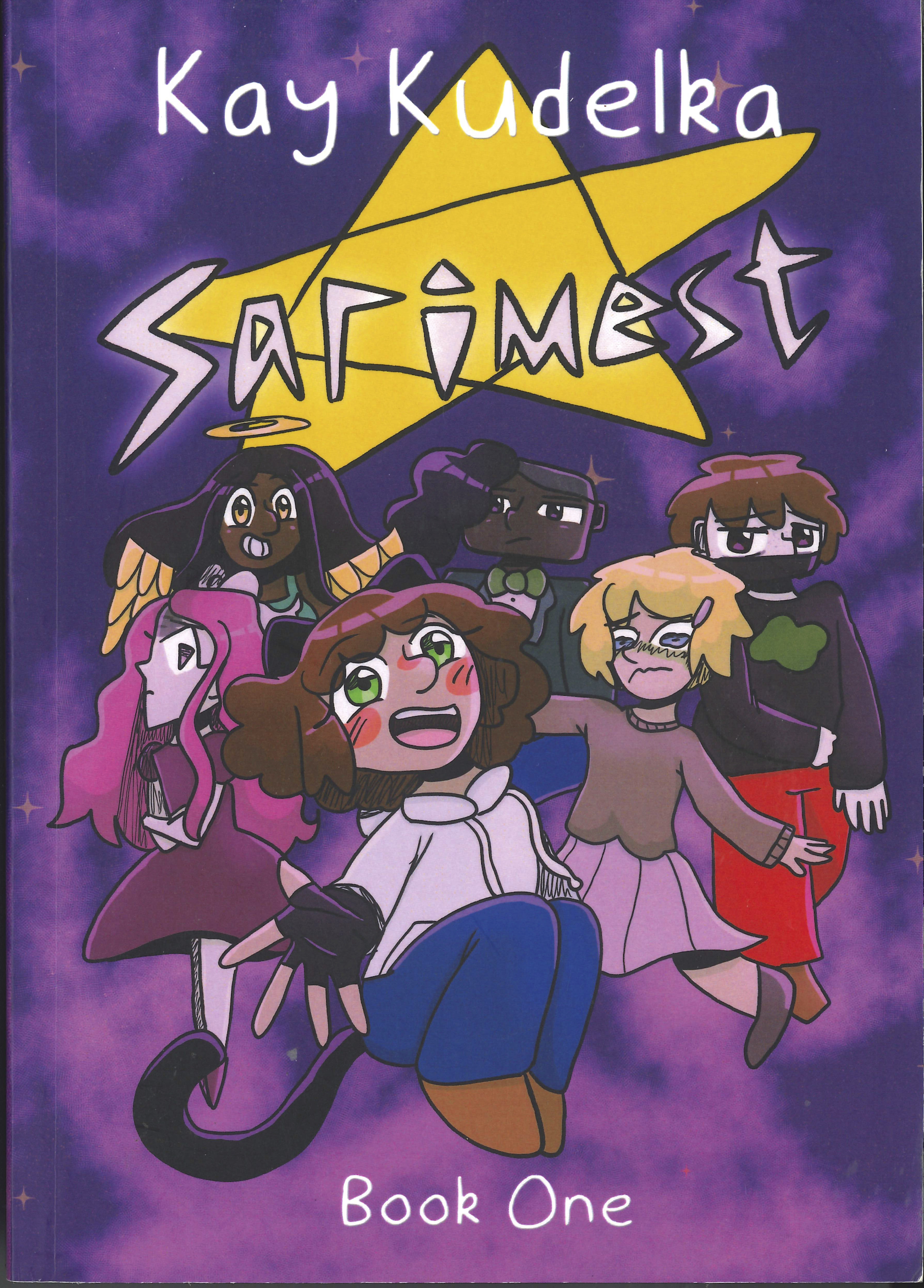
Kudelka, K. (2022) Sarimest: Book One. Hobart: self-published.
However, unlike Kudelka's book, many comics presented at these venues share concerns and tendencies with non-comics zines: a mix of personal expression and confession (perzines), artistic experimentation that employs hybridity to cite different popular visual and textual forms, and political or activist content, along with niche fannish interests. ‘Zines represent a counterculture that enables identity construction to be fluid’ (Zammit, 2021: 180); zine-making is among those practices that might ‘creatively interrupt’ dominant and unequal, institutionalised ways of being (Gray et al., 2022: 887), both allowing and promoting alternative expression (Zammit, 2021: 180).
Our methods
Collecting comics from zine fairs and like events is an exercise in delineation from the first because organisers curate the zinesters who table through a mix of methods that might include invitation or application. Yet, amid the well-known and often self-defeating project of defining comics for different purposes (Meskin, 2007), we decided to collect publications from zine fairs that might reasonably be considered comics, without requiring particular elements such as recognisable panels, gutters or speech balloons, or privileging a certain kind of narrative or thematic development (let alone sequence). For example, a collective zine called A Pony with a Secret – a Zine Come True (2022), with over 20 contributors, unfolds in an accordion style and contains pictures of many horses, and the zine is said to have been ‘compiled’ on the lands of the Wurundjeri people. However, it's published in what is broadly a comics context, and the images are intended to be read in order – as it unfolds, each picture of the horse or pony is a surprise – so we have chosen to consider it a comic. Because the purpose of the study is to understand what might be said about a cultural moment through a hard-to-access-and-comprehensively-survey sector of its comics world, we made the arbitrary but useful distinction of only writing about comics that were clearly evidenced as being published in 2022, including reprints, given that publication and material context are as important to cultural meaning as creative content (Scott, 2017). The corpus is still considerably limited. The number of comics that could be written about from Naarm/Melbourne's Festival of the Photocopier, for example, was about 1 in 10. In many instances zines dated from earlier years, with a reasonable amount of representation from 2019–2021 – which makes sense, given that most of these events were not able to run in 2020 or 2021 – but others far earlier. In many instances, too, zines were undated, including zines that carefully documented other contextual information such as acknowledgements of Country and artist contact details. In the description and analysis that make up the body of this article, we only used comics that clearly indicated they were published in 2022.
Works by first nations artists
It is important to note that we also collected hundreds of comics that are a significant part of the picture of the intersection of Australian zines and comics in 2022, but which couldn’t be included in the body of this paper if we wanted to maintain our deliberately porous parameters. 2021 was a boon year for original comics made by First Nations artists. The importance and originality of these works demand careful attention despite them falling just prior to our 2022 parameter. At Watch This Space Zine Fair on 9 July 2022, we collected three Stick Mob books by Declan Miller, Seraphina Newberry, Lauren Boyle and Alyssa Mason, all published in 2021. These are important for their First Nations authorship but also for the model through which they have been published. These books demonstrate that an established publisher, Gestalt, can partner with emerging Indigenous creators. Equally important is that the publishing of these books led directly to the creation of Comics On Country, a publishing house whose first book Dark Heart was launched at the Perth Comic Arts Festival in 2022, announcing the arrival of an ambitious Indigenous-owned and led universe of Aboriginal superheroes called the ‘Indigiverse’ that stands in contrast to the existing genre of Australian themed superhero comics.
‘Watch This Space’ ‒ an artist-run initiative and gallery space in Central Arrernte Country ‒ hosts the Alice Springs annual zine fair. Their 2022 site is adorned with a beautiful, scratchy image in the unmistakeable style of Leonie Brialey of someone holding and kissing a zine. The event description reads: We invite you to join this thematically sprawling, temporally finite autonomous zone, where anyone can publish anything they like as a little paper thing you can hold in your hand. A zine is an inherently political tool of self-expression. It can be a self-published story, comic, poster, single-page drawing, open letter, photo journal, flip book, brochure, postcard, sticker, manifesto, etc. The model for making is DIY and you don’t need any experience as a writer, artist or human being (WTS, 2022).
Though we’d heard about Stick Mob, it was at WTS that we collected the three books created through this partnership between Gestalt Comics, Stick Mob Studio and the Indigenous Literacy Foundation. With mentorship from Wolfgang Bylsma and Brenton McKenna, ‘Mixed Feelings’ by Declan Miller, ‘Storm Warning’ by Lauren Boyle and Alyssa Mason, and ‘Exo Dimensions’ by Seraphina Newberry were created over the course of 2018 and 2019. All three books are beautifully and carefully produced in full glossy colour, printed by Australian comics stalwart Jeffries Printing in Sydney; all artists were still in high school when the books were created.
In the foreword to Declan Miller's ‘Mixed Feelings: Book 1′, Brenton McKenna writes, ‘For a long time I was considered Australia's only Indigenous published graphic novelist. I am happy to announce that this is no longer the case’. ‘Mixed Feelings’ is the story of high-schooler Pam who lives with her Uncle and her dog, Max. At school, she is ‘that weird lonely Pam’ and at night she is haunted by a Phantom creature who wears a scarf, top-hat, and demonic grin. At school, Pam's friend Ross, who has a secret crush on her, idly doodles a picture of the two of them, himself as a King, and Pam holding his arm and laughing at his joke. The doodle is confiscated by a teacher and falls into Pam's hands. Too late, Ross snatches it from her and stuffs it into his mouth in one of the most hilarious images of the book. The class turns on Pam, mocking her relentlessly. That afternoon she is consoled by her ‘old fart’ Uncle. The following day Pam, via the waking presence of her dream-Phantom, is, as the blurb says, ‘open to manipulation by a trio of popular students’ and begins her transformation and downfall.
The comic is beautifully paced, the drawings are dynamic and evocative, and the narrative is genuinely thrilling, funny, suspenseful and frightening. Declan Miller has a great talent for timing the twist as it sits in the page of the comic – opening panels up to achieve suspense and quiet, and using stark objective details to infuse the story with authenticity. Perhaps our favourite moment was on p.28 when Pam arrives home from her horrible day at school. Her Uncle asks ‘Ay Missy Moo. How was your first day ba–’ and is interrupted by a panel inset showing Pam's discarded school bag lying in a crumpled heap on the floor. ‘–so, not good then’, says Uncle. A fantastic, restrained moment, perfectly timed.
‘Exo Dimensions: Book 1’ by Seraphina Newberry is, as the back matter states, ‘a roller coaster ride into central Australian Indigenous creation stories, interwoven through family relationships and sheer adventure.’ From its opening scene, we are immersed in an alternate world of mutants, zombies, clones, scorpion creatures, shapeshifters, portals and doppelgangers. We follow the central story threads of Dilan and Konan, who exist across different dimensions. Konan's story in particular grounds the comic, with Konan's deep ambivalence and rage around his past and being adopted by white parents acting as a mirror or guise for his hidden, unexplored superhuman powers. Newberry has a huge talent for twisted humour, the power of comics to shock, and storytelling that scrambles forward at breakneck, dizzying pace. In one rare quiet scene, Konan's adoptive mother approaches a boy leaning on a tree who looks eerily like her son. ‘Hi,’ she says. ‘I am sorry if I was staring. You just look so much like my son. The resemblance is uncanny.’ The boy (who we know is actually the shapeshifter Jeda) replies, ‘Sure, white lady. You all look alike to me too.’ He holds a blue snaking S-shaped keyring, exactly the same as the one Konan bought as a souvenir from a truck stop in a previous scene. Later when Konan and Jeda meet, the two keyrings lock together and intertwine, Jeda's blue-sleeved arm becoming a real, writhing snake to bite Konan as part of the blood portal ritual. We take it all in our stride as readers. It's a wild adventure on Country and every character is broken - halved, doubled - cyborgs and amalgams of past and future.
In her foreword to Lauren Boyle and Alyssa Mason's ‘Storm Warning’ author and screenwriter Maria Lewis writes: I try and infuse [my stories] with the same elements I love when I’m an audience member as well: heart, humour, heroics … and a lil dash of horror. STORM WARNING has all of those things in its very first volume and the fact that it's created by two teenage girls […] is absolutely baffling to me. Like…how dare they? Be this good? Already?.
Also published in 2021, acquired at ‘Watch This Space’, and too important not to mention, is Crime Scene Australia: Edition 1 Terror Nullius, described by broadcaster Mercedes Zanker in a 3CR interview as ‘Australia's first postcolonial revisionist-history graphic novel’. The creators of CSA are Charlie Hill-Smith and Uncle Robbie Thorpe, with pencils by Michael Kumnick and ink art by Heydi Ibrahim. It's a sumptuously beautiful full-colour production in standard floppy comic size, with the artwork filling every millimetre of the unbordered pages. The story follows the cast and crew of a cold-case TV show about Australia's frontier wars.
Hill-Smith, a documentary film-maker with a lifelong concentration on stories of cross-cultural human rights, got to know Uncle Robbie through protest events in Melbourne where Robbie is a powerful, ‘terrifying’ (in Hill-Smith's words) public orator. Rather than approaching their ideas via documentary film, a medium which requires enormous collective labour as well as buckets of cash, the two decided to work in the medium of comics. As Hill-Smith said in an interview with SBS: ‘Traditionally ignored by the powers that be, the humble comic book has remained the free-est and least censored world art form. While the god-botherers and prudes have banned movies, books and even people, the comic book/graphic novel has flown under the radar, and like the Poms before it; gets away with murder’ (Nicol, 2016).
The collected corpus
The bulk of the comics we collected have a handmade quality that make them unlikely to be distributed through traditional channels for newspapers, magazines, comics or books. This meant we were collecting a very wide range of comics of a kind that a library might class as ‘ephemera’: printed in small runs, on the kind of ink and paper that is far from durable or simple to archive. These comics had the potential to act as a site of meaning through both what was being published and the way it was published. It seemed an appropriate method to take stock of the ‘now’, because of the directness and immediacy of access and distribution for makers, and the liveliness of the kinds of comics communities that create for, and present at, zine fairs, comics fairs and market days. For Vanessa Berry, who has made zines for over twenty years, as well as publishing through mainstream and traditional markets, attendance at zine fairs is crucial, because ‘the best way to obtain a good knowledge of zines is to browse and read them’ (2018: 49). We saw it as a way for us to: have and experience a presence in a room in a current moment; expand our project nationally through physical extension in space; have contact and communication with creators while informing them of the NLA's collecting remit, and their obligation under legal deposit to provide their publications to the NLA.
The corpus of 144 comics we were able to clearly identify as having been published in 2022 included Knight, a fancomic by Alienmandy that assumes the reader comes with knowledge of Final Fantasy XIV (2020); Hotel Quarantine Diary (2022), a comic by Meg O'Shea about her time in hotel quarantine after returning from overseas to Sydney during the COVID-19 pandemic; and Anticitizen (2022) a two-colour Risograph zine created by the Refugee Art Project that accompanies a larger series of artworks made for Documenta 15 art festival in Kassel Germany in 2022. A mixture of comics, illustration and commentary, the zine exemplifies the blending of zine and comics styles and concerns, discussing the artworks that were made for the festival, artworks about the lived experiences of racism in Australia and the negative impacts of the Australian government's refugee detention policies.
Skeleton World by Ruben Camilleri, a surreal, dark and funny comic about a lonely boy whose friends hate him so much they jumped in front of a truck (so he deliberately dies to rescue them), can only be included in the corpus because of the date on a coffin: ‘Jake Buzz, 2007–2022’. ‘He wanted iced coffee’.
One comic (re)published in 2022 is Peter Lane and Jason Paulos's textured, bibliophilic fantasy Skye's Cavern Library #1, which a back cover explains is a revival of a comic that Lane first published in 1998. Another revised comic published in 2022 is A Space Oddity by Owen Heitmann, a madcap adventure about an appealingly sassy space Viking, which an endnote explains ‘was originally written and drawn between 11:00 a.m. Saturday 13 August 2016 and 10:30 a.m. Sunday 14 August 2016 as a 24-h comic’; was at some stage revised and coloured before being printed; and has now been published with a new cover and artwork that has been further revised. The decision to include these revised works in our corpus was predicated on the notion that the ‘moment’ under analysis in 2022 is a moment of publication, which includes such processes as printing and distribution, as well as the steps involved in creative and editorial production.
Within these parameters, then, we are documenting and analysing comics collected from Festival of the Photocopier 12 February 2022, the Brisbane Zine Fair 7 May 2022, Comic Gong Wollongong 14 May 2022, Oz Comic-Con Adelaide Homegrown 21–22 May 2022, Brazen Comics Festival Sydney 22 May 2022, Other Worlds Zine Fair 29 May 2022, Perth Supanova 25-26 June 2022, Watch This Space Zine Fair Alice Springs 9 July 2022, SydZu Zine Fair 16 July 2022, Darwin Fringe Zine Fair 17 July 2022, Perth Comics Arts Festival 7 August 2022, Homecooked Comics Fest 28 August 2022, and Hobart Small Press Zine Fair 17 September 2022. The comic books range in scale from 500 × 350 mm (Brailey, 2022) to 50 × 55 mm (Candiloro, 2022) and are produced using a range of commercial and bespoke forms of manufacturing and production techniques, often using non-conventional processes such as thermal printing (Higginbotham, 2022), Risograph printing (Alexander-Mironov, N. and Alexander-Mironov, A. eds. 2022), steel-plate etching (Dakin, 2022) and single-sheet folded with scissor-cut pages (H-Q, 2022).
Most are assumed to be funded independently; still, funding sources varied: Presents: Noir #3 (2022), a thick issue of an indie anthology series devoted to showcasing creators and letting them test Teen + -rated creator-owned stories in a profitshare model, devotes a page to thanking its Kickstarter backers, while I GOT COVID by comicsbylily (2022) was supported by a City of Melbourne Arts Grant, likely through pandemic-specific emergency funding.
Just as there is value in collecting one-off and self-published materials and ephemera for a cultural institution such as the NLA, there is value in the project of describing a corpus of ephemeral texts. That being said, our key questions are twofold: what types of comics are being produced (made and distributed) in this huge yet particular and easy-to-miss market in Australia in 2022 – the end (or an end) of a period of lockdown and social upheaval? And, as a corollary, what might these descriptions suggest about the powers and limitations of comics and zines to speak to and about a cultural moment? We first group descriptions by theme, and our suggestions follow.
Themes
We note five themes here which recurred through the collected corpus: Covid; Mental health, disability and chronic illness; Online life; Place; and Climate and disaster. This list of themes is by no means exhaustive. A significant contingent of the works we collected either had a unique, unrepeated theme, or would be more usefully grouped in terms of their genre (for instance: fantasy, sci-fi) rather than their theme. Because we are interested in what these works can tell us about the ‘now’, we observed and selected these themes because of their interaction with and representation of a current national moment in 2022. In exploring these themes, we are interested in how the specific material and ephemeral nature of the zine-fair comic speaks to and about the cultural moment.
COVID
The comics we describe here are exemplary of those from our corpus which either explicitly mention Covid or are framed by Covid's effects on daily life such as separation from loved ones, removal from places of work and education, ennui, fear and the replacement of physical spaces with online or digital ones.
I GOT COVID by comicsbylily (2022) is a folded zine in blue ink that tells the story of a protagonist, Lily, who acquires COVID while taking videos at a wedding: ‘wOW! What a busy and exciting dance floor’, they think. ‘What possibly could go wrong?’ Although the story is brief and simple, the specifics have a morbid and familiar fascination. Lily is ‘couch-ridden’ for three days, which provokes the reader to think about how long they were ‘down’ for when they had COVID (or how long they might be); in this period, Lily reads, draws, and makes tik-tok dances. Combined with the uber-quotidian visual details of the scene and what we might find curious about a protagonist's dailiness (Lily has an L-shaped couch; what kind of couch do you have?), terms like ‘flattening the curve’ both sink into life's background texture and stand out for their contemporaneity and strangeness.
Live, Laugh, Love, in the time of CORONA VIRUS by Carly Candiloro (2022) is a saddle-stitched zine with a single staple that shows a button-eyed, big-nosed, long-haired character breathing in, at the start of the zine, with a mask-sucking against their nose and mouth, and at the end of the zine breathing out with the mask billowing. The zine is printed on bright pink ink on unevenly cut pages. In between the breaths, over three beats, the character sits on a couch, looks at a phone, and ‘lives’ (by holding a phone), ‘laughs’ (by sending a crying-face emoji), and ‘loves’ (by sending a love-heart emoji). In the opening and closing images, the head is angled up and the button-eyes appear slightly off-kilter, somewhere between determined and despairing, as if being suffocated, even when exhaling, by the mask.
Mystery Friend by Paul Rhodes and Haein Kim (2022) is a Risographed art book described by Kim as being ‘all about the small moments in life and the vibes’ (Angelos, 2022). It is thick, luxurious, vibrant, and surreal work that combines an aesthetic-first art-book ethos and the surreal social humour of an art-forward comic, with each artist taking a side in a flip book that is symbolically linked and divided in the middle of the volume by a cutout shaped like an uneven brick wall. The volume also includes stickers; the edition we collected is numbered 164 of 250.
Both stories in Mystery Friend are funny, including hysterically-toned wellness satire – a woman claiming ‘Apparently I got all the hallmarks of a future billionaire’ – but the pandemic contextualises its fevered mood. When an ego-bruised, muscular character asks, ‘Hey Kevin.. am I bad vibe?’, Kevin comments, ‘Lock down gets a little bit weird aye.. Mmm’ (Figure 2).
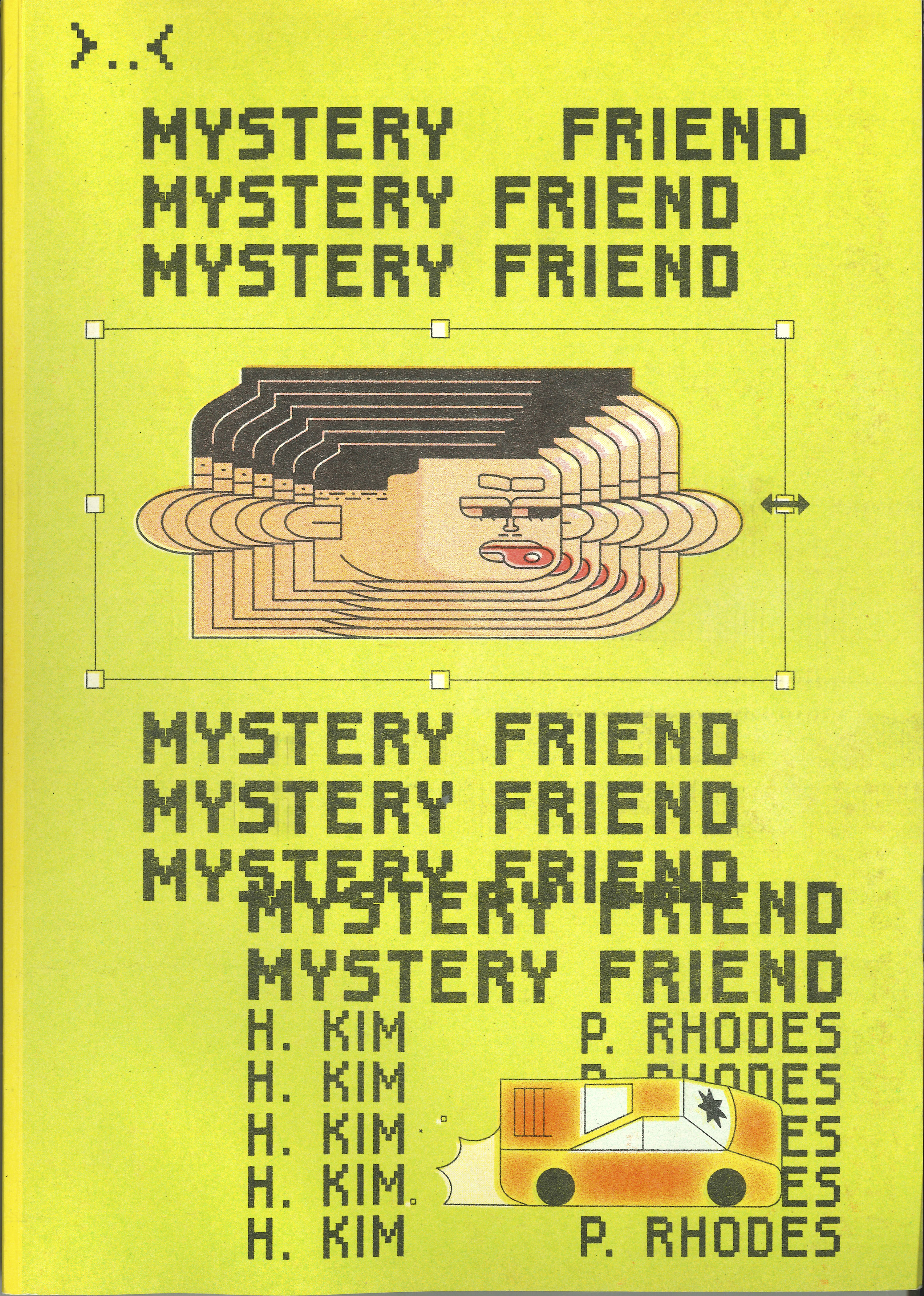
Rhodes, P. and Kim, H. (2022) Mystery Friend. Stolen lands of the Wurundjuri People of the Kulin Nation: Glom Press.
Tale Town: Tales from the Hermit Kingdom is an approximately tabloid-sized, 16-page newsprint anthology. Conceived and distributed as a ‘free local newspaper’, it was created by 12 of the volunteer members of the Perth Comic Arts Festival (PCAF) organising committee for PCAF 2022, held 5 months after Western Australia became the last Australian state to open its borders following COVID's outbreak. It comprises 11 one-page autobiographical comics and one crossword puzzle. Each comic incorporates anthropomorphic animal characters which, led by PCAF creative co-director Elizabeth Marruffo, were additionally developed as felt sculptures exhibited at the festival as part of PCAF's aims to both ‘[push] at the edges of where comics and other mediums overlap’ and introduce the committee to attendees’ (interview).
In its focus on contributors’ experiences as part of Australia's ‘Hermit Kingdom’, Tale Town serves as a record of WA residents’ unique pandemic experience. In Campbell Whyte's Little Nemo-inspired Little Perth, Whyte as a long-eared dog, his partner Marruffo as her own mouse character, and their son as a penguin, stumble out of the hypnagogic gloom of the home to which they were forced to ‘retreat’ during lockdown. Outside, they find a no less dreamlike red sky and rain of ash – a reference to the bushfires that occurred in the midst of Perth's COVID restrictions in 2021.
The role of creators’ practices during Western Australia's extended border closures is also featured in many of the anthology's pieces. A migrant from the USA, Sarah Winifred Searle as a bespectacled rabbit, has no outlet to grieve the ill and dying loved ones she is kept from, so buries herself in her work until her body aches. Bruce Mutard, Kristina Turner and Jess Harris sit isolated and unsmiling at their work desks. Conversely, in their collaborative comic At Home, Lola Baldsing and Scott Higginbotham (as a unicorn and warthog respectively), flourish as they find that the frequently solitary practice of comic making has primed them for lockdown.
Tale Town, as a part of PCAF, in the focus of its content and its means of distribution, serves to create connections following a period of unprecedented isolation, bridging gaps between the comics medium and other art forms, the comics community and the broader public, PCAF and the broader comics community and Western Australians and those of elsewhere. As the collaborative comic on the front cover says, ‘comics help us stay in touch when we can’t be there’.
Campbell Whyte, along with other PCAF organisers, participated in the development of ISO:ID, A Pandemic Anthology (2022). An A5, 40-page anthology of comics by artists between the ages of 13–15, it is the final outcome of the ‘Constructing Identity Through Comics’ program, funded by the Western Australian Government agency Healthway, in which Campbell Whyte led the mentorship of young creators in making comics about their experiences of COVID for print. The personal impact of pandemic isolation manifests variously throughout the works – a thylacine stranded in a snowy wasteland, a glass dome protecting the city from a marauding virus monster, a family photograph torn in two.
As with Mystery Friend, the timing of COVID can be understood as framing individual zines even when the virus is not explicitly present. A small, untitled zine by Alex E Clark, ‘The unsteady feet of two steering at once…’ (2022), shows two femme-presenting figures, one with black hair, one with red, courting, enjoying a relationship, undergoing travails, narrated through indirect, stylised, ‘courtly’ language. The point of the zine seems to be for the artist to show the figures at different points in, if not a relationship, then against the theme of love; individual pages read almost as figural character studies. But the last page, with no image, reads ‘Something for you until we are together again’. In the context of the 2022 zine fair, this holds open the possibility that it's an individually dedicated comics zine – the cover is Valentine-red with evidence of folding and a heart cut out by hand – and a dedication to the reader in a time of physical separation.
Mental health, disability, and chronic illness
Throughout or corpus, issues of mental and physical illness and disability were a prominent theme. Our selection here highlights the works which address these issues explicitly and/or which do so in ways exceptional to the moment of 2022. It's worth noting that the intersection of comics and health is a site of global scholarship, led by the Graphic Medicine team and its international conference, journal and edited collections. Comics as a medium provides a unique means of representing the sightlines of pain, disorder, impairment, fatigue, the slowing of time, the repetition of daily cycles through chronic illness, and the lived experiences of those with neurodiverse cognition. Our selection here observes this well-documented intersection via our abiding questions: how does the specific materiality of zine-fair comics inflect these themes, and how does the cultural moment of 2022 – particularly the exacerbation and visibility of existing health conditions during Covid – draw these themes out in unique ways?
Sluggish #1 by Rob Lisle, who also publishes under the moniker Spedsy, and writes and draws many genre-inflected independent comics in the ‘Spedsyverse’ including the madcap, lively The Devil's Toilet (we collected #3), is printed on glossy paper but is deliberately ‘artistically simpler, more indie-feeling’ than Lisle's other work, according to the ‘back stuff’ – information about context and intention printed on a back page, as you sometimes find in a single issue of a comic printed by a mainstream publisher. On the inside cover Lisle introduces a sort of disclaimer: ‘Mental illness can be a real bitch … Within these pages I poke fun at it. I’m not making light of your struggle – I’m raggin’ on my own’.
The comic centres on a slug-creature named Herb, who dreads work, parties, and people. He moves through a sad grey world and awkwardly hits on a woman from work at a party – ‘Oh shoot. I’m so sorry. I was thinking about your butt’. The woman responds more generously than many people would; the two talk for so long they are the last people at the party; the world brightens; but just as they are about to go out on a date, aliens crash into the office, resolving a kind of meta-thread that evolves throughout the story about Herb accepting the bleakness of life and not inviting ‘twists’. In a similar use of the thematic and visual flexibility of the form, Personal Growth by Sarah Milne expresses loneliness through the ‘body horror’ of a mycelium infestation, whose personal dimension is always more forceful in tone than the visual horror or the essayistic discussion of fungal behaviour, demonstrating a divorce's shattering.
Interestingly, this contrasts with a small and cheerful zine printed on stiff paper in shades of green, Jimmy's Mush, which tells the wordless story of a mushroom popping to smiling life and hitching a ride on an axolotl-like creature until it finds mateship with another mushroom. But an awareness of the significance of mental wellbeing inflects comics we collected far across styles and genres.
Harry's Pizza Volume One by Rebecca Sheedy, for instance, is a collection of colourful vignettes largely about fun-loving animals who watch VHS and eat pizza – but one vignette, a birthday party for Oliver the dog, is about being 37 and realising that he spends ‘all my days opening boxes at work’. He reflects, ‘I’m never going to be able to find a better job’ (He ends up learning to make pizza) (Figure 3).
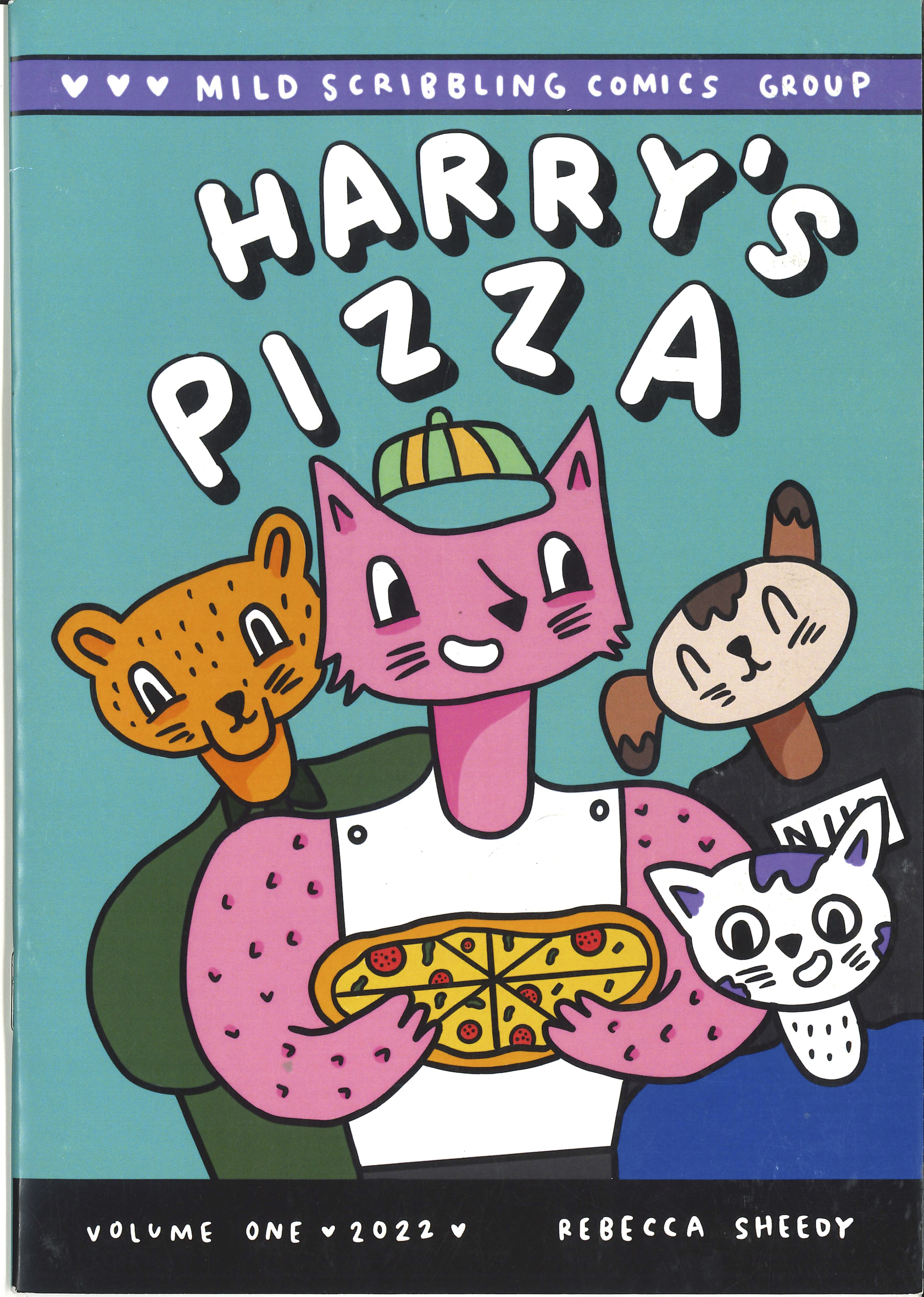
Sheedy, R. (2022) Harry's Pizza Volume One. Australia: Amplified Press.
Meanwhile, the plot of Polaroids by Finn O'Sullivan, a kind of psychologically-tinged high school monster mystery story, is kicked off when a young man named Syd is walking around at night and taking polaroids: ‘My insomnia's been getting really bad lately. The walks have been helping’.
Keiyan's Welcome to My Brain is a slim paper zine stapled seven times along its top edge and read by flipping the pages up like a reporter's notebook. The zine is an eclectic, intriguing collection of images, ciphers, and text that come together to give the impression of a series of idle doodles directly from ‘my brain’. The second page is in Japanese; Google translates the text as ‘A selfless person, an incomplete person. A dispossessed person. Koreichiza Kojima. This is a small boat. Empty bird. A small boat with endless charm. Lost family. This is a cave person. There are no thoughts. There are no thoughts, there is no honey’. A series of picture-equations comes next. A house plus half a sun. A house plus half a heart. A house plus half a person. ‘Half of me is not here! Home sick’, the text reads. As the zine moves on, its tone becomes more joyful, playful and cheeky. A naked character begins to reappear, bendy and rubbery, sometimes with wings, sometimes with its hair on fire.
‘Be naked or be jailed,’ one page reads and the figure, over the next few pages, appears inside flowers, dancing on a stage, taking a shower outdoors under traffic lights and looking at a Wanted poster of themselves: ‘Hi, it me! I’m famous.’ The arrival ‘home’, towards the end of the zine, is imbued with sadness. Looming faces stare from the page, and the naked character appears in a bin, with ‘I Am Trash’ on a banner over their head. The simplest of production: pen on paper, staples, rough photocopying. The feel of the staples under your fingers, the rustle of paper. A poem of a zine.
Drawings from my bed: A visual medidtation [sic] of chronic illness by Iris Blazely and Can you feel that? A zine about chronic pain by Sha are slim zines that bring the reader into the site of pain and production. The site is the bed – soft and static – but the pain is sharp. Across both zines, pain is rendered in images with spiky edges: barbed wire coiled around a wolf holding a prone rabbit in its mouth, the jagged shining teeth of a predator's skull, ragged-edged ovaries and fallopian tubes, a razor cutting a seam, a witch with ‘curly rotting fingernails and their hands are inside of me, inside my uterus’ (Sha). The spine of Blazely's zine is zig-zag stitched in black thread by a sewing machine; on our copy, the threads are uncoiling, hanging from the paper. The simplest of sentences accompanies the central image of Blazely's zine, a hunched crouching body seen from behind, its head invisible, its shoulder a pulsing bulge against the knee: ‘Pain is something the body goes through’.
Online life
Representations of online and digital lives are included in a substantial contingent of our corpus; perhaps it's unsurprising that a comic like Live, Laugh, Love, in the time of CORONA VIRUS by Carly Candiloro (2022) would take place considerably online, and from that positioning draw much of its humour, its meaning, its incidental realism and its pathos.
Briefly, in order to highlight online life as a secton on its own, we will draw attention to two examples here which highlight the intersection between the hands-on DIY material form of the zine-fair comic, and the harder-edged, slicker forms that our online communications and identities take.
Youth Compendium Issue #2, a ‘collaborative artwork’ featuring 12 Tasmanian youth artists who attended workshops facilitated by 3 Tasmanian professional artists, one of whom was a comics maker, responds to the theme ‘Who I am. Who we aren’t’; a comics work by Bailey Cyngler shows a figure in a hoodie with a screen for a head struggling to receive the ‘signal’ of a friend saying ‘DUDE’. When the figure checks in, the friend says ‘YOU… YOU Kind Checked out for a sec there…’ This comic inspires the graphic that appears on the cover (albeit with different shirt). The prominence granted to this image, as well as its capacity to serve as useful shorthand, screen life as an emblem of identity confusion, suggests a widespread and established understanding not just of the role played by online life in offline life, but a host of familiar, linked emotional associations – everything from casual cool to the alarm of missed connections and disassociation.
Less emotionally charged, but in the same broad territory of digital relations, 20 People by Sarah H-Q is a single-folded A4 page, printed on quite sumptuous paper. The few illustrations are expressive, carefully coloured and composed and layered, including a two-page spread of a striking crowd scene in Delhi. The image comes after a discussion between ‘Sarah, Melbourne, 47’ and ‘Paras, 10,415Km Away, 42’ who have matched on Tinder, although Paras reveals a little way down the page they are actually 22. In the text boxes that gather down the cover page, Paras tells Sarah that they are going to surprise-visit their family in Delhi at Christmas; the image is perhaps both the artist's speculation on Paras's future and a memory of her own, as she writes in the gathered text boxes that she's been to India as well – a reflection of the nature of online dating encounters, which occur at speed and scale (Figure 4).
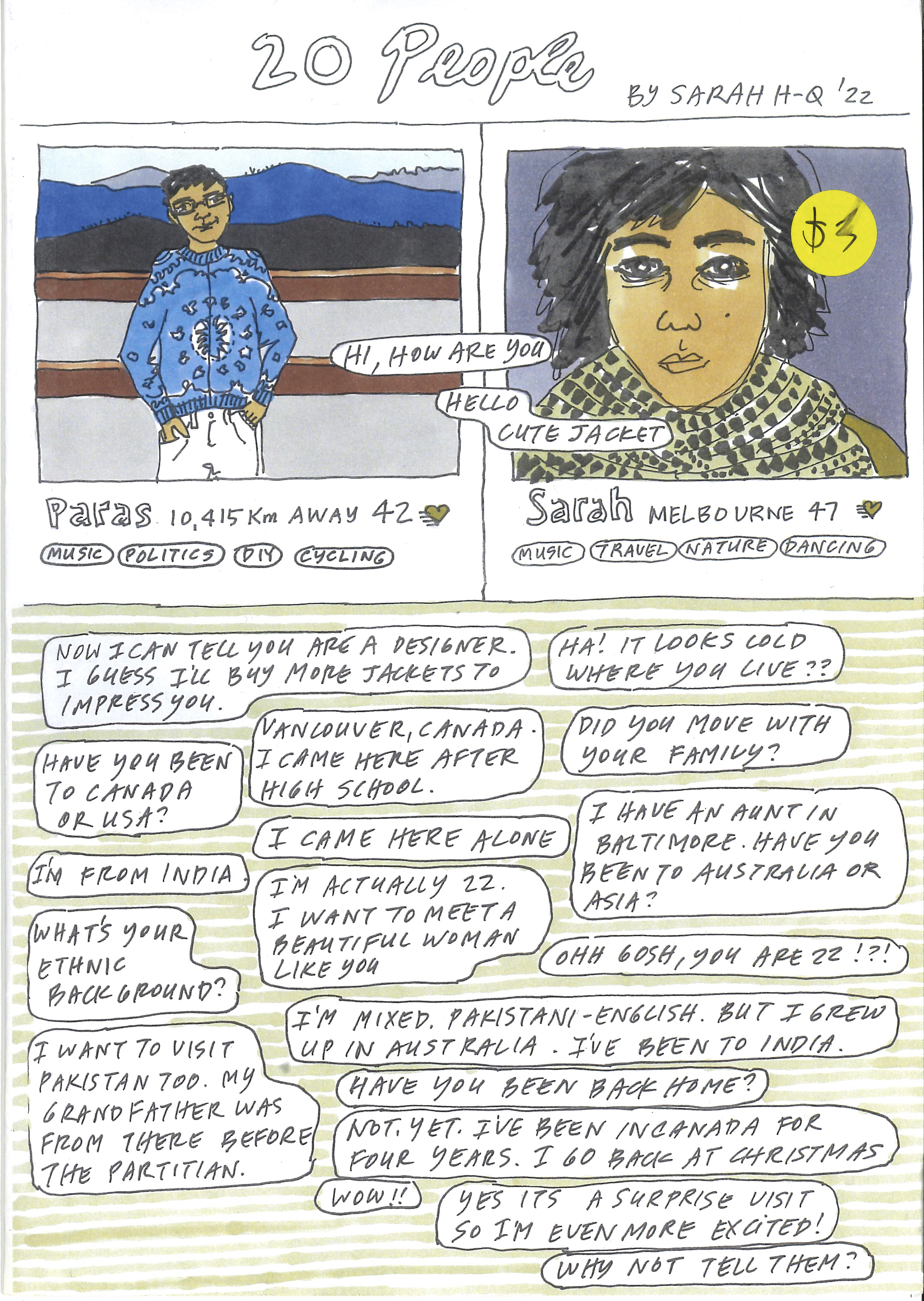
H-Q, S. (2022) 20 People. Melbourne: self-published.
Other instances of H-Q's work are about these online encounters, including Global Setting, a folded zine that features no pictures of people, just the gathering text boxes: Sarah talking to a few different people online, from Iraq, Baghdad and a self-described Lebo. The text boxes of Global Settings are set against a black-and-white background of a carpet, different from the colourful carpets that form the backgrounds to three unnumbered editions of H-Q's Persian Carpet Stories, which give brief grabs of the different colours’ backgrounds and uses, in floating text boxes once again.
Place
Place is a perennial theme in all forms of the comics medium, and interestingly was most prominent as a theme in works from the regional capital cities of Boorloo/Perth and nipaluna/Hobart in our corpus. As our selection demonstrates, the ways in which artists describe, transform and construct place in Australian comics is one of the most significant ways we can observe their complex representation of national identities. Place leads to history, politics, psychogeography, trauma, identity and colonisation.
At Perth Supanova, our collector was treated to a signed and numbered advance printing of the first issue of Dark Heart, a comic series from Gestalt's Indigiverse imprint written by Scott Wilson, drawn by Katie Houghton-Ward, coloured by Justin Randall and edited and lettered by Wolfgang Bylsma. It is a complex outfit, copyright Ice-Cream Productions and Comics On Country Inc and published by Gestalt. The Indigiverse characters, concepts and scenarios are trademarked to Wilson (Figure 5).
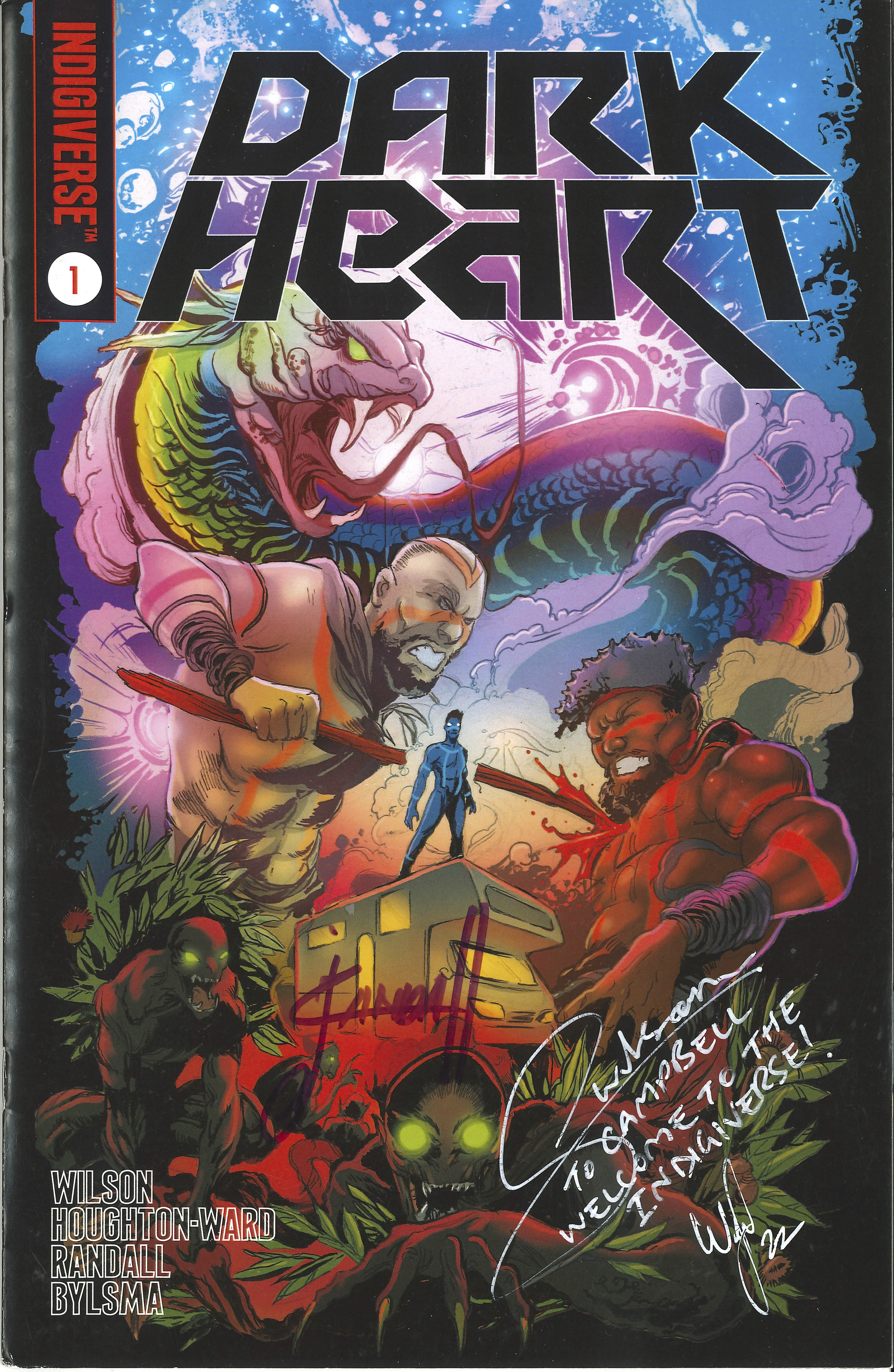
Wilson, S., Houghton-Ward, K., Randall, J. and Bylsma, W. (2022) Dark Heart: Chapter #1 Dying of the Light. Gestalt/Indigiverse: Applecross WA.
The bulk of the story depicts the elder protector Warnoo drifting through the Dreaming ‘listening to moments in space and time … just in case someone is brave enough to break the lore of the Gungura Jiwi’ – the fire. The lore is broken by two oblivious white campers in the Blue Mountains, Sal and Bill, who set up for the night on a marked sacred site and are beset by feasting Mamoo (devils or bad spirits). This kinetic action sequence is framed in didactic terms, perhaps balancing a concern for both entertaining an Indigenous readership and educating the non-Indigenous, but it's also a thematic entree to a lush, specific, character-driven superhero world, ‘inspired by First Nations stories, transposed into a fictional comic universe’ and with language used in consultation with First peoples (p. 24). In this case, the language is done in consultation with Gooniyandi Language consultants Robert Brooking and Teejay Cox Worrigal from the Northwest of Western Australia, and the Gooniyandi language group appears highlighted on a broader map that shows the Indigiverse's intense concern with place. On the inside cover, Wilson writes, ‘The creation of this Aboriginal Superhero Universe is part of a vision to shift the perspectives of Aboriginal culture and shine a positive light on its richness. Aboriginal culture is about preserving and protecting the land, because it is the land and our environment that gives us the stories, the power, and the connection to everything’.
The Small Press Zine Fair in nipaluna/Hobart was the source of the largest number of zines that fit within our parameters: new work with comics content. Founded in 2013 by Bridget Stewart, the Fair ran as part of ‘Her Majesty's Favourite Really Great Graphical Festival’ – a comics, illustration and animation festival directed by comic artist Joshua Santospirito from 2014 to 2016 – and has continued on its own ever since, with Santospirito and Miranda Rogers now its directors. The 2022 Small Press Zine Fair was a treasure trove of eclectic work.
Leigh Rigozzi is one of Australia's most prolific creators of art books, and his 2022 zine Cryptogeography is an extraordinary accordion-folded A5 work of abstract comics, bound front and back in thick black card. The accordian-fold means that the book is essentially spineless, or double-spined, depending on your definition of spine. The accordianed pages form identical white edges on all four sides of the book – finding the ‘way in’ to its own cryptogeography. The text-free, abstract comics inside are rendered meticulously – three-dimensional hard-lined cityscapes and close-ups of urban ‘pieces’ in soft grey, with quiet pastel-coloured gradient backgrounds. The digitally-created images are sometimes like the impossible trident optical illusion, sometimes like science-fiction pulp covers from the 1970s, sometimes like Escher. The startling image of a pink fruit on page six, along with a few scraps of grass and carefully spaced palm trees, comprise the only curved lines in the book. These cities float, unpeopled, abandoned or never-born. The book forms part of Rigozzi's career-long preoccupation with his childhood home of lutruwita/Tasmania, a place he escaped from and then escaped to. The pseudo-futurism of Cryptogeography should be read alongside Rigozzi's other recent short works which give attention to stolen land and climate change, ‘Blackberry’ and ‘Secret Beach’, and his co-edited anthology of Tasmanian artists, Future Lutruwita.
Conceptions and imaginings of place and landscape – their histories and futures – feature prominently in a number of other Tasmanian-produced zines. Tasmanian printmaker John Robinson's A6 black-and-white zine Steamy Stations lovingly documents remnants of Australian steam travel in watercolour-washed ink drawings and single-sentence descriptions typed out on a typewriter. Robinson, a collector of printing equipment, observes the architectural remnants of a previous technological era matter-of-factly, without comment: ‘Small weatherboard stations with large steel verandahs built in the late 1800s’, ‘Large bluestone sheds with arched entrances to allow for a locomotive to enter’. Modern railway tracks criss-cross the images, and the only drawing of a train is a modern Comeng metro. This quiet zine speaks to a love of the material remnant and the memory of slower time. These preoccupations intersect with a substantial sub-section of the Australian independent comics community that gathers itself around particular printing techniques such as the risograph, and with artisanship that observes the materiality of its own production.
Josh Santospirito's body of work has for many years been centred in ideas of place, particularly his most well-known graphic novel The Long Weekend in Alice Springs, based on a Jungian psychogeographical essay by Craig San Roque. Santospirito's 2022 zines are We Climbed a Mountain: Art from a residency on Flinders Island, and I Wanna Be A Travella in Italia. Both are bound in saddle-stitched creamy yellow card, Mountain in A5 portrait, and Travella in A6 landscape. Travella is the latest in Santospirito's series of travel sketch diaries, some of which form the basis of graphic novels such as 2015s Swallows Part One. In Travella in Italia, as stated on the back-cover blurb, ‘Josh heads to the Aeolian Islands in search of material for a graphic novel Swallows Part Two’. All Santospirito's works are driven by voice: an unmistakeable drifting, searching, whimsical voice which imbues the narrative structure, page layouts, the text, the drawings and the colour. Panels and sketches drift across the pages accompanied by blocks of text in Santospirito's trademark handwriting with its loopy ‘y’ and ‘g’ tails and proliferation of ellipses at the ends of sentences. These ellipses, in particular, are what gives the text its drift and wander: there are very few hard conclusions here (apart from incontrovertible phrases like ‘also I stink’.). Most of the time, one thought, one step, one image, one encounter, leads to the next and the next and the next, ‘…circadian rhythm smash plus 30 air-con drone and I can’t even recall what I was doing at work for the last decade…’
We Climbed A Mountain is less narrative-driven, comprising a series of paintings created for an exhibition held in Santospirito's backyard gallery space Moon Shed. The palette is a sun-soaked beach of yellows, oranges and blues. Blocky capital-lettered text dominates many of the artworks with phrases like ‘Jane told us to wear baggy pants for snakes. We didn’t’, ‘We went down that track with those rocks. The water was dreamy. There's a road that says beach’. ‘The wind. The wind. The wind. The wind. The wind. The wind. The wind’. The images are coastal landscapes in varying degrees of abstraction, with lumped rocks, twisty melaleucas, big sky and big water. One detail that captures the dreamy creation of the works is when words in the text are interrupted by line spacing. So ‘We have sand in our car boot and in our sketchbooks’, becomes:
WE HAV E Sand IN OUR CAR Bo OT And IN OUR SKETCH BOOKS
The sentence, wandering across and limited by the space of the page, appears unplanned, bumping against the edges of the art-space like waves to the beach.
For the richly Risographed West Coast Comic Anthology #2, Stories from the Twilight and Periods of Obscurity (2022), place – Western Australia and its situated creative community – has been the driver of the book's production. A collection of work by 24 Western Australia-based comic and graphic artists, printed and perfect-bound in a limited edition of 500 by Nora and Scott Alexander-Mironov as Neighbourhood Press, the book contains a foreword which makes this explicit. Aimed at Western Australian audiences, it seeks to not only provide insight into and build upon Western Australia's creative communities, but ‘maintain a thriving creative culture here in Western Australia’.
Climate and Disaster
As is highlighted by the recently defined sub-genre of ‘cli-fi’ in literature, contemporary stories about climate change conflate their ‘nowness’ with generic elements of futurism, science-fiction and magical realism, pointing to the impossibly doubled experience of living through and within climate disaster while also imagining it as something ‘yet to come’. The comics we select under this theme all hover in the boundary between realism and imagination, lived experience and metaphor.
In February 2022 the floodplains of Lismore and central New South Wales were inundated by the most devastating floods in modern Australian history. In Queensland, the Brisbane City Council area received an average 795 millimetres of rainfall, much of which fell between Friday 25 and Sunday 27 February. In 72 h, Brisbane received around 80% of the city's average annual rainfall (Hutchins, 2023). Brisbane comic artist Matt Rice began posting regular updates on his Instagram (@mattrcomics) as he was forced to evacuate his home. The resulting story ‘Flood’ is a 4-page comic that appears in Rice's 2022 ‘Flood and Other Stories’, a handsome perfect-bound A5 booklet, printed by Worldwide on lush, glossy paper. All the stories in the book feature Rice's endearing wit and wonderfully hilarious cartoon style in diary comics, the wild imaginings of ‘going feral’/off-grid in the two-part ‘Sub-Troppo’, and ‘Horrible Histories’ style vignettes about the past.
The tone of the story ‘Flood’ differs both visually and narratively. The colour palette is heavy grey and maroon watercolour washes. In the first double-page spread, the eye is immediately drawn to the photograph sitting in the middle of the second page – a photo of Rice's weatherboard rental house half under the Brisbane river. Rice has captured the weird purple-green of the river water and mirrored it in the drawn panels. On page three, the flood enters Rice's mind, and that maroon slowly fills up seven panels. ‘Gradually rising around me…’ thinks Rice's avatar, ‘…the realisation the flood hasn’t just taken physical items but the places I visit, my routines, my comfortable spot in the garden, familiar faces’. By the next panel, Rice is submerged. ‘There's no water, but the flood is still there. And I’m adrift’. It's a beautiful, heartbreaking representation of how practical considerations and the work of picking up after disaster can be subsumed by a disaster of the mind – what else has been lost? And what else, and what else and what else?
Interestingly, among the wealth of vignettes in the tenth birthday edition and seventh volume of the Curtin Illustration Club Anthology, Myth, a contributor, Coda Owens depicts a ‘kind-hearted elf druid’ dealing with memories of a great fire, perhaps wrought by a dragon, and ends up blurring the boundary with something that may be more interior or personal – ‘the day my childhood was stolen from me’ (unpaginated). A short introduction (p.64) makes clear that Owens had explored their own PTSD through playing Dungeons and Dragons character, and the comic seems to dramatise this exploration and physicalise it too, exploiting an easy relationship on the comics page between interior and exterior geographies.
Our collector at the inaugural Brazen Comic festival in Sydney, a festival that aimed to ‘amplify, highlight, and celebrate the voices of women, non-binary, and gender diverse comic book creators’, collected Sas Milledge's 224-page graphic novel Mamo. Miledge's lushly illustrated book artfully combines fantasy genre with young adult fiction to explore themes of connectedness to nature and climate disaster. It's the story of a young witch Orla O’Reily and their return home in the wake of the death of their grandmother Mamo. The protagonist finds a town where nature and the environment are in peril, ‘seas are impossible to fish, crops have soured’ (Miledge, 2022) and sets about lifting what is perceived to be a curse that has been set upon the climate ravaged town, and in the process finds love and meaning.
Conclusion
Anomaly is an important part of the contextual richness that zines and comics share – which is to say that not every comic collected at a comics or zine fair in 2022 will have the clear timeliness or urgency of a COVID zine or a comic about climate change. Muffin Wars Issue 01 (2022), written and illustrated by Callum Dingwall and coloured by Pamela Edwards, is about Australia being destroyed by exploding muffins and seems to be by at least one child (Figure 6).
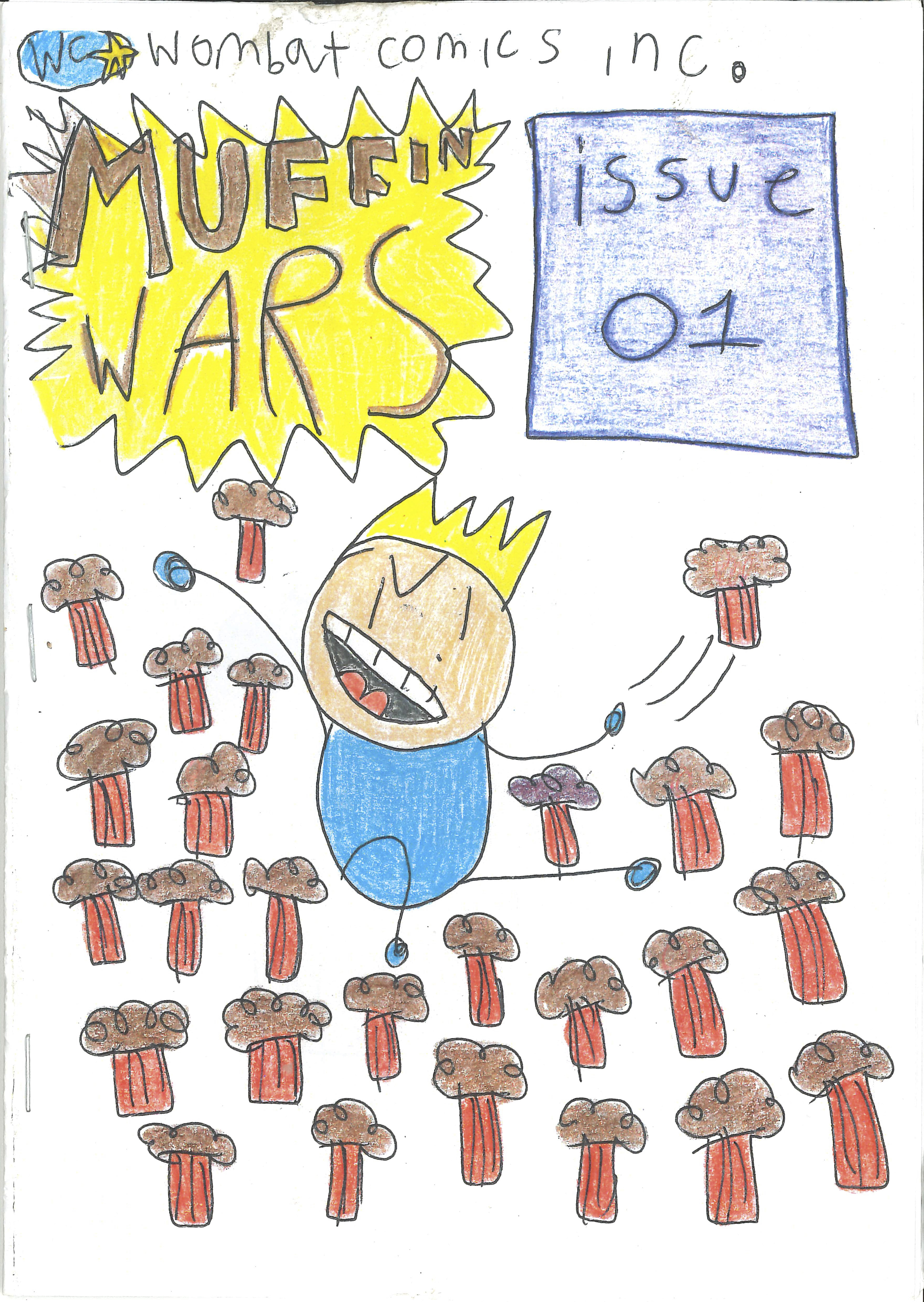
Dingwall, C. and Edwards, P. (2022) Muffin Wars Issue 01. Wombat Comics Incorporated: self-published.
Smoosh by likealuca and alienmandy (2022) is two A4 saddle-stitched sheets, including a cover. Across three narrative pages, a humanoid figure dives into and under a surface, collects something – alternately represented as a series of blobs, and a starburst shape – and grabs it, or an instance of it, closing it in their hand. The framing sometimes indicates the person is diving under the ocean, while sometimes there's a contextual suggestion the figure is in space, sized enormously by comparison to a planet. It's narratively confusing but visually immersive and rich – the kind of comic that makes us grateful for comics and zine fairs when considered against anything from online marketplaces, where it's unlikely we would find such a work, to formal publishing markets, where such a work is unlikely to be produced.
Aaron Billings's saddle-stitched A5 short comics collection Dog of the Universe (2022) belongs in a queer alterna-comics tradition and sketches scenes of weirdness, character beats, and short jokes across (mostly) a six-panel grid, quietly citing other contemporary comics-makers like Simon Hanselmann, barbed commentary on phenomena and jobs like life coaching, sex dreams about Instagram celebrities, a partly fictional ‘list of sentient cars in popular culture ranked on evil energy’, and observations from animal hospital waiting rooms, and a ‘bonus’ (nearly half the book) collection of older comics. Vamoose #3 is an anthology comic whose contributors are asked to respond to the theme ‘Robots and Rowboats’ (Lisle, R., ed. 2022). Lana Leuka: Blood Ties #2 by Lauren Marshall, Tanya Beeson and Kaylene Harris is the second chapter of a vivid, character-driven, hard-boiled, supernatural caper. Volumes 2 and 3 of Wild North Comics (Parish, T., ed 2022) present instalments of ongoing science fiction and fantasy comics by a variety of creators, interspersed with interviews and process images that seemingly aim to encourage an appreciation of comic-making labour as much as the final work. And Stoneseeker, The Floating Isles, Chapter 1 by Scott Pritchett (2022) is the first chapter of a projected ongoing fantasy story, manga-inspired figuration, and clean, efficient storytelling; it's a grounded introduction to a fantasy story set in a Nepal-like mountain range, printed in the format of a matte newsstand comic with a professional colour palette, also comes in a standard-sized brown paper lunch bag with a hand-drawn goat and title on the outside of the bag, the comic itself peeking out of it.
Three comics collected at Festival of the Photocopier were produced for Hourly Comics Day 2022. __JUNIP3R (2022) wakes up and thinks ‘Oh my god I have to work on Hourly Comics Day’ (and then goes to a physical office, where they forget their lunch); b weird! (2022) is ‘in javascript hell’, bullet-journaling, and eating corn with wasabi butter; and bbboar/bbboart (2022) organises their zines for FOTP – ‘What i sold last time how much stock i have now, what i need to print this year’.
It is quite true that these comics take on special meaning when the 2022 FOTP is the first to run since 2019, so the stated and the unstated seem to mingle closely – the dailiness of these comics feel sharper than ordinary. As important, though, is that the collection's thematic anomalies come to form a part of its meaning. The themes we have identified as being central concerns in the comics we have collected – COVID; mental health, disability and illness; online life; place; and climate and disaster – should not be surprising in a set of artworks that are primarily single-authored, self-made, funded by passion and distributed to a community of artist-consumers, and which tend towards the expressive and the personal. They are also, of course, linked, and one of the reasons to describe them qualitatively in a paper of this kind is that the relevant topics and resultant anxieties aren’t neatly separated into topic sentences or panels in the comics themselves – they blur and group, and they manifest in emphasis and tendency.
On the one hand, there's something both historically constructed and medially guided in the tendency of the largely-self-made comics to contend with problems of society and the self. On the other hand, don’t stories that focus on online life in 2022 have special meaning when placed against COVID; and/or, against mental health; and/or, against physical space, as idyll or in crisis? Whether it's part of the artistic production is not up to us, but it's part of the context in how the work is read, and distributed. In this light, the borrowed traces of other comics formats, trends, publishing markets and cultures – like the glossy, saddle-stitched comics that are clearly self-published, but imitate the direct-market and newsstand formats of superhero comics of the 1990s – are as important as the tiny, folded, hand-creased zines.
The types of comics being produced (made and distributed) in this huge yet particular and easy-to-miss market in Australia in 2022 – the end (or an end) of a period of lockdown and social upheaval – can be grouped by thematic reading into five loose categories, each showing clear sets of concerns and interests, but within these categories – COVID; mental health, disability and chronic illness; online life; place; and climate disaster – a huge range of treatments and approaches, which this paper documents.
To return to our corollary question, what might these descriptions suggest about the powers and limitations of comics and zines to speak to and about a cultural moment? In its mess, its diversity, it's a cultural expression of the kind of formal thinking that comics-makers and -readers know like the backs of their hands, with meaning drawn from repetition and tendency – perhaps like braiding, after Groensteen (2007) – and organised into clumps that stick together with various grip-strengths into emphatic arrangements of varying consistencies – perhaps navigable via something like Neil Cohn's attention units (2013). A corpus collected from comics and zine fairs is important to document for its ephemeral nature, and that is the primary purpose of this paper. In a lovely and difficult way, though, it's hard not to notice that the strange and human picture of this quadrant of Australian comics’ recent history is formally reflective of comics-making and -reading in more than one way – drawing stray pieces of individual pasts into collective presents, where it shares space with both anomalous markings and imagined futures. Of significant research potential here are abiding questions relating to: the contrast between the often scrappy DIY materiality of the zine-fair comic with its complex and enduring thematic content; the importance of ‘nowness’ held in the comic zine which has been made quickly in reaction to a daily moment or direct lived experience; the representation and construction of Australian places, particularly in regional cities and towns; and the openness of short-form hand-made comics as a way of representing chronic illness and disability when other art-forms prove inaccessible.
Footnotes
Declaration of conflicting interests
The authors declared no potential conflicts of interest with respect to the research, authorship, and/or publication of this article.
Funding
The authors disclosed receipt of the following financial support for the research, authorship and/or publication of this article: This work was funded by the Australian Research Council's Linkage Scheme (grant number LP190100393).

List of 2022 Comics
__JUNIP3R (2022) Hourly Comics Day 2022.
Alexander-Mironov, N. and Alexander-Mironov, A. eds. West Coast Comic Anthology #2, Stories from the Twilight and Periods of Obscurity (2022). Fremantle: Neighbourhood Press.
Alexis Smith, L. (2022) Untitled. Sydney: Self-published.
Alienmandy (2022) Knight. The stolen lands of the Wunrundjeri People of the Kulin Nation: self-published.
Andrews, T. (2022) The Complete Hero League - Collecting Book 1-3. Perth: Christ Church Grammar School.
Ang, R. (2022) What you seek (is seeking you). Melbourne: Self-published.
Aṡka. (2022) Seven Fragments: Comics about love, lose, desire, obsession & limbo. Perth: Self-published.
Aze (2022) Japanese Culture of Eating Insects. Sydney: Self-published.
b [all of my mistakes] (2022) E.T. The Extra Terrestrial - From Memory. Sydney: Self-published.
b weird! (2022) Hourly Comic Day 2022!
bbboar/bbboart (2022) Hourly Comics 2022.
Billings, A. (2022) Dog of the Universe. Bunurong Boon Wurrung and Wurundjeriwoi Wurring Land: n.p.
Bissy [Brown, I] (2022) Some little drawings from McIver baths. Sydney: Self-published.
Blazely, I. (2022) Drawings from My Bed: A visual meditation of chronic illness. Hobart: Self-published.
Brailey, L. (2022) Broadsheet. Perth: Self-published.
Broadhurst, J. (2022) Liferaft and Cosmic Miracle. Perth: Copernicus Comics.
Broadhurst, J. (2022) Ric McClune - Second fastest gun in the West #5. Perth: Reverie Publications.
Burden, T. (2022) M.M.M. Misery Miss Muffet. Sydney, NSW: Morbid Sheep Comics.
Busuttil, M. (ed) (2022) Super Massive. Portland, OR: Image Comics.
Camilleri, R. (2022) Skeleton World. Self-published.
Candiloro, C. (2022) Live, Laugh, Love, in the time of CORONA VIRUS.
Clark, A.E. (2022) ‘The unsteady feet of two steering at once…’
comicsbylily (2022) I Got Covid. City of Melbourne: Tree Paper Gallery.
Cutler, E. (2022) Green Rat. Sydney: Cloudship Press.
Dakin, N. (2022) Bird Girl 2. Perth: Self-published.
Dakin, N. (2022) Eaten Paths - steel plate etched comic. Perth: Self-published.
Dakin, N. (2022) As You Drive. Perth: Self-published.
Dakin, N. and Marriott, E. eds. (2022) Myth: Curtin Illustration Club Anthology Volume 7. Perth: Gestalt Publishing.
Dingwall, C. and Edwards, P. (2022) Muffin Wars Issue 01. Wombat Comics Incorporated: self-published.
Dunn, K. (2022) Contact but It's at the Marrickville Metro. Sydney: Self-published.
Dunn K. (2022) Boats of Hobart. Sydney: Self-published.
Dunn K. (2022) Shitty Kate Bush Fan Art. Sydney: Self-published.
Escalator Dreams [Attard, J] (2022) I Wish I Was the Brightest Fish in the Sea. Sydney: Self-published.
Fodor, J. @swamphaar (2022) A Brief Illustrated Natural History of Dreams. Australia: self-published.
French, I. (2022) Dragon Slayer. Perth: Self-published.
Furnell, F. (2022) Bakery in Space - a comic about FOMO & bread. Sydney: Self-published.
George, I. (2022) Bronwyn, The Celtic Warrior - The Prophecy Part One. Australia: Whatzacdrew Comics.
George, I. (2022) Bronwyn The Wrath of the Cursed - The Blood Crown. Australia: Whatzacdrew Comics.
Gougoulis, S. (2022) Scar. Sydney: Self-published.
Guerrieri, M. (2022) Big Aliens on a Rainy Wet Sunday. Australia: self-published.
H-Q, S. (2022) 20 People. Melbourne: self-published.
H-Q, S. (2022) Global Settings. Self-published.
H-Q, S. (2022) T 1 - 3 (unnumbered). Self-published.
Hanna, J. (2022) You Can't Kill Us - 04. Burwood, NSW: Midnight Runners, Lonley Driver Publishing.
Hanna, J. (2022) Cursed. Burwood, NSW: Midnight Runners, Lonley Driver Publishing.
Hanna, J. (2022) Machine // Heart #4. Burwood, NSW: Midnight Runners, Lonley Driver Publishing.
Hawkins, M. (2022) Murmurs - 24 page microfiction trilogy. Melbourne: Glom Press.
Heitmann, O. (2022) A Space Oddity. South Australia: Amplified Press.
Hien Lau, J. (2022) Mufty Days: Return of the Scatter Chimps. Sydney: Self-published.
Higginbotham, S. (2022) Dundgeon Buddies: A printed scroll comic. Perth: Self-published.
Higginbotham, S. (2022) Dundgeon Buddies 2: A printed scroll comic. Perth: Self-published.
Hodge, T. @lavalodge (2022) Mountain Priest. Hobart: self-published.
Howe, G. (2022) The Life and Other Stories. Australia: self-published.
Hunag, A. (2022) DIY A story about haircuts. Sydney: Blueprint comics.
Icaruscubed [Doan, N.] (2022) L'enfer (Hell). Sydney: Self-published.
Icaruscubed [Doan, N.] (2022) Routines. Sydney: Self-published.
Im, J. (2022) In Creation. Sydney: Self-published.
Johnson, T. (2022) Pep29: weak daze. Sydney: Self-published.
Joyce, L. (2022) Blade Zine 1. Wollongong, NSW: Self-published.
Kearins, R. (2022) Like Magic. Australia: self-published.
Keiyan (2022) Welcome To My Brain. Australia: self-published.
Kennedy, J. (2022) Mush. Australia: self-published.
Kennedy, J. (2022) Turtle House. Australia: self-published.
Kimatra, K. (2022) An Ode to Lost Places. Sydney: Self-published.
Kudelka, K. (2022) Sarimest: Book One. Hobart: self-published.
Kudelka, K. (2022) Earth 2.0. Hobart: self-published.
Lane, P. and Paulos, J. (2022) Skye’s Cavern Library #1. Australia: REVERIE Publications.
likealuca and alienmandy (2002) Smoosh. Stolen lands of the Wurundjeri People of the Kulin Nation: self-published.
Lindsay, R. (2022) Speed Republic #1. Miami, FL: Mad Cave Studios.
Lisle, R. (2022) The Devil’s Toilet #3. Australia: Reverie Publications and Psycho Janitor.
Lisle, R. (2022) Sluggish #1. Australia: Psycho Janitor.
Lisle, R., ed. (2022) Vamoose #3. Australia: Reverie and Psycho Janitor.
Lloyd, E., et al (2022) ISO:ID, A Pandemic Anthology. Perth: Healthway Act Belong Commit, Propel Youth Arts WA
McCabe, F. (2022) Eleven Comics Exercises U Won't Believe U Must Try. Sydney: Self-published.
McCabe, F. (2022) Leathery Little Saints. Sydney: Self-published.
McEwen, S. (2022) Loose: Issue 3. Sydney: Self-published.
McEwen, S. (2022) Arctic monkeys. Sydney: Self-published.
McEwen, S. (2022) Talking Heads - Stop Making Sense. Sydney: Self-published.
McKenna, B. (2022) Ole Champ Cards. Perth: Self-published.
Majumdar, S. (2022) It Broke - Dedicated to everyone who hates touch-sensitive dishwashers. Perth: Self-published.
Majumdar, S. (2022) Ideal Delivery Service Comio. Perth: Self-published.
Majumdar, S. (2022) Life Hex - Volume 1. Perth: Self-published.
Marshall, L. (2022) Lana Lueka - Blood Ties. Perth: Moxie Comics.
Marshall, L., Beeson, T. and Harris, K. (2022) Lana Leuka: Blood Ties #002. Moxie Comics.
Marruffo, E., et al. (2022) Tale Town: Tales from the Hermit Kingdom. Perth: self-published.
Miledge, S. (2022) Mamo. Los Angeles, CA: Boom Box.
Milne, S. (2022) Personal Growth. Australia: Amplified Press.
Morris-Merkel, T. (2022) Spots and bruises on my fruit doesn't seem to bother me anymore. Australia: self-published.
O'Shea, M. (2022) Tigers of the Korean Peninsula. Sydney: Self-published.
O'Shea, M. (2022) National Adoption Awareness Month. Sydney: Self-published.
O'Shea, M. (2022) Circle. Sydney: Self-published.
O'Shea, M. (2022) Hotel Quarantine Diary. Sydney: Self-published.
O'Shea, M. (2022) Tigers of the Korean Peninsula. Sydney: Self-published.
O'Shea, M. (2022) Pyeongtaek. Sydney: Self-published.
O’Sullivan, F. (2022) Polaroids. South Australia: Amplified Press.
Oudomvilay, M. (2022) The Adventures of Shiny Locket, Issue 1. Sydney: Self-published.
Oudomvilay, M. (2022) The adventures of Shiny Locket, Issue 4. Sydney: Self-published.
Parish, T. ed. (2022) Wild North Comics Volume 2. Darwin: Undergrowth Productions.
Parish, T. ed. (2022) Wild North Comics Volume 3. Darwin: Undergrowth Arts.
PCAF Planning Committee. (2022) PCAF, Perth Comic Arts Festival - 2022 Program. Perth: Perth Comic Arts Festival.
Peek, K. (2022) Grimoire of Creation: Ch 1 A Tale of Elements. Australia: self-published.
Pritchett, S. (2022) Stoneseeker Chapter 1: The Floating Isles. Australia: self-published.
Proudly, G. (2022) Talgard - Tome 2. Perth: Gestalt Publishing.
Quinlan, B. (2022) Any Port in Storm: a Post Teleportation Graphic Novel. Australia: Inkling Comics.
Rex, G. [Chadderton, G] (2022) Doodads - A collection of short fictional comics. Adelaide: Amplified Press.
Rhodes, P. and Kim, H. (2022) Mystery Friend. Stolen lands of the Wurundjuri People of the Kulin Nation: Glom Press.
Rice, M. (2022) Flood: And Other Stories. Brisbane: self-published.
Rigozzi, L. (2022) Cryptogeography. Hobart: self-published.
Robinson, J. (2022) Steamy Stations. Australia: self-published.
Rogers, M. (2022) Resets: A zine of poems, comics, musings and amusings. Australia: self-published.
Row, L. (2022) Engineered Durability. Perth: Self-published.
Ryan-Krawczyk, L. (2022) How to Be Your Own Little Rat. Sydney: Self-published.
Saara (2022) Sketch Book Covers. Sydney: Self-published.
Sabolta, P. (2022) A Brief Review of Ramen Found in Sydney, Issue One. Sydney: Self-published.
Sabolta, P. (2022) A Brief Review of Ramen Found in Sydney, Issue Two. Sydney: Self-published.
Sabolta, P. (2022) A Brief Review of Ramen Found in Sydney, Issue Three (Vego Special). Sydney: Self-published.
Sabolta, P. (2022) Hilarious Fish. Sydney: Self-published.
Sadder, A. (2022) Jester: Short comics about a little guy. Australia: self-published.
Santospirito, J. (2022) We Climbed A Mountain. Moonah, Hobart: self-published.
Santospirito, J. (2022) I Wanna Be a Travella in Italia. Moonah, Hobart: self-published.
Saunders, J. (2022) Zero Point: Origins - Part One. Northern Territory: Undergrowth Arts.
Sha (2022) Can You Feel That? A zine about chronic pain. Alice Springs: Self-published.
Sheedy, R. (2022) Harry’s Pizza Volume One. Australia: Amplified Press.
Sparkle, Lizzie et al. (2022) A Pony with a Secret: A Zine Come True.
Spook Doom (2022) Death Candy Issue 1. Australia: Penny Black Stamp.
Syddall, S., George, I., and Lisle, R., eds. (2022) Presents: Noir: An Australian black & white anthology #003, Summer ‘22, Cover D. Australia: ComX Studios.
Sublime, R. (2022) Lovely Nightmares of the Nat Geo grey wolf. Australia: self-published.
Taylor, K. (2022) The Weather Condition. Sydney: Self-published.
The Refugee Art Project (2022) Anticitizen. Sydney: Documenta 15 and Pirahna Records.
Tinh Le, M. (2022) Mer Maid. Sydney: Self-published.
Toda, Y. (2022) Anaismiysk: A comic about returning to Japan. Sydney: Self-published.
Touber, E. (2022) Mihkkil The Snowblind and the Creature Made of Ether, Fire and Seas. Australia: self-published.
Tribe, A. (2022) Bolt Comics Presents #6. Sydney, NSW: Bolt Comics.
Tsunami Hee Ja (2022) Twying But Cwying. Adelaide: self-published.
Wilson, S., Houghton-Ward, K., Randall, J. and Bylsma, W. (2022) Dark Heart: Chapter #1 Dying of the Light. Gestalt/Indigiverse: Applecross WA.
Vass Viney, N. (2022) Walpole Kids Book 2 - "New Friends!" Walpole, Perth: Self-published.
Various authors (2022) Fantastic Cavader: The world's first printed improv scroll comic. Perth: Self-published.
Various Authors. (2022) Wild North Comics 2. Northern Territory: Undergrowth Arts.
Various Authors. (2022) Wild North Comics 3. Northern Territory: Undergrowth Arts.
Various authors (2022) Who I Am, Who We Aren’t: Youth Compendium Issue #2. Australia: self-published.
Viktori Diak, M. (2022) Mushroom maidens. Blue Mountains: Self-published.
Whyte, C. and Marruffo M. (2022) Pup Pup / Luna Express. Perth: Self-published.
Wrigg, S. (2022) Pluto Pups. Sydney: Small train comics.
Wu, J. (2022) This is Pen Pen. Sydney: Self-published.
Yang, P. (2022) Redwater anomaly. Perth: Self-published.