



Abstract
This study adopts a multimodal approach to critical discourse analysis to unpack the discourses embedded in the performance of hyper-feminine bimbo identities on TikTok. Guided by a social semiotic approach to language, this study analyses a corpus of 16 short-form videos published by self-proclaimed ‘bimbos’ on TikTok, focusing on the lexical and iconographical choices of these texts and how they function contextually to signal broader discourses. This analysis reveals that TikTok influencers frequently reinforce hegemonic norms of gender by incorporating bodily signifiers of patriarchal Eurocentric ideals of femininity and linking signifiers of overconsumption and hyper-femininity in their performance of a bimbo identity. Simultaneously, they contest these hegemonic norms by juxtaposing hyper-feminine images with critiques of patriarchal, Eurocentric, and capitalist structures of inequality. Ultimately, the subversive potential of these representations is ambivalent; there is a marked tension between their stated aims of inclusion and empowerment and the intersection of hyper-femininity with privilege.
Introduction
‘Bimbo’ is derogatory slang for a conventionally attractive, curvaceous, sexually appealing woman who is perceived as unintelligent. The term is often linked to the ‘dumb blonde’ trope of highly gullible women and is typically associated with blonde white women who wear heavy makeup and revealing clothing. Pervasive in popular media, the bimbo trope traces back to Anita Loos’ comic novel Gentlemen Prefer Blondes (1925). Many feminists critique the trope for objectifying women and perpetuating the sexist idea that femininity and intelligence are mutually exclusive in women. Some also argue that the trope is widespread due to a lack of nuanced roles for women in media. Indeed, many female celebrities have admitted to embracing the bimbo persona to succeed in the entertainment industry (Guerrilla Girls, 2003).
In 2017, Dutch porn star Alicia Amira founded the ‘Be A Bimbo’ movement to destigmatise being a bimbo and encourage women to embrace their femininity and sexuality (Amira, 2019). Simultaneously, the phrase ‘bimbofication’ garnered attention when an illustration of a tanned, blonde woman in a mini-dress and heels picking up a book and transforming into a conservatively dressed, pale brunette went viral. The artist defended the image, insisting they intended it as fetish pornography, known as ‘transformation porn’, not misogynistic commentary. However, many people critiqued the insinuation that hyper-femininity and intelligence are incompatible (Shvedsky, 2018).
Recently, the bimbo trope resurged on TikTok by a community that calls itself ‘BimboTok’. Created by the Chinese company ByteDance, TikTok is a short video-sharing platform popular among younger users. BimboTok influencers are largely Generation Z individuals based in the USA who post videos in which they caricature hyper-femininity to critique the male gaze, misogyny, and capitalism (Dickson, 2020). This study examines how these influencers perform the trope to engage with feminism, focusing on how their self-representations work discursively to challenge and reproduce hegemonic gender norms.
Social media and resistance
While early Internet scholars extolled the Internet as a forum where users could transcend gender, contemporary studies show users bring ‘their materiality with them’ into online spaces and tend to perform highly stereotypical gendered identities online (Andreevskikh and Muravyeva, 2021: 206; Webb and Temple, 2016). Alvares (2018) found that the ability to surveil and police norms of femininity on social media forcefully reproduces gendered power relations. Users frequently ridicule online self-presentations that deviate too noticeably from the coveted ideal, thereby functioning as a kind of ‘institutionally unbounded discipline’ (Burns, 2015: 132), which induces users to enact greater self-surveillance to ensure their self-representations align with the socially desired norm (Foucault, 1977).
Nonetheless, scholars recognise the potential for online environments to enable performances of gender that challenge hegemonic understandings (Andreevskikh and Muravyeva, 2021; Cook and Hasmath, 2014). Many scholars studying online communities use Foucault's (1970: 202) concept of ‘counter-discourse’, which posits that when marginalised voices represent themselves, they create a counter-discourse and start resisting or negotiating the dominant discourses discriminating against them. For example, many women have used social media to document their experiences of sexism and criticise oppressive gender norms (Webb and Temple, 2016). Connell (2012: 209) explores an online fashion community that uses online aesthetics as an instrument for social justice and protest by including bodies that mainstream fashion – generally excluding, specifically, queer, femme-identified and plus-size bodies – terming this counter-discourse ‘fashionable resistance’. More recently, Uh (2020) argues that the Internet subcultures of ‘E-girls’ and ‘E-boys’ use distinct androgynous styles to challenge gender norms. However, there remains a lack of research on online communities with a hyper-feminine style.
Several scholars also discuss how digital activism is further complicated by social media ‘influencer culture’, which Dean (2023: 6) defines as ‘a pervasive set of cultural norms and expectations that emphasise self-promotion and self-branding through the promise of (potential) accrual of cultural and/or economic capital’. Dean argues that social media influencers and influencer activists often draw on leftist political discourses as part of their efforts to self-brand and increase their following. Subsequently, many left-wing commentators have criticised influencer activism as individualistic and superficial. However, distinguishing between ‘serious’, ‘real’ activism and influencer activism is increasingly impractical in the context of neoliberal digital capitalism. Indeed, the suggestion that feminist activism is separate from neoliberal capitalist logics fails to account for the ways in which activism has always been structured by neoliberal market forces. Likewise, the common tendency to treat influencing as both a feminised and superficial undertaking reflects the broader trivialisation of feminine pursuits in general (Scharff 2024).
Hyper-femininity
Murnen and Bryne (1991: 480) define ‘hyper-femininity’ as an ‘exaggerated adherence to a stereotypic feminine gender role’, particularly in heterosexual relationships. Butler (1990: 43) argues that gender and sex are social constructs imposed by heteronormativity. Individuals gradually learn to perform gender through the ‘repeated stylisation of the body’, which eventually appears natural and fixed. Paechter (2006: 255) describes ‘hyper-femininity’ as the enactment of an ideal or exaggerated performance of femininity that most women do not usually perform – a kind of ‘dramaturgical, glamourised femininity’. Moreover, Holland and Harpin (2015: 307) argue that the hyper-feminine ‘“girly-girl” is a powerful cultural figure’ and reflects the dominant treatment of women as sexualised and objectified, while simultaneously embodying all the least desirable ‘excesses of hegemonic “femininity”’.
Scholars have also explored the subversive potential of performances of hyper-femininity. For example, Whitney (2012: 141, 155) argues that by representing herself as a hyper-feminine, hyper-sexualised ‘black Barbie’, rapper Nicki Minaj denaturalises ‘Barbie doll–like white femininity’. Additionally, Butler (1990: 176) discusses the gender parody of drag queens, who adopt exaggerated signifiers of hyper-femininity. Although these ‘parodic styles’ depict gender norms from ‘hegemonic, misogynist culture’, they are nonetheless ‘denaturalised and mobilised through their parodic recontextualisation’. Furthermore, when men perform caricatures of femininity, they embody the very notion of gender as performance.
Scholars also problematise the revived acceptance of tasks and roles that contemporary and former generations of feminists have judged oppressive (Cook and Hasmath, 2014). Post-feminism embraces and extols all that feminism has accomplished while suggesting that the movement has already attained many or all of its aims, making it unnecessary to develop the movement further (McRobbie, 2009). Additionally, Gill (2007: 147) argues that post-feminism is a ‘sensibility’ typified by several interconnected themes, including the treatment of femininity as a bodily property, the prominence of self-discipline and self-surveillance and an emphasis on neoliberal values of ‘individualism, choice and empowerment’, among others. Importantly, she argues that these themes are interwoven with and shaped by ongoing inequalities and exclusions linked to not only gender but also ‘race’, ethnicity, class, sexuality, disability and age. Of particular relevance is Gill's (2007: 151) observation of a shift in imagery since the 1980s whereby women no longer assume the role of passive sex objects displayed for a masculinised gaze but actively choose to portray themselves as autonomous, ‘desiring sexual subjects’. Therefore, power no longer functions through an external male gaze but through a self-governing, internal gaze. McRobbie (2009: 64) coins the term ‘post-feminist masquerade’ to describe such performances of femininity that reproduce historical forms of patriarchal subjugation with an ironic distance. Therefore, the post-feminist masquerade enables women to envision themselves as liberated from the constraints of the masculine symbolic world while simultaneously re-securing patriarchal hegemony. Moreover, she argues that the postfeminist discourse of sexiness as empowerment essentially takes features of feminism, such as the emphasis on agency, and presents a depoliticised version of feminism which depicts pursuing idealised femininity as an individual choice. Similarly, Rottenberg (2018) coins the term ‘neoliberal feminism’ to describe a new form of feminism that acknowledges gender inequality but focuses on individual women's achievement within a capitalist framework rather than addressing the intersecting structures of oppression that constrain those choices.
Research also demonstrates the intersection of hyper-femininity and privilege. Griffin et al. (2006) problematise the over-consumption of hyper-femininity as girls and women from lower socioeconomic backgrounds often cannot afford the trappings of hyper-femininity. Likewise, McRobbie and Garber (1977) argue that using consumption practices to signal group identification reflects the influence of capitalist consumer culture on bodies. Alvares (2018) also asserts that the notion that performances of hyper-femininity are empowering assumes that women have autonomy. However, this autonomy is absent in contexts without social, political or economic gender equality.
BimboTok
Recently, studies of BimboTok have emerged, exploring the feminist potentials of these representations. Proposing a ‘relational feminist ethics of dressing’, Knowles and Lopes (2023: 1) analyse ‘the relation’ TikTok bimbos have with their clothing as a means to understand its broader feminist implications. They find that TikTok bimbos appear to care about their outfits as though they were predominantly sexual objects, fetishise agency and choice and that the promoted inclusivity does not subvert patriarchal conventions but instead finds new means to fulfil them. Hester (2022: 178–179) argues that bimbofication on TikTok represents a new cross-platform ‘cyberqueer movement’. Expressions of queerness are only accepted within heteronormative social structures when devoid of sexual desire. Therefore, by explicitly articulating their queer sexual desires, TikTok bimbos generate ‘queer visibility’ that resists these norms.
Alternatively, Pierce (2022: 208) argues that labelling these online representations as either oppressive or empowering risks oversimplifying the complexities of the queer dis-identifications taking place. Pierce explores how BimboTok's representations align with the qualities of a (post-)post-feminist media culture (Gill, 2007). She contends that TikTok influencers engage in a ‘dis-identifactory performance’ of gender norms that denaturalises hegemonic norms of gender and femininity, as well as an ironic cultural critique that foregrounds ‘the absurdity of life within contemporary social, political and environmental crisis’. The concept of ‘dis-identification’ is the reshaping of encoded meanings, whereby marginalised subjects embody and, thus, re-signify dominant cultural norms to reveal how they exclude particular communities (Muñoz, 1999). BimboTok is particularly powerful in its collectiveness as users circulate aesthetic, affective and political dis-identification as a networked public.
The reviewed research demonstrates that self-representations on social media have explored the potential of online communities to resist dominant discourses of gender. Scholars also debate whether performances of hyper-femininity are subversive or simply reproduce patriarchal oppression under the guise of empowerment. Thus, this study adopts a multimodal critical discourse analysis (CDA) to unpack the discourses of gender embedded in the performance of hyper-feminine bimbo identities on TikTok.
Theoretical and methodological framework
This study uses Machin and Mayr's (2012: 15, 17) multimodal approach to CDA to explore how TikTok influencers politicise the bimbo trope through their online self-representations. This approach holds a social semiotic perspective of language, contending that all communication is achieved ‘through a set of semiotic resources, options and choices’. Importantly, CDA conceptualises language not ‘as a system’ but as a ‘set of resources’ individuals actively employ. Individuals are conscious that written and visual components have certain connotations and possible communicative meanings attached to them. Therefore, all communication necessitates an element of choice. Moreover, Machin and Mayr (2012: 26) treat individuals as immersed ‘in networks of social relations’ where everyone is communicating ‘through semiotic choices’. These networks involve people with different values and ideas interacting and are, therefore, simultaneously ‘cooperative, contested, and fragmentary’. Importantly, they argue that all uses of semiotic resources should be regarded as an indication that individuals are, to some degree, both aware that their use of language can achieve particular outcomes and use these choices purposefully in every interaction.
In CDA, ‘discourse’ refers to the broader ideas conveyed by a text and can be conceptualised as ways of viewing the world (Fairclough, 2000; Van Dijk, 1993). Fairclough (2000) argues that discourses do not merely reflect social reality but represent values and ideas that contribute to the production and reproduction of social processes and structures. Semiotic choices work as discourse to emphasise particular perspectives while downplaying or masking others. Thus, CDA is interested in analysing the language used in a text to uncover the wider discourses about social life that it signifies. Kress (1985) argues that all language choices are ideologically consequential because they affect the portrayal of events, people, and objects. Thus, language choices do not merely ‘represent’ the social world, but actively ‘constitute’ it by constructing and maintaining social norms and practices (Machin and Mayr, 2012: 18). Moreover, ‘language constitutes us as subjects’ because we conceive of ourselves through discourse (Machin and Mayr, 2012: 26). Thus, CDA is interested in analysing the particular language used in a text in order to uncover the wider discourses about social life that they signify.
Power is a central issue in CDA concerning the ‘authority, status and influence’ derived ‘from privileged access to social resources’, such as wealth, education and knowledge, which allows those who have this access to dominate subordinate groups (Machin and Mayr, 2012: 24). CDA seeks to expose the relations of power that are reflected, reproduced or legitimated through texts (Van Dijk, 1993). CDA's understanding of power draws on Gramsci's (1999) concept of ‘hegemony’, whereby one group becomes dominant over other subaltern groups by winning their consent and convincing them to accept the former's values and institutions. Discourse reinforces systems of power by representing hegemonic beliefs, values and opinions as ‘common sense’ and ‘natural’ (Machin and Mayr, 2012).
Data collection
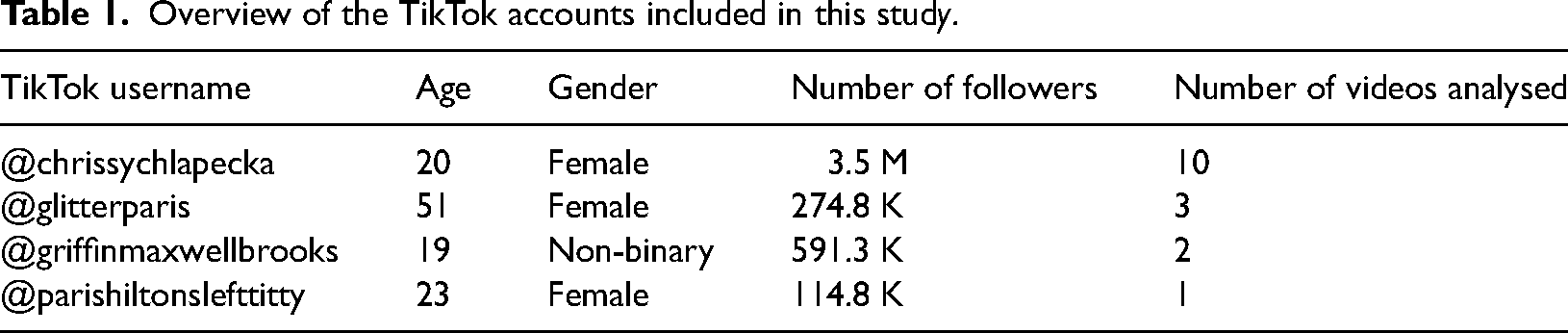
The data for this study is public videos posted by self-proclaimed ‘bimbos’ on TikTok. The term ‘#BimboTok’ was entered into TikTok's search engine, and, to reduce algorithmic bias, the ‘Sort by most liked’ filter was applied. These results provided a selection of the most popular and, by inference, more influential videos captioned with ‘#BimboTok’. Some videos were excluded from the final dataset if they did not relate to the bimbo community. The final dataset, shown in Table 1, included 16 videos published between November 2020 and February 2021 by four popular influencers based in the USA. All videos and captions were transcribed, and notes were made about the visual signifiers in each video.
Overview of the TikTok accounts included in this study.
Data analysis
This study uses Machin and Mayr's (2012) multimodal approach to CDA to analyse the semiotic choices in the collected videos as a way to explore how the performance of hyper-feminine bimbo identities on TikTok both contest and reinforce hegemonic understandings of gender. Specifically, this analysis focuses on the lexical, or word, choices in the videos. Machin and Mayr (2012: 30) explain that lexical choices in a text can recall particular discourses or establish certain ‘lexical fields’. These discourses can signify meanings through the connotations of words. They can also highlight or downplay particular kinds of discourses and connotations through an excessive emphasis on particular words – known as ‘over-lexicalisation’ – or omitting terms that audiences would typically expect, known as ‘suppression or lexical absence’ (Machin and Mayr, 2012: 37–38).
Additionally, this analysis unpacks the visual semiotic choices in the videos, focusing on the concrete images in the videos and the general or abstract ideas these images connote, particularly as they relate to discourses of gender. It will explore how the settings and ‘attributes’, or objects, are represented and the ideas or values they communicate (Machin and Mayr, 2012: 51). Likewise, it will focus on pose and gaze in the videos. According to Barthes (1973), poses are a vital form of connotation in images which can communicate wider social meanings. Gaze is a significant pose which can direct the viewer as to how they should interpret the person being represented (Machin and Mayr, 2012). Kress and Van Leeuwen (1996: 124) use the term ‘offer images’ to describe instances where participants avoid direct eye contact with the viewer, encouraging viewers to treat them as objects to observe. In contrast, ‘demand images’ involve participants looking directly at the viewer, using their gaze or expression to prompt particular emotional responses.
The concepts of ‘intertextuality’ and ‘interdiscursivity’ are also used. ‘Intertextuality’ refers to texts referencing other texts, either explicitly or implicitly. Intertextuality can account for how texts are produced in relation to particular social practices and power relations. The term ‘interdiscursivity’ refers to a kind of intertextuality in which a text contains a combination of discourse conventions, such as genres or styles, reflecting different formal or social meanings (Fairclough, 1992).
Overall, this study will describe and explain the semiotic choices in the selected videos; establish broader discourses signalled by those semiotic choices, particularly on a connotative level; and analyse the power relations manifested in these discourses. In doing so, this analysis seeks to understand how these influencers represent themselves on social media, the broader discourses of gender they engage with, and the power relations shaping this communication practice.
Findings
This analysis of the collected videos begins by unpacking how these performances of hyper-feminine bimbo identities reinforce dominant discourses of gender and then discusses how they challenge them.
Stereotypical femininity, conspicuous consumption and self-sexualisation
Influencers frequently included stylistic and behavioural signifiers of hyper-femininity. In one video, a robotic voice-over intended to articulate Chrissy's stream of consciousness states: ‘Sparkles, glitter … I want to eat glitter … glitter … pink, pink … sparkles … pink, sparkles’. This over-lexicalisation of signifiers of stereotypical femininity further portrays Chrissy as not just feminine but hyper-feminine, thus defined by excess. Likewise, Chrissy wears heavily contoured makeup, overdrawn winged eyeliner, bright pink eyeshadow and lip colours, with added decorative details, like small hearts or diamantes around her eyes (see Figure 1). This exaggerated makeup style serves as an interdiscursive reference to drag queen makeup, adopting conventional signifiers of femininity to an extreme. In a collaborative video, Griffin and Chrissy meet in Chrissy's apartment and partake in stereotypically ‘girly’ activities, such as applying makeup, dancing and posing for photos together, reproducing the dominant discourse of femininity as tied to the home. The song I Am a Girl Like You from the children's animated film Barbie as the Princess and the Pauper (2004) soundtrack plays. This intertextual reference to the Barbie franchise and the interdiscursive reference to the fairy tale genre connote hyper-femininity and childlike innocence. Here, they pose openly, gazing directly at the camera (see Figure 2), connoting self-confidence and reproducing the discourse of femininity as vain.
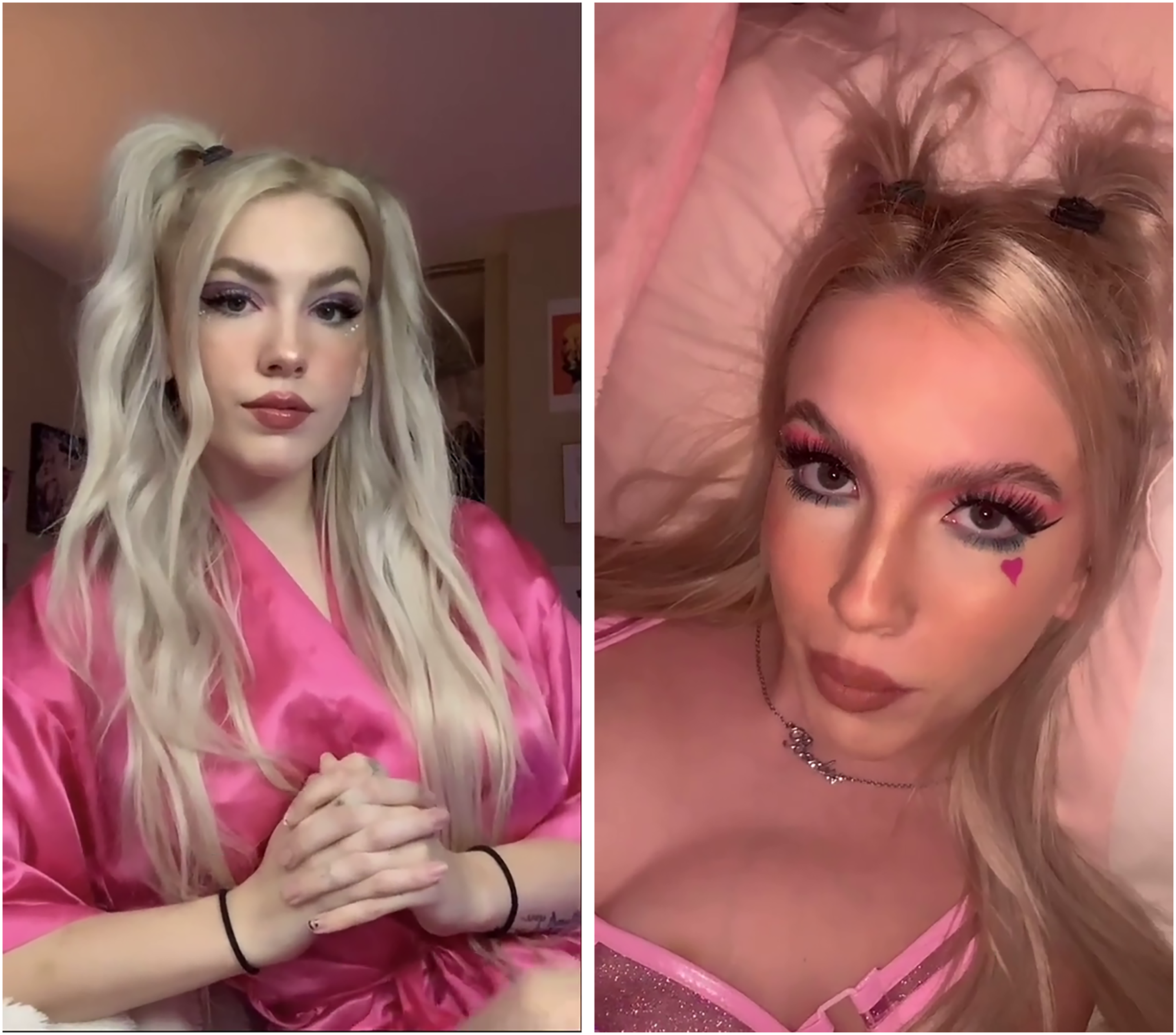
Screenshots of Chrissy's videos showing examples of her makeup. Image description: Two screenshots taken from Chrissy's videos. In the first, she wears a silk dress robe and heavy makeup while staring directly into the camera. In the second, a close-up shot of her face framed by three pillows is filmed from above. She wears heavy makeup with dramatic eyeshadow, a tank top and a Barbie necklace.
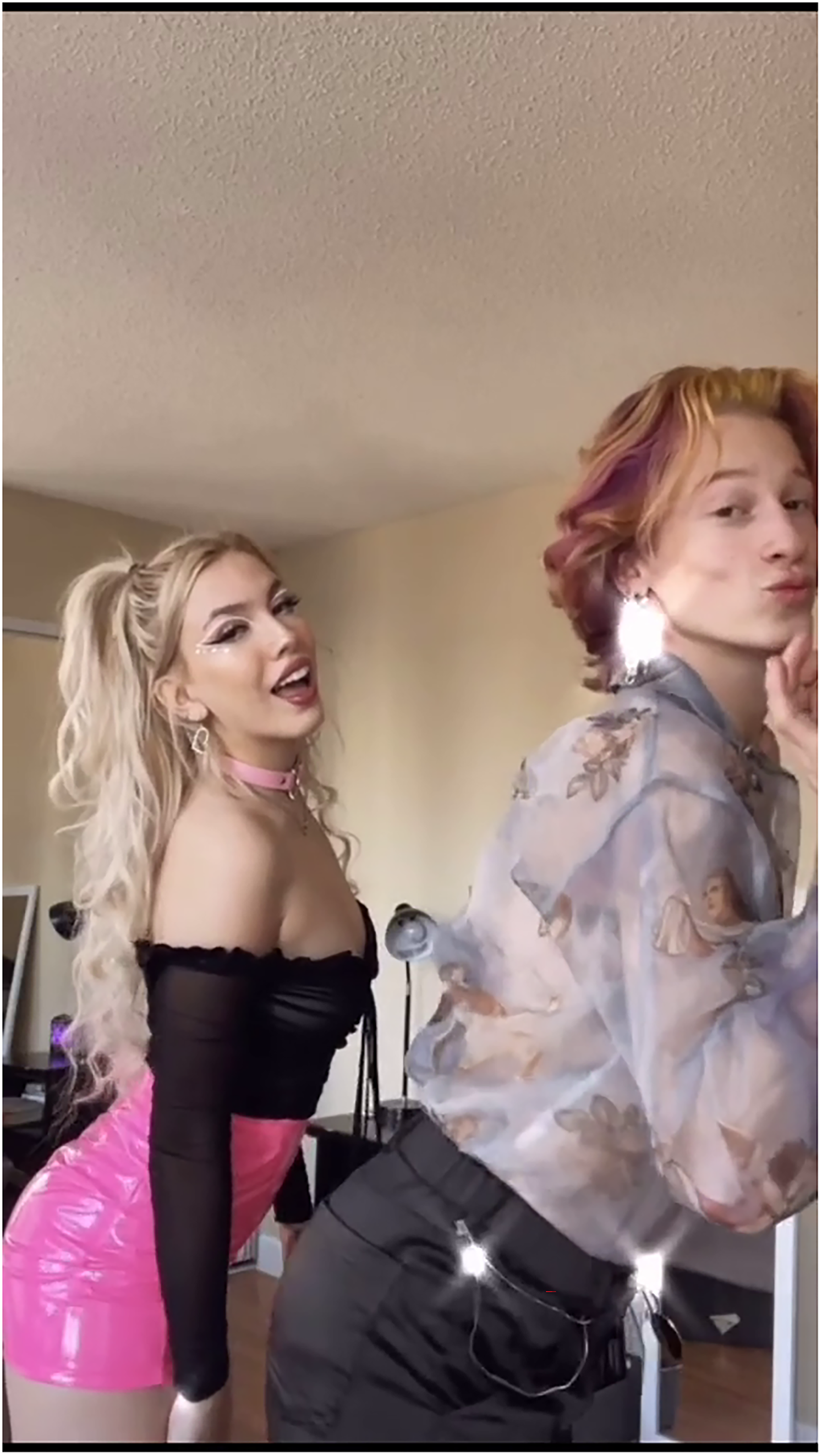
Screenshot of Chrissy's video with Griffin showing examples of their pose and gaze. Image description: A screenshot taken from Chrissy's video, filmed indoors where she and Griffin stand side profile and stare directly into the camera. Chrissy is wearing a PVC choker necklace, a sheer long-sleeve top and a PVC mini-skirt. Griffin is wearing a sheer long-sleeve shirt and suiting trousers while pouting at the camera and raising their hand to their face.
Conspicuous consumption is also central to these hyper-feminine self-representations. For instance, Chrissy often films in her bedroom, which is constructed as a hyper-feminine setting through attributes such as maximalist decor in a pink-and-white colour scheme. In another video, Ginger pans the camera upwards from her shoes to her face, capturing her outfit in the shot, including her Louis Vuitton handbag. She captions this video with ‘#chaneladdict’ and ‘#guccigang’, thus linking her identity as a bimbo to the consumption of designer brands. The term ‘addict’, in particular, connotes a lack of control, thus portraying commodities as having a powerful grip on her. In this way, she reproduces the dominant discourse of women as being materialistic and having an insatiable appetite for commodities, particularly fashion and beauty products (Falk and Campbell, 1997).
Many influencers included interdiscursive references to the early-2000s bimbo trope, like Ginger's pink Juicy Couture velour tracksuit and rhinestone-covered leggings or Chrissy and Griffin's leopard print clothing. Likewise, both Ginger and Hannah adopt the look of the stereotypical early-2000s bimbo with heavy makeup, fake tan, blonde hair and using plastic surgery to achieve a more hyper-feminine appearance (see Figure 3). For example, Ginger exclaims, ‘Now I get to go and get my botox’, thus framing plastic surgery as pleasurable while simultaneously reproducing the discourse of feminine bodies as entities to be constantly disciplined. Like early-2000s bimbos, influencers act out the ‘dumb blonde’ trope in their self-representations, reproducing the discourse linking hyper-femininity with a lack of academic intelligence. Chrissy asks her viewers: ‘Are you good at math? Are you good at reading? Well, if you are… How?’ She also speaks slowly in throaty, high-pitched tones with an upward inflexion. Colloquially known as ‘Valley Girl English’, this accent is typically associated with those young women often considered superficial or unintelligent (Nycum, 2018).
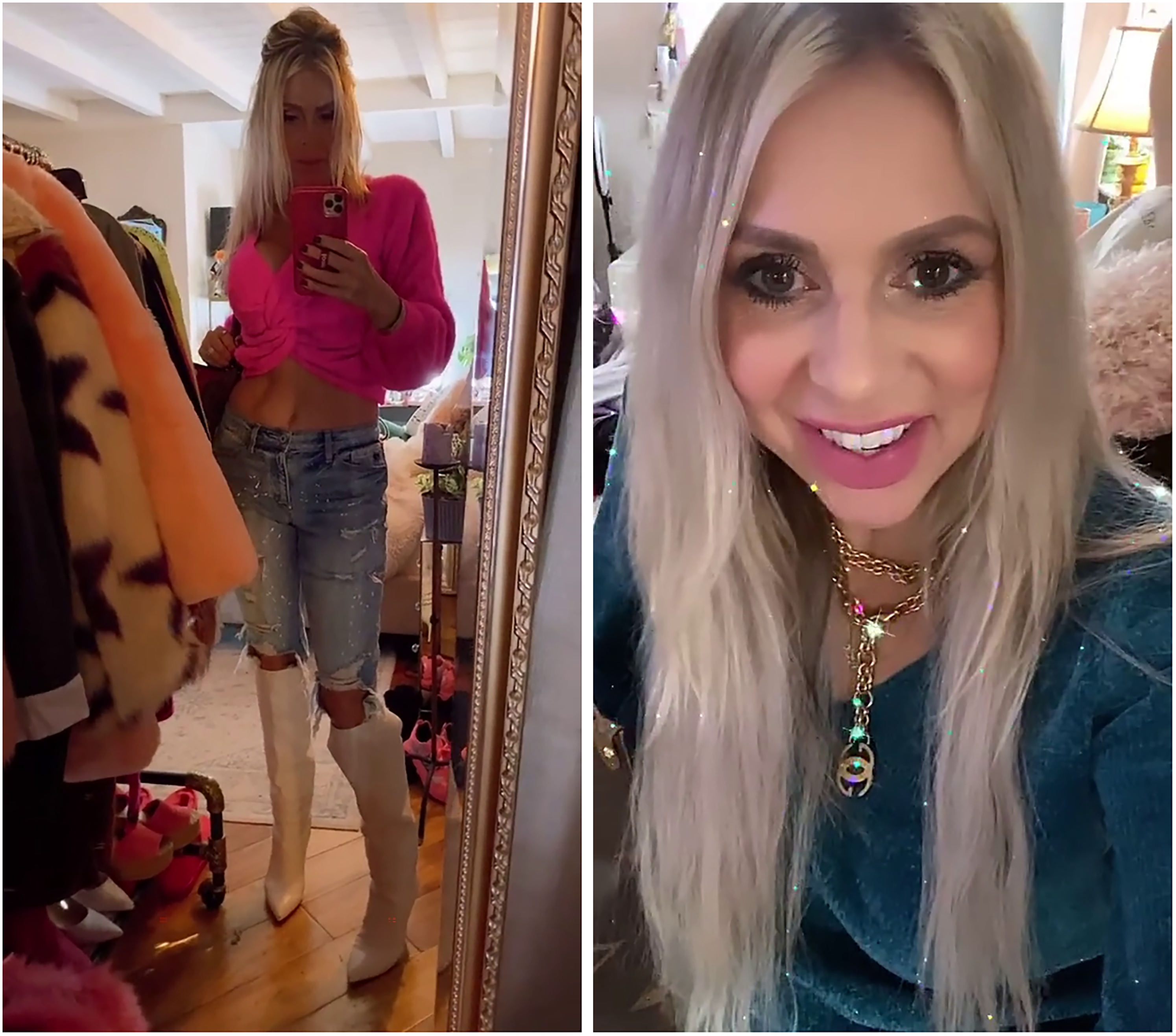
Screenshots of Ginger's videos. Image description: Two screenshots taken from Ginger's videos. In the first, she stands pointing her phone at a mirror, showing her wearing a cropped top, ripped skinny jeans, and knee high boots. To her left, is a clothing rack stacked with garments. The second is a close-up shot of her face as she talks directly to the camera. A filter adds a sparkling effect to her face and hair.
Additionally, influencers represented themselves as sexualised subjects, often posing seductively, flaunting their bodies, twirling their hair, winking at the camera and pouting their lips. Chrissy often adopts a vacant gaze, an interdiscursive reference to ‘the quintessential commodity dream-girl’ common in advertising (Dobson, 2015: 56). This vacant gaze acts as an ‘offer image’, inviting viewers to scrutinise Chrissy without expecting her to respond, thus portraying her as an object (Kress and Van Leeuwen, 1996). Furthermore, Chrissy and Hannah show themselves wearing the Playboy Bunny logo, an institution predicated on treating women as sexual objects for men, representing themselves through the patriarchal lens of heterosexual male fantasy.
Reclaiming bimbo identities, gender parody and social commentary
Importantly, influencers often portrayed their bimbo identity as a performance they intentionally embody. For example, Griffin states: ‘You might be wondering, what is a bimbo, and how do I become one? … So, partake in the study of bimbology. I’ll be waiting for you’. The suffix ‘-ology’ denotes a branch of study, positioning Griffin as an expert within the community. By instructing others on how to ‘become’ a bimbo, they frame it not as an inherent quality but as a learned one. Similarly, Chrissy introduces an element of ironic distance into her self-representations, creating space for interpretations of her performances as self-parody. She includes a clip of her falling to the floor with the subtitle: ‘(falls for attention)’, suggesting self-awareness around how her ditziness is perceived. Elsewhere, she says: ‘Now it's time to stare at myself in the mirror for three hours. Wow. I really am the hottest bitch I’ve ever seen’. Her monotone delivery, blank expression, and use of exaggeration all imply a self-parody of the superficial bimbo stereotype. In different ways, Griffin and Chrissy suggest there exists an ‘authentic’ way of being a bimbo.
Likewise, many influencers reclaimed slurs used to denigrate women. For instance, Griffin shows themselves skiing topless while smiling and declaring to the camera: ‘A hoe never gets cold’. By proudly describing themselves as a ‘hoe’, Griffin subverts its derogatory connotations. Similarly, Ginger states: ‘And if people wanna call me a slut, or say I’m a slut, it doesn’t matter ‘cause I don’t give a fuck what people think of me, and you shouldn’t either’. Her provocative language and rejection of the ideal of feminine modesty contradict the hegemonic gender norm of women as passive. She moves through her house as she talks, heightening this impression of power. Her direct eye contact with the camera in both videos acts as a ‘demand image’, making the viewer feel noticed and asks them to respond to her requests of embracing self-confidence despite possible criticism (Kress and Van Leeuwen, 1996). Likewise, in a possible intertextual reference to Amira's ‘Be A Bimbo’ movement, Chrissy states: ‘I’m a bimbo and I’m proud’. Additionally, Chrissy describes the daily routine of a bimbo: ‘Bimbos like to get a lot of sleep before they dismantle the patriarchy. Yes, I woke up like this. She then goes on to tweet something super important. She then puts clothes on (optional)’. By wearing revealing clothing while engaging with contemporary issues, she directly challenges the patriarchal discourse that only modestly dressed women should be taken seriously.
These influencers also challenged the dominant discourse that their performances of hyper-femininity are designed for the male gaze, instead framing their vanity as a way of reclaiming their bodies in a society that promotes female insecurity. Chrissy addresses this explicitly: ‘I don’t do this for the male gaze. I do this for my gaze’. In another video, she lies on her bed, pointing the camera at her face from above. Her pose is an interdiscursive reference to classical art in which artists painted women lying nude to appeal to the male gaze. However, her dialogue subverts these relations of power by rejecting male approval: ‘If you’re a man, I don't care that you don’t like me … Keep sending those misogynistic messages, Gabe … The root of your humour is misogyny, but the root of my humour is my goddamn trauma’. Soft pink lighting suffusing the video intensifies the sense of femininity as dominant. Likewise, Griffin states: ‘The only requirement for bimbofication is that you embrace and reclaim your body in the name of independence’. The term ‘reclaim’ is linked with wider feminist discourses of bodily autonomy and connotes that bimbofication is a way of taking back ownership that is currently absent. Thus, a bimbo identity is framed principally as a mindset where individuals find power in qualities they have been conditioned to be ashamed of.
Furthermore, by pairing stereotypical hyper-feminine images with radical social commentary, influencers subverted the power relations embedded in the bimbo trope. Chrissy articulates the political leanings of the bimbo: ‘She's actually a radical leftist, who's pro-sex work, pro-Black Lives Matter, pro-LGBTQ+, and will always be there for her girls, and theys!’ According to Chrissy, the daily routine of a bimbo includes ‘dismantling the patriarchy’, ‘calling out problematic family members’ and using her online presence to broadcast ‘super important’ messages. Thus, she positions the bimbo community's online discourse as a form of social and political activism and challenges mainstream bimbo performances and discourses of bimbos as oblivious and subservient. Anti-capitalist discourse is also prevalent in many videos. Chrissy, for instance, captions all her videos with ‘#ihatecapitalism’. Her video ‘Thoughts with Chrissy’ includes a monotonous AI-generated voiceover: ‘Capitalism is the root of all evil … I want more money … I will destroy capitalism’. Her desire for more money interspersed between critiques of capitalism captures the tension between her anti-capitalist beliefs and desire to consume. Displays of overconsumption across the videos exemplify the totality of living in a capitalist society, where one cannot opt out of capitalist structures but must navigate them correctly to survive. In another video, Griffin parodies stereotypical, upper-class mannerisms, walking in front of a sizeable lakeside property, donning fur and holding a wine glass. Their friends assume the role of house staff catering to Griffin's every need – opening gates for them, holding their drink and serving as a human coat stand – highlighting the inequalities fostered by capitalism (see Figure 4).
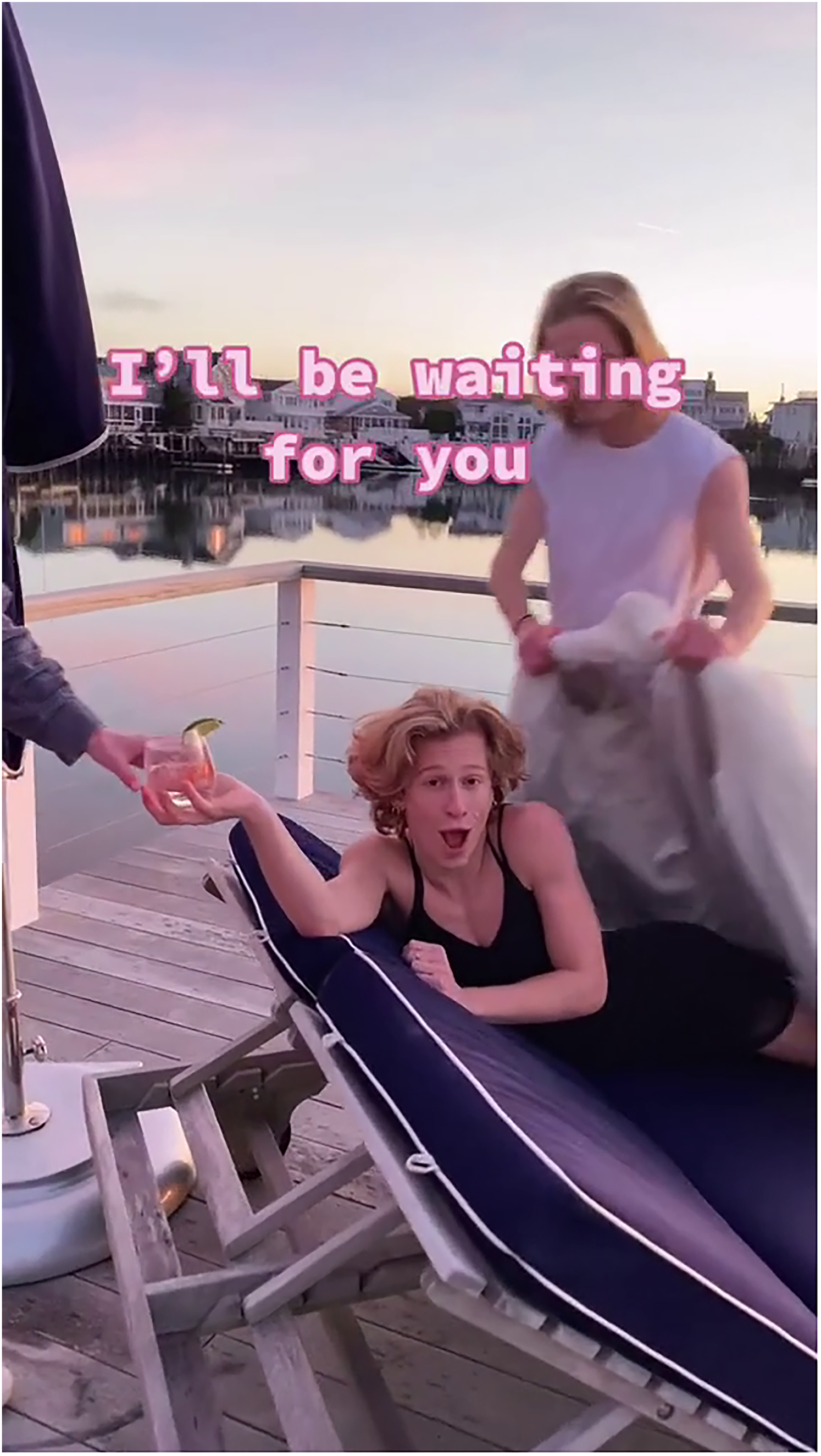
Screenshot of Griffin's video. Image description: A screenshot taken from Griffin's video shows them reclining on a deck chair in front of a lake while a figure outside the frame on the left hands them a cocktail and another person to their right drapes a fur coat over them.
Contrary to the conventional thin, blonde, white, heterosexual bimbo, the bimbo community on TikTok frames itself as intersectional. Griffin emphasises that bimbo identity transcends physical appearance and has more to do with embracing femininity: ‘The bimbo has no race, no class, or ability’. Likewise, Chrissy states: ‘This is an inclusive organisation! There's bimbos, thembos, himbos’ and stares vacantly into the camera while declaring in a deadpan tone: ‘If you’re homophobic, I’ll castrate you’. Chrissy and Griffin also both openly share their queer identities and experiences. For instance, Chrissy recounts using her neighbour's Wi-Fi as an 8-year-old child to find images of ‘girls kissing’. This story conveys the secrecy around her sexuality growing up, unlike another video where she exudes confidence, joyously shouting: ‘I love women!’. Furthermore, influencers frequently adopt many elements of camp fashion in their representations. Camp fashion is a highly exaggerated aesthetic style and sensibility associated with queer culture that blends elements from high and low culture to mock elitist tastes (Bolton et al., 2019). Many influencers adopted elements of camp fashion in their excessive makeup, bright colours, and glitzy jewellery, visually unifying the bimbo community on TikTok with signifiers of queer culture.
Discussion
TikTok influencers employed the bimbo trope to critique contemporary conceptions of femininity. An enduring sexist trope in popular media and re-emerging in the early 2000s, the bimbo embodies the notion that attractiveness and intelligence preclude one another in women. She appeals to the desired norms of femininity – sexually appealing, subservient and eager to please – yet is also the antithesis of idealised femininity, vain, superficial and promiscuous (Holland and Harpin, 2015). However, TikTok influencers reclaimed the term, emphasising the emotional intelligence, confidence and inclusiveness of the bimbo. This reclamation reflects feminist strategies of re-appropriating derogatory terms to subvert their power (O’Reilly, 2012). Influencers often called themselves bimbos based on their dress or behaviour, instructing others on how to ‘become’ a bimbo. Thus, they frame being a bimbo as an identity that they actively choose to embody. Similarly to the gender parody of drag queens, they adopt stereotypically feminine qualities to an extreme, revealing the constructed nature of both the feminine ideal and the bimbo trope itself (Butler, 1990). Therefore, influencers effectively denaturalised the discourse of hyper-femininity and intelligence as mutually exclusive and the notion that some women are born as bimbos – ideas that have historically functioned to oppress women.
McRobbie (2009) and Gill (2007) caution that such performances of hypersexualised femininity may inadvertently cater to an internalised male gaze, thus representing a form of false consciousness. In many videos, these influencers visually embodied the sexualised bimbo trope in their representations while presenting these performances as a means of empowerment. Yet, this kind of ironic sexual ‘subjectification’ nonetheless presents their bodies as objects for the male gaze (Gill, 2007: 147). Importantly, only white, thin, conventionally attractive and able-bodied people ‘are constructed as active, desiring subjects’, as exemplified by the influencers in this study, thus upholding norms of idealised femininity (Gill, 2007: 152). Likewise, the emphasis on sexiness as a means of personal empowerment by these influencers overlooks the wider systemic aims of feminism and presents pursuing an individualised ideal of femininity as a feminist act.
However, TikTok influencers frequently assert that they do not intend their performances of hyper-femininity to appeal to the male gaze but to critique patriarchal capitalism. Their self-representations challenge socio-cultural understandings of intelligence predicated on patriarchal, classist, Eurocentric and ableist norms. While popular media portray unintelligence in men as endearing, innocent and tender, unintelligent women are represented as vacuous and self-absorbed (Halberstam, 2011). Importantly, these influencers are not necessarily uneducated or unintelligent. However, they do not centre their self-representations around their educational and professional achievements. Additionally, their succinct explanations of feminist theory in layperson's terms render these ideas accessible to a larger audience, further challenging the exclusivity of scholarly discourse. They value feminine-coded skills, knowledge and interests traditionally undervalued in the market and trivialised by the patriarchy, such as emotional intelligence or expertise in fashion, beauty and homemaking.
Notably, BimboTok often proclaims itself as highly intersectional, explicitly welcoming people of all ages, genders, sexualities, races, ethnicities, classes and body types. Using camp fashion, influencers represented BimboTok as a safe space for LGBTQIA+ individuals. Many young LGBTQIA+ individuals have adopted the trope as a source of empowerment. This finding supports scholarly arguments that communities, including online communities, often identify themselves through distinctive style choices, such as fashion choices (Uh, 2020). Moreover, it aligns with Connell's (2012) claim that online aesthetics can serve as a vehicle for social activism. Simultaneously, it is also possible, as Dean (2023) suggests, that BimboTok influencers are incorporating feminist discourses as part of their self-branding strategies in order to gain social media clout and, in turn, economic capital.
Additionally, the discourse of agency can be seen as a form of ‘choice feminism’, wherein all choices women can make freely are construed as inherently feminist (Hirshman, 2006). Many scholars critique choice feminism as it overlooks the structural inequalities that shape those choices. Other critics argue that choice feminism does not foster gender equality between women but rather promotes neoliberal Western ideals of individualistic satisfaction at the expense of others (Budgeon, 2015). In this case, not all women have equal access to perform hyper-feminine bimbo identities. For example, many women of colour are already hyper-sexualised and could face violent repercussions for performing hyper-femininity in this way, particularly in online contexts where misogynistic, sexually violent comments are more prevalent than in offline environments (Alvares, 2018). Indeed, all the influencers in this study appealed to Eurocentric ideals of femininity: thin, white, blonde and wealthy. Similarly, the use of conspicuous consumption to signal identification with the bimbo community may inadvertently exclude lower-income individuals from participating (Griffin et al., 2006) and recalls the concerns of McRobbie and Garber (1977) about such practices representing an embodiment of neoliberal power, perpetuating existing systems of inequality.
Furthermore, although the influencers in this study often claim the trope is intersectional and inclusive, they do not address the systemic issues embedded in the bimbo trope or the challenges lower-income or BIPOC individuals may face in enacting the trope. Even in their wider engagement with feminist discourse, there is a lack of discussion on how this intersectional approach works in practice to address broader issues. Instead, ‘a grammar of individualism’ is used to frame all these political issues in personal terms, focusing on personal choices such as being ‘sexy for one's self’ (Gill, 2007: 153). However, this neoliberal logic demonstrates a limited understanding of the intersecting structural barriers that shape the choices available to individuals (Rottenberg, 2018).
Conclusion
This analysis explores how TikTok influencers have reclaimed the bimbo trope, celebrating interests, behaviours and skills traditionally coded as feminine. They perform caricatures of hyper-femininity through sexualised poses, signifiers connoting stereotypical femininity and intertextual references to popular representations of feminine women. However, unlike mainstream representations of bimbos, influencers juxtapose these images with critiques of patriarchal, Eurocentric and capitalist structures of inequality through subversive dialogue and iconographical signifiers of queer culture. Simultaneously, there is a lack of awareness around the extent of their own privilege and the difficulties other individuals may face in embodying these tropes. Indeed, the embodiment of patriarchal and Eurocentric ideals of femininity, the underrepresentation of people of colour, and the discursive linking of femininity and consumerism actively reproduce hegemonic norms of femininity. This study corroborates existing findings that the subversive potential of these representations is ambivalent (Pierce, 2022), providing critical insights into how self-representations of hyper-feminine bimbo identities on TikTok work discursively to both reinforce and subvert dominant discourses of gender.
Footnotes
Declaration of conflicting interests
The author declared no potential conflicts of interest with respect to the research, authorship, and/or publication of this article.
Funding
The author received no financial support for the research, authorship, and/or publication of this article.
