



Abstract
Australia witnessed a substantial degree of racism toward Asian and Muslim communities during the Covid-19 pandemic, much of which was shared and amplified on social media. However, while a growing body of national and international literature has illuminated the problem of racism during significant crisis events, limited studies have addressed how these narratives are both produced and resisted in online spaces. In this paper, I present the findings of a Thematic Content Analysis of how Asian and Muslim communities were constructed on Twitter/X during Australia's 2020–2021 lockdowns. Drawing on the literature surrounding Networked Counterpublics—and analyzed through a Systemic Racism lens—findings illuminate how publics used Twitter/X as a space to both legitimize and contest racist narratives relating to the pandemic, further demonstrating the power of social media as a vehicle for the amplification and resistance of racism during a significant global crisis.
Introduction
Pandemics, like other crisis events, are fertile ground for mediated racism, which was observed on a global scale during the SARS-CoV-2 (Covid-19) pandemic. Worldwide, much of this rhetoric was directed at Asian and Muslim communities, and took the form of racial slurs, online harassment, and racialized mis- and disinformation (Boseley, 2020; Elias et al., 2021; Kamp et al., 2022). During the early stages of the pandemic, an abundance of false claims circulated and gained traction in news, political, and digital media communication, including claims that Muslims breached national lockdown restrictions and intentionally spread the virus (Boseley, 2020); the virus was bioengineered in a laboratory in Wuhan, China (Andersen et al., 2020); and that it was created by the Chinese government to facilitate the rollout of 5G mobile technology (Bruns et al., 2020). These claims reached global audiences and were widely reproduced in social media discussion about the pandemic worldwide; including in Australia (Awan and Khan-Williams, 2020; Graham et al., 2020).
The circulation (and widespread acceptance) of such claims has been found to diminish the social, physical, and emotional well-being of those targeted (Carson et al., 2020; Shahid, 2020). In Australia, in addition to lessening feelings of safety (Itaoui, 2016), mediated racism is linked to serious health and mental health issues (Brinckley and Lovett, 2021; Paradies et al., 2015), as well as decreased opportunities to engage in education and employment (Elias et al., 2021). In fact, a recent investigation into the consequences of Covid-related racism in Australia reported that people targeted (both online and offline) refrained from accessing vital healthcare services during the pandemic, even in the face of serious illness (Haw and Hauw, 2024).
Alongside the insidious problem of mediated racism, however, is a substantial degree of resistance. The widespread public condemnation of both overt and systemic racism exemplified by the Black Lives Matter movement, 1 for instance, demonstrates how marginalized communities and allies engage in what Jackson and Welles (2015) describe as “networked counterpublic activism” (p. 933), by tackling race-based oppression and social exclusion through acts of antiracist advocacy and digital solidarity (Elias et al., 2021). As burgeoning scholarship indicates, digital platforms have become important tools in the fight against racism in recent years, as well as a vehicle for sharing important information during times of crisis. Zhang and Zhao (2020), for instance, observed how videos posted by Chinese YouTube vloggers enabled Chinese communities to unite and support each other emotionally during the pandemic. Furthermore, research into social media discourse during Covid-19 has shown how discussions of racism in online spaces can foster offline community-building (Abidin and Zeng, 2020; Kuo et al., 2020).
In this article, I present the findings of research deploying an Interpretive Thematic approach to Content Analysis (Vaismoradi et al., 2016; Zhang and Wildemuth, 2009) to examine how Asian and Muslim communities were constructed in Twitter/X discussions surrounding the Covid-19 pandemic in Australia; ascertained through the analysis of posts originating in Australia during country's 2020–2021 lockdowns. Drawing on the literature surrounding Networked Counterpublics (Jackson and Welles, 2015)—and analyzed with close consultation of Systemic Racism Theory (Feagin, 2006)—this study aims to illuminate how members of the Australian public used Twitter/X as a space to both legitimize and contest racist narratives during the height of the pandemic. The ensuing findings further demonstrate the power of social media as a vehicle for the amplification and resistance of racialized scapegoating during a significant global crisis. Ultimately, due to the well-documented social, educational, and health ramifications of racism (Brinckley and Lovett, 2021; Elias et al., 2021; Haw and Hauw, 2024; Paradies et al., 2015), I argue that understanding how stigmatizing and exclusionary discourses are formed, reproduced, and contested remains an urgent task for communication scholars, practitioners, and policymakers.
Background
A note on language use in this paper
In this article, I use the term “racism” to describe both anti-Asian and anti-Muslim sentiments. “Racism” is widely used to describe racialized attacks and scapegoating of Asian communities (Kamp et al., 2022; Zhao et al., 2022), and the term “Islamophobia” is typically used to describe exclusionary attitudes toward Muslim communities (Bleich, 2011). It is well established, however, that Islamophobia is deeply rooted in racism (Dunn and Hopkins, 2016; Itaoui et al., 2021; Noble and Poynting, 2010; Yousuf and Calafell, 2018). As Yousuf and Calafell (2018) argue, regarding anti-Muslim discourses as manifestations of racism enables scholars to account for how “structural violence against Muslims functions as a mode of white supremacy” (p. 313). This article therefore posits that anti-Muslim ideas (much like anti-Asian rhetoric) cannot be separated from racism and in turn, I deploy the term “racism” to describe the online hostility and racialized scapegoating observed toward both groups.
I also use the term “Asians” to refer to people who self-identify as Asian or Asian Australians. This includes people with Asian ancestry who are Australian citizens, as well as people of Asian descent who have migrated to Australia. I recognize that Asians in Australia embody a broad range of backgrounds, nationalities, cultural practices/beliefs, and racial and ethnic identities. I also recognize that Chinese communities were primarily targeted in anti-Asian hostility related to Covid-19, however, as my analysis will show, many Twitter/X users in Australia have used “Asian” as a blanket “catch-all” term to express racist sentiments during the pandemic. As such, I have exercised care to avoid making assumptions about these discourses and their focus on Chinese communities, unless explicitly stated. Lastly, I use the term “Twitter/X” when describing the social media platform from which I collected the data discussed in this paper. This is largely in recognition that “Twitter” is undergoing a period of upheaval due to its recent rebranding as “X” (coupled with the fact that my data were collected and analyzed while the platform was still known as “Twitter”).
Racism toward Asian and Muslim communities: the Australian context
Australia has a long and complex history with racism, with both anti-Asian and anti-Muslim rhetoric centered in the national conversation about multiculturalism for hundreds of years. To understand the shaping, legitimization, and contestation of contemporary forms of racism, however, we must consider the integral role of historic forms of dominance (such as white supremacy, settler colonialism, and slavery) and work to unpack how these imbue contemporary enactments of racism (Fredericks and Bradfield, 2021; Hage, 2000). Such a task requires us to look back at Australia's history of Asian and Muslim migration; unpacking how widespread (and legitimized) anxieties of both groups have long permeated the national conversation about multiculturalism and difference.
Australia began to see significant Asian immigration after the first Opium War of 1839–1842 when many Chinese people fled to Western nations. During this time, many Chinese immigrants worked in Australia's goldfields in the hope of attaining wealth and success (Ryan, 1995). In response, statements in national media and political discourse increasingly peddled discriminatory constructions of Chinese immigrants; metaphorically constructing them as “invaders” and “hordes of barbarians” (Martin, 2021). These discourses—driven by settler-colonial anxieties about the legitimacy of Chinese immigrants—resulted in Asian communities being treated as a deviant out-group. This culminated in the introduction of numerous exclusionary policies, including (but not limited to) legislation enacted in Victoria in 1855 to ban Chinese immigration, which formed the foundations of the White Australia Policy; a series of immigration policies, including the Immigration Restriction Act, 1901, collectively borne out of a colonialist and nationalist imperative to maintain an Anglo-Celtic Australian national identity (Kamp, 2014; Ryan, 1995).
Despite the abolishment of the White Australia Policy in 1973, Australia remains plagued by the ongoing legacy of settler colonialism. As Papastergiadis (2004: 8) asserts, the notion of an “Asian invasion” is grounded in Australian nationalism. Consequently, the racialization of the Covid-19 pandemic in Australian media, online, and political communication cannot be separated from the country's settler colonial past and present (Elias et al., 2021). As Ang and Mansouri (2022) write, “the Covid-19 global crisis has had the unintended consequence of exacerbating ideological beliefs in racial hierarchies, dividing the global community into an ‘us’ versus ‘othered’” (p. 2). Indeed, the perception of Australia as a white nation under threat from the undesirable “other” persists and has become more pronounced in the Covid-19 era (Elias et al., 2021). In turn, contemporary racism toward nonwhite communities—including anti-Asian rhetoric—is heightened in times of social, political, and economic upheaval. Historical stereotypes of Asians as untrustworthy “purveyors of disease,” for instance, are commonly reinvoked during both local and global health emergencies (Tessler et al., 2020).
As with previous pandemics (White, 2020), anti-Asian racism was observed to increase substantially following the onset of the Covid-19 pandemic (Tao and Loo, 2022), which some scholars have attributed to a phenomenon dubbed the “Trump effect” (Korostelina, 2016). Here, the use of racially prejudiced language in public statements by former United States President Donald Trump was found to embolden citizens to publicly express similar sentiments via their own social and online networks (Newman et al. 2021). Indeed, upon the declaration of Covid-19 as a global health emergency in March 2020, Trump made public statements that openly blamed China for the spread of the virus, referring to Covid-19 as the “China Virus” and “Kungflu” (Kiely et al., 2020); framings that featured heavily in subsequent social media discussion about the pandemic. Budhwani and Sun (2020), for example, found that Twitter/X posts labeling Covid-19 as the “Chinese virus” increased tenfold in the week following Trump's statements.
Similar rhetoric appeared in Australian news and political discourses during this period, circulating both online and in traditional media. Here, we saw political figures and news organizations engage in dog-whistling tactics to scapegoat minoritized communities, for instance, by attributing the spread of Covid-19 to Chinese communities living in Australia (Ittefaq et al., 2022; Sengul, 2024) and Muslims celebrating Eid; an important Islamic holiday held at the end of Ramadan (Boseley, 2020). For example, Sengul's (2024) analysis of Facebook posts from Australia's most prominent far-right populist party, Pauline Hanson's One Nation, revealed how the party used their platform to discursively scapegoat Chinese communities during the pandemic. Furthermore, the Victorian Parliament's Inquiry into Extremism revealed how far-right extremist groups and political figures used social media to capitalize on preexisting fears of the multicultural “other” through a deliberate campaign to expose “disenfranchised people to extremist content, further fuelling distrust and anger” (Parliament of Victoria, 2022: 70).
Alongside anti-Asian rhetoric, numerous reports of Covid-related racism targeting Muslim communities were reported on a global scale (Boseley, 2020; Poole and Williamson, 2023). Often referred to as “Islamophobia” (Bleich, 2011)—and characterized by unfavorable attitudes toward Muslim communities—such hostility has long featured in both national and international conceptions of multiculturalism and difference for many years (Forrest et al., 2020). In the wake of 9/11 and the ensuing declaration of the “war on terror,” Muslims residing in non-Muslim majority nations were routinely positioned as a racialized “folk devil” (Poynting, 2006); an idea inherent in many contemporary forms of racism, including those observed during the Covid-19 pandemic (He et al., 2024). In India, for example, several online memes circulating in the early stages of the pandemic portrayed Muslims as “superspreaders” who intentionally transmit the virus in their communities (Rajan and Venkatraman, 2021). Furthermore, amid claims of Muslims flouting social distancing measures in the UK, a preponderance of dehumanizing language—for example, through animalistic framings of Muslims as “Muzrats” (vermin)—was observed within social media commentary about the pandemic (Awan and Khan-Williams, 2020); further illustrating Steuter and Wills’ (2009) observations of animal metaphors in post 9/11 media representations of Muslims in Canada.
In Muslim-minority countries such as Australia, mediated racism toward Muslims is reported to coincide with upticks in offline attacks, including physical violence (Kabir, 2007; Poynting, 2002, 2006). This can lead Muslims to adopt a “siege” mentality by forgoing essential everyday activities (such as working, seeking healthcare, and engaging in social outings) to avoid incidences of abuse (Awan and Khan-Williams, 2020; Haw and Hauw, 2024). Amid this climate of racialized hostility, however, exists a substantial degree of antiracist resistance. In the following discussion, I summarize the available literature on the various ways racism was denounced and/or contested during the Covid-19 pandemic. Here, I draw on relevant prior research and theoretical frameworks surrounding digital antiracism and Networked Counterpublics (Jackson and Welles, 2015).
Digital antiracism and discourses of resistance
Fang (2016) described racial minorities as the “internet's earliest adopters” (p. 6), with social media increasingly serving as a crucial space for marginalized people to form affective social and community ties (Papacharissi, 2016). In addition to offering a means of social support and connection, scholars have long reported the value of online spaces for the sharing of personal and collective narratives to subvert “the power embedded in the institutions of society for the purpose of claiming representation for their own values and interests” (Castells, 2012, p. 5). In this vein, social media platforms offer a site for the amplification of traditionally unheard voices, whose sense of belonging and community can be enhanced via the mutual sharing of experiences and perspectives (Fang, 2016; Papacharissi, 2016).
Twitter/X is widely documented as an integral tool in the fostering of online communities; especially in times of crisis (Yang, 2016). For instance, Mundt et al. (2018) highlighted how the affordances of social media vastly increased the reach of the #BlackLivesMatter movement, during which Twitter/X users were observed to share personal stories as a means of connecting with the broader social issue of institutionalized racism, with these stories gaining global attention and prominence (Yang, 2016). In Australia, Abidin and Zeng (2020, 2021) have explored how Asian communities use social media functions (such as hashtags) to engage in shows of mutual care and digital activism in the face of widespread racism and xenophobia. In the early phases of the Covid-19 pandemic, they explored how an Asian diasporic online community used Facebook to share personal narratives about their experiences of, and responses to, pandemic-related racism and exclusion (Abidin and Zeng, 2020). During this time, hashtags such as #IStandWithAsianAustralians enabled online communities to express solidarity with Asian communities while taking a public stand against racism.
There is also evidence of publics taking to social media to oppose racism toward Muslim communities. In a pre-Covid context, hashtag activism was invoked to counteract racist news, political, and social media constructions of Muslims in response to major news events, including the Charlie Hebdo shooting in Paris in 2015 2 ; following which hashtags such as #MuslimsAreNotTerrorist and #NotInMyName gained considerable traction on social media (Magdy et al., 2015). Similarly, the hashtag campaign #IllRideWithYou (with “you” referring to Muslims in Australia) went viral following a barrage of anti-Muslim hate in response to the 2014 Sydney Lindt Café Siege 3 (Colic-Peisker et al., 2016). In both examples, Muslim communities had been subjected to vast racialized scapegoating in the wake of highly publicized crisis events. The Covid-19 crisis thus represents one contemporary example of what is ultimately a long-standing pattern of racism and antiracist advocacy in online spaces during periods of significant uncertainty and upheaval.
While an expansive body of international literature illuminates how, in times of crisis, social media plays an integral role in the provision of supports for marginalized communities, several questions remain. While digital racism has received increased scholarly attention in Australia in recent years (e.g., Kamp et al., 2022; Shin et al., 2023), investigations of how antiracism is enacted on social media in the Australian context remain scarce. Such examinations are of critical importance in our current global context, where populist politics, neoliberal ideologies, and ensuing social movements swiftly reach significant global audiences (Mattoni, 2020). An analysis of both dominant and counter discourses can therefore help identify rhetorical, linguistic, and broader communication policy and practice strategies that may be of use for informing future crisis responses and antiracism advocacy efforts. By discursively analyzing Twitter/X discourse during Australia's Covid-19 lockdowns in 2020–2021, this paper interrogates how digital racism was constructed and contested during a period of social, political, and economic upheaval; addressing two key research questions:
What are the dominant discourses about Asian and Muslim communities within Twitter/X discussion surrounding the Covid-19 pandemic in Australia? How have these discourses been challenged and/or contested on Twitter/X?
By critically looking at how racist discourses were reproduced and resisted in online spaces during the pandemic, I explore the capacity for social media to act as a vehicle for reclaiming the kind of power and authenticity that has long been reflected in hegemonic narratives that rationalize continued exclusion of the racialized “other.”
Research design
The research documented in this article deployed a Systemic Racism lens, which recognizes structural racism as a prominent driver of social, health, and economic inequity in white-settler societies (Feagin, 2006). By exploring ongoing interrelationships among racially framed meanings, practices, structures, and hierarchies, Systemic Racism Theory addresses: (1) the “microaggressions’ experienced daily by people of color; and (2) the macro-level racist social structures that shape their everyday world (Feagin, 2006); both of which are routinely reflected in (and shaped by) news, political, and social media discourse (Haw, 2023; van Dijk, 1989). In efforts to address racism in Australia, it is vital to interrogate the social history of white Australians’ interrelations with people of color and seek to better understand the maintenance of major resource inequalities that underlie (and reinforce) ongoing racial oppression and hostility (Feagin and Elias, 2013). As noted, racist discourses observed during the pandemic reflect long-standing anxieties observed since Australia's Federation, during which the so-called “yellow peril” was constructed as a threat to the newly established “white” colony (Walker, 1999). By deploying a Systemic Racism lens, this paper seeks to contribute to broader, scholarly understandings of how digital racism is enacted and contested online, while paying careful attention to Australia's settler-colonial past and present.
I also draw on the concept of Networked Counterpublics (Jackson and Welles, 2015), which emerged as a critique of Habermas’ (1991) foundational theory of the “public sphere.” Fraser (1990) introduced the notion of “counterpublics” to describe “parallel discursive arenas” where members of marginalized groups can “formulate oppositional interpretations of their identities, interests, and needs” (p. 67). Here, we see the production of alternative forms of knowledge that challenge and subvert modes of thinking that have long excluded these communities. These networks of resistance work to produce “counterpower,” which “challenges the power embedded in the institutions of society for the purpose of claiming representation for their own values and interests” (Castells, 2012, p. 15). By enacting this counterpower, online communities can unite through discourses of resistance and work to transform the kinds of inequitable power divisions that harm society's most vulnerable people. For example, in response to then Western Australian State Premier Colin Barnett's 2014 announcement that he would close approximately 150 remote Aboriginal communities, First Nations communities commenced a digital campaign (via the website www.sosblakaustralia.com and hashtag #SOSBlakAustralia) to mobilize kin and allies across the country to oppose Barnett's proposal (Carlson and Frazer, 2016).
Counterpublics scholars recognize the complex and dynamic nature of networked communication, focusing their attention on understanding various collaborative processes at play—across diverse social, political, cultural, and economic contexts—in efforts to “make things public” (Kavada and Poell, 2021, p. 193). By investigating how Twitter/X users in Australia constructed Asian and Muslim communities during the height of the Covid-19 pandemic, this paper seeks to illuminate how this form of “counterpower” played out during a significant crisis of our time. Twitter/X was chosen as the platform for this investigation because: (1) racism in online discussion of the Covid-19 pandemic is well-documented on this platform (Budhwani and Sun, 2020; Rowe et al., 2021; Shin et al., 2023); and (2) at the time of data collection, no Australian research had specifically examined antiracist resistance to pandemic-related racism (targeting both Asian and Muslim communities) on Twitter/X.
To ascertain how users of the platform in Australia discussed Asian and Muslim communities during the Covid-19 lockdowns, I ran two separate searches via the Twitter/X Application Programming Interface (API) v2: one to collect posts containing references to Asian communities and one for Muslims. I set the post origin location to Australia with the date range between 1 March 2020 and 31 December 2021, using the search terms “Covid*,” “Covid-19,” “Lockdown,” “Corona*,” and “Pandemic.” For the first search, I added the terms “China,” “Chinese,” “Asia*,” “Asian*,” and “Wuhan,” and for the second, I added “Muslim*,” “Islam,” “Islamic,” “Eid,” and “Ramadan” (see Table 1).
Search terms and number of posts returned.
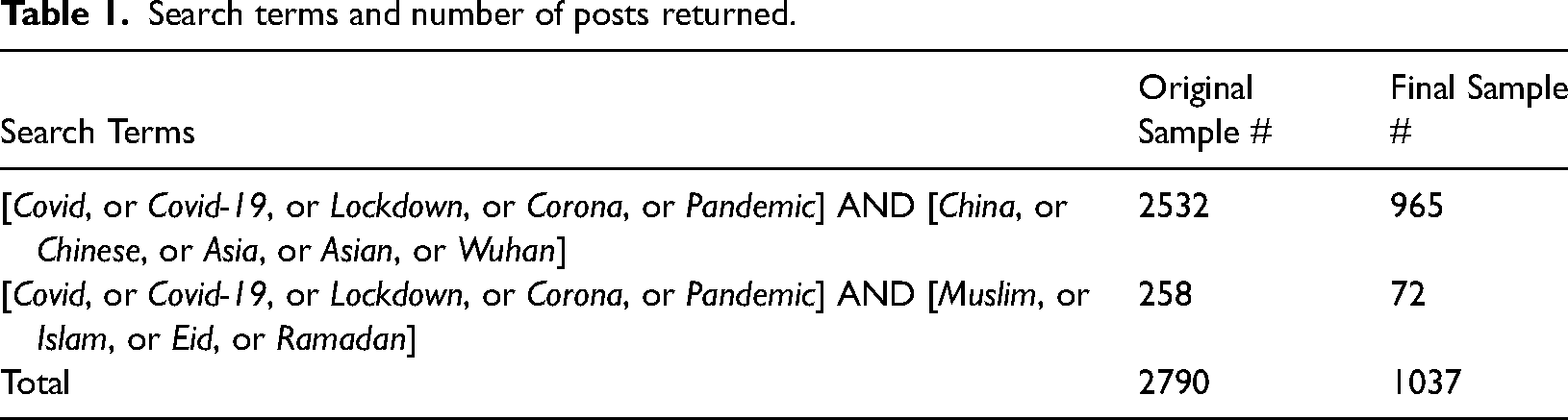
Search #1 returned 2532 posts (with 965 included for analysis) while search #2 returned 258 posts (with 72 included for analysis), resulting in a total of 1037 posts in the final dataset. All returned posts were downloaded as CSV files, cleaned up to remove duplicates and irrelevant posts, 4 and imported into NVivo for analysis.
All posts in the final sample (n = 1037) were analyzed using a qualitative Content Analysis approach (Vaismoradi et al., 2016; Zhang and Wildemuth, 2009), informed through a Reflexive Interpretive Thematic lens (Braun and Clarke, 2019) to make sense of the data. In thematic content analysis, scholars are concerned with analyzing textual data and—through a systematic process of coding—examining meaning within said data through the creation (and connection) of evident themes (Zhang and Wildemuth, 2009). Drawing on Braun and Clarke's (2006) formative work on thematic analysis in social psychology, a reflexive interpretive approach acknowledges the active role of researchers in knowledge production and thus regards emerging themes as products of the researcher's interpretations of meaning (Braun and Clarke, 2019). In interpretive thematic content analysis, therefore, researchers are not concerned with replicability and/or “intercoder reliability.” Rather, the focus is on their “reflective and thoughtful engagement with the data, as well as their reflexive and thoughtful engagement with the analytic process” (Braun and Clarke, 2019, p. 594). Appling a reflexive, interpretive approach to my data thereby enabled me to achieve the kind of rich interpretations of meaning necessitated by my research questions.
I commenced my analysis by importing both data spreadsheets into NVivo (QSR International Pty Ltd Version 14, 2023), before reading each document individually and coding the data to identify overarching themes. I used an inductive approach by enabling discourses (and the broader themes with which they relate) to emerge organically rather than identifying them based on predetermined parameters. I began by highlighted interesting linguistic features of how the posts were constructed, including what kinds of ideological positions they reflect, challenge, or resist. I then further categorized each post according to the specific arguments they draw upon, making note of how the emerging themes support and/or contest existing literature. To ensure confidentiality, all Twitter/X handles (including tagged accounts and named individuals) are omitted from this paper, and no other identifying information was collected about the posters.
To gain an overall sense of how Asian and/or Muslim communities were constructed in my data, I categorized all posts in terms of whether they contain racist, antiracist, or neutral ideas. In line with a Systemic Racism lens—which regards both overt and covert forms of racialized scapegoating as racism (Feagin, 2006)—posts were classified as “racist” if they contained any of the following elements:
Racialized scapegoating, via blanket attributions of blame toward Asian and/or Muslim communities for the pandemic (including characterizations of Covid-19 as the “China virus” and/or “Muslim virus”); Derogatory and/or stereotypical constructions of Asian and/or Muslim communities or individuals (including racist jokes); Statements in support of exclusionary treatment of Asian and/or Muslim communities (including calls to deny or restrict their immigration to Australia); Dehumanising depictions of Asian and/or Muslim communities (i.e., portraying them as “nonhuman”); and Threats or endorsement of violence toward Asian and/or Muslim communities or individuals.
Conversely, posts that resisted these kinds of narratives and/or voiced support for Asian and/or Muslim communities in the face of pandemic-related racism were considered “antiracist.” This included shows of solidarity via hashtags such as #IStandWithAsianAustralians. Content that mentioned Asian and/or Muslim communities but contained neither racist nor antiracist sentiments were classified as “neutral.” I unpack these findings in the following discussion by first noting the prevalence of racist versus antiracist posts in my data, before commenting on how these ideas were constructed (focusing on how they work to legitimize or contest long-standing racist narratives observed during global crises).
Findings and discussion
RQ1: How are Asian and Muslim communities constructed in Twitter/X discussion surrounding COVID-19 in Australia?
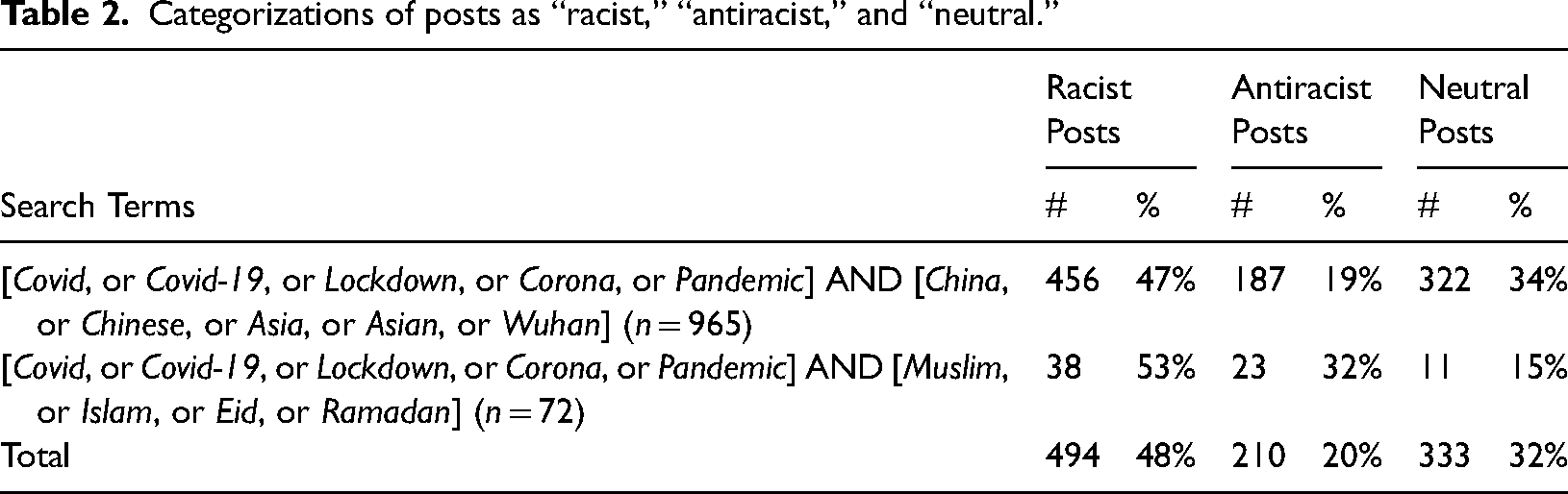
Almost half of the posts in both datasets (n = 494, 48%) expressed racist sentiments, while 20% (n = 210) expressed antiracist ideas, and the remaining 32% (n = 333) were classified as “neutral” (see Table 2). A higher proportion of the posts about Muslim communities (n = 23, 32%) contained antiracist ideas compared with the Asian dataset (n = 187, 19%). There were also proportionately more racist posts in the Muslim dataset (n = 38, 53%) than the Asian dataset (n = 456, 47%), whereas neutral posts were more evident in the Asian dataset (n = 322, 34%) than the Muslim dataset (n = 11, 15%).
Categorizations of posts as “racist,” “antiracist,” and “neutral.”
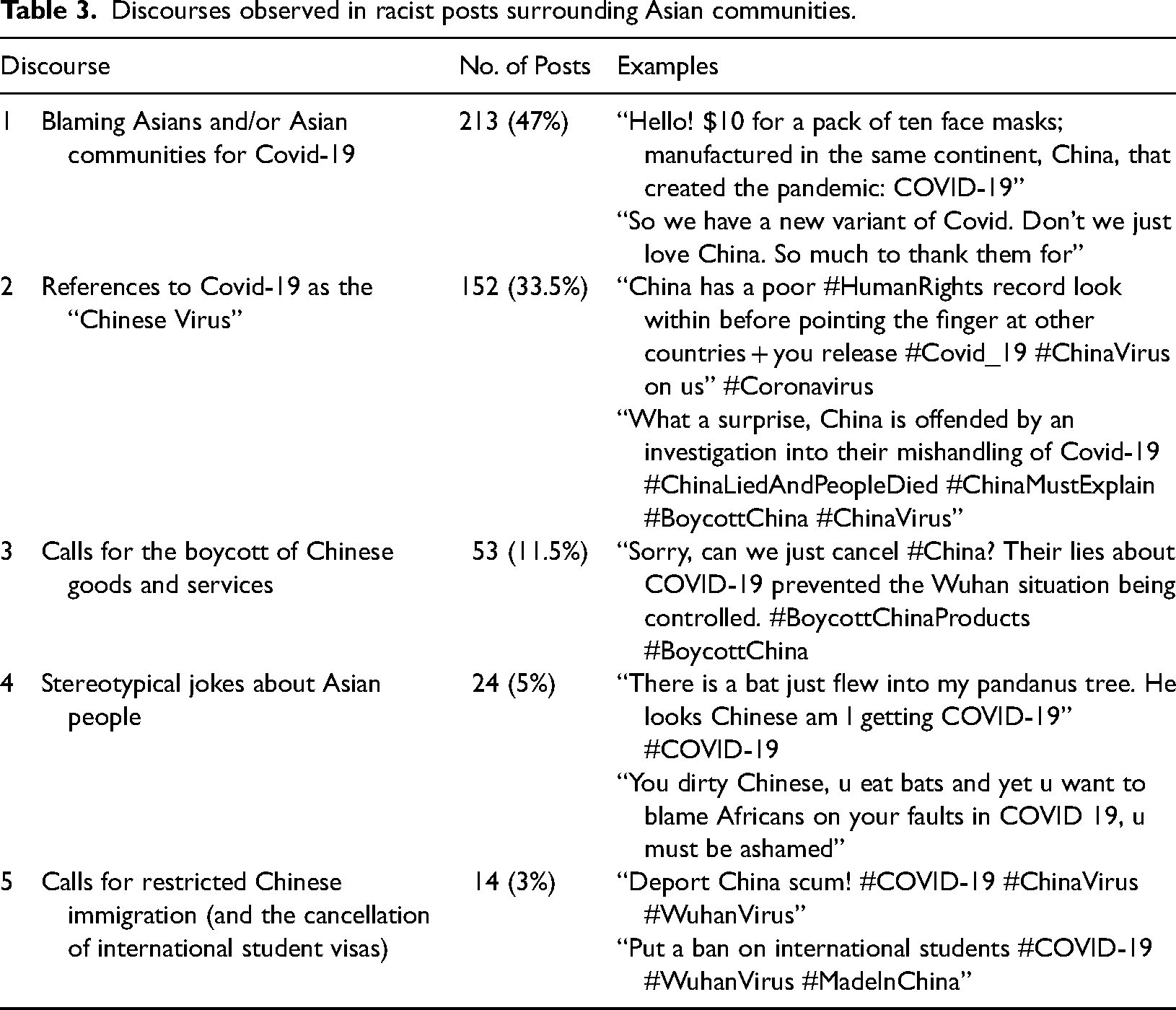
Within the racist posts about Asian communities, the following thematic categories were observed (see more details in Table 3): blaming China (or Chinese communities) for the pandemic (including suggestions that the virus is a bioengineered weapon from the Chinese government to take over the Western world); general references to Covid-19 as the “Chinese Virus” (including use of the #ChineseVirus, #ChinaVirus, or #MadeInChina hashtags); calls for the boycott of Chinese goods and/or services; stereotypical jokes about Asian communities and/or individuals; and calls for the deportation of Chinese residents and/or cancellation of visas for international students, including general anti-immigration attitudes (e.g., using China's so-called “importation” of Covid-19 to justify stricter immigration policies).
Discourses observed in racist posts surrounding Asian communities.
An interesting facet of these posts is the use of hashtags to serve various communicative functions. The use of hashtags enables social media users to connect their posts to a particular issue, debate, or discussion and, in the process, disseminate their ideas widely (Fang, 2016). They therefore serve both a pragmatic and ideological purpose; allowing users to find and organize content related to issues they wish to engage with, while also offering them a useful means of voicing their own stance on the issue at hand.
According to McVey and Woods (2016), the hashtag offers a “space of freedom for activists who desire to imagine the world otherwise, as well as a strategy for co-option for those who oppose these activist interventions” (p. 4). In the present study, people who shared anti-Asian sentiments often accompanied their posts with common hashtags associated with the pandemic (e.g., #Covid-19 and #Coronavirus—see Table 3); a practice that facilitates greater exposure for the posts in question. Hashtags were also used as a discourse marker, with many users communicating their opinions within the hashtags themselves (e.g., #ChinaLiedAndPeopleDied, #MadeInChina, #BoycottChina, and #ChinaVirus). These hashtags imply that China and/or Chinese people are to blame for the global spread of Covid-19, further evidenced by the strong focus on “boycotting” Chinese products and imports, alongside calls to restrict Asian immigration; narratives which align with Covid-related discourses observed internationally (e.g., Rowe et al., 2021; Li and Chen, 2021) and reflect long-standing prejudices toward Asian communities (King et al., 2021). References to “eating bats,” for example, are reminiscent of discourses that make fun of Asians for consuming strange exotic foods; depicting such practices as examples of their supposed cultural incompatibility with Western norms and ideals (King et al., 2021).
Similarly prejudicial ideas were evident in the racist posts about Muslim communities, with the following themes observed: attributing the spread of Covid-19 to Muslims, including claims that so-called “Covid hotspots” were caused by Muslim residents; complaining that Muslims in Australia refuse to follow lockdown and/or isolation rules; blaming Eid and/or Ramadan celebrations for the spread of Covid-19, including references to the July 2020 outbreak in Melbourne as the “Muslim outbreak”; and making Covid-related jokes to present stereotypical depictions of Muslims (see Table 4 for more details).
Discourses observed in racist posts surrounding Muslim communities.
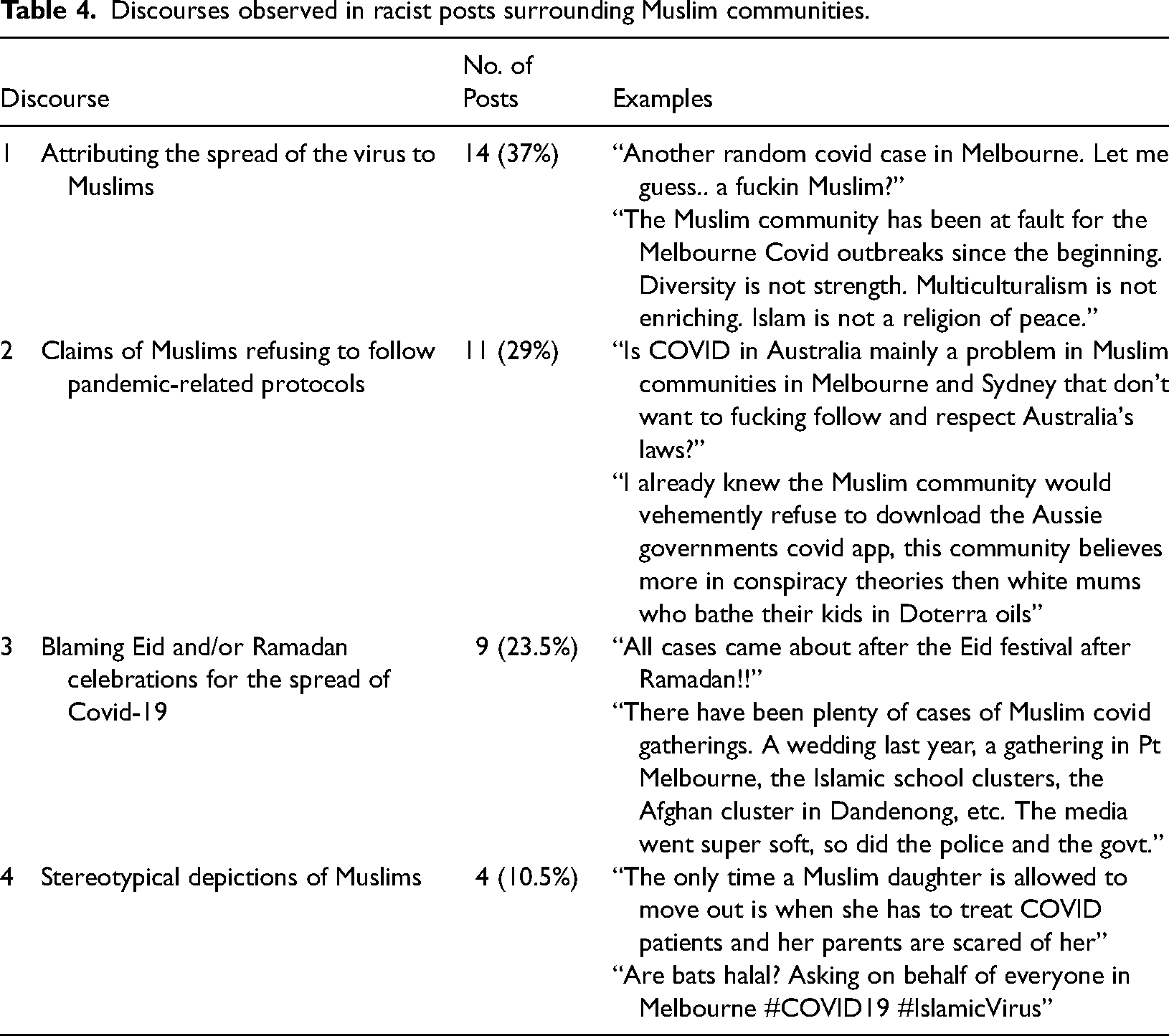
For context, in June 2020, several unconfirmed news reports claimed that one of Melbourne's Covid-19 outbreaks originated at a family Eid celebration. The publicization of these claims—which were later confirmed to be false (Australian Human Rights Commission, 2021)—led to widespread criticism of Muslim communities in Australia (Boseley, 2020). References to Ramadan and Eid observed in the Muslim dataset reference this news event (and the public debate that ensued), while simultaneously invoking well-documented prejudices toward Muslim communities; particularly those observed in the face of highly publicized global crises. For instance, the notion of Muslims being unable or unwilling to “follow the rules” during Covid-19 is reminiscent of longstanding constructions of Muslims as dangerous, deviant and/or criminal (Abdel-Fattah, 2017; Briskman, 2015).
In addition, the stereotypical jokes about Muslims observed in several of these posts draw upon well-documented prejudices; observed nationally and globally (Haw, 2019, 2022; Nadal et al., 2012). For example, a post asking about whether bats are “Halal” (which includes a reference to Melbourne's lockdowns and the hashtag #IslamicVirus) deploys a common device observed in discourses that mock certain Islamic practices (in this case, consuming Halal products) while making a negative statement about Muslims (Zimbardo, 2014). Despite these narratives, however, it is evident that many Twitter/X users pushed back; either by contesting Covid-related racism and/or expressing support for targeted communities. In the following section, I critically discuss these contestations and demonstrations of networked solidarity.
RQ2: How have Twitter/X users in Australia contested racist constructions of Asian and Muslim communities during the pandemic?
While racist posts dominated both datasets, several Australian Twitter/X users demonstrated antiracist resistance. For the Asian dataset, these posts fell into the following thematic categories (see more details in Table 5): problematizing language such as “China Virus” and “Chinese Virus”; refuting claims that China is to blame for the pandemic; lamenting Covid-related racism toward Asians in Australia; and use of the #IStandWithAsianAustralians hashtag.
Discourses observed in antiracist posts surrounding Asian communities.
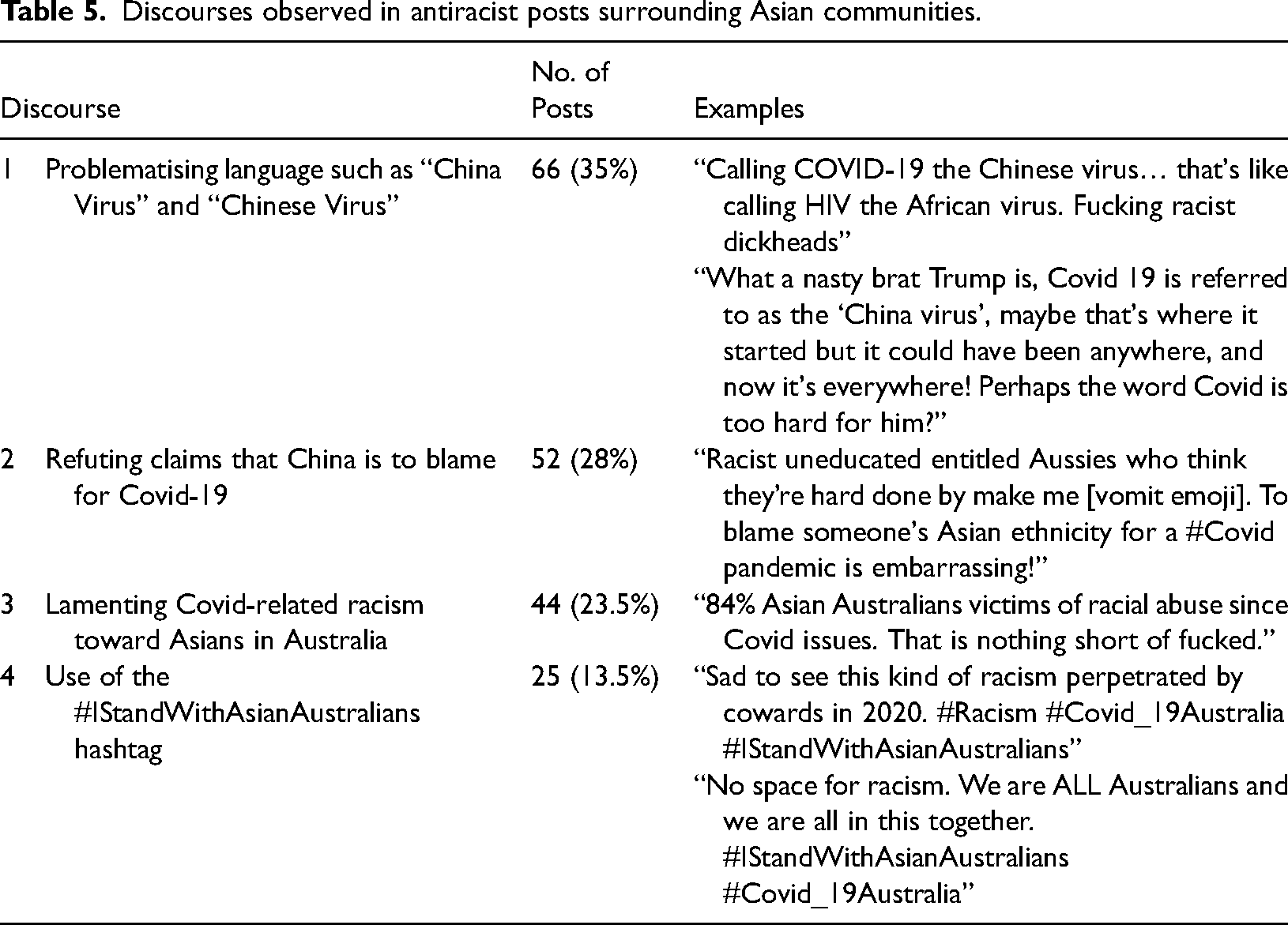
As observed with the racist posts (see Table 3), hashtags appeared to serve both a practical and ideological function in the antiracist posts. Hashtags are commonly deployed to demonstrate allegiance with certain social movements and, in some cases, reclaim power for marginalized communities (Yang, 2016). This practice was observed globally during Covid-19, including among Asian communities facing pandemic-related discrimination in the US (Tao et al., 2022) and within grassroots activist groups in Taiwan seeking to build international allyship to respond to the crisis (Liu et al., 2022). In the current study, use of the hashtag #IStandWithAsianAustralians—created in response to several online and offline incidents of racist attacks against Asians in Australia during the lockdowns (see Shin et al., 2023)—enabled Twitter/X users to demonstrate solidarity with Asians affected by pandemic-related racism, while also allowing their posts to be organized under this hashtag (and thus, engaged with more widely across the platform). Use of generic hashtags, such as #Covid-19 and #Covid_19Australia, was also common in the antiracist posts, enabling these to reach more Twitter/X users and form part of the broader discussion of Covid-19 across the platform.
In addition to deploying hashtags in both an ideological and practical way, much of the antiracist content was framed in a manner that acknowledges racism toward Asian communities while rejecting and/or condemning these ideas. This phenomenon is known as “duelling discourses”; a rhetorical device whereby a person calls attention to a certain perspective while either challenging or refuting it (Fozdar, 2008). As an antiracism strategy, the use of “duelling discourses” enables people to communicate their perspectives as arguments against a counter position. It is observed in research surrounding attitudes toward multicultural communities in Australia and New Zealand (e.g., Haw, 2020; Fozdar, 2008). For example, in research by Haw (2020), Australian community members who voiced welcoming attitudes toward asylum seekers routinely framed their perspectives as arguments against more exclusionary ideas. The prominence of antiracist hashtags and “duelling discourses” strategies in the current analysis illustrates how online responses to pandemic-related racism were discursively constructed in a dialogic manner, further demonstrating how Networked Counterpublics function as a means of resisting prejudicial attitudes that harm marginalized communities (Jackson and Welles, 2015).
A similar theme emerged in the Muslim dataset, evidence through the following thematic categories (see more details in Table 6): contesting rhetoric that blames Muslims for Covid-19 outbreaks in Australia; lamenting anti-Muslim racism in social media, news, and/or political discourse; and describing accounts of Muslims coming together to support their communities during the pandemic (e.g., Muslim community leaders and volunteers sharing information with their communities about vaccines and virus mitigation policies).
Discourses observed in antiracist posts surrounding Muslim communities.
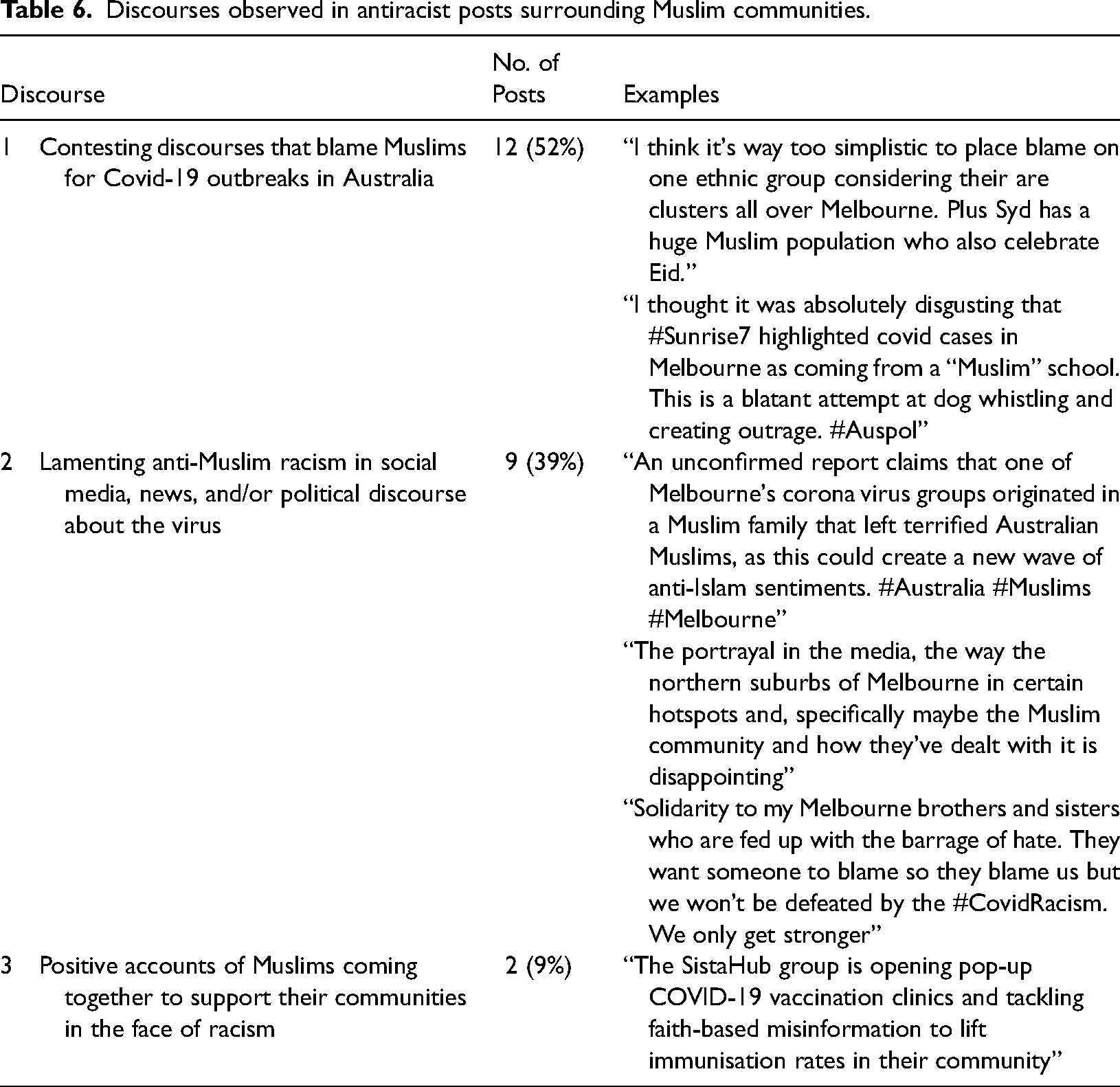
As observed for the Asian dataset, many of the antiracist posts about Muslim communities took the form of “duelling discourses” (Fozdar, 2008), expressed in two evident ways: (1) condemnation of anti-Muslim narratives circulating during the pandemic; and (2) refutations of anti-Muslim racism encountered by the Twitter/X user. In line with scholarship surrounding Networked Counterpublics (Jackson and Welles, 2015), several of the posts pushing back against anti-Muslim rhetoric were posted by Muslim Twitter/X users, further highlighting how members of vilified minority groups use social media as a vehicle for supporting and uplifting their communities in face of online hostility. This supports the findings of recent research in China, which demonstrated how networked Islamic counterpublics have used social media to voice dissent in response to anti-Muslim rhetoric circulated online during the pandemic (Wang, 2022). Taken together, the analyses of both racist and antiracist posts in both the Asian and Muslim datasets reflect a highly polarized social media landscape with respect to discussion of Covid-19 in Australia. It is evident that Australia's long history of discursively scapegoating Asian and Muslim communities was both reproduced and contested in Twitter/X discussion of both groups during the pandemic. The broader implications of these findings, including potential directions for future research, are further unpacked in the following discussion.
Conclusion
The findings documented in this paper further illuminate the problem of racist communication in digital spaces during global crisis events, using Australia's discursive treatment of Asian and Muslim communities on Twitter/X during the Covid-19 pandemic as a contemporary case study. In line with prior studies in Australia (e.g., Elias et al., 2021) and internationally (e.g., Li and Chen, 2021; Rowe et al., 2021), I observed that many people used Twitter/X to share stereotypical remarks about both groups during the height of the pandemic, with some citing the crisis as a justification for exclusionary attitudes and policies. These discourses reflect observed dog-whistling tactics in Australian news media and political discourse during the pandemic, whereby the spread of Covid-19 was discursively attributed to Asian and Muslim communities (Boseley, 2020; Ittefaq et al., 2022; Sengul, 2024). As discussed, these framings closely reflect long-standing exclusionary attitudes observed in Australia since Federation (Elias et al. 2021; Kamp, 2014; Martin, 2021; Walker, 1999).
Alongside the more harmful narratives emerging in this study, however, was evidence of antiracist resistance. Several Twitter/X users challenged and, in some cases, condemned the racialized scapegoating of Australia's Asian and Muslim communities; with many refuting claims that these groups are responsible for the spread of the virus. This aspect of the findings builds on the literature surrounding the function of Networked Counterpublics during precarious times (Jackson and Welles, 2015; Wang, 2022), illuminating some ways in which Australians took to Twitter/X to engage in antiracist advocacy during a major (and highly divisive) global crisis event of our time.
Despite this contribution, however, many questions remain. While the observation of antiracist discourses is promising, most of the posts in both datasets articulated racist ideas about Asian and Muslim communities, indicating that there is much work to be done from an antiracism advocacy standpoint. Furthermore, as most social media research concerned with racism and antiracism focuses on Twitter/X content, more investigation is needed into how these phenomena play out on other digital platforms. For instance, it was beyond the scope of this research to look at the reach of the posts in my datasets; including how people are interacting with each other in these exchanges. While in-depth, qualitative examinations of online discourses are crucially important for ascertaining how networked counterpublics communicate in the face of racism (and how antiracist advocacy plays out in digital spaces), future studies could build on such work by deploying mixed methods approaches—for instance, by combining qualitative, discursive approaches with Social Network Analysis (Wasserman and Faust, 1994)—to examine both the form and reach of these posts. Such an approach could reveal more about how publics are interacting with the broader Twittersphere when engaging in these discussions.
Nonetheless, while quantitative and mixed methods approaches are useful for understanding the scope and extent of the problem of racism, it is well documented that mediated racism remains a pervasive, global problem with serious health and social impacts (Carson et al., 2020; Haw and Hauw, 2024; Paradies et al., 2015). In turn, more efforts are needed to, not only accept this reality but further interrogate the role of mediated communication in addressing the problem. For instance, in what ways are social media platforms and media organizations complicit in amplifying and normalizing racism? What measures are they taking to address the problem, and what barriers do they currently face while working to implement these measures? What are the discursive and structural connections between digital racism and far right political movements (and actors), including disinformation purveyors (both locally and globally)? While numerous scholars are working to address these questions in the Australian context (e.g., Cover et al., 2022; Elias et al., 2021; Graham et al., 2020; Sengul, 2024), communication researchers, professionals and policymakers must grapple with how we collectively apply the knowledge arising from this work to radically shift current practice; particularly through approaches that center the embodied expertise of people with lived experience of racism.
Indeed, limited Australian studies and policy initiatives to date have engaged in meaningful (and equitable) partnerships with multicultural communities to learn about their experiences with digital racism and what they recommend in terms of: (1) improving supports for people subjected to racism and racialized discrimination during crisis events such as the Covid-19 pandemic; and (2) engaging in effective, accessible, and culturally informed approaches to antiracism advocacy. Efforts to engage with multicultural communities to better understand the consequences of digital racism—and inform frameworks designed to address this ongoing problem—is of critical importance, especially in the context of the highly fragmented and polarized digital media landscape that has punctuated Covid-related communication worldwide.
As noted, the kind of racialized scapegoating reported in this paper has been found to diminish multicultural communities’ social, physical, and emotional well-being (Carson et al., 2020; Paradies et al., 2015). In fact, during Covid-19, these communities’ experiences (and well-founded fears) of racism were cited as a leading factor for their decreased engagement with urgent health and social supports (Haw and Hauw, 2024; Liddell et al., 2021). Pandemic-related racism, however, is by no means a new phenomenon and is known to have dangerous, long-term repercussions (White, 2020). Previous investigations of racism during major health crises have highlighted the long-term ramifications for marginalized communities (Schlabach, 2019; Shah, 2001); illuminating a strong imperative to better understand the vital role of communication in responding to these issues. One important step toward advancing this understanding is to both examine and document how stigmatizing and exclusionary ideas are formed, reproduced, and resisted in contemporary communication. In turn, it is an urgent task for media professionals, scholars, and policymakers to prioritize strategies aimed at addressing racism beyond the Covid-19 context, with the ultimate aim to foster meaningful progress toward healthier and more inclusive societies; online and offline.
Footnotes
Declaration of conflicting interest
The author declares that there is no conflict of interest.
Funding
The author disclosed receipt of the following financial support for the research, authorship, and/or publication of this article: This research is funded by the Australian National University’s 2022 Herbert and Valmae Freilich Project for the Study of Bigotry ‘Early Career Research Small Grant’.
Ethics approval
The research documented in this paper was carried out at Deakin University, in accordance with the requirements set by the Faculty of Arts and Education’s Human Research Ethics Committee (approval no. HAE-22-029).
