



Abstract
Australian teenagers have grown up with abundant choices in digital screen entertainment including social media, gaming, and global streaming video services such as Netflix. This participatory audience study investigates how, why and to what extent Australian teenagers engage with drama and movies in their daily lives, including Australian stories. The research findings show that Australian teens enjoy watching long-form screen stories on their favourite streaming services and that on-demand delivery is critical to their viewing preferences. Although many remember with affection the Australian drama they watched as children, teens now place a low priority on a screen story being Australian. A sophisticated audience that particularly values diverse and inclusive representation, teens’ deprioritising of Australian content – and linear television – has profound implications for policy, for Australian screen production and for public service broadcasters the Australian Broadcasting Corporation and the Special Broadcasting Service.
Introduction
The viewing habits and screen cultures of young Australian television audiences including teenagers are often overlooked. The most recent report from Australia's media regulator the Australian Communications and Media Authority (ACMA) into the digital lives of ‘younger Australians’ does not include teens, with the lowest demographic being 18–24-year-olds (ACMA, 2023). All 4016 respondents involved in the federal government's otherwise comprehensive 2022 Television Consumer Survey (DITRDCA, 2022) were over 18. Scholars have not conducted substantive audience research with Australian teens in the on-demand age either, although studies of teens’ media use have been undertaken in other parts of the world including Belgium, the United States, Aotearoa New Zealand, and Greece (see Adriaens et al., 2011; Clarke, 2022; Podara et al., 2021; Wee, 2017).
Remarkably little is known then about contemporary Australian teens in terms of how, why and to what extent they engage with television in their daily lives as a generation growing up with abundant screen entertainment options including social media and gaming. It is unclear to what extent teenagers continue to view long-form scripted content such as drama and movies, including the enormous range of titles that subscription video-on-demand services (SVODs) such as Netflix offer. We know very little about how teenagers use these services to access long-form content or which of their features they most enjoy. We have no clear sense either of whether teenagers value Australian content in their viewing of long-form scripted stories, although Australian cultural policy has historically constructed children as an audience particularly benefitting from the socialising influence of domestically produced drama (Potter, 2023).
The dearth of teen audience studies in Australia (see Turnbull, 2020) is a significant absence, especially given the recent industrial changes that have led to young children and teenagers becoming a highly attractive audience for global SVODs as well as advertiser-funded YouTube (Potter and Steemers, 2022). Data gathered in the United Kingdom by media regulator Ofcom indicate that the average daily viewing of linear broadcasters by children and young adults under 25 has dropped 73% since 2012 (Ofcom, 2023), a very significant reduction in their use of broadcast services and a trend likely reflected in Australia. U.K. teens are moving away from linear television including to social media services offering short-form content and social connection, such as Snapchat, Instagram, YouTube and TikTok (Ofcom, 2023).
This research aimed for a more granular view of Australian teenagers’ viewing habits by asking them to what extent they view long-form scripted content, given the plethora of personalised, data-driven forms of digital entertainment available. How teenagers engage with long-form stories and their reasons for choosing them can help shed light on an underresearched audience whose media consumption habits are evolving rapidly with likely profound consequences for legacy media including public service media (Wee, 2017). Audience studies of teens can also make important contributions to contemporary debates about Australian cultural policy reform currently dominated by stakeholder interests, particularly those of the screen production sector (Lotz and Potter, 2022).
In this article, we begin to address the absence of Australian teen voices in the on-demand age through some preliminary findings of an interdisciplinary audience study ‘Australian Teens, Global Screens’ conducted in Southeast Queensland, Australia over 2022 and 2023. The research investigates teenagers aged 13 to 19 and their engagement with linear broadcasting channels, broadcaster video on demand (BVOD) players including the Australian Broadcasting Corporation (ABC)'s iView, and SVODs, for which they are a distinctive and growing market. This study provides a voice to an audience that is generally overlooked but frequently constructed on screen in a negative light in content made foremost for adults. From troubling teens in the U.S. juvenile delinquent movies of the 1950s (Buckingham, 2021) to the out-of-control teens in exploitative reality entertainment series such as World's Strictest Parents (BBC Three, 2008–2011), representations of teens often play into adult fears about unmanageable youth (Potter and Goldsmith, 2017).
In conducting audience research with Australian teens about how they use, watch and perceive scripted screen stories, this research provides much-needed insights into audience screen behaviour (Turner, 2019) at a time of great change in screen industries due to digitisation. The focus of this study is Australian teens’ use of professionally produced long-form screen stories, that is drama and movies. We recognise the importance of platforms and services such as YouTube, Snapchat and TikTok to teens’ screen consumption. However, long-form stories are the focus here, in part because of Australia's sustained support for locally produced drama due to television's perceived importance as a ‘nationing’ instrument that represents and reflects Australian society back to itself (Turner, 2020).
Methodology and research design
The audience research project ‘Australian Teens, Global Screens’ used a teen-focussed participatory research methodology to elicit teenagers’ own views of the content they watch and enjoy. We adopted a rights-based approach, ensuring that teenagers’ own views were the focus of the research, providing nuance and complexity to understanding how young people in Australia engage with streaming services. This focus on teenagers’ own perspectives of their lives is positioned within children's geographies, a discipline which increasingly highlights the multiple identities and realities that exist for children and young people in a global context by including their own perspectives (Punch, 2002; Van Blerk and Kesby, 2008). A participatory rights-based approach focuses on young people's views and lived experiences to emphasise their own conceptualisations and accounts of what is important to them, and of decisions that have been made for them by adults (Beazley et al., 2009, 2017; Bessell et al., 2017; Van Blerk and Kesby, 2008).
The project applied these rights-based approaches to the study of teenagers’ uses of long-form stories on linear free-to-air television and on-demand streaming services, both commercial and public service. The project's research questions that we focus on here are: how do Australian teen audiences engage with long-form scripted content, on which services and for what reasons, and as part of that engagement, to what extent do they value and prioritise Australian content?
To collect initial qualitative data for this project, we held five participatory workshops from May 2022 to July 2023: four in-person and one online with participants in regional and metropolitan localities. Like Jensen and Mitric (2023), our concern was to centralise teen agency and to mitigate common age-based power imbalances that can risk young people confirming to adult expectations (Dobson, 2021). It was vital that the workshop spaces did not appear ‘school-like’ (Willett and Richards, 2021). To this end, we deliberately held all workshops in areas away from schools and parents, in locations such as council libraries within shopping malls, or in collaborative open spaces on various university campuses. We sat at round tables with participants and shared sweet treats and snacks while working through activities. By design, all workshops were held out of school hours on weekends or school holidays, so participants were not in school uniforms and came from diverse schools to participate. Our intention was to make the workshop more like a co-created event: enjoyable and collaborative. During these workshops, multiple participatory methods were used to capture young people's means of self-expression in both verbal and non-verbal forms (Bessell et al., 2017). Participatory methods included: thematic drawings of favourite characters, scenes and shows; mapping of time spent watching TV (when, where and with whom); matrix ranking of drama and movies; wish diagrams of the ideal drama; and focus group discussions on specific dramas and movies. We also employed teens’ phones, asking them real-time questions that they could respond to anonymously via text messages, such as recommendations they would send to a friend about a drama or movie. The five workshops varied in size from four to 19 participants, aged 13 to 19, with an even spread between male and female participants, and one identifying as nonbinary. Fifty-three teenagers participated in the workshops in total.
The richness and complexity of the qualitative data from the workshops were augmented by a survey that collected responses from Australian teens aged 15 to 19 (n = 699). The 15-min survey contained both closed and opened-ended questions about linear and streaming services used, reasons for viewing, viewing habits, and the appeal of these services’ respective affordances, content and features. The survey was distributed by researchers’ disciplinary-specific networks and through Facebook advertising to target teens aged 15 to 19 living in Australia. As teens participated on a voluntary basis there are risks of volunteer bias, of the sample not being fully representative, and that not all participants were teenagers as claimed. The survey ran from July to August 2023. Completed anonymously, the survey also asked teens to provide more detail about how and why they watch screen stories, to rank their favourite streaming services and the features they most value about those services, and to indicate when, where, why and with whom they watch screen stories. Survey respondents were also able to skip questions and many respondents did not complete the entire survey. Percentages discussed in the findings section of this article therefore represent counts for that specific question as a percentage of total survey respondents. Survey responses helped to refine the planning for the workshop activities.
Findings
In this section, we present and discuss key findings from the survey and workshops, focussing particularly on teenagers’ views and attitudes towards Australian content. We begin by presenting the survey data indicating where teens are watching long-form content, the features of those services they particularly value, the attributes of their favourite titles and the implications of their preferences for Australian cultural policy. We then present and discuss the qualitative data that emerged from the workshop, with a focus on teenagers’ engagement with and opinions of Australian drama and movies, including Netflix's 2022 re-make of the 1990s Australian drama Heartbreak High (Network Ten, 1994–1996; ABC TV, 1997–1999; Netflix, 2022–present).
In terms of where teens are watching long-form content, the survey responses indicate a clear preference for SVOD rather than linear television in teens’ viewing habits. In this respect, Australian teens’ preferences appear to align with those of the U.K. teens who were the subject of Ofcom's (2023) survey and with recent research undertaken with young Danish audiences (Jensen and Mitric, 2023). Teens overwhelmingly ranked SVODs such as Netflix, Disney+, Amazon Prime and Australian provider Stan as their most used streaming service, followed by YouTube (See Figure 1).
The survey also asked respondents which SVOD they would pay for themselves if required. Netflix was the most popular streaming service in terms of willingness to pay; 43% (n = 298) of respondents selected this streamer as their first choice, followed by Disney+ as their second choice at 25% (n = 177), and Apple TV+ as third most popular at 4.6% (n = 32).
The survey participants also reported disengagement from linear television and BVOD services. Overall, 88 (12.6%) respondents said they never watched free-to-air television, 196 survey respondents (28%) noted they ‘rarely’ did and 178 (25%) said they ‘sometimes’ watched free-to-air television. For BVODs, 191 survey respondents (27%) ‘sometimes’ watched these free services, such as those provided by Australian public service broadcasters the ABC and the Special Broadcasting Service (SBS), that is iView and SBS On Demand respectively, and commercial broadcaster Channel Ten's 10Play service. The wider Australian population has similarly embraced SVODs such as Netflix, Disney+ and Australian provider Stan for the consumption of long-form scripted content. Netflix for example had 6.3 million subscribers in 2022 (Telsyte, 2022) with Australian-made content estimated at 1.7% of its catalogue (Lobato and Scarlata, 2019).
Australian content ranks low as a prioritised feature of streaming services
Both the survey and the workshops reveal the low priority Australian teens place on Australian stories. When asked to rank six SVOD features in order of importance, teen participants placed much less value on the availability of long-form content portraying life in Australia. Teens ranked this feature lower than others including the ability to watch a whole season on demand; not having to watch at a particular time of day; not having to wait a week between episodes; and having access to drama and movies which are not available on linear broadcasting services. Further, 233 (33%) of the survey participants ranked access to Australian content last and 178 (25%) ranked it second last as their reason for liking streaming services that they regularly watch (see Figure 2).
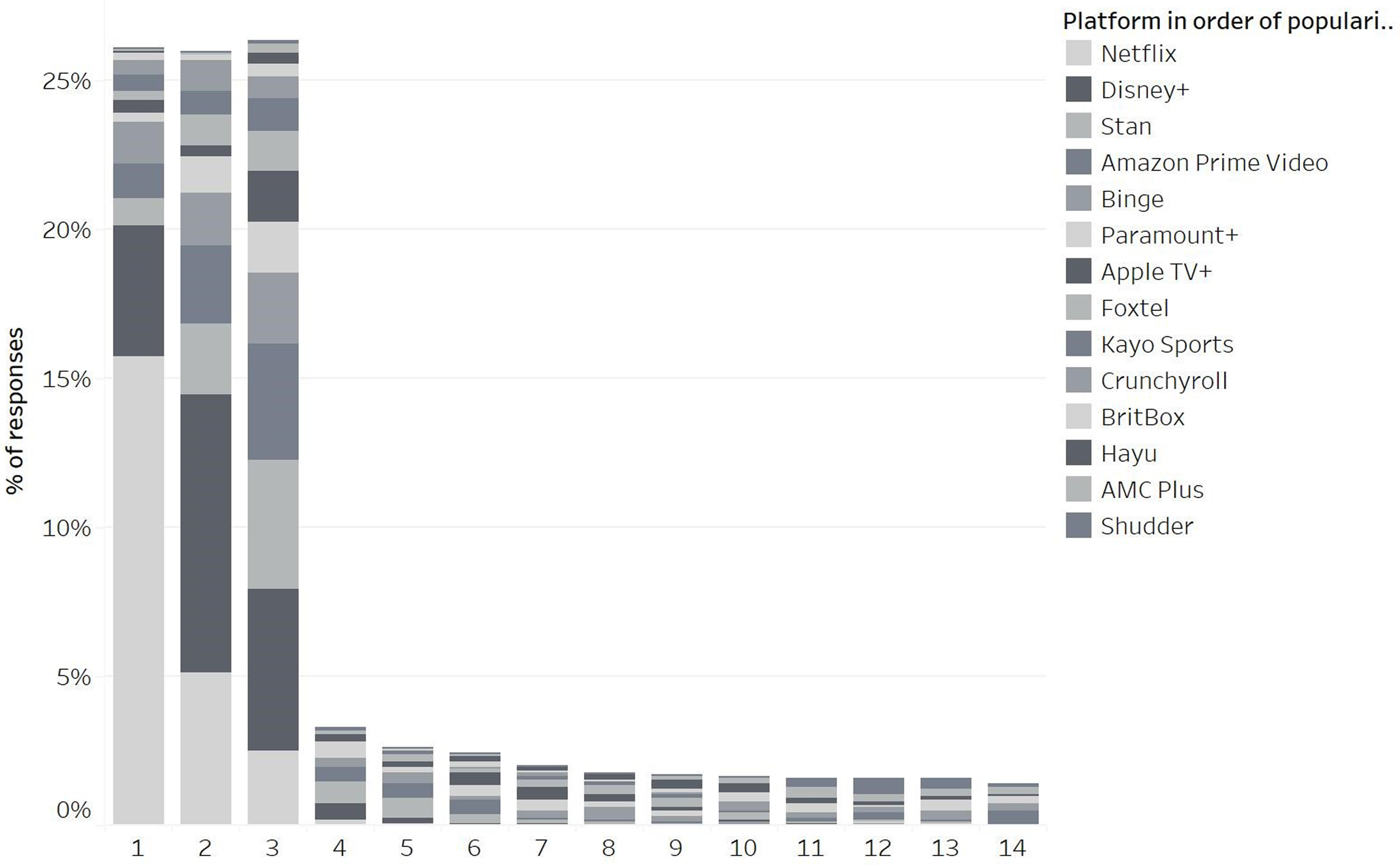
Platforms and services rankings.
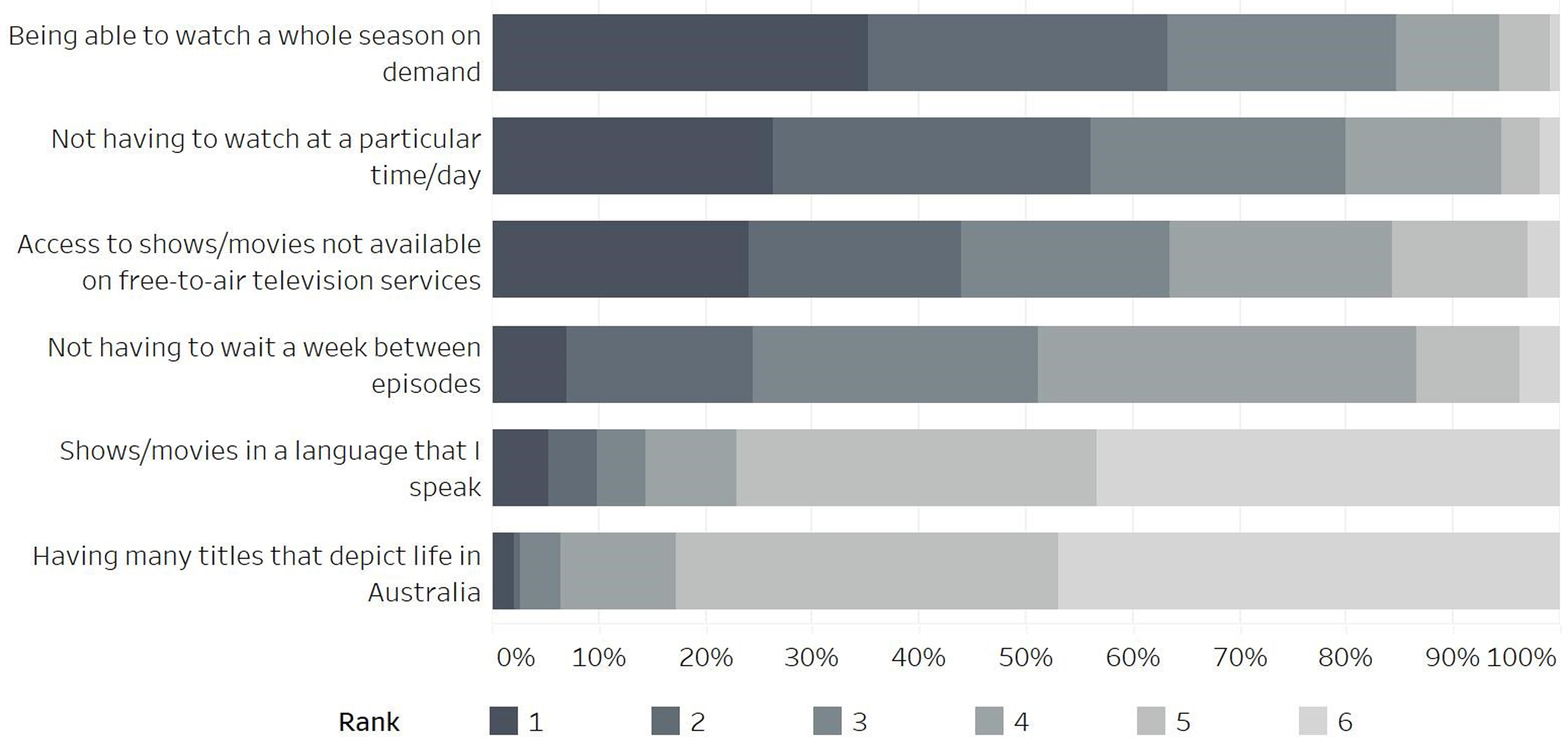
Ranked importance of streaming service features.
Teen participants’ low prioritising of the availability of Australian content as a feature of streaming services is very much at odds with decades of Australian broadcasting policy. Historically, Australian governments pursued a policy agenda that foregrounded the importance of domestically produced drama and children's programs as a means of socialising and uniting Australian viewers, particularly young audiences. As part of this agenda of national cultural representation, broadcasting policy frameworks from the late 1970s compelled Australia's three commercial broadcasters Seven, Nine and Ten to provide 32 h each a year of new Australian children's drama. The government also provides direct subsidies and tax breaks to children's drama producers, because of the genre's relatively high costs and perceived importance to young audiences (Potter, 2015). In 2021 however, the Morrison government removed all children's quota obligations from commercial broadcasters, after decades of lobbying bolstered by declining ratings for children's drama. This policy development left ABC largely responsible for the provision of domestically produced children's television for Australian audiences, including through the children's channel ABC launched in 2009, ABCME.
Initially, ABCME provided new Australian drama for teen audiences, such as the flagship series set in a Sydney ballet school, Dance Academy (2010–2013), that attracted over 1 million viewers a week (ACTF, 2011), and fantasy action-adventure Nowhere Boys (2013–2018). The provision of children's programs is a ‘defining principle’ of Public Service Broadcasting (Buckingham et al., 1999: 66). However, PSBs with a few exceptions (see Sundet, 2020) have become reluctant to invest scant resources in teenagers; in 2016, PSB children's channels in Australia, the United Kingdom and Canada all lowered their top target age group to 12 (Potter, 2017). Instead of providing drama for teens, PSBs including the ABC are choosing to concentrate their resources in programming for much younger children particularly pre-schoolers whose caregivers generally manage their viewing. Many PSBs including the ABC have thus abandoned the commission and acquisition of domestically produced programs for the teenage audience, believing they have largely been lost to other digital screen-based pursuits.
SVODs sit outside national regulatory frameworks for broadcasting and are therefore exempt from the kind of Australian content regulations to which commercial broadcasters were subject until 2021. Since 2017 industry stakeholders including the Screen Producers Association (SPA) have lobbied for policy changes, including a Make it Australian campaign, that would create what they call ‘a level playing field’ by obliging global streamers operating in Australia to invest in Australian content (Deaner, 2017). In July 2023, SPA released data claiming that 81% of Australians want to see more ‘Australian-made’ films and television series, data suggesting strong local support for Australian content (SPA, 2023). SPA CEO Matthew Deaner used the report SPA commissioned from market research provider Roy Morgan to bolster the industry organisation's long-running efforts to secure Australian content obligations on US-based streaming services such as Netflix, arguing that: ‘Government investment requirements on streaming platforms is … a win for audiences, a win for cultural impact and a win for the screen industry’ (SPA, 2023).
In 2024, the current Australian government appears confident that the use of local content obligations on US-based SVODs will deliver both cultural and economic objectives to Australians, despite these services prioritising global audiences and having unstable business models (Lotz and Potter, 2022). A commitment to regulating SVODs was finally made as part of the Albanese government's 2023 Revive cultural policy (Commonwealth Government, 2023). No detail exists, however, around what those obligations would look like, or whether under-served audiences such as Australian teens would be prioritised in their design.
To gain further insights into teenagers’ engagement with Australian content, survey respondents were also asked to list their top three favourite movies, dramas and comedies. 1 When asked why they liked the titles listed, by far the most popular attribute was an engaging storyline, with 344 survey respondents (49%) selecting this option; teens also highly ranked their top title's themes (n = 286, 41%) the genre (n = 285, 41%) and the fact it was funny (n = 293, 42%). Only 46 respondents (6.6%) selected an Australian setting for their favourite title as a reason for its attraction, the lowest count (see Figure 3). The data reiterate the low priority teens place on Australian content when selecting their favourite titles. The chart indicates a significantly consistent prioritising not just at the top and bottom end of the scale but throughout. Preferencing flexibility to stream desired content on demand over having access to locally made content suggests teenagers define themselves as more transnational consumers and are connecting with stories for different reasons than any national cultural connection.
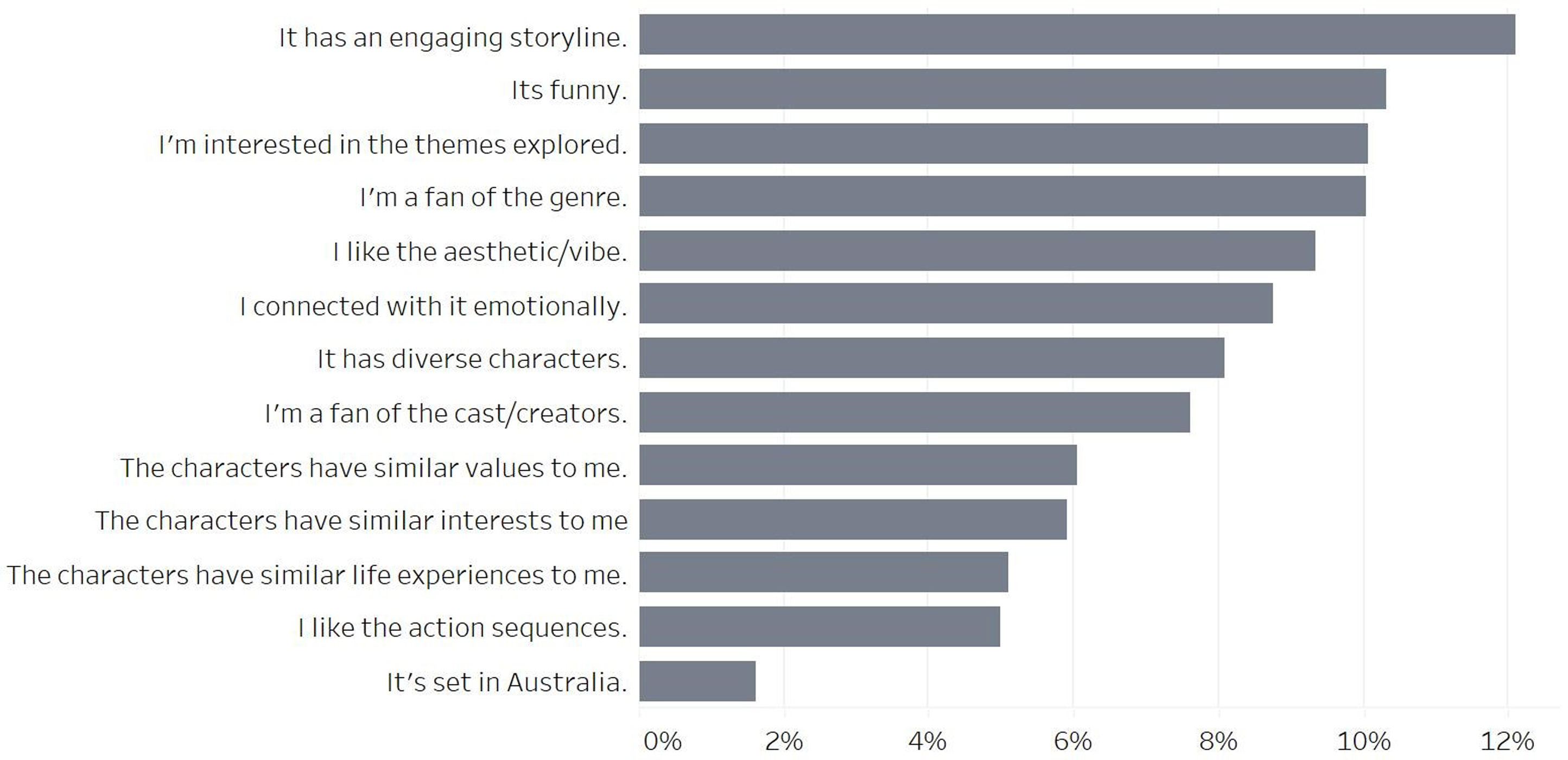
Reasons for liking favourite movies, TV dramas and comedies.
Australian teens are not drawn to content based on the nation of production or setting, despite Australia's sustained policy agenda of national cultural representation. Humour and engagement are, however, high on their preferred attributes. Similarly in Denmark, which also has a policy history of strong protections and support for domestically produced content, Jensen and Mitric's (2023) study of 8- to 17-year-olds reveals their top 10 most mentioned movies included no Danish titles. Danish teens enjoyed established movie franchises including Lord of the Rings and Harry Potter In the Danish study, Danish films and series appear as a ‘non-standard and arguably anomalous supplement’ (Jensen and Mitric, 2023: 56). It is clear from our own project's data that Australian teens engage with long-form content for a variety of reasons, including to relax with humorous and engaging stories. An Australian setting is a very low priority for most teens’ favourite screen stories.
Since the respondents in our study could select more than one option, this picture of their use of scripted stories for entertainment rather than for consuming national content is nuanced. The thickness in the middle levels of Figure 3 reveals genre and aesthetic knowledge, diverse representation, and similar values/character interests to be significant factors. Overall, the data suggests teen audiences want content that they can engage with emotionally, that represents issues that affect them but is not, crucially, set in Australia. This focus on affect and diversity in content consumption is reflected in the workshop data discussed in more depth below.
Difficult or mediated access to Australian content
Data gathered in the project's workshops display similar ambivalence to Australian content as that found in the survey. Several teens stated they do not watch or desire to watch Australian content. For example, one teen stated: ‘I don't really want to watch shows that are about Australia. I just feel like I pretty much already know what Australia's like’. Several teens stated that Australian content was not easy to locate or as available as other options: I feel like when it comes to Australian TV, the fact that it's not watched as much isn’t that I don't want to watch it. It's more that there's kind of a lack of it on Netflix or other things.
For some teens, adults mediate their access to Australian content. Several teens in workshops reported that their parents sometimes influenced their viewing, especially when asked about Australian content. Parents and other family members may intentionally recommend specific content or teens may just encounter content in a shared family viewing room: Mum tried … this zombie thing, there was an Aboriginal community and there was zombies (Firebite, Warwick Thornton's Vampire series) …. And there's also … Ten Pound Poms … I loved that so much … Ten-Pound Poms in the 1950s … came to Australia and then trying to fit in and living in those hangers … one of the main guys talking to one of the Aboriginal people … (and the white Australians say) ‘You shouldn't be talking to him. He's a bad person’. And him [the ten-pound pom] not understanding that. Yeah. Mum started watching it and then I was lucky enough to be there when she put the first episode on. So, I got into it, and I was like, oh, this is pretty nice. So, I went into my room, and I'd be watching, going through and watching more. I thought of another one that I saw when I was young, it was The Sapphires. That I liked. That's lovely.
Teens were also cognisant of the place of Australian screen content in their secondary school curriculum. When asked directly in workshops for any example of an ‘Australian drama or movie that you watched or you thought was good’ several teens talked about exposure to films featuring Aboriginal characters: …we’ve been watching a few in English. We watched one called The Sapphires. Like an Aboriginal story, a movie. I liked that. And then we watched Rabbit Proof Fence and I like that stuff. I liked their story.
Several teens enjoyed Rabbit Proof Fence as part of the Australian secondary school curriculum. It is important that teens are experiencing representations of Aboriginal and Torres Strait Islander experiences and stories in schools and significant that teens frequently thought of Indigenous stories when asked about Australian content. These are atypical viewing experiences, however, and may speak more to national curriculum priorities. They may also be evidence of learning enjoyment comparative to other curriculum experiences rather than teen viewing priorities. The Sapphires and Rabbit Proof Fence were the repeated examples teens provided of schools’ selection of Australian content that reflects a strong curriculum bias to historical narratives. Parental or school influence caused teens to watch these forms of Australian content; they did not autonomously discover and select them because they were Australian or frequently told stories from the perspectives of Indigenous Australians. Although they enjoyed the diverse representation these movies included, their Australianness was not central to teens’ identification and discussion of these works.
Australian content is associated with nostalgic childhood viewing
Workshop participants did recall examples of Australian dramas that they had watched with enthusiasm, despite survey participants ranking a show being set in Australia as a low priority. Further, when both survey respondents and workshop participants were asked to list any Australian drama series that they had watched, most were able to name one and sometimes more than one. Some of these were dramas and comedies specifically targeted at teens,but not all. For instance: Bump (Stan 2021–2023) was really funny. It was about a teen pregnancy who had no idea she was pregnant [sic]. And it was good. I mean, I watched the second season, but I think I stopped. I don't know.
2
Teens’ lack of recognition of PSB content is concerning given that as they grow older, today's teenagers will determine the future of PSB. If this group is not recognising how PSB is serving national audiences or connecting and engaging with PSB now, can teens be expected to do so in the future? It is unclear how teens will differentiate between PSB and commercial content if at all in future, and what might this mean for the public service values and remits of PSBs. The ABC's decision in 2016 to no longer serve teen audiences may have been in response to the proliferation of platforms attractive to that audience, but it also ensured teens’ disengagement from drama on the national broadcaster. The decision also abrogated the ABC's Charter responsibilities to all audiences, including young audiences. Previous generations of teens may have turned away from linear broadcasters and Australian content, only to return as adults, given the scarcity of content choices available pre-digitisation. Given the enormous range of services now available and the lack of interest shown in the teen audience by Australian broadcasters, regulators and screen industries, that assumption can no longer be made.
Many of the teens in our research had fond memories of their experiences watching Australian content, even if they could not remember or interpret the show as Australian. For example, one participant said: ‘I don't watch anything Australian … H20's Australian? I forgot about H20! That's my favourite TV show on the whole planet!’ Overall, then, the place of Australian content was more a feature of pre-teen viewing: I watched Nowhere Boys (ABC Me, 2013–2018), loved that one. I loved the mystery… There was one I watched in England. I’ve seen it over here. It was called Koala Brothers (ABC Kids, 2003–2007). They'd be flying all around trying to help out. I would always love Koala Brothers and I feel like they were Australian. It was on ABC Kids.
The Australian content discussed by workshop participants was not part of their contemporaneous, adolescent viewing experiences and preferences, as one put it: … that was really my childhood. I have really haven't watched a lot of Australian TV and Heartbreak High was probably one of the first ones I'd seen.
Australian content, then, has a nostalgic resonance in viewing memories for many teens and may be a place to comfortingly return to. But it is not part of their teen viewing preferences or selections.
Given the decades of cultural policy-making and the growing public subsidies that go into supporting Australian screen stories, teen viewers’ lack of interest and awareness in whether content is Australian or not is striking. As they grow older, today's teenagers will largely determine the norms and settings of television and television-like services and the cultural policy frameworks that govern them. In Australia, they will determine the extent to which domestic production of screen stories continues to be supported, including through any local content obligations, generous tax rebates, and well-resourced systems of PSB. Their views on the significance of Australian-made film and drama are therefore highly pertinent.
As the respondent's comment above suggests, Netflix's 2022 Australian reboot of Heartbreak High was a marked exception to teens’ general lack of independent engagement with Australian stories.
Diverse representation is highly valued in Australian content
Originally broadcast in the 1990s (Network Ten, 1994–1996; ABC, 1997–1999), Netflix released a reboot of Heartbreak High in September 2022 during the middle of the data collection for this project. The series was well received by critics and remained in Netflix's Top 10 TV English titles for its first three weeks (Sun, 2022). As a recent release on a major SVOD, Heartbreak High was a common talking point for many teens, who were particularly drawn to the characters, storyline and representation of neurodivergence, as well as diverse representations of sexuality, gender and ethnicity. During one focus group discussion, participants offered the following reasons for liking the programme: ‘I like Quinni (Chloe Hayden), they actually represent how autistic people are through their day-to-day lives’ and another ‘I like how there were First Nations people … (It's not) just all white Australian cast. There's a diversity’.
Teens also reported enjoyment listening to Australian accents and familiar vernacular used in the show, such as ‘bin chickens’ referring to an urban scavenging bird, the ibis. Similarly, they laughed at ‘eshay’: a common slang term in Australia for a male working-class youth subculture, associated with sports brands, disruptive behaviour and crime. Participants reported enjoying the construction of an ‘eshay’ character Ca$h (Will McDonald), who they felt was humanised and disrupted classist stereotypes. The complication of stereotypes was also important to many participants in relation to the construction of one (of three) First Nations teen characters in the series, Malakai (Thomas Weatherall): Heartbreak High was probably one of the first (Australian shows) I'd seen being a teenager, and it was weird—so weird to hear the accent. Like it just didn't feel right. But I mean they did a pretty good job. There was one character who was Indigenous Australian, and he had like issues with like the police and brutality. And that was really interesting to see…
The workshops revealed the teen participants were savvy consumers and aware of how Australian drama contains not just a narrative but a sense of Australia as unreal, cliched, and even exotic. In fact, the way the show represented the Australian teen experience was sometimes criticised as inauthentic. The age of the characters was one critique as many participants felt the actors were a lot older than the characters they represented. Participants appreciated the plot lines for their sexual educative potential but were seen by several participants to be ‘a bit full on’ and ‘unrealistic’ in terms of the sexually adventurous characters’ activities. Many participants felt the lack of school uniform reflected a desire to appeal to more ‘American’ screen markets and did not reflect Australian school culture: ‘If they were all in uniform it would be so much better.’ This was not an isolated observation.
In discussing children's dramas H20: Just Add Water and Mako Mermaids, teens offered the notion of a cliched beach environment with unrealistic mermaids. As one participant observed: Mako Mermaids – that's an Australian show, but it has mermaids. And so, it's like unrealistic with Australian life … Ironically, the one show that does have a really good representation of Australian every day-to-day life is Bluey, even though it's about cartoon dogs. Well, for example in H2O, Rikki (Cariba Heine) is like a badass and she kind of like stands up for everyone, doesn’t care. But then Emma's (Claire Holt) really like studious and always has to study for her exams … I resonate with Emma because I am studious, I do a dual degree and it's hard, but then I still like do things that Rikki does so it's hard to just like … I don't resonate with Cleo (Phoebe Tonkin).
The positive response to representation here is individual, teen relatability. There were negative responses to some Australian content. Workshop participants critiqued what they saw as producers capitalising on previous successes in teen drama set in Australia to produce formulaic content: Did you ever watch Mako Mermaids, the rip-off one? (audible gasps from Teen 1) I didn’t like it as much … I haven't watched that really since I was like 12 … and H20 was more iconic. I feel like H20 was the mermaid show, and then Mako Mermaids came on and it was like, we already have this.
In making such observations, teens demonstrated fatigue with the replication of palatable, unrealistic and marketed forms of Australian life. As suggested above, Australian stereotypes were frequently discussed. Some participants also showed awareness of the historical recycling of the cliched, rugged itinerant bushman, intrinsic to myths of Australian identity: ‘And yeah ever since Crocodile Dundee (Peter Faiman, 1986) … it's always been like “shrimp on the barbie” and like over-stereotyped in some way.’
Related to this critique of stereotypes was criticism of the whiteness of Australian drama in contrast to teens’ appreciation of Australian movies foregrounding Indigenous stories discussed earlier. As one participant noted: ‘With Australian shows there's also focus on white Australia, not First Nations Australians.’ There was also criticism of more overt racist content, especially as a reason for avoiding content, as one teen suggested: ‘I haven't seen Jonah from Tonga, I feel like I would get too annoyed by all the racism.’ Teen viewers clearly had some awareness of the Australian drama available and were critical of any homogenising and exclusionary practices in terms of diverse representations of Australian identities. This reality is recognised in the recent Seeing Ourselves 2 – Diversity, equity and inclusion in Australian TV drama report by Screen Australia, which demonstrates that cultural diversity has increased in Australian children's television but representations of disability and LGBTQIA+ identities remain limited (Screen Australia, 2023: 56). As previously mentioned, however, the teens in our project were not seeing Australian content as crucial to their viewing.
Conclusion: implications for policy and production
This research does not seek to define teen viewing habits but to provide a snapshot of how a small number of Australian teenagers engage with long-form scripted content on linear and streaming services. We have focussed here on teens’ opinions of and engagement with Australian content because they are so at odds with the sustained Australian cultural policy agenda of cultural nationalism that has operated since the 1970s. Teenagers’ lack of enthusiasm for Australian stories also belies industry claims that Australian audiences are clamouring for more Australian film and TV series (SPA, 2023), claims that are often used to justify greater protections including increased public funding for the screen production sector in Australia.
Our findings highlight the importance of conducting audience research with Australian teens about how and why they engage with long-form scripted stories. Teens are an audience that foretells the future of adult viewing behaviours and will determine future existing cultural policy frameworks for Australian content. Today's teenagers have grown up in digital conditions of content abundance rather than mass media's analogue conditions of content scarcity. Previously both industry and scholars (see, for example, Straubhaar, 1991) assumed television audiences preferred local content, rather than recognising this was most likely due to their having few other viewing choices. Digital distribution technologies that allow access to an enormous range of stories from all over the world have forced scholars to revisit these previously held convictions as well as those related to the cultural function of domestically produced children's television dramas (Potter, 2020). The teen voices heard here suggest a growing engagement with screen stories internationally, facilitated by access to global streaming services and a de-prioritising of Australian content. The research presented here also indicates it is important to understand the overlooked teen audience as both a savvy interpreter of media content and as frequently engaging in long-form content, not just gaming and social media.
Teens viewing habits and preferences also pose a challenge to public service broadcasters competing for their attention against seemingly insurmountable odds with finite resources. Unlike national PSBs, global SVODs such as Netflix and Disney+ can aggregate audiences globally, which provides significant economies of scale when producing drama made specifically for teens (Potter, 2023). This change in the status of the previously neglected teen audience highlights the need for more audience research about why teens connect with screen stories, particularly the international dramas made specifically for their age group. Such research would also support Australian PSBs to better accommodate teens’ viewing needs in future, in order to remain relevant to this group as they grow older. Policymakers, producers and public service broadcasters would all benefit from being better equipped to respond to teen viewing priorities in the future.
Footnotes
Declaration of conflicting interests
The authors declared no potential conflicts of interest with respect to the research, authorship, and/or publication of this article.
Funding
The authors received no financial support for the research, authorship, and/or publication of this article.
