



Abstract
We examine how TikTok expanded into the South Korean landscape by utilizing K-pop as a vehicle, thus demonstrating the theory of ‘platformed glocalization’. After several failed attempts to enter the Korean market – having been stigmatized as a ‘vulgar Chinese app’ – TikTok Korea eventually launched a successful event series known as ‘TikTok Stage’ to leverage on the gaps in the K-pop market arising from the COVID-19 pandemic. While ‘platformization’ has been studied as the pervasive reach and impact of platforms on cultures, we showcase the potential for a variant that we term ‘platformed glocalization’, usually observed when domestic market cultures and their associated socio-politics are particularly strong. We investigate K-pop stars and fans’ ‘promotional labour’ during the events, which is essential in the process of platformed glocalization. We discuss how the mainstream entertainment industry and newly emerging social media platforms work in tandem to produce a market-specific mobilization of digital cultures.
Introduction
Knowing Bros: ‘Dance is trendy these days, right? Seung-Hoon uploads dance videos on TikTok.’ Seung-Hoon: ‘There are easy dances you can follow, as well as difficult dances. Check out the dances.’ [SH gives a demonstration] KB: ‘He is serious about this […] Hey, why do you dance motionlessly in the same spot? […] Is that a trendy dance?’ SH: ‘You don’t move your legs.’ […] KB: ‘You pester other members to get a lot of views. You shouldn’t do that. Who do you pester?’ SH: ‘I do it because fans love it. To provide content for the fans. I do what the agency can’t do in my own time.’ KB: ‘You do it for WINNER.’ SH: ‘That's right.’ […] KB: ‘Teach us how we should dance in order to get a lot of views.’ –Snippet of an interview with Seung-Hoon, member of idol group WINNER, in ‘Winner’ (2022) from Knowing Bros [아는 형님 or ‘Aneun Hyeongnim’], a prominent variety talk show programme in South Korea; translation by Netflix.
Having first launched in South Korea (hereafter Korea) in November 2017, TikTok developed various marketing strategies to gain a foothold in this competitive media economy. Milestone marketing strategies have included offline events for fans to meet with influencers, social media challenges with food-and-beverage companies (e.g. McDonald Korea's Big Mac Song challenge), and even rigorous advertising on mainstream entertainment outlets such as television, digital billboards, and mobile screens on public transport. Cross-platform marketing was also sighted on competitor apps like YouTube and Instagram. However, as we will demonstrate below, these early attempts were not successful as TikTok carried a reputation for being a ‘Chinese app’ laden with user privacy concerns, and was later accused of being vulgar for hosting seductive and immature content for younger audiences. Yet, in the months following the COVID-19 pandemic in 2020, TikTok swiftly rose to become one of the most downloaded and celebrated apps in Korea, in partnership with K-pop entertainment agencies and their stars through a series of events known as ‘TikTok Stage’. The resulting impact in the years since has seen TikTok vernacular and norms seep into almost every aspect of the K-pop industry, from the dance choreography to interactions and celebrity disclosures on social media. Further, TikTok-driven meme cultures have popularized the use of ‘audio memes’ as a template, where the quality, texture, and emotional quality of sounds are used as popular vehicles to create and distribute trends (Abidin and Kaye, 2021). In the context of the music industry, the potential for such audio memes to go viral has seen an uptake of artists using TikTok for publicity (Kaye, 2022). Even veteran K-pop stars like Psy – who has been active as a singer and producer since 2001 and whose 2012 record-breaking hit ‘Gangnam Style’ has been widely credited for popularizing K-pop around the world – have signed up to TikTok, after his song went viral on the platform (Kim, 2022a).
This partnership between TikTok and the K-pop industry is symbiotic. On the one hand, TikTok Stage events that were broadcast live globally have provided opportunities for the K-pop industry to stay afloat and remain connected with international audiences, in the face of restrictions on physical events during the pandemic. On the other hand, the events served to recoup from TikTok's previously fraught market entries by harnessing the reputational value of the K-pop industry. What this demonstrates is a variant of ‘platformization’. Platformization is a concept that explains ‘the penetration of economic and infrastructural extensions of online platforms into the web, affecting the production, distribution, and circulation of cultural content’ (Nieborg and Poell, 2018: 4275). Platformization has noted the pervasive reach and impact of (usually US-based Silicon Valley) platforms on local cultures and practices by (re)organizing the existing web ecosystems of cultural production and exchange in line with platform features (Nieborg and Poell, 2018; Poell et al., 2019; Steinberg, 2020).
However, our ethnographic study showcases the potential for a variant we term ‘platformed glocalization’, usually observed when domestic market cultures and their associated socio-politics are particularly strong, resulting in platforms having to ‘bend to’ the local market to compromise with local norms and mores. When platforms introduce the new operational systems of cultural industries to locals in their market penetration efforts, glocalization is strategically employed to ‘meet the expectations of locally situated audiences’ (Sigismondi and Ciofalo, 2022: 316). Ritzer (2003: 193) defines glocalization as ‘the interpenetration of the global and the local, resulting in unique outcomes in different geographic areas’. When global platforms attempt to enter foreign markets, they often struggle and may even encounter backlash from local markets for not understanding local cultures properly, or for not considering the specificities of local systems of cultural content production and circulation (Jin, 2015; Mozur, 2016; Sigismondi and Ciofalo, 2022). By strategically adjusting their platform features – that are otherwise universally used across various markets – for the local systems, global platforms gain a foothold and further expand their reach in the local markets. We offer that this process of platformed glocalization is the customization, adaptation, and accommodation of (usually foreign) platforms as they take root in local markets, by complying to the domestic political, cultural, and economic contexts, to maximize user compatibility and uptake.
In this article, we trace the early histories of TikTok's entry into the Korean market, especially as it was facilitated through the K-pop industry during a time of increased internet use over the COVID-19 pandemic. To show how the short video platform has navigated the digital media and K-pop industries in Korea, and to demonstrate the operationalization of platformed glocalization, we focus especially on the networked promotional labour by K-pop stars and fans as they have transposed K-pop cultures and traditions onto TikTok. To begin, we provide a brief context of the role of social media in the K-pop industry.
The K-pop industry on social media
As social media has become ubiquitous, celebrity-fan relationships have drastically changed over the past two decades. In the twenty-first century mediascape where one's personal lives are casually posted and easily accessed on social media platforms, the ‘secret’, ‘hidden’, ‘personal’, and ‘authentic’ aspects of celebrity lives are constantly demanded among fan-audiences on social media. Celebrities, including traditional celebrities and relatively nascent internet celebrities, practice various labours to showcase their ‘backstage’ performance, making their media personae intimate, authentic, and approachable (Abidin, 2016, 2018). It is popularly sighted that traditional celebrities share snippets of their personal and private lives on Instagram and YouTube, show their goofy personalities on TikTok, and directly interact with fans and audiences via Twitter (Click et al., 2013; Marwick and boyd, 2011; Wurzburger, 2020). Fans laboriously work as prosumers and produce various contents about celebrities’ personal lives, sometimes by almost stalking their privacy, taking paparazzi-style photos, and sharing such personal information with the fandom (Williams and Ho, 2016). In particular, engagement metrics and streaming practices are central to K-pop fandom norms on social media.
Social media metrics
Social media has a particular stronghold on the K-pop industry, concerning especially the reliance on platforms for measuring success and for maintaining celebrity-fan relationships. In the first instance, many live music TV shows – such as Inkigayo (SBS), M Countdown (Mnet), Music Bank (KBS), Show! Music Core (MBC) – operate via a charting system that ranks the most ‘popular’ songs every week via a combination of digital and social media: the amount of album sales and digital sales, the result of audience votes for stars via social media platforms, and ‘SNS points’ (Channel Korea, 2020; Lee, 2013). The SNS point criterion was introduced in 2013, reflecting the increased use and importance of social media in the K-pop industry, and measures the success of K-pop releases through the number of views and likes accumulated by a song or a celebrity on various social media and streaming platforms (Lee, 2013).
This has given rise to several social media practices that have become a mainstay among K-pop fandoms known as ‘chonggong’ [‘총공’, trans. ‘collective attack’] – the collective coordinated action undertaken by fans, usually organized by fandom leaders and gatekeepers, to streamline efforts to break digital and social media metric records (Chang, 2022; Kang et al., 2022). This collective fan action is exercised across the world (Jung, 2012), and even across different fandoms for ‘mutual help’ (Kang et al., 2022: 1483). Specific practices include ‘suming’ [‘스밍’, trans. ‘collective attack for streaming’] which is the mass streaming and purchasing of digital releases within a short period of time; ‘tupyo chonggong’ [‘투표총공’, trans. ‘collective attack for votes’] which is the streamlined coordination of multiple accounts to collectively send votes in to live music shows; and ‘munkku chonggong’ [‘문구총공’, trans. ‘collective attack for search trends’] which is the collective agreement to mass post under a pre-agreed dedicated hashtag on social media, or mass search a pre-agreed set of key terms on search engine platforms to enhance the visibility of K-pop stars on globally trending lists (Kim, 2020a; Ko, 2018). All these practices are undertaken by fandoms as a duty to demonstrate their loyalty and enthusiasm towards their favourite stars [화력, ‘hawryuk’], with the end goal of growing the size of their group to win various K-pop fandom competitions. In return for such fan dedication, K-pop stars often offer as ‘pay back’ or reciprocal gifting, exclusive opportunities for fans to feel intimate with them (Chang, 2022) through livestreaming events.
Livestreaming
One of the most common livestreaming practices in the K-pop industry is the ‘fan meeting’, where K-pop stars causally interact with fans through ‘group broadcasts’ via social media features like Instagram Live, or through ‘exclusive dyadic’ exchanges in video calls of roughly 1.5 to 2 min (Jung, 2020). The latter is usually a ticketed and premium afforded only to the most loyal of fans who earn the opportunity through album purchases, fandom competitions, or lottery draws. Apart from such scheduled livestreamed fan meetings, K-pop stars also often take to a casual talking head format to conduct live Q&As, livestream eating sessions, or live vlog as ways to connect with their audiences. These are usually curated to appear more intimate and casual, with settings like K-pop stars clad in pyjamas sans make-up in their bedrooms, as mediated performances of authenticity (Kim, 2021; King-O’Riain, 2021).
However, these simulated feelings of ‘liveness’ are not new, but a cornerstone of the K-pop industry since its early days of being televised. Since the late-1990s, live music shows like Ingigayo (SBS) have endeavoured to deliver a sense of liveness through the TV screen, for audiences at home to simulate the experience of a live concert (Kim, 2018b). With the advent of online video and social media platforms, TV stations have also taken to curating ‘fan cams’, ‘behind the scenes’ footage, pre-recorded previews, and exclusive teasers for fans to consume as ‘mediatized liveness’ (Kim, 2018b), facilitating a ‘degree of emotional rapport between performances and audiences’ (Kim, 2018b: 73–74) who co-experience the performance.
When the COVID-19 pandemic broke out in early 2020, opportunities for in-person concerts, fan meetings, and branded events took a sudden pause. As lockdown and self-isolation decrees were announced, live televised performances and competitive charting shows were also briefly put on hold. While some K-pop stars continued to maintain connections with fans through social media posts and livestreams, concerts and performances as a whole came to a halt. It was against this backdrop that TikTok's re-entry into the Korean market finally gained a foothold by providing the literal ‘platform’ for K-pop stars to perform on. In the next section, we detail the methodology undertaken for our study.
Methodology
In this article, we utilize a mixed-method approach comprising press archival research, document analysis, content analysis, and digital ethnography. This approach is needed to grasp an overview of how TikTok has repeatedly attempted to enter the competitive Korean media market, how users have reacted to such attempts within the Korean sociocultural contexts, what key issues have emerged in this process, and how the platform has settled within the Korean social media ecology. To do so, we designed our methodology in three sections: (1) researching the general discourse around the platform and culture by using news articles and social media posts about TikTok; (2) tracing the company's marketing strategies by looking at its PR materials, events, and partnerships or tensions with the related stakeholders (e.g. entertainment industry, other social media platforms); and (3) mapping out the cultural changes and trends brought by TikTok by observing TikTok contents and related social media posts. Below we detail each specific method.
Press archival research
In our press archival research on news articles, we used the keyword ‘틱톡’ [‘TikTok’] on Google News Search and Korean news search engine BigKinds, gathering news coverage on TikTok from September 2017 (when TikTok was launched in the global market) to December 2020, resulting in a corpus of 6685 articles. After the initial screening of the data corpus, two thematic groups emerged: (1) news articles about various social, political and cultural issues around TikTok (n = 6615) and (2) articles on the TikTok Stage events specifically, inclusive of tabloid coverage of K-pop stars in the events and PR news about the events (n = 70). Our analysis of the first group was focused on titles, repeated keywords, and topics covered in the articles to contextualize the emerging discourses on TikTok. Our analysis of the second group was more crucial for providing insight into how the TikTok Stage events were positioned and marketized in Korean social media culture alongside the discourses of TikTok.
However, this second corpus revealed some limitations as many pieces were tabloidesque articles focused on the arrival of K-pop stars at the events, and featured little to no information on the actual TikTok Stage initiatives (e.g. Yang, 2020). A smaller group of articles highlighted TikTok's success in the Korean social media climate, often in tandem with their collaborations with the K-pop industry. To supplement this third group of articles, we corroborated our corpus against industry documents.
Document analysis
In the document analysis of public relations (PR) materials from industry, we aimed to understand how TikTok Korea navigated political tensions and other prominent scandals highlighted in the media. We collected the publicly available PR documents from TikTok Korea (e.g. TikTok, 2020a, 2020b, 2020c), and mapped out a selection of marketing strategies deployed throughout their materials. This method was particularly useful for us to reorganize and connect our different datasets – that is, TikTok discourses, TikTok Stage events, K-pop stars’ TikTok contents, K-pop fans’ consumption of TikTok – more coherently against the backdrop of the larger social media entertainment industry in Korea. By doing so, we explored how a new platform like TikTok initially struggled to enter the competitive Korean media market, and how its partnership with K-pop subsequently opened up pathways to the industry.
Content analysis
We conducted content analyses of the emergent TikTok K-pop trends by three K-pop acts – solo rapper and singer Zico, idol group WINNER, and solo rapper and singer Jessi – that took place at the cusp of TikTok Stage's rising popularity in Korea. As we will detail later in the article, the three acts were selected for being among the first K-pop stars to engage with TikTok in innovative ways. Zico's experience with TikTok took the form of virality by happenstance, when his new release ‘Any Song’ became viral as an ‘audio meme’ (Abidin and Kaye, 2021) on the platform in January 2020. WINNER's engagement of TikTok took the form of a promotional campaign for ‘Ddeum’ designed for TikTok in March 2020. Jessi's adoption of TikTok took the form of choreography for ‘NunuNana’ that was designed specifically to be performed on TikTok in August 2020.
For all three K-pop trends, we isolated the original videos published by the K-pop stars on TikTok, identified the official campaign hashtags used in tandem with the song, observed the top 30 videos published on the campaign hashtag on TikTok, and conducted a visual analysis of the video content and the textual contents. Our longitudinal digital ethnography informed 30 posts as the cap for content analyses as the data was often saturated thereafter. The latter includes text in the captions, the video layover, and comment threads. To provide context as to the larger cultural impacts of the TikTok trends, we also juxtapose our analyses against the press archival materials (detailed earlier) that discuss these viral trends.
Digital ethnography
Finally, we conducted digital ethnography on TikTok Korea's emergent relationship with the K-pop industry and culture. Inspired by Pink et al.’s (2018) analytical categories in conducting digital ethnography, we explored the event (e.g. the TikTok Stage events), the practice (i.e. K-pop fans and stars’ interactions on TikTok), and the cultural discourse (i.e. discourses about TikTok on online K-pop fora).
Participant observation was conducted on a series of TikTok Stage events that were hosted in 2020. We focused on the fourth event held in September 2020 (‘TikTok Voice On’), attending the livestream and documenting ethnographic fieldnotes on how the event was organized, how fans and K-pop stars communicated with each other, and how a sense of liveness was mediatized in the event by the platform features among event participants. Based on these notes, we revisited the recordings, video clips, and social media posts on prior TikTok Stage events (often streamed under hashtags #TikTokStageVoiceOn, #TikTokStage, #틱톡스테이지 [#TikTokStage]). We attended to how these events grew in stature with growing partnerships within the industry, and what TikTok-specific media practices were adopted by and creatively strategized among K-pop fans. Later on, we corroborated our observations at subsequent TikTok Stage events through the contents posted on dedicated event hashtags during the duration of the events. An updated list of TikTok Stage events, as at the time of writing, is collated in Table 1.
List of TikTok Stage events by date and format, as of August 2022.
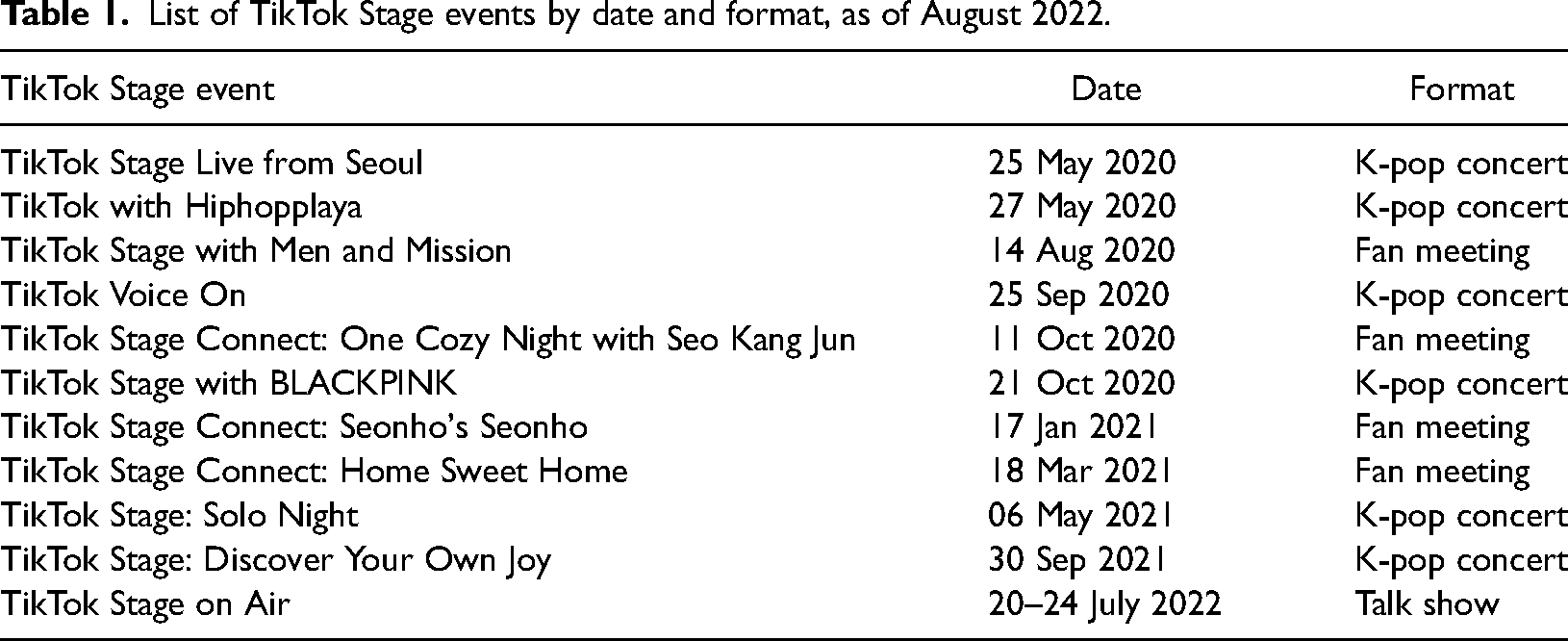
Subsequently, we juxtaposed the ‘event’ data and the ‘practice’ data with a new dataset focused on ‘cultural discourse’, collected through our observation of discussions about TikTok and K-pop on selected fora: the Korean community theqoo, and English-based forum allkpop. Using the search keyword ‘TikTok Stage’ in both English and Korean (‘틱톡스테이지’), we investigated how K-pop fans talked about the events and what they thought of TikTok's entry into the K-pop scene.
TikTok's entry into the Korean market
In this section, we present a summary of findings from our empirical data, detailing a history of TikTok's early attempts to enter the Korean market. This can be simplified into three main stages, typified by the Korean public's initial reactions to the app. They include an aversion to TikTok as a ‘Chinese app’ (around 2018), an annoyance at TikTok as a ‘vulgar app’ (around 2019), and an emergent acceptance to TikTok as a ‘K-pop (challenge) app’ (from 2020 onwards).
Aversion to a ‘Chinese app’
TikTok's first attempt to enter the Korean media market was fraught with anti-Chinese sentiments around 2018. This took place against the backdrop of the Chinese-owned platform being embroiled in geopolitical controversies, specifically as it was widely considered to be a threat to Anglo-American society nominally due to concerns about data security and user privacy but actually because of the rise of Chinese hegemony (Gray, 2021). In Korea, these feelings were especially prevalent among Gen Z users who criticized the Chinese government's authoritarian regime, including the violent crackdown on the democratic movements in Hong Kong (Ahn, 2019). During this period, tensions between Korean and Chinese users became especially volatile on social media, as a war of words broke out on several issues including China's copyright violations of Korean media content (Jang, 2018) and the Chinese government's ban on Korean media content as a retaliative move against the Korea-US alliance (i.e. Korea's deployment of THAAD missile defense system) (Choi, 2019). Against this background, the platformization of TikTok in the Korean media market was unsuccessful as TikTok became a centre of political debates, yielding diplomatic tensions particularly concerning the discourse around emerging Chinese media surveillance.
In the local media, the top three discourses on TikTok and anti-Chinese sentiments in Korea focused on the Chinese government and company's lukewarm response to regulate growing number of provocative and immoral contents on the platform (Kim, 2018a); the Chinese government's surveillance of the platform (Lee, 2019); and data leaks of user information including those in Korea (Yoo, 2020). Following the string of controversies, TikTok's questionable reputation was reinforced among the populace when the Korean government issued the platform a KRW186 million fine, after its six-month long investigation exposed that the data of children under 14 were being collected without parental consent and transferred overseas (Shin, 2020). At this point, the aversion towards TikTok as a ‘Chinese app’ resulted in highly racialized discourses on internet fora: [TikTok is] So scary. They [Chinese government] take pictures of every citizen, almost at the Big Brother level. I think they also leak and use photos of other nationals. (Comment on a thread from theqoo; poster anonymized, translation by authors) I immediately uninstalled it after realizing it's a Chinese app. (Comment on a thread from theqoo; poster anonymized, translation by authors)
Annoyance at a ‘vulgar app’
By 2019, another route taken by TikTok to promote its uptake in Korea was through coordinated advertising on traditional and social media platforms. We observed on-site in Seoul and Busan and via our digital ethnography across various social media platforms that TikTok was executing a number of advertising campaigns. On the likes of Instagram, Twitter, and YouTube, some Korean influencers were sighted cross-promoting TikTok as a new and upcoming platform. But TikTok also tapped into everyday users and content creators to generate interest among the public. Throughout 2019, the ads often included video footage of young people dancing to addictive and repetitive music, as a way to demonstrate the visual culture of TikTok to prospective users. One particular social media campaign was ‘메이크썸틱톡’ [lit. trans. ‘MakeSomeTikTok’], featuring young women showing ‘feminine cuteness’ with skintight clothes, smiley wink faces, and the heart gestures while repeating a simple, short dance to catchy music (see Figure 1).
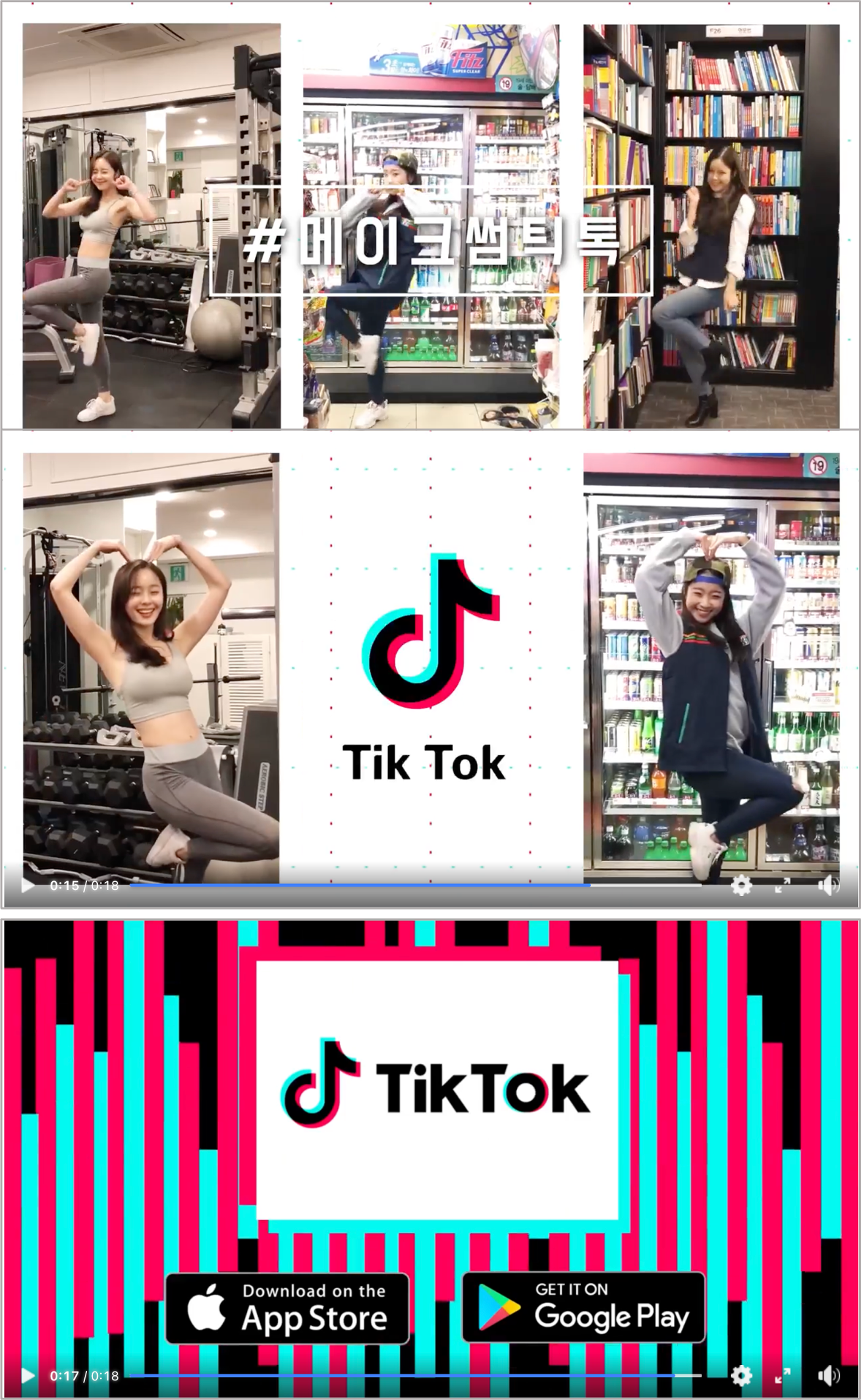
#MakeSomeTikTok YouTube campaign. Archived on the original ad creator Plus Agency's Facebook account (2019). Screengrab by authors.
While the ‘dance’ snippet undertaken in the campaign encapsulated TikTok's most distinctive brand as a ‘short video platform’, the contents of the ad per se roused displeasure among the Korean public. On Korean social media and fora, many social media users described TikTok ads as their ‘biggest pet peeve’ that made them feel ‘annoyed’. In fact, anti-TikTok sentiment was often trending on Twitter through the likes of viral key terms and search phrases like ‘틱톡광고극혐’ [‘TikTok gwango geukhyum’, trans. ‘super-hate TikTok ads’]. Another frequent sentiment that surfaced in the ethnography was the sense of exhaustion towards feeling ‘cringe’ [‘오글거리는’, ‘ogeulgeorineun’] towards TikTok (Choi, 2018; Lee, 2019). For instance, discussions extended on how the campaign was ‘vulgar’ and ‘immature’, leading Korean users to presume that Chinese users were ‘all just pretending to be cute and pretty too much’ (Lee, 2019). The undertones also referred to TikTok being childish, giving rise to more colloquialisms that TikTok was a ‘choding’ [‘초딩’] app – a derogatory term usually used to refer to young children for their immaturity, clumsiness, and low cultural taste in relation to the growing hate against children in Korea (Jieum, n.d.). This backlash against TikTok culture emerged as the biggest setback for TikTok to extend its cultural outreach to Korean media culture.
Emergent acceptance as a ‘K-pop (challenge) app’
Alongside its aforementioned forays into the Korean market, TikTok also began to tap into the mainstream entertainment industry of K-pop. This collaborative work with the K-pop industry facilitated the process of platformization, particularly in regards to the cultural production of K-pop TikTok contents. Media scholar Marc Steinberg notes three distinctive points in the process of platformization: (1) transformation or creation of cultural products and contents; (2) introduction of new markets for the exchange of these contents; (3) transformation of the subjectivities of the actors in the scene (Steinberg, 2020: 2). This is evident through TikTok's collaboration with K-pop, which steered the process by introducing a new genre of K-pop content – that is, the K-pop (TikTok) challenge – and providing the platform space as a new marketing venue for the K-pop industry to sell and circulate the idol contents. TikTok has been successful in the global market by platformizing ways to produce and consume short videos in its introduction of virality-centered meme culture (Kaye et al., 2021). The invention of the K-pop challenge is the local adaptation of this platformization, by adjusting its system of cultural production to the local market situation in Korea.
In Korea, K-pop is not just a mere genre of pop cultures, but the biggest driving force in Korean society and its culture and economy (Joo, 2011; Yoon, 2023). As the country's growth in soft power through K-pop and K-drama has brought ‘palpable economic spin-offs’, including a boost to tourism and an increase of global export of Korean media content (Joo, 2011: 495), many media platforms and companies began to use ‘Korea’ in their brand marketing and collaborate with various stakeholders related to the Korean Wave phenomenon. For example, Netflix has established partnerships with Korean drama studios and TV stations (Park et al., 2022) and launched the playlist of ‘K-dramas’ responding to the growing demands of Korean content (Zhao and Shaw, 2022). TikTok's invention of the K-pop challenge genre can be read within this context. By combining TikTok's most well-known content production format known as the ‘TikTok challenge’ (Vizcaíno-Verdú and Abidin, 2022), with the strongest driving force of Korean pop culture of K-pop, TikTok uniquely customizes its features, functions, and genres to build a new social media ecosystem in Korea, pivoting on its economic compatibility with local specificities. Below, we illustrate how this process of platformed glocalization has developed.
Since 2018, TikTok began to sponsor bespoke prizes at major music award ceremonies, including Mnet's MAMA (December 2018) and the Golden Disc Awards (January 2020). To promote their platform and expand their user base, TikTok had structured the outcome of these awards to be contingent upon fan voting on the app, thus leveraging on the popularity of K-pop stars and the loyalty of fans to give their platform a boost. There were also early attempts to rope in K-pop stars to lend gravitas to the app, such as hosting an in-person fan meeting for Cha Eun-woo – a member of the idol group ASTRO and a highly popular actor and model in Korea (Park, 2018). TikTok also began to engage K-pop stars and Korean actors for their advertising, including the ‘MakeSomeTikTok’ TV commercial featuring soloist Sunmi and actor Lee Jong-suk (Nah, 2019). It was around this time that the first K-pop stars began to get on board TikTok en masse to engage with their fans. However, it was only in 2020 that TikTok became a mainstream platform in the K-pop industry. In our digital ethnography, we identified three key K-pop TikTok milestones by K-pop acts – solo rapper and singer Zico, idol group WINNER, and solo rapper and singer Jessi – that took place at the cusp of TikTok Stage's rising popularity in Korea.
On 2 January 2020, Zico posted his first TikTok and explained that he aimed to ‘communicate with you [the fans] more efficiently and directly’ (@kozico0914, 2020a). In the days that followed, he posted four teaser TikToks to promote his upcoming song, including two TikToks to formally introduce the ‘#AnySongChallenge’, where both he and TikTok Korea invited fans to post TikToks of themselves dancing to his song. The TikTok page of the challenge read: How to participate in the challenge? Just dance to the song ‘AnySong’ randomly, of course it would be great if you can do the choreography. Upload the video with the hashtag #AnysongChallenge and in a public mode. Heighten a possibility to win by sharing it to other SNS. The most exciting challengers (five people) amongst participants will get an ‘AnySong’ album with Zico's autograph. (TikTok, n.d. b)
Since TikTok's audio meme feature seemed able to facilitate rapid virality, in March 2020, idol group WINNER designed two platform-specific promotional campaigns for their new song ‘Ddeum’ especially for TikTok. On both their YouTube channel and newly launched TikTok account, they announced a snippet of their dance dubbed the ‘Finger dance’ as part of the ‘Ddeum’ choreography (WINNER, 2020a), and invited TikTokers to participate in the ‘#DDeumChallengeOnTikTok’ (WINNER, 2020b; @wn_tiktok, 2020). The TikTok version of the dance was scaled down to fit the dimensions of a mobile screen, simplified for easily replication by TikTokers, and also invited TikTokers to use stickers and emoji to enhance their performances. This cross-platform campaign by WINNER demonstrated the early potential of TikTok dance challenges to take flight in tandem with audio memes, giving rise to new opportunities for publicity on social media.
After the resounding success of the TikTok campaigns by Zico and WINNER, and following the first two TikTok Stage events launched in May 2020, K-pop stars swiftly took to TikTok as a new frontier for their publicity efforts. Soon, K-pop singers like Jessi began to design the official choreography for their songs to be tailor-made for performance on TikTok. In August 2020, to accompany her new release ‘NunuNana’, Jessi revealed a dance routine on TikTok dubbed the ‘#NunuNanaChallenge’ (@Itsjessibaby, 2020). The dance featured very limited footwork (to remain within the frame of a mobile screen), and only small limb movements (to be easily replicated). It was evident that the dance routine was augmented for TikTok as the relatively tame moves were a departure from Jessi's usually flamboyant and typically sexualized choreography.
Following this emergent acceptance of TikTok as an app for K-pop challenges, the app's footing and reputation in the K-pop industry was solidified during the period of mass self-isolation during the COVID-19 pandemic. Amidst restrictions on mobility and in-person events in the K-pop industry, and alongside the ‘forced digital acceleration’ of work-from-home contexts (Nagel, 2020), the development of further TikTok Stage events was critical for sustaining the music scene and cementing TikTok's place in the Korean media landscape.
TikTok Stage and promotional labour
In this section, we demonstrate the operationalization of platformed glocalization by TikTok, demonstrating how its features have facilitated the deployment of ‘promotional labour’ from K-pop stars and fans, to retain interest and traffic on the platform. K-pop stars and fans, the most prominent actors in Korean social media cultures, are reconfigured and emerge as key subjects who produce, consume, and circulate new cultural contents of the platform – that is, K-pop TikToks. This illustrates how TikTok adapts to specificities in local markets and how the (free) labour of users is essential and even often taken-for-granted in the process of platformization.
During the COVID-19 pandemic, the music industry turned to utilizing social media as an alternative avenue for online concerts; video platforms with a livestreaming function, like YouTube, have also experienced exponential increase in traffic due to livestreamed online concerts (Snider, 2021). The partnership between online platforms and the music industry affords fans and stars opportunities to remain connected, directly engage with each other, and feel intimacy through live online chats and donations (Kanga, 2022; Snider, 2021). This was also the case in Korea with new lingo like lanseon party or lanseon concert [‘랜선파티’, trans. a party or concert through ethernet cable (‘laneson’, metaphorically meaning internet connection)] being popularly used to refer to the new form of concerts that are livestreamed via social media platforms (cf. Abidin, Barbetta and Lee, 2020). The TikTok Stage event series emerged within these contexts. The rousing success of the TikTok Stage series was no doubt supported by the promotional labour undertaken both by stars and fans, as we will demonstrate below.
Promotional labour
Promotional labour is commonly sighted in the contemporary mediascape, frequently done by celebrities, internet celebrities, and fans (Duffy and Wissinger, 2017; Lawson and Draper, 2021; Willard, 2017). In popular culture, celebrities exercise various media practices to promote their businesses, brand, or reputation, which is ultimately to enhance their media visibility (Duffy and Wissinger, 2017; Lawson and Draper, 2021). While this culture has been common for self-branding in the broader gig economy (Carah, 2014; Marwick, 2013), it is also easily sighted in fan cultures. Fans often voluntarily participate in promoting the cultural texts that they like by prosuming contents related to the original work, and sharing them across their online and offline social networks (Chin, 2014; Cox, 2018; Willard, 2017). Companies and stars also actively use fans’ free labour in their marketing (Abidin, 2016; Baym, 2018), by instigating fan activities and their power of prosumption and leveraging it as ‘promotional vehicles’ in social media (Cox, 2018: n.p.). In other words, promotional labour often involves the curated performance of specific actions with the intention of extracting a symbiotic exchange of value. For instance, while celebrities may lend their reputation and credibility to a brand or product being promoted, they are themselves leveraging the publicity and press around the event to promote themselves.
Drawing from our analysis, we offer that in K-pop culture, promotional labour by celebrities are marked by four key elements: the efforts to leverage on opportunities to remain visible in the media and to fans, to be relevant to popular discourse and increase the likelihood of pedestrian interest in them, and thus to maintain or increase their value and brand as marketable objects. For K-pop stars, ‘schedules’ are opportunities for promotional labour. These are the formal and informal activities pertaining to their work – whether paid or pro bono, whether in the capacity as performers or promoters. Ardent fans have traditionally tabulated and circulated on social media these informal but detailed lists of activities, where even the most mundane and fleeting moments – such as a star's arrival at the lobby of a television station, or their brief walk from their vehicle to the check-in counter at the airport – are among the most documented of such ‘schedules’. As such, fans themselves also partake in a version of promotional labour, which focuses on how to maintain the positive reputation of stars (usually on social media), to curate content that highlights their work and work ethic, and thus extend their shelf life in the spotlight as a current and buzzworthy object.
Specific to the K-pop industry, the promotional labour of fans is practiced in the name of ‘fanshim’ [팬심, a K-pop lingo referring to ‘fan enthusiasm’ or ‘fan's love towards stars’], as a way for fans to publicly demonstrate their authentic, sincere, and unconditional love to the stars (Chang, 2022; Kim, 2022b). While the entertainment industry has conventionally relied on free fan labour for the consumption, circulation, and reproduction of creative work (Baym, 2018; Stanfill and Condis, 2014; Willard, 2016), the promotional labour of fans in the K-pop industry has been considered as integral to its development (Chang, 2022; Sun, 2020) and business model (Jung and Lee, 2009; Oh and Park, 2012). In this section, we consider four devices frequently deployed between stars and fans (and often reciprocally so) to demonstrate how K-pop concert traditions and routines have been transposed onto TikTok – untact, live chats, ment, and fan chants – as forms of promotional labour.
Untact
The neologism ‘untact’ [언택트] is a Korean English-adopted portmanteau from the prefix ‘un’ and the word ‘contact’, meaning ‘non-in-person contact’. As in-person contact was discouraged during COVID-19, the word ‘untact’ is widely used to describe tactics, digital devices, and socio-cultural phenomena that are mediated by media technologies. For example, the Seoul Metropolitan government launched a metaverse platform to handle civil complaints, and the Korean government introduced a COVID-19 self-diagnosis app (Rashid, 2021). In the realm of K-pop, this focused on the rise of virtual concerts (Lee, 2020b).
During the period of ‘untact’, K-pop stars turned their attention to online events like TikTok Stage to maintain and heighten their visibility in the industry and maintain intimacies with (potential) fans. However, the novelty of these virtual approaches became quickly adopted as a mainstay, and fandoms grew to expect ‘untact’ opportunities throughout the pandemic. In fact, it was against this backdrop that new pathways for debuting via social media became common, as aspiring singers could ‘bypass’ the mainstream gatekeepers in the K-pop industry by utilizing social media to disseminate their contents and acquire social capital. One example is female singer-songwriter Seori, who debuted during the pandemic. She had participated in ‘TikTok Stage: Discover Your Own Joy’ to promote her new release and increase her visibility as a newcomer in the K-pop scene (Choi, 2021), in place of using televised competition singing shows to debut, as per tradition. Globally popular idol group BLACKPINK also hosted a TikTok Stage event that was exclusively designed for their fanmeet, scheduled around the release of their first album ‘The Album’, to promote their singles and album sales (Lee, 2020a).
TikTok's vertical screen setting was also effective for showcasing K-pop stars’ dynamic choreographic movement in their performances (Yoon, 2020), and K-pop stars actively incorporated such technical settings in their promotional work at the events. We observed K-pop stars’ performance of intimacy when camera angles focused on the moments where they would engage in ‘eye contact’ with audiences at home, often preceded by an emcee who would announce that it was ‘time’ for the stars to ‘speak to’ or ‘look at’ fans. In a sense, this moment of making untact ‘eye contact’ during the TikTok Stages became a highlight in and of itself, underscoring the efforts made to maintain parasocial relations via the mobile platform.
Parasocial relationships refer to imaginary and affective connections that audiences build with media personae or characters (Horton and Richard Wohl, 1956). The sense of parasociality plays a key role in the media industry, leading people to develop affective registers to media figures and related products and to continue their cultural prosumption (Abidin, 2018; Turner, 2013). In the entertainment industry, this pseudo feeling of being intimate with media figures has been strategically simulated by various devices. For example, settings like ‘talking back to the camera’ have widely been used in TV shows, especially the reality TV genre, to generate people's attention and stimulate a feeling of interaction between audiences and the characters by building the idea of ‘authenticity’ to media characters (Auter, 1992; Chung and Cho, 2014). This is also found in the music industry; fans attend live concerts of their stars and build parasocial relationships with them through a sense of liveness (Baym, 2018; Chang, 2022; Kim, 2018b). In the COVID-19 context, where in-person connections are cumbersome, such feelings of connection are made in an alternative way, through virtual connections mediated through platforms like TikTok. In this way, TikTok Stage configured the platform's communicative features and stage settings to mediate such virtual connections between fans and K-pop stars during TikTok livestreaming events.
For example, TikTok events also featured segments where K-pop stars were scheduled to read out prepared greetings and scripts in the English language for their international fans. When these moments involved idol groups, the camera work would zoom in on just the group member who was speaking English, cutting the other members out of the frame, to give the impression of a dyadic and more intimate conversation between the idol and audiences watching on their mobile phones. As such, K-pop stars’ adept handling of the camera and the stage settings, afforded by TikTok's livestreaming and vertical screen functions, is carefully calculated and undertaken as part of their promotional labour. Such work contributes to building ‘untact intimacy’ among the fans by delivering a new version of ‘mediatized liveness’ of the K-pop scenes (Kim, 2018b), while emphasizing the virtual connection through TikTok screen is ‘genuine’ and ‘authentic’. Among these instances of live activity, live chats are perhaps the most popular practice.
Live chats
In our observation of the TikTok Stage events, K-pop fans often turn to online communities and social media to rally others to join TikTok, to support the activities and performances of their favourite stars. The posts almost always listed specific instructions, such as requesting for (prospective) fans to ‘like’ a TikTok, populate a hashtag with posts, or comment on posts using specific key words. In the context of forced accelerated digitalization brought by the COVID-19 pandemic (Nagel, 2020), live studio audiences are replaced with live chats on the screen, carrying over the ‘mediatized liveness’ (Kim, 2018b) from television to mobile phone. In his explanation of how the idea of liveness is mediatized in the contemporary mediascape, Nick Couldry (2004) contends that ‘liveness’ is ‘not a textual feature’ that was used to be conveyed through television, but a concept of ‘achiev[ing] a shared attention to the “realities” that matter for us as a society’ (Couldry, 2004: 353–356). By capturing the event where a user is situated and posting the captured images on social media, they rebuild the sense of ‘what is happening now’ with their social network. This practice immediately brings the user to their communities and invokes affinity within the community (Couldry, 2004; Hammelburg, 2015). Similarly, a sense of liveness delivered through TikTok Stage helps K-pop fans collectively achieve a shared attention to their stars and reinstate a feeling of connection to their fan communities, which has been difficult to grasp during the COVID era. These opportunities often rouse the interest of K-pop fans, who inevitably promote TikTok in the course of promoting their favourite stars. The following exchange was sighted among the fandom of idol group Pentagon: Should I download TikTok then? I hate to do that…. (Comment on a thread from theqoo; poster anonymized, translation by authors) At last, it's Jung Wooseok [member of idol group Pentagon] who makes me download TikTok. (Comment on a thread from theqoo; poster anonymized, translation by authors) I just reposted [the video clips of TVXQ's TikTok performance] on my Twitter account. Will add other videos that come later too. You can ‘like’ the content when you log on TikTok. So please, click the ‘heart’ button to the content and add comments if you can. Make sure you do these! (Request and reply posted in the TVXQ subpage on theqoo; poster anonymized, translation by authors) Okay, thanks! Will do! (Request and reply posted in the TVXQ subpage on theqoo; poster anonymized, translation by authors)
Ment
At the TikTok Stage events, K-pop stars’ performances are – for the most part – already scripted by backend staff members of TikTok and their agencies. For instance, the set list, the duration of the performance, the interview script, and even what would appear to be informal unscripted conversation known as ‘ment’. Ment is a K-pop lingo, adapted from the English word ‘comment’. In the K-pop scene, ment is frequently found in ‘breaks’ during live concert performances where K-pop stars would take a pause from singing and dancing for interaction with their audience. This can take the form of a greeting to fans, an interactive snippet between members of an idol group, call-and-answer games with audiences, a pre-recorded video, or even ‘in the moment’ interviews with fans on the ground. On a pragmatic note, ment allows the K-pop stars a public water break to rest in the middle of their setlist, undergo swift outfit changes, or enable the sound and stage crew to recalibrate and tend to contingencies.
On TikTok Stage, we observe that ment has been adapted to focus on the expression of gratitude towards fans who continue to support the K-pop stars throughout the pandemic, as well as civic-minded calls to heed safe health practices. To foster a sense of unity and solidarity, K-pop stars also often remind fans that they stand ‘together’ with them – one of the distinctive characteristics of K-pop culture (Chang, 2022) – and will remain ‘connected’ despite the period of untact. For example, the TikTok Stage with BLACKPINK saw the idol group continuously thanking their fans throughout each ment, and rallying together a sense of community and group membership between themselves and the fandom: Rose: I think we all are lucky girls, having been loved so much by fans. Jisoo: You guys, Blink [BLACKPINK's fandom] are the ones who made us. Thanks to all your love, we are here now. Jennie: We’re all sad that we cannot meet you [fans] in person though our first album is now released. But we are here at the TikTok Stage live. So don’t be sad. We’re also planning to make various contents to remain connected with you. Blink, don’t worry! – Snippet of BLACKPINK's ment at TikTok Stage; translation by authors
Fan chants
In hosting the TikTok Stage events, TikTok Korea also executed a few sub-events designed to attract more people to the main series. For example, prior to its fourth concert TikTok Voice On, TikTok Korea promoted the sub-event #TikTokStageVoiceOn challenge (#틱톡스테이지보이스온 in Korean), in which K-pop fans on TikTok were encouraged to record fanchants on the app. This included the use of TikTok's duet function, which is a video template with a split-screen layout that allows users to create a ‘reaction’ video on the right-hand-side, that would play simultaneously with the ‘original’ video to which they are reacting on the left-hand-side. To generate interest, the campaign materials offer that selected fanchants on the dedicated hashtags will be played in the background on screen during the stars’ live performance at TikTok Stage. TikTok Korea has even posted guiding videos to demonstrate how fanchants can work in the virtual space of TikTok Stages, as opportunities for fans to sing along at home (see Figure 2).
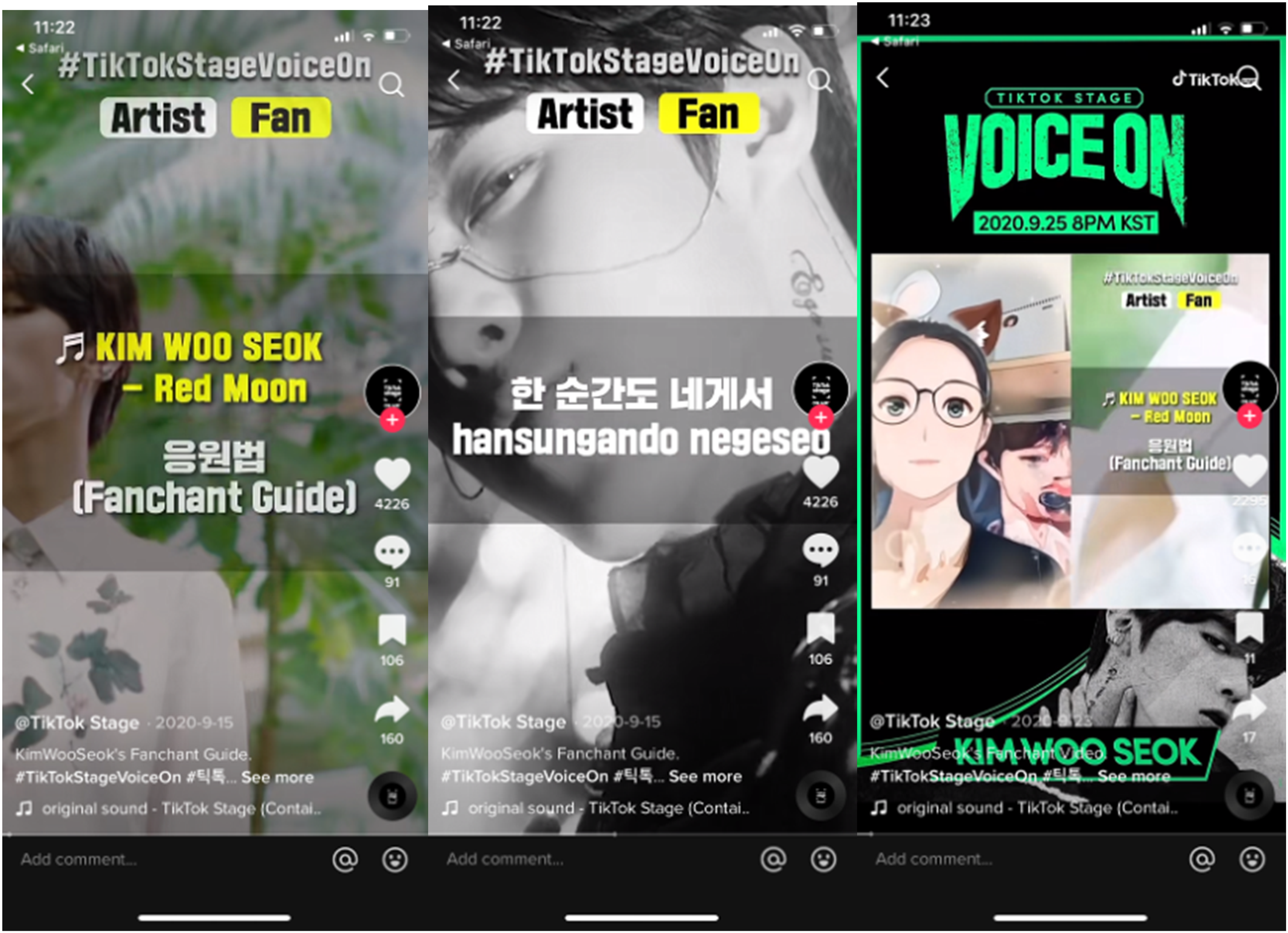
Fanchant guide video for ‘TikTok Stage Voice On’, posted by @TikTok Stage. Screengrab by authors.
However, domestic K-pop fans are usually reluctant to risk their anonymity on social media, resulting in a low turn-out initially. In response, the more bold fans have taken it upon themselves to garner support for the K-pop stars and rally fans to participate in TikTok Korea's corporate fan labour: Guys, please join us in posting TikTok fanchant videos. Not many videos yet. Not that difficult. You can hide your face; don’t need to reveal your face in the video. Just participate in the challenge so that our fanchants can be loudly echoing when Woo Seok sings. (Comment from Twitter; poster anonymized, translation by authors) Hi all please play #김우석응원법 [‘Kim Woo Seok eungwon beob’, trans. Kim Woo Seok fanchant] a lot  The number of plays is so outnumbered [by other fandoms]
  . Please like and share. Also [post your own fanchant] videos, please. Hashtag #TikTokVoiceOn. Let's post supportive comments too. (Comment from Twitter; poster anonymized)
From the ‘platformed glocalization’ of TikTok to the platformization of ‘K-pop TikTok’
In this article, we traced the fraught histories of TikTok's early entry into Korea, and demonstrated how the platform leveraged on the K-pop industry during the COVID-19 pandemic to finally gain a foothold in the market. This was facilitated through the TikTok Stage series of events, which solicited a matrix of promotional labours from both K-pop stars and their fans, including untact, live chats, ment, and fan chants, transposed from traditional in-person K-pop events to the mobile platform of TikTok. This success demonstrates how platforms have to consider glocalizing to pay heed to local norms and mores, to comply with the politics, culture, and market economics of the local market, especially in places where domestic market cultures and socio-politics are particularly strong. The success of TikTok Stage in operationalizing platformed glocalization is perhaps most obvious when we review the popular discourse about celebrities on TikTok. While news (Haynes, 2020) and viral TikTok discourse (@owen_squires, 2022) from the Global North has exhibited a reluctance and even disdain towards the growing presence and dominance of mainstream entertainment celebrities on the platform, in Korea, K-pop stars are very much celebrated in the safehaven of TikTok, as demonstrated by Psy's rousing welcome on the app.
However, the symbiotic relationship that we have outlined between TikTok and the K-pop industry also showcases how the platformization of the K-pop economy reveals some concerns in this emerging genre of ‘K-pop TikTok’. For one, we note from our study that early iterations of TikTok Stage relied on the most globally renowned, chart-topping, and veteran K-pop acts from the major agencies to garner initial interest. While subsequent TikTok Stage events eventually involve lesser-known idol groups and newly debut acts, the series is still dominantly headlined by K-pop stars who already have a strong footing in the mainstream entertainment industry. This replicates the barriers to entry from the pre-TikTok landscape of K-pop, and challenges prior studies that have highlighted the demotic potential of the app for aspiring micro-celebrities and influencers (cf. Abidin, 2021).
The platformization of K-pop has also resulted in a homogenization of K-pop performances. As we note in the opening vignette with Seung-Hoon of WINNER, after a mere two years of ‘K-pop TikTok’, the platform has accumulated a reputation for introducing a particular template of choreography and fan service. This has led to significant changes in how K-pop production and consumption is being tailor-made for ‘TikTok virality’. While K-pop news media have celebrated the ‘K-pop TikTok’ genre of choreography designed for TikTok challenge templates (ean1994, 2022), popular discourse on K-pop fandom fora also frequently lament the over-simplicity and repetitiveness across recent releases (u/LatterPhilosopher143, 2022), which can easily tire people and negatively affect the song's longevity on music charts (Sara27ya, 2022). On the other hand, some fans find it ‘pleasant’ to watch members from different groups and different agencies help each other by collaborating together as ‘colleagues’, not just ‘competitors’, which was very rare to see in the past (comment on a thread from theqoo).
In light of these recent pivots to the platformization of ‘K-pop TikTok’, this article also serves as a historical documentation of the changing trajectories of the K-pop industry amidst the mass digitization and virtualization during the pandemic. Alongside an increasing number of K-pop stars turning to TikTok livestreaming as the first port for their new releases (Sun, 2022), many K-pop agencies have drawn lessons from the early success of TikTok Stage to host livestreamed concerts on other platforms (Frater, 2022; Yonhap News, 2020). The K-pop industry is also at the cusp of its ‘virtual turn’, perhaps a couple of decades later than their predecessor J-pop vocaloids in Japan (Jackson and Dines, 2016; Leavitt et al., 2016). Newer idol groups like Aespa (est. November 2020) have debuted with both physical members and complementary AI avatar counterparts who serve as their doubles in virtual worlds (Raj, 2021). At the time of writing, BLACKPINK is the latest K-pop act to release a new song during a virtual concert livestreamed in a mobile game world (Gallagher, 2022), marking a new shift from social media towards virtual worlds. As the K-pop industry catches up to the early innovation of TikTok Stage, the platformed glocalization of the app continues as TikTok has begun to expand from its initial offerings. The newest string of TikTok Stage events, such as TikTok Stage on Air (TikTok, 2022), have pivoted to a talk show format, demonstrating the platform's growth from being a contingency platform for pandemic-induced virtual concerts and fan meets, to being a key partner in creating and sustaining new ways to perform celebrity-fan relations on mobile media. So successful and mainstream is ‘Kpop TikTok’ that TikTok's competitors have begun imitating it. YouTube recently announced its ‘meaningful partnership’ with globally popular K-pop girl group BLACKPINK, using the release of their single Pink Venom to promote the #PinkVenomChallenge exclusively on its newest feature ‘YouTube Shorts’ (The YouTube Music Team, 2022). At the time of writing, competition between the use of TikTok and YouTube Shorts to promote new K-pop singles is rife. Evidently, the early days of TikTok Stage and the promotional labour of K-pop that gave rise to its platformed glocalization are well and truly ushering in the dominance of the platformization of ‘K-pop TikTok’.
Footnotes
Acknowledgements
This article draws from Abidin's research on digital cultures in the Asia Pacific region between 2019 and 2022, during which several grants supported the fieldwork. In particular, Abidin would like to acknowledge the most recent funding from the Australian Research Council (DE190100789) for supporting research on Social Media Influencers as Conduits of Knowledge in Australia and Asia, as well as support from the TikTok Cultures Research Network. Lee also would like to acknowledge a research support package from MCASI and the Faculty of Humanities at Curtin University.
Declaration of conflicting interests
The author(s) declared no potential conflicts of interest with respect to the research, authorship, and/or publication of this article.
Funding
Abidin received funding from the Australian Research Council (DE190100789) supporting research on Social Media Influencers as Conduits of Knowledge in Australia and Asia, as well as support from the TikTok Cultures Research Network. Lee also received a research support package from MCASI and the Faculty of Humanities at Curtin University.

Appendix 1: Empirical data sources of TikTok and YouTube videos;organized by chronology of mention in the article.
Plus Agency (2019, January 20). [틱톡]바이럴광고-여자편. [TikTok Viral ad – Female version]. Available at:https://www.facebook.com/PlusXagency/videos/%ED%8B%B1%ED%86%A1%EB%B0%94%EC%9D%B4%EB%9F%B4%EA%B4%91%EA%B3%A0-%EC%97%AC%EC%9E%90%ED%8E%B8/225928534960787/
@kozico0914 (2020a, January 2). Hello #지코 #ZICO
Available at https://www.tiktok.com/@kozico0914/video/6777282584582851842?is_copy_url = 1&is_from_webapp = v1&lang = en
TikTok (n.d. a) TikTok for good. Retrieved from https://www.tiktok.com/forgood?lang = en
TikTok (n.d. b) #anysongchallenge. Retrieved from https://www.tiktok.com/tag/anysongchallenge
@kozico0914 (2020b, January 12). #AnysongChallenge #ZICO #지코 #화사 #아무노래 #Anysong# 아무노래나틀어주세요#K OZ
Available at https://www.tiktok.com/@kozico0914/video/6780701284392504578?is_copy_url = 1&is_from_webapp = v1&lang = en
@kozico0914 (2020c, January 13). #AnysongChallenge #ZICO #지코 #청하 #아무노래 #Anysong# 아무노래나틀어주세요#K OZ
Available at https://www.tiktok.com/@kozico0914/video/6781257472414993665?is_copy_url = 1&is_from_webapp = v1&lang = en
@kozico0914 (2020d, January 17). 샵에서 우연히 만난 버전! #AnysongChallenge with #Dara #지코 #ZICO #Anysong #아무노래
Available at https://www.tiktok.com/@kozico0914/video/6782779836780891393?is_copy_url = 1&is_from_webapp = v1&lang = en
@kozico0914 (2020e, January 31). #AnysongChallenge 에 참여해주신 모든 분들께 감사드립니다!
Available at https://www.tiktok.com/@kozico0914/video/6788060724821314817?is_copy_url = 1&is_from_webapp = v1&lang = en
WINNER (2020a, March 21). WINNER – ‘뜸(Hold)’ FINGER DANCE TEASER Available at https://www.youtube.com/shorts/JTd5k-uEbjQ
WINNER (2020b, March 23). WINNER – ‘뜸(Hold)’ FINGER DANCE TEASER #2
@wn_tiktok (2020, March 23) #WINNER #위너 #뜸 #Hold #FingerDance #DDeumChallenge #뜸챌린지 #TikTok #DDeumChallengeOnTikTok
@Itsjessibaby (2020, July 30) #nununanachallenge #fyp #foryou #duet #jessi #제시 #hyori #이효리
Available at https://www.tiktok.com/@itsjessibaby/video/6855171012967943426?is_copy_url = 1&is_from_webapp = v1
@owen_squires (2022, July 15) I said it. #celebrities #tiktok #wethepeople #justintimberlake #keepitreal #creators #tiktokcreator
Appendix 2: Empirical data sources including news,public relations releases,and online forum materials;organized alphabetically
Ahn H (2019) 고려대서 ‘홍콩 시위 대자보’ 훼손 中 유학생과 한국 학생 충돌 [At Korea Uni, Tension between domestic students and Chinese students become intense around the damaged ‘Free Hong Kong’ posters]. Hankuk Ilbo, 12 November. Available at: https://www.hankookilbo.com/News/Read/201911121471094037
Channel Korea (2020) Everything you need to know about SBS’ weekly music show, Inkigayo: airing time, score system, special stage, and more. Channel Korea. Available at: https://channel-korea.com/sbs-weekly-music-show-inkigayo/.
Choi J (2019) ‘반중 넘어 혐중'‥ 중국인 혐오, 도 넘은 수준까지? [Anti-Chinese sentiment develop into Chinese-hate…even at the extreme level]. Financial News, 13 June. Available at: https://www.fnnews.com/news/201906131104460296.
Choi J (2018) ‘광고 극혐’ 틱톡 선정성 논란까지…한국은? [‘Super-hate’ TikTok ads, and controversies around provocative content…How about TikTok in Korea?]. An Economic Review, 27 December. Available at: https://www.econovill.com/news/articleView.html?idxno = 353533.
Choi S (2021) ‘틱톡 스테이지’ 서리, 라이브도 잘 하는 ‘글로벌 신예'…4만 시청자 사로잡은 美친 음색 [Seori at TikTok Stage: ‘Global super rookie’. Her voice captivated 40,000 viewers]. Top Star News, 1 October. Available at: https://www.topstarnews.net/news/articleView.html?idxno = 14634749.
ean1994 (2022) Most popular TikTok challenges inspired by K-Pop. allkpop. Available at: https://www.allkpop.com/article/2022/07/most-popular-tiktok-challenges-inspired-by-k-pop.
Frater P (2020) BTS’ ‘Bang Bang Con: the live’ claims record viewership for online concert. Variety, 14 June. Available at: https://variety.com/2020/digital/asia/bts-big-bang-con-the-live-record-online-concert-1234635003/.
Gallagher A (2022). Blackpink announce Pubg mobile virtual concert. NME, 12 July. Available at: https://www.nme.com/en_au/news/music/blackpink-announce-pubg-mobile-virtual-concert-3267282.
Haynes T (2020) Ranking celebrities on how lame their attempts to get popular on TikTok are. The Tab, 22 May. Available at: https://thetab.com/uk/2020/05/22/ranking-celebrities-on-how-lame-their-attempts-to-get-popular-on-tiktok-are-158277.
Im E-b (2019) TikTok hopes to form ties with K-pop. The Korean Herald, 3 October. Available at: http://www.koreaherald.com/view.php?ud = 20191003000202.
Jang Y (2018) [중국 한류 모방| 예능] 중국 도넘은 한국예능 표절, ‘대응책 시급’ [China's mimicry of Korean wave: entertainment. China's plagiarism of Korean variety shows becomes intense, needs ‘urgent response’]. Aju Business Daily, 22 June. Available at: https://www.ajunews.com/view/20180622105822721.
Jung H (2020) 얄팍한 상술 비난 받던 ‘영통팬싸’, K팝팬이 열광하는 이유 [While ‘fan meet’ livestream is criticized for being too commercial, but K-pop fans love it]. Snap Time. Available at: http://snaptime.edaily.co.kr/2020/11/%EC%96%84%ED%8C%8D%ED%95%9C-%EC%83%81%EC%88%A0-%EB%B9%84%EB%82%9C-%EB%B0%9B%EB%8D%98-%EC%98%81%ED%86%B5%ED%8C%AC%EC%8B%B8-k%ED%8C%9D%ED%8C%AC%EC%9D%B4-%EC%97%B4%EA%B4%91%ED%95%98/.
Kara (2019) 아지냥이x틱톡, 평생함께 챌린지 캠페인 [Ajinyangi x TikTok, pyungsaeng hamkke challenge campaign]. Kara, 20 August. Available at: https://www.ekara.org/parttake/issue/read/11886.
Kim H (2020a) ‘내가수 순위’ 높이는 팬덤 ‘총공’, 차트 격변과 함께 사라질까 [Fandom Chonggong for my stars on the ranking system, will it disappear after the change on the chart system?]. Yonhap News, 7 July. Available at: https://www.yna.co.kr/view/AKR20200706150700005.
Kim J (2018a) 중국 앱 ‘틱톡’ 선정성 논란… ‘청소년에 성관계 제안 이어져’ [Chinese app TikTok is in controversy of sexual content. ‘Teenagers are asked for sex’]. Joongang Ilbo, 26 December. Available at: https://news.joins.com/article/23240173.
Kim G (2022a). “Psy joins TikTok one month after ‘Gangnam Style’ trends on the platform.” Next Shark, 5 April. Available at: https://nextshark.com/psy-joins-tiktok-one-month-after-gangnam-style-trends-on-the-platform/
Kim S (2020b) ‘틱톡 스테이지 라이브 프롬 서울’, 에이핑크·악뮤·몬스타엑스 등 ‘황금 라인업’ [TikTok Stage Live from Seoul: Golden line up includes Apink, AKMU, MONSTA X, and so on]. Hankook Kyungje, 20 May. Available at: https://www.hankyung.com/entertainment/article/202005207267H.
Ko H (2018) [요즘 것들의 문화 답사기] 오늘 밤 12시 ‘총공’ 알지?.. 10대들이 작전 짜는 까닭 [Remember Chonggong at midnight tonight? Why teenagers set up an plan]. Seoul Shinmun, 12 November. Available at: https://news.v.daum.net/v/20181112033624954?d = y
Lee H (2013) 순위제 가요프로 1위 하는 세 가지 꼼수 [Three tricks to win the 1st place in music shows]. Star Today, 29 March. Available at: https://www.mk.co.kr/star/musics/view/2013/03/209894/.
Lee J (2019) [트렌드줌인] 뜨겁게 관심 받는 ‘틱톡’…국내에선 ‘틱톡 극혐'까지 나오는 이유는? [TikTok is trending and popularly demanded. But in Korea, why people even ‘hate’ it?’]. Daily Pop, 13 February. Available at: http://www.dailypop.kr/news/articleView.html?idxno = 37741.
Lee J (2020a) 블랙핑크, 21일 ‘틱톡 스테이지'로 팬들 만난다…특별한 라이브 소통 예고 [BLACKPINK meet fans on 21, at TikTok Stage…special live communication is planned]. Korea Economic Daily, 14 October. Available at: https://www.hankyung.com/entertainment/article/202010147620I
Lee JY (2020b) The South Koreans left behind in a contact-free society. BBC, 6 August. Available at: https://www.bbc.com/worklife/article/20200803-south-korea-contact-free-untact-society-after-coronavirus.
Lyris (2020) Zico's ‘Any Song’ Takes South Korea By Storm With Chart-Topping Feats & Viral Dance Challenge. HelloKPop. Available at: https://www.hellokpop.com/featured/zico-any-song-viral-dance-challenge/.
Mozur P (2016) A South Korean copy of snapchat takes off in Asia. New York Times, 5 July. Available at: https://www.nytimes.com/2016/07/06/technology/snapchat-snow-korea.html#:∼:text = This%20is%20Snow%2C%20a%20popular,Snow%20focuses%20on%20Asian%20consumers.
Nah K (2019) [e기자가 해봤다] 유튜브 제친 ‘틱톡'의 AtoZ…기자가 직접 15초 ‘매력 발산’ 해보니 [TikTok outpassed YouTube… Its AtoZ, a reporter experienced]. eToday, 30 January. Available at: https://www.etoday.co.kr/news/view/1716894.
Park C (2018) ‘얼굴천재’ 차은우, 틱톡 ‘대흥민국’ 참석 [Super handsome Cha Eun-woo attending at TikTok's Daeheungminkuk]. Maeil Economy, 5 December. Available at: https://www.mk.co.kr/news/culture/view/2018/12/760566/.
Raj TI (2021) Inside Aespa's AI Universe NYLON, 1 July. Available at: https://www.nylon.com/entertainment/aespa-ai-concept-explained-next-level-black-mamba
Rashid R (2021) South Korea cuts human interaction in push to build ‘untact’ society. Guardian, 10 December. Available at: https://www.theguardian.com/world/2021/dec/10/south-korea-cuts-human-interaction-in-push-to-build-untact-society
Sara27ya (2022) Who is the first group to make a TikTok challenge and when did it become the norm? Reddit. Available at: https://www.reddit.com/r/kpophelp/comments/x0bdzs/who_is_the_first_group_to_make_a_tiktok_challenge/
Shin JS (2020) Koreans Shun Global Backlash Against TikTok. The Korea Bizwire, 12 August. Available at: http://koreabizwire.com/koreans-shun-global-backlash-against-tiktok/167056
Snider M (2021) What will entertainment look like after COVID? Hybrid events for live and streaming crowds, plus more Zoom. USA Today, 10 April. Available at: https://www.usatoday.com/restricted/?return = https%3A%2F%2Fwww.usatoday.com%2Fin-depth%2Ftech%2F2021%2F04%2F10%2Fzoom-concerts-stream-music-life-after-covid-stay-home%2F6987045002%2F
Sun M (2022) 위너, 7월 5일 컴백 카운트다운 라이브..비하인드 대방출 [WINNER return on 5 July with new album, to be livestreamed with behind-the-scenes]. OSEN, 1 July. Available at: http://osen.mt.co.kr/article/G1111885246.
The YouTube Music Team (2022) BLACKPINK announce the #PinkVenomChallenge only on YouTube Shorts. YouTube Official Blog. Available at: https://blog.youtube/creator-and-artist-stories/blackpink-comeback-pinkvenomchallenge-youtube-shorts/.
TikTok (2019) TikTok For Good: 서울시와 #한강쓰레기는내손으로 [TikTok For Good: #pickuptrasharoundHanRiver with City of Seoul]. TikTok, 8 November. Available at: https://newsroom.tiktok.com/ko-kr/ttfg-keep-han-river-clean.
TikTok (2020a) 안방에서 즐기는 라이브 콘서트, ‘틱톡 스테이지 보이스온’ 개최 [Live concert at living room, ‘TikTok Stage Voice On’ will be hosted]. Available at: https://newsroom.tiktok.com/ko-kr/tiktok-stage-voice-on.
TikTok (2020b) 웃음 에너지로 활력을, 기부로 행복 시너지를 동시에! ‘Smile with TikTok’ 캠페인 전개 [Smile with TikTok campaign: entertain people with smile energy and deliver happy synergy with donations]. TikTok, 13 May. Available at: https://newsroom.tiktok.com/ko-kr/smile-with-tiktok.
TikTok (2020c) 틱톡 스테이지, ‘K팝·힙합·기부’ 결합… 전 세계 희망과 응원의 메시지 전한다 [TikTok Stage, mixing ‘K-pop, hiphop, charity donation’ sends messages of hope and support to the world]. Available at: https://newsroom.tiktok.com/ko-kr/tiktok-stage-live-from-seoul-hiphopplaya.
TikTok (2022). TikTok Live Talk Show. Available at: https://activity.tiktok.com/magic/eco/runtime/release/62bfe8207a34a803338fc250?appType = tiktok_source = blank&u_code = dd1agjj8ahgi4j&iid = 7110836643602843435&utm_source = copy_link&utm_campaign = client_share&utm_medium = android&share_iid = 7110836643602843435&share_link_id = fe34c6f6-adb2-41f5-8171-10de6413e507&share_app_id = 1233
u/LatterPhilosopher143 (2022) TikTok has made a negative impact on kpop choreographies. Reddit. Available at: https://www.reddit.com/r/kpoprants/comments/w8apy7/tiktok_has_made_a_negative_impact_on_kpop/?utm_source = share&utm_medium = ios_app&utm_name = iossmf
‘WINNER’ (2022) Knowing Bros [아는 형님 or ‘Aneun Hyeongnim’], Series 7, episode 7. JTBC and Netflix. 7 May.
Wurzburger A (2020) Kylie Jenner, Reese Witherspoon and the Rest of the A-List Celebs You Should Be Following on TikTok. People, 3 December. Available at: https://people.com/celebrity/celebrities-on-tiktok/
Yang M (2020) 강다니엘, 심쿵 비주얼 [Kang Daniel, astonishing look]. Seoul Kyungje, 25 May. Available at: https://www.sedaily.com/NewsVIew/1Z2VZWA627.
Yonhap News (2020) SM Entertainment to stream free online concert. Yonhap News, 28 December. Available at: https://en.yna.co.kr/view/AEN20201228002800315.
Yoo J (2020) ‘틱톡, 9초에 125장 분량 문서 데이터 빼 가’. Chosun Ilbo, 15 July. Available at: http://it.chosun.com/site/data/html_dir/2020/07/15/2020071501640.html
Yoon K (2020) 세로형 콘텐츠·라이브 공연 결합… ‘틱톡 스테이지’ 주목 [Combination of vertical video content and live concert … It's ‘TikTok Stage’]. eDaily, 21 October. https://www.edaily.co.kr/news/read?newsId = 01341526625935216&mediaCodeNo = 258