



Abstract
Despite recent investments in telecommunications infrastructure in regional Australia, a digital divide remains between rural and urban communities. The impacts of comparatively limited digital connectivity in rural Australia include fewer opportunities for economic participation, difficulty accessing health and educational services, and challenges responding to crisis events such as natual disasters and the COVID-19 pandemic. There is an acute need for improved access to robust mobile and broadband services before, during and after crises in rural Australia. This article presents solutions for improved digital connectivity and digital capability in Far North Queensland, founded in a project that brought together researchers, business owners, councils, development organisations, technical experts and service providers to collaboratively identify and define telecommunications challenges related to a catastrophic flood in 2019. The research supports telecommunications providers, state and local governments, and community development organisations working together to collaboratively invest in technical and social solutions that enable rural communities to achieve greater crisis resilience.
Introduction
Several recent global crises, including but not limited to the COVID-19 pandemic and weather events, have impacted people's access to and experiences of digital technologies. In many instances, digital technologies have helped people to work through these challenges by, for example, enabling continued access to health and education services online. Yet, these crises have also highlighted and exacerbated digital disadvantages in more vulnerable populations, such as people in precarious housing, people from culturally and linguistically diverse backgrounds, and Indigenous peoples (Butcher and Curry, 2022; Crawford and Serhal, 2020). In Australia, there is a pronounced and persistent rural–urban digital divide (Thomas et al., 2021b). Many rural Australians struggle to access the services and information needed to prepare for, endure, and recover from crises. Moreover, with the rapid escalation of digital-by-default government services, the one-third of Australians living outside cities (Australian Bureau of Statistics, 2022) are disadvantaged in their ability to access financial and social support using digital connections and technologies.
Crisis resilience is a holistic term describing the capacity of communities to prepare for, respond to, and recover from crisis events such as natural disasters, public health crises, and environmental emergencies (McDermott, 2022). In rural contexts, crisis events can include natural disasters (e.g. flood, fire, earthquake), economic downturns (e.g. slowed tourism or commodity markets), biosecurity issues (e.g. plant and animal diseases), or human health issues (e.g. pandemics). In the context of natural disasters. Freeman and Hancock, (2017), observe that resilience may be defined as a continuous process whereby communities adapt, innovate, and grow amongst uncertainty, encompassing factors such as risk reduction, community preparedness, relief efforts, and recovery efforts. This definition highlights scholars’ recent progression from crisis resilience frameworks centred on response efforts, to more holisticaccounts that consider sustained human agency over time and a combination of social and territorial cohesion as a means to negotiate and overcome adversity (Greene et al., 2022; Imperiale and Vanclay, 2016; Sánchez-Zamora et al., 2014). To this point, Scott (2013) suggests that while traditional ‘equilibrium’ notions of rural resilience promote ‘bouncing back’ and ‘returning to normal’, more progressive notions emphasise communities’ capacity to ‘bounce forward’ and transform to become more resilient in the future. We adopt the latter evolutionary crisis resilience approach in the present study.
It is recognised globally that crisis resilience is highly dependent on telecommunications as essential infrastructure (Bruneau et al., 2003; Kapucu et al., 2013; Patricelli et al., 2009; Tierney and Bruneau, 2007 , Vargo et al., 2021). During natural disasters, for example, information and communication flows play a critical role in preparedness, response, and recovery processes (Houston et al., 2019), and thereby disaster resilience (Houston, 2015). Sparsely populated regions in Australia are particularly vulnerable to the impacts of natural disasters (Martin and Rice, 2012) due to various shortcomings including deteriorating copper landlines, large gaps in mobile network coverage, and unreliability caused by network congestion and weather conditions (Australian Government, 2021). Deficits in rural telecommunications infrastructure can impede upon management of cybersecurity, biosecurity, agroterrorism, and human health crises. Conversely, as Anand (2018: 58) notes, ‘new technologies for civilian application in agriculture, as well as for legitimate actions pertaining to defence, detection, protection, and prophylaxis, and in upgrading laboratory facilities can increase the agricultural sector's level of preparedness for outbreaks’. For example, in Australia and New Zealand, remote microscopy (which creates virtual, real-time networks that allows experts to access real-time images of scientific specimens from anywhere in the world) can be employed for rapid detection and identification of biosecurity threats (Thompson et al., 2011).
Despite recent investments in telecommunications infrastructure in Australia, there is inequality in the provision of broadband and mobile infrastructure in rural areas. While the National Broadband Network (NBN), a nation-building infrastructure programme costing $57 billion carried out between 2009 and 2022, is complete (Gregory, 2022), the NBN solutions for rural consumers (fixed wireless and satellite) are slower and offer less data and value for money than the fixed-line services in cities (Freeman et al., 2020). Moreover, while major telecommunications providers (telcos) purport to make mobile service available to 99.4% of the population, coverage is only extends to one-third of the continent of Australia (Australian Government, 2021). 1 Nonetheless, several carriers (e.g. Telstra, Optus, Vodafone) have LTE-M and NB-IoT networks (suitable for Internet of Things (IoT) applications like remote sensors for water levels, temperature and soil composition that exceed mobile 3/4G networks) available for rural customers (though awareness of these services is less than for mobile coverage). Starlink also offers an alternative satellite service, and other solutions are offered by wireless internet service providers in some locations, which leverage existing infrastructure in bespoke ways. These alternative services do, however, come at a premium cost that many rural consumers cannot justify.
We assert that the complex mix of infrastructure and services is unlikely to crisis-proof rural communities in Australia. Moreover, the current mechanisms for delivery of government-backed broadband and mobile upgrades, namely the Regional Connectivity Program (RCP) and Mobile Black Spot Program (MBSP), make only incremental contributions to improved telecommunications services. Such programmes are ‘gap-filling’ measures, rather than robust, holistic programmes of work to transform rural internet and mobile services. Furthermore, current approaches largelydo not account for broader technical and social barriers to delivering sustainable telecommunications solutions for rural Australia, such as affordability and digital skills (Afshar Ali et al., 2020; Randell-Moon and Hynes, 2022 Marshall et al., 2023).
In response, this article presents solutions for improved digital connectivity to strengthen crisis resilience in rural Australia through more equitable access to essential telecommunications infrastructure and services. While this research was undertaken in the context of disaster resilience in Far North Queensland (FNQ), the proposed solutions are applicable to helping rural communities more generally in responding to other types of crises and in their post-pandemic recovery and growth. The article is structured as follows. First, we review literature at the intersection of rural telecommunications and crisis communications, demonstrating limitations in rural communities’ ability to respond to crises, which motivates the study. Second, the mixed methodology is outlined in the research context of FNQ. Third, three inter-related digital solutions are presented, predicated on five key priority areas that were found to underpin crisis and community resilience. Overall, we promote region-wide collective approaches and partnerships between local authorities, governments, businesses and telcos, along with concurrent attention to digital capacity and digital capability building. This packaged approach is needed to meaningfully address deficits in mobile and broadband connectivity and people's ability to access and use these services when they need them most.
Telecommunications policy in rural Australia
Australia has significant challenges in the provision of telecommunications infrastructure and services, owing to its dispersed population over a vast geographical area. While most Australians live in cities where they have reliable access to high-speed internet and several mobile services (Ali et al., 2020), some 8.4 million people live outside capital cities (Australian Bureau of Statistics, 2022) where both the quality of service and choice of providers is lacking (Marshall et al., 2020). These disparities have persisted through several terms of government by both major political parties and drastic technological changes over at least the past 40 years. Additionally, access to and reliability of telecommunications in rural areas is consistently constrained by legacy issues associated with infrastructre degradation, mobile service gaps and congestion, and limited backup power supply at mobile base stations, fixed wireless towers, and landline network exchanges (Australian Government, 2021).
Until the 1990s, the Australian Government-owned Telecom provided near-universal access to landlines throughout Australia. Since then, the deregulation of the telecommunications market and privatisation of Telecom (now Telstra) in the mid-2000s, as well as advances in technology, has brought significant changes to service provision, including the widespread use of mobile phones and direct fibre broadband connections (Madsen and Percy, 2020). However, development has been concentrated in urban areas because the higher population density offered the best commercial returns (Madsen and Percy, 2020). As a result, equitable and affordable access to telecommunications services is an ongoing challenge in rural areas.
As mentioned earlier, recent schemes (e.g., RCP and MBSP) have been introduced by the Commonwealth Government whereby local organisations (e.g. local council) partner with a telco to pledge funds, matched by the federal grant, for new telecommunications infrastructure to address specific instances of no or limited mobile or broadband access. For example, many rural mobile phone towers are over-subscribed, which causes the network to become congested at particular times of the day (e.g. after school) or during events (e.g. seasonal tourist influx or online stock auctions), thus interrupting service (Australian Government, 2021). Several RCP-funded projects have aimed to increase backhaul to existing towers and/or build new towers to better meet demand. Also, the MBSP funds projects to build new infrastructure, often along rural arterial roads, where there are gaps in mobile service between townships.
While these are welcome improvements for local residents and travellers in locations that receive investment, many other ‘black spots’ are not funded and the footprint of many of the funded projects is limited; 13,480 locations with poor or no mobile coverage were reported prior to October 2018 and, as of October 2022, a total of 1047 base stations have been activated (Australian Government, 2018). Accordingly, rural residents and organisations continue to report inadequate mobile and broadband services and highlight the impacts this has on social and economic life. For example, there have been cases where a gap in mobile coverage in one area that is predominately serviced by one telco is 'filled' with new infrastructure and service from a different provider. Here, rather than providing rural residents more equitable access to mobile services, customers need to purchase additional plans or equipment to receive reliable coverage over two networks (Australian Government 2021).
Rural telecommunications in times of crisis
A major motivator for improving rural telecommunications in Australia is the high incidence of natural disasters, such as bushfires, droughts, storms, floods, tropical lows/cyclones and monsoonal troughs (Australian Government, 2020). This is an increasingly crucial issue as climate change generates more frequent disaster events in rural areas (Bird, 2013; Head et al., 2014; Westra et al., 2016). Likewise, poor rural connectivity has impacted access to resources and services during other crises, such as the COVID-19 pandemic (Bennett et al., 2020; Podubinski et al., 2021), the 2019 monsoon flood event in northern Queensland (Marshall et al., 2023), and the 2019–2020 fires in eastern Australia (Campbell et al., 2020). Appropriate infrastructure and services to support crisis resilience in rural Australia should therefore be a national priority. Indeed, the National Recovery and Resilience Agency was established in 2021 and has made some strategic investments in telecommunications (like this research), but more is needed.
Research confirms that crisis resilience (comprised of preparedness, response and recovery (Ritchie and MacDonald, 2010)) is undermined by deficits in telecommunications infrastructure in rural Australia (Aloudat and Michael, 2011; Freeman and Hancock, 2017). Damage to telecommunications and power infrastructure during natural disasters can result in widespread power and network outages (Freeman and Hancock, 2017). While this may be mitigated by establishing additional power and internet services for redundancy, many rural residents have no or few options for backup internet due to the ‘thin’ coverage of mobile networks and limited availability of broadband connections in non-urban Australia. Such outages also impact emergency services, since dedicated emergency networks tend to become congested during a crisis, and are reserved for brief, succinct communications. As a result, emergency service agencies depend on commercial mobile and broadband services for real-time information and communication, which have several aforementioned vulnerabilities including inadequate mobile coverage in priority areas such as major transport corridors and disaster-prone areas. (Australian Government, 2021).
With scant local technical support available, continuity of service for community members depends on rural people being able to ensure that their connections and devices are operating effectively. Such capabilities, referred to collectively as ‘connectivity literacy’ (Australian Government, 2021) include: knowing which routers/modems work best with satellite/fixed wireless connections; configuring local hardware (e.g. modem, router) for optimal connection to broadband service (e.g. fixed wireless, satellite); installing extra hardware (e.g. booster) to make connections work optimally; and fixing issues related to critical power connections/generator (Marshall et al., in press).
Deficits in connectivity literacy become particularly problematic when they impact on access to critical communication and information channels during times of crisis. For individuals, this may result in: the inability to monitor disasters by accessing early warning systems and real-time information; the inability to contact others such as emergency services for support or to check on family members; and the inability to access financial and psychological support directly after the event. Impacts upon organisations and their communities include: the inability to receive and provide real-time information; the inability to coordinate rescues (due to a reliance on mobile phones for communications); and the inability to coordinate disaster response and recovery efforts (Marshall et al., 2023).
Digital technologies for crisis resilience
Digital connectivity infrastructures and literacies are essential for crisis resilience because they enable people to use various digital technologies and the internet to access critical information and media coverage from authoritative sources as well as enabling real-time updates and discussions on social media (Vargo et al., 2021). In Australia, the COVID-19 pandemic highlighted the critical role of communication and messaging, often delivered via digital channels, in influencing public behaviour (Williams et al., 2022). For example, Australia's public broadcaster, the Australian Broadcasting Corporation (ABC), used multiple digital channels, such as websites, news apps, and podcasts (alongside more traditional radio and television broadcasts) to produce news media coverage of the COVID-19 pandemic. Moreover, the ABC works in close collaboration with emergency services to provide alerts, warnings, and information about disasters. Similarly, disaster agencies like the Bureau of Meteorology release data, information, and alerts via digital methods, such as push text alerts, app notifications, and Tweets. Using digital technologies, these agencies can also target their messaging to specific regions and communities.
Research shows that, during a localised crisis, people prefer to seek information from local sources (Ewart, 2020). Accordingly, social media has become an increasingly crucial source of information during crises, offering benefits including increased situational awareness, faster information diffusion, and better monitoring and coordination among stakeholders (Horbury and Hughes, 2010; Luna and Pennock, 2018; Mason and Power, 2015). In Australia, social media plays a crucial role in disaster management and offers a collaborative approach to public information and warnings. Social media creates a sense of connectedness between citizens and serves simultaneously at operational, technological, and communication levels to meet emergency service delivery needs (Wamba et al., 2019), notwithstanding challenges such as the dissemination of false information and the need for regulation and better management (Ehnis and Bunker, 2020).
Where sufficient supporting infrastructure exists, emerging digital technologies have the potential to aid the various stages of crisis and disaster management. A study by Stieglitz et al. (2022) found that emergency management agencies were receptive to the use of chatbots for crisis communication. Chatbots could enhance the dissemination of location-based information, answer frequently asked questions, improve the accuracy of collected data through requesting further information from users, and efficiently communicate with individuals who speak diverse languages (Stieglitz et al., 2022). Relatedly, big data analysis can help refine and extract appropriate real-time information from large volumes of data gathered from affected areas via social media, satellite images, wireless sensor networks, and other emerging technologies (Niyazi and Behnamian, 2022). The Internet of Things (IoT) and cloud and fog computing can be used to collect and analyse data from users and the physical environment to aid in decision making (Butt, 2022), whilst Web 3.0 has the potential to enhance disaster communication by providing better data integration and personalisation of information, and better facilitating citizen reporting and collective problem solving (Ahmed, 2018). Finally, unmanned aerial vehicles have various applications in disaster management, including monitoring, damage assessment, situational awareness, and search and rescue missions (Niyazi and Behnamian, 2022).
Of particular relevance to areas that are prone to mobile and broadband outages, novel solutions have been proposed to enable disaster management technologies to remain connected when core telecommunications infrastructure is destroyed or damaged, such as device-to-device communications between IoT devices and mobile phones (Ali et al., 2019; Sarbajna et al., 2021). However, their use depends on short-range connectivity and therefore is not well suited to rural areas where people and devices are typically some distance apart. Long-Range Wide Area Networks (LoRaWAN) have been proposed as a solution to enable IoT devices to remain connected during critical situations in the urban context (Navarro-Ortiz et al., 2019), and as an alternative instant messaging system in rural environments (Cruz De La Cruz et al., 2021). Several companies are investigating the feasibility of establishing a direct link between smartphones and low-earth-orbit satellites, thereby providing connectivity in regions where access to Wi-Fi and mobile networks is not available (Sheetz, 2022). For example, Apple recently launched a satellite emergency SOS service in Australia and New Zealand, albeit only for the latest iPhone models and with limited area serviceability (Maguire, 2023).
Overall, the internet and data are playing an increasingly crucial role in crisis communication and management in rural Australia, and opportunities exist to apply cutting-edge digital technologies to help vulnerable and isolated populations attain greater crisis resilience. Therefore, provision of infrastructure and support to enable rural residents to access and use telecommunications should be a high priority for Australian policy makers. To more comprehensively and holistically tackle the fundamental and persistent rural–urban digital divide that is undermining rural Australians’ crisis resilience, we present an alternative to the current ‘gap-filling’ measures taken by the Australian Government and telcos, focused on regional-level investment in digital infrastructure and support that meets the needs of local communities.
Methodology
The research was undertaken in Far North Queensland (FNQ), Australia, by a research team from Queensland University of Technology (QUT) 2 and James Cook University, in close consultation with key stakeholders including Gulf Savannah Natural Resource Management, Far North Queensland Regional Organisation of Councils, Gulf Cattleman's Association, and AirBridge Networks. The project brought together business and property owners, local government councils, community development organisations, technical experts and telcos to collaboratively identify and define mobile and broadband shortfalls and devise novel technical solutions and systemic improvement options for the future. The research was not focused on remote Indiegnsou communities, which have particular telecommunications challanges (Babacan et al., 2021), and Indigenous participation was incidental to the snowball recruitment strategy (Saunders et al., 2009) based on the partners' networks. The researchers canvassed mobile and internet experiences, requirements, and potential solutions with over 100 participants in three stages from October 2020 to March 2021 in the wake of a catastrophic flood in 2019. The research was approved by the QUT Human Research Ethics Committee.
Context
Queensland is the second largest and third most populous Australian state or territory, with a comparatively highly distributed population (nearly half of Queenslanders live outside its capital of Greater Brisbane) (Australian Bureau of Statistics, 2022). FNQ covers approximately twenty per cent of the state's land mass (Queensland Government, 2021), with an estimated resident population of approximately 281,000 and a population density of nearly one person per square kilometre (Informed Decisions, n.d.), including approximately 31,000 Indigenous people. Significant industries include agriculture, tourism, mining, health, education, marine, aviation and construction (RDA Tropical North, n.d.). FNQ has a tropical climate and regularly experiences extreme weather and climate events, including tropical cyclones, floods, bushfires, storms, tropical lows, and monsoonal troughs (Australian Government, 2020). A large monsoon flood event impacted FNQ in February 2019, causing significant damage, including the death of an estimated 457,000 head of cattle, 43,000 sheep, 710 horses and 3000 goats across an area of 11.4 million hectares (Condon, 2020). The total social and economic cost was approximately $5681 million (Deloitte Access Economics, 2019). Of this, $807 million was related to damage to public infrastructure, including telecommunications infrastructur. This study focused on the Gulf Savannah region within FNQ (Figure 1).
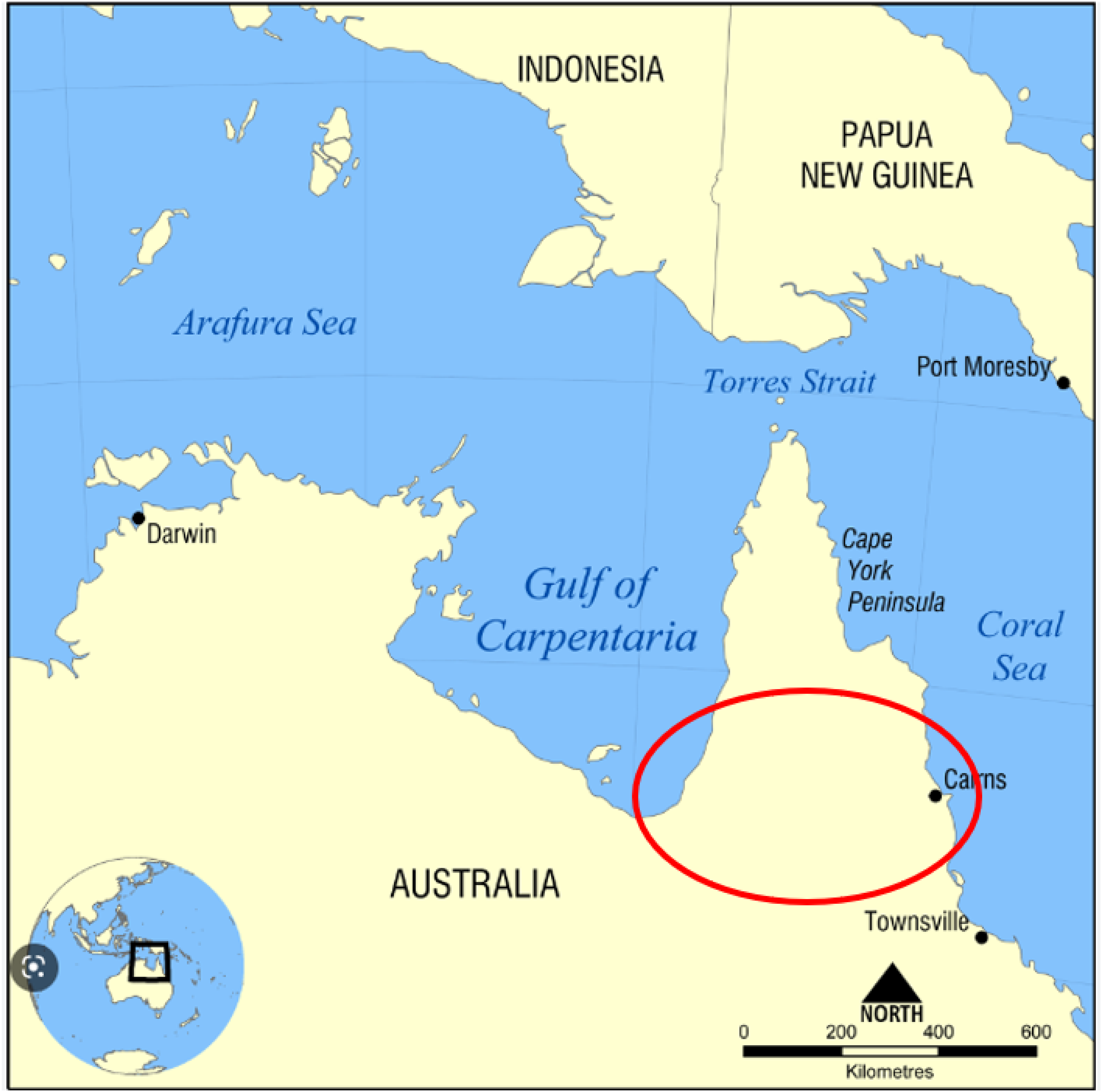
Map showing the Gulf Savannah area in Far North Queensland region (circled). Source: https://en.wikipedia.org/wiki/Gulf_of_Carpentaria.
Needs analysis
The needs analysis sought to understand the digital connectivity needs and lived experience of FNQ residents in the wake of the 2019 flood event. Approximately 25 semi-structured interviews (approx. 60 min each) were undertaken in-person and via Zoom. Participants included graziers, farmers, tourism operators, educators, health practitioners, park rangers, business owners and local government representatives, many of whom were also first responders. Face-to-face interviews took place in Mareeba, Mount Molloy, Chillagoe, Dimbulah, Mount Garnet and Georgetown. Zoom interviews canvassed residents in Normanton, Karumba, Hughenden, Croydon and Burketown. With consent from participants, interviews were audio recorded and transcribed using transcription software. Researchers also took notes during and after interviews. Interview questions covered three topics in relation to telecommunications: existing infrastructure and services, disaster response and recovery, and community resilience and capacity building.
Community engagement workshops with over 60 participants in total across three locations (Croydon, Einasleigh, Dimbulah) were then held to identify and discuss issues and consider potential digital connectivity solutions for homes, businesses and communities. Participants, including business owners, farmers/graziers, councillors, public servants and other interested community members, were recruited through project partners’ networks and word-of-mouth. Two authors were physically present to facilitate each workshop. Participants were divided into groups (3-4 people) based on their business/sector affiliation (e.g. beef, tourism, local government, horticulture), and were asked to consider, and record key points on paper, two questions in relation to disaster resilience: (1) What are the mobile and internet needs for your business/sector? (2) What are the opportunities for your business/sector with better mobile/internet connectivity? The researchers took observational notes and collected the paper as data for analysis.
Interview and workshop data were analysed thematically (Flick, 2006), using a manual process involving two of the authors comparing and contrasting their findings through several rounds of analysis. These authors arrived at five of the most pressing telecommunications needs for FNQ residents and businesses, which directly informed the Digital Connectivity Solutions Packages.
Technical audit and expert panel
As technical consultants to the project, AirBridge Networks undertook a digital connectivity audit focused on mobile service coverage, satellite internet, fixed internet and IoT services. A summary of the relevant telecommunications services for the region was compiled using information from provider websites, discussions with providers, and industry knowledge. Ubiquitous services, such as satellite phone and UHF/VHF radio, were not included as they are broadly available and seen as last-resort options. The primary categories covered include mobile voice and data coverage, satellite internet, fixed internet, and IoT services. Mainstream service provision within each category was identified and mapped for each nominated community within the project region (Einasleigh, Croydon, Dimbulah). In conjunction with the needs analysis, proposed telecommunications solutions were developed. These solutions were targeted to four levels (local self-help quick-wins; community enablement initiatives; regional enablement initiatives; and cross-regional enablement initiatives) which, taken together, support enhancing mobile and broadband connectivity across FNQ.
As a final step, an expert panel was assembled to review the proposed needs-based solutions packages to meet community-identified priorities. The panel consisted of 10 senior representatives from seven telcos and advocacy organisations operating in FNQ. The panel members were engaged in a group consultation on Zoom to share their expertise and provide feedback on the project's understanding of issues and possible solutions. The panel enthusiastically engaged with the research findings and offered clarification and correction on some aspects of service provision.
Needs-driven Digital Connectivity Solutions
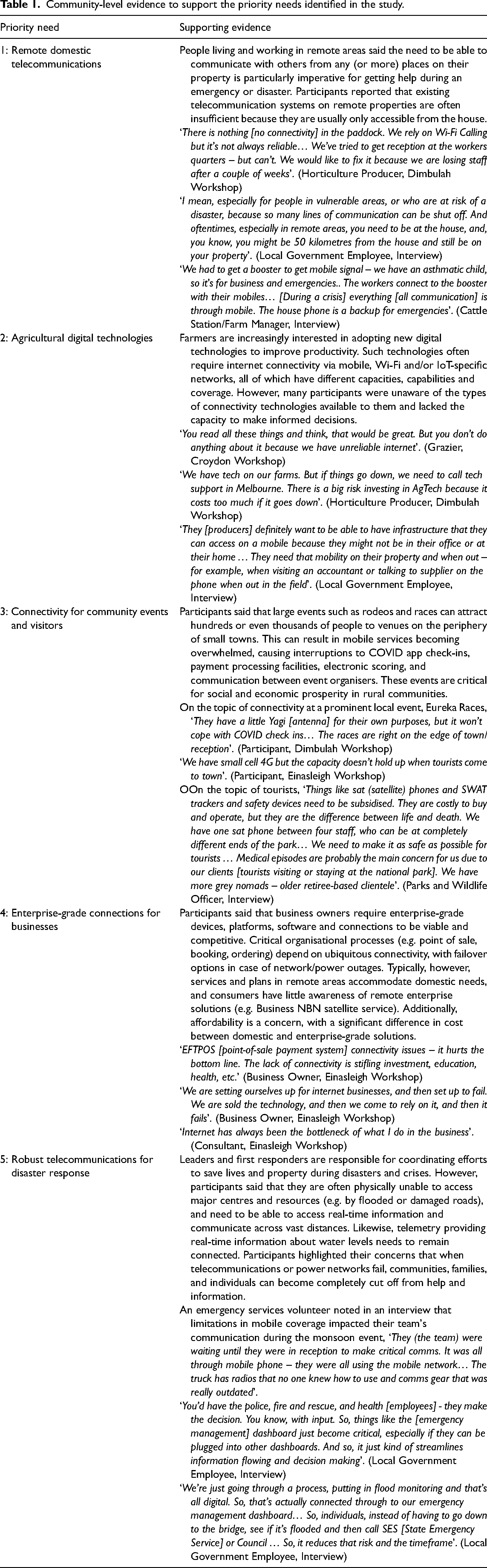
The Digital Connectivity Solutions Packages operationalise the findings, providing new pathways to rural crisis resilience. The three key pillars of the strategy – last-mile connectivity, major infrastructure and initiatives, and digital capability building – address the five inter-related priority telecommunications needs, as identified by research participants (see Figure 2). The priority needs are summarised below in Table 1, with supporting evidence from the dataset. All five priority needs are related to our holistic definition of crisis resilience, which emphasises building socially and economically sustainable communities that can bounce forward from adversity. With this understanding of crisis resilience in mind, we now explore three solutions packages designed to meet these contextualised needs of FNQ residents.
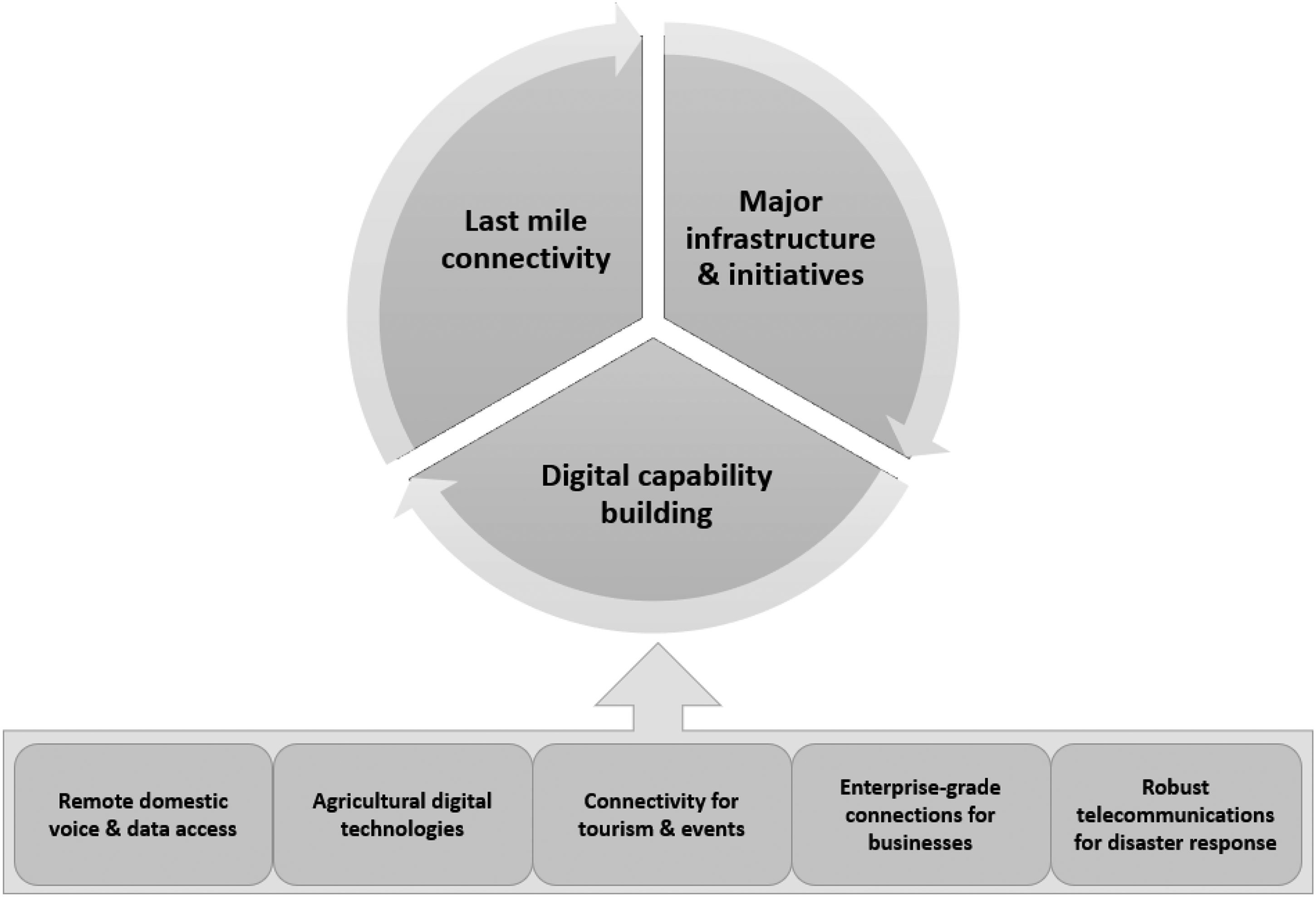
Needs-driven digital connectivity solutions for rural crisis resilience.
Community-level evidence to support the priority needs identified in the study.
Other digital capability building options include: devising a comprehensive and independent register of mobile and broadband connectivity service coverage, to increase awareness and adoption of under-recognised options such as NBN SkyMuster Plus and NBN Business Satellite service; bolstering digital AgTech extension programmes (e.g. GSNRM's eBeef Smart Farming program); and supporting development of IT/digital support services in remote communities through, for example, upskilling existing service providers (e.g. library and post office workers).
First, private network extension involves utilising microwave radio networks to extend fixed broadband service to smaller regional communities or properties. The options may provide point-to-point or point-to-multipoint solutions, which can help multiple users access high-speed internet services. Second, local mobile coverage expansion involves deploying small mobile repeaters to enhance localised mobile coverage at businesses or on rural properties. Community mobile coverage expansion involves engaging with mobile carriers to deploy macro-repeater or small cell services to target specific community locations. Small cell options are significantly cheaper than full mobile base stations but have the drawback of providing limited coverage. They are best targeted for locations where isolated coverage is needed (e.g. Council facilities, tourists stopping points at national parks) and can be used to achieve improved safety and emergency communications for locals and visitors.
Third, brokering fit-for-purpose last-mile broadband connections involves connecting local consumers to independent advice and brokerage support for acquiring suitable and affordable last-mile mobile and broadband solutions for the home, business or organisations. At the individual level, this can be achieved through education about existing support, namely the federally funded Regional Tech Hub. 3 Free services provided by the Hub include: a Monday to Friday hotline; a connectivity report of options available for a specific address (manually generated upon request); lists of provider options for different types of technologies and connections; and online resources about how to get connected, stay connected, improve connections, and use connections effectively. At the community level, brokerage could be undertaken by civic organisations, such as Councils, with appropriate education, support and funding from state and federal governments, and major service providers in the region. This could include preparing place-based resources, facilitating information sessions, and coordinating stakeholders to co-invest in solutions. In relation to crisis resilience, like in Package 1, these proposed last-mile connectivity solutions will serve to broaden the use of digital technologies already widely adopted for crisis response and recovery (e.g. access to critical real-time data, social media participation), and during periods of isolation (e.g. telework, telehealth and online learning activities). Having more robust, last-mile connections could also enable rural residents to take up emerging technologies for crisis resilience, such as more advanced applications for IoT that display aggregate data (e.g., rainfall, river levels, windspeed) on dashboards for their own properties.
First, macro mobile coverage expansion would involve engaging with mobile carriers to develop a progressive funding model to establish coverage, for example, along the 442 km Gulf Developmental Road, a principal freight and tourism route extending from Karumba via Normanton to Mount Surprise. The aim is to fill the broad gaps in highway coverage progressively to achieve better safety and emergency communications for locals and visitors. Solutions include extension of the mobile voice coverage and mobile data footprint, establishing core network access points along the highway route to provide access to other telco services, and new approaches to coverage such as the Field Solutions Group's Regional Australia Network 4 , funded under the Regional Connectivity Program, which delivers regional coverage with the possibility of roaming to other mobile network operators.
Second, NBN fixed service enablement would involve building new infrastructure that does not currently exist in the region. There are direct benefits in enabling the larger townships with fixed NBN technology options (FTTP/C/N) such as: more choice of retail service providers; providing broader service offerings (speeds, data plans, extras), such as no lock-in contracts already offered by many providers; support for business enablement with business-specific services; pricing comparable with major regional centres; removing groups of users from the satellite platform, improving service for remaining remote users; and future-proofing the connectivity needs of communities. A key barrier to enablement for NBN has been the cost of backhaul infrastructure. With the prospect of Telstra InfraCo offering dark fibre options, it may now prove practical for NBN to reassess the viability of such community enablement projects. The townships to be targeted include Normanton; Karumba; Croydon; Georgetown; Mt Surprise; Dimbulah; Mutchilba; and Chillagoe. These communities are serviced by Telstra InfraCo fibre today, presenting a backhaul option for service provision.
Third, leveraging partnerships developed during this project (and other projects carried out in parallel), a partnership-based Regional Digital Investment Strategy could be developed. Initial activities could include: engaging key organisations to lead region-wide efforts to address digital connectivity holistically in ENQ and the Cape and Torres Strait; engaging key federal and state agencies to assist in progressing the strategy through existing policy and funding frameworks (e.g. National Disaster Recovery Fund); establishing local working groups to advocate for specific investments over the next 5-10 years; continued engagement of the expert panel from this project to collaboratively design and implement placed-based digital connectivity solutions; and discussing and developing new approaches to digital enablement funding not focused on commercial return but with greater emphasis on digital/social criteria for rural communities.
The Major Infrastructure and Initiatives Package could be a game-changer for rural crisis resilience. Rural communities could adopt cutting-edge technologies to receive earlier and more targeted warnings, make decisions based on larger, higher quality datasets, and use big data to guide social and economic recovery and ongoing transformation. Improved infrastructure and extended coverage will therefore be key to facilitate emerging technologies that could be employed in future crisis response and recovery efforts, such as Web 3.0 based citizen reporting and data integration, and situational awareness using unmanned aerial vehicles.
Conclusion: New pathways to crisis resilience
This article has presented Digital Connectivity Solutions Packages that expressly address shortcomings in current approaches to rural telecommunications policy and investment in Australia for improved crisis resilience These solutions are underpinned by three principles: (1) supporting strategic partnerships for region-wide connectivity solutions for the benefit of many, instead of gap-filling programmes benefiting comparatively fewer people; (2) promoting digital capability building amongst rural populations to help them make better use of existing services, and ready them for improved infrastructure and access; and (3) adopting a ‘bounce forward’ instead of a ‘bounce back’ approach to building digital capacity and capability that is more likely to future-proof rural communities. These solutions extend those recently suggested by the most recent independent Regional Telecommunications Review Committee including, that the Government make a commitment to a Regional Telecommunications Resilience Fund, aimed at initiatives that enhance emergency and network resilience in vulnerable communities, and further funding be allocated to infrastructure hardening initiatives. The Committee further suggested that greater attention be given to improved coordination between stakeholders such as government, emergency services, the telecommunications industry and energy providers, as well as the implementation of maintenance and preparedness standards for emergency events (Australian Government, 2021). As crisis events become more frequent, we agree that governments and private enterprise must work together to replace current short-sighted and reactionary approaches to digital connectivity and digital capability in rural areas with policy, investment and initiatives that meet the current and future needs of rural people.
Footnotes
Acknowledgements
The authors acknowledge the valuable contribution of Arthur Tsakissiris of AkasT Consulting (and sub-contractor to AirBridge Networks) in undertaking the technical audit component of this research. The authors also thank Gulf Savannah Natural Resource Management, Far North Queensland Regional Organisation of Councils, Gulf Cattleman's Association and their local community members for their participation in this research.
Declaration of conflicting interests
The author(s) declared no potential conflicts of interest with respect to the research, authorship, and/or publication of this article.
Funding
The author(s) disclosed receipt of the following financial support for the research, authorship, and/ or publication of this article: This research was funded under the Community Development Program, which was jointly funded under the Australian Commonwealth/Queensland State Disaster Recovery Funding Arrangements 2018.
