



Abstract
Journalism unions are among the chorus of voices advocating for digital platform regulation. Yet, despite the documented impacts of platformisation on working conditions and labour markets, few of the recent inquiries into platform power have addressed the impacts of platforms on labour. In this article, we ask: what is the role of labour unions in shaping digital platform regulation? As our case study, we analysed how Australia's journalism union (the MEAA) articulated the interests of news workers in submissions to the Digital Platform Inquiry and the resulting News Media Bargaining Code. Through a critical discourse analysis of the union's submissions, we found that the MEAA's lobbying efforts championed the interests of freelancers, advocated for a more inclusive Code, and sought guarantees that the revenue it generated would be used to pay for content creation. The MEAA used a range of discursive strategies, including seizing on ambiguity surrounding the definition of the policy problem and key actors. For the most part, the submissions aligned the union with the regulator, state and media companies in pursuit of platform regulation. However, the competing interests among this advocacy coalition became increasingly clear in the later stages of the policy-making process. Ultimately, the union's strategies were constrained by the hegemony of market-centric discourses that framed the inquiry and shaped the policy outcomes.
Introduction
In 2021, the Australian Parliament voted the News Media and Digital Platforms Mandatory Bargaining Code (the Code) into law. The law was intended to address the market power of platform companies and provide a mechanism through which these companies would pay for news content that appears on their sites. It was the result of an investigation into the impacts of transnational digital platforms on Australia's media and advertising markets conducted by the Australian Competition and Consumer Commission (ACCC). During the policy-making process, the Media Entertainment and Arts Association of Australia (MEAA) – the national union which represents journalists among other media and entertainment workers and sports people – contributed six formal submissions.
Journalism unions are among the chorus of voices that have advocated for digital platform regulation. Despite this advocacy, in the case of Australia's Code, the perspectives of civil society organisations, including unions and professional associations were largely overshadowed by platform and media companies’ lobbying and public relations campaigns. Few of the MEAA's specific policy recommendations made it into the final legislation. This is unfortunate, as the union was among the stakeholders who identified and consistently lobbied to fix significant issues with the legislation: the exclusion of smaller news companies and freelancers, the failure to direct funds to news production, and the arbitrary powers of the Treasurer to designate (or not designate) digital platforms, to name a few.
Nonetheless, as the 2020 Media Diversity in Australia and 2022 Digital Platform Services inquiries indicate, debates over platform regulation in Australia are far from settled. The MEAA's external engagement efforts warrant investigation not only to understand the significance of platform regulation to news workers, but also to explore union engagement strategies, media union renewal, and the relationships between unions, industry, and political actors. As we see a global regulatory turn towards digital platforms, it is critical to understand how to best advocate for workers in policy processes, lest they get left out of the conversation altogether.
In this article, we ask: what is the role of unions in shaping digital platform regulation? As our case study, we analyse how the MEAA articulated the interests of news workers in the Australian policy debate. Through a critical policy discourse analysis of the submissions, we found that the union's lobbying efforts were primarily directed towards making the Code more inclusive and seeking guarantees that the revenue it generated would be used to pay for content creation. However, the ability for news workers to voice their interests in the policy process was constrained by the terms of reference for the inquiry; in particular, its market competition framing. As a result, the union's submissions adopted a discourse that emphasised competition in the market and, for the most part, framed the interests of workers as aligned with those of employers. Our analysis suggests that the market competition framing of the public inquiry prioritised the needs of industry over the public good. It also made it difficult for the MEAA to adequately advocate for news workers’ interests.
Labour unions and platform regulation
Surprisingly few of the inquiries into platform power have addressed the impacts of platforms on workers’ rights or labour markets. Popiel (2022: 37) notes: ‘Despite growing documentation of exploitative working conditions and labor arrangements…the inquiries say little about labor laws, the gig economy, or contract labor, except under the aegis of economic growth and employment’. Platforms enable the micro-management of workflows and increased surveillance (Adler-Bell and Miller, 2018), while the labour relations normalised by platform companies classify many workers as self-employed, limit their rights, and place these workers outside existing union contracts or pay rates (Woodcock and Graham, 2020). In short, digital platforms are of concern to unions not only due to the poor conditions for workers they directly employ, but also because their business model is a troubling template for the economy more generally (Pötzsch and Schamberger, 2022). Even with the competition law framing of the DPI and the implementation of the Code, the policy intersects with significant issues facing news workers (Steinbaum, 2019: 46).
Unions face questions about how platformisation will continue to transform the media workforce. Almost all major journalists’ unions are experiencing declining membership, which has been attributed to staff cuts in print and broadcast media, increases in precarious journalism jobs, and a younger journalism workforce (Bellanger, 2020: 53–55). These changes coincide with the rise of platform companies (Dawson et al., 2021). Workers in platform environments are also more difficult to organise, while unions often lack the resources or expertise to take on transnational platform corporations (Felix, 2020; Kellogg et al., 2020; O’Regan and Young, 2019). Yet, through attempts to address these structural issues, there have been recent ‘green shoots’ in union membership among news workers (Cohen and De Peuter, 2020).
The MEAA is the primary institutional voice for news workers in Australia. It is tasked with representing the industrial interests of its membership, including employment relations and labour conditions. At the same time, the MEAA is committed to promoting ethical and quality journalism. These dual purposes (which often overlap in practice) cannot simply be won in individual workplaces, they also necessitate interventions at the national policy level. As such, the MEAA has intervened in recent policy-making processes, including their successful petition to the Fair Work Commission to recognise digital journalists in the award system and their lobbying efforts around Australia's Right to Know parliamentary inquiry to promote press freedom.
External engagement in policy debates is one mechanism through which journalism unions can articulate news workers’ interests and mobilise their membership around shared concerns (O’Donnell, 2022: 73). Yet, as we will see, engagement strategies can risk implicating unions in counterproductive discourses or unpopular policies (Coles, 2016: 457). The fraught terrain of external engagement makes it particularly important for unions to build in-house technical knowledge, skills, capacity for effective lobbying, and durable internal solidarity (Kellogg et al., 2020: 391). This is especially true in the case of platform regulation wherein labor struggles are likely to take decades and require sustained campaigns.
Platform power
In the news industry, platformisation describes a process through which news organisations have become dependent on companies such as Meta and Google to reach online audiences (Bell and Owen, 2017). According to Park et al. (2022: 85) ‘more than one-third [of Australian news audience members] come across news while they are on social media [and] 22% search for news stories’. As a result, many news organisations commit extensive resources to posting and optimising their content for social network sites and search engines. While some news organisations are attempting to shed their platform dependency (Meese and Hurcombe, 2021), the relationship between transnational platform companies and news companies remains ‘deeply asymmetrical’ (Nielsen and Ganter, 2018).
Platform companies also pose a direct challenge to the advertising revenue model of commercial media (Poell et al., 2019: 6). Social media platforms receive 27% ($2.6 billion) of digital advertising spending in Australia (Digital Platforms Inquiry, 2022: Australia). Furthermore, Alphabet's share of global digital advertising continues to grow with YouTube, Google Search, and its ad tech services bringing in AUD$76.54 billion in 2021 (Kemp, 2022). News companies have not been able to match the effectiveness with which social media and search engines process user data and target advertising.
Moreover, platform companies and their owners have mobilised their lobbying efforts in policy debates about data privacy, free speech, intellectual property, anti-trust law and tax reform (Drutman, 2015; McChesney, 2013; Smith, 2015). Despite discursive attempts by digital platforms to position themselves as neutral intermediaries (Gillespie, 2010; Napoli and Caplan 2017), they have become embroiled in controversies over content shared on their sites, their use of data, and their impacts on news and creative industries (Flew et al., 2021). As such, a growing community of researchers is investigating the discursive strategies used by what Popiel (2018) calls the ‘new media elite’ to pursue their interests and increase their political power.
Regulating digital platforms
Australia's DPI is part of a wave of platform inquiries, including the EU Hate Speech monitoring code, the UK Online Harms Bill, and the US House Judiciary Committee hearings on Online Platforms and Market Power. Together, they are evidence of a broader structural shift in public discourse, which sees the size and socio-economic power of transnational digital platforms as problems that need to be addressed (Bossio et al., 2022). The outcomes of these platform policy debates will be shaped by the competing interests of a range of parties (Savski, 2016). These groups may include policy makers, traditional media companies and platform companies. The interests of civil society organisations, such as unions, should also be represented in the policy-making process.
While the DPI and the Code are a major first step towards platform regulation in Australia, they are also part of more enduring trends in Australian media policy. The recent history of media policy in the country is characterized by the repeal of industry-specific regulation and, in its place, an ever-greater reliance on competition law and the ACCC as the general regulator (Cunningham, 2014: 81). The DPI and Code introduce novel approaches for the general regulator to address platform markets, but they do not diverge significantly from these broader trends. The DPI's terms of reference were intended to provide support for the conservative Liberal-National coalition government's program of deregulation in the media sector (Picard and Park, 2021). Arguably, the approach also prioritises competition as a good in itself and frames the public as consumers (Neilson and Balasingham, 2022: 177). As such, claims about the ‘return of the regulatory state’ (Flew et al., 2021) should not be overstated.
In the press, the debate prompted by the report was largely framed as a struggle between digital platform companies and traditional media owners. Google ran an extended public relations campaign against the implementation of the report's recommendations. Meanwhile, in February of 2021, Facebook abruptly removed access to news content on its site for all Australian users and barred international Facebook users from accessing Australian news products (Heylen, 2023). With Microsoft backing the Code and Australian politicians open to negotiations, however, it did not take long for Google and Facebook to change their strategies. Instead, they lobbied to remove or water down key obligations in the final bill and to negotiate individually with Australian news companies (Lee and Molitorisz, 2021: 39–40).
Meanwhile, the mastheads for Australia's major news companies published a slew of opinion pieces that were critical of Facebook and Google, and supported legislative change (see, for example, Kelly 2020; Stinton, 2021). Australian media companies made submissions to the inquiry and the Code, with News Corp supporting the draft code and Nine Entertainment seeking to tighten up aspects of the legislation (Bossio et al., 2022: 145). In all, 55 separate groups and individuals made submissions. Flew et al. (2021: 13) conducted a stakeholder analysis of the DPI, and reflected that civil society organisations had little impact on the final legislation. Yet, little has been written about the MEAA's submissions or how news workers’ interests were expressed in the policy-making process. This dearth of analysis, together with the fact that other countries are closely watching the DPI and the Code before attempting similar regulation, makes this an important case study.
Critical policy discourse analysis
In the debate over digital platform regulation, the formal submissions made by different groups provide a rich resource for exploring how they define the problem, the interests they are pursuing, and their rhetorical strategies. Critical discourse analysis (CDA) is well-suited to investigating these features of texts, and their relationships to social structures and power (Fairclough, 1995: 132). At the level of the text, CDA is concerned with the semiotics of meaning making, rhetoric, and how texts draw on and intervene in existing ideologies. At the sociological level, it addresses the (re)production of political subjectivities, ideology, and power. Furthermore, the critical orientation of CDA refers to its normative commitment to investigating ‘what is wrong with a society’ and how these issues can be remedied (Fairclough, 2013: 7).
Critical discourse analysis provides a methodological supplement to the interpretive turn in policy studies (Montesano Montessori et al., 2019). Critical policy studies (CPS) focus on the policy-making process, rather than outcomes. This requires researchers to investigate competition and cooperation between political actors, as well as ‘the interests, values and normative assumptions’ integral to policy formation (Fisher et al., 2019: 5). Montesano Montessori et al. (2019) advocate for a combined methodology that they call critical policy discourse analysis (CPDA). They suggest that such an approach can contribute to the study of how political subjectivities are (re)produced in policy debates and provide a critique of the ways that certain ideologies have become hegemonic.
Several studies have identified the discourses employed by platform companies in their political lobbying and public relations efforts, including platform neutrality (Gillespie, 2010; Napoli and Caplan, 2017), technological solutionism (Morozov, 2013), global citizenship (Elkins, 2019), and gig worker autonomy (Shibata, 2020). Popiel's research on policy debates during the 2019–2020 House Judiciary Committee hearings on Online Platforms and Market Power explicitly adopts a CDA approach to study how stakeholders defined the policy problem, the role of the state, and competition policy (2020: 347–349). Here, using a CPDA approach, we turn to the understudied area of union interventions in digital platform policy.
Research questions
Platform regulation has important implications for media workers, yet labour issues have received short shrift in inquiries into platform power (Popiel, 2022). As such, we set out to better understand what role labour unions can and have had in the platform policy-making process. Our research questions were shaped by CDA approaches and adapted to the specifics of our policy case study (Montesano Montessori et al., 2019; Reisigl and Wodak, 2008). We ask:
RQ1. What role do unions have in shaping digital platform regulation?
RQ2. How is the debate over digital platform regulation in Australia framed, and how did this framing impose limits or create opportunities for the articulation of news workers’ interests?
RQ3. Who were the key actors in the policy making process, and in what ways did the MEAA align its positions with these groups?
RQ4. How did the MEAA articulate the interests of news workers in the policy debate over digital platform regulation?
RQ5. In what ways did the MEAA's participation in the policy process relate to the union's goals and campaigns?
Method
The MEAA made six formal submissions regarding the DPI and the Code: two responded to different stages of the DPI, three addressed the Code, and one responded to the call to review the legislation a year after its implementation. We conducted a detailed discourse analysis of the union's submissions and limited reviews of the ministerial directions for the DPI, the DPI issues paper and full report, and the Code legislation (see Table 1). Modifying the approach proposed by Reisigl and Wodak (2008, 93–94), our analysis focused on: 1) how the policy issue was defined and how key actors were categorised into in-groups and out-groups; 2) the features attributed to actors and processes; 3) the arguments made and the ways they were justified; 4) the perspective or self-positioning of the authors and 5) the rhetorical force of the arguments being made.
Sample of texts.
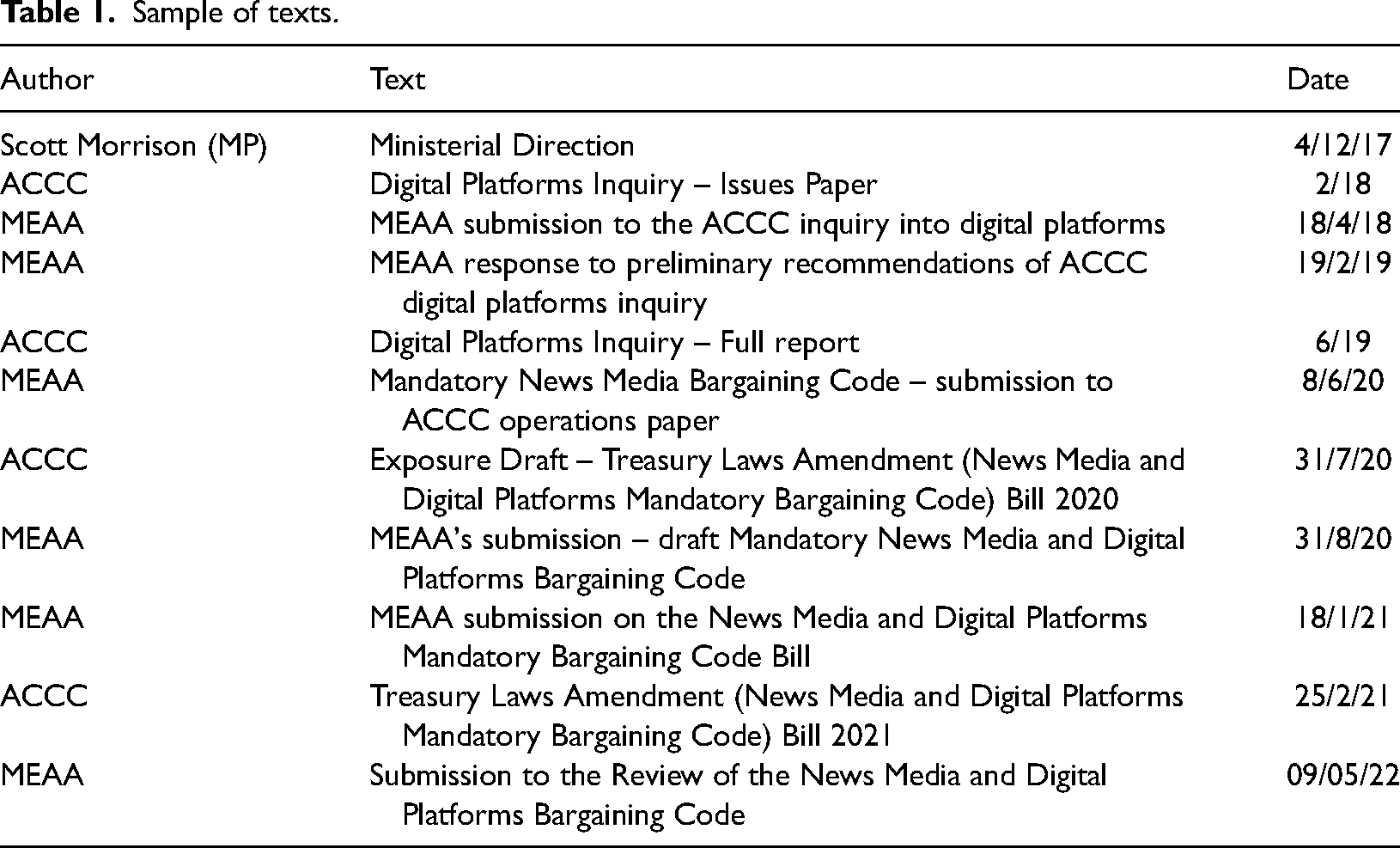
Our analysis was also informed by existing research and theory from digital platform and labour studies. As such, we moved back and forth between the detailed coding of the texts on the one hand, and broader questions of power in the policy-making process, on the other. This was an iterative process through which we refined our categories and grouped them into significant themes (see Table 2).
Coding scheme grouped by key themes.
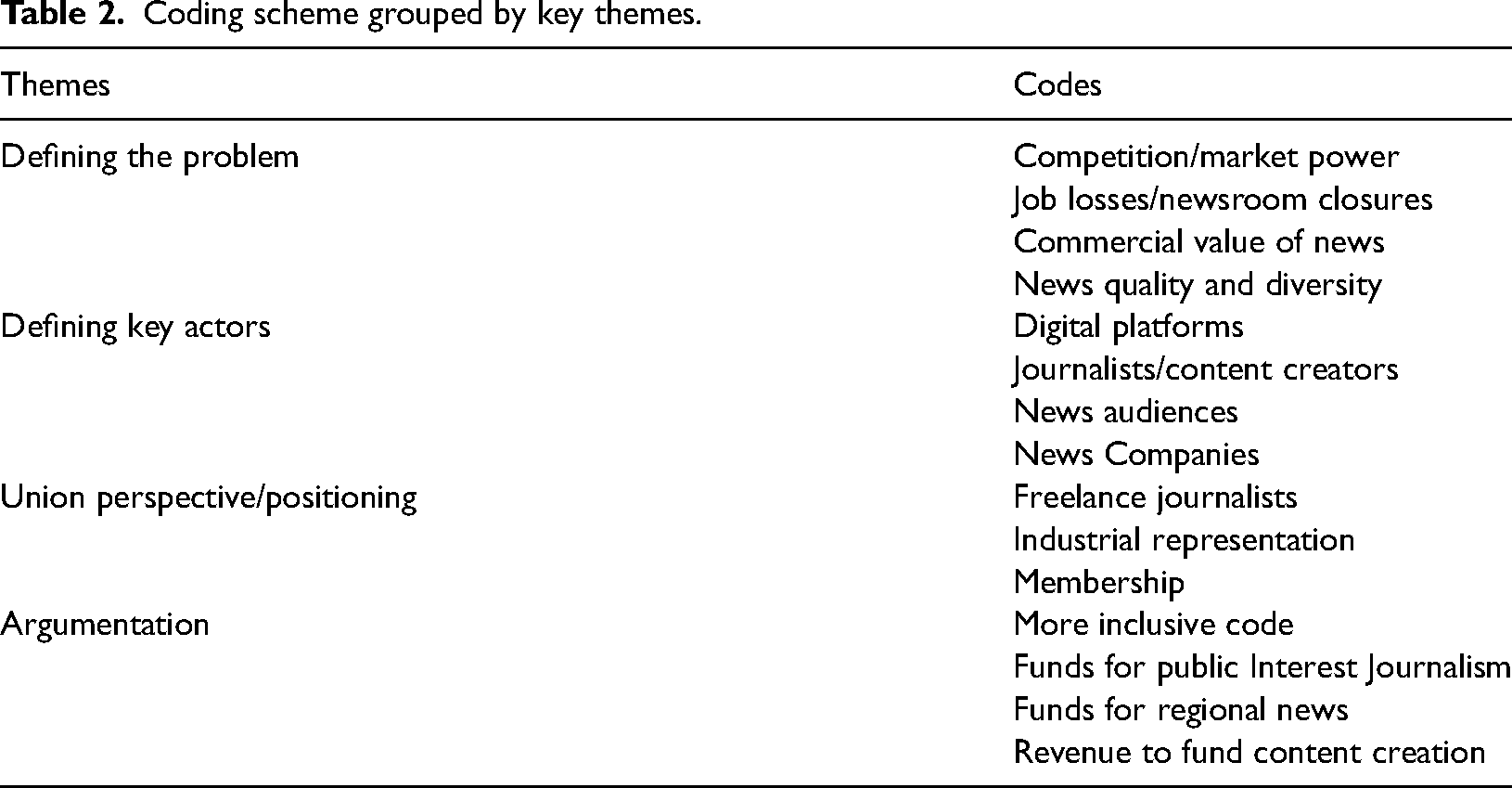
Below, we discuss the MEAA submissions in relation to the different stages and drafts of the DPI and the Code. Our qualitative approach and focus on one case study limits the generalisability of our findings. As such, other researchers can determine the extent to which our conclusions can be transferred to the study of platform policy and union engagement in other national contexts. Yet, this limited scope enabled a close reading of union submissions and policy documents, which, as noted above, is key to understanding how to better advocate for news workers in policy discussions. We conducted an in-depth analysis of how the union defined the issue, positioned itself and other actors, the arguments made by the union, and how these arguments were presented (Jessop, 2010; Leifeld et al., 2021; Leitch and Davenport, 2007).
Findings
Framing the problem
The ministerial directions for the DPI set the formal policy reform process in motion in 2017. The two-page document framed the problem of digital platform regulation in terms of market power. The Minister tasked the ACCC to investigate the ‘impact of digital platform services on the state of competition in media and advertising services markets’. The letter also included five areas for investigation. Of these, the most pertinent to this study were platform services’ ‘dealings with creators of journalistic content’ and impacts on the ‘choice and quality of news and content to consumers’.
Beginning with the opening lines of their April 2018 submission to the DPI, the MEAA blamed digital platforms for many of the problems facing its members and news companies. The union highlighted the ‘imbalanced relationship’ between news organisations and platform companies, in which ‘[n]ews media companies are now strategically dependent’ on Google and Facebook. Platform companies had, according to the union's submission, rendered commercial news ‘business models… obsolete’. Yet, as we will see below, this binary conflict with the MEAA, traditional news companies, and the regulator on one side, and platform companies on the other concealed the diversity and complexity of the interests of those involved (Savski, 2016: 506).
The ministerial direction framed the policy problem in terms of the distortion of markets and the anti-competitive behaviour of digital platforms. Following these terms of reference, the union's submissions adopted market-centric terminology that prioritised competition and framed the policy problem as an issue of market power. Their April 2018 submission to the DPI explicitly expressed that the ‘MEAA's strong preference is for Australian media companies to be provided with a merit-based, free market’. The MEAA endorsed competition law approaches to the problem throughout this submission, including reforms to the ways the ACCC could assess the misuse of market power, and acquisitions and mergers.
This neoliberal framing, however, was inconsistent with some non-market policy solutions proposed by the union. One example, in their April 2018 submission, is the MEAA's proposal for the establishment of a ‘Public Interest Journalism Fund’ to be paid for with a levy on large digital platforms. This proposal to create a contestable public fund was dropped in subsequent submissions. Furthermore, in their submissions regarding the Code, the MEAA lobbied for the inclusion of public broadcasters (the ABC and SBS) in the Code's revenue provisions. These are important exceptions to the market-competition framing. The misalignment between the market-centric terminology and the non-market solutions reflects the challenges that the union faced due to the framing of the inquiry.
Defining the actors
The ministerial direction to the ACCC also identified the main stakeholders. On one side, it identifies ‘platform services’, including ‘search engines, social media sites, and content aggregators’. In the DPI, the ACCC goes on to describe several distinguishing characteristics of digital platforms and markets. Yet, discussions of major platform services came to focus almost exclusively on Google and Facebook. On the other side, the directive lists ‘media content producers, advertisers, and consumers’ as groups who are impacted by platforms. While the directive provides terminology for the inquiry, the union's submissions engage in arguments over how to define key stakeholders.
Beginning with the MEAA's April 2018 submission, the union challenged the distinction between digital platforms and media companies. Noting that platform companies ‘deny that they are media companies’ the MEAA argued that ‘there is no credible barrier to describing the major digital platforms as technology, advertising and media companies’. On this basis, the MEAA lobbied for these companies to 1) ‘be classified as media companies for regulatory purposes’, and 2) ‘pay for the news and current affairs content’. Defining Google and Facebook as media companies would make them subject to the Broadcasting Services Act 1992 that stipulates, among other things, rules related to content that is offensive, defamatory, false, or otherwise harmful. Here, the definition of actors in the policy debate has material and legal implications.
The framing of news audiences as ‘consumers’, however, went unchallenged in the MEAA's submissions. The choice of the term ‘consumers’ over alternatives such as ‘the public’ or ‘citizens’ impacted how news audiences were framed in the policy process. While the DPI mentions the significance of public service journalism to democracy, this framing is quickly replaced by the consumer lens. The ACCC is charged with protecting consumers and consumer welfare. It is this focus on consumer welfare, which places concerns about news audiences within the scope of the regulator and foregrounds the rights of consumers over their rights of citizens in a democracy. This framing is also consonant with neoliberal approaches to competition law that conceive people foremost as consumers or customers who make rational choices based on their self-interest (Buch-Hansen and Wigger, 2010). This limits the types of interests that can be included and the solutions that are considered legitimate (Turner, 2018: 10–11). In fact, discussions of news audiences were a significant ellipsis in the union's submissions, despite the potential to express concerns over audience data, privacy, or unpaid labour.
Finally, in the ministerial directions and DPI the terms ‘media content producers’ and ‘creators of journalistic content’ are used in favour of more specific terms such as: ‘media companies’, which would have focused on employers; or ‘journalists’ which would place the emphasis on news workers. As we suggest below, this ambiguity provided the terrain on which the MEAA could make one of its most consistent arguments in favour of a more inclusive code. Strategic ambiguity describes the intentional use of language that is unclear or open to interpretation in the pursuit of organisational goals (Eisenberg, 1984). According to Leitch and Davenport (2007: 44) strategic ambiguity can enable ideologically diverse actors to collaborate, even where their goals may be in conflict. We found this terminology reproduced throughout the MEAA's submissions, including the terms ‘content providers’ and ‘generators of news content’, for example. In fact, the union expressed a preference for broader definitions of news content and producers over the terms ‘journalist’ and ‘journalism’ when defining the potential beneficiaries of the draft Code's revenue sharing provisions.
The union's perspective/self-positioning
The union presented itself as part of what Leifeld et al. (2021: 3) call an ‘advocacy coalition’ with media companies and the regulator. As such, the MEAA's submissions tend to conflate the interests of its members with the commercial interests of news companies. For instance, in their January 2021 submission, the union was part of a chorus of voices from industry and government that highlighted ‘the parlous economic and employment situation at regional media organisations’. Unions’ relationships with employers often pivot between confrontation and collaboration, as unions are caught up in the ‘labour-management relationship’ (Coles, 2016: 461). Newsroom closures are also a structural reason for declining journalism union membership and the MEAA's alignment with traditional news companies can be seen as part of their strategy to help (and recruit) members by simply ‘keeping the lights on’ at news companies.
The MEAA also aligned itself with employers by drawing extensively on third-party research to make arguments about the plight of media companies. This included: reports released by large news companies such as News Corp and Nine Entertainment; research commissioned by the ACCC; industry reports; and research conducted by consulting firms such as Ibis World, PwC, and Morgan Stanley. The union used figures from this research to highlight the revenue losses among media companies and the market power of platforms. In fact, in their April 2018 submission the MEAA goes as far as quoting the head of News Corp in Australia, Michael Miller, who claimed that ‘Google is destroying the journalism model’. While the union acknowledged points of divergence between the interests of workers and employers, their submissions positioned the MEAA as part of an advocacy coalition along with these actors lobbying for platform regulation.
The tension between the interests of MEAA members and the profit motive of media employers was most apparent in the union's stance on how potential revenue from the Code should be spent. The union's reasons for concern are explained in the August 2020 submission, which notes ‘[a]lthough it appears logical that funds raised under the Code will be devoted to the production of content, there is an evident risk that funds may not be directed to such purposes in the absence of an explicit requirement in the Code’. The MEAA reiterated the concern that revenue will either be directed to other aspects of media businesses or into the pockets of executives and shareholders in their January 2021 submission. As we discuss below, terms such as ‘concern’ and ‘risk’ became more frequent in the union's later submissions to mark disagreements with positions taken by the regulator and media companies.
Surprisingly, there were few references to what might be considered the ‘bread and butter’ issues for unions in the submissions, such as industrial representation or workplace rights. This is despite a key recommendation of the DPI (providing an exemption under section 88 of the CCA) that amounted to a type of collective bargaining for media companies. That is, the inquiry concluded that news organisations should be able to negotiate with digital platforms on a collective basis. While the MEAA supported this proposal, they did not advocate for the union to be at the table during these negotiations or for any other mechanism through which workers interests could be represented. There were also limited references to media work or journalists as workers. In other words, with the except of thei advocacy for freelance journalists that we discuss in detail below, the submissions did not attempt to shift the policy discourse towards issues of labour relations or working conditions.
Key arguments for a more inclusive code
Throughout the MEAA's submissions, the union consistently called for a broader definition of media producers and news content, and a more inclusive Code. This lobbying reflects the MEAA's broad membership which includes workers from across the media and arts industries, including those ‘employed on a full time, part time or casual basis, or as independent contractors or freelancers’ (January 2021 submission). In the August 2020 submission, there was a lengthy explanation of the structural conditions that have led to more precariously employed journalists. The union contended: As a result of ongoing structural changes in the Australian news media sector over more than a decade, many journalists (and their equivalents) have remained in the profession as independent contractors. They often endure sub-Award levels of payment for their work and the level of work they are engaged to perform is directly linked to the economic health of the entire media ecosystem.
The submission continued to advocate for freelancers’ interests to be reflected in the Code, arguing: ‘There is a clear case for the Code to expressly recognise the role of freelancers’. Put simply, the sustained emphasis on freelance media workers in the MEAA's submissions is consistent with their organising strategy.
A recurrent criticism of journalism unions is that they have been unable or unwilling to effectively recruit and represent freelance workers. Many journalists who lose their permanent jobs cease their union memberships (O’Donnell and Zion, 2019: 230), while some union leaders see representing freelance journalists as too resource-intensive (Neilson, 2021: 114). However, the MEAA has identified the potential to recruit precariously employed and casual news workers. As early as 2013, the union began its Freelance Pro initiative. It has maintained a National Freelance committee and, in 2022, launched a Freelance Charter of Rights. Organising efforts among precariously employed and freelance journalists may have played a role in stabilising membership numbers in recent years (O’Donnell, 2022: 69).
The bid for a more inclusive response to the issues caused by platform services was also evident in the MEAA's lobbying against the proposed revenue test. The ACCC recommended benchmarks to assess a news company's eligibility to benefit from the Code. These included an AU$150,000 per-year revenue test. In the union's June 2020 submission, they argued that ‘[t]he scale of a news organisation or news provider should not be a consideration for coverage by the Code. For example, if an established freelancer or blogger's content is accessed through Google and Facebook, it should attract payment’. Noting that approximately 90 percent of Australia's newspapers are owned by four companies, the MEAA argued that ‘the Code should play a critical role addressing Australia's very low levels of media diversity’. This was a rare example in which the union ventured, cautiously, to criticize the organisation of media markets and the entrenchment of large media companies’ interests. The criticism was reiterated as a key deficiency of the legislation in the union's 2022 submission to the review of the Code. Overall, one of the MEAA's most consistent arguments throughout the submissions was the call for a more inclusive policy that would represent the interests of its diverse membership.
Rhetorical strategies
For the most part, the MEAA directed their criticism towards digital platforms and specific policy instruments. It couched its more limited criticism of the government, media businesses, and the regulator in careful language with the unions’ critique of the policy-process and outcomes becoming more explicit in the latter submissions. In their April 2020 submission, the union identified ways that the influences of the conservative government and Australian media companies threatened to result in poor policy outcomes. They suggested that the limited inclusion of public service broadcasters under the Code had been ‘arrived at for political reasons outside the control (and remit) of the ACCC’. That is, they implied that the initial exclusion of the ABC and SBS from key bargaining and revenue provisions was the result of the conservative government's animosity towards the broadcasters and the capture of the policy process by the interests of corporate media.
The term ‘concern’ became a prominent way that the union marked its disagreements with the regulator. For example, their April 2020 submission critiqued the benchmarks for inclusion under the Code by expressing a ‘key concern with the definition of “core news content”’ and that they were ‘concerned by the Code's reference to excluding content produced by academics’. The language of concern was also used to highlight the need to legislate how revenue from the Code would be used. In the January 2021 submission, they stated that the ‘MEAA is ultimately concerned [about] the Code's failure to mandate the use of funds for journalistic content’. Elsewhere, they referred to this as representing an ‘evident risk’ (January 2021 submission) with potentially ‘perverse consequence’ (August 2020 submission). Similarly, in the January 2021 submission, MEAA expressed it was ‘gravely concerned’ and ‘maintains its concern’ over the lack of specific provisions in the Code to address the issues faced by regional news companies.
The unions’ submission to the 2022 review of the Code, took on the most strident tone. The submission admonished the ACCC for failing to require transparency from digital platforms and media corporations, noting ‘[i]t is passing strange that the key government agencies guiding this review process can only implore news media companies to share key data’. Furthermore, the MEAA describes the failure of the Code to stipulate how funds are used by media companies as a ‘serious deficiency’ and describes the clause of the Code which allows digital platforms to escape designation as ‘unsound’. At the end of the policy-making process, the union's advocacy alliance with the regulator, government, and media companies was no longer necessary and the MEAA employed language that more explicitly expressed disagreements and conflicting interests.
Conclusion
We have argued that unions have an important role to play in the development of platform regulation, as digital platforms have impacted working conditions and normalised troubling new labour arrangements (Pötzsch and Schamberger, 2022). Even in the case of Australia's DPI (framed as it was through competition law), platform regulation intersected with labour issues, including those related to freelance media workers and collective bargaining. Yet, amongst the growing number of inquiries into platform power, there has been little attention paid to labour issues (Popiel, 2020). As the primary representatives for workers in areas of industrial policy, the role of unions is to put these concerns on the policy agenda and to effectively advocate for outcomes that benefit workers.
Entering policy debates is a fraught endeavor, as law-making processes are embedded in enduring power relations and discourses. Yet, interventions at the policy level are necessary for journalists’ unions that are pursuing better employment conditions and defending quality journalism. The MEAA has recognised the importance of platform regulation for its members. Across its six submissions to the DPI and Code, the union consistently advocated for a more inclusive approach that would benefit freelance workers. To make this argument, the union drew on a range of rhetorical techniques including a strategic use of ambiguity around terms like ‘content producer’. The ‘big tent’ approach reflects the union's diverse membership and their long-term campaigns directed towards freelance journalists. In this respect, the union's submissions suggest that they are responding to workforce trends, if not the academic research on precarity in journalism and the cultural industries (Cohen, 2016; Hayes and Silke, 2018; Marjoribanks et al., 2022).
The MEAA positioned itself as part of an advocacy coalition with traditional media companies and the regulator, emphasizing concerns about newsroom closures and challenges to traditional media business models. Meanwhile, references to industrial representation or working conditions and rights were limited. For the most part, the union conflated the interests of news workers and media companies in their contributions to the debate. This, however, became increasingly untenable later in the process as it became obvious that there would be no guarantee that revenue from the code would be directed to news production.
Ultimately, the discursive framing of the inquiry limited the union's possible actions (Buch and Andersen, 2015: 149). The DPI and Code are significant policies that have provided a cash injection for Australia's media companies (Treasury, 2022). Yet, they also need to be understood within the recent historical context of successive waves of sector-specific media deregulation and, in turn, the growing role of the ACCC as the general regulator (Cunningham, 2014: 81). The terms of reference were drafted by a conservative government, no less, with a track-record of de-regulating the media (Hitchens, 2007). In line with the hegemony of neoliberal approaches to competition policy (Buch-Hansen and Wigger, 2010), the union's submissions also tended to reproduce market-centric terminology and framing. In short, the competition framing of the terms of reference sidelined news workers’ interests. If unions continue to adopt such framing in their own submissions, they risk ultimately working against the best interests of their members and the broader public good.
We hope to have shown that critical discourse approaches can contribute to research on the political economy of communication and on media regulation. With Fischer and Forester (1993), we suggest that policy reform is a political process that involves struggles to delimit legitimate responses, define problems, and sometimes even to challenge existing paradigms. While the scope of this research is limited by our case study, we hope that other researchers will continue to take up the task of studying the role of labour unions in platform policy (Popiel, 2020, 2022), as well as media unions’ lobbying efforts (Coles, 2016) and rhetorical strategies (Salamon, 2022).
Footnotes
Declaration of conflicting interests
The author(s) declared no potential conflicts of interest with respect to the research, authorship and/or publication of this article.
Funding
The author(s) received no financial support for the research, authorship and/or publication of this article.
