



Abstract
This study explores how Chinese riders game the algorithm-mediated governing system of food delivery service platforms and how they mobilize WeChat to build solidarity networks to assist each other and better cope with the platform economy. We rely on 12 interviews with Chinese riders from 4 platforms (Meituan, Eleme, SF Express and Flash EX) in 5 cities, and draw on a 4-month online observation of 7 private WeChat groups. The article provides a detailed account of the gamification ranking and competition techniques employed by delivery platforms to drive the riders to achieve efficiency and productivity gains. Then, it critically explores how Chinese riders adapt and react to the algorithmic systems that govern their work by setting up private WeChat groups and developing everyday practices of resilience and resistance. This study demonstrates that Chinese riders working for food delivery platforms incessantly create a complex repertoire of tactics and develop hidden transcripts to resist the algorithmic control of digital platforms.
Introduction
Work mediated by online labor platforms is spreading rapidly around the world, especially in the Global South. The gig economy is also playing an increasingly central role in countries such as China, where it is expected that by the year 2036 gig workers could reach 400 million people (Masiero, 2021). Within the gig economy, a booming sector is food delivery. While there are no official statistics about the total number of delivery workers in China, in a short documentary produced by the Beijing television station that was first broadcast on the evening of April 27th, 2021, an officer of “Meituan Waimai” (Meituan) 1 demonstrated that at least 10 million outsourced riders in China currently work for Meituan. 2 It should be noted that this number does not include the number of riders working for other food delivery platforms. In other words, the number of riders working for food delivery platforms in China is at least tens of millions up to date. The work of these riders is governed by algorithm-based apps that rank each rider's performance according to non-transparent (black-boxed) parameters, prompting them to compete with each other through multiple forms of gamification and rewards. Literature on digital labor and food delivery was scarce until a few years ago and has boomed only recently (e.g. Abilio et al., 2021; Anwar and Graham, 2020, 2021; Barratt et al., 2020; Ferrari and Graham, 2021; Gregory, 2020; Moore and Woodcock, 2021; Tassinari and Maccarrone, 2020; Veen et al., 2020); however, in the context of China, there are still few studies (e.g, Lei, 2021; Liu and Friedman, 2021; Sun, 2019) focusing on how workers adapt to this work context and how they negotiate and react to the algorithmic power of food delivery companies.
This paper fills this gap by shedding light on how riders working for Chinese food delivery platforms adapt to the algorithmic systems that govern their work. It investigates how Chinese riders cope with the power exerted on them by the platforms through algorithmic ranking. We situate our research in the broader context of studies on the agency of gig workers in the platform economy (Anwar and Graham, 2020; Barratt et al., 2020; Ferrari and Graham, 2021; Tassinari and Maccarrone, 2020). In line with the Introduction to the Special Issue, which this article is part of, our contribution aims to “turn the critical study of data to consider algorithms’ antagonistic and tactical uses” (Heemsbergen et al., 2022: 2).
The research is based on 12 semi-structured interviews with Chinese riders from 5 cities (Beijing, Shanghai, Shenyang, Dongguan and Shenyang), working for 4 Chinese food delivery platforms (Meituan, Eleme, SF Express and Flash EX). In addition to the interviews, the research builds on a 4 months online observation (October 2020–February 2021) within 7 private WeChat groups composed of hundreds of Chinese riders. WeChat, a social media platform developed by Tencent, is widely used by Chinese riders to communicate with coworkers to avoid being monitored by the platform and their superiors.
The findings highlight how riders rely on WeChat for intense conversations, exchanges, and complaints about the food delivery platforms they work for. While food delivery platforms set up their own WeChat groups in different cities to facilitate communication between riders and issue work notices, all interviewees point out that they prefer to establish their own digital environments for various reasons. Our results illuminate different forms of resistance to the power of the platforms that are emerging among Chinese riders, such as complex tactics of “gaming” the platforms’ algorithm, together with forms of collective organization established through private chats. These tactics are evidence of emerging forms of solidarity among riders who reject the competitive ethos encoded in the algorithms of the Chinese food delivery apps and instead organize to support each other to survive in this ruthless economy.
WeChat groups represent a safety net for experienced riders, but also for newcomers (as in the case of Knights League 3 (KL)'s WeChat group, a spontaneous rider “union” founded in 2018). Within these groups, riders share news about the emergence or increase of temporary subsidies; provide technical assistance with equipment; help newcomers to get started and overcome obstacles; share real-time traffic information and provide emergency assistance. These practices point to the existence of a new type of algorithm-mediated solidarity that this article will disentangle in its constitutive dynamics. The exploration of the forms of algorithmic solidarity and resistance among Chinese riders will contribute new knowledge to grasp the ways in which people engage with algorithmic media in everyday life, re-evaluating their ability (agency) to collectively act on algorithmic power (Sun and Chen, 2021; Velkova and Kaun, 2019).
Algorithmic power in the platform economy
Given the continuous expansion of the gig/platform economy, more and more scholars across various disciplines have gradually started to examine and criticize the profit-seeking algorithms of platform companies and their power from the perspective of “algorithmic/technological control and management” empirically in recent years (e.g. Goods et al., 2019; Lee et al., 2015; Lei, 2021). Gig economy platforms exercise “techno-normative control” driven by algorithms to control labor processes and workers (Gandini, 2019: 1041).
In other words, the adoption of new technology to enhance control over platform-based workers has been a recurring research theme globally (Liu and Friedman, 2021; Newlands, 2020). For example, Rosenblat and Stark (2016) found out that Uber leverages indirect control over Uber drivers’ performance and efficiency through digital technology and algorithms, such as blind rider acceptance and minimum fares, structuring asymmetric relationships between the company and labor that benefits the former. Wu and Li’s (2018) discovered that the ride-hailing platform in China also leverages similar control over their drivers through various algorithmic designs, such as bonding drivers’ scores with their bonuses. By drawing on a four-year study with workers who work for one of the world's biggest gig work platforms (Upwork) in 5 countries in Africa, Anwar and Graham (2021: 253) show that even though the idea of freedom and flexibility in gig work represents an idealized version of jobs, the structural and technological design of platforms—such as “social isolation, high work intensity, non-payment of wages and unfair dismissals”—led to African workers’ “precariousness and vulnerability”. In the food delivery industry that this research sheds light on, Griesbach et al. (2019) also pointed out that workers’ freedom is constrained by food delivery platforms through algorithms control: “Instacart (…) constrains workers’ choices more than the other platforms, forcing them to commit to schedules in advance and exerting more pressure on them to accept particular orders, minimizing autonomy over their time and tasks” (13). Gig workers’ daily practices are governed by “black-boxed” algorithms within food delivery apps (Bartholomew, 2021). This “black boxed” computational power highly structures and constrains the gig workers’ agency.
Food delivery platforms also exert power on riders through gamification processes, nudging them to increase their performance to obtain greater benefits. Gamification, according to Warmelink et al. (2020: 331), refers to “the design approach that implements elements (affordances, mechanics, technologies) that are familiar from games in contexts where these elements are not commonly encountered”. In the food delivery industry, the datafied gamification techniques employed by the platform companies are varied. However, there are few studies shedding light on these techniques so far (e.g. Sun, 2019; Van Doorn and Chen, 2021). For example, Sun (2019) discloses that the hierarchical and “gamified” evaluation systems embedded in Chinese food delivery platforms were used by the companies to monitor the working practices of riders and boost their work efficiency. Specifically, riders’ incomes are closely linked to their levels within Chinese food delivery platforms, and these levels are linked to factors such as “traveling distance, duration of work time, and work performance reviews, such as ratings and comments by customers” (Sun, 2019: 317). Moreover, as a form of algorithmic control and management technique adopted by these food delivery platforms, the datafied gamification techniques are adopted by food delivery platforms to regulate their labor and manage their labor costs to meet investors’ expectations of their financial performance (Van Doorn, 2017; Van Doorn and Chen, 2021).
Resistance within food delivery platforms
Given that user agency is largely ignored in debates on algorithmic culture and power, Velkova and Kaun point out that it is increasingly important to consider to what extent and in what ways algorithmic power can be resisted, so “we can start charting more hopeful approaches to managing their power in everyday life” (2019: 525). By employing a research framework of studying algorithms with a focus on user agency and looking into the case of World White Web (3W) project, 4 Velkova and Kaun (ibid) suggest that reactive user agency (the “repair” tactics in this case) in relation to algorithms can emerge from alternative use of platforms, correcting existing shortcomings within the algorithmic culture. Including Velkova and Kaun's work, recently, studies on how users can use different innovative practices to resist the algorithmic power of platforms have started to emerge (e.g. Treré et al., 2017).
Inspired by, and in response to Velkova and Kaun's call, we argue that in order to disentangle all the complexity inherent in the algorithmic power of food delivery platforms, we also need to focus on the agency of the riders and their forms of everyday resistance (Scott, 1985) against the platforms. Riders should not be regarded as passive participants in the unequal relationship between workers and platforms, but as subjects who are actively coping with the algorithmic power exerted by the platforms. In recent years, the literature on riders’ resistance against the food delivery platforms has started to flourish globally (Anwar and Graham, 2020; Ferrari and Graham, 2021; Tassinari and Maccarrone, 2020; Woodcock, 2021). In relation to China, Liu and Friedman (2021) have demonstrated that Chinese riders refused to take reassigned orders and used WeChat groups to organize offline strikes to express dissatisfaction with the decline in wages and bonuses. In another study, Sun (2019) showcased that Chinese riders can tactically game the platform algorithms for their benefit by aligning with restaurants and food manufacturers, transferring orders (a practice called “zhuandan”), joining a virtual community based on WeChat groups, and working for multiple platforms at the same time. Similarly, Chen (2020) has illustrated how riders in Beijing can extend their delivery time by “guadan”—pretending that they have not received the food prepared by the restaurants, and “baobei”—proactively informing the platform they have arrived at the restaurant, but the restaurant has not prepared the food yet.
These works have started to illuminate emerging forms of resistance to food delivery platforms. However, given that the algorithms adopted by these platforms (and the practices related to them) are constantly evolving based on the data generated by the riders (e.g, Chen, 2020), more research on how workers adapt to this job context and how they negotiate, react, and circumvent algorithmic power is needed.
Research design
The current study adopts a mixed qualitative method to generate data. Research questions were created following the principles of Grounded Theory (Charmaz, 2006). We entered the field with the aim of exploring how riders working for Chinese food delivery platforms adapt and react to the algorithmic systems that govern their work. We produced an array of fieldnotes and memos, interview transcripts, and ethnographic materials (screenshots of WeChat private groups’ conversions) that were analyzed through an iterative process of sense-making (Schwartz-Shea and Yanow, 2013). Concept development took place during fieldwork, not before it. The research question emerged inductively, from the coding of the data generated.
A constant review of the data allowed us to refine the research question, focusing on the tactics adopted by Chinese riders to survive the algorithmic systems that govern them. The coding of the data brought out the category of solidarity among riders and the central role of WeChat in building these bonds of solidarity.
First, we conducted 12 semi-structured interviews with food-delivery riders via telephone between October 2020 and July 2021. The interview questions were mainly about their daily experience of working for the platforms, how they adapted and responded to the algorithmic settings of the platforms and how they make sense of these settings. The average interview time for the interviewees ranged from 30 to 60 min. All interviews were recorded and conducted in Chinese and then translated into English. The interviewees were recruited from 7 private WeChat groups composed of hundreds of riders, as well as through riders’ recommendations. The twelve (N = 12) interviewees are from Meituan, Eleme, Flash EX (Shansong) and SF Express, which are the main food delivery platforms in China. The interviewees are from 5 cities (Beijing, Shanghai, Shenyang, Weifang, Dongguan) in China and have worked on these platforms for between 0.5 and 7 years. All interviewees are familiar with mobile phones and different food delivery platform apps, 10 of them are Gig platform couriers (GPCs), and only 2 of them are service platforms couriers (SPCs). According to Lei (2021), SPCs are full-time employees who work for service stations (an actual physical station used to coordinate within a locality); GPCs can decide when they want to work and do not share a workplace. All interviewees were informed that the interview data would be confidential and their names would be anonymized. Table 1 shows the details of these interviewees.
Interviewees’ working platforms, working years, locations.
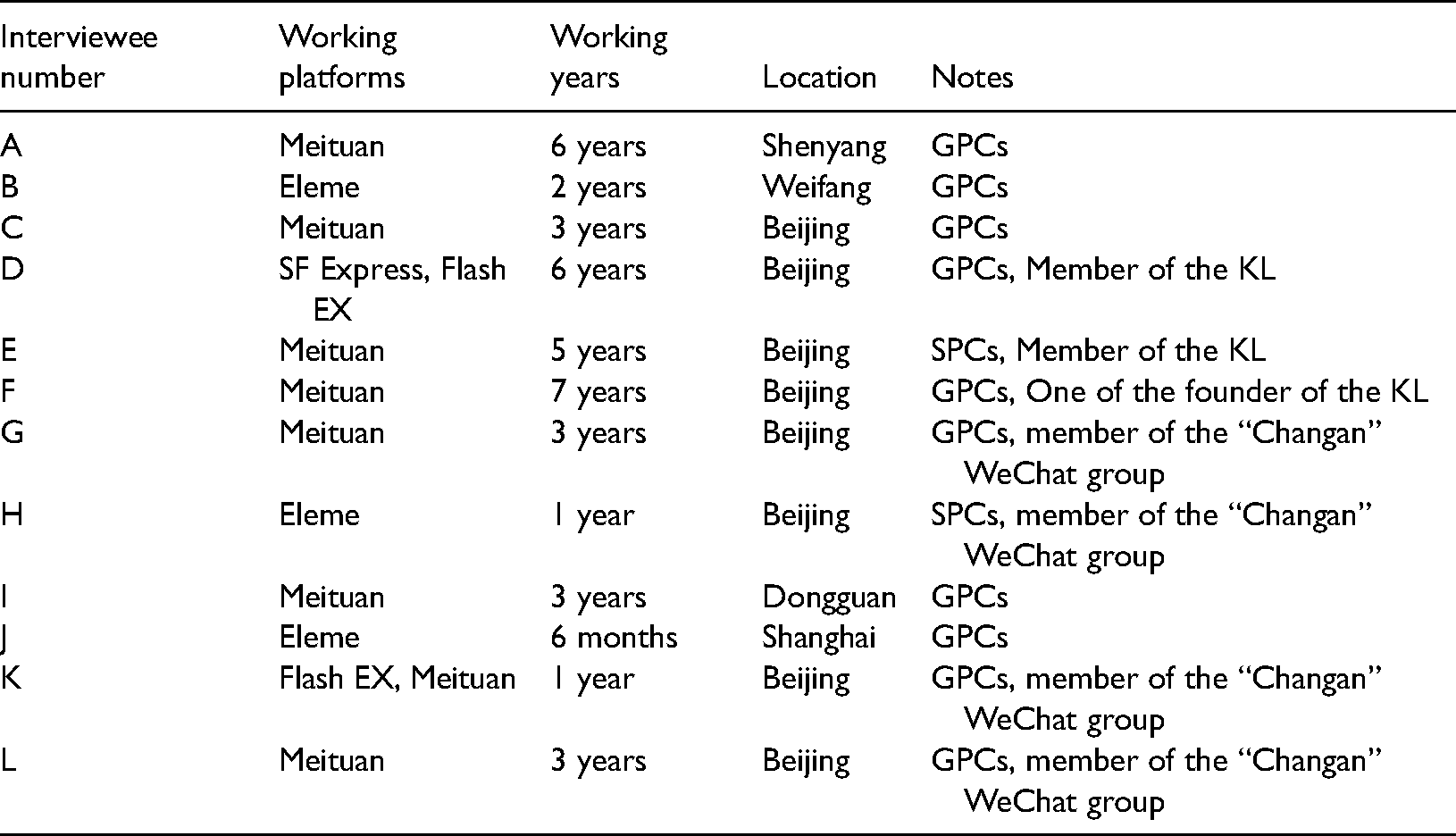
Second, to further understand how Chinese riders use WeChat to build networks of solidarity, we conducted a 4-month online observation between October 2020 and February 2021 within 7 private WeChat groups (including the WeChat group set up by the KL, and the “Changan” group) composed of hundreds of Chinese riders. 5 During the 4 months of observation, we had daily access to these groups and read all their conversations. The data generated were of two types: screenshots of the most relevant conversations and fieldnotes. More specifically, we observed and recorded in detail how Chinese riders use WeChat to communicate with each other and establish solidarity ties and close mutual assistance relationships to cope with the precarious conditions generated by the platform economy.
Findings
Three main thematic clusters emerged from the data coding: the first is related to the ranking systems and processes of gamification of riders’ work, which push them to improve their performance to climb the rankings and obtain benefits. Our interviewees all admitted to feeling the pressure exerted by these gamification mechanisms.
The second thematic cluster relates to the tactics that riders have developed in response to this pressure. We found that these tactics are shared among riders through private groups on WeChat. The third thematic cluster, related to the second, is the role that WeChat groups play in the daily lives of riders. We found that these informal networks afford the building of solidarity bonds among riders. Both the interviewed riders, and the hundreds of riders we observed in WeChat groups, manifest a willingness to support each other rather than compete with each other, in order to survive in a highly competitive ecosystem.
In the next sections, we will describe the competitive mechanisms designed by the platforms. Next, we will show the tactics adopted by the riders to circumvent these mechanisms and finally we will focus on the third thematic cluster, the role of WeChat in building solidarity bonds.
Competitive features of food delivery platforms
Ranking systems
According to Sun (2019) and Chen (2019), food delivery platforms in China set up different ranking systems for their riders. Our investigation discovered that these food delivery platforms imitate the ranking system in the popular mobile game “Honor of Kings” 6 in China. Take Meituan as an example: riders are divided into four levels according to their weekly performance (riders’ ranks will drop if they perform poorly): Bronze, Silver, Gold and Kings (each level is subsequently divided into other four sub-levels, like bronze 1, bronze 2, bronze 3 and bronze 4). In Eleme, according to the rider's weekly performance, riders are divided into six levels: Bronze, Silver, Gold, Platinum, Diamonds, Kings.
Regardless of the platform, the same principle is followed, that is, the higher the level of the rider, the higher the number of orders sent by the system will be received by the rider. This means the revenue per order will increase, and the higher-level riders will also receive better benefits, such as extra orders given by the platform, dedicated service hotline, and faster appeal efficiency. 7 In Meituan for example, according to interviewee L, one of the most valuable benefits is that “Kings” have seven “privilege” orders. “The higher your level, the more privileges you have, and the more orders you can receive.”, interviewee L said. “Privilege” order means that as long as the rider turns on the option of privileged order, they can choose a specific area and they will have priority to select the high-priced orders in that area. On the contrary, the lower the level of the rider, the fewer orders and benefits they will get.
Daily, weekly, monthly, quarterly and other competitions
To encourage riders to take more orders (increase their working efficiency), food delivery platforms also carry out daily, weekly, monthly, quarterly and other competitions.
Take Meituan as an example: riders are ranked according to the following four indicators every day (including the number of orders they complete each day, the punctuality rate, the average time it takes to complete each order, and the total distance of food delivery each day), and the top three riders in each category will receive additional bonuses.
Although the SPCs and GPCs sometimes do not attend the same competitions (our findings suggest that platforms design different competitions for different types of riders), the basic rules of these competitions are the same. As long as the riders complete the targets set by the platform (which means they win the competition), they can get the cash or other rewards (such as free electronic bicycles, mobile phones, Bluetooth earbuds, power banks, and other daily supplies that riders will use) provided by the platforms. For example, according to interviewee I, Meituan is carrying out a summer competition for SPCs in Dongguan. From May 31, 2021, to September 12, 2021 (15 weeks), riders who earn 63 points during this period will receive an additional cash prize (3388 Yuan). In a similar fashion, Eleme also carries out competitions regularly. During the Chinese New Year in 2021, Eleme launched an annual reward competition for its SPCs: if a rider could complete 7 consecutive tasks (between Jan 11, 2021, to February 28, 2021), he would receive a cash prize (8200 Yuan).
Notwithstanding the pressure imposed by the gamification processes described so far, riders found a way to partially deal with this pressure. We discovered four resistance tactics adopted by Chinese riders: (1) working for multiple platforms (2) refusing to follow the delivery routes set by the platforms (3) “Shuadan” (a Chinese verb, meaning “to create fake orders artificially/deceitfully”, or, in English, “brushing orders”, see the next section for detailed explanation) (4) refusing to accept orders from certain regions. Further, our research shows that Chinese riders are forming a new type of algorithmically mediated solidarity by making use of the WeChat to set up or join private WeChat groups.
Riders’ individual gaming tactics
Individual gaming tactics adopted by riders mentioned below are used to resist the platform to avoid competition with other riders. Our findings further refine the results of previous studies (Sun, 2019; Sun and Chen, 2021) about Chinese riders’ gaming tactics. First, Chinese riders indeed work for multiple platforms at the same time. In China, some food delivery platforms do not allow riders to work for multiple platforms at the same time (while some other platforms do not have such regulations). In this regard, riders usually deploy multiple mobile phones and use them to register on different platforms to ensure that they can work on several platforms simultaneously. Second, Chinese riders do not follow the routes arranged by the platforms (Figure 1). In order to complete each order faster, experienced riders usually take various shortcuts based on their own experience to save the delivery time for each order, even though some shortcuts discovered by riders are obvious violations of traffic rules.
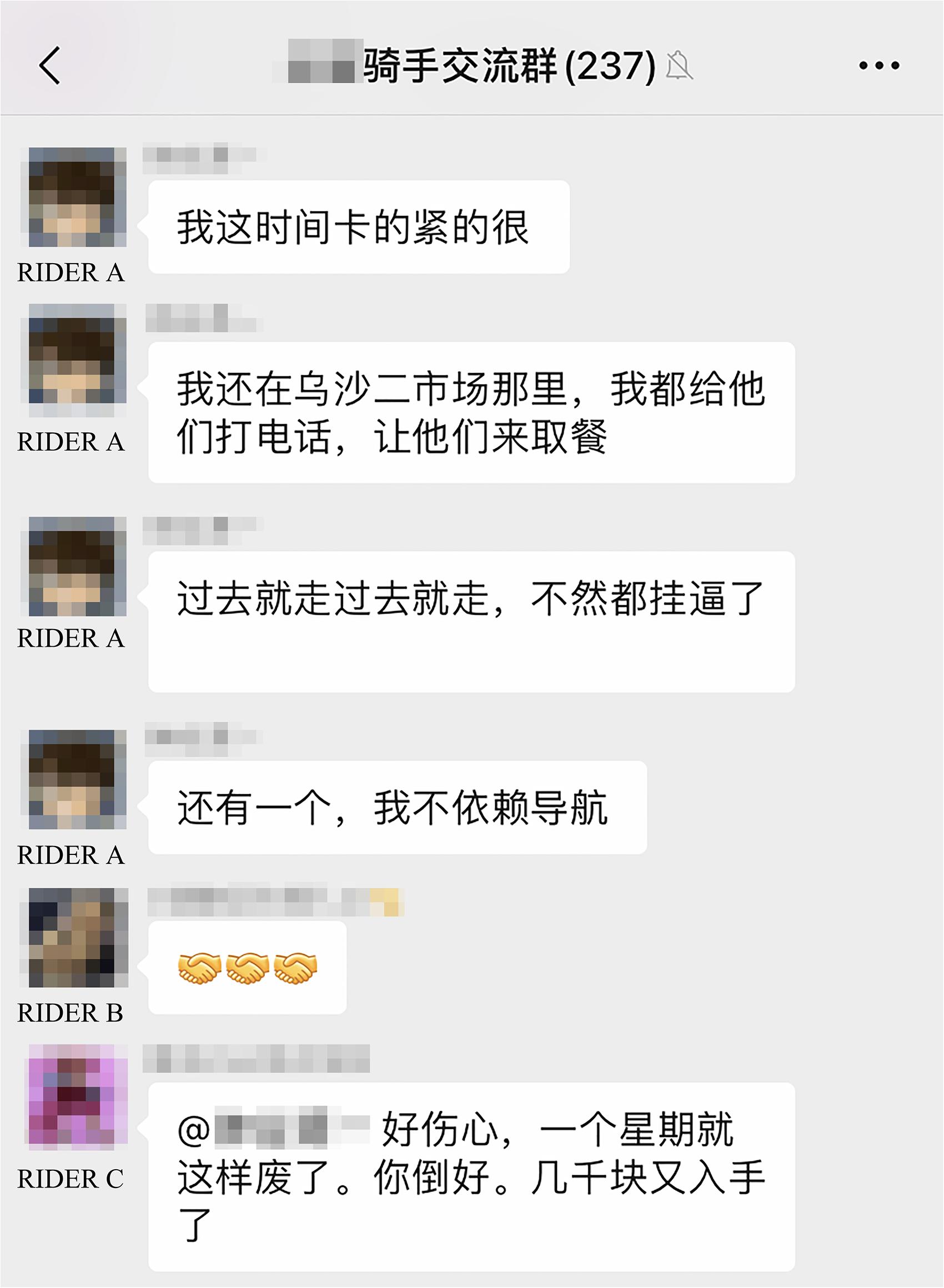
In one of the private WeChat groups set by riders, rider A was sharing his experience of how to complete more orders with others, “For me, the delivery time is tight […], even though I was still at the Usha No.2 Market [the rider hadn't arrived at the customer's residence], I would still call them (the customer) and ask them to pick up the meal in advance [In this way, the rider can leave the food to the customer when he/she arrives], I have to leave as soon as I get to the place, otherwise it will be bad [deliver time will not be enough], one more thing, I don't follow the routes set by the platforms.” Rider A said. Rider B agreed with what A said and thanked him for sharing, and Rider C admired A for completing so many orders: “So sad, I wasted a week, unlike you, you have earned thousands of RMB again this week”.
Third, to achieve the targets set by the platform in daily/weekly/monthly/quarterly and other competitions and win the corresponding cash bonuses, some riders choose to use multiple phones and numbers to “Shuadan” (Figures 2 and 3). It should be pointed out that in these “competitions”, the number of final winners is not strictly limited. As long as riders reach the number of orders set by the platform, they can get the corresponding cash bonuses. Put differently, the purpose of the riders using the “Shuadan” tactics is not to get more orders to harm other riders, but to complete the number of orders set by the platform and obtain the cash bonuses in these competitions. Our findings display two types of “Shuadan”: riders-led and restaurants-led. Riders-led “shuadan” means that a rider uses two or more mobile phones to act as the customer and the rider at the same time. In the first step, the rider uses one phone and number to register a customer account on one food delivery platform app, then uses another phone and number to register a rider account on the same platform. In the second step, the rider pretends to be a customer, places an order on the first phone and then uses their second phone to immediately grab the order they have just placed. To increase the success rate of “Shuadan”, the rider will choose a restaurant closest to them and no other riders nearby, so there is a high probability that the algorithm will dispatch the order to them because they are the rider closest to the restaurant. By doing so, the rider can increase the number of their orders, achieve the targets they want, and obtaining the corresponding bonus. However, it should be noted that the risk of this approach is very high. Once discovered by the platforms, riders’ accounts will be banned, and riders will even bear legal responsibility.
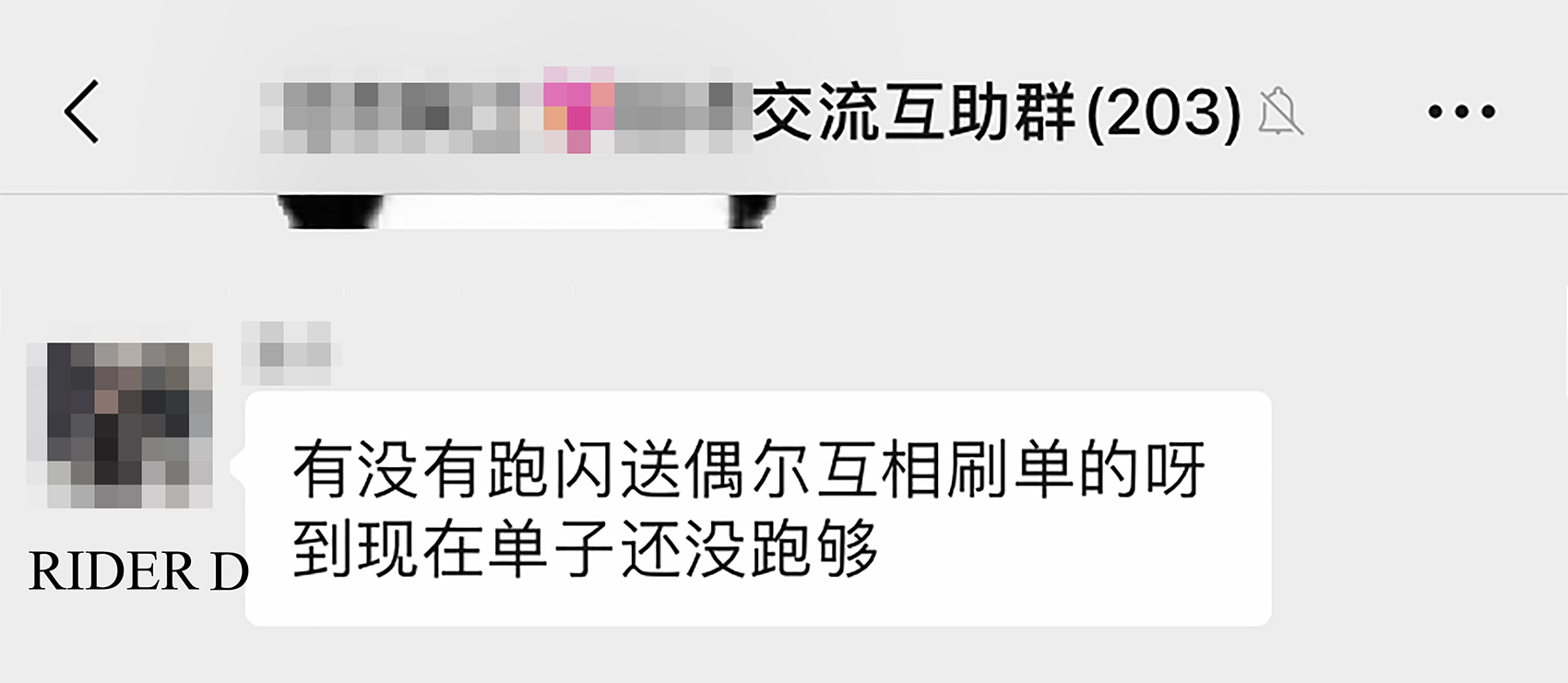
In one of the WeChat groups, Rider D was looking for partners to “shuadan” together: “Is there anyone who works on the Flash EX like me? Is anyone interested in “Shuadan”? The number of orders I have completed so far is not enough”.
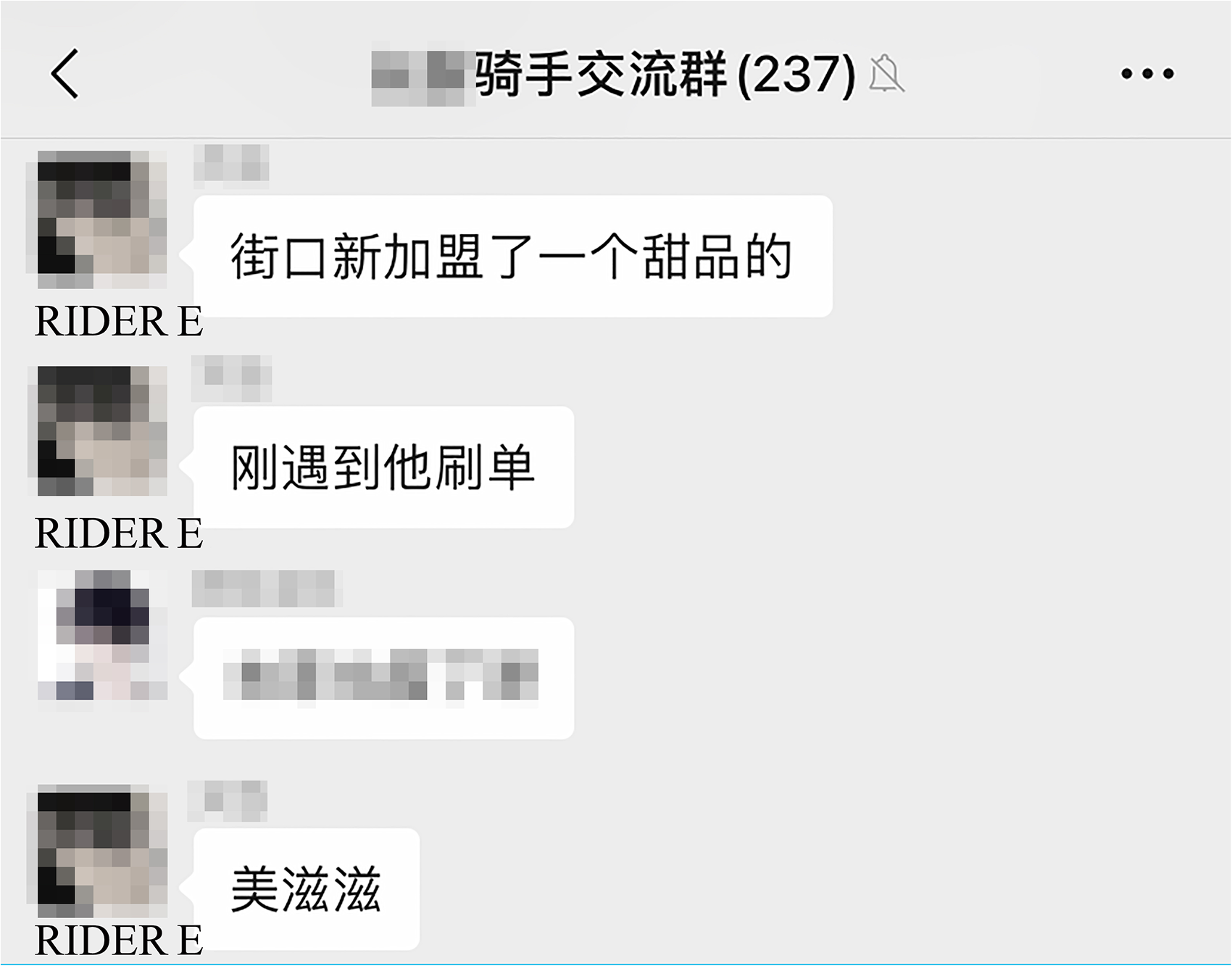
In another WeChat group, Rider E was sharing his latest “shuadan” experience with other riders in the group: “there is a new franchise dessert shop at the corner of the street, I just met this shop was ‘shuadaning’, very nice”.
Restaurants-led “shuadan” means that some new-opened restaurants/food-manufacturers cooperate with the riders to “Shuadan” to receive more “orders” and improve their scores and rankings on the platforms. This modality requires the mutual cooperation between restaurants/food-manufacturers and riders. More specifically, these restaurants/food-manufacturers will play the role of customers, place orders (they do not need to actually prepare the food) on the platforms from their restaurants (the location of these customers are usually near the restaurants, which is set by these restaurants in advance), and ask the riders who come to the shops to “pick up” the orders to choose “delivered” directly on the platforms. By doing so, the riders can get more “orders” and the delivery fees for “doing” nothing. Again, the risks of both “shuadan” tactics are high and both are forbidden by the platforms.
Fourth, our research shows that experienced riders will refuse to accept orders from a certain region, indirectly forcing the platforms to increase the order price or convincing the customers to provide extra tips. These riders know that orders in some areas are more difficult to complete. Reasons vary: from the absence of an elevator in high buildings which forces the rider to climb multiple stairs, to the difficulty of completing an order in an area that is too wide. When they encounter orders that need to be sent to these areas, riders will avoid accepting them (e.g. they can directly reject these orders dispatched by the system or choose to take a break by logging out of the system), forcing the platform or the customer to increase the order price.
In addition to these tactics, Sun and Chen (2021) indicate that some riders would install bots to bypass certain platform-imposed restrictions or to help them get higher-paid orders. However, all interviewees in this research mentioned that they had heard of cheating bots (these bots can help them to change their GPS positioning, or freely choose higher-paid orders, etc.) but no one used these bots, because they were afraid of the platforms’ punishment—once they were discovered by the platform, they would be immediately suspended.
Again, the rider's individual gaming tactics mentioned above are targeting the food delivery platforms, and riders are not using these tactics to compete with or “defeat” other riders in the competitions. As interviewee E mentioned: “Most of the riders I know are very united, they don't compete with each other for orders, they help each other more often.” We also found that these individual tactics were publicly shared by the riders in WeChat groups (see next section), and this sharing action can be regarded as a proxy for the existence of mutual aid and solidarity practices.
Building solidarity networks through WeChat
Scholarly research on Chinese riders’ resistance to the food delivery platforms have pointed out the importance of WeChat private groups for riders (Liu and Friedman, 2021; Sun, 2019; Sun and Chen, 2021). Yet, few of these works clarify how riders can build solidarity networks through these chat groups. Our findings illuminate this unexplored area.
Setting up private WeChat groups
Our findings show that no Chinese riders use the rider app provided by the platforms to chat with each other, even though some platforms like Meituan have embedded a group chat function within their rider apps. The low activity, lack of privacy, and ineffectiveness of these chat rooms or forums are the reasons why riders are unwilling to use them.
WeChat, a social media platform developed by Tencent, is widely used by Chinese riders to communicate with other riders to avoid being monitored by the platform. All our interviewees state that they usually use WeChat to communicate with other riders. It should be noted that different food delivery platforms’ franchisees 8 in diverse cities also set up WeChat groups to facilitate communication between the riders they hire and issue work notices to them. However, all interviewees said that they would not choose to chat in these groups set up by franchisees. On the contrary, these riders would privately establish or join private WeChat groups (such as the WeChat groups set up by the KL, and the “Changan” WeChat group) to communicate with each other and complain about platforms and franchisees. Most of these private WeChat groups consist of hundreds of riders.
Fear of being punished by the administrators and ineffectiveness are the main reasons why they are unwilling to chat in these environments. As interviewee F pointed out: “in the WeChat group established by the platform, basically no one speaks. If you say something that is not good for the platform, your superiors will criticize you, which will definitely have a bad influence on your own work”. Even if riders are allowed to freely express their grievances within these groups, their voices cannot play a big role. “SF Express has established an official WeChat group for riders, and everyone can say anything about SF Express or complain about SF Express in this WeChat group. However, the reality is that even if you complain, it has no effect, and no one will pay attention to you.” Interviewee D explained.
In the face of these limitations, Chinese riders chose to set up or join their own private WeChat groups. Woodcock (2021) recently illustrated the widespread use of digital platforms such as WhatsApp and Facebook for communication across all platform work. As he points out, “this stems from the technical composition of the work, as most platforms deliberately do not include means for workers to discuss with each other” (Woodcock, 2021: 73). Within these WeChat groups, riders can truly and freely communicate with each other. As already noted by Maffie, “they find in these groups the comradery and support of their digital colleagues” (2020: 133).
Based on the data emerged from the interviews and observation, it is possible to outline 6 main ways in which riders usually employ these WeChat groups to help each other. These six different practices within WeChat groups also represent six different manifestations of solidarity among Chinese riders that we detail below.
Riders provide news about the emergence or increase of temporary subsidies. In most WeChat groups we observed, riders will inform each other about the platform currently providing subsidies so that everyone can take more orders and earn a higher income. For example, we found that riders shared information about weather subsidies. These subsidies are likely to appear at any time during rainy weather (the heavier the rain, the higher the weather subsidy), so riders will inform each other about the appearance of the weather subsidy so that more riders can take more orders during this time and get the subsidy. Riders provide each other with equipment assistance. “The original intention of establishing this group is to help each other and let us riders become more united. Everyone will help each other when they encounter urgent things.” As interviewee F mentioned, if a rider's electric bike suddenly runs out of power during meal delivery, the rider will send a help message in the WeChat group, “if a nearby rider sees this help message, she/he will rush to find the rider in need and lend the spare battery to this rider.” Interviewee E also said: “I have witnessed this situation many times—without a word, riders in the group rushed to the place of the rider who said that his battery was dead, and gave their spare batteries to the rider.” Help newcomers get started quickly. Riders in the chat support newcomers to apply for health certificates, recommend cheap and cost-effective monthly housing and electric bikes and share tips and recommendations on the experience of taking orders. For example, Interviewee G mentioned, “I once met a female rider in the WeChat group who was just starting to be a rider and was unfamiliar with the route and had no experience. When I first met her, she happened to ask other riders various questions in the group. I took the initiative to share some work experience with her and let her ask me any questions at any time. Because I have also gone through this stage, I can understand her difficulties very well. Experienced riders should help novices.” Riders will share real-time traffic news. When a rider encounters congestion on a certain road section, he will notify everyone in the WeChat group so that other riders can detour to avoid wasting time. As interviewee C mentioned: “In the WeChat group we built, everyone can discuss various issues that arise in the platform. At the same time, in these private WeChat groups, the issues we discussed include where the police is investigating illegal parking of electric vehicles, where the roads are currently blocked, etc.” Providing emergency assistance. As Interviewee D mentioned, “If someone sends out a signal that urgent help is needed in the group, someone in the group will definitely respond and help this person. For example, if a rider encounters a traffic accident, he will ask for help in the group. Riders nearby will rush to help after seeing the message. The problems raised by the riders can be really solved in this group [compared with those WeChat groups set up by the platforms].” Moreover, if a rider encounters a problem of wage arrears or conflicts with merchants, she/he can also get help from the group. We can see that in the group, riders can get timely opinions and suggestions on how to appeal to the platforms and how to solve the problem through legal means (Figure 4). Collective unpacking of the platforms’ algorithm. Regarding the platform's algorithm, all interviewees said that the platform did not provide relevant training or explanations to them. They only received 1 h of training by the platforms on their first day in relation to platforms’ working rules. As highlighted by Woodcock, “the refusal of platforms to provide effective training or support platform means that workers must resolve many issues themselves. In response, workers seek each other out to share information and discuss the work.” (2021: 72). The riders we observed in the WeChat groups used to exchange information about how the algorithms work. Experienced riders share their knowledge with newcomers and many conversations are aimed at unpacking the principles that drive the platform's algorithm. Black boxed algorithms are thus subjected to rough forms of reverse engineering based on the riders’ personal experience. Our findings are consistent with those of Sun (2019). According to him, through these online groups, riders improve what he calls algorithm literacy.
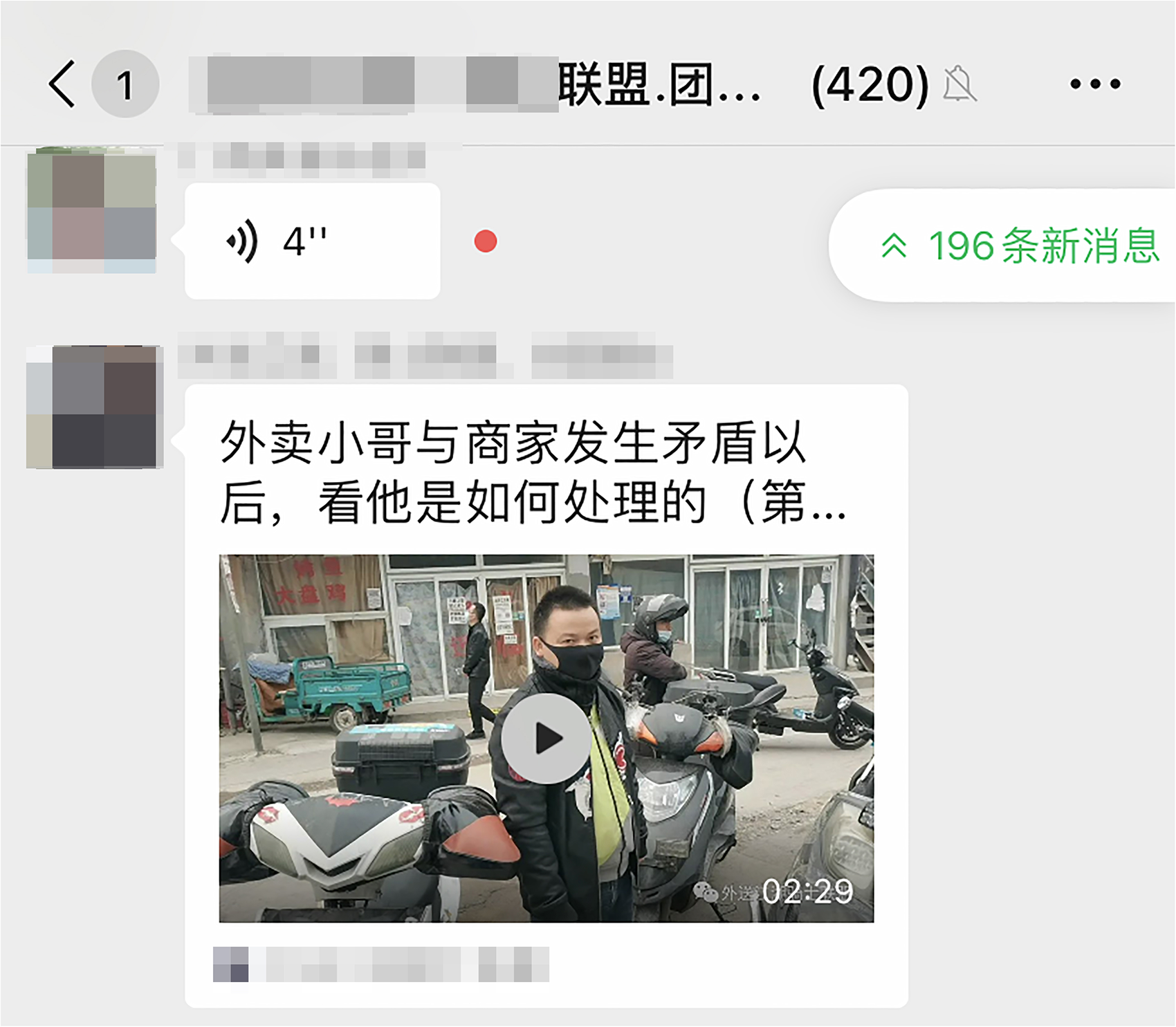
In the private WeChat group set by the KL, a rider shared a short video (named “after a conflict with the merchant, let's see how the rider responds.”) that teaches other riders how to deal with conflicts between merchants and riders.
Spontaneous rider union and small mutual assistance groups
Our findings show that private WeChat groups have also hatched out “spontaneous” rider unions and smaller mutual aid groups, which further demonstrate the emerging networks of solidarity among riders. Unlike those unions among gig workers mentioned by Tassinari and Maccarrone (2020) and Iazzolino (2021) in the UK, Italy and Kenya, the functions and social influence of the “unions” mentioned in this research are limited by their size and online-based form. More specifically, the function of these “unions” is limited to helping their members to solve problems related to their personal interests, rather than speaking on behalf of the riders as a whole to fight for more rights and interests with the platforms. One example of a spontaneous rider union is the Knight League (KL). According to one of the founders of the KL, the league (a private WeChat group) was founded in 2018 and riders from any food delivery platform can join it (WeChat group). KL is not registered as a Chinese trade union, and is not properly a “union”, although its members often use this term. Rather, this group performs, informally, some of the tasks traditionally carried out by trade unions, such as providing support to its members and recruiting new members to improve their collective bargain power.
According to the reports of Tencent News, 9 the KL was using QR codes to recruit new rider members. By printing out the QR code of the league's WeChat group and pasting it on the delivery bag on their electric bikes, they try to invite new riders who have not yet joined the league to scan the QR code to join its WeChat group. Moreover, the KL also recruits new members via Douyin (known as TikTok outside of China). For example, one of the founders of the KL opened a Douyin account, in addition to sharing the daily experience of being a rider on Douyin and using his account to promote the KL. Riders who want to join the KL (WeChat group) can thus get in touch with him via Douyin.
Within KL's WeChat group, strong solidarity ties were formed between riders who previously did not know each other. The KL's WeChat group provides daily support to all its members, as traditional trade unions used to do. In addition to the online group, the KL also has an informal “office” in Beijing for the countless Chinese migrants that arrive in Beijing every day to earn a living as a rider. When these new riders need to find a room to rent, apply for a health certificate (people need to apply for a health certificate before serving as a food delivery rider in China), buy a moped or electric bike, register on the app, learn the tricks of the trade, they turn to the Knights League.
Besides the KL mentioned above, riders also spontaneously set up smaller and closer mutual assistance groups derived from the larger private WeChat groups. In other words, the large private WeChat groups provide a place for riders to make good friends and partners. These smaller groups normally consist of a few or dozens of riders. The bonds between riders in these smaller WeChat groups are stronger than those built in the large private WeChat groups. Interviewee L's small group is a vivid example of this, as is evident from this illustrative excerpt: The four of us met in this WeChat group (“Changan”). We often chatted in this group and got along very well, hence we decided to set up a small WeChat group with only four of us. We chat more frequently in groups, and we often meet offline. We share our experience and various tactics and information in time to truly help each other. Once I accidentally ran into a car during the delivery of one order, I asked for help in the group. The three of them quickly arrived at my place to help me. At that time, A helped me call the police, B helped me complete the order, and C helped me negotiate with the driver. At that moment, I felt the warmth and sense of belonging. Our small group is really good. If they need me at any time, I will help them as soon as possible, just like what they did for me.
Conclusions
Our study contributes new knowledge to current research (Chen, 2020; Liu and Friedman, 2021; Sun, 2019; Sun and Chen, 2021) on the gamification of food delivery platforms and forms of resistance and solidarity developed by gig workers in China. We first illustrated the gamification features of food delivery platforms in China (the ranking systems and the daily, weekly, monthly, quarterly, and other competitions). Then, we developed a typology of gaming practices among Chinese riders.
The tactics we have explored in this article are aligned with two categories discussed by Ramizo (2021), that is Optimization and Boundary-hunting. The former means riders use different tactics “to maximize the benefits of using the algorithmic platforms, including the leveraging of loopholes without directly violating platform rules” (Ramizo, 2021: 12). The tactics we shed light on such as working for multiple platforms, not following the routes arranged by the platforms, and refusing to accept orders from a certain region proactively fall into this category. The latter means riders identify and exploit the “limits of enforceable platform rules” (Ramizo, 2021: 12), that is, using tactics that obviously violate the rules of the platform and risk being punished. Using cheating bots and “shuadan” fall into this second category.
Furthermore, our research casts private WeChat groups as: (1) learning environments, (2) “hidden transcripts” of resistance and 3) solidarity-building spaces. Firstly, within these groups riders can learn and exchange work experience, such as the tactics of “shuadan”. They can share instant traffic information, as well as any other information that help riders better handle this environment. In these online spaces, newcomers can learn from more experienced riders and all members can exchange tips and tricks. Here, everyone learns from their peers, and together they build a collective algorithmic imaginary (Bucher, 2017).
Secondly, the private WeChat groups can also be understood as “hidden transcripts” of resistance (Anwar and Graham, 2020; Scott, 1990). In his analysis of everyday resistance practices, Scott (1990) traces a subtle difference between forms of resistance that openly manifest themselves in the face of power, and forms that only manifest themselves far away from the power's gaze. Where subaltern subjects know they cannot defeat or subvert power, they maintain a public behavior that is compliant with it, to vent their dissent in places invisible to power. Scott called the first form of resistance “public transcript”, i.e. open action in front of the other side in the power relationship (1990: 2), while naming the latter an “hidden transcript”—the discourse (both verbal and non-verbal actions) that takes place “offstage” so that powerholders cannot see (Scott, 1990: 4, quoted in Anwar and Graham, 2020: 1272). We found traces of these hidden transcripts in the conversations happening among riders within WeChat private chats. Because of the fear of being punished by the administrators in the official WeChat groups, Chinese riders prefer to set up or join private groups where all members are riders. Since platforms and franchisees are excluded by these “hidden” groups, riders can complain, confront or challenge them without fear of reprisal. While in corporate chats Chinese riders never complain, in private chats they openly express their dissent, aware that they are in a protected environment, far from the panoptic control of the platforms. It is in this protected environment that riders begin to understand the consequences of algorithmic power, becoming aware of the constraints it places on their agency. It is only through the collective unpacking of how algorithms work—that occurs every day inside these chats—that riders learn how to partially protect themselves from algorithmic power and exploit its loopholes. The stream of conversations that is being reproduced in the chats literally represent the hidden transcript of the practices of resistance that Chinese riders will then implement on the streets. This online environment is an incubator of future resilience and resistance practices, as Woodcock (2021) also argued. According to him, these existing networks can be understood as “the building blocks from which more formal organizations can be developed.” (2021: 73)
Thirdly, private WeChat groups can be understood as mutual aid and solidarity building spaces for riders, where they can form spontaneous rider unions (e.g, KL) and smaller mutual assistance networks. These online environments provide what Tassinari and Maccarrone (2020) called “day to day mutual support”. We showed how riders form smaller online groups from participation in larger online groups. The latter allow workers to meet and bond with their peers. From these online encounters, relationships are born that continue offline and produce smaller online groups, which in turn provide, as we have seen, stronger and more lasting solidarity ties. Online food delivery platforms design their apps to govern each worker individually, without allowing them to communicate with other peers. Private chats, on the other hand, provide a technological affordance intentionally omitted by the platforms: they allow communication between peers, which in the long run creates an environment favorable to the construction of bonds of solidarity, exchanges of information and increased awareness of one's condition of subalternity.
In conclusion, we showed that, despite the lack of opportunities for collective action and a highly controlled work environment, Chinese riders are able to exercise individual and collective agency to partially and temporarily improve their working conditions. We highlighted the existing tensions between algorithmic power and control and workers’ agency and resistance. We also showed that through the intermediation of WeChat private groups, they can improve their own understanding of their job, learn tactics of resilience and resistance and build networks of peer-to-peer solidarity. Our article demonstrates that, despite the severe power unbalance and injustices that define the platform society, forms of resistance and solidarity are still emerging every day.
