



Abstract
This article examines the music writing skills of instrumental students. The study participants, aged 8 to 19 (n = 78), from four school orchestras in Western Norway, none of them beginners, were asked to write down a well-known children’s song on a blank staff. 8.7% of the participants performed the task correctly, using all the necessary musical symbols. 66.7% of the participants wrote all the pitches correctly, while 25.8% wrote all the note values correctly. The nonparametric correlation test (Spearman) revealed a significant correlation between age and the number of correctly written note values and pitches. These results suggest that student recognition of pitches and rhythm patterns while playing does not transfer directly to the ability to write down the same notes and patterns. Understanding the relationship between pitches and their place on the staff seems to be less cognitively demanding than notation of the time relation between the note values. The results are compared with findings from the field of language literacy and discussed from an educational perspective, arguing that writing is an important a means to enhance music literacy skills.
Introduction
Language reading and music reading share many cognitive similarities and have often been compared (Aiello, 1994; Blix, 2004; Hansen et al., 2014; Patel, 2008, 2012; Rebuschat et al., 2012; Sloboda, 1985; Waller, 2010). Acquiring language literacy is a crucial aspect of primary school education, with most students achieving fluency. In contrast, fluent music reading, or sight-reading, defined as the ability to perform notated music without prior rehearsal, is a skill that relatively few musicians and amateurs in Western culture master (Asmus, 2004; Green, 2002; Gudmundsdottir, 2010). Even after years of practice, only a small number of students can sight-read music as fluently as they read language text (Mills & McPherson, 2006). Comparing teaching methods for language and music reading reveals fundamental differences, particularly in the progression of introducing new symbols and the choice of teaching activities, such as writing (Lehmann et al., 2007; Waller, 2010). The explorative study reported in this article aimed to investigate whether the writing of Western tonal music using five-line staff notation as an educational activity facilitates the development of music literacy skills, in the same way that text writing is used to enhance language literacy skills (Graham & Hebert, 2011). A lack of extant research into music writing in the context of music literacy development (Leikvoll, 2025; Waller, 2010), as well as the similarities in cognitive processing of a written text in language and music, were the main reasons for applying research findings from the field of language literacy development as a starting point to explore possibly similar processes in music literacy development. The research questions guiding the study were thus: how do instrumental students who have not received systematic instruction in writing, but who are able to read music, solve a presumably easy music writing task? To what extent does reading ability transfer to writing ability in music?
Musical memory and meaningful units
Fluent text readers recognize familiar words by retrieving them from long-term memory, a process known as sight word reading. With continued practice, all words are eventually read automatically by sight, making this the most efficient and seamless way to process text. This process is facilitated by phonemic awareness and an understanding of the alphabet system, which serves as a powerful tool for encoding spellings into memory (Ehri, 2005).
Meaningful elements in music are, for example, melodic motifs, rhythmic patterns, harmonic progressions, and scales or arpeggios. Unlike written language text providing spaces between all words, written musical text does not provide this kind of visual guidance for the eye and the brain, clearly separating musical elements to be stored and retrieved from the long-term memory. However, several studies confirm that processing of music and language text takes place in a similar manner: profficient music readers organize written musical symbols into larger units consisting of meaningful patterns. The consequence of this cognitive process can be observed through fluent sight-reading (Goolsby, 1994; Kopiez & Lee, 2008; Lehmann et al., 2007). The ability to segment written music is the result of a relatively large inventory of meaningful units in the musician’s long-term memory. In the same way, the ability to quickly recognize musical structures and patterns is a prerequisite for efficient sight-reading (Mishra, 2014).
The difference in how meaningful elements are discriminated, by visual spaces in written language and through familiarity with musical syntax and theory in written music, does not seem to significantly impact the cognitive dimension of the reading process (Clifton et al., 2007; Madell & Hébert, 2008; Patel, 2012). Despite these differences, both language and music reading rely on similar cognitive mechanisms for processing visual information. In both cases, the brain must interpret and organize symbols into meaningful units, suggesting that the underlying visual and cognitive processes involved in reading may be comparable across both domains (Clifton et al., 2007; Madell & Hébert, 2008).
Rhythm and pitch are two measures that frequently arise in the analysis of music reading skills. There seems to be agreement on the unsymmetrical importance of the two in a sight-reading situation, since encoding rhythm and pitch while playing requires different cognitive processes (Russell, 2019). Playing the correct pitches at the expense of rhythmic accuracy has been reported in a majority of studies focusing on sight-reading (Alexander & Henry, 2015; Drake & Palmer, 2000; Gudmundsdottir, 2002; Mishra, 2014, 2016; Russell, 2019). At the same time, studies report that good rhythmic reading abilities have a high positive statistical correlation with success in music reading (Boyle, 1970; Elliott, 1982; Gromko, 2004; Kopiez & Lee, 2008; Mishra, 2016; Russell, 2019).
There is a prevailing assumption among both educators and researchers that music notation primarily serves as a set of motor instructions—visual cues that prompt finger or arm movements—rather than as a symbolic system for representing sound. This perspective often emphasizes the physical execution of music-making over its cognitive and perceptual dimensions, particularly in early stages of instruction. While this view may reflect certain pedagogical practices, it does not align with how skilled musicians cognitively process notation. Research in music cognition and eye-tracking studies suggests that proficient music readers engage with notation as a structured, meaningful representation of sound, not merely as a guide for action. In this article, I challenge the reductionist view of notation as motor instruction and instead argue for a broader understanding of music literacy: one that includes not only reading but also writing as a cognitively rich activity. Music writing, in particular, requires the learner to internalize and reproduce musical structures, fostering deeper engagement with the symbolic and syntactic aspects of music. By integrating writing into the learning process, we can support the development of more robust and transferable music literacy skills.
Writing activity in educational research
A meta-analysis of 95 studies of the impact of writing and writing instruction on language reading conducted by Graham and Hebert (2011) provides evidence showing that using writing activities seems to improve students’ reading comprehension, fluency, and word recognition. These findings empirically support the long-held belief in the powerful role of writing in facilitating reading and text comprehension.
However, a comprehensive search of frequently used databases (e.g., Google Scholar) reveals surprisingly few research findings describing instrumental students’ acquisition of music literacy using music writing: the ability to write down a sequence of pitches, a rhythm pattern, or a short melody. No existing studies appear to systematically investigate the music writing skills of instrumental students, or the connection between music reading and writing as cognitive processes, and what impact music writing activities can have for the music literacy acquisition of children learning to play an instrument.
Waller (2010) and Lehmann et al. (2007) argue that the operating standard of literacy within music pedagogy seems to be markedly imbalanced, demanding fluency in reading while, for the most part, neglecting writing, unless the student eventually pursues advanced studies in composition. Indeed, a meta-analysis of 124 studies of music reading and factors related to sight-reading accuracy (Mishra, 2014) shows that only around 5% of these studies included notation, but none focused directly on music writing. One study directly addressing music writing is that of Davidson et al. (1988), who revealed that advanced instrumental students had difficulties writing down the well-known melody, “Happy birthday.” The lack of research findings examining if and how the use of music writing may influence the development of music reading skills among instrumental students might suggest that these two cognitive activities are assumed mutually irrelevant from an educational perspective.
Development of reading and writing skills
The lack of research exploring how the use of writing may influence the comprehension of Western musical notation draws attention to corresponding research findings from the field of language literacy. The interrelation between language reading and writing has been studied extensively (Berninger et al., 2002; Fitzgerald & Shanahan, 2000; Shanahan, 2016), commonly acknowledging that these two skills are of equal importance for children’s development of language literacy. Research findings show that although reading and writing are referred to as two complementary literacy skills, mastery of one will not automatically lead to mastery of the other (Graham & Hebert, 2011). Cognitive processes involved in reading and writing activities use separate systems, but at the same time they interact with each other in predictable ways. Reading and writing are connected because they depend on shared knowledge representations, cognitive processes, and contexts and contextual constraints (Berninger et al., 2002; Fitzgerald & Shanahan, 2000). Although it is assumed that learning to read will then enable students to write, in contrast, research supports using writing activities as a gateway to develop reading skills (Berninger et al., 2019; Graham & Hebert, 2011).
Writing to learn is a strategy that has gained attention of researchers and educators during past decades (Gammill, 2006; Klein & Boscolo, 2016; Klein et al., 2007). Writing seems to be an efficient tool to facilitate understanding, as it helps students reflect and think critically about content. Writing to learn encourages students to self-question, activate prior knowledge, infer, and use their imagination (Klein & Boscolo, 2016). Research suggests that students who use writing-to-learn strategies build stronger comprehension skills than their peers who do not actively engage in writing, and that writing to learn is an effective tool in helping students become active instead of passive learners (Gammill, 2006).
The acquisition of music literacy skills has received far less attention than language literacy (Gudmundsdottir, 2010), though several research reports reveal that mastering music reading is less common than one might expect, describing music students as lacking foundations in music literacy even after many years of study (Davidson et al., 1988; Gudmundsdottir, 2010; Mills & McPherson, 2006). The factors that may influence effective teaching and learning of music literacy have not yet been agreed upon, due to a lack of research in the field (Russell, 2019). Gudmundsdottir (2010) points to how numerous studies have failed to establish positive correlations between music reading skills and factors such as amount of music instruction, amount of musical practice, and amount of music reading (sight-reading) practice. Music writing seems generally to have been excluded as an element of music literacy skills, or as a pedagogical activity that might strengthen the music reading skills of instrumental students (Asmus, 2004; Lehmann et al., 2007; Waller, 2010).
Method
To investigate how students who have not received systematic instruction in writing music, but who are able to read music, solve a presumably easy music writing task, a short experiment was designed. The participants were asked to write down a four-bar-long, well-known children’s song consisting of six different pitches and three different note values (Figure 1).

The Children’s Song Lisa Gikk Til Skolen.
Participants
Seventy-eight students aged between 8 and 19 years old from four Norwegian school orchestras participated in the study. All study participants had received at least two years of instrumental lessons, with music reading as an integral part of the curriculum from the very beginning. Playing in a school orchestra is a voluntary activity in Norway, and demands basic music reading skills from enrolled students.
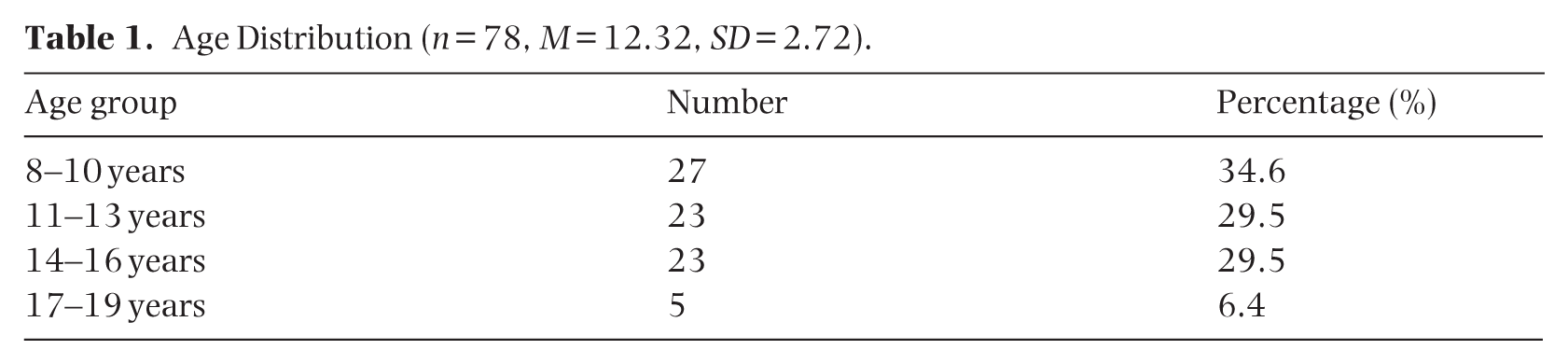
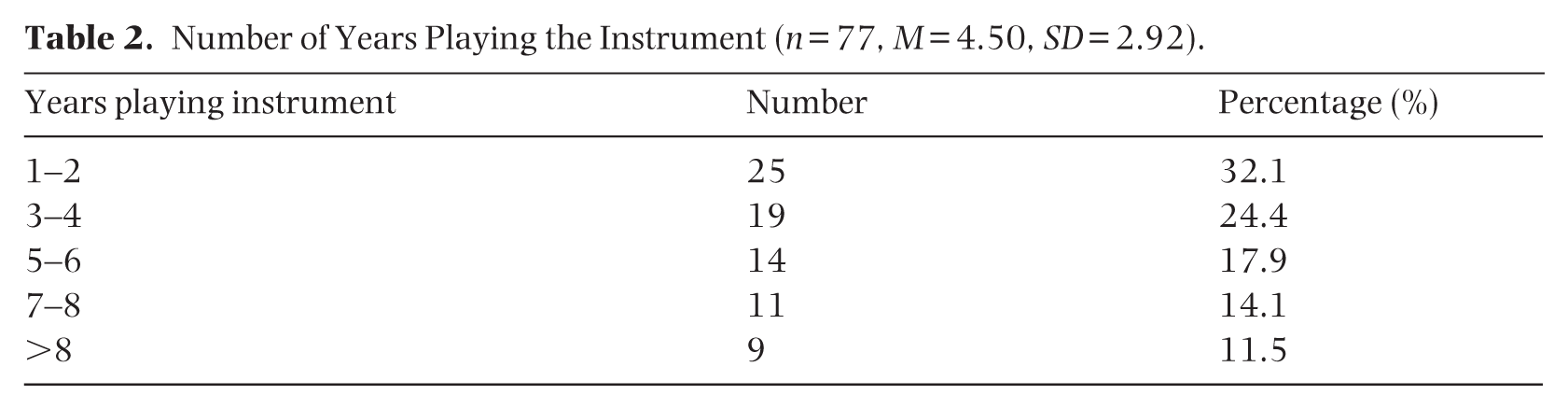
Students played instruments in the following families: woodwind (10), brass (42), percussion (8), and strings (18). The age distribution and number of years playing their instrument for each student are shown in Table 1 (n = 78, M = 12.32, SD = 2.72) and Table 2 (n = 77, M = 4.50, SD = 2.92). In all of the orchestras, it was mandatory for the percussionists to play a melodic instrument for 2 years in order to learn to read music. All percussionists usually played both drums and melodic percussion instruments, depending on the demands of the pieces being performed.
Age Distribution (n = 78, M = 12.32, SD = 2.72).
Number of Years Playing the Instrument (n = 77, M = 4.50, SD = 2.92).
A brief analysis of the pieces the orchestras were rehearsing during the data collection period was conducted (e.g., A Klezmer Karnival by Philip Sparke), to ensure that all parts used by the participants were much more complex in terms of melody, rhythm, and harmonic progression than the music which they were asked to write down in the research study (Figure 1).
None of the conductors reported to have been using music writing activities for students during orchestra rehearsals. Music theory, composition, and writing activities were not part of the curriculum in any of the teaching institutions, and are rarely used by instrumental teachers in Norway (Leikvoll, 2024 ). This information, together with analysis of the method books used by beginners in each of the orchestras and the oral information from the conductors about the usual progression of learning, were used to design a writing task utilizing the pitches and note values introduced during the first 3 months of instrumental lessons. Two assumptions underpinned the design: (1) that the majority of the participants had not received any systematic writing instruction prior to the experiment, and (2) that they could read and play music of a level above that of the writing task used in the experiment. It is important to clarify that some participants may have also used aural skills and musical memory to decode music during rehearsals, rather than solely reading the printed score. At the same time, the task designed consisted of the pitches and note values the participants learned during the first weeks of instrumental lessons, and all participants had played in their orchestras for at least two years.
Ethics
The project was approved by the Norwegian Agency for Shared Services in Education and Research (Sikt). The parents of the participants received written information including all relevant details about the project and gave their informed written consent to participation. The answer sheets for the music writing task were anonymous and participation was voluntary.
Procedure
As part of this study, the participants received a worksheet with an empty five-line music staff in addition to space to fill in their age, instrument, and how many years they had played their instrument. They were asked to each write down a well-known Norwegian children’s song, Lisa gikk til skolen (Figure 1), after playing it three times by ear together with all the other orchestra members (in C-major or G-major for wind instruments, and D-major for string instruments). The participants were told that they could write only the beginning if they were not able to write down the whole song, or that they could just fill in the questionnaire and leave a blank staff if they did not know how to write down the music at all.
The experiment took place during students’ ordinary rehearsal time. The researcher worked closely with the conductor to streamline data collection. The participants were first informed about the pitches they were supposed to play by the conductor singing the song using letter names of the notes. After playing through the song three times the researcher briefly explained the task and handed out answer sheets. Participants were instructed to work independently without helping each other. Both the researcher and the conductor remained in the rehearsal room, offering encouragement, addressing participant questions during the task, and ensuring that the work was completed individually.
As students were writing, the participants were allowed to use their instruments to check whether the music was written down correctly. The reason for both going through the letter names of the notes, playing through the melody prior to the writing task, and giving permission to use instruments while writing was to make sure that the participants knew both the name of the pitches and the rhythm they were supposed to write down. Gordon (1997) defines audiation, or the ability to hear music without it being played, as the crucial cognitive function that allows individuals to derive meaning from music while listening. It also helps them organize and interpret music that is read, transcribed, remembered, written from memory, created, improvised, or composed. The current study focused on musical language by hand and by eye. That is why both research on audiation and melodic dictation (Buonviri, 2017) were considered less relevant in the context of the present study.
The participants spent between five and 15 minutes writing down the melody and filling in the brief questionnaire. There was no time restriction, and the researcher waited until everyone had finished the task to ensure that participants had enough time to complete the task. Neither the clef, the bar lines nor the time signature were predetermined, but rather were included as essential elements of a written musical text, on a par with the pitches and note values, in the same way that spaces, capitals, and punctuation are an integral part of a written language text. All of the students playing in each orchestra agreed to participate in the study and all except two were familiar with the song that they were asked to write down.
Results
The data were analyzed statistically with SPSS software, mainly using descriptive statistics. The following measures were used:
Percentage of correct pitches and note values. The results for the pitches were divided into four groups: 0–10%, 11–50%, 51–90%, 91–100%, while the note values results had an additional fifth group: no rhythm differentiation. There were 22 notes in the melody. The number of correctly written pitches and note values on each answer sheet was counted manually, without differentiating between repeated and non-repeated notes, and the results for rhythm and pitch were each assigned into one of the categories.
Use of bar lines (three categories: yes, no, some or not correctly).
Use of time signature (two categories: yes, no).
Use of the clef (two categories: yes, no).
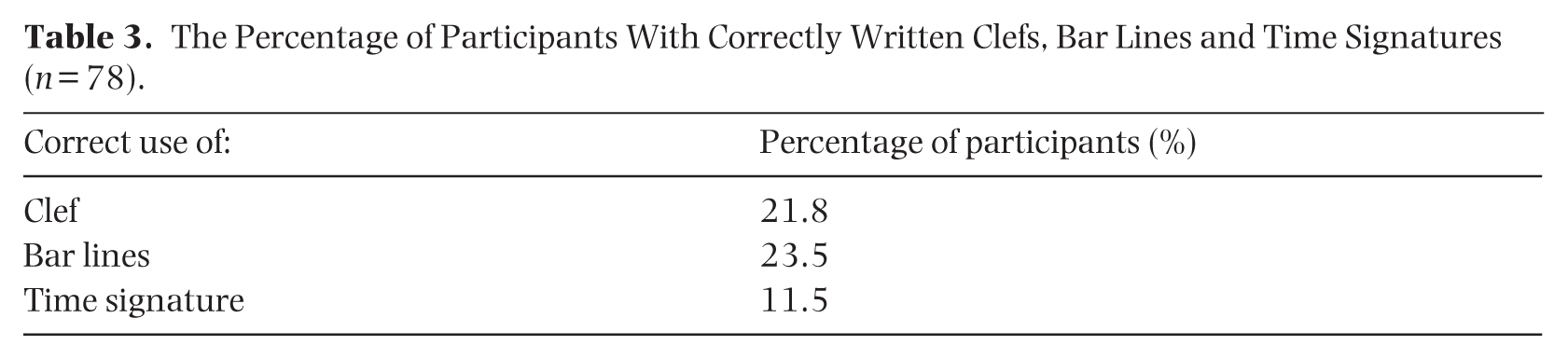
The results identified that 8.7% of the participants (7 out of 78) wrote down the entire song using correct pitches, rhythm values, bar lines, clef, and time signature. The time signature, bar lines, and clef were omitted by the majority of participants. 23.5% used bar lines correctly, while 71.1% did not use them at all (Table 3). The distribution of correct pitches and rhythm values is shown in Table 4.
The Percentage of Participants With Correctly Written Clefs, Bar Lines and Time Signatures (n = 78).
The Percentage of Participants With Correctly Written Pitches and Rhythm Values (n = 78).
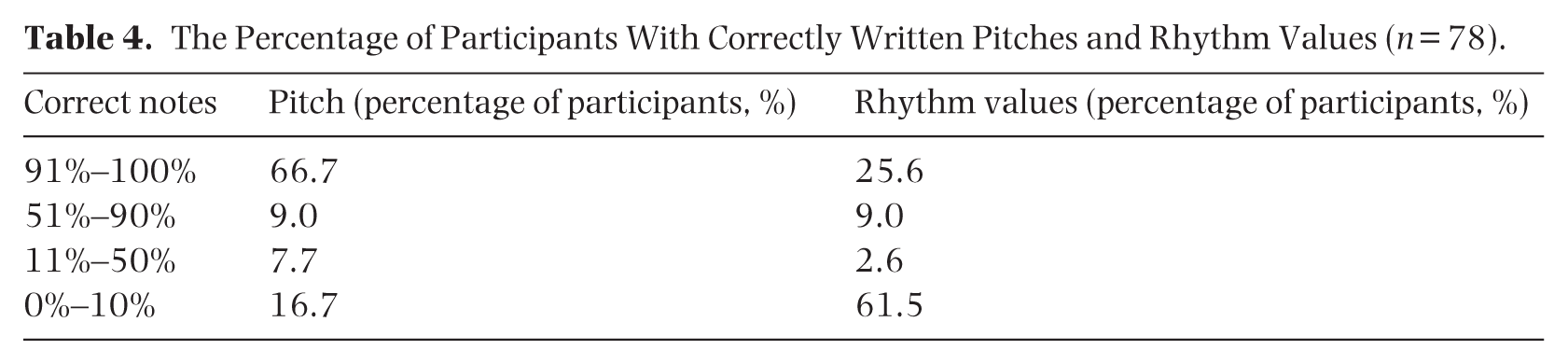
83.4% of the participants wrote the pitches in at least the first two bars correctly, while 66.7% wrote all the pitches correctly. 61.5% of the participants did not write any differentiated rhythm values: their response consisted of either the same note values or just circles showing the pitch, as shown in Figure 2.

Examples of the Song Notated Using Correct Pitches Without Any Rhythmic Differentiation (10-Year-Old Participant to the Left, and 13-Year-Old to the Right).
Correlations were measured using categorized values for rhythm and pitch notation, as described above. The nonparametric correlation test (Spearman, two-tailed) revealed a significant correlation (at the .01 level) between the age of participants, the number of years playing their instrument, and the number of correctly written note values and pitches (Table 5). In the youngest group (8–10 years old, n = 27), only one participant wrote correct rhythm values, while 26 did not differentiate the rhythm at all. Ten of the participants in this group wrote all the pitches correctly, while five wrote over 50% of pitches correctly. There was also a significant correlation between the percentage of correctly written note values and the percentage of correctly written pitches, as shown in Table 5. On the other hand, there was no significant correlation between the age of the participants and the use of the clef, time signature, or bar lines.
Correlation Between the Age, Number of Years Playing Instrument, and Number of Correctly Written Note Values and Pitches (n = 77).
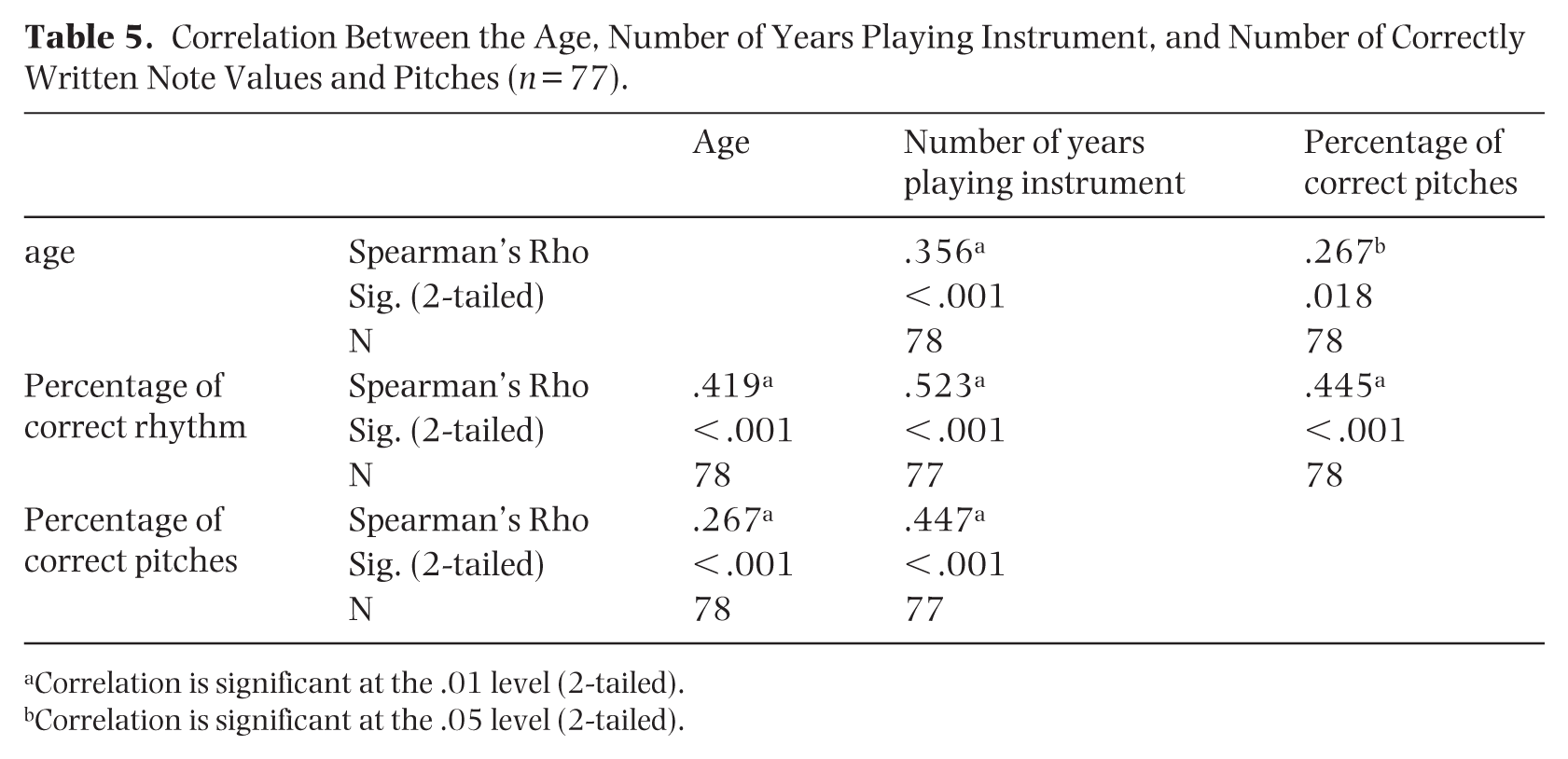
Correlation is significant at the .01 level (2-tailed).
Correlation is significant at the .05 level (2-tailed).
Discussion
Research focusing on the relationship between reading and writing skills in language literacy acquisition suggest that reading and writing draw on shared knowledge, yet remain separable skills (Fitzgerald & Shanahan, 2000). Although the present study did not directly assess participants’ music reading skills, analysis of method books, orchestral repertoire, and conversations with conductors reliably indicated that participants were able to read the melody they were asked to write down. The usual repertoire of the orchestras in which the student participants were enrolled was far more complicated to read than the piece used in the study, and the majority of students had read and played Lisa gikk til skolen during the first 3 months of learning to play an instrument. Yet only 8.7% of participants were able to write down the music correctly, using all the necessary music notation symbols.
Knowing how to read music notation does not, therefore, mean that it can be applid to notate familiar music with the same degree of fluency. Graham and Hebert (2011) argue that teaching handwriting and spelling may have greater transfer to word recognition than teaching word recognition does to handwriting and spelling. The results of the present study suggest similar tendencies for the relationship between reading and writing music. Recognition of pitches and rhythm patterns while playing has limited transfer to the ability to write down the same notes and patterns. More research is needed to discuss whether and how handwriting music can enhance the recognition of pitches and rhythm patterns in sight-reading.
The parallels in the processes of decoding and comprehending written text suggest that literacy skills in the domains of language and music may develop in comparable ways. The present findings suggest that the acquisition of music literacy may follow a similar trajectory to language literacy development (Fitzgerald & Shanahan, 2000), perhaps more so than educators have previously recognized. Consequently, applying certain methods from language literacy instruction could enhance instrumental students’ understanding of notational systems in music and enhance the process of learning to read music. Research on reading and writing in the context of efficient learning strategies (Gammill, 2006; Kim & Graham, 2022; Klein & Boscolo, 2016) has found that students who used writing activities developed stronger comprehension skills compared to the students who did not. The findings from the current study suggest that music writing might be beneficial to deeper engagement with and understanding of music notation, and that music writing could be utilized to assess understanding of musical notation systems and their symbols.
While many students in ensemble settings, such as school orchestras, already possess practical experience with music reading and performance, music writing offers a complementary pathway to deepen their understanding of notational systems. Writing music requires learners to actively retrieve, organize, and represent musical ideas using symbolic modes, thereby reinforcing their grasp of pitch, rhythm, and structure. This process promotes metacognitive engagement with musical syntax and encourages students to reflect on how musical meaning is constructed and communicated. Moreover, writing can reveal gaps in understanding that may remain hidden during performance, making it a valuable tool for assessment and individualized instruction. By integrating writing into music education, we can support the development of more holistic musical literacy—one that bridges perception, cognition, and creative expression.
The results of the analysis of this music writing task are consistent with research findings describing how sight-reading relates to variables such as pitch, rhythm, and age of study participants. In the present study, pitch and rhythm were clearly not considered equally important by participants while writing. The primary goal of the majority of the participants seemed to be writing down the correct pitches; rhythm was only addressed by 38.5%, and only 25.8% wrote it down correctly. Findings for sight-reading showed that, likewise, pitch information was frequently of greater focus than rhythm and timing for both children and adult participants (Alexander & Henry, 2015; Drake & Palmer, 2000; Gudmundsdottir, 2002). Some earlier studies comparing errors in rhythm and pitch during sight-reading discuss the possible reasons for this asymmetry. Gudmundsdottir (2002) suggests that an emphasis on decoding pitches may stem from training methods that prioritize this aspect of music notation. However, existing research does not conclude whether this focus on pitch reading, at the expense of rhythm, is a consequence of teaching methods or if it reflects a more inherent tendency among students and musicians, regardless of their training.
The present results show a significant correlation between writing skills for rhythm and pitch. Pitch accuracy without rhythm success occurred most frequently; none of the participants wrote down a higher number of correct rhythm values than pitches. At the same time, writing correct rhythms was more closely correlated to age than writing correct pitches. Understanding the relationship between pitches and their place on the staff may, therefore, be less cognitively demanding than notation of the time relation between the notes, which is a far more abstract concept. This finding is consistent with research on music reading and confirms the findings of Alexander and Henry (2015) and Russell (2019), who conclude that performing rhythm alone or pitch alone requires different cognitive processes. Kopiez and Lee (2008) identified rhythm-reading accuracy as one of the key predictors of sight-reading proficiency. From an educational standpoint, these results suggest that emphasizing rhythm reading, playing, and writing, along with practicing rhythm and pitch separately, could positively influence the development of music reading skills of instrumental students.
It is interesting to note that 17.1% of the participants wrote the first two or three bars of the song correctly but did not complete the task. All the pitches they had to know to be able write down the entire song (C, D, E, F, G and A) were present in the first three bars, the rhythmic and tonal complexity of the next bars was identical with the two already written, and enough time was given to complete the task. This result may have occurred because the melody was too long for some participants to write down. Pick et al. (1982) have shown that young children seem more confident reading one pitch at a time rather than a short melody consisting of a sequence of the same pitches. The results of the current study suggest that a similar process might occur while writing music, in the same way that, for beginner readers, words consisting of a few letters are easier to decode that longer words consisting of the same letters (Adams, 2000).
Reliability and validity
The research design and data collection in this study left certain factors unaddressed, which may raise questions about the validity of the results. The study was conceived as an explorative experiment aimed at identifying general tendencies and new questions in an under-researched area. Some underlying assumptions were based upon previous studies of instrumental teaching methods (Lehmann et al., 2007; Leikvoll, 2024, 2025; Waller, 2010), as well as upon my own experiences in music education.
Nevertheless, assumptions regarding the playing and reading levels of the participants raise some important questions. For instance, how accurately do these assumptions reflect the actual skills of the participants? Variations in individual abilities were not captured by general assessment. Reading ability at a level above that of the writing task was verified by the conductors, who selected appropriate repertoire for students’ current skill levels for their regular participation in music competitions. However, the music reading abilities of the students were not assessed as part of the experiment. Consequently, it is possible that some participants relied on their musical ear and memory rather than reading music during practice and rehearsals, and this may have somewhat affected the validity of the results. Nevertheless, all participants had received at least two years of weekly music reading instruction as part of their individual or small group lessons (typically consisting of two to four students), and during rehearsals they all utilized sheet music and received instructions that directly referred to reading music notation.
Conclusion
Learning to read music is a complex process that has been studied from many perspectives. The findings from the current study indicate that the cognitive skills involved in writing music differ in part from those used in music reading. This distinction suggests that writing music may engage different mental processes compared to reading and playing a written score. Students who can read and play music are only to some extent able to use their knowledge to write down a melody. These findings may challenge current practices within instrumental pedagogy, with its primary focus on reading, contributing to develop deeper insights into the process of learning music literacy. The similarities between the reading processes for language and music, together with the results of this explorative study, imply that music writing may have a positive impact on instrumental students’ music reading acquisition. Awareness of the importance of both may improve the efficiency of future teaching methods and enhance balance between reading and writing in music education. A deeper understanding of how music literacy is acquired is crucial for understanding this complex process and for the future development of research-based teaching methods.
Footnotes
Acknowledgements
I would like to express my gratitude to the conductors who helped me to conduct the experiment and students who participated in the study.
Author Contributions
Declaration of conflicting interests
The author declared no potential conflicts of interest with respect to the research, authorship, and/or publication of this article.
Funding
The author received no financial support for the research, authorship, and/or publication of this article.
Ethical considerations
The study was approved by the Norwegian Centre for Research Data (Sikt). All the parents of the children participants gave their informed consent to participation.

Data availability statement
Data available on request from the author.