



Abstract
While creativity is a primary focus in music education, its exploration within the realm of music studio teaching is considerably less extensive compared with other educational contexts. Moreover, the related research is predominantly focused on creativity in developing music skills. In the present study, we explore how Spanish instrumental music teachers (n = 10) perceive creativity and its development among students in the music studio, in the absence of predefined limitations (i.e., with respect to various forms and definitions of creativity inherent in the music studio as perceived from their viewpoint). By means of a case study methodology, we gathered data over a one-year period through a questionnaire, in-depth interviews, participants’ written essays, and researchers’ journal entries following observations of the participants’ teaching practices. Subsequently, qualitative analysis was conducted using thematic analysis. Among our main results, we found tensions between our participants’ theories and their practices, evidence for an underlying individual-centered theory of creativity, both positive and negative attitudes toward the development of creativity among their students, and ignorance of creativity in music listening. Our study implications emphasize the urgency of implementing strategies to enhance teacher self-awareness and underscore the need for further investigation into music studio teaching with a specific focus on creativity.
Introduction
The relevance of fostering creativity in education is well-established (Torrance, 1976). Moreover, creativity constitutes a pivotal subject in the music education field, wherein “this body of research has focused on creativity within music [. . .]. In other words, creativity research has centered on creativity pertaining to content knowledge [. . .] to become creative musicians” (Abramo & Reynolds, 2015, p. 38). However, there are studies within this field that are focused on pedagogical aspects and, specifically, on researching teachers’ views on creativity (Odena, 2001, 2006; Schiavio et al., 2023; Veblen et al., 2016). These works are often constrained by the teaching of music in primary or secondary education within the Anglosphere context and do not typically involve a the multi-method collection of data; although there are exceptions (e.g., Burnard, 2014). With the present study, we contribute to the existing literature by exploring instrumental music teachers’ views on creativity within studio music teaching (also known as one-to-one music teaching) in Spain. Specifically, our purpose is to examine this population’s conceptions of creativity and the cultivation of creative abilities among their students as articulated in the following research questions:
The broad scope of our research questions was an a priori decision to fully capture the breadth of our participants’ understandings and beliefs—even if they attached creativity to musical, nonmusical, or educational aspects that we did not expect. Similarly, in this study, we did not specifically adhere to a theory of creativity but rather maintained an open stance, allowing the perspectives of our participants to emerge freely. Finally, in regard to our assumptions, this study aimed to explore comprehensive understandings and beliefs by closely linking these terms to attitudes, notions, perceptions, perspectives, opinions, conceptions, and interpretations (Pajares, 1992). This study therefore aligned with a postmodern exploration of creativity in music education, recognizing its plurality and the coexistence of different visions of the topic (Randles & Burnard, 2022).
Our exploration of teacher perspectives is underpinned by the compelling interrelation that exists between the beliefs and pedagogical strategies that teachers employ (Maggioni & Parkinson, 2008). Furthermore, this study has the potential to inform creative practices in music education, as teachers’ experiential knowledge, which is implicit in their beliefs, serves as a vital source of knowledge for the teaching profession (Elbaz, 2018).
Framework
Creativity, musical creativity, or creativity in (music) education represent broad research fields. Indeed, “creativity in music teaching and learning [is] perhaps the most important area of study for both researchers and practitioners alike in the field of music education” (Randles & Webster, 2013, p. 617). Therefore, when developing the framework for this study, we had to prioritize topics and studies that we deemed highly relevant to our work. However, we acknowledge that there may be other related topics and studies that bear some degree of relevance as well.
The standard and traditional definition of creativity in research is bipartite, as it requires both originality and usefulness to produce a valuable new product (Guilford, 1950; Stein, 1953). This definition equates “creativity” with “creation,” which is highly controversial; for example, people may not respond favorably to novel ideas and may therefore fail to recognize something as useful (Hughes et al., 2018); the usefulness of something might only be proven afterward when situational demands emerge (Zhou et al., 2017); and a “creation can be judged only when it has concluded, whereas creativity is active throughout the process” (Walia, 2019, p. 239). Other historical conceptions of creativity differentiate it from an end result, as proposed by Vygotsky (2004): regard it as a nonlinear way of thinking, namely divergent thinking (Guilford, 1967); envision it as the aptitude to discover new problems (Csikszentmihalyi, 1996); as a socio-psychological phenomenon intrinsic to all individuals and arising from the interaction of individual characteristics with social environments (Amabile & Pillemer, 2012); or as a quality possessed exclusively by gifted individuals (Gardner, 1993). Modern perspectives advocate for a flexible approach in conceptualizing creativity, which depends on the research field and situation (Runco, 2004), and which regards creativity as an interplay of individual traits, environment, society, product, and one’s capacity of persuasion (Walia, 2019). With respect to the specific field of the arts, Csikszentmihalyi found that successful creators are not interested in the finished product so much as they are in the creative process (Beard & Csikszentmihalyi, 2014).
Regarding the conceptualization of creativity in music and music education, Odena (2018) stated that “creativity is a complex and fairly vague term” (p. 7). He analyzed the uses of the term in the context of research in music education and found that it was typically associated with “imaginative thinking” and “creative musical activities” such as composition or improvisation. Likewise, Odena (2018) highlighted that creativity is rarely associated with performing music or listening to music. In addition, Burnard (2016) found that the prevailing perspective on musical creativity tends to conceptualize it as an individual-centered process rather than, for instance, a socially emergent phenomenon. Drawing on a sociocultural perspective, Burnard and Haddon (2016) proposed the existence of “diverse musical creativities” in relation to the individual (i.e., personal characteristics), the field (social systems in music and music education), and the domain (cultural systems in relation to music), where several musical creativity practices coexist, such as “individual,” “communal,” “collective,” “collaborative,” “performance,” “symbolic,” “empathic,” “interdisciplinary,” “computational,” “intercultural,” and “digital” practices. Also in regard to the study of musical creativity, a recent bibliometric review (Ozenc-Ira, 2023) unveiled eight primary topical foci: “computational creativity, processes of improvisation, improvisation teaching and learning, interactions/collaboration during improvisation, effects of improvisation practice, innovative music technology, [and] aesthetic aspects of everyday creativity and music therapy” (p. 1). As this classification demonstrates, studies on beliefs about creativity regarding music, albeit present, do not constitute a central topic in the field. This is corroborated by recent research literature: “[a] review of literature revealed limited research has investigated these [music teachers’] perceptions [of creativity]” (Kladder & Lee, 2019, p. 395).
With regard to creativity in education, fostering creative thinking is central (Torrance, 1976). To achieve this goal, Kim’s (2017) CATs (climate, attitude, and thinking skills) model proposes fostering three skills: Inbox skills, regarding the acquisition of “expertise” and the development of “critical thinking”; Outbox skills, where the emphasis lies in fostering divergent thinking (i.e., outside-the-box thinking) through “fluent thinking” (spontaneous generation of ideas), “flexible thinking” (considering different angles), and “original thinking” (finding something new); and Newbox synthesis skills, supported by the two previous skills and aimed at the “connection, refinement and promotion” of ideas. In addition, the CATs model proposes three steps for fostering creativity: (a) cultivating “creative climates,” (b) nurturing creative attitudes, and (c) developing creative thinking skills (Kim, 2017). In the music-specific research field, Webster (1990, 2002) proposed the “Model of Creative Thinking in Music” for fostering creative thinking. This model is based on (a) “enabling skills” regarding the enhancement of musical aptitudes, craftsmanship (i.e., the capacity to use knowledge for pursuing complex musical tasks), aesthetic sensitivity, and conceptual understanding of music; and (b) “enabling conditions,” regarding the strengthening of motivation, “subconscious imagery” (by providing knowledge while also allowing for mental rests), environment, and personality. The aforementioned processes are conceived as a progression through stages that involve alternating between convergent and divergent thinking: preparation (i.e., to play with ideas), incubation (i.e., to allocate time away from the tasks), verification (working in a structured way), and illumination (finding solutions).
With regard to previous research on music teachers’ views on creativity and its development, the body of literature appears to differ from studies focused on teachers of other subjects due to the consistent alignment between music teachers’ views and the actual teaching strategies and conceptions that are present in creativity research (Aljughaiman & Mowrer-Reynolds, 2005; Fryer & Collings, 1991; Haddon, 2016; Kladder & Lee, 2019). However, several studies works found that music teachers’ views on creativity resist generalization and are highly dependent on their own experiences in composing music, knowledge of different musical styles, working contexts, or past experiences (Odena & Welch, 2007, 2016). The majority of participants in these studies are located in the Anglosphere world (e.g., MacGlone et al., 2022; Vitale, 2017), with a few exceptions (Schiavio et al., 2023; Sungurtekin, 2021). Likewise, they are typically primary or secondary music teachers, although there are exceptions, such as the study presented in the fourth chapter of Odena (2018), which focuses on developing creativity among conservatoire students. Furthermore, as highlighted by Burwell (2016) in relation to one-to-one music teaching, “in this particular context, however, it could equally be argued that creativity is hardly an issue” (p. 191). On the other hand, the music teachers who participate in studies investigating beliefs on creativity in music or music education generally think that environmental factors are central in mediating creativity; they show highly positive attitudes toward the development of their students’ creativity, and they mainly think about composition and improvisation when speaking on creativity (Kladder & Lee, 2019; Schiavio et al., 2022; Sungurtekin, 2021; Vitale, 2017). However, Sungurtekin (2021) found that among the teachers participating in their study in Turkey, there was no significant emphasis placed on the creation of melodies, rhythms, or music composition. Moreover, Schiavio et al. (2023) found that in fostering students’ creativity, their participants (who were based in Italy and Belgium) differentially highlighted “stimulating their curiosity,” “changing their perspectives,” and “helping them navigate both personal and social domains.” The limited research on conceptions about creativity in music education in the Spanish context underscores that its understanding is pre-scripted by educational regulations, based in traditional conceptions, and disregards creativity in listening (González-Ben, 2015; Mateos-Moreno & Gallego-García, 2022).
In the specific context of this study, one-to-one music teaching may be delivered in publicly or privately funded conservatories and music schools. In Spanish conservatories, this tuition is typically organized in levels and exams according to state regulations (i.e., Royal Decree 17/2009 and Royal Decree 1577/2006). It is mainly focused on Western classical music and instruments and does not commonly involve improvisation (Mateos-Moreno & Erlanson, 2022). However, Spanish conservatory education is gradually expanding to encompass a wider range of musical genres and instruments (Pozo et al., 2022). In the case of music schools, which are usually privately funded, they may offer similar tuition if granted permission by the state. More typically, they offer recreational instrumental education within a more flexible framework. 1
In summary, while the research field of creativity extensively examines its development in relation to musical composition and improvisation, studies investigating music teachers’ conceptions of creativity are comparatively rare. Furthermore, their participants’ understandings appear to vary and depend on geographical and background factors. In addition, there is a scarcity of such studies focused on creativity in one-to-one music teaching and in relation to the Spanish context. Taking all of these aspects into consideration, the justification for pursuing the current study becomes apparent.
Methodology
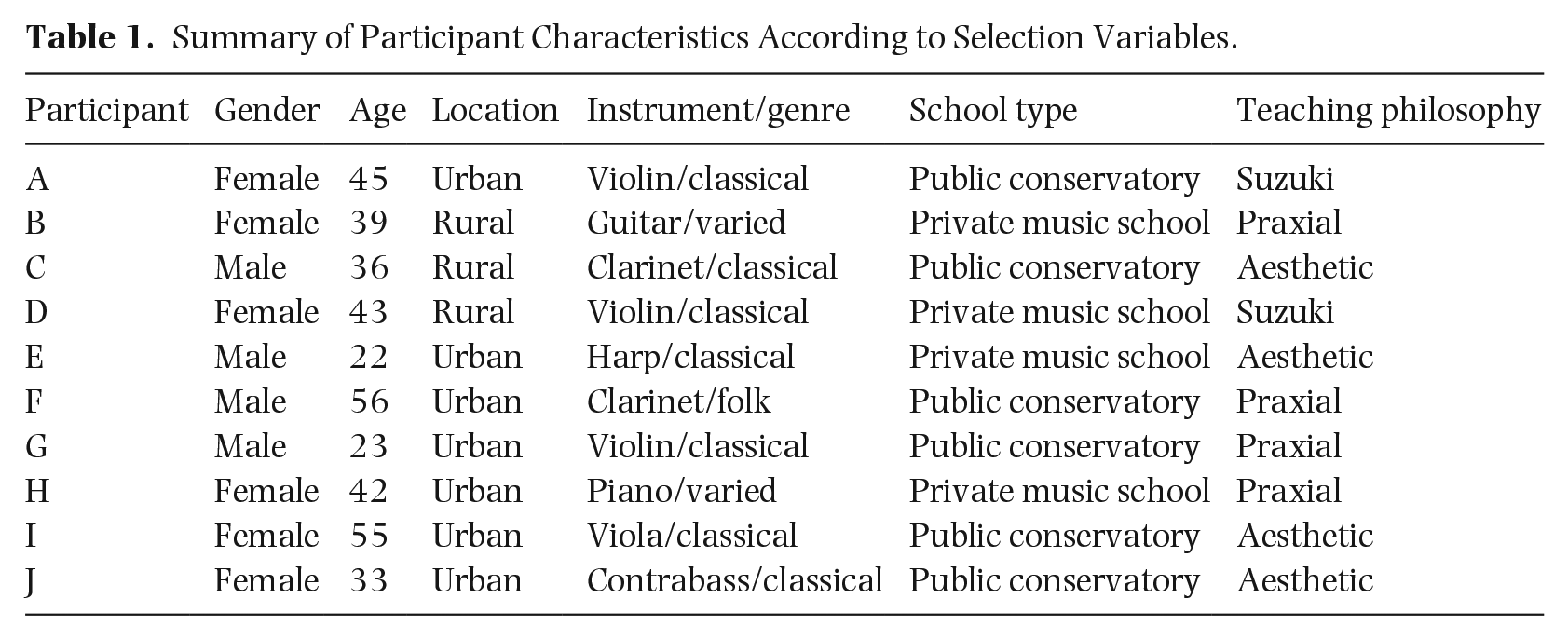
This research received clearance from the Ethics Committee of the University of Málaga and is part of a larger project aimed at exploring attitudes, beliefs, and motivations in music teaching contexts. Each research study within this project has distinct objectives, frameworks, and methodologies. The methodology employed in this study is aligned with case study research (Stake, 1998), focusing specifically on the case of instrumental music teachers within the context of one-to-one music teaching. The timeline for this study was approximately one year. Initially, a semi-structured, in-depth interview was developed in alignment with the objectives of our study and the relevant literature. Subsequently, the interview underwent a pilot phase involving two participants from a population comparable to that of the present study. The pilot stage resulted in minor adjustments to the wording of the interview questions, aimed at enhancing clarity and tailoring the questions to the specific target population. Next, the email addresses of teachers affiliated with 15 different music schools and conservatories located in both rural and urban areas across southern and northern Spain were obtained through a combination of internet searches and direct communication with school principals. Information and an invitation to participate in the study, along with a consent form and a questionnaire to retrieve information, was sent to these teachers. Based on the responses received (with a response rate of approximately 25%), we employed purposeful sampling to ensure a diverse range of subject profiles, aiming to enhance the richness of the study results (Creswell, 2014). This involved selecting participants with variation across several variables, including location (urban/rural), age, gender, school type (public/private; conservatory/music school), and our assessment of their self-stated teaching philosophy as indicated by their responses to the open-ended questions included in the aforementioned questionnaire: “What do you prioritize as a teacher?”, “What is the main objective with your students?”, and “Do you adhere to a specific educational philosophy?”. A summary of the selected participants (n = 10) is presented in Table 1. Our sample included instrumental music teachers whose philosophies were deemed closer to praxial music education (Small, 1977), music education as aesthetic education (Reimer, 1970), or Suzuki teaching methodology. Furthermore, several of them reported having significant experience in improvisation (n = 2) or historically informed performance (n = 1).
Summary of Participant Characteristics According to Selection Variables.
The participants were interviewed either through video conferencing or in person at their respective schools. During these interviews, they were presented with a series of questions, including “What is creativity, in your opinion?”, “How do you conceive creativity in your profession?”, “What are the traits of a creative music student, in your opinion?”, “How do you work in your lessons regarding creativity, if you do so?”, and “What factors do you think may help your students in developing creativity?”. Additional spontaneous questions aimed at eliciting further clarification and elaboration of the interviewees’ thoughts. The interviews, which had a duration of approximately 80 to 100 minutes each, were recorded and subsequently transcribed.
In addition, we collected data through two supplementary methods. First, we asked the teachers to write an unrestricted-length essay expressing their thoughts and experiences regarding the topics addressed in our research questions (no further guidance was given in doing this). All our participants submitted essays that ranged in length from one to two pages. We utilized this approach as teachers’ written reflections can offer valuable insights into their beliefs (Bullough, 2014). Second, we conducted in-class observations (21 instances, between two and four times in each case, with a minimum of 30 minutes in each observation instance) of several participants (n = 7) at the schools where we were granted access. The purpose of these observations was twofold: (a) to gain a deeper understanding of the teachers’ narratives based on real-life classroom practices (Patton, 2014), and (b) to explore the relationship between teachers’ beliefs and their instructional practices (Bullough, 2014). Throughout the observations, we assumed a non-participant role, solely observing and documenting classroom activities related to our research topics in a nonstructured journal. We intentionally refrained from engaging in interactions with the teachers or students during the observations. These observations were pursued in a team effort; travel organization and journey, when required, involved only one of the authors.
In the subsequent phase, we conducted an analysis of the participants’ responses and essays using thematic analysis, following the six-step process outlined by Braun and Clarke (2006): (a) becoming familiar with the data, (b) generating initial codes, (c) identifying potential themes, (d) reviewing and refining themes, (e) defining and labeling the final themes, and (f) producing the final report. The point of saturation in our analysis was reached after examining approximately 80% of the data. Throughout the analysis process, the authors engaged in discussions and achieved consensus at each stage. This collaborative effort led to the identification of codes and themes that directly addressed the research questions of this study. Similarly, we performed a thematic analysis of our observation journal and subsequently compared the results with those obtained from the analysis of the teachers’ interviews and essays. In doing this, we did not impose a predefined set of categories or definitions of creativity and refrained from relying on our own conceptions. However, the codes and themes that emerged in our analysis are naturally contingent upon our understandings of the data and the extant knowledge on creativity that is outlined in the framework section of this study (Stake, 1998).
Results
In the following section, we present the results pertaining to each research question, accompanied by carefully chosen quotations that serve to illuminate the nuances of the participants’ experiences and provide readers with a vicarious understanding (Sandelowski, 1994). In addition, for the purposes of triangulation we present a section in relation to our observational analysis. In what follows, the numbers in brackets indicate the frequency of appearances of the accompanying code, with capital letters serving as identifiers for the participants and lowercase letters indicating the source of each quotation (e.g., “i” for interview, “e” for essay, “o” for observation). The primary themes and codes are summarized in Table 2.
Summary of Codes and Themes From Our Analysis.
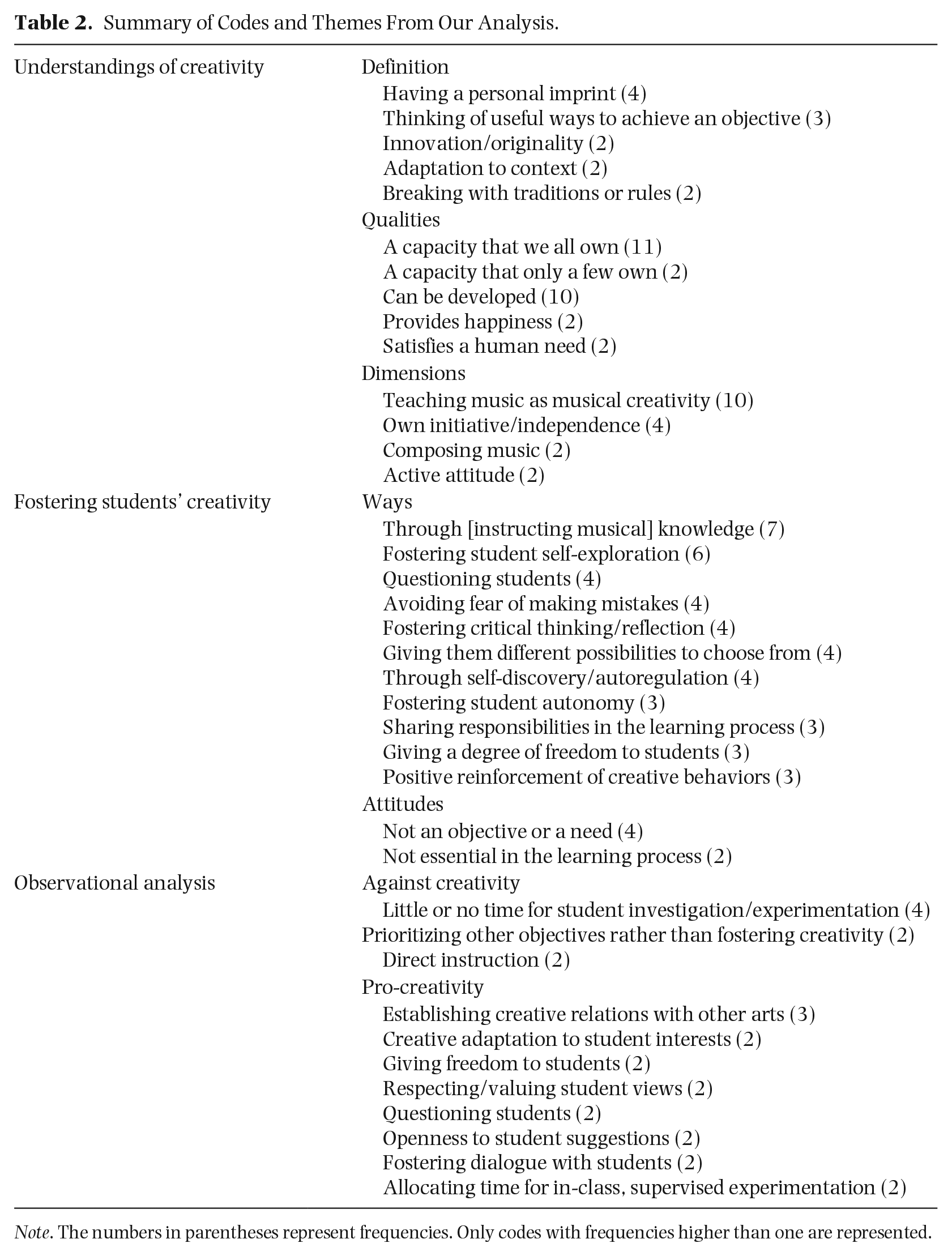
Note. The numbers in parentheses represent frequencies. Only codes with frequencies higher than one are represented.
Understandings of creativity
In regard to our first research question, the definition that our participants most frequently attached to creativity was “having a personal imprint” (4), with expressions such as “it is a very broad word, but I think it has to do with the fact that when someone does something, they do it personally” (Ai). Utility was also associated with creativity, as identified by the code that we labeled “thinking of useful ways to achieve an objective” (3). Other aspects that our participants mentioned regarded “innovation/originality” (2), “adaptation to context” (2), and “being empathic” (1). On the contrary, creativity was seen either as “a capacity that we all own” (11) or “a capacity that only a few own” (2). Those participants who were aligned with the first concurrently thought that creativity “can be developed” (10), “provides happiness” (2), “satisfies a human need” (2), and is “important for the development of personality” (1).
When our participants reflected on creativity, they typically mentioned expressions that we coded within “teaching music as musical creativity” (10). This code expressed different ways of adapting teaching to the circumstances of each student: “each student is different from each other. So, to vary the way of teaching [music to] a student who has a character that may be different from another, that is [an example of] creativity in music” (Ie). Other codes associated with the participants’ conceptions of creativity regarded the characteristics of a creative student in terms of “[those who] compose music” (2) and “breaking with traditions or rules” (2). In addition, teachers thought of a creative student as one who demonstrates their “own initiative/independence” (4), and in relation to having an “active attitude” (2) by “[the students] daring to discuss [something] during the lessons or to ask you questions when they have not understood [something]” (Ai).
Fostering students’ creativity
When it came to our second research question, the most common codes that we identified across participants were “through [instructing musical] knowledge” (7) and “fostering student self-exploration” (6), with expressions such as, Being creative is a result of adapting and applying the knowledge we have a priori. If you don’t know about something, it will be difficult for you to find solutions. (De) We must give them [the students] the opportunity to investigate on their own [. . .]. I don’t think it’s appropriate asking my students to exactly copy the interpretation that I’m doing. (Ai)
Other codes in regard to teaching to develop creativity regarded many different strategies, among which the most widely shared across our participants were “questioning students” (4), “avoiding fear of making mistakes” (4), “fostering critical thinking/reflection” (4), “giving them different possibilities to choose from” (4), “through self-discovery/autoregulation” (4), “fostering student autonomy” (3), “sharing responsibilities in the learning process” (3), “giving a degree of freedom to students” (3), and “positive reinforcement of creative behaviours” (3). On the contrary, we also identified negative conceptions or attitudes of indifference to fostering musical creativity, such as those contained in expressions coded “not an objective or a need” (4), “not essential in the learning process” (2), “may decrease quality in learning” (1), “provokes mental fatigue” (1), “should not be fostered at the beginning” (1), “a potential problem for teachers” (1), and “had not thought sufficiently on this topic” (1). These were spread across participants, including the following expressions: I think that creativity is not essential for the learning of a boy or a girl [. . .]. People who are less creative seem to move forward with clearer ideas. By not having so many concerns or so many questions, they trust what you tell them, and they efficiently follow your path, as new paths are not even considered. These students are able to focus on one thing and with more quality than the others [i.e., the more creative ones]. (Ei)
Observational analysis
In the analysis of the journal that we kept while observing the participants, two main themes emerged: “against creativity” and “pro-creativity” teacher behaviors. These results stemmed from comparing the teachers’ praxis with the teachers’ own conceptions of creativity, collectively considered.
Within the “against creativity” behaviors, the code that we found most frequently was labeled “little or no time for student investigation/experimentation” (4). Some of our annotations within this code included the following: He always provides the students with the sheet music with the fingerings and bows on. He allows very little time for students to investigate and discover [things] on their own. It flattens and makes the learning path much [more] direct so that they can achieve the proposed objectives quickly, although not creatively. (Io) No process of reflection on the part of the students; there is simply a process of acquiring knowledge without criticism, adaptation, refinement, or analysis. (Jo)
Other codes within the theme “against creativity” included “prioritising other objectives rather than fostering creativity” (2), “direct instruction” (2), “[the teacher] speaking too much” (1), and “fostering exact imitation” (1). For example, All the objectives that he proposes are closely related to technical issues connected with psychomotor skills—nothing in relation to developing creativity. (Io) He talks a lot; although he seems to like [it] when his students participate, he is often unable to shut up and listen to everything they have to say. (Fo)
When it came to the theme “pro-creativity,” the code most frequently identified across our participants regarded “establishing creative relations with other arts” (3) and included observations such as “[chatting about] a book, an interesting concert, or visiting an art gallery [in relation to the music that the student was working on]” (Fo). Other codes that related to more than one participant regarded “creative adaptation to student interests” (2), “giving freedom to students” (2), “respecting/valuing student views” (2), “questioning students” (2), “openness to student suggestions” (2), “fostering dialogue with students” (2), and “allocating time for in-class, supervised experimentation” (2). Less frequent codes within this theme included another six, namely, “decisions adopted in a shared manner with their students” (1), “giving multiple options to students to choose from” (1), “avoids requesting that students exactly copy an interpretation” (1), “using musical games” (1), “using different and creative approaches for working on the same thing” (1), and “student leading the lesson (or a part of it)” (1).
Discussion
A major result of our study, based on the analysis of our participants’ views on creativity and its development, provides evidence for rejecting the attribution of creativity as “the elephant in the room” in one-to-one music teaching. However, our results suggest that paradoxically, our teachers’ teaching practices counteract their beliefs (considered collectively) on the topic in many ways. The teaching practices of our participants were indeed aligned (at least to some degree, depending on each case) with traditional conceptions of one-to-one music teaching (Burwell, 2016). According to the analysis of our observations, while we found teaching behaviors coherent with the development of students’ creativity (e.g., establishing creative relations with other arts, creative adaptation to student interests), we also identified many others opposed to it, such as providing little or no time for student experimentation, reflection, questioning, or speech. Notwithstanding these issues, creativity was far from being an “elephant” across our participants’ teaching theories, as they were generally able to reflect extensively on it, even providing counterarguments to their own teaching practices. This finding is interesting as it goes against the typical assumption that beliefs are closely related to practices (Maggioni & Parkinson, 2008). Likewise, these tensions between theory and practice seem to depict what has been referred to in the philosophy of music education as a “dialectic” model (Jorgensen, 2005).
In terms of our first research question, “How do instrumental studio music teachers understand creativity?”, the participants mostly attributed “having a personal imprint” in doing something and “utility” as the most relevant evidence of creativity. This demonstrates, in our opinion, a greater emphasis on performance creativity rather than pedagogical creativity and aligns their views with a traditional conception of creativity, where usefulness is a priority over the creative process itself (Walia, 2019). Likewise, it is congruent with previous research within the Spanish context (González-Ben, 2015) and goes against conceptions of creativity specifically aimed at the arts that prioritize the process over the product (Beard & Csikszentmihalyi, 2014; Csikszentmihalyi, 1996). On the contrary, the pursuit of a personal imprint as a creative behavior is not equally prevalent in the broader context of creativity research. However, there is research that supports its significance within the specific domain of creativity in art education (Glăveanu, 2018; Mateos-Moreno, 2011). In addition, our participants regarded “innovation,” “originality,” and “adaptation to context” as indicators of creativity, which are typical constructs associated with creativity in any field (Ozenc-Ira, 2023). Interestingly, with the exception of “being empathic,” the absence of more codes in relation to the sociocultural perspective of creativity (Burnard & Haddon, 2016; Glăveanu, 2018) aligns our teachers’ views with an individual-centered process rather than other possible perspectives, such as a socially emergent phenomenon or a posthumanistic performative standpoint (Barad, 2003), thereby confirming its prevalence among music teachers as theorized by Burnard (2016). In addition, our participants’ perspectives might also align with a human exceptionalist view, in which, for example, spaces, sounds, bodies, instruments, or technology are not considered to play a relevant role when thinking about creativity (Hickey-Moody & Page, 2015).
Regarding our second research question, “What are participants’ beliefs on fostering creativity among students?” the analysis of our teachers’ views aligns well with Kim’s (2017) CATs model for fostering creative skills. In this sense, the majority of their beliefs regarded the development of “Outbox skills,” as reflected in statements that we coded within “questioning students,” fostering “self-exploration,” “critical thinking and reflection,” and “self-discovery/autoregulation.” In addition, they also thought about developing “Inbox skills,” in terms of providing students with knowledge as a base for the development of creativity, and of “Newbox skills,” by allocating time for in-class supervised experimentation. Moreover, they proposed strategies that fit well the CATs model in “cultivating creative climates,” by, for example, the statements that we coded within “sharing responsibilities on the learning process,” “fostering dialogue with students,” “avoiding fear of making mistakes,” or “teaching music as musical creativity” in terms of adapting teaching to students’ characteristics. Overall, these aspects provide additional evidence that our participants collectively possessed a solid theory on the development of creativity, which supports previous findings on the agreement between expressed beliefs and existing theories on creativity in the case of music teachers (Kladder & Lee, 2019). However, there is an aspect of Webster’s (1990, 2002) “Model of Creative Thinking in Music” that is totally absent in their views, according to our analysis: creative listening and thereby “aesthetic sensibility.” This confirms previous research that underscores how creativity is rarely considered in relation to listening to music (Odena, 2018).
The opinions among our participants on whether creativity is a capacity inherent to all individuals or a talent exclusive to gifted students were divided and thus reflect the strands present in the literature on creativity (Amabile & Pillemer, 2012; Gardner, 1993). For those who conceived creativity exclusively as a talent, we suggest that neglecting it as a focus for student development may result in teachings aligned with the master-apprentice tradition instead of more modern and equitable teaching philosophies in one-to-one music teaching (Mateos-Moreno & Erlanson, 2022). Furthermore, some participants held negative attitudes toward their students’ development of creativity, such as perceiving it as “not essential”: they considered creativity to decrease “quality in learning,” since “people who are less creative [seem] to move forward with clearer ideas,” “trust [better] what you tell them,” or “are able to focus on one thing and with more quality.” Some thought that creativity may provoke “mental fatigue” and therefore hinder teaching and learning, believed that it should not be a focus when teaching beginners, or considered it “a potential problem” for teachers as they could lose control of what is learnt by their students. These negative conceptions contradict extant research in the field of creativity in music and music education, which typically attribute highly positive attitudes toward the development of creativity (Kladder & Lee, 2019; Schiavio et al., 2023; Sungurtekin, 2021; Vitale, 2017). Moreover, our participants seemed more aligned with the music teachers in research in Turkey than with those in Anglosphere contexts based on the low frequency of beliefs that we identified in relation to improvisation or composition (Sungurtekin, 2021). We hypothesize that the aforementioned discrepancies may arise from investigating distant geographical (and, therefore, sociocultural) contexts, as well as from our narrow focus on examining one-to-one music teaching.
Conclusion
Our study revealed tensions and discrepancies between the beliefs and practices of our participants concerning creativity. Furthermore, we found evidence supporting the presence of an underlying individual-centered theory of creativity and a human exceptionalist view, rather than, for example, a socially emergent concept. In addition, we identified both positive and negative attitudes toward the development of students’ creativity. Other noteworthy findings include the absence of music listening in our participants’ beliefs regarding creativity and variations in their perspectives compared with those of participants in other studies. We attribute these differences to the specific context (one-to-one music teaching) and the geographical location (Spain) of our participants, as previous studies in similar contexts have also highlighted traditional conceptions in delivering one-to-one music teaching (Mateos-Moreno & Erlanson, 2023; Pozo et al., 2022). Finally, future qualitative investigations may reveal additional categories and specificities within one-to-one music teaching, while quantitative examination may offer insights into the generalizability of our findings. In line with qualitative case studies, our research is limited in determining the extent to which our results are contingent upon specific cases and the analysts’ preconceptions (Stake, 1998).
Implications
A main implication of our study stems from the discrepancy that we found between teachers’ beliefs and practices around creativity, which suggests the need for increasing self-awareness in teaching practices, as this may contribute toward reducing the theory–practice gap by fostering a more conscious and reflective professional praxis. Moreover, the aforementioned gap reinforces the importance of including observational means for data collection when studying music teachers’ beliefs in contexts that might be deemed similar to the present study. In addition, the negative attitudes regarding creativity that we found among our participants and the strong link that some of them established between creativity and talent may lead to conferring a low priority on the development of their students’ musical creativity. We find this issue deeply concerning as we hold the belief that art represents one of the most profound expressions of human creativity. Nevertheless, the occurrence of negative attitudes toward creativity among our participants, a phenomenon practically unexplored in existing research, highlights the necessity for future studies dedicated to investigating attitudes toward creativity in one-to-one music teaching. Finally, the participants’ disregard for developing their students’ creativity in music listening may paradoxically confine future musicians to a limited understanding of the music they are capable of playing; for instance, being able to creatively listening out of one’s knowledge has been identified as a prerequisite for understanding contemporary music in the Western classical tradition (Mateos-Moreno, 2015) and as a necessary response to colonialism in music education (Robinson, 2020). The absence of teacher reflection on fostering creativity in music listening may therefore limit students to conventional approaches and customary interpretations.
Footnotes
Author note
Declaration of conflicting interests
The author(s) declared the following potential conflicts of interest with respect to the research, authorship, and/or publication of this article: I confirm that this work is original and has not been published elsewhere, nor is it currently under consideration for publication elsewhere.
Funding
The author(s) disclosed receipt of the following financial support for the research, authorship, and/or publication of this article: this work was supported by the Spanish Research Agency (Agencia Estatal de Investigación, MCIN/AEI/10.13039/501100011033), under grant to Project Musihabitus (ref. PID2020-118002RB-I00).

Ethical approval
This study is derived from a research project which has undergone ethical review and has received approval from the University of Malaga (approval ref. 132-2021-H).