




Abstract
There has been a recent expansion of school curricula and extra-curricular activities emphasizing musical creativity and collaboration. Parents have a crucial role in providing children with access to such experiences; their views on music and the nature of creativity influence the types of musical engagement their children will access. Teachers also have an important role, yet can have difficulties when supporting children in open-ended tasks. A qualitative study investigated parents’ and teachers’ constructions of creativity and music. Interviews were held with 11 parents and 4 teachers of preschool children who took part in improvisation workshops. Data were analyzed with thematic analysis, resulting in identification of three themes. Creativity and musicality were described as fundamental to children’s “human nature” but positioned as a non-fundamental part of their own adult identities. “Values” explored conceptualizations of creativity through artistic products; musicality was appreciated demonstration of technical skill. “Frames for engaging” identified adults engaging with their children in creative tasks mainly through child-led narratives; in contrast, parents took on the role of “teacher” in musical tasks. Understanding these influential views offers insight into the types of activities and guidance offered to pre-schoolers and how they can be built on to foster children’s musical creativity.
Although creativity is seen as a key objective in music education, it remains a difficult concept to clearly define. This may be as creative musical activities can have spontaneous and unpredictable outcomes (Johansen et al., 2019). This presents challenges for apprehending, understanding, and, therefore, talking about what happens in creative music events (Johansen et al., 2019; Wilson & MacDonald, 2017). For teachers, a lack of experience and training in approaches to creative music making can create a barrier to including improvisational activities (Larsson & Georgii-Hemming, 2019). Another key aspect is that parents and teachers hold “implicit” theories about children’s creativity which can affect the opportunities they present to them (Runco & Johnson, 2002).
Group musical improvisation has unique potential to deliver creativity in education, as creativity and collaboration are key features, even from a young age (R. K. Sawyer, 2003, 2007; Wassrin, 2019). Improvisation is partly but crucially a process of identity development (MacDonald & Wilson, 2020). Children’s vocal improvisations have been of interest to many researchers as they can be a vehicle for children to experiment with different identities (Barrett, 2016a, 2016b). For example, children can appropriate pop music and other cultural references from their home lives (Campbell, 1998, 2009). Barrett (2006) proposed that the content of children’s spontaneous songs was influenced by a combination of process and context. Context was defined as a child’s background in home life as well as in nursery surroundings. Children’s vocal improvisations can also be viewed as a means of expressing self, giving information, conveying, and arousing emotion (Bjørkvold, 1989). They can use improvised songs to communicate in different ways, such as “protest, plead, command, tell stories, annoy and tease” (Bjørkvold, 1989, p. 216).
Identity development will be influenced by the important adults in a child’s life (parents, teachers, etc.). Parental engagement can support this through “active” music-making together (Barrett et al., 2018) but various factors may influence this parental involvement. For example, parents’ perceptions of what activities best suit their child’s temperament will affect the opportunities they provide (McPherson, 2009; Runco & Johnson, 2002). Families experiencing socio-economic disadvantage may prioritize music only if they believe their child has the potential for commercial success (McPherson, 2009). Therefore, how parents regard their child and their needs for musical participation have far reaching consequences for that child’s musical development.
Parents’ and teachers’ identity processes are, however, likely to be shaped by their own beliefs about music and wider creativity. Musical competence is also widely believed to be a special aptitude which a child either has or does not have (Lehmann et al., 2007; McPherson, 2009). Teachers’ confidence in teaching music in Primary schools is directly affected by their beliefs about their own musical abilities (Jeffrey, 2009; Wilson et al., 2008). In Nurseries, this is also a key influence, as well as teachers’ expectations of what children are able to produce (Cheung & Leung, 2013). Teachers’ beliefs about creativity and how knowledge is formed can then influence their teaching strategies (MacGlone & Johansen, 2019). For example, in improvisation education, teachers’ pedagogical approaches can be framed in the following contrasting positions: improvisation is an inherent capacity (e.g., Barrett, 2006; Hickey, 2009), opposed to improvisation is possible after internalizing genre or context-specific rules (e.g., Whitcomb, 2010). These positions have implications; for example, for which aspects of children’s musicality are evaluated to determine progress, or for the point in music education at which improvisation is introduced.
It is not clear how these influences may operate for young children. In the context of music education, interrelations between the socio-cultural setting; participant’s background and disposition; the qualities of pedagogical activities and resulting musical actions are important to appreciate (Welch, 2007). Understanding these discrete elements is particularly important in Early Years; arts provision can be more successful when preschools effectively engage with their children’s carers (Callanan et al., 2017). In education, the curriculum in Scotland has implicitly socio-constructivist values (Priestley & Biesta, 2013) drawing from concepts introduced by Vygotsky (1930/1978) such as mediation and the Zone of Proximal Development (ZPD). These are the basis of a framework to guide practitioners’ interactions with children. For example, teachers are expected to collaborate with children through the ZPD, in a process where children go from what they know by themselves to forming new ideas independently. In creative, open-ended tasks, the end goal can be flexible and hard to define (Burnard & Younker, 2008), thus presenting an additional challenge for adults.
This article will investigate views from key adults in children’s lives to gain understanding of how their creative and musical actions are valued, and the ways in which parents’ and teachers’ beliefs potentially affect their patterns of engagement with children. Improving our understanding in this area will enable parents and music educators to make the most of children’s musicality, and identify how young children can best be supported to develop a key creative faculty.
To address these issues, the following three research questions are proposed:
What are parents’ and teachers’ beliefs about creativity and music?
In what ways do parent and teachers conceptualize children’s creativity and musicianship?
How do parents and teachers describe their engagement with children in creative and musical tasks?
The article reports on a qualitative study that was nested within a larger action–research investigation into children’s group improvising which has been reported elsewhere (MacGlone et al., 2021). Interviews with participating children’s parents and teachers were analyzed to address the research questions.
Methods
Qualitative methods were adopted as they seek to “explore, elaborate and systematise” (Parker, 1994, p. 48). A qualitative approach is concerned with how people understand themselves and the inductive nature of enquiry is suited to examining how parents, teachers understand creativity and musicality. The semi-structured interview was chosen as the most suitable method of gathering data because the participant’s own frame of reference is prioritized (Willig, 2001).
The first author delivered two cycles of improvisation workshops for 13 children in 2 separate nurseries in Glasgow, Scotland and sought to interview their teachers and a parent of each child as part of the research. The purpose of these was to facilitate children’s musical creativity and responsiveness. Activities included giving descriptive instructions (e.g., “What does a hedgehog sound like?”); giving open instructions (e.g., “Just play”); and using graphic symbols as a starting point for improvisation. Full details can be found in Redacted (2020, in press). The nature and purpose of the study were explained to parents and teachers of participating children in a meeting before each cycle of research commenced. In total, 11 parents (five from Nursery I and six from Nursery II) and four teachers (two from Nursery I and two from Nursery II) were interviewed after gaining informed consent. 1 Pseudonyms for interviewees, who were all female, are given in Table 1.
Pseudonyms for Interviewees.
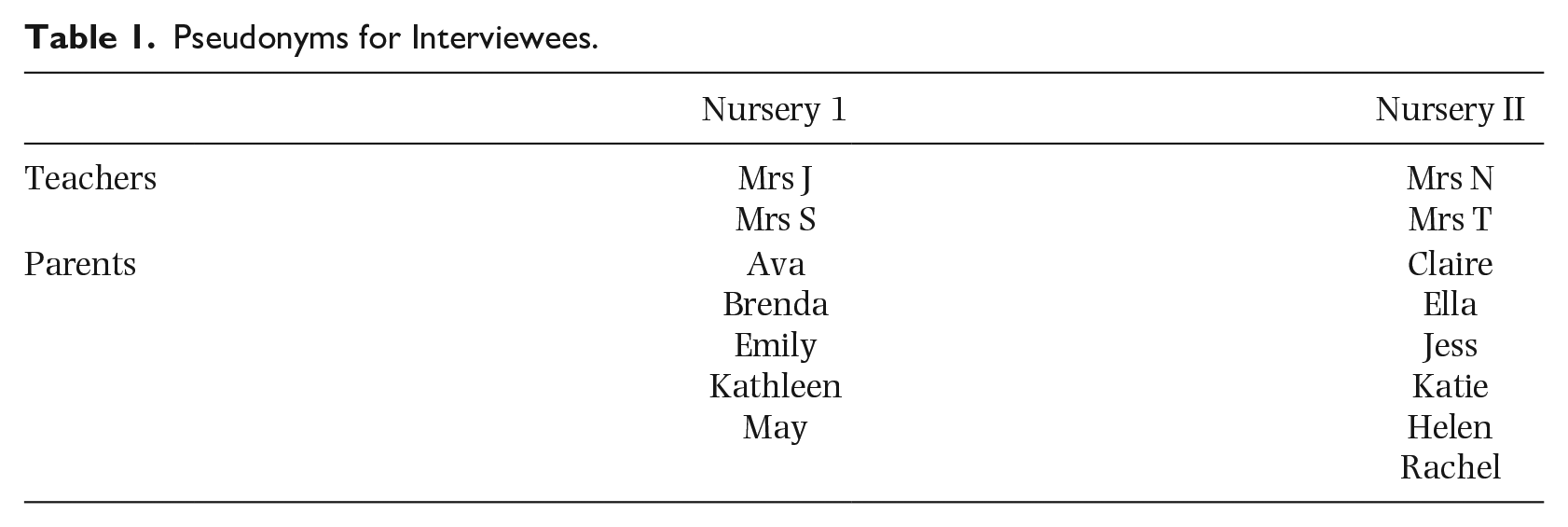
Ava, Emily, and May from Nursery I and Ella from Nursery II were non-native English speakers. For Ava, Emily, and May, a Cantonese translator attended interviews to translate. Following guidelines for conducting interviews with a translator from Squires (2009), the translator (Aya) was a known and trusted individual to the parents, as she regularly worked with their community and in the nursery. Topics and questions were discussed before the interview to make sure that both specific concepts and broader contextual information were understood by Aya, as these types of information can easily be changed through interpretation (Squires, 2009). Ella from Nursery II had excellent English to the extent that she acted as a translator for other parents.
In both nurseries, interviews were held in a quiet office space. They were all arranged either soon after drop-off time or soon before pick-up time, to accommodate parents’ preference. It was emphasized to each interviewee that participation was voluntary and they could withdraw from the research at any stage without consequence. Interviews were audio recorded and transcribed anonymously for analysis. Thematic analysis, which seeks to identify, analyze, and report patterns (themes) within data (Braun & Clarke, 2006, 2013) was applied within a contextualist orientation, which recognizes the ways the individual makes sense of their world as a truth valid in certain contexts (Tebes, 2005). A contextualist approach seeks to uncover a participant’s truth or understanding but also considers how outside influences (e.g., social and cultural) may shape this, because wider communities and society are understood to affect these personal constructs (Braun & Clarke, 2006). The interview transcripts were repeatedly read and then coded by the first author for initial themes. Themes were patterns of interest noted in both interview types and considered in relation to the whole data set. These themes were discussed at monthly meeting of the research team to take account of divergent instances and arrive at a consistent coding of themes agreed by all authors.
Interviews yielded rich data, including parents’ and teacher’s views about children’s personal qualities which have been reported elsewhere (MacGlone, 2020). The three research questions for this study were refined during the process of analysis outlined in Figure 1. Three themes which addressed the research questions were identified from the interview data and are reported in the “Results” section.
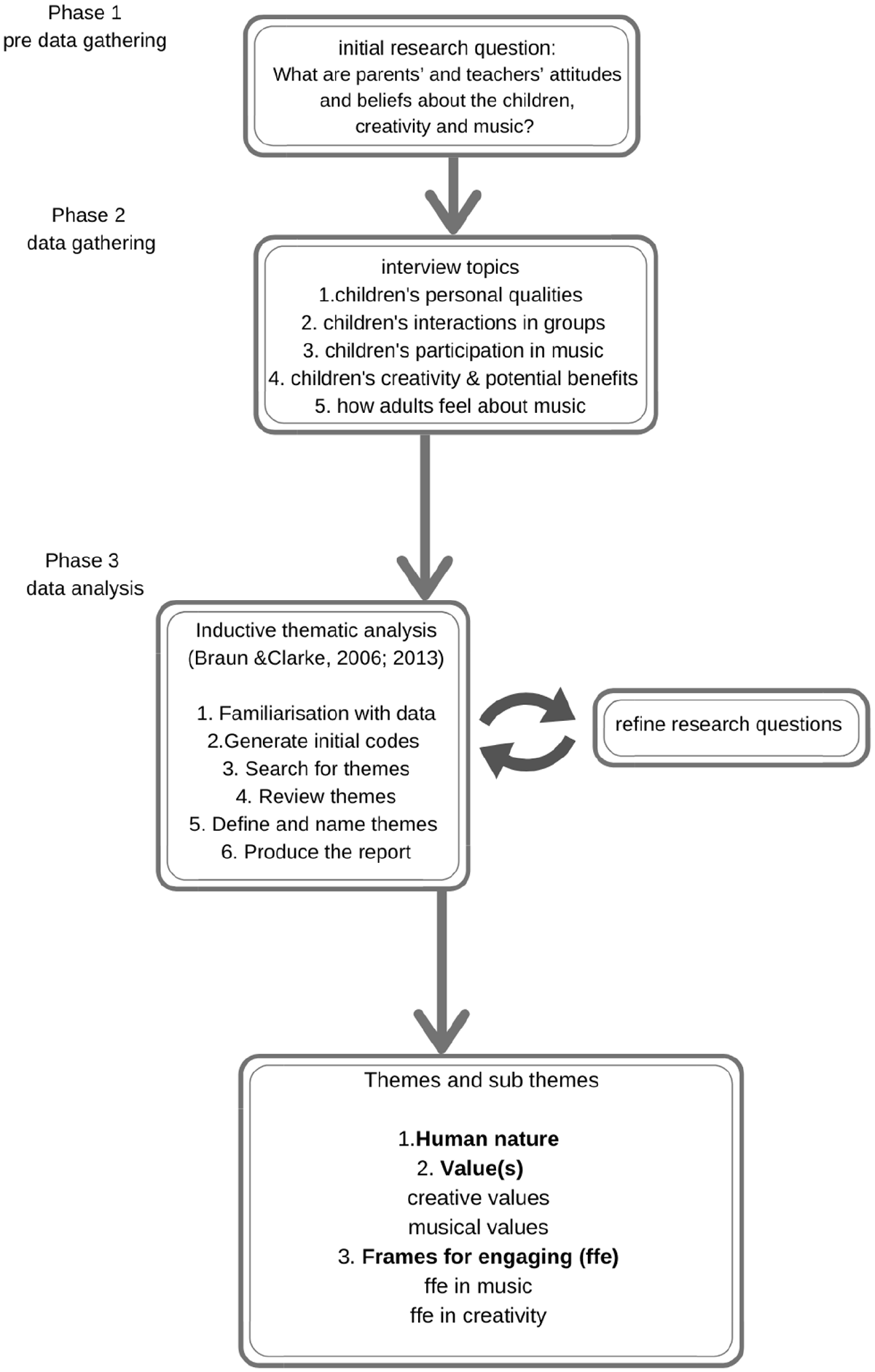
Analytical Process.
Results
The findings reported here are organized under the following three overarching themes: human nature, values, and frames for engaging.
Human nature
This theme encompasses interviewees’ ways of talking about creativity and music as either a fundamental or non-fundamental aspect of human nature. The fundamental discourse portrayed creativity and music as universal and an intrinsic part of being human: “everyone’s got some creativity somewhere” (Mrs N); “all these kids love music” (Mrs T). Creativity was defined as an everyday process, manifesting in the action of making choices. Children’s engagement with music was described as embodied and spontaneous, often manifesting through joyful dancing or movement. However, an alternative discourse was offered by parents and teachers through their portrayal of themselves as non-musicians. This was despite many descriptions of the various ways in which they engaged with the children in music-making. No teacher or parent described themselves as non-creative.
Assertions of children’s creativity as an intrinsic quality were given in descriptions of activities: She is creative, she’ll share ideas whether it be through . . . her art work or choices she makes. (Mrs N) I think she’s very creative in terms of her dance (Mrs S)
These extracts demonstrate an understanding of creativity being appreciable in a child’s concepts (ideas); products (artwork or dance); and processes (choices). The descriptions of creativity offer a vision of the child having agency in an activity, generating new work. This contrasts with ways in which music was depicted as a catalyst which invoked a response. For example, Ben absolutely loves music . . . any time any music was on or anybody was singing or anything . . . he immediately got up and started dancing . . . and really responding to the music (Mrs J)
In this example, T1 portrays Ben being unable help his spontaneous, embodied response. Music connected to him in an immediate and powerful way. Another strong assertion by both parents and teachers was that idea that some children were good at music naturally, and were particularly gifted: oh, musically he’s really great . . . he’s got talent! (Mrs S) he likes if there’s music on . . . you know you see him kind of thinking “Oh, where’s that coming from?” and he just . . . he has—he’s got rhythm (Ava)
In saying that children have “got talent” or “got rhythm,” interviewees construct musicality as something inherent rather than acquired or learned. Skill in music, how well a child is understood to demonstrate musical facility is seen as indicating musicality.
Alternative positions to the above discourse were avoided. For example,
would you say he was a particularly creative child?
No, he is . . . he likes singing and dancing, . . . No, he is interested, maybe not the art, crafty kind of creativity, but he’s musical and he likes kind of role play as well. (Mrs J)
Here, Mrs J categorizes musicality as a separate characteristic from creativity, reframing an initially negative response to focus on the child’s strengths. This may indicate that her definition of creativity, which focused on arts and crafts is the main lens for assessing creativity. However, a key part of the curriculum in Scotland is that creativity is enacted through all curricular areas, so her consideration of music and role play as other creative indicators can be seen as an expression of a professional identity. In this framing of creativity and music as fundamental, both were understood as essentially human capacities, but conceptualized in different ways. Creativity was seen as commonplace while music was understood to be enigmatic yet influential. Love for music was seen as universal, yet being musical was tightly defined and recognized in children showing technical skill.
Parents and teachers offered an alternative discourse of musicality being non-fundamental to human nature through their consistent identification of themselves as non-musicians. This was the case even though they all sang songs with and to the children and some parents played music with their children. This identity was pervasive. One teacher portrayed the whole nursery staff as non-musical due to the nature of the children’s music participation in the improvisation workshops: probably if they’d been in a real musical nursery they’d have been able to catch on . . . because we’re not really a musical nursery (Mrs S)
Mrs S interpreted the children’s musical responses in the workshops as incorrect, despite an explanation of the workshop aims in the pre-program meeting. This perception on the teacher’s part led her to explain that the children were not at fault. Instead, she understood that teachers had not instilled enough musical knowledge and understanding in the children for them to “catch on” because nobody among the nursery staff had the necessary musical skills to pass on.
Identity as non-musical was also constructed in contrast with identity around other skills (“I’m quite arty—but musical—no,” Mrs J) or through minimizing existing musical skills: I’m no very . . . good (laughs) if you know what I mean, I cannae read music, wee chords . . . that’s all I know (Kathleen)
Despite knowledge of chords being an important musical skill, this parent claims she is not competent. She suggests that criteria for being a musical person include musical literacy. A negative implication of these non-musical identities is evident in the sense of helplessness expressed by Mrs J when teaching music: “when it comes to music . . . I’m sort of at a loss you know!” In this discourse about music, adults asserted their lack of technical skills and confidence. Teachers were concerned that young children’s experience of music might be adversely affected by these two aspects of their identities as non-musicians.
The theme human nature was concerned with adults’ constructions of creativity and music as either a fundamental or non-fundamental aspect of a person. There is a distinct disjunct between how interviewees applied these constructions to children and to themselves. They often framed the children they spoke of as both creative and musical. When talking about themselves, they were able to define features indicating they could not be regarded as musical, and then articulate how this impacted their engagement with the children. The same person could offer different views about creativity and music within the course of the interview depending if they were talking about themselves or the children.
The next theme considers how children’s creativity and musicality was evaluated.
Values
This theme examines ways in which interviewees evaluated products as creative or musical. Their criteria for ascribing creativity could be categorized as (1) providing an aesthetic contribution, (2) having a high level of detail and (3) effective execution of an artistic “vision,” and (4) participation in a creative activity. Criteria for musical capacity were (1) fluency in execution of music and (2) replication of recognizable tunes. Not all musical behavior was evaluated and ascribed as musical. When children were playing with instruments in an experimental way, exploring sound rather than attempting to play a known tune or nursery rhyme, interviewees did not categorize this as either musical or creative.
Creative values
Both parents and teachers described children showing creativity primarily through the ability to produce visual art work, but also appreciated it in their invented stories and role-play. In some cases, this judgment was based on the end product: Just in general I would say Tess was quite creative . . . she can sort of produce really lovely sort of paintings and drawings and things (Mrs J) sometimes he’s drawing a whole picture with the whole details . . . there is a plane in the sky and there is sun, clouds, birds and everything (Claire)
Mrs J’s view that Tess produces work of high aesthetic value contributes to her construction of Tess as a creative child. This is different to Claire’s description, with her focus on his execution of detail and therefore, an appreciation of his technical skill.
However, in contrast to Mrs J, Mrs S proposes a child’s participation in an art activity as an indication of creativity: she’s always drawing and colouring in and things like that, so she is quite creative (Mrs S)
This account of a child’s creativity recognizes her engagement in the art activities themselves as an indication of creativity. No judgment about the quality of the work is offered, just that the child participated. This focus on process suggests a child’s preference for arts activities may influence whether the teacher perceives that child as creative or not creative, and thus how they subsequently engage with the child.
Musical values
Musical values were recognized in the possession of technical skills (e.g., playing tunes fluently) or aural skills (e.g., correctly spotting when there was a wrong note in an existing tune): yes he make some tunes, Mary Had A Little Lamb and . . . like . . . Twinkle, Twinkle . . . Happy Birthday To You. Yes, but ehm . . . if I say that uhm “This, you press this,” he say “No! Don’t tell me, I will think and I will.” And I think “Yes you are genius!” (laughs) (May)
Another parent described her daughter’s engagement with music in terms of recognizing her reproduction of music from a film: Have you seen the film Tooth Fairy? . . . she likes that and the wee boy in that plays the bass guitar and she . . . loves the, this band and she copies them. (Brenda)
When children were not playing recognizable music, parents found it harder to articulate the value in their activity. For example, two parents described her children experimenting with sounds but were hesitant to confer musicality upon this: she’ll get near the guitar and sit and mess aboot wi it for hours if you let her. (Katie) See . . . I don’t know how musically creative they should be at that age (laughs) but I just . . . (exhales) I see him like picking up . . . musical instruments and just kind of making . . . like to me he’s making, he’s just making noises—do you know what I mean? In his head he’s obviously doing stuff. (Ella)
Katie’s use of “mess aboot” suggests that she may not see worth in this pursuit even though her daughter can become immersed in musical exploration. Ella also thinks of her son’s activity as “just” noise, but does recognize that his behavior might be recognized as musical creativity. However, in her uncertainty about this, she positions a non-musical identity for herself as someone not appropriate to judge this; she says she lacks knowledge of what might be expected of children of his age. She finishes by saying “in his head he’s obviously doing stuff” implying that he may be musically creative even though she cannot access or assess this.
Values captured the varied ways in which creativity and musicality were appraised with respect to their worth either as a pleasing aesthetic product or as a meaningful, important activity. There was an overlap between the two themes in that technical skill was viewed as a criterion for both creativity (e.g., in Claire’s description of the details in her son’s drawing) and music (e.g., in May’s description of her son’s skilful execution of nursery rhymes). The final theme brings together material on how adults facilitated the children’s creativity and musicality.
Frames for engaging
Parents and teachers supported their children’s creative and musical activities in distinct ways. For activities, they deemed creative, adults described the importance of giving children space and time, to let them experiment without placing an expectation on the outcome. Adults participated in children’s stories by recognizing their initiatives as creative and responding to children’s suggestions. To support musical activities, all of the parents apart from one had bought instruments for their children and both schools had a wide range of percussion.
FFE in creativity
Aside from describing co-creating or helping with artwork, other frames for engagement in creativity were making up stories (taking place in conversation with the adult) and creating a larger narrative with others (created with other children). Helen gives an example of her son creating a story when they were walking home: He makes up a lot of stories (laughs). We were going up the street there and he was telling me about superheroes. And then going “Mummy, I’m this superhero, you’re that superhero, we did this and we did that” and I’m like “Right, ok” and it’s all just imaginative story telling (laughs)
A story where the child directs the parent into a particular role is a way for the child to entice the parent into a narrative that they enjoy. Making such a game may be the child’s strategy to engage their parent’s attention. His mother sees his repurposing of superhero characters into a new situation as the creative (“imaginative”) achievement in this setting, and his participation is seen in his initiation of story-making.
Mrs N describes a child, Fiona, as being shy and non-communicative with teachers, yet able to participate in child-led role-play: She is in a group of friends, ehm, and as I said she will communicate with them . . . Ehm . . . they’re very active in terms of role play and things like stories. I mean Derek refers to Fiona as his “Mummy” because she often pushes him in the pram! Where is my Mummy today? I’m going home with my Mummy!. I’m like “Who is your mummy? Fiona? Oh she’s still your mummy?” this has been going on for weeks.
Mrs N’s assessment of Fiona’s shyness was also confirmed by her mother. However, she is seen as able to contribute to this particular child-only game: “she will communicate with them” in a way that she does not with teachers. In this activity, the children playfully reframe adult roles. Mrs N appreciates this game as forming an engaging structure for children to explore these roles, with favored scripts and strategies. As this game progresses over the weeks, the children can co-author the fine details of the story, even if the roles are set. This illustrates the children being creative with familiar structures, using them as the basis for developing their narrative. This construction of the children’s game as a form of group creativity is notable, as previous descriptions have centered on either individual expression of creativity or in an adult or child dyad. This emphasizes the importance of Mrs N recognizing the benefit of this child-led creative activity for Fiona as a situation where she is comfortable communicating with her peers on her own terms. An important role for the teacher is stepping back and giving space and time to child-led frames for engaging.
However, staff acknowledged inherent difficulties in supporting children’s agency: for us as staff, to embrace the creativity of the child and not overtake . . . and curb it for want of a better word—Because they would make that creativity, or that creative conclusion to go “Right, where are we, what do we do now?” . . . the role of the adult in that creativity it’s a challenge isn’t it? (Mrs J)
Here, she implies that adults need to provide time and space for children to reach their own decisions but that there may be frustration for the adult in this: “it’s a challenge.” She emphasizes that it is important to “embrace” the children’s processes and recognize that they are distinct from adults. Prioritizing the child’s own frames of reference is positioned as a necessary aspect of an adults’ role in facilitating or adding to children’s creativity.
FFE in music
All the parents in this study apart from one, facilitated their children’s participation in music in some way. This could be through singing with them, buying them instruments, or taking them to concerts. Some parents described music as being “good for them” (Emily), but did not elaborate on the ways in which they understood it to be beneficial. Other parents expressed a belief that music participation was beneficial for cognitive development: “music . . . its so important for them, its meant tae be good for their . . . brains you know” (Brenda). This is analogous to the way a parent might give vitamins to their children to help bodies develop.
Families’ participation in music with children was centered around sharing pop music and reinforcing nursery rhymes. Although children did make up their own music, parents did not join in with them. Jess talks about how music was shared in their family: so she kind of likes older stuff right enough . . . like Patsy Cline and stuff like that! (laughs) her grandparent—her Nan likes Patsy Cline so . . . she just loves Patsy Cline we had to take her to the show . . . (laughs)
Jess attributes her daughter’s love for Patsy Cline to the bond between child and Nan. Music provides an important link between generations, through an activity they both enjoy.
Many parents described playing pop songs or nursery rhymes with their children where they took the role of a teacher, for example, I dae know some chords but, I dae try and show them what I . . . wee chords . . . that’s all I know (Kathleen) actually, she’ll sit and sometimes, she’ll just want the keyboard, she’ll just sit up on the couch . . . and she’ll just play away . . . .but some of it sounds quite good (laughs) she’ll, she’ll just thingmy along and then I’ll say “Oh look can you do this?” and “Can you do this?” and like I say it’s only Twinkle, Twinkle (laughs) and she’ll say “Oh I want to do that” so I’ll show, I’ll try and show her and I’ll tell her what ones to press and as I say she gets bored after a while (Helen)
In a similar way to Katie (quoted in the Values theme), Helen downplays her daughter’s keyboard experimentation as “just” playing away even though to her own ears, some of the improvising “sounds quite good.” She describes interrupting this to try and teach a nursery rhyme, and thus transform this play into what can be valued by an adult as musical activity. However, she observes that this adult-directed music has limited success in engaging her daughter.
FFE demonstrated the differences in how adults facilitated creative and musical activities. Both were seen as important for children to have access to. Parents and teachers joined in with child-led role-play and stories. In contrast, when children were playing music, parents described taking on a “teacher role” to guide their children toward “correct choices.”
Discussion
The first research question was concerned with investigating parents’ and teachers’ beliefs about creativity and music. These capacities were identified as fundamental or non-fundamental dimensions of human nature. Children were always described as both creative and musical, while adults consistently cast themselves as non-musical despite teachers singing every day in the nursery and some parents playing music with their children. This disjunct in beliefs, where musicality is understood to be innate in children but somehow absent in adults like themselves, could indicate an awareness of what parents understand “good parenting” to be for their young children. By recognizing an instinctive capacity and need for music in them, they position themselves as a parent who knows what is good for the child, and aware that should include creative and musical opportunities. This was articulated in Brenda’s proposition that music has beneficial effects on children’s brains.
The second research question explored different ways in which the capacities were evaluated. Creativity was exemplified in children’s concepts, products, and processes. Musicality was recognized in fluency of execution and replication of known tunes. Creativity was seen as a valuable attribute by parents and teachers in this study, and is a core value within Scotland’s curriculum (Scottish Executive, 2008). For the teacher, there is more agency in creating the curriculum content to meet the specific needs of their environment (Biesta et al., 2015). However, in creative music tasks, teachers in this article expressed difficulty realizing the aims of the music curriculum for this stage, perhaps in some part due to the openness of prescribed experiences and outcomes (Yates & Young, 2010). Their difficulty could also be attributed to the conflict of negotiating their own musical identities as non-musicians but having to teach music. This is problematic in that teachers are required to cover this area of the curriculum whether or not they feel that they are musical.
In art, skill is valued as it is associated with creating recognizable artistic symbols that parents and teachers can appreciate, and so evaluation of the art work has a tangible focus. In contrast, a child’s participation in creative activities could also be seen as another indicator of creativity, with no judgment on aesthetic quality. In examples where children engaged with music on their own terms, adults found it difficult to apprehend the intent and so appreciate and evaluate their creativity. In contrast, when children devised stories or group narratives, adults could talk about these products with the children as creative since they had a shared point of reference. In one musical example, Helen was able to understand her child’s engagement with music as she recognized familiar melodies in what he played (e.g., Twinkle, Twinkle) and was able to communicate with him playfully and praise him for his accuracy. As well as this, the child’s musical activity had an identifiable aim or function for the parent: to replicate a nursery rhyme.
The third research question considered the nature of parents’ and teachers’ engagement with children in creative and musical tasks. Adults were able to describe the ways in which they took part in child-led role-play; however, when participating in music, parents took on a “demonstrator” role, feeling they had to model and guide children through gaining technical skills to execute familiar music. Their identities as non-musicians created uncertainty and lack of confidence. For an adult, moving beyond encouraging children’s creative musical play to engaging and communicating with them about it means finding a shared point of reference. The inherent ambiguity of music (Cross, 2005) and improvisation (MacDonald et al., 2012) presents a challenge to finding a common basis for talking about musical creativity. Talking about improvisation may be difficult as it can be construed in different ways (Wilson & MacDonald, 2017). These factors, together with the age of the children in the study and beliefs that parents held about their own musicianship, can form barriers. This can be seen in the example of Ella finding it difficult to understand what was going on “in his head” when her son was improvising.
Facilitating children’s own self-efficacy in creative musical activities can lead to teachers designing creative musical activities with the emphasis on participation and engagement rather than passing on adult values of what constitutes quality. Davies and Harre (2001) found that once a young person has taken up a position within a discourse, such as “I’m not really a musician,” he or she will inevitably come to experience the world and his or herself from that perspective. MacGlone, (2019) reports themes arising from children’s talk during the workshops, where the children’s own conceptions of themselves as musicians, their ideas about music and their own musical ability had already formed.
Parents have a crucial role in their children’s musical development and identities. For example, Borthwick and Davidson (2002) investigated family influences on children’s engagement with music using “script theory” (Byng-Hall, 1995). This examined the ways in which different familial factors can shape a young person’s musical path and identity. In examining children from different backgrounds, both musical and non-musical, parents’ expectations and musical identity affected children’s personal and musical development. Kathleen’s understanding of herself as “not very good” even though she had achieved enough skill to play pop songs on the guitar reflects findings from Hallam (2017) that the ability to read music was one of the “strongest perceived indicators of musical ability” (p. 142). However, even though she did not feel skilled, she valued musical activities and provided instruments and opportunities for her daughter to play music.
During the COVID-19 pandemic, there has been a growth in parent–child musical activities because of the dual role that parents acquired as educators (Cho & Ilari, 2021; Ribeiro et al., 2021; Steinberg et al., 2021). Interestingly, music provided a space for expression and regulation of children’s emotions and to connect to others, for example, by playing music and dancing (Steinberg et al., 2021). This suggests that parents experience and perceive music as having a positive effect on their family’s wellbeing (Ribeiro et al., 2021). This may have overridden the lack of belief in personal musical ability expressed by parents in this study. To further increase family musical participation, more strategies for parents have been called for (Cho & Ilari, 2021).
Interviewees described children’s musical creativity, but did not evaluate it consistently as such. Amabile (1996, 1997) suggested that creativity can be encouraged by providing sufficient resources and having support from management in formal educational settings. Within this study, it is apparent that teachers and parents could expand their appreciation of creative music-making in the following ways: (1) engagement, for example, when children pick instruments up and “mess aboot” with them; (2) immersion, when children are absorbed in the creation of music for long periods of time, and (3) combinations, when children use music with movement; to illustrate a story or give symbolic value to what they play (e.g., through metaphors). Contemporary views on developing competence in improvisation from MacDonald and Wilson (2020) suggest that confidence in exercising choice in real time and strength of personal rationale for such choices are important first steps. These points offer parents or teachers identifying as non-musicians an accessible way of thinking about engagement with children’s musical creativity and align with child-centered pedagogies.
Implications
There is an ongoing interest in creativity and how it can be facilitated for young children in and out with schools. In this article, we have highlighted some of the challenges for adults in this activity: (1) the disjunct in musical and non-musical identities, in that the adults saw children as musical but not themselves and (2) being able to describe creativity in the children (through creative products, processes, and verbal expressions) but not consistently appreciate it as such. As changing deeply held beliefs may be very difficult, we propose strategies for teachers and parents which recognize and build on adults’ creative and musical interactions with children described in this article, These are (1) to support children’s agency in choosing musical activities, (2) to give space to children when they are absorbed in creative musical events, and (3) to become more aware of ways in which children merge music with other curricular areas such as movement, art, literacy, and numeracy. There is great potential for adults to understand and facilitate access to an activity which is both personal and social, absorbing, creative, and combinable with other art forms.
