



Abstract
Attending a concert may prove difficult for individuals with exceptionalities or disabilities and those who support them. While traditional performance environments may not feel welcoming or amenable for individuals with exceptionalities and their families, arts organizations have recently made efforts to produce concerts that address barriers to accessibility. These adaptive concerts, most frequently labeled as Sensory-Friendly Concerts, attempt to create environments suitable for diverse communities, supporting individuals and groups who are frequently underrepresented as audience members in performance contexts. This article explores adaptive music performances, contributing a model for sensory-friendly adaptive concerts supported by caregivers’ perspectives through a post-concert survey. The model proposed includes four areas of adaptation: pre-show work, environment audit, extra-musical aids, and programming adjustments. The authors outline the various modifications with data points from a sample of adaptive concert caregiver attendees (n = 15), aligning the theoretical model with practice to provide practical examples and tangible outputs for researchers, presenters, musicians, educators, and policymakers.
Keywords
Attending a concert or participating in cultural activities may prove difficult for individuals with exceptionalities and those who support them due to a variety of barriers. These groups “face unique challenges” when attempting to participate in social and leisure activities (Silverman & Tyszka, 2017, p. 1). It is therefore not surprising that people with exceptionalities and families with children who have exceptionalities are far less likely to attend performances and cultural events than able-bodied and/or neurotypical populations (Kempe, 2015). As a result of decreased participation, social, physical, and mental wellbeing may be affected, and feelings of isolation may occur (LaMarre et al., 2021; Shiloh & LaGasse, 2014; Thompson et al., 2020; Umeda, 2017; Umeda & Jirikowic, 2019; Vize, 2014). However, an inclusive style of presentation has burgeoned in the performing arts to alleviate barriers to participation. Adaptive concerts, also termed as sensory-friendly or relaxed concerts, originated from Relaxed Performances in British Theater (Shiloh & LaGasse, 2014). Adaptive concerts are now produced across North America and Europe, often aiming to serve children with exceptionalities and their families, such as those with autism spectrum disorder, fetal alcohol spectrum disorder, or Down syndrome.
While several researchers have examined sensory-friendly programming, particularly in theater, few studies have managed to garner sufficient firsthand data, and even fewer address musical content and programming. Sensory-Friendly Concerts are a promising practice, but with little supporting evidence to assess efficacy and modify emergent methods, this style of programming may not meet its full potential. Gaining a better understanding of the adaptations that facilitate concert attendance for people with exceptionalities may allow music educators to apply these principles to various aspects of their practice as they relate to music listening and performance.
Literature review
Although disability rights, accessibility, and inclusivity literature have been topical for decades, work concerning sensory-friendly presentations began more recently with accounts of case studies, surveying, and interview procurement since the mid-2010s. Beginning in the 1990s, individuals within theater studies sought to alleviate certain barriers for individuals with exceptionalities, making theater more accessible through Relaxed Performances (Shiloh & LaGasse, 2014). Designed to be inclusive for neurodiverse individuals and their families and accessible to those with disabilities (LaMarre et al., 2021; Umeda & Jirikowic, 2019; Vize, 2014), performances moved toward “sensory-friendly” language, wherein productions featured modifications in the physical environment to alleviate hyper- or hypo-stimulation and reduce intimidation and anxiety (LaMarre et al., 2021). It is estimated that 45%–75% of individuals with autism have sensory sensitivities (Muskett et al., 2019). These sensitivities may result in behavioral responses that communicate distress, avoidance, and hypervigilance (Ayres, 1972). Although initially most sensory-friendly endeavors directed programming toward those with autism, it is now acknowledged that adaptive programming is beneficial for a much broader population (Fletcher et al., 2019; Santanello, 2020; Thompson et al., 2020). With a welcoming atmosphere that defies several performance conventions—such as expectations of silence and remaining seated at length—sensory-friendly events provide certain assurances for caregivers and families that their attendance will be met with positive outcomes (Shiloh & LaGasse, 2014).
Researchers who have previously examined sensory-friendly arts events have discussed physical environment and communication adaptations, as well as inclusive design, and focused on cultural events for children with autism or other exceptionalities including sensory sensitivities (DeBoth et al., 2021; Fletcher et al., 2019; Kempe, 2015, 2018; Koenig & Rudney, 2010; LaMarre et al., 2021; Santanello, 2020; Silverman & Tyszka, 2017; Umeda & Jirikowic, 2019; Vize, 2014). LaMarre et al. (2021) explored sensory-friendly performances in Canadian theater and discussed modifications in Relaxed Performances while advocating for inclusive arts creation. Vize (2014) examined sensory-friendly film screenings, outlining adjustments to light, sound, and removal of advertisements and previews, as well as freedom of movement within the theater space. DeBoth et al. (2021) reflected on sensory-friendly programming in museums, noting that in recent years there have been more events and modifications on offer, and that it is “essential to support caregiver involvement with their children in community activities” (p. 293). Kempe (2015, 2018) examined theater and musical theater, stating that feelings of exclusion felt by individuals with exceptionalities and their families from cultural attractions is a social injustice that must be addressed.
Common among these sources are conversations surrounding standard sensory-friendly environmental adaptations where the cultural event or interaction is occurring, and the need for dialogue around inclusivity and accessibility in the arts. These include suggestions of maintaining a consistent level of lighting or dimming lighting, providing noise-canceling headphones and/or modifying volume levels (e.g., in films), allowing unlimited entry and exit in the concert space, offering fidget or other sensory items, and ensuring a variety of seating options are available (Considine, 2017; DeBoth et al., 2021; Fletcher-Watson, 2015; Kempe, 2015, 2018; LaMarre et al., 2021; Shiloh & LaGasse, 2014; Silverman & Tyszka, 2017; Vize, 2014). In the context of the performing arts, some authors have also discussed having a secondary space (e.g., a silent room) available outside of the performance area (LaMarre et al., 2021; Shiloh & LaGasse, 2014).
In addition to physical modifications and provisions, researchers have suggested visual and communication adaptations before and during the show. Recommendations for a visual story, accessible within a few clicks online or directly in a ticket confirmation email, were established by those in theater to provide a step-by-step walkthrough of the concert venue from the parking lot to a patron’s seat (Fletcher-Watson, 2015; LaMarre et al., 2021). In addition, researchers have acknowledged that a visual story should include venue floorplans, as well as information regarding parking, transit, and accessibility features of the event building (LaMarre et al., 2021). Silverman and Tyszka (2017) suggested that the capacity of the venue (i.e., 50 or 1,500-seat hall) and anticipated audience size (i.e., 20 or 1,000 attending) should be described, and Thompson et al. (2020) discussed simplified language, typically in the first person, as the most comprehensible communication method for many individuals with exceptionalities.
Some authors have discussed wellbeing in adaptive programming. Silverman and Tyszka (2017) outlined how these cultural events can relieve real or perceived stresses families may have regarding participation, contributing positively to overall wellbeing. From a community music perspective, Thompson et al. (2020) also discussed the social isolation that may plague individuals with exceptionalities and families with children who have exceptionalities. They posited that physical and social environments significantly impact success of participation, stressing that the judgment these individuals and families face by neurotypical and able-bodied individuals can be extremely detrimental to mental health.
Recent sensory-friendly sources have increasingly involved caregiver perspectives (Fletcher et al., 2019; Santanello, 2020; Umeda & Jirikowic, 2019). Caregiver perspectives provide insights on how adaptations contribute to relief of stress for families, as well as whether expectations are properly set and met. However, a major drawback within the aforementioned studies is their small sample size, with most papers having 10 or fewer responses (DeBoth et al., 2021; Fletcher et al., 2019; Santanello, 2020).
While researchers have examined sensory-friendly needs in music education (Kim, 2021; Leger & Rushing, 2019), community music practice (Ansdell, 2005; Stige, 2004; Thompson et al., 2020), and forms of music within a therapeutic context (Koenig & Rudney, 2010; Umeda & Jirikowic, 2019), there is a distinct lack of research on sensory-friendly performance programming in the music discipline, with no known studies dedicated to this area at the time of writing. No clear guidance from the literature addresses adaptations to musical programming in Sensory Friendly Concerts, but research in the areas noted above can inform potential approaches. Research in adaptations in music education and general education for neurodiverse students suggests that elements such as using a visual schedule to support structure (Hourigan, 2016; Knight et al., 2015), using multimodal approaches to enhance understanding (McCord, 2016; Tissot & Evans, 2003), and providing sensory breaks (Pingale et al., 2019) could be beneficial in the context of Sensory Friendly Concerts. In addition, including participatory elements in the programming could improve engagement (Latham & Stockman, 2014; Salmon, 2016), and creating shorter events with varied programs may support those who have difficulties sustaining attention (Polychronis et al., 2004). An adaptive approach centered around Universal Design for Learning has previously been found to be beneficial as it allows for differentiation in modes of engagement and participation (Darrow, 2003; Pickard, 2021).
While literature on adaptive programming continues to expand at an increasing rate, more research is needed to develop in-depth studies, assimilate best practices, and provide practical recommendations for producers, artists, and practitioners, particularly in the music discipline. The purpose of this study was, therefore, to collect firsthand data to better understand how Sensory Friendly Concerts are experienced by people with exceptionalities and their caregivers, and to develop a sensory-friendly adaptive concert model that integrates these findings with current practices. The researchers explored two questions to develop a sensory-friendly adaptive concert model for artists, producers, and practitioners:
How do caregivers perceive current adaptations in Sensory Friendly Concerts?
How can caregiver experiences inform a model for Sensory Friendly Concerts?
Theoretical framework
The researchers approached the survey study through the framework of the transformative lens, an advocacy-based outlook developed by Mertens (1999, 2003, 2007, 2021) and streamlined by Sweetman et al. (2010) through a series of research questions the authors utilized from the onset of their work (see Appendix 1). However, no studies to date using this methodological approach address all the transformative questions. The transformative lens contends that research should advocate for improved quality of life and that societal improvement can be transformative when it includes and elevates marginalized groups (Sweetman et al., 2010). The vulnerability of the population of study of Sensory Friendly Concerts requires alternative means of gathering data, which is demonstrated by various authors’ use of caregiver perspectives and insights. By involving caregivers, the transformative framework can be more aptly applied as it pertains to involving and supporting the marginalized community of study (Sweetman et al., 2010). The researchers adhered to the principles of the transformative lens throughout the study. As an example, assuming the language used by participants in Canada of “exceptionalities” was a consideration based on centering the voices of the area of study.
Adopting the transformative lens, the researchers therefore focused on individuals with exceptionalities and their caregivers who are often marginalized, particularly from cultural and social participation (LaMarre et al., 2021; Shiloh & LaGasse, 2014; Thompson et al., 2020; Umeda & Jirikowic, 2019). Assimilating research ideas on emancipatory-transformative theory by Mertens (1999, 2003, 2007), Sweetman et al. (2010) argued for the use of a transformative lens when engaging in studies that intend to improve quality of life and/or advocate for various groups. This advocacy perspective extends to various vulnerable groups such as individuals with exceptionalities and their families, and includes reorganizing research to value the opinions of the study participants themselves as well as translating findings into practical outputs to help support social change. The transformative lens is a framework by which researchers can ensure participants are included in the research process while simultaneously advocating for these marginalized populations through the research itself. By involving caregivers of individuals with exceptionalities as the main participants in this research survey, this study highlights and values the lived experience of those for whom these events were created. The researchers present and validate current practices with caregivers’ voices, strengthening information on musical phenomena and corroborating elements of the literature that have yet to procure supporting data.
Methodology
Surveying is a common methodology in social research to collect data from a specific sample of individuals (Singleton & Straits, 2009). In this study, a purposive sample (Schwandt, 2001) of caregivers of children with exceptionalities who had attended Sensory Friendly Concerts were surveyed to better understand which adaptations contributed to a positive concert experience. Equally, the researchers sought to procure data on the efficacy of current adaptations to programming and how they could be improved.
A survey was sent via email to 39 caregivers who participated in online and in-person Sensory Friendly Concerts delivered by two organizations between 2020 and 2022. No identifying information was obtained in the survey, rendering it entirely anonymous. There were four online concerts and two in-person concerts presented during this period. The 39 caregivers emailed had registered for at least one of these performances, with some having registered for multiple. Of the 39 caregivers emailed, 15 completed the survey within the three-week period it was active, totaling a 38.5% response rate. The survey included Likert-type scale, open-ended, and multiple-choice questions. The survey data was analyzed through inductive content analysis and subsequent categorical groupings (Kyngäs, 2020). The categories—accessibility and inclusivity, communication, sensory and environmental adaptations, and programming—reflect caregiver responses.
Sensory Friendly Concerts adaptations in the performances of surveyed caregivers
As previously discussed, Sensory Friendly Concerts include various adaptations when compared with traditional concert environments. For the performances surveyed in this study, pre-show work, environmental audit, extra-musical aids, and programming adjustments were the four categories of adaptation. Pre-show work included providing venue descriptions, modifying communication, and increasing accessibility efforts (e.g., simplified language and mixed media; free registration), as well as creating and publicizing programming booklets describing instrumentation, repertoire, and other relevant materials that caregivers could utilize before, during, or after the concerts. Artists, volunteers, and staff were trained by special education experts and organizational staff on what to expect and how to adapt interactions and programming.
An environmental audit of the venue was conducted by the presenting organization to determine optimal seating, positioning of sensory toys, lighting, sound, and signage.
In addition, venues had a designated quiet space outside the concert area in case individuals or families required some time away from the performance. Space to move around within the performance area was provided for those who wished to move freely during the concert, and extra-musical aids such as noise-canceling headphones and fidgets were offered.
Musical programming was adapted with shorter and varied works, simplified language in interactive components, and engagement components including nonverbal interaction participation and modeled movement options during and between pieces. Pieces were typically selections from the Western Classical canon, jazz, or popular musics. A clear delineation of rules was laid out at the onset of the performance using plain language and physical gestures (e.g., the audience was advised not to touch the musicians or instruments during the concert).
Data analysis
Accessibility and inclusivity
While accessibility is a key component of many inclusive activities, the researchers sought to understand the specific adaptations that created optimal conditions for accessibility within Sensory Friendly Concerts. All caregivers stated that the initiative was important for accessibility, with 86.67% (13) strongly agreeing and the remaining 13.33% (2) somewhat agreeing. When asked what accessibility elements made it possible to attend the events, the most cited item was the time of the concert (85.71%; 12), followed by free registration (64.29%; 9). Location and online format both achieved 57.14% (8). Notably, six people cited parking, which corresponds to all those who attended in-person only. These responses are depicted in Figure 1.
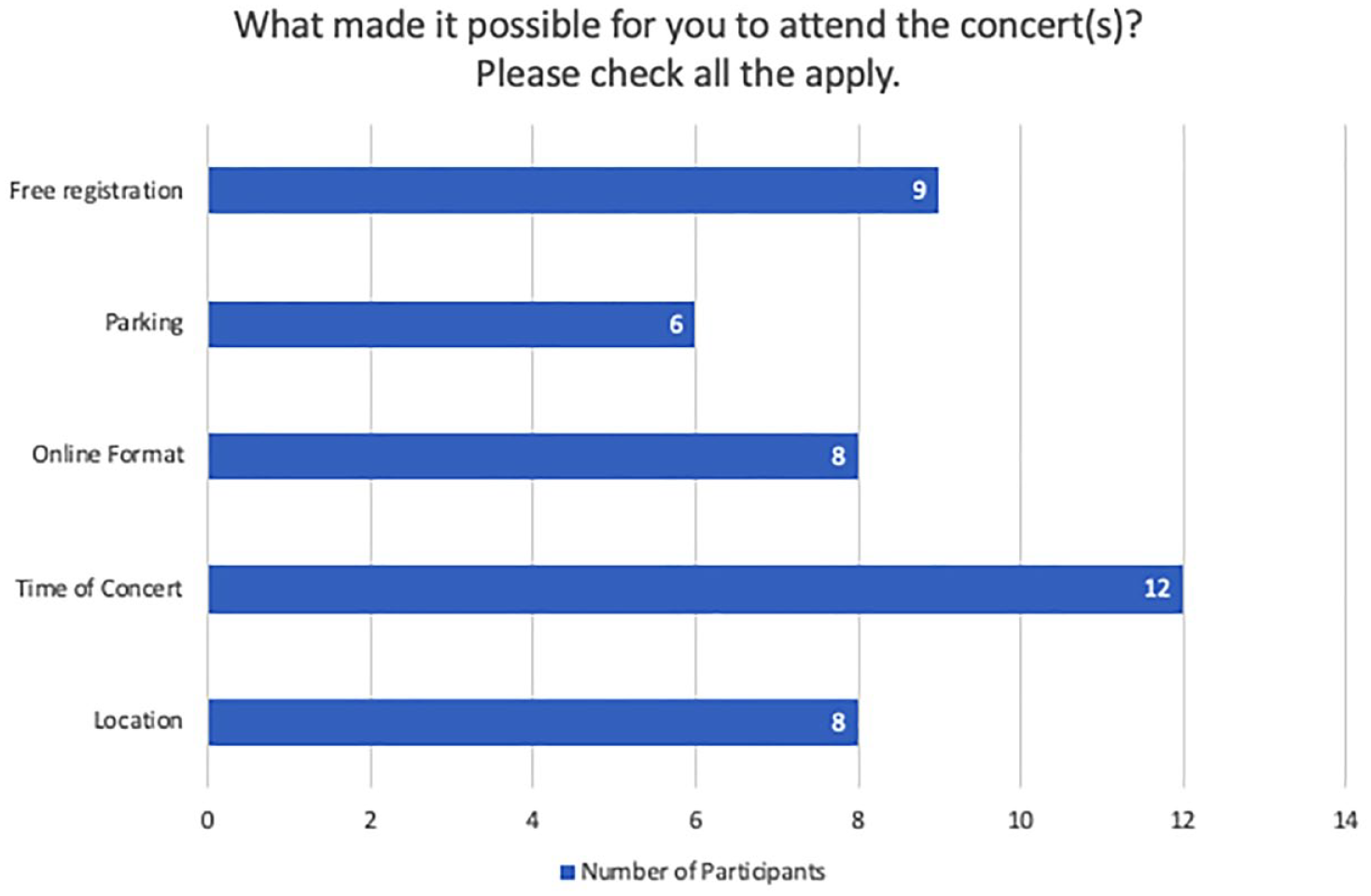
Accessibility and Inclusivity Responses.
Within an open field section of this question, caregivers were provided an additional opportunity to identify which accessibility elements made it easier for their family to attend, including location, time of concert, online format, parking, free registration, or “other.” One respondent commented overall, “With the accommodations, we can attend successfully.” In addition, free registration was mentioned by two respondents, such as this respondent: “Free registration was probably the main reason [we were able to attend]. . .We never know if it will be a success and we’ll be able to stay so it’s a big consideration.”
With the presenting organizations adhering to the sensory-friendly adaptive adjustments, 100% of survey respondents agreed with the statement that accessibility considerations at Sensory Friendly Concerts are sufficient (80% strongly agreeing and 20% somewhat agreeing). This was further emphasized by a greater majority stating that these concerts are an important accessibility initiative (100% agreeing, with 86.67% strongly agreeing and 13.33% somewhat agreeing). One caregiver mentioned: “I’m sure there’s always room for improvement, but we were very happy with the forethought put into accessibility.”
Inclusivity was consistently mentioned by caregivers in open-ended response questions. For instance, one caregiver mentioned: “knowing my daughter’s occasional disruptions are not frowned upon in this type of setting is a huge relief for me as a parent.” Qualitative data from this study illuminates the significant sense of comfort caregivers derive from feeling their needs and the needs of their children are being considered in planning and executing Sensory Friendly Concerts. Many respondents emphasized the understanding of volunteers, staff, and artists at these events with statements like: “The staff and volunteers were nice, thoughtful, and seemed to have experience working with children with special needs. I am grateful,” or “The strong interaction between the audience and the instructors was very genuine and appropriate.”
Communication
Participants stated that adapted communications were an important aspect of Sensory Friendly Concerts, with attention given to additional communications on the concert webpage, in emails to caregivers and attendees, and adaptations to in-concert communications. Among caregivers, 73.33% (11) strongly agreed that communication adaptations enhanced the concert experience, with an additional 13.33% (2) somewhat agreeing, and 13.33% (2) neither agreeing nor disagreeing.
When asked which specific adaptations to communications enhanced the experience, simplified language was prominently selected at 73.33% (11). Instructions and information by website and email and outlining of the rules were both cited by 46.67% (7) of caregivers, and 33.33% (5) noticed nonverbal prompts. Notably, only 20% (3) of caregivers selected the visual information packet option despite all caregivers having been sent this information and it being available on the website. When given the opportunity to share elements of communication that were beneficial, the nature of communication was noted, not just the adaptations themselves (i.e., how artists spoke to the audience, the interactions of volunteers with families, and the multimodal offerings of information). Furthermore, a caregiver noted: “The staff and volunteers are so welcoming. The musicians are so patient with the children and interact well with them.” This highlights the importance of communication in creating an inclusive environment.
Sensory and environmental adaptations
The sensory and environmental adaptations implemented at these events were quite extensive to ensure a comfortable experience. When asked which adaptations to the environment were most beneficial, caregivers cited sensory toys most prominently at 73.33% (11), followed by space to move and varied seating, which were both noted by 60% (9) of caregivers. Nearly all caregivers who attended in-person events remarked on noise-canceling headphones (46.67%; 7). Freedom of movement was mentioned by many caregivers as important both for themselves and their children, including “being able to move freely in the space” and “children are allowed to move around.” A quieter setting and designated quiet space were discussed in multiple responses as most useful for caregivers. Several respondents mentioned sensory toys and items such as noise-canceling headphones as key success factors for their children. Figure 2 outlines adaptations mentioned for each category.
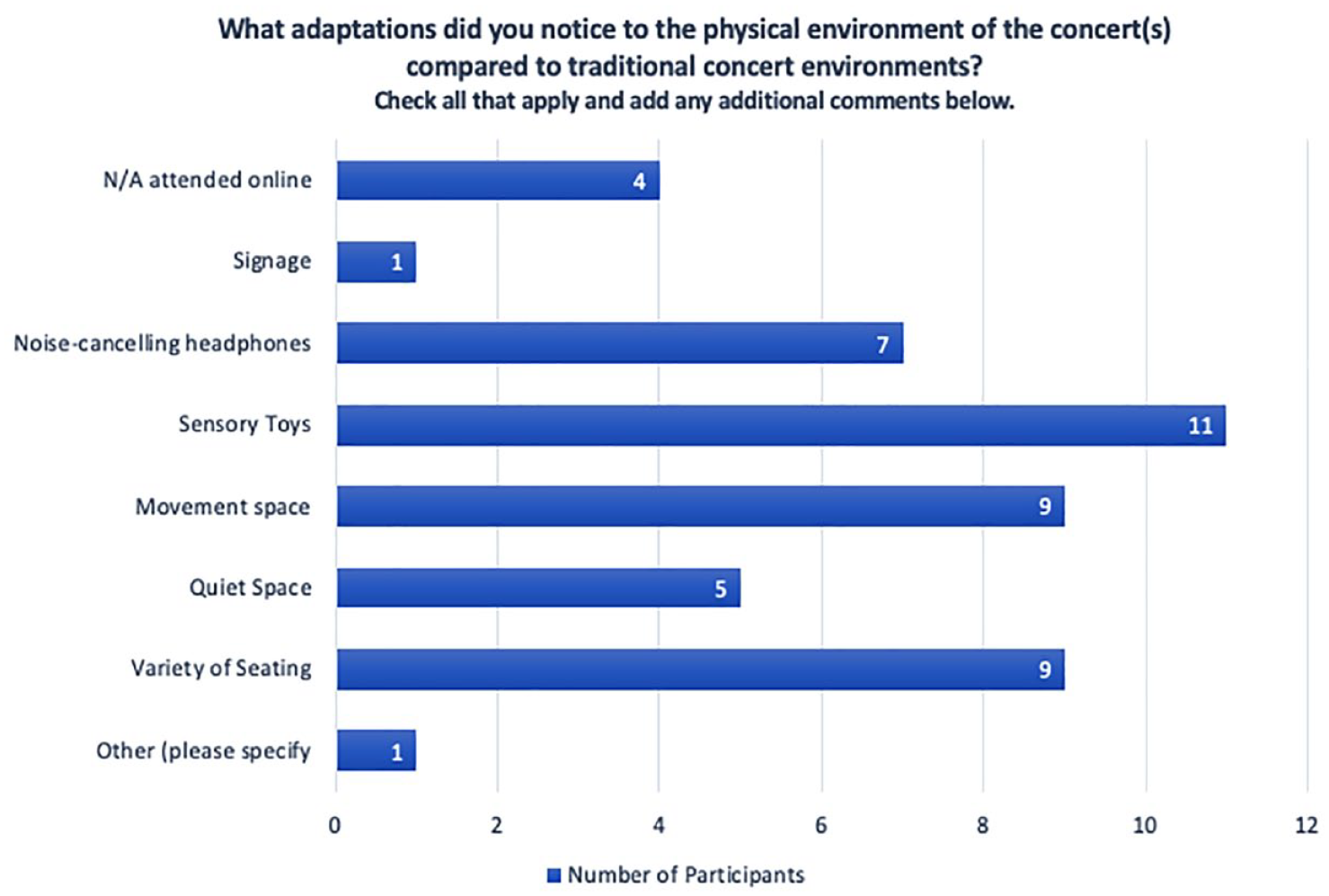
Physical Environment Adaptation Responses.
Programming
Participants observed programming adaptations, such as the variety of songs and demonstrations of musical techniques, each selected by 73.33% (11) of respondents, and shorter songs and participation, each cited by 60% (9). One caregiver added that they noticed the shorter duration of the Sensory Friendly Concert compared with traditional concerts (45 minutes of programming with a question period as opposed to more traditional concert lengths of 75–120 minutes, often with intermission). Others used this space to suggest different musical styles (e.g., “Disney songs or other modern music my child would recognize”), or to share what they particularly enjoyed (e.g., “We particularly liked the introductions to the instruments and the encouragement to participate by moving and imagining together”).
Programming adaptations that were specifically mentioned by respondents as important included explanations and interactive elements between songs (e.g., “short explanations between numbers [worked best for my child]”), the short length of pieces, simplified language, and the outlining of rules at the onset of the performance (e.g., “outlining the rules and simplified language helped me set appropriate boundaries for my son”). Several caregiver comments spoke to the specific medium of music and its positive effects, such as: “Music speaks to our hearts and soul. Everyone feels better after listening to and being in the presence of music,” or “Music is good for the soul . . . for all ages, actually!”
A proposed model for sensory-friendly adaptive concerts
Attending a Sensory Friendly Concert with well-planned modifications and accessibility considerations was a positive experience for caregivers and their children. These events contributed to overall wellbeing, allowed for social interaction, and created a sense of community. Modifications, following the adaptive concert model to be further outlined below, were sufficient, according to caregiver survey participants, but notably certain adaptations were imperative to almost all attendees, whereas others seemed to be more individualized. In addition, adjustments to elements of the programming were noted to improve the experience of attendees.
Based on the researchers’ findings and the voices of surveyed caregivers, we advocate that various conditions should be met when designing a Sensory Friendly Concert. Figure 3 is a visual representation of the sensory-friendly adaptive concert model we propose based on the literature and data collected in this study. Two elements must be considered and executed prior to the event, and two components occur during the event.
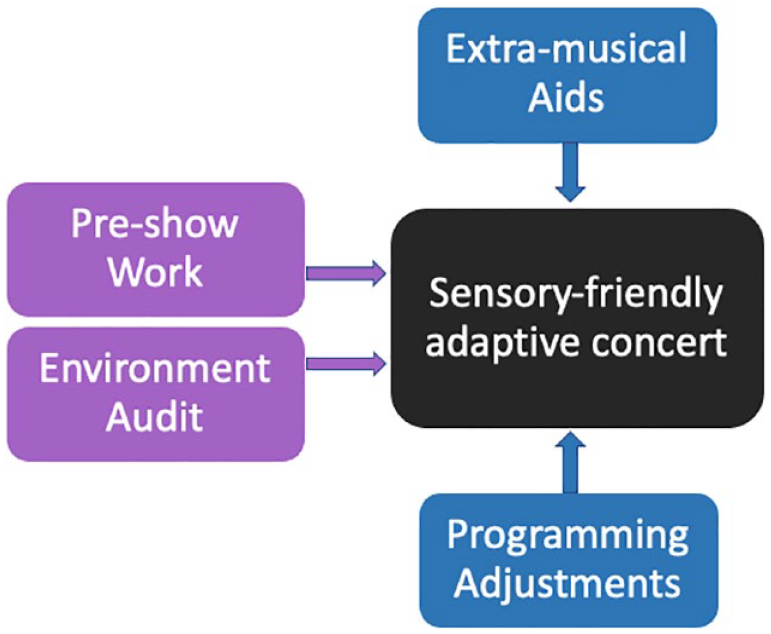
Sensory-Friendly Adaptive Concert Model.
Pre-show work
A visual story is strongly recommended (Fletcher-Watson, 2015; LaMarre et al., 2021; Payne & James, 2019) with a step-by-step walkthrough from outside the concert venue to a patron’s seat via images and text. This helps attendees familiarize themselves with the space before they arrive. The visual story should include photos of important non-musical elements audience members will encounter such as staff and volunteer usher uniforms, types of washrooms, staging, accessibility sites, and anything else that may stand out about the space (Marks, as cited in Payne & James, 2019). The capacity of the venue should be described, and, if possible, the estimated, anticipated, or maximum number of people attending the performances should be published (Silverman & Tyszka, 2017). This information is useful for those who find crowd size and social stimulation challenging. Throughout the visual story, plain text written in the first person should be used (Payne & James, 2019; Thompson et al., 2020) as this is the most comprehensible form of writing for those on the autism spectrum, who account for a large share of individuals with sensory-sensitivities (Thompson et al., 2020).
In addition to the visual story, a second guide document exclusive to each performance should be created to outline concepts and characters of the Sensory Friendly Concert (LaMarre et al., 2021; Payne & James, 2021; Silverman & Tyszka, 2017). For instance, if the performance features a cellist and pianist, both instruments should be briefly presented visually and by text in the guide. Compositions, composers, and other details may be provided. Links to videos and detailed descriptions are particularly useful as individuals with processing challenges and other exceptionalities may wish to comprehend components of a performance ahead of time rather than attempting to synthesize new individual aspects of information during the event itself (Marks, as cited in Payne & James, 2019). Also, the document may specify whether any dramatic noises are expected, such as cymbal crashes (Silverman & Tyszka, 2017). This guide should be created in advance and made widely available for audience use.
While Sensory Friendly Concert presenters expect caregivers to supervise those who cannot attend the performance independently, organizers must nevertheless ensure they have sufficient, informed, and organized “human help” (Silverman & Tyszka, 2017) for their production. Artists, staff, and volunteers should have training prior to a sensory-friendly event, beginning with a discussion around expectations and programming (Fletcher-Watson, 2015; LaMarre et al., 2021). It is recommended to involve occupational therapists where possible in developing training (Silverman & Tyszka, 2017; Umeda & Jirikowic, 2019). This pre-show work anticipates potential situations that staff may not typically encounter and relays the importance of inclusive accessibility in these performances. Most audience movements and sounds would be discouraged and curtailed by staff and volunteers in a traditional setting, perhaps even resulting in a request to leave the performance so as not to interrupt other patrons’ experience. In the context of Sensory Friendly Concerts, it must be clarified to front of house, ushers, and other staff members that myriad behaviors are acceptable and individuals exhibiting divergent behaviors should not be singled out, reprimanded, or made to feel unwelcome. Statements made by respondents concerning inclusivity underscore the need for training and planning for those working within nontraditional environments to alleviate caregiver stresses. It is crucial that artists, staff, and volunteers are knowledgeable, have the capacity to adapt to various situations and needs (which will vary greatly at each concert), and encourage a welcoming environment.
Environmental audit
An environmental audit reviews the physical spaces that participants navigate from the beginning of their experience to its completion. Elements such as parking, free registration, location of the event, and timing of the event should be considered in adaptive concert preparation. Within the venue, this includes adjusting lighting, providing secondary accessible space(s) separate from the performance area, and allowing various seating arrangements (Calem, 2016; LaMarre et al., 2021; Shiloh & LaGasse, 2014). In addition, announcements may be made at the beginning of the performance reiterating any rules of the venue, hospitality allowances, and programming elements.
The concert venue and performance space should have clear signage throughout (Marks, as cited in Payne & James, 2019) indicating location names, maps, and other required information, such as where to acquire physical items like fidgets or food. A secondary room or space separate from the concert hall should be designated for those who become hyper-stimulated, overwhelmed, anxious, or who simply need a break (Shiloh & LaGasse, 2014; Thompson et al., 2020). Audience members should be able to leave the concert space at any time for the designated secondary area(s), and to return, should they choose to do so. With proper training of volunteers and staff (e.g., preparing them for what to expect and explaining the differences between traditional concert environments and the adaptive programming environment) and an announcement reiterating this allowance, this adaptation to typical concert performance etiquette allows individuals, caregivers, and families to make their entrances and exits with lessened anxiety and judgment.
As mentioned earlier, adjustments should be made to lighting to ensure it is not altogether dark during the event (LaMarre et al., 2021; Payne & James, 2019; Shiloh & LaGasse, 2014; Vize, 2014). This style of subtle lighting within the performance space—again atypical when compared with traditional performances where the audience space is darkened considerably—will aid individuals in entering and exiting the hall if necessary. It will also improve the experience of those who are sensitive to significant adjustments and contrast in lighting. In theatrical performances, no strobe lighting or radically varying lighting should be used for this reason and to prevent seizures in certain cases (Fletcher-Watson, 2015; Kempe, 2015). Finally, and once more counter to some traditional performance customs, “flashing the lights” or ringing a bell for the start-time of shows is not recommended (Marks, as cited in Payne & James, 2019).
Various seating options should be provided. In a large hall, for instance, some would prefer to sit toward the rear of the venue or in the balcony while others would wish to be up front, near the performers. If possible, seating with various tactile stimuli (e.g., mats; wiggle and hard seats) or textures should be available (Leger & Rushing, 2019). Furthermore, similar to light-sensitivity, many who exhibit sensory sensitivities often find sudden changes in dynamics or loud sounds over-stimulating, or even painful (Fletcher-Watson, 2015; LaMarre et al., 2021; Vize, 2014). Providing noise-canceling or noise-deafening headphones is standard practice to alleviate this issue (Calem, 2016; LaMarre et al., 2021). Tangible accessibility considerations such as parking, timing and location of events, free registration, and resources (e.g., toys or noise-canceling headphones) were commonly cited by participants as contributing to positive event attendance. These aspects of the event are crucial to its success, and in conducting an environmental audit and undertaking pre-show work, many attendance hurdles may be removed.
Extra-musical aids
A space for visual creation and materials, such as adapted crayons, washable markers, and paper of various colors, should be provided with clear indications of where these materials may be used (Fletcher-Watson, 2015; Leger & Rushing, 2019). Sensory devices and tactile toys, such as fidgets and sensory boxes, should be made available, as well as noise-canceling or noise-suppressing headphones (Leger & Rushing, 2019; Marks, as cited in Payne & James, 2019; Shiloh & LaGasse, 2014). These provide stimulation for those who require additional support, and, conversely, can aid those who are hyper-stimulated in returning to a calmer state. It is recommended to adapt signage to include non-speaking elements, such as symbols and pictures, and to use visual aids throughout the performance (Parkes, personal communication, February 9, 2021). For instance, a program list on a large board or a screen with a moving element (such as a magnet or character) can indicate which musical selection the musicians are performing and approximately how much time remains in the full program as the concert progresses.
While toys, headphones, and other physical resources on-site were discussed prominently by in-person attendees, there was variance in the exact items mentioned and opinions over how important each item was for a successful experience were far from unanimous. This aligns with the literature regarding individuals with exceptionalities having significantly varying needs and therefore differing in their required adaptations on a case-by-case basis. Regardless of whether all individuals accessed the physical items or capitalized on the adaptations in the Sensory Friendly Concert, data collected through the caregiver surveys indicated that having diverse options is necessary.
Programming adjustments
The last category in this model is the least explored in current literature, and perhaps in practice. Current programming adjustments favor shortening the length of pieces to approximately five minutes or less and ensuring a variety of pieces in terms of style and tempo (Parkes, personal communication, February 9, 2021; Wise, 2015; Zelenka, 2019). The latter aspect may be challenging for performers depending on their level of comfort with nontraditional repertoire, but even within the classical music canon, pieces can fluctuate significantly in character, mood, and playing style. For instance, a string player could choose a piece that includes pizzicato (i.e., plucked) or staccato (i.e., short) sections and then contrast this with a lyrical bowed selection (i.e., smooth). In addition, some familiarity is suggested, such as performing one or more tunes that resonate with the community attending (e.g., a recent children’s movie theme that has been popular).
Announcements at the onset of the performance should clearly outline the “rules” of the space (e.g., it should be mentioned that audience members cannot touch the musicians or instruments) (Shiloh & LaGasse, 2014). Interactive components should be considered throughout the program, such as engaging audience members in questions or demonstrating certain musical techniques. The commentary during these interactive periods should be adapted, in a similar manner to how one might speak at a slower pace to those learning a language, or to groups of children. As Calem (2016) stated, “making verbal instructions short and clear is helpful to everyone, but crucial to children with aural processing challenges” (n.p.) who account for a significant portion of children with sensory sensitivities. Some interactions should also be presented in a manner that individuals may respond nonverbally (e.g., “Raise your hand if you have heard of Mozart!”). A question period should be included, announced at the onset of the performance.
While the programming adjustments mentioned as important by caregivers may seem intuitive (e.g., explanations and interactive components; shortened piece length; simplified language; rules), these aspects of sensory-friendly adaptive events have not been studied. The respondents’ contributions in the present survey are therefore significant in confirming appropriate adjustments for the adaptive concert model, particularly where there has been little to no discussion of programming specific to the music discipline.
Future areas of research include studying the effects of musical content within Sensory Friendly Concerts (i.e., investigating which styles, genres, instruments, and programs are successful within this context), as well as augmenting the sample size of caregivers surveyed and interviewing participants for more in-depth information concerning these events and inclusion efforts in the arts. In addition, building a broader base of relevant academic works on the topic of Sensory Friendly Concerts is key to validating this nascent practice and delivering more meaningful and effective content moving forward.
Conclusion
With this study, we sought to garner opinions of caregivers on the sensory-friendly adaptive concerts model while equally examining these events’ contribution(s) to inclusivity efforts. Researchers examining sensory-friendly events have detailed welcoming environments, perceived or real stresses of individuals and families attempting to attend cultural events, and current practices in performing arts, while illuminating a distinct lack of literature on adaptive practices in the music discipline. It is evident that the adaptations made within the context of Sensory Friendly Concerts contribute to a positive experience for caregivers and their families by collectively offering an inclusive, friendly, and welcoming environment made possible by knowledgeable individuals and meticulous planning to meet diverse needs. It is also apparent that in-person attendance and the communal support these events facilitate are both appreciated and desired. In providing accessible programming to whole families, Sensory Friendly Concerts enhance the wellbeing of otherwise potentially isolated individuals and groups, and it is important that this population be supported to relieve the myriad barriers affecting their attendance of cultural events. This encompasses various efforts, from free registration to physical modifications, as well as musical programming itself.
It should be noted that one of the authors is a music educator who has situated her practice in teaching students with exceptionalities. This project was developed in part through observed interest in concert attendance in her studio and classrooms, and on the potential impact of participation in adaptive concerts for her students. The importance of immersive music listening experiences in developing musicianship and music appreciation is significant as it can allow students to develop their interests, potentially leading to greater motivation in music learning. Furthermore, the findings of this study can inform music educators in their development of student concerts and recitals, as the proposed adaptations would be applicable to any music performance setting.
Through this study, the researchers established a sensory-friendly adaptive concert model and answered questions concerning which aspects of this model were most needed. In addition, caregivers provided new information on how these adaptations ameliorated their experience. The researchers demonstrated that previously unsupported but well-intended adaptations are, in fact, realistic assumptions in many cases, albeit every concert must be adaptive to recognize the varying needs of the individuals who attend. Unmistakably, caregivers pointed to physical adaptations as the most important aspect of modification, particularly mentioning freedom of movement almost unanimously. The inclusive nature of events appears to provide significant relief for caregivers, with many especially recognizing that their child’s behaviors will not result in a negative response from others and are instead accepted and expected in these environments. As a result of such accessibility and inclusivity efforts, whole families can enjoy musical experiences together and arts organizations and artists may positively contribute to whole-system change.
Sensory-friendly adaptive model summary points
Pre-show work
Engage experts such as occupational therapists, special music educators, interpreters, caregivers, and other relevant communities for planning, engagement, and production;
Offer artist, staff, and volunteer training or seek external training resources;
Create and publicize a visual story of your venue;
Provide access to event-specific programming documents that outline performers, instruments, and other items before, during, and after the concert.
Environment audit
Ensure the venue is accessible from parking lot and local transportation route to concert area;
Ensure a variety of seating options are available or can be created;
Ensure a secondary space can be made available to attendees;
Avoid strobe lighting and varying lighting (e.g., the traditional flickering of lights to indicate the performance will begin momentarily);
Create clear signage including simplified and nonverbal communications.
Extra-musical aids
Provide space within the performance area for movement and/or multidisciplinary work such as sculpting, dancing, or visual art creation;
Provide a secondary space separate from the performance area as a quiet room;
Offer various seating options such as chairs, mats, tactile seats, and standing room;
Provide noise-canceling headphones and tactile toys (e.g., fidgets).
Programming adjustments
Clearly outline the “rules” at the onset of the program (e.g., indicate where participants can move freely, but mention that they must respect one another’s personal space);
Indicate milestones in the program such as mentioning when half the program is finished, or what is coming next;
Perform mostly two- to five-minute works or excerpts;
Vary the style of pieces (i.e., slow or fast, major or minor, classical or pop);
Interact with the audience in various ways such as by asking questions including some that can be answered nonverbally by raising hands, or by introducing movements or sounds to be done together or as part of a song (e.g., tapping a beat, moving up or down according to volume, or hand-raising when a certain instrument or tune is playing);
Demonstrate sounds and/or capabilities of the instruments (e.g., pizzicato, arco, harmonics, ponticello for string instruments; how sound is made on the piano);
Consider programming some familiar works;
Have a question period (and indicate at the onset of the event when it will occur).
Footnotes
Appendix
Transformative Lens Framework Questions (Sweetman et al., 2010).
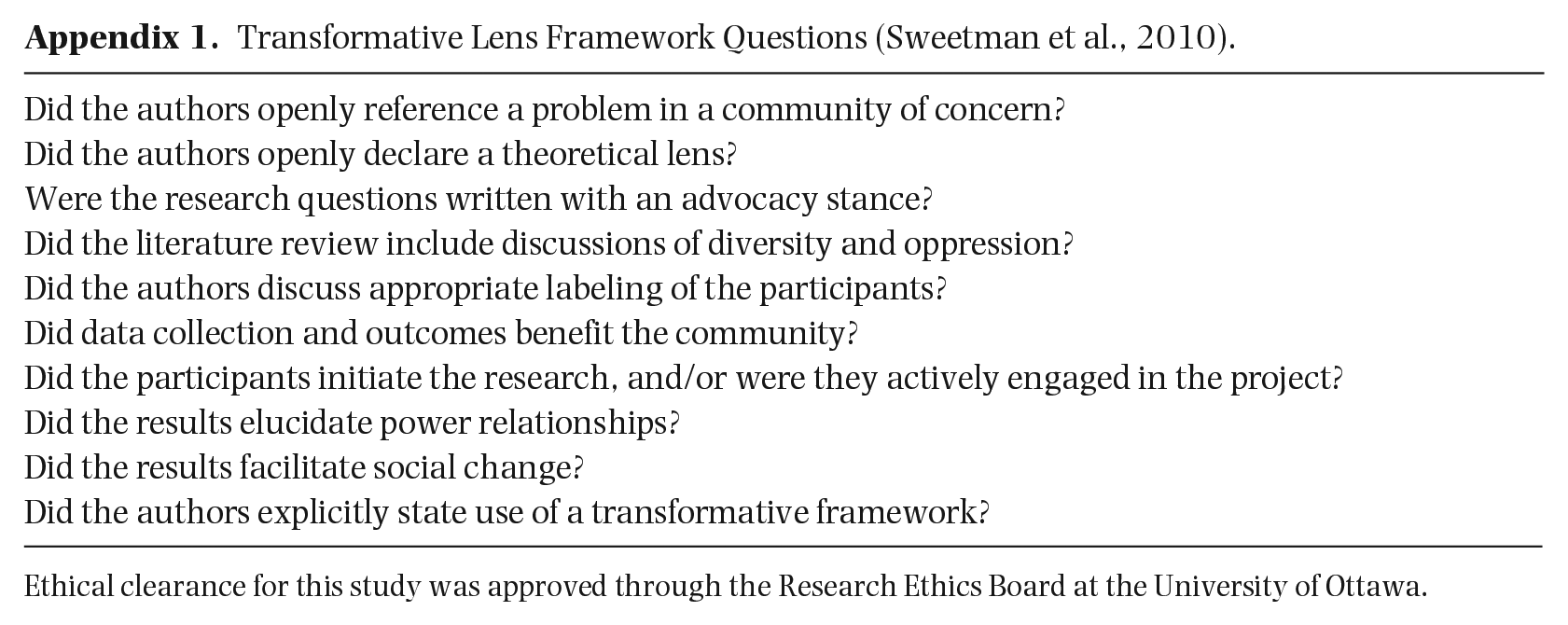
| Did the authors openly reference a problem in a community of concern? |
| Did the authors openly declare a theoretical lens? |
| Were the research questions written with an advocacy stance? |
| Did the literature review include discussions of diversity and oppression? |
| Did the authors discuss appropriate labeling of the participants? |
| Did data collection and outcomes benefit the community? |
| Did the participants initiate the research, and/or were they actively engaged in the project? |
| Did the results elucidate power relationships? |
| Did the results facilitate social change? |
| Did the authors explicitly state use of a transformative framework? |
Ethical clearance for this study was approved through the Research Ethics Board at the University of Ottawa.
Author contribution(s)
Declaration of Conflicting Interests
The author(s) declared no potential conflicts of interest with respect to the research, authorship, and/orpublication of this article.
Funding
The author(s) received no financial support for the research, authorship, and/or publication of this article.
