



Abstract
This article reports research that identified and analyzed assessment for learning strategies employed by six Canadian music educators to support and develop student creativity. Findings include descriptions of creativity-nurturing practices organized into four categories: (a) developing assessment criteria, (b) encouraging creative processes, (c) optimizing the classroom context, and (d) activating self-assessment. Results include detailed descriptions of strategies that educators can employ to leverage formative assessment to nurture student creativity within and beyond music education contexts.
Creativity has emerged as a key 21st-century competency and central learning objective for students across educational systems in Canada (Fullan & Langworthy, 2014), the United States (President’s Committee on the Arts and the Humanities, 2011), Europe (Europa, 2014), Asia (Kim, 2011), and elsewhere (Organisation for Economic Co-Operation and Development, 2019). In Canada, where this research was situated, curriculum documents across the country’s educational systems explicitly require the teaching and learning of creative skills. However, literature detailing evidence-based pedagogical strategies for nurturing classroom creativity remains scarce (Davies et al., 2013), and educators report a lack of preparedness for teaching it (Gralewski & Karwowski, 2013). Indeed, a number of experts claim that teachers and schools are more likely to stifle than nurture creativity (Kim, 2011; Runco, 2016). As Grigorenko (2019) summarizes, “creativity, although highly desired, as conceptualised and operationalised in contemporary school settings today, remains a challenge for educational systems around the world” (p. 126).
For some time, creativity has been of interest within the field of music education, with many experts recognizing the potential for nurturing creativity within music learning contexts (e.g., Burnard, 2012; Hickey, 2012; Webster, 2012). Although some discourse has emphasized that creativity is present in a broad range of music activities, including performing, listening, and analyzing music (e.g., Elliott, 1995), music educators often think of creativity as most robustly located in improvising and composing (Burnard & Power, 2013; Hickey & Lipscomb, 2006). A more contemporary view, however, recognizes that music makers are engaging with an ever-expanding and diversifying range of musical creativities (Burnard, 2012) such as DJing, videogame sound design, livecoding, and more. While this increased diversity brings with it increased complexity for teachers in supporting musical creativity through assessment, such assessment is possible and meaningful when teachers and learners share a clear understanding of what diverse creativities look like and the considerations at play in assessing original and valued outcomes (Burnard & Fautley, 2014).
In music education contexts, creativity can be assessed summatively (assessment of learning) and formatively (assessment for learning [AFL]) (Leong et al., 2012). Summative assessment of music creativity has been examined in research focusing on Amabile’s (1996) consensual assessment technique (Hickey, 2001; Priest, 2006a, 2006b; Stefanic & Randles, 2015), children’s creative musical thinking (Hickey & Lipscomb, 2006), and preservice music teachers’ capacity for creativity assessment (Kokotsaki & Newton, 2015). Research on teachers’ formative assessment of music creativity has identified some practical problems. Odena and Welch (2007), for example, found that teachers’ lack of personal creative music experience hindered their ability to meaningfully assess student creative work. Fautley (2004) identified that teachers, when using formative assessment to support composing, most often used it to check student understanding of what was required to complete the task, rather than assessing the originality or value of the creative work. Fautley and Savage (2011), examining English secondary teachers’ assessment of composing, found that teachers tended to assess the performance of compositions rather than the creative process or product, and offered little detail about their formative assessment practices in survey and interview responses. Leong and colleagues (2012), investigating case studies from England, Australia, and Hong Kong, identified that the success criteria teachers used to assess student work did not actually address the concept of creativity. The authors concluded that additional research is needed to help teachers better understand how to value creativity in music assessment. Burnard and Power (2013) call in particular for “innovative practitioner research” (pp. 226–227). Accordingly, the study reported here was designed to contribute to existing knowledge by examining specifically how teachers are making use of AFL strategies to nurture musical creativity in Canadian classrooms.
Creativity and AFL
AFL involves actively and continuously engaging students in practices, including self-, peer-, and teacher-based assessments leading to feedback on learning. Feedback supports students’ growth and development toward learning goals but has also been shown to cultivate students’ self-regulation and metacognitive functions (Willis, 2010). In a meta-analysis of pedagogical approaches that support improvements in student learning, feedback-driven instruction (i.e., AFL) was among the most statistically significant (Hattie, 2009). Fundamentally, AFL is supported by sociodevelopmental and constructivist learning theories that value the role of classroom context, social interactions, and developmental learning progressions (Black & Wiliam, 2006).
Working with the assumption that creativity can be learned (Beghetto et al., 2015; Csikszentmihalyi, 1996; Dweck, 2006; Starko, 2018), it follows that the development of creativity should be assessable in ways useful to both learners and teachers (Lucas, 2016). However, despite recognition that “an important aspect of supporting children to develop their creativity is teacher engagement with, and sound application of, assessment for learning strategies” (Blamires & Peterson, 2014, p. 155), the use of AFL approaches to support student creativity remains underdeveloped (Collard & Looney, 2014; Fautley, 2010).
A possible reason that teachers have been slow to apply AFL to creativity-based learning is the troubled relationship between creativity and assessment in educational contexts. For instance, evaluative assessment (i.e., assessment of learning) has been shown to cause anxiety and so inhibit willingness and capacity for creativity (Hennessey, 2010). Teachers often resist assessing creativity because they believe it is too subjective to assess, because they fear assessment will discourage a student’s self-expression (Lucas et al., 2013), or because they struggle to define or recognize creativity and therefore are at a loss as to how to assess it (Mullet et al., 2016). Accordingly, the potential of applying assessment practices to support creativity development remains largely untapped. Hence, in this research, we look to AFL as an assessment approach that can bypass traditional challenges associated with creativity assessment thanks to its focus not on evaluating but on nurturing creativity through formative guidance from teachers and peers.
Theoretical underpinnings
The theoretical framework for this research intersects theories of creativity and AFL. Our work is grounded in the conception of creativity as the production of something original within a given context (through divergent thinking) and of value within a given context (through convergent thinking) (Cropley, 2006). When the context is a classroom, we believe it is helpful to draw on the recognition of “little-c” creativity (Craft, 1996) that all people including young students can demonstrate, and the recognition that feedback can enhance students’ creative efforts (Beghetto & Kaufman, 2014).
AFL engages students in formative assessment activities (including self-, peer-, and teacher-based feedback) with the goal of improving achievement and developing students’ self-regulation and metacognition (Black & Wiliam, 2006). Black and Wiliam (2006) have identified key evidence-based strategies that optimize AFL:
Clarifying and understanding learning intentions and criteria for success;
Engineering effective classroom discussions, questions, and tasks that elicit evidence of learning;
Providing feedback that moves learners forward;
Activating students as instructional resources for each other;
Activating students as owners of their own learning.
Despite being one of the most statistically significant pedagogies for supporting students’ learning (Hattie, 2009), very little research has examined how AFL can be applied to the development of students’ creativity (Collard & Looney, 2014; Lucas, 2016). Accordingly, the purpose of the research reported here was to identify and analyze AFL strategies employed by school music educators to nurture students’ creativity. Specifically, our study was guided by the following question: How do music educators leverage AFL to nurture students’ creativity?
Method
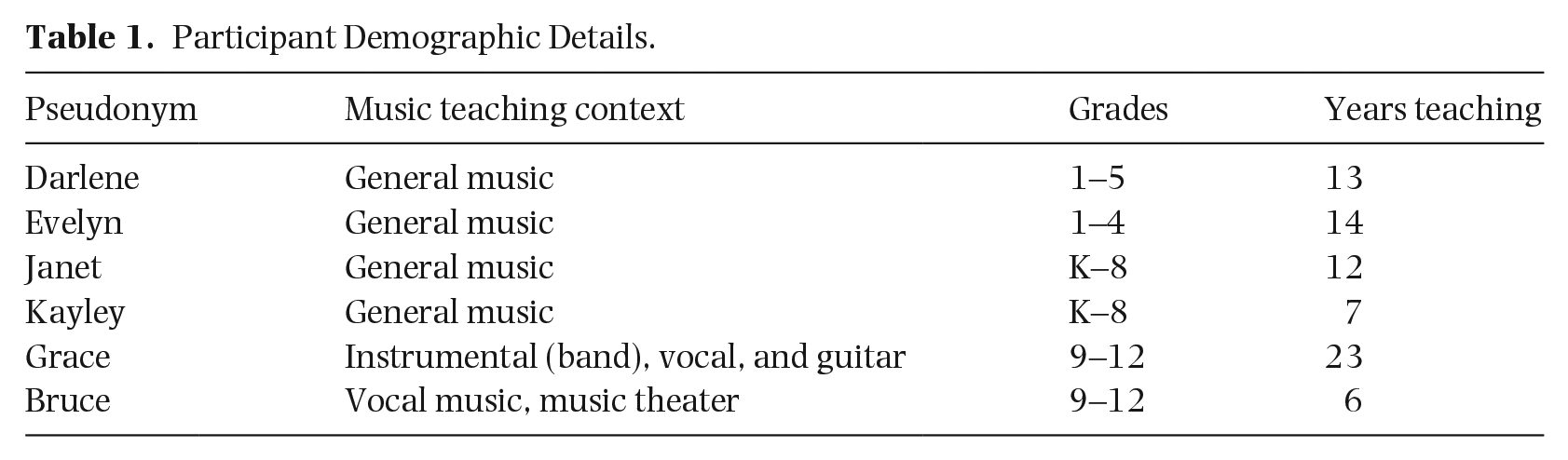
For this basic qualitative study (Merriam & Tisdell, 2016), data were gathered via semistructured telephone interviews with six Canadian music teachers (four elementary [Grades K–8; student ages 4–13] and two secondary [Grades 9–12; student ages 13–17]) who taught at schools within the province of Ontario’s public education system. Following Institutional Review Board approval, the teachers were recruited via notices published in Canadian music educator professional publications, asking for music teachers who used teaching or coaching strategies to nurture student creativity to contact us. The teachers who volunteered to participate were recruited based on eligibility requirements of (a) at least 5 years of classroom music teaching experience and (b) self-identified experience nurturing student creativity within the music classroom. We do not know to what extent these teachers are representative of teachers in Ontario generally, but, due to their willingness to participate in the research, we assume they had a particular interest in supporting creativity in music and were confident in their capacity to do so. Table 1 provides participant details.
Participant Demographic Details.
The interviews were audio-recorded, transcribed, and lasted between 35 and 90 min. Interview questions targeted the activities teachers used to enable student creativity, how teachers supported students’ engagement with those activities, and how teachers made use of assessment. The questions did not rely on teachers to have knowledge or familiarity with AFL principles. Instead, the questions were worded with general language to elicit responses that addressed pedagogical strategies associated with AFL, for example, What activities or assignments do your students do that most actively develop their creativity? How do you clarify how you want students to be creative? Can you provide examples of feedback you give to move learners toward greater creativity? Can you provide examples of enabling peer feedback to support students’ creativity? Can you provide examples of enabling self-assessment for students to monitor their own creative progress, and to identify what they need to achieve creative goals? Are there any other strategies you use to nurture students’ creativity? Many talk about assessment as being a roadblock to creativity—is that something you’ve observed in your teaching? What are your thoughts on this? The interviews were transcribed and then the transcripts were sent back to the participants. The teachers were invited to add to or modify their responses as they saw fit, thereby ensuring the transcripts effectively represented the teachers’ experiences and perspectives.
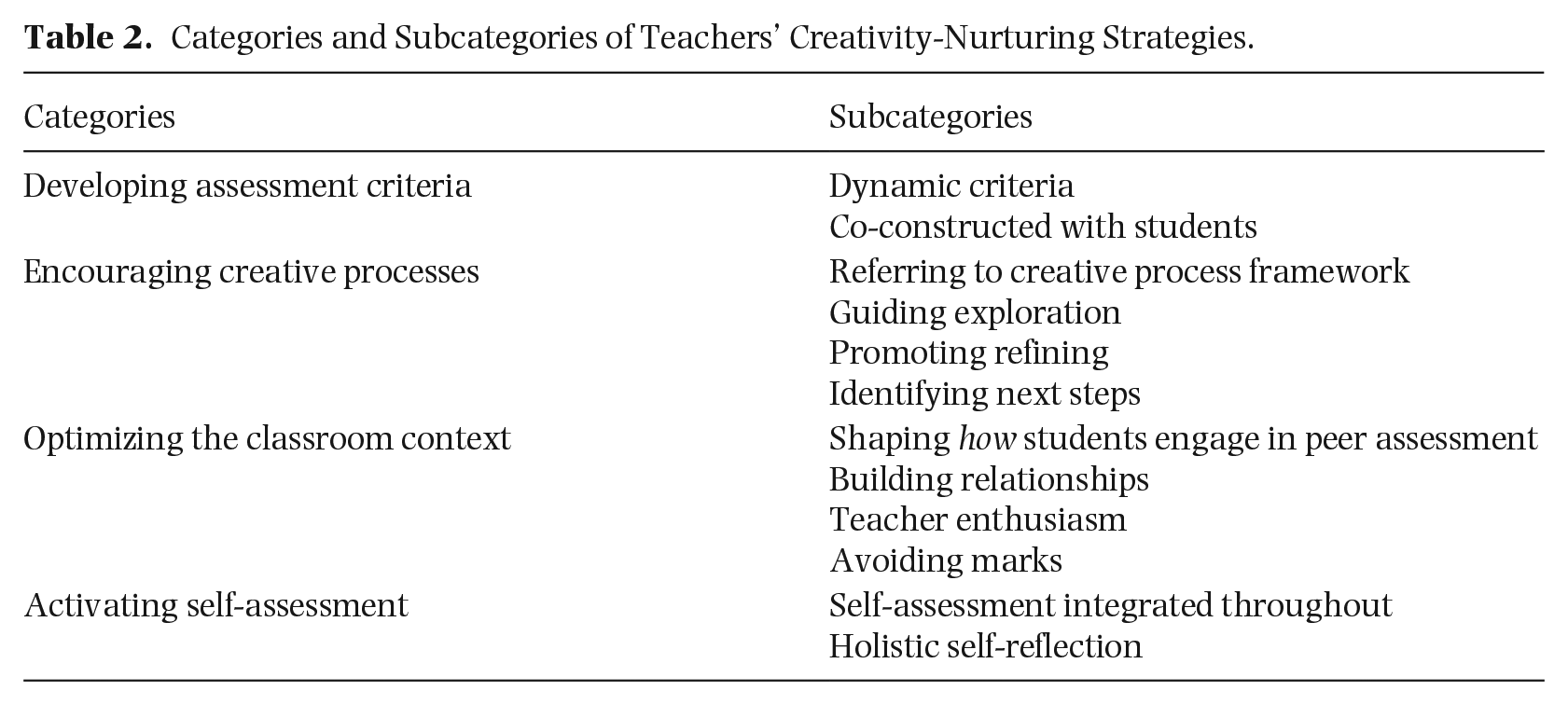
The interview data were then inductively analyzed (Thomas, 2006) to identify how the teachers leveraged assessment strategies to nurture student creativity. This approach involved highlighting and assigning codes to relevant text segments within the interview transcripts; organizing the codes into categories and subcategories; reducing overlap and refining codes, subcategories, and categories; and finally organizing subcategories and categories hierarchically (see Table 2). We employed this inductive strategy because we did not wish to limit our perception of what was going on by deductively analyzing the data for AFL strategies exclusively. Instead, our intention was to gain a holistic understanding of the pedagogical approaches the teachers were using to support student creativity and then examine their relation to AFL principles.
Categories and Subcategories of Teachers’ Creativity-Nurturing Strategies.
Findings
Analysis of the data enabled identification of creativity-nurturing approaches that we represent in a model (see Figure 1) of four categories of relevant strategies: (a) developing assessment criteria, (b) encouraging creative processes, (c) optimizing the classroom context, and (d) activating self-assessment. Related subcategories are identified in Table 2. Below, we describe the array of strategies in detail with participant quotations to convey how the teachers conceptualize and use them as they support student creativity in composing, improvising, songwriting, performing, and responding to music. Connecting back to our theoretical understanding of creativity, we also include commentary addressing how the strategies function to support the originality and value of students’ creative work within the classroom context.
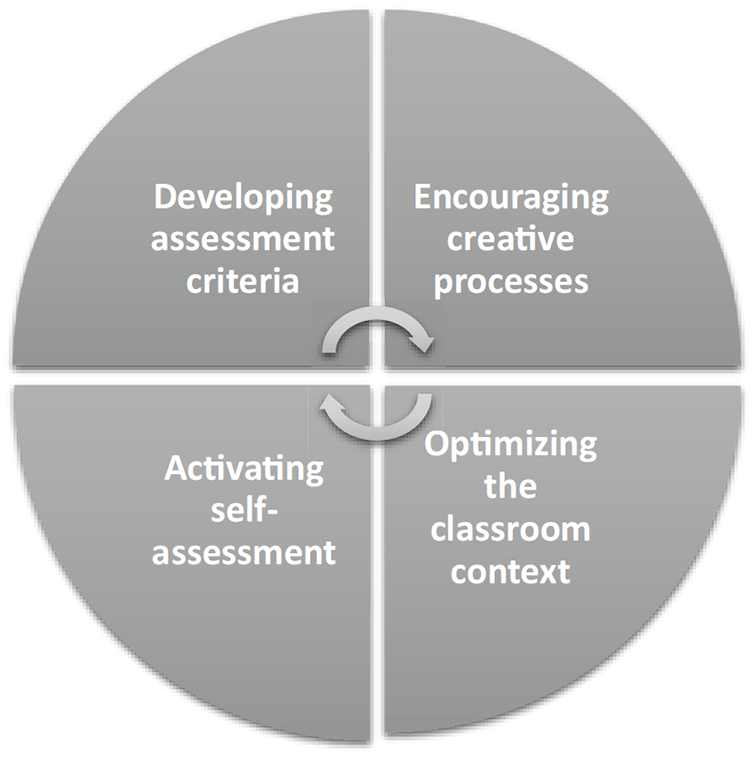
Model of Teachers’ Creativity-Nurturing Strategies.
Developing assessment criteria
Teachers described developing assessment criteria, often co-constructing the criteria with their students, as a preliminary step in supporting creative work. When preparing students for composing, Evelyn (teaching Grades 1–4) explained, “We use chart paper. . . . They come up with their [assessment] criteria and then we talk a little bit about what it looks like.” Most of the criteria the teachers described developing were logistical in nature. Darlene (teaching Grades 1–5) offered this example: “They need to incorporate some quarter notes, some half notes, some eighth notes. It’s in 4/4 time; they’re going to create 16 beats.” Referring back to Cropley’s (2006) conception of creativity as producing something original (through divergent thinking) and of value (through convergent thinking), we note that these assessment criteria in fact do not address either aspect. Instead, the criteria serve as enabling constraints to prompt or initiate the work—to get students going. As Grace (teaching Grades 9–12) described, “If you just say, ‘Here it is and go to it’, some of the kids get off track and don’t really know where to begin.”
However, Darlene also reported introducing additional criteria later in the composing process, offering as an example that “the mood of the piece aligns with the texts that they’re using—the way it sounds, you know, fits.” With this clarification, students are guided toward the “value” aspect of creativity; they are encouraged to consider how they can design their compositions—through convergent thinking—to meet listeners’ expectations. None of the teachers described introducing assessment criteria that guided students toward the “original” aspect of creativity.
A key point made by a few of the teachers was that any established assessment criteria should remain flexible, or dynamic. Evelyn explained, As we’re working through the process, the criteria change. So if we’re constantly talking about something that’s not on the criteria list, we say, “OK, if it’s this important, then perhaps we need to add it in.” Or if it doesn’t seem to be relevant anymore, we cross it out.
Bruce (teaching Grades 9–12) emphasized that “putting something in four columns, typed out and printed out [referring to typical pre-established assessment rubrics], ends up being meaningless because the project completely changes in two days based on how they’re responding and reacting to it.” Instead, he clarified, “We try to keep it dynamic and we check in verbally a lot: ‘What does success look like on this project, how are we going to define progress?’”
Encouraging creative processes
Once creative work was underway, teachers described supporting students with a variety of assessment responses, including (a) referencing a creative process framework, (b) guiding exploration, (c) promoting refining and revision, and (d) identifying next steps.
All but one of the teachers we interviewed described assessing and commenting on students’ work in reference to a model of the creative process produced as a poster by the Ontario Ministry of Education and distributed to schools across the province. The model describes a circular, cyclical process through eight stages: challenging and inspiring; imagining and generating; planning and focusing; exploring and experimenting; producing preliminary work; revising and refining; presenting, performing, and sharing; and reflecting and evaluating. All stages are shown to interact with feedback (from peers and teacher) and reflection (Ontario Ministry of Education, 2009, p. 20). Bruce told us, “I have it on the wall and we look at it and refer to it a lot. . . . They seem to understand and resonate with it.” Evelyn similarly reported, I’ll talk to the kids a lot about that creative process . . . Like are we in the “imagining” stage, or are we revising?
The teachers indicated that the framework helped students to conceptualize their work within the full trajectory of creative production, offering touchstones along the route to keep them on track.
The framework also helped teachers to recognize how they needed to focus their feedback. In describing the assessment responses they gave to students, feedback related to the “exploring and experimenting” stage was prominent. Evelyn shared, I find they’re not very good at that [stage], and that’s where a lot of the potential for creativity is. They try one thing, and they’re like, “Yep, that’s it, that’s done.” So they need a lot of prompting and a lot of questioning and a lot of gentle pushing.
The teachers often described making use of questions to guide exploration and experimentation. Evelyn reported, “I’m all about the probing questions. ‘What might this look like if you . . .?’ or ‘How could you . . .?’ Just to kind of get them thinking in a different way.” Bruce offered a different strategy—tasking a student with a particular exercise to guide exploration: I had a really good songwriter in the class—I challenged her to substitute a different chord for every single chord in [her song]. So, still make it fit with the melody, make the chords be related, but can you substitute a chord with a different quality, and see what happens?
In addition to guiding exploration with questions, prompts, and exploratory tasks, teachers also actively guided students toward an exploratory mind-set. Janet (teaching Grades K–8), for example, described encouraging exploration by praising inventiveness and risk-taking: “Thank you so much for being so brave. Thank you so much for taking a risk!” . . . I try to celebrate a variety of different students and their approaches to an activity. . . . “Oh wow, Johnny’s acting like a snake right now. I would have never thought of acting like snake to this piece of music!”
In addition to exploration, teachers also deliberately guided and promoted refining. Grace explained that “through conversations with the kids, we sort of get to where it needs to be.” Janet offered details of such a conversation: Once the instruments are in their hands, whether it’s recorders, whether it’s ukuleles, whether it’s their band instruments . . . [I say,] “I’d like to hear more of this,” or, “Have you thought about this?” or “I wonder what would happen if you tried this?”
With such suggestions and questions, Janet specifically guides students’ refining. Bruce, meanwhile, reported that he asks students to explain certain creative decisions: “Why have you chosen this chord here?” “Why have you highlighted this lyric in this way?” “Why are you using three singers instead of two?” Such questions serve the purpose, he explained, of “getting them to look a little deeper at what they’ve done and be critical about why they made those choices.” Darlene described encouraging refinement by reminding students to consider how their composition might be heard or received: “What do you want the audience to be feeling when they’re listening to your piece? . . . When I was listening to your piece, I was feeling this way. Is that how you wanted me to be feeling?” Grace has students play their compositions for peers to guide revision and refining. She explained, “sometimes it’ll be formal where there’s a piece of paper and a checkbox thing. And other times it’s just we go around the room and people will share thoughts.” A few of the teachers identified that their students tend to resist revising and refining, and really need a push in this part of the creative process. Bruce explained, A lot of them put something out really fast, but then aren’t keen to go through the process of refining it. So I use some of those questions and cues to let them know it’s OK to be slow. “Let the process be slow, you’re not done yet!”
In addition to encouraging refining, teachers described a significant aspect of guiding creative work to be helping students to move through the various stages of the creative process—encouraging forward motion. Grace related, We’ve set it up with steps or stages, so like do this and then do this and check in along the way. . . . I often use programs like Padlet or even Google Docs, and the kids will journal what they’re doing so that I can see what they’ve done, and give them immediate feedback to help guide them.
The teachers identified that students often need help progressing in their creative work. A common strategy was to provide feedback indicating clear and specific next steps. Bruce offered this example: We come in a circle at the end of the day and I’ll say, “Where are you at today?” And they’ll say, “I picked my song and I sat with the manuscript paper for 45 minutes and stared at it and couldn’t write anything down.” “Great. So tomorrow you’re going to stare at that manuscript paper again and you’re going to write your name on it and you’re going to label some chords and write some lyrics. Then the next day you’ll see if you can’t add a harmony to your melody!”
Once creative work was underway, teachers supported students with assessment responses that encouraged creative processes. When guiding exploration, teachers employed strategies such as probing questions (Evelyn), technical challenges (Bruce), and praising risk-taking (Janet) to invite students toward greater originality. When promoting refinement, teachers addressed both the value and originality of student products through conversations that included suggesting (Janet) and questioning to provoke critical consideration (Bruce, Janet), and by soliciting peer feedback (Grace).
Optimizing the classroom context
The third identified category of nurturing creativity comprised strategies for optimizing the classroom context—both for creativity itself and for assessment to support creativity. Teachers reported intentionally shaping the working environment so that students were open to receiving and benefiting from teacher and peer assessment responses. Teachers described cultivating a safe space, leveraging teacher enthusiasm, building relationships, and avoiding marks or grades.
One way teachers addressed classroom context was to consciously strive toward a space where students could feel comfortable sharing their creative work. Darlene explained, as soon as the students come in, we start in a community circle. There’s this acceptance and trust that all ideas are welcome and there’s this comfort. It’s a risk-taking environment.
Teachers noted that a key aspect of making the space safe and open to risk-taking was guiding and managing the way students offered feedback to their peers. Bruce explained that students sharing their creative work tend to “feel like there’s already a spotlight on them, [and need to] trust that it [the feedback] is going to be safe and constructive. . . . I care about controlling how that feels in the room.” As a strategy for keeping peer feedback encouraging, Darlene insists feedback be focused and purposeful. She related, “We really push the comments to be feedback that’s helpful: ‘Give them information to have them be able to add to and improve their piece!’”
A connected strategy for keeping the space safe entailed teachers deliberately taking an interest in their students as individuals not only within but also beyond the class context—building relationships—so that students would feel comfortable and open to sharing of themselves through their creative work. Bruce elucidated, The relationship with kids outside of the class is super important to me—checking in about non-musical things . . . results in having a rich relationship and then the door is open for them to say, “Look at these lyrics,” or “Look at this song that I wrote.” Then this space is created where they feel safe sharing their creative work with you, which is highly personal.
Given that creative work can indeed be so very personal, it is often challenging for teachers to convince students to bring their efforts to a public forum. Bruce described another strategy for helping students get past this natural reticence—activating teacher enthusiasm: I think the biggest thing to nurturing their creativity is my own excitement about art and music and them in general. That’s the biggest thing that I can do. When I can really max my enthusiasm towards a project or a piece of music that they’re working on, I really feel the response from them in kind. So their enthusiasm and creative spirit and willingness goes up . . . Me being excited is important for them to feel validated and therefore wanting to be more creative.
According to Bruce, his overt enthusiasm for students’ work functions powerfully to optimize the classroom context for creativity. When students perceive him as a champion of their work, it boosts their confidence and desire to be creative.
A final very significant strategy for optimizing the classroom context for creativity, offered independently by five of the six teachers we interviewed, was not giving grades or marks in response to creative work: More and more and more over the last couple of years, I try not to mark. I try just to give descriptive feedback: “You did this really well, here’s your next step.” (Janet) We don’t ever give them marks. I mean, we give them marks on the report card, but . . . our feedback is always just that: it’s feedback. It’s about what are they doing well and what are their next steps. (Evelyn) The one thing that I don’t really do, especially with this type of work, is use language like “assessment” or “success criteria” or “level 3 or level 4” or any of that. Because I feel that attaches judgement. Of course they’re going to be assessed eventually and they know that, but the early stages are hopefully not about that. (Bruce)
Grace explained, “I don’t give grades. . . . the kids get feedback.” She sees this approach as helping students feel more comfortable with creative tasks because when they encounter failure or setback, “they know that it’s OK . . . it’s just one bleep along the way. It’s not going to make or break anything as long as they keep working hard.”
Deliberately shaping the classroom context was a key aspect of creativity nurturing reported by the teachers. Strategies such as cultivating a safe space through community building, carefully guiding peer feedback, building relationships with students, demonstrating enthusiasm for their work, and avoiding marks or grades helped students to feel confident enough to take risks and think divergently toward original creative outputs. Teachers also explained how these strategies allow students to feel comfortable sharing their work and enable peers to offer feedback to guide them toward products of value.
Activating self-assessment
Possibly, the most prevalent creativity-nurturing strategy described across the interview transcripts involved teachers, in various ways, activating students to assess their own creative processes and products-in-progress. As related throughout the findings already presented, teachers often provided feedback in the form of questions, designed to provoke self-assessment. These questions often served the purpose of guiding students toward products of increased originality or value, but a key nuance is that the teachers generally strove to guide the students toward products that they themselves recognized as original and valuable—helping students to recognize and realize their own creative intentions. Evelyn described how this might sound: “Why did you do that? Why did you make that artistic choice—and is there a better choice?”
As a means of prompting students to ask such questions of themselves, teachers described the strategy of inviting students to listen to and consider the work of their peers. Darlene explained, We have them listen to each other perform and then ask, “How was so-and-so’s different from yours? What was it that you appreciated about their piece compared to yours? Is there something you could take from there that you think would work with yours?”
This exercise therefore not only serves the purpose of enabling peer feedback but also allows peers to gain new perspectives on their own work. Listening to peers’ creative musical products can provide students with another frame of reference for assessing their own efforts.
Intriguingly, in addition to activating students to assess their creative products, three of the teachers also reported activating self-assessment at a broader, holistic level. These teachers described inviting students to self-reflect on their experience of their creative work. Darlene reported, Sometimes it doesn’t go so well, especially for the little guys. It’s nice for them to take the very last minute or two of class, and just do that self-assessment piece—checking in where they’re at and where they want to go forward with it when they come back to our room. . . . We have them lie on their backs and we’ll just ask them a question: “What do you like about what you created today?”
Bruce described inviting self-reflection at a broader level still: We often do a mantra . . . come together and set an intention that sets the tone for the day, a positive “I am.” It can be anything, “I am leaving my ego at the door,” or “I am being my best self,” or “I am trusting my instincts,” or “I am not worrying about the outside world.” . . . Then I prompt them to check in with that throughout the period to see how they’re honoring the intention.
Of note, Darlene’s example of holistic self-assessment addresses personal value (what did you like about what you created?) while Bruce’s example addresses both personal value (being my best self; trusting my instincts) and a suggested path toward originality (I am not worrying about the outside world).
Discussion
The purpose of this research was to identify and analyze how school music educators leverage AFL strategies to nurture students’ creativity. Drawing from interviews with six music teachers, we identified four categories of creativity-nurturing strategies that support both convergent and divergent thinking: (a) developing assessment criteria, (b) encouraging creative processes, (c) optimizing the classroom context, and (d) activating self-assessment. We now consider these findings through the lens of Black and Wiliam’s (2006) five core evidence-based principles for optimizing AFL, and in relation to relevant creativity and music education literature.
Clarifying and understanding learning intentions and criteria for success
The teachers described developing assessment criteria, with students, to help them understand the expectations at the start of their creative work. However, the criteria as teachers described them primarily served the purpose of getting students going rather than clarifying what creativity would look like when they had achieved it. The teachers introduced strategies to guide and shape students’ creative work toward original products of value later in the process. Notably, the teachers maintained that they needed to keep the assessment criteria flexible for them to be meaningful throughout the arc of the creative task. This approach aligns with the systematic review finding of Davies et al. (2013), that nonprescriptive planning is conducive to creativity development.
While recognizing the logic in this perspective, we suggest it is beneficial to articulate at the start of the learning process at least some of the ways students might successfully achieve creative products. Leong et al. (2012), in an analysis of creative music tasks and their assessment in England, Australia, and Hong Kong, found—as we did—that although teachers did identify success criteria for students, scrutiny of those criteria revealed a strong emphasis on structural aspects of the musical product and “very little on the concept of creativity” (p. 403). In addition, in the instances in which creativity-relevant criteria were explicitly identified, such as “novelty” and “originality,” they were not accompanied by qualifiers to enable students or teachers to recognize if or how these criteria could be achieved. As assessment experts have found, establishing learning goals helps students self-regulate throughout the learning process; goals serve as milestones for learning and help students monitor their growth and progress (Andrade & Brookhart, 2016). Burnard and Fautley (2014) emphasize the importance of articulating assessment criteria that “make tangible and visible the considerations used in assessing creativity,” thereby enabling a “clear and shared understanding” of the creativity students are striving for (p. 227). Beghetto et al. (2015) propose that classroom assessment tools include levels of creative proficiency, clearly articulating what novelty (originality) and appropriateness (value) look like for a given task. We suggest that it is of particular importance to clarify how students can work toward originality, as research has identified that teachers often do not promote or recognize this integral aspect of creativity. Kokotsaki and Newton (2015), for example, found that music teachers rated student compositions as creative when they were appropriate to the task, while imagination, originality, and variety featured far less as significant in their assessments. Fautley (2010) noted that music teachers generally do not specify how students can qualify achievement of creative aspects of their work such as risk-taking and originality. Educators need to rise to this challenge and find ways to clearly articulate to students what originality looks like for given tasks in their particular contexts and how they can work toward it.
Engineering classroom discussions, questions, and tasks that elicit evidence of learning
In nurturing students’ creative work, the teachers described engineering classroom discussions, not to elicit evidence of learning, but to provide a forum for feedback to move the creators forward. When students’ products were shared or presented, they served to spark discussion that drove the learning—manifested in the creative work—forward. Similarly, teachers engineered questions to provoke self-assessment of students’ creative work, that is, questions that stimulated and focused students’ further exploration or refinement. Notably, teachers also engineered tasks to push the creative work forward, as when Bruce required his student to change every chord in her song to encourage exploration and originality.
Providing feedback that moves learners forward
Providing feedback to move learners forward was very much in evidence. Specifically, the teachers offered feedback and elicited feedback from peers that (a) referenced a creative process framework, (b) encouraged exploration, (c) encouraged refinement, and (d) directly indicated next steps. Webster (2012) has made the case that encouraging revision (refinement) through feedback is very much a teacher’s prerogative, as revision is integral to creative work in music and beyond, but students “may not naturally gravitate to revision, largely because they do not have proper diagnostic skills” (p. 98). Webster explained that students must be taught how to revise to develop their creative work beyond initial musical ideas. Teachers can offer feedback—often in the form of questions—that, “on the one hand, values their voice and, on the other hand, guides their thinking in ways that deepen and enrich their world of sonic possibilities” (p. 96). Ruthmann (2008) has emphasized that it is critical for teachers to honor student agency in this process by seeking to understand students’ creative intentions and providing feedback accordingly. Questions, as a form of feedback, can support this process.
A salient finding in relation to feedback within this study was that the teachers specifically avoided feedback in the form of grades or marks, having recognized that such evaluative feedback does not help to move learners forward. This approach aligns with Cropley’s (1995) identification that creativity-nurturing teachers tend to delay formal assessment of students’ ideas until they have been fully worked out and with the advice of many creativity experts who identify that impending evaluation negatively affects students’ motivation and creativity (e.g., Amabile, 1996; Beghetto et al., 2015; Hennessey, 2010).
Activating students as instructional resources for each other
The teachers provided a number of examples of activating students as instructional resources for each other, usually by engineering opportunities for peer feedback. In alignment with Soh’s (2000) finding of the importance of building a creativity-conducive classroom ecology, the teachers made efforts to optimize the effectiveness of peer support by communicating how to offer feedback to peers in ways that maintained the creators’ sense of safety and comfort, while also being focused and purposeful. Furthermore, teachers encouraged students to learn from considering the work of their peers with a view to borrowing ideas or noticing possibilities. Previously reported studies have also indicated the value of peer collaboration in supporting creative work (Davies et al., 2013), for example, when teachers facilitate peer discussion to prompt idea generation (Wang & Murota, 2016). Studies have identified that peer feedback is particularly efficacious when the peers are guided in the process by having them reference assessment criteria (Liu et al., 2016).
Activating students as owners of their own learning
The strategy of activating students as owners of their own learning was evident throughout the data in the teachers’ stimulation of the students’ self-assessment of their work. Teachers often motivated self-assessment through questioning: by asking where students were or needed to go next in reference to a creative processes framework, by questioning intent and creative choices, or through questions to stimulate further refinement. However, some teachers also activated self-assessment at a broader, holistic level—inviting students to self-reflect on their experience of their creative work. Previously reported studies support the notion that teacher-guided reflection and self-reflection can lead to increased creativity, when, for example, teachers guide students through creative processes (Eow et al., 2010), introduce peer and teacher feedback to stimulate student reflection (Liu et al., 2016), and lead students in reflection exercises (Kim et al., 2016).
Conclusions and recommendations
This research has provided detailed descriptions of how music educators employ AFL strategies to nurture creativity. Although the study was limited by its focus on teachers’ self-reporting of their practices and did not include observational data, these reports nevertheless provide valuable examples of a variety of nuanced ways educators can support musical creativity through formative assessment.
Given the strategies that were identified as significant by teachers in this study (along with some that we feel were overlooked), we propose that music educators particularly consider (a) developing assessment criteria with their students that are flexible but nevertheless clearly identify how students’ creative products can demonstrate both value and originality; (b) encouraging creative processes through feedback by specifically referencing a creative process framework, actively supporting exploration and refinement, and helping students identify next steps in their process; (c) optimizing the context for AFL and for creative work by helping learners to structure their feedback for peers in an encouraging way and in reference to specified assessment criteria, by building personal relationships with students to open the door for the sharing of personal creative ideas, by communicating enthusiasm for those ideas, and by avoiding grades or marks in early stages of creative work; and (d) continuously activating students’ self-assessment through questions about intent, choices, and alternate possibilities.
With this study, we respond to Burnard and Power’s (2013) call for further research on formative creativity assessment that “could result in a framework that will facilitate the fundamental changes required in the development of assessment practices” (p. 226). What this study contributes is a fledgling understanding of how teachers can approach formative assessment of creativity within (and indeed beyond) music education contexts. We hope future research can build on the initial model of creativity-nurturing strategies developed here to further refine, expand, and validate it across contexts and with additional teachers and students. Research including classroom observation of teachers’ use of these strategies and interviews with students to gain understanding of their responses to the strategies would be particularly valuable. Ideally, the research could also include analysis of student creative products (artifacts) and processes, and of how assessment strategies specifically affected their creative work. Driving this research agenda, fundamentally, should be a reframing of assessment—in particular, formative assessment or AFL—as a productive pedagogy for classrooms with powerful potential for nurturing creativity.
Footnotes
Funding
The author(s) disclosed receipt of the following financial support for the research, authorship, and/or publication of this article: This work was supported by the Social Sciences and Humanities Research Council of Canada (Grant Reference No. 430-2017-00101).
