



Abstract
Curious as to why conducting gesture are both acknowledged and ignored by choral singers, this article investigates the enigmatic nature of the act of conducting. Education and research are biased toward gestural aspects of the choral conductor role. At the same time, research shows that gestural skills rank strikingly low compared with other musical skills and interpersonal skills. This study endeavors to unpack this enigma, based on 40 interviews with choral singers and conductors in Norway and Sweden. Taking a phenomenological approach, analysis of the fieldwork reveals that singers are more aware of gesture when something out of the ordinary happens, is unclear, or is even particularly appealing. The enigmatic role of gesture is partly due to conceptual ambiguity—gestures are signals that conductors “do” as well as embody the integral conductor “being.” Moreover, four “enigma busting” contextual dimensions were found: complexity of the music, the irreplaceability of gestures in the specific situation, singers’ receptiveness to gestures, and the gestural proficiency of the conductor. The article points at some implications for education as well as future research.
Introduction
Conductor gestures are central in the enactment of musical leadership and a core element in choral conductor education (Jansson, Balsnes, & Bygdéus, 2018). As a dedicated leader function, the conductor role as we know it today emerged with romanticism in the nineteenth century, meeting the demands of increasing complexity of musical works and ensembles. It quickly became the iconic figure that embodied both the genius artist and the omnipotent leader—commonly recognized and easily mimicked (Durrant, 2003; Lebrecht, 1992; Schonberg, 1967). Although orchestral and choral conducting share many of the same features, this article addresses choral conducting specifically. Beyond the conspicuous position and discernible movements, the choral conductor fulfills key ensemble functions with regard to synchronization, unifying expression, and mobilizing efforts (Gumm, 2012). The conductor relies on a range of musical and interpersonal skills that are condensed into leadership by gestural-visual means only in the performing situation.
At the same time, the universal meaning consistency of conductor gestures has been questioned (du Quercy Ahrén, 2002; Luck & Sloboda, 2008; Sousa, 1988; Wöllner & Auhagen, 2008), and gestural skills may not even be the determining factor for overall conductor effectiveness (Durrant, 2003, 2018). Furthermore, gestures are not what choral singers tend to talk about when asked to describe great musical leadership (Jansson, 2019), and choral conductors rank the importance of gestural skills surprisingly low in the overall competence set (Jansson, Elstad, & Døving, 2019, 2021). We are therefore presented with a contrasting view of conductor gestures—that they are not crucial in constituting the choral leader gestalt.
We have chosen to frame these apparently conflicting views as the gesture enigma. We ask the following research question:
How might we reconcile the two opposites that conductor gestures are emblematic of the conductor role and fulfill crucial functions, and, at the same time, that they take a rather auxiliary role in perceptions of effective choral leadership?
We aim to unpack the enigma by investigating the role of conducting gestures and how it varies across situations.
We need to be wary of conductor gestures as an object of scrutiny as they emerge in multiple guises—as the embodiment of conductor presence, as a semiotic system, and as a distinctive skill set. At the outset, all these are within the scope of the research question. We therefore understand conductor gestures in a wide sense, including the composite appearance of the conductor gestalt, the tool of deliberate nonverbal musical communication, and the ability to embody gesturally the music at hand.
The impact of conducting gestures operates beyond conscious thought, and such mechanisms might be understood via the natural sciences. However, our focus is the integrity of the gesture phenomenon and how it constitutes meaningful musical leadership and artistic, musical interpretation. The study is therefore positioned within the humanities, and the role of gestures is approached as an experiential phenomenon. Access to the phenomenon is via participants’ life worlds. We have chosen to investigate the experience by using a phenomenological approach, based on in-depth interviews with conductors and choral singers.
Practice, research, and theoretical perspectives
The conductor role, its functions, and inherent competencies do not belong to a well-defined research tradition or scientific discipline. Even the gestural aspects, specifically, represent a highly open-ended knowledge domain. The conductor’s gestural leadership can be understood via different (“sacred”) disciplines such as semiotics, neurology, and music theory, whereas how it all comes together and becomes meaningful for its practitioners is more of a “mundane” type of knowledge (Bernstein, 1999; Hordern, 2014). The relationship between highly specialized research on gestures, and research on the integrity of the role, where gestures take a prominent but elusive position, is unclear. We present a varied and rather heterogeneous literature overview and then home in on three theoretical perspectives that were key in shaping the research design: gestural functions, conductor competencies, and phenomenology.
The conductor role and gestures
Berlioz (1843) and Wagner (1869) were key shapers of the conductor profession and also the first to write about it. A series of conductor-writers followed, such as Thomas (1935), Boult (1949), Malko (1950), Davison (1964), Holst (1973), Garretson (1987), Rudolf and Stern (1994), Bowen (2003), and Roxburgh (2014). The most notable observation from this canon of practice-based writing is how both the conductor role and beat patterns are taken for granted. Here, there is no enigma—gestures take a central position and never leave the stage.
Scientific research on the conductor role and conducting gestures has been pursued for a few decades. One strand of research concerns the relative position of gestural versus verbal communication. Skadsem (1997) found that, contrary to traditional conductor ideals, verbal communication was more effective than gestures to elicit dynamic performance responses when rehearsing. Similarly, Napoles (2014) found that singers responded better to verbal instructions about articulation than gestures. They also responded better when verbal and gestural instructions were congruent than incongruent. At the same time, speech fills a large portion of rehearsal time, especially for inexperienced conductors (Price & Byo, 2002). Speech tends to interrupt the flow of an effective rehearsal, whereas gestural communication allows more singing and playing time. The effectiveness of speech during rehearsals therefore depends on a number of situational factors, such as the music material, stage of the musical process, and singer competence (Napoles, 2006; Yarbrough & Madsen, 1998).
Another strand of research concerns the various modes of corporeal communication. In a study of orchestral conducting, Wöllner (2008) found that the conductor’s face is more important for expressivity than hands, whereas hands provide more information. An alternative interpretation is that humans have a large capacity to quickly extract information from an expressive face. In fact, a study of orchestra conductors showed that people can perceive leadership information from small fragments of behavior, where expressiveness is key (Tskhay et al., 2014). Given the multimodal nature of choral leadership (Sandberg-Jurström, 2009), communication is integral, and isolating the impact of hands, face, and posture is rather problematic. It further complicates matters that the proficiency of the conductor has bearing on how the blend of communicative modes is perceived. A study of band conductors found that the right hand was most impactful for students of conducting, whereas the left hand and facial expression were most impactful for professional conductors (Johnson et al., 2003). The experience level of the perceivers also matters. Byo (1990) found that graduate music majors were more accurate in identifying conductors’ intensity contrasts than undergraduate musicians and nonmusic majors.
The impact of conductor gestures
The majority of research on gestures deals with the impact of gestures. Studies of impact fall into two categories that seem rather similar but generate widely different types of knowledge. The first category looks at how gestures affect singers and players, and thereby the sounding music, whereas the second category focuses on the visual perception of gestures as a stand-alone phenomenon. The neurological basis for the fact that conductor gestures influence singers in the first place is considered to be the mirror mechanism (Rizzolatti & Fogassi, 2014). Scholars have investigated how conducting gestures enable synchronization of ensemble members (Burger et al., 2014; Luck & Nte, 2008; Luck & Sloboda, 2008; Luck & Toiviainen, 2006). Also, specifically for the conductor’s preparatory gestures, singers are found to mirror the conductor’s movements, whether hands, shoulders, head, or breath (Manternach, 2012). The saliency of information seems to matter, for example, determined by the viewing angle. The violin section of an orchestra was found to perceive more of the conductor’s expressive gestures (commonly given by the left hand) than the cello/double bass sections (Wöllner & Auhagen, 2008). Yarbrough (1975) found that the “magnitude” of conductor behavior, that is, “louder” movement, facial expression, and voice, did not explain variations in performance. One crucial aspect of choral conductors’ gestures is the impact on vocal production (Hendrickson, 2011; Leman, 2000). The shape and the position of the left hand have been found to directly affect vocal tension in singers, which means that gestures are tools for avoiding inappropriate tension and promoting vocal effectiveness (Fuelberth, 2003).
The category of experimental set-ups that disconnect visual and aural stimuli attempts to understand the assessment of gestures as a visual phenomenon, without regard for unconscious mirror effects. Silvey (2013) investigated the effect of facial expression of amateur band conductors, based on video clips coupled with soundtracks by professional ensembles. He found that people scored ensemble expressiveness higher when a supportive facial expression is shown as opposed to disapproving or neutral expression. A similar study that looked at two specific features—the conductor’s articulation and dynamics—found that these were correlated with perceived ensemble expressivity, although video and sound were unrelated also in this study (Morrison et al., 2014). In a study by Bender and Hancock (2010), participants rated high-intensity conducting as more effective than low, irrespective of performance quality. Napoles (2013) also found that participants rated performances conducted with an expressive style higher than performances conducted with a stricter style.
The common feature among these notable observations is that perceivers tend to value expressivity and intensity even when it has no bearing on the ensemble and the sounding music. This is consistent with one of the key phenomena in general leadership theory, that followers attribute leadership qualities to certain prototypes of leader appearance (Conger et al., 2000; Meindl et al., 1985). Simply put, if it looks like a powerful leader, it must be one. A puzzling implication is that it might actually work; by exhibiting a wilful, leader-like demeanor, irrespective of actual competence, ensemble members might pay attention and follow. In a study by Van Weelden (2002), involving highly competent choral conductors, music students assessed various aspects of conductor appearance. The author found that the evaluators’ confidence in the conductor was strongly related to posture and facial expression, but notably, not to body type or gender. Musical leadership unfolds as a rather untransparent blend of leader substance and appearance (Jansson, 2018), and conducting gestures are the embodiment of that blend.
A central topic in the study of conducting gestures is the degree of universality, that is, to what extent they are emblems with consistent meaning. Effective conductors are able to operate across ensemble types and settings, and according to Benge (1996), they work within certain paradigms of gestural communication that invoke only one or very few meanings, leading to a coherent ensemble interpretation. Wöllner (2008) points out, however, that only a small number of conducting gestures have generally accepted meanings and that the great variety of conducting styles presents a serious challenge to research on conducting. Sousa (1988) investigated 55 gestural “emblems” and observed that the language of conducting is not universally understood; it has to be learned, and recognition improves with experience. In a study of conducting movement trajectories that explain ensemble synchronization, Luck and Nte (2008) made the striking observation that the only significant factor was the experience level of the musicians, not any aspect of the actual movement or the conductor’s proficiency. In other words, a competent musician can deal with a variety of more or less ambiguous gestures and conducting styles. Summarizing, we observe that the significance of gestures within the integrity of the conductor role is understood only to some degree. As such, extant research on conducting gestures reinforces the enigma—gestures are conspicuous but not necessarily important.
The functions of conducting
The most systematic research on the functions that the conductor fulfills has been done by Gumm (1993, 2012, 2018), who has proposed six distinct functions that are conceptualized with a gestural angle. An overview of the model is shown in Table 1.
Six Functions of Conducting. Overview of Alan Gumm’s (2012) model.
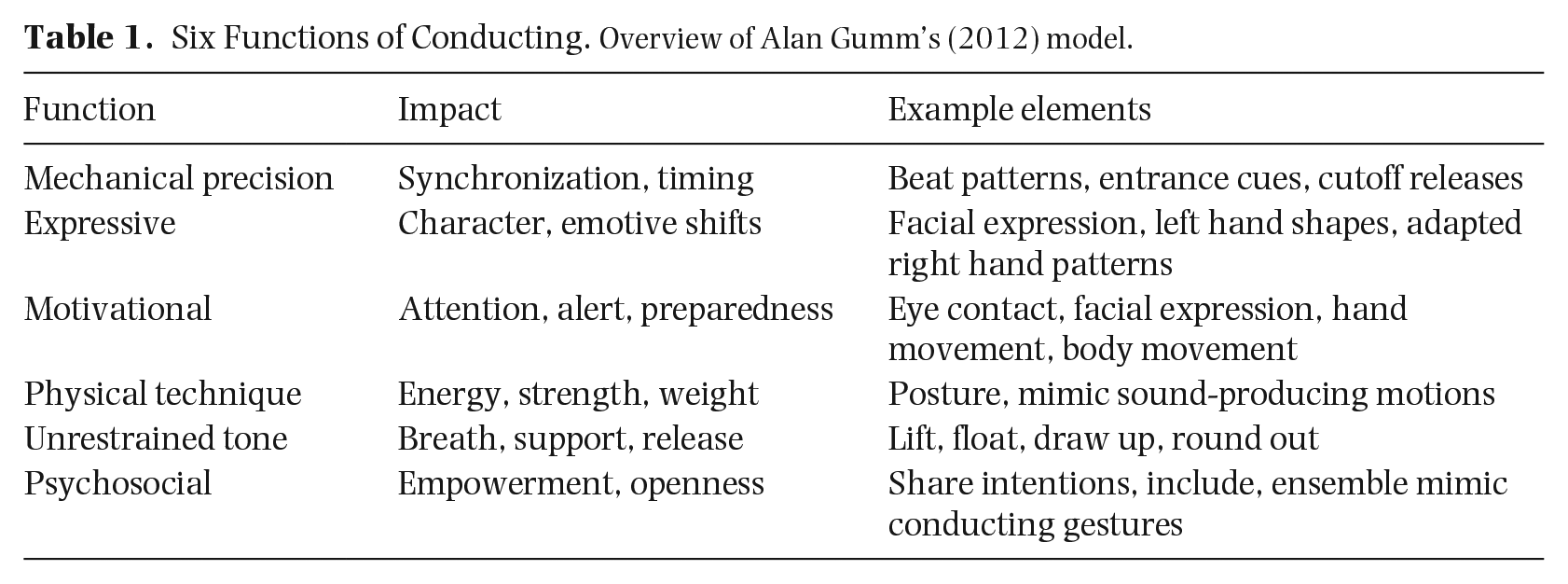
Although all gestures serve the needs of the ensemble, the two first functions focus on the music itself, whereas the remaining four attend specifically to ensemble members. According to Gumm, the functions provide a complete basis for conducting. He states that conductors need a rich gestural repertoire to be able to communicate with a variety of ensembles. Durrant (2003) has provided a simpler taxonomy, where the four last functions are labeled as supportive functions.
Fulfilling the functions of the conductor requires an array of competencies; however, there is no simple mapping between functions and competencies. Durrant (2003) also established a choral conductor competence model that distinguished between musical-technical skills, interpersonal skills, and philosophical principles. Jansson (2018) amended this model by considering situational mastery as an integral part of relational skills and expanding the philosophical platform to include a more comprehensive set of existential features, such as devotion, authority, and will.
All Gumm’s functions require a certain gestural proficiency, a skill set which belongs to the musical-technical category (Durrant, 2003; Jansson, 2018). However, the functions may draw on other competencies as well. For example, the motivational function relies on situational-relational mastery (Jansson, 2018) and the psychosocial function is closely connected to the philosophical principles that underpin a conductor’s professional practice (Durrant, 2003). The practical application of gestural skills may to a larger or lesser degree also depend on other technical competencies, such as vocal technique, aural skills, language skills, and choir acoustics.
Gestural mastery enables key functions of the conductor. However, in rehearsal, the functions are not unequivocally of a gestural nature. Synchronization may be ensured by piano accompaniment, expressivity may be evoked by verbal explanation, and the supportive functions may be enabled by a mix of interventions. In addition to Gumm’s six functions, there are functions that are enacted with other modes of communication, such as error correction, rehearsal planning, and ensemble recruiting. Hence, despite the comprehensive view of gestures offered by Gumm’s model, it does not determine the importance of gestures relative to other features of the role. These other features include relational and existential competencies that are not in any way peripheral but in fact paramount for how choral singers experience great choral leadership (Jansson, 2019). The conductor’s ability to mentor singers, blend control and empowerment, and be present with devotion, sincerity, and authority is rated as more important than gestural skills (Jansson et al., 2021). Notably, this observation does not vary with contextual factors such as ensemble type and singer competence level. Here, the enigma reappears: the relational and existential features are deemed more important than gestures, but at the same time, they are demonstrated as an embodied whole—as a gestural being. A gestural demeanor is always present when enacting choral leadership, but it does not follow that gestural proficiency is always in the foreground.
The phenomenology of conducting gestures
We apply a wide definition of gestures, encompassing the overall appearance of the conductor as well as various bodily features and hand movements. Given the research question and the choice of a phenomenological approach, we appreciate that people use the term in different ways and are rarely precise about its definition. This lack of clarity is a helpful premise to address the role of gestures with an open mind.
Phenomenology has an ambivalent relationship with preconceptions and existing theory. We adhere to a phenomenology that recognizes that pure, uninterpreted descriptions are not possible, that some level of interpretation always comes into play, framed by already lived experience and preconceptions—even when these are bracketed (van Manen, 1990). A hermeneutic-phenomenological description aims to capture essences based on appearance but allows the conscious reflection about existing theory. For our study, the functions of the conductor and the competence model are useful interpretive touch points, which are allowed to inform the study but not impose a particular structure for the research design or the analysis.
Method and materials
An underlying premise is that the enigma primarily exists at the macro level, that is, at the level of education and professional practice. Conversely, at the micro level—in situ, where the music-making situation is precisely given—the role of gestures is more clearly determined. The approach to unpack the enigma was to identify characteristics of situations where the role of conducting gestures is unequivocal and therefore nonenigmatic. We carried out the project as a combined divergent and convergent process. The divergent process sought to expose a wide array of situations where conducting gestures are paramount or, alternatively, where they are easily supplanted or combined with some other communicative means. Such investigation of gestures’ varying appearance, functions, and contingencies represents a phenomenological epistemology. Once the “role of gestures” phenomenon is understood in its diversity, the convergent process sought to find a structure to the variation in the form of classes of contingencies—that is, themes. The work was organized in five steps, where (1), (3), and (4) were primarily of divergent nature and (2) and (5) were of convergent nature:
Interviews with 20 conductors about their professional trajectories and competence development. The results have been analyzed within a social learning framework and reported elsewhere (Jansson & Balsnes, 2020a). This study takes a renewed look at these data with specific attention to gestural skills (Step 2). The interviews were semi-structured, free-flowing peer dialogues.
Interpretation of the conductor interviews seeking to understand what determines the varying role of gestural skills within the composite realm of a conductor practice. The transcripts were coded, using software HyperRESEARCH, where the initial coding was based on situational characteristics and gestural functions. The analysis revealed how the role of gestures varies throughout a rehearsing process, in a way that depends on the music as well as the ensemble. The saliency of the gestural functions also varies across situations, including a difference between choir and orchestra. In addition, conductors may actively shape the role of gestures in their practice. Based on these preliminary insights, we decided to reground the study by expanding the informant base to include the choral singer perspective and opening up the identified issues to ensure that whatever taken-for-granted conceptions could be scrutinized.
Interview with 20 choral singers. Twenty interviews with singers were carried out, 10 in Norway and 10 in Sweden. Informants were selected for variety in terms of music education, choral experience, and choir type. The interview guide was designed to impose as little guidance as possible at every stage throughout the interview to avoid priming the interviewees by anticipating a certain understanding of the topic. The guide adhered to the following principles: (a) We imposed no constraints with regard to how informants might interpret the conductor role, and they were initially not informed about the gestural focus of the study. (b) We were sensitive to the fact that singers may or may not be conscious about gestures and what they mean. (c) We allowed the informants to reflect on gestures without imposing any particular scope of what gestures encompass. (d) There was no premise that gestural skills are more or less important than other conductor competencies. The interviews were carried out by the authors and a group of master’s students of conducting. The following five main questions were asked in this order:
Q1: What do you associate with “choral conducting”?
Q2: Are there choral situations where you consciously think about the conductor’s gestures?
Q3: What does the conductor’s bodily appearance mean to you when you sing?
Q4: How would you describe a gesturally skilled or proficient conductor?
Q5: How would you view gestural skills in relation to other choral leader competencies and behaviors?
The aim of Q1 was to solicit an unprompted reflection of what choral conducting is about. Q2 was intended to identify circumstances (micro or macro) where gestures become the object of conscious reflection. Q3 and Q4 provided increasing opportunity to talk about the specifics of gestures. Q5 invited an elaboration of Q4. A wide menu of follow-up questions was used to stimulate and enrich the dialogue. At the end of the interview, we revealed our research objective and invited the informants to reflect on the enigma.
Interpretation of singer interviews. The aim of the analysis was to establish a wide variety of situations where the role of gestures was unambiguous and nonenigmatic. The sequence of the questions does in itself present eidetic variation, where each question throws a new light on the role of gestures. Also, within each question, the variation continues by contrasting situations and pointing at contingencies. The interview transcripts were analyzed by two of the authors, where analysis by one was reviewed by the other. The first step was to compile all text related to each question. The second step was a hermeneutic-phenomenological writing and rewriting process elaborating our understanding of the “role of gestures” phenomenon.
Development of a thematic structure for the array of nonenigmatic situations. This step consisted of grouping the situations that were captured in Step 4. Some of the preconceptions from the conductor interviews reappeared and additional themes were identified. A theme was deemed distinct and robust when it captured an essence of the phenomenon and could not be aggregated further without loss of clarity. Such an iterative process of thematization implies an abductive logic, which is a conjecturing about the world, qualified by existing knowledge (Timmermans & Tavory, 2012). It involves the constant shifting between what Alvesson and Sköldberg (1994) call theory loaded material and empirically loaded theory.
In total, the material comprises 40 interviews, half with conductors and half with singers. Within each group, half were males and half were females. Age was evenly spread out from 18 to 80 years. The conductors span both professional and amateur choral practices. The interviewed singers were all amateurs, where the majority was highly experienced, with and without formal music education. The project was approved by the national review board (NSD—Norwegian Centre for Research Data) in two rounds as it comprised two separate data collection processes. Terms and conditions for informed consent and statements of consent were exchanged in different formats, depending on the interview setting: as a signed paper copy, as email confirmation, or sound recorded and transcribed.
Analysis
The insights from the conductor interviews were embedded in the guide for the singer interviews in a way that opened up the topic rather than narrowing it. The following analysis reflects a hermeneutic-phenomenological reading of the singer interviews. The sequence of the Questions Q1 to Q5 is of great significance as it moves from an unguided to a guided conversation. The analysis identifies situations and conditions where the role of gestures seems rather clear. By a number of follow-up questions throughout the interviews, as conditions are flipped or modified, the role of gestures suddenly appears quite differently. In sum, the analysis therefore presents a variety of “un-enigmatic nuggets.” Through the Q1 to Q5 sequence, we develop five main themes that describe the role of conducting gestures—with the potential to resolve the enigma.
Q1: Unprompted associations with “choral conducting”
The most notable observation from the informants’ free associations with “choral conducting” is that there was a striking lack of any pattern. Responses ranged from the specific and technical to the relational and existential: Keeping everyone in the choir in the same pulse is super important. The most important of all is that the conductor has a solid downbeat. Conducting is using the body to make the choir do what you want. The conductor is the core of the choir’s soul.
Informants associate with all the gestural functions outlined by Durrant (2018) and Gumm (2012). Some focused on synchronization and ensemble cohesion. Others spoke about motivation, guidance, and inspiration—the supportive and psychosocial function. As informants elaborated upon their reflections, an emerging theme was that movements in themselves are meaningless without intention, which connects gestures with the expressive function. The spontaneous choice of conversational entry point seemed somewhat arbitrary. When informants spoke about conducting or gestures, they relied on different connotations, based on their own experience, competence, and preferences. What informants started to speak about seemed less indicative of the phenomenon itself than what it revealed about the informant. The key insight from Q1 is that both conceptual ambiguity and individual connotations are key enigma boosters.
Q2: Awareness triggers of conductor gestures
Contrary to Q1 responses, where there was no pattern, Q2 responses showed a clear pattern: Choral singers unequivocally become aware of conductor gestures when change of any kind happens. We identified four categories of change: within the musical flow (“text”), in the course of musical process (“context”), related to the singer, and to the conductor. Being exposed to a new conductor was the most explicit change. Singers inevitably noticed the style and peculiarities in the first encounter with a new conductor. Similarly, singers’ awareness waned as they grew accustomed to a conductor. Singers in choirs with project conductors, such as philharmonic choirs, were constantly made aware of gestural communication. Changes in the musical flow were also explicit triggers of awareness of gestures, for example, start, stop, entry, tempo changes, and emotive shifts. The complexity of the musical material was a key driver of gestural “needs.” Different genres also called for different blends of gestural functions.
Changes in the course of the musical process are, however, more subtle. Informants noted that gestures evolve through the phases of a musical process, from the introduction of new material, through rehearsing, to final perfecting and performing. The status of gestures relative to other means of communication may change, partly due to what is available and partly due to what singers appreciate. Singers rely totally on gestures in concert, whereas they may not observe them in the introductory phase—barely looking up from their sheet music. Throughout the musical process, singers’ receptivity for gestural communication changes, depending on the singer competence level. Competent singers have the capacity to attend to conducting gestures in parallel with their own learning issues. Singers may also have to make an effort to make gestures matter: [I am conscious of gestures] all the time. I look at the conductor a lot. I try to know my things by heart, so that I can look at the conductor and pay attention as much as possible.
In this case, the singer’s receptiveness is not externally given but is nurtured and enhanced by deliberate action—memorizing the score.
Conducting gestures also affect singers when they are not consciously aware of them. In fact, reflection may not even be a primary mechanism in making conducting gestures work.
For the most part, it is unconscious, it just happens. But sometimes there are moments when I think “oh, that was nice, that was a nice way to conduct, that was a nice way to express the music.” Or, I think the opposite—“this was unclear, I don’t know where he or she is going”—and something unwanted happens.
Within the musical flow, gestures may move to the foreground or background depending on the demands of the music and the conductor’s ability to meet those demands. Both the particularly appealing and the dysfunctional can move gestures into conscious awareness (foreground) from a slumbering awareness (background). Because foreground and background are individual perceptions, singer competence and preferences shape the evolving receptiveness.
Q3: Scope of corporeal-gestural feature
The conceptual ambiguity observed in Q1 seemed to work in a limiting fashion—it did not expand the role of gestures, unless prompted. The aim of Q3 was to invite the singers to reflect on the entirety of the visual appearance of the conductor. When prompted, these distinct corporeal facets were suggested: posture, breath, facial expression, eye contact, and overall gestalt—as well as hand movements. In principle, all these may serve each of the gestural functions. It would be an oversimplification, for example, to attach each gestural function to a specific blend of bodily appearances, such as associating synchronization primarily with hands, expression with eyes, and support with breath.
Unprompted reflections on gestures gravitated toward hand movements, and the informants had to be guided toward a broader scope of corporeal-gestural features. A few informants stayed with the prominence of hands and expressed a certain obsession with rules, downbeats, and straight gestural lines. However, as the interviews evolved, the overarching pattern was that some sort of euphoria emerged when informants “discovered” these were in fact an integral part of the overall conductor appearance: Everything a conductor does affects the choir. If the conductor is low on energy, so does the choir. If the conductor is super-focused [informant demonstrates what it looks like], the choir becomes super-focused. It is mirrored. I would say that the conductor’s body movements mean everything. Breath is very important, but I believe that eyes are very, very important.
Singers want eye contact—now and then—but not too much. Eyes can become invasive. Eye contact is two-way communication, but singers may experience that they are “being seen” also when not looked at. “To see” is not so much a visual phenomenon, but a relational one—the willingness to be with the singers. Eye contact enables all gestural functions; they are key in voice entries (indexal), convey emotions (expressive), and confirm being in it together (supportive). Being seen can be an intense experience, and it can creative inclusiveness as well as being invasive. This duality is an explicit manifestation of the enigma.
The gestalt is the conductor’s inner state that becomes visible as a whole, but it may even include features such as body size and attire. The gestalt may convey a range of existential states, such as presence, power, will, preparedness, oversight, conviction, passion, warmth, dynamism, and restraint. One singer used the word “contagion,” in a positive sense, to describe how he is affected by the conductor gestalt. Posture comes from grounding, the direction of the spine and the position of the head. Posture signals the balance between preparedness and ease. Its function is primarily supportive but may also be expressive.
Q4: Characteristics of gestural proficiency
Responses to Q4 highlight a certain conceptual ambiguity as informants during the conversation sought to verify what to include in their understanding of gestures. The common theme expressed by the informants is that gestural proficiency implies “clarity,” which underscores its communicative rationale. Here lies a tension between conducting gestures as universally accepted conventions and individual style (Jansson & Balsnes, 2020b). Clarity comes from some level of standardization because a gestural style cannot be overly individualistic. At the same time, expressivity means that the conductor embodies the music, which is a manifestation of subjective intent and individual predispositions. A key source of clarity is the avoidance of superfluous movements: [A proficient conductor is] someone who is able to bring out the greatest possible effect with least possible affective material—minimal gestures. That it is a condensed and unambiguous conductor.
Clarity comes from a combination of conveyance of intent and economizing with gestural means. However, informants noted that while clarity is desirable, it cannot be absolute: There is a scale between precision and freedom. It is important to strike a balance and find space for the choir’s voice and warmth and friendliness that is beyond precision.
There seems to be a rather elusive balancing point between what is sufficiently clear to provide ensemble cohesion and sufficiently unclear to afford self-determination and a certain level of unpredictability and risk. An underlying premise for this balance, however, is a sense of security on the part of the singers. Informants saw gestures as the emblem of authority and reassurance that comes from knowing the music and the ensemble. One informant offered a pertinent reminder that gestures cannot be understood solely in terms of function: I really enjoy beat patterns and that a beautiful technique offers clarity, a feeling of control, and is aesthetically appealing.
Gestures serve a meta-purpose; they make control an object of beauty—the medium is the message, so to speak. Conductors may make gestures matter more by catering to the full range of singer needs, and proficiency expands the possible role of gestures. However, whenever singers are not receptive to visual guidance—struggling to orient themselves in the score, for example—gestural proficiency is of little value (Durrant, 2009).
Q5: Gestures’ position in the conductor gestalt
Interview Q5 explored gestural skills relative to other conductor competencies. This question does, however, impose one particular way of looking at gestures—as a distinct attribute apart from other role features. Informants responded easily within this perspective, and the overarching pattern revealed how they, in a variety of ways, articulated the subordinate role of gestures.
[Gestural skills] are a foundation, but it’s so much more. It’s relational competence—sensitivity to people. Aural skills are probably the most important. You can in fact conduct a choir without a very good technique or even know the beat patterns. You can still have a goal with what you do, and you can still have the relational skills. As long as you are musical, you can lead a choir.
Even an informant who expressed the opposite opinion—that the gestural ability to ensure rhythmic accuracy overrides everything else—was confined to a narrow understanding of gestures.
The alternative view is that gestures are inseparable from the whole human being and the appearance of the conductor gestalt. Despite the biased question, some informants insisted on an expanded view.
For me, the conductor’s musicality, power, and energy are expressed through gestures. That’s where I take part in the conductor’s musicality. I can’t read the conductor’s brain. The conductor must somehow show me.
Q5 strikes at the heart of the enigma—gestures are everything because they are the embodiment of the choral leader act and gestures may be subordinate to other features that are valued independently or despite their appearance. The conceptual ambiguity that contributes to the enigma may therefore have a more fundamental root cause; the role of gestures is ontologically unstable as its guise shifts between the whole and specifics, between being and doing. The challenge is that the embodiment of the choral leader is a wider notion than the appearance of the choral leader. Substantial aspects of the leader, such as hearing, motivation, judgment, ideas, and knowledge, do not necessarily surface visibly in every ensemble encounter but they are still at work. Even a wide conception of gestures therefore does not completely capture the entire choral leader gestalt.
Emerging themes
The structure of Questions Q1 to Q5 reveals different facets of the role of gestures. Each question elucidates one or more recurring themes that each captures a key dimension of why and when conducting gestures are absolutely crucial and why and when they are of no consequence. Five distinct themes were identified:
T1. Complexity of the music material
T2. Irreplaceability of gestures
T3. Singer receptiveness to conductor gestures
T4. The conductor’s gestural proficiency
T5. Conceptual disambiguation
When developing the themes, we observed that some contributions were particularly salient. For example, the notion of complexity of the music material (T1) is first and foremost substantiated by awareness triggers (Q2) and the characteristics of gestural proficiency (Q4). The irreplaceability of gestures (T2) also draws on awareness triggers (Q2) but even more importantly the role of gestures in the conductor gestalt (Q5). Although a number of rather specific substantiations of a theme can be found in the analyses of Q1 to Q5, the thematic structure is nonetheless a result of the data set as a whole.
Discussion
Each of the themes T1 to T4 presents at their end points situations where the role of gestures is rather unenigmatic. We therefore view them as “enigma busting” dimensions. With well-prepared singers performing complex music in concert with a gesturally proficient conductor, gestures are of great significance. Conversely, gestures may not matter at all in a campfire sing-along with guitar support. These end points all together represent the two simple situations where gestures are either paramount or marginal, as depicted in Figure 1. More importantly, the themes allow the consideration of the limitless number of in-between situations.
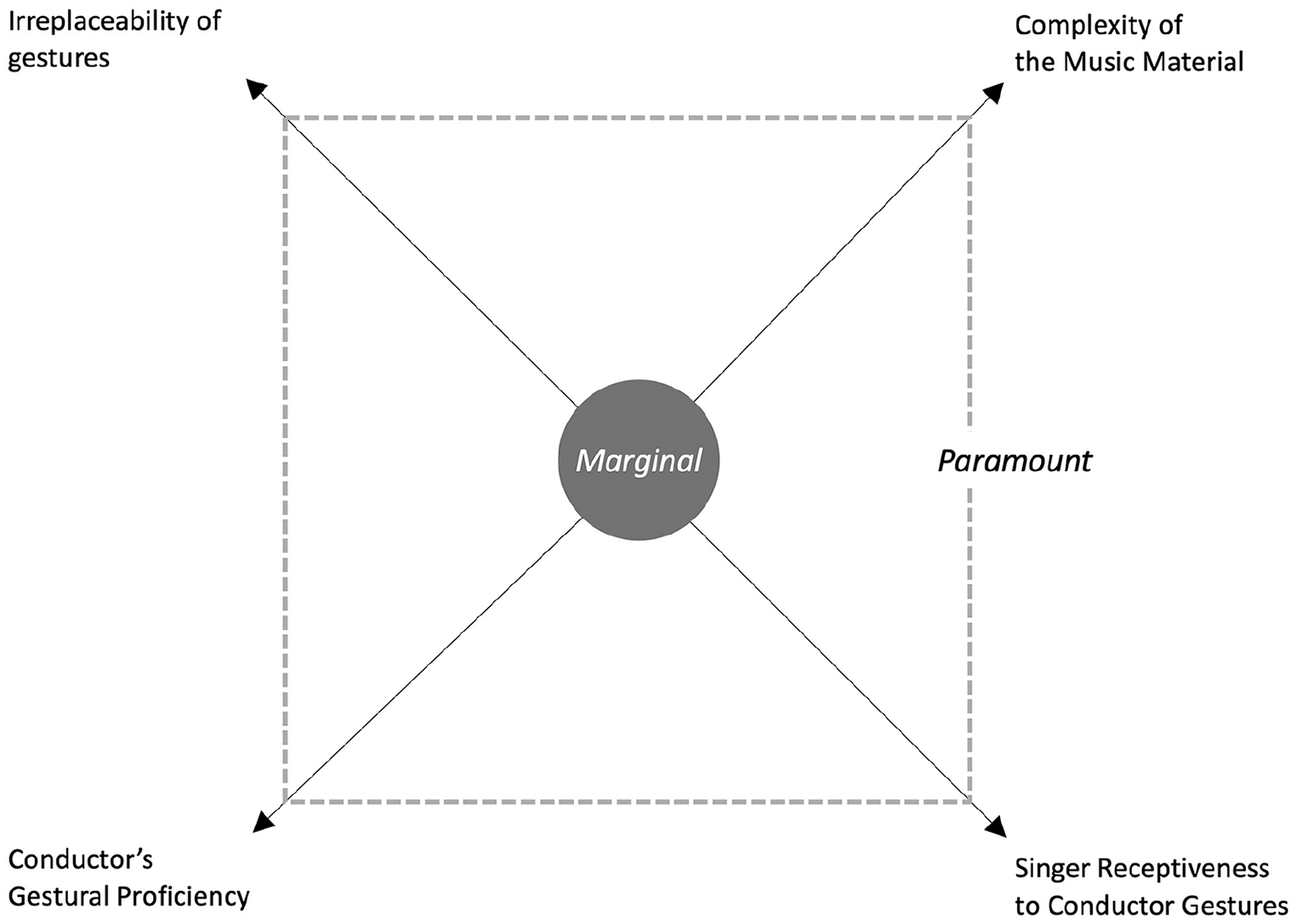
End Points of Conducting Gestures’ Importance.
The four dimensions are conceptually distinct; however, they are interdependent when applied to specific cases. Complexity of the music material determines the need for gestural communication. It is, for example, hard to imagine a successful performance of Britten’s Rejoice in the Lamb without clear and unambiguous beat patterns in highly rhythmic sections with quickly changing time signatures. Expressivity is to a large degree embedded in the timekeeping itself. The indexal function of gestures is even prominent in the rehearsing process, suggesting a high degree of irreplaceability. Nonetheless, the beat patterns are only irreplaceable if the conductor is in fact able to do them and the singers are able to look at them.
A different kind of gestural communication is called for to make Mozart’s motet Ave verum expressive. The indexal function may be less prominent, but the supportive and emotionally present conductor may enable a vibrant performance. The irreplaceability of gestures here appears in a different guise than in the Britten example. It also suggests that the notion of gestural proficiency is not always straightforward because mastery is somewhat context-dependent. It is more than a rhetorical question to ponder how the scholarly professional conductor would fare in front of the school choir.
While the needs of the music are discussed in terms of objective features, they are served through the subjective needs of the singers. A particularly aesthetically appealing gesture may create a moment of awe, and the converse can cause the musical flow to collapse. Singer receptiveness and conductor proficiency therefore combine in a joint meaning-making process. Conductors do not always understand what they bring. Few conductors have the benefit of feedback on their gestural proficiency and which aspects are most meaningful for the ensemble. Other researchers have also pointed at how ensemble member experience is key to understanding conductors and that competent musicians get by even with unclear gestures (Byo, 1990; Luck & Nte, 2008). It complicates the subjective nature of receptivity that ensemble members have been found to be poor judges of how gestures affect them, for example, appreciating conductor expressivity independently of the sounding music (Bender & Hancock, 2010; Napoles, 2013).
The role of gestures is too multifaceted to be considered on a single axis of importance. The enigma arises because we can always construct a situation that deviates from this simplicity. This study reveals that the role of gestures must be considered a multidimensional phenomenon, which concords with Sandberg-Jurström’s (2009) multimodal view of the conductor role. We have identified four dimensions that determine the role of conducting gestures. Importance is then no longer a scale, but shapes in this multidimensional space—there are different forms of importance. In fact, there is an endless number of shapes that cannot be ranked but assume different qualities of importance. Four example qualities are shown in Figure 2.
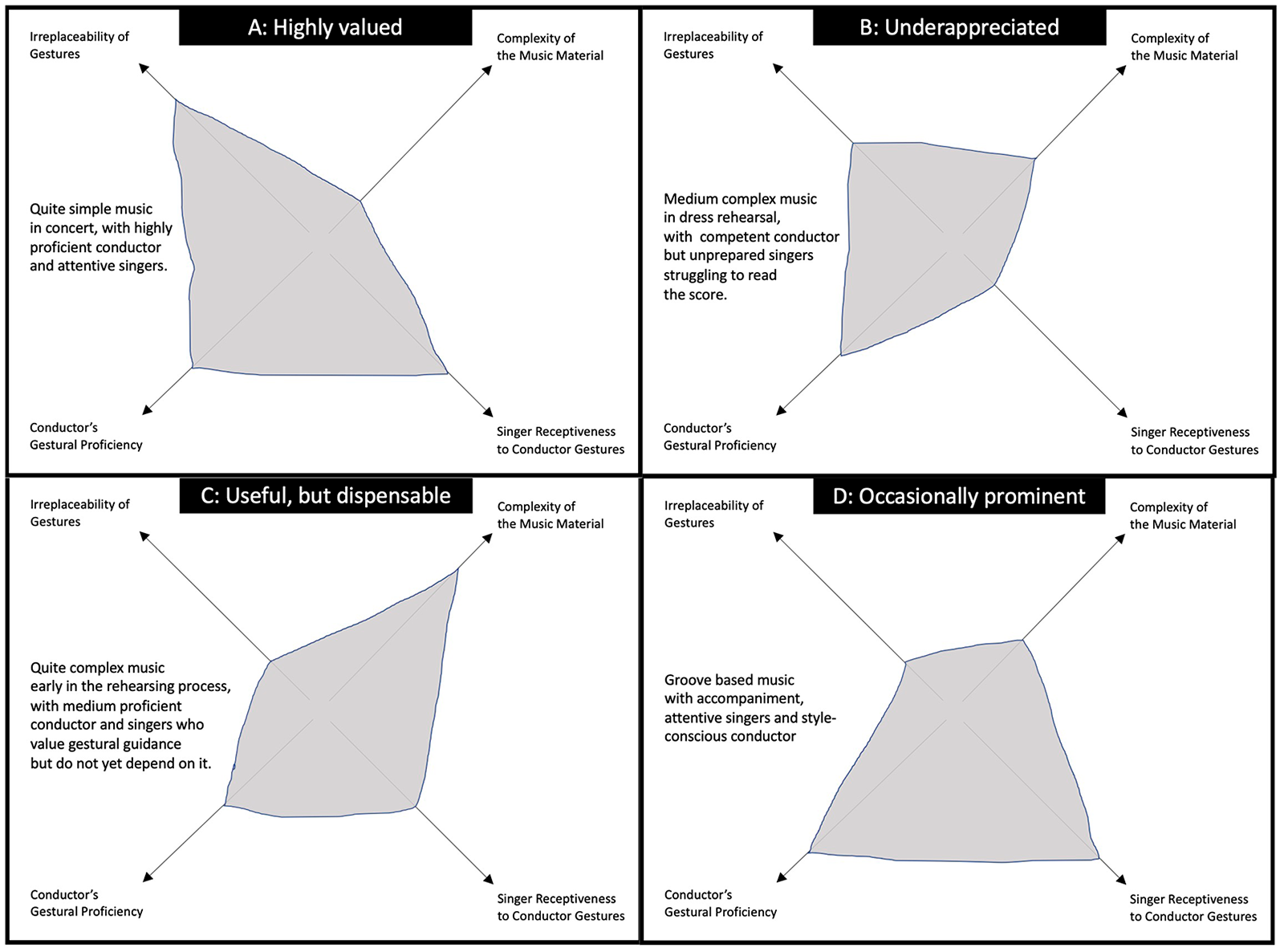
Qualities of Importance of Conductor Gestures in Four Example Situations. The Shapes Illustrate How the Four Dimensions (Arrows) Determine the Role of Gestures in Each Situation.
While the four enigma-busting dimensions in Figure 2 capture substantial aspects of gestures, the fifth theme of conceptual disambiguation would certainly help to demystify the role of gestures. However, even with the widest and most comprehensive definition, we are left with an ontological duality that eludes unpacking. In the sounding moment, conductors “do” gestures across all of Gumm’s (2012) six functions in the shaping of the musical flow, but they also “are” gestures—an embodied human being. The singer statement that “the conductor is the core of the choir’s soul” ennobles being rather than doing. But when a controlling gesture is perceived as beautiful doing, it draws on the full range of existential qualities of the conductor being—passion for the music and devotion to the ensemble.
For conductor practices, especially for experienced conductors, our findings call for increased self-reflexivity as part of their ongoing development and continued education. An implication for educators is that conductors not only need to learn to conduct but also understand when gestures are crucial and when they are of marginal importance. Beyond the establishing and security of basic beat patterns, students of conducting need the time and environment in which to explore and experiment with a range of communicative modes in active, analytical, and reflexive settings with singers. Conductor practice in a live choral environment is crucial. The complementary use of video recording may promote critical analysis and self-awareness of the impact of gestures. The value of continuing education here in the form of workshops and long and short courses for choral conductors at their various levels of competence and experience should not be underestimated.
Research on conductor gestures needs to be more explicitly situated with regard to music genre and complexity, stage in the musical process, as well as singer and conductor predispositions. We suggest that the model can be used as a tool for further research into conductor gestures, whether the research aims are of pedagogic of artistic nature.
Footnotes
Acknowledgements
We would like to thank the 2019 master class of choral conducting at the Academy of Music and Drama in Gothenburg (Sweden) for their contribution in interviewing choral singers.
Declaration of conflicting interests
The author(s) declared no potential conflicts of interest with respect to the research, authorship, and/or publication of this article.
Funding
The author(s) received no financial support for the research, authorship, and/or publication of this article.
Ethical approval
The project is approved by the Norwegian Centre for Research Data, in compliance with standard ethical guidelines for research.
