



Abstract
Making sense of musicians’ professional learning pathways is of crucial importance to understanding their career progressions, their routes into creative employment, and the relevance of various policies to their professional lives. However, this is a far cry from understanding how critical reflection catalyzes diverse learning routes, especially when considering evidence originating from postgraduate musicians’ own accounts of their journeys into job creation. In this study, we invited five postgraduate classical musicians who were invested in professional learning through performance programs in higher education to contribute these types of personal perspectives. The article explores the value of postgraduate musicians’ own accounts of their journeys and illustrates how a more nuanced understanding of them can be arrived at through the use of visual-based tools, for example, Rivers of Musical Experience and Dixit Cards. This constructivist intervention prompted both group and individual critical reflections, as well as sense-making processes that enabled the participants to become more informed about the (typically overlooked or neglected) critical incidents that differently catalyze professional learning pathways. All of the participants articulated sociocultural influences that were situated along historical, present, and future points of departure and arrival, helping them to create meaning and understanding of themselves and their (at times unsettling) professional learning pathways. From the ensuing thematic analyses, we identified a commonality of themes across life phases with three key influential groups of people (parents, peers, and professionals) that strongly affected their professional learning pathways and learner identity-construction. The results indicate that the relationships between these phases and people are complex. The research illuminates the previously unexplored connection between the meaning-making trajectories that are instantiated through critical reflection, and adds to our understanding of the development of musicians’ professional learning pathways and learner identities.
Keywords
Postgraduate musicians require specialist support to grow professionally and to engage reflexively in these challenging times (e.g., López-Íñiguez & Bennett, 2020, 2021). Large numbers of postgraduate musicians return to university settings to complete Higher Music Education courses to acquire new skills. Professional learning opportunities, as exemplified for postgraduate musicians, involve some of the most complex and fast-moving work contexts in existence (e.g., Burnard, 2019). The professional learning pathways and learner identities of musicians are understood as dialectical, dynamic, and fluid (Lawson, 2014; Turner & Tobbell, 2017); as living phenomena maximizing the impact of chances and choices during the process of finding or creating new music careers (see recent report in the United Kingdom by Bloom, 2020). In a study of identity and its relationship to cultivating a music career, Hracs (2010) found that self-reflexivity is increasingly important to the ways in which professionals engage, seize opportunities, and manage risk across their practices. Fostering the development of professional learning pathways for postgraduate musicians involves adapting and developing innovations that they perceive to be pragmatically valuable; however, trying their best to dutifully learn from critical reflection practices in their professional life may not align with or be supported by significant changes in the professional learning pathways of the careers of postgraduate musicians.
Determining what really matters to how musicians’ professional learning pathways are evidenced in career decisions is problematic at best, and is also rapidly shifting given the current global pandemic. In this study, we define professional learning pathways (expanding the concept of “learning pathways” previously studied in musical improvisation by Després et al., 2016, to professional studies) as the constructed route that learners build through and outside their training programs to discover new ideas, pursue their interests, and develop their skills—trajectories that are necessarily relational and contextually constituted (e.g., Moran & John-Steiner, 2004). However, inequalities within the highly competitive fields of live performance and recording within the music industry are manifested at every level, from finding jobs in professional ensembles to securing commissions to record studio session gigs (Bennett, 2008). The field is still shaped by institutionalized hegemonic systems that contribute to a legacy of professional capital, established networks, and who-you-know/masculine and racialized privilege (Martin et al., 2019).
So, why is it that the overall professional learning experiences of musicians tend to be reported as either lacking credibility or sustainability, or as being not very powerful interventions, reified as episodic events without professional relevance (Schediwy et al., 2018), neither facilitating nor enhancing the prospects for career success (Ziechner et al., 1987)? In contrast, we know that in other fields, for example, teaching, professional learning pathways can facilitate the achievement of career success (Young & Collin, 2004). This situation is a far cry from the urgent calls (e.g., Burnard & Stahl, 2021; López-Íñiguez & Bennett, 2020, 2021) for professional learning to be responsive to how musicians learn, to have more influence on musicians’ professional learning pathways, and to develop the role of critical reflection in professional life.
Even more urgently, considering how fast things have changed during the Covid-19 global pandemic, we find these previously identified difficulties in navigating learning (and future-making) pathways for postgraduate musicians combining with a lack of ensemble and solo performance opportunities. Many musicians are struggling to survive and cultivate strategies to overcome the limitations and complexity of musicians’ professional learning pathways and careers (Bennett, 2019; Gill & Pratt, 2008). So, how do postgraduate musicians reflect critically on their own professional learning pathways, and how does this inform their future? For now, at least, there is no clear answer to this question. But one thing we do know is that an understanding of critical reflective strategies (using tools like the ones we present in this study) can enhance and catalyze change for artists and music professionals alike, as individuals who want to design a successful career in music and re-position themselves as learners for the coming changes (Zhukov, 2019).
In this study, which ended exactly a week before the pandemic put the European country where this study took place into a lockdown (end of March 2020), we asked questions that, despite being different than those mentioned above, also need to make use of critical reflection processes to be answered. For instance, how do musicians’ professional learning pathways reflect self-discovery, and how do they learn to navigate such unequal and challenging systems? How do they transfer these lessons to inform changes to their professional learning pathways? How do they use critical reflection strategies and concern themselves with developing the skills necessary for self-sufficiency when, in reality, such professional learning requires time and skills that are not easily accessible? How do professional musicians remain distinctive within the oversaturated sea of individual artists? How salient is the journey of self-discovery for postgraduate musicians for determining how they feel about and prioritize certain decisions, incorporating the opinions of family, friends, peers, and prominent role models in their life? How do musicians self-propel changes to their professional learning pathways in response to critical incidents?
Classical music education has been slow to react to this situation—which concerns social class, gender, and Whiteness, or economic inequalities (e.g., Bull, 2019)—failing to adopt what is now a normal method of operation in the visual arts and design, where professional learning happens in collaborative group work contexts that are valued as an end-product alongside individual creative output. It is argued here that a new set of skills is required to produce musically competitive work, and that these skills are located in critical reflective practices, and reflective management and organization, as much as they are in musicianship. Higher education requires postgraduate musicians to carve out new professional learning pathways, and there is a need to help postgraduate musicians develop their own learner identities, which can in turn make possible ongoing future-making learning, as suggested by López-Íñiguez and Bennett (2021). In this context, future-making education refers to reflecting critically together so that we can act together to make the futures we want, to make change possible (Burnard & Colucci-Gray, 2019).
As studied in the field of music performance, higher (music) education has overlooked the individual training experiences of students, producing the so-called “skills and knowledge gap” (Carey et al., 2019; Toscher, 2020). For instance, instrumental classical music instruction—where this study is focused, as it has powerful currency educationally (e.g., Bull, 2019)—remains rooted in traditional approaches that do not support agency, autonomy, and motivation in students. In addition, the overall training of students in many higher (music) institutions lacks an integrated education model (i.e., subject-based curriculum) that would offer chances to equip/engage them in “industry-ready” talk and the development of professional (e.g., collaborative, interdisciplinary, working, entrepreneurial) literacy and transferable, metacognitive, and technological skills and critical-creative thinking. The effects of this education model have led students to narrow their learning interests to exclusively mastering the craft of their instrument (Burland & Pitts, 2007; MacNamara et al., 2008), and top professional performers have acknowledged that music education did not sufficiently prepare them for their multifaceted careers and the continuous professional challenges they face (e.g., López-Íñiguez & Bennett, 2020).
Furthermore, music universities and conservatoires, as social spaces where learning takes place and learning cultures develop, can have a strong effect on students’ learning and positioning within educational institutions (e.g., Burt-Perkins, 2013a, 2013b). To navigate this effect, it is imperative to engage in critical reflection practices, and one potential way to improve this aspect is the analysis of critical incidents—or turning points—that stimulate (both positively and negatively) times of change and choosing into and across future-making careers in music (in line with Denicolo & Pope, 1990; Griffin, 2003; Halquist & Musanti, 2010). This is the ability to make sense of an uncertain future by (a) examining the expanding nature of practice in the field, and (b) exploring creative and transgressive approaches to navigating the profession.
Critical incidents and learner identity in professional learning
In this article, we follow Falsafi and Coll (2015) in the field of Constructivist Psychology of Education, for whom learner identity is . . . the set of meanings that we build on ourselves as learners and that allow us to recognize ourselves as such. It is the reference from which people construct and attribute meaning to learning experiences. We attribute (or not) a meaning to learning experiences and to what we have learned, learn or hope to learn, and we attribute one or the other sense to it depending on how we position ourselves as learners in situations and activities—past, present or future, relational or imagined—to which these experiences refer. (p. 17, translation our own)
According to Valdés et al. (2016), in their studies at the university level in fields other than music, critical incidents, or turning points, and key experiences in one’s life confer on individuals an identity as learners. In addition, these authors establish a clear connection between the formation of a learner identity in graduate students and the diverse acts of recognition (e.g., giving an award, positive reinforcement/assessment) and rupture (e.g., preventing students from learning and professional opportunities, patronizing attitudes aimed at harming the confidence of students) by different stakeholders surrounding them (teachers, family members, colleagues). These authors argue that such acts of recognition and rupture might lead to meaningful destinations in their professional learning pathways (see also Yair, 2009).
However, despite the interdependent connection between identity construction and learning, as studied in professional development in fields such as the constructivist psychology of education (e.g., Coll & Falsafi, 2010), narrative theory (e.g., Sfard & Prusak, 2005), and the sociology of education (e.g., Jarvis, 1997; Woods, 1997), there has been little research on such experiences or turning points in relation to the learner identities of students in educational settings (Valdés et al., 2016; Yair, 2009). Furthermore, although there are a few studies in professional music studies concerning music teachers and adult learners (Coutts, 2019; López-Íñiguez & Coutts, 2020), there is no evidence of such research involving young postgraduate instrumentalists.
Thus, there is a need to better understand how these transformative experiences affect individuals’ self-recognition as professional learners, and their positioning toward more or less meaningful professional learning activities and situations across their learning cycle, in which others’ acts of recognition of ourselves as learners are crucial to our development and our engagement in lifelong learning (Falsafi & Coll, 2015); in this case, in relation to the future careers of emerging musicians. This type of work has an effect on the cognitive and emotional learning of individuals in connection to their self-discovery and their positioning relative to their learning and career trajectories (Yair, 2009).
Turning points in various phases of postgraduate musicians’ careers
In the field of music education, there has been work on the analysis of autobiographic memories of children and young pupils in music learning settings that uses the approach of critical incident charting. This research has focused on annotating key turning points or significant episodes in the Rivers of Musical Experience—a constructivist technique to promote critical reflection—among such populations (i.e., Burnard, 2012). It is understood here that critical reflection is a process of identifying, questioning, and assessing our deeply held assumptions about what we know and who we are being/becoming, feeling, and doing, as well as a critical process of being skeptical toward existing knowledge to dismantle hegemonic practices. However, no such studies have been conducted on postgraduate classical musicians enrolled in higher education.
Purpose of the study
In this study, we were interested in analyzing how classical instrumentalists enrolled in higher music education describe their professional learning pathways through the recall of autobiographic memories. Particularly, we attended to the elements that affected their changes and choices across their paths. In addition, we wanted to achieve an in-depth understanding of the issues identified by each participant and their articulations of mobilizing change strategies, and to help them reflect critically on the meanings they ascribe to their experiences and their desired future directions in music as lifelong learners. The following questions guided our research:
Research Question 1. What is the role that catalytic/significant critical incidents play in professional classical musicians’ professional learning pathways and subsequent/potential identity (de-) construction? (What evidence?)
Research Question 2. Who or what do professional classical musicians identify as the key people/events/places influencing their professional learning pathways and (subsequent) perceived learner identity construction? And when and in which ways have they influenced/contributed? (What matters?)
Research Question 3. What is the potential role played by critical reflection through visual-based tools as a driving force for professional musicians situated in the context of postgraduate programs in higher music education? (What contributes?)
Method
Design
This is a critical incident case study (Weatherbee, 2012) in which we employ a psychosocial lens (Denicolo, 2003) approach to (a) elicit the participants’ construction of experiences into and across careers/studies in relation to places, events, and people and (b) explore particular types of events or incidents that are perceived to be significant—through post hoc analyses—in some way in relation to the topic studied.
Sampling
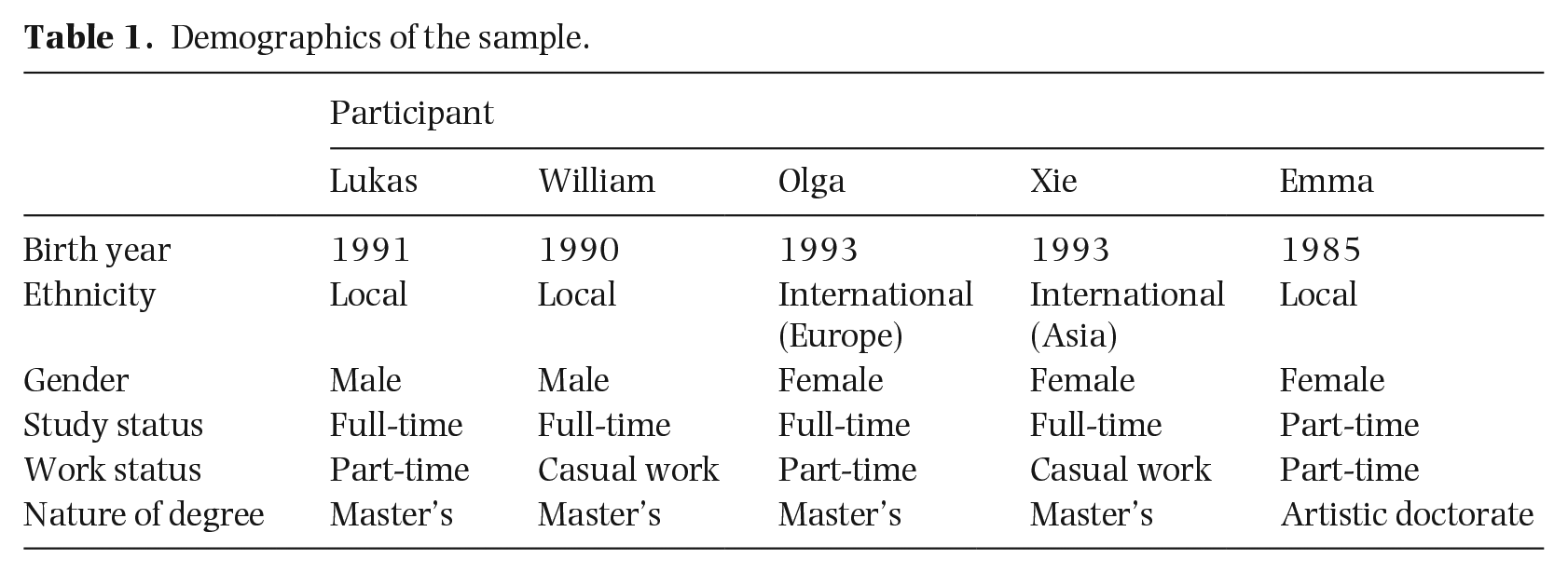
We purposefully selected five classical cellists who come from different nations in Asia and Europe, with a mix of socioeconomic backgrounds, for maximum variety between them (Stake, 2005). The reason to select cellists is based on our interest to seek coherence and cultural alignment in terms of the specific aspects they share as music performers involved in postgraduate studies who are exposed to similar repertoires and instrument-specific methods (in line with Cook, 2006; Davidson & Coulam, 2006). The participants were exemplary of postgraduate musicians who made a choice to further their education by enrolling in master’s and doctoral study programs for classical music performance at a European Higher Music Education institute. The participants were aged between 26 and 34 years of age at the time the research was conducted. There were two males and three females. The participants were chosen as representatives of musician students in transition from university studies to the employment stage. While all were enrolled full-time in mainly master’s programs (just one was enrolled in a doctorate program), they were all engaged in either part-time (in this context meaning working fewer than 15 hr per week) or casual work (occasional work for short periods with no contractually guaranteed hours, generally paid hourly), by playing a few gigs as freelancers per year or teaching music as substitutes with short notice. All participants were available and willing to participate, and proficient in written and oral English. The names of the participants have been changed to protect their anonymity (see demographics in Table 1).
Demographics of the sample.
Procedures
All participants took part in a 90-min research-based seminar series given by the first author (Spring 2019–Spring 2020 in the Northern hemisphere), with the purpose of offering postgraduate classical musicians a critical event/experience within a group of peers (in line with Woods, 1997) focused on integral and specific aspects of musical training that were lacking in their personal study plans in higher music education, and which were linked to musicians’ careers and generally rounded education. These included topics such as musical competence, approaches to learning, musical and professional identities, conceptions of teaching-learning instrumental music, employability and careers, self-regulation and self-determination for performance optimization, canonical music performance practice, and professional program notes writing.
The seminars included a combination of lectures by the first author and occasionally by invited experts, preparatory research reading, watching videos on the aforementioned topics, individual and group reflective and role-playing activities, completing questionnaires and surveys, narrative writing, and collaborative discussions. Originally, these seminars comprised seven students; however, two of them left the process part way through the study as they moved abroad.
The seminars took place at the same institution where they were enrolled as part of their optional studies, for which study credits were added to their personal degree records, following the European Credit Transfer and Accumulation System (ECTS). The researcher accessed the participants via an open invitation to participate in the study, sent by the Head of the Department in charge.
Ethics
Ethical approvals were obtained prior to the study from the Research Ethics Committee at the university where the study took place. Students signed consent forms following the guidelines of the local Advisory Board on Research Integrity, and students were not obliged to participate.
Data collection tools
Once the seminars were concluded, the first author offered a session on Critical Incident Charting (i.e., Kelly, 1955; see also Webster & Mertova, 2007, in narrative research; or Schluter et al., 2008, in the field of nursing) as a constructivist visual tool that helps individuals to reflect critically on and identify/elicit the most crucial aspects related to their professional learning pathways. This tool was adapted to the music education field as “Rivers of Musical Experience” by Burnard (2012), in its first iteration with children (2000) and then in the context of teacher education (Burnard, 2006, 2008). For this, exercise instructions were given to annotate key turning points, critical incidents, or significant episodes in their professional learning pathways as musicians. The participants refined their data sheets for 6 weeks—at home and individually through critical reflection—in connection to the knowledge gathered during the seminars, responding to the question “What are your rivers telling you about your music career and education in connection to the topics we have learnt?” This served as a suspensive moment of their own analysis of their reflexivity.
After that, the first author presented the participants with an activity adapted from the official Dixit boardgame (using a selection of 32 cards from the Odyssey and Revelations sets) to support the participants in re-examining their Rivers of Musical Experience to synthesize their ideas and gather insight into each participant’s stories through progressive focus. This is a visual prompt/elicitation tool for reflecting more deeply on the previously identified sociocultural elements affecting the participants’ professional learning pathways—the cards acted as catalysts to go deeper into the meta-concepts that united or divided the five participants. These particular metaphors are a form of A/r/tography
1
that functions as a creative pedagogy and helps not only in expanding on, but also triangulating, the aspects identified in the Rivers of Musical Experience. For this, the participants were given the following instructions: We found that parents, professionals (including teachers and performers) and peers are the 3 characterising features that influence postgraduate musicians’ careers. Is there a card on this table that speaks to you about them? If so, please choose a card for each group, and then talk about this card. Is there anything special that you have learnt by choosing these particular cards?
It is important to note that these cards also serve as respondent validation, because they help to confirm/verify or reject the interim analytic ideas found in the Rivers of Musical Experience, similar to the process of internal consistency utilized by Atkinson (2001) for the analysis of narratives. Overall, the study conforms with the implementation of methods triangulation to address issues of reliability and validity (i.e., Patton, 1990). In particular, we refer to both data and method triangulation (in line with Janesick, 1998) in which we use multiple data sources (responses to visual-based stimulus, a variety of participants), and multiple methods (Dixit boardgame, Rivers of Musical Experience, life story interviews) in the same study.
Thematic analytic approach
We first followed the interviewee–interviewer charting method to identify the main critical moments of change and choosing included in the Rivers of Musical Experience of each participant, following the premise that “a narrative is co-constructed around incidents that both interviewee and interviewer consider highly influential” (Burnard, 2012, p. 171). Graphics of each participant’s stories were created according to their life phases, equally identified across cases (see Figures 1–5).
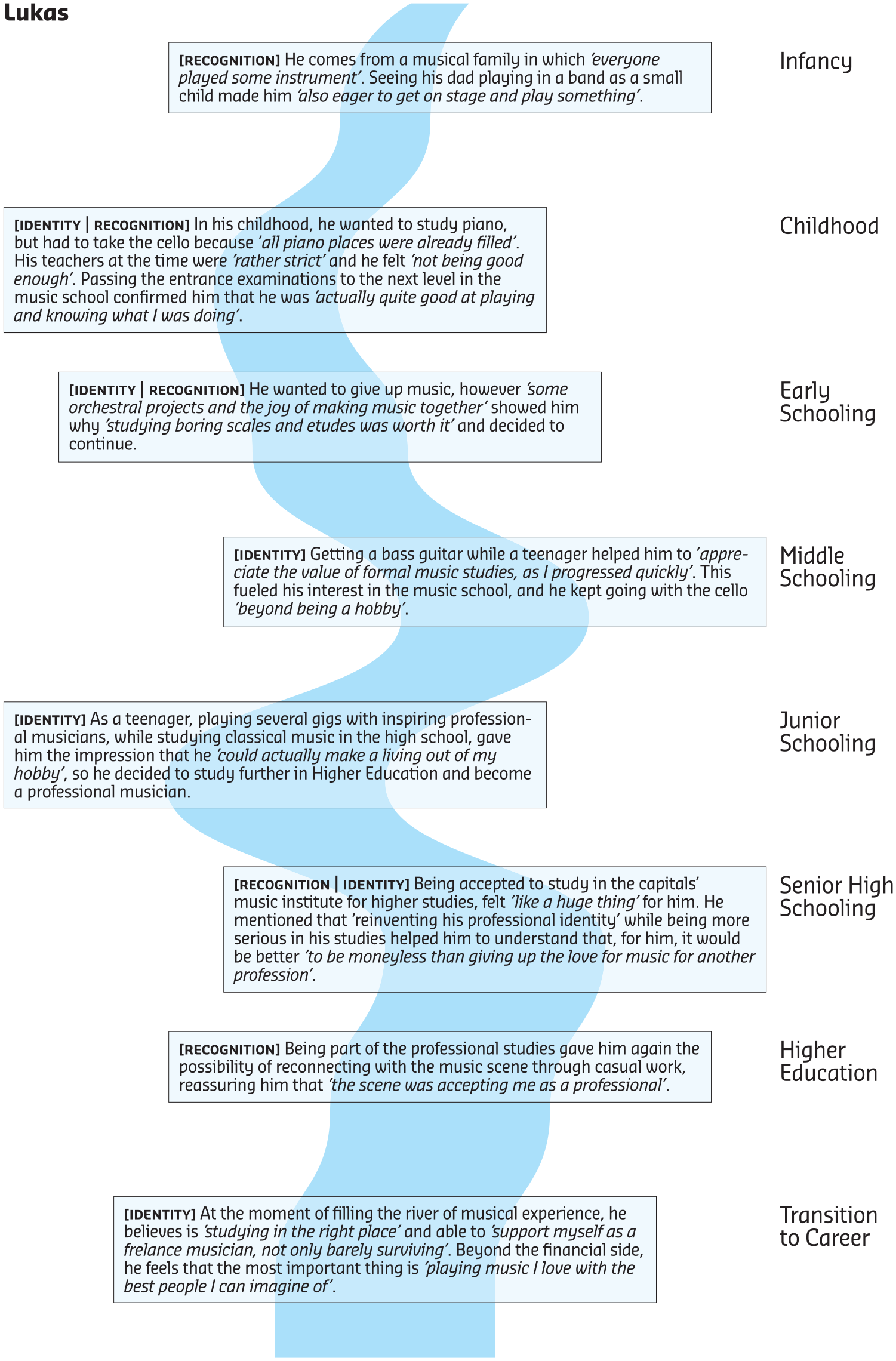
Musical River of Experience by Lukas.
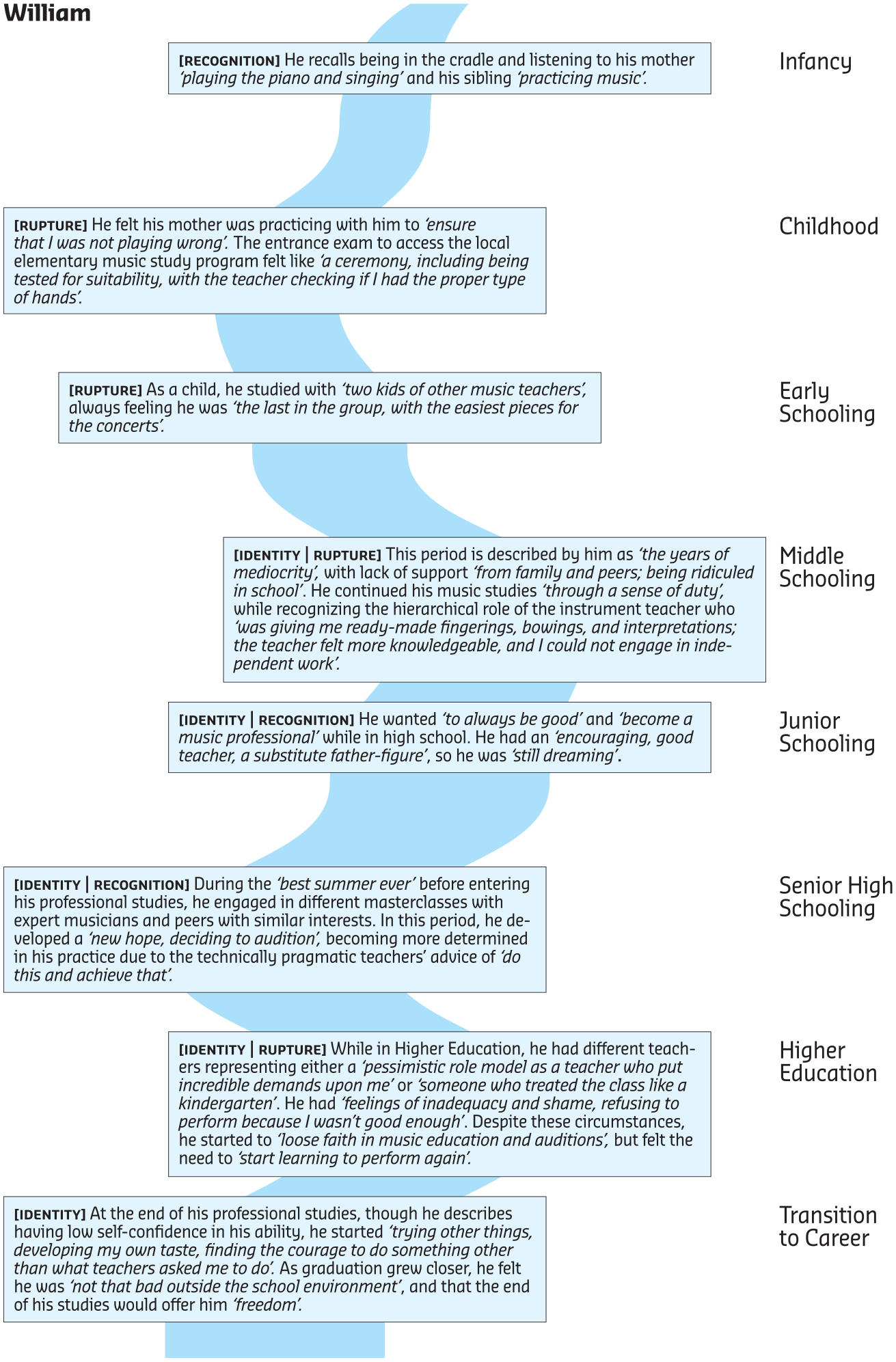
Musical River of Experience by William.
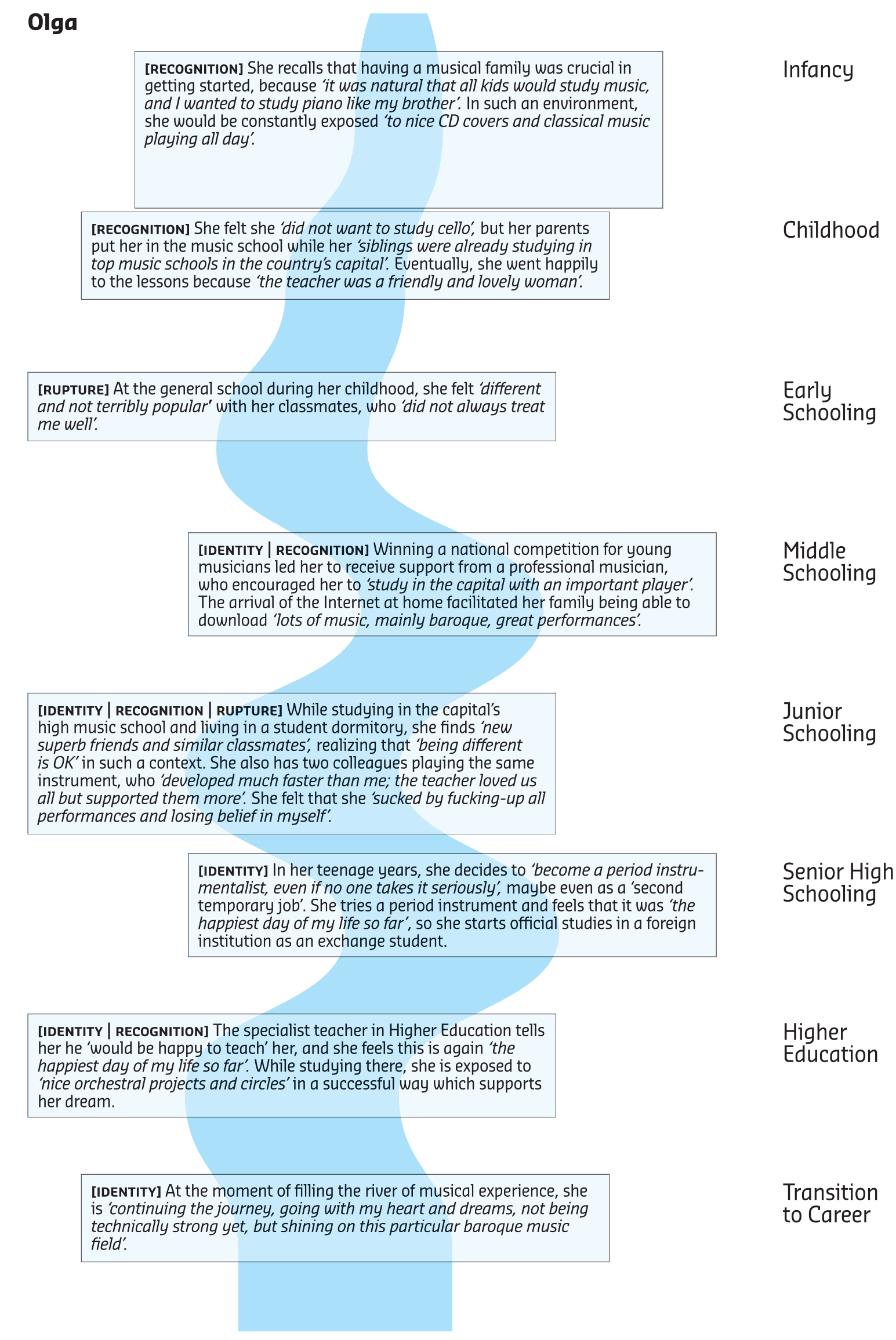
Musical River of Experience by Olga.
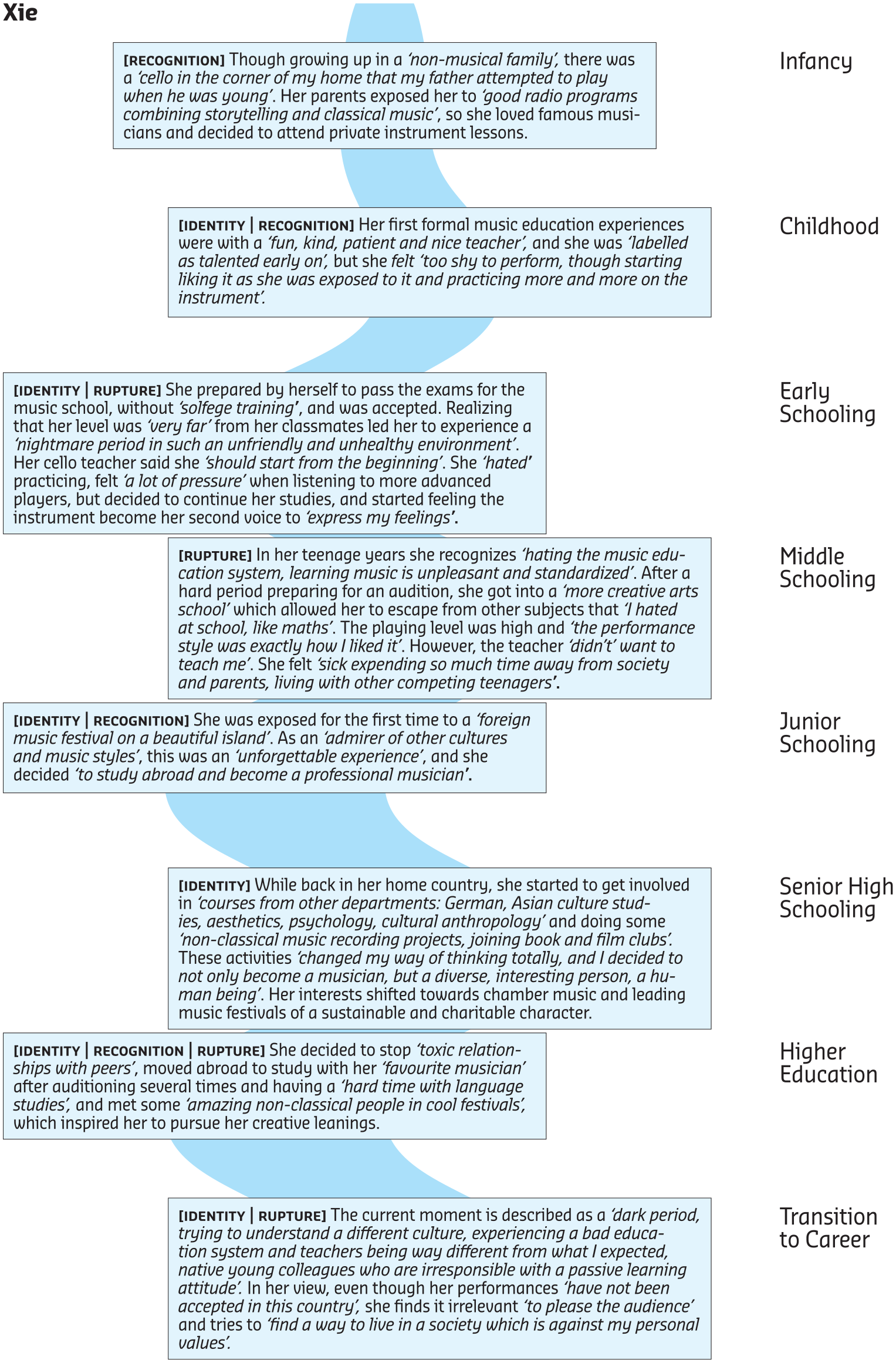
Musical River of Experience by Xie.
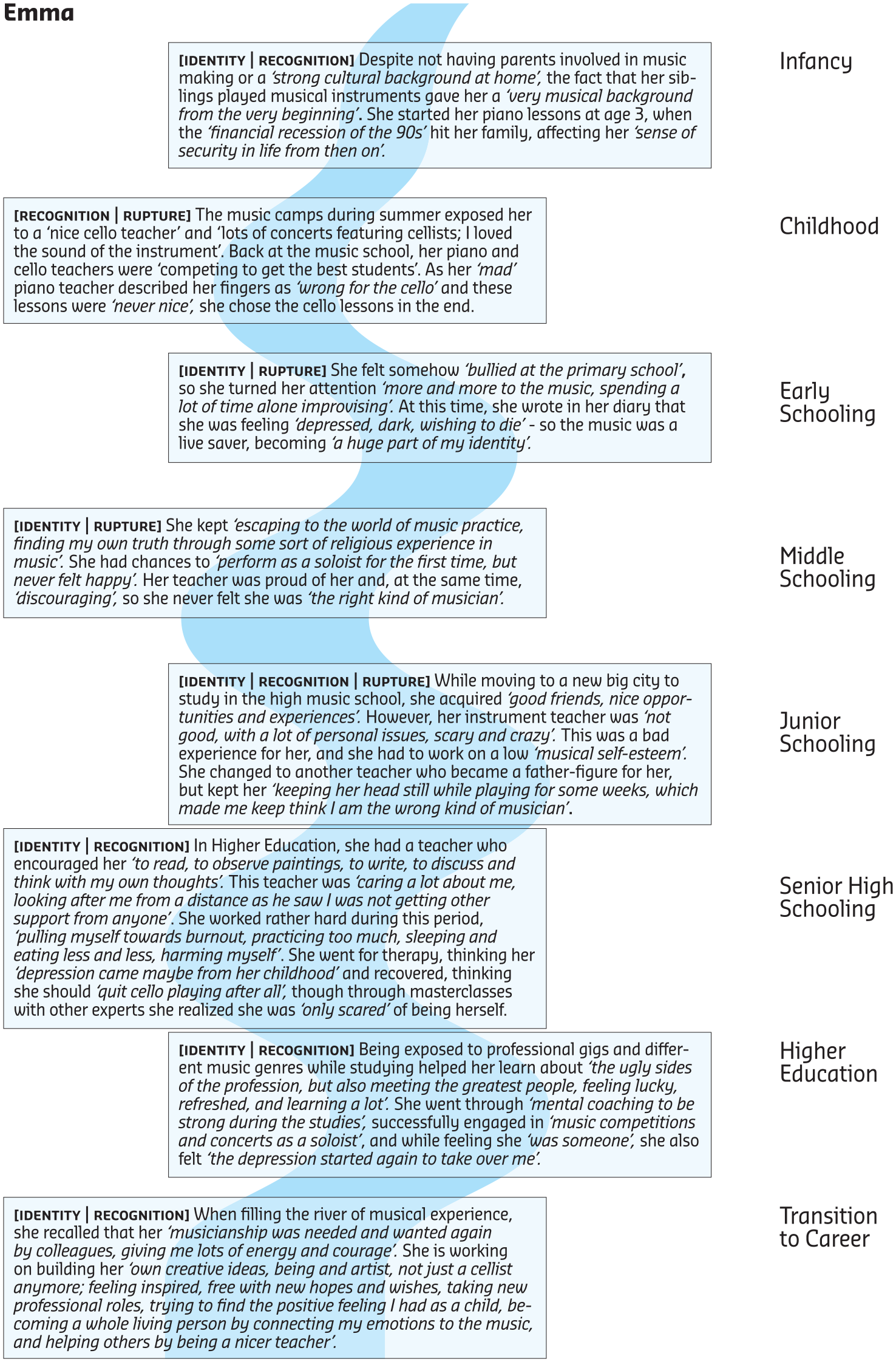
Musical River of Experience by Emma.
This process helped to represent the thematic analysis, which guided the authors’ narrative interpretation of the results in connection to the main critical sociocultural elements identified in participants’ stories (Baker, 2005). For this, we used a triangulation approach to data representation to exemplify those elements influencing trajectories common to the participants’ professional learning experiences, which then guided the second phase of analysis. A collaborative co-coding protocol by both authors included several online sessions to build a shared understanding of categories and subcategories, and after that a cross-coding check of findings and overarching triangulation was performed on the analyzed data.
Findings
What evidence? What matters? What does critical reflection contribute?
The evidence of the participants’ professional learning pathways (past and present phases/in terms of critical incidents) is marked by the mapping of the critical phases and incidents that mark times of change and choosing in the Rivers of Musical Experience, which have been highlighted on the individual rivers (see Figures 1–5). We have aligned our description of critical incidents in terms of different acts of recognition and rupture, and identity-(de-)construction performed by key influential figures—parents, professionals, and peers—below, across eight developmental phases equally identified for all participants in relation to salient times and spaces in their professional learning pathways in music. These time–space matters were identified as follows: (a) infancy, (b) childhood, (c) early schooling, (d) middle schooling, (e) junior schooling, (f) senior high schooling, (g) higher education, and (h) transitioning to career.
To facilitate the description, we will present the findings by comparing the two local male participants first, followed by the two female international participants, and finally the local female participant pursuing a doctorate. Overall, evidence regarding the turning points identified by the participants helped them to engage in critical reflection, contributing to mobilizing change in their professional learning pathways. In the next subsection, we will introduce the participants’ Rivers of Musical Experience, as evidencing a meaning-making trajectory of common developmental phases (times and spaces that featured prominently and mattered to each participant).
Introducing the participants’ Rivers of Musical Experience
Lukas and William, both male and from the same country and socioeconomic background, although of slightly different ages and at different levels of their master’s studies (beginning and end), were both raised by musical families, but their experiences of parental support differed considerably, as William felt lonely and unsupported because his mother was busy trying to raise her family alone while working, whereas Lukas’s parents brought him to lessons and generally supported him. Infancy was a critical phase for both of them in relation to their music engagement. Lukas had his father as a musician role model, and was supported across his studies by both of his parents, even in times when becoming a professional musician seemed doubtful; in contrast, William experienced that he chose music because everyone at home was involved in music making, but felt that his mother was rather controlling, preventing him from feeling joy in his practice and development.
Their relationships to peers in their early school years were also experienced differently. While William felt that the other music students were better than him and that his teacher also made him feel that way, thus preventing him from bonding with other students, Lukas experienced group music making as thrilling. During middle and junior schooling in music contexts, Lukas felt connected to his peers through some experiences with professionals, and felt that nonformal music experiences contributed to appreciating his formal studies. William, on the contrary, centered his discourse on the lack of teacher support, his feelings of not being good enough, and thinking he had a duty to continue his studies. Eventually, a more encouraging teacher kept him engaged in music studies.
In senior high schooling and higher education, Lukas described the impact of professional experiences and being able to earn money from his concert engagements as evidence of his transition into the professional life; he also recognized that accessing the higher music institution mattered, interpreting this as a kind of recognition that he could become a professional. William described his current moment of transitioning into professional life as a learning momentum, as the lack of supportive and inspiring music teachers in higher education was not beneficial enough to his development. He still remains positive, as he has experienced positive moments with some encouraging teachers during his studies, but not as much as he would have desired.
Olga and Xie are both young females coming from two different nations than the previous participants, being international students in the institution and country where the research was carried out. They both had positive experiences in their infancy, as their parents were musically supportive in distinct ways. For Olga, starting music studies was a decision by her parents, and Xie felt she was labeled as “talented” early on, which had an impact on her education. Their relationships to peers during childhood are described in terms of being bullied or having lesser abilities than their musical peers. The experiences during middle and junior schooling for both participants were rather different. Whereas Olga felt recognized as a capable music student and found great new friends with similar interests among her peers, Xie felt desolated due to the lack of support from teachers, peers, or her institution, and suffered from feelings of mediocrity and depression.
Senior and high schooling were also considerably different phases for these participants. For Olga, following her passion and being supported by her teacher and her professional engagements mattered when shifting toward a different music style in her studies—this contributed to feeling that she belonged to the field, and thus she is currently fully committed to having a professional career as a performer in her chosen style. However, after critical reflection, Xie decided to go abroad to change the negative experiences she had suffered across music education in her homeland, finding herself lost in a place where the teachers and peers were not any better and contributed to her systemic racialized negative experiences. The nature of these experiences responds to racialized group’s recognition of “dynamic and complex process by which racial categories are socially produced by dominant groups in ways that entrench social inequalities and marginalisation” (Rights and Wellbeing of Racialised Groups, 2011, p. 2). Therefore, the sociocultural context abroad did not feel supportive of her ideas and background, which evidenced a rather negative transition from university to employment as a dark period where career decisions have to be made.
Emma, a female European student, is the older participant, and more advanced in her university studies, as she is pursuing an artistic doctorate as a performer-researcher. She describes her infancy as a period of economic crisis in the family, which—she recalls—led to feelings of depression that continued in later phases. Emma mentions a connection to music studies through her siblings playing musical instruments, despite not having musical parents or a strong exposure to culture. She connected immediately with the sound of her chosen instrument during her childhood through concerts, a decision supported by a cello teacher at the time she describes as caring and kind.
Music mattered during her early and middle schooling because it was comforting, as otherwise she experienced bullying and depression. Her identity as a musician was confronted because she did not feel happy as a player, and her teacher at the time was not as encouraging as she would have needed. In Junior schooling, she had a better relationship with peers in musical gatherings, but was still exposed to teachers who contributed to increasing her negative feelings. Senior high schooling was characterized by a more supportive teacher who also encouraged Emma to develop herself in other important areas of life. However, her depression continued, and as a result, she overpracticed to physically harm herself. Attending therapy and talking with supportive peers helped her to reflect critically on her life, while contributing to more positive attitudes toward herself as a person and as a musician.
Even though Emma particularly enjoyed her musical experiences during higher education—being exposed to different musical genres, winning competitions, and playing successful concerts—depression was still rather present in her life. What matters now to her when she is graduating from her studies is that while she is working on those aspects of her life, she is engaged in self-discovery processes by developing artistically and academically, and enjoying playing music at a professional level with supportive peers.
The ways in which these musicians narrated the critical incidents that influenced their professional learning pathways involved acts of recognition by key influential people who mattered to the participants; for instance, most of the parents drove changes in them by providing learning opportunities, peers encouraged changes by securing confidence and self-belief in negotiating who these musicians were, and professionals powered changes by sharing formative experiences with them or supporting their studies and growth. Acts of rupture also informed their professional learning pathways, either through teachers dictating meanings and diminishing self-confidence, parents overcontrolling and pressing them to practice and succeed, or peers engaging in bullying or competition. These findings led to a further task engagement in critical reflection through the Dixit Cards 2 activity, which served not only as a triangulation of the people, relationships, and events, but also as a means to ascertain how the participants see themselves and construct their identities. Thus, the next section presents summaries of the data analysis related to the use of Dixit Cards, which resulted from the participants’ detailed narratives and rationales for choosing three cards.
Description of the participants’ critical reflections on professional identity construction in the Dixit Cards activity. How do the participants see themselves?
Lukas (see Figure 6) reflected on his appreciation of the efforts made by his parents during his music studies. He sees himself now as a result of the power of teachers as gatekeepers of knowledge, mentioning the need to become more autonomous and artistically agentic, and keeping a positive mind-set and being surrounded by supportive peers.
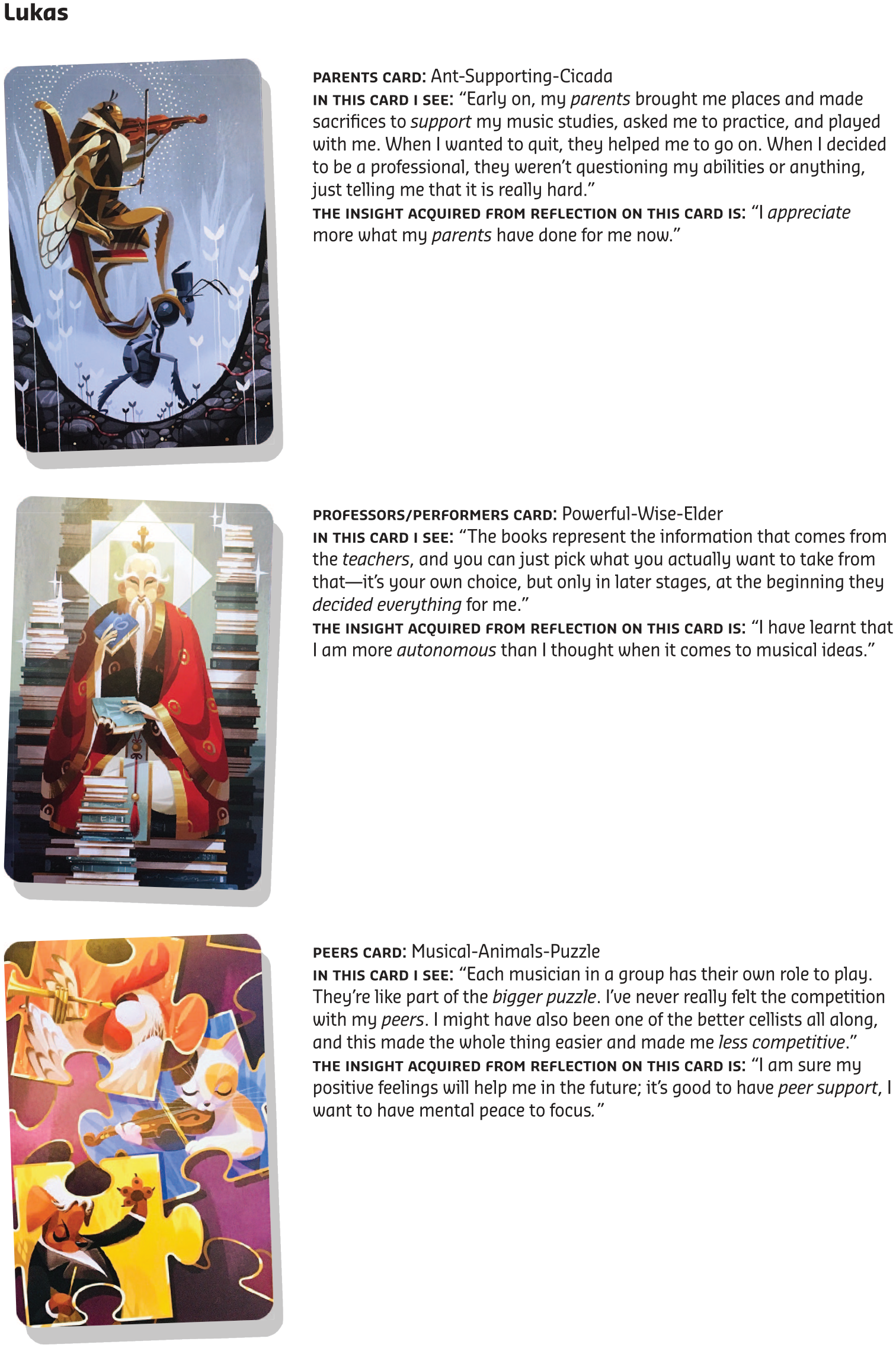
Cards Selected by Lukas for Each Group of Recognition/Rupture, Including Summaries of the Participant’s Narrative.
William (see Figure 7) highlighted his feelings toward his nonsupportive parents as informing his present situation. While William would have liked to be inspired by expert performers and more supportive teachers, he sees his peers and his professional environment as the source of his self-acceptance and self-confidence.
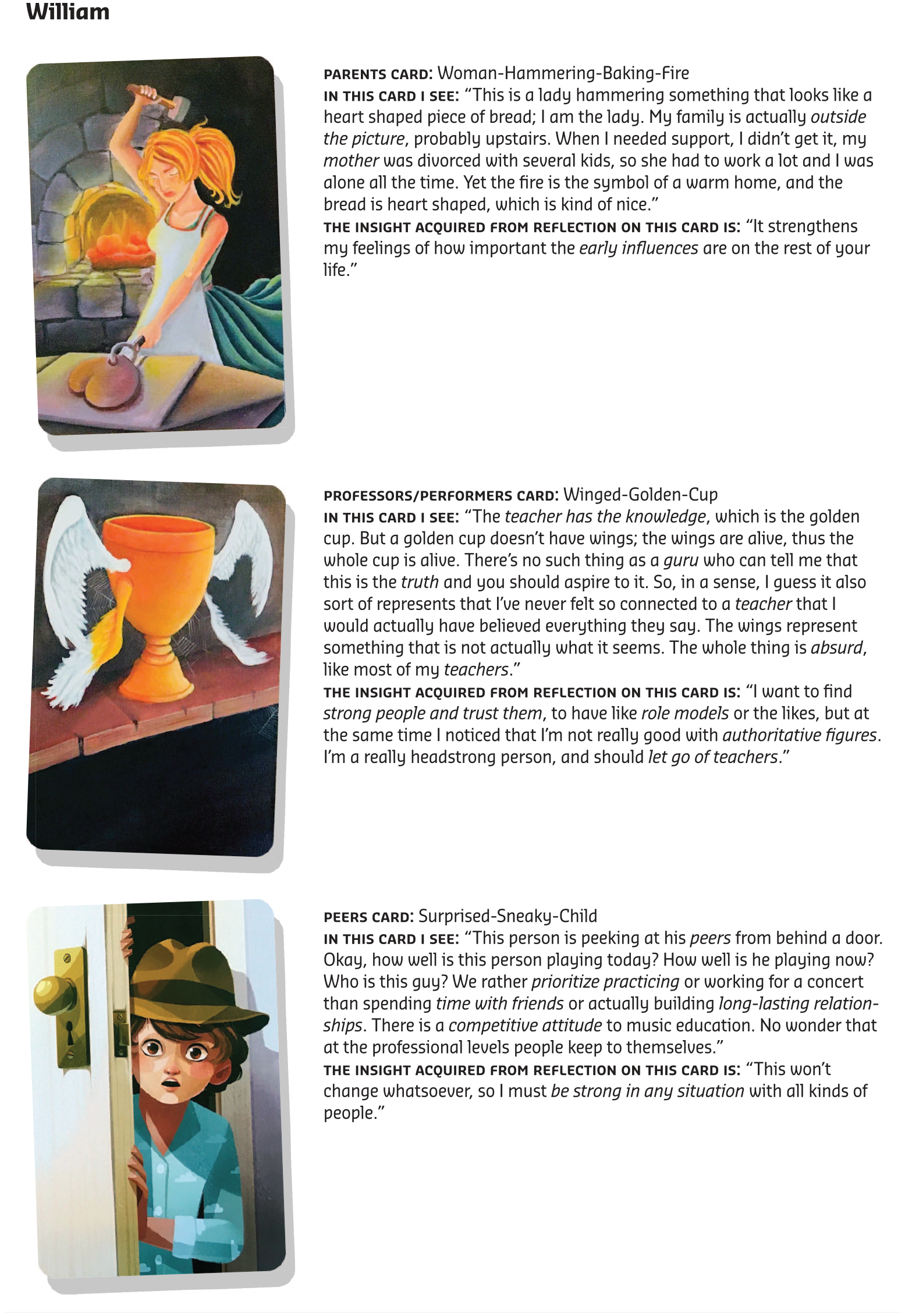
Cards Selected by William for Each Group of Recognition/Rupture, Including Summaries of the Participant’s Narrative.
Olga (see Figure 8) learnt that her parents are still the most supportive agents in her life, and that she had both demanding and supportive teachers. She learnt that artistic agency is important for her, and that her loss of self-confidence and passion was connected not only to teachers but also to her peers during earlier stages of her professional learning pathways.
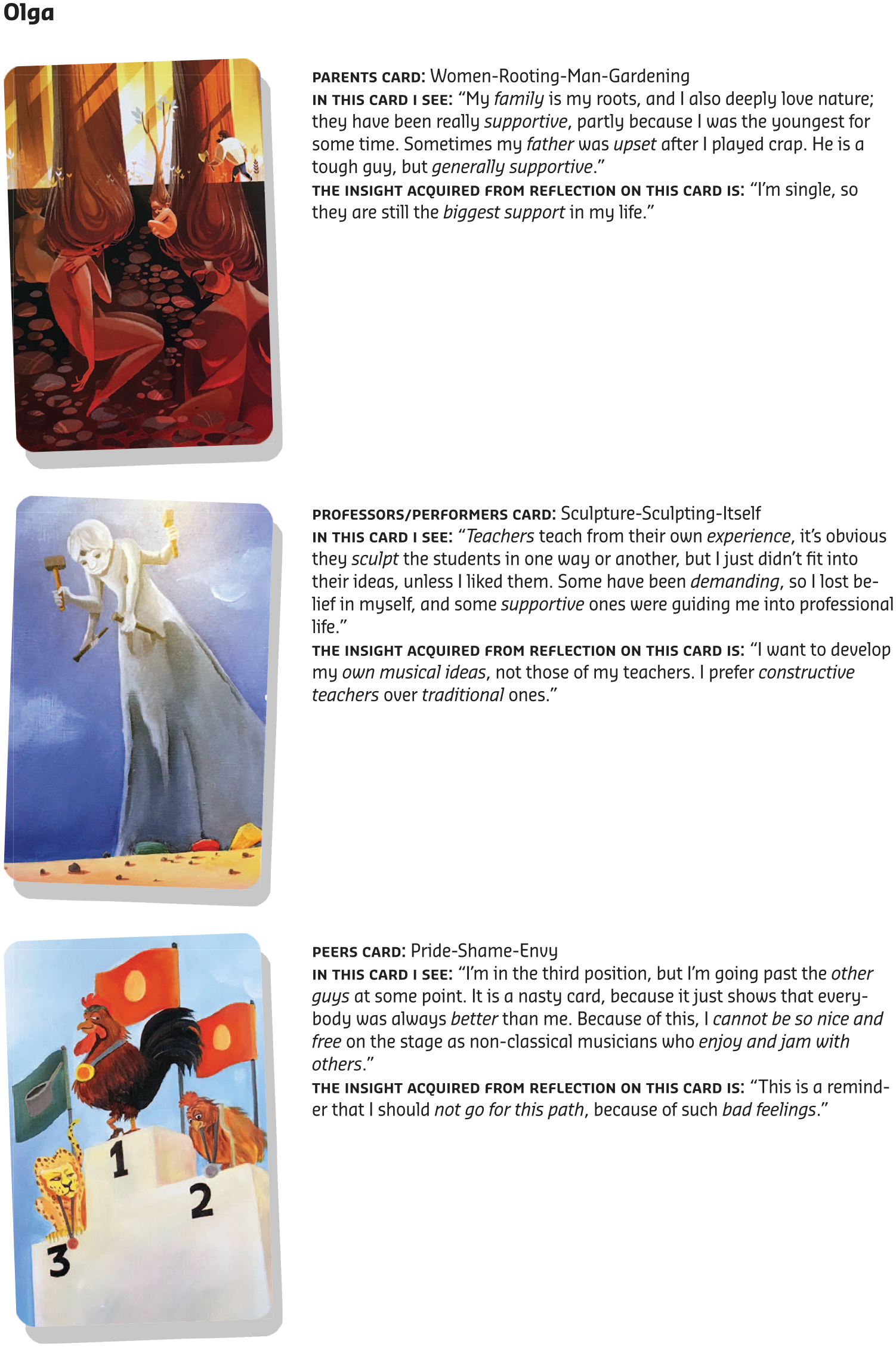
Cards Selected by Olga for Each Group of Recognition/Rupture, Including Summaries of the Participant’s Narrative.
Xie (see Figure 9) spoke about her own adventurous personality and the boundaries her parents might have wanted to place on her during her professional learning pathways. She includes a negative depiction of teachers as dehumanizing their relationship with students by not caring about other aspects of their lives beyond music learning and excellence. She describes a lack of trust in peers’ intentions and interests toward her and others.
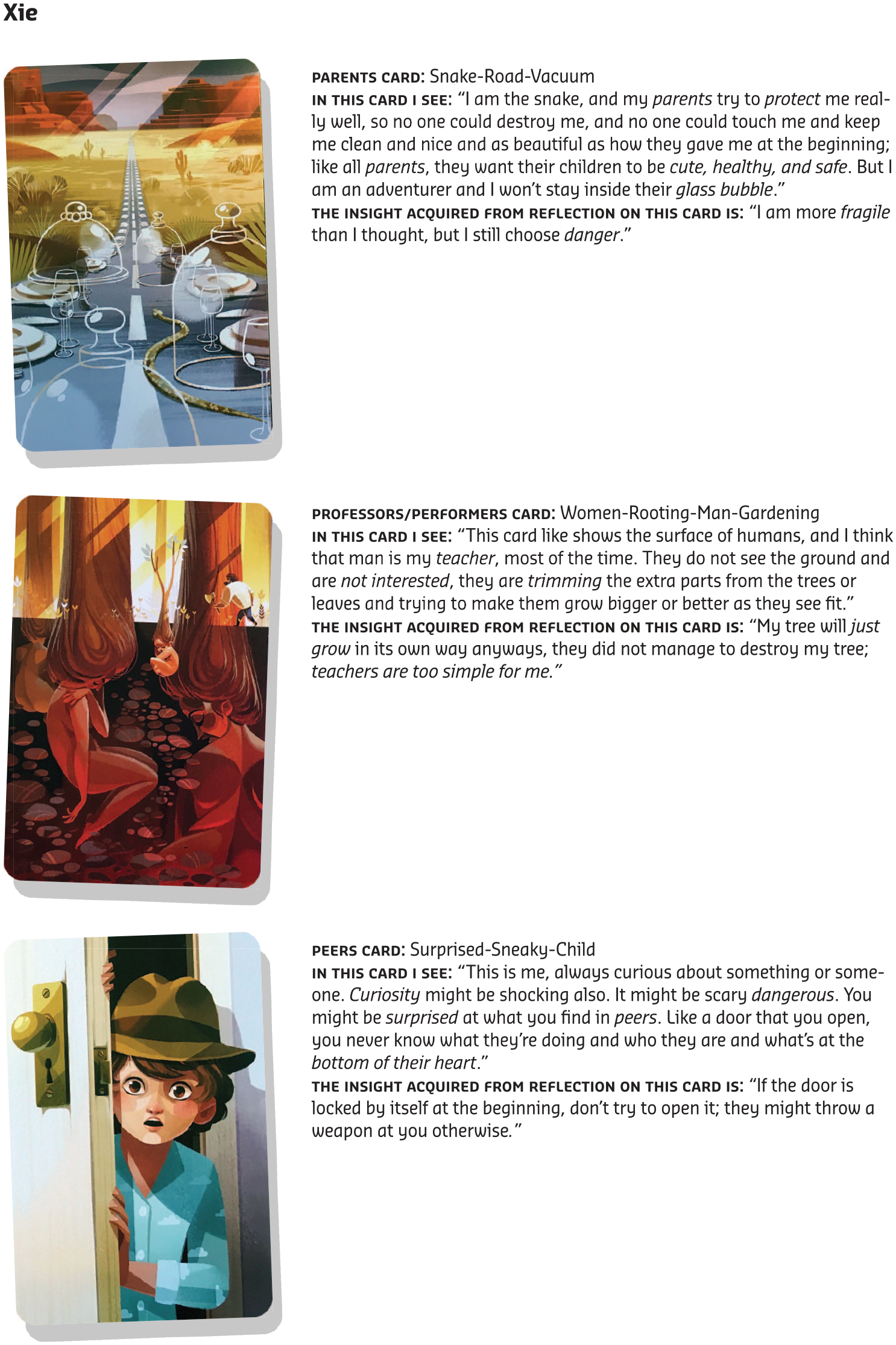
Cards Selected by Xie for Each Group of Recognition/Rupture, Including Summaries of the Participant’s Narrative.
Emma (see Figure 10) reflected on her warm, positive childhood memories that relate to her parents, despite not having the economic resources to fully support her. She explains that some teachers did not let her become the musician she wanted to be, and that she was bullied by her school peers, while having an overall positive relationship with musical peers during her professional learning pathways.
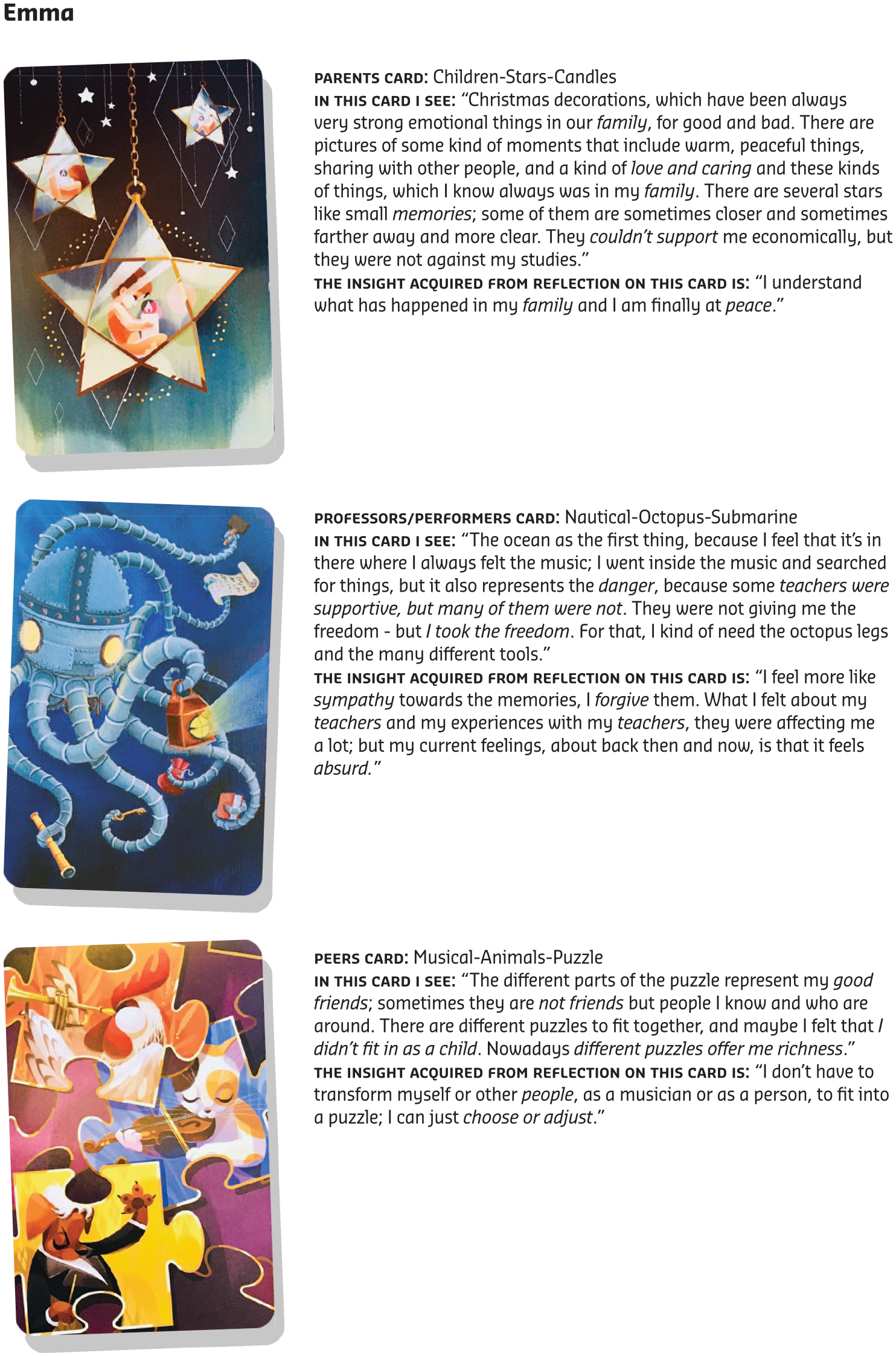
Cards Selected by Emma for Each Group of Recognition/Rupture, Including Summaries of the Participant’s Narrative.
Overall findings: What can we learn about what matters and the value of critical reflection through triangulation processes?
A synthesis of the findings from the Dixit Cards activity in relation to the Rivers of Musical Experience is presented in Figure 11, which shows the shifts in what participants focused on in their critical incident charting (some of which is shared/linked and other times contrasting) and how we are making meaning and moving toward an understanding of the interplay between parents, professionals (teachers/performers), and peers, and the significance of these postgraduate musicians’ shifts in professional learning pathways over time. There is a continuum of “continuity” (related to the acts of recognition and rupture) and “culmination” in professional learning pathways that exemplifies the value of critical reflection to engage postgraduate musicians in these meaning-making trajectories. We observe how opportunities for learning are created, accepted, or rejected by the participants in the real-life dynamic of interaction with key people.
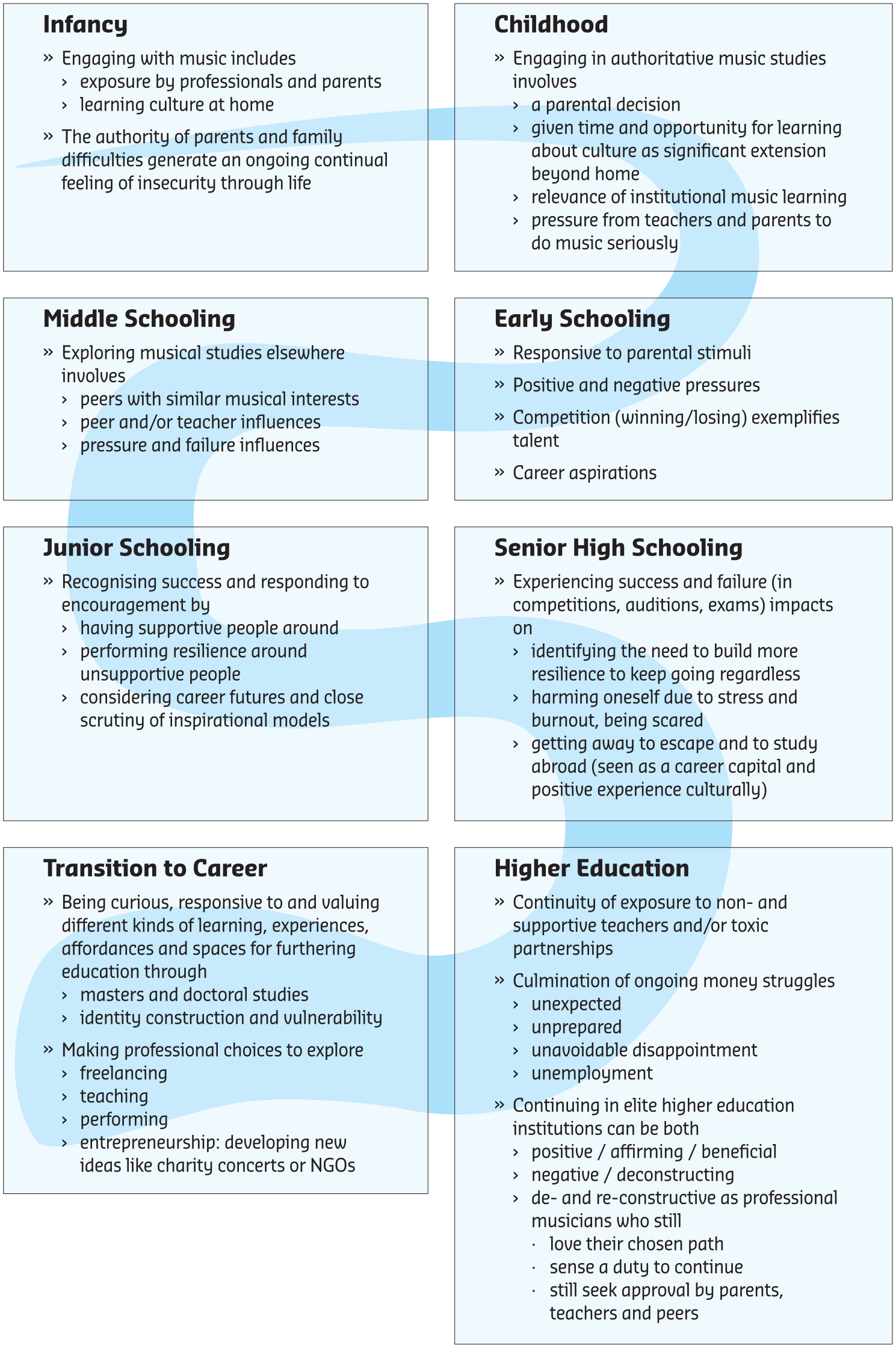
Shifts Between Phases of Education in terms of the People that Influenced the Participants’ Decisions Across Their Professional Learning Pathways.
As can be observed, there is not a clear leitmotif connecting the eight phases across all the participants in relation to the ways in which key people contributed to these participants’ professional learning pathways and identity-construction. Instead, we observe a multiplicity of aspects, including diverse ways of dismantling binaries that tend to be more complex and varied in the first experiences of early musical experiences (Middle and Early Schooling), and then again in later phases of their professional learning pathways (Higher Education and Transition to Career). We also observe how at certain times in the participants’ life, the dynamic interplay between parents, professionals, and peers is recognized as a driving force in/as/through professional learning pathways.
Discussion and conclusions: What (really) matters?
Responding to our first research question on the use of the Rivers of Musical Experience to access the perceptions of the participants regarding their professional learning pathways, our study found a salience of certain phases of development across all participants, regardless of their backgrounds and personal characteristics, which are intrinsically connected to formal education levels, the phases prior to entering education in infancy, and after graduating when transitioning into a career.
The use of the Rivers of Musical Experience, as well as the Dixit Cards—by their very nature as vivid tools—helped the participants in describing in a rather vivid manner that there are recognition and rupture moments that heavily informed their professional learning pathways and identity formation across the eight identified phases. The participants returned to crystallizing experiences of their professional learning pathways that connected to their choices within music learning (Cameron et al., 1995) in relation to three main societal groups: parents, professionals, and peers—all equally emphasized by these musicians. These influential societal agents were described as central to their professional learning pathways and identity construction.
As the participants acknowledged through the insights acquired from reflection on the Dixit Cards task and their testimonies in the last two phases of their professional learning pathways (higher education and transition to career), the eight phases and three main societal groups identified made the participants understand that to become lifelong learners in music, there is more to the profession than the aspects that they had studied previously, if they desire to function effectively and creatively as a musician—such as acquiring knowledge, attitudes, values, and artistic skills (e.g., Smilde, 2008).
As discussed here, the participants made decisions across their professional learning pathways according to both (a) the influences that the three groups of social agents had on their lives and (b) the learning phase they were going through informal education. In that respect, we conclude that higher music education (and other music education at lower levels of instruction) should be aware that decision making in music students is to a great extent related to the institution (where many professionals and peers surrounding students are affiliated) and level of instruction. We agree that despite the fact that some of the participants’ discourses in this study point out positive experiences across the education system, we still found plenty of unsettling struggles linked to such phases across the participants—some of which continue to be present in their lives (in line with Beech et al., 2016), and include issues related to racialized privilege in the case of our Asian female participant (Martin et al., 2019).
These results with classical musicians within the higher education level expand those from earlier studies that either focused on the role of critical reflection in student musicians’ metacognitive practice development (Esslin-Peard et al., 2016) or linked a multiplicity of social aspects to the construction of professional identities, and which have considered indie musicians at work (Beech et al., 2016), professional musicians working voluntarily in health settings (Preti & Welch, 2013), the diverse identities of preservice music teachers (Draves, 2014), or the transition of pianists from study to working life (Juuti & Littleton, 2012). First of all, we tackle professional identity by understanding it as a process concept that is linked to the entire learning pathway of each participant, and not to a particular present moment. Second, we do not aim to exclusively access the identity of these participants, but to provoke reflection among them and empower them to better inform their future-making decisions. Finally, we understand that, regardless of the diverse pathways of musicians, professionalism in a lifelong discipline such as music performance is dependent on identifying oneself as a learner, and that in turn requires critically engaging with the incidents that have shaped our lives (Falsafi & Coll, 2015), which may ultimately lead to self-discovery processes such as those highlighted in our participants’ discourses.
Furthermore, our study shows that authentic learning activities in higher education influence occupational identity development, as in the case of these musicians, who were studying to achieve professionalism. In this article, we have also extended the concept of “learning pathways” (as introduced by Després et al., 2016). This distinctive contribution highlights the significance of the dynamic interplay of relationships played by parents, professionals, and peers as key stakeholders in the negotiation and aspiration of careers in music. Given the temporality or time frame covered, we crucially illustrate how apparent shifts away from a career in music can be characterized from the acts of recognition and rupture that subsequently turn into opportunities; the significance here is for the creation of continuity and cumulative learning pathways.
Overall, this research intervention, when viewed as a critical individual-group reflective process, was cathartic for the participants as they had never had the opportunity to critically (and profoundly) reflect on their professional learning pathways and further analyze how that had informed their career and education choices. The intervention also highlighted how these students’ basic psychological needs (i.e., Deci & Ryan, 2000)—autonomy as learners; competence as proficient musicians; and relatedness to parents, professionals, and peers—were often compromised, which can lead music students to stop their studies (e.g., Evans et al., 2012). For instance, the participants’ discourse included paralyzing experiences that occurred when they were exposed to people who inhibited their learning or negatively affected their confidence, motivation, and emotion, particularly in relation to how others saw them as capable learners and professionals (in line with the acts of recognition established by Falsafi & Coll, 2015, within the learner identity theory).
These graduate musicians’ accounts of critical incidents and reflection evidenced turning points along different professional learning pathways that often shared points of self-discovery as musicians and learners, and which lead to meaningful destinations. Here, again, the roles of recognition and rupture lead to meaningful destinations. These results expand on those focused at the university level in other educational fields, where there is a clear connection between the learner identity of graduate students as informed by these acts of recognition/rupture and the professional learning pathways that lead to meaningful destinations (Valdés et al., 2016; Yair, 2009) such as effective transitioning from creative higher education into creative professions. Understanding the nuances of professional learning pathways suggests that they are neither linear nor nonlinear, but rather navigated as “squiggly” bends of a river with currents and turbulences created by critical incidents that catalyze and create unexpected, potentially meaningful destinations radically shifting away from linear pathways to choreographic moves involving a variety of acts of recognition and rupture.
The participants attributed meaning to learning experiences and described their momentum of personal growth and understanding as learners in the complex music industry by pinpointing toward the following acts of recognition/rupture: (a) appreciating supportive figures and understanding societal impact; (b) becoming autonomous and courageous; (c) owning their feelings; (d) developing artistic agency and focusing on developing musical ideas; (e) letting go of transmissive and negative teachers, preferring constructivist ones; (f) keeping a positive attitude toward life and the profession; (g) building resilience and avoiding negative situations and people for self-protection; and (h) knowing themselves better and embracing their strong personal characteristics.
These results from employing visual-based tools in the elicitation of the participants’ learner identity have implications for research, educational policy, and pedagogical development in higher music education. It signals that the students’ perspectives on their professional learning pathways, their ideas about learning and about the music profession and the sociocultural world around them, as well as the critical phases they identified as crucial in their pathways require greater collaboration between higher music education institutions, parents, professors, performers, peers, policy makers, and the students themselves—all agents who belong to the learner identity model proposed by Coll and Falsafi (2010).
The use of the visual-based tools in this study proved useful when searching for answers to the research questions concerning the critical events, people, and places that participants identified as salient to their professional learning pathways. Furthermore, the methodological combination of constructivist techniques such as the Rivers of Musical Experience and the Dixit Cards were helpful in triangulating our understanding of the participants’ discourse in relation to the dramatic differences that took place over time for all participants. Participants willingly raised private issues and concerns as part of their critical turns in professional learning pathways, sharing deeply, sensitive and distressing experiences that would be impertinent to raise in a traditional interview, or difficult to ascertain in open-ended questions or individual interviews. For instance, navigating manifestations of discrimination and expressing the negative impact of the power hierarchies typical of the master–apprentice tradition in classical musicians’ education (e.g., Gaunt et al., 2021) are topics that some postgraduate musicians might find challenging to acknowledge while engaged as a student in an institution.
Both tools were combined in the same study for the first time and were also used for the first time in ascertaining the specific population of higher music education students through their learning histories. This, in itself, not only expands on other studies that have made use of the Rivers of Musical Experience in different populations within the arts (Burnard, 2012), but also represents a new paradigm and a relevant contribution to the field of professional musicians’ education and learner identity formation. For instance, our research considerably expands recent work on reflective practices in arts education (i.e., what it means to be an expert professional practitioner in the field), as well as on creative thinking from the perspectives of sociology and philosophy of music education (e.g., Burnard, 2006; Burnard & Stahl, 2021; Westerlund & Gaunt, 2021). This previous work acknowledges the need of providing professional artists with relevant education (crafts and skills) while nurturing their roles as game changers in our challenging societies. However, in this study—by employing frameworks from the learning sciences and applying reflective interventions with classical musicians—we have also attended to the importance of linking the professional learning pathways of musicians to the acts of recognition/rupture of the stakeholders that surround them. Without this kind of critical work—that we argue should be enacted in an integrated curriculum—it becomes challenging to truly empower professional musicians as social activists while improving their experiences across the career lifespan. Furthermore, our study expands previous research on learner identities in higher education settings by including postgraduate musicians—a population whose relationships with parents, professionals, and peers is more complex and nuanced (and often longer lasting) than found in other educational settings (e.g., Yair, 2009).
Turning to the implications for future research, we suggest that it would be important to study what the benefits of similar visual-based research tools would be when applied in larger pedagogic settings. In any case, university-level music teachers should feel encouraged to use these tools with their students as powerful pedagogical resources within their instructional practices; this will help them to (a) know their students (and their professional learning pathways) better, (b) better connect with them and their desires and needs, and (c) support them in their struggles and learning/career decisions. Furthermore, music students deeply value the learning and relationships that they encounter on their path to becoming music professionals, and thus educational settings should equip everyone involved in higher music institutions to navigate such relationships in supportive and scaffolded ways. In that regard, interventions such as the one proposed here should have a place in the music curricula for professional studies.
The study presents certain limitations. This type of design does not allow for empirically valid generalizations, as it only directly concerns the participants involved in the study. In addition, the study has a highly subjective nature and, therefore, cannot provide a respondent validation of the groups of people who performed acts of recognition and rupture as—to maintain the anonymity of the participants—we have not accessed the participants’ parents, teachers, peers, or performers with whom they might have been involved. However, the findings can resonate with the direct experiences of readers. Thus, to end our piece, we would like to invite the readers of this study to reflect critically on their own crucial incidents, to understand how their life experiences reflect archetypes or cultural patterns that help situate their own professional learning pathways and reflections on theory, and to analyze which stories from this study create personal meaning(s) for them.
To make sense of an uncertain future, the analysis of critical incidents and turning points—that is critical reflective practice—is an imperative. Reflection tools that help understanding oneself and one’s professional values, by demarcating power in decision making, as either defensive or offensive strategies with other professionals with others include
Reflective practices that help (re-)define professional students’ identity (i.e., who they are in relation to others enhanced by reflecting on how values-driven practices might be reconfigured in relation to other professionals);
Cocreating innovative and diverse tools for reflection on practice and learning from practice in response to change is a new skill to be learnt by practitioners in (higher) music education;
Critically reflecting in ways that perform reflexivity as an agent for change;
Reflective practices as ongoing embodiment of professional practice—in which we enter and engage with, facilitate and handle challenges, and build extended professionalism—and future making.
Footnotes
Declaration of conflicting interests
The author(s) declared no potential conflicts of interest with respect to the research, authorship, and/or publication of this article.
Funding
The author(s) disclosed receipt of the following financial support for the research, authorship, and/or publication of this article: This work was funded by the Academy of Finland under Grant 315378 and supported by the Center for Educational Research and Academic Development in the Arts (CERADA) at the University of the Arts Helsinki.
